China Warehouse Robotics Market, By Type (Automated Guided Vehicles [AGVs], Autonomous Mobile Robots [AMRs], Others), By Offering (Hardware, Software [WMS, WES, WCS], Services), By Payload Capacity (≤100 KG, 101–200 KG, 201–500 KG, 501–1000 KG, 1001–2000 KG, 2001–5000 KG, More than 5000 KG), By Application (Palletizing and Depalletizing, Sorting and Packaging, Picking and Placing, Transportation), By End User (E-commerce, Automotive & Others) – Analysis & Forecast, 2025–2035
Industry: ICT & Media | Latest Edition: October 1, 2026 | No of Pages: 227 | No. of Tables: 108 | No. of Figures: 98 | Format: PDF | Report Code: IC3141
China Warehouse Robotics Market Size & Forecast
|
Parameters |
Details |
|
Market Size (2025) |
USD 2.58 Billion |
|
Market Size (2026) |
USD 4.01 Billion |
|
Market Size (2035) |
USD 21.86 Billion |
|
Revenue CAGR (2026–2035) |
20.74% |
|
Volume (2025) |
167 Thousand Units |
|
Volume (2026) |
264 Thousand Units |
|
Volume (2035) |
1,544 Thousand Units |
|
Volume CAGR (2026–2035) |
21.68% |
|
Historical/Base Year |
2025 |
|
Estimate Year |
2026 |
|
Forecast Period |
2026–2035 |
Industry Outlook
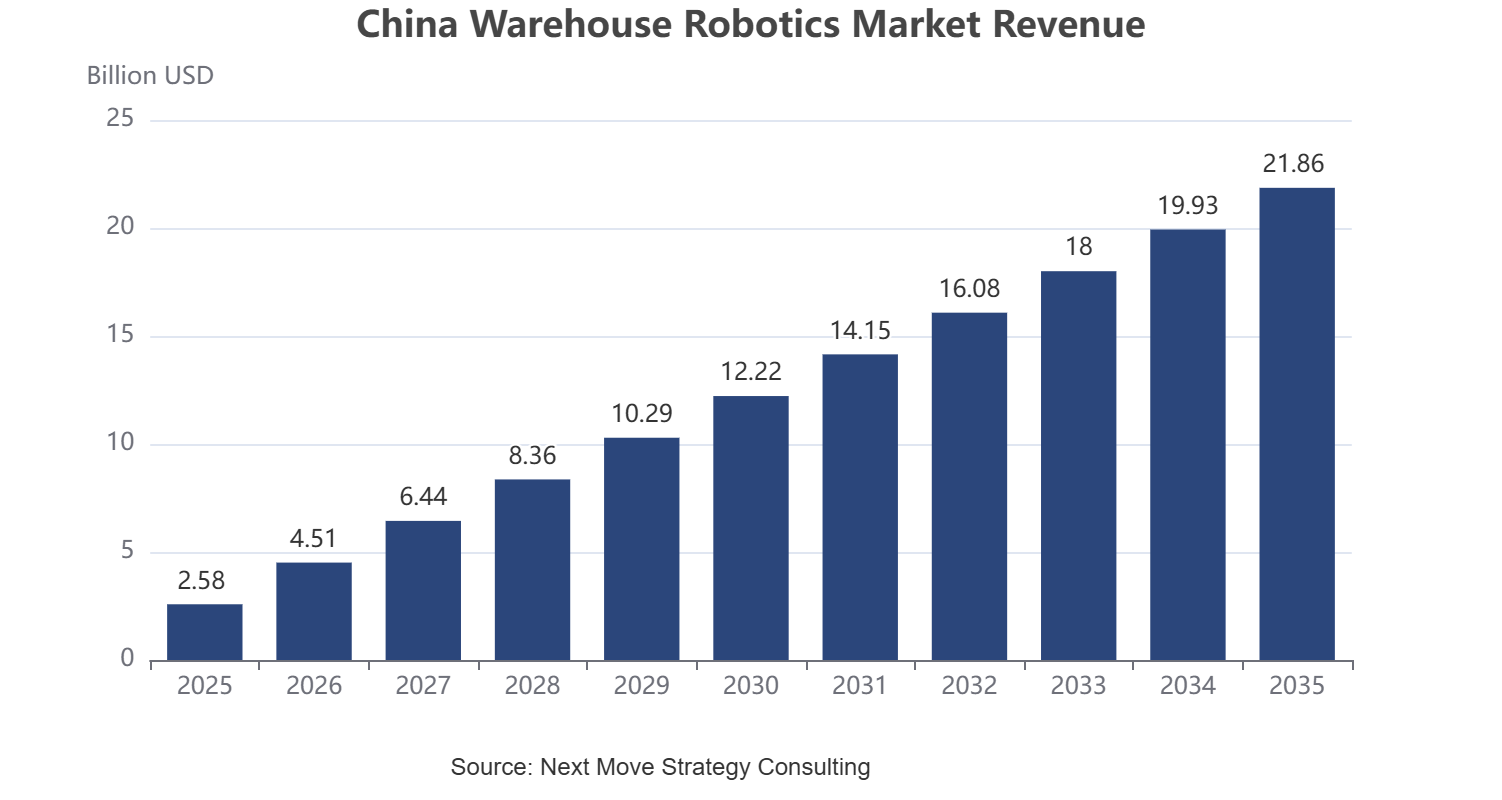
The China Warehouse Robotics Market was valued at USD 2.58 billion in 2025 and is estimated to reach USD 4.01 billion in 2026. The market is projected to witness substantial growth, reaching USD 21.86 billion by 2035, registering a CAGR of 20.74% during the forecast period from 2026 to 2035. In terms of volume, the market recorded 167 thousand units in 2025 and is expected to increase to 264 thousand units in 2026, before reaching 1,544 thousand units by 2035, reflecting a CAGR of 21.68% over the forecast period..
What Are the Key Growth Catalysts and Risks Defining the China Warehouse Robotics Market Outlook?
|
Drivers / Trends / Restraints |
(+/–) % Impact on CAGR Forecast |
Geographic Relevance |
Impact Timeline |
|
World-scale e-commerce growth accelerates warehouse automation demand. |
+2.2% |
China |
Short to medium term (1–5 years) |
|
Made in China 2025 and national robotics policies drive automation investments. |
+2.0% |
China |
Medium to long term (3–8 years) |
|
Strong domestic robotics manufacturing ecosystem lowers costs and speeds innovation. |
+1.8% |
China |
Medium to long term (3–8 years) |
|
Cybersecurity and data sovereignty regulations increase deployment complexity. |
–1.1% |
China |
Short to medium term (1–5 years) |
|
Expansion of cold-chain and pharmaceutical automation creates new growth opportunities. |
+1.3% |
China |
Long term (4–10 years) |
The China Warehouse Robotics Market operates within a uniquely powerful macro environment shaped by world-leading e-commerce volumes, state-backed industrial policy, and a maturing domestic robotics manufacturing base that is rapidly closing the technology gap with global incumbents. At the same time, regulatory headwinds around data governance and export controls introduce complexity for multinational vendors. A thorough understanding of these drivers, restraints, and emerging opportunities is essential for companies seeking to navigate and capitalise on China's extraordinary warehouse automation growth trajectory through 2035.
Growth Drivers:
How Is China's World-Scale E-Commerce Ecosystem Fuelling Unprecedented Warehouse Robotics Demand?
China is home to the world's largest e-commerce market, with platforms processing billions of orders annually and consumers expecting same-day or next-day delivery as standard. This volume imperative places extraordinary pressure on fulfilment centre operators to deploy robotics at scale, replacing human-intensive picking, sorting, and packing operations with autonomous systems capable of continuous, high-accuracy throughput. The sheer density of Chinese online retail activity makes warehouse robotics a business-critical infrastructure investment rather than an operational enhancement, directly driving market expansion at a pace unmatched globally.
How Are China's Made in China 2025 and National Robotics Policies Accelerating Market Growth?
China's Made in China 2025 initiative and successive Five-Year Plans designate intelligent robotics as a strategic national priority, directing substantial state subsidies, R&D grants, and preferential financing toward domestic robot manufacturers and end-user adopters. Government procurement targets, industrial parks dedicated to robotics innovation, and mandated automation thresholds in key sectors create a structural demand pull that sustains market expansion independent of short-term economic cycles. These policy instruments simultaneously lower adoption costs for businesses and accelerate the commercial maturation of indigenous robotic platforms.
Why Does China's Advanced Domestic Robotics Supply Chain Represent a Structural Competitive Advantage?
China has developed one of the world's most comprehensive robotics manufacturing ecosystems, encompassing precision motors, servo drives, vision systems, LiDAR sensors, and software platforms produced domestically at competitive cost points. This vertical integration enables Chinese warehouse robotics vendors to iterate product designs rapidly, offer aggressive pricing, and provide localised after-sales support that international competitors struggle to match. The resulting cost advantages and shortened delivery lead times make high-capability robotic systems accessible to a far broader range of warehouse operators, including cost-sensitive SMEs and third-party logistics providers.
Growth Inhibitor:
How Do Cybersecurity and Data Sovereignty Regulations Constrain Foreign Vendors in China's Warehouse Robotics Market?
China's Data Security Law, Personal Information Protection Law, and expanding cross-border data transfer restrictions impose significant compliance obligations on multinational warehouse robotics vendors whose cloud-based fleet management and analytics platforms process sensitive supply chain data. Foreign operators must navigate complex data localisation requirements, security assessments, and licensing regimes that add cost, delay deployment timelines, and may limit the functionality of globally standardised software platforms. These regulatory conditions favour domestic vendors with compliant architectures, creating structural headwinds for international market participants seeking large-scale entry or expansion.
Growth Opportunity:
What Growth Opportunities Does Cold Chain and Pharmaceutical Warehouse Automation Present in China?
China's rapidly expanding pharmaceutical distribution network, post-pandemic cold chain infrastructure investment, and tightening Good Manufacturing Practice (GMP) compliance requirements are generating substantial demand for specialised warehouse robotics capable of operating in temperature-controlled, sterile, or hazardous environments. Robotic systems designed for cold chain logistics including low-temperature AMRs, automated pallet handling in freezer warehouses, and GMP-compliant articulated robots command significant price premiums and represent a high-margin growth frontier. Vendors developing solutions tailored to these regulated, technically demanding segments are positioned to capture disproportionate value within the broader China warehouse robotics opportunity.
Supply Chain Structure Of The China Warehouse Robotics Market
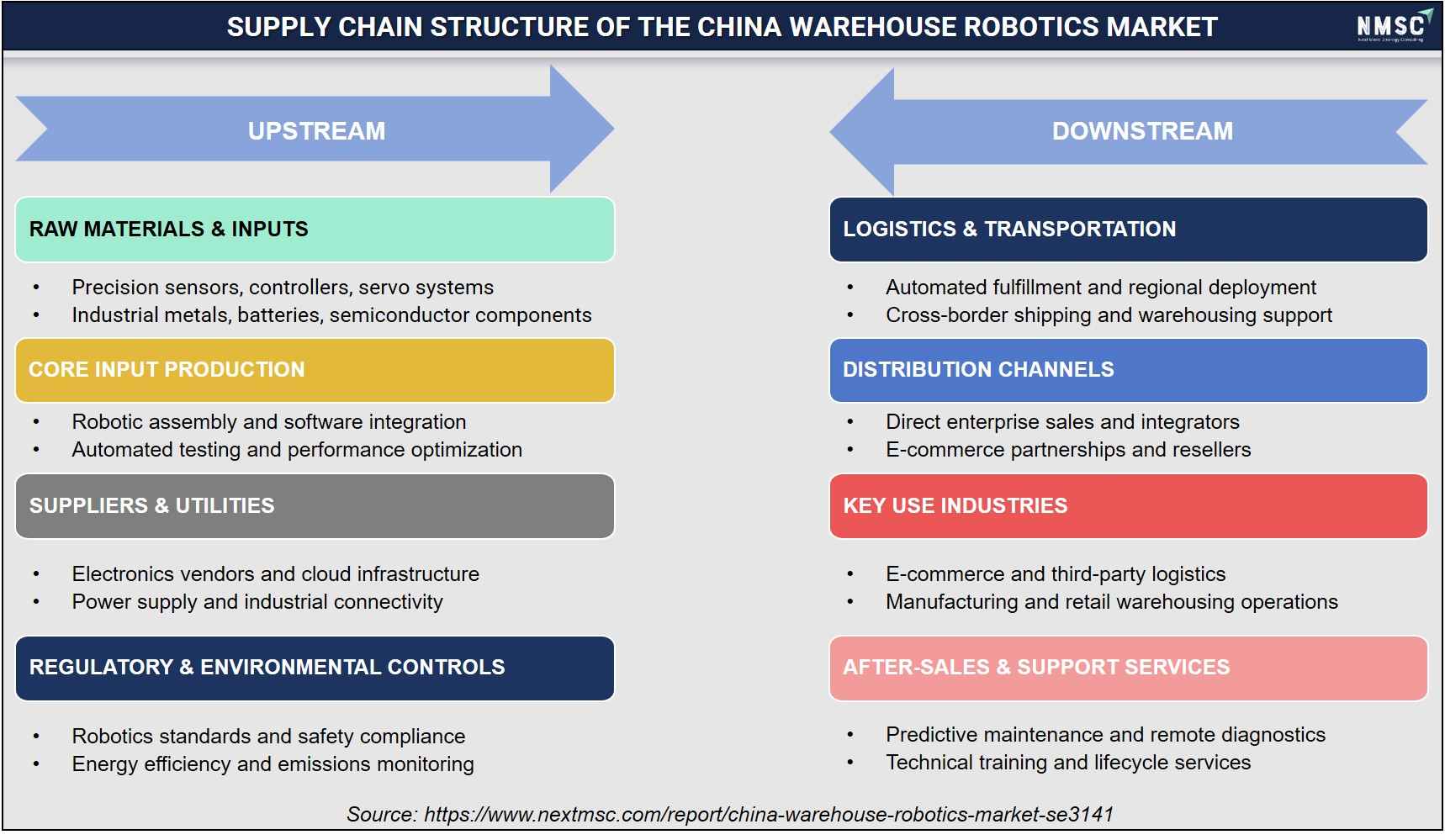
The supply chain structure of the China Warehouse Robotics Market spans the entire value chain from component sourcing to after-sales support. Upstream activities include the production of precision sensors, controllers, servo systems, semiconductor components, robotic assembly, software integration, and performance optimization, supported by strong electronics and industrial infrastructure. Downstream operations involve logistics, distribution through enterprise sales and system integrators, deployment across e-commerce, manufacturing, and third-party logistics sectors, followed by predictive maintenance, remote diagnostics, technical training, and lifecycle support to maximize operational efficiency and system performance.
How Is the China Warehouse Robotics Market Segmented by Robot Type, and What Are the Key Insights from the Analysis?
By Type Insights
Is Type Segmentation Influencing Automation Adoption Across the China Warehouse Robotics Market?
Based on type, the market is segmented into Automated Guided Vehicles (AGVs), Autonomous Mobile Robots (AMRs), Articulated Robots, Collaborative Robots (Cobots), SCARA Robots and Cylindrical Robots, and Others.
Based on our analysis, we observed that warehouse robotics adoption across China is primarily driven by the rapid expansion of e-commerce fulfilment, large-scale logistics operations, and advancements in intelligent automation technologies. Autonomous Mobile Robots (AMRs) are witnessing the fastest adoption due to their advanced navigation capabilities, operational flexibility, and suitability for high-throughput warehouse environments. Meanwhile, Automated Guided Vehicles (AGVs) continue to play a critical role in repetitive material handling and transportation tasks. In addition, articulated robots, cobots, and SCARA robots are increasingly deployed for palletizing, picking, sorting, and packaging operations. Furthermore, continuous advancements in artificial intelligence, machine vision, and autonomous navigation technologies, supported by strong domestic robotics manufacturing capabilities, are accelerating the deployment of specialized robotic systems across modern warehouse facilities in China.
By Application Insights
Is Application Segmentation Driving Warehouse Automation Growth Across the China Warehouse Robotics Market?
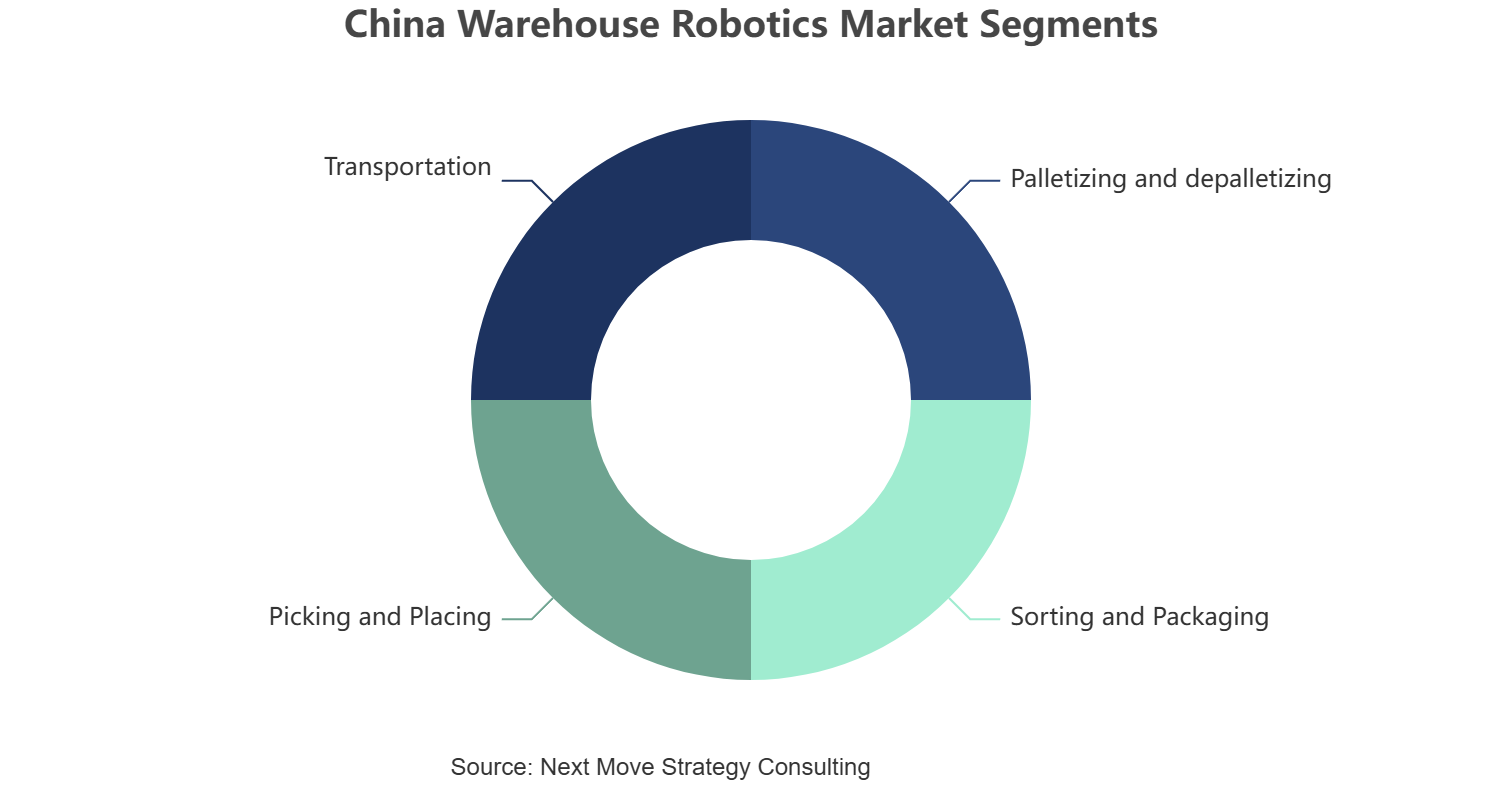
Based on application, the market is segmented into Palletizing and Depalletizing, Sorting and Packaging, Picking and Placing, and Transportation.
Based on our evaluation, we identified that application demand is increasingly shaped by China's rapidly expanding e-commerce sector, high parcel volumes, and the need for faster order fulfilment. The Sorting and Packaging segment accounts for a significant share of warehouse robotics adoption due to the country's large-scale parcel handling requirements and continuous warehouse operations. Meanwhile, the Picking and Placing segment is witnessing strong growth as AI-powered vision systems enable robots to handle diverse product assortments with greater speed and accuracy. In addition, robotic transportation and palletizing solutions are gaining wider adoption to improve material flow, reduce labor dependency, and enhance operational efficiency. Furthermore, increasing investments in intelligent fulfilment centres and smart logistics infrastructure continue to drive the adoption of advanced warehouse robotics across multiple application areas in China.
Competitive Landscape
The China Warehouse Robotics Market is characterised by an intensely competitive landscape that uniquely combines globally established multinational automation leaders with agile, innovation-driven domestic champions. Competitive differentiation is achieved through navigation software sophistication, AI-powered fleet orchestration, payload versatility, integration depth with Chinese e-commerce and ERP platforms, and the ability to deliver rapid localised deployment and after-sales support. The growing assertiveness of domestic vendors backed by state investment and deep knowledge of Chinese operational requirements is progressively reshaping competitive dynamics and redefining the global benchmark for warehouse robotics performance and price competitiveness.
Key Players
-
Toyota Material Handling (Shanghai) Co., Ltd.
-
KUKA Robotics (Shanghai) Co., Ltd.
-
SHANGHAI-FANUC Robotics Co., Ltd.
-
John Bean Technologies (Shanghai) Co., Ltd.
-
KNAPP Automation Systems (Suzhou) Co., Ltd.
-
Zebra Technologies (China) Co., Ltd.
-
Yaskawa Electric (China) Co., Ltd.
-
Omron (China) Co., Ltd.
-
Teradyne (Shanghai) Co., Ltd.
-
Techman Robot Co., Ltd.
-
Beijing Geekplus Technology Co., Ltd.
-
Daifuku (China) Co., Ltd.
-
Murata Machinery (Shanghai) Co., Ltd.
The competitive ecosystem of the China Warehouse Robotics Market encompasses a formidable roster of global and domestic players. ABB (China) Co., Ltd., KUKA Robotics (Shanghai) Co., Ltd., and SHANGHAI-FANUC Robotics Co., Ltd. lead in articulated and industrial robotic systems, while Yaskawa Electric (China) Co., Ltd. and Omron (China) Co., Ltd. compete strongly in precision motion control and collaborative automation. Toyota Material Handling (Shanghai) Co., Ltd., KION (China) Investment Co., Ltd., and Daifuku (China) Co., Ltd. anchor the materials handling and automated storage segments. Beijing Geekplus Technology Co., Ltd. has emerged as a dominant domestic AMR champion, complemented by the enterprise logistics solutions of KNAPP Automation Systems (Suzhou) Co., Ltd., Zebra Technologies (China) Co., Ltd., Teradyne (Shanghai) Co., Ltd., Techman Robot Co., Ltd., John Bean Technologies (Shanghai) Co., Ltd., and Murata Machinery (Shanghai) Co., Ltd.
Key Segments
By Types
- Automated Guided Vehicles (AGVs)
-
Laser Guidance
-
Magnetic Guidance
-
Optical Tape Guidance
-
Vision Guidance
-
Others
-
- Autonomous Mobile Robots (AMRs)
-
Tow Vehicle
-
Tug Vehicle
-
Unit Load Vehicle
-
Pallet Truck
-
Forklift Vehicle
-
Other Type
-
-
Articulated Robots
-
Collaborative Robots (Cobot)
-
Scara Robots and Cylindrical Robot
-
Others
By Offerings
-
Hardware
-
Software
-
Warehouse Management System (WMS)
-
Warehouse Execution System (WES)
-
Warehouse Control System (WCS)
-
-
Services
By Payload Capacity
-
≤ 100 KG
-
101-200 KG
-
201-500 KG
-
501-1000 KG
-
1001-2000 KG
-
2001-5000KG
-
More than 5000 KG
By Application
-
Palletizing and depalletizing
-
Sorting and Packaging
-
Picking and Placing
-
Transportation
By End User
-
E-commerce
-
Automotive
-
Food & Beverages
-
Pharmaceutical
-
Chemical and Materials
-
Semiconductor and Electronics
-
Others
Ecosystem Analysis Of The China Warehouse Robotics Market
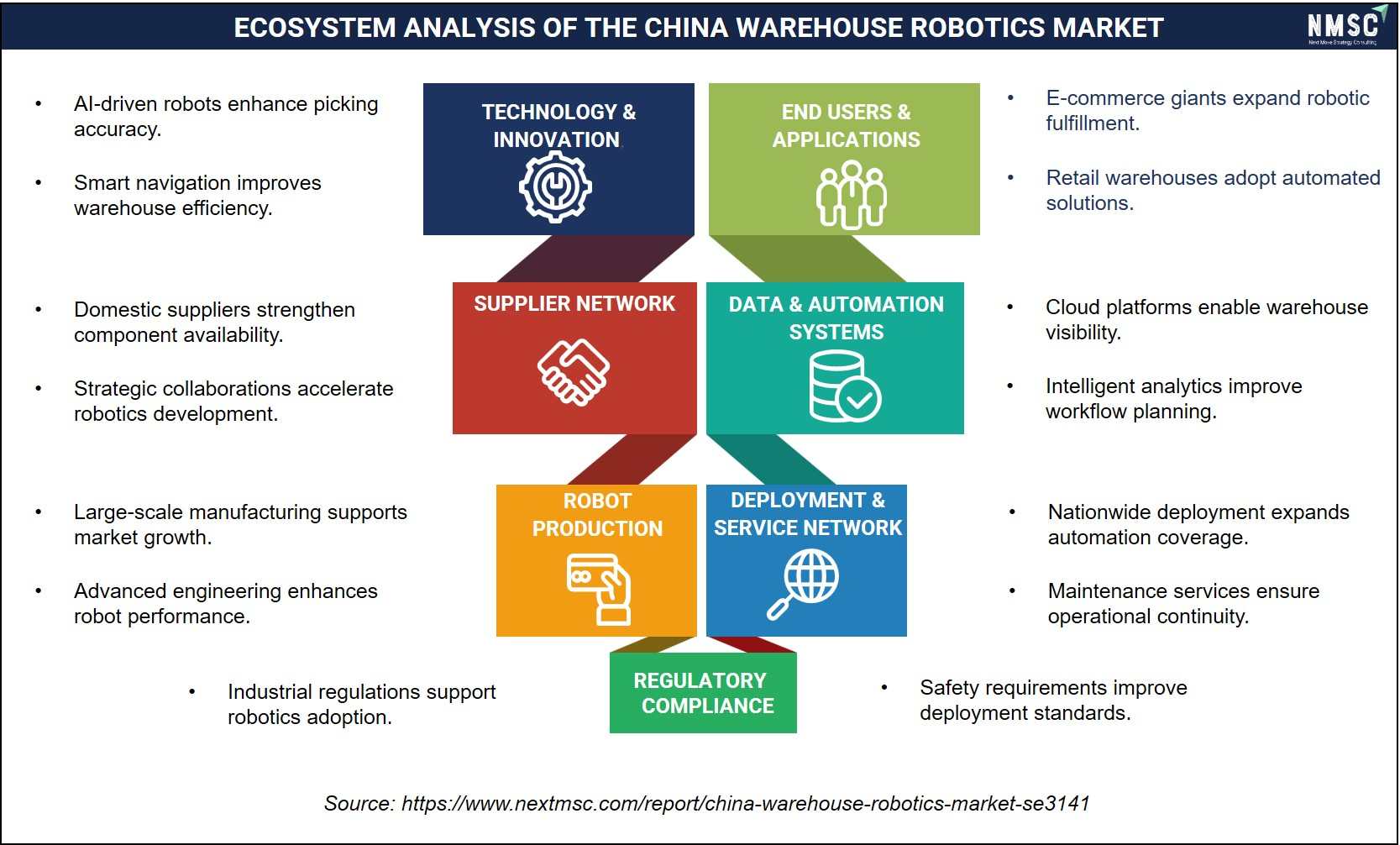
The ecosystem analysis of the China Warehouse Robotics Market highlights the interconnected network of technology providers, component suppliers, automation platforms, manufacturers, deployment partners, and end users driving market growth. Innovation in robotics, artificial intelligence, and data automation systems supports advanced warehouse operations, while strong supplier networks and domestic robot production enhance manufacturing capabilities. Regulatory compliance ensures operational safety and quality standards, and widespread adoption by e-commerce, retail, and logistics companies continues to accelerate warehouse automation and intelligent fulfilment across China
Key Benefits for Stakeholders
Next Move Strategy Consulting (NMSC) presents a comprehensive analysis of the Market, covering historical developments from 2020 to 2025 and providing forecasts through 2035. Our study evaluates the market across China, delivering quantitative market outlooks alongside qualitative insights into warehouse automation adoption, autonomous mobile robot (AMR) deployment, automated guided vehicle (AGV) implementation, artificial intelligence integration, smart logistics development, fulfillment center modernization, and advancements in warehouse management systems. Investors benefit from significant opportunities created by China's rapidly expanding warehouse automation ecosystem, while robotics manufacturers, automation solution providers, system integrators, logistics companies, e-commerce platforms, third-party logistics (3PL) providers, warehouse operators, software developers, and manufacturing enterprises benefit from growing demand for intelligent, scalable, and high-efficiency warehouse operations across the country.
Customisation Options
|
Parameters |
Details |
|
Customization Scope |
Free customization (equivalent to up to 80 analyst-working hours) after purchase. |
|
Pricing and Purchase Options |
Avail customized purchase options to meet your exact research needs. |
|
Approach |
In-depth primary and secondary research; proprietary databases; rigorous quality control and validation measures. |
|
Analytical Tools |
Porter's Five Forces, SWOT, value chain, and Harvey ball analysis to assess competitive intensity, stakeholder roles, and relative impact of key factors. |
Conclusion
The China Warehouse Robotics Market is poised for transformative growth, expanding from USD 2.58 billion in 2025 to USD 21.86 billion by 2035 at a compelling CAGR of 20.74%. The convergence of world-scale e-commerce demand, state-backed industrial policy, and an increasingly capable domestic robotics supply chain creates structural growth conditions of exceptional durability. Emerging opportunities in cold chain, pharmaceutical, and semiconductor automation promise high-margin expansion avenues, while the intensifying competition between global incumbents and agile Chinese champions will continue to drive innovation, cost reduction, and accelerated technology adoption across China's warehouse automation ecosystem.
About the Author
 Liza Phukan
— Liza Phukan is Research Associate at Next Move Strategy Consulting, where she has covered emerging industries and market research across sectors for 3.5 years. Her work includes analyzing industry developments, validating market data, and developing structured business content from research findings. She uses secondary research and data-validation practices to turn complex market information into clear decision-useful market analysis for business audiences and support report development and B2B.
Liza Phukan
— Liza Phukan is Research Associate at Next Move Strategy Consulting, where she has covered emerging industries and market research across sectors for 3.5 years. Her work includes analyzing industry developments, validating market data, and developing structured business content from research findings. She uses secondary research and data-validation practices to turn complex market information into clear decision-useful market analysis for business audiences and support report development and B2B.
About the Reviewer
 Supradip Baul
— Supradip Baul is an accomplished business consultant and strategist with over a decade of rich experience in market intelligence, strategy, technology, and business transformation. His work has included rigorous qualitative and quantitative analysis across multiple industries, helping clients shape investment decisions and long-term roadmaps. Earlier in his career, he was associated with Gartner, where he contributed to industry-leading reports and market share analyses. He has worked with leading global companies and holds an MBA with a dual specialization in Marketing and Finance.
Supradip Baul
— Supradip Baul is an accomplished business consultant and strategist with over a decade of rich experience in market intelligence, strategy, technology, and business transformation. His work has included rigorous qualitative and quantitative analysis across multiple industries, helping clients shape investment decisions and long-term roadmaps. Earlier in his career, he was associated with Gartner, where he contributed to industry-leading reports and market share analyses. He has worked with leading global companies and holds an MBA with a dual specialization in Marketing and Finance.
At Next Move Strategy Consulting, we understand that insightful market research is the cornerstone of successful business decisions. That's why we employ a robust and multifaceted approach, combining various methodologies to deliver the most accurate and actionable data for our clients.

Research Landscape
We navigate the world of research with two primary approaches:
Qualitative Approach
Our qualitative research methodologies involve immersive techniques such as in-depth interviews, focus groups, and observational studies. By engaging directly with individuals and stakeholders, we uncover valuable insights that quantitative data alone may overlook.

Quantitative Research
In tandem with qualitative methodologies, NMSC leverages the power of Quantitative Research to provide a robust foundation of numerical insights. Through systematic data collection and analysis, we quantify patterns, preferences, and market trends, offering a comprehensive view of the business landscape.
Our quantitative research approach employs diverse tools, including surveys, experiments, and statistical modelling. These methodologies enable us to gather data from a large and representative sample, ensuring the statistical significance of our findings. By employing structured questionnaires and standardized data collection methods, we guarantee the reliability and validity of the information we present to our clients.
Quantitative research is particularly effective in measuring the prevalence of trends, assessing market size, and gauging the impact of various factors on consumer behavior. The numerical precision attained through this approach equips our clients with actionable insights, facilitating data-driven decision-making and strategy formulation.


Our Specialized Toolbox for Industry-Specific Market Research
We deploy a specialized arsenal of techniques tailored to meet your unique requirements. Here's a glimpse into our comprehensive toolbox:

Information Procurement
The stage entails acquiring market data or relevant information through various sources and methodologies.


Market Research Approach
We utilize both top-down and bottom-up approaches in market research analysis to achieve a comprehensive understanding of the market dynamics, leveraging the broad perspective of industry trends and macroeconomic factors alongside detailed insights from specific segments and individual companies.

Porters Five Forces Analysis
We conduct Porter's Five Forces analysis to evaluate the competitive landscape of an industry, providing us with insights into factors that affect profitability and strategic positioning.

SWOT Analysis

Forecasting
We utilize a forecasting model to predict future consumption by considering parameters like population, economics, regulations, market competition, drivers, constraints, technology, and pricing. We also employ statistical techniques such as multilinear regression, exponential smoothing, moving average, ARIMA, and Monte Carlo simulations for accurate predictions. In econometric forecasting, we analyzed short-term and long-term event impacts, attributing values based on regulatory frameworks, economic factors, and market events.





 Speak to Our Analyst