Electronic Warfare Drone Market

Electronic Warfare Drone market was USD 3.20B in 2025, forecast to reach USD 12.90B by 2035 at a 15.0% CAGR from 2026 to 2035, per this market report.

Download Free Sample PDF
Base Year (2025)
$3.20 Billion
Forecast (2035)
$12.90 Billion
CAGR (2026-2035)
15.0%
Top Region
North America

What Is the Electronic Warfare Drone Market Size?

The global Electronic Warfare Drone market was valued at USD 3.20 billion in 2025 and is estimated at USD 3.68 billion in 2026, forecast to reach USD 12.90 billion by 2035, growing at a 15.0% CAGR from 2026 to 2035. North America leads with approximately 45% revenue share, while Electronic Attack systems command approximately 55% of total 2025 market value.

NMSC's analysis indicates that the Electronic Warfare Drone market is entering an accelerated growth phase driven by demonstrated combat utility in near-peer conflict environments, escalating national defense procurement for EW-capable unmanned systems, and the rapid maturation of AI-driven signal processing that enables real-time threat classification and adaptive jamming response at drone-compatible size, weight, and power budgets.

Electronic Warfare Drone Market Revenue Forecast

Values in USD Billion

2025 $3.20 Billion
2025
2026 $3.68 Billion
2026
2027 $4.23 Billion
2027
2028 $4.87 Billion
2028
2029 $5.60 Billion
2029
2030 $6.44 Billion
2030
2031 $7.40 Billion
2031
2032 $8.51 Billion
2032
2033 $9.79 Billion
2033
2034 $11.26 Billion
2034
2035 $12.90 Billion
2035

Key Takeaways

By Drone Type: Fixed-Wing EW Drones held the largest share of approximately 45% (USD 1.44 Billion) in 2025 and is estimated at USD 5.55 Billion in 2035; Swarm EW Drones is the fastest-growing sub-segment at 21.7% CAGR from 2026–2035.

By EW Function: Electronic Attack held the largest share of approximately 55% (USD 1.76 Billion) in 2025 and is estimated at USD 7.10 Billion in 2035; Combined EW Missions is the fastest-growing sub-segment at 19.2% CAGR from 2026–2035.

By Range Classification: Short Range (50–200 km) held the largest share of approximately 32% (USD 1.02 Billion) in 2025; Long Range (above 800 km) is the fastest-growing sub-segment at approximately 20.5% CAGR from 2026–2035.

By Operation Mode: Semi-Autonomous Operation held the largest share of approximately 46% (USD 1.47 Billion) in 2025; Autonomous Operation is the fastest-growing segment at approximately 21.0% CAGR from 2026–2035.

By End User: Air Forces held the largest share of approximately 40% (USD 1.28 Billion) in 2025 and is estimated at USD 4.90 Billion in 2035; Special Operations Forces is the fastest-growing segment at 21.2% CAGR from 2026–2035.

Dominant Region: North America dominated with approximately 45% revenue share (USD 1.44 Billion) in 2025.

Fastest-Growing Region: Middle East & Africa is expected to register the highest regional CAGR of approximately 22.3% during 2026–2035.

Dominant Country: U.S. led with approximately USD 1.38 Billion in 2025.

Fastest-Growing Country: Saudi Arabia is the fastest-growing country at approximately 23.3% CAGR from 2026–2035.

Market Opportunity: The Electronic Warfare Drone market is expected to create an absolute dollar opportunity of USD 9.22 billion between 2026 and 2035, representing one of the most compelling capital deployment opportunities in the global defense electronics and unmanned systems sectors.

According to NMSC analysis, the proliferation of commercially derived drone platforms in conflict zones has fundamentally changed the electronic warfare threat environment, compelling defense establishments worldwide to accelerate procurement of dedicated EW drone systems capable of conducting electronic attack, signal intelligence collection, and radar suppression missions at standoff ranges that protect crewed aircraft from advanced integrated air defense systems.

What Does the Electronic Warfare Drone Market Encompass?

The Electronic Warfare Drone market encompasses unmanned aerial vehicle systems purpose-designed, configured, or integrated with electronic warfare payloads to conduct electronic attack, electronic support, and electronic protection missions. The scope includes fixed-wing MALE and HALE platforms, rotary-wing and multirotor configurations, loitering munitions with dedicated EW payloads, swarm drone systems optimized for distributed electronic attack, and hybrid VTOL platforms. Revenue is recognized at the point of system delivery to defense end users, including embedded EW payload costs, ground control station software, mission planning tools, training, and initial support packages.
The regulatory environment is defined by national defense acquisition frameworks, export control regimes including the U.S. International Traffic in Arms Regulations and Export Administration Regulations, and multilateral arms transfer control mechanisms such as the Wassenaar Arrangement. Technology adoption is accelerating across AI-driven adaptive jamming, cognitive electronic warfare, software-defined radio payloads enabling multi-mission reconfiguration, and miniaturized direction-finding arrays achieving direction-of-arrival accuracy below one degree on platforms weighing less than fifty kilograms, enabling tactical-grade electronic support missions from Group 2 and Group 3 drone platforms previously restricted to commercial sensor payloads.

Market Drivers & Dynamics

Interactive Dataset
Escalating near-peer conflict experience demonstrating EW drone operational effectiveness driver +3.2% Global 2026–2035
Rising global defense budgets directing record investment to EW and unmanned systems driver +2.8% North America, Europe, Asia-Pacific 2026–2035
Proliferation of advanced integrated air defense systems compelling SEAD/DEAD drone EW demand driver +2.1% Global 2026–2032
AI and cognitive EW enabling adaptive jamming in contested spectrum environments driver +1.8% North America, Europe, Asia-Pacific 2026–2035
Swarm and loitering EW drone procurement programs in major NATO and allied forces driver +1.5% North America, Europe 2026–2035
Miniaturization of EW payload SWaP enabling Group 2 and 3 platform integration driver +1.2% Global 2026–2033
Export control restrictions under ITAR and Wassenaar limiting international market penetration restraint −1.8% MEA, Asia-Pacific, Latin America 2026–2035
High EW drone system acquisition and sustainment costs constraining allied force budgets restraint −1.3% Europe, MEA, Latin America 2026–2032
Spectrum management and frequency deconfliction challenges in coalition operations restraint −0.8% Global 2026–2030
Source: Next Move Strategy Consulting

Growth Drivers

What Is the Primary Growth Driver of the Electronic Warfare Drone Market?

Escalating near-peer conflict experience providing operational proof of EW drone effectiveness is the single most powerful demand catalyst for the Electronic Warfare Drone market. The Russia-Ukraine conflict has demonstrated that drone-deployed jamming systems can suppress communications and navigation across large areas, degrade adversary ISR drone operations, and neutralize GPS-guided munitions at costs orders of magnitude below crewed EW aircraft. The U.S. Department of Defense fiscal year 2025 budget requests, published through official DoD Comptroller submissions, allocated significantly increased funding to electronic warfare programs including unmanned EW platform development, reflecting the institutionalization of EW drone lessons learned.

How Is Rising Defense Budget Investment Driving Electronic Warfare Drone Market Growth?

NATO member states' commitment to achieve 2% GDP defense spending targets, as documented in NATO's official defence expenditure reports, is generating substantial incremental procurement capacity for advanced EW capabilities including drone-based systems. We observed that the U.S. Department of Defense's Electronic Warfare Strategy, as articulated through official DoD publications, explicitly identifies unmanned EW platforms as a priority modernization investment area, directing funding toward programs including the Next Generation Jammer and dedicated EW drone development. European NATO members' defense investment acceleration following Russia's 2022 invasion of Ukraine has created multi-year EW drone procurement pipelines across the UK, Germany, France, and Poland.

Growth Inhibitors

What Is Restraining the Electronic Warfare Drone Market?

Export control restrictions under the U.S. International Traffic in Arms Regulations and the multilateral Wassenaar Arrangement represent the most structurally significant restraint on Electronic Warfare Drone market expansion, particularly into Middle East, African, and Southeast Asian markets where defense demand is growing rapidly. EW drone systems incorporating sensitive technologies including advanced jamming waveform libraries, high-power amplifiers above controlled thresholds, and software-defined EW payloads fall under Category XI of the U.S. Munitions List, requiring end-use certificates and Congressional notification for transfers above threshold values, materially extending sales cycles and limiting addressable export markets for U.S.-headquartered EW drone developers.

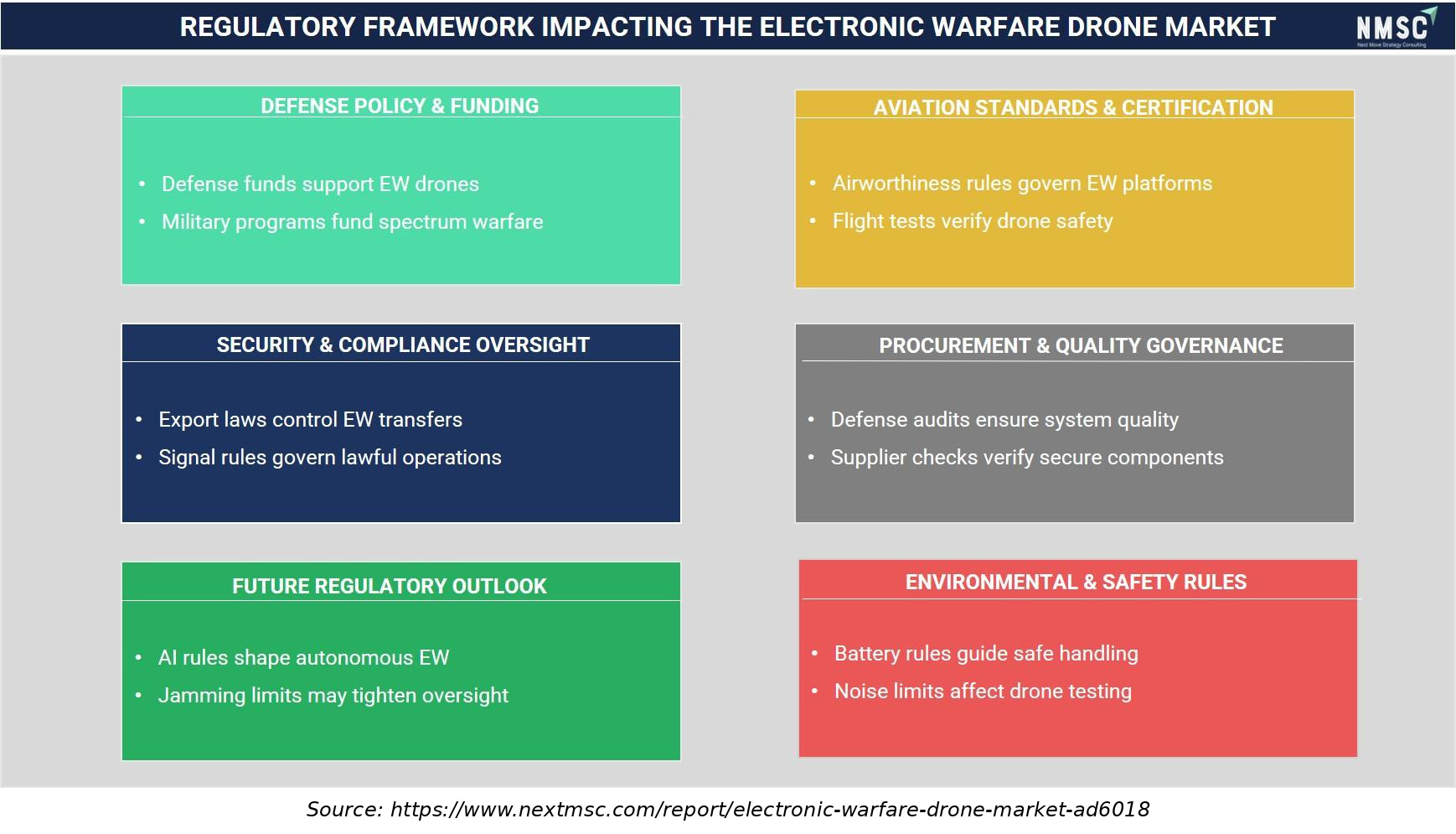
Regulatory Framework Impacting the Electronic Warfare Drone Market

The electronic warfare drone market is influenced by defense policies, aviation certification, export controls, spectrum-use requirements, procurement standards, and safety regulations. Government funding supports EW platform development, while airworthiness testing ensures operational safety. Export laws and secure-component requirements affect international transfers, whereas emerging rules governing autonomous systems, AI, jamming activities, batteries, and environmental impacts increasingly shape market development.

Segmentation Analysis

2025 (USD Billion)
2035 (USD Billion)
Fixed-Wing EW Drones 2025: $1.44 Billion | 2035: $5.55 Billion
Fixed-Wing E
Rotary-Wing EW Drones 2025: $0.64 Billion | 2035: $2.19 Billion
Rotary-Wing
Loitering Munitions with EW Payloads 2025: $0.80 Billion | 2035: $3.48 Billion
Loitering Mu
Swarm EW Drones 2025: $0.22 Billion | 2035: $1.29 Billion
Swarm EW Dro
Hybrid VTOL EW Drones 2025: $0.10 Billion | 2035: $0.39 Billion
Hybrid VTOL
Fixed-Wing EW Drones $1.44 Billion $5.55 Billion 16.0%
Rotary-Wing EW Drones $0.64 Billion $2.19 Billion 14.6%
Loitering Munitions with EW Payloads $0.80 Billion $3.48 Billion 17.7%
Swarm EW Drones $0.22 Billion $1.29 Billion 21.7%
Hybrid VTOL EW Drones $0.10 Billion $0.39 Billion 16.2%

Which Drone Type Dominates the Electronic Warfare Drone Market?

Fixed-Wing EW Drones commanded the largest revenue share, reaching USD 1.44 billion in 2025, reflecting endurance, speed, and payload capacity advantages for long-range SIGINT collection, wide-area communications jamming, and escort EW missions. Swarm EW Drones are the fastest-growing drone type at a 21.7% CAGR from 2026 to 2035, driven by active procurement programs in the U.S. Navy, U.S. Air Force, and multiple European NATO allies seeking distributed electronic attack capabilities. The fixed-wing drone platform ecosystem is providing the airframe foundation for next-generation MALE and HALE EW drone systems replacing crewed electronic support aircraft in persistent SIGINT collection roles.

2025 (USD Billion)
2035 (USD Billion)
Electronic A
Communicatio
Radar Jammin
Navigation S
Directed Ene
Segment Item 2025 (USD Billion) 2035 (USD Billion) CAGR
Electronic Attack $10.0 USD Billion $40.0 USD Billion 8.0%
Communications Jamming $17.1 USD Billion $51.1 USD Billion 14.0%
Radar Jamming and Suppression $24.2 USD Billion $62.2 USD Billion 12.0%
Navigation Signal Spoofing $31.3 USD Billion $73.3 USD Billion 14.0%
Directed Energy Attack $38.4 USD Billion $84.4 USD Billion 17.0%

Segment-wise data is locked

Unlock complete segment-wise numbers for By EW Function.

Unlock Full Data

Which EW Function Segment Leads the Electronic Warfare Drone Market?

Electronic Attack dominated the EW Function axis, generating USD 1.76 billion in 2025 revenue, driven by defense procurement for communications jamming, radar suppression, and navigation signal spoofing systems whose operational demand increased substantially following near-peer conflict observations of drone-based electronic attack effectiveness at the tactical and operational levels. Combined EW Missions is the fastest-growing function at a 19.2% CAGR from 2026 to 2035, as software-defined payload architectures enable single platforms to execute attack, support, and protection functions simultaneously, creating premium-priced multi-role EW drone system demand among air forces and special operations forces requiring maximum mission flexibility per deployed asset.

2025 (USD Billion)
2035 (USD Billion)
Very Short R
Short Range
Medium Range
Long Range (
Segment Item 2025 (USD Billion) 2035 (USD Billion) CAGR
Very Short Range (below 50 km) $10.0 USD Billion $40.0 USD Billion 8.0%
Short Range (50–200 km) $17.1 USD Billion $51.1 USD Billion 10.0%
Medium Range (200–800 km) $24.2 USD Billion $62.2 USD Billion 8.0%
Long Range (above 800 km) $31.3 USD Billion $73.3 USD Billion 18.0%

Segment-wise data is locked

Unlock complete segment-wise numbers for By Range Classification.

Unlock Full Data
2025 (USD Billion)
2035 (USD Billion)
Autonomous O
Semi-Autonom
Remotely Pil
Segment Item 2025 (USD Billion) 2035 (USD Billion) CAGR
Autonomous Operation $10.0 USD Billion $40.0 USD Billion 10.0%
Semi-Autonomous Operation $17.1 USD Billion $51.1 USD Billion 12.0%
Remotely Piloted Operation $24.2 USD Billion $62.2 USD Billion 10.0%

Segment-wise data is locked

Unlock complete segment-wise numbers for By Operation Mode.

Unlock Full Data
2025 (USD Billion)
2035 (USD Billion)
Air Forces
Army and Lan
Navy and Coa
Special Oper
Intelligence
Segment Item 2025 (USD Billion) 2035 (USD Billion) CAGR
Air Forces $10.0 USD Billion $40.0 USD Billion 26.0%
Army and Land Forces $17.1 USD Billion $51.1 USD Billion 16.0%
Navy and Coast Guard $24.2 USD Billion $62.2 USD Billion 18.0%
Special Operations Forces $31.3 USD Billion $73.3 USD Billion 8.0%
Intelligence Agencies $38.4 USD Billion $84.4 USD Billion 23.0%

Segment-wise data is locked

Unlock complete segment-wise numbers for By End User.

Unlock Full Data

Which End User Segment Leads the Electronic Warfare Drone Market?

Air Forces accounted for the largest end-user revenue share, generating USD 1.28 billion in 2025, reflecting the mission-critical role of airborne electronic warfare in air superiority operations, suppression of enemy air defenses, and escort jamming for strike packages where dedicated EW drone platforms are increasingly replacing or supplementing crewed EW aircraft. Special Operations Forces is the fastest-growing end-user segment at a 21.2% CAGR from 2026 to 2035, as SOCOM-affiliated organizations globally are acquiring compact, rapidly deployable EW drone systems capable of conducting communications disruption, radar spoofing, and electronic reconnaissance missions in denied access environments where larger crewed EW aircraft cannot operate without unacceptable risk.

Growth Opportunities

Our analysis shows that three structurally significant growth opportunities are emerging for system integrators, EW payload developers, and platform manufacturers positioning in the Electronic Warfare Drone market through the 2026–2035 forecast period.

How Can AI-Driven Cognitive EW Payloads Create a Premium Replacement Cycle for Legacy Drone EW Systems?

Defense establishments that purchased first-generation drone EW systems with fixed-program jamming libraries are confronting the growing limitation of pre-programmed responses against frequency-agile adversary communications and radar systems. Cognitive EW payload upgrades incorporating real-time machine learning-based threat classification and adaptive jamming generate a replacement cycle demand among air forces and special operations forces that currently operate legacy EW drone fleets, creating a recurring high-value retrofit and new-system revenue stream for EW payload developers with certified cognitive EW product lines already demonstrating superior performance in U.S. and allied EW range evaluations.

What Opportunity Does Swarm EW Drone Proliferation Create for Modular Payload Developers?

The transition toward swarm EW drone architectures is creating demand for standardized, modular EW payload units that can be mass-produced at costs enabling fielding of tens to hundreds of swarm drone units per procurement program, rather than the small-quantity high-cost acquisition model applicable to MALE and HALE EW platforms. Payload developers that achieve size-weight-and-power targets compatible with Group 2 and 3 platforms at unit payload costs below USD 50,000 will command dominant positioning in swarm EW system competitions for U.S. and allied forces where acquisition strategies specify interchangeable payloads across multiple airframe suppliers.

How Can Export Licensing Reform Create New Market Access for Ally EW Drone Procurement?

Regulatory reform of ITAR Category XI provisions governing export of advanced EW systems to treaty allies, including Foreign Military Sale program expansions and enhanced Defense Cooperation Agreements, could unlock substantial procurement budgets among NATO European allies, Gulf Cooperation Council members, and Pacific ally air forces that currently cannot access U.S.-origin EW drone systems at the required sophistication level. Our findings suggest that defense companies with established FMS infrastructure enabling expedited Congressional notification waivers are positioned to capture early-mover advantage in EW drone markets unlocked by policy liberalization. The drone software ecosystem enabling mission planning and EW payload control software is a lower-ITAR-threshold market entry point allowing international software sales to precede full platform transfers.

Regional Outlook

2025 (USD Billion)
2035 (USD Billion)
North Americ
Europe
Asia-Pacific
Middle East
Latin Americ
Region 2025 (USD Billion) 2035 (USD Billion) CAGR (%)
North America $10.0 USD Billion $40.0 USD Billion 9.0%
Europe $17.1 USD Billion $51.1 USD Billion 27.0%
Asia-Pacific $24.2 USD Billion $62.2 USD Billion 25.0%
Middle East & Africa $31.3 USD Billion $73.3 USD Billion 23.0%
Latin America $38.4 USD Billion $84.4 USD Billion 12.0%

Regional data is locked

Unlock complete regional numbers for this market.

Unlock Full Data

Competitive Landscape

We observed that the Electronic Warfare Drone market features a concentrated competitive structure dominated by U.S. and European defense primes with established EW technology intellectual property, challenged by Israeli specialist EW drone developers with operational deployment experience and a rapidly developing cohort of non-Western producers targeting domestic and regional export markets.

Dimension Description
Market Structure Concentrated; top five providers (Northrop Grumman, RTX Corporation, L3Harris, Israel Aerospace Industries, Elbit Systems) account for a substantial majority of global Electronic Warfare Drone market revenue; European primes (Leonardo, Thales, BAE Systems, HENSOLDT, Saab) serve primarily domestic and allied nation markets; non-Western producers (ASELSAN, EDGE Group) are gaining market share in MEA and select Asia-Pacific markets.
Innovation Focus Cognitive EW payload development with AI-driven threat classification; software-defined radio architectures enabling multi-mission reconfiguration; miniaturized direction-finding arrays for Group 2/3 platforms; swarm EW coordination algorithms; DRFM-based deception jamming for advanced radar defeat; low-power high-gain EW antennas for long-range stand-in EW drone operations.
M&A Activity Strategic partnerships between airframe drone manufacturers and EW payload specialists as the dominant collaboration model over outright M&A; AeroVironment's EW developer partnerships for Switchblade; Kratos Defense's EW specialist collaboration for Valkyrie XQ-58A; Sierra Nevada Corporation's EW integration on SNC Freedom aircraft representing the teaming model delivering program wins in U.S. DoD EW drone competitions.

How Do Companies Compete in the Electronic Warfare Drone Industry?

Competition in the Electronic Warfare Drone market operates across three primary dimensions: EW system technical performance measured by jammer effective radiated power, frequency coverage, and adaptation speed; platform integration quality encompassing airframe-payload interface and mission system software maturity; and programmatic execution including production delivery reliability, total lifecycle cost management, and field support network depth. We observed that U.S. defense primes compete primarily on classified EW technology superiority and established government program relationships, while Israeli competitors differentiate on operational deployment references and willingness to customize systems for allied nation-specific threat libraries.

Which Competitive Archetypes Dominate the Electronic Warfare Drone Market?

Three archetypes dominate the competitive landscape: fully integrated defense primes providing complete EW drone systems from airframe through payload through sustainment under single prime contracts (Northrop Grumman, L3Harris, Leonardo); EW payload specialists integrating classified EW systems across multiple airframe partners (RTX Corporation, HENSOLDT, Saab); and loitering EW platform specialists with operational employment records (Israel Aerospace Industries, Elbit Systems, Rafael). Our assessment indicates that the fully integrated prime archetype commands premium pricing and program capture rates in NATO markets, while loitering specialists lead in MEA markets where operational deployment experience constitutes the decisive competitive differentiator.

How Are Companies Innovating and Differentiating in the Electronic Warfare Drone Market?

Innovation investment is concentrated in cognitive EW payload development, swarm coordination software, and power management systems enabling high-output EW jamming from lightweight drone platforms without battery or fuel endurance penalties that reduce mission persistence. Our analysis shows that Northrop Grumman's investment in its Adaptive Radar Countermeasures program, L3Harris's digital EW payload miniaturization research, and HENSOLDT's Kalaetron drone EW sensor development are establishing technology differentiation commanding program-of-record selection advantages in NATO EW drone competitions over the next procurement cycle through 2030.

What M&A and Strategic Expansion Activity Is Shaping the Electronic Warfare Drone Market?

Strategic partnerships between airframe drone manufacturers and EW payload specialists are the dominant collaboration model replacing outright M&A in the Electronic Warfare Drone market, as defense regulatory complexity and export control management make full corporate consolidation less attractive than co-prime teaming arrangements preserving each partner's existing classified program relationships. NMSC's analysis indicates that AeroVironment's partnership with EW payload developers for Switchblade and JUMP systems, Kratos Defense's collaboration with EW specialists for the Valkyrie, and Sierra Nevada Corporation's EW integration programs represent the partnership model delivering EW drone program wins in U.S. DoD competition while preserving commercial flexibility for international expansion.

Key Market Players

Our findings suggest that the following 20 companies represent the confirmed set of active producers, developers, and system integrators leading the global Electronic Warfare Drone market in 2026, spanning dedicated EW drone platform manufacturers, EW payload specialists, and system integrators with established EW drone program delivery records.

Northrop Grumman Corporation RTX Corporation L3Harris Technologies, Inc. Israel Aerospace Industries Ltd. Elbit Systems Ltd. Leonardo S.p.A. Thales Group BAE Systems plc Lockheed Martin Corporation General Dynamics Corporation Boeing Company (The) HENSOLDT AG Saab AB ASELSAN A.S. Rafael Advanced Defense Systems Ltd. Sierra Nevada Corporation AeroVironment, Inc. Kratos Defense & Security Solutions, Inc. Textron Inc. Mercury Systems, Inc.

Latest Developments

Based on research conducted by NMSC, we found that 2025–2026 developments in the Electronic Warfare Drone market are concentrated on advanced EW drone system contract awards, cognitive EW technology demonstrations, swarm EW program initiation, and allied nation EW drone procurement commitments driven by near-peer conflict lessons.

Date Event
July 16, 2026 L3Harris and Shield AI completed the first live-flight demonstration of their Distributed Spectrum Collaboration and Operations ecosystem with Hivemind autonomy aboard L3Harris Green Wolf UAS. Multiple drones detected and characterized electromagnetic threats, shared data and autonomously rerouted follow-on systems through safe operating zones.
July 16, 2026 IAI unveiled HYPNOSIS, a soft-kill navigation-warfare system designed to simultaneously disrupt satellite-navigation signals used by multiple aerial threats, including unmanned aircraft. The system is intended to complement kinetic interception and provide an additional defensive layer against increasingly numerous GNSS-dependent drone operations.
June 22, 2026 Leonardo and Baykar conducted flight trials in Türkiye demonstrating autonomous KIZILELMA operations with Leonardo’s M-346. The unmanned aircraft autonomously rejoined and responded to commands from the piloted aircraft, demonstrating coordinated formations and manned-unmanned teaming using integrated avionics and autonomy technologies.

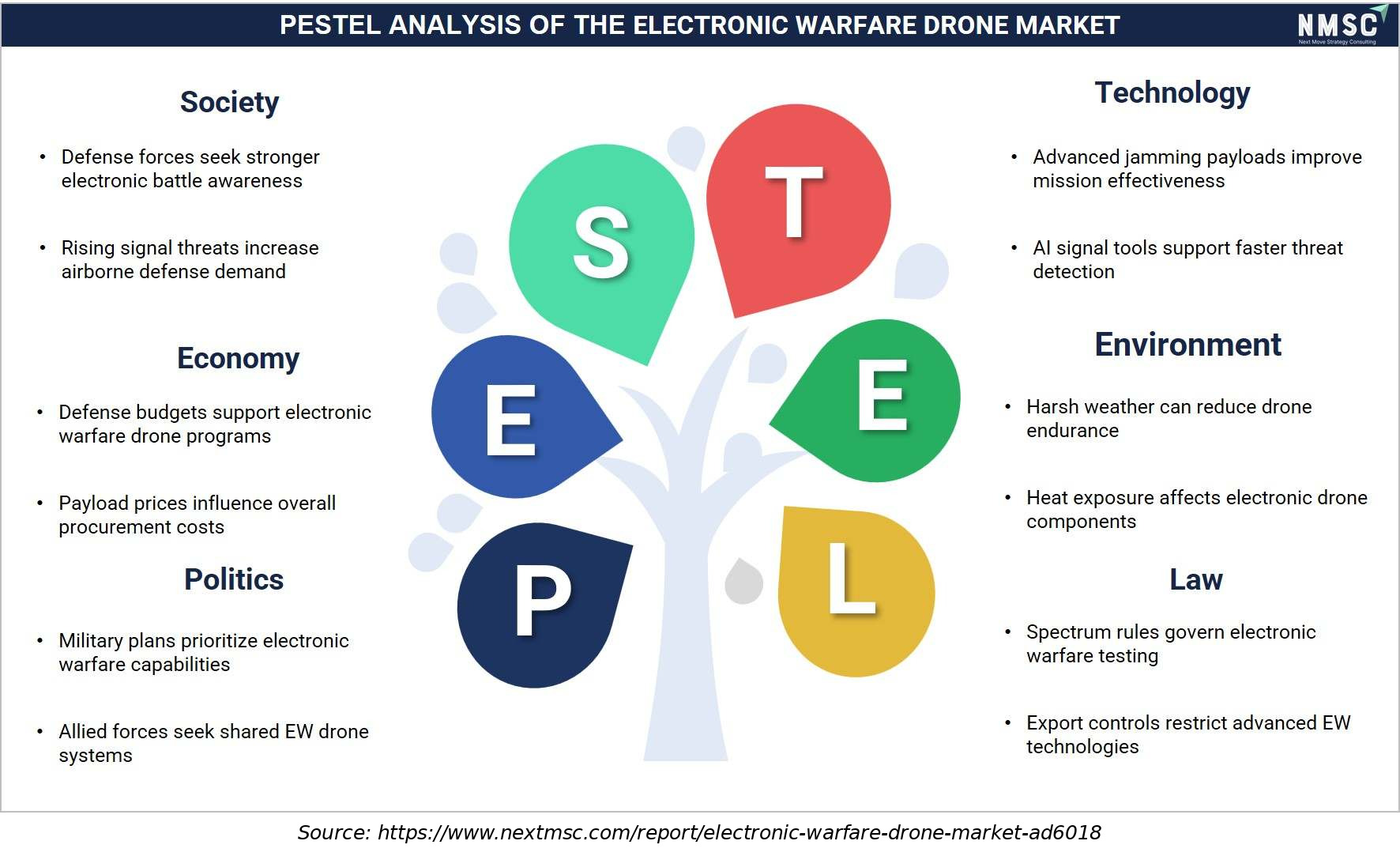
PESTEL Analysis – Electronic Warfare Drone Market

PESTEL Analysis – Electronic Warfare Drone Market

The electronic warfare drone market is shaped by political priorities, defense spending, economic conditions, technological advancements, environmental considerations, social factors, and evolving legislation. Defense modernization and spectrum warfare requirements support demand, while AI, autonomous operation, and advanced electronic systems drive technological development. Export controls, operational regulations, cybersecurity, environmental requirements, and safety standards influence deployment and procurement decisions.

Investment Opportunities

What Capital Inflows Are Targeting the Electronic Warfare Drone Market?

Capital inflows into the Electronic Warfare Drone market are concentrated in three vectors: government-directed defense R&D funding through DARPA, U.S. Air Force Research Laboratory, and allied nation defense research organizations sustaining a classified program development pipeline; private equity and strategic investment in emerging EW drone technology companies developing AI-driven cognitive EW payloads and swarm coordination software; and established defense prime internal R&D investment in EW payload miniaturization. The U.S. DoD's Defense Innovation Unit engagement with commercial EW technology companies is creating investment pathways from venture-backed companies into classified EW drone program competition within the U.S. defense acquisition system.

How Is Defense Infrastructure Investment Supporting Electronic Warfare Drone Market Growth?

Defense infrastructure investment in spectrum monitoring facilities, EW range training complexes, and EW drone testing and evaluation infrastructure is directly expanding the commercial market by enabling procurement programs to advance through testing and evaluation milestones that convert research programs into production contracts. The U.S. DoD's investment in EW test ranges including the Electronic Combat Range and allied nation investments through the NATO EW Joint Advanced Training Center are creating evaluation infrastructure that validates commercial EW drone system performance, reducing technical risk for program managers and accelerating procurement cycle completion from demonstrator to program-of-record status.

What ESG Considerations Are Shaping Electronic Warfare Drone Investment Decisions?

Environmental, social, and governance considerations in the Electronic Warfare Drone market primarily manifest through the governance dimension of responsible autonomy in AI-enabled EW systems, where institutional investors with defense ethics frameworks are engaging defense companies on their policies regarding autonomous EW drone employment and human-in-the-loop requirements for adversary communications disruption. The U.S. DoD's AI ethics principles, published through official DoD channels, and the EU's European Defence Agency guidelines on autonomous weapons systems are creating governance documentation requirements that EW drone developers must address in investor relations communications and sustainability reporting frameworks as ESG fund screening becomes more prevalent.

Key Benefits for Stakeholders

How Does This Report Benefit Defense Manufacturers and System Integrators?

Defense manufacturers and system integrators gain validated segmentation data across By Drone Type, EW Function, Range Classification, Operation Mode, and End User axes, enabling product line investment decisions, platform targeting strategy, and payload integration prioritization calibrated to actual market demand distribution. Our analysis shows that the report's identification of Swarm EW Drones at 21.7% CAGR, Special Operations Forces at 21.2% CAGR, and Combined EW Missions at 19.2% CAGR as the highest-growth segments provides actionable investment case data for R&D budget allocation decisions across the USD 3.20 billion 2025 market growing to USD 12.90 billion by 2035.

How Does This Report Benefit Investors and Financial Analysts in the Electronic Warfare Drone Market?

Investors and financial analysts benefit from internally consistent single-point market size estimates, regional CAGR differentiation, and a validated 20-company competitive landscape supporting equity valuation, M&A target identification, and portfolio construction across defense electronics and unmanned systems equity baskets. We observed that the report's identification of Middle East & Africa as the fastest-growing region at 22.3% CAGR and Saudi Arabia as the fastest-growing country at 23.3% CAGR enables geographic revenue concentration risk assessment for defense company investment theses dependent on international EW drone export market penetration.

How Does This Report Benefit Government Defense Planners and Procurement Officials?

Government defense planners and procurement officials gain strategic intelligence on EW drone market structure, competitive positioning of major suppliers, technology innovation trajectories, and allied nation procurement investment levels informing domestic program sizing, industrial base assessments, and allied burden-sharing analyses. Our findings suggest that the report's country-level market data provides benchmark revenue figures for assessing the commercial viability of domestic EW drone industrial base development against the cost and timeline of procuring equivalent capability from allied nation suppliers through established FMS or direct commercial sale channels.

Key Market Segments Evaluated

By Drone Type

  • Fixed-Wing EW Drones
  • Rotary-Wing EW Drones
  • Loitering Munitions with EW Payloads
  • Swarm EW Drones
  • Hybrid VTOL EW Drones

By EW Function

  • Electronic Attack
  • Electronic Support
  • Electronic Protection
  • Combined EW Missions

By Range Classification

  • Very Short Range (below 50 km)
  • Short Range (50–200 km)
  • Medium Range (200–800 km)
  • Long Range (above 800 km)

By Operation Mode

  • Autonomous Operation
  • Semi-Autonomous Operation
  • Remotely Piloted Operation

By End User

  • Air Forces
  • Army and Land Forces
  • Navy and Coast Guard
  • Special Operations Forces
  • Intelligence Agencies

Conclusion & Recommendations

The Electronic Warfare Drone market is on a sustained high-growth trajectory through 2035, advancing from USD 3.68 billion in 2026 to USD 12.90 billion by 2035 at a 15.0% CAGR. NMSC's analysis indicates that this growth is structurally anchored by three mutually reinforcing forces: demonstrated operational effectiveness of EW drones in near-peer conflict environments generating non-discretionary procurement demand, the rapid technology convergence of AI, miniaturized RF electronics, and autonomous systems enabling new EW drone mission profiles, and the escalating global defense budget investment in electromagnetic spectrum dominance capabilities as a top-tier modernization priority across NATO and Indo-Pacific allied forces.

What Strategic Positioning Should Market Participants Pursue?

EW drone system developers should prioritize cognitive EW payload development, swarm architecture programs, and software-defined EW platform integration to capture the highest-growth market segments at 19–22% CAGR, while maintaining program execution discipline in fixed-wing MALE and HALE EW programs that generate the largest revenue base. Our assessment indicates that international market expansion through established FMS channel relationships, co-production agreements with allied defense industries, and Foreign Military Finance-funded procurement support programs will determine which U.S. and European defense companies capture above-average growth rates available in Middle East & Africa and Asia-Pacific relative to the domestic North American base.

How Attractive Is the Electronic Warfare Drone Market for New Investment?

The Electronic Warfare Drone market presents a highly attractive defense sector investment profile through 2035, combining a 15.0% CAGR with structural demand anchoring from rising global defense budgets, near-peer conflict-proven operational utility, and advancing AI and miniaturization technology tailwinds expanding EW drone mission envelopes. We found that Swarm EW Drones at 21.7% CAGR, Special Operations Forces end-user at 21.2% CAGR, Combined EW Missions at 19.2% CAGR, and Middle East & Africa at 22.3% CAGR represent the highest-growth investment vectors, while cognitive EW payload technology development commands the most defensible intellectual property moat within the competitive architecture.

What Market Shifts and Key Risks Should Stakeholders Monitor?

The primary structural shift is the transition from single-platform crewed EW aircraft to multi-domain EW drone networks distributing electronic attack and support functions across swarms of affordable unmanned systems, creating budget pressure on high-cost crewed EW aircraft programs and structural risk for defense companies without competitive drone EW system offerings. Key risks include export control regulatory tightening that could further restrict allied nation market access, adversary counter-EW drone technology development reducing first-generation system effectiveness requiring costly capability refresh, and the concentration of classified EW payload technology within a small number of defense primes creating supply chain vulnerability for allied nations dependent on U.S.-origin EW drone systems.

What Are the Key Growth Pathways for the Electronic Warfare Drone Market?

Three principal growth pathways exist through 2035: first, winning swarm EW drone program-of-record competitions in U.S. and NATO allied forces where active capability development programs are approaching procurement decisions, capturing the fastest-growing drone type segment at 21.7% CAGR before it matures; second, developing cognitive EW payload upgrades for the large installed base of legacy EW drone systems in U.S. and allied inventories, creating a recurring replacement revenue stream independent of new-platform procurement budgets; and third, penetrating Middle East & Africa defense markets through Gulf state co-production agreements and technology partnerships that provide export compliance pathways below the ITAR threshold for the highest-growth geographic market at 22.3% CAGR.

FAQs

About the Author

Mihul Sharma

Mihul Sharma

Mihul Sharma is Research Associate at Next Move Strategy Consulting, where he has covered technology, industrial, and healthcare markets for 3 years. His work applies structured business research, market analysis, and secondary-source review to assess market trends, competitive developments, and growth opportunities. He supports report development by fully synthesizing industry data, company information, and market signals into concise findings for strategy and investment-focused research teams.

About the Reviewer

Supradip Baul

Supradip Baul

Supradip Baul is an accomplished business consultant and strategist with over a decade of rich experience in market intelligence, strategy, technology, and business transformation. His work has included rigorous qualitative and quantitative analysis across multiple industries, helping clients shape investment decisions and long-term roadmaps. Earlier in his career, he was associated with Gartner, where he contributed to industry-leading reports and market share analyses. He has worked with leading global companies and holds an MBA with a dual specialization in Marketing and Finance.

Download Free Sample

Amos Chang

AMOS CHANG

Strategy Consultant

Kardex Group

I have bought the intralogistics market reports from NMSC two times so far. Joseph and his team are always very helpful and flexible in responding to any customization requirements on the report. Their expertise in market reports really helps us steer the day-to-day business. I will definitely recommend and come back myself whenever there is a need.

Robert Sean Trevino

ROBERT SEAN TREVINO

Sr. Director, Head of Strategic Insights & Analytics

Foundation Medicine

I realized that it was a reliable source of information. These days, there are many people who are looking for authentic data, and this is one of the only sources that can offer them with what they need;

Semih Kavaklioglu

SEMIH KAVAKLIOGLU

Co-Founder & Sales Manager

Decortie

I work a lot in the marketing industry and I know that research is an essential part of any campaign. I have used Market research reports for my own products and I found them to be very informative and well-researched. The team here produces insightful reports for a good price

Henri Knyphausen

HENRI KNYPHAUSEN

Partner at Singulier [Ex-BCG]

Singulier

I recently engaged NEXTMSC.com for a commercial due diligence project within the intralogistics sector, and I am pleased to provide a reference based on my experience. In utilizing NEXTMSC.com's services, I found their report to offer valuable insights into market dynamics and key industry players. The initial report provided a solid foundation for our analysis. However, as we were investigating a smaller target in the market, and I had specific customization requests requiring additional research. These requests included detailed information on product portfolios of various players and sub-market sizes, both inclusive and exclusive of certain product categories. NEXTMSC.com demonstrated commendable responsiveness and agility in accommodating these customization requests. Within a timeframe of 1-2 weeks, they delivered a revised report that met our specific needs. Furthermore, they were receptive to my follow-up inquiries, ensuring clarity and understanding of the data provided. The final deliverable significantly contributed to our due diligence efforts. One of NEXTMSC.com's notable strengths lies in their qualitative research capabilities. However, for future engagements, I would recommend the inclusion of a quantified market model in Excel format. Such a model would offer the ability to conduct in-depth analyses and explore various market segments, including country-specific data and subcomponent breakdowns. Based on my positive experience, I would not hesitate to work with NEXTMSC.com again. Their responsiveness, willingness to accommodate customization requests, and commitment to delivering actionable insights make them a reliable partner for commercial research projects.

Nishant Awate

NISHANT AWATE

Business Development Global Sales

Zehnder Group Deutschland GmbH

Our experience working with Next Move Strategy Consulting was positive. The team was responsive, professional, and open to incorporating our specific requirements throughout the project. The India AHU market study was comprehensive and well structured, covering market value and volume forecasts, product and application segments, and key industry trends. The inclusion of both AHU and residential MVHR market insights made the study particularly relevant for our strategic market assessment. Overall, the report provides a solid foundation for evaluating market potential, identifying priority segments, and supporting business-development decisions in India.

Custom Market Research Services

We will customize the research for you if the listed report does not fully match your requirements.

Get 30% Free Customization

Select License

This website uses cookies to ensure you get the best experience on our website. Learn more

✖