EConsent Market Size, Share, Growth & Forecast by Application Type (Clinical Research EConsent: Interventional Trials, Observational Studies, Registries), Delivery Setting (On-Site, Remote, Hybrid), Deployment Model (Cloud SaaS, Private Hosted, On-Premises, Hybrid), Revenue Stream (Subscription, Usage-Based), Buyer Type (Sponsor, CRO, Site Network, Hospital, Health System, Clinic, Public Sector), and Commercial Channel (Direct Enterprise Sales) — Global Analysis 2025–2035
Industry: Healthcare | Publishing Date: July 7, 2026 | Last Updated: September 30, 2026 | No of Pages: N/A | No. of Tables: N/A | No. of Figures: N/A | Format: PDF | Report Code: HC4983
What Is the EConsent Market Size?
The global EConsent Market was valued at USD 1.8 billion in 2025 and is expected to reach USD 2.1 billion in 2026. Sustained regulatory mandates for digital patient consent, accelerating adoption of decentralized and hybrid clinical trials, and the ongoing digital transformation of hospital consent workflows are projected to propel the market to USD 7.4 billion by 2035, advancing at a CAGR of 15.2% from 2026 to 2035. Core growth drivers include the global shift from paper-based informed consent to interactive digital platforms, expanding regulatory acceptance of remote eConsent by the U.S. Food and Drug Administration (FDA) and the European Medicines Agency (EMA), the proliferation of decentralized clinical trial (DCT) models, and rising demand from hospitals and health systems for integrated digital consent workflows that reduce administrative burden and improve patient engagement.
|
Parameters |
Details |
|
Market Size in 2025 |
USD 1.8 Billion |
|
Market Size in 2026 |
USD 2.1 Billion |
|
Revenue Forecast in 2035 |
USD 7.4 Billion |
|
Growth Rate |
CAGR of 15.2% from 2026 to 2035 |
|
Analysis Period |
2025–2035 |
|
Base Year Considered |
2025 |
|
Forecast Period |
2026–2035 |
|
Market Size Estimation |
Billion USD |
|
Companies Profiled |
20 |
|
Countries Covered |
33 |
|
Market Share |
Top 10 |
EConsent Market Overview
What Is the EConsent Market?
The EConsent Market encompasses the software platforms, workflow engines, and professional services that enable healthcare organizations and clinical research sponsors to obtain, manage, and store patient or participant consent in a legally valid electronic format. Unlike paper-based informed consent, electronic consent solutions present dynamic multimedia content, interactive comprehension checks, e-signature capture, and real-time audit trails. From our research, we found that the market spans two primary application domains: clinical research eConsent, which governs participant enrollment into interventional trials, observational studies, registries, and biobanks; and healthcare delivery eConsent, which governs procedure, treatment, and administrative consents across hospitals, health systems, and clinics.
How Has the EConsent Market Evolved?
The EConsent Market has evolved through three distinct development phases. The first phase centered on basic electronic signature capture that replicated paper forms in digital format. The second phase introduced interactive multimedia consent modules, comprehension assessments, and integration with electronic data capture (EDC) platforms. Based on NMSC's research, we found that the current phase is defined by remote and hybrid delivery architectures that enable fully decentralized consent across mobile devices and patient portals, supported by real-time regulatory audit trails and multilingual content engines. The COVID-19 pandemic served as a structural inflection point, compelling regulatory bodies worldwide to formally accept remote eConsent and permanently expanding the total addressable market.
How Do Regulations Influence the EConsent Market?
Regulatory developments are the most consequential structural driver of the EConsent Market. The U.S. FDA's 21 CFR Part 11 framework establishes binding requirements for electronic records and signatures in clinical research, while the agency's guidance on electronic informed consent, updated to accommodate remote consent during the COVID-19 pandemic, has permanently expanded the scope of acceptable eConsent modalities. The European Medicines Agency's guidance on computerized systems and electronic data in clinical trials similarly mandates audit trail integrity and participant data protection. Through our market assessment, we observed that the EU Clinical Trials Regulation (CTR 536/2014), now fully operational, creates a harmonized regulatory environment that incentivizes EConsent platform standardization across EU member states.
How Is Technology Adoption Expanding Across the EConsent Market?
Technology adoption across the EConsent Market is accelerating as clinical research organizations and healthcare providers pursue end-to-end digital consent ecosystems. Cloud-native SaaS deployment models are supplanting legacy on-premises installations, lowering total cost of ownership and enabling rapid updates to consent content libraries as protocols evolve. NMSC's analysis indicates that the integration of eConsent modules within broader clinical operations platforms, including electronic data capture, site management, and patient engagement suites, is reducing implementation friction and accelerating procurement cycles. At the same time, mobile-first design, biometric authentication, and patient-facing applications are extending eConsent access to underserved and geographically dispersed participant populations.
|
Key Takeaways |
|
By application type, Clinical Research EConsent held the largest share of the EConsent Market in 2025, driven by widespread adoption across regulated clinical trial environments. Healthcare Delivery EConsent is the fastest-growing primary application segment from 2026 to 2035, supported by accelerating hospital digitization and growing adoption of digital consent workflows for procedures and diagnostics. |
|
Within Clinical Research EConsent, Interventional Trials represent the dominant sub-segment due to extensive Phase II–IV trial activity and stringent regulatory documentation requirements. Biobanks and Genomics is the fastest-growing sub-segment, fueled by expanding genomics research programs, biobank network development, and increasing demand for dynamic re-consent capabilities. |
|
By delivery setting, On-Site delivery accounted for the largest share of the EConsent Market in 2025, reflecting the continued importance of site-based clinical trial and healthcare operations. Remote delivery is the fastest-growing setting from 2026 to 2035, supported by the adoption of decentralized clinical trials and broader acceptance of remote informed consent procedures. |
|
By deployment model, Cloud SaaS held the dominant position in the EConsent Market in 2025, as healthcare organizations and clinical research sponsors prioritize scalability, accessibility, and streamlined software updates. Hybrid deployment is the fastest-growing model from 2026 to 2035, driven by increasing requirements for data residency, security, and regulatory compliance. |
|
By revenue stream, Subscription represented the leading revenue model in 2025, reflecting the industry's shift toward recurring software licensing structures. Usage-Based pricing is the fastest-growing revenue stream from 2026 to 2035, driven by the ongoing shift toward per-consent and per-study billing models that align vendor incentives with sponsor portfolio activity and clinical trial volume. |
|
By buyer type, Sponsors, including pharmaceutical and biotechnology companies, accounted for the largest share of the EConsent Market in 2025 due to their central role in global clinical trial funding and management. Health Systems are the fastest-growing buyer segment from 2026 to 2035 at a CAGR of 16.4%, driven by enterprise-wide procurement of consent platforms integrated with EHR and patient engagement systems across multi-facility networks. |
|
By commercial channel, Direct Enterprise Sales held the largest share in 2025, reflecting the complex procurement processes associated with large sponsors, CROs, and healthcare systems. Embedded in Broader Suite solutions are the fastest-growing channel from 2026 to 2035 as vendors increasingly integrate eConsent capabilities into wider clinical operations, eClinical, and patient engagement platforms. |
|
North America held the largest regional share of the EConsent Market in 2025, supported by advanced healthcare digitization, a mature regulatory environment, and a high concentration of clinical trial activity. |
|
Asia-Pacific is the fastest-growing major region from 2026 to 2035, driven by expanding research activity, healthcare modernization initiatives, and increasing investment in digital health infrastructure. |
|
The United States is the single largest country market in the EConsent Market, underpinned by the world's largest clinical trial ecosystem, strong CRO presence, and established regulatory framework supporting electronic informed consent adoption. |
|
India is the fastest-growing national market within the EConsent Market, propelled by expanding clinical research capabilities, rising biotechnology investment, and ongoing digital health transformation initiatives across healthcare and research institutions. |
Key Emerging Trends in the EConsent Market
How Is the Adoption of Decentralized Clinical Trial Models Reshaping Demand in the EConsent Market?
Decentralized clinical trial (DCT) models are fundamentally redefining EConsent Market demand by mandating remote and hybrid consent capabilities at scale. DCT frameworks require participants to complete informed consent from home environments via mobile devices, tablets, or patient portal interfaces, eliminating geographic barriers to trial enrollment. Our findings suggest that leading sponsors including AstraZeneca and Pfizer have institutionalized DCT-compatible eConsent as a standard requirement in their trial operations. Platform vendors that offer mobile-first, multi-language, and low-bandwidth-optimized consent experiences are capturing disproportionate DCT market share as global trial decentralization accelerates through 2035.
How Are Integration Ecosystems Between EConsent Platforms and Broader eClinical Suites Transforming the EConsent Market?
The EConsent Market is experiencing a structural shift from standalone consent platforms to deeply integrated eClinical ecosystem components. Vendors such as Veeva Systems, Medidata Solutions, and IQVIA are embedding eConsent directly within their broader trial management, EDC, and site activation suites, reducing the need for point-solution procurement and creating significant switching cost advantages. Our assessment indicates that API-native architectures and HL7 FHIR-compatible data exchange standards are becoming baseline integration requirements for hospital and health system buyers, enabling seamless flow of consent status data into EHR and clinical workflow systems.
What Role Is Artificial Intelligence Playing in the Evolution of the EConsent Market?
Artificial intelligence is emerging as a differentiating capability within the EConsent Market, with applications spanning adaptive comprehension assessment, multilingual content generation, and consent completion risk prediction. AI-driven readability scoring tools are enabling consent form authors to optimize document complexity for participant literacy levels, improving comprehension rates and reducing protocol deviations. Through NMSC's assessment, we found that vendors are beginning to deploy natural language processing to automatically flag protocol amendments that require re-consent workflows, reducing manual review burden and accelerating regulatory compliance timelines. These AI capabilities are particularly valuable in complex oncology and rare disease trials with frequent protocol modifications.
How Is the Expansion of Biobank and Genomics Programs Driving Long-Term Growth in the EConsent Market?
The global expansion of population-scale biobank programs is creating durable long-term demand for dynamic re-consent capabilities within the EConsent Market. National biobank initiatives such as the UK Biobank, All of Us Research Program in the United States, and India's Genome Initiative require ongoing participant engagement and the ability to obtain layered consent for evolving data use cases as genomic research applications expand. Based on our market evaluation, we noticed that these programs require eConsent platforms capable of managing longitudinal consent lifecycles spanning decades, with audit trail integrity, participant preference management, and automated re-consent notification workflows, creating a specialized and high-value platform requirement that differs materially from single-study consent workflows.
What Are the Key Market Drivers, Breakthroughs, and Investment Opportunities that Will Shape the EConsent Market in the Next Decade?
|
Drivers / Trends / Restraints |
(+/-) % Impact on CAGR Forecast |
Geographic Relevance |
Impact Timeline |
|
Global Expansion of Decentralized Clinical Trials |
+2.4% |
Global (led by North America, Europe) |
2025–2032 |
|
FDA and EMA Regulatory Acceptance of Remote eConsent |
+1.8% |
North America, Europe |
2025–2030 |
|
Hospital and Health System Digital Transformation |
+1.6% |
North America, Europe, APAC |
2025–2035 |
|
Biobank and Genomics Program Expansion |
+1.2% |
North America, Europe, UK |
2026–2035 |
|
Integration Within Broader eClinical Suites |
+1.0% |
Global |
2025–2030 |
|
EU Clinical Trials Regulation (CTR 536/2014) Harmonization |
+0.8% |
Europe |
2025–2028 |
|
Interoperability and EHR Integration Complexity |
-1.1% |
Global |
Ongoing |
|
Participant Digital Literacy Gaps and Technology Access Barriers |
-0.7% |
LATAM, MEA, South/Southeast Asia |
Ongoing |
|
Regulatory Fragmentation Across Jurisdictions |
-0.6% |
All Regions |
Ongoing |
|
AI-Enabled Consent Personalization Opportunities |
+1.4% |
North America, Europe, APAC |
2026–2035 |
|
Biobanks and Genomics Re-Consent Monetization |
+1.1% |
UK, North America, Europe |
2026–2035 |
What Are the Growth Drivers of the EConsent Market?
How Is the Regulatory Mandate for Electronic Informed Consent Driving EConsent Market Growth?
Regulatory mandates represent the primary structural growth driver of the EConsent Market. The U.S. FDA's final rule on electronic informed consent, codified under 21 CFR Part 11 and supplemented by the agency's specific guidance on IRB waiver of written documentation of informed consent, legally establishes the validity of electronic consent in clinical investigations and healthcare settings. The FDA explicitly confirmed the acceptability of remote eConsent in its March 2020 guidance on conducting clinical trials during the COVID-19 pandemic, and subsequent guidance has preserved this expanded permissibility. Our analysis shows that the National Institutes of Health (NIH) has mandated eConsent capabilities for all studies conducted through its National Cancer Institute and broader research programs, creating an institutionalized federal demand driver.
How Is the Global Growth of Clinical Trial Activity Sustaining Long-Term Demand in the EConsent Market?
The secular expansion of global clinical trial volume is a primary revenue growth engine for the EConsent Market. The ClinicalTrials.gov registry maintained by the U.S. National Library of Medicine lists over 500,000 registered studies globally as of 2025, reflecting an unprecedented pipeline of interventional and observational research requiring regulatory-grade consent management. NMSC's analysis indicates that the accelerating development of cell and gene therapies, oncology immunotherapies, and rare disease programs is driving disproportionately high consent complexity per trial, as these studies require layered consents for tissue collection, genetic data use, and compassionate use extensions. This structural trend increases both the volume and per-study value of eConsent deployments.
How Is Hospital and Health System Digital Transformation Creating Demand for Healthcare Delivery EConsent?
Hospital digital transformation programs are catalyzing substantial growth in the healthcare delivery segment of the EConsent Market. The U.S. Centers for Medicare and Medicaid Services (CMS) promotes electronic health record adoption through meaningful use incentive programs, and integrated digital consent is increasingly recognized as a clinical quality improvement measure that reduces procedural documentation errors, liability exposure, and pre-surgical workflow delays. Based on our research, we found that the Office of the National Coordinator for Health Information Technology (ONC) interoperability rules, which mandate FHIR-based data exchange, are compelling hospitals to integrate consent management with EHR and patient engagement platforms, driving standardization and procurement consolidation across the healthcare delivery eConsent segment.
Regulatory Framework Impacting the Econsent Market
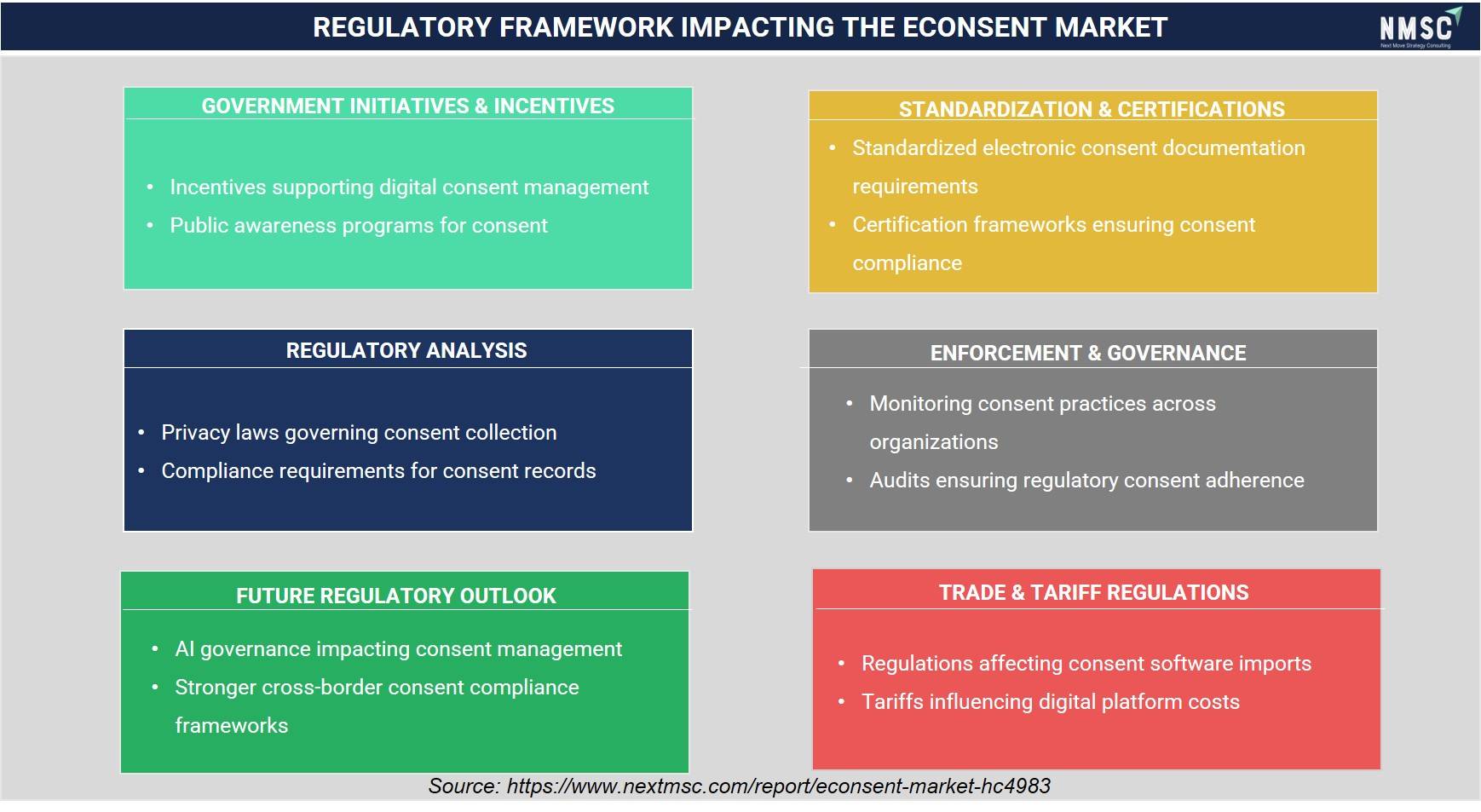
The EConsent Market is heavily influenced by evolving regulatory frameworks governing electronic records, patient privacy, informed consent, and digital healthcare operations. Regulations such as FDA 21 CFR Part 11, ICH-GCP, GDPR, HIPAA, and the EU Clinical Trials Regulation drive platform adoption by establishing requirements for secure consent documentation, audit trails, and data integrity. Government digital health initiatives and healthcare modernization programs further support market growth, while increasing focus on AI governance, cross-border data protection, and standardized electronic consent practices is expected to shape future market development and compliance requirements globally.
What Are the Growth Inhibitors of the EConsent Market?
How Does Interoperability Complexity Between EConsent Platforms and Legacy Health IT Systems Constrain EConsent Market Growth?
Interoperability challenges between eConsent platforms and legacy electronic health record, clinical data management, and site management systems represent a significant operational constraint on the EConsent Market. Many hospital and clinical trial site environments operate heterogeneous IT stacks built over decades, with limited API support and inconsistent data standards. Our assessment indicates that the cost and time required to achieve bidirectional integration between eConsent platforms and incumbent EHR vendors, EPIC, Oracle Health (Cerner), and Meditech among them, frequently extends implementation timelines and increases total cost of ownership. The U.S. Department of Health and Human Services (HHS) has acknowledged interoperability complexity as a persistent barrier to health IT adoption in its annual Health IT progress reports.
How Do Participant Digital Literacy Gaps and Technology Access Barriers Limit EConsent Market Penetration in Underserved Populations?
Digital literacy disparities and unequal access to internet-enabled devices represent structural constraints on the EConsent Market, particularly in efforts to expand clinical trial diversity and improve health equity in consent administration. The FDA's guidance on diversity in clinical trials explicitly acknowledges the need for consent processes that accommodate participants with limited technology proficiency or device access. Our findings suggest that elderly, rural, and lower-income participant populations demonstrate lower eConsent completion rates without supplementary engagement support, creating operational complexity for trial sponsors committed to representative enrollment. The National Institute on Minority Health and Health Disparities has documented these digital divide effects in federally funded research programs.
What Are the Growth Opportunities in the EConsent Market?
How Does the Expansion of Real-World Evidence Programs Create a Structural Opportunity in the EConsent Market?
The rapid expansion of real-world evidence (RWE) and real-world data (RWD) programs is creating a high-value growth opportunity in the EConsent Market. Regulatory agencies including the FDA, through its Real-World Evidence Program established under the 21st Century Cures Act, increasingly accept RWD to support drug approval and label expansion decisions, generating demand for scalable consent infrastructure that can operate across patient registries, health system networks, and claims databases. Through our analysis, we found that the FDA's framework for real-world evidence specifically requires valid consent and participant data protection protocols, making eConsent platforms essential infrastructure for the estimated 40% of FDA regulatory submissions that now incorporate RWE components.
How Do Emerging Market Clinical Trial Expansion Programs Create Growth Opportunities in the EConsent Market?
Rapid clinical trial expansion across Asia-Pacific, Latin America, and the Middle East is creating significant geographic growth opportunities in the EConsent Market. India's Central Drugs Standard Control Organisation (CDSCO) and China's National Medical Products Administration (NMPA) have both updated their clinical trial regulations to align with International Council for Harmonisation (ICH) Good Clinical Practice (GCP) standards, which incorporate electronic consent as a compliant modality. The Indian government's National Digital Health Mission and the Ministry of Health and Family Welfare's push to establish India as a global clinical research hub are generating demand for scalable, multilingual eConsent platforms capable of supporting ICH GCP-compliant operations across hundreds of research sites.
How Does the Growing Importance of Continuous Consent in Longitudinal Research and Precision Medicine Create a Platform Opportunity in the EConsent Market?
The paradigm shift from single-event informed consent to continuous consent management across longitudinal research and precision medicine programs represents a structurally new and high-value platform opportunity in the EConsent Market. Precision medicine initiatives, including the NIH's All of Us Research Program, which aims to enroll one million or more U.S. participants, require eConsent platforms capable of managing rolling re-consent as genomic findings, data sharing permissions, and study protocols evolve over years or decades. Based on our market evaluation, we noticed that these longitudinal programs create durable software subscription revenue and represent a differentiated use case that standalone paper consent or basic e-signature tools cannot support, creating a defensible market segment for purpose-built eConsent platform vendors.
Pestel Analysis of the Econsent Market
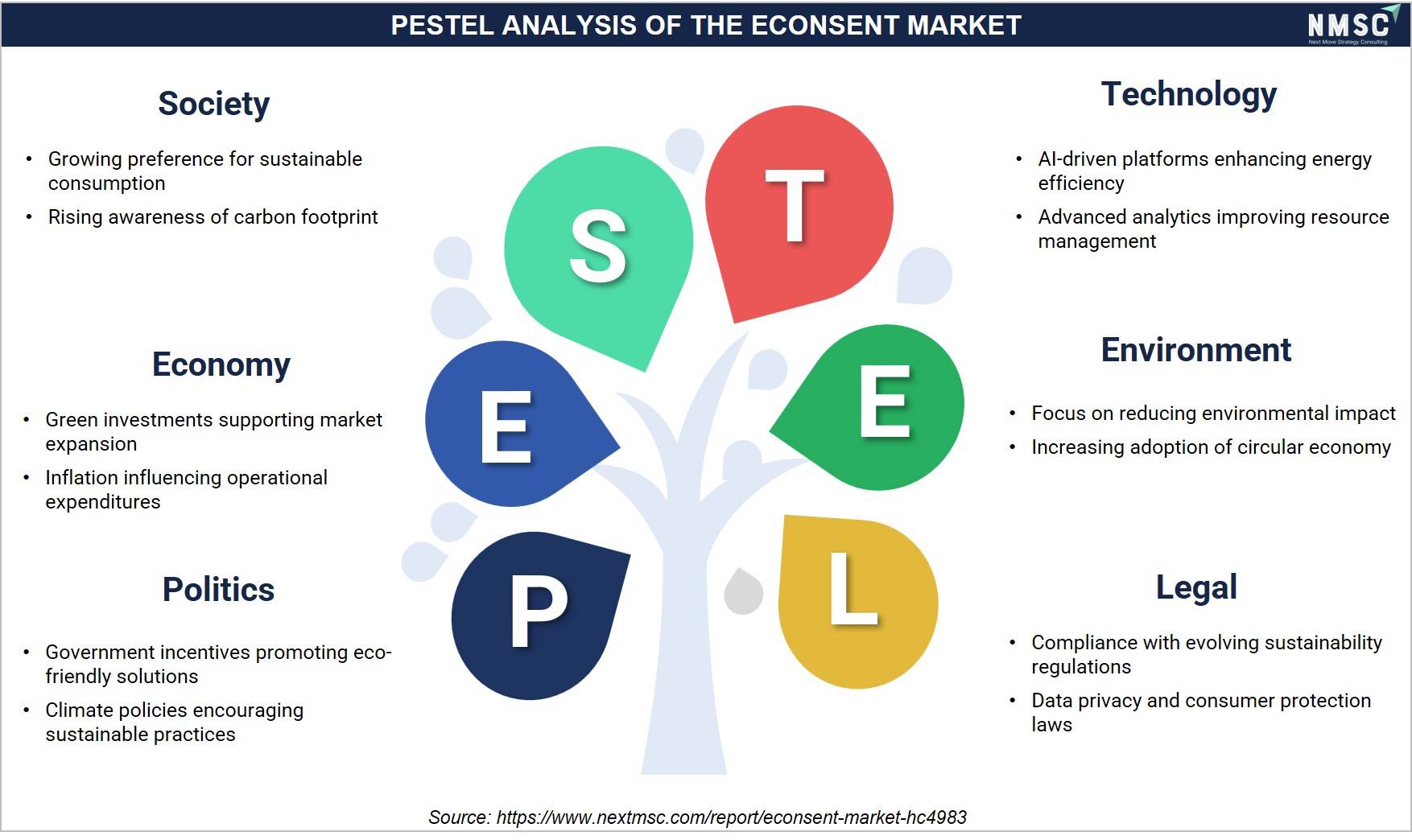
The EConsent Market is influenced by a range of political, economic, social, technological, environmental, and legal factors. Regulatory support for digital health, clinical research modernization, and electronic records adoption drives market growth, while increasing healthcare and life sciences investments strengthen demand. Rising patient expectations for convenient digital experiences support adoption, and advances in cloud computing, AI, mobile technologies, and system interoperability accelerate innovation. Environmental benefits from reduced paper usage further support digital transformation. Meanwhile, stringent legal requirements related to informed consent, privacy protection, electronic signatures, and data security remain critical determinants of vendor competitiveness and market adoption.
How Is the EConsent Market Segmented in This Report, and What Are the Key Insights from the Segmentation Analysis?
How Does Application Type Segmentation Define the Structural Composition of the EConsent Market?
|
Application Type Segment |
2025 (USD Bn) |
2035 (USD Bn) |
CAGR (%) |
|
Clinical Research EConsent |
1.09 |
4.36 |
14.8% |
|
Interventional Trials |
0.54 |
2.10 |
14.6% |
|
Observational Studies |
0.22 |
0.88 |
14.9% |
|
Registries and Real World Evidence |
0.18 |
0.76 |
15.5% |
|
Biobanks and Genomics |
0.10 |
0.46 |
16.5% |
|
Other Research |
0.05 |
0.16 |
12.3% |
|
Healthcare Delivery EConsent |
0.71 |
3.04 |
15.6% |
|
Procedure Consent |
0.28 |
1.18 |
15.4% |
|
Surgical Procedure Consent |
0.18 |
0.74 |
15.2% |
|
Diagnostic and Imaging Consent |
0.07 |
0.31 |
16.1% |
|
Other Procedure Consent |
0.03 |
0.13 |
15.8% |
|
Treatment Consent |
0.24 |
1.06 |
16.1% |
|
Medication and Therapy Consent |
0.19 |
0.82 |
15.8% |
|
Other Treatment Consent |
0.05 |
0.24 |
17.0% |
|
Financial and Administrative Consent |
0.12 |
0.58 |
17.1% |
|
Other Care Consent |
0.07 |
0.22 |
12.1% |
Based on our segmentation analysis of digital consent adoption patterns across clinical and healthcare delivery settings, we observed that the EConsent Market is divided into two principal application domains: Clinical Research EConsent and Healthcare Delivery EConsent. The Clinical Research EConsent segment is the larger of the two, valued at USD 1.09 billion in 2025 and comprising interventional trials, observational studies, registries and real-world evidence programs, biobanks and genomics initiatives, and other research categories. Interventional Trials dominate this segment due to mandatory FDA and ICH GCP regulatory requirements for audit-traceable participant consent in Phase I through IV studies. Biobanks and Genomics is the fastest-growing sub-segment, driven by national population genomics programs requiring dynamic re-consent as data use cases expand. Healthcare Delivery EConsent, valued at USD 0.71 billion in 2025, spans procedure, treatment, and financial and administrative consent categories, with Financial and Administrative Consent growing fastest as hospitals digitize revenue cycle and pre-service workflows.
How Does Delivery Setting Define Operational Architecture and Growth Dynamics in the EConsent Market?
|
Delivery Setting |
2025 (USD Bn) |
2035 (USD Bn) |
CAGR (%) |
|
On-Site |
0.88 |
2.97 |
12.9% |
|
Remote |
0.54 |
2.72 |
17.5% |
|
Hybrid |
0.38 |
1.71 |
16.2% |
Through our market analysis of delivery setting adoption across clinical research and healthcare delivery organizations, we assessed that the EConsent Market is segmented into On-Site, Remote, and Hybrid delivery settings. On-Site delivery commands the largest 2025 revenue share at USD 0.88 billion, reflecting the continued prevalence of site-based clinical trial infrastructure and traditional in-person consent workflows in hospital and ambulatory settings. Remote delivery is the fastest-growing segment at a CAGR of 17.5%, powered by the FDA's expanded acceptance of remote eConsent, the global institutionalization of decentralized clinical trials, and patient demand for convenient home-based consent completion. Hybrid delivery, combining site-based and remote modalities within a single study or care pathway, is growing at 16.2% and is increasingly preferred by sponsors seeking operational flexibility to accommodate both site-capable and remote participants within the same protocol framework.
How Do Deployment Model Preferences Shape Technology Investment Decisions in the EConsent Market?
|
Deployment Model |
2025 (USD Bn) |
2035 (USD Bn) |
CAGR (%) |
|
Cloud SaaS |
0.94 |
4.07 |
15.8% |
|
Private Hosted |
0.38 |
1.36 |
13.6% |
|
On-Premises |
0.27 |
0.67 |
9.5% |
|
Hybrid |
0.21 |
1.30 |
19.9% |
Our findings suggest that the EConsent Market's deployment landscape reflects the broader healthcare and life sciences industry's migration from on-premises infrastructure toward cloud-native service delivery. Cloud SaaS is the dominant deployment model, accounting for USD 0.94 billion in 2025, as sponsors, CROs, and health systems prioritize multi-site accessibility, automatic regulatory update propagation, and lower total cost of ownership. Private Hosted deployments remain relevant for organizations with strict data sovereignty and privacy requirements, particularly large health systems and government research entities. On-Premises deployments, while declining in share, persist in highly regulated environments where data cannot leave organizational control. Hybrid deployment is the fastest-growing model at a CAGR of 19.9%, as organizations implement blended architectures that leverage cloud efficiencies while maintaining on-premises data residency for consent records subject to jurisdiction-specific retention mandates.
How Do Revenue Stream Structures Reflect Commercial Maturity Across the EConsent Market?
|
Revenue Stream |
2025 (USD Bn) |
2035 (USD Bn) |
CAGR (%) |
|
Subscription |
0.79 |
3.26 |
15.2% |
|
Usage-Based |
0.28 |
1.29 |
16.6% |
|
Managed Service |
0.29 |
1.15 |
14.8% |
|
Professional Services |
0.32 |
1.43 |
16.2% |
|
Perpetual License |
0.12 |
0.27 |
8.5% |
Based on NMSC's research, we found that the EConsent Market is transitioning rapidly from perpetual license models toward subscription and usage-based revenue structures that align vendor incentives with customer utilization and outcome metrics. Subscription is the leading revenue stream at USD 0.79 billion in 2025, reflecting enterprise buyer preference for annual recurring cost structures and vendor commitment to continuous product development. Usage-Based pricing is gaining traction at a CAGR of 16.6%, particularly in clinical research settings where trial volume fluctuates and sponsors prefer per-consent or per-study billing that scales with portfolio activity. Professional Services revenue, encompassing implementation, localization, regulatory consulting, and ongoing support, is growing at 16.2% as the complexity of global multi-site deployments increases. Perpetual license models are declining as a percentage of total market revenue, limited to legacy deployments in on-premises environments.
Which Buyer Segments Are Driving Purchasing Decisions and Revenue Generation in the EConsent Market?
|
Buyer Type |
2025 (USD Bn) |
2035 (USD Bn) |
CAGR (%) |
|
Sponsor |
0.58 |
2.29 |
14.8% |
|
Contract Research Organization |
0.30 |
1.31 |
15.8% |
|
Site Network |
0.16 |
0.67 |
15.4% |
|
Investigator Site |
0.12 |
0.45 |
14.2% |
|
Hospital |
0.26 |
1.12 |
15.7% |
|
Health System |
0.18 |
0.82 |
16.4% |
|
Clinic |
0.09 |
0.36 |
14.9% |
|
Public Sector |
0.08 |
0.31 |
14.5% |
|
Other |
0.03 |
0.07 |
8.8% |
Our analysis shows that the EConsent Market spans a diverse buyer ecosystem that includes pharmaceutical and biotechnology sponsors, CROs, site networks, investigator sites, hospitals, health systems, clinics, and public sector research bodies. Sponsors constitute the largest buyer segment at USD 0.58 billion in 2025, given their contractual responsibility for ensuring GCP-compliant consent processes across all trial sites. CROs represent the fastest-growing clinical research buyer segment at a CAGR of 15.8%, driven by the ongoing outsourcing trend in clinical trial operations and CROs' increasing adoption of standardized eConsent platforms across their global site networks. Hospitals and health systems collectively represent the fastest-growing healthcare delivery buyer cluster, as hospital executives prioritize consent digitization to improve patient experience, reduce legal exposure, and streamline pre-procedural workflows. Health System buyers are growing at 16.4% CAGR as multi-facility organizations procure enterprise-wide consent platforms with EHR integration capabilities.
How Do Commercial Channel Structures Shape Go-to-Market Strategies in the EConsent Market?
|
Commercial Channel |
2025 (USD Bn) |
2035 (USD Bn) |
CAGR (%) |
|
Direct Enterprise Sales |
0.90 |
3.48 |
14.5% |
|
Partner-Led |
0.40 |
1.72 |
15.7% |
|
Embedded In Broader Suite |
0.28 |
1.48 |
18.2% |
|
Services-Led |
0.22 |
0.72 |
12.6% |
Through NMSC's assessment, we found that the EConsent Market's commercial channel structure reflects the specialized, high-touch nature of enterprise consent technology procurement. Direct Enterprise Sales dominates at USD 0.90 billion in 2025, appropriate for complex deployments requiring regulatory consulting, multi-site configuration, and long-term support relationships with pharmaceutical sponsors and health system executives. Partner-Led channels, including value-added resellers, systems integrators, and CRO technology partnerships, are growing steadily at 15.7% as mid-tier buyers seek implementation support through trusted regional partners. Embedded In Broader Suite is the fastest-growing channel at a CAGR of 18.2%, reflecting the strategy of EDC vendors, patient engagement platforms, and clinical operations suites to bundle eConsent as a native capability, reducing point-solution procurement and capturing bundled contract value. Services-Led channels, typically associated with managed service engagements, are growing more modestly as buyers prefer SaaS self-service models over outsourced consent management arrangements.
Regional Outlook
Geographic Performance Snapshot
|
Region |
2025 (USD Bn) |
2035 (USD Bn) |
CAGR (%) |
Key Driver |
|
North America |
0.90 |
3.50 |
14.6% |
FDA regulation, DCT adoption, clinical trial volume |
|
Europe |
0.46 |
1.73 |
14.2% |
EU CTR harmonization, hospital digitization |
|
Asia-Pacific |
0.27 |
1.48 |
18.6% |
Trial expansion, India genomics, APAC CRO growth |
|
Middle East & Africa (MEA) |
0.07 |
0.33 |
16.8% |
Health system digitization, GCC clinical research |
|
Latin America |
0.10 |
0.36 |
13.6% |
Brazil clinical trial growth, health IT investment |
North America EConsent Market
North America leads the global EConsent Market with a 2025 valuation of USD 0.90 billion, forecast to reach USD 3.50 billion by 2035 at a CAGR of 14.6%. The region benefits from the world's highest concentration of clinical trial activity, a mature FDA regulatory framework that formally accepts eConsent, and an advanced hospital digital infrastructure supported by decades of EHR meaningful use investment. The FDA's ongoing guidance expansion covering remote consent, decentralized trials, and real-world evidence is continuously reinforcing eConsent adoption. NMSC's analysis indicates that the presence of all major global CROs and the majority of top-20 pharmaceutical companies' clinical operations headquarters in North America creates a concentrated, high-value procurement cluster that sustains platform vendor investment and innovation in the region.
U.S. EConsent Market
Based on our engagements with market participants, the United States is the single largest country-level market in the EConsent Market, representing over 75% of North American revenue in 2025. The U.S. benefits from the world's highest clinical trial volume documented in ClinicalTrials.gov, the FDA's comprehensive eConsent regulatory framework under 21 CFR Part 11, and the ONC's FHIR-based interoperability mandates that drive EHR integration. Enterprise procurement by large hospital networks including HCA Healthcare and CommonSpirit Health is expanding the healthcare delivery eConsent segment. The NIH's All of Us Research Program and the National Cancer Institute's clinical trial network create sustained federal demand for scalable, compliant consent infrastructure across both academic and community research sites.
Canada EConsent Market
Through our analysis, Canada represents approximately 15% of North American EConsent Market revenue and demonstrates strong adoption of eConsent in both clinical research and hospital settings. Health Canada's adoption of ICH E6(R3) Good Clinical Practice guidelines aligns with FDA and EMA standards, creating a regulatory environment conducive to cross-border eConsent platform deployment. The Canadian Institutes of Health Research (CIHR) funds extensive clinical trials through university-affiliated academic health centers, creating institutional demand for research-grade eConsent. Provincial health system digitization programs, particularly in Ontario and British Columbia, are accelerating healthcare delivery eConsent adoption as hospitals pursue integrated digital consent aligned with provincial EHR initiatives.
Mexico EConsent Market
From our assessment, Mexico is the fastest-growing market within North America in the EConsent Market, driven by the expansion of its clinical research sector and growing hospital digitization. COFEPRIS, Mexico's Federal Commission for the Protection against Sanitary Risks, regulates clinical trials under standards increasingly aligned with ICH GCP principles, supporting eConsent adoption by multinational sponsors conducting trials at Mexican sites. Significant pharmaceutical manufacturing capacity and a growing network of private hospital groups including Hospital Ángeles and CIMA are creating healthcare delivery eConsent demand. Government investment in digital health through the Secretariat of Health's digital transformation initiatives is expanding institutional awareness and readiness for electronic consent platforms.
Europe EConsent Market
Europe is the second-largest region in the EConsent Market, valued at USD 0.46 billion in 2025 and forecast to reach USD 1.73 billion by 2035 at a CAGR of 14.2%. The EU Clinical Trials Regulation (CTR) 536/2014, fully operational since January 2023, creates a harmonized clinical trial approval framework across EU member states and establishes standardized requirements for informed consent documentation and electronic management. European hospital digitization programs funded through EU structural funds and national recovery plans are expanding healthcare delivery eConsent adoption. The GDPR imposes strict requirements on personal data processing inherent in consent transactions, compelling vendors to offer data minimization, audit trail management, and right-to-withdraw workflows as core platform capabilities.
UK EConsent Market
Based on our engagements, the United Kingdom represents Europe's largest individual country EConsent Market, accounting for approximately 22% of European revenue in 2025. The Medicines and Healthcare products Regulatory Agency (MHRA) has published specific guidance on electronic consent in clinical trials, and the NHS England's clinical trial strategy explicitly promotes eConsent adoption to accelerate participant recruitment. The UK Biobank, which manages consent for over 500,000 participants, and the 100,000 Genomes Project represent high-profile eConsent deployments that demonstrate platform scale and regulatory maturity. NHS Trust digital transformation programs under NHS England's Long Term Plan are driving healthcare delivery eConsent adoption across major acute hospital networks.
Germany EConsent Market
Through our analysis, Germany is the second-largest European EConsent Market, driven by its globally significant pharmaceutical industry, including Bayer, Boehringer Ingelheim, and Merck KGaA, which generate substantial clinical trial eConsent demand. The German Drug Law (AMG) governs clinical trial conduct and consent requirements, aligned with EU CTR standards. Germany's hospital sector, encompassing over 1,900 facilities, is experiencing accelerating digital health investment supported by the Hospital Future Act (Krankenhauszukunftsgesetz), which allocated EUR 3 billion to hospital digitization, creating a structural demand driver for healthcare delivery eConsent. The Federal Data Protection Act (BDSG) imposes GDPR-equivalent and supplementary consent data management requirements that favor purpose-built eConsent platforms with German-language compliance frameworks.
France EConsent Market
From our assessment, France is a significant European EConsent Market, distinguished by a strong public health research infrastructure led by INSERM and the AP-HP hospital network, which collectively conduct extensive clinical trials requiring regulatory-grade consent management. The French National Agency for the Safety of Medicines (ANSM) regulates clinical trial consent under CTR 536/2014 and French-specific provisions. France's Ségur du Numérique in Health program has allocated EUR 2 billion to hospital digital transformation, including EHR modernization and integrated patient consent management, creating structural demand for healthcare delivery eConsent. The CNIL enforces GDPR with particular attention to healthcare data, compelling eConsent vendors to offer certified GDPR-compliant architectures.
Italy EConsent Market
According to evaluation, Italy's EConsent Market is expanding as the Italian Medicines Agency (AIFA) aligns clinical trial oversight with EU CTR requirements and as public hospital networks pursue digital health investments through the National Recovery and Resilience Plan (PNRR). The PNRR has directed significant funding to digitizing healthcare administrative processes, including patient consent workflows, within the Servizio Sanitario Nazionale. The Garante per la protezione dei dati personali, Italy's data protection authority, enforces stringent GDPR compliance in healthcare data processing, creating demand for eConsent platforms with comprehensive audit trail and data subject rights management capabilities.
Spain EConsent Market
Based on our market evaluation, Spain is a growing EConsent Market driven by expanding clinical research activity through the Hospital General Universitario Gregorio Marañón network, VHIR, and private CRO operations serving multinational sponsors. The Spanish Agency for Medicines and Medical Devices (AEMPS) implements EU CTR requirements, and Spain has established itself as a competitive clinical trial location within Europe. The Spanish National Health System's digital health strategy, Estrategia de Salud Digital del SNS, is directing investment toward integrated patient consent management across public hospital networks. The Agencia Española de Protección de Datos (AEPD) enforces GDPR compliance, reinforcing demand for audit-traceable eConsent platforms.
Sweden EConsent Market
Through our analysis, Sweden's EConsent Market benefits from a world-class clinical research ecosystem anchored by Karolinska Institutet and AstraZeneca's R&D headquarters in Södertälje. The Medical Products Agency (Läkemedelsverket) governs clinical trial consent under EU CTR standards. Sweden's comprehensive personal health data registries, among the most advanced globally, create structured demand for eConsent platforms that can manage longitudinal consent across registry linkage programs. The Swedish Authority for Privacy Protection (IMY) enforces GDPR, and Sweden's high digital literacy among both healthcare professionals and patients supports rapid adoption of remote and hybrid eConsent modalities.
Denmark EConsent Market
From our assessment, Denmark maintains a sophisticated clinical research environment supported by the Danish Medicines Agency (Lægemiddelstyrelsen) and a nationally integrated health data infrastructure that underpins extensive observational and registry-based research requiring eConsent management. Denmark's publicly funded biobank network and the Danish National Patient Registry create institutional demand for scalable, long-term consent management platforms. The Danish Data Protection Agency (Datatilsynet) enforces GDPR with a focus on healthcare data, and Denmark's high digital health maturity facilitates remote eConsent adoption across both clinical and healthcare delivery settings.
Finland EConsent Market
Based on our engagements, Finland is a specialized but high-value EConsent Market, notable for its FinnGen genomics program, a flagship collaboration between the University of Helsinki and Biobank Finland that has consented and biosampled over 500,000 Finnish participants. This program represents one of Europe's largest national biobank eConsent deployments and demonstrates Finland's strategic commitment to population genomics research infrastructure. Fimea, Finland's Medicines Agency, governs clinical trial consent under EU CTR. Finland's Digital Health Village platform and national patient data registry (Kanta) are driving healthcare delivery eConsent integration with national health information architecture.
Netherlands EConsent Market
Through our market assessment, the Netherlands operates a commercially active clinical research environment, supported by leading academic medical centers including Amsterdam UMC, Erasmus MC, and Radboudumc, which collectively conduct hundreds of clinical trials annually requiring eConsent management. The Dutch Medicines Evaluation Board (CBG) implements EU CTR standards, and the Netherlands is a frequent first-approval country for multinational EU trial applications. The Dutch Authority for the Personal Data (Autoriteit Persoonsgegevens) enforces GDPR with particular scrutiny on healthcare data controllers. The Netherlands' Health Data Space initiative aligns with the European Health Data Space regulation, creating demand for interoperable eConsent platforms compatible with federated health data governance frameworks.
Rest of Europe EConsent Market
According to evaluation, the rest of Europe encompasses clinical research and healthcare delivery markets in Belgium, Switzerland, Austria, Poland, the Czech Republic, and other EU and non-EU countries, collectively generating meaningful EConsent Market revenue. Switzerland, as a major global pharmaceutical R&D hub for Novartis and Roche, generates substantial eConsent demand through multinational trial programs governed by Swissmedic. Belgium's clinical research sector, supported by UCB, Janssen (Belgium), and KU Leuven's clinical trial network, is an active eConsent adopter. Central and Eastern European countries including Poland and the Czech Republic are growing clinical trial destinations with increasing eConsent platform penetration as local regulations align with EU CTR requirements.
Asia-Pacific EConsent Market
Asia-Pacific is the fastest-growing major region in the EConsent Market at a CAGR of 18.6%, advancing from USD 0.27 billion in 2025 to USD 1.48 billion by 2035. The region's growth is driven by rapidly expanding clinical trial activity in China, India, South Korea, Japan, and Australia, accelerating hospital digitization programs, and the regulatory maturation of eConsent acceptance across major national medicines agencies. NMSC's analysis indicates that Asia-Pacific's large and diverse participant population base, combined with increasingly ICH GCP-aligned regulatory environments, is attracting global pharmaceutical sponsors to expand their clinical research operations across the region, generating sustained demand for scalable, multilingual eConsent platforms.
China EConsent Market
Based on our engagements, China is the largest Asia-Pacific EConsent Market by revenue, reflecting its position as the world's second-largest clinical research market after the United States. The National Medical Products Administration (NMPA) has progressively aligned Chinese clinical trial regulations with ICH E6 GCP standards, formally accepting electronic consent in clinical research settings. China's 14th Five-Year Plan for healthcare explicitly promotes hospital digital transformation, including electronic patient consent management across tier-3 hospital networks. The Personal Information Protection Law (PIPL), effective November 2021, imposes comprehensive data protection requirements on healthcare consent data, mandating purpose limitation, data minimization, and audit trail integrity that drive adoption of purpose-built eConsent platforms.
India EConsent Market
Through our analysis, India is the fastest-growing national EConsent Market in Asia-Pacific at a CAGR of 21.4%, driven by the Central Drugs Standard Control Organisation's (CDSCO) alignment of Indian clinical trial regulations with ICH GCP E6(R2) standards and the Indian government's strategic initiative to expand India's share of global clinical trial activity. The Ministry of Health and Family Welfare's clinical trial framework explicitly references informed consent requirements, and the Digital Personal Data Protection Act (DPDP Act 2023) establishes legal obligations for healthcare data processing that favor structured eConsent platforms. The National Digital Health Mission (ABDM) is building interoperable digital health infrastructure that creates integration opportunities for eConsent platforms connecting with the Health ID and clinical data exchange ecosystem.
Japan EConsent Market
From our assessment, Japan maintains a mature and high-compliance EConsent Market governed by the Pharmaceuticals and Medical Devices Agency (PMDA), which implements ICH GCP E6 standards and has progressively accepted electronic consent modalities for clinical trials. Japan's pharmaceutical industry, anchored by Takeda, Astellas, Eisai, and Daiichi Sankyo, generates substantial domestic clinical trial eConsent demand. The Act on the Protection of Personal Information (APPI), administered by the Personal Information Protection Commission (PPC), governs healthcare consent data with stringent requirements. Japan's advanced hospital digitization, supported by the Ministry of Health, Labour and Welfare's eHealth initiatives, is creating growing healthcare delivery eConsent demand across major national university hospitals and large private hospital chains.
South Korea EConsent Market
Based on our market evaluation, South Korea is a dynamic and fast-growing EConsent Market within Asia-Pacific, benefiting from the Ministry of Food and Drug Safety's (MFDS) progressive regulatory stance on clinical trial digitization and growing investment by Samsung Biologics, Celltrion, and LG Chem's Life Sciences division in biopharmaceutical R&D. South Korea's Hospital Information System infrastructure, among the most advanced in Asia-Pacific, supports rapid healthcare delivery eConsent adoption across major hospital groups. The Personal Information Protection Act (PIPA) imposes strict data consent and privacy requirements, driving demand for compliant eConsent platforms with Korean-language regulatory documentation. South Korea's government-funded clinical trial network, encompassing over 1,500 registered sites, creates a scalable institutional demand base.
Taiwan EConsent Market
Through our analysis, Taiwan is a growing clinical research market with an active pharmaceutical sector and robust regulatory framework administered by the Taiwan Food and Drug Administration (TFDA). Taiwan's well-developed hospital infrastructure, including National Taiwan University Hospital and Taipei Veterans General Hospital, supports clinical trial eConsent adoption in both research and care delivery settings. The Personal Data Protection Act (PDPA) regulates healthcare data management, creating compliance requirements for eConsent platforms. Taiwan's biopharmaceutical sector, supported by government-backed biomedical industry programs, is generating growing demand for compliant eConsent infrastructure aligned with ICH GCP standards.
Indonesia EConsent Market
According to evaluation, Indonesia is an emerging EConsent Market with growing clinical research activity and accelerating hospital digital transformation supported by the Ministry of Health's digital health transformation program, Transformasi Kesehatan. The National Agency of Drug and Food Control (BPOM) regulates clinical trials in alignment with ASEAN Common Technical Dossier standards, and eConsent adoption is expanding as multinational sponsors include Indonesian sites in Asia-Pacific trial programs. The Personal Data Protection Law, enacted in 2022, establishes foundational healthcare data protection requirements. Indonesia's large population and government investment in national health insurance digitization through BPJS Kesehatan are creating structural long-term eConsent demand.
Vietnam EConsent Market
Based on our engagements, Vietnam is an emerging clinical research destination with growing EConsent Market potential, driven by the Ministry of Health's efforts to expand clinical trial capacity and attract global pharmaceutical sponsors. The Drug Administration of Vietnam (DAV) regulates clinical trials under standards increasingly aligned with ASEAN harmonization frameworks. Vietnam's young and growing population, combined with a high burden of infectious and non-communicable diseases, makes it an attractive location for multinational clinical programs. Government investment in health information technology through the National E-Health Strategy is progressively building the digital infrastructure needed to support eConsent adoption across public hospital networks.
Australia EConsent Market
From our assessment, Australia maintains a mature EConsent Market supported by the Therapeutic Goods Administration (TGA), which regulates clinical trial consent under ICH GCP standards and has issued specific guidance on the use of electronic informed consent in clinical trials. Australia's network of National Health and Medical Research Council (NHMRC)-funded academic medical centers and the Australian Clinical Trials Alliance (ACTA) create a well-organized institutional demand base. The Privacy Act 1988 and the Australian Privacy Principles govern healthcare data, and the Office of the Australian Information Commissioner (OAIC) provides guidance on digital health data management. Australia's My Health Record national health data system is driving hospital eConsent integration opportunities aligned with national digital health infrastructure.
Philippines EConsent Market
Through our analysis, the Philippines is a growing clinical research and healthcare delivery EConsent Market, supported by the Food and Drug Administration Philippines' (FDA Philippines) regulatory framework for clinical trials and a large public and private hospital sector. The government's Universal Health Care Act is driving hospital digitization investments that include patient consent management as part of broader health information system upgrades. The Data Privacy Act of 2012, enforced by the National Privacy Commission, establishes healthcare data protection requirements applicable to eConsent deployments. Growing multinational pharmaceutical and CRO activity at major research hospitals in Manila and Cebu is expanding clinical trial eConsent demand.
Malaysia EConsent Market
Based on our market evaluation, Malaysia is an active clinical research market with a sophisticated regulatory environment governed by the National Pharmaceutical Regulatory Agency (NPRA), aligned with ICH GCP and ASEAN Common Technical Dossier standards. Malaysia's pharmaceutical industry, anchored by Pharmaniaga and growing multinational research activity, generates clinical trial eConsent demand across major hospital research centers including Hospital Kuala Lumpur and University Malaya Medical Centre. The Personal Data Protection Act (PDPA) 2010 governs healthcare data processing. Malaysia's MyDIGITAL initiative and the Ministry of Health's Health White Paper 2023 are directing investment toward hospital digital transformation programs that include structured patient consent management.
Rest of Asia-Pacific EConsent Market
According to evaluation, the rest of Asia-Pacific includes New Zealand, Thailand, Singapore, Hong Kong, and other markets that collectively contribute meaningful EConsent Market revenue. Singapore, as a leading Asia-Pacific biopharmaceutical hub and home to the Health Sciences Authority (HSA), generates concentrated clinical trial eConsent demand from major pharmaceutical manufacturers and CRO regional headquarters. New Zealand's research-aligned regulatory framework, administered by MedSafe, and Thailand's growing CRO sector under the Food and Drug Administration (FDA Thailand) represent additional regional adoption drivers. Across the rest of APAC, eConsent adoption is progressing in parallel with broader clinical research sector development and national digital health infrastructure investments.
Middle East and Africa (MEA) EConsent Market
The Middle East and Africa region represents a rapidly developing EConsent Market, valued at USD 0.07 billion in 2025 and forecast to reach USD 0.33 billion by 2035 at a CAGR of 16.8%. The Gulf Cooperation Council (GCC) countries, particularly Saudi Arabia and the UAE, are driving regional growth through substantial healthcare infrastructure investment, national digital health transformation programs, and increasing ambition to participate in global clinical research networks. NMSC's analysis indicates that Africa's growing pharmaceutical sector, expanding hospital networks, and the African Medicines Agency's (AMA) progressive harmonization of regulatory standards across member states are creating medium-term eConsent adoption drivers.
Saudi Arabia EConsent Market
Based on our engagements, Saudi Arabia is the largest MEA EConsent Market by revenue, driven by Vision 2030 healthcare transformation investments and the Saudi Food and Drug Authority's (SFDA) alignment with ICH GCP standards for clinical trial oversight. King Faisal Specialist Hospital and Research Centre and King Abdullah International Medical Research Center (KAIMRC) represent major institutional clinical research consumers of eConsent platforms. The National Data Governance Interim Regulations, administered by the Saudi Authority for Data and Artificial Intelligence (SDAIA), establish data privacy and consent management requirements applicable to healthcare settings. Saudi Arabia's National Transformation Program is directing significant investment toward hospital digitization programs that include integrated patient consent management.
UAE EConsent Market
Through our analysis, the UAE is a dynamic EConsent Market with growing clinical research activity coordinated through the Dubai Health Authority (DHA) and the Abu Dhabi Department of Health (DoH). The UAE's strategic positioning as a regional healthcare hub, anchored by Cleveland Clinic Abu Dhabi and Mediclinic Middle East, is attracting multinational clinical trial programs that require GCP-compliant eConsent infrastructure. The UAE Personal Data Protection Law, Federal Decree-Law No. 45 of 2021, governs healthcare consent data processing. The UAE National Digital Health Strategy is driving hospital digital transformation investments that include integrated patient consent workflows across Dubai and Abu Dhabi's hospital networks.
Egypt EConsent Market
From our assessment, Egypt is the largest clinical research market in North Africa within the EConsent Market context, with the Egyptian Drug Authority (EDA) governing clinical trial conduct under GCP-aligned standards. Cairo University Hospitals, Ain Shams University Medical Center, and private hospital groups represent the primary clinical research and healthcare delivery eConsent consumers. Egypt's health sector reform program, supported by the Universal Health Insurance Law, is driving hospital digitization investments. The country's large population and high disease burden in oncology, cardiovascular, and respiratory conditions make it an attractive clinical trial location for multinational sponsors and an emerging eConsent adoption market.
Israel EConsent Market
Based on our market evaluation, Israel is a technologically advanced EConsent Market with a globally recognized pharmaceutical and medical device industry led by Teva Pharmaceutical Industries, along with active clinical research at major medical centers including Sheba Medical Center and Hadassah Medical Organization. The Ministry of Health's Israel Medical Products Administration (IMPA) governs clinical trials under ICH GCP standards. Israel's national digital health infrastructure, including the Clalit and Maccabi health maintenance organizations' integrated EHR networks, provides a sophisticated platform for healthcare delivery eConsent integration. The Protection of Privacy Law governs healthcare data handling, and Israel's health technology innovation ecosystem supports local eConsent platform development.
Turkey EConsent Market
Through our analysis, Turkey is a significant emerging EConsent Market within the MEA region, driven by its position as a major clinical trial destination for European and multinational sponsors facilitated by the Turkish Medicines and Medical Devices Agency (TÍTCK). Turkey's large and diverse patient population, extensive hospital network including the Istanbul and Ankara University hospital complexes, and competitive site costs attract significant Phase II–IV trial activity. The Personal Data Protection Law (KVKK) establishes healthcare consent data processing requirements aligned with GDPR principles. Turkey's national e-health transformation program, encompassing EHR deployment across public hospitals, is creating integration opportunities for healthcare delivery eConsent platforms.
Nigeria EConsent Market
According to evaluation, Nigeria represents an emerging EConsent Market with growing clinical research potential anchored by the University of Lagos Teaching Hospital, Lagos University Teaching Hospital, and federally funded research programs. The National Agency for Food and Drug Administration and Control (NAFDAC) governs clinical trial conduct in alignment with WHO GCP guidelines. The Nigeria Data Protection Regulation (NDPR), administered by the Nigeria Data Protection Commission (NDPC), establishes healthcare data consent requirements. Nigeria's significant disease burden, including infectious diseases, malaria, and non-communicable conditions, creates demand for clinical trial programs and the eConsent infrastructure to support them as the country's health research capacity expands.
South Africa EConsent Market
Based on our engagements, South Africa is the most developed EConsent Market in sub-Saharan Africa, supported by a sophisticated clinical research infrastructure led by the South African Health Products Regulatory Authority (SAHPRA), which aligns with ICH GCP standards and has been progressively implementing electronic clinical trial submissions. Major academic medical centers including Groote Schuur Hospital, Steve Biko Academic Hospital, and the Nelson Mandela School of Medicine Research programs conduct substantial clinical trial activity. The Protection of Personal Information Act (POPIA), enforced by the Information Regulator, governs healthcare consent data processing. South Africa's public sector health information system modernization is creating demand for interoperable healthcare delivery eConsent platforms.
Rest of MEA EConsent Market
Through our analysis, the rest of the MEA region includes Kuwait, Bahrain, Oman, Qatar, Jordan, Morocco, Kenya, Ethiopia, Ghana, and other markets with varying levels of clinical research activity and healthcare digitization. Qatar's Hamad Medical Corporation and Sidra Medicine represent high-specification clinical research environments with growing eConsent adoption. Jordan's Clinical Research Organization ecosystem and Royal Medical Services are expanding trial activity. Kenya's KEBS and Morocco's ANAM are progressively aligning with international GCP standards. These markets collectively represent medium-term growth opportunities for eConsent vendors as regional healthcare investment expands and research infrastructure matures.
Latin America EConsent Market
Latin America represents a growing EConsent Market valued at USD 0.10 billion in 2025 and forecast to reach USD 0.36 billion by 2035 at a CAGR of 13.6%. The region's growth is anchored by Brazil and Argentina, which collectively account for over 70% of Latin American clinical trial activity, with growing contributions from Chile, Colombia, and Mexico. Our assessment indicates that ICH GCP alignment across major LATAM regulatory authorities, combined with large and genetically diverse participant populations and competitive clinical site operating costs, is attracting increasing multinational trial investment. Hospital digitization programs in Brazil and Chile, supported by national health information technology strategies, are creating healthcare delivery eConsent adoption drivers alongside the clinical research segment.
Brazil EConsent Market
Based on our engagements, Brazil is the dominant Latin American EConsent Market, supported by ANVISA's (National Health Surveillance Agency) robust clinical trial regulatory framework and Brazil's status as the most active clinical research location in the region. ANVISA has implemented GCP-aligned eConsent acceptance within its clinical trial resolution frameworks, and major research hospital networks including Hospital Sírio-Libanês, Hospital Albert Einstein, and the Oswaldo Cruz Foundation (FIOCRUZ) drive institutional eConsent demand. The Brazilian General Data Protection Law (LGPD), enforced by the National Data Protection Authority (ANPD), establishes healthcare consent data processing requirements. Brazil's RNDS national health data network creates integration opportunities for healthcare delivery eConsent platforms connected with the national digital health infrastructure.
Argentina EConsent Market
Through our analysis, Argentina is the second-largest Latin American EConsent Market, with ANMAT (National Administration of Drugs, Foods and Medical Devices) governing clinical trials under GCP-aligned standards. Argentina has a well-established clinical research sector with major academic medical centers in Buenos Aires and Córdoba conducting Phase II–IV trials for global pharmaceutical sponsors. The Personal Data Protection Law No. 25,326 regulates healthcare data processing, and Argentina's evolving data protection framework is being updated toward GDPR equivalency under proposed reforms. Growing hospital digitization investment within the Argentine public health system is creating emerging healthcare delivery eConsent demand alongside the established clinical research segment.
Chile EConsent Market
From our assessment, Chile operates one of Latin America's most mature clinical research regulatory environments under the Instituto de Salud Pública (ISP), which maintains ICH GCP-aligned clinical trial oversight. Chile's high healthcare literacy, relatively concentrated urban population in Santiago, and well-equipped clinical research centers including Hospital Clínico de la Universidad de Chile and Clínica Alemana make it an efficient clinical trial location. The Data Protection Law No. 19,628, currently undergoing comprehensive reform toward GDPR alignment, governs personal data in healthcare consent settings. Chile's Red de Salud UC CHRISTUS and other private health networks are investing in hospital digitization programs that include electronic patient consent management.
Colombia EConsent Market
Based on our market evaluation, Colombia is a growing clinical research and healthcare delivery EConsent Market, governed by INVIMA (National Institute for Drug and Food Surveillance) under GCP-aligned clinical trial regulations. Colombia's large urban population in Bogotá, Medellín, and Cali, combined with a mixed public-private healthcare system including major hospital groups such as Grupo Keralty and Fundación Cardioinfantil, creates both clinical research and healthcare delivery eConsent demand. The Statutory Law 1581 of 2012 on personal data protection and the Decree 1377 of 2013 govern healthcare data processing. Colombia's growing biopharmaceutical sector and increasing participation in multinational clinical trial programs are expanding eConsent platform adoption in the country.
Rest of Latin America EConsent Market
According to evaluation, the rest of Latin America encompasses Peru, Ecuador, Venezuela, Panama, Uruguay, and other markets with emerging clinical research and healthcare digitization profiles. Peru's regulatory authority DIGEMID and Ecuador's ARCSA are aligning with international GCP standards, and both countries host growing clinical trial activity for multinational sponsors seeking diverse participant populations. Panama's advanced healthcare infrastructure, anchored by the Instituto Oncológico Nacional and Hospital Nacional, supports clinical research eConsent adoption. Uruguay's progressive data protection law and high digital literacy support eConsent deployment in both clinical and healthcare delivery settings, while other regional markets are at earlier stages of digital health investment that will drive medium-term eConsent adoption.
Competitive Landscape
Competitive Dynamics and M&A Landscape in the EConsent Market
|
Key Takeaways |
Details |
|
Market Structure |
The EConsent Market features multi-tiered competition among clinical trial technology providers, CRO-integrated solution vendors, decentralized clinical trial (DCT) platforms, and healthcare delivery software providers. Leading companies such as Veeva Systems, Medidata, IQVIA, and Signant Health compete on platform breadth, regulatory compliance capabilities, and integration across clinical research workflows, while specialized vendors focus on decentralized trials, healthcare delivery, and site-centric eConsent solutions. |
|
Innovation Focus |
Innovation in the EConsent Market is centered on decentralized clinical trial enablement, remote patient onboarding, AI-assisted consent comprehension, multilingual consent workflows, mobile-first patient engagement, and seamless integration with EDC, eTMF, CTMS, and broader eClinical platforms. Vendors are increasingly investing in patient-centric digital experiences, real-time compliance monitoring, and automation technologies to improve enrollment efficiency and participant retention. |
|
M&A Activity |
Strategic partnerships, platform integrations, and technology consolidation continue to shape the EConsent Market as vendors seek to expand capabilities across clinical trial operations and digital health ecosystems. Market participants are increasingly embedding eConsent functionality within broader clinical research, patient engagement, and healthcare workflow platforms to strengthen competitive positioning and deliver end-to-end digital trial solutions. |
How Do Companies Compete in the EConsent Market?
The EConsent Market is characterized by multi-tiered competition among clinical trial technology providers, eClinical platform vendors, contract research organizations (CROs), decentralized clinical trial (DCT) specialists, and healthcare-focused consent solution providers. Full-suite platform vendors such as Veeva Systems, Medidata, IQVIA, and Signant Health compete on breadth of integrated clinical research capabilities, regulatory compliance expertise, and global deployment scale. Specialized providers including Medable, Florence Healthcare, Suvoda, YPrime, and OpenClinica differentiate on decentralized trial enablement, patient engagement functionality, and workflow-specific innovation. Healthcare-focused vendors such as Interlace Health and Magentus compete on digital consent solutions tailored to hospital and healthcare delivery environments.
Which Kind of Companies Dominate the EConsent Market?
Three distinct categories of companies dominate the EConsent Market. First, integrated clinical research platform providers including Veeva Systems, Medidata Solutions, IQVIA, and Signant Health leverage comprehensive eClinical ecosystems to deliver end-to-end consent, data capture, and trial management capabilities. Second, decentralized clinical trial and patient engagement specialists such as Medable, Science 37, ObvioHealth, Florence Healthcare, and Suvoda provide purpose-built solutions focused on remote participation, patient-centric workflows, and digital trial execution. Finally, healthcare and site-focused providers including Interlace Health, Magentus, Castor, OpenClinica, and Sitero deliver specialized eConsent solutions designed for healthcare organizations, academic research institutions, and site-level clinical operations.
AI-Enabled Patient Engagement and Regulatory Compliance Drive Market Success in the EConsent Market
Innovation focus across the EConsent Market is concentrated in remote and hybrid consent delivery, AI-powered participant comprehension assessment, multilingual consent workflows, decentralized clinical trial enablement, and seamless integration with EDC, CTMS, eTMF, EHR, and broader eClinical platforms. Vendors that successfully combine patient-centric digital experiences with strong regulatory compliance capabilities are capturing premium market opportunities and expanding adoption across both clinical research and healthcare delivery environments. Advanced audit trail functionality, dynamic re-consent capabilities, and mobile-first engagement tools are emerging as key differentiators among leading vendors.
Market Players to Opt for Platform Expansion and Strategic Acquisition Strategies to Strengthen Their Presence in the EConsent Market
Strategic partnerships, platform integrations, and acquisition activity continue to reshape the competitive landscape of the EConsent Market. Leading vendors are expanding their capabilities through the integration of eConsent functionality into broader clinical trial management, patient engagement, and healthcare workflow ecosystems. Clinical technology providers are increasingly pursuing platform consolidation strategies to offer unified eClinical environments, while CROs and decentralized trial specialists continue to strengthen their digital consent capabilities through technology investments and partnership agreements. Continued consolidation is expected as vendors seek to expand geographic reach, strengthen compliance capabilities, and deliver end-to-end digital trial solutions.
Who Are the Key Market Players in the EConsent Market?
-
Veeva Systems
-
Medidata Solutions, Inc.
-
IQVIA
-
Signant Health
-
Medable, Inc.
-
Florence Healthcare
-
Suvoda
-
YPrime, LLC
-
Medrio Inc.
-
OpenClinica, Inc.
-
Castor
-
Parexel International (MA) Corporation
-
Fountayn
-
Science 37
-
ObvioHealth USA, Inc.
-
Cloudbyz, Inc.
-
Clinion AI Technologies Pvt Ltd
-
Sitero
-
Magentus
-
Interlace Health
What Are the Latest Developments in the EConsent Market?
|
Date |
Event |
|
October 2025 |
Medidata unveiled its next-generation Medidata Consent innovations, developed with clinicians and patient advocates to improve patient enrollment, simplify consent management, and strengthen compliance across clinical trials. This is one of the most direct eConsent-specific product announcements in the market. |
Expert Insights
 “SiteVault eConsent makes the process easy for our patients and allows us to break down the barriers of paper and location, expanding the reach of our study.”
— Charles Sydnor, Project Manager, Croofoot Research Center
Statement made in Veeva SiteVault eConsent customer testimonial published on Veeva's official website
Market Interpretation
This industry-wide perspective highlights the strategic value proposition of eConsent technologies. The emphasis on multimedia communication, patient empowerment, compliance, and operational efficiency aligns directly with the current evolution of digital clinical trial ecosystems. The statement supports the long-term growth outlook for eConsent solutions as regulators and sponsors seek more transparent, patient-friendly consent processes.
What Are the Investment Opportunities in the EConsent Market?
How Are Capital Inflows Shaping Platform Development in the EConsent Market?
The EConsent Market has attracted sustained private equity and venture capital investment, reflecting the recurring revenue characteristics of subscription-based consent platforms, the regulatory defensibility of established deployments, and the durable secular growth drivers of clinical trial expansion and hospital digitization. Our assessment indicates that investment activity has concentrated in two primary archetypes: growth equity into scaling eClinical platform vendors seeking to expand eConsent capabilities as part of broader suite strategies, and early-stage venture investment into AI-native and mobile-first consent platforms targeting underserved participant populations and emerging market clinical research expansion. The shift toward decentralized clinical trials has elevated eConsent from a compliance tool to a strategic patient engagement asset, attracting investor interest from both health IT and digital health fund categories.
How Do Infrastructure Investments in Digital Health Ecosystems Create Downstream EConsent Market Opportunities?
National digital health infrastructure investments across the United States, European Union, India, and the Middle East are creating downstream eConsent platform opportunities by building the interoperability and identity management foundations on which scalable eConsent systems depend. The U.S. ONC's 21st Century Cures Act interoperability mandates are compelling hospital systems to implement FHIR-native data exchange that facilitates eConsent platform integration with EHR workflows. India's Ayushman Bharat Digital Mission (ABDM) is establishing the national patient health ID infrastructure that eConsent platforms can leverage for participant verification. Through NMSC's assessment, we found that vendors positioned to align their integration architectures with these national digital health infrastructure programs gain privileged access to government-funded procurement pipelines.
How Do ESG Considerations Influence Investment in the EConsent Market?
Environmental, Social, and Governance (ESG) considerations are emerging as meaningful investment criteria in the EConsent Market, particularly around the social dimensions of participant equity, clinical trial diversity, and equitable healthcare access. The FDA's guidance on increasing diversity in clinical trials highlights the need for consent processes that accommodate diverse participant backgrounds, literacy levels, and technology access, creating demand for eConsent platforms that go beyond serving digitally fluent participant populations. Investors applying ESG frameworks increasingly recognize that vendors enabling broad, equitable participant consent across demographic and geographic groups are aligned with the healthcare industry's evolving diversity commitments and regulatory expectations. Paper elimination through electronic consent also represents a quantifiable environmental benefit that is increasingly documented by vendors in their corporate sustainability reporting.
How Is the Digital Transformation of Clinical Operations Driving PE and VC Activity in the EConsent Market?
The broader digital transformation of clinical trial operations is a primary driver of private equity and venture capital activity in the EConsent Market. Based on our research, we found that the clinical research technology sector has attracted multi-billion dollar PE interest through the consolidation of eClinical platforms that bundle eConsent with EDC, CTMS, eCOA, and patient engagement capabilities into integrated contract revenue. This bundling strategy, exemplified by IQVIA's acquisitions and Veeva Systems' organic expansion, creates high switching costs and durable subscription revenue that are attractive PE characteristics. Venture capital activity is concentrated in decentralized trial enablement platforms, AI-powered consent personalization, and emerging market clinical research digitization, with investors targeting the gap between large-enterprise integrated suites and the needs of mid-size biotech and academic research institutions.
Key Benefits for Stakeholders
For Pharmaceutical Sponsors
Pharmaceutical sponsors gain comprehensive insights into the EConsent Market, including adoption trends across clinical research settings, deployment models, buyer segments, and geographic regions. This intelligence supports informed technology investment decisions, regulatory compliance planning, and global trial execution strategies. The report also enables sponsors to evaluate vendor capabilities, improve participant enrollment efficiency, and optimize digital consent processes across decentralized, hybrid, and site-based clinical trial environments.
For Investors and Financial Analysts
Investors and financial analysts access a structured assessment of the EConsent Market's growth outlook, competitive landscape, technology innovation trends, and long-term revenue opportunities through 2035. Segment-level growth analysis, regional forecasts, and company benchmarking provide a robust foundation for valuation modeling and investment strategy development. Detailed coverage of leading vendors and market developments further supports the identification of acquisition targets, emerging growth leaders, and consolidation opportunities within the broader eClinical technology ecosystem.
For EConsent Vendors and Platform Providers
EConsent vendors and platform providers gain actionable intelligence on competitive positioning, high-growth application areas, and evolving customer requirements across clinical research and healthcare delivery environments. The analysis highlights opportunities in decentralized clinical trials, remote patient engagement, AI-powered consent workflows, multilingual consent solutions, and healthcare digitization initiatives. Regional market assessments help vendors prioritize expansion strategies, while deployment and buyer analysis support product roadmap development and go-to-market optimization.
For Government and Regulatory Bodies
Government agencies, ethics committees, institutional review boards (IRBs), and regulatory authorities gain a structured analysis of how evolving clinical research regulations, electronic record requirements, and digital health policies are shaping the EConsent Market. Country-level and regional insights provide policymakers with evidence-based perspectives on digital consent adoption, participant protection, regulatory compliance, and healthcare modernization. The report also supports the development of electronic consent guidelines, audit frameworks, and digital clinical research strategies.
For Hospitals and Health Systems
Hospitals and health systems gain valuable insights into digital consent adoption trends, deployment best practices, and integration requirements across healthcare delivery environments. The report supports decision-making related to patient engagement initiatives, EHR integration strategies, compliance management, and operational efficiency improvement. Market intelligence on vendor capabilities and deployment models further assists healthcare organizations in selecting scalable eConsent solutions that enhance patient experience and reduce administrative burden.
For CROs and Clinical Research Organizations
Contract Research Organizations (CROs) gain visibility into sponsor adoption patterns, technology innovation trends, and emerging opportunities within the EConsent Market. The analysis supports platform standardization decisions, operational efficiency initiatives, and global study execution strategies. Insights into decentralized trial adoption, patient engagement technologies, and regulatory requirements enable CROs to strengthen service offerings and improve study performance across diverse therapeutic areas and geographic regions.
Key Market Segments
By Application Type
-
Clinical Research EConsent
-
Interventional Trials
-
Observational Studies
-
Registries and Real World Evidence
-
Biobanks and Genomics
-
Other Research
-
-
Healthcare Delivery EConsent
-
Procedure Consent
-
Surgical Procedure Consent
-
Diagnostic and Imaging Consent
-
Other Procedure Consent
-
-
Treatment Consent
-
Medication and Therapy Consent
-
Other Treatment Consent
-
-
Financial and Administrative Consent
-
Other Care Consent
-
By Delivery Setting
-
On-Site
-
Remote
-
Hybrid
By Deployment Model
-
Cloud SaaS
-
Private Hosted
-
On-Premises
-
Hybrid
By Revenue Stream
-
Subscription
-
Usage-Based
-
Managed Service
-
Professional Services
-
Perpetual License
By Buyer Type
-
Sponsor
-
Contract Research Organization
-
Site Network
-
Investigator Site
-
Hospital
-
Health System
-
Clinic
-
Public Sector
-
Other
By Commercial Channel
-
Direct Enterprise Sales
-
Partner-Led
-
Embedded In Broader Suite
-
Services-Led
By Region
-
North America: U.S., Canada, and Mexico.
-
Europe: UK, Germany, France, Italy, Spain, Sweden, Denmark, Finland, the Netherlands, and the rest of Europe.
-
Asia Pacific: China, India, Japan, South Korea, Taiwan, Indonesia, Vietnam, Australia, Philippines, Malaysia and the rest of APAC.
-
Middle East & Africa (MEA): Saudi Arabia, UAE, Egypt, Israel, Turkey, Nigeria, South Africa, and the rest of MEA.
-
Latin America: Brazil, Argentina, Chile, Colombia, and the rest of LATAM.
Conclusion and Recommendations
Long-Term Outlook
The EConsent Market is positioned for sustained, compounding growth through 2035 and beyond, underpinned by irreversible structural trends: the permanent expansion of digital clinical trial infrastructure, the ongoing digital transformation of hospital consent workflows, and the progressive regulatory entrenchment of electronic consent as the mandated standard across all major global jurisdictions. The market is forecast to grow from USD 2.1 billion in 2026 to USD 7.4 billion by 2035 at a CAGR of 15.2%, reflecting both the widening addressable base as clinical trials expand globally and the deepening per-organization investment as eConsent evolves from single-study deployments to enterprise-wide consent management platforms. NMSC's analysis indicates that the long-term trajectory of this market is tightly coupled to the global healthcare sector's digital infrastructure maturation, creating a durable and defensible growth profile.
Strategic Positioning Recommendations
Vendors seeking to maximize competitive positioning in the EConsent Market should prioritize three strategic imperatives. First, deep regulatory intelligence, maintaining real-time capability mapping against FDA, EMA, ICH GCP, and country-specific eConsent requirements, represents the most defensible competitive moat in a market where regulatory failure carries severe consequences. Second, platform integration depth, specifically bidirectional HL7 FHIR and API-native connectivity with major EHR vendors (Epic, Oracle Health, Meditech) and EDC platforms (Veeva Vault, Medidata Rave, Oracle Clinical), determines enterprise procurement outcomes in the hospital and large-sponsor segments. Third, remote and hybrid delivery excellence, encompassing mobile-first design, low-bandwidth optimization, and biometric authentication, is essential for capturing DCT market share and serving the globally distributed participant populations that define the next decade of clinical trial growth.
Investment Attractiveness
The EConsent Market represents a high-conviction investment theme within the broader health IT and eClinical technology universe. Recurring subscription revenue, high switching costs after multi-site implementation, and alignment with regulatory compliance mandates create a durable revenue quality profile that is attractive to growth equity and PE investors. Our assessment indicates that the highest-conviction sub-themes include Remote Delivery capabilities (17.5% CAGR), Biobanks and Genomics eConsent (16.5% CAGR), Healthcare Delivery eConsent (15.6% CAGR), and Asia-Pacific market expansion (18.6% regional CAGR). The market's fragmented vendor landscape presents consolidation opportunities for platform vendors seeking to build comprehensive eClinical consent management capabilities through targeted acquisitions of specialized point-solution providers.
Market Shifts and Key Risks
The most significant market shift underway is the transition from standalone eConsent point solutions toward deeply embedded consent capabilities within broader clinical operations and healthcare delivery platforms. This bundling trend is creating structural pressure on independent eConsent vendors while rewarding integrated suite providers with superior cross-sell economics. Key risks include regulatory evolution that could materially change acceptable consent modalities, interoperability failures that impede EHR integration and delay enterprise deployments, cybersecurity vulnerabilities in consent data repositories that could trigger regulatory enforcement, and the digital divide persisting in participant populations that limits remote eConsent completion rates in trials targeting underserved demographic groups.
Growth Pathways
Organizations seeking to maximize value from the EConsent Market should pursue a three-horizon growth strategy. In the near term (2025–2027), prioritize regulatory compliance framework updates to align with EU CTR 536/2014 operational requirements and FDA DCT guidance, establishing the compliance foundation required for global enterprise contract wins. In the mid-term (2027–2031), invest in AI-powered consent personalization, dynamic re-consent infrastructure for biobank and genomics programs, and FHIR-native EHR integration to capture the healthcare delivery eConsent growth wave. In the long term (2031–2035), position for emerging market expansion across Asia-Pacific and Latin America as clinical research investment in these regions matures and national digital health infrastructure enables scalable eConsent deployment across geographically distributed research and care delivery networks.
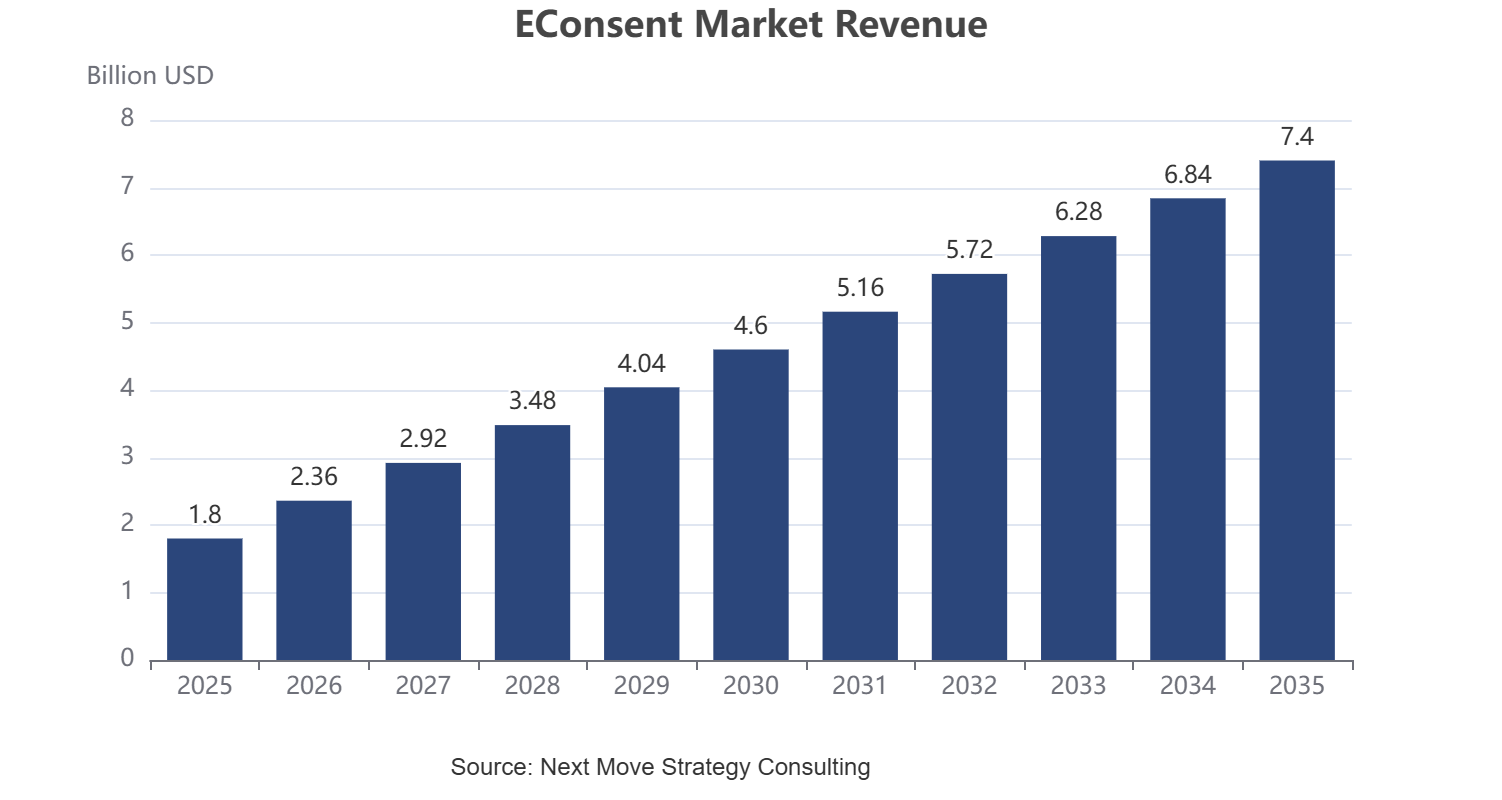
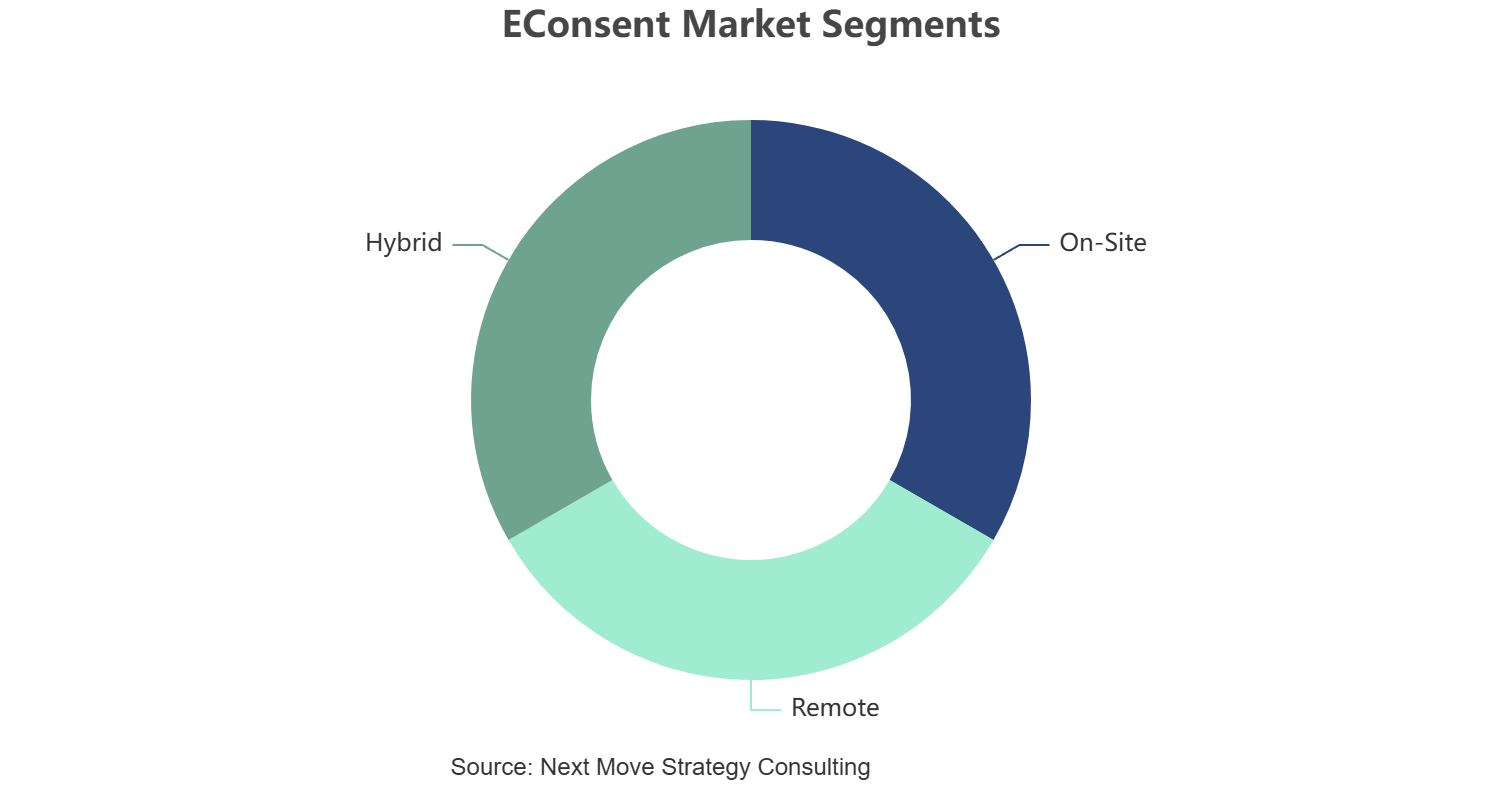
About the Author
 Liza Phukan
— Liza Phukan is Research Associate at Next Move Strategy Consulting, where she has covered emerging industries and market research across sectors for 3.5 years. Her work includes analyzing industry developments, validating market data, and developing structured business content from research findings. She uses secondary research and data-validation practices to turn complex market information into clear decision-useful market analysis for business audiences and support report development and B2B.
Liza Phukan
— Liza Phukan is Research Associate at Next Move Strategy Consulting, where she has covered emerging industries and market research across sectors for 3.5 years. Her work includes analyzing industry developments, validating market data, and developing structured business content from research findings. She uses secondary research and data-validation practices to turn complex market information into clear decision-useful market analysis for business audiences and support report development and B2B.
About the Reviewer
 Supradip Baul
— Supradip Baul is an accomplished business consultant and strategist with over a decade of rich experience in market intelligence, strategy, technology, and business transformation. His work has included rigorous qualitative and quantitative analysis across multiple industries, helping clients shape investment decisions and long-term roadmaps. Earlier in his career, he was associated with Gartner, where he contributed to industry-leading reports and market share analyses. He has worked with leading global companies and holds an MBA with a dual specialization in Marketing and Finance.
Supradip Baul
— Supradip Baul is an accomplished business consultant and strategist with over a decade of rich experience in market intelligence, strategy, technology, and business transformation. His work has included rigorous qualitative and quantitative analysis across multiple industries, helping clients shape investment decisions and long-term roadmaps. Earlier in his career, he was associated with Gartner, where he contributed to industry-leading reports and market share analyses. He has worked with leading global companies and holds an MBA with a dual specialization in Marketing and Finance.
At Next Move Strategy Consulting, we understand that insightful market research is the cornerstone of successful business decisions. That's why we employ a robust and multifaceted approach, combining various methodologies to deliver the most accurate and actionable data for our clients.

Research Landscape
We navigate the world of research with two primary approaches:
Qualitative Approach
Our qualitative research methodologies involve immersive techniques such as in-depth interviews, focus groups, and observational studies. By engaging directly with individuals and stakeholders, we uncover valuable insights that quantitative data alone may overlook.

Quantitative Research
In tandem with qualitative methodologies, NMSC leverages the power of Quantitative Research to provide a robust foundation of numerical insights. Through systematic data collection and analysis, we quantify patterns, preferences, and market trends, offering a comprehensive view of the business landscape.
Our quantitative research approach employs diverse tools, including surveys, experiments, and statistical modelling. These methodologies enable us to gather data from a large and representative sample, ensuring the statistical significance of our findings. By employing structured questionnaires and standardized data collection methods, we guarantee the reliability and validity of the information we present to our clients.
Quantitative research is particularly effective in measuring the prevalence of trends, assessing market size, and gauging the impact of various factors on consumer behavior. The numerical precision attained through this approach equips our clients with actionable insights, facilitating data-driven decision-making and strategy formulation.


Our Specialized Toolbox for Industry-Specific Market Research
We deploy a specialized arsenal of techniques tailored to meet your unique requirements. Here's a glimpse into our comprehensive toolbox:

Information Procurement
The stage entails acquiring market data or relevant information through various sources and methodologies.


Market Research Approach
We utilize both top-down and bottom-up approaches in market research analysis to achieve a comprehensive understanding of the market dynamics, leveraging the broad perspective of industry trends and macroeconomic factors alongside detailed insights from specific segments and individual companies.

Porters Five Forces Analysis
We conduct Porter's Five Forces analysis to evaluate the competitive landscape of an industry, providing us with insights into factors that affect profitability and strategic positioning.

SWOT Analysis

Forecasting
We utilize a forecasting model to predict future consumption by considering parameters like population, economics, regulations, market competition, drivers, constraints, technology, and pricing. We also employ statistical techniques such as multilinear regression, exponential smoothing, moving average, ARIMA, and Monte Carlo simulations for accurate predictions. In econometric forecasting, we analyzed short-term and long-term event impacts, attributing values based on regulatory frameworks, economic factors, and market events.





 Speak to Our Analyst