Egypt Urea Market By Grade (Feed Grade, Fertilizer Grade, and Others), By Product Form (Solid Urea, Liquid Urea, and Specialty Urea), By Production Technology (Conventional Synthesis, Enhanced Production Technology, and Others), By Distribution Channel (Direct Sales, Distributor/Wholesale Network, and Others), By Application (Nitrogenous Fertilizer, Chemical Synthesis, and Others), By End Use Industry (Agriculture, Chemical Manufacturing, and Others) – Analysis & Forecast, 2025-2035
Industry: Materials and Chemical | Latest Edition: September 30, 2026 | No of Pages: 236 | No. of Tables: 118 | No. of Figures: 106 | Format: PDF | Report Code: MC4593
Egypt Urea Market Size & Forecast
|
Parameters |
Details |
|
Market Size in 2026 |
USD 2.63 Billion |
|
Revenue Forecast in 2035 |
USD 4.52 Billion |
|
Growth Rate |
CAGR of 6.18% from 2026 to 2035 |
|
Market Volume in 2026 |
6.70 million tons |
|
Volume Forecast in 2035 |
13.14 million tons |
|
Growth Rate |
CAGR of 7.77% from 2026 to 2035 |
|
Analysis Period |
2025–2035 |
|
Base Year Considered |
2025 |
|
Forecast Period |
2026–2035 |
|
Market Size Estimation |
Billion (USD) |
|
Companies Profiled |
10 |
|
Market Share |
Available for 10 companies |
Industry Outlook
The Egypt Urea Market size was valued at USD 2.32 billion in 2025 and is expected to reach USD 2.63 billion by 2026. Looking ahead, the industry is projected to expand significantly, reaching USD 4.52 billion by 2035, registering a CAGR of 6.18% from 2026 to 2035. In terms of volume, the market recorded 5.73 million tons in 2025, with forecasts indicating growth to 6.70 million tons by 2026 and further to 13.14 million tons by 2035, reflecting a CAGR of 7.77% over the same period.
Ecosystem Analysis of the Egypt Urea Market:
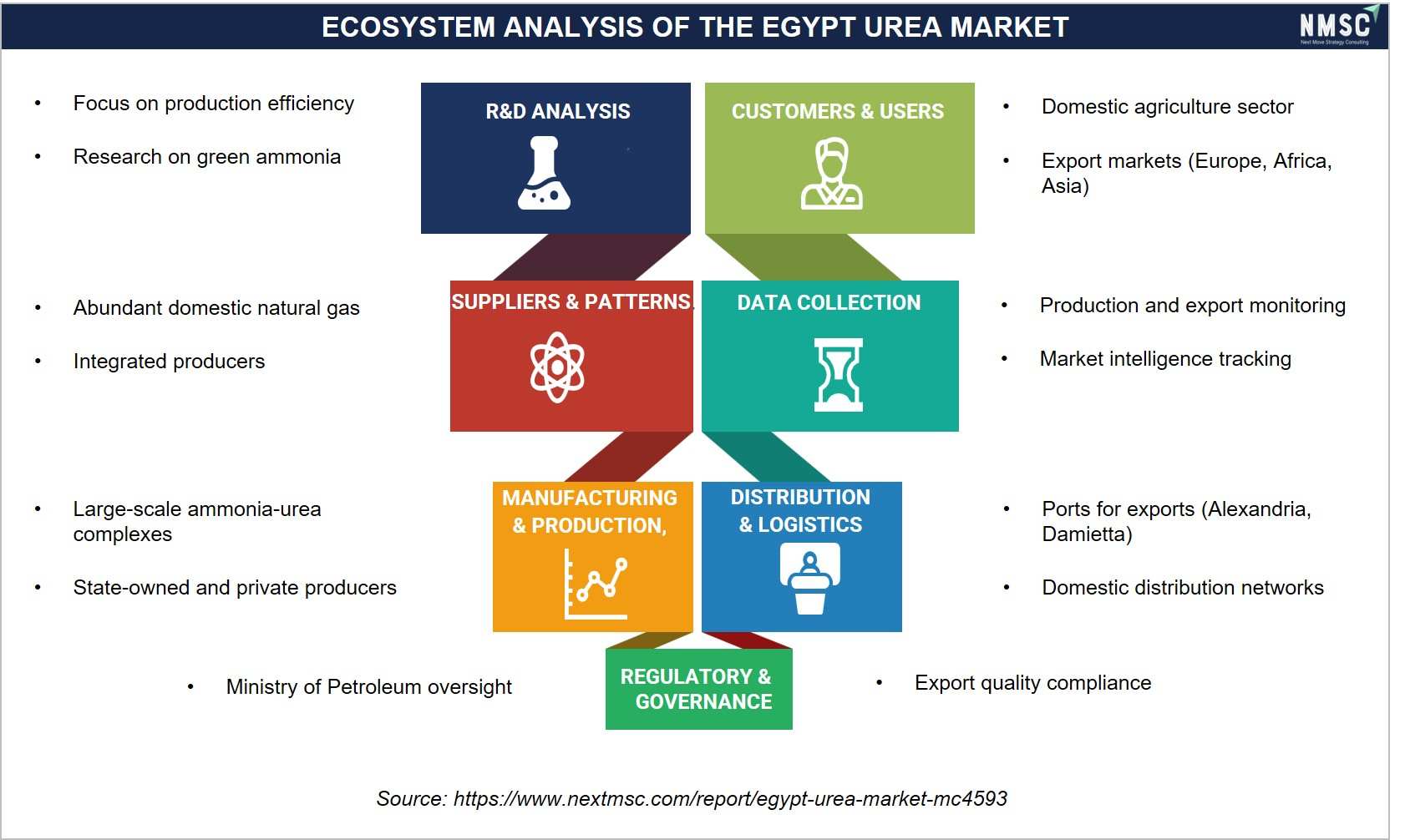
The ecosystem analysis of the urea market in Egypt shows that production is concentrated in large-scale ammonia-urea complexes operated by state-owned and private players, supported by abundant domestic natural gas that enables cost-efficient, integrated production. R&D efforts are increasingly focused on improving efficiency and adopting low-carbon technologies in line with sustainability goals. On the demand side, consumption comes from domestic agriculture and export markets across Europe, Africa, and Asia, strengthening Egypt’s trade position. Distribution relies on major ports for exports and inland networks for domestic supply. Market intelligence systems track production and trade flows, while regulatory frameworks ensure compliance with export quality and environmental standards.
What Are the Key Market Drivers, Breakthroughs, and Investment Opportunities That Will Shape the Egypt Urea Market in the Next Decade?
Growth Catalyst & Risk Assessment Matrix
|
DRIVERS / TRENDS / RESTRAINTS |
(+/–) % IMPACT ON CAGR FORECAST |
GEOGRAPHIC RELEVANCE |
IMPACT TIMELINE |
|
Fundamental reliance on nitrogen-based soil fertility inputs to boost wheat, maize, and cotton productivity using urea’s high nitrogen efficiency |
+1.20% |
Nile Delta, Upper Egypt, Faiyum governorates |
Short to medium term (1–3 years) |
|
Domestic fertilizer subsidies and national land expansion projects promoting balanced nutrient management and adoption of enhanced fertilizers |
+1.00% |
Nationwide via agricultural directorates and cooperatives |
Short to medium term (1–3 years) |
|
Rising preference for high-efficiency urea (urease inhibitors and polymer-coated products) improving nitrogen utilization efficiency |
+0.90% |
Beheira, Sharqia, Minya intensive cultivation zones |
Medium term (2–4 years) |
|
Deployment of digital agriculture tools including variable-rate machinery and soil testing systems optimizing fertilizer application in reclaimed lands |
+0.80% |
Toshka, East Oweinat, West Minya agricultural corridors |
Medium term (2–4 years) |
|
Strict environmental mandates limiting nitrogen fertilizer volumes under Nile protection and irrigation water quality regulations (Restraint) |
-0.7% |
Nile Delta aquifer, Rosetta branch, coastal lake zones |
Medium term (2–4 years) |
Our comprehensive evaluation indicates that the Egypt urea market is supported by sustained reliance on nitrogen-based soil fertility inputs, particularly across the Nile Delta and Valley regions, where intensive cultivation of wheat, maize, and cotton requires regular nutrient replenishment. Moreover, government-backed fertilizer subsidies and horizontal land expansion initiatives are improving product affordability and accessibility, thereby reinforcing urea adoption across diverse farming segments. We also observe a gradual shift toward efficiency-enhanced urea formulations aimed at improving nitrogen utilization and reducing input losses. At the same time, environmental mandates regulating nitrogen application are encouraging more structured and disciplined usage practices. In parallel, the adoption of digital agriculture technologies is supporting more precise fertilizer application methods. Consequently, these combined factors are contributing to stable demand, stronger agricultural productivity, and the long-term development of the Egyptian urea market.
Growth Drivers:
Is the Fundamental Reliance on Nitrogen-Based Soil Fertility Inputs Accelerating Urea Adoption in Egypt’s Urea Market?
Our analysis indicates that the strong dependence on nitrogen-based soil fertility inputs continues to play a central role in shaping the Egyptian urea market. Farmers across the country rely heavily on urea to sustain and improve crop productivity, particularly for staple crops such as wheat, maize, and cotton. This dependence is largely driven by the need to preserve soil nutrient balance in intensively cultivated agricultural zones. Moreover, urea’s concentrated nitrogen content offers a cost-effective and efficient solution for enhancing yields in high-demand cropping systems. Rising pressure to maximize agricultural output in response to population growth is further reinforcing fertilizer consumption. Consequently, the continued requirement for nitrogen supplementation is sustaining steady urea demand and preserving its critical role in Egypt’s agricultural productivity and food security framework.
How Are Domestic Fertilizer Subsidies Alongside National Horizontal Expansion Projects Driving Egypt Urea Market Expansion?
Government-backed fertilizer subsidies and agricultural expansion projects are significantly influencing the growth trajectory of the Egyptian urea market. Domestic subsidy programs, combined with national horizontal expansion initiatives aimed at increasing arable land, are encouraging farmers to adopt balanced nutrient management practices. These policies are designed to raise crop yields, improve soil productivity, and support the country’s long-term food security objectives. Furthermore, the availability of subsidized fertilizers makes urea more accessible and affordable, strengthening its adoption among both small- and large-scale farmers. The integration of enhanced nitrogen formulations is also gaining momentum under these initiatives. In addition, our assessment confirms that government support for modern irrigation and farming methods further complements efficient fertilizer use. As a result, these combined efforts are driving higher urea consumption and reinforcing market expansion across Egypt’s agricultural sector.
How Is the Expanding Preference for High-Efficiency Urea Types Expanding the Scope of the Egyptian Urea Market?
The growing preference for high-efficiency urea products is reshaping demand patterns within the Egypt urea market share. Farmers are gradually shifting toward advanced urea formulations, including products with urease inhibitors and polymer encapsulation, to improve nitrogen utilization efficiency. These enhanced fertilizers help reduce nutrient losses caused by volatilization and leaching, ensuring stronger nutrient absorption and better crop performance. Moreover, increasing awareness of sustainable agricultural practices and the need to optimize fertilizer input costs are accelerating this transition. Continued efforts by agronomists and fertilizer suppliers to promote efficient nutrient management are also supporting wider adoption. Consequently, demand for advanced-efficiency urea is gaining momentum as producers seek higher yields, stronger resource efficiency, and alignment with evolving agricultural and environmental standards in Egypt.
Growth Inhibitor:
Are Strict Environmental Mandates Limiting Nitrogen Fertilizer Volumes Limiting Egypt Urea Market Growth?
Strict environmental regulations on nitrogen fertilizer use are emerging as a notable constraint on the Egypt urea market. Measures linked to the Nile River Protection Law and irrigation water quality standards impose defined limits on nitrogen application to protect critical water resources. These controls are particularly important in the Nile Delta and Valley regions, where intensive cultivation increases the risk of nutrient runoff and water contamination. In addition, authorities have established application thresholds to reduce eutrophication risks and preserve irrigation quality over the long term. Farmers are also required to follow structured nutrient management practices, maintain accurate usage records, and comply with periodic monitoring systems. While these regulations do not eliminate urea demand, our assessment reveals that they materially reduce excessive application volumes. Consequently, agricultural producers are increasingly adopting precision fertilization methods and efficient nutrient strategies to remain compliant while maintaining crop productivity.
Growth Opportunity:
How Is the Deployment of Digital Agricultural Solutions Creating New Opportunities?
The deployment of digital agricultural solutions is emerging as a significant opportunity in the Egyptian urea market, particularly across reclaimed desert lands. Farmers and agribusiness operators are increasingly adopting technologies such as variable-rate machinery and electronic soil testers to optimize urea distribution according to field-specific nutrient requirements. These innovations enable precise fertilizer application, improving nitrogen use efficiency while reducing unnecessary input consumption in newly cultivated areas with variable soil conditions. Moreover, real-time soil diagnostics support stronger decision-making and help minimize nitrogen losses through leaching and volatilization, which is essential for maintaining soil health in reclaimed regions. In addition, the government’s focus on expanding arable land and promoting modern farming techniques is accelerating adoption of these digital tools. Although implementation remains more prominent among large-scale and government-supported projects, rising awareness and greater technological accessibility are expected to support broader uptake. Consequently, digital agricultural solutions present a strong growth avenue for urea producers, agritech providers, and advisory services within Egypt’s evolving agricultural landscape.
How Is the Egypt Urea Market Segmented in This Report, And What Are the Key Insights from the Segmentation Analysis?
By Grade Insights
Is Grade Segment Shaping the Egypt Urea Industry in 2025?
Based on grade, the urea market in Egypt is segmented into feed grade, fertilizer grade, technical/industrial grade, and medical/laboratory grade.
Grade-based segmentation defines the structure of the Egyptian urea market, with fertilizer-grade urea leading demand due to its extensive use in wheat, maize, and cotton cultivation across the Nile Delta and Valley regions. Feed-grade urea also supports livestock nutrition, particularly in dairy and poultry sectors, contributing to a balanced crop–livestock demand base and overall market stability. Technical and industrial-grade urea is used in chemical processing, resin manufacturing, and diesel exhaust fluid production, while medical and laboratory-grade urea serves pharmaceutical and research applications. Overall, this diversified segmentation enhances nitrogen utilization, supports industrial and scientific applications, and reinforces the long-term growth potential of the Egyptian urea market.
By Production Technology Insights
Is Production Technology Segment Shaping the Egypt Urea Industry in 2025?
Based on production technology, the urea market in Egypt is segmented into conventional synthesis, low-emission/green technology, enhanced production technology, and specialty urea manufacturing.
The Egyptian urea market operates through a mix of production technologies across manufacturing facilities. Low-emission and green technologies are being gradually adopted in line with environmental regulations, water conservation goals, and emission control requirements. Enhanced production technologies are also gaining traction, improving process efficiency, energy optimization, and product quality in large-scale operations. At the same time, conventional synthesis remains widely used due to established infrastructure and cost advantages in existing plants. Specialty urea manufacturing is also expanding to meet demand for coated and customized fertilizers used in precision agriculture and select industrial applications. Overall, this diversified technology base supports efficiency, sustainability, and innovation, contributing to the steady development of the Egyptian urea market.
Competitive Landscape
NMSC’s comprehensive industry assessment indicates that the Egypt urea market is supported by a balanced mix of domestic producers, multinational companies, and regional distributors ensuring consistent fertilizer availability. Key participants, including Abu Qir Fertilizers and Chemical Industries Company, Misr Fertilizers Production Company S.A.E., Helwan Fertilizers Company, El Nasr Company for Intermediate Chemicals, Saudi Basic Industries Corporation, and others, collectively maintain supply through integrated production capabilities, import-export networks, and nationwide distribution systems. Moreover, regional distributors and agronomic advisors strengthen last-mile delivery and technical support. Consequently, supply reliability, operational expertise, and product innovation continue to define competitive dynamics and sustain growth across Egypt’s urea market.
Strategic Developments:
- March 2026- Abu Qir Fertilizers and Chemical Industries Company approved a USD 5.6 million coated urea project with production capacity of 400 tons per day, expected to be completed within 12 months.
Key Players of the Egypt Urea Market:
-
Abu Qir Fertilizers and Chemical Industries Company
-
Misr Fertilizers Production Company S.A.E.
-
Helwan Fertilizers Company
-
El Nasr Company for Intermediate Chemicals
-
Saudi Basic Industries Corporation
-
Egypt Globe Group
-
Fertiglobe PLC
-
AlexFert (Alexandria Fertilizers Company)
-
Company 10
We found that competition within the Egypt urea market is increasingly driven by supply reliability, innovation in fertilizer solutions, and strong agronomic support rather than production volume alone. Leading suppliers are prioritizing advanced urea formulations, including stabilized and controlled-release variants, which enhance nitrogen efficiency while supporting environmentally responsible nutrient management across key crops such as wheat, rice, vegetables, and fruits. Moreover, the rising adoption of precision nutrient application practices highlights farmers’ growing focus on optimizing yields while maintaining soil health and long-term agricultural sustainability.
Furthermore, major market participants are expanding their presence through extensive distribution networks, agronomic advisory services, and collaborations with cooperatives and agricultural suppliers. Additionally, these initiatives are improving accessibility across Egypt’s primary agricultural regions, ensuring stronger farmer engagement and technical guidance. As a result, continued investment in innovative fertilizer technologies, resilient supply chains, and field-level advisory services remains critical in shaping competitive positioning, thereby supporting sustained growth in the Egypt urea market.
Price Point Analysis of the Egypt Urea Market:
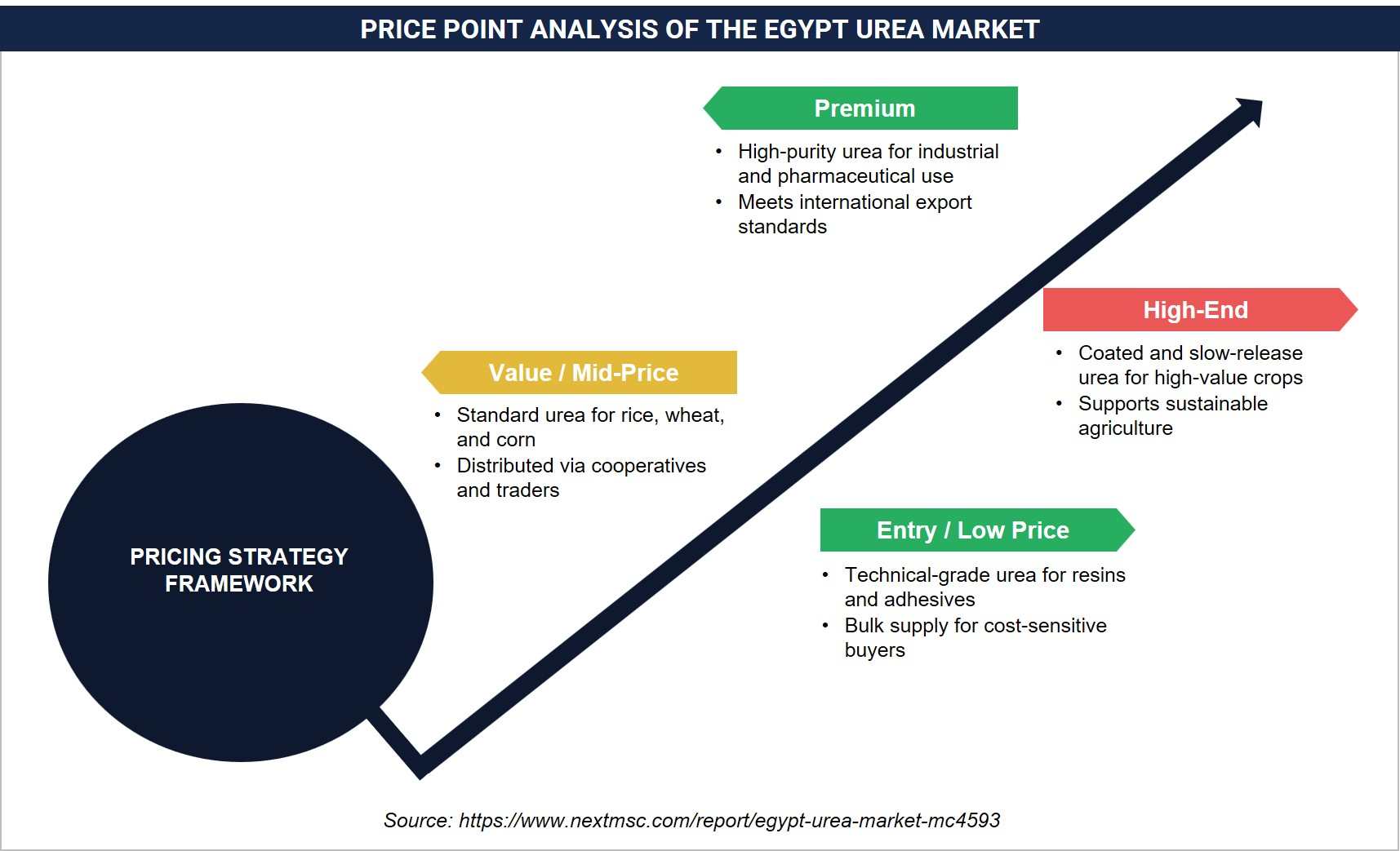
Our market analysis suggests that price point segmentation in the Egypt urea market reflects product quality, end-use suitability, and buyer budget preferences across multiple customer groups. The Value and mid-price tier include standard urea used for rice, wheat, and corn cultivation, with supply commonly routed through cooperatives and trader networks. Premium-priced products consist of high-purity urea intended for industrial and pharmaceutical applications, where compliance with international export standards is a key purchasing factor. The entry and low-price segment cover technical-grade urea used in resins, adhesives, and bulk procurement by cost-sensitive buyers. In addition, the high-end category includes coated and slow-release urea designed for high-value crops, while also supporting sustainable agriculture practices through controlled nutrient application.
Egypt Urea Market Key Segments
By Grade
-
Feed Grade
-
Fertilizer Grade
-
Technical / Industrial Grade
-
Medical / Laboratory Grade
By Product Form
-
Solid Urea
-
Granular Urea
-
Prilled Urea
-
Pellet Urea
-
Crystal Urea
-
-
Liquid Urea
-
Urea Ammonium Nitrate Solution
-
Aqueous Urea Solution
-
Diesel Exhaust Fluid
-
Liquid Fertilizer Blends
-
-
Specialty Urea
-
Urea-Formaldehyde
-
Methylene Urea
-
Melamine
-
Urea-Ammonium Sulfate
-
By Production Technology
-
Conventional Synthesis
-
Low Emission / Green Technology
-
Enhanced Production Technology
-
Specialty Urea Manufacturing
By Distribution Channel
-
Direct Sales
-
Distributor / Wholesale Network
-
Retail / Agro Stores
-
Online / B2B Platforms
-
Institutional / Government Procurement
By Application
-
Nitrogenous Fertilizer
-
Chemical Synthesis
-
Diesel Exhaust Fluid Production
-
Animal Feed
-
Medical and Pharmaceutical Use
-
Cosmetics and Personal Care
-
Deicing Agent
-
Laboratory Reagent
-
Textiles and Construction Chemicals
-
Oilfield Chemicals
By End Use Industry
-
Agriculture
-
Chemical Manufacturing
-
Automotive and Transportation
-
Animal Nutrition
-
Healthcare and Cosmetics
-
Construction and Other Industrial Uses
Key Benefits for Stakeholders:
Next Move Strategy Consulting (NMSC) presents a comprehensive analysis of the Egypt urea market trends, covering historical developments from 2020 to 2025 and providing forward-looking forecasts through 2035. Based on discussions with fertilizer distributors, agronomists, and farm operators, we found that the urea market in Egypt is increasingly influenced by stabilized and efficiency-enhanced urea products in areas. Moreover, we observed that farmers’ adoption of precision nutrient application, coupled with government-led sustainability initiatives, is enhancing nitrogen use efficiency and boosting productivity for wheat, rice, and vegetable crops.
Furthermore, field-level advisory services, agronomic workshops, and cooperative programs are driving adoption of precision nitrogen management. Consequently, farmers optimize fertilizer efficiency, minimize nitrogen losses through leaching or volatilization, and maintain high crop quality, collectively promoting environmentally responsible practices across Egypt’s major agricultural regions.
|
Parameters |
Details |
|
Customization Scope |
Free customization (equivalent to up to 80 analyst-working hours) after purchase. |
|
Pricing and Purchase Options |
Avail customized purchase options to meet your exact research needs. |
|
Approach |
In-depth primary and secondary research; proprietary databases; rigorous quality control and validation measures. |
|
Analytical Tools |
Porter's Five Forces, SWOT, value chain, and Harvey ball analysis to assess competitive intensity, stakeholder roles, and relative impact of key factors. |


About the Author
 Mayurima Roy
— Mayurima Roy is Research Analyst at Next Move Strategy Consulting, where she has spent 4 years working across the firm's full industry coverage rather than a single fixed vertical. Her work centers on structured research, ongoing trend tracking, competitive assessment, and insight-led content development, translating complex market data into clear, decision-ready narratives that support informed client decision-making across diverse global industries, market sectors, and world regions every day.
Mayurima Roy
— Mayurima Roy is Research Analyst at Next Move Strategy Consulting, where she has spent 4 years working across the firm's full industry coverage rather than a single fixed vertical. Her work centers on structured research, ongoing trend tracking, competitive assessment, and insight-led content development, translating complex market data into clear, decision-ready narratives that support informed client decision-making across diverse global industries, market sectors, and world regions every day.
About the Reviewer
 Supradip Baul
— Supradip Baul is an accomplished business consultant and strategist with over a decade of rich experience in market intelligence, strategy, technology, and business transformation. His work has included rigorous qualitative and quantitative analysis across multiple industries, helping clients shape investment decisions and long-term roadmaps. Earlier in his career, he was associated with Gartner, where he contributed to industry-leading reports and market share analyses. He has worked with leading global companies and holds an MBA with a dual specialization in Marketing and Finance.
Supradip Baul
— Supradip Baul is an accomplished business consultant and strategist with over a decade of rich experience in market intelligence, strategy, technology, and business transformation. His work has included rigorous qualitative and quantitative analysis across multiple industries, helping clients shape investment decisions and long-term roadmaps. Earlier in his career, he was associated with Gartner, where he contributed to industry-leading reports and market share analyses. He has worked with leading global companies and holds an MBA with a dual specialization in Marketing and Finance.
At Next Move Strategy Consulting, we understand that insightful market research is the cornerstone of successful business decisions. That's why we employ a robust and multifaceted approach, combining various methodologies to deliver the most accurate and actionable data for our clients.

Research Landscape
We navigate the world of research with two primary approaches:
Qualitative Approach
Our qualitative research methodologies involve immersive techniques such as in-depth interviews, focus groups, and observational studies. By engaging directly with individuals and stakeholders, we uncover valuable insights that quantitative data alone may overlook.

Quantitative Research
In tandem with qualitative methodologies, NMSC leverages the power of Quantitative Research to provide a robust foundation of numerical insights. Through systematic data collection and analysis, we quantify patterns, preferences, and market trends, offering a comprehensive view of the business landscape.
Our quantitative research approach employs diverse tools, including surveys, experiments, and statistical modelling. These methodologies enable us to gather data from a large and representative sample, ensuring the statistical significance of our findings. By employing structured questionnaires and standardized data collection methods, we guarantee the reliability and validity of the information we present to our clients.
Quantitative research is particularly effective in measuring the prevalence of trends, assessing market size, and gauging the impact of various factors on consumer behavior. The numerical precision attained through this approach equips our clients with actionable insights, facilitating data-driven decision-making and strategy formulation.


Our Specialized Toolbox for Industry-Specific Market Research
We deploy a specialized arsenal of techniques tailored to meet your unique requirements. Here's a glimpse into our comprehensive toolbox:

Information Procurement
The stage entails acquiring market data or relevant information through various sources and methodologies.


Market Research Approach
We utilize both top-down and bottom-up approaches in market research analysis to achieve a comprehensive understanding of the market dynamics, leveraging the broad perspective of industry trends and macroeconomic factors alongside detailed insights from specific segments and individual companies.

Porters Five Forces Analysis
We conduct Porter's Five Forces analysis to evaluate the competitive landscape of an industry, providing us with insights into factors that affect profitability and strategic positioning.

SWOT Analysis

Forecasting
We utilize a forecasting model to predict future consumption by considering parameters like population, economics, regulations, market competition, drivers, constraints, technology, and pricing. We also employ statistical techniques such as multilinear regression, exponential smoothing, moving average, ARIMA, and Monte Carlo simulations for accurate predictions. In econometric forecasting, we analyzed short-term and long-term event impacts, attributing values based on regulatory frameworks, economic factors, and market events.





 Speak to Our Analyst