Extract, Transform, Load (ETL) Market Size, Share, Growth, Trends and Forecast 2025–2035, By Offering (Software, Support, Services), By Product Function (Batch ETL, Real-Time ETL, CDC, ELT, Reverse ETL, and Others), By Deployment (Public Cloud, Private Cloud, On-Premise, Hybrid), By Buyer Size, By End User Industry (BFSI, Healthcare and Life Sciences, IT and Telecom, and others), and By Sales Channel (Direct, Partner SI, and others) — Global Analysis 2026–2035
Industry: ICT & Media | Publishing Date: June 18, 2026 | Last Updated: September 10, 2026 | No of Pages: N/A | No. of Tables: N/A | No. of Figures: N/A | Format: PDF | Report Code: IC4714
What Is the Extract, Transform, Load (ETL) Market Size?
The global Extract, Transform, Load (ETL) market was estimated at USD 14.3 billion in 2025 and is projected to reach USD 16.2 billion in 2026. By 2035, the ETL market is forecast to expand to USD 51.8 billion, registering a CAGR of 13.8% over the 2026–2035 forecast period. Key growth drivers include the accelerating adoption of cloud-native data architectures, rising demand for real-time data processing across BFSI and retail sectors, proliferation of IoT-generated data volumes, and increasing regulatory mandates for data governance and auditability across North America and Europe.
|
Parameters |
Details |
|
Market Size in 2025 |
USD 14.3 Billion |
|
Market Size in 2026 |
USD 16.2 Billion |
|
Revenue Forecast in 2035 |
USD 51.8 Billion |
|
Growth Rate |
CAGR of 13.8% from 2026 to 2035 |
|
Analysis Period |
2025–2035 |
|
Base Year Considered |
2025 |
|
Forecast Period |
2026–2035 |
|
Market Size Estimation |
Billion USD |
|
Companies Profiled |
20 |
|
Countries Covered |
33 |
|
Market Share |
Top 10 |
Extract, Transform, Load (ETL) Market Overview
What Is the ETL Market?
The ETL Market encompasses the global ecosystem of software platforms, support services, and professional solutions that enable organizations to extract data from diverse source systems, transform it into structured and analytics-ready formats, and load it into target repositories such as data warehouses, data lakes, and cloud environments. ETL platforms play a critical role in enterprise data management by ensuring data consistency, accessibility, and quality across business applications. NMSC's analysis indicates that ETL solutions have become foundational components of modern data architectures, supporting business intelligence, advanced analytics, artificial intelligence, and operational decision-making across industries.
How Has the ETL Market Evolved?
The ETL Market has undergone a significant transformation over the past decade. The initial phase was characterized by on-premise, batch-oriented ETL tools designed primarily to support centralized enterprise data warehouses. The next phase introduced hybrid integration environments as organizations expanded their data footprints across multiple systems. Based on research conducted by NMSC, we found that the current phase is defined by cloud-native ETL platforms, real-time data pipelines, and ELT (Extract, Load, Transform) architectures that leverage the scalable compute capabilities of modern cloud data platforms. The emergence of reverse ETL solutions, which operationalize analytical insights by feeding data back into business applications, has further expanded the scope of the market.
How Do Regulations Influence the ETL Market?
Regulatory and compliance frameworks play a critical role in shaping the ETL Market. Regulations such as the General Data Protection Regulation (GDPR) in Europe, the California Consumer Privacy Act (CCPA), and HIPAA in the United States require organizations to implement robust data governance, privacy protection, and auditability measures within their data integration environments. ETL vendors are increasingly embedding capabilities such as data lineage tracking, audit logging, access controls, and privacy-preserving transformations to help organizations meet regulatory obligations. Our assessment indicates that compliance-driven modernization initiatives are becoming a major driver of ETL platform adoption, particularly across highly regulated sectors including BFSI, healthcare, and government.
How Is Technology Adoption Expanding Across the ETL Market?
Technology adoption across the ETL Market is accelerating as organizations pursue data-driven operating models and increasingly complex cloud-based data ecosystems. Modern ETL platforms are integrating artificial intelligence and machine learning capabilities to automate schema mapping, identify anomalies, optimize data transformations, and improve data quality management. Our findings suggest that AI-assisted ETL workflows are helping enterprises reduce development complexity and accelerate data engineering cycles while improving operational efficiency. The growing demand for real-time analytics, streaming data integration, and intelligent automation continues to drive investment in next-generation ETL technologies, positioning the market as a critical enabler of digital transformation strategies.
Ecosystem Analysis of the ETL Market
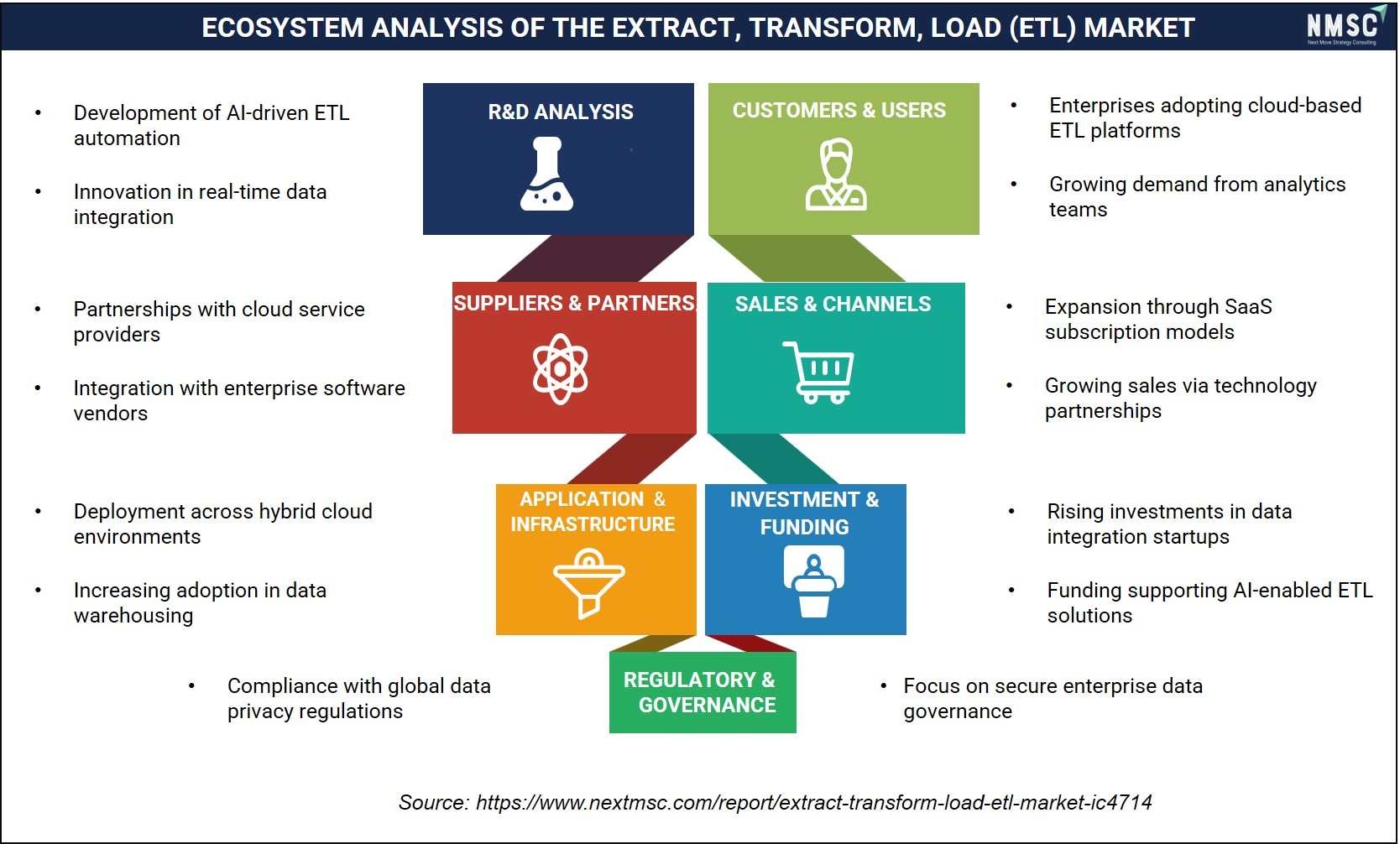
The infographic maps the ecosystem of the Extract, Transform, Load (ETL) market. It highlights R&D analysis, key customer segments including enterprises adopting cloud-based ETL platforms and analytics teams driving data integration demand, suppliers and partners, sales channels, application and infrastructure, investment and funding, as well as regulatory and governance factors shaping the industry landscape.
|
Key Takeaways |
|
The software segment dominates the ETL market offering category, with subscription SaaS licensing emerging as the leading revenue model due to its consumption-aligned pricing, automatic update delivery, and reduced total cost of ownership. The services segment, particularly migration and modernization services, represents the fastest-growing offering sub-segment, driven by sustained enterprise demand for legacy-to-cloud workload transitions. Managed services within the services category are gaining traction among mid-market buyers seeking operational flexibility without internal data engineering headcount. |
|
Among product functions, real-time ETL is the fastest-growing sub-segment, propelled by demand from financial services, e-commerce, and telecom sectors requiring sub-second data freshness for fraud detection, personalization, and network operations. Batch ETL retains the largest installed-base share, reflecting the continued dominance of traditional enterprise data warehouse refresh cycles in manufacturing and public sector. Change Data Capture (CDC) is emerging as a critical bridging technology between legacy operational databases and modern cloud analytics environments. |
|
Public cloud deployment holds the dominant share of the ETL market, supported by the widespread adoption of hyperscaler data platforms including AWS, Microsoft Azure, and Google Cloud. Hybrid deployment is the fastest-growing deployment model, as large enterprises seek to balance cloud agility with on-premise data residency requirements driven by regulatory and security mandates across financial and government sectors. |
|
Large enterprises represent the dominant buyer segment by revenue contribution, reflecting their complex, multi-source data environments and higher average contract values. SMBs are the fastest-growing buyer segment, benefiting from the emergence of self-serve and low-code ETL platforms that lower the technical barrier to integration adoption. Mid-market buyers are increasingly engaging through cloud marketplace channels, attracted by consolidated billing and pre-validated integrations with major cloud platform services. |
|
BFSI remains the dominant end-user industry within the ETL market, accounting for the largest share of deployment activity due to its data-intensive operations, stringent regulatory compliance requirements, and high investment in real-time fraud analytics infrastructure. Healthcare and life sciences represent the fastest-growing industry vertical, driven by accelerating clinical data integration mandates, genomics data processing requirements, and expanding adoption of electronic health record interoperability standards. |
|
North America holds the dominant regional share of the global ETL market, supported by the concentration of large enterprise data consumers, leading technology vendor ecosystems, and early adoption of cloud-native data platforms. |
|
Asia Pacific is the fastest-growing region, with India, China, and Southeast Asian economies accelerating cloud data infrastructure investment. The United States is the single largest country market, while India ranks as the fastest-growing individual country market driven by expanding digital economy initiatives and IT sector growth. |
|
The United States is the largest country market within the ETL Market, supported by extensive adoption of cloud-native analytics architectures, AI-driven data platforms, and large-scale enterprise modernization programs. |
|
India represents the fastest-growing country market in the ETL Market, driven by rapid digital economy expansion, increasing cloud adoption among enterprises, government-led digital transformation initiatives, and the growing presence of data-intensive IT and business services sectors. |
Key Emerging Trends in the Extract, Transform, Load (ETL) Market
How Is the Shift Toward Cloud-Native ELT Architectures Transforming Data Pipeline Design?
The architectural pivot from traditional ETL to cloud-native ELT is reshaping pipeline design across large enterprises. By leveraging the computational scalability of platforms such as Snowflake, Google BigQuery, and Amazon Redshift, organizations are shifting transformation workloads into the warehouse itself. From our research, we found that this transition reduces pre-load data processing latency and enables on-demand transformation scalability. Vendors including dbt Labs and Matillion have built their core value propositions around this architectural paradigm, driving significant adoption across technology and financial services sectors.
How Is Reverse ETL Operationalising Data Warehouses Across Business Functions?
Reverse ETL represents a structural inversion of the traditional data flow, enabling organizations to push curated analytics outputs from warehouses back into operational systems such as CRM, marketing automation, and customer success platforms. NMSC's analysis indicates that this capability is transforming data teams from cost centers into revenue enablers by activating warehouse insights within sales and marketing workflows. Companies including Census and Hightouch pioneered the category, which is now being absorbed into broader data integration platform offerings by established vendors such as Salesforce and Microsoft.
How Is AI-Augmented Data Integration Accelerating ETL Development Velocity?
Artificial intelligence is being embedded into ETL platform functionality to automate schema inference, mapping suggestion, and data quality remediation. Based on our market evaluation, we noticed that AI-assisted transformation logic is reducing the time required to build new integration pipelines by enabling low-code or no-code data engineering workflows. Vendors including Informatica with its CLAIRE engine and IBM with its AI-driven data fabric capabilities are positioning AI augmentation as a primary competitive differentiator, reducing dependency on scarce data engineering talent.
How Is Streaming Data Integration Displacing Batch Processing in Time-Sensitive Industries?
Real-time and micro-batch ETL architectures are displacing scheduled batch workflows in industries where data latency directly affects business outcomes. Our findings suggest that financial services firms are deploying streaming ETL pipelines powered by Apache Kafka, AWS Kinesis, and Google Dataflow to support real-time fraud detection, trade surveillance, and customer behavioural analytics. E-commerce platforms are similarly investing in streaming pipelines to power real-time inventory synchronization and personalized recommendation engines. This trend is accelerating investment in CDC-enabled integration platforms.
What Are the Key Market Drivers, Breakthroughs, and Investment Opportunities That Will Shape the Extract, Transform, Load (ETL) Market in the Next Decade?
|
Drivers / Trends / Restraints |
(+/-) % Impact on CAGR Forecast |
Geographic Relevance |
Impact Timeline |
|
Cloud data platform adoption |
+2.5% |
North America, Europe, APAC |
2025–2028 |
|
Real-time analytics demand |
+1.8% |
Global |
2025–2030 |
|
AI/ML-augmented ETL tooling |
+1.4% |
North America, Europe |
2026–2035 |
|
Regulatory compliance mandates |
+1.1% |
Europe, North America |
2025–2027 |
|
Data privacy and sovereignty concerns |
-0.9% |
Europe, MEA, APAC |
2025–2030 |
|
Shortage of data engineering talent |
-0.7% |
Global |
2025–2032 |
|
Growth of self-serve analytics platforms |
+0.8% |
North America, APAC |
2026–2035 |
What Are the Growth Drivers of the Extract, Transform, Load (ETL) Market?
How Is Cloud Data Platform Proliferation Expanding the ETL Market Revenue Base?
The rapid adoption of cloud-native data warehousing and lakehouse platforms is the primary structural driver of ETL market expansion. As organizations migrate from on-premise databases to multi-cloud and hybrid architectures, the complexity of data integration workflows increases substantially, creating sustained demand for ETL software and services. Through our market assessment, we observed that major cloud providers have developed native data integration services, while third-party ETL vendors are competing through superior cross-platform connectivity, transformation flexibility, and governance tooling. The U.S. Department of Commerce has documented the sustained growth of cloud infrastructure investment across regulated industries.
How Is the Rise of Data-Driven Decision-Making Fueling ETL Investment Across Enterprises?
Enterprises across all verticals are investing in unified data architectures to enable real-time business intelligence, predictive analytics, and AI model training. ETL pipelines form the foundational data supply chain for these initiatives. Based on NMSC's research, we found that organizations expanding their analytics capabilities require more sophisticated extraction, lineage tracking, and transformation governance features, driving upgrade cycles and new deployments. The increasing volume of data generated by IoT sensors, mobile applications, and digital commerce platforms is further amplifying the need for scalable ETL infrastructure across manufacturing, retail, and logistics sectors.
How Are Regulatory Mandates Creating Sustained Demand for Auditable Data Pipelines?
Compliance requirements such as GDPR in the European Union, CCPA in California, HIPAA for U.S. healthcare data, and Basel III/IV for financial reporting are compelling organizations to implement traceable, auditable, and privacy-compliant data pipelines. ETL platforms with embedded data lineage, masking, and transformation audit capabilities are benefiting directly from this regulatory tailwind. Our analysis shows that procurement of ETL solutions in heavily regulated sectors now frequently includes explicit compliance feature scoring as part of vendor evaluation criteria, elevating switching costs and supporting premium pricing for governance-capable platforms.
What Are the Growth Inhibitors of the Extract, Transform, Load (ETL) Market?
How Are Data Privacy and Sovereignty Regulations Constraining Cross-Border ETL Deployments?
Increasing data localization mandates and cross-border data transfer restrictions are creating architectural complexity for multinational ETL deployments. The EU's data residency requirements under GDPR, India's Digital Personal Data Protection Act, and China's Data Security Law require organizations to implement jurisdiction-specific pipeline architectures, increasing deployment cost and operational overhead. Our assessment indicates that these regulatory constraints are particularly challenging for global enterprises seeking to consolidate analytics platforms, often necessitating multi-region deployments rather than centralized integration hubs, which increases total ETL infrastructure spending while also slowing consolidation decisions.
How Is the Shortage of Qualified Data Engineering Talent Limiting ETL Market Adoption?
The implementation and operation of sophisticated ETL pipelines requires specialized skills in data modelling, SQL transformation logic, workflow orchestration, and cloud platform configuration. A persistent shortage of qualified data engineers in both developed and emerging markets constrains the pace of new ETL deployments, particularly among mid-market and SMB buyers. The U.S. Bureau of Labor Statistics has documented sustained above-average growth projections for data engineering occupations, which, alongside supply constraints, contributes to implementation cost inflation. Vendors are responding with low-code, self-serve platforms, but complex enterprise migrations continue to require specialised implementation expertise.
What Are the Growth Opportunities in the Extract, Transform, Load (ETL) Market?
How Is the SMB Segment Emerging as a High-Growth Addressable Market for ETL Vendors?
The SMB segment represents a structurally underserved opportunity within the ETL market, historically constrained by cost and complexity barriers. The emergence of cloud marketplace distribution, usage-based pricing, and self-serve onboarding models is making ETL capabilities accessible to smaller organizations for the first time. Through NMSC's assessment, we found that vendors including Airbyte and Fivetran have built scalable SMB acquisition motions through product-led growth strategies and open-source community development. The SMB segment's growing reliance on SaaS application ecosystems generates native connector demand that aligns well with modern ETL platform capabilities.
How Is Embedded and OEM ETL Enabling New Revenue Channels for Platform Vendors?
OEM-embedded ETL represents a high-margin distribution channel in which ETL capabilities are licensed within third-party software platforms, SaaS applications, and industry-specific solutions. Application vendors in ERP, CRM, and healthcare information systems are embedding ETL connectors to differentiate their platforms and reduce customer integration friction. Our findings suggest that this channel is growing as SaaS application ecosystems proliferate, with ETL vendors including Boomi and SnapLogic establishing dedicated OEM partnership programs. OEM licensing typically commands recurring royalty structures with high renewal rates, providing revenue predictability for ETL platform providers.
How Is the Healthcare Data Integration Wave Creating a Structural ETL Growth Vertical?
The healthcare sector is undergoing a structural transformation in data integration requirements driven by the adoption of electronic health record (EHR) interoperability standards, clinical data exchange mandates under the U.S. 21st Century Cures Act, and expanding use of genomics and real-world evidence data for pharmaceutical research. These dynamics are creating large-scale ETL deployment opportunities in clinical data integration, payer-provider data exchange, and life sciences analytics infrastructure. Based on our engagements with healthcare IT buyers, we observed that organizations are actively replacing legacy HL7-based integration middleware with modern ETL platforms capable of handling FHIR-compliant data at scale.
How Is the Extract, Transform, Load (ETL) Market Segmented in This Report, and What Are the Key Insights from the Segmentation Analysis?
By Offering
How Do Software, Support, and Services Segments Define the ETL Market Offering Landscape?
|
Segment |
2025 (USD Billion) |
2035 (USD Billion) |
CAGR (%) |
|
Software |
7.2 |
26.1 |
15.1% |
|
Support |
3.1 |
10.4 |
12.8% |
|
Services |
4.0 |
15.3 |
14.2% |
The offering segment of the ETL market is structured across software, support, and professional services categories. Within software, subscription SaaS is the dominant licensing model, reflecting the industry-wide shift toward cloud-hosted deployment and consumption-based pricing; usage-based models are gaining traction among high-volume data pipeline operators who prioritize cost alignment with workload scale. Term and perpetual licenses remain relevant in regulated industries requiring deterministic software cost management. The support segment encompasses maintenance, technical support, and premium support tiers, with premium support capturing increasing wallet share as enterprise ETL deployments become mission-critical. Services, particularly migration and modernization, represent the fastest-growing offering sub-segment as organizations invest in legacy infrastructure transformation.
By Product Function
Which ETL Product Functions Are Gaining Strategic Importance in Modern Data Architectures?
|
Segment |
2025 (USD Billion) |
2035 (USD Billion) |
CAGR (%) |
|
Batch ETL |
4.8 |
11.9 |
10.1% |
|
Micro-Batch ETL |
1.4 |
5.5 |
15.3% |
|
Real-Time ETL |
2.1 |
10.6 |
18.2% |
|
CDC |
1.6 |
7 |
16.6% |
|
ELT |
2.2 |
8.8 |
15.5% |
|
Reverse ETL |
0.8 |
3.9 |
17.8% |
|
Other |
1.4 |
4.1 |
12.1% |
The product function segment of the ETL market spans batch, micro-batch, real-time, CDC, ELT, reverse ETL, and other specialized processing paradigms. Batch ETL retains the largest installed base, reflecting its continued role in scheduled data warehouse refresh cycles across manufacturing, public sector, and traditional enterprise analytics. Real-time ETL is the fastest-growing product function, driven by demand for sub-second data freshness in BFSI fraud detection, e-commerce personalization, and telecom network analytics. Change Data Capture is experiencing rapid adoption as a bridging technology for operational database modernization. Reverse ETL is an emerging but high-growth category, operationalizing warehouse data within CRM, marketing, and customer success platforms.
By Deployment
How Is Cloud Adoption Reshaping the ETL Market Deployment Landscape?
|
Segment |
2025 (USD Billion) |
2035 (USD Billion) |
CAGR (%) |
|
Public Cloud |
6.1 |
24.8 |
15.0% |
|
Private Cloud |
2.4 |
8.6 |
13.5% |
|
On-Premise |
3.2 |
8.1 |
9.7% |
|
Hybrid |
2.6 |
10.3 |
14.8% |
Deployment preferences in the ETL market reflect the broader enterprise transition to cloud-first data architectures. Public cloud deployment is dominant, supported by the elastic scalability and managed service models offered by AWS Glue, Azure Data Factory, and Google Cloud Dataflow. Hybrid deployment is the fastest-growing model, as enterprises balance cloud agility with on-premise data residency mandates in regulated industries. Private cloud deployments serve organizations in defense, financial services, and government sectors that require dedicated infrastructure isolation. On-premise deployments are declining as a share of new contracts but remain strategically relevant for legacy enterprise environments with long software investment cycles.
By Buyer Size
How Does Buyer Size Influence ETL Platform Selection and Deployment Complexity?
|
Segment |
2025 (USD Billion) |
2035 (USD Billion) |
CAGR (%) |
|
Large Enterprise |
8.3 |
28.4 |
13.0% |
|
Mid-Market |
3.6 |
13.8 |
14.4% |
|
SMB |
2.4 |
9.6 |
14.8% |
Buyer size is a critical determinant of ETL platform feature requirements, deployment model, and sales channel preference. Large enterprises dominate market revenue, driven by complex multi-source data environments requiring enterprise-grade governance, high connector volumes, and dedicated support SLAs. Mid-market buyers represent a balanced segment with growing appetite for cloud-native platforms that deliver enterprise functionality without enterprise-scale implementation complexity. SMBs are the fastest-growing buyer cohort, attracted by the self-serve, product-led growth models offered by modern ETL vendors. Cloud marketplace procurement is becoming a primary acquisition channel for SMBs, enabling frictionless trial-to-purchase conversion and consolidated billing through existing cloud accounts.
By End User Industry
Which Industries Are the Largest Consumers and Fastest Adopters of ETL Solutions?
|
Segment |
2025 (USD Billion) |
2035 (USD Billion) |
CAGR (%) |
|
BFSI |
3.6 |
12.2 |
13.0% |
|
Healthcare & Life Sciences |
1.8 |
7.8 |
15.7% |
|
IT & Telecom |
2.4 |
8.6 |
13.6% |
|
Retail & E-commerce |
2.1 |
7.9 |
14.2% |
|
Manufacturing |
1.6 |
5.4 |
12.9% |
|
Public Sector |
1.2 |
4.1 |
12.9% |
|
Other |
1.6 |
5.8 |
13.7% |
BFSI is the dominant end-user industry within the ETL market, reflecting the sector's intensive data processing requirements for transaction reconciliation, risk modelling, regulatory reporting, and fraud analytics. Healthcare and life sciences are the fastest-growing industry vertical, propelled by EHR interoperability mandates, clinical trial data integration, and genomics data processing. IT and telecom organizations are significant ETL consumers, leveraging real-time pipelines for network telemetry, customer experience analytics, and billing system integration. Retail and e-commerce buyers are accelerating ETL investment in support of omnichannel analytics, demand forecasting, and real-time personalization. Manufacturing and public sector represent steady-growth verticals with increasing adoption of IoT data integration and digital government platforms.
By Sales Channel
How Are Evolving Sales Channels Reshaping ETL Vendor Go-to-Market Strategies?
|
Segment |
2025 (USD Billion) |
2035 (USD Billion) |
CAGR (%) |
|
Direct |
5.2 |
17.4 |
12.8% |
|
Partner SI |
4.1 |
15.2 |
14.0% |
|
Cloud Marketplace |
1.9 |
9.2 |
17.1% |
|
OEM Embedded |
1.4 |
5.8 |
15.3% |
|
Self-Serve |
1.7 |
4.2 |
9.4% |
Sales channel dynamics in the ETL market are shifting from predominantly direct and systems integrator-led models toward cloud marketplace and self-serve acquisition. Direct sales retains the largest channel share, particularly for large enterprise and government accounts requiring customized procurement and implementation planning. Partner and systems integrator channels represent a critical route to market for complex multi-vendor data architecture deployments. Cloud marketplace is the fastest-growing sales channel, driven by enterprise cloud procurement commitments and frictionless purchase workflows on AWS Marketplace, Azure Marketplace, and Google Cloud Marketplace. OEM embedded distribution is gaining strategic importance as a recurring royalty channel for ETL vendors embedded within vertical SaaS applications and ERP platforms.
Supply Chain Structure of the ETL Market
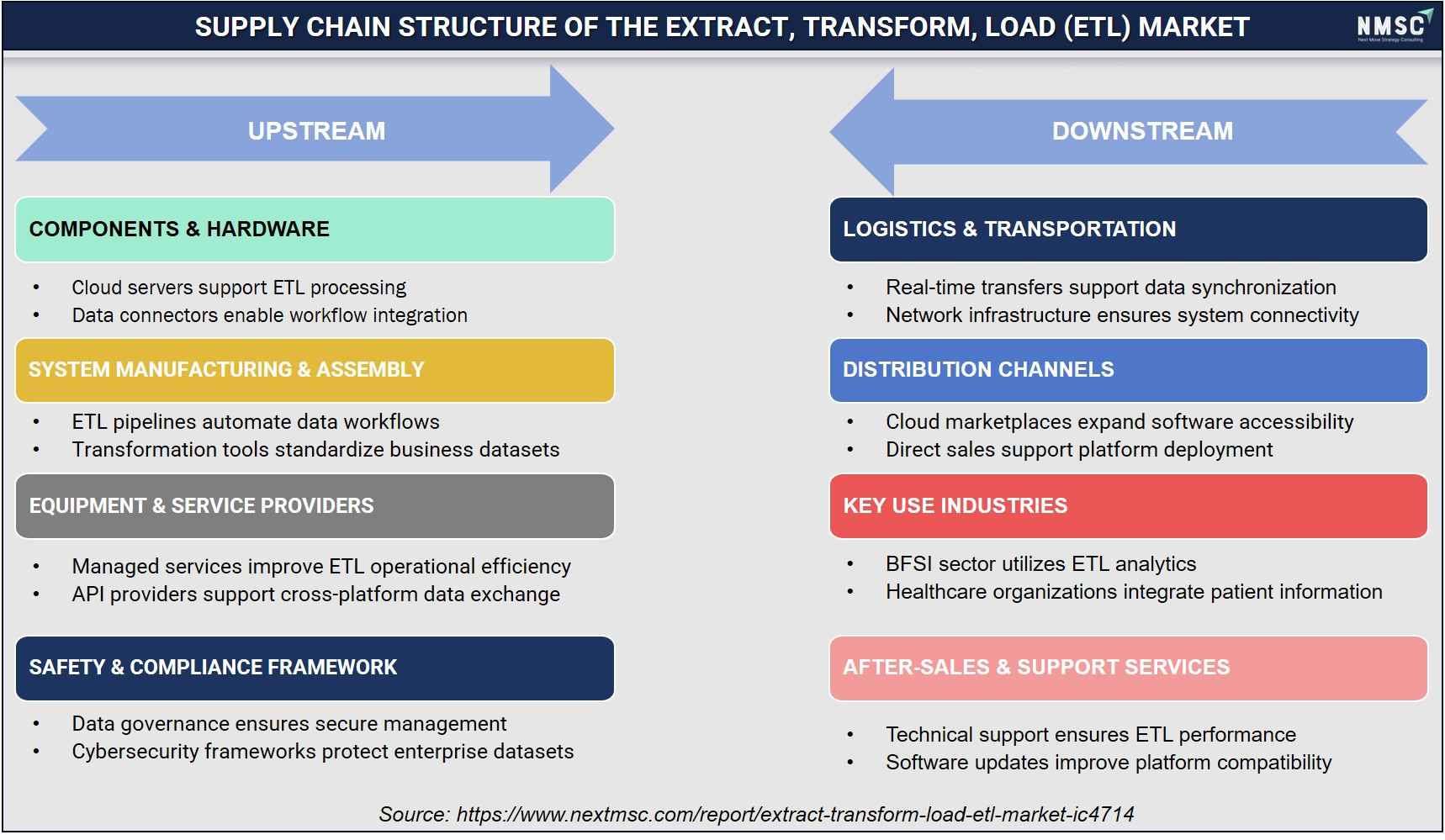
The infographic above depicts the supply chain structure of the Extract, Transform, Load (ETL) market. It breaks down upstream components including cloud servers, data connectors, ETL pipelines, managed services, and data governance frameworks. The downstream segment, further, covers logistics, cloud marketplaces, key use industries such as BFSI and healthcare, plus after-sales support and software updates.
Regional Outlook
Geographic Performance Snapshot
|
Region |
2025 (USD Billion) |
2035 (USD Billion) |
CAGR (%) |
Key Driver |
|
North America |
5.9 |
20.1 |
13.0% |
Cloud adoption, enterprise analytics |
|
Europe |
3.3 |
11.2 |
13.0% |
GDPR compliance, digital transformation |
|
Asia Pacific |
3.1 |
12.4 |
14.9% |
Cloud infrastructure expansion, IT growth |
|
Middle East & Africa |
0.9 |
3.4 |
14.2% |
Smart city investments, digital economy |
|
Latin America |
1.1 |
4.7 |
15.5% |
E-commerce growth, cloud adoption |
North America Extract, Transform, Load (ETL) Market
North America holds the dominant share of the global ETL market, underpinned by the concentration of hyperscaler cloud platforms, enterprise technology buyers, and established data engineering ecosystems. Based on our engagements with enterprise technology buyers across the U.S. and Canada, we observed that real-time ETL and CDC capabilities are the most actively procured features in financial services and healthcare sectors. The U.S. leads regional investment, while Canada demonstrates strong growth in financial analytics and public sector data modernization. Regulatory compliance with HIPAA, SOX, and state-level data privacy laws reinforces procurement of governance-capable ETL platforms.
U.S. Extract, Transform, Load (ETL) Market
Through our analysis of the U.S. ETL market, we observed that the country represents the single largest national market globally, driven by enterprise investment in cloud data platforms, AI-driven analytics infrastructure, and regulatory compliance tooling. Major hyperscalers including AWS, Microsoft Azure, and Google Cloud are headquartered in the U.S., creating a native technology ecosystem that accelerates ETL platform adoption. Federal agencies and defense contractors are investing in secure, on-premise, and private cloud ETL deployments, while financial services firms drive real-time CDC and streaming ETL procurement.
Canada Extract, Transform, Load (ETL) Market
From our assessment of the Canadian ETL market, we found that growth is driven by expanding financial services data modernization programs, public sector digital transformation initiatives, and growing adoption of cloud-native analytics platforms. Canada's Personal Information Protection and Electronic Documents Act (PIPEDA) and provincial data residency requirements create demand for ETL platforms with embedded compliance and data localization capabilities. Toronto's financial technology cluster and Vancouver's technology sector are key demand centers for ETL deployment activity.
Mexico Extract, Transform, Load (ETL) Market
According to our evaluation of the Mexican ETL market, growth is primarily driven by manufacturing sector digitalization, retail analytics investment, and expanding cloud infrastructure adoption among local enterprises and multinational corporations operating regional shared service centers. Mexico's proximity to U.S. technology ecosystems and its role as a nearshore IT services hub support ETL platform adoption. Data protection regulations under Mexico's Federal Law on Protection of Personal Data provide incremental compliance-driven ETL procurement activity.
Europe Extract, Transform, Load (ETL) Market
Europe represents the second-largest regional ETL market, with adoption heavily influenced by GDPR compliance requirements, digital transformation mandates across public and private sectors, and growing cloud migration activity. Through NMSC's assessment, we found that European enterprises are investing in ETL platforms with strong data lineage, masking, and cross-border transfer governance capabilities to satisfy regulatory audit requirements. The EU's Digital Decade policy objectives and cloud sovereignty initiatives are driving both public sector ETL procurement and preference for European-hosted deployment options.
UK Extract, Transform, Load (ETL) Market
Based on our engagements with UK technology buyers, we observed that the ETL market benefits from the country's well-developed financial services sector, government digital service programs, and active cloud adoption ecosystem. Post-Brexit data transfer framework complexities have created incremental demand for ETL platforms with cross-jurisdiction data governance capabilities. London's fintech cluster is a significant driver of real-time ETL and CDC procurement, while NHS digital transformation programs are creating healthcare data integration demand.
Germany Extract, Transform, Load (ETL) Market
Through our analysis of the German ETL market, we observed that industrial manufacturing, automotive, and engineering sectors are primary demand centers, driven by Industry 4.0 digitalisation programs that require large-scale IoT data integration and operational analytics pipelines. German data sovereignty concerns drive preference for private cloud and on-premise ETL deployments among large enterprises. SAP's dominant presence in German enterprise software creates significant ETL demand for SAP-native and SAP-compatible integration platforms.
France Extract, Transform, Load (ETL) Market
Our assessment of the French ETL market indicates that growth is led by financial services, retail, and public sector digital transformation. France's national cloud strategy, Gaia-X participation, and ANSSI cybersecurity certification requirements influence procurement toward certified, locally hosted ETL solutions. French enterprises in the luxury retail and media sectors are investing in customer data integration platforms that consolidate ETL with customer data platform capabilities, reflecting a trend toward converged data infrastructure.
Italy Extract, Transform, Load (ETL) Market
According to our evaluation of the Italian ETL market, financial services, manufacturing, and retail sectors are key drivers of data integration investment. Italy's National Recovery and Resilience Plan include significant digital transformation funding for public administration data modernisation, creating ETL procurement opportunities in government analytics programs. Italian enterprises are adopting cloud ETL platforms as part of broader SaaS application migration programs, with compliance with GDPR and Banca d'Italia reporting requirements reinforcing data pipeline governance needs.
Spain Extract, Transform, Load (ETL) Market
From our assessment of the Spanish ETL market, we found that growth is concentrated in financial services, telecom, and retail sectors, with cloud ETL adoption accelerating among Spanish enterprises undergoing digital transformation. Spain's National AI Strategy and digital economy investment programs are driving data infrastructure modernisation. Spanish regulatory alignment with GDPR creates sustained demand for ETL platforms with privacy transformation and data subject management capabilities. Madrid and Barcelona serve as primary enterprise technology demand centers.
Sweden Extract, Transform, Load (ETL) Market
Based on NMSC's research of the Swedish ETL market, we found that technology adoption is advanced, with financial services, retail, and manufacturing sectors leading ETL investment. Sweden's high internet penetration, digitally sophisticated enterprise buyer base, and proximity to Nordic financial and telecommunications hubs create a favourable environment for cloud-native ETL platform adoption. Swedish enterprises are early adopters of real-time ETL and streaming integration capabilities, particularly in e-commerce and payments sectors.
Denmark Extract, Transform, Load (ETL) Market
Through our analysis of the Danish ETL market, we observed that the country's highly digitized public sector, advanced financial services ecosystem, and strong life sciences industry create diversified demand for data integration platforms. Denmark's national data strategy and digital government programs are driving public sector ETL procurement. Danish pharmaceutical and biotechnology companies are investing in life sciences data integration for clinical trial and regulatory submission data management.
Finland Extract, Transform, Load (ETL) Market
Our assessment of the Finnish ETL market indicates that telecom, public sector, and manufacturing sectors are primary demand contributors. Finland's technology heritage, particularly in telecommunications infrastructure, supports advanced adoption of real-time data integration platforms. The Finnish government's public sector digitalization programs are creating structured ETL procurement cycles. Nordic regulatory alignment and GDPR compliance requirements reinforce data governance platform investment.
Netherlands Extract, Transform, Load (ETL) Market
Based on our engagements with Dutch enterprise technology buyers, we observed that the Netherlands serves as a significant European data center and cloud infrastructure hub, supporting above-average ETL platform adoption relative to market size. Financial services, logistics, and retail sectors drive ETL demand, with Amsterdam's technology and financial ecosystem hosting numerous European headquarters of global enterprises. The Netherlands' advanced cloud infrastructure and high enterprise IT spending support premium ETL platform adoption.
Asia Pacific Extract, Transform, Load (ETL) Market
Asia Pacific is the fastest-growing regional ETL market, driven by accelerating cloud infrastructure investment, expanding digital economies, and rising enterprise data analytics adoption across China, India, Japan, South Korea, and Southeast Asia. From our assessment, we observed that the region's large-scale cloud migration programs, government-led digitalization initiatives, and rapid e-commerce expansion are creating substantial ETL demand. Hyperlocal regulatory requirements across APAC jurisdictions add complexity to multi-country ETL deployments, supporting demand for governance-capable integration platforms.
China Extract, Transform, Load (ETL) Market
Through our analysis of the Chinese ETL market, we observed that government-driven data economy initiatives, domestic cloud platform growth led by Alibaba Cloud, Tencent Cloud, and Huawei Cloud, and extensive manufacturing and financial services digitalization are primary demand drivers. China's Data Security Law and Personal Information Protection Law create compliance-driven ETL procurement requirements. Local ETL vendors including Alibaba and Tencent are developing competing platforms, while international vendors navigate regulatory complexity in this strategically important market.
India Extract, Transform, Load (ETL) Market
Based on NMSC's research, we found that India is the fastest-growing individual country market for ETL solutions, driven by rapid digital economy expansion, substantial IT and BPO sector investment, and accelerating cloud-native analytics adoption. The Digital India initiative and expanding fintech ecosystem are creating high-volume data integration requirements. India's large pool of data engineering talent supports cost-competitive ETL implementation services, attracting global system integrators and creating a self-reinforcing technology ecosystem. The Personal Data Protection Bill is expected to further stimulate governance-capable ETL procurement.
Japan Extract, Transform, Load (ETL) Market
Our assessment of the Japanese ETL market indicates that manufacturing, financial services, and retail sectors are primary demand centers. Japan's Society 5.0 digital transformation strategy and significant investment in smart manufacturing and connected supply chain infrastructure are driving IoT data integration and ETL adoption. Japanese enterprises tend toward hybrid deployment models, balancing domestic data center investment with cloud migration. Language and compliance requirements support localized ETL platform offerings and Japanese-headquartered system integrator channels.
South Korea Extract, Transform, Load (ETL) Market
According to our evaluation of the South Korean ETL market, the country's highly connected digital economy, advanced semiconductor and electronics manufacturing sector, and sophisticated financial services industry are key demand drivers. South Korea's Digital New Deal government investment program is accelerating public sector data platform modernization. K-Cloud adoption is expanding, with domestic platforms complementing hyperscaler offerings. Regulatory compliance with the Personal Information Protection Act reinforces data governance ETL procurement.
Taiwan Extract, Transform, Load (ETL) Market
From our assessment of the Taiwanese ETL market, we found that the semiconductor and electronics manufacturing sector is the primary demand driver, with high-volume production data integration requirements for yield analytics, supply chain visibility, and equipment telemetry. Taiwan's strategic role in global semiconductor supply chains creates interconnected data integration requirements with multinational customers and partners. Cloud ETL adoption is growing among Taiwanese manufacturers as part of Industry 4.0 and smart factory programs.
Indonesia Extract, Transform, Load (ETL) Market
Based on our engagements in the Indonesian ETL market, we observed that the country's rapidly expanding digital economy, driven by large-scale e-commerce and fintech adoption, is creating significant data integration demand. Indonesia's large population and growing middle class support high-volume consumer data pipeline requirements. Government digitalization programs, including the National Data Center initiative are driving public sector ETL procurement. Domestic data localization requirements under Indonesia's Personal Data Protection Law influence deployment architecture choices.
Vietnam Extract, Transform, Load (ETL) Market
Through our analysis of the Vietnamese ETL market, we observed that the country's expanding manufacturing sector, growing digital economy, and increasing FDI in technology and financial services are driving data integration adoption. Vietnam's strategic positioning as a manufacturing alternative to China is attracting supply chain analytics investment requiring ETL infrastructure. The National Digital Transformation Program is accelerating public sector cloud and data platform adoption, creating incremental ETL procurement opportunities.
Australia Extract, Transform, Load (ETL) Market
Our assessment of the Australian ETL market indicates that financial services, healthcare, and government sectors are primary demand centers, supported by the country's mature cloud adoption ecosystem and advanced enterprise IT investment. Australia's Consumer Data Right (CDR) legislation is creating compliance-driven ETL procurement in banking and energy sectors, requiring governed data extraction and transformation capabilities. Proximity to rapidly growing Southeast Asian markets positions Australian technology buyers as regional ETL early adopters.
Philippines Extract, Transform, Load (ETL) Market
According to our evaluation of the Philippine ETL market, BPO and shared services sectors are significant data integration consumers, with large-scale offshore service delivery operations requiring cross-border data pipeline governance. The Philippines' rapidly expanding digital economy and government digitalization programs are creating public sector ETL demand. Financial services digitalization, including a growing fintech sector, is driving real-time data integration adoption among Philippine banks and payment platforms.
Malaysia Extract, Transform, Load (ETL) Market
Based on NMSC's research in the Malaysian ETL market, we found that financial services, manufacturing, and telecommunications sectors lead adoption, supported by the government's Malaysia Digital Economy Blueprint and Smart City initiatives. Malaysia's positioning as a regional cloud hub, hosting AWS, Microsoft Azure, and Google Cloud availability zones, supports advanced cloud ETL adoption. Cross-border data integration requirements from multinational manufacturing operations reinforce ETL platform investment in the country.
Middle East and Africa (MEA) Extract, Transform, Load (ETL) Market
The Middle East and Africa represent a high-growth ETL market, driven by smart city investments, national digital transformation programs, and rapidly expanding financial services sectors across Saudi Arabia, UAE, and South Africa. From our assessment, we observed that regional cloud infrastructure buildout by hyperscalers and local providers is creating enabling conditions for ETL adoption. Sovereign data and cybersecurity mandates across GCC countries are influencing deployment architectures, with private and government cloud deployments preferred for sensitive government and financial data pipelines.
Saudi Arabia Extract, Transform, Load (ETL) Market
Through our analysis of the Saudi Arabian ETL market, we observed that Vision 2030 digital transformation programs, large-scale smart city infrastructure development, and NEOM technology platform investments are primary demand drivers. The Saudi Data and AI Authority (SDAIA) and National Data Management Office are driving public sector data integration standardization. Financial services digitalization and oil and gas sector operational analytics are significant ETL procurement contributors. Cloud hosting by regional providers aligned with government data residency requirements shapes deployment choices.
UAE Extract, Transform, Load (ETL) Market
Based on our engagements with UAE technology buyers, we observed that the country's advanced digital infrastructure, high enterprise technology spending, and strategic positioning as a regional hub for financial services, logistics, and tourism create diversified ETL demand. The UAE's Smart Government initiatives and Dubai Smart City program drive public sector data integration investment. The Dubai International Financial Centre and Abu Dhabi Global Market financial regulatory environments create compliance-driven ETL procurement in financial services.
Egypt Extract, Transform, Load (ETL) Market
Our assessment of the Egyptian ETL market indicates that financial services, government, and telecommunications sectors are primary demand centers. Egypt's Vision 2030 and National Digital Transformation Strategy are driving public sector data platform modernization. Central Bank of Egypt digital banking regulations are stimulating financial sector data integration investment. Growing cloud adoption among Egyptian enterprises, supported by regional availability zone expansion, is enabling transition from on-premise to cloud ETL architectures.
Israel Extract, Transform, Load (ETL) Market
According to our evaluation of the Israeli ETL market, the country's advanced technology startup ecosystem, large defense and intelligence sector, and sophisticated financial services industry create high-value ETL demand. Israel's concentration of cybersecurity, AI, and data analytics companies generates both ETL vendor activity and enterprise buyer demand. The Israeli Privacy Protection Law and defense sector data security requirements reinforce governance-capable ETL procurement. Strong R&D culture supports early adoption of AI-augmented ETL capabilities.
Turkey Extract, Transform, Load (ETL) Market
From our assessment of the Turkish ETL market, we found that financial services, manufacturing, and retail sectors are primary drivers, with Turkey's large and growing digital economy supporting expanding cloud ETL adoption. Turkey's Personal Data Protection Law (KVKK) creates compliance-driven ETL procurement requirements for both domestic and multinational enterprises operating in the country. Istanbul's financial and technology hub concentration supports premium ETL platform adoption, while Anatolian manufacturing clusters drive industrial data integration demand.
Nigeria Extract, Transform, Load (ETL) Market
Based on NMSC's research in the Nigerian ETL market, we found that financial services and telecommunications sectors lead adoption, supported by Nigeria's rapidly expanding fintech ecosystem and large mobile money infrastructure. The Central Bank of Nigeria's digital finance regulations and cashless policy are driving real-time data integration investment among Nigerian banks and fintech operators. Cloud ETL adoption is growing as Nigerian enterprises migrate from legacy on-premise systems to cloud-hosted platforms, supported by expanding regional cloud availability.
South Africa Extract, Transform, Load (ETL) Market
Through our analysis of the South African ETL market, we observed that financial services, mining, and retail sectors are primary demand contributors. South Africa's Protection of Personal Information Act (POPIA) creates compliance-driven ETL procurement requirements comparable to GDPR in scope and complexity. Johannesburg's position as sub-Saharan Africa's primary financial and technology hub concentrates enterprise ETL procurement activity. Cloud adoption is accelerating among South African enterprises, with Microsoft Azure and AWS establishing local cloud regions to support data residency requirements.
Latin America Extract, Transform, Load (ETL) Market
Latin America is the fastest-growing regional ETL market on a percentage basis, driven by rapid e-commerce expansion, accelerating cloud adoption, and growing enterprise investment in data analytics infrastructure across Brazil, Mexico, and Colombia. Our findings suggest that the region's large unbanked population, expanding fintech sector, and digital-first retail growth are creating substantial real-time data integration requirements. National data protection laws across Brazil, Colombia, Argentina, and Chile are aligning with GDPR principles, reinforcing compliance-driven ETL procurement.
Brazil Extract, Transform, Load (ETL) Market
Based on our engagements with Brazilian technology buyers, we observed that financial services, retail, and agribusiness sectors drive ETL demand in the country's large and diverse economy. Brazil's Lei Geral de Proteção de Dados (LGPD) creates GDPR-comparable data governance requirements that directly stimulate ETL platform procurement with privacy transformation capabilities. Brazil's fintech and digital banking sector, including Nubank and other neobanks, generates high-volume real-time data integration requirements. São Paulo's technology ecosystem concentrates the majority of enterprise ETL deployment activity.
Argentina Extract, Transform, Load (ETL) Market
Our assessment of the Argentine ETL market indicates that financial services, agriculture, and retail sectors are key demand drivers. Argentina's established IT services sector supports ETL implementation capability, while economic volatility influences procurement timing and vendor selection criteria. Cloud ETL adoption is growing, with local data center and cloud provider expansion supporting Argentine enterprises transitioning from on-premise infrastructure. Regulatory compliance with Argentina's Personal Data Protection Law shapes data pipeline governance requirements.
Chile Extract, Transform, Load (ETL) Market
According to our evaluation of the Chilean ETL market, mining, financial services, and retail sectors are primary demand centers. Chile's advanced digital infrastructure relative to Latin American peers supports sophisticated enterprise analytics and ETL adoption. The country's Personal Data Protection Law modernization aligns with GDPR principles, creating compliance-driven ETL procurement. Santiago's role as a regional technology hub attracts multinational enterprise investment in shared service center data infrastructure.
Colombia Extract, Transform, Load (ETL) Market
From our assessment of the Colombian ETL market, we found that financial services, retail, and telecommunications sectors lead adoption. Colombia's Data Protection Law (Law 1581) creates regulatory compliance requirements for ETL platforms. A growing fintech sector and expanding e-commerce ecosystem generate real-time data integration demand. Bogotá's technology and financial services concentration supports premium ETL platform procurement. Regional cloud infrastructure expansion is enabling Colombian enterprises to transition from legacy on-premise to cloud-native ETL architectures.
Competitive Landscape
Competitive Dynamics & M&A Landscape
|
Key Takeaways |
Details |
|
Market Structure |
Moderately consolidated, led by a group of global data integration and cloud platform providers including Microsoft Corporation, Amazon Web Services, Inc., Google LLC, IBM Corporation, Oracle Corporation, SAP SE, and Informatica LLC. The market also includes a growing ecosystem of specialized cloud-native ETL vendors such as Fivetran, Inc., Matillion Limited, Airbyte, Inc., dbt Labs, Inc., Boomi, LP, SnapLogic, Inc., and CData Software, Inc., which compete through automation, connectivity, and ease of deployment. |
|
Innovation Focus |
AI-powered data integration, metadata-driven automation, low-code/no-code pipeline development, real-time data replication, Change Data Capture (CDC), data observability, DataOps, GenAI-ready data pipelines, cloud-native ELT architectures, and unified data governance capabilities. |
|
M&A Activity |
Strategic acquisitions continue to reshape the ETL landscape as vendors expand cloud integration, data quality, analytics, and AI capabilities. Major platform providers and data management vendors are increasingly acquiring complementary technologies to strengthen end-to-end data ecosystem offerings, while private equity-backed consolidation remains active among mid-sized integration and data management providers. |
How Do Companies Compete in the Extract, Transform, Load (ETL) Market?
The ETL Market is increasingly competitive across cloud integration capabilities, automation, real-time data processing, AI readiness, and data governance. Based on our analysis, we noticed that leading vendors differentiate through connector breadth, low-code development tools, automated pipeline management, and support for hybrid and multi-cloud environments. Competition has shifted beyond traditional data movement toward enabling scalable, governed, and AI-ready data ecosystems that support enterprise analytics and digital transformation initiatives.
Which Kind of Companies Dominate the Extract, Transform, Load (ETL) Market?
The ETL Market is led by three major groups, which are hyperscale cloud providers such as Microsoft, AWS, Google, and Oracle; enterprise data integration specialists including Informatica, IBM, SAP, and Qlik; and cloud-native ETL innovators such as Fivetran, Matillion, Airbyte, and dbt Labs. Our assessment indicates that market leadership is increasingly influenced by cloud ecosystem strength, automation capabilities, and the ability to support modern data architectures.
AI-Native Integration and Data Automation Drive Market Success in the ETL Market
AI-enabled automation, intelligent data transformation, and metadata-driven orchestration have become key differentiators in the ETL Market. Our findings suggest that enterprises increasingly prioritize platforms capable of delivering trusted, high-quality, and AI-ready data across distributed environments. Vendors that combine automation, governance, and interoperability with modern analytics and AI frameworks are better positioned to capitalize on growing enterprise data modernisation investments.
Market Players to Opt for Merger and Acquisition Strategies to Expand Their Presence in the ETL Market
Mergers and acquisitions remain an important growth strategy in the ETL Market as vendors seek to strengthen capabilities in AI, data governance, real-time integration, and cloud-native data management. Based on our market evaluation, acquisition activity is increasingly focused on expanding technology portfolios and accelerating innovation. Future consolidation is expected among specialised integration, DataOps, and data observability providers as competition intensifies across enterprise data platforms.
Who Are the Key Market Players in the Extract, Transform, Load (ETL) Market?
-
Microsoft Corporation
-
Amazon Web Services, Inc.
-
IBM Corporation
-
Oracle Corporation
-
Google LLC
-
Informatica LLC
-
SAP SE
-
Salesforce, Inc.
-
Qlik Technologies Inc.
-
Boomi, LP
-
Fivetran, Inc.
-
SAS Institute Inc.
-
SnapLogic, Inc.
-
Matillion Limited
-
dbt Labs, Inc.
-
Airbyte, Inc.
-
Hitachi Vantara LLC
-
Precisely Holdings, LLC
-
CData Software, Inc.
-
CloverDX a.s.
What Are the Latest Developments in the Extract, Transform, Load (ETL) Market?
|
Date |
Event |
|
October 2025 |
Fivetran and dbt Labs announced an all-stock merger combining automated data movement and data transformation capabilities. The deal unites two core layers of the modern ETL/ELT stack and reflects increasing market demand for integrated data infrastructure platforms supporting analytics and AI workloads. It is one of the most significant consolidation events in the modern ETL market. |
|
May 2025 |
Salesforce signed a definitive agreement to acquire Informatica for approximately USD 8 billion. Since Informatica is one of the largest enterprise data integrations and ETL vendors globally, the transaction represents a major consolidation event in the ETL market. The acquisition underscores the strategic value of data integration, governance, and metadata management in enterprise data ecosystems. |
Expert Insights
 “Data integration is critical for the success of AI and GenAI projects. A comprehensive data integration solution should be able to discover, ingest, integrate, automate, cleanse, govern, master and share data for AI and GenAI consumption. This ensures that AI/GenAI models have access to the right data in the right format, enabling them to produce more accurate, reliable and relevant results.”
- Pratik Parekh, Senior Vice President and General Manager at Informatica
Statement made during an Informatica discussion on the role of data integration and data management in enabling enterprise AI and Generative AI initiatives.
Market Interpretation
NMSC's analysis indicates that the ETL Market is increasingly evolving from a traditional data movement function into a strategic enabler of AI and Generative AI adoption. The statement highlights the growing importance of end-to-end data integration capabilities, including data ingestion, transformation, quality management, governance, and sharing, to support AI-ready data environments. As enterprises accelerate investments in AI-driven applications, ETL vendors are expanding automation, metadata management, and data governance functionalities to ensure trusted, high-quality data availability. This trend is expected to drive sustained demand for cloud-native, intelligent, and AI-enabled ETL platforms that can efficiently manage increasingly complex and distributed data ecosystems.
What Are the Investment Opportunities in the Extract, Transform, Load (ETL) Market?
Capital Inflows and Venture Activity
The ETL Market continues to attract significant venture capital and strategic investment, particularly across cloud-native data integration, open-source data engineering, and AI-powered data automation platforms. Companies such as Fivetran, Airbyte, dbt Labs, and Matillion have secured substantial funding rounds, reflecting investor confidence in the long-term growth of enterprise data infrastructure. Strategic investments increasingly target vendors that combine automated data integration, governance, and AI-ready data management capabilities, as enterprises prioritize scalable data architectures to support analytics and generative AI initiatives.
Infrastructure Investment
Cloud infrastructure expansion remains the most important investment driver for the ETL Market. Major hyperscalers including Microsoft, Amazon Web Services, and Google continue to invest heavily in cloud data platforms, analytics ecosystems, and AI infrastructure that rely on robust data integration capabilities. These investments are creating sustained demand for ETL solutions capable of managing high-volume, multi-cloud, and real-time data environments. Enterprise spending on data lakes, lakehouses, and modern analytics platforms is further strengthening the market outlook for ETL technology providers.
ESG Considerations
Environmental, social, and governance considerations are becoming increasingly relevant in ETL procurement and investment decisions, particularly among government agencies and large enterprises. Cloud-based ETL deployments can support sustainability objectives by improving resource utilization, reducing on-premise infrastructure requirements, and enabling more efficient data management practices. Our analysis indicates that organizations are increasingly evaluating data platform providers based on operational efficiency, cloud optimization strategies, and alignment with broader sustainability and digital governance initiatives.
Digital Transformation Enablement
ETL platforms have become foundational infrastructure for enterprise digital transformation strategies, enabling organizations to unify data across applications, cloud environments, and business functions. From our research, we found that demand for AI, machine learning, real-time analytics, and regulatory compliance initiatives is accelerating investment in modern data integration architectures. Vendors that align their product roadmaps with cloud modernization, data governance, and AI adoption trends are well positioned to benefit from long-term digital transformation spending across industries.
Private Equity and Strategic M&A Activity
Strategic M&A activity in the ETL Market is increasingly focused on acquiring capabilities in cloud-native integration, data transformation, governance, metadata management, and AI-driven automation. The acquisitions of Informatica by Salesforce and the merger of Fivetran and dbt Labs demonstrate the growing strategic value of data integration platforms within enterprise software ecosystems. Our assessment indicates that specialized ETL vendors with strong cloud partnerships, differentiated automation technologies, and established enterprise customer bases remain attractive targets for private equity investors and strategic acquirers.
Key Benefits for Stakeholders
For Enterprise Buyers and IT Leaders
Enterprise technology leaders gain access to a comprehensive and vendor-neutral assessment of the ETL Market, including quantitative analysis across offering, deployment, enterprise size, and end-user segments. Our competitive landscape evaluation provides actionable intelligence on cloud-native ETL platforms, AI-enabled data integration capabilities, and vendor differentiation strategies, enabling informed platform selection and long-term data architecture planning. The regional outlook further supports cloud adoption and digital transformation investment decisions.
For Investors and Financial Analysts
Investors and financial analysts benefit from a structured assessment of the ETL Market's growth outlook, competitive dynamics, and segment-level opportunities through the forecast period. The market sizing, CAGR analysis, and regional growth projections provide a foundation for valuation modeling and investment prioritization. The report's coverage of M&A activity, AI-driven platform evolution, and cloud data infrastructure trends offers valuable insights into emerging growth opportunities and competitive shifts across the data integration ecosystem.
For ETL Vendors and Technology Providers
ETL vendors, cloud platform providers, and data management companies gain actionable intelligence on high-growth market segments, evolving customer requirements, and competitive positioning strategies. Our analysis identifies emerging opportunities in real-time integration, AI-powered automation, data governance, and hybrid-cloud deployment environments. The regional and industry-specific assessments enable vendors to optimize product roadmaps, channel strategies, and geographic expansion initiatives while aligning investments with enterprise modernization and AI adoption trends.
For System Integrators and Consulting Firms
System integrators, managed service providers, and consulting organizations gain a detailed understanding of ETL adoption patterns across industries and regions. The report highlights enterprise demand drivers, cloud migration trends, regulatory considerations, and modernization initiatives that are generating new implementation and advisory opportunities. These insights help service providers prioritize target industries, strengthen data transformation practices, and develop value-added offerings around analytics, governance, and AI readiness.
For Government and Regulatory Bodies
Government agencies, policymakers, and regulatory organizations gain a structured perspective on how data governance requirements, privacy regulations, cloud adoption policies, and digital transformation initiatives influence ETL Market development. Country- and region-level insights provide evidence-based context for evaluating the impact of regulatory frameworks on enterprise data integration investments. The analysis also highlights the growing importance of trusted data management, compliance, and AI-ready data infrastructure in supporting national digital economy objectives.
Key Market Segments
By Offering
-
Software
-
Subscription SaaS
-
Usage Based
-
Term License
-
Perpetual License
-
-
Support
-
Maintenance
-
Technical Support
-
Premium Support
-
-
Services
-
Implementation
-
Migration and Modernization
-
Managed Services
-
Training
-
By Product Function
-
Batch ETL
-
Micro-Batch ETL
-
Real-Time ETL
-
CDC
-
ELT
-
Reverse ETL
-
Other
By Deployment
-
Public Cloud
-
Private Cloud
-
On-Premise
-
Hybrid
By Buyer Size
-
Large Enterprise
-
Mid-Market
-
SMB
By End User Industry
-
BFSI
-
Healthcare and Life Sciences
-
IT and Telecom
-
Retail and E-commerce
-
Manufacturing
-
Public Sector
-
Other
By Sales Channel
-
Direct
-
Partner SI
-
Cloud Marketplace
-
OEM Embedded
-
Self-Serve
By Region
-
North America: U.S., Canada, and Mexico.
-
Europe: UK, Germany, France, Italy, Spain, Sweden, Denmark, Finland, the Netherlands, and the rest of Europe.
-
Asia Pacific: China, India, Japan, South Korea, Taiwan, Indonesia, Vietnam, Australia, Philippines, Malaysia and the rest of APAC.
-
Middle East & Africa (MEA): Saudi Arabia, UAE, Egypt, Israel, Turkey, Nigeria, South Africa, and the rest of MEA.
-
Latin America: Brazil, Argentina, Chile, Colombia, and the rest of LATAM.
Conclusion and Recommendations
Long-Term Outlook
The ETL Market is entering a period of sustained expansion driven by accelerating cloud adoption, enterprise AI deployment, real-time analytics requirements, and increasingly stringent data governance mandates. The market is projected to grow from USD 16.2 billion in 2026 to USD 51.8 billion by 2035 at a CAGR of 13.8%. NMSC's analysis indicates that this growth reflects the evolution of ETL platforms from traditional data movement tools into strategic data engineering and AI-enablement infrastructure, supporting enterprise-wide digital transformation initiatives across industries.
Strategic Positioning Recommendations
ETL vendors should prioritize AI-augmented data integration, automated pipeline development, and cloud-native deployment capabilities as the most critical competitive initiatives over the forecast period. Expanding cloud marketplace presence, strengthening multi-cloud interoperability, and developing industry-specific integration frameworks for sectors such as healthcare, financial services, and manufacturing will be essential for differentiation. Vendors targeting mid-market organizations should focus on low-code experiences, self-service deployment models, and consumption-based pricing structures to expand market penetration and compete effectively against hyperscaler-native offerings.
Investment Attractiveness
The ETL Market presents a compelling investment opportunity supported by durable demand drivers including cloud modernization, AI adoption, regulatory compliance, and enterprise data governance requirements. Our assessment indicates that the highest-conviction investment themes include AI-powered data integration platforms, cloud-native ETL solutions, real-time data processing technologies, and multi-cloud connectivity capabilities. Vendors with strong governance functionality, broad connector ecosystems, and recurring subscription revenue models are expected to command premium valuations as organizations increase investment in trusted data infrastructure.
Market Shifts and Key Risks
The most significant market shift underway is the convergence of ETL, data observability, reverse ETL, metadata management, and governance capabilities into unified data engineering platforms. Key risks include macroeconomic pressures that constrain enterprise IT spending, expanding hyperscaler-native integration capabilities that intensify competitive pressures, and persistent shortages of skilled data engineering talent that may slow deployment cycles. Additionally, evolving data sovereignty regulations and localization requirements are expected to influence deployment architectures and vendor selection decisions across global markets.
Growth Pathways
Organizations seeking to maximize value from the ETL Market should pursue a three-horizon strategy. In the near term from 2025 to 2027, prioritize cloud migration initiatives, AI-ready data architecture development, and real-time integration capabilities. In the mid-term from 2027 to 2031, invest in automated data governance, DataOps practices, and advanced metadata management to improve operational efficiency and compliance readiness. In the long term from 2031 to 2035, position for AI-native data ecosystems, autonomous data integration workflows, and unified enterprise data platforms that support large-scale analytics, machine learning, and next-generation digital business models.


About the Author

About the Reviewer

At Next Move Strategy Consulting, we understand that insightful market research is the cornerstone of successful business decisions. That's why we employ a robust and multifaceted approach, combining various methodologies to deliver the most accurate and actionable data for our clients.

Research Landscape
We navigate the world of research with two primary approaches:
Qualitative Approach
Our qualitative research methodologies involve immersive techniques such as in-depth interviews, focus groups, and observational studies. By engaging directly with individuals and stakeholders, we uncover valuable insights that quantitative data alone may overlook.

Quantitative Research
In tandem with qualitative methodologies, NMSC leverages the power of Quantitative Research to provide a robust foundation of numerical insights. Through systematic data collection and analysis, we quantify patterns, preferences, and market trends, offering a comprehensive view of the business landscape.
Our quantitative research approach employs diverse tools, including surveys, experiments, and statistical modelling. These methodologies enable us to gather data from a large and representative sample, ensuring the statistical significance of our findings. By employing structured questionnaires and standardized data collection methods, we guarantee the reliability and validity of the information we present to our clients.
Quantitative research is particularly effective in measuring the prevalence of trends, assessing market size, and gauging the impact of various factors on consumer behavior. The numerical precision attained through this approach equips our clients with actionable insights, facilitating data-driven decision-making and strategy formulation.


Our Specialized Toolbox for Industry-Specific Market Research
We deploy a specialized arsenal of techniques tailored to meet your unique requirements. Here's a glimpse into our comprehensive toolbox:

Information Procurement
The stage entails acquiring market data or relevant information through various sources and methodologies.


Market Research Approach
We utilize both top-down and bottom-up approaches in market research analysis to achieve a comprehensive understanding of the market dynamics, leveraging the broad perspective of industry trends and macroeconomic factors alongside detailed insights from specific segments and individual companies.

Porters Five Forces Analysis
We conduct Porter's Five Forces analysis to evaluate the competitive landscape of an industry, providing us with insights into factors that affect profitability and strategic positioning.

SWOT Analysis

Forecasting
We utilize a forecasting model to predict future consumption by considering parameters like population, economics, regulations, market competition, drivers, constraints, technology, and pricing. We also employ statistical techniques such as multilinear regression, exponential smoothing, moving average, ARIMA, and Monte Carlo simulations for accurate predictions. In econometric forecasting, we analyzed short-term and long-term event impacts, attributing values based on regulatory frameworks, economic factors, and market events.





 Speak to Our Analyst