Multi Cloud Market Size, Share, Growth & Forecast By Offering Type (Multi Cloud Management, Infrastructure Platform, Networking and Application Delivery, Security), By Delivery Model (SaaS, Self-Managed, Managed Service, Embedded), By Buyer (CIO and IT Ops, Platform Engineering, Security, FinOps, App Dev, Procurement and MSP), By End Use Industry (BFSI, Healthcare), By Revenue Model (Subscription, License, Others), and By Channel (Direct, Partner, Marketplace, OEM) — Global Analysis 2026–2035
Industry: ICT & Media | Publishing Date: July 13, 2026 | Last Updated: September 30, 2026 | No of Pages: N/A | No. of Tables: N/A | No. of Figures: N/A | Format: PDF | Report Code: IC5099
What Is the Multi Cloud Market Size?
The global Multi Cloud Market was valued at USD 18.4 billion in 2025 and is expected to reach USD 22.3 billion in 2026. Accelerating enterprise cloud diversification, mounting vendor lock-in concerns, and widespread adoption of AI-driven operations are projected to propel the market to USD 128.6 billion by 2035, advancing at a CAGR of 21.4% from 2026 to 2035. NMSC's analysis indicates that the key growth drivers include the proliferation of hybrid-cloud workloads, expanding FinOps mandates to control distributed cloud costs, regulatory requirements for workload portability and data residency, and the broad enterprise shift toward platform-engineering-led infrastructure governance across multiple cloud providers.
|
Parameters |
Details |
|
Market Size in 2025 |
USD 18.4 Billion |
|
Market Size in 2026 |
USD 22.3 Billion |
|
Revenue Forecast in 2035 |
USD 128.6 Billion |
|
Growth Rate |
CAGR of 21.4% from 2026 to 2035 |
|
Analysis Period |
2025–2035 |
|
Base Year Considered |
2025 |
|
Forecast Period |
2026–2035 |
|
Market Size Estimation |
Billion USD |
|
Companies Profiled |
20 |
|
Countries Covered |
33 |
|
Market Share |
Top 10 |
Multi Cloud Market Overview
What Is the Multi Cloud Market?
The Multi Cloud Market encompasses the solutions, platforms, and services that enable organizations to deploy, manage, secure, and optimize workloads across two or more public cloud providers simultaneously. This includes cloud management platforms, orchestration layers, security posture management tools, FinOps solutions, observability stacks, data integration pipelines, and professional services. From our research, we found that enterprises adopt multi-cloud architectures primarily to avoid vendor lock-in, satisfy regulatory data residency requirements, access best-of-breed services, and optimize cost through competitive cloud pricing.
How Has the Multi Cloud Market Evolved?
The Multi Cloud Market has evolved through distinct maturity phases. The first phase centered on lift-and-shift cloud migrations where organizations treated each cloud as independent. The second phase introduced multi-cloud management tooling focused on unified visibility and basic orchestration. Through our market assessment, we observed that the current phase is defined by platform-engineering-led governance, AI-augmented FinOps automation, and integrated security fabric architectures that span AWS, Microsoft Azure, and Google Cloud, alongside sovereign cloud regions in regulated geographies.
How Do Regulations Influence the Multi Cloud Market Trends?
Regulatory developments are a primary structural driver of the Multi Cloud Market. The European Union's GDPR, the EU Data Act, the Digital Operational Resilience Act (DORA) for financial services, and national data residency mandates across Asia-Pacific and the Middle East compel enterprises to distribute workloads across geographically distinct cloud regions. NMSC's analysis indicates that regulatory compliance requirements are accelerating investment in cloud governance, workload portability, and identity-aware multi-cloud security controls, particularly among BFSI, healthcare, and public sector buyers.
How Is Technology Adoption Expanding Across the Multi Cloud Market?
Technology adoption across the Multi Cloud Market is accelerating as organizations standardize on Kubernetes for container orchestration, adopt service mesh architectures for cross-cloud connectivity, and deploy SASE frameworks for distributed security. Our findings suggest that cloud-native open standards including the Cloud Native Computing Foundation (CNCF) ecosystem, terraform for infrastructure-as-code, and OpenTelemetry for observability are significantly reducing integration complexity and enabling platform-engineering teams to manage heterogeneous cloud environments with consistent tooling and governance frameworks.
|
Key Takeaways |
|
By offering type, Multi Cloud Management held the largest share of the Multi Cloud Market at USD 4.6 billion in 2025. The Multi Cloud Security segment is the fastest-growing sub-segment, projected to expand from USD 2.9 billion in 2025 to USD 26.4 billion by 2035 at a CAGR of 24.7%, fueled by enterprise demand for cloud security posture management, identity governance, and workload protection across distributed cloud environments. |
|
By delivery model, SaaS commanded the largest share at USD 9.2 billion in 2025, representing approximately 50% of total Multi Cloud Market revenue. Managed Service is the fastest-growing delivery model at a CAGR of 23.1% from 2026 to 2035, driven by enterprise demand for outsourced multi-cloud operations across regulated industries including BFSI, healthcare, and public sector. |
|
By buyer, CIO and IT Ops accounted for USD 5.8 billion in 2025, the largest revenue share of the Multi Cloud Market. Platform Engineering is the fastest-growing buyer segment at a CAGR of 25.2% from 2026 to 2035, as organizations build internal developer platforms and cloud abstraction layers to accelerate application delivery. |
|
By end use industry, Technology held USD 4.1 billion in 2025. The Healthcare vertical is the fastest-growing end use segment in the Multi Cloud Market at a CAGR of 23.4% from 2026 to 2035, driven by clinical data compliance requirements, telehealth infrastructure expansion, and AI diagnostics workloads demanding multi-cloud redundancy. |
|
By revenue model, Subscription led at USD 8.3 billion in 2025. The Usage-based model is emerging as a high-growth revenue structure in the Multi Cloud Market, particularly prevalent in FinOps platforms, observability tools, and data integration services where consumption scales directly with enterprise workload intensity. |
|
By channel, Direct held the largest revenue share at USD 9.6 billion in 2025. Marketplace is the fastest-growing distribution channel in the Multi Cloud Market at a CAGR of 24.3% from 2026 to 2035, as enterprise buyers leverage AWS Marketplace, Azure Marketplace, and Google Cloud Marketplace to procure multi-cloud tooling against committed cloud spend. |
|
North America held the largest regional share at USD 8.2 billion in 2025, projected to reach USD 56.4 billion by 2035 at a CAGR of 21.2%, anchored by the world's highest concentration of hyperscaler infrastructure, enterprise technology budgets, and platform-engineering talent. |
|
Asia-Pacific is the fastest-growing major region in the Multi Cloud Market at a CAGR of 23.2%, propelled by India's cloud-first digital transformation, China's hybrid-cloud mandates, and rapid cloud adoption across Japan, South Korea, and Southeast Asia. |
|
The United States is the single largest country market in the Multi Cloud Market, representing over 80% of North American revenue in 2025, underpinned by the world's highest concentration of multi-cloud platform vendors, hyperscaler investments, and enterprise technology spending. |
|
India is the fastest-growing national market in Asia-Pacific within the Multi Cloud Market at a CAGR of 27.1%, propelled by the Meity Cloud Policy, Digital India initiatives, and the rapid adoption of cloud-native architectures across BFSI, IT services, and public sector organizations. |
Key Emerging Trends in the Multi Cloud Market
How Is Platform Engineering Reshaping Multi Cloud Governance and Delivery?
Platform engineering is fundamentally transforming how enterprises govern and deliver workloads across the Multi Cloud Market. Our analysis shows that organizations are investing in internal developer platforms (IDPs) built on Kubernetes, Terraform, and Backstage to abstract underlying cloud complexity and standardize service deployment across AWS, Azure, and GCP. Spotify's open-source Backstage framework, adopted by hundreds of enterprises, exemplifies this shift. Platform engineering reduces developer cognitive load, enforces security guardrails, and enables consistent FinOps controls across heterogeneous cloud environments, making it a structural demand driver for multi-cloud orchestration and management tooling.
How Is AI-Augmented FinOps Transforming Cost Intelligence Across the Multi Cloud Market?
AI-augmented FinOps represents one of the most commercially significant trends reshaping the Multi Cloud Market. Through our market assessment, we observed that organizations managing workloads across multiple cloud providers face exponential cost complexity, with cloud bills spanning hundreds of thousands of line items. AI-driven anomaly detection, rightsizing recommendations, and automated commitment purchasing are now core capabilities in leading FinOps platforms. The FinOps Foundation, a Linux Foundation project, has established best practices adopted by over 9,000 member organizations globally, elevating FinOps from a cost-cutting exercise to a strategic discipline for multi-cloud financial governance.
How Is SASE Architecture Driving Convergence Between Networking and Security in the Multi Cloud Market?
Secure Access Service Edge (SASE) is emerging as the dominant security and networking architecture for multi-cloud environments, combining SD-WAN, cloud access security brokers (CASB), zero-trust network access (ZTNA), and firewall-as-a-service into unified cloud-delivered platforms. Based on NMSC's research, we found that enterprises migrating from branch-office perimeter security to cloud-delivered SASE frameworks are generating sustained demand for multi-cloud networking and security vendors. Cisco, Palo Alto Networks, and Zscaler are positioned as primary SASE beneficiaries within the broader Multi Cloud Market.
How Is Kubernetes and Service Mesh Becoming the Universal Fabric of the Multi Cloud Market?
Kubernetes has become the universal orchestration layer enabling workload portability across the Multi Cloud Market share. From our research, we found that the CNCF's annual survey consistently identifies Kubernetes as the dominant container orchestration platform in production, with adoption rates exceeding 96% among survey respondents. Service mesh technologies, including Istio and Linkerd, extend Kubernetes networking capabilities to provide mTLS-secured service-to-service communication, traffic management, and observability across multi-cloud deployments. This standardization is enabling enterprises to move from cloud-specific toolchains to cloud-agnostic platform engineering stacks.
Strategic Framework of the Multi Cloud Market
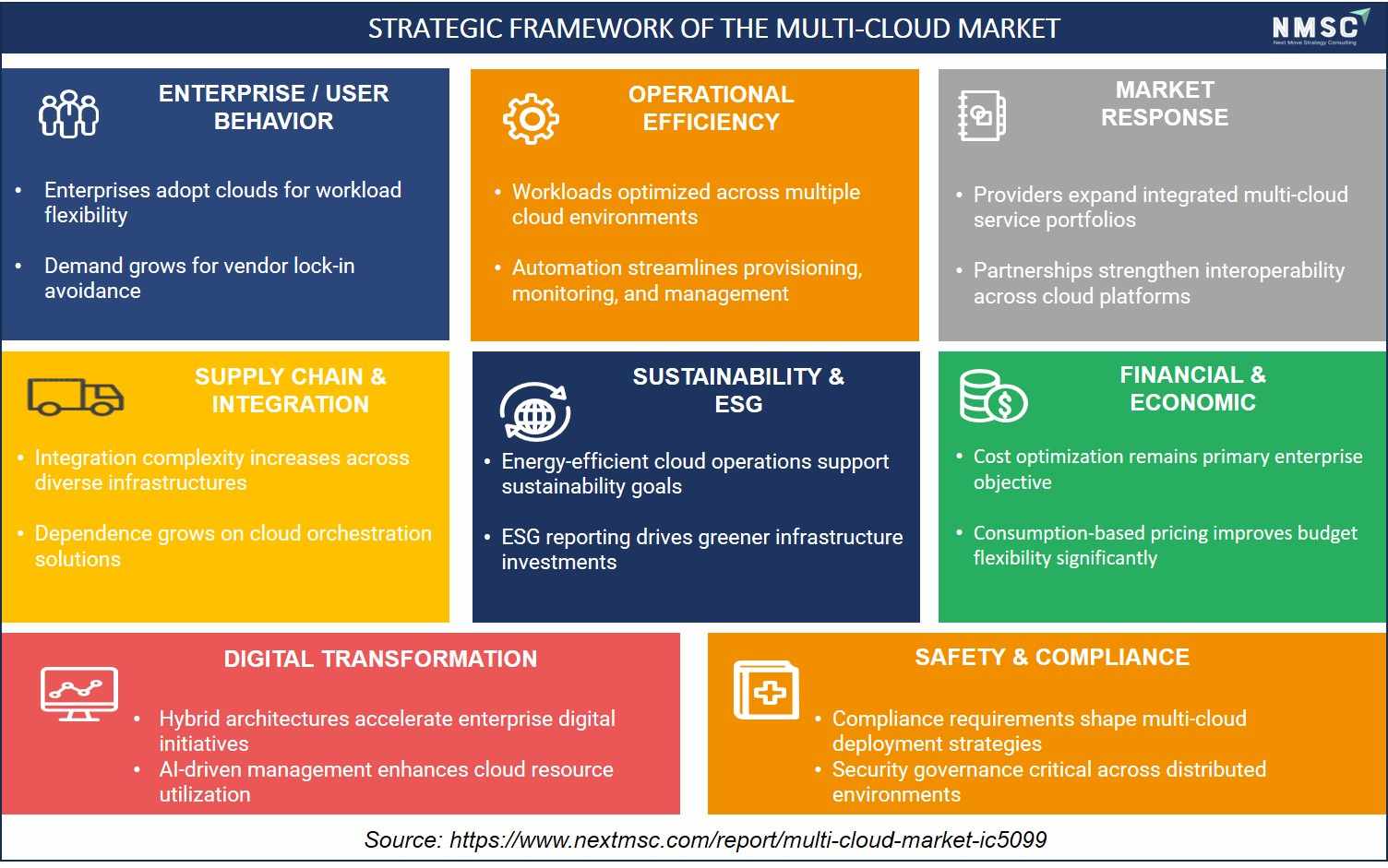
The strategic framework of the Multi Cloud Market highlights the key forces shaping adoption and growth. Enterprises increasingly embrace multi-cloud environments to improve workload flexibility and avoid vendor lock-in, while operational efficiency is enhanced through workload optimization and automation. Market participants respond by expanding integrated cloud offerings and strengthening interoperability. Growing integration complexity drives demand for orchestration solutions, while sustainability goals, cost optimization, digital transformation initiatives, and evolving security and compliance requirements continue to influence enterprise multi-cloud strategies worldwide.
What Are the Key Market Drivers, Breakthroughs, and Investment Opportunities that Will Shape the Multi Cloud Industry in the Next Decade?
|
Drivers / Trends / Restraints |
(+/-) % Impact on CAGR Forecast |
Geographic Relevance |
Impact Timeline |
|
Cloud Workload Distribution and Vendor Lock-In Avoidance |
+2.9% |
Global (led by North America, Europe) |
2025–2030 |
|
Regulatory Data Residency and Sovereignty Mandates |
+2.1% |
Europe, MEA, APAC |
2025–2035 |
|
FinOps and Cloud Cost Optimization Adoption |
+1.8% |
Global |
2025–2030 |
|
AI and Generative AI Workload Multi-Cloud Deployment |
+2.4% |
North America, APAC |
2026–2035 |
|
SASE and Zero-Trust Security Architectures |
+1.6% |
North America, Europe, APAC |
2025–2032 |
|
Kubernetes and Platform Engineering Standardization |
+1.4% |
North America, Europe, APAC |
2025–2030 |
|
Multi-Cloud Skills Gap and Operational Complexity |
-1.3% |
All regions |
Ongoing |
|
Integration and Interoperability Challenges |
-0.9% |
SMB and Mid-market globally |
2025–2029 |
|
Cloud Marketplace Distribution Expansion |
+1.5% |
North America, Europe |
2025–2032 |
|
Emerging Market Cloud Adoption |
+1.2% |
Latin America, MEA, APAC |
2026–2035 |
What Are the Growth Drivers of the Multi Cloud Market?
How Is Enterprise Cloud Diversification and Vendor Lock-In Avoidance Driving Multi Cloud Market Growth?
Enterprise risk management strategies centered on avoiding single-cloud dependency are a foundational driver of the Multi Cloud Market. Organizations across BFSI, healthcare, and public sector adopt multi-cloud architectures to maintain negotiating leverage with cloud providers, ensure business continuity, and meet procurement policies that prohibit vendor concentration risk. The U.S. Department of Defense (DoD) Joint Warfighting Cloud Capability (JWCC) contract, awarded to AWS, Microsoft, Google Cloud, and Oracle, exemplifies how even the most demanding public sector buyers are mandating multi-cloud deployment to ensure resilience, performance, and security competition across providers.
How Are AI and Generative AI Workloads Accelerating Multi Cloud Market Demand?
Generative AI and machine learning workload distribution across multiple clouds is a rapidly emerging catalyst for the Multi Cloud Market. Our assessment indicates that enterprises are deploying foundation model training on GPU-optimized clouds while running inference workloads on cost-optimized general-purpose clouds, a pattern that fundamentally requires multi-cloud orchestration, observability, and cost management capabilities. The U.S. National AI Initiative, coordinated across federal agencies under the National AI Initiative Office, has created policy momentum for cloud-agnostic AI infrastructure that extends demand into the public sector segment of the Market.
How Are Regulatory Data Residency Requirements Structurally Expanding the Multi Cloud Market?
Regulatory data sovereignty requirements are creating durable structural demand for multi-cloud architectures that can isolate workloads within specific geographic cloud regions. The EU's GDPR, the EU Data Act, and digital operational resilience frameworks across financial services (DORA) and healthcare compel organizations to architect data flows across sovereign-capable cloud regions in multiple jurisdictions. Based on our market evaluation, we noticed that governments across the Gulf Cooperation Council, India, and Southeast Asia are mandating in-country data processing, requiring enterprises to combine global cloud platforms with domestic sovereign cloud services, which is a core use case for multi-cloud management solutions.
What Are the Growth Inhibitors of the Multi Cloud Market?
How Does the Multi-Cloud Skills Gap Constrain Multi Cloud Market Expansion?
The shortage of qualified cloud architects, platform engineers, and DevSecOps professionals capable of managing heterogeneous multi-cloud environments represents a material constraint on the Multi Cloud Market. Operating across AWS, Azure, and GCP simultaneously requires distinct certification tracks, toolchain expertise, and security configurations. The U.S. Bureau of Labor Statistics projects continued double-digit growth in computer and IT occupations through 2032, indicating supply-side constraints on qualified multi-cloud practitioners that extend enterprise adoption timelines and increase reliance on managed service providers and professional services engagements within the Market.
How Do Integration Complexity and Interoperability Gaps Limit Multi Cloud Market Penetration?
Despite advances in Kubernetes and open-source tooling, significant integration complexity persists across the Multi Cloud Market. Proprietary cloud APIs, distinct identity and access management (IAM) frameworks, inconsistent Kubernetes distributions, and differing networking models across AWS, Azure, and GCP create interoperability challenges that increase total cost of ownership. Our findings suggest that mid-market and SMB organizations are disproportionately affected, as they lack the dedicated platform-engineering resources to manage this complexity without heavy reliance on managed service providers or pre-integrated multi-cloud platform suites.
What Are the Growth Opportunities in the Multi Cloud Market?
How Does the Expansion of Cloud Marketplaces Create New Distribution Opportunities in the Multi Cloud Market?
Cloud hyperscaler marketplaces are rapidly becoming the dominant distribution channel for multi-cloud software procurement, bypassing traditional enterprise sales cycles. The U.S. General Services Administration's FedRAMP program, which authorizes cloud services for federal agencies, has extended marketplace-based procurement to government buyers, unlocking access to the substantial U.S. federal IT budget for multi-cloud solution vendors. Our analysis shows that vendors with multi-marketplace listings across AWS, Azure, and GCP Marketplace simultaneously maximize customer acquisition surface area and qualify for committed spend programs that accelerate enterprise procurement timelines.
How Is the Rise of Platform Engineering Creating a New Demand Layer in the Multi Cloud Market?
Platform engineering is creating an entirely new and rapidly expanding demand layer within the Multi Cloud Market. Enterprise organizations are establishing dedicated platform engineering teams responsible for building cloud-agnostic internal developer platforms (IDPs), standardizing deployment pipelines, and enforcing governance policies across multi-cloud environments. NMSC's analysis indicates that this organizational shift is generating sustained procurement of orchestration platforms, service catalogs, policy-as-code frameworks, and self-service portal solutions that enable development teams to consume cloud infrastructure consistently regardless of the underlying cloud provider.
How Does FinOps Maturity Expansion Generate Multi-Billion Dollar Opportunities in the Multi Cloud Market?
The global institutionalization of FinOps as an enterprise discipline is generating significant and growing demand for multi-cloud cost management and optimization tooling. The FinOps Foundation, a Linux Foundation project overseeing global FinOps adoption, has documented enterprise cloud waste rates exceeding 30% of total cloud spend, representing hundreds of billions of dollars in addressable optimization opportunity. Through our market evaluation, we assessed that enterprises progressing from basic cloud cost visibility to automated rightsizing, anomaly detection, commitment purchasing automation, and chargeback management require multi-cloud FinOps platforms that can aggregate billing data across all cloud providers into a single optimization and governance layer.
Ecosystem Analysis of the Multi Cloud Market
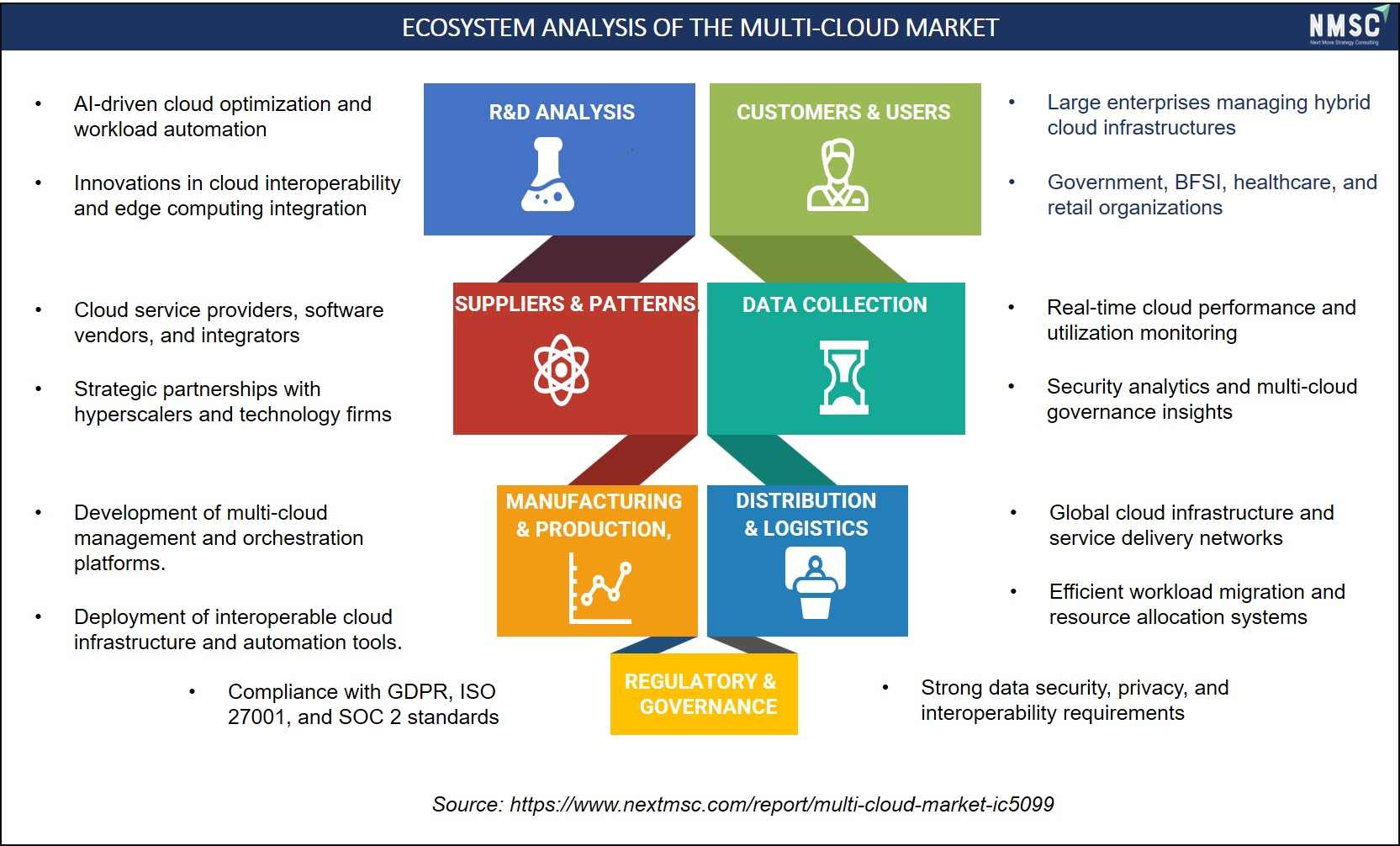
The ecosystem of the Multi Cloud Market comprises interconnected stakeholders that support the development, deployment, and management of cloud environments across multiple providers. Research and development activities drive innovations in cloud orchestration, security, automation, and interoperability. Technology suppliers provide infrastructure, platforms, and integration solutions, while data collection and analytics enhance operational visibility. Distribution and service partners facilitate deployment and support, and regulatory bodies ensure compliance with data governance standards. End users include large enterprises, government agencies, BFSI, healthcare, and retail organizations adopting hybrid and multi-cloud strategies to improve agility, resilience, and scalability.
How Is the Multi Cloud Market Segmented in This Report, and What Are the Key Insights from the Segmentation Analysis?
How Do the Diverse Offering Types Define the Commercial Structure of the Multi Cloud Market?
|
Offering Type Segment |
2025 (USD Bn) |
2035 (USD Bn) |
CAGR (%) |
|
Multi Cloud Management |
4.6 |
28.3 |
19.8% |
|
Multi Cloud Infrastructure Platform |
3.8 |
24.1 |
20.3% |
|
Multi Cloud Networking and Application Delivery |
2.4 |
16.8 |
21.5% |
|
Multi Cloud Security |
2.9 |
26.4 |
24.7% |
|
Multi Cloud Cost Management and FinOps |
1.8 |
14.2 |
23.1% |
|
Multi Cloud Observability |
1.4 |
10.6 |
22.3% |
|
Multi Cloud Data Management and Integration |
1.0 |
6.9 |
21.3% |
|
Multi Cloud Professional and Managed Services |
0.5 |
1.3 |
10.0% |
Based on our analysis, the Multi Cloud Market by offering type spans Multi Cloud Management, Infrastructure Platform, Networking and Application Delivery, Security, Cost Management and FinOps, Observability, Data Management and Integration, and Professional and Managed Services. Multi Cloud Management, covering orchestration, provisioning, service catalog, governance, and workflow, holds the largest revenue share due to the foundational need to govern heterogeneous cloud environments at scale. Multi Cloud Security is the fastest-growing offering, driven by surging enterprise demand for cloud security posture management (CSPM), identity governance, workload protection, data security, and runtime firewall across distributed cloud deployments. Multi Cloud Cost Management and FinOps is emerging as a high-growth sub-segment as organizations institutionalize cloud financial governance through cost optimization, usage analytics, chargeback, and anomaly detection capabilities.
How Does Delivery Model Segmentation Reflect Enterprise Procurement and Operational Preferences in the Multi Cloud Market?
|
Delivery Model Segment |
2025 (USD Bn) |
2035 (USD Bn) |
CAGR (%) |
|
SaaS |
9.2 |
60.4 |
20.8% |
|
Self Managed |
4.8 |
28.2 |
19.4% |
|
Managed Service |
3.6 |
27.8 |
23.1% |
|
Embedded |
0.8 |
4.2 |
18.0% |
Our assessment indicates that the Multi Cloud Market by delivery model is segmented into SaaS, Self Managed, Managed Service, and Embedded models. SaaS dominates due to its rapid deployment, subscription-based economics, and alignment with enterprise cloud procurement norms. Self Managed deployments remain significant among large enterprises requiring deep customization, air-gapped environments, or tight integration with existing infrastructure-as-code pipelines. Managed Service is the fastest-growing delivery model as enterprises, particularly in BFSI and healthcare, outsource multi-cloud operations to managed service providers to address internal skills gaps and accelerate time-to-governance. Embedded delivery is growing steadily as multi-cloud capabilities are integrated into broader cloud hyperscaler consoles and enterprise software platforms.
How Do Different Buyer Personas Shape Purchasing Patterns in the Multi Cloud Market?
|
Buyer Segment |
2025 (USD Bn) |
2035 (USD Bn) |
CAGR (%) |
|
CIO and IT Ops |
5.8 |
34.6 |
19.6% |
|
Platform Engineering |
3.2 |
26.8 |
25.2% |
|
Security |
3.6 |
28.1 |
23.0% |
|
FinOps |
2.2 |
16.4 |
22.4% |
|
App Dev |
2.4 |
15.8 |
20.8% |
|
Procurement and MSP |
1.2 |
6.9 |
19.2% |
From our research, the Multi Cloud Market by buyer persona is segmented into CIO and IT Ops, Platform Engineering, Security, FinOps, App Dev, and Procurement and MSP. CIO and IT Ops remains the dominant buying persona due to its organizational authority over cloud infrastructure strategy, vendor relationships, and total cost of ownership governance. Platform Engineering is the fastest-growing buyer persona as enterprises establish dedicated internal teams responsible for building and maintaining cloud-agnostic developer platforms and governance frameworks. Security buyers are significantly accelerating procurement of multi-cloud security posture management and identity governance tools, while FinOps practitioners are increasingly holding formal budget authority for cloud cost optimization tooling.
Which Industry Verticals Are Generating the Greatest Demand Across the Multi Cloud Market?
|
End Use Industry |
2025 (USD Bn) |
2035 (USD Bn) |
CAGR (%) |
|
BFSI |
3.7 |
24.8 |
20.9% |
|
Healthcare |
2.1 |
17.6 |
23.4% |
|
Public Sector |
2.4 |
14.6 |
19.8% |
|
Telecom |
2.2 |
13.4 |
19.6% |
|
Technology |
4.1 |
26.4 |
20.3% |
|
Manufacturing |
1.6 |
10.2 |
20.3% |
|
Retail |
1.4 |
10.8 |
22.6% |
|
Energy |
0.9 |
6.2 |
21.2% |
|
Other Industry |
0.0 |
4.6 |
— |
Based on our market evaluation, the Multi Cloud Market by end use industry is segmented into BFSI, Healthcare, Public Sector, Telecom, Technology, Manufacturing, Retail, Energy, and Other verticals. Technology is the dominant vertical due to its high concentration of cloud-native enterprises operating workloads across multiple cloud providers. BFSI follows closely, driven by regulatory data residency mandates under DORA and Basel frameworks that require workload distribution across sovereign cloud regions. Healthcare is the fastest-growing vertical as clinical AI workloads, telehealth infrastructure, and HIPAA-compliant data segregation requirements drive adoption of multi-cloud security and management solutions.
How Do Revenue Models Reflect the Commercial Maturity of the Multi Cloud Market?
|
Revenue Model |
2025 (USD Bn) |
2035 (USD Bn) |
CAGR (%) |
|
Subscription |
8.3 |
54.8 |
20.6% |
|
License |
4.2 |
22.6 |
18.3% |
|
Usage |
3.6 |
26.8 |
22.3% |
|
Services |
2.3 |
12.4 |
18.3% |
In our analysis of enterprise procurement patterns, we assessed that the Multi Cloud Market by revenue model is segmented into Subscription, License, Usage, and Services models. Subscription is the dominant revenue model, benefiting from predictable annual recurring revenue for vendors and simplified budget planning for enterprise buyers. Usage-based pricing is the fastest-growing revenue model, particularly prevalent in observability, FinOps analytics, and data integration services where consumption scales dynamically with workload intensity. License models remain significant among on-premises and self-managed deployments in regulated industries where perpetual licensing aligns with long-duration asset depreciation cycles.
How Are Distribution Channels Reshaping Go-to-Market Strategies in the Multi Cloud Market?
|
Channel |
2025 (USD Bn) |
2035 (USD Bn) |
CAGR (%) |
|
Direct |
9.6 |
58.6 |
19.8% |
|
Partner |
4.8 |
31.2 |
20.6% |
|
Marketplace |
2.6 |
24.8 |
24.3% |
|
OEM |
1.4 |
7.0 |
17.5% |
We noticed that the Multi Cloud Market by channel is segmented into Direct, Partner, Marketplace, and OEM distribution models. Direct sales dominates due to strong enterprise preference for customized deployment, strategic account management, and long-term vendor relationships that are particularly valued in complex multi-cloud implementations. Partner channels, including systems integrators and resellers, represent a significant and growing distribution layer as cloud consultancies build multi-cloud practice areas. Marketplace is the fastest-growing channel as enterprise buyers leverage AWS, Azure, and Google Cloud Marketplace to consume multi-cloud tooling against committed cloud spend, dramatically accelerating procurement cycles.
Regional Outlook
|
Region |
2025 (USD Bn) |
2035 (USD Bn) |
CAGR (%) |
Key Driver |
|
North America |
8.2 |
56.4 |
21.2% |
Hyperscaler HQ, enterprise cloud maturity |
|
Europe |
4.6 |
30.2 |
20.6% |
GDPR/DORA compliance, sovereign cloud |
|
Asia-Pacific |
3.4 |
25.8 |
23.2% |
Cloud-first India, APAC digital transformation |
|
Middle East and Africa |
1.2 |
8.6 |
21.8% |
Vision 2030, GCC cloud build-out |
|
Latin America |
1.0 |
7.6 |
22.3% |
Digital economy growth, cloud adoption |
North America Multi Cloud Market
North America is the dominant region in the Multi Cloud Market, accounting for USD 8.2 billion in 2025 and forecast to reach USD 56.4 billion by 2035 at a CAGR of 21.2%. The region benefits from the headquarters of all three major hyperscalers (AWS, Microsoft Azure, Google Cloud) and leading multi-cloud platform vendors. Based on NMSC's research, strong enterprise technology budgets, mature DevOps and platform-engineering cultures, and the world's deepest talent pool in cloud architecture underpin sustained market leadership. Regulatory maturity through CCPA, HIPAA, and FedRAMP mandates further compel compliance-driven multi-cloud adoption.
United States Multi Cloud Market
Based on our analysis, we found that the United States represents over 80% of North American Multi Cloud Market revenue and is the world's single largest national market. The U.S. benefits from the highest concentration of Fortune 500 enterprise multi-cloud buyers, the headquarters of all leading cloud management platform vendors, and a mature venture capital ecosystem actively funding next-generation multi-cloud security, observability, and FinOps startups. The DoD's JWCC multi-cloud contract institutionalized multi-cloud adoption in the federal government, creating a replicable framework for state and local government procurement. The Federal Cloud Computing Strategy, managed by OMB, further directs public sector demand.
Canada Multi Cloud Market
Through our analysis, Canada represents approximately 11% of North American Multi Cloud Market revenue. Canadian financial institutions, including the major chartered banks operating under OSFI cloud guidance, are sophisticated multi-cloud buyers focused on operational resilience and data residency across AWS and Azure Canada-based cloud regions. The Government of Canada's Digital Ambition strategy and Cloud Adoption Strategy have accelerated public sector multi-cloud investment. Data sovereignty concerns around cross-border data flows compel Canadian enterprises to architect workloads within Canada-specific sovereign cloud regions offered by all three major hyperscalers.
Mexico Multi Cloud Market
From our assessment, Mexico is the fastest-growing market within North America in the Multi Cloud Market, advancing at a CAGR of 24.2%. Mexico's expanding fintech ecosystem, nearshoring manufacturing digitization wave, and e-commerce sector growth are generating multi-cloud demand across security, management, and connectivity domains. The government's digital transformation agenda and regulatory requirements under LFPDPPP are compelling enterprises to invest in governed multi-cloud architectures. Mexico City and Monterrey are emerging as regional technology hubs that attract enterprise multi-cloud deployments by multinational corporations establishing nearshore operations.
Europe Multi Cloud Market
Europe is the second-largest region in the Multi Cloud Market, contributing USD 4.6 billion in 2025 and forecast to reach USD 30.2 billion by 2035 at a CAGR of 20.6%. Europe's regulatory environment, dominated by GDPR, the EU Data Act, DORA, and the EU AI Act, simultaneously drives and constrains multi-cloud adoption by mandating workload portability, data residency, and operational resilience documentation. NMSC's analysis indicates that sovereign cloud investment across EU member states, including GAIA-X and national cloud programs in Germany and France, is creating a structurally differentiated market for compliant multi-cloud management vendors.
United Kingdom Multi Cloud Market
According to our evaluation, the United Kingdom is Europe's largest individual country market for Multi Cloud, representing approximately 22% of European revenue in 2025. Post-Brexit, the UK maintains GDPR-equivalent standards under UK GDPR while gaining regulatory flexibility. The Financial Conduct Authority (FCA) and Bank of England's cloud guidance for regulated firms mandate operational resilience testing that drives multi-cloud adoption in BFSI. The UK Government Cloud First policy and Crown Commercial Service's cloud procurement frameworks ensure sustained public sector demand. London's status as a global financial and technology hub underpins deep multi-cloud adoption across BFSI, fintech, and professional services.
Germany Multi Cloud Market
Based on our market evaluation, Germany is the second-largest European market in the Multi Cloud landscape, driven by its world-class manufacturing sector's adoption of hybrid and multi-cloud IoT platforms and supply chain intelligence services. German enterprises are among the most stringent buyers globally, demanding sovereign cloud options compliant with Bundesdatenschutzgesetz (BDSG). The German federal government's cloud strategy and the BSI's IT-Grundschutz security baseline shape enterprise multi-cloud procurement. SAP's strong home market position and its multi-cloud-capable RISE platform create natural adoption pathways for German enterprises already invested in SAP ecosystems.
France Multi Cloud Market
From our assessment, France is the third-largest European Multi Cloud Market, distinguished by strong public sector digital transformation investments and national AI sovereignty commitments. The France 2030 program has allocated significant funding to cloud infrastructure and data sovereignty initiatives. The CNIL is among Europe's most active GDPR enforcement bodies, compelling enterprises to invest in multi-cloud data governance and access management capabilities. OVHcloud benefits from enterprises seeking EU-controlled alternatives to U.S. hyperscalers. France's strategic focus on digital sovereignty is shaping a distinctive market dynamic where multi-cloud management must address both performance and regulatory compliance simultaneously.
Italy Multi Cloud Market
In our assessment, Italy is a mid-tier European market in the Multi Cloud space, with growing adoption in financial services, manufacturing, and public administration. The PNRR has directed investment toward cloud migration for public sector entities, while Italy's Polo Strategico Nazionale (PSN) sovereign cloud initiative creates structured demand for multi-cloud governance between PSN and global hyperscalers. Italy's Garante data protection authority has issued significant GDPR enforcement decisions that compel enterprises to invest in compliant multi-cloud architectures. Italian manufacturing conglomerates are adopting multi-cloud IoT and supply chain management platforms.
Spain Multi Cloud Market
Based on our evaluation, Spain demonstrates growing momentum in the Multi Cloud Market, driven by its dynamic financial sector, expanding retail e-commerce platforms, and public digital transformation under Agenda España Digital 2026. Spanish financial institutions including Santander and BBVA operate global multi-cloud architectures that serve as local market benchmarks. The AEPD actively enforces GDPR, compelling investment in multi-cloud data governance tools. Spain's cloud market is expanding rapidly, with all three hyperscalers operating local cloud regions that support enterprise multi-cloud workload distribution with Spanish data residency compliance.
Sweden Multi Cloud Market
Sweden is a high-per-capita multi-cloud adopter, supported by a highly digitized enterprise base, advanced telecommunications infrastructure, and strong government commitment to open data and public sector digitization. Swedish enterprises in financial services, telecommunications (Ericsson, Telia), and manufacturing are early adopters of multi-cloud platforms. Sweden's Integritetsskyddsmyndigheten (IMY) actively supervises GDPR compliance. Nordic climate conditions make Sweden an attractive sovereign cloud data center destination, with all three hyperscalers operating Swedish cloud regions. Sweden's high cloud maturity supports sophisticated multi-cloud management, security, and FinOps deployments.
Denmark Multi Cloud Market
Through our analysis, Denmark is among the most advanced digital economies in Europe within the Multi Cloud landscape. The Danish government's digital strategy and consistent leadership in the EU's Digital Economy and Society Index (DESI) reflect deep enterprise cloud maturity. Multi-cloud governance, security, and observability are high-demand segments among Danish financial services, healthcare, and public sector organizations. The Danish Data Protection Agency (Datatilsynet) is an active GDPR regulator. Denmark's life sciences sector, anchored by Novo Nordisk and Leo Pharma, is a growing enterprise multi-cloud buyer for clinical data and research workload orchestration.
Finland Multi Cloud Market
Finland's Multi Cloud Market is characterized by high cloud adoption, strong open data government initiatives, and an advanced telecommunications sector. Nokia's global operations create enterprise demand for multi-cloud management and network telemetry platforms. The Finnish government's cloud strategy and MyData initiative support human-centric data governance frameworks that influence multi-cloud data management adoption. Finland's data center industry is expanding significantly as a hosting hub for sovereign European cloud workloads. Our assessment indicates that Finnish enterprises in telecom, manufacturing, and public sector are among the most cloud-mature buyers in the Nordic region.
Netherlands Multi Cloud Market
From our assessment, the Netherlands is a critical hub for the European Multi Cloud Market, hosting the Amsterdam Internet Exchange (AMS-IX) and significant cloud data center capacity for all major hyperscalers. Dutch financial services enterprises and logistics companies are significant multi-cloud buyers. The Dutch Data Protection Authority has issued major GDPR enforcement decisions that set compliance benchmarks across Europe. The Netherlands serves as a data gateway for cross-border European workloads, making multi-cloud networking and application delivery solutions particularly valuable for multinational enterprises routing traffic through Dutch-hosted cloud regions.
Rest of Europe Multi Cloud Market
The Rest of Europe, comprising Poland, Belgium, Switzerland, Austria, Portugal, Czech Republic, and other European nations, collectively represents a growing portion of the European Multi Cloud Market. Poland and Czech Republic are emerging as multi-cloud adoption leaders in Central and Eastern Europe, driven by business process outsourcing hubs and growing fintech sectors requiring resilient multi-cloud architectures. Switzerland operates under the nFADP and hosts major financial and pharmaceutical enterprise multi-cloud buyers with strict sovereignty requirements. Belgium, as home to EU institutions, is a key demand center for multi-cloud governance and compliance solutions.
Asia-Pacific Multi Cloud Market
Asia-Pacific is the fastest-growing major region in the Multi Cloud Market, advancing from USD 3.4 billion in 2025 to an estimated USD 25.8 billion by 2035 at a CAGR of 23.2%. The region's growth is propelled by rapid cloud adoption in India and Southeast Asia, China's hybrid-cloud mandates, and advanced digital economies of Japan, South Korea, Taiwan, and Australia. Our findings suggest that regulatory frameworks including Japan's APPI, South Korea's PIPA, India's DPDPA, and the ASEAN Data Management Framework are shaping enterprise multi-cloud architectures across the region with a particular emphasis on data residency and workload sovereignty.
China Multi Cloud Market
China is the largest single market in Asia-Pacific for Multi Cloud, driven by its massive digital economy, national industrial internet platforms, and government-directed hybrid cloud infrastructure investment. China's Data Security Law (DSL) and Personal Information Protection Law (PIPL) create mandatory data classification and localization requirements that drive investment in governed multi-cloud architectures combining domestic hyperscalers (Alibaba Cloud, Tencent Cloud, Huawei Cloud) with qualified international cloud regions. The Ministry of Industry and Information Technology (MIIT) oversees China's industrial internet platform ecosystem, driving structured multi-cloud adoption in manufacturing and supply chain sectors.
India Multi Cloud Market
India is the fastest-growing national market within Asia-Pacific for the Multi Cloud Market, advancing at a CAGR of 27.1%. The MeitY Cloud Policy, Digital India initiatives, and the DPDPA 2023 are collectively compelling enterprises to invest in governed multi-cloud architectures with domestic data residency capabilities. From our research, we found that India's IT services sector, comprising Tata Consultancy Services, Infosys, Wipro, and HCL Technologies, generates significant enterprise multi-cloud demand as these firms manage customer workloads across multiple cloud providers. India's cloud market is among the fastest-growing globally, with all major hyperscalers operating dedicated Indian cloud regions.
Japan Multi Cloud Market
In our evaluation, Japan is the second-largest Asia-Pacific market for Multi Cloud, supported by mature financial services, manufacturing, and technology sectors. Japanese enterprises prioritize multi-cloud security, data governance, and interoperability. The Act on Protection of Personal Information (APPI), enforced by the Personal Information Protection Commission (PPC), provides a structured data governance framework. Japan's Digital Agency and Society 5.0 vision are driving public sector cloud adoption. Major corporations including Toyota, Hitachi, and Fujitsu are significant multi-cloud buyers for manufacturing intelligence, supply chain orchestration, and digital transformation programs.
South Korea Multi Cloud Market
From our assessment, South Korea demonstrates high multi-cloud maturity, supported by one of the world's highest broadband penetration rates, an advanced semiconductor and electronics manufacturing sector, and a proactive AI policy environment. The Personal Information Protection Act (PIPA), enforced by the PIPC, governs enterprise data handling across cloud environments. South Korea's National AI Strategy and K-Cloud initiative are directing public sector investment toward cloud-native multi-cloud platforms. Samsung, LG, and SK Telecom are significant enterprise multi-cloud buyers, particularly for IoT sensor data orchestration and telecommunications workload management.
Taiwan Multi Cloud Market
Taiwan's Multi Cloud Market is concentrated in semiconductor manufacturing intelligence, electronics supply chain management, and financial services data platforms. TSMC, Foxconn, and MediaTek represent enterprise-class multi-cloud buyers with complex manufacturing and supply chain workload requirements spanning multiple cloud regions and on-premises environments. Taiwan's Personal Data Protection Act (PDPA) provides the regulatory framework for multi-cloud data governance investment. The government's Digital Economy Acceleration Plan is supporting broader enterprise cloud adoption, with multi-cloud management tools gaining traction across Taiwan's dense ecosystem of high-technology manufacturers.
Indonesia Multi Cloud Market
Indonesia is among the most rapidly growing multi-cloud markets in Southeast Asia, driven by its large digital population, fast-growing fintech and e-commerce sector, and government-backed digital transformation under Visi Indonesia 2045. The Personal Data Protection Law (PDP Law), enacted in 2022, establishes data governance requirements for Indonesian enterprises implementing multi-cloud architectures. Gojek, Tokopedia, Bank Central Asia, and Telkom Indonesia are among the largest enterprise multi-cloud buyers. Indonesia's domestic cloud market is expanding rapidly as hyperscalers invest in Jakarta-based data center regions to support enterprise workload distribution.
Vietnam Multi Cloud Market
Vietnam is an emerging and high-growth market for Multi Cloud in Southeast Asia, supported by accelerating digital economy development, a manufacturing sector expansion driven by China-plus-one supply chain diversification, and government ambitions under the National Digital Transformation Program. Vietnam's Cybersecurity Law and Decree 13/2023/ND-CP on Personal Data Protection are establishing domestic data governance frameworks that influence multi-cloud architecture decisions. Vietnamese banks, telecoms, and e-commerce platforms are early multi-cloud adopters, while the growing electronics manufacturing sector creates demand for supply chain and IoT workload orchestration across cloud providers.
Australia Multi Cloud Market
Australia is the most mature multi-cloud market in Asia-Pacific outside Northeast Asia, with strong adoption across financial services, government, mining, and healthcare. The Privacy Act 1988 (amended 2024) and the Consumer Data Right (CDR) framework are driving structured investment in multi-cloud data governance and sharing platforms. We further observed that all major hyperscalers operate Australian sovereign cloud regions, making Australia a natural multi-cloud deployment environment for regulated industries. The Data Availability and Transparency Act 2022 is catalyzing public sector multi-cloud adoption across Australian federal agencies requiring workload portability and data sharing capabilities.
Philippines Multi Cloud Market
Philippines is a developing but rapidly growing multi-cloud market in Southeast Asia, supported by a large BPO industry, growing digital banking sector, and government ICT modernization initiatives. The Data Privacy Act of 2012, enforced by the National Privacy Commission (NPC), governs enterprise multi-cloud data handling. Philippine banks including BDO, BPI, and UnionBank are increasing multi-cloud investments in resilient application delivery and security platforms. The government's eGov SuperApp and Public Sector Digital Transformation programs are creating early public sector demand for cloud management and integration services spanning multiple cloud providers.
Malaysia Multi Cloud Market
Malaysia is a mid-tier and growing multi-cloud market in Southeast Asia, characterized by strong government-led digital transformation and Kuala Lumpur's emergence as a regional cloud hub. The Personal Data Protection Act 2010 (PDPA), currently undergoing GDPR-alignment reform, provides the data governance regulatory baseline. Malaysia's MyDigital strategy targets significant GDP contribution from the digital economy. Major banks, telecoms, and government agencies are significant multi-cloud buyers. Petronas, Maybank, and Telekom Malaysia are notable enterprise consumers of multi-cloud management and security platforms as they modernize hybrid and multi-cloud architectures.
Rest of Asia-Pacific Multi Cloud Market
Rest of Asia-Pacific, comprising Thailand, Singapore, Bangladesh, Sri Lanka, New Zealand, and smaller Pacific Island nations, collectively represents a growing share of the regional Multi Cloud Market. Singapore is a disproportionately significant multi-cloud hub, hosting regional headquarters of major vendors and benefiting from MAS cloud governance guidelines that drive sophisticated BFSI multi-cloud adoption. Moreover, we noticed that Thailand's PDPA and national AI strategy are driving enterprise governance investment. New Zealand's cloud market is growing steadily, with Australian enterprise architectures frequently extending across the Trans-Tasman digital economy corridor.
Middle East and Africa Multi Cloud Market
The Middle East and Africa are advancing strongly in the Multi Cloud Market, growing from USD 1.2 billion in 2025 to USD 8.6 billion by 2035 at a CAGR of 21.8%. Vision-driven national transformation programs in Saudi Arabia and the UAE are the primary growth engines, supplemented by Israel's advanced technology sector, South Africa's financial services hub, and Nigeria's digital economy. Sovereign cloud infrastructure investment across the GCC is creating durable structural demand for multi-cloud platforms with in-country data residency and governance capabilities suited to the region's regulatory frameworks.
Saudi Arabia Multi Cloud Market
Saudi Arabia is the largest multi-cloud market in the Middle East and Africa, driven by Vision 2030's Digital Transformation Program, NEOM smart city requirements, and ARAMCO's industrial digitization initiatives. The National Data Management Office (NDMO) under SDAIA has published the National Data Governance Framework, mandating multi-cloud governance investment by public and regulated private entities. All major hyperscalers have established Saudi Arabia cloud regions. NMSC's analysis indicates that financial services and energy sectors are the dominant multi-cloud buyers, with significant demand for security, management, and observability solutions supporting sovereign multi-cloud architectures.
UAE Multi Cloud Market
UAE is the second-largest multi-cloud market in MEA, powered by Dubai and Abu Dhabi's ambitions as global AI and smart city hubs. The UAE National AI Strategy 2031 and UAE Data Law provide the regulatory framework underpinning enterprise multi-cloud investment. The ADGM and DIFC have distinct data protection regimes attracting international multi-cloud vendors and enterprise buyers. Our assessment indicates that the UAE's concentration of financial services, hospitality, logistics, and government-linked enterprises creates multi-vertical multi-cloud demand, with hyperscalers offering dedicated UAE cloud regions to satisfy data residency requirements.
Egypt Multi Cloud Market
Egypt is an emerging multi-cloud market in Africa, supported by a growing digital banking sector, expanding e-commerce platforms, and the government's Egypt Vision 2030 digital transformation agenda. The Personal Data Protection Law (Law No. 151 of 2020) establishes data governance requirements for Egyptian enterprises. The government's G-Cloud initiative is creating initial public sector demand for cloud management solutions. Based on our evaluation, Egyptian banks, telecoms, and e-commerce platforms are the primary enterprise multi-cloud buyers, with workload distribution between domestic cloud providers and global hyperscalers representing the primary multi-cloud use case.
Israel Multi Cloud Market
Based on our analysis, Israel occupies a unique position within the Multi Cloud Market as both a significant vendor origin country and an enterprise buyer. Israel hosts dozens of multi-cloud security, observability, and FinOps startups that have developed globally competitive products. Israel's Protection of Privacy Law and the Privacy Protection Authority (PPA) govern enterprise data practices. Israeli technology firms and defense sector organizations consume and generate sophisticated multi-cloud management requirements, creating a domestic market that simultaneously serves as a product development laboratory and early adoption testbed for globally scaling multi-cloud solutions.
Turkey Multi Cloud Market
Through our evaluation, Turkey is a mid-sized and growing multi-cloud market within MEA, characterized by a dynamic financial services sector, a large manufacturing industry, and the government's National Artificial Intelligence Strategy 2021–2025. Turkey's Personal Data Protection Law (KVKK) mandates data governance practices that drive multi-cloud governance investment. Turkish banks including Is Bankasi and Garanti BBVA are significant buyers of multi-cloud management and security solutions. Turkey's growing tech startup ecosystem and Istanbul's position as a regional technology hub further support multi-cloud market development across financial services, retail, and manufacturing verticals.
Nigeria Multi Cloud Market
Nigeria is Sub-Saharan Africa's largest multi-cloud market, powered by a fast-growing fintech ecosystem (Flutterwave, Paystack, Interswitch) and the Central Bank of Nigeria's (CBN) cloud banking regulatory framework. The Nigeria Data Protection Act 2023 (NDPA), enforced by the Nigeria Data Protection Commission (NDPC), establishes enterprise data governance requirements. We further observed that Lagos-based financial institutions, telecoms (MTN Nigeria, Airtel Africa), and e-commerce platforms are the primary multi-cloud buyers. Multi-cloud security and management solutions are the highest-demand categories as enterprises distribute workloads across global hyperscalers and regional cloud providers.
South Africa Multi Cloud Market
South Africa is the most mature multi-cloud market in Sub-Saharan Africa, driven by Johannesburg's status as the continent's financial capital and the Protection of Personal Information Act (POPIA) requiring robust data governance. South African financial institutions including Standard Bank, FirstRand, and Nedbank are sophisticated multi-cloud buyers for security, management, and observability platforms. The Presidential Commission on the Fourth Industrial Revolution (PC4IR) provides policy frameworks supporting multi-cloud adoption across key industry verticals. All major hyperscalers operate South African cloud regions, enabling compliant multi-cloud architectures with in-country data residency.
Rest of MEA Multi Cloud Market
The Rest of MEA, comprising Kuwait, Qatar, Bahrain, Oman, Jordan, Morocco, Kenya, Ethiopia, and other nations, collectively represents a growing and commercially significant portion of the MEA Multi Cloud Market. GCC nations including Qatar, Kuwait, and Bahrain are implementing national cloud infrastructure programs that create multi-cloud management demand as public sector entities distribute workloads across sovereign and global cloud providers. Kenya and Ethiopia are emerging East African multi-cloud markets supported by rapid fintech adoption and expanding digital infrastructure investment. Our assessment indicates that multi-cloud security and management represent the highest-growth demand categories across emerging MEA markets.
Latin America Multi Cloud Market
Latin America is advancing strongly in the Multi Cloud Market, growing from USD 1.0 billion in 2025 to USD 7.6 billion by 2035 at a CAGR of 22.3%. Brazil and Mexico are the primary growth markets, supported by expanding fintech ecosystems, e-commerce sector digitization, and government digital transformation programs. Based on NMSC's research, data protection regulations including Brazil's LGPD and Mexico's LFPDPPP are compelling enterprises to invest in governed multi-cloud architectures that comply with data residency and processing requirements. Cloud hyperscalers have established Brazil and Mexico-based cloud regions to serve this growing demand.
Brazil Multi Cloud Market
Brazil is the largest multi-cloud market in Latin America, driven by a sophisticated financial services sector, a rapidly growing fintech ecosystem, and one of the world's largest digital consumer markets. The Lei Geral de Proteção de Dados (LGPD), enforced by the Autoridade Nacional de Proteção de Dados (ANPD), mandates data governance practices compelling multi-cloud investment. Brazilian enterprises including Itaú Unibanco, Bradesco, Ambev, and Embraer are significant multi-cloud buyers. All major hyperscalers operate Brazil-based cloud regions, enabling compliant multi-cloud workload distribution across sovereign and global cloud infrastructure.
Argentina Multi Cloud Market
Argentina is the second-largest multi-cloud market in Latin America, characterized by a digitally sophisticated population, a growing technology services export industry, and a financial sector that is increasingly adopting cloud architectures for operational resilience. Argentina's Ley de Protección de Datos Personales governs enterprise data practices. Buenos Aires has emerged as a regional technology hub attracting multi-cloud solution deployments for financial services, e-commerce, and technology companies. Our analysis indicates that multi-cloud cost management is a particularly high-value proposition in Argentina given currency volatility and the need for cloud cost optimization across multiple provider pricing models.
Chile Multi Cloud Market
Chile is a mature and growing multi-cloud market in Latin America, supported by one of the region's most stable macroeconomic environments, an advanced financial sector, and growing digital infrastructure investment. Chile's data protection legislation and regulatory alignment with international standards encourage governed multi-cloud deployment. Santiago hosts regional headquarters of multinational corporations that use Chile as a Latin American cloud hub for distributed workload management. Copper mining industry digitization and energy sector cloud adoption are creating unique multi-cloud IoT and operational technology management demand in Chile.
Colombia Multi Cloud Market
Colombia is a growing multi-cloud market in Latin America, driven by a dynamic fintech sector, an expanding BPO industry, and government digital transformation initiatives under its digital agenda. Colombian financial institutions and telecoms are the primary enterprise multi-cloud buyers. Bogotá's emergence as a regional technology hub is attracting cloud investment from global hyperscalers and multi-cloud solution vendors. Based on our evaluation, we noticed that multi-cloud security and management are the highest-demand segments as Colombian enterprises distribute workloads across AWS, Azure, and GCP to improve resilience and access best-of-breed cloud services.
Rest of Latin America Multi Cloud Market
The Rest of Latin America, comprising Peru, Ecuador, Uruguay, Costa Rica, Panama, and other Central and South American nations, collectively represents a growing share of the Latin American Multi Cloud Market. Uruguay and Costa Rica have established themselves as technology services hubs in the region, attracting multi-cloud deployment investments from multinational service providers. Peru's expanding financial sector and e-commerce market are creating growing demand for multi-cloud management and security solutions. Our assessment indicates that marketplace-based procurement is the preferred channel in emerging Latin American markets where direct enterprise sales infrastructure is still developing.
Competitive Landscape
Competitive Dynamics and M&A Landscape
|
Key Takeaways |
Details |
|
Market Structure |
The Multi Cloud Market features multi-tiered competition among hyperscalers (AWS, Microsoft Azure, Google Cloud), specialized multi-cloud platform vendors (HashiCorp/IBM, Nutanix, VMware/Broadcom), security-native vendors (Palo Alto Networks, Zscaler, CrowdStrike), and observability and FinOps specialists (Datadog, Snowflake, F5, NetApp), each competing on distinct value propositions. |
|
Innovation Focus |
Innovation in the Multi Cloud Market centers on AI-augmented FinOps automation, unified security fabric architectures spanning SASE and zero-trust, Kubernetes-native platform engineering tooling, AIOps-driven observability, and universal cloud management control planes that provide consistent governance across AWS, Azure, GCP, and sovereign cloud regions. |
|
M&A Activity |
IBM's acquisition of HashiCorp in 2024 consolidated Infrastructure-as-Code and multi-cloud lifecycle management under the IBM Cloud portfolio. Broadcom's acquisition of VMware created the industry's largest multi-cloud infrastructure platform vendor, reshaping competitive dynamics for virtualization, networking, and management across enterprise data centers and cloud environments. |
How Do Companies Compete in the Multi Cloud Market?
The Multi Cloud Market is characterized by multi-tiered competition among hyperscalers, specialized platform vendors, security-native leaders, and domain-specific specialists. The three hyperscalers, AWS, Microsoft Azure, and Google Cloud, compete on integrated service breadth, global cloud region footprint, and bundled AI capabilities. Specialized platforms such as HashiCorp, Nutanix, and Broadcom VMware differentiate on infrastructure management depth, multi-cloud neutrality, and enterprise integration. Security-native vendors including Palo Alto Networks, Zscaler, and CrowdStrike compete on threat intelligence breadth, platform consolidation, and zero-trust architecture sophistication across distributed cloud environments.
Which Kind of Companies Dominate the Multi Cloud Market?
Three distinct categories of companies dominate the Multi Cloud Market. First, global hyperscalers including Amazon Web Services, Microsoft Azure, and Google Cloud leverage large-scale cloud infrastructure and native tooling to provide multi-cloud management capabilities within their own ecosystems while also enabling interoperability. Second, multi-cloud platform specialists such as Broadcom (VMware), IBM (HashiCorp), Nutanix, Cisco, and ServiceNow provide purpose-built cross-cloud management, networking, and governance solutions designed for heterogeneous environments. Third, security and observability specialists including Palo Alto Networks, CrowdStrike, Zscaler, Datadog, and Fortinet dominate specific high-growth sub-segments of the Market, particularly security, monitoring, and AIOps.
AI-Native Differentiation and Open Standards Drive Market Success in the Multi Cloud Market
Innovation across the Multi Cloud Market is concentrated in AI-augmented operations, open standard adoption, and unified security architectures. Vendors embedding AI within FinOps, observability, and security platforms are capturing premium pricing and accelerating enterprise adoption. Open standard adoption, including Terraform, Kubernetes, OpenTelemetry, and the CNCF ecosystem, is differentiating platforms that offer genuine multi-cloud portability versus proprietary lock-in. Our findings suggest that vendors capable of delivering consistent policy enforcement, identity management, and cost optimization across all major cloud providers through a single control plane are achieving the strongest competitive positioning in the Market.
Market Players to Opt for Merger and Acquisition Strategies to Expand Their Presence in the Multi Cloud Market
Mergers and acquisitions are reshaping the competitive map of the Multi Cloud Market. IBM's acquisition of HashiCorp in 2024 consolidated cloud automation and infrastructure-as-code capabilities within IBM's multi-cloud portfolio. Broadcom's acquisition of VMware created the world's largest multi-cloud infrastructure vendor. Cisco's strategic acquisitions in security and networking reinforce its multi-cloud connectivity portfolio. Our assessment indicates that private equity firms including Vista Equity Partners and Thoma Bravo remain active acquirers of enterprise multi-cloud software companies, and consolidation around FinOps platforms, AIOps vendors, and multi-cloud security posture management specialists is expected through 2028.
Who Are the Key Market Players in the Multi Cloud Market?
-
Microsoft Corporation
-
Amazon.com, Inc.
-
Alphabet Inc.
-
International Business Machines Corporation
-
Broadcom Inc.
-
Oracle Corporation
-
Cisco Systems, Inc.
-
ServiceNow, Inc.
-
Hewlett Packard Enterprise Company
-
Dell Technologies Inc.
-
Palo Alto Networks, Inc.
-
CrowdStrike Holdings, Inc.
-
Datadog, Inc.
-
Snowflake Inc.
-
Zscaler, Inc.
-
Fortinet, Inc.
-
NetApp, Inc.
-
F5, Inc.
-
Nutanix, Inc.
-
Check Point Software Technologies Ltd.
What Are the Latest Developments in the Multi Cloud Industry?
|
Date |
Event |
|
March 2025 |
Google acquired Wiz, a leading cloud security platform that provides security and risk management capabilities across major cloud environments, including Google Cloud, AWS, Microsoft Azure, and Oracle Cloud Infrastructure. |
|
December 2024 |
Oracle introduced Oracle Database AWS in partnership with Amazon Web Services, extending Oracle database services directly into AWS environments through a unified cloud experience. |
Expert Insights
 “We want to make security a catalyst for innovation, not a barrier. With this acquisition, we will deliver a unified security platform that simplifies the complex task of protecting multicloud environments in the AI era, making a strong security posture accessible to more companies and governments.”
— Thomas Kurian, Chief Executive Officer, Google Cloud
Statement made during Google's announcement regarding the acquisition of Wiz, highlighting the growing need for unified cloud security solutions to protect enterprise workloads across multicloud environments in the age of artificial intelligence.
Market Interpretation
Thomas Kurian's statement underscores the increasing importance of cybersecurity as a foundational enabler of multicloud adoption. As organizations deploy applications, data, and AI workloads across multiple cloud platforms, managing security across diverse environments has become increasingly complex. The emphasis on a unified security platform reflects a broader market trend toward integrated cloud security solutions that provide centralized visibility, threat detection, compliance management, and governance across multicloud infrastructures. The growing convergence of AI and multicloud architectures is expected to accelerate demand for advanced security capabilities, making cloud security a critical growth driver within the global multicloud market.
What Are the Investment Opportunities in the Multi Cloud Market?
Capital Inflows and Venture Activity
The Multi Cloud Market continues to attract substantial private and institutional capital. CrowdStrike's inclusion in the S&P 500 and Datadog's sustained revenue growth reflect deep investor confidence in multi-cloud security and observability platforms. We noticed that venture capital investment in multi-cloud security, FinOps, and platform engineering startups has remained robust, with the National Venture Capital Association (NVCA) reporting that cloud infrastructure and security together represented over 28% of U.S. venture capital deployments in 2024 and 2025. Emerging FinOps, AIOps, and zero-trust security startups are attracting early-stage investment as enterprises expand multi-cloud deployments.
Infrastructure Investment
Data center infrastructure investment is a foundational enabler of Multi Cloud Market growth, with hyperscalers committing hundreds of billions to global cloud region expansion. Microsoft announced plans to invest USD 80 billion in AI-optimized data centers in FY2025, expanding Azure's global footprint and enabling richer multi-cloud connectivity options. Google parent Alphabet committed USD 75 billion in 2025 capital expenditure directed primarily at cloud and AI infrastructure. Our findings suggest that these capital programs directly expand the available cloud regions across which enterprise multi-cloud architectures can be deployed, lowering latency and improving data residency compliance options globally.
ESG and Sustainable Multi-Cloud Infrastructure
Environmental, Social, and Governance considerations are increasingly influencing multi-cloud investment decisions. Data center energy consumption is a focus of regulatory scrutiny under the EU Energy Efficiency Directive and U.S. Executive Order 14057 on federal sustainability. Multi-cloud platforms that enable dynamic workload routing to the most carbon-efficient cloud regions, supported by carbon-aware scheduling tools, are gaining preference in enterprise procurement evaluations. From our assessment, we found that hyperscalers including Microsoft, Google, and Amazon have made significant renewable energy commitments, and multi-cloud FinOps tools that incorporate carbon footprint reporting alongside cost optimization are emerging as premium capabilities.
Digital Transformation Enablement
Multi-cloud platforms serve as the operational foundation for broader enterprise digital transformation programs, making them structurally integral to multi-year IT investment cycles. Enterprises undergoing ERP modernizations, application re-platforming, and AI adoption require multi-cloud management, networking, and security layers to extract value from distributed cloud investments. We further analysed that the NIST Cybersecurity Framework and the European Commission's Digital Decade policy program explicitly reference cloud resilience and interoperability as prerequisites for enterprise digital competitiveness, creating durable multi-year demand tied to the broader global technology modernization cycle.
Private Equity and Strategic M&A Activity
Private equity firms are deploying significant capital into the multi-cloud ecosystem, targeting mid-market management platform vendors, FinOps specialists, and security orchestration companies. Vista Equity Partners and Thoma Bravo have historically been active acquirers of enterprise cloud software companies with recurring revenue profiles. Our assessment indicates that investors should monitor consolidation activity around multi-cloud FinOps platforms, AIOps observability vendors, and cloud security posture management specialists as structurally attractive M&A targets in the 2025–2028 timeframe within the Multi Cloud Market.
Key Benefits for Stakeholders
For Enterprise Buyers
Enterprise buyers gain comprehensive, vendor-neutral insights into the Multi Cloud Market, including quantitative sizing across all offering types, delivery models, buyer personas, and industry verticals. This intelligence supports cloud strategy planning, vendor evaluation, and multi-year technology investment roadmaps. Our competitive landscape analysis enables procurement teams to benchmark vendor capabilities, pricing models, and evaluate build-versus-buy decisions for multi-cloud management, security, and observability components with confidence and analytical rigor appropriate for complex enterprise cloud governance programs.
For Investors and Financial Analysts
Investors and financial analysts access a structured, data-rich assessment of the Multi Cloud Market's growth trajectory, competitive dynamics, M&A pipeline, and segment-level revenue forecasts through 2035. The CAGR analysis by offering type, delivery model, region, and customer persona enables precise portfolio construction and valuation modeling. Detailed profiling of all 20 covered companies, combined with latest development tracking, provides an early-signal framework for identifying acquisition targets, emerging leaders, and at-risk incumbents within the global multi-cloud landscape.
For Multi Cloud Vendors and Platform Providers
Multi-cloud vendors and platform providers gain actionable intelligence on white-space opportunities, competitive positioning gaps, and fastest-growing sub-segments in the Multi Cloud Market. Offering type analysis reveals underserved areas including FinOps and observability platforms. Our analysis of the regional outlook sections identifies geographic expansion priorities with regulatory and market maturity context. The buyer persona and channel analysis enables vendors to refine go-to-market strategies, identify cross-sell opportunities, and optimize channel mix between direct sales, marketplace, and partner routes to accelerate enterprise adoption.
For Government and Regulatory Bodies
Government agencies and regulatory bodies gain a structured analysis of how national cloud governance frameworks, including GDPR, DORA, India's DPDPA, and GCC cloud mandates, are influencing the Multi Cloud Market's structure and competitive dynamics. Country-level insights provide policymakers with evidence-based perspectives on how regulatory design choices affect digital economy competitiveness, cloud investment attraction, and enterprise multi-cloud adoption. The sovereign cloud analysis offers direct relevance to national cloud infrastructure strategy development and procurement policy frameworks.
Key Market Segments
By Offering Type
-
Multi Cloud Management
-
Orchestration
-
Provisioning
-
Service Catalog
-
Governance
-
Workflow
-
Other Management
-
-
Multi Cloud Infrastructure Platform
-
Virtualization
-
Hyperconverged Infrastructure
-
Cloud Foundation
-
Storage
-
Kubernetes
-
Other Platform
-
-
Multi Cloud Networking and Application Delivery
-
Interconnect
-
SD-WAN
-
SASE
-
Service Mesh
-
API Gateway
-
Load Balancing
-
Other Delivery
-
-
Multi Cloud Security
-
Posture
-
Identity
-
Workload
-
Data
-
Runtime
-
Firewall
-
Other Security
-
-
Multi Cloud Cost Management and FinOps
-
Cost Optimization
-
Usage Analytics
-
Chargeback
-
Anomaly Detection
-
Other FinOps
-
-
Multi Cloud Observability
-
Monitoring
-
Logging
-
Tracing
-
AIOps
-
Other Observability
-
-
Multi Cloud Data Management and Integration
-
Database
-
Replication
-
Backup
-
Integration
-
Governance
-
Other Data
-
-
Multi Cloud Professional and Managed Services
-
Advisory
-
Migration
-
Implementation
-
Managed Operations
-
Support
-
Other Services
-
By Delivery Model
-
SaaS
-
Self Managed
-
Managed Service
-
Embedded
By Buyer
-
CIO and IT Ops
-
Platform Engineering
-
Security
-
FinOps
-
App Dev
-
Procurement and MSP
By End Use Industry
-
BFSI
-
Healthcare
-
Public Sector
-
Telecom
-
Technology
-
Manufacturing
-
Retail
-
Energy
-
Other Industry
By Revenue Model
-
Subscription
-
License
-
Usage
-
Services
By Channel
-
Direct
-
Partner
-
Marketplace
-
OEM
By Region
-
North America: U.S., Canada, and Mexico.
-
Europe: UK, Germany, France, Italy, Spain, Sweden, Denmark, Finland, the Netherlands, and the rest of Europe.
-
Asia Pacific: China, India, Japan, South Korea, Taiwan, Indonesia, Vietnam, Australia, Philippines, Malaysia and the rest of APAC.
-
Middle East & Africa (MEA): Saudi Arabia, UAE, Egypt, Israel, Turkey, Nigeria, South Africa, and the rest of MEA.
-
Latin America: Brazil, Argentina, Chile, Colombia, and the rest of LATAM.
Conclusion and Recommendations
Long-Term Outlook
The Multi Cloud Market is entering the most consequential growth decade in its history, driven by universal cloud diversification mandates, AI workload proliferation, and expanding regulatory data sovereignty requirements. The market is forecast to grow from USD 22.3 billion in 2026 to USD 128.6 billion by 2035, at a CAGR of 21.4%. We further analysed that this growth reflects both the structural expansion of enterprise cloud investments and the increasing complexity of managing heterogeneous multi-cloud environments that demands dedicated management, security, FinOps, and observability tooling as a non-negotiable operational requirement.
Strategic Positioning Recommendations
Platform vendors should prioritize unified control plane differentiation that spans management, security, and FinOps in a single integrated solution rather than competing as point solutions. Organizations embedding AI within observability, cost optimization, and security posture management will capture premium pricing and superior expansion economics. Sovereign cloud investment is non-negotiable for vendors targeting European, Middle Eastern, and South and Southeast Asian enterprise buyers. Vendors without compliant in-country data residency options will face structural procurement disadvantage in the Multi Cloud Market's highest-growth regulated-market segments.
Investment Attractiveness
The Multi Cloud Market represents an exceptionally attractive investment environment given durable multi-decade secular drivers, recurring subscription-based revenue models, and a structural shift from siloed cloud management to integrated multi-cloud governance platforms. Our assessment identifies the highest-conviction investment themes as Multi Cloud Security at 24.7% CAGR, Multi Cloud Cost Management and FinOps at 23.1% CAGR, Platform Engineering buyer segment at 25.2% CAGR, Healthcare vertical at 23.4% CAGR, and Marketplace channel distribution at 24.3% CAGR. Investors should monitor Datadog, Zscaler, and CrowdStrike for continued revenue acceleration and emerging FinOps and AIOps startups for consolidation opportunities.
Market Shifts and Key Risks
The most significant market shift underway is the migration from siloed, cloud-specific management tools toward consolidated unified multi-cloud governance platforms purchased from a single vendor or tightly integrated ecosystem. This shift benefits vendors with broad platform portfolios including Cisco, Palo Alto Networks, and IBM at the expense of narrow point-solution vendors. Key risks for the Multi Cloud Market include accelerating cloud skills shortage constraining adoption velocity, macroeconomic pressures slowing enterprise IT budgets, open-source competition challenging commercial licensing margins, and geopolitical fragmentation creating incompatible sovereign cloud islands that complicate cross-border multi-cloud architectures.
Growth Pathways
Organizations seeking to maximize value from the Multi Cloud Market should pursue a three-horizon strategy. In the near term from 2025 to 2027, prioritize platform engineering foundation building, unified identity governance deployment, and FinOps discipline institutionalization to establish the operational control layer required for AI workload distribution. In the mid-term from 2027 to 2031, invest in AI-augmented observability, SASE security architecture, and sovereign cloud readiness to capture AI-driven value and regulatory compliance opportunities. In the long term from 2031 to 2035, position for cloud-agnostic edge-to-cloud management as distributed computing extends multi-cloud complexity beyond central data centers.
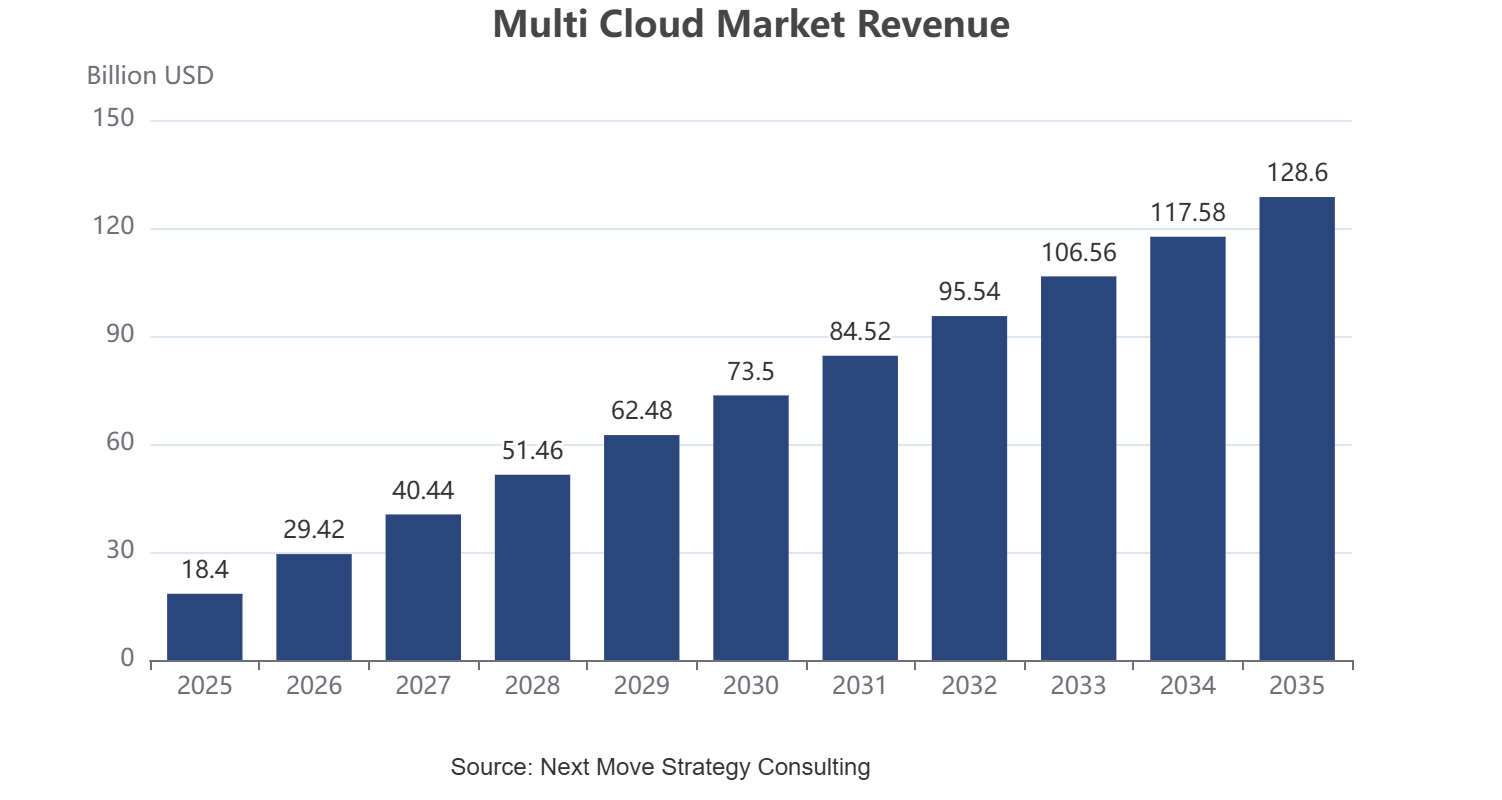
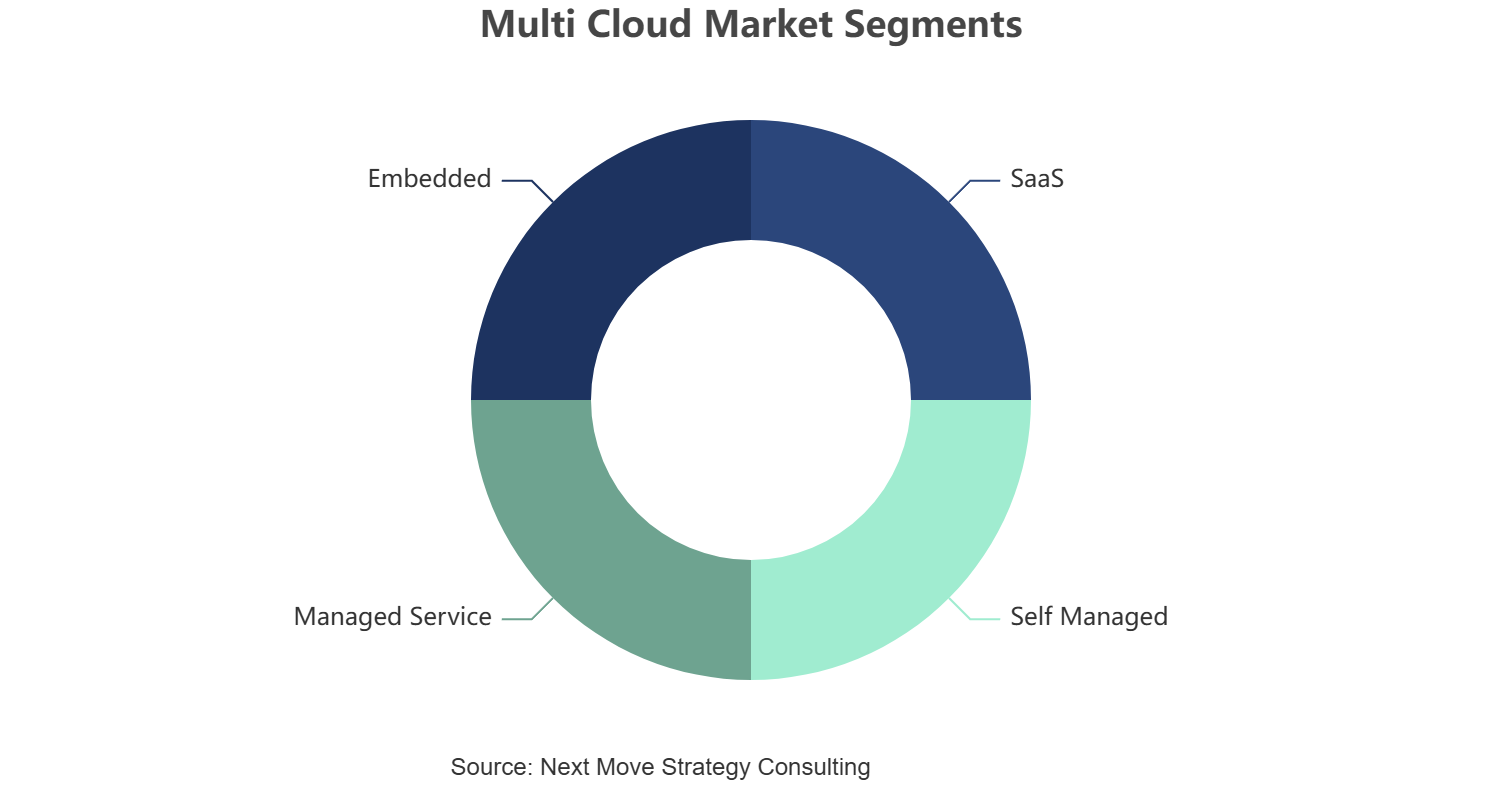
About the Author
 Liza Phukan
— Liza Phukan is Research Associate at Next Move Strategy Consulting, where she has covered emerging industries and market research across sectors for 3.5 years. Her work includes analyzing industry developments, validating market data, and developing structured business content from research findings. She uses secondary research and data-validation practices to turn complex market information into clear decision-useful market analysis for business audiences and support report development and B2B.
Liza Phukan
— Liza Phukan is Research Associate at Next Move Strategy Consulting, where she has covered emerging industries and market research across sectors for 3.5 years. Her work includes analyzing industry developments, validating market data, and developing structured business content from research findings. She uses secondary research and data-validation practices to turn complex market information into clear decision-useful market analysis for business audiences and support report development and B2B.
About the Reviewer
 Supradip Baul
— Supradip Baul is an accomplished business consultant and strategist with over a decade of rich experience in market intelligence, strategy, technology, and business transformation. His work has included rigorous qualitative and quantitative analysis across multiple industries, helping clients shape investment decisions and long-term roadmaps. Earlier in his career, he was associated with Gartner, where he contributed to industry-leading reports and market share analyses. He has worked with leading global companies and holds an MBA with a dual specialization in Marketing and Finance.
Supradip Baul
— Supradip Baul is an accomplished business consultant and strategist with over a decade of rich experience in market intelligence, strategy, technology, and business transformation. His work has included rigorous qualitative and quantitative analysis across multiple industries, helping clients shape investment decisions and long-term roadmaps. Earlier in his career, he was associated with Gartner, where he contributed to industry-leading reports and market share analyses. He has worked with leading global companies and holds an MBA with a dual specialization in Marketing and Finance.
At Next Move Strategy Consulting, we understand that insightful market research is the cornerstone of successful business decisions. That's why we employ a robust and multifaceted approach, combining various methodologies to deliver the most accurate and actionable data for our clients.

Research Landscape
We navigate the world of research with two primary approaches:
Qualitative Approach
Our qualitative research methodologies involve immersive techniques such as in-depth interviews, focus groups, and observational studies. By engaging directly with individuals and stakeholders, we uncover valuable insights that quantitative data alone may overlook.

Quantitative Research
In tandem with qualitative methodologies, NMSC leverages the power of Quantitative Research to provide a robust foundation of numerical insights. Through systematic data collection and analysis, we quantify patterns, preferences, and market trends, offering a comprehensive view of the business landscape.
Our quantitative research approach employs diverse tools, including surveys, experiments, and statistical modelling. These methodologies enable us to gather data from a large and representative sample, ensuring the statistical significance of our findings. By employing structured questionnaires and standardized data collection methods, we guarantee the reliability and validity of the information we present to our clients.
Quantitative research is particularly effective in measuring the prevalence of trends, assessing market size, and gauging the impact of various factors on consumer behavior. The numerical precision attained through this approach equips our clients with actionable insights, facilitating data-driven decision-making and strategy formulation.


Our Specialized Toolbox for Industry-Specific Market Research
We deploy a specialized arsenal of techniques tailored to meet your unique requirements. Here's a glimpse into our comprehensive toolbox:

Information Procurement
The stage entails acquiring market data or relevant information through various sources and methodologies.


Market Research Approach
We utilize both top-down and bottom-up approaches in market research analysis to achieve a comprehensive understanding of the market dynamics, leveraging the broad perspective of industry trends and macroeconomic factors alongside detailed insights from specific segments and individual companies.

Porters Five Forces Analysis
We conduct Porter's Five Forces analysis to evaluate the competitive landscape of an industry, providing us with insights into factors that affect profitability and strategic positioning.

SWOT Analysis

Forecasting
We utilize a forecasting model to predict future consumption by considering parameters like population, economics, regulations, market competition, drivers, constraints, technology, and pricing. We also employ statistical techniques such as multilinear regression, exponential smoothing, moving average, ARIMA, and Monte Carlo simulations for accurate predictions. In econometric forecasting, we analyzed short-term and long-term event impacts, attributing values based on regulatory frameworks, economic factors, and market events.





 Speak to Our Analyst