Malaysia Warehouse Robotics Market, By Type (Automated Guided Vehicles [AGVs], Autonomous Mobile Robots [AMRs], Articulated Robots, Collaborative Robots), By Offering (Hardware, Software [WMS, WES, WCS], Services), By Payload Capacity (≤100 KG, 101–200 KG, 201–500 KG, 501–1000 KG, 1001–2000 KG, 2001–5000 KG, More than 5000 KG), By Application (Palletizing and Depalletizing, Sorting and Packaging, Picking), By End User (E-commerce, Automotive, Food & Beverages) – Analysis & Forecast, 2025–2035
Industry: ICT & Media | Latest Edition: September 30, 2026 | No of Pages: 230 | No. of Tables: 108 | No. of Figures: 98 | Format: PDF | Report Code: IC5167
Malaysia Warehouse Robotics Market Size & Forecast
|
Parameter |
Details |
|
Market Size (2025) |
USD 88.68 Million |
|
Market Size (2026) |
USD 135.29 Million |
|
Projected Market Size (2035) |
USD 629.58 Million |
|
Revenue CAGR (2026–2035) |
18.63% |
|
Market Volume (2025) |
6 Thousand Units |
|
Market Volume (2026) |
10 Thousand Units |
|
Projected Market Volume (2035) |
49 Thousand Units |
|
Volume CAGR (2026–2035) |
19.55% |
|
Base Year |
2025 |
|
Estimated Year |
2026 |
|
Forecast Period |
2026–2035 |
Industry Outlook
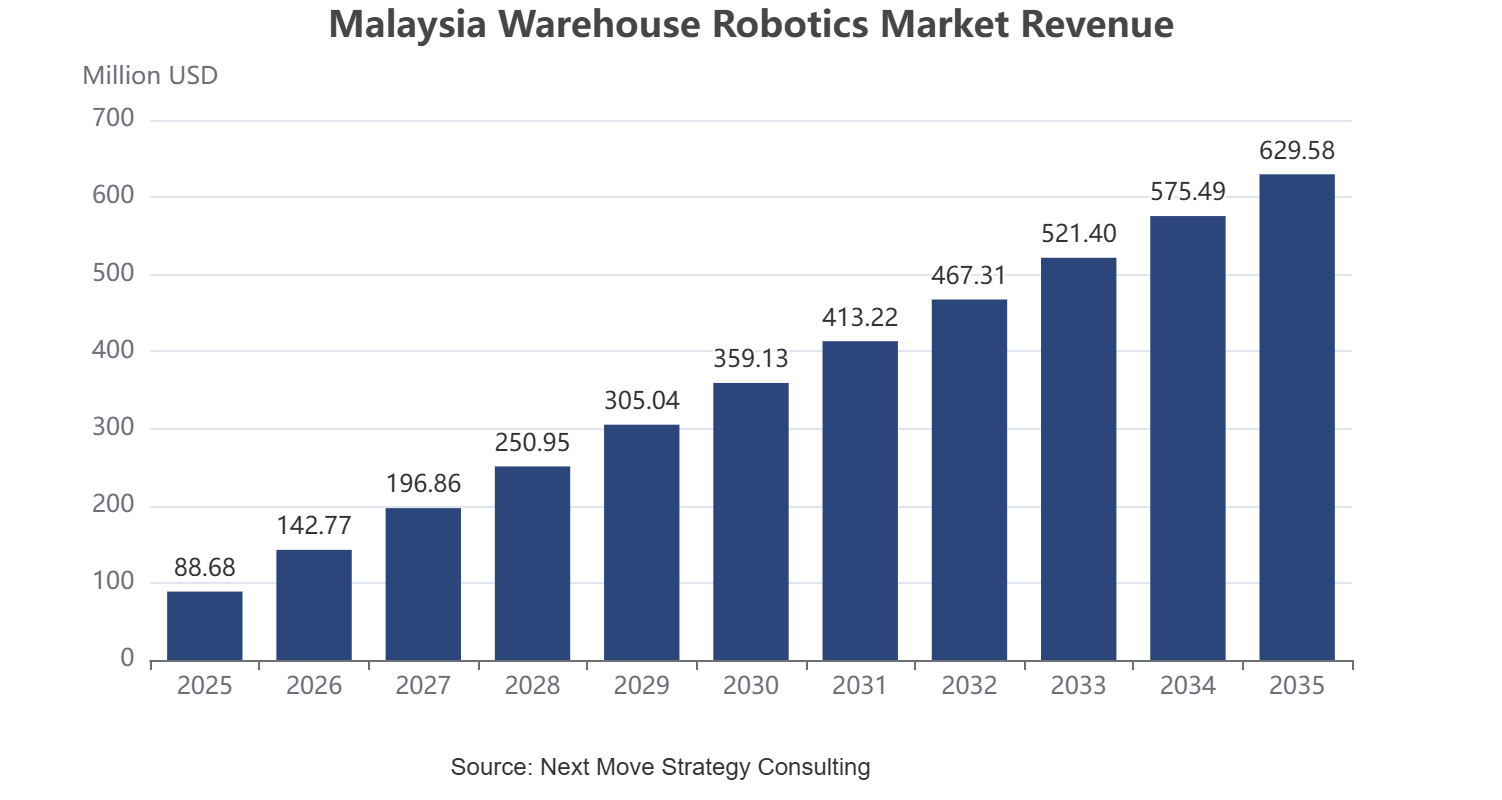
The Malaysia Warehouse Robotics Market was valued at USD 88.68 million in 2025 and reached USD 135.29 million in 2026. Looking ahead, the market is projected to witness strong growth, reaching USD 629.58 million by 2035, registering a CAGR of 18.63% from 2026 to 2035. In terms of volume, the market recorded 6 thousand units in 2025, with forecasts indicating growth to 10 thousand units by 2026 and further to 49 thousand units by 2035, reflecting a volume CAGR of 19.55% over the same period.
What Are the Key Growth Catalysts and Risks Shaping the Malaysia Warehouse Robotics Market?
|
Factor |
Category |
Impact Level |
Description |
|
Rapid E-Commerce and Logistics Expansion |
Driver |
High |
Booming online retail demands highly automated, scalable fulfilment centres. |
|
Government Industry 4.0 Initiatives |
Driver |
High |
National policies and incentives accelerate smart manufacturing adoption. |
|
Labour Scarcity and Rising Wage Costs |
Driver |
Medium-High |
Persistent workforce shortages push businesses toward robotic alternatives. |
|
High Initial Capital Investment |
Restraint |
Medium |
Steep upfront costs deter SME adoption and delay ROI realisation. |
|
Integration with AI and IoT Ecosystems |
Opportunity |
High |
Convergence of AI and IoT enables next-generation adaptive robotic systems. |
The Malaysia Warehouse Robotics Market is influenced by a dynamic interplay of growth drivers, restraints, and emerging opportunities. Rapid digitalisation of trade, supportive government frameworks, and demographic labour constraints are collectively accelerating investment in warehouse automation. However, capital barriers and integration complexity temper the pace of adoption, particularly among smaller enterprises. Understanding these forces is critical for stakeholders to develop effective market entry, expansion, and investment strategies over the 2026–2035 forecast period.
Growth Drivers:
How Is the Expansion of Digital Commerce Fulfilment Networks Strengthening Warehouse Robotics Adoption in Malaysia?
Malaysia's e-commerce sector has expanded at an extraordinary pace, fuelled by rising smartphone penetration, digital payments adoption, and changing consumer behaviour. Logistics providers and retail fulfilment operators are under intense pressure to process higher order volumes with greater speed and accuracy. Automated Guided Vehicles, Autonomous Mobile Robots, and robotic picking systems address these demands by enabling continuous, high-throughput operations that manual workforces cannot sustain, making robotics investment a strategic necessity rather than an optional upgrade.
How Are Government-Led Digital Transformation Initiatives Supporting Warehouse Automation Investments Across Malaysia?
The Malaysian Government's Industry 4.0 roadmap, including the National Industry 4.0 Policy and Malaysia Digital Economy Blueprint, provides substantial fiscal incentives, grants, and tax reliefs to companies investing in automation technologies. These programmes lower the effective cost of deploying warehouse robotics, reduce technology risk, and build a supportive regulatory environment. Public-private collaboration through agencies such as MIDA and MITI further streamlines technology adoption, creating powerful tailwinds for robotics vendors targeting the Malaysian logistics sector.
Why Is Labour Scarcity a Critical Catalyst for Warehouse Robotics Investment in Malaysia?
Malaysia faces a persistent labour shortage in its warehousing and logistics sector, compounded by rising statutory minimum wages and declining availability of low-skilled foreign workers following post-pandemic immigration policy changes. Businesses are compelled to automate repetitive, physically demanding tasks such as palletising, picking, and transportation to sustain operational continuity. Collaborative robots and AMRs offer scalable, cost-effective solutions that reduce dependency on human labour, directly addressing the structural workforce gap constraining industry productivity.
Growth Inhibitor:
How Does High Capital Investment Restrain Warehouse Robotics Adoption Among Malaysian SMEs?
The substantial capital expenditure required for deploying warehouse robotics systems encompassing hardware acquisition, software licensing, systems integration, and workforce retraining presents a significant barrier for small and medium-sized enterprises (SMEs) that constitute the majority of Malaysia's warehousing ecosystem. Extended payback periods, limited access to technology financing, and uncertainty over ROI in price-sensitive sectors further dampen adoption. Without targeted financial assistance mechanisms, this restraint risks widening the automation gap between large corporations and SMEs.
Growth Opportunity:
What Growth Opportunities Does AI and IoT Integration Unlock for the Malaysia Warehouse Robotics Market?
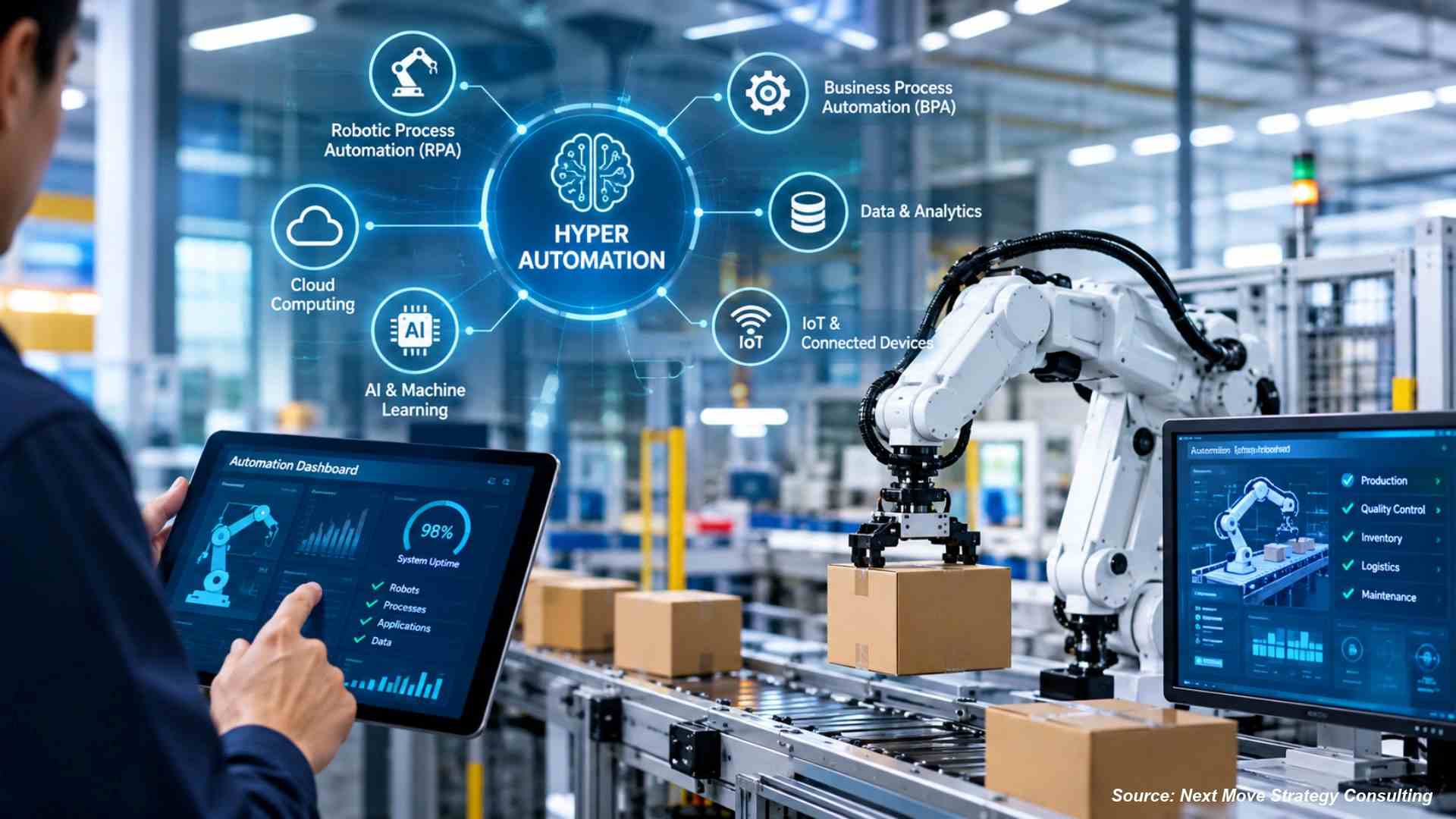
The convergence of Artificial Intelligence, Machine Learning, and Internet-of-Things technologies with warehouse robotics platforms is unlocking powerful new capabilities, including real-time adaptive navigation, predictive maintenance, autonomous task orchestration, and intelligent inventory management. For the Malaysian market, this technology convergence presents a significant commercial opportunity for vendors offering integrated AI-IoT-robotic solutions tailored to the unique constraints of tropical operating environments, fragmented supply chains, and the high-mix, low-volume order profiles characteristic of regional e-commerce fulfilment operations.
Supply Chain Structure Of The Malasiya Warehouse Robotics Market
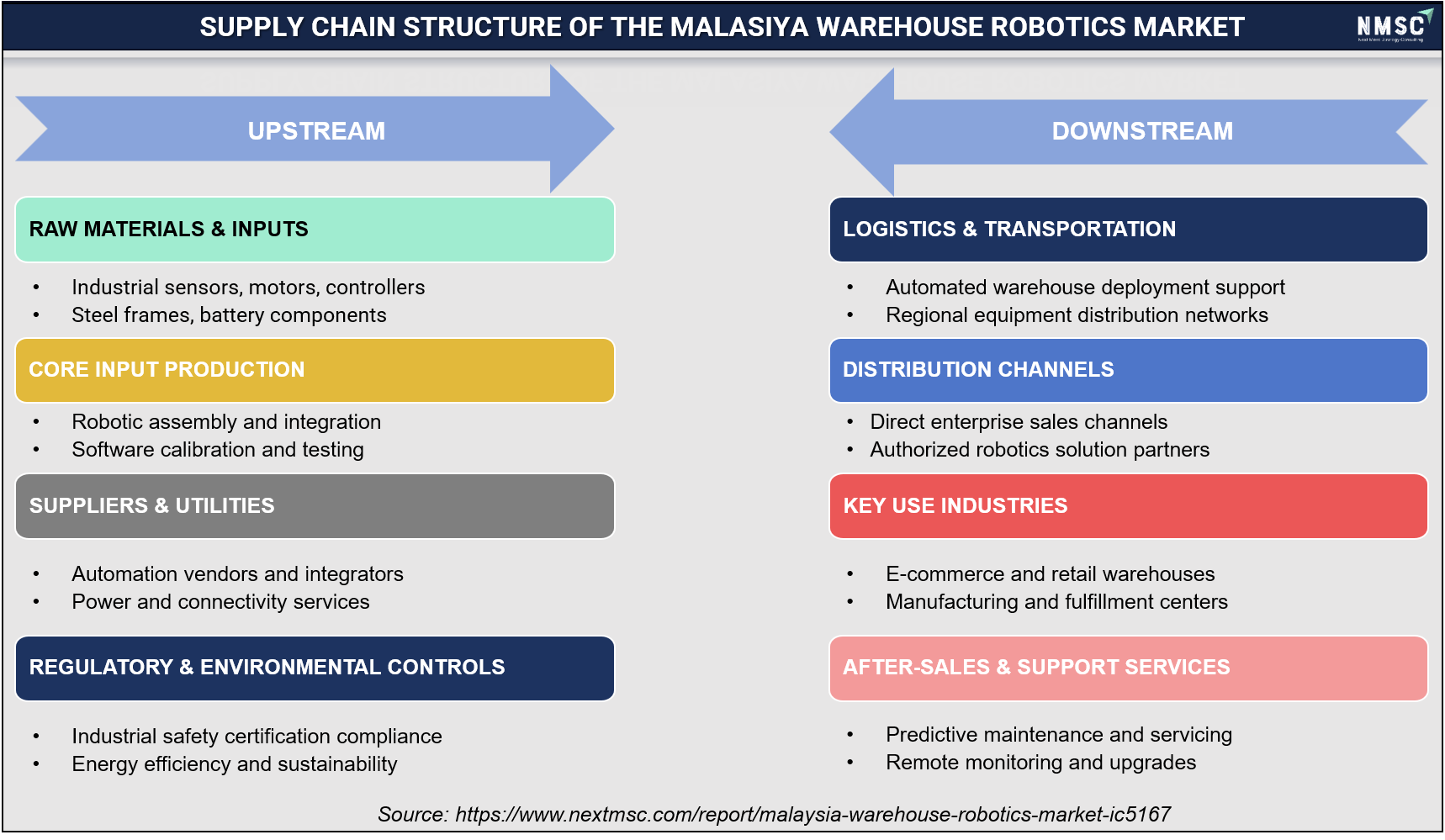
The supply chain structure of the Malaysia Warehouse Robotics Market consists of component suppliers, robotics manufacturers, software developers, system integrators, logistics providers, and end-user industries. Upstream activities involve the supply of sensors, motors, controllers, batteries, and other essential hardware components, while downstream operations focus on warehouse deployment, distribution, fulfilment, and logistics services. Growing demand from e-commerce, retail, manufacturing, and fulfilment centres is strengthening the market ecosystem, supported by predictive maintenance services, remote monitoring capabilities, technical support, and compliance with industrial safety and sustainability standards.
How Is the Malaysia Warehouse Robotics Market Segmented, and Which Segments Are Expected to Drive Future Growth?
By Offerings Insights
How Is Offering Segmentation Influencing Technology Adoption Across the Malaysia Warehouse Robotics Market?
Based on offering, the market is segmented into Hardware, Software, and Services. The software segment is further classified into Warehouse Management System (WMS), Warehouse Execution System (WES), and Warehouse Control System (WCS).
Based on our analysis, demand for warehouse robotics solutions in Malaysia is increasingly shaped by the integration of advanced hardware, intelligent software platforms, and specialized service capabilities. Hardware components, including robotic systems, sensors, controllers, and navigation technologies, account for a significant share of market adoption as organizations invest in warehouse modernization initiatives. Software solutions such as WMS, WES, and WCS are becoming critical for inventory visibility, workflow optimization, and robotic fleet coordination. Meanwhile, services including system integration, maintenance, technical support, and employee training are gaining importance as companies seek to maximize automation performance and ensure seamless warehouse operations.
By Payload Capacity Insights
How Is Payload Capacity Segmentation Shaping Warehouse Robotics Deployment Across the Malaysia Market?
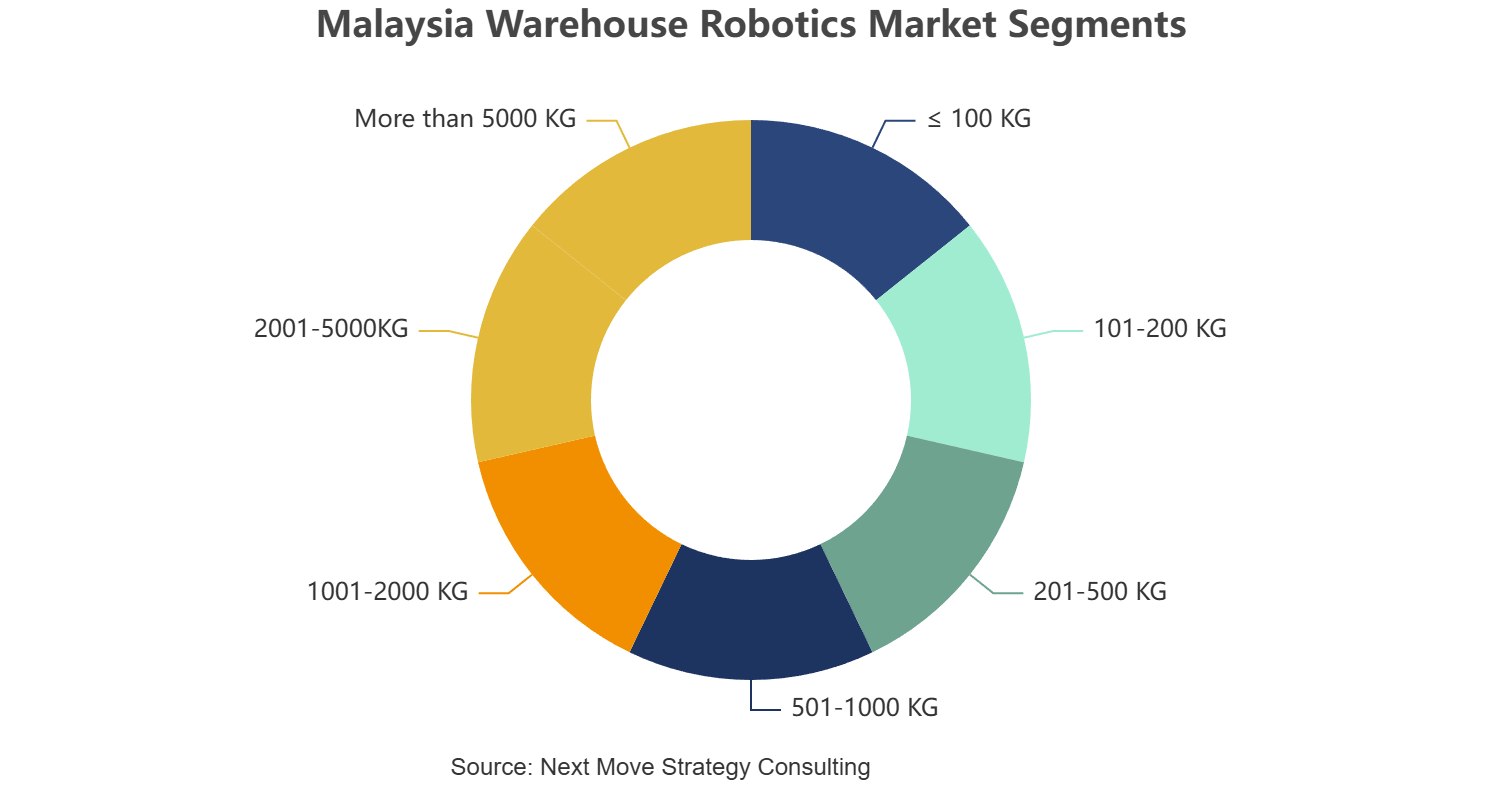
Based on payload capacity, the market is segmented into ≤ 100 KG, 101–200 KG, 201–500 KG, 501–1000 KG, 1001–2000 KG, 2001–5000 KG, and More than 5000 KG.
Based on our evaluation, payload capacity requirements vary significantly across Malaysia's warehousing and logistics sectors depending on product characteristics, operational workflows, and material handling demands. Robots with payload capacities up to 500 KG are widely adopted in e-commerce, pharmaceutical, and electronics warehouses where flexibility, speed, and precision are essential. The 501–2000 KG segment is increasingly utilized in food and beverage distribution centers and manufacturing warehouses for pallet movement and inventory transportation. Meanwhile, robotic systems with payload capacities exceeding 2000 KG are gaining traction in automotive, chemical, and heavy industrial facilities, supporting high-volume material handling operations and improving warehouse productivity.
Competitive Landscape
The Malaysia Warehouse Robotics Market features a highly competitive landscape comprising global automation leaders, regional system integrators, and specialised local players. Competition is driven by technological differentiation in navigation systems, software integration capabilities, payload flexibility, and after-sales service quality. Leading vendors are investing in localised support networks, cloud-based fleet management platforms, and strategic partnerships with Malaysian logistics operators and government-linked companies to strengthen market positioning. The growing demand for turnkey automation solutions is also reshaping competitive dynamics toward service-led, outcome-based business models.
Key Players
-
Swisslog Malaysia Sdn. Bhd.
-
Daifuku (Malaysia) Sdn. Bhd.
-
SSI Schaefer Systems (Malaysia) Sdn. Bhd.
-
Honeywell Engineering Sdn. Bhd.
-
Teradyne Malaysia Sdn. Bhd.
-
FANUC Mechatronics (Malaysia) Sdn. Bhd.
-
Yaskawa Malaysia Sdn. Bhd.
-
OMRON Malaysia Sdn. Bhd.
-
Jungheinrich Lift Truck Malaysia Sdn. Bhd.
-
DF Automation & Robotics Sdn. Bhd.
-
Zebra Technologies Malaysia Sdn. Bhd.
-
Kardex Malaysia Sdn. Bhd.
-
Koerber Technologies Sdn. Bhd.
The competitive ecosystem of the Malaysia Warehouse Robotics Market is anchored by global technology leaders including Swisslog Malaysia Sdn. Bhd., Daifuku (Malaysia) Sdn. Bhd., and Dematic (Malaysia) Sdn. Bhd., which collectively offer end-to-end automated storage and retrieval solutions. SSI Schaefer Systems (Malaysia) Sdn. Bhd., Honeywell Engineering Sdn. Bhd., and ABB Malaysia Sdn. Bhd. bring industrial automation expertise, while FANUC Mechatronics (Malaysia) Sdn. Bhd., Yaskawa Malaysia Sdn. Bhd., and OMRON Malaysia Sdn. Bhd. lead in robotic arm and collaborative robot technologies. Local innovator DF Automation & Robotics Sdn. Bhd. provides regionally tailored AMR solutions, whereas Teradyne Malaysia Sdn. Bhd., Zebra Technologies Malaysia Sdn. Bhd., Kardex Malaysia Sdn. Bhd., Jungheinrich Lift Truck Malaysia Sdn. Bhd., and Koerber Technologies Sdn. Bhd. round out a diversified field spanning hardware, software, and integrated services.
Key Segments
By Types
-
Automated Guided Vehicles (AGVs)
-
Laser Guidance
-
Magnetic Guidance
-
Optical Tape Guidance
-
Vision Guidance
-
Others
-
-
Autonomous Mobile Robots (AMRs)
-
Tow Vehicle
-
Tug Vehicle
-
Unit Load Vehicle
-
Pallet Truck
-
Forklift Vehicle
-
Other Type
-
-
Articulated Robots
-
Collaborative Robots (Cobot)
-
Scara Robots and Cylindrical Robot
-
Others
By Offerings
-
Hardware
-
Software
-
Warehouse Management System (WMS)
-
Warehouse Execution System (WES)
-
Warehouse Control System (WCS)
-
-
Services
By Payload Capacity
-
≤ 100 KG
-
101-200 KG
-
201-500 KG
-
501-1000 KG
-
1001-2000 KG
-
2001-5000KG
-
More than 5000 KG
By Application
-
Palletizing and depalletizing
-
Sorting and Packaging
-
Picking and Placing
-
Transportation
By End User
-
E-commerce
-
Automotive
-
Food & Beverages
-
Pharmaceutical
-
Chemical and Materials
-
Semiconductor and Electronics
-
Others
Pestel Analysis Of The Malaysia Warehouse Robotics Market
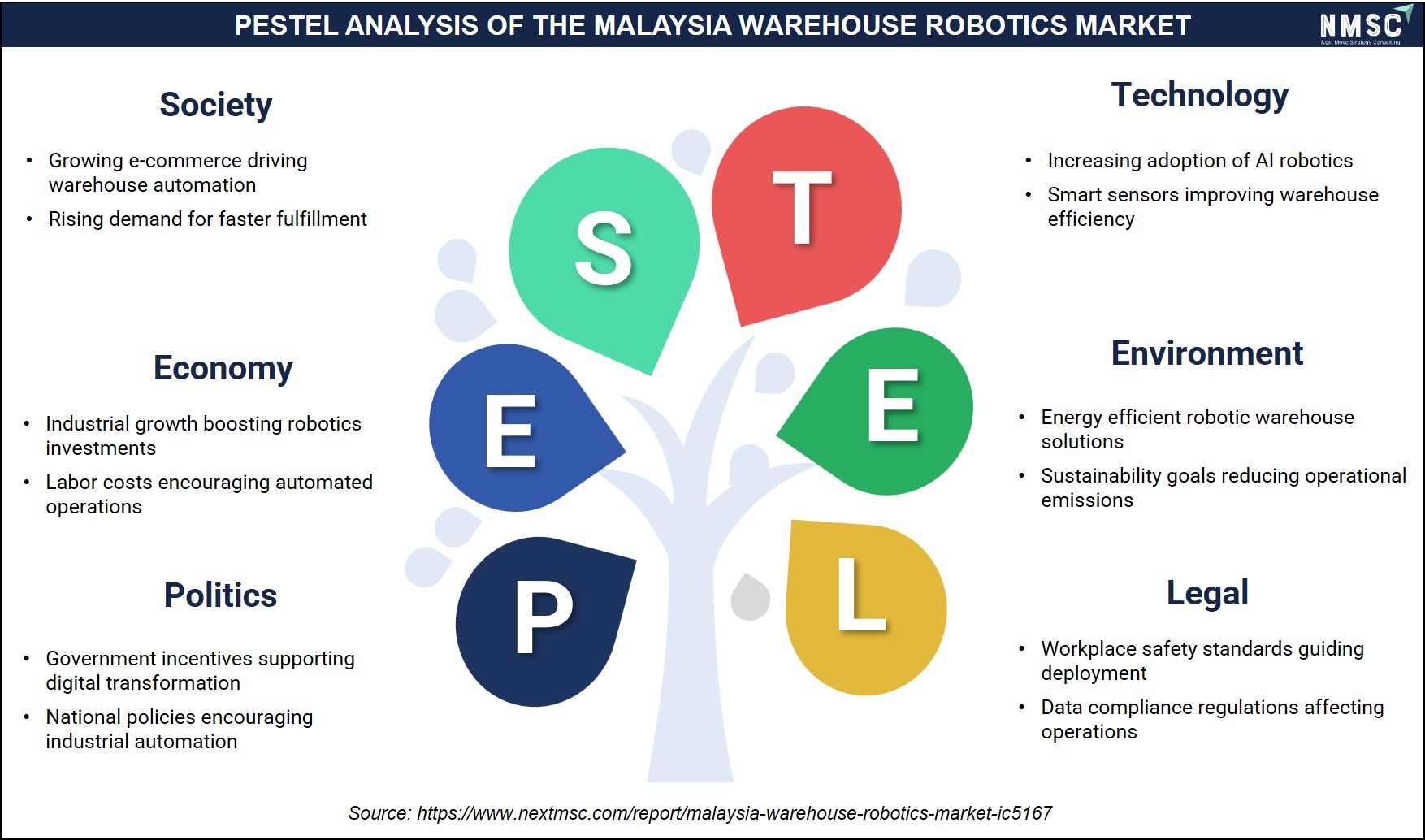
The PESTEL analysis of the Malaysia Warehouse Robotics Market highlights the key external factors shaping market growth and automation adoption. Government initiatives supporting Industry 4.0 and digital transformation, coupled with strong economic development and expanding e-commerce activity, are encouraging investments in warehouse robotics. Technological advancements in artificial intelligence, autonomous navigation, and warehouse management systems are accelerating deployment across logistics and manufacturing sectors. Additionally, sustainability objectives, regulatory compliance requirements, and workplace safety standards are further supporting the adoption of efficient and intelligent warehouse automation solutions throughout Malaysia.
Key Benefits for Stakeholders
This syndicated research report on the Malaysia Warehouse Robotics Market delivers comprehensive, data-driven intelligence enabling stakeholders to make informed strategic decisions. Investors and technology vendors gain granular insights into market sizing, growth trajectories, segment-level opportunity mapping, and competitive benchmarking that are critical for capital allocation and product roadmap development. Logistics operators and end users benefit from analysis of technology maturation curves, integration best practices, and total cost of ownership comparisons that directly inform automation strategy formulation and procurement decisions.
Government agencies, industry associations, and policy makers can leverage the report's analysis of regulatory frameworks, Industry 4.0 incentive programme effectiveness, and workforce transition dynamics to design targeted interventions that accelerate sustainable automation adoption across Malaysian industries. Academic researchers and market analysts will find value in the rigorous methodology, historical baseline data from 2025, and ten-year forecast extending to 2035. Collectively, the report serves as an authoritative reference for all participants seeking to navigate and capitalise on the significant growth opportunities in Malaysia's rapidly evolving warehouse robotics ecosystem.
Customisation Options
|
Parameters |
Details |
|
Customization Scope |
Free customization (equivalent to up to 80 analyst-working hours) after purchase. |
|
Pricing and Purchase Options |
Avail customized purchase options to meet your exact research needs. |
|
Approach |
In-depth primary and secondary research; proprietary databases; rigorous quality control and validation measures. |
|
Analytical Tools |
Porter's Five Forces, SWOT, value chain, and Harvey ball analysis to assess competitive intensity, stakeholder roles, and relative impact of key factors. |
Conclusion
The Malaysia Warehouse Robotics Market stands at a compelling inflection point, positioned to expand from USD 88.68 million in 2025 to USD 629.58 million by 2035 at an 18.63% CAGR. E-commerce proliferation, government Industry 4.0 mandates, and structural labour shortages are creating a durable foundation for sustained robotics investment. With AMRs, Cobots, and AI-integrated platforms capturing increasing market share, and global technology leaders alongside agile local players competing for market leadership, stakeholders who act strategically on emerging automation opportunities are well-positioned to achieve transformative operational and financial returns over the forecast horizon.
About the Author
 Liza Phukan
— Liza Phukan is Research Associate at Next Move Strategy Consulting, where she has covered emerging industries and market research across sectors for 3.5 years. Her work includes analyzing industry developments, validating market data, and developing structured business content from research findings. She uses secondary research and data-validation practices to turn complex market information into clear decision-useful market analysis for business audiences and support report development and B2B.
Liza Phukan
— Liza Phukan is Research Associate at Next Move Strategy Consulting, where she has covered emerging industries and market research across sectors for 3.5 years. Her work includes analyzing industry developments, validating market data, and developing structured business content from research findings. She uses secondary research and data-validation practices to turn complex market information into clear decision-useful market analysis for business audiences and support report development and B2B.
About the Reviewer
 Supradip Baul
— Supradip Baul is an accomplished business consultant and strategist with over a decade of rich experience in market intelligence, strategy, technology, and business transformation. His work has included rigorous qualitative and quantitative analysis across multiple industries, helping clients shape investment decisions and long-term roadmaps. Earlier in his career, he was associated with Gartner, where he contributed to industry-leading reports and market share analyses. He has worked with leading global companies and holds an MBA with a dual specialization in Marketing and Finance.
Supradip Baul
— Supradip Baul is an accomplished business consultant and strategist with over a decade of rich experience in market intelligence, strategy, technology, and business transformation. His work has included rigorous qualitative and quantitative analysis across multiple industries, helping clients shape investment decisions and long-term roadmaps. Earlier in his career, he was associated with Gartner, where he contributed to industry-leading reports and market share analyses. He has worked with leading global companies and holds an MBA with a dual specialization in Marketing and Finance.
At Next Move Strategy Consulting, we understand that insightful market research is the cornerstone of successful business decisions. That's why we employ a robust and multifaceted approach, combining various methodologies to deliver the most accurate and actionable data for our clients.

Research Landscape
We navigate the world of research with two primary approaches:
Qualitative Approach
Our qualitative research methodologies involve immersive techniques such as in-depth interviews, focus groups, and observational studies. By engaging directly with individuals and stakeholders, we uncover valuable insights that quantitative data alone may overlook.

Quantitative Research
In tandem with qualitative methodologies, NMSC leverages the power of Quantitative Research to provide a robust foundation of numerical insights. Through systematic data collection and analysis, we quantify patterns, preferences, and market trends, offering a comprehensive view of the business landscape.
Our quantitative research approach employs diverse tools, including surveys, experiments, and statistical modelling. These methodologies enable us to gather data from a large and representative sample, ensuring the statistical significance of our findings. By employing structured questionnaires and standardized data collection methods, we guarantee the reliability and validity of the information we present to our clients.
Quantitative research is particularly effective in measuring the prevalence of trends, assessing market size, and gauging the impact of various factors on consumer behavior. The numerical precision attained through this approach equips our clients with actionable insights, facilitating data-driven decision-making and strategy formulation.


Our Specialized Toolbox for Industry-Specific Market Research
We deploy a specialized arsenal of techniques tailored to meet your unique requirements. Here's a glimpse into our comprehensive toolbox:

Information Procurement
The stage entails acquiring market data or relevant information through various sources and methodologies.


Market Research Approach
We utilize both top-down and bottom-up approaches in market research analysis to achieve a comprehensive understanding of the market dynamics, leveraging the broad perspective of industry trends and macroeconomic factors alongside detailed insights from specific segments and individual companies.

Porters Five Forces Analysis
We conduct Porter's Five Forces analysis to evaluate the competitive landscape of an industry, providing us with insights into factors that affect profitability and strategic positioning.

SWOT Analysis

Forecasting
We utilize a forecasting model to predict future consumption by considering parameters like population, economics, regulations, market competition, drivers, constraints, technology, and pricing. We also employ statistical techniques such as multilinear regression, exponential smoothing, moving average, ARIMA, and Monte Carlo simulations for accurate predictions. In econometric forecasting, we analyzed short-term and long-term event impacts, attributing values based on regulatory frameworks, economic factors, and market events.





 Speak to Our Analyst