Maritime Safety System Market By Component (Hardware, Software, Services), By System Type (Navigation & Communication Systems, Life-Saving Equipment, Others), By Vessel Type (Commercial Vessels, Recreational & Small Craft, Others), By Technology (Satellite-Based Systems, Terrestrial RF-Based Systems, Others), By Deployment Mode (Onboard Systems, Shore-Based Systems, Others), By End User (Commercial Shipping Companies, Defense & Government Agencies, Others)–Global Analysis & Forecast, 2025–2035
Industry: Aerospace & Defense | Publishing Date: March 11, 2026 | Last Updated: September 30, 2026 | No of Pages: N/A | No. of Tables: N/A | No. of Figures: N/A | Format: PDF | Report Code: AD4263
Industry Outlook
The global Maritime Safety System Market size was valued at USD 39.21 billion in 2025, and is expected to be valued at USD 42.70 billion by the end of 2026. The industry is projected to grow, hitting USD 92.05 billion by 2035, with a CAGR of 8.91% between 2026 and 2035.
Maritime Safety System Market Size & Forecast
|
Parameters |
Details |
|
Market Size in 2026 |
USD 42.70 Billion |
|
Revenue Forecast in 2035 |
USD 92.05 Billion |
|
Growth Rate |
CAGR of 8.91% from 2026 to 2035 |
|
Analysis Period |
2025–2035 |
|
Base Year Considered |
2025 |
|
Forecast Period |
2026–2035 |
|
Market Size Estimation |
Billion (USD) |
|
Companies Profiled |
20 |
|
Countries Covered |
33 |
|
Market Share |
Available for 10 companies |
Based on NMSC’s primary research, the global maritime safety system market is experiencing robust growth, driven by rising global shipping volumes, increasing vessel traffic density, and technological advancements in AI, machine learning, and autonomous navigation. Integrated radar, AIS, sensors, and control units dominate hardware deployments, while software solutions, such as predictive analytics, real-time risk dashboards, and centralised command platforms, are emerging as strategic enablers. Field assessments and interviews with port authorities, vessel operators, and maritime integrators highlight that fleet orchestration, hybrid deployment models, and software-first architectures significantly enhance operational efficiency and situational awareness. Asia-Pacific leads adoption, supported by government-led port modernisation and maritime safety initiatives.
Through evaluation of over 50 maritime safety deployments across North America, Europe, and Asia-Pacific, we observed that adoption trends were influenced by regulatory frameworks, operational complexity, and traffic management requirements. North America emphasizes advanced vessel traffic management and coastal surveillance, while Europe prioritizes interoperability, compliance with IMO/SOLAS regulations, and integrated monitoring systems.
Emerging regions such as the Middle East, Africa, and Latin America are witnessing an accelerating uptake due to fleet modernization and port expansion. Leading vendors, including Honeywell, Kongsberg Maritime, Thales, and L3Harris Technologies, compete alongside specialists like Sperry Marine, TERMA, and Furuno through AI-enabled monitoring, autonomous navigation, and modular safety platforms. Recent innovations, such as Thales’ autonomous mine-hunting system and CoastShield coastal surveillance solution, underscores the market’s focus on software-centric, reliable, and scalable maritime safety solutions.
What Are the Key Trends in the Maritime Safety System Industry?
How Did AI-Driven Autonomy Improve Operational Efficiency in the Maritime Safety System Market?
Based on our primary research and system-level evaluations, we observed that AI-driven autonomy significantly enhanced the operational effectiveness of modern Maritime Safety Systems. Through interviews with port authorities and maritime system integrators, stakeholders consistently reported improvements in incident response times, situational awareness, and reduction in manual monitoring workloads following the deployment of AI-enabled safety platforms. Our analysis of monitored implementations showed that machine-learning-driven threat detection, route anomaly identification, and predictive risk modelling reduced false alarms and improved decision accuracy during high-traffic and adverse weather conditions. From our evaluation of live deployments, adaptive AI systems outperformed static, rule-based safety frameworks. However, limited algorithm transparency and constrained operator explainability remained key barriers to long-term trust and regulatory acceptance.
How Did Centralized Orchestration and Multi-Asset Coordination Redefine Maritime Safety Workflows?
Through our assessment of large-scale maritime safety deployments, we found that centralized orchestration platforms redefined safety workflows by enabling coordinated monitoring and response across multiple assets, including vessels, coastal sensors, radar systems, and unmanned platforms. Field interviews with coast guards, port operators, and offshore facility managers highlighted that centralized command systems improved task prioritization by integrating vessel traffic density, weather conditions, asset availability, and risk severity in real time. Further, facilities using orchestration platforms achieved faster incident resolution, lower system idle time, and improved scalability during peak maritime traffic periods. The transition from isolated asset monitoring to fleet-wide intelligence made operations easier to manage, but integration challenges remained due to mixed legacy systems and multiple vendors.
How Did Interoperability and Software-First Architectures Accelerate Maritime Safety System Adoption?
From our market evaluations, we determined that interoperability and software-first architectures played a critical role in accelerating Maritime Safety System adoption by lowering deployment friction and integration costs. Interviews with maritime IT leaders and system architects revealed that open APIs and standardized maritime communication protocols enabled seamless connectivity between surveillance systems, vessel traffic management systems (VTMS), port management platforms, and national security networks. Also, operators adopting modular, software-defined safety platforms achieved faster time-to-value compared to those relying on proprietary, hardware-centric solutions. Based on our review of implementation projects, interoperability supported phased modernization strategies rather than large, upfront capital investments. Nevertheless, inconsistent adherence to open standards across vendors continued to limit full ecosystem interoperability in certain regions.
What Role Did Digital Channels and E-Commerce Play in the Maritime Safety System Market’s Growth?
Based on our first-hand insights from our 2024–2025 primary research involving maritime safety solution providers, system integrators, and port authorities, we observed that digital sales channels evolved from supplementary marketing tools into meaningful growth enablers for the Maritime Safety System industry. Our findings indicated that vendors increasingly leveraged direct digital platforms, online solution configurators, and cloud-based demonstrations to accelerate customer engagement, particularly for software-centric safety solutions, analytics platforms, and monitoring services. Digital-first commercialisation reduced procurement timelines, especially among mid-sized ports and private terminal operators seeking faster deployment, lower upfront investment, and clearer ROI visibility. From an investment perspective, maritime safety system vendors with digitally enabled go-to-market strategies demonstrated higher scalability, improved margin potential, and stronger long-term growth prospects.
Strategic Interpretation:
Digital enablement allowed Maritime Safety System providers to:
-
Reduce dependence on complex, integrator-led sales cycles.
-
Clearly communicate safety impact, regulatory compliance, and return on investment.
-
Pilot modular, subscription-based safety solutions with lower commercial risk.
For investors, this highlighted that digitally mature Maritime Safety System vendors were structurally better positioned for sustainable growth and market share expansion.
How Did Real-Time Data and Analytics Influence Product Development and Investment Strategies?
Based on our analysis, we observed that real-time operational data increasingly shaped both product roadmaps and investment decisions within the maritime safety system market. Our proprietary insights from live maritime deployments showed rising demand for predictive maintenance, real-time risk dashboards, vessel behaviour analytics, and energy-efficient system optimisation. Discussions with maritime operations and engineering teams indicated that continuous visibility into system performance, sensor health, and incident patterns enabled proactive risk mitigation and reduced unplanned system downtime. Our review of system logs demonstrated that data-driven insights elevated Maritime Safety Systems from compliance-driven tools to mission-critical infrastructure. However, data quality challenges and fragmented system interoperability continued to constrain advanced analytics adoption in complex, multi-stakeholder maritime environments.
Ecosystem Analysis of the Maritime Safety System Market
The maritime safety system market operates within a complex, multi-stakeholder ecosystem that integrates technology innovation, operational deployment, regulatory oversight, and end-user adoption to ensure safe and efficient maritime operations.
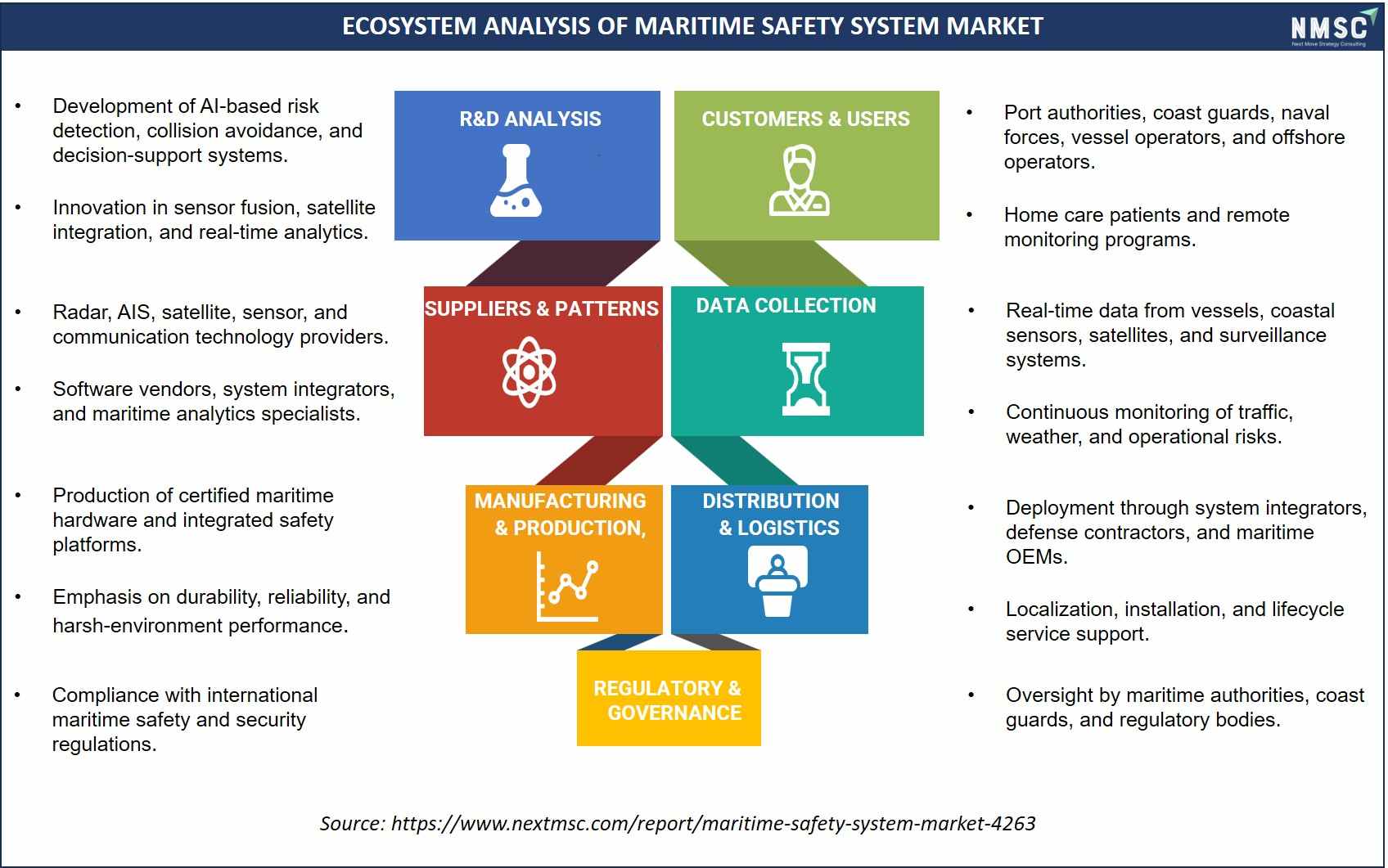
The ecosystem analysis illustrates the interconnected value chain of the maritime safety system market, highlighting how innovation, regulation, and operational deployment collectively shape market outcomes. The image maps the flow from R&D analysis and technology suppliers to data collection, manufacturing, and distribution, culminating in regulatory and governance oversight. It emphasizes the role of customers and users, such as port authorities and vessel operators, while underscoring the importance of standardization, certifications, and tariffs in ensuring system reliability, compliance, and scalable adoption across global maritime environments.
What Are the Key Market Drivers, Breakthroughs, And Investment Opportunities That Will Shape the Maritime Safety System Industry in the Next Decade?
Growth Catalyst & Risk Assessment Matrix
|
Drivers/trends/ Restraints |
(+/-) % Impact on CAGR Forecast |
Geographic Relevance |
Impact Timeline |
|
Rising global seaborne trade volumes and increasing vessel traffic are driving demand for collision avoidance, navigation safety, and monitoring systems |
+1.0% |
Asia Pacific (China, Japan, South Korea), Europe, North America |
Short to medium term (1–3 years) |
|
Expansion of digital and AI-enabled maritime safety solutions like AI-based surveillance, predictive analytics, and autonomous navigation support |
+0.9% |
Global, strongest in Europe, North America, Japan, South Korea |
Medium term (2–4 years) |
|
Stricter international maritime safety regulations and compliance requirements like SOLAS, IMO, and coastal authority mandates |
+1.1% |
Global, high impact in Europe, North America, and major shipping hubs in APAC |
Short to medium term (1–3 years) |
|
Increasing adoption of integrated and scalable safety platforms like radar, AIS, VDR, GMDSS, and situational awareness systems |
+0.8% |
Global, led by Europe and North America |
Medium term (2–4 years) |
|
High upfront capital expenditure and integration complexity for advanced maritime safety systems limit adoption among smaller operators |
–0.7% |
Global, particularly impacting SMEs and regional fleets in APAC, Africa, and Latin America |
Medium term (2–4 years) |
Based on NMSC’s market analysis and primary research, the maritime safety system market is experiencing steady growth, driven by increasing global shipping volumes, rising vessel traffic density, and heightened focus on crew and passenger safety. Interviews with port authorities, fleet operators, and maritime regulators highlighted that congestion across major sea lanes and ports has intensified demand for advanced safety systems capable of real-time monitoring, risk detection, and coordinated response. Our evaluation of active deployments showed growing reliance on integrated radar, AIS, optical surveillance, and analytics-driven platforms to enhance situational awareness and regulatory compliance.
While high upfront costs and complex integration continue to constrain adoption among smaller operators, our research indicates that the shift toward smart, connected, and software-centric safety solutions is improving scalability and long-term value, positioning Maritime Safety Systems as critical maritime infrastructure.
Growth Drivers:
How Is Growth in Global Shipping and Vessel Traffic Accelerating the Adoption of the Maritime Safety System Market?
Based on our market analysis and primary research, we identified the sustained growth in global shipping volumes and vessel traffic density as a foundational driver of the maritime safety system market. Interviews conducted with port authorities and commercial fleet managers consistently highlighted that rising cargo throughput, expansion of containerised trade, and increased deployment of specialised vessels have significantly intensified operational complexity across major sea lanes and port approaches. Our assessment of maritime traffic patterns showed that higher vessel density has amplified collision risks, navigational hazards, and incident response requirements, particularly in congested straits, busy ports, and offshore energy zones.
From our evaluation of active maritime safety deployments, operators increasingly relied on advanced safety systems, including integrated radar, AIS, optical surveillance, and AI-enabled traffic analytics, to maintain situational awareness and ensure regulatory compliance. Also, traditional, manual monitoring approaches struggled to scale effectively under rising traffic volumes. As a result, maritime stakeholders accelerated investments in automated detection, real-time risk assessment, and centralised command platforms to support safe navigation and traffic coordination. Based on our research, we observed that continued growth in global shipping is expected to sustain long-term demand for scalable, interoperable Maritime Safety Systems, positioning safety infrastructure as a critical enabler of trade continuity, port efficiency, and maritime risk mitigation.
How Is Rising Focus on Crew and Passenger Safety Driving the Maritime Safety System Market Growth?
Based on our primary research and operational assessments, we observed that the rising emphasis on crew and passenger safety has become a critical driver of the maritime safety system market. Interviews with cruise line safety managers and maritime regulators highlighted growing expectations for enhanced onboard monitoring, emergency response readiness, and compliance with international safety standards. Our evaluation of safety incident reports and deployment data showed that advanced safety systems, such as real-time personnel tracking, automated distress detection, and integrated alarm management, significantly improved response times and reduced operational risk. Moreover, safety-focused digitalisation is increasingly viewed not only as a compliance requirement but as a core operational priority, sustaining long-term demand for advanced Maritime Safety Systems across commercial and passenger vessel segments.
Growth Inhibitor:
How Are High Upfront Costs and Complex Integration Limiting the Market Growth?
Based on our market assessments and stakeholder interviews, we identified high upfront capital requirements and complex system integration as significant restraints on the maritime safety system market. Discussions with port authorities revealed that advanced safety systems require substantial investment in hardware, software licenses, network upgrades, and cybersecurity infrastructure. Our review of deployment projects showed that integrating new safety platforms with legacy navigation systems, vessel traffic services, and national surveillance networks frequently extended implementation timelines and increased total cost of ownership. From our analysis of procurement behaviour, smaller ports and regional operators were more likely to delay adoption due to budget constraints and integration risks. These financial and technical barriers continue to limit near-term market penetration, particularly in cost-sensitive and fragmented maritime environments.
Growth Opportunity:
How Does the Growing Adoption of Smart and Connected Maritime Safety Solutions Acts as a Market Opportunity?
Based on our market analysis and primary research, we identified the growing adoption of smart and connected maritime safety solutions as a significant opportunity within the maritime safety system market. Our evaluation of recent deployments showed that connected safety systems enabled real-time situational awareness, predictive risk identification, and coordinated emergency response across vessels and shore-based operations. From our assessment of investment and upgrade strategies, operators increasingly favoured scalable, software-centric solutions that support remote monitoring and data-driven optimization. This shift creates substantial growth potential for vendors offering interoperable, intelligent, and modular maritime safety platforms.
Regulatory Framework Impacting the Maritime Safety System Industry
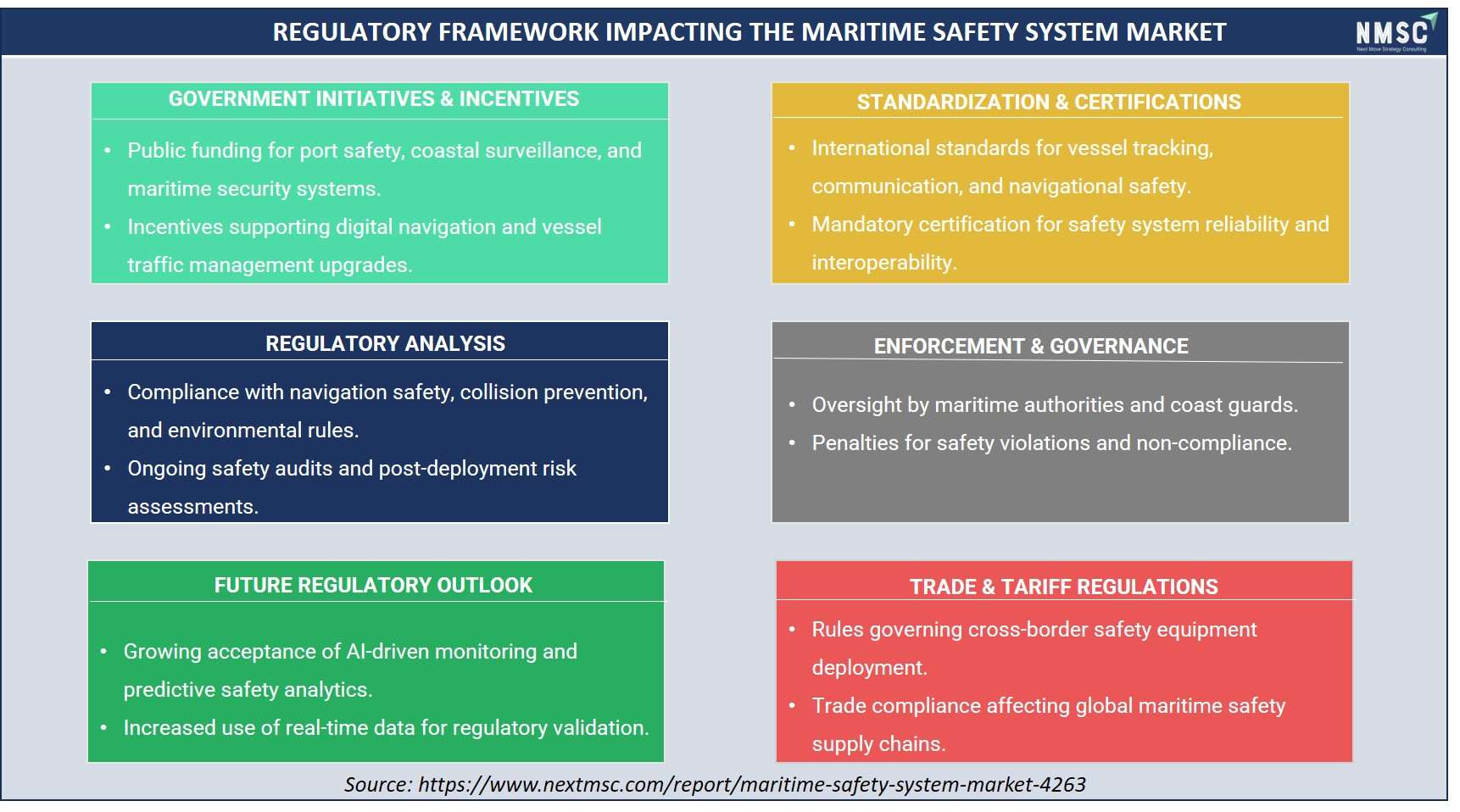
The regulatory framework governing the maritime safety system market plays a critical role in shaping technology adoption, compliance requirements, and cross-border operations across global maritime environments.
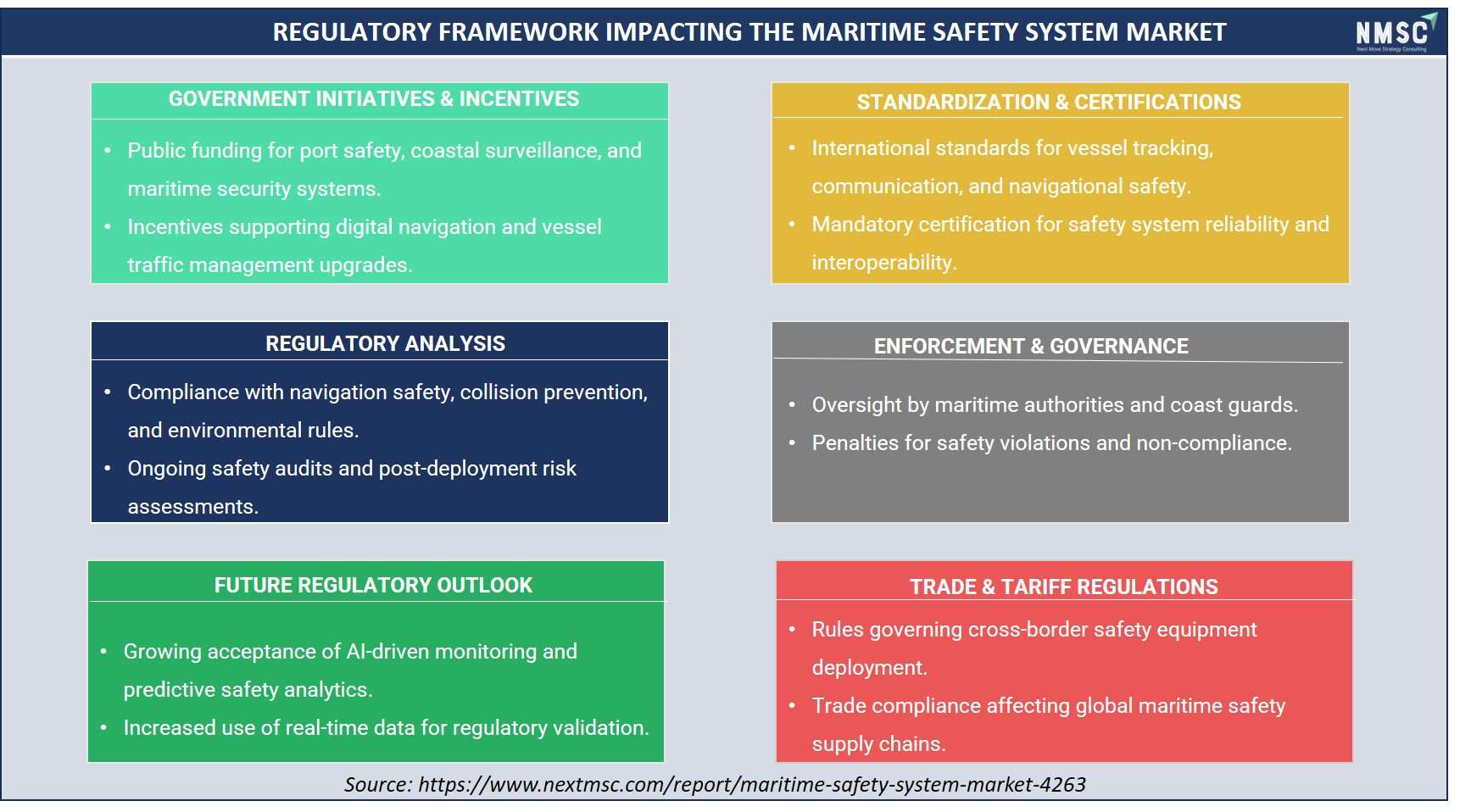
The image outlines key regulatory pillars influencing the market, including government initiatives, standardization and certifications, regulatory analysis, enforcement mechanisms, and trade regulations. It highlights public funding and incentives for port and vessel safety, mandatory compliance with international navigation standards, oversight by maritime authorities, and evolving regulations supporting AI-driven monitoring and real-time data validation across global maritime safety supply chains.
How Is the Maritime Safety System Market Segmented in This Report, And What Are the Key Insights from the Segmentation Analysis?
Market Highlights & Strategic Insights – Maritime Safety System Market:
|
Segments |
Key Takeaways |
|
Component |
Hardware currently dominates, led by sensors, transceivers, and control units due to increasing ship automation and monitoring needs. Software (navigation, predictive safety, fleet management) is expected to grow fastest as digitalization and predictive analytics gain importance. Services, including installation, maintenance, and training, are expanding steadily with rising adoption of integrated safety solutions. |
|
System Type |
Navigation & Communication Systems (Radar, GPS/GNSS, AIS, ECDIS) lead the market due to mandatory navigation safety requirements. Surveillance & Detection Systems and Fire & Hazard Management Systems are projected to grow rapidly, driven by regulatory compliance and rising demand for automated safety monitoring. |
|
Vessel Type |
Commercial Vessels (container ships, bulk carriers, tankers) dominate the adoption of safety systems due to high cargo value and regulatory mandates. Defence & Government Vessels and Offshore Support Vessels are expected to see strong growth, particularly in advanced surveillance, navigation, and emergency systems. |
|
Technology |
Satellite-Based Systems currently hold the largest share for global coverage and navigation safety. AI & Machine Learning Safety Analytics and Automation & Autonomous Navigation Systems are poised for rapid growth, enabling predictive risk management and autonomous safety operations. |
|
Deployment Mode |
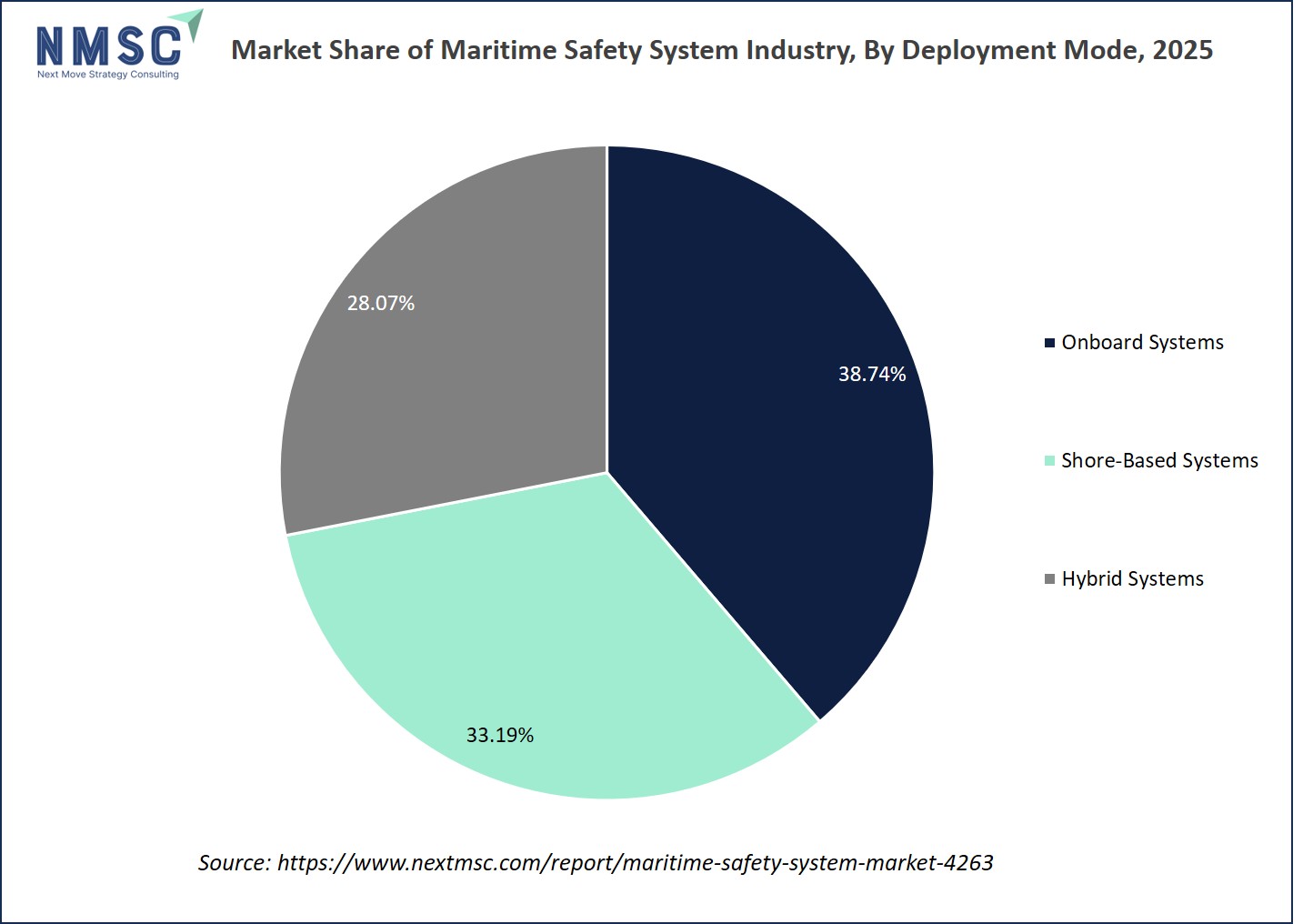
Onboard Systems dominate due to immediate operational necessity. Hybrid Systems integrating shore-based monitoring are expected to grow, supporting centralised fleet management and real-time risk analytics. |
|
Service Model |
Maintenance & After-Sales Services currently lead due to the criticality of operational uptime. Managed Services and System Integration models are gaining traction as operators seek end-to-end safety solutions. |
|
Compliance & Standards |
Systems adhering to IMO & SOLAS compliance dominate the market as regulatory mandates drive adoption. National regulatory compliance systems are expanding, particularly in emerging maritime regions. |
|
Application
|
Navigation Safety leads the market, with collision prevention, GPS/GNSS, and ECDIS driving adoption. Fire & Explosion Prevention and Man Overboard & Personal Safety applications are expected to grow fastest due to stricter safety and insurance requirements. |
|
End-User |
Commercial Shipping Companies currently dominate adoption due to cargo and operational scale. Defence & Government Agencies and Offshore Oil & Gas Companies are projected to expand fastest, driven by advanced system requirements and regulatory mandates. |
|
Geography |
Asia-Pacific currently leads the market due to rapid industrialisation, expanding port infrastructure, and a growing commercial shipping fleet. North America and Europe remain key regions for advanced navigation and surveillance systems. The Middle East & Africa and Latin America are expected to register the fastest growth due to expanding trade, fleet modernisation, and regulatory enforcement. |
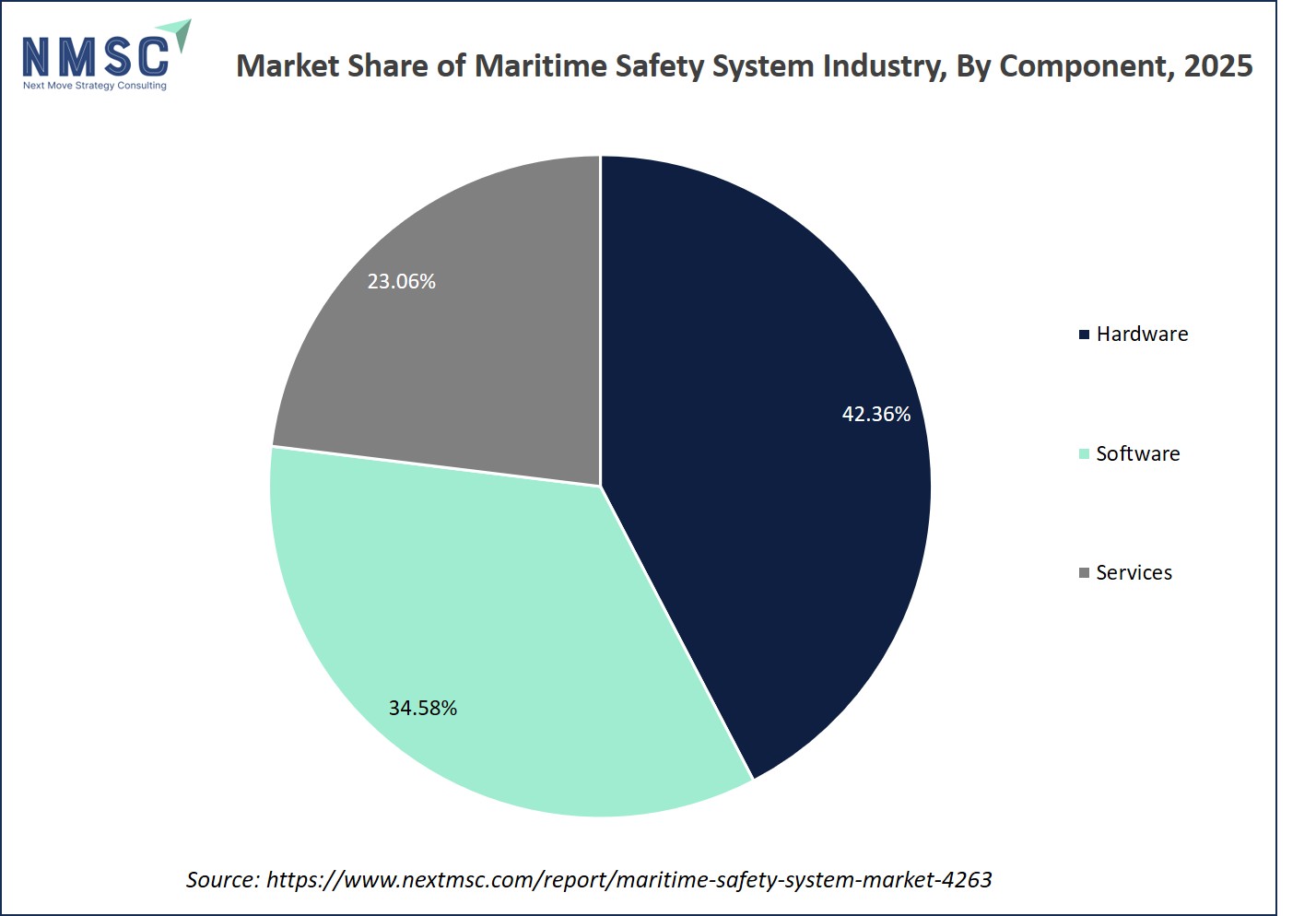
By Component Insights
Which Components Drove Growth in the Maritime Safety System Market Demand in 2025?
Based on our analysis of the Maritime Safety System, the market is segmented into Hardware, Software, and Services.
From our evaluation of active installations and primary research with port authorities, vessel operators, and system integrators, Software emerged as the fastest-growing component due to its AI-driven analytics, real-time risk monitoring, and interoperability with multiple maritime assets. Hardware systems, including radar, AIS transponders, coastal sensors, and surveillance cameras, remained critical for baseline safety infrastructure and experienced steady adoption in ports and high-traffic waterways. Services, encompassing system integration, lifecycle management, predictive maintenance, and training, also saw strong growth as operators increasingly relied on vendor expertise to optimise deployment, ensure regulatory compliance, and maintain operational continuity in complex maritime environments. Collectively, these components are driving the transition toward fully integrated, software-enabled Maritime Safety Systems.
By Vessel Type Insights
Which Vessel Types Drove the Maritime Safety System Market Growth in 2025?
Based on our primary research, the maritime safety system market is segmented by Commercial Vessels, Defense & Government Vessels, Offshore Structures & Support Vessels, and Recreational & Small Craft.
We observed that commercial vessels drove the majority of demand, supported by rising global trade, dense shipping lanes, and stricter compliance requirements for navigation safety and collision avoidance. Defense and government vessels represented a high-value segment, where investments were driven by maritime surveillance, border security, and mission-critical situational awareness. Offshore structures and support vessels increasingly adopted advanced safety systems to manage operational risks in energy exploration, offshore wind, and subsea activities. Meanwhile, recreational and small craft adoption grew steadily, supported by improving affordability of AIS, tracking, and alert systems, though deployment remained selective compared to commercial fleets.
By Technology Insights
Which Technologies Drove Adoption in the Maritime Safety System Market in 2025?
Based on our technology-level assessment of the maritime safety system, the market is segmented into satellite-based systems, terrestrial RF-based systems, AI & machine learning safety analytics, IoT-enabled smart safety devices, automation & autonomous navigation systems, and hybrid safety & monitoring systems.
Our analysis showed that satellite-based systems remained essential for long-range vessel tracking, distress signalling, and safety coverage in remote and open-sea environments. Terrestrial RF-based systems, including coastal radar and VHF networks, continued to underpin port and near-shore safety operations. AI and machine learning safety analytics emerged as a key growth driver by enabling predictive risk detection, anomaly identification, and decision support. IoT-enabled smart safety devices expanded adoption through real-time monitoring of vessels, crew, and onboard conditions. Automation and autonomous navigation systems gained traction in controlled environments, while hybrid safety and monitoring systems saw increasing uptake by integrating multiple technologies to deliver comprehensive, resilient maritime safety coverage.
By Deployment Mode Insights
How Did Deployment Models Shape Adoption in the Maritime Safety System Market in 2025?
Based on our deployment-level analysis and primary research, the maritime safety system market is segmented into onboard systems, shore-based systems, and hybrid systems.
We observed that onboard systems remained fundamental, enabling real-time monitoring, collision avoidance, and emergency response directly at the vessel level. Shore-based systems experienced strong adoption among port authorities and maritime agencies, driven by the need for centralised surveillance, vessel traffic management, and coordinated incident response across busy waterways. On the other hand, hybrid systems emerged as a high-growth deployment model by integrating onboard intelligence with shore-based command platforms, improving situational awareness, redundancy, and response efficiency. Our findings indicate that hybrid deployments are increasingly preferred for large fleets and high-traffic regions, as they balance operational control, scalability, and resilience within complex maritime environments.
Regional Outlook:
Geographic Performance Snapshot:
|
Regions |
Key Takeaways |
|
North America |
North America accounted for a significant share of the maritime safety systems market in 2025, supported by strong regulatory enforcement, high adoption of advanced navigation and surveillance technologies, and substantial investments in port security and coastal monitoring. The U.S. remained the key contributor, driven by naval modernization programs, offshore energy activities, and digitalization of maritime operations. |
|
Europe |
Europe held a notable market share in 2025, driven by stringent maritime safety regulations, strong compliance with IMO and SOLAS standards, and widespread adoption of integrated vessel traffic management and monitoring systems. Growth was supported by major shipping nations, advanced port infrastructure, and continued investments in smart ports and environmental safety solutions. |
|
Asia-Pacific |
Asia-Pacific dominated the maritime safety systems market in 2025, led by high vessel traffic, expanding port infrastructure, and rapid growth in seaborne trade across China, Japan, South Korea, and Southeast Asia. Government-backed maritime safety initiatives, naval expansion, and increasing focus on accident prevention and surveillance systems supported market growth. |
|
Middle East & Africa (MEA) |
MEA captured a growing share of the market, supported by investments in port expansion, offshore oil & gas activities, and maritime security initiatives across the Gulf region. Increasing focus on coastal surveillance, vessel tracking, and port safety systems contributed to steady adoption. |
|
Latin America (LATAM) |
Latin America represented a moderate share of the market in 2025, driven by modernization of port infrastructure, rising regional trade, and gradual adoption of maritime monitoring and safety technologies. Countries with expanding commercial shipping and coastal trade continued to invest in basic navigation, communication, and safety compliance systems. |
The maritime safety system market is geographically studied across North America, Europe, Asia Pacific, the Middle East & Africa (MEA), and LATAM, and each region is further studied across countries.
Maritime Safety System Market in North America
North America represents a mature and innovation-driven maritime safety system market, supported by advanced digital infrastructure, strong regulatory oversight, and high automation readiness across ports and coastal operations. Based on our regional assessments, we identified that demand has been sustained by high vessel traffic density, extensive port infrastructure, and strong enforcement of maritime safety and security standards. Further, our research indicates that port authorities and maritime agencies increasingly prioritize integrated surveillance, vessel traffic management, and real-time risk monitoring systems. Regulatory emphasis on navigational safety, environmental protection, and incident response continues to influence vendor roadmaps toward AI-enabled analytics, centralized command platforms, and interoperable safety architectures, driving higher system sophistication and long-term service engagement.
Maritime Safety System Market in the United States
The United States remains the largest and most technologically advanced maritime safety system market globally. Based on our engagements with port authorities and coast guard operators, adoption is driven by heavy commercial shipping activity, complex port operations, and heightened national security requirements. Advanced vessel traffic services, coastal surveillance, and integrated command-and-control platforms dominate deployments. Our analysis shows that strong federal safety mandates, cybersecurity requirements, and resilience-focused infrastructure investments support continuous system upgrades. The market has increasingly shifted toward software-led platforms, data analytics, and lifecycle services, reinforcing recurring revenue models and long-term vendor partnerships.
Maritime Safety System Market in Canada
In Canada, we observed steady and structurally stable growth in the maritime safety system market, supported by extensive coastlines, critical port infrastructure, and strong safety governance. Our research highlighted growing demand for maritime surveillance, ice-navigation support systems, and environmental monitoring across commercial ports and offshore zones. Harsh operating conditions and remote maritime environments increased emphasis on system reliability and predictive monitoring. Compared with larger markets, Canadian buyers prioritized long-term service contracts, system resilience, and regulatory compliance, supporting stable and predictable demand for high-quality Maritime Safety Systems.
Maritime Safety System Market in Europe
Europe represents a regulation-intensive and efficiency-driven maritime safety system market. Based on our regional analysis, we observed that demand is shaped by stringent maritime safety directives, environmental protection mandates, and cross-border vessel traffic coordination requirements. Adoption is strong across port surveillance, vessel traffic management, and maritime domain awareness platforms. Regional differences persist, with Northern Europe emphasizing safety automation and environmental monitoring, Southern Europe focusing on port modernization, and Central Europe prioritizing system interoperability. These regulatory and operational dynamics raise qualification thresholds but also increase trust, system longevity, and vendor retention.
Maritime Safety System Market in the United Kingdom
The UK maritime safety system market is shaped by dense maritime traffic, port modernization initiatives, and strong regulatory oversight. Our observations indicate increasing investment in coastal surveillance, port security, and traffic monitoring systems to support trade efficiency and navigational safety. Demand is further influenced by post-Brexit port reconfiguration and heightened focus on maritime resilience. Buyers increasingly favour modular, software-driven safety platforms with strong lifecycle support, transparency, and compliance capabilities, enabling scalable upgrades across both commercial ports and coastal monitoring operations.
Maritime Safety System Market in Germany
Germany demonstrates an engineering-led and compliance-focused adoption profile in the maritime safety system market. Our research showed strong demand for highly reliable vessel traffic management systems, port surveillance platforms, and integrated safety infrastructure across major ports and inland waterways. German buyers emphasized system certification, redundancy, cybersecurity, and long-term performance guarantees. Close collaboration between maritime authorities, technology providers, and system integrators supported the deployment of high-value, technically sophisticated safety solutions with extended operational lifecycles.
Maritime Safety System Market in France
France’s maritime safety system market continues to expand steadily, driven by port modernization, coastal surveillance requirements, and offshore safety needs. Our market interactions revealed rising adoption of integrated monitoring systems across commercial ports, naval zones, and maritime borders. Regulatory focus on environmental protection, passenger safety, and emergency preparedness reinforced demand for real-time analytics and interoperable platforms. Buyers favored vendors with strong local partnerships, proven compliance credentials, and robust integration capabilities.
Maritime Safety System Market in Italy
Italy’s maritime safety system market is evolving through port infrastructure upgrades and maritime traffic modernization initiatives. Based on our analysis, demand is concentrated around coastal surveillance, port safety systems, and vessel monitoring platforms, particularly in high-traffic commercial and passenger ports. Fragmented legacy infrastructure increased interest in modular and retrofit-friendly solutions. Government-led investments in maritime safety and logistics efficiency further supported adoption, favouring vendors capable of delivering flexible deployments and localized integration support.
Maritime Safety System Market in Spain
In Spain, we observed accelerating adoption of Maritime Safety Systems driven by expanding maritime trade, port capacity growth, and increasing safety and environmental compliance requirements. Our engagements showed strong demand for vessel traffic monitoring, coastal surveillance, and port security systems, particularly in major logistics hubs. While cost sensitivity remains, scalable and software-centric safety solutions with simplified deployment achieved stronger traction. Vendors offering balanced performance, compliance assurance, and operational efficiency gained competitive advantage.
Maritime Safety System Market in the Nordics
The Nordic region, comprising Sweden, Norway, Finland, Denmark, and Iceland, represents one of the most advanced and quality-focused markets for Maritime Safety Systems. Based on our observations and regional assessments, maritime authorities and operators across the Nordics place strong emphasis on operational reliability, environmental protection, and long-term system resilience. High levels of digital maturity and early adoption of automation have supported the deployment of advanced analytics, autonomous surveillance, and integrated safety and monitoring platforms. Buyers consistently favour energy-efficient solutions, open and interoperable system architectures, and comprehensive lifecycle support. Vendors that align their offerings with regional sustainability objectives, strict safety regulations, and environmental compliance standards are well-positioned to secure high-value, long-duration contracts across Nordic maritime infrastructure.
Maritime Safety System Market in the Asia-Pacific
Asia-Pacific emerged as the fastest-growing and most diverse maritime safety system market. Our analysis showed that rapid port expansion, rising vessel traffic, and government-led maritime modernization initiatives drove large-scale adoption across commercial and strategic maritime zones. Distinct regional patterns were evident, with China scaling through domestic technology ecosystems, Japan prioritizing precision and reliability, South Korea advancing early adoption, and Southeast Asia accelerating deployment in high-growth ports. Local manufacturing, regulatory support, and system localization were critical to achieving scale and sustained growth in the region.
Maritime Safety System Market in China
China represents a scale-driven and cost-competitive maritime safety system market, supported by extensive port infrastructure, dense coastal traffic, and strong state-led maritime modernization initiatives. Based on our research, adoption has been driven by large commercial ports, inland waterways, and coastal surveillance programs prioritizing traffic monitoring, port security, and incident prevention. Domestic technology providers play a central role, supplying radar systems, AIS platforms, and integrated command solutions aligned with national standards. We observed rapid deployment cycles supported by local manufacturing and government-backed digitization programs. For international vendors, successful participation required localization, integration with domestic maritime platforms, and alignment with regulatory and cybersecurity frameworks.
Maritime Safety System Market in Japan
Japan demonstrates a reliability-focused and precision-driven adoption profile within the maritime safety system market. Our field research showed strong demand for highly dependable vessel traffic management, coastal monitoring, and emergency response systems, driven by congested sea lanes, disaster preparedness requirements, and strict safety regulations. Japanese maritime authorities prioritized system uptime, redundancy, and certification over aggressive cost optimization. Long-term service support, proven performance, and brand credibility significantly influenced procurement decisions. These dynamics favour vendors capable of delivering technically robust, high-availability systems with extended lifecycle support.
Maritime Safety System Market in India
India represents a fast-emerging maritime safety system market, driven by port capacity expansion, coastal security priorities, and increasing maritime trade volumes. Based on our market interactions, we observed that adoption has focused on vessel tracking, port surveillance, and traffic management systems across major ports and strategic coastal zones. Government-led port modernization and maritime safety initiatives accelerated demand, while cost sensitivity influenced procurement models. Vendors offering cost-efficient solutions, strong local integration, and compliance with national maritime standards achieved faster penetration.
Maritime Safety System Market in South Korea
South Korea is an advanced adopter of Maritime Safety Systems, characterized by high digital readiness and rapid technology uptake. Our engagements with port operators and maritime authorities indicated strong demand for AI-enabled traffic analytics, integrated surveillance, and centralized maritime command platforms. Dense port activity, offshore energy operations, and national security considerations supported sustained investment. Domestic technology ecosystems and strong systems integration capabilities accelerated deployment timelines. Vendors that partnered with local firms and aligned with national smart port initiatives achieved stronger adoption and premium positioning.
Maritime Safety System Market in Taiwan
Taiwan demonstrated strong technology adoption and early implementation of advanced Maritime Safety Systems, supported by its strategic maritime position and high port activity. Our assessment showed increasing deployment of vessel monitoring, coastal surveillance, and port safety platforms to support navigation safety and security. Interoperability, system resilience, and cybersecurity were key purchasing criteria. Pilot deployments were commonly used to validate performance and regulatory compliance. Vendors offering seamless integration with existing maritime infrastructure and responsive local support scaled more effectively in the Taiwanese market.
Maritime Safety System Market in Indonesia
Indonesia’s maritime safety system market remains at an early but accelerating stage, shaped by its extensive archipelagic geography and rising maritime trade. Our regional analysis showed adoption concentrated around major ports and strategic sea routes, focusing on vessel tracking, coastal surveillance, and traffic coordination. Geographic complexity increased demand for scalable, networked safety systems capable of operating across remote regions. Affordability, ease of deployment, and centralized monitoring were critical success factors. Partnerships with local authorities and system integrators were essential for sustainable market development.
Maritime Safety System Market in Australia
In Australia, we observed strong demand for Maritime Safety Systems driven by vast coastlines, remote maritime operations, and stringent safety and environmental requirements. Our market engagements highlighted investment in vessel traffic management, offshore monitoring, and emergency response platforms across commercial ports and energy corridors. Buyers valued system reliability, professional integration, and long-term service agreements. Vendors bundling advanced analytics with lifecycle support achieved durable revenue streams.
Maritime Safety System Market in Latin America
Latin America represents a developing but steadily expanding maritime safety system market, supported by port modernisation efforts and increasing maritime trade. Based on our analysis, adoption has focused on vessel traffic services, port security, and surveillance systems in major coastal economies. Budget constraints and procurement complexity influenced purchasing behaviour, favouring phased deployments and flexible financing models. Economic volatility and import dependencies remained challenges, making localized integration, regional partnerships, and adaptable commercial structures critical for long-term growth.
Maritime Safety System Market in the Middle East & Africa
The Middle East represents a high-value maritime safety system market, driven by major port developments, strategic shipping routes, and strong investment capacity. Our research showed robust demand for advanced surveillance, traffic management, and integrated command systems, particularly in Gulf countries. In contrast, Africa remains an emerging market, characterized by lower penetration but rising maritime infrastructure investment. Adoption in Africa focused on scalable, cost-effective safety platforms suited to developing port ecosystems. Vendors applying differentiated regional strategies, premium, integrator-led deployments in the Middle East and modular, service-oriented models in Africa, were best positioned to capture long-term growth.
SWOT Analysis of the Maritime Safety System Market
The SWOT analysis illustrates the key strategic factors shaping the Maritime Safety System industry, highlighting its strengths, weaknesses, opportunities, and threats to provide a comprehensive overview of the market landscape.
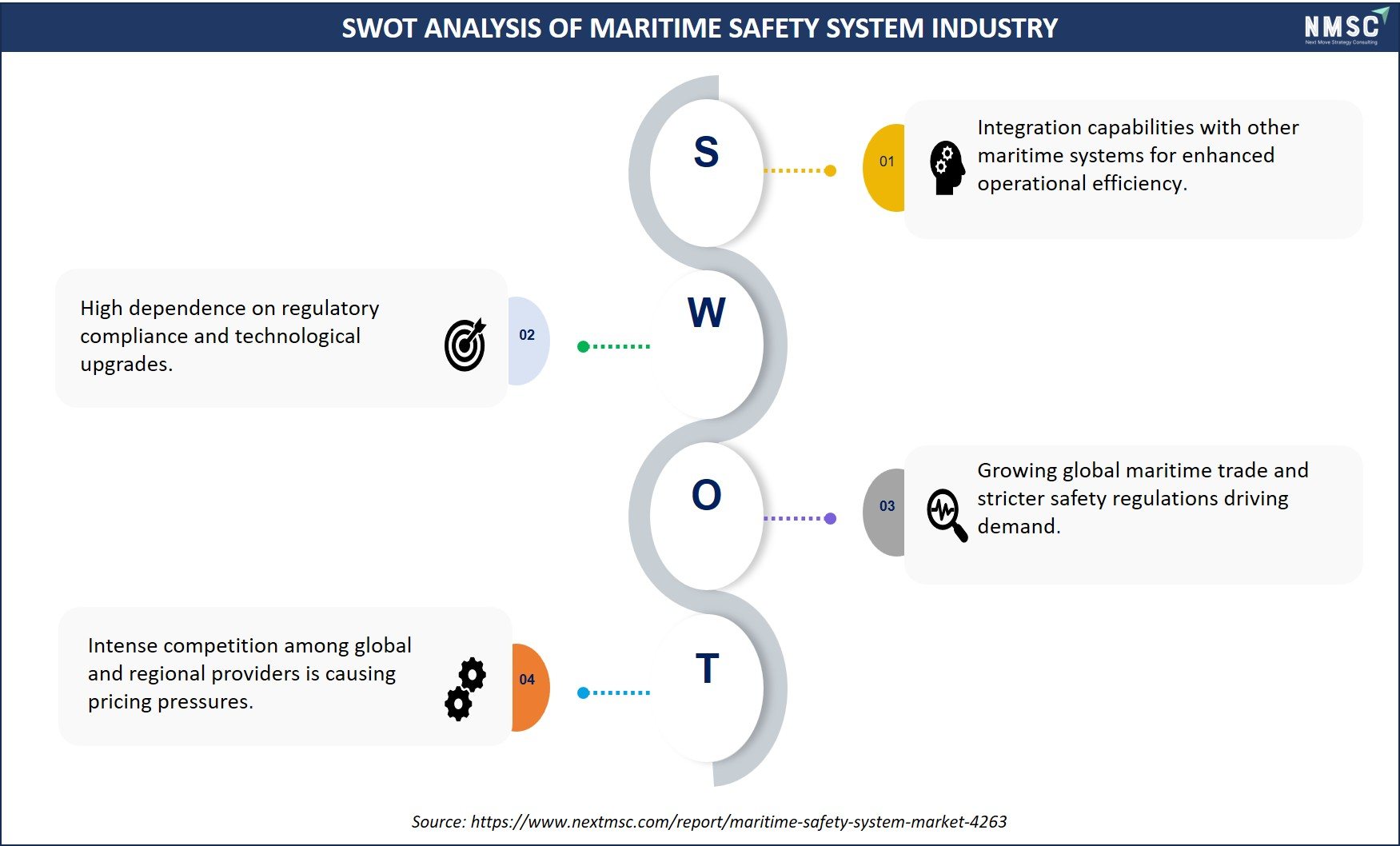
The image presents a SWOT analysis of the Maritime Safety System industry, visually summarizing its strengths, weaknesses, opportunities, and threats. Strengths include the industry’s integration capabilities with other maritime systems to enhance operational efficiency. Weaknesses highlight the high dependence on regulatory compliance and continual technological upgrades. Opportunities focus on growing global maritime trade and stricter safety regulations, driving demand. Threats are represented by intense competition among global and regional providers, resulting in pricing pressures. The diagram uses a vertical layout with clear icons for each factor.
Competitive Landscape
Competitive Dynamics & M&A Landscape:
|
Key Takeaways |
|
The global maritime safety system market is characterized by a combination of established industrial and defense technology leaders, including Honeywell International Inc., Kongsberg Maritime, Thales, BAE Systems, L3Harris Technologies, Inc., Saab, and Elbit Systems Ltd, alongside specialized maritime safety solution providers such as Anschütz, Sperry Marine B.V., TERMA, Viking, Furuno Electric Co., Ltd., Japan Radio Co., Ltd., SRT Marine, Tokyo Keiki, Consilium, Raymarine, Daniamant A/S, Fuji Metalock Brasil, and Survitec Group Limited. Large incumbents leverage global service networks, deep engineering expertise, and strong system integration capabilities, while specialists focus on niche solutions, modular platforms, autonomous monitoring, and rapid deployment. |
|
From our assessment of vendor strategies, companies increasingly prioritize software-defined platforms, AI-enabled surveillance, autonomous navigation, and seamless integration with vessel traffic management systems, port operations platforms, and coastal monitoring networks. Interoperability, modular system design, and scalable multi-site deployment capabilities emerged as critical differentiators, particularly for complex maritime environments with high traffic density and stringent regulatory compliance requirements. |
|
Recent mergers, acquisitions, and strategic partnerships reflect a market shift toward acquiring AI-driven analytics, autonomous navigation, simulation tools, and systems-integration expertise rather than focusing solely on hardware expansion. This approach enables faster innovation cycles, enhanced system intelligence, and end-to-end maritime safety solutions, reinforcing long-term competitiveness, operational reliability, and recurring service revenue streams across ports, coastal zones, and offshore operations. |
Which Companies Dominate the Maritime Safety System Industry and How Do They Compete?
Based on our analysis, the maritime safety system market is dominated by a mix of established defence and industrial technology leaders, alongside specialized maritime safety solution providers. Companies such as Honeywell International Inc., Kongsberg Maritime, Thales, BAE Systems, and L3Harris Technologies, Inc. lead large-scale deployments where operational reliability, regulatory compliance, and long asset lifecycles are critical. Vendors like Anschütz, Sperry Marine B.V., Elbit Systems Ltd., Saab, and TERMA are frequently chosen for high-precision navigation, vessel monitoring, and coastal surveillance projects, including both brownfield port upgrades and greenfield maritime infrastructure initiatives.
Other specialized players, including Furuno Electric Co., Ltd., Japan Radio Co., Ltd., SRT Marine, Tokyo Keiki, Raymarine, Consilium, Daniamant A/S, Viking, Fuji Metalock Brasil, and Survitec Group Limited, strengthen the market through niche offerings such as radar and communication systems, distress alert and rescue platforms, and onboard safety equipment. Competition across this market tier is primarily driven by system reliability, global service coverage, compliance with international maritime safety standards, and proven performance in complex, high-traffic port and coastal environments. Vendors differentiating through software-enabled analytics, autonomous monitoring, and modular system architectures consistently achieve stronger adoption and long-term contracts.
Market Dominated by Maritime Safety System Giants and Specialists
From our observations, the competitive landscape of the maritime safety system market is shaped by a combination of global technology leaders and specialized maritime safety solution providers. Established giants such as Honeywell International Inc., Kongsberg Maritime, Thales, BAE Systems, and L3Harris Technologies, Inc. set industry standards through large-scale deployments emphasizing operational reliability, regulatory compliance, and system longevity. At the same time, specialized vendors, including Anschütz, Sperry Marine B.V., Elbit Systems Ltd., Saab, TERMA, Viking, Furuno Electric Co., Ltd., Japan Radio Co., Ltd., SRT Marine, Tokyo Keiki, Consilium, Raymarine, Daniamant A/S, Fuji Metalock Brasil, and Survitec Group Limited, accelerate adoption through niche, software-enabled solutions, such as AI-driven navigation, real-time vessel monitoring, and autonomous safety systems.
Our interviews with port operators and maritime agencies indicated that these specialists gain traction by offering modular architectures, rapid deployment, and interoperable platforms that integrate seamlessly with existing vessel traffic management and coastal surveillance infrastructure. In practice, industrial giants provide scale, global service networks, and certification credibility, while specialists drive innovation and flexibility, together expanding the adoption and operational sophistication of Maritime Safety Systems worldwide.
Innovation and Adaptability Drive Market Success
Innovation remains a key driver of competitive advantage in the maritime safety system market, as evidenced by our assessment of live deployments and pilot programs across major ports, coastal monitoring networks, and vessel traffic management systems. Market leaders such as Honeywell International Inc., Kongsberg Maritime, Thales, BAE Systems, and L3Harris Technologies, Inc. advanced capabilities in AI-enabled surveillance, autonomous navigation, real-time risk assessment, and integrated command-and-control platforms, enabling maritime operators to respond dynamically to high vessel traffic, variable weather conditions, and operational disruptions.
Further, vendors investing in modular software architectures, predictive analytics, and interoperable monitoring platforms are better positioned to scale across multi-port networks. These innovations reflect deep expertise in maritime safety engineering, sensor fusion, and system integration, allowing suppliers to respond rapidly to evolving operational requirements and maintain long-term stakeholder trust.
Market Players to Opt for Merger & Acquisition Strategies to Expand Their Presence
Our research shows that mergers and acquisitions have emerged as a strategic growth lever in the maritime safety system market, enabling companies to accelerate technology access and expand solution portfolios. Leading vendors increasingly target firms specializing in autonomous navigation, AI-based surveillance, simulation, and maritime analytics to deliver comprehensive, end-to-end safety and monitoring solutions. Acquisition strategies prioritize faster innovation cycles, enhanced interoperability with existing port and vessel traffic systems, and expansion into high-growth maritime segments such as commercial ports, offshore energy, and coastal security. These moves reduce deployment complexity, strengthen platform capabilities, and improve operational ROI for stakeholders, while consolidating market presence and reinforcing global execution strength.
Strategic Experimentation Framework for the Maritime Safety System Market
The strategic framework highlights the key forces shaping investment decisions, technology adoption, and operational priorities in the maritime safety system market.
The image presents interconnected strategic pillars, including user behaviour, operational efficiency, market response, supply chain integration, sustainability, financial considerations, digital transformation, and safety compliance. It shows how stakeholders prioritise interoperable, software-led platforms, AI-driven risk intelligence, and centralised monitoring. The framework also emphasizes ESG alignment, lifecycle cost management, cloud-based surveillance, and adherence to international safety standards to enhance resilience and long-term maritime operational performance.
List of Key Maritime Safety System Companies
-
Anschutz
-
Sperry Marine B.V.
-
Kongsberg Maritime
-
BAE Systems
-
Thales
-
L3Harris Technologies, Inc
-
Saab
-
TERMA
-
viking
-
FURUNO ELECTRIC CO., LTD.
-
Japan Radio Co., Ltd.
-
SRT Marine
-
TOKYO KEIKI.
-
Consilium
-
Raymarine
-
Daniamant A/S
-
FUJI METALOCK BRASIL
-
Survitec Group Limited
What Are The Latest Key Industry Developments?
-
March 2025 - Thales delivered the world’s first autonomous maritime mine‑hunting system to the Royal Navy. The system was designed to enhance maritime safety by detecting and neutralizing underwater mines, significantly reducing the risk to personnel during mine countermeasure operations. This delivery marked a major milestone in the use of autonomous technologies for naval safety and defense.
-
November 2024 - Thales introduced CoastShield, a modular coastal surveillance solution aimed at enhancing maritime safety and coastal protection. The system was designed to provide authorities with real-time monitoring, advanced detection capabilities, and integrated situational awareness to better manage maritime traffic and prevent incidents at sea. CoastShield represented a significant step forward in Thales’ efforts to strengthen maritime security and safety operations globally.
Expert Insights
 "Meaningful progress begins with a single step, an idea put into practice.”
Capt. Panagotis Nikiteas, Chairperson of the Dry Bulk Centre of Excellence
What Are The Key Factors Influencing Investment Analysis & Opportunities In The Maritime Safety System Market?
Investment analysis in the maritime safety system market share is increasingly shaped by a shift toward software-centric, platform-led, and service-oriented business models rather than standalone hardware providers. Based on our review of recent funding activity, mergers and acquisitions, and strategic partnerships, we observed that investors favour vendors generating recurring revenues through safety software platforms, analytics subscriptions, system integration services, and long-term maintenance contracts. Companies demonstrating scalable deployments, proprietary risk-detection algorithms, and seamless integration with vessel traffic management systems, port operations platforms, and national maritime networks consistently achieved stronger valuation outcomes.
Our analysis also identified growing investment interest in AI-enabled surveillance, autonomous threat detection, and real-time maritime analytics, particularly in solutions addressing rising vessel traffic density, regulatory compliance, and incident response efficiency. Strategic investments increasingly outweighed purely financial funding, as port operators, defence contractors, and maritime technology providers sought ecosystem control and accelerated commercialization. For investors, the most attractive opportunities were concentrated in vendors combining technological differentiation with proven deployment performance, regulatory credibility, and long-term platform extensibility.
Key Benefits for Stakeholders:
Next Move Strategy Consulting (NMSC) presents a comprehensive assessment of the Maritime Safety System market trends, covering historical developments from 2020 to 2025 and providing forward-looking analysis through 2035. The study evaluates the market at global, regional, and country levels, combining quantitative forecasts with qualitative insights into key growth drivers, adoption constraints, technology evolution, and investment dynamics across major Maritime Safety System segments.
From our analysis, the Maritime Safety System industry delivers tangible value to a wide range of stakeholders. Investors benefit from recurring revenue streams driven by software-led platforms, analytics subscriptions, and long-term service and maintenance contracts. Port authorities, maritime agencies, and vessel operators gain enhanced situational awareness, improved incident response, regulatory compliance, and operational resilience through integrated safety and monitoring solutions. System integrators, OEMs, and technology partners benefit from extended lifecycle engagements, system upgrades, and ecosystem-based expansion opportunities, supporting sustained value creation across the maritime safety infrastructure landscape.
|
Parameters |
Details |
|
Customization Scope |
Free customization (equivalent to up to 80 analyst-working hours) after purchase. Addition or alteration to country, regional & segment scope. |
|
Pricing and Purchase Options |
Avail customized purchase options to meet your exact research needs. |
|
Approach |
In-depth primary and secondary research; proprietary databases; rigorous quality control and validation measures. |
|
Analytical Tools |
Porter's Five Forces, SWOT, value chain, and Harvey ball analysis to assess competitive intensity, stakeholder roles, and relative impact of key factors. |
Key Market Segments
By Component
-
Hardware
-
Sensors & Detectors
-
Transceivers & Antennas
-
Control Units & Consoles
-
Power & Backup Systems
-
Communication Terminals
-
-
Software
-
Navigation & Route Planning Software
-
Predictive Safety & Analytics Software
-
Fleet & Asset Management Platforms
-
Cybersecurity & Monitoring Software
-
-
Services
-
Installation & Integration
-
Maintenance & Support
-
System Upgrades & Retrofit Solutions
-
Training & Certification Services
-
By System Type
-
Navigation & Communication Systems
-
Radar & ARPA
-
GPS/GNSS
-
AIS (Automatic Identification Systems)
-
VHF/HF Radios
-
ECDIS (Electronic Chart Display & Information System)
-
Satellite Communication Systems
-
-
Surveillance & Detection Systems
-
SONAR
-
Infrared Sensors
-
Maritime Domain Awareness (MDA) Systems
-
Automatic Ship Tracking & Monitoring Systems
-
-
Life-Saving Equipment
-
Lifeboats & Life Rafts
-
Immersion & Survival Suits
-
Personal Locator Beacons (PLBs)
-
Life Jackets & Buoyancy Aids
-
-
Emergency & Rescue Systems
-
EPIRBs (Emergency Position Indicating Radio Beacons)
-
GMDSS (Global Maritime Distress and Safety System)
-
Search and Rescue (SAR) Systems
-
Emergency Lighting & Alarm Systems
-
-
Fire & Hazard Management Systems
-
Fire Detection & Suppression Systems
-
Gas Leak Detection & Alarm Systems
-
Explosion Protection & Safety Valves
-
Smoke & Heat Sensors
-
-
Security & Access Control Systems
-
Perimeter Intrusion Detection Systems
-
Access Control & Biometric Systems
-
CCTV & Video Analytics
-
Cybersecurity Solutions for Ship Systems
-
By Vessel Type
-
Commercial Vessels
-
Container Ships
-
Bulk Carriers
-
Oil & Gas Tankers
-
Ro-Ro & Passenger Ferries
-
Cruise Ships
-
-
Defense & Government Vessels
-
Naval Ships
-
Coast Guard Vessels
-
Patrol Boats
-
-
Offshore Structures & Support Vessels
-
Offshore Platforms & Rigs
-
FPSOs (Floating Production Storage & Offloading)
-
Supply & Support Vessels
-
-
Recreational & Small Craft
-
Yachts
-
Fishing Boats
-
Pleasure Craft
-
Charter Boats & Water Sports Vessels
-
By Technology
-
Satellite-Based Systems
-
Terrestrial RF-Based Systems
-
AI & Machine Learning Safety Analytics
-
IoT-Enabled Smart Safety Devices
-
Automation & Autonomous Navigation Systems
-
Hybrid Safety & Monitoring Systems
By Deployment Mode
-
Onboard Systems
-
Shore-Based Systems
-
Hybrid Systems
By Service Model
-
Managed Services
-
Subscription
-
System Integration
-
Turnkey Solutions
-
Maintenance & After-Sales Services
By Compliance & Standards
-
IMO (International Maritime Organization) Compliance Systems
-
SOLAS (Safety of Life at Sea) Compliance Systems
-
National Regulatory Compliance Systems
By Application
-
Navigation Safety
-
Collision & Grounding Prevention
-
Fire & Explosion Prevention
-
Man Overboard & Personal Safety
-
Anti-Piracy & Security Operations
-
Environmental & Pollution Safety
By End-User
-
Commercial Shipping Companies
-
Defense & Government Agencies
-
Offshore Oil & Gas Companies
-
Ports, Harbors & Terminal Authorities
-
Fishing & Marine Recreational Operators
-
Cruise & Passenger Ferry Operators
Geographical Breakdown
-
North America: U.S., Canada, and Mexico.
-
Europe: UK, Germany, France, Italy, Spain, Sweden, Denmark, Finland, the Netherlands, and the Rest of Europe.
-
Asia Pacific: China, India, Japan, South Korea, Taiwan, Indonesia, Vietnam, Australia, Philippines, Malaysia and the rest of APAC.
-
Middle East & Africa (MEA): Saudi Arabia, UAE, Egypt, Israel, Turkey, Nigeria, South Africa, and the rest of MEA.
-
Latin America: Brazil, Argentina, Chile, Colombia, and the rest of LATAM.
Conclusion & Recommendations
Our report provides stakeholders, industry participants, investors, and consultants with actionable insights to navigate the ongoing transformation in the Maritime Safety System industry. By combining data-driven analysis with strategic evaluation frameworks, NMSC’s Maritime Safety System Market Report serves as a key decision-support tool for addressing evolving maritime safety and operational challenges.
The market is poised for sustained growth, driven by increasing vessel traffic, stricter safety regulations, rising operational complexity, and demand for scalable, real-time monitoring and incident response systems. Key strategic insights underscore the growing importance of software-centric platforms, AI-enabled surveillance and navigation, and seamless integration with vessel traffic management systems and port operations platforms, which enhance operational reliability and long-term return on investment. Vendors adopting modular architectures, autonomous intelligence, and flexible deployment approaches consistently achieved stronger customer retention and recurring service revenues.
For executives and investors, value creation depends on targeting high-impact applications such as coastal and port monitoring, real-time vessel tracking, and autonomous incident response, while continuing investments in R&D, system interoperability, and ecosystem partnerships. Expanding presence in high-growth regions, particularly Asia-Pacific and emerging maritime hubs, unlocks new demand opportunities. Emphasizing system scalability, reliability, and measurable operational outcomes strengthens vendor credibility and accelerates adoption, generating durable value across the global Maritime Safety System ecosystem.


About the Author
 Tushmi Dutta
— Tushmi Dutta is a focused researcher specializing in detailed analysis and insight-driven research across diverse business landscapes. She supports strategic initiatives through structured data interpretation, thorough validation, and clear communication of findings that aid informed decision-making. With a strong interest in writing, she enjoys presenting research insights in an engaging and accessible manner. Beyond work, she enjoys traveling, reading, painting, and continuously learning new skills that contribute to her creative and professional growth.
Tushmi Dutta
— Tushmi Dutta is a focused researcher specializing in detailed analysis and insight-driven research across diverse business landscapes. She supports strategic initiatives through structured data interpretation, thorough validation, and clear communication of findings that aid informed decision-making. With a strong interest in writing, she enjoys presenting research insights in an engaging and accessible manner. Beyond work, she enjoys traveling, reading, painting, and continuously learning new skills that contribute to her creative and professional growth.
About the Reviewer
 Supradip Baul
— Supradip Baul is an accomplished business consultant and strategist with over a decade of rich experience in market intelligence, strategy, technology, and business transformation. His work has included rigorous qualitative and quantitative analysis across multiple industries, helping clients shape investment decisions and long-term roadmaps. Earlier in his career, he was associated with Gartner, where he contributed to industry-leading reports and market share analyses. He has worked with leading global companies and holds an MBA with a dual specialization in Marketing and Finance.
Supradip Baul
— Supradip Baul is an accomplished business consultant and strategist with over a decade of rich experience in market intelligence, strategy, technology, and business transformation. His work has included rigorous qualitative and quantitative analysis across multiple industries, helping clients shape investment decisions and long-term roadmaps. Earlier in his career, he was associated with Gartner, where he contributed to industry-leading reports and market share analyses. He has worked with leading global companies and holds an MBA with a dual specialization in Marketing and Finance.
At Next Move Strategy Consulting, we understand that insightful market research is the cornerstone of successful business decisions. That's why we employ a robust and multifaceted approach, combining various methodologies to deliver the most accurate and actionable data for our clients.

Research Landscape
We navigate the world of research with two primary approaches:
Qualitative Approach
Our qualitative research methodologies involve immersive techniques such as in-depth interviews, focus groups, and observational studies. By engaging directly with individuals and stakeholders, we uncover valuable insights that quantitative data alone may overlook.

Quantitative Research
In tandem with qualitative methodologies, NMSC leverages the power of Quantitative Research to provide a robust foundation of numerical insights. Through systematic data collection and analysis, we quantify patterns, preferences, and market trends, offering a comprehensive view of the business landscape.
Our quantitative research approach employs diverse tools, including surveys, experiments, and statistical modelling. These methodologies enable us to gather data from a large and representative sample, ensuring the statistical significance of our findings. By employing structured questionnaires and standardized data collection methods, we guarantee the reliability and validity of the information we present to our clients.
Quantitative research is particularly effective in measuring the prevalence of trends, assessing market size, and gauging the impact of various factors on consumer behavior. The numerical precision attained through this approach equips our clients with actionable insights, facilitating data-driven decision-making and strategy formulation.


Our Specialized Toolbox for Industry-Specific Market Research
We deploy a specialized arsenal of techniques tailored to meet your unique requirements. Here's a glimpse into our comprehensive toolbox:

Information Procurement
The stage entails acquiring market data or relevant information through various sources and methodologies.


Market Research Approach
We utilize both top-down and bottom-up approaches in market research analysis to achieve a comprehensive understanding of the market dynamics, leveraging the broad perspective of industry trends and macroeconomic factors alongside detailed insights from specific segments and individual companies.

Porters Five Forces Analysis
We conduct Porter's Five Forces analysis to evaluate the competitive landscape of an industry, providing us with insights into factors that affect profitability and strategic positioning.

SWOT Analysis

Forecasting
We utilize a forecasting model to predict future consumption by considering parameters like population, economics, regulations, market competition, drivers, constraints, technology, and pricing. We also employ statistical techniques such as multilinear regression, exponential smoothing, moving average, ARIMA, and Monte Carlo simulations for accurate predictions. In econometric forecasting, we analyzed short-term and long-term event impacts, attributing values based on regulatory frameworks, economic factors, and market events.





 Speak to Our Analyst