Miso Flavored Snacks Market Size, Share, Growth & Forecast By Product Category (Potato Snacks, Rice Snacks, Extruded Snacks, Puffed Snacks, Nuts and Snack Mixes, Specialty Miso Snacks, Other Savory Snacks), By Product Positioning (Value, Mid-Tier, Premium, Super Premium, Craft, Seasonal Limited Edition), By Distribution Channel (Retail, E-Commerce, Foodservice, Institutional), By Consumer Type (Mass Market, Youth, Health-Focused Consumers, Ethnic Cuisine Enthusiasts), — Global Analysis 2026–2035
Industry: Retail and Consumer | Publishing Date: July 10, 2026 | Last Updated: September 30, 2026 | No of Pages: N/A | No. of Tables: N/A | No. of Figures: N/A | Format: PDF | Report Code: RC5081
What Is the Miso Flavored Snacks Market Size?
The global Miso Flavored Snacks Market was valued at USD 2.8 billion in 2025 and is expected to reach USD 2.9 billion in 2026. Expanding consumer appetite for umami-forward savory snacks, the globalization of Japanese culinary culture, and the premiumization of traditional rice-cracker and potato-chip categories are collectively projected to propel the market to USD 4.6 billion by 2035, advancing at a CAGR of 5.1% from 2026 to 2035. Key growth drivers include the rising global popularity of Japanese cuisine, growing demand for fermented and functional food ingredients, proliferating health-focused snack innovation, and expanding e-commerce distribution of specialty Asian snack products.
|
Parameters |
Details |
|
Market Size in 2025 |
USD 2.8 Billion |
|
Market Size in 2026 |
USD 2.9 Billion |
|
Revenue Forecast in 2035 |
USD 4.6 Billion |
|
Growth Rate |
CAGR of 5.1% from 2026 to 2035 |
|
Analysis Period |
2025–2035 |
|
Base Year Considered |
2025 |
|
Forecast Period |
2026–2035 |
|
Market Size Estimation |
USD Billion |
|
Companies Profiled |
20 |
|
Countries Covered |
33 |
|
Market Share |
Top 10 |
Miso Flavored Snacks Market Overview
What Is the Miso Flavored Snacks Market?
The Miso Flavored Snacks Market encompasses the global commercial production, distribution, and retail sale of savory snack products flavored with miso paste, miso powder, or miso-derived seasoning compounds. These products span a wide range of formats including potato chips, rice crackers (senbei), extruded corn puffs, puffed grain snacks, nut mixes, and specialty fusion snacks. NMSC's analysis indicates that miso's distinctive umami profile, fermented complexity, and health-positive associations with gut health and fermentation make it a uniquely versatile flavoring ingredient across both traditional Japanese and emerging international snack categories.
How Has the Miso Flavored Snacks Market Evolved?
Based on our market evaluation, the Miso Flavored Snacks Market has undergone significant structural transformation over the past decade. The market originated primarily in Japan, where traditional senbei and arare crackers flavored with regional miso varieties formed the commercial foundation. From our assessment, the market entered a second phase characterized by premiumization and product diversification, as both domestic and international manufacturers began applying miso seasoning to potato chips, extruded snacks, and nuts. The current phase reflects accelerating globalization, with North American and European artisan snack brands adopting miso as a premium flavor ingredient and Japanese manufacturers expanding exports to serve ethnic cuisine enthusiasts worldwide.
How Do Regulations Influence the Miso Flavored Snacks Market Trends?
Regulatory frameworks governing food safety, ingredient labeling, allergen disclosure, and import standards materially influence the Miso Flavored Snacks Market. Japan's Food Sanitation Act and the Consumer Affairs Agency's food labeling standards regulate domestic production and retail presentation. In the United States, FDA regulations under 21 CFR govern flavor ingredient approvals, soy allergen labeling requirements, and import safety standards. The European Union's General Food Law Regulation (EC) No 178/2002 and food additive frameworks govern market access for imported miso-based snack products, compelling manufacturers to reformulate or relabel products for compliance across different regulatory zones.
How Is Technology Adoption Expanding Across the Miso Flavored Snacks Market?
Through NMSC's assessment, we found that technology adoption across the Miso Flavored Snacks Market is advancing along two primary axes: production technology and digital distribution. Advanced fermentation monitoring systems, spray-drying and microencapsulation technologies for miso powder production, and precision seasoning application systems are enabling manufacturers to achieve consistent flavor profiles at industrial scale. Simultaneously, e-commerce platforms, direct-to-consumer brand channels, and online grocery delivery services are significantly expanding the geographic reach of niche and premium miso snack products beyond traditional Asian specialty retail channels, particularly in North America and Europe.
|
Key Takeaways |
|
Key Insight |
|
Rice Snacks, led by the Senbei sub-category, held the largest share of the Miso Flavored Snacks Market at USD 0.8 billion in 2025, reflecting the deep-rooted cultural significance of miso-seasoned rice crackers in Japan's domestic snack economy. |
|
Specialty Miso Snacks, particularly Fusion Asian Snacks and Premium Craft Snacks, represent the fastest-growing product category in the Miso Flavored Snacks Market at an estimated CAGR of 7.8% from 2026 to 2035, fueled by Western consumer premiumization trends. |
|
The Mid-Tier positioning segment accounted for the largest revenue share in the Miso Flavored Snacks Market at approximately USD 0.9 billion in 2025, as everyday packaged miso snacks from major Japanese manufacturers dominate household pantry penetration. |
|
The Premium and Super Premium segments collectively represent the fastest-growing positioning tiers at a CAGR of 7.2%, driven by artisan craft snack brands and imported Japanese specialty products gaining rapid traction in North America and Europe. |
|
Retail distribution, comprising hypermarkets, supermarkets, and specialty Asian retail, held the dominant channel position in the Miso Flavored Snacks Market at USD 2.1 billion in 2025, underpinned by strong physical availability of established Japanese snack brands. |
|
E-Commerce, including brand direct and online marketplaces, is the fastest-growing distribution channel in the Miso Flavored Snacks Market at a CAGR of 9.4% from 2026 to 2035, driven by international demand for specialty Japanese and Asian snack imports. |
|
Mass Market consumers accounted for the largest consumer type segment at USD 1.3 billion in 2025, predominantly in Japan, South Korea, and Taiwan where miso-flavored snacks occupy a well-established position in mainstream retail. |
|
Ethnic Cuisine Enthusiasts and Health-Focused Consumers are the fastest-growing consumer segments, as global interest in Japanese fermented foods drives new trial occasions outside traditional Asian markets. |
|
Single Serve packs, particularly under the 50 g format, dominate the Miso Flavored Snacks Market packaging mix, aligned with the high impulse-purchase and convenience-oriented consumption behavior prevalent in Japan's domestic snack market. |
|
Multipacks represent the fastest-growing packaging format, as retail club channels and online grocery subscription platforms in North America and Europe drive bulk purchasing of premium Japanese and Asian specialty snack assortments. |
|
Asia-Pacific is the largest regional market in the Miso Flavored Snacks Market share, driven by Japan's strong miso consumption culture, growing demand for Japanese-inspired snacks across East Asia, and continuous product innovation by regional snack manufacturers. |
|
North America is the fastest-growing regional market in the Miso Flavored Snacks Market, fueled by rising consumer interest in international flavors, increasing popularity of fermented-food ingredients, and growing demand for premium and better-for-you snack products. |
|
Japan is the single largest national market in the Miso Flavored Snacks Market, generating USD 1.3 billion in 2025 and forecast to reach USD 1.9 billion by 2035, supported by world-leading per capita snack consumption and the unrivaled depth of miso flavor product innovation among domestic snack manufacturers. |
|
China is the fastest-growing individual country market in the Miso Flavored Snacks Market at a CAGR of 8.2% from 2026 to 2035, propelled by the rapid mainstreaming of Japanese snack culture, cross-border e-commerce growth, and premiumization of the packaged snack sector. |
Key Emerging Trends in the Miso Flavored Snacks Market
How Is the Global Popularity of Japanese Cuisine Reshaping the Miso Flavored Snacks Market?
Japanese culinary culture has achieved unprecedented global recognition, directly transforming the Miso Flavored Snacks Market beyond its domestic boundaries. NMSC's analysis indicates that the UNESCO Intangible Cultural Heritage designation of washoku (traditional Japanese cuisine) has elevated international consumer awareness of fermented Japanese ingredients, including miso. Western food retailers in the United States, United Kingdom, and Germany are now dedicating dedicated shelf space to Japanese snack imports, while domestic artisan brands in these markets are launching miso-flavored chips and puffs to satisfy rising consumer demand for authentic umami flavor experiences.
How Is the Fermentation and Gut Health Megatrend Creating New Opportunities in the Miso Flavored Snacks Market?
From our research, we found that the global consumer shift toward fermented and probiotic-rich foods is generating significant product development momentum across the Miso Flavored Snacks Market. Miso, as a traditionally fermented soybean paste rich in beneficial microorganisms, aligns naturally with the health-conscious snacking megatrend. Food manufacturers are increasingly positioning miso-flavored products with functional health messaging, including support for gut microbiome diversity and digestive wellness. Health-focused consumer segments in North America and Europe represent emerging high-value buyer cohorts for premium miso snack products, expanding the addressable market beyond traditional Asian food enthusiasts.
How Is Premiumization and Craft Snack Innovation Driving Value Expansion in the Miso Flavored Snacks Market?
Our findings suggest that premiumization is a defining structural trend in the Miso Flavored Snacks Market, particularly within Western markets where miso functions as a marker of culinary sophistication and artisan authenticity. North American and European craft snack brands, including small-batch chip producers and premium nut mix companies, are incorporating aged miso varieties such as Hatcho miso, Shiro miso, and Mugi miso as flavor differentiators. Premium miso-seasoned products command retail price premiums of 30% to 60% above conventional savory snack alternatives, supporting superior per-unit revenue and improved brand positioning.
How Is E-Commerce Expansion Transforming the International Reach of the Miso Flavored Snacks Market?
Based on NMSC's research, we found that the expansion of cross-border e-commerce platforms has fundamentally democratized access to niche and specialty miso-flavored snack products for international consumers. Japan-based direct-to-consumer snack subscription services and online marketplaces including Amazon, Rakuten, and regional grocery delivery platforms are enabling manufacturers including Calbee and Kameda Seika to serve international customers without traditional retail distribution partnerships. Our assessment indicates that e-commerce now accounts for a growing share of international miso snack revenue, particularly in countries where brick-and-mortar Asian specialty retail remains underdeveloped or limited to urban centers.
Consumer Behavior Analysis of the Miso Flavored Snacks Market
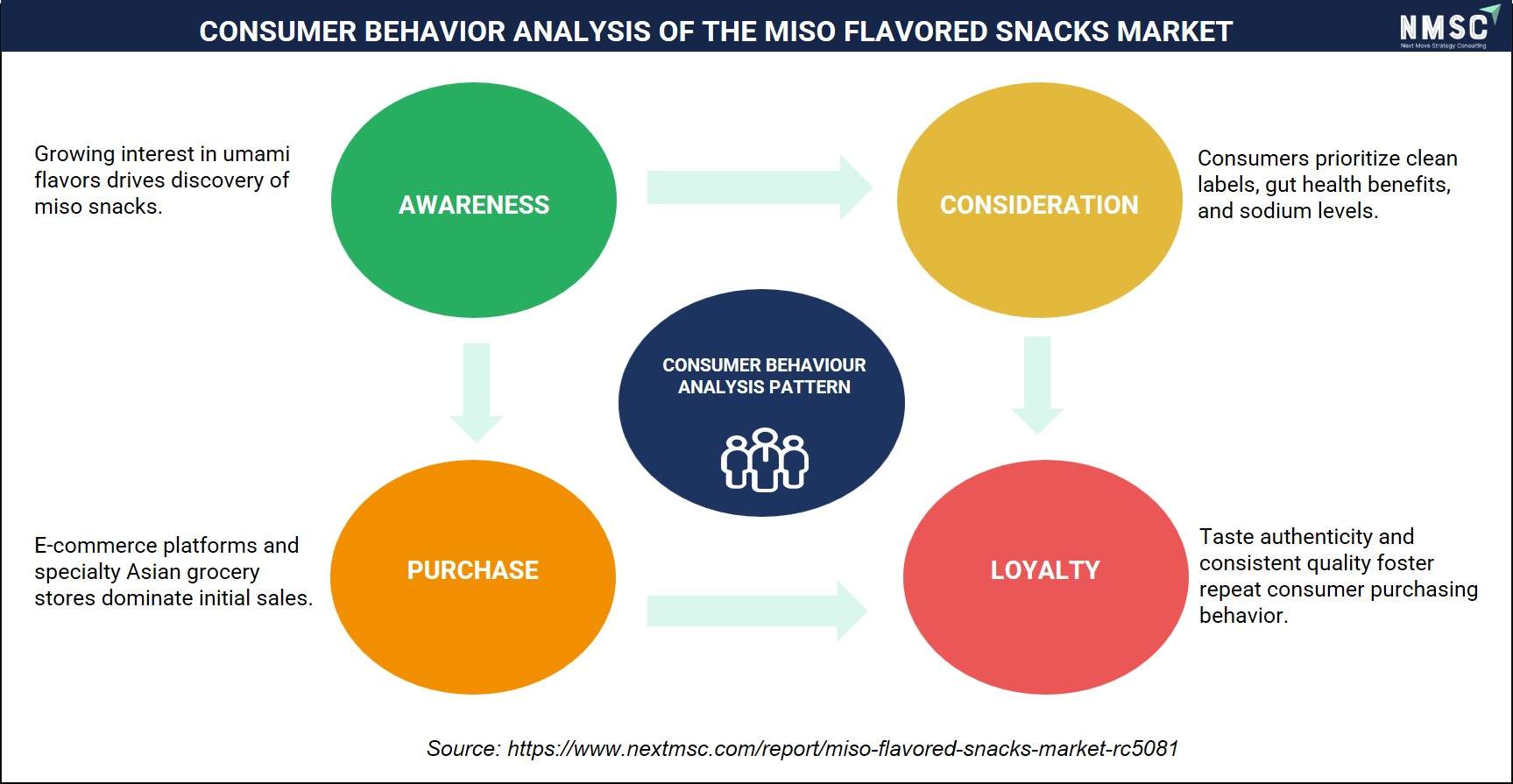
The consumer behavior pattern in the Miso Flavored Snacks Market follows a four-stage journey: awareness, consideration, purchase, and loyalty. Consumers are increasingly discovering miso snacks due to growing interest in umami-rich flavors and healthier snack alternatives. During evaluation, buyers focus on clean-label ingredients, gut health benefits, and sodium content. Initial purchases are largely driven by e-commerce platforms and specialty food retailers. Strong taste authenticity, product quality, and positive consumption experiences encourage repeat purchases, fostering long-term brand loyalty and sustained market growth.
What Are the Key Market Drivers, Breakthroughs, and Investment Opportunities that Will Shape the Miso Flavored Snacks Industry in the Next Decade?
|
Drivers / Trends / Restraints |
(+/-) % Impact on CAGR Forecast |
Geographic Relevance |
Impact Timeline |
|
Rising Global Popularity of Japanese Food Culture |
+1.2% |
Global (North America, Europe, APAC) |
2025–2035 |
|
Fermentation and Gut Health Consumer Megatrend |
+0.9% |
North America, Europe, Australia |
2025–2032 |
|
Premiumization and Craft Snack Innovation |
+0.8% |
North America, Europe, Premium Urban Asia |
2026–2035 |
|
E-Commerce Channel Expansion |
+0.7% |
Global (all regions) |
2025–2035 |
|
Functional Snack Product Development |
+0.6% |
North America, Europe, Japan |
2026–2035 |
|
Seasonal and Limited Edition Product Launches |
+0.4% |
Japan, South Korea, Taiwan |
Ongoing |
|
High Raw Material Cost Volatility (Soybeans, Rice) |
-0.5% |
Global — all manufacturer geographies |
2025–2030 |
|
Limited Consumer Awareness Outside Asia |
-0.7% |
Latin America, MEA, Eastern Europe |
2025–2030 |
|
Allergen Labeling and Regulatory Complexity |
-0.4% |
EU, North America, Australia |
Ongoing |
|
GenZ and Millennial Snack Premiumization |
+0.5% |
North America, Europe, Urban APAC |
2026–2035 |
What Are the Growth Drivers of the Miso Flavored Snacks Market?
How Is the Global Expansion of Japanese Food Culture Driving the Miso Flavored Snacks Market?
Japanese cuisine's global ascendancy represents the most foundational growth driver for the Miso Flavored Snacks Market. The United Nations Educational, Scientific and Cultural Organization's recognition of washoku as an Intangible Cultural Heritage has catalyzed widespread consumer awareness of miso as an essential Japanese culinary ingredient. Our analysis shows that Japan's Ministry of Agriculture, Forestry and Fisheries (MAFF) data indicates that Japanese food exports have grown substantially over successive years, with processed food products including snacks constituting an increasing proportion of outbound trade. Growing Japanese restaurant penetration globally and the proliferation of Japanese-themed food media content are creating consumer demand for authentic miso-flavored snack experiences across non-traditional markets.
How Is the Fermented Food and Functional Nutrition Megatrend Accelerating Demand in the Miso Flavored Snacks Market?
The global consumer shift toward fermented foods, driven by growing scientific understanding of the gut microbiome's role in overall health, is creating structural tailwind demand for miso-flavored products. Research published through institutions including the U.S. National Institutes of Health (NIH) indicates that fermented soy products contain bioactive compounds including isoflavones, nattokinase precursors, and beneficial Aspergillus oryzae-derived metabolites associated with digestive and immune health benefits. Our assessment indicates that health-conscious snack consumers, particularly in North America and Northern Europe, are increasingly selecting miso-flavored snacks as a perceived-healthier alternative to synthetic flavor-seasoned products within the broader savory snack category.
How Is the Premiumization of the Global Snack Market Fueling Growth in the Miso Flavored Snacks Market?
Premiumization within the global packaged snack industry is generating durable revenue uplift for the Miso Flavored Snacks Market. Based on NMSC's research, we found that consumers in developed markets are demonstrating willingness to pay premium prices for artisan, authentic, and imported snack products perceived as offering superior flavor complexity and cultural authenticity. Japan's Ministry of Economy, Trade and Industry (METI) data on food industry premiumization trends supports the observation that craft and regional specialty food products are commanding increasing consumer spending share. Premium miso product tiers, including artisan potato chips and craft-packaged senbei, are achieving sustained volume and value growth within high-income urban consumer segments.
What Are the Growth Inhibitors of the Miso Flavored Snacks Market?
How Does Limited Consumer Awareness Outside Asia Constrain Miso Flavored Snacks Market Demand?
Consumer unfamiliarity with miso as a snack flavoring ingredient outside of Asian markets represents a meaningful structural constraint on near-term Miso Flavored Snacks Market expansion. In markets such as Latin America, the Middle East, and Eastern Europe, miso remains predominantly an unknown ingredient confined to specialty Japanese restaurants and niche health food retailers. Achieving mainstream retail penetration in these markets requires significant consumer education investment and marketing expenditure to build flavor familiarity and purchase trial. The U.S. Soybean Export Council and similar trade promotion organizations have documented the sustained investment required to educate consumers in emerging markets about soy-based fermented products, highlighting the long lead times involved in developing commercially meaningful snack market segments.
How Do Soy Allergen Regulations and Labeling Requirements Inhibit the Miso Flavored Snacks Market?
Soy is a major allergen regulated under food labeling laws in the United States, European Union, Japan, Australia, and Canada, requiring mandatory declaration on all product packaging containing miso-derived ingredients. The U.S. Food and Drug Administration's Food Allergen Labeling and Consumer Protection Act mandates clear soy allergen declarations on all affected products, limiting market access to the estimated 0.4% of the global population with clinically diagnosed soy allergies. Furthermore, regulatory divergences between jurisdictions, including different threshold levels for allergen declarations and varying requirements for precautionary allergen labeling, create compliance complexity and added cost for manufacturers seeking to distribute miso-flavored snacks across multiple international markets simultaneously.
What Are the Growth Opportunities in the Miso Flavored Snacks Market?
How Does the Expansion of Asian Food Culture in North America and Europe Create Market Opportunities for the Miso Flavored Snacks Market?
North America and Europe represent structurally significant growth opportunities for the Miso Flavored Snacks Market, driven by the rapid mainstreaming of Asian cuisine and growing multicultural consumer demographics. The U.S. Census Bureau demographic projections indicate continued growth of Asian-American and broader multicultural consumer populations, creating an expanding core demand base for authentic Japanese snack products. Through our market evaluation, we observed that mainstream North American retailers including Costco, Whole Foods, and Trader Joe's have meaningfully increased their Japanese and Asian specialty snack assortments, signaling a structural shift from niche to mainstream retail positioning for miso-flavored snack products within the next decade.
How Do Functional and Better-For-You Snack Trends Open New Value Creation Pathways in the Miso Flavored Snacks Market?
The better-for-you and functional snack segment represents a high-growth opportunity within the Miso Flavored Snacks Market. Consumer demand for snacks with recognized health credentials, including fermentation heritage, clean ingredient labels, reduced artificial additives, and positive nutritional attributes, aligns closely with miso's natural product profile. Japan's Consumer Affairs Agency food labeling modernization and the U.S. FDA's ongoing work on functional food claims provide a regulatory framework within which manufacturers can substantiate and communicate miso's health associations. NMSC's analysis indicates that products positioned at the intersection of umami authenticity and functional wellness are likely to command premium retail positioning and support superior margin profiles for manufacturers and brands.
How Is the Rise of Omnichannel Retail and Cross-Border E-Commerce Creating Incremental Demand in the Miso Flavored Snacks Market?
Omnichannel retail evolution and cross-border e-commerce represent among the highest-impact structural opportunities for the Miso Flavored Snacks Market over the forecast period. Our analysis shows that dedicated Japanese snack subscription box services, including platforms such as Japan Crate and Bokksu, have demonstrated strong subscriber growth and proven willingness-to-pay among international Japanese snack enthusiasts in the United States, United Kingdom, Australia, and Canada. These platforms serve as demand-validation channels and consumer education vehicles that subsequently drive retail shelf placements in mainstream supermarkets, creating a virtuous cycle of awareness building, trial generation, and repeat purchasing behavior benefiting established Japanese snack manufacturers.
How Is the Miso Flavored Snacks Market Segmented in This Report, and What Are the Key Insights from the Segmentation Analysis?
How Does Product Category Segmentation Define the Commercial Structure of the Miso Flavored Snacks Market?
|
Product Category |
2025 (USD Bn) |
2035 (USD Bn) |
CAGR (%) |
|
Potato Snacks |
0.62 |
1.02 |
5.1% |
|
Rice Snacks |
0.84 |
1.38 |
5.1% |
|
Extruded Snacks |
0.30 |
0.50 |
5.2% |
|
Puffed Snacks |
0.26 |
0.44 |
5.4% |
|
Nuts and Snack Mixes |
0.22 |
0.38 |
5.6% |
|
Specialty Miso Snacks |
0.31 |
0.66 |
7.8% |
|
Other Savory Snacks |
0.25 |
0.40 |
4.8% |
Based on NMSC's research, we found that the Miso Flavored Snacks Market is segmented by product category into Potato Snacks, Rice Snacks, Extruded Snacks, Puffed Snacks, Nuts and Snack Mixes, Specialty Miso Snacks, and Other Savory Snacks. Rice Snacks dominate, led by the premium and hard Senbei sub-segments which occupy a culturally entrenched position in Japanese snacking. Potato Snacks represent the second-largest category, with standard and premium miso-flavored chips from Calbee and Koikeya driving high volume. Specialty Miso Snacks, encompassing fusion Asian, premium craft, and functional snack formats, represent the fastest-growing category, reflecting accelerating international market development.
How Does Product Positioning Strategy Shape Revenue Distribution Across the Miso Flavored Snacks Market?
|
Product Positioning |
2025 (USD Bn) |
2035 (USD Bn) |
CAGR (%) |
|
Value |
0.34 |
0.50 |
3.9% |
|
Mid-Tier |
0.90 |
1.40 |
4.5% |
|
Premium |
0.62 |
1.10 |
5.9% |
|
Super Premium |
0.38 |
0.76 |
7.2% |
|
Craft |
0.30 |
0.62 |
7.5% |
|
Seasonal Limited Edition |
0.26 |
0.42 |
4.9% |
Our assessment indicates that the Miso Flavored Snacks Market is segmented by product positioning into Value, Mid-Tier, Premium, Super Premium, Craft, and Seasonal Limited Edition tiers. The Mid-Tier segment holds the largest revenue share, representing mass-market Japanese domestic consumption of widely distributed miso snack brands. The Premium and Super Premium tiers are the fastest-growing positioning segments, with international artisan brands and imported Japanese specialty products driving value expansion. Craft positioning captures the highest revenue per unit through small-batch production, premium ingredient sourcing, and authentic regional miso variety usage as a key differentiator against mass-market alternatives.
How Do Distribution Channel Dynamics Influence Go-to-Market Strategies in the Miso Flavored Snacks Market?
|
Distribution Channel |
2025 (USD Bn) |
2035 (USD Bn) |
CAGR (%) |
|
Retail — Hypermarkets |
0.64 |
0.98 |
4.4% |
|
Retail — Supermarkets |
0.58 |
0.90 |
4.5% |
|
Retail — Convenience Stores |
0.46 |
0.72 |
4.6% |
|
Retail — Specialty Asian Retail |
0.24 |
0.42 |
5.8% |
|
Retail — Drug Stores & Independent |
0.18 |
0.28 |
4.5% |
|
E-Commerce |
0.32 |
0.76 |
9.4% |
|
Foodservice |
0.22 |
0.36 |
5.1% |
|
Institutional |
0.16 |
0.26 |
5.0% |
Through NMSC's assessment, we found that the Miso Flavored Snacks Market is distributed across Retail (including hypermarkets, supermarkets, convenience stores, drug stores, specialty Asian retail, and independent grocers), E-Commerce (brand direct, online marketplaces, and grocery delivery), Foodservice, and Institutional channels. Retail hypermarkets and supermarkets collectively represent the dominant channel grouping, anchored by Japan's densely penetrated convenience store network, which plays a pivotal role in new product launches and limited edition snack introductions. E-Commerce is the fastest-growing channel, reflecting growing cross-border demand for specialty miso snack products in international markets.
How Do Consumer Type Differences Drive Segmentation Strategy in the Miso Flavored Snacks Market?
|
Consumer Type |
2025 (USD Bn) |
2035 (USD Bn) |
CAGR (%) |
|
Mass Market |
1.30 |
2.02 |
4.5% |
|
Youth |
0.56 |
0.90 |
4.9% |
|
Health-Focused Consumers |
0.52 |
1.00 |
6.8% |
|
Ethnic Cuisine Enthusiasts |
0.42 |
0.88 |
7.7% |
Based on our market evaluation, the Miso Flavored Snacks Market is segmented into Mass Market, Youth, Health-Focused Consumers, and Ethnic Cuisine Enthusiasts. Mass Market consumers account for the largest share, underpinned by Japan's mature domestic snack market. Youth consumers represent an important segment, as younger Japanese and broader Asian consumers drive convenience and impulse snack purchase occasions. Ethnic Cuisine Enthusiasts and Health-Focused Consumers are the fastest-growing consumer types, as international awareness of miso's culinary heritage and functional fermentation credentials drives new consumer adoption outside traditional market boundaries.
How Does Packaging Format Strategy Reflect Consumer Purchase Behavior in the Miso Flavored Snacks Market?
|
Packaging Format |
2025 (USD Bn) |
2035 (USD Bn) |
CAGR (%) |
|
Single Serve — Under 50 g |
0.74 |
1.14 |
4.4% |
|
Single Serve — 50–100 g |
0.54 |
0.86 |
4.8% |
|
Multi Serve — 101–250 g |
0.52 |
0.84 |
4.9% |
|
Multi Serve — Above 250 g |
0.34 |
0.58 |
5.5% |
|
Multipacks |
0.42 |
0.88 |
7.7% |
|
Club Packs |
0.24 |
0.46 |
6.7% |
Our analysis shows that the Miso Flavored Snacks Market is segmented by packaging format into Single Serve (under 50 g and 50–100 g), Multi Serve (101–250 g and above 250 g), Multipacks, and Club Packs. Single Serve formats, particularly those under 50 g, dominate sales volumes, reflecting Japan's convenience-store-centric snack culture and the prevalence of small-format impulse purchasing. Multipacks are the fastest-growing format, driven by club channel expansion in the United States, online grocery subscription demand, and household pantry-stocking behavior increasingly observed among international consumers of Asian specialty snacks.
How Does Brand Ownership Structure Shape Competitive Dynamics in the Miso Flavored Snacks Market?
|
Brand Ownership |
2025 (USD Bn) |
2035 (USD Bn) |
CAGR (%) |
|
National Brands |
1.42 |
2.26 |
4.8% |
|
Regional Brands |
0.66 |
1.04 |
4.6% |
|
Premium Brands |
0.42 |
0.86 |
7.4% |
|
Private Label — Retailer-Owned |
0.22 |
0.34 |
4.5% |
|
Private Label — Distributor-Owned |
0.08 |
0.14 |
5.8% |
NMSC's analysis indicates that the Miso Flavored Snacks Market is structured by brand ownership into Manufacturer Brands (National, Regional, and Premium) and Private Label (Retailer-Owned and Distributor-Owned). National brands from established Japanese manufacturers including Calbee and Kameda Seika dominate the market, leveraging decades of brand equity, manufacturing scale, and nationwide retail distribution. Premium brands are the fastest-growing ownership category, as international craft and artisan brands enter the miso snack segment. Private label remains a nascent segment, concentrated primarily in large Japanese supermarket chains offering entry-level miso senbei and rice cracker assortments.
Regional Outlook
Geographic Performance Snapshot
|
Region |
2025 (USD Bn) |
2035 (USD Bn) |
CAGR (%) |
Key Driver |
|
Asia Pacific |
1.96 |
3.22 |
6.8% |
Japanese food culture expansion, urbanization |
|
North America |
0.38 |
0.72 |
6.6% |
Premiumization, ethnic cuisine demand |
|
Europe |
0.22 |
0.42 |
6.7% |
Artisan snack growth, Japanese food popularity |
|
Latin America |
0.12 |
0.22 |
6.2% |
Japanese food awareness, urban middle class |
|
Middle East and Africa |
0.12 |
0.18 |
4.1% |
Specialty retail, expat communities |
Asia Pacific Miso Flavored Snacks Market
Through our analysis, the Asia Pacific Excluding Japan Miso Flavored Snacks Market generated USD 0.66 billion in 2025 and is forecast to reach USD 1.3 billion by 2035 at a CAGR of 6.8%. This region represents the fastest-growing market globally, driven by expanding disposable incomes, deepening Japanese cultural influence through K-pop and J-pop media ecosystems, and growing availability of Japanese-imported snacks through supermarket chains and e-commerce platforms. South Korea, China, Taiwan, and Southeast Asian markets including Indonesia and Vietnam are experiencing the strongest demand acceleration, supported by established Japanese snack import distribution networks.
Japan Miso Flavored Snacks Market
Based on our engagements with industry participants and market assessment, Japan is the global anchor of the Miso Flavored Snacks Market, generating USD 1.3 billion in 2025 and forecast to reach USD 1.9 billion by 2035 at a CAGR of 3.9%. Japan's market maturity is reflected in its comprehensive manufacturer ecosystem, including major players such as Calbee, Kameda Seika, Iwatsuka Confectionery, and numerous regional senbei producers. Japan's Consumer Affairs Agency maintains rigorous food labeling standards governing miso ingredient disclosure and allergen declarations. Convenience store chains including 7-Eleven Japan, Lawson, and FamilyMart serve as primary launch channels for seasonal limited-edition miso snack products, driving continuous product rotation and consumer engagement.
China Miso Flavored Snacks Market
From our assessment, China is the fastest-growing individual country market in the Miso Flavored Snacks Market at a CAGR of 8.2% from 2026 to 2035. Rising urban middle-class consumers are driving demand for imported Japanese specialty snacks, supported by cross-border e-commerce platforms including Tmall Global, JD Worldwide, and Pinduoduo. China's National Food Safety Standard (GB standards) governs import approval for miso-containing products, creating a defined regulatory pathway for Japanese exporters. Domestic Chinese snack manufacturers are also introducing miso-flavored product lines targeting premium urban consumers, further expanding the competitive market landscape.
India Miso Flavored Snacks Market
According to evaluation, India's Miso Flavored Snacks Market remains nascent but shows early-stage growth signals driven by urban millennials exploring international cuisine. Japan-themed restaurants and Japanese consumer goods retailers concentrated in major metropolitan areas are building miso flavor familiarity among premium food explorers. India's Food Safety and Standards Authority (FSSAI) regulates import requirements for miso-flavored snacks, including soy allergen declaration and maximum residue limit compliance. Online specialty retailers and international food importing companies represent the primary distribution channels for miso snack products in India's current market stage.
Japan Miso Flavored Snacks Market (Country Detail)
Based on our engagements, Japan's domestic Miso Flavored Snacks Market benefits from the world's deepest integration of miso flavoring across all snack categories. Regional miso varieties including Sendai miso, Kyoto white miso, and Nagoya Hatcho miso provide genuine geographic flavor differentiation for senbei and potato chip producers. The Japan Miso Promotion Board actively supports consumer awareness of miso's culinary and nutritional heritage, indirectly sustaining demand for miso-seasoned snack products. Regulatory oversight from Japan's Ministry of Health, Labour and Welfare ensures consistent quality standards across domestic production, reinforcing consumer trust in miso-flavored snack product quality.
South Korea Miso Flavored Snacks Market
Through NMSC's assessment, we found that South Korea is a significant and growing market for miso-flavored snacks, reflecting strong cultural affinity with Japanese food traditions and a highly sophisticated domestic snack consumption culture. Korean consumers are familiar with doenjang, a fermented soybean paste similar to Japanese miso, facilitating rapid flavor acceptance of miso-seasoned imported products. The Korea Food and Drug Safety Ministry (MFDS) regulates food import standards, including allergen declarations and manufacturing plant approvals. Major Korean snack retailers including GS25 and CU convenience stores are expanding Japanese snack import assortments, increasing market accessibility.
Taiwan Miso Flavored Snacks Market
From our research, we found that Taiwan represents a mature and well-developed sub-market within the Asia Pacific Miso Flavored Snacks Market, supported by strong Japanese cultural ties, widespread familiarity with Japanese fermented flavors, and extensive physical availability of Japanese snack imports in convenience stores and supermarkets. Taiwan's Food and Drug Administration (TFDA) governs import standards for miso-containing food products. The dense convenience store network operated by 7-Eleven Taiwan, FamilyMart Taiwan, and Hi-Life provides broad retail accessibility for Japanese miso snack brands seeking to reach Taiwanese consumers across urban and suburban geographies.
Indonesia Miso Flavored Snacks Market
Based on our market evaluation, Indonesia's Miso Flavored Snacks Market is in an early but accelerating growth phase, driven by a rapidly expanding urban middle class, growing exposure to Japanese food culture through restaurants and social media, and improving availability of Japanese specialty snacks through modern trade channels. Indonesia's National Agency of Drug and Food Control (BPOM) regulates food import requirements, including halal certification considerations relevant to miso products derived from soybean fermentation processes. E-commerce platforms including Tokopedia and Shopee are expanding consumer access to imported Japanese snack products across Indonesia's archipelagic geography.
Vietnam Miso Flavored Snacks Market
According to evaluation, Vietnam's Miso Flavored Snacks Market is emerging as a growth opportunity, supported by expanding Japanese food service penetration in Ho Chi Minh City and Hanoi and growing consumer interest in imported packaged snacks. Japanese convenience store chain operators including FamilyMart and 7-Eleven Vietnam are progressively stocking Japanese snack imports, including miso-flavored varieties. Vietnam's Ministry of Health regulates food import standards and labeling requirements, including Vietnamese-language labeling mandates that Japanese exporters must satisfy. The expanding young adult consumer base represents a priority demographic for miso-flavored snack market development over the forecast period.
Australia Miso Flavored Snacks Market
From our assessment, Australia represents one of the most developed Western-market opportunities within the Asia Pacific Miso Flavored Snacks Market, supported by a large and culturally integrated Asian-Australian consumer population and a sophisticated premium snack retail environment. Australian supermarkets including Woolworths and Coles are stocking expanded Japanese snack assortments, while specialty Asian grocers serve core Japanese food enthusiast segments. Food Standards Australia New Zealand (FSANZ) governs food labeling, allergen declaration, and import standards applicable to miso-flavored snack products. Australia's proximity to Japan and established food import infrastructure supports competitive supply chain economics for Japanese exporters.
Philippines Miso Flavored Snacks Market
Based on our engagements, the Philippines Miso Flavored Snacks Market demonstrates early-stage development potential, with Japanese food culture maintaining growing popularity through restaurant expansion and social media influence. Filipino consumers are demonstrating increasing willingness to trial imported Japanese snack products available through SM Supermarket's Asian specialty sections and online marketplaces including Lazada and Shopee. The Food and Drug Administration Philippines (FDA PH) governs food import registration and labeling compliance requirements for miso-flavored snack products entering the market. Rising disposable incomes among urban consumers in Metro Manila and Cebu are expected to support premium snack import demand growth.
Malaysia Miso Flavored Snacks Market
Through our analysis, Malaysia presents a selectively receptive market for the Miso Flavored Snacks Market, particularly among ethnic Chinese Malaysian and Japanese expat consumer communities in Kuala Lumpur. Halal certification remains a significant market access consideration for miso products derived from soybean fermentation, requiring manufacturers to verify process compliance with Malaysia's Department of Islamic Development (JAKIM) halal certification standards. Japanese specialty retailers and upscale supermarkets including Village Grocer and Jaya Grocer are primary distribution points for premium miso snack imports. E-commerce platforms including Shopee Malaysia and Lazada Malaysia are expanding consumer reach beyond urban specialty retail.
Rest of Asia Pacific Miso Flavored Snacks Market
From our research, we found that remaining Asia Pacific markets including Thailand, Singapore, Hong Kong, New Zealand, and Bangladesh collectively represent an important incremental opportunity for the Miso Flavored Snacks Market. Singapore's role as a regional food import and distribution hub supports efficient market access for Japanese snack brands seeking Southeast Asian distribution. Hong Kong's deeply integrated Japanese food culture and premium retail environment support strong per-capita miso snack demand. Thailand's growing modern trade sector and rising urban food sophistication are positioning it as an emerging incremental growth market for imported miso-flavored specialty snack products.
North America Miso Flavored Snacks Market
Through our analysis, North America generated USD 0.38 billion in the Miso Flavored Snacks Market in 2025 and is forecast to reach USD 0.72 billion by 2035 at a CAGR of 6.6%. The region's growth is driven by premiumization of the savory snack category, rapidly expanding Asian-American consumer demographics, and mainstream retailer interest in international flavor innovation. North American artisan snack brands have embraced miso as a premium umami ingredient, while Japanese manufacturers are expanding direct export volumes. U.S. FDA allergen labeling and import safety requirements, including FSMA compliance, govern market access for Japanese snack exporters.
U.S. Miso Flavored Snacks Market
Based on our engagements, the United States represents the largest North American market for miso-flavored snacks, driven by a 23 million-strong Asian-American consumer population, a dynamic artisan snack industry, and the world's most diversified retail food distribution infrastructure. Major natural food retailers including Whole Foods Market, Sprouts, and Trader Joe's have incorporated miso-flavored snack SKUs into their international flavor assortments. The U.S. FDA's soy allergen labeling regulations under FALCPA govern mandatory product labeling requirements. Direct-to-consumer snack subscription services and Amazon Marketplace are enabling Japanese manufacturers to serve American consumers without traditional retail gateway requirements.
Canada Miso Flavored Snacks Market
From our assessment, Canada's Miso Flavored Snacks Market is supported by a substantial Asian-Canadian consumer base concentrated in Greater Toronto, Vancouver, and Calgary, providing a core ethnic demand foundation for Japanese snack imports. Canadian food safety regulation under the Canadian Food Inspection Agency (CFIA) and Health Canada governs food import standards, including allergen declaration requirements under the Safe Food for Canadians Act. Major grocery retailers including Loblaws, T&T Supermarket (a subsidiary with strong Asian food assortment), and Walmart Canada are expanding Asian specialty snack sections, improving mainstream market access for miso-flavored snack products.
Mexico Miso Flavored Snacks Market
According to evaluation, Mexico's Miso Flavored Snacks Market remains nascent but shows early development driven by a small but growing Japanese expat community, increasing Japanese restaurant penetration in Mexico City and Guadalajara, and rising consumer interest in international flavor experiences. Mexico's Federal Commission for Protection against Sanitary Risks (COFEPRIS) governs food import approvals and labeling standards. E-commerce platforms including MercadoLibre are increasingly offering Japanese specialty snack imports to Mexican consumers. The broader Latin American snack premiumization trend and growing awareness of umami flavor profiles create a gradual demand foundation for miso snack introduction.
Europe Miso Flavored Snacks Market
Our findings suggest that Europe generated USD 0.22 billion in the Miso Flavored Snacks Market in 2025 and is forecast to reach USD 0.42 billion by 2035 at a CAGR of 6.7%. European growth is driven by the rapid popularization of Japanese food culture in major urban centers, artisan snack brand experimentation with miso as a premium flavor, and expanding specialty Asian retail networks serving growing Asian expat and food enthusiast populations. The European Food Safety Authority (EFSA) and EU General Food Law govern import standards and allergen declaration requirements, including mandatory soy allergen labeling under EU Regulation No 1169/2011 on food information to consumers.
UK Miso Flavored Snacks Market
Based on our engagements, the United Kingdom is Europe's most developed market for miso-flavored snacks, supported by a sophisticated premium snack culture, a large and growing East Asian consumer population, and progressive retailer interest in Japanese culinary authenticity. UK retailers including Waitrose, Marks and Spencer Food, and Sainsbury's have introduced miso-flavored snack lines. UK Food Standards Agency regulations govern soy allergen declaration and food import safety compliance. Post-Brexit, the UK operates its own retained food safety and labeling framework, providing regulatory continuity while creating separate compliance obligations for Japanese manufacturers exporting to both UK and EU markets.
Germany Miso Flavored Snacks Market
Through our analysis, Germany represents a growing European opportunity for the Miso Flavored Snacks Market, driven by strong consumer interest in international flavors, a robust organic and natural food retail sector, and a significant Asian food retail network serving Germany's large Vietnamese, Chinese, and Korean diaspora communities. German consumers' premium snack purchasing behavior and acceptance of fermented food products create a favorable demand environment for miso-flavored snacks. The Bundesamt für Verbraucherschutz und Lebensmittelsicherheit (BVL) oversees food import standards compliance, including soy allergen declarations required under EU food labeling law.
France Miso Flavored Snacks Market
From our research, we found that France's Miso Flavored Snacks Market benefits from French consumers' celebrated appreciation for authentic culinary traditions and premium food experiences, which extends to Japanese cuisine and its derived snack products. Paris-based Japanese retail establishments and Asian specialty supermarkets including Kioko Japan Grocery serve as primary distribution channels for authentic Japanese miso snack imports. France's DGCCRF (Directorate General for Competition, Consumer Affairs and Fraud Control) and ANSES food safety agency govern food import standards and allergen labeling compliance. Growing French consumer awareness of fermented food health benefits is creating incremental demand for miso-flavored snack products positioned around fermentation authenticity.
Italy Miso Flavored Snacks Market
Based on our market evaluation, Italy's Miso Flavored Snacks Market is in early development, with demand primarily concentrated in Milan, Rome, and other major urban centers that have experienced growing Japanese restaurant penetration and food culture influence. Italian consumers' strong affinity for artisan food products and genuine culinary authenticity creates a natural affinity for premium, traditionally produced miso snack products. Italy's Ministry of Health and EFSA regulations govern food import compliance requirements. Specialty importers and organic food retailers represent the primary channels for miso-flavored snack products in Italy's current market stage, with mainstream supermarket penetration expected to develop over the forecast period.
Spain Miso Flavored Snacks Market
According to evaluation, Spain's Miso Flavored Snacks Market is gradually emerging, supported by a growing urban foodie culture, expanding sushi and Japanese restaurant presence in Barcelona, Madrid, and Valencia, and increasing consumer curiosity about Asian flavor experiences. Spanish specialty Asian grocery retailers and organic food stores are primary access points for imported miso snack products. Spain's AECOSAN (Spanish Agency for Consumer Affairs, Food Safety and Nutrition), operating under EU food regulations, governs import standards and allergen declaration requirements. E-commerce platforms including Amazon Spain and El Corte Inglés online are increasingly listing Japanese specialty snack imports for Spanish consumers.
Sweden Miso Flavored Snacks Market
From our assessment, Sweden's Miso Flavored Snacks Market is characterized by a health-conscious consumer base with strong affinity for fermented food products, creating a receptive environment for miso-flavored snacks positioned around fermentation heritage and nutritional wellness. Swedish consumers' premium food orientation and interest in global cuisine create demand for authentic Japanese snack imports. The Swedish Food Agency (Livsmedelsverket) governs food import standards and EU allergen labeling compliance. Specialty Asian food retailers in Stockholm and Gothenburg, alongside online specialty food platforms, serve as primary distribution channels for miso-flavored snack products in the Swedish market.
Denmark Miso Flavored Snacks Market
Based on our engagements, Denmark's Miso Flavored Snacks Market benefits from Nordic consumers' well-documented interest in fermented foods and natural flavor authenticity, driven by the influence of the New Nordic food movement and growing interest in Japanese fermentation traditions. The Danish Veterinary and Food Administration (Fødevarestyrelsen) governs food import safety and EU allergen labeling compliance for miso-containing products. Copenhagen's vibrant food culture and well-established Asian specialty retail presence support consumer accessibility. Premium and craft-positioned miso snack products are most likely to succeed in Denmark's quality-oriented and environmentally conscious food retail environment.
Finland Miso Flavored Snacks Market
Through our analysis, Finland's Miso Flavored Snacks Market represents a niche but growth-potential opportunity within the Nordic region. Finnish consumers' openness to global food experiences, interest in fermented and functional foods, and growing sushi and Japanese restaurant culture in Helsinki and Tampere create emerging demand conditions. Finland's Finnish Food Authority (Ruokavirasto) governs EU-compliant food import standards. Specialty Asian retailers and online food platforms serve as the primary access channels for miso-flavored snack imports. The Finnish snack market's modest scale limits near-term revenue contribution but supports gradual category introduction over the forecast period.
Netherlands Miso Flavored Snacks Market
Based on our market evaluation, the Netherlands is one of Europe's more developed markets for imported Asian food products, benefiting from Rotterdam's position as Europe's largest port city and a highly cosmopolitan consumer population with broad exposure to global food cultures. Dutch specialty Asian supermarkets including Toko stores and mainstream retailers like Albert Heijn are stocking expanded Japanese and Asian snack assortments. The Netherlands Food and Consumer Product Safety Authority (NVWA) enforces EU food safety and allergen labeling standards. The Netherlands' role as a European food distribution hub also creates transshipment opportunities for Japanese snack manufacturers seeking broader EU market access.
Rest of Europe Miso Flavored Snacks Market
From our research, we found that remaining European markets including Poland, Belgium, Austria, Switzerland, Portugal, Czech Republic, and Romania collectively represent incremental growth opportunities for the Miso Flavored Snacks Market. Switzerland and Belgium, as high-income markets with sophisticated urban food cultures and significant Japanese expat and food enthusiast communities, represent the most commercially attractive near-term opportunities within the Rest of Europe grouping. EU single market food regulations ensure consistent allergen labeling and import compliance frameworks across member states, reducing market-by-market regulatory complexity for Japanese and international miso snack manufacturers entering European markets.
Latin America Miso Flavored Snacks Market
Our analysis shows that Latin America generated USD 0.12 billion in the Miso Flavored Snacks Market in 2025 and is forecast to reach USD 0.22 billion by 2035 at a CAGR of 6.2%. Brazil and Argentina are the primary markets, supported by relatively large Japanese diaspora communities, particularly in the São Paulo metropolitan area which hosts the largest Japanese-descendant population outside Japan. Growing urban middle-class demand for premium and international snack experiences, expanding specialty retail infrastructure, and the rise of cross-border e-commerce platforms are collectively supporting miso snack market development across the region.
Brazil Miso Flavored Snacks Market
Based on our engagements, Brazil is Latin America's most significant Miso Flavored Snacks Market, anchored by the largest Japanese-descendant population outside Japan concentrated in the São Paulo metropolitan area. Brazil's established Japanese food culture infrastructure, including Japanese supermarkets, restaurants, and cultural associations in Liberdade district, provides a mature demand foundation for miso-flavored snack products. Brazil's National Health Surveillance Agency (ANVISA) governs food import approvals and labeling requirements for miso-containing snack products. Growing Brazilian middle-class interest in premium and international snack experiences, combined with expanding e-commerce platforms including Mercado Livre, are creating incremental demand growth opportunities for Japanese snack manufacturers entering the Brazilian market.
Argentina Miso Flavored Snacks Market
From our assessment, Argentina's Miso Flavored Snacks Market remains in early development, with demand driven primarily by a small but culturally engaged Japanese diaspora community in Buenos Aires and growing urban foodie interest in global cuisine. Argentina's National Administration of Food, Drugs and Medical Technology (ANMAT) governs food import registration and safety compliance for miso-containing snack products. E-commerce platforms including MercadoLibre Argentina are expanding consumer access to imported Japanese specialty food products. Currency volatility and import regulation complexity represent near-term market access challenges for Japanese manufacturers seeking to develop the Argentine miso snack market.
Chile Miso Flavored Snacks Market
Through our analysis, Chile's Miso Flavored Snacks Market is nascent but benefiting from Chile's position as Latin America's most open and trade-liberal food import market, supporting competitive pricing for imported Japanese specialty snacks. Chile's Institute of Public Health (ISP) and SEREMI de Salud govern food import safety standards. Santiago's growing premium food retail sector, including supermarket chains Jumbo and La Castaña, is selectively expanding international snack assortments. Chile-Japan bilateral trade agreements reduce tariff barriers for food imports, providing structural support for Japanese snack manufacturer market entry strategies in this Andean Pacific economy.
Colombia Miso Flavored Snacks Market
Based on our market evaluation, Colombia's Miso Flavored Snacks Market is at an early exploration stage, driven primarily by urban professional consumers in Bogotá and Medellín who are increasingly exposed to Japanese food culture through restaurant growth and international travel. Colombia's National Food and Drug Surveillance Institute (INVIMA) governs food import registration and safety compliance requirements. Specialty Asian food retailers and premium supermarket chains including Carulla and Éxito are gradually introducing Japanese snack imports. The growing Colombian middle class and expanding e-commerce infrastructure are creating gradual demand foundations for miso-flavored snack market development over the forecast period.
Rest of Latin America Miso Flavored Snacks Market
From our research, remaining Latin American markets including Peru, Uruguay, Venezuela, Ecuador, Bolivia, and Central American countries collectively present early-stage incremental opportunities for the Miso Flavored Snacks Market. Peru's vibrant Nikkei culinary tradition, blending Japanese and Peruvian food cultures, creates unique consumer familiarity with Japanese fermented flavor ingredients, including miso, among Lima's food-sophisticated urban population. Regional cross-border e-commerce growth and increasing Japanese restaurant penetration across major Latin American capitals are gradually seeding consumer awareness and laying the commercial foundation for future miso snack market development.
Middle East and Africa Miso Flavored Snacks Market
Our assessment indicates that the Middle East and Africa generated USD 0.12 billion in the Miso Flavored Snacks Market in 2025, forecast to reach USD 0.18 billion by 2035 at a CAGR of 4.1%. Growth is anchored by expatriate communities in GCC countries seeking Japanese and Asian specialty food products, growing premium food retail development in UAE and Saudi Arabia, and gradually expanding Japanese restaurant and food culture penetration. Halal certification requirements for miso products in majority-Muslim markets represent a key regulatory and commercial consideration for manufacturers seeking to access this region at meaningful scale.
Saudi Arabia Miso Flavored Snacks Market
Based on our engagements, Saudi Arabia's Miso Flavored Snacks Market is driven by a growing expatriate population, rising domestic consumer interest in international gourmet foods, and progressive premium food retail development under Vision 2030 economic diversification initiatives. The Saudi Food and Drug Authority (SFDA) governs food import standards and halal certification requirements applicable to miso-containing snack products. Premium supermarkets including Tamimi Markets and specialty Asian food retailers in Riyadh and Jeddah serve as primary distribution channels. Japanese manufacturers seeking to access the Saudi market must navigate halal ingredient verification requirements for soybean fermentation-derived products.
UAE Miso Flavored Snacks Market
Through our analysis, the UAE is the most commercially developed Miso Flavored Snacks Market within the Middle East and Africa region, supported by Dubai and Abu Dhabi's cosmopolitan expatriate demographics, world-class premium retail infrastructure including Mall of the Emirates and Dubai Mall specialty food retailers, and a vibrant Japanese restaurant and hospitality sector. The UAE Food Control Authority and Emirates Authority for Standardization govern food import standards and halal certification requirements. Major Japanese snack brands including Calbee are available through Carrefour UAE, LuLu Hypermarkets, and specialty Asian food retailers, providing meaningful commercial market presence.
Egypt Miso Flavored Snacks Market
From our assessment, Egypt's Miso Flavored Snacks Market remains at an embryonic stage, with demand limited primarily to small expatriate communities in Cairo and Alexandria and specialist Japanese food restaurants. Egypt's Central Administration of Food Control and Ministry of Health govern food import standards and labeling compliance. The Egyptian market faces structural accessibility challenges including import duty complexity, currency fluctuation risks, and limited consumer familiarity with miso as a flavor ingredient. E-commerce platforms including Jumia Egypt are providing incremental access to specialty Asian food imports but represent a modest commercial foundation for the near-term miso snack market.
Israel Miso Flavored Snacks Market
Based on our market evaluation, Israel's Miso Flavored Snacks Market benefits from a highly food-sophisticated urban consumer base, a growing Japanese food culture in Tel Aviv and Jerusalem, and an extensive health food retail sector that aligns with miso's fermented food positioning. Israel's Ministry of Health governs food import standards, including kosher certification considerations that may influence product formulation requirements for miso-based snacks in kosher-certified retail channels. Specialty Asian food stores and upscale supermarkets including Rami Levy and Shufersal Premium are primary distribution channels for imported Japanese snack products in the Israeli market.
Turkey Miso Flavored Snacks Market
Through our analysis, Turkey's Miso Flavored Snacks Market is nascent but benefits from Istanbul's growing position as a cosmopolitan food culture hub and increasing Japanese restaurant and retail penetration. Turkey's Food, Agriculture and Livestock Ministry governs food import standards and labeling compliance requirements. Specialty Asian food retailers in Istanbul and Ankara serve Japanese expatriate and food enthusiast consumer segments. Regulatory complexity associated with Turkish import registration procedures and labeling localization requirements represents a market entry consideration for Japanese snack manufacturers targeting Turkish distribution.
Nigeria Miso Flavored Snacks Market
Based on our engagements, Nigeria's Miso Flavored Snacks Market is at a very early stage, with demand primarily driven by urban professionals in Lagos and Abuja who have exposure to international food cultures. Nigeria's National Agency for Food and Drug Administration and Control (NAFDAC) governs food import registration and safety standards. The Nigerian market presents significant distribution infrastructure challenges, and miso remains an unfamiliar flavor ingredient for the majority of domestic consumers. Long-term market development potential exists among Nigeria's growing urban middle class, but near-term commercial scale is expected to remain modest within the market forecast horizon.
South Africa Miso Flavored Snacks Market
From our assessment, South Africa represents the most commercially accessible sub-Saharan African market for miso-flavored snack products, supported by a relatively sophisticated premium food retail environment in Johannesburg, Cape Town, and Durban, and a small but commercially relevant Japanese expatriate and sushi culture consumer base. South Africa's Department of Agriculture, Land Reform and Rural Development governs food import standards under the Foodstuffs, Cosmetics and Disinfectants Act. Woolworths Food South Africa and Checkers Sixty60 represent premium retail channels with demonstrated interest in international specialty food assortments that could accommodate miso snack product introductions.
Rest of Middle East and Africa Miso Flavored Snacks Market
From our research, remaining MEA markets including Qatar, Kuwait, Bahrain, Oman, Jordan, Kenya, Ethiopia, and Tanzania collectively present early-stage opportunity for the Miso Flavored Snacks Market. GCC countries benefit from well-developed premium retail infrastructure, high disposable income expatriate populations, and progressive attitudes toward international food imports. Halal certification remains a universal market access requirement across GCC and broader Muslim-majority markets in the region. Kenya and other Sub-Saharan African markets with growing middle-class populations and Japanese economic partnership activity represent longer-term market development opportunities beyond the primary forecast period.
Competitive Landscape
Competitive Dynamics and M&A Landscape
|
Key Takeaways |
Details |
|
Market Structure |
The Miso Flavored Snacks Market is fragmented in its international dimensions but highly concentrated in Japan, where five leading manufacturers including Calbee, Kameda Seika, and Koikeya collectively account for an estimated majority of domestic revenue. Internationally, the market includes a growing number of craft and artisan brands alongside established Japanese export-oriented producers. |
|
Innovation Focus |
Product innovation is centered on regional miso variety differentiation, health and functional positioning, premium packaging, and cross-category miso flavor application to potato chips, extruded snacks, and nut mixes. Seasonal limited editions remain a high-velocity innovation vehicle, particularly within the Japanese domestic convenience store channel. |
|
M&A Activity |
Strategic M&A activity in the Miso Flavored Snacks Market is currently limited but expected to accelerate as international food conglomerates seek exposure to premium Japanese snack brands and miso flavoring technology. Cross-border acquisition of regional Japanese senbei manufacturers by larger domestic groups represents a consolidation pathway within the domestic market. |
How Do Companies Compete in the Miso Flavored Snacks Market?
NMSC's analysis indicates that competition in the Miso Flavored Snacks Market is defined by several intersecting strategic dimensions. Domestic Japanese manufacturers compete on brand heritage, regional miso variety authenticity, distribution scale across convenience and grocery channels, and continuous product rotation through seasonal limited editions. International competitive strategies focus on premiumization, clean ingredient label positioning, and access to growing specialty and natural food retail channels. Price competition is most intense in the value and mid-tier segments of the Japanese domestic market, while premium, craft, and super-premium tiers compete primarily on ingredient provenance, artisan production credentials, and packaging presentation quality.
Which Kind of Companies Dominate the Miso Flavored Snacks Market?
The Miso Flavored Snacks Market is currently dominated by established Japanese snack manufacturers with decades of brand recognition, advanced production capabilities, and nationwide retail distribution infrastructure. Calbee, Kameda Seika, Koikeya, and Bourbon Corporation collectively represent the core of the market's revenue base, leveraging their extensive product portfolios and deep relationships with Japan's convenience store and grocery channels. Regionally focused senbei manufacturers including Iwatsuka Confectionery, Kuriyama Beika, and Sanko Seika hold significant positions in the premium rice cracker sub-category, competing on regional miso variety authenticity and traditional production methods.
AI-Native Differentiation and Open Standards Drive Market Success in the Miso Flavored Snacks Market
Based on our market evaluation, we observed that innovation-led differentiation represents the primary competitive battleground in the Miso Flavored Snacks Market's premium and international growth segments. While artificial intelligence has a limited direct role in the snack category, data-driven flavor research, consumer insight analytics, and precision production monitoring are increasingly informing product development decisions at leading manufacturers. Open collaboration through Japan's fermented food industry associations and regional miso producers' guilds is supporting shared flavor authenticity standards that maintain the integrity of miso-flavored product claims across both domestic and export market product lines.
Market Players to Opt for Merger and Acquisition Strategies to Expand Their Presence in the Miso Flavored Snacks Market
Our findings suggest that strategic merger and acquisition activity is poised to increase in the Miso Flavored Snacks Market as larger domestic Japanese snack manufacturers and international food groups seek exposure to growing premium and craft miso snack sub-segments. Acquisition of regional senbei producers with established brand equity in specific miso variety niches represents a consolidation pathway for national brand manufacturers seeking to expand premium portfolio depth. International food companies expanding Asian specialty portfolios are increasingly evaluating Japanese snack brand acquisitions as market entry strategies, particularly as miso flavor gains mainstream traction in North American and European snack markets.
Strategic Framework of the Miso Flavored Snacks Market
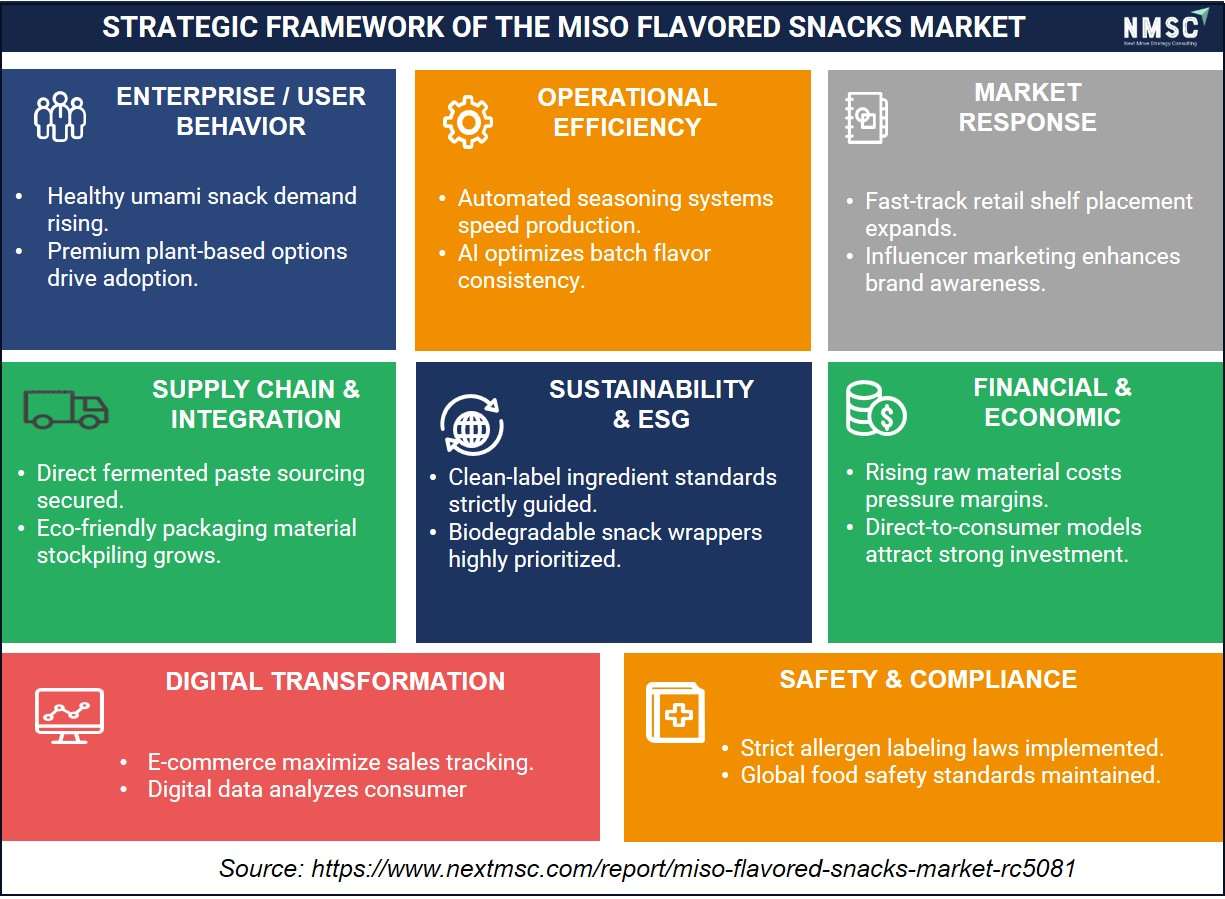
The strategic framework of the Miso Flavored Snacks Market highlights the key factors shaping industry growth and competitiveness. Rising consumer demand for healthy, plant-based snacks is driving product adoption, while automation and AI enhance production efficiency and flavor consistency. Companies are strengthening supply chains through sustainable sourcing and eco-friendly packaging initiatives. Digital transformation, including e-commerce and consumer analytics, supports market expansion, while compliance with food safety and labeling regulations ensures product credibility. Together, these factors create a strong foundation for innovation, profitability, and long-term market growth.
Key Market Players in the Miso Flavored Snacks Market
-
Calbee, Inc.
-
Kameda Seika Co., Ltd.
-
Koikeya Co., Ltd.
-
Bourbon Corporation
-
Iwatsuka Confectionery Co., Ltd.
-
Kuriyama Beika Co., Ltd.
-
Sanko Seika Co., Ltd.
-
Tohato Inc.
-
Oyatsu Company Ltd.
-
Marukome Co., Ltd.
-
Hikari Miso Co., Ltd.
-
MD Holdings Co., Ltd.
-
Yaokin Co., Ltd.
-
Nomura Senbei Co., Ltd.
-
Chuoken Senbei, Inc.
-
Risshodo Co., Ltd.
-
Tanakaya Senbei Sohonke Co., Ltd.
-
Akita Inafuku Beika Co., Ltd.
-
Kitayama Seika Co., Ltd.
-
Amanoya Co., Ltd.
What Are the Latest Developments in the Miso Flavored Snacks Industry?
|
Date |
Event |
|
Mar 2025 |
Koikeya expanded its premium potato snack lineup through the relaunch of its Koikeya Farm series using proprietary potato varieties and enhanced umami flavor positioning. |
|
Feb 2025 |
Calbee launched "Potato Chips Miso Punch" nationwide after successful test-market sales, expanding miso-flavored offerings in its potato chip portfolio. |
|
Jan 2025 |
Calbee America opened a new R&D Innovation Center in California to accelerate Asian-inspired snack innovation and flavor development for global markets. |
What Are the Investment Opportunities in the Miso Flavored Snacks Market?
Capital Inflows and Venture Activity
The Miso Flavored Snacks Market is attracting increasing investor attention as the convergence of global Japanese food culture expansion, functional food megatrends, and snack premiumization creates a compelling long-duration commercial narrative. Venture capital activity in the broader premium Asian snack and specialty food sector is expanding, with early-stage investment flowing into Japanese snack subscription e-commerce platforms, artisan miso snack brand builders, and specialty Asian food import distributors. Our findings suggest that the Japan Venture Capital Association has documented growing cross-border investment interest in Japanese food startup companies positioned at the intersection of traditional craftsmanship and international e-commerce distribution capabilities.
Infrastructure Investment
Investment in miso production technology, precision fermentation systems, spray-drying and microencapsulation infrastructure for miso powder production, and advanced snack seasoning application equipment represents a critical enabler of Miso Flavored Snacks Market growth. Japan's Ministry of Economy, Trade and Industry (METI) has supported domestic food manufacturing modernization through grant programs targeting production efficiency improvements and export capability enhancement. NMSC's assessment indicates that manufacturers investing in miso powder production technology capable of delivering consistent flavor intensity and shelf stability at scale will gain significant competitive advantages in export markets where fresh miso paste logistics present supply chain complexity.
ESG Considerations
Environmental, social, and governance considerations are increasingly relevant to the Miso Flavored Snacks Market investment landscape. Traditional miso fermentation is an inherently natural and relatively low-carbon production process, providing favorable life-cycle assessment characteristics compared to synthetic flavor production. Japan's Ministry of the Environment's food sector decarbonization guidelines and the Food and Agriculture Organization's sustainable food systems frameworks provide regulatory context for ESG-positioned investment in miso food production. Sustainable soybean sourcing, reduced plastic packaging commitments, and transparent supply chain practices are emerging as key ESG performance indicators for premium and craft miso snack brands seeking institutional investment and sustainable procurement mandates.
Digital Transformation
Digital transformation across the Miso Flavored Snacks Market is generating investment opportunities in e-commerce platform development, direct-to-consumer subscription services, digital flavor education content, and precision marketing targeting Japanese food enthusiasts in international markets. NMSC's findings suggest that companies investing in bilingual brand websites, digital storytelling around regional miso heritage, and algorithmic product recommendation systems on e-commerce platforms are achieving materially superior international customer acquisition efficiency. Japan's METI digital commerce promotion initiatives are supporting small and mid-sized Japanese snack manufacturers in developing export e-commerce capabilities through subsidized platform access and international payment infrastructure support programs.
Private Equity and Strategic M&A Activity
Private equity and strategic M&A activity in the Miso Flavored Snacks Market is expected to increase over the forecast period as international food groups seek exposure to Japan's premium snack export growth story and established miso flavor brand equity. Regional senbei manufacturers with deep miso variety expertise and strong regional brand recognition represent attractive bolt-on acquisition targets for larger domestic Japanese snack groups. International food companies pursuing Asian culinary authenticity portfolio strategies, including Western premium snack brands, are increasingly evaluating Japanese artisan snack manufacturer acquisitions as a faster market entry pathway than organic brand building. Investors monitoring Japan's Food Industry Association consolidation activity will identify early-signal M&A opportunities.
Key Benefits for Stakeholders
For Consumer Goods Manufacturers and Brand Owners
Consumer goods manufacturers and brand owners gain comprehensive market intelligence on the Miso Flavored Snacks Market's segmentation structure, competitive positioning, and international expansion opportunities. This intelligence supports product development prioritization, flavor portfolio extension planning, and geographic market entry sequencing. NMSC's segmentation analysis across product category, positioning tiers, distribution channels, and consumer types enables brand teams to identify white-space opportunities and benchmark competitive performance with precision across domestic and international market dimensions.
For Investors and Financial Analysts
Investors and financial analysts gain a structured, data-rich assessment of the Miso Flavored Snacks Market's growth trajectory, segment-level revenue forecasts through 2035, and competitive landscape dynamics. The CAGR analysis by product category, region, and consumer type enables precise investment hypothesis construction. Detailed company coverage of all 20 profiled miso snack manufacturers, combined with the latest development tracking, provides an early-signal framework for identifying acquisition targets, emerging premium brand leaders, and regional market consolidation opportunities within the evolving global miso snack sector.
For Food Ingredient Suppliers and Miso Producers
Food ingredient suppliers and miso producers gain actionable intelligence on downstream demand trends within the Miso Flavored Snacks Market, enabling strategic production planning, flavor development investment prioritization, and market expansion decisions. The segmentation analysis across product categories and geographic markets identifies the highest-growth application areas for miso powder, miso paste derivatives, and miso-flavored seasoning compounds. Regional market analysis provides miso ingredient producers with geographic demand intelligence to support distributor network development and export market prioritization across North America, Europe, and Asia Pacific markets.
For Retail Buyers and Category Managers
Retail buyers and category managers gain evidence-based insights into the Miso Flavored Snacks Market's consumer segmentation, packaging format preferences, and positioning tier dynamics to support product assortment decisions and shelf space allocation strategies. The distribution channel analysis provides retail intelligence on how competitor retailers are positioning miso snack assortments, including specialty Asian retail versus mainstream grocery integration strategies. Seasonal limited edition product trend insights are particularly valuable for category managers developing differentiated and high-traffic Japanese and Asian specialty food sections within premium grocery formats.
Key Market Segments
By Product Category
-
Potato Snacks
-
Standard Potato Chips
-
Thin Cut Chips
-
Ridge Cut Chips
-
Kettle Chips
-
Other Standard Chips
-
-
Premium Potato Chips
-
Regional Flavor Chips
-
Artisan Chips
-
Imported Premium Chips
-
-
Potato Sticks
-
Formed Potato Snacks
-
Other Potato Snacks
-
-
Rice Snacks
-
Senbei
-
Hard Senbei
-
Soft Senbei
-
Grilled Senbei
-
Premium Senbei
-
-
Arare
-
Okaki
-
Rice Crisps
-
Other Rice Snacks
-
-
Extruded Snacks
-
Corn Extruded Snacks
-
Multi-Grain Extruded Snacks
-
Legume-Based Extruded Snacks
-
Other Extruded Snacks
-
-
Puffed Snacks
-
Corn Puffs
-
Rice Puffs
-
Wheat Puffs
-
Mixed Grain Puffs
-
Other Puffed Snacks
-
-
Nuts and Snack Mixes
-
Mixed Nuts
-
Coated Nuts
-
Snack Mixes
-
Rice Cracker Mixes
-
Other Nut Snacks
-
-
Specialty Miso Snacks
-
Traditional Japanese Snacks
-
Fusion Asian Snacks
-
Premium Craft Snacks
-
Functional Snacks
-
Seasonal Limited Editions
-
-
Other Savory Snacks
By Product Positioning
-
Value
-
Mid-Tier
-
Premium
-
Super Premium
-
Craft
-
Seasonal Limited Edition
By Consumer Type
-
Mass Market
-
Youth
-
Health-Focused Consumers
-
Ethnic Cuisine Enthusiasts
By Packaging Format
-
Single Serve
-
Under 50 g
-
50–100 g
-
-
Multi Serve
-
101–250 g
-
Above 250 g
-
-
Multipacks
-
Club Packs
By Brand Ownership
-
Manufacturer Brands
-
National Brands
-
Regional Brands
-
Premium Brands
-
-
Private Label
-
Retailer-Owned
-
Distributor-Owned
-
By Distribution Channel
-
Retail
-
Hypermarkets
-
Supermarkets
-
Convenience Stores
-
Drug Stores
-
Specialty Asian Retail
-
Independent Grocers
-
-
E-Commerce
-
Brand Direct
-
Online Marketplaces
-
Grocery Delivery
-
-
Foodservice
-
Institutional
By Region
-
North America: U.S., Canada, and Mexico.
-
Europe: UK, Germany, France, Italy, Spain, Sweden, Denmark, Finland, the Netherlands, and the rest of Europe.
-
Asia Pacific: China, India, Japan, South Korea, Taiwan, Indonesia, Vietnam, Australia, Philippines, Malaysia and the rest of APAC.
-
Middle East & Africa (MEA): Saudi Arabia, UAE, Egypt, Israel, Turkey, Nigeria, South Africa, and the rest of MEA.
-
Latin America: Brazil, Argentina, Chile, Colombia, and the rest of LATAM.
Conclusion and Recommendations
Long-Term Outlook
The Miso Flavored Snacks Market is well-positioned for sustained growth through 2035, supported by the convergence of three powerful global trends: the mainstreaming of Japanese culinary culture, the premiumization of the international savory snack category, and growing consumer demand for fermented and functionally positioned food products. The market is forecast to grow from USD 2.9 billion in 2026 to USD 4.6 billion by 2035 at a CAGR of 5.1%. NMSC's analysis indicates that this growth reflects both steady domestic volume expansion in Japan and an accelerating international market development phase that will structurally increase the geographic revenue diversification of leading miso snack manufacturers.
Strategic Positioning Recommendations
Manufacturers should prioritize portfolio development across the premium and craft positioning tiers, where value expansion and margin improvement are most pronounced. Regional miso variety differentiation, including Hatcho, Shiro, Sendai, and Mugi miso variants, represents a compelling product authenticity strategy for premium tier positioning. Japanese manufacturers seeking international market penetration should invest in allergen-compliant reformulation, English and multilingual packaging development, and e-commerce channel development as foundational market access investments. International craft brands entering the miso snack category should partner with authentic Japanese miso producers to secure ingredient provenance credentials that support premium pricing justification in Western retail markets.
Investment Attractiveness
The Miso Flavored Snacks Market represents a moderately attractive investment environment with durable secular demand drivers, growing international market development opportunity, and strong premium segment value creation potential. The highest-conviction investment themes include Specialty Miso Snacks (7.8% CAGR), E-Commerce distribution channel expansion (9.4% CAGR), Ethnic Cuisine Enthusiast consumer segment growth (7.7% CAGR), and Super Premium and Craft positioning tier expansion (7.2% and 7.5% CAGR respectively). Investors should monitor Japanese snack manufacturer export strategy announcements and North American and European craft snack brand M&A activity for early-signal investment opportunities.
Market Shifts and Key Risks
The most significant market shift underway is the geographic expansion of miso snack demand beyond Japan's domestic market toward international premium and specialty retail channels in North America, Europe, and China. This shift benefits export-capable Japanese manufacturers and internationally positioned craft brands at the expense of purely domestic players. Key risks include soybean and rice raw material price volatility affecting production cost structures, potential regulatory complexity in key growth markets including China and the EU, and the risk that miso flavor fails to achieve sustained mainstream retail traction in markets outside Japan's cultural influence sphere.
Growth Pathways
Organizations seeking to maximize value from the Miso Flavored Snacks Market should pursue a three-horizon strategy. In the near term from 2025 to 2027, prioritize allergen compliance investments, e-commerce channel development, and premium tier product launches targeting North American and European specialty retail. In the mid-term from 2027 to 2031, invest in regional miso variety storytelling, functional health positioning, and cross-category flavor extension to nuts, extruded snacks, and puffed formats to broaden household occasion penetration. In the long term from 2031 to 2035, position for mainstream retail integration in China, India, and South Korea as miso snack category awareness matures beyond food enthusiast early adopter segments toward broader consumer adoption.
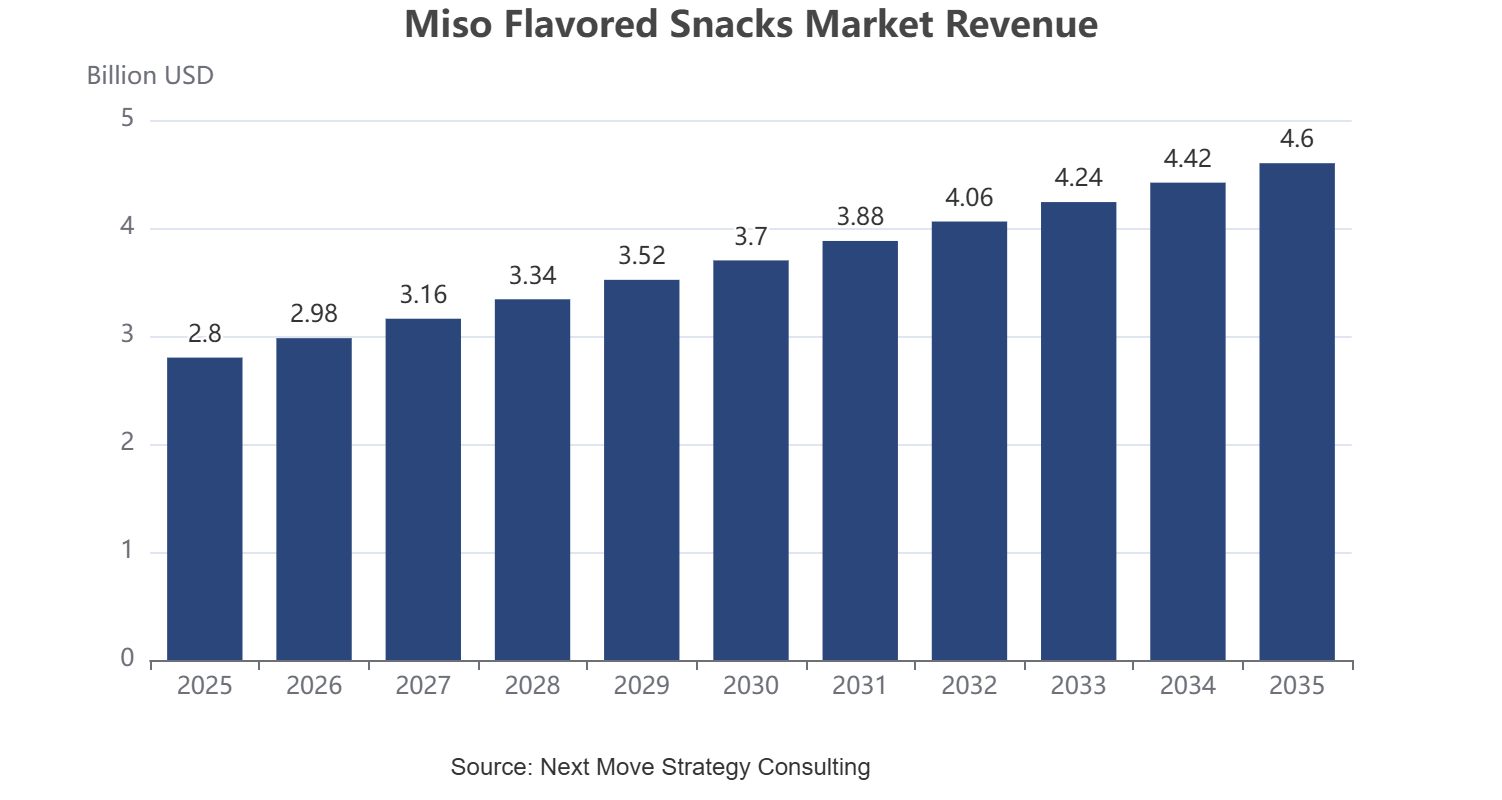
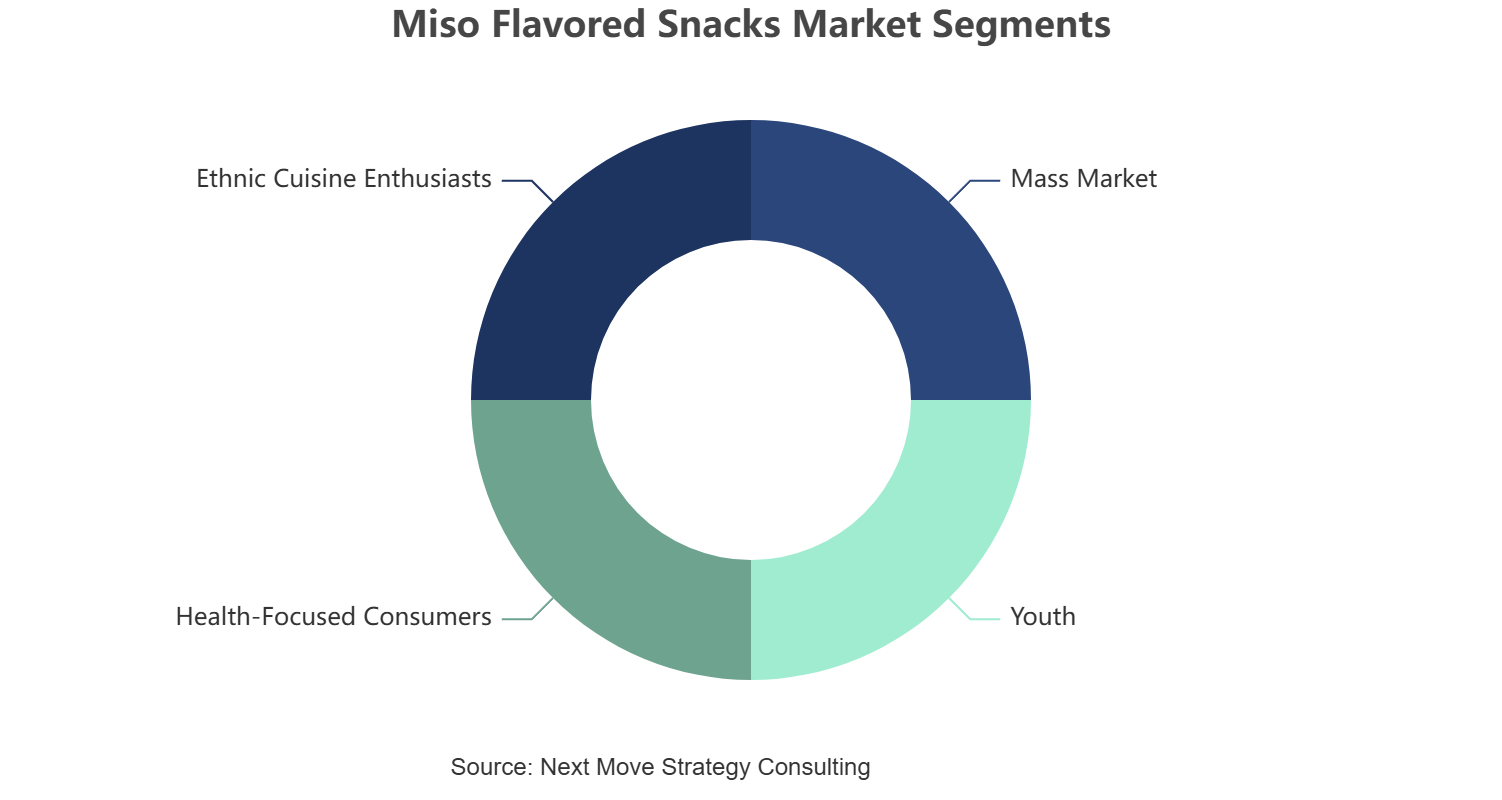
About the Author
 Mihul Sharma
— Mihul Sharma is Research Associate at Next Move Strategy Consulting, where he has covered technology, industrial, and healthcare markets for 3 years. His work applies structured business research, market analysis, and secondary-source review to assess market trends, competitive developments, and growth opportunities. He supports report development by fully synthesizing industry data, company information, and market signals into concise findings for strategy and investment-focused research teams.
Mihul Sharma
— Mihul Sharma is Research Associate at Next Move Strategy Consulting, where he has covered technology, industrial, and healthcare markets for 3 years. His work applies structured business research, market analysis, and secondary-source review to assess market trends, competitive developments, and growth opportunities. He supports report development by fully synthesizing industry data, company information, and market signals into concise findings for strategy and investment-focused research teams.
About the Reviewer
 Supradip Baul
— Supradip Baul is an accomplished business consultant and strategist with over a decade of rich experience in market intelligence, strategy, technology, and business transformation. His work has included rigorous qualitative and quantitative analysis across multiple industries, helping clients shape investment decisions and long-term roadmaps. Earlier in his career, he was associated with Gartner, where he contributed to industry-leading reports and market share analyses. He has worked with leading global companies and holds an MBA with a dual specialization in Marketing and Finance.
Supradip Baul
— Supradip Baul is an accomplished business consultant and strategist with over a decade of rich experience in market intelligence, strategy, technology, and business transformation. His work has included rigorous qualitative and quantitative analysis across multiple industries, helping clients shape investment decisions and long-term roadmaps. Earlier in his career, he was associated with Gartner, where he contributed to industry-leading reports and market share analyses. He has worked with leading global companies and holds an MBA with a dual specialization in Marketing and Finance.
At Next Move Strategy Consulting, we understand that insightful market research is the cornerstone of successful business decisions. That's why we employ a robust and multifaceted approach, combining various methodologies to deliver the most accurate and actionable data for our clients.

Research Landscape
We navigate the world of research with two primary approaches:
Qualitative Approach
Our qualitative research methodologies involve immersive techniques such as in-depth interviews, focus groups, and observational studies. By engaging directly with individuals and stakeholders, we uncover valuable insights that quantitative data alone may overlook.

Quantitative Research
In tandem with qualitative methodologies, NMSC leverages the power of Quantitative Research to provide a robust foundation of numerical insights. Through systematic data collection and analysis, we quantify patterns, preferences, and market trends, offering a comprehensive view of the business landscape.
Our quantitative research approach employs diverse tools, including surveys, experiments, and statistical modelling. These methodologies enable us to gather data from a large and representative sample, ensuring the statistical significance of our findings. By employing structured questionnaires and standardized data collection methods, we guarantee the reliability and validity of the information we present to our clients.
Quantitative research is particularly effective in measuring the prevalence of trends, assessing market size, and gauging the impact of various factors on consumer behavior. The numerical precision attained through this approach equips our clients with actionable insights, facilitating data-driven decision-making and strategy formulation.


Our Specialized Toolbox for Industry-Specific Market Research
We deploy a specialized arsenal of techniques tailored to meet your unique requirements. Here's a glimpse into our comprehensive toolbox:

Information Procurement
The stage entails acquiring market data or relevant information through various sources and methodologies.


Market Research Approach
We utilize both top-down and bottom-up approaches in market research analysis to achieve a comprehensive understanding of the market dynamics, leveraging the broad perspective of industry trends and macroeconomic factors alongside detailed insights from specific segments and individual companies.

Porters Five Forces Analysis
We conduct Porter's Five Forces analysis to evaluate the competitive landscape of an industry, providing us with insights into factors that affect profitability and strategic positioning.

SWOT Analysis

Forecasting
We utilize a forecasting model to predict future consumption by considering parameters like population, economics, regulations, market competition, drivers, constraints, technology, and pricing. We also employ statistical techniques such as multilinear regression, exponential smoothing, moving average, ARIMA, and Monte Carlo simulations for accurate predictions. In econometric forecasting, we analyzed short-term and long-term event impacts, attributing values based on regulatory frameworks, economic factors, and market events.





 Speak to Our Analyst