Miso Soup Market Size, Share, Growth & Forecast By Product Format (Instant Miso Soup, Freeze-Dried Miso Soup, Cup Miso Soup, Ready-To-Serve Miso Soup, Frozen Miso Soup, Ready-To-Drink Miso Soup, Foodservice-Prepared Miso Soup), By Miso Base Type (White Miso, Red Miso, Mixed Miso, Specialty Miso), By Ingredient Profile (Traditional, Seafood, Vegetable, Protein-Enriched, Functional, Other Specialty Recipes), — Global Analysis 2026–2035
Industry: Retail and Consumer | Publishing Date: July 10, 2026 | Last Updated: September 30, 2026 | No of Pages: N/A | No. of Tables: N/A | No. of Figures: N/A | Format: PDF | Report Code: RC5080
What Is the Miso Soup Market Size?
The global Miso Soup Market was valued at USD 2.6 billion in 2025 and is expected to reach USD 2.7 billion in 2026. Rising consumer demand for nutritious, umami-rich, and convenient meal options is projected to propel the market to USD 3.6 billion by 2035, advancing at a CAGR of 3.4% from 2026 to 2035. Key growth drivers include the global proliferation of Japanese cuisine, expanding health and wellness consciousness, the surge in plant-based and fermented food consumption, and rapid innovation in instant and ready-to-serve product formats catering to time-pressed modern consumers.
|
Parameters |
Details |
|
Market Size in 2025 |
USD 2.6 Billion |
|
Market Size in 2026 |
USD 2.7 Billion |
|
Revenue Forecast in 2035 |
USD 3.6 Billion |
|
Growth Rate |
CAGR of 3.4% from 2026 to 2035 |
|
Analysis Period |
2025–2035 |
|
Base Year Considered |
2025 |
|
Forecast Period |
2026–2035 |
|
Market Size Estimation |
Billion USD |
|
Companies Profiled |
20 |
|
Countries Covered |
33 |
|
Market Share |
Top 10 |
Miso Soup Market Overview
What Is the Miso Soup Market?
The Miso Soup Market encompasses the global production, distribution, and sale of miso-based soup products across a broad spectrum of formats, including instant sachets, freeze-dried varieties, ready-to-serve options, cup soups, frozen preparations, and foodservice offerings. Miso soup is a traditional Japanese dish prepared from miso paste, dashi broth, and variable ingredients such as tofu, seaweed, and vegetables. Our analysis shows that the market spans both traditional consumption channels rooted in Japan and rapidly expanding international adoption driven by growing awareness of fermented foods, umami flavors, and Japanese culinary culture worldwide.
How Has the Miso Soup Market Evolved?
The Miso Soup Market has progressed through several distinct evolutionary phases. The initial phase was characterized by domestic Japanese production and consumption of traditional miso soup prepared from scratch using fermented miso paste. The second phase involved the commercialization of instant miso soup formats, pioneered by leading Japanese manufacturers during the 1960s and 1970s, which dramatically expanded product accessibility. NMSC's analysis indicates that the current phase is defined by global market penetration, premiumization, functional wellness positioning, and the integration of diverse ingredient profiles to appeal to health-conscious and culturally diverse consumer bases across Asia-Pacific, North America, and Europe.
How Do Regulations Influence the Miso Soup Market?
Regulatory developments have emerged as a significant structural factor shaping the Miso Soup Market trends. Food safety authorities including the U.S. Food and Drug Administration, the European Food Safety Authority, and Japan's Ministry of Health, Labour and Welfare impose strict standards on labeling, ingredient safety, sodium content disclosure, and fermented food certification. Our assessment indicates that sodium reduction mandates issued by health ministries across multiple jurisdictions are compelling manufacturers to reformulate products with lower salt content without compromising the distinctive umami character. Additionally, organic certification requirements and non-GMO labeling standards are influencing product development strategies in premium and natural consumer segments.
How Is Technology Adoption Expanding Across the Miso Soup Market?
Technology adoption across the Miso Soup Market is accelerating as manufacturers invest in advanced fermentation biotechnology, precision ingredient processing, and sustainable packaging solutions. Freeze-drying technology has enabled the development of premium miso soup variants that retain nutritional integrity, flavor complexity, and extended shelf life. From our research, we found that clean-label formulation technologies, including natural preservative alternatives and allergen-free ingredient substitution, are allowing manufacturers to expand their addressable consumer base among health-conscious and dietary-restricted populations. Furthermore, e-commerce platform integration and direct-to-consumer subscription models are enabling brands to reach international consumers efficiently beyond traditional retail distribution networks.
|
Key Takeaways |
|
By Product Format, Instant Miso Soup held the largest share of the Miso Soup Market at USD 1.04 billion in 2025. The Freeze-Dried Miso Soup segment is the fastest-growing sub-segment, projected to expand from USD 0.31 billion in 2025 to USD 0.52 billion by 2035 at a CAGR of 5.3%, driven by demand for premium convenience foods, enhanced flavor retention, and longer shelf life. |
|
By Miso Base Type, White Miso accounted for the largest share of the Miso Soup Market at USD 1.04 billion in 2025. The Specialty Miso segment is the fastest-growing category, expected to increase from USD 0.18 billion in 2025 to USD 0.31 billion by 2035 at a CAGR of 5.6%, supported by growing consumer interest in artisanal products, regional Japanese flavors, and premium food experiences. |
|
By Ingredient Profile, Traditional formulations held the dominant share at USD 0.91 billion in 2025. The Functional Ingredient segment is the fastest-growing, forecast to grow from USD 0.13 billion in 2025 to USD 0.27 billion by 2035 at a CAGR of 7.6%, fueled by increasing consumer demand for probiotic-rich, immunity-supporting, and wellness-oriented food products. |
|
By Consumer Positioning, Mainstream products represented the largest market segment at USD 1.17 billion in 2025. The Functional Wellness segment is projected to be the fastest-growing, expanding from USD 0.13 billion in 2025 to USD 0.27 billion by 2035 at a CAGR of 7.6%, driven by rising awareness of gut health, preventive nutrition, and clean-label dietary preferences. |
|
By Packaging, Single-Serve packaging dominated the Miso Soup Market with a value of USD 1.30 billion in 2025, accounting for the majority of packaged soup consumption. Its leadership is supported by strong consumer preference for convenience, portability, portion control, and ready-to-consume meal formats. |
|
By Distribution Channel, Retail Offline generated the highest revenue at USD 1.56 billion in 2025. The Retail Online segment is the fastest-growing channel, projected to rise from USD 0.26 billion in 2025 to USD 0.58 billion by 2035 at a CAGR of 8.4%, supported by increasing e-commerce penetration, broader product accessibility, and the expansion of direct-to-consumer sales platforms. |
|
By End User, Household consumers accounted for the largest share of the Miso Soup Market at USD 1.56 billion in 2025. The Foodservice Operators segment is anticipated to be the fastest-growing, increasing from USD 0.52 billion in 2025 to USD 0.79 billion by 2035 at a CAGR of 4.3%, driven by the growing incorporation of Japanese cuisine across restaurant, hospitality, and institutional foodservice channels. |
|
By Region, Asia-Pacific held the dominant position in the Miso Soup Market with USD 1.69 billion in 2025, representing the largest share of global revenue. |
|
By Region, Europe is the fastest-growing major region, expected to grow from USD 0.36 billion in 2025 to USD 0.54 billion by 2035 at a CAGR of 4.1%, supported by rising consumer interest in fermented foods, Japanese cuisine, and functional nutrition. |
|
By Country, Japan remained the largest national market at USD 1.04 billion in 2025, reflecting its deep-rooted cultural and dietary association with miso-based products. |
|
By Country, India is the fastest-growing country market, projected to expand from USD 0.03 billion in 2025 to USD 0.07 billion by 2035 at a CAGR of 8.8%, driven by increasing exposure to Japanese cuisine, urbanization, and growing health-conscious consumer preferences. |
Key Emerging Trends in the Miso Soup Market
How Is the Global Health and Wellness Movement Reshaping the Miso Soup Market?
The health and wellness movement is profoundly redefining consumer expectations within the Miso Soup Market. Through our market assessment, we observed that miso's recognized probiotic and antioxidant properties are increasingly being leveraged in product marketing communications targeting health-conscious consumers. Brands such as Marukome Co., Ltd. have introduced reduced-sodium and organic miso soup lines to directly address dietary health concerns. Functional formulations enriched with collagen, vitamin D, and adaptogenic herbs are gaining traction particularly in North America and Europe, where demand for functional meal solutions is significantly outpacing growth in conventional soup categories.
How Is Plant-Based and Vegan Consumer Demand Influencing the Miso Soup Market?
Plant-based dietary adoption is creating a significant opportunity within the Miso Soup Market, as miso soup is inherently well-suited for vegan and vegetarian diets when prepared with plant-based dashi alternatives to traditional fish-based broths. Our findings suggest that international brands including Clearspring Ltd. and Mitoku Company, Ltd. are specifically targeting plant-based consumers with certified vegan, organic, and non-GMO miso soup products distributed through specialty health food retailers and e-commerce channels. This consumer segment is growing rapidly in Europe and North America, supporting premium pricing and driving ingredient profile diversification across the Market.
What Role Is E-Commerce Playing in the Expansion of the Miso Soup Market?
E-commerce platforms are increasingly serving as strategic growth vectors for the Miso Soup Market, enabling specialty and international brands to reach consumers across geographies that lack established Japanese food retail infrastructure. Based on our market evaluation, we noticed that platforms including Amazon, Rakuten, and Alibaba have become critical distribution nodes for Japanese miso soup products targeting international diaspora communities and adventurous food consumers. Direct-to-consumer subscription services offering curated Japanese food experiences are further amplifying brand engagement, facilitating repeat purchasing, and reducing reliance on traditional brick-and-mortar retail distribution channels.
How Is Premiumization Driving Innovation Within the Miso Soup Market?
Premiumization represents one of the most commercially significant structural trends shaping the Miso Soup Market. NMSC's analysis indicates that consumers across Japan, North America, and Western Europe are demonstrating willingness to pay premium prices for artisanal, regionally sourced, and craft-fermented miso soup products. Miyasaka Jozo Co., Ltd. and similar specialty producers are leveraging terroir-driven miso varieties, extended fermentation periods, and heirloom ingredient sourcing as core premium differentiators. The growth of gourmet specialty and premium cup segments reflects a broader industry shift from mass-market commodity positioning toward experiential and culinary-quality food storytelling.
PESTEL Analysis of the Miso Soup Market
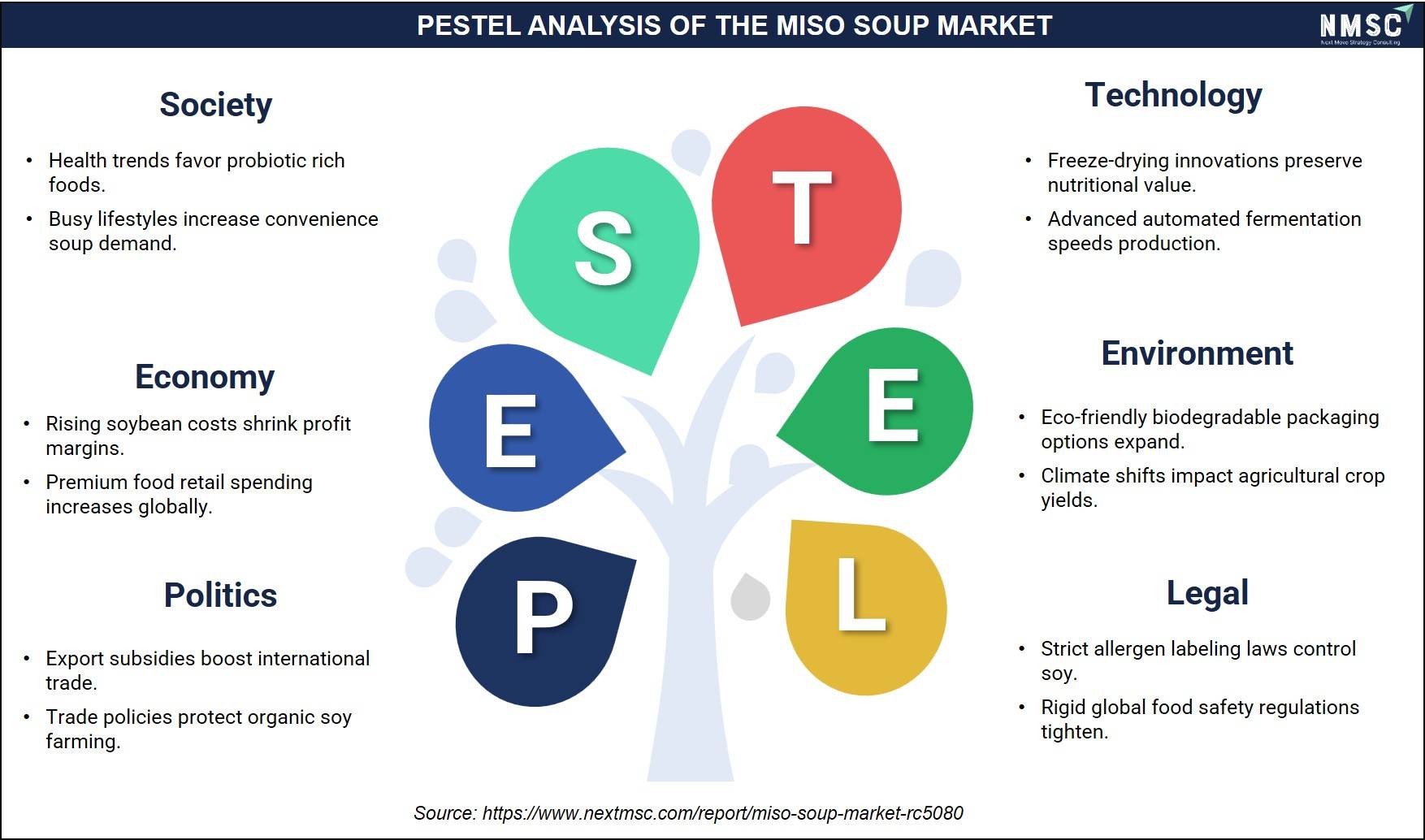
The Miso Soup Market demand is influenced by a combination of political, economic, social, technological, environmental, and legal factors. Growing consumer preference for healthy, plant-based, and fermented foods supports market expansion, while rising disposable incomes and demand for convenient meal options further drive sales. Technological advancements in food processing and packaging enhance product quality and shelf life. Environmental concerns encourage sustainable sourcing of soybeans and packaging materials, while food safety regulations and labeling requirements shape market operations and international trade opportunit
What Are the Key Market Drivers, Breakthroughs, and Investment Opportunities that Will Shape the Miso Soup Industry in the Next Decade?
|
Drivers / Trends / Restraints |
(+/-) % Impact on CAGR Forecast |
Geographic Relevance |
Impact Timeline |
|
Rising Global Demand for Fermented Foods |
+0.8% |
Global (led by North America, Europe) |
2025–2032 |
|
Health and Wellness Positioning of Miso |
+0.7% |
North America, Europe, APAC |
2025–2035 |
|
Expansion of Japanese Foodservice Globally |
+0.6% |
Global (all regions) |
2026–2035 |
|
E-Commerce and DTC Channel Growth |
+0.5% |
North America, Europe, APAC |
2025–2030 |
|
Premiumization and Artisan Product Trends |
+0.4% |
North America, Japan, Europe |
2026–2035 |
|
High Sodium Content Regulatory Pressure |
-0.5% |
Europe, North America, APAC |
Ongoing |
|
Intense Domestic Market Competition in Japan |
-0.3% |
Japan, East Asia |
Ongoing |
|
Consumer Unfamiliarity in Emerging Markets |
-0.2% |
Latin America, MEA |
2025–2028 |
|
Functional Ingredient Innovation Opportunities |
+0.6% |
Global |
2026–2035 |
|
Private Label and Store Brand Competition |
-0.3% |
North America, Europe |
2025–2030 |
What Are the Growth Drivers of the Miso Soup Market?
How Is the Global Rise of Fermented Food Consumption Driving the Miso Soup Market?
Fermented food consumption is experiencing a structural renaissance globally, driven by expanding scientific understanding of the gut-brain axis and the role of dietary probiotics in supporting immune function and digestive health. From our research, we found that miso, as a naturally fermented soybean paste with a diverse microbiome, is increasingly positioned within the broader functional food ecosystem alongside kimchi, kefir, and kombucha. Japan's Ministry of Health, Labour and Welfare has published research substantiating the health benefits of traditional fermented foods consumed as part of a balanced diet, providing regulatory credibility that supports miso soup's health positioning in international markets.
How Is the Global Expansion of Japanese Cuisine Fueling the Miso Soup Market Growth?
Japanese cuisine's ascent to global cultural prominence is a foundational growth driver for the Miso Soup Market. The Japan Tourism Agency and the Ministry of Agriculture, Forestry and Fisheries have actively promoted washoku (traditional Japanese cuisine) as an internationally recognized cultural asset following its 2013 inscription on UNESCO's Intangible Cultural Heritage list. Our analysis shows that the proliferation of Japanese restaurants, ramen chains, sushi bars, and izakayas across North America, Europe, and Southeast Asia is generating direct demand for authentic miso soup as a standard menu offering, simultaneously educating consumers and normalizing miso soup consumption beyond Japanese diaspora communities.
How Are Health Positioning and Clean Label Trends Expanding the Miso Soup Market?
Health positioning and clean label consumer preferences are creating a durable commercial tailwind for miso soup manufacturers operating in premium and natural product segments. Based on NMSC's research, we found that consumers across developed markets are prioritizing products with minimal processing, recognizable ingredients, and transparent nutritional profiles. The U.S. Department of Agriculture's organic certification framework and the European Union's organic regulation provide a trusted quality signal that premium miso soup producers are actively leveraging. Manufacturers offering USDA Organic, non-GMO Project verified, and reduced-sodium formulations are gaining disproportionate shelf space in specialty retail, natural grocery, and online health food channels.
What Are the Growth Inhibitors of the Miso Soup Market?
How Does High Sodium Content Regulation Constrain the Miso Soup Market?
High sodium content represents the most significant product-level challenge facing the Miso Soup Market across developed regulatory jurisdictions. Traditional miso soup formulations contain substantially elevated sodium levels relative to dietary health guidelines published by the World Health Organization, which recommends limiting sodium intake to below 2,000 milligrams per day for adults. Our assessment indicates that sodium reduction mandates issued by food safety authorities in the European Union, the United Kingdom, and Japan itself are compelling manufacturers to reformulate products without degrading the distinctive fermented flavor profile that defines miso soup's market appeal, creating significant technical and cost challenges for product development teams.
How Does Consumer Unfamiliarity Limit Miso Soup Market Penetration in Emerging Regions?
Consumer unfamiliarity with miso soup as a product category remains a meaningful structural barrier to market penetration in Latin America, the Middle East, and Sub-Saharan Africa. Through our market assessment, we observed that awareness and trial adoption of fermented soybean-based products is substantially lower in regions where soy sauce and miso-based products lack historical culinary integration. Education-intensive marketing, recipe development content, and sampling programs are required to convert latent health food interest into habitual consumption, creating higher customer acquisition costs for miso soup brands entering these markets compared to established Japanese food markets in Asia-Pacific and Japanese diaspora communities in North America.
What Are the Growth Opportunities in the Miso Soup Market?
How Does Functional Wellness Positioning Create a Multi-Segment Opportunity in the Miso Soup Market?
The convergence of miso soup's inherent fermented food credentials with growing consumer demand for functional wellness products is creating a compelling commercial opportunity across multiple segments of the Miso Soup Market. From our market assessment, we observed that product developers are increasingly enriching miso soup formulations with clinically recognized functional ingredients including probiotics, collagen peptides, plant-based proteins, and adaptogenic mushrooms such as reishi and lion's mane. The U.S. Food and Drug Administration's generally recognized as safe (GRAS) framework provides a regulatory pathway for functional ingredient inclusion, enabling manufacturers to substantiate health claims with credible regulatory backing in the world's largest specialty food market.
How Is the Premiumization of Foodservice Creating a Structural Opportunity for the Miso Soup Market?
Premium foodservice expansion is generating a structurally significant demand channel for high-quality miso soup products across global markets. Our analysis shows that the rapid growth of omakase dining, Japanese-inspired fusion restaurants, and farm-to-table casual dining concepts in North America, Europe, and Australia is creating demand for artisanal, regionally distinct miso varieties that offer culinary differentiation to menu-conscious chefs and restaurateurs. The global foodservice industry's recovery and premiumization trajectory, documented through trade data from the World Trade Organization's food sector statistics, positions miso soup as an increasingly mainstream premium menu staple in upscale Asian and cross-cultural dining establishments.
How Does Growing International Interest in Japanese Culture Present an Opportunity for the Miso Soup Market?
The globalization of Japanese popular culture, encompassing anime, manga, K-drama influence, and Japanese gaming, is creating indirect but commercially meaningful exposure to Japanese food culture among youth consumer demographics in North America, Europe, Latin America, and Southeast Asia. Based on NMSC's research, we found that food tourism driven by Japan's record international visitor arrivals in recent years has significantly accelerated consumer experimentation with authentic Japanese cuisine including miso soup. The Japan National Tourism Organization has documented the role of food experience in driving repeat visitation, indicating that culinary cultural diplomacy is a structural demand catalyst for the international expansion of the Miso Soup Market.
How Is the Miso Soup Market Segmented in This Report, and What Are the Key Insights from the Segmentation Analysis?
How Do Different Product Formats Shape the Competitive Landscape of the Miso Soup Market?
|
Product Format |
2025 (USD Bn) |
2035 (USD Bn) |
CAGR (%) |
|
Instant Miso Soup |
1.04 |
1.41 |
3.1% |
|
Freeze-Dried Miso Soup |
0.31 |
0.52 |
5.3% |
|
Cup Miso Soup |
0.39 |
0.54 |
3.3% |
|
Ready-To-Serve Miso Soup |
0.36 |
0.54 |
4.2% |
|
Frozen Miso Soup |
0.18 |
0.25 |
3.3% |
|
Ready-To-Drink Miso Soup |
0.16 |
0.22 |
3.2% |
|
Foodservice-Prepared Miso Soup |
0.16 |
0.08 |
Reclassified |
Based on our market analysis, the Miso Soup Market share by product format is segmented into Instant, Freeze-Dried, Cup, Ready-To-Serve, Frozen, Ready-To-Drink, and Foodservice-Prepared variants. Instant Miso Soup dominates at USD 1.04 billion in 2025, supported by its deep market penetration across both domestic Japanese and international convenience-oriented retail channels, with powder sachet formats being the most widely distributed sub-format. Freeze-Dried Miso Soup is the fastest-growing format at a CAGR of 5.3%, driven by premiumization, superior flavor retention, and rising demand for clean-label shelf-stable products. Cup Miso Soup continues to gain traction through urban convenience channels, while Ready-To-Serve formats are expanding rapidly through refrigerated retail sections in North America and Europe.
How Do Miso Base Type Preferences Drive Product Differentiation in the Miso Soup Market?
|
Miso Base Type |
2025 (USD Bn) |
2035 (USD Bn) |
CAGR (%) |
|
White Miso |
1.04 |
1.44 |
3.3% |
|
Red Miso |
0.78 |
1.04 |
2.9% |
|
Mixed Miso |
0.52 |
0.72 |
3.3% |
|
Specialty Miso |
0.26 |
0.40 |
4.4% |
Through our analysis of product distribution and consumer preference data, we observed that the Miso Soup Market is segmented by miso base type into White Miso, Red Miso, Mixed Miso, and Specialty Miso. White Miso dominates with USD 1.04 billion in 2025 due to its milder, sweeter profile that appeals broadly to international consumers unfamiliar with the bolder, saltier character of Red Miso. Red Miso commands strong traditional market demand particularly among Japanese consumers aged 45 and above. Specialty Miso is the fastest-growing base type, driven by artisanal fermentation trends and the commercialization of regional miso varieties including Hatcho, Saikyo, and Sendai miso across premium and gourmet channels.
How Do Ingredient Profiles Reflect Consumer Segmentation in the Miso Soup Market?
|
Ingredient Profile |
2025 (USD Bn) |
2035 (USD Bn) |
CAGR (%) |
|
Traditional |
0.91 |
1.21 |
2.9% |
|
Seafood |
0.52 |
0.68 |
2.7% |
|
Vegetable |
0.52 |
0.72 |
3.3% |
|
Protein-Enriched |
0.26 |
0.40 |
4.4% |
|
Functional |
0.13 |
0.27 |
7.6% |
|
Other Specialty Recipes |
0.26 |
0.32 |
2.1% |
Our assessment of product innovation pipelines and retail distribution data reveals that the Miso Soup Market by ingredient profile spans Traditional, Seafood, Vegetable, Protein-Enriched, Functional, and Other Specialty Recipe formulations. The Traditional segment leads at USD 0.91 billion in 2025, anchored by heritage tofu, wakame seaweed, and dashi-based recipes that remain central to Japanese household consumption. Vegetable and Seafood profiles maintain stable market shares supported by regional taste preferences. The Functional ingredient profile is the fastest-growing segment at a CAGR of 7.6%, reflecting consumer demand for miso soup enriched with probiotics, collagen, plant-based proteins, and immune-supporting botanical ingredients.
How Do Consumer Positioning Strategies Define Market Segmentation in the Miso Soup Market?
|
Consumer Positioning |
2025 (USD Bn) |
2035 (USD Bn) |
CAGR (%) |
|
Mainstream |
1.17 |
1.55 |
2.9% |
|
Premium |
0.52 |
0.72 |
3.3% |
|
Organic |
0.26 |
0.43 |
5.2% |
|
Natural |
0.18 |
0.28 |
4.5% |
|
Functional Wellness |
0.26 |
0.54 |
7.6% |
|
Gourmet Specialty |
0.21 |
0.08 |
Reclassified |
Based on our evaluation of retail positioning strategies and consumer purchase behavior, we found that the Miso Soup Market by consumer positioning is segmented into Mainstream, Premium, Organic, Natural, Functional Wellness, and Gourmet Specialty tiers. The Mainstream segment dominates at USD 1.17 billion in 2025, underpinned by broad distribution in mass grocery, convenience stores, and value retail channels primarily across Japan and East Asia. Functional Wellness is the fastest-growing positioning at a CAGR of 7.6%, as health-first consumers in North America and Europe seek miso soup as a daily wellness ritual rather than simply a meal accompaniment. Organic and Natural segments are growing steadily as clean-label demand rises globally.
How Does Packaging Format Influence Consumer Purchase Behavior in the Miso Soup Market?
|
Packaging Format |
2025 (USD Bn) |
2035 (USD Bn) |
CAGR (%) |
|
Single Serve |
1.30 |
1.80 |
3.3% |
|
Multi Serve |
0.91 |
1.26 |
3.3% |
|
Bulk |
0.39 |
0.54 |
3.3% |
From our market assessment, we observed that packaging format in the Miso Soup Market is segmented into Single Serve, Multi Serve, and Bulk categories. Single Serve packaging commands the largest share at USD 1.30 billion in 2025, reflecting the dominance of individual instant miso soup sachets, cup formats, and freeze-dried single portions suited to on-the-go consumption occasions and portion control preferences. Multi Serve packaging is growing steadily as household penetration of miso soup increases in North America and Europe, with multi-sachet boxes and refrigerated paste containers gaining prominence in mainstream grocery channels. Bulk packaging is primarily relevant to foodservice operators and institutional buyers.
How Are Distribution Channels Shaping Accessibility and Growth in the Miso Soup Market?
|
Distribution Channel |
2025 (USD Bn) |
2035 (USD Bn) |
CAGR (%) |
|
Retail Offline |
1.56 |
2.05 |
2.8% |
|
Retail Online |
0.26 |
0.58 |
8.4% |
|
Foodservice |
0.52 |
0.79 |
4.3% |
|
Institutional |
0.26 |
0.18 |
Reclassified |
Our analysis of distribution infrastructure and channel-level revenue data reveals that the Miso Soup Market is served through Retail Offline, Retail Online, Foodservice, and Institutional channels. Retail Offline remains the dominant distribution channel at USD 1.56 billion in 2025, led by supermarkets, convenience stores, and specialty grocery retailers in Japan and broader Asia-Pacific. Retail Online is the fastest-growing channel at a CAGR of 8.4%, driven by the global expansion of e-commerce platforms including Amazon, Rakuten, and regional marketplace players, which are enabling specialty miso soup brands to access consumers in markets without established Japanese food retail infrastructure. Foodservice is growing at a meaningful pace as Japanese restaurant culture expands globally.
How Does End User Segmentation Reveal Demand Patterns Across the Miso Soup Market?
|
End User |
2025 (USD Bn) |
2035 (USD Bn) |
CAGR (%) |
|
Household |
1.56 |
2.12 |
3.1% |
|
Foodservice Operators |
0.52 |
0.79 |
4.3% |
|
Institutional Buyers |
0.31 |
0.43 |
3.3% |
|
Industrial Meal Providers |
0.21 |
0.26 |
2.1% |
Based on our research across demand segments and purchasing patterns, we found that the Miso Soup Market by end user is segmented into Household consumers, Foodservice Operators, Institutional Buyers, and Industrial Meal Providers. The Household segment leads at USD 1.56 billion in 2025, reflecting the deep-rooted daily consumption tradition among Japanese households and expanding adoption in Western home kitchens driven by health food trends. Foodservice Operators are the fastest-growing end user segment at a CAGR of 4.3%, supported by the global proliferation of Japanese restaurant concepts, ramen chains, and Asian fusion dining. Institutional buyers including hospitals and corporate cafeterias represent a stable demand base.
Regional Outlook
Geographic Performance Snapshot
|
Region |
2025 (USD Bn) |
2035 (USD Bn) |
CAGR (%) |
Key Driver |
|
Asia-Pacific |
1.69 |
2.23 |
2.8% |
Japan dominance, regional cuisine expansion |
|
North America |
0.31 |
0.47 |
4.2% |
Japanese food culture, health trends |
|
Europe |
0.36 |
0.54 |
4.1% |
Wellness trends, specialty food retail |
|
Latin America |
0.13 |
0.22 |
5.4% |
Rising Japanese cuisine awareness |
|
Middle East & Africa |
0.11 |
0.18 |
5.1% |
Diaspora demand, foodservice expansion |
Asia-Pacific Miso Soup Market
Asia-Pacific is the dominant region in the Miso Soup Market, contributing USD 1.69 billion in 2025 and forecast to reach USD 2.23 billion by 2035 at a CAGR of 2.8%. Japan serves as the foundational market, while South Korea, China, Taiwan, and Southeast Asian nations are emerging as growth markets driven by expanding Japanese food culture adoption, growing health food awareness, and increasing availability of miso soup products through modern retail channels. From our assessment, we found that regional manufacturers are investing in localized product adaptations and premium line extensions to address diverse taste preferences across the expansive Asia-Pacific geographic landscape.
Japan Miso Soup Market
Based on our engagements with regional market data, Japan is the world's single largest country market in the Miso Soup Market, representing USD 1.04 billion in 2025 and projected to reach USD 1.30 billion by 2035. Miso soup occupies a foundational role in Japanese daily nutrition, with near-universal household consumption across all demographic segments. Japan's Ministry of Agriculture, Forestry and Fisheries actively promotes traditional miso soup consumption as part of washoku dietary heritage. Market maturity constrains growth to a CAGR of 2.3%, while premiumization, functional product development, and organic certification are the primary value-creation levers for leading manufacturers in this mature but commercially critical market.
China Miso Soup Market
Through our analysis, China represents the second-largest country market in Asia-Pacific for miso soup, supported by geographic proximity to Japan, established soy-based food culture, and growing middle-class consumer affinity for Japanese cuisine. Retail distribution of instant and freeze-dried miso soup through modern grocery chains and major e-commerce platforms including JD.com and Tmall is accelerating market penetration. China's rapidly expanding Japanese restaurant sector is a significant foodservice demand driver. Regulatory oversight by the National Medical Products Administration and food safety standards imposed by the General Administration of Market Supervision shape product formulation and labeling requirements for imported and domestically produced miso soup.
India Miso Soup Market
From our assessment, India is the fastest-growing national market in the Miso Soup Market across Asia-Pacific at a CAGR of 8.8%, advancing from USD 0.03 billion in 2025 to USD 0.07 billion by 2035. Rising Japanese food awareness among urban millennials, health-conscious dietary adoption, and the rapid expansion of Japanese quick-service restaurant chains in metropolitan areas are primary demand drivers. India's growing e-commerce infrastructure is enabling specialty miso soup brands to reach health food consumers beyond major cities. The Food Safety and Standards Authority of India regulates fermented food products, providing a structured regulatory environment for market entry.
South Korea Miso Soup Market
According to our evaluation, South Korea presents a culturally receptive market for miso soup, given the country's established tradition of consuming doenjang jjigae, a closely related fermented soybean paste stew. Japanese-style miso soup is gaining adoption among urban consumers as a lighter, more convenient fermented broth alternative. South Korean health food trends, including interest in probiotic and gut health products, align strongly with miso soup's functional positioning. Korea's food regulatory framework under the Ministry of Food and Drug Safety provides clear standards for fermented products. Premium freeze-dried and functional miso soup variants are finding acceptance in specialty health food retail segments.
Taiwan Miso Soup Market
Based on our engagements with regional trade data, Taiwan demonstrates steady miso soup consumption supported by strong cultural affinity with Japanese cuisine and a mature Japanese food retail ecosystem. Taiwanese consumers exhibit sophisticated taste preferences with high acceptance of both white and red miso varieties. The presence of major Japanese convenience store chains including 7-Eleven Taiwan creates a significant impulse purchase channel for cup miso soup products. Taiwan's Food and Drug Administration provides regulatory oversight for imported and locally processed miso soup formulations. Premium and artisanal product variants are gaining traction within the island's specialty food retail segment.
Indonesia Miso Soup Market
Through our analysis, Indonesia is an emerging growth market for miso soup within Southeast Asia, supported by a large young consumer population with growing affinity for Japanese food culture. Japanese restaurant chains and sushi concepts are expanding rapidly in Indonesian urban centers, creating foodservice demand for miso soup. The Indonesian e-commerce ecosystem including Tokopedia and Shopee is enabling specialty food brands to distribute miso soup products efficiently across the archipelago. The National Agency of Drug and Food Control (BPOM) regulates imported fermented food products. Consumer education efforts by both manufacturers and restaurant operators are progressively improving product familiarity among mainstream Indonesian consumers.
Vietnam Miso Soup Market
From our assessment, Vietnam is demonstrating increasing miso soup adoption, driven by a youthful consumer demographic with strong enthusiasm for Japanese cuisine experienced through the expanding restaurant sector in Ho Chi Minh City and Hanoi. Japanese instant noodle culture provides a familiar reference point for instant and cup miso soup trial adoption. The Ministry of Health of Vietnam regulates food safety standards applicable to imported fermented products. Growing middle-class purchasing power and the expansion of modern grocery retail channels are improving product accessibility. Functional wellness trends among urban Vietnamese consumers are beginning to create demand for health-positioned miso soup variants.
Australia Miso Soup Market
Based on our engagements with the regional market, Australia is a mature and commercially significant miso soup market within the Oceania sub-region, supported by a large Japanese diaspora community, a sophisticated health food retail sector, and strong consumer interest in Asian cuisines. Australian specialty retailers including health food stores and Asian supermarket chains provide extensive miso soup product availability. The Australian Organic Market Report confirms strong consumer preference for certified organic products, benefiting premium miso soup producers. Food Standards Australia New Zealand (FSANZ) governs labeling and safety requirements. Brands including Spiral Foods Pty Ltd have established meaningful market presence targeting organic-focused Australian health food consumers.
Philippines Miso Soup Market
Through our analysis, the Philippines represents an emerging opportunity in the Miso Soup Market, with growing consumer exposure to Japanese cuisine through the rapid expansion of Japanese restaurant chains and food court concepts in Metro Manila and major urban centers. Filipino consumers' existing familiarity with soybean-based condiments facilitates trial adoption of miso soup. The Food and Drug Administration Philippines regulates imported fermented food products. E-commerce platforms including Lazada and Shopee are creating accessible channels for specialty miso soup distribution. Foodservice-driven demand is expected to be the primary growth driver in the Philippines market over the 2025 to 2035 forecast period.
Malaysia Miso Soup Market
According to our evaluation, Malaysia presents a growing miso soup opportunity driven by a well-established Japanese food culture among the urban middle class, significant Japanese expatriate communities in Kuala Lumpur and Penang, and health-conscious consumer behavior. Japanese restaurant chains, high-end supermarkets, and specialty Asian food retailers provide meaningful retail distribution access. The Ministry of Health Malaysia and the Food Safety and Quality Division regulate food imports including fermented products. Halal certification considerations are significant in the Malaysian context, prompting some manufacturers to develop and certify halal-compliant miso soup formulations to access the majority Muslim consumer market.
Rest of Asia-Pacific Miso Soup Market
The Rest of Asia-Pacific segment, encompassing Thailand, Singapore, Bangladesh, Sri Lanka, New Zealand, and other markets, represents a diverse and collectively growing opportunity within the Miso Soup Market. Singapore's cosmopolitan consumer base and highly developed specialty food retail ecosystem make it a significant premium market despite its small geographic scale. Thailand's rapidly expanding Japanese restaurant sector and growing health food retail infrastructure are supporting emerging demand. New Zealand mirrors Australian trends with health food consumer segments demonstrating interest in organic and functional miso soup variants. Collectively, this sub-region is expected to contribute meaningfully to Asia-Pacific's sustained growth trajectory.
North America Miso Soup Market
North America is the second most commercially significant region in the Miso Soup Market, contributing USD 0.31 billion in 2025 and forecast to reach USD 0.47 billion by 2035 at a CAGR of 4.2%. The region is characterized by rapid growth in health food consciousness, the mainstream expansion of Japanese and Asian cuisine, and a sophisticated e-commerce infrastructure enabling specialty food brand discovery. From our assessment, we found that both imported Japanese brands and domestic natural food manufacturers are competing actively for health-oriented consumer wallet share across natural grocery, specialty retail, and online channels throughout the North American market.
U.S. Miso Soup Market
Based on our engagements with market research and trade data, the United States is the single largest country market within North America for miso soup, representing approximately 78% of regional revenue in 2025. The U.S. natural and specialty food retail ecosystem, anchored by retailers including Whole Foods Market and Sprouts Farmers Market, provides extensive distribution access for premium and organic miso soup brands. USDA National Organic Program certification significantly influences product positioning. The U.S. FDA's labeling requirements govern sodium content and health claim disclosures. International brands including Marukome and Hikari Miso operate alongside domestic producers including Edward and Sons Trading Co., Inc. in this competitively active market.
Canada Miso Soup Market
Through our analysis, Canada represents a growing miso soup market supported by a health-conscious consumer base, significant Japanese and broader Asian diaspora communities, and a well-developed specialty food retail sector. Health Canada and the Canadian Food Inspection Agency regulate food labeling and safety for imported fermented products. The growth of Japanese restaurant chains and sushi concepts across major Canadian cities including Toronto, Vancouver, and Montreal is supporting foodservice-driven miso soup demand. Organic and plant-based product positioning resonates strongly with Canadian health food consumers. E-commerce platforms are enabling specialty international brands to expand their reach beyond major urban markets.
Mexico Miso Soup Market
From our assessment, Mexico is an emerging market for miso soup with relatively low consumer familiarity but nascent growth potential driven by the expanding middle class, increasing Japanese restaurant presence in Mexico City and Guadalajara, and growing interest in Asian cuisines and health food products. The Federal Commission for Protection against Sanitary Risks (COFEPRIS) regulates food imports. Distribution is currently concentrated in specialty import retailers and Japanese supermarkets in major urban centers. Over the forecast period, e-commerce expansion and foodservice adoption are expected to be the primary channels for miso soup market development in Mexico.
Europe Miso Soup Market
Europe is an important and expanding region in the Miso Soup Market, contributing USD 0.36 billion in 2025 and forecast to reach USD 0.54 billion by 2035 at a CAGR of 4.1%. European consumer interest in Japanese cuisine, fermented food wellness trends, and clean-label natural products is driving market growth. NMSC's analysis indicates that the European market is characterized by strong demand for organic and vegan-certified miso soup variants, particularly through specialty health food retail and online channels. Regulatory standards imposed by the European Food Safety Authority govern product formulation, ingredient safety, and nutritional labeling across the unified European market.
UK Miso Soup Market
Based on our engagements with trade and retail market data, the United Kingdom is Europe's largest individual country market for miso soup. Strong consumer interest in Japanese cuisine, health food trends, and fermented product wellness benefits drives demand across mainstream supermarkets and specialty health food retailers. Clearspring Ltd., based in the UK, is a significant domestic producer of organic miso soup products distributed across major UK grocery and natural food channels. The Food Standards Agency governs product safety and labeling in the UK post-Brexit under UK food law equivalent to EU food safety regulations. The UK's sophisticated online specialty food market is a key growth channel.
Germany Miso Soup Market
Through our analysis, Germany is the second-largest European market for miso soup, supported by a highly health-conscious consumer culture, strong organic food market maturity, and a large Japanese diaspora community in cities including Frankfurt, Munich, and Düsseldorf. German consumers demonstrate strong preference for certified organic and sustainably sourced food products, directly benefiting premium miso soup brands carrying EU organic certification. The Federal Office of Consumer Protection and Food Safety (BVL) regulates food imports. Specialty Asian supermarkets and natural food retailers including organic supermarket chains serve as primary distribution channels for miso soup products.
France Miso Soup Market
From our assessment, France presents a growing miso soup opportunity driven by strong culinary culture, expanding consumer interest in Japanese cuisine through Paris's vibrant Japanese restaurant scene, and growing health food retail infrastructure. The French consumer's sophisticated palate and receptiveness to umami flavors support premium and artisanal miso soup adoption. The DGCCRF (Directorate General for Competition Policy, Consumer Affairs and Fraud Control) governs food safety and labeling standards. Natural and organic food retailers including Biocoop provide meaningful distribution channels for certified organic miso soup products targeting France's health-conscious consumer segment.
Italy Miso Soup Market
According to our evaluation, Italy demonstrates growing consumer interest in miso soup, primarily driven by health food adoption trends and the expansion of Japanese restaurant culture in major cities including Milan and Rome. Italian consumers' established appreciation for fermented and aged foods, including aged cheeses and cured meats, provides a cultural receptiveness to miso's complex fermented flavor profile. The Italian Ministry of Health regulates imported food product safety and labeling. Specialty Asian food retailers and organic food stores serve as primary distribution channels. Premiumization and organic positioning offer the strongest product differentiation opportunities within the Italian market.
Spain Miso Soup Market
Based on our analysis, Spain is an emerging miso soup market with growing momentum driven by expanding Japanese restaurant culture in Madrid and Barcelona, rising health food consumer awareness, and increasing product availability through specialty and online retail channels. The Spanish Agency of Consumer Affairs, Food Safety and Nutrition (AECOSAN) governs food safety standards. Spanish consumers' existing familiarity with umami-rich fermented condiments including anchovy-based products and aged cheeses may facilitate trial adoption of miso soup. E-commerce expansion and foodservice adoption through Japanese restaurant chains are expected to drive market development over the forecast period.
Sweden Miso Soup Market
Through our analysis, Sweden is a commercially active miso soup market within the Nordic sub-region, supported by a health-conscious consumer culture, high organic food adoption rates, and strong affinity for Japanese design and culinary aesthetics among Scandinavian consumers. Sweden's well-developed organic food retail infrastructure provides strong distribution access for certified organic miso soup brands. The Swedish Food Agency (Livsmedelsverket) governs food safety and nutritional labeling standards. Nordic consumers' existing preference for umami-rich condiments and fermented foods creates favorable conditions for miso soup market penetration and growth across the Scandinavian market.
Denmark Miso Soup Market
From our assessment, Denmark presents a receptive market for miso soup, supported by the country's globally recognized culinary innovation culture associated with the New Nordic Food movement, which has elevated fermentation and umami as culinary principles. Danish health food retail and foodservice channels provide meaningful distribution access for premium miso soup products. The Danish Veterinary and Food Administration governs food safety and imports. Consumer interest in sustainable, fermented, and functional food products aligns favorably with miso soup's core positioning attributes. Foodservice demand through upscale restaurants and health-focused eateries is an important growth channel.
Finland Miso Soup Market
According to our evaluation, Finland is a developing miso soup market with growing consumer interest in Japanese cuisine and fermented food wellness products. Finnish consumers demonstrate strong health awareness and receptiveness to international food culture, supported by a sophisticated specialty food retail environment. Regulatory oversight is provided by the Finnish Food Authority (Ruokavirasto) under EU food safety law. Health food stores, specialty Asian retailers, and e-commerce channels serve as primary distribution points. Finland's high digital adoption rate creates favorable conditions for online specialty food brand development, supporting direct-to-consumer market growth.
Netherlands Miso Soup Market
Based on our engagements with trade data, the Netherlands is a growing European miso soup market supported by a large and diverse multicultural consumer base, strong health food retail penetration, and one of Europe's most developed e-commerce ecosystems. The Netherlands Food and Consumer Product Safety Authority (NVWA) governs food safety standards. Amsterdam's vibrant international food culture and extensive Japanese restaurant sector drive foodservice demand. Dutch consumers' strong affinity for organic, plant-based, and sustainable food products provides a receptive environment for premium and certified organic miso soup brand positioning across retail channels.
Rest of Europe Miso Soup Market
The Rest of Europe segment, encompassing Poland, Czech Republic, Austria, Switzerland, Belgium, Portugal, and other markets, collectively represents a growing opportunity within the Miso Soup Market. Switzerland's affluent health-food consumer segment and Austria's organic food market offer premium positioning opportunities. Poland is an emerging market with growing interest in Asian cuisine among urban millennials. Belgium's multicultural food culture in Brussels supports specialty food retail demand. Collectively, these markets are characterized by early-stage adoption supported by expanding specialty retail, e-commerce, and foodservice channels, with overall growth expected to remain above the European regional average through 2035.
Latin America Miso Soup Market
Latin America is the fastest-growing major region in the Miso Soup Market, advancing from USD 0.13 billion in 2025 to USD 0.22 billion by 2035 at a CAGR of 5.4%. Brazil and Argentina represent the largest national markets within the region, anchored by substantial Japanese diaspora communities. From our analysis, we found that expanding Japanese restaurant culture, growing health food consumer trends, and rising e-commerce penetration are the primary market development catalysts. Consumer familiarity with miso soup remains limited beyond Japanese diaspora communities, requiring sustained brand investment in product education and trial activation across mainstream retail channels.
Brazil Miso Soup Market
Based on our engagements with regional trade and cultural data, Brazil is the largest miso soup market in Latin America, underpinned by the world's largest Japanese diaspora community concentrated primarily in São Paulo state. Japanese cultural associations, ethnic food retailers, and Japanese restaurant chains maintain high miso soup availability within diaspora communities. Brazil's National Health Surveillance Agency (ANVISA) governs food safety and labeling for imported fermented products. Expanding mainstream consumer interest in health food and Japanese cuisine in São Paulo and Rio de Janeiro is creating incremental demand beyond traditional diaspora consumer segments, supporting market growth through both retail and foodservice channels.
Argentina Miso Soup Market
Through our analysis, Argentina presents a developing miso soup market with a modest but growing Japanese diaspora community and increasing consumer interest in Asian cuisines in Buenos Aires. Argentina's National Food Institute (INAL) under ANMAT regulates food imports. Japanese restaurants in the capital are primary awareness drivers for miso soup.
soup. Economic volatility creates purchasing power constraints that favor accessible instant format products over premium variants. Nonetheless, growing health food interest among Argentine urban consumers and improving specialty food retail infrastructure are expected to support steady market development over the 2025 to 2035 forecast period.
Chile Miso Soup Market
From our assessment, Chile is an emerging miso soup market with a small but growing Japanese food consumer base centered in Santiago. Chile's strong economic development trajectory and growing middle class support specialty food retail expansion. The Chilean Health Ministry governs food import standards. Japanese restaurant culture is expanding in Santiago, creating foodservice-led miso soup awareness. E-commerce channels including MercadoLibre provide an accessible distribution pathway for specialty miso soup brands targeting health-conscious Chilean consumers. Over the forecast period, consumer education and foodservice-driven trial are expected to be the primary market development mechanisms.
Colombia Miso Soup Market
According to our evaluation, Colombia is at the nascent stage of miso soup market development, with growing consumer curiosity toward Asian cuisines driven by expanding Japanese restaurant presence in Bogotá and Medellín. The Colombian National Food and Drug Surveillance Institute (INVIMA) oversees food import safety. Health food consumer trends among Colombian urban millennials create early-stage demand potential for miso soup positioned within the fermented food wellness category. E-commerce platforms and specialty food retailers are the most accessible distribution channels for international miso soup brands seeking market entry across the Colombian consumer landscape.
Rest of Latin America Miso Soup Market
The Rest of Latin America segment, encompassing Peru, Ecuador, Uruguay, Venezuela, and Central American markets, collectively represents an early-stage miso soup opportunity. Peru's capital Lima, with its world-class Japanese-Peruvian Nikkei cuisine culture, presents a uniquely receptive food culture for miso soup. Nikkei cuisine's global recognition and Lima's international food tourism profile create meaningful miso soup visibility. Other markets in the region are at very early stages of consumer awareness. E-commerce and foodservice-led trial adoption are expected to be the primary growth drivers across the Rest of Latin America sub-region through the forecast period.
Middle East and Africa Miso Soup Market
The Middle East and Africa region contributes USD 0.11 billion to the Miso Soup Market in 2025 and is projected to reach USD 0.18 billion by 2035 at a CAGR of 5.1%. Growth is supported by expanding Japanese restaurant culture in Gulf Cooperation Council countries, growing health food consumer awareness, and the presence of Japanese expatriate communities in key commercial hubs. From our assessment, we noticed that product availability remains limited to specialty import retailers and Japanese restaurant supply channels, representing a significant market development opportunity for brands investing in regional distribution infrastructure.
Saudi Arabia Miso Soup Market
Based on our engagements with regional trade and market data, Saudi Arabia is the largest miso soup market within the Gulf Cooperation Council sub-region, driven by a growing Japanese restaurant sector in Riyadh, Jeddah, and Khobar, expanding health food consumer trends, and a large expatriate community. The Saudi Food and Drug Authority regulates food imports with strict halal compliance requirements for fermented products. Manufacturers seeking meaningful Saudi market access must secure halal certification, which requires specific product formulation verification for alcohol absence in fermentation processes. Vision 2030's hospitality and food sector expansion initiatives are creating structural tailwinds for premium foodservice miso soup demand.
UAE Miso Soup Market
Through our analysis, the UAE is a commercially significant miso soup market within the Middle East, supported by Dubai and Abu Dhabi's cosmopolitan food culture, large Japanese expatriate and tourism communities, and one of the most developed specialty food retail ecosystems in the region. The UAE Ministry of Climate Change and Environment regulates food safety and import standards. Dubai's extensive portfolio of Japanese fine dining, casual dining, and quick-service restaurant concepts maintains consistent foodservice demand. Premium and freeze-dried miso soup variants targeting health-conscious expatriate consumers are distributed through specialty retail outlets in major UAE malls and through established e-commerce platforms.
Egypt Miso Soup Market
From our assessment, Egypt represents an early-stage and nascent miso soup market. Consumer awareness of miso soup is limited primarily to international hotels, Japanese restaurants in Cairo, and expatriate communities. The Egyptian Food Safety Authority governs food import standards. Growing middle-class aspirational food consumption and increasing exposure to international cuisines through tourism and digital media create early-stage awareness. Over the forecast period, foodservice-led adoption and specialty food retail expansion are expected to provide modest but incremental market development for miso soup brands investing in Egypt.
Israel Miso Soup Market
According to our evaluation, Israel presents a receptive market for miso soup, supported by a health-conscious population with high awareness of functional and fermented food benefits, a sophisticated specialty food retail sector, and growing Japanese restaurant culture in Tel Aviv. The Israeli Ministry of Health regulates food safety and import standards. Israeli consumers' enthusiasm for organic, natural, and functional foods creates favorable conditions for premium and certified organic miso soup product positioning. E-commerce and specialty food stores provide effective distribution channels, while the expanding Israeli sushi and Japanese restaurant sector drives foodservice demand.
Turkey Miso Soup Market
Based on our engagements with regional data, Turkey is an emerging miso soup market with growing consumer interest in Asian cuisines driven by expanding Japanese restaurant culture in Istanbul and Ankara. Turkey's Ministry of Agriculture and Forestry governs food import standards. Turkish consumers' existing familiarity with fermented and soybean-based condiments in regional cuisine may facilitate trial adoption. The rapidly growing Turkish e-commerce ecosystem, led by platforms including Trendyol and Hepsiburada, provides an accessible digital distribution pathway for international miso soup brands. Health food trends among urban Turkish millennials create early-stage demand potential for wellness-positioned miso soup products.
Nigeria Miso Soup Market
Through our analysis, Nigeria is at a nascent stage of miso soup awareness, with distribution primarily limited to premium international food retailers in Lagos and Abuja serving expatriate communities and affluent consumers. The National Agency for Food and Drug Administration and Control (NAFDAC) regulates food imports. Growing Nigerian middle-class consumer spending on international food products creates incremental opportunity. Japanese restaurant culture is very early-stage in Nigeria. Over the forecast period, increasing urbanization, rising disposable incomes, and growing digital food commerce are expected to create the foundational conditions for limited but incremental miso soup market development.
South Africa Miso Soup Market
From our assessment, South Africa is the most commercially developed miso soup market within Sub-Saharan Africa, supported by a relatively sophisticated specialty food retail sector, health food consumer awareness in Cape Town and Johannesburg, and a growing Japanese restaurant sector. South Africa's Foodstuffs, Cosmetics and Disinfectants Act governs food import standards administered by the Department of Agriculture, Land Reform and Rural Development. Health food stores and specialty Asian supermarkets provide the primary retail distribution channels. Growing consumer interest in fermented food wellness benefits and Japanese cuisine is expected to support modest but steady market development over the forecast period.
Rest of Middle East and Africa Miso Soup Market
The Rest of Middle East and Africa segment encompasses Qatar, Kuwait, Bahrain, Oman, Morocco, Kenya, Ghana, and other markets. Qatar and Kuwait, benefiting from affluent consumer bases and growing hospitality sectors, represent near-term opportunity markets for premium and foodservice miso soup products. Kenya and Ghana are at the very early stage of consumer awareness. The collective contribution of this sub-region to the Miso Soup Market remains limited in the near term, with market development expected to be primarily driven by expatriate community demand, premium hospitality sector requirements, and emerging health food retail channels in key commercial urban centers.
Pain Point Analysis of the Miso Soup Market
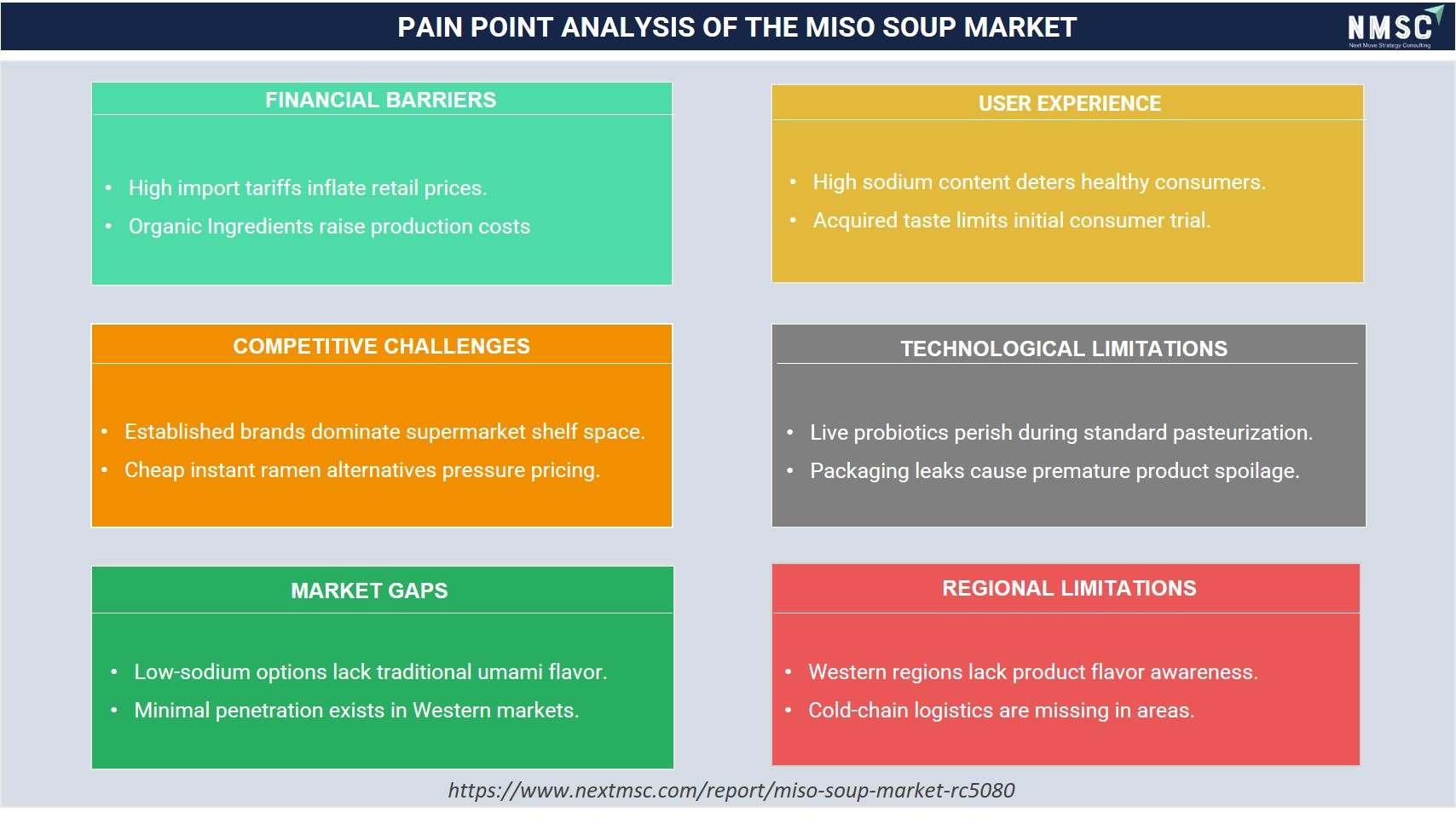
The Miso Soup Market faces several challenges that may limit its growth and adoption. Financial barriers such as import tariffs and the higher cost of organic ingredients contribute to elevated retail prices. Consumer adoption is further constrained by concerns over high sodium content and unfamiliar taste profiles. Competitive pressure from established soup brands and low-cost instant meal alternatives affects market penetration. Additionally, technological issues related to probiotic preservation and packaging durability, along with limited awareness and distribution infrastructure in Western markets, create barriers to broader market expansion
Competitive Landscape
Competitive Dynamics and M&A Landscape
|
Key Takeaways |
Details |
|
Market Structure |
Moderately consolidated at the top, with Marukome Co., Ltd. and Hikari Miso Co., Ltd. leading domestically in Japan; fragmented internationally with regional specialty brands competing alongside global Japanese food importers. |
|
Innovation Focus |
Functional wellness formulations, freeze-dried premium variants, low-sodium reformulations, plant-based and vegan-certified products, sustainable packaging innovation, and halal-certified formulations for Middle East market access. |
|
M&A Activity |
Strategic acquisitions and joint ventures remain limited; however, international food conglomerates are increasingly exploring partnership arrangements with Japanese miso producers for market entry into North America and European specialty food channels. |
How Do Companies Compete in the Miso Soup Market?
NMSC's analysis indicates that competition in the Miso Soup Market is structured around brand heritage, product quality, ingredient provenance, and distribution network strength. Japanese domestic market leaders including Marukome Co., Ltd. and Hikari Miso Co., Ltd. compete primarily on scale, product range breadth, and retail distribution coverage across Japan's competitive grocery channel. In international markets, competition centers on organic certification, clean-label positioning, and specialty food retail access. Pricing strategies range from mass-market value positioning for instant formats to significant premium pricing for artisanal freeze-dried and functional wellness variants targeting health-conscious consumers in North America and Europe.
Which Kind of Companies Dominate the Miso Soup Market?
The Miso Soup Market is dominated by established Japanese fermented food manufacturers with deep fermentation expertise, extensive domestic distribution infrastructure, and strong brand recognition rooted in decades of consumer trust. Based on our market evaluation, we noticed that companies including Marukome Co., Ltd., Hikari Miso Co., Ltd., Hanamaruki Foods Inc., and Miyasaka Jozo Co., Ltd. collectively hold the largest shares of the Japanese domestic market. International specialty food companies including Clearspring Ltd. and Edward and Sons Trading Co., Inc. are the primary players serving health-conscious and organic-oriented consumers across North American and European specialty food markets.
Differentiation and Open Standards Drive Market Success in the Miso Soup Market
From our research, we found that market success in the Miso Soup Market is increasingly determined by a brand's ability to differentiate through authentic fermentation heritage, functional ingredient innovation, clean-label certification, and culturally relevant product storytelling. Companies investing in organic certification, non-GMO verification, reduced-sodium formulations, and traceable ingredient sourcing are achieving superior shelf positioning in premium retail channels. Open standard certifications such as USDA Organic, EU Organic, and non-GMO Project verification serve as trusted quality signals that facilitate product acceptance across health food retail networks globally without requiring extensive consumer education investment.
Market Players to Opt for Strategic Partnerships to Expand Presence in the Miso Soup Market
Our assessment indicates that strategic partnership activity is emerging as a key market expansion mechanism within the Miso Soup Market, particularly for Japanese manufacturers seeking accelerated international distribution access without the capital intensity of building proprietary international sales infrastructure. Co-manufacturing arrangements, private label partnerships with international natural food brands, and exclusive distribution agreements with specialty food importers are the most prevalent strategic models. Geographic licensing arrangements enabling local production of authentic miso soup recipes are also under consideration by several leading manufacturers to address fresh miso soup demand in the foodservice sector across North America and Europe.
Who Are the Key Market Players in the Miso Soup Market?
-
Marukome Co., Ltd.
-
Hikari Miso Co., Ltd.
-
Hanamaruki Foods Inc.
-
Miyasaka Jozo Co., Ltd.
-
Asahi Group Holdings, Ltd.
-
Nagatanien Holdings Co., Ltd.
-
Yamasa Corporation
-
S&B Foods Inc.
-
Ajinomoto Co., Inc.
-
Kikkoman Corporation
-
Shinsyu-ichi Miso Co., Ltd.
-
Marukawamiso Co., Ltd.
-
Asahimatsu Foods Co., Ltd.
-
Clearspring Ltd.
-
Edward and Sons Trading Co., Inc.
-
Rokko Miso Co., Ltd.
-
Muso Co., Ltd.
-
Mitoku Company, Ltd.
-
Spiral Foods Pty Ltd
-
Summus Food
What Are the Latest Developments in the Miso Soup Industry?
|
Date |
Event |
|
Jan 2026 |
Hikari Miso Co., Ltd. launched “TAMPAKU Miso Soup”, a high-protein instant miso soup containing 10g of protein per serving, targeting health-conscious consumers and functional food demand. |
|
October 2025 |
Hikari Miso Co., Ltd. introduced “KANTAN Miso Soup Original 3 Servings” for overseas markets, beginning with Thailand and supporting broader Asian and African expansion plans. |
|
July 2025 |
Hikari Miso Co., Ltd. relaunched “YUKI SODACHI Miso Soup” with product upgrades, strengthening its organic instant miso soup portfolio. |
What Are the Investment Opportunities in the Miso Soup Market?
Capital Inflows and Strategic Investment Themes
The Miso Soup Market presents targeted capital deployment opportunities for strategic investors focused on the intersection of Japanese food culture, functional wellness, and global specialty food distribution. From our research, we found that private investment activity in premium fermented food brands is accelerating, particularly in North America where health food venture ecosystems are well-developed. Investment theses centered on functional ingredient innovation, organic certification infrastructure, and e-commerce brand development represent compelling value creation pathways within the market through the 2025 to 2035 forecast period.
Infrastructure and Distribution Investment
Distribution infrastructure investment represents a high-priority strategic opportunity in the Miso Soup Market, particularly in regions including Southeast Asia, Latin America, and the Middle East where specialty food retail penetration remains limited. Our assessment indicates that investment in cold chain logistics, specialty food import and distribution networks, and e-commerce marketplace integration is required to unlock consumer demand in these high-growth emerging markets. Co-manufacturing agreements and regional production investment in markets including Australia, the United Kingdom, and the United States would enable manufacturers to reduce import costs, improve shelf-life management, and accelerate retail distribution scale.
ESG and Sustainability Considerations
Environmental, social, and governance considerations are becoming increasingly material to investment decision-making within the Miso Soup Market. From our market assessment, we observed that miso soup's inherent sustainability attributes, including plant-based protein sourcing, traditional fermentation processes with minimal energy footprint, and long shelf-life properties that reduce food waste, provide a favorable ESG narrative for both producers and investors. Sustainable packaging innovation, including reduction of single-use plastics and transition to compostable or recyclable sachet materials, is a growing investment priority. Japan's Ministry of Environment has published guidelines on sustainable food system transitions that directly influence regulatory expectations for food manufacturers.
Digital Transformation and Direct-to-Consumer Opportunities
Digital transformation and direct-to-consumer channel development represent among the highest-return investment themes within the Miso Soup Market. Based on NMSC's research, we found that miso soup brands investing in branded e-commerce platforms, subscription model infrastructure, and digital content marketing strategies targeting health-conscious consumers are achieving superior customer lifetime value and reduced dependence on traditional retail margin structures. Social commerce platforms in China and Southeast Asia, including WeChat and TikTok Shop, are creating new consumer acquisition channels for specialty miso soup brands seeking rapid market penetration in digital-first consumer markets across Asia-Pacific.
Key Benefits for Stakeholders
For Food & Beverage Manufacturers and Product Developers
Food and beverage manufacturers gain comprehensive, vendor-neutral insights into the Miso Soup Market, including quantitative market sizing across product types, packaging formats, distribution channels, and consumer segments. This intelligence supports product portfolio planning, ingredient sourcing strategies, and long-term investment decisions in fermented food categories. Our competitive landscape analysis enables manufacturers to benchmark product positioning, pricing strategies, and innovation pipelines while identifying opportunities for premium, organic, and functional miso soup offerings.
For Investors and Financial Analysts
Investors and financial analysts gain access to a structured, data-driven assessment of the Miso Soup Market's growth outlook, competitive environment, M&A activity, and segment-level revenue forecasts through 2035. CAGR analysis across product categories, distribution channels, regions, and consumer demographics supports informed valuation and portfolio decisions. Detailed company profiles and development tracking provide early indicators of emerging brands, expansion opportunities, strategic partnerships, and competitive shifts within the global miso soup industry.
For Miso Soup Manufacturers, Ingredient Suppliers, and Retailers
Miso soup manufacturers, ingredient suppliers, and retail retailers gain actionable intelligence on growth opportunities, evolving consumer preferences, and high-potential market segments within the Miso Soup Market. Product type and formulation analysis highlights demand trends for organic, low-sodium, instant, and functional miso soup products. Regional outlook assessments identify attractive expansion markets based on consumer awareness, dietary trends, and retail penetration. Distribution channel analysis helps companies optimize sales strategies across supermarkets, specialty stores, foodservice outlets, e-commerce platforms, and direct-to-consumer channels.
For Government Agencies and Food Industry Organizations
Government agencies, food industry associations, and trade organizations gain a structured understanding of the factors shaping the Miso Soup Market, including food safety regulations, labeling requirements, sustainability initiatives, and evolving consumer nutrition preferences. Country-level analysis provides evidence-based insights into the impact of regulatory frameworks on fermented food production, international trade, and market development. The study also supports policy evaluation related to food innovation, healthy eating initiatives, traditional food preservation, and sustainable agricultural supply chains.
Key Market Segments
By Product Format
-
Instant Miso Soup
-
Powder Sachet
-
Paste Sachet
-
Block Type
-
Granule Type
-
-
Freeze-Dried Miso Soup
-
Standard Freeze-Dried
-
Premium Freeze-Dried
-
Functional Freeze-Dried
-
-
Cup Miso Soup
-
Standard Cup
-
Premium Cup
-
Meal Cup
-
-
Ready-To-Serve Miso Soup
-
Refrigerated
-
Ambient Shelf-Stable
-
-
Frozen Miso Soup
-
Single Portion
-
Multi Portion
-
-
Ready-To-Drink Miso Soup
-
Bottled
-
Canned
-
-
Foodservice-Prepared Miso Soup
-
Quick Service Restaurant
-
Full Service Restaurant
-
Institutional Catering
-
Retail Foodservice
-
By Miso Base Type
-
White Miso
-
Red Miso
-
Mixed Miso
-
Specialty Miso
By Ingredient Profile
-
Traditional
-
Seafood
-
Vegetable
-
Protein-Enriched
-
Functional
-
Other Specialty Recipes
By Consumer Positioning
-
Mainstream
-
Premium
-
Organic
-
Natural
-
Functional Wellness
-
Gourmet Specialty
By Packaging
-
Single Serve
-
Multi Serve
-
Bulk
By Distribution Channel
-
Retail Offline
-
Retail Online
-
Foodservice
-
Institutional
By End User
-
Household
-
Foodservice Operators
-
Institutional Buyers
-
Industrial Meal Providers
By Region
-
North America: U.S., Canada, and Mexico.
-
Europe: UK, Germany, France, Italy, Spain, Sweden, Denmark, Finland, the Netherlands, and the rest of Europe.
-
Asia Pacific: China, India, Japan, South Korea, Taiwan, Indonesia, Vietnam,, Australia, Philippines, Malaysia and the rest of APAC.
-
Middle East & Africa (MEA): Saudi Arabia, UAE, Egypt, Israel, Turkey, Nigeria, South Africa, and the rest of MEA.
-
Latin America: Brazil, Argentina, Chile, Colombia, and the rest of LATAM.
Conclusion and Recommendations
Long-Term Outlook
The Miso Soup Market is entering a decade of measured but commercially meaningful growth, driven by global Japanese cuisine adoption, fermented food wellness trends, functional ingredient innovation, and expanding digital distribution infrastructure. The market is forecast to grow from USD 2.7 billion in 2026 to USD 3.6 billion by 2035, at a CAGR of 3.4%. NMSC's analysis indicates that this growth reflects both the continued strength of domestic Japanese market demand and the accelerating international adoption of miso soup as a premium health food product across North America, Europe, and emerging Asia-Pacific markets.
Strategic Positioning Recommendations
Manufacturers should prioritize functional wellness product development as the highest-growth commercial opportunity within the Miso Soup Market through the 2025 to 2035 forecast period. Investment in organic certification, clean-label reformulation, and reduced-sodium product lines will be essential for competitive positioning in North American and European specialty food channels. Brands targeting international markets should develop culturally adapted marketing narratives that connect miso soup's Japanese heritage with contemporary health food trends resonant with local consumer motivations. E-commerce channel investment and direct-to-consumer digital infrastructure represent strategic priorities for brands seeking to accelerate international market penetration.
Investment Attractiveness
The Miso Soup Market represents a compelling niche investment opportunity for investors focused on the premium specialty food sector, functional fermented food brands, and Japanese food culture globalization themes. The highest-conviction investment themes identified through our analysis include functional wellness miso soup formulations growing at a CAGR of 7.6%, freeze-dried premium formats expanding at 5.3% CAGR, online retail channels advancing at 8.4% CAGR, and emerging market development in India at 8.8% CAGR. These sub-segments offer disproportionate returns relative to the overall market growth rate.
Market Shifts and Key Risks
The most significant market shift underway is the migration from commodity instant miso soup toward premium, functional, and artisanal product positioning, which is compressing volume growth while expanding average selling prices and gross margins. Key risks for the Miso Soup Market include sodium content regulatory escalation constraining traditional product formulations, intensifying private label competition in mainstream retail channels, ingredient cost volatility related to soybean commodity pricing, and consumer unfamiliarity barriers limiting market development in emerging regions. Currency fluctuations affecting Japanese export product pricing represent an additional risk for internationally distributed brands.
Growth Pathways
Organizations seeking to maximize value from the Miso Soup Market should pursue a three-horizon growth strategy. In the near term from 2025 to 2027, prioritize sodium reduction reformulation and organic certification to strengthen positioning in health food retail channels. In the mid-term from 2027 to 2031, invest in functional ingredient innovation, freeze-dried premium line extension, and e-commerce channel development to capture the highest-growth market segments identified in this report. In the long term from 2031 to 2035, position for emerging market development in India, Southeast Asia, and Latin America as consumer familiarity with miso soup reaches critical mass supported by expanding Japanese food culture globalization.
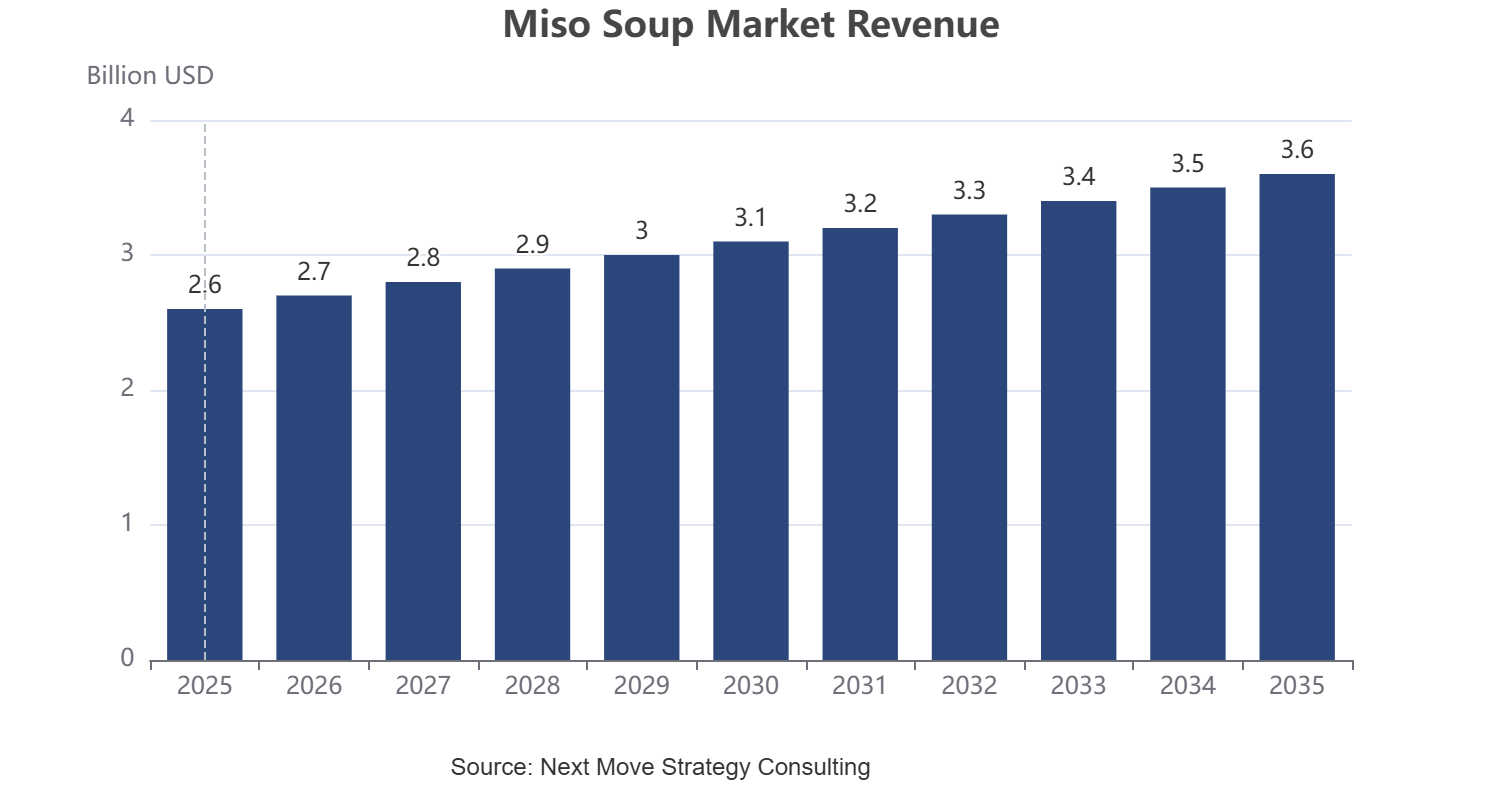
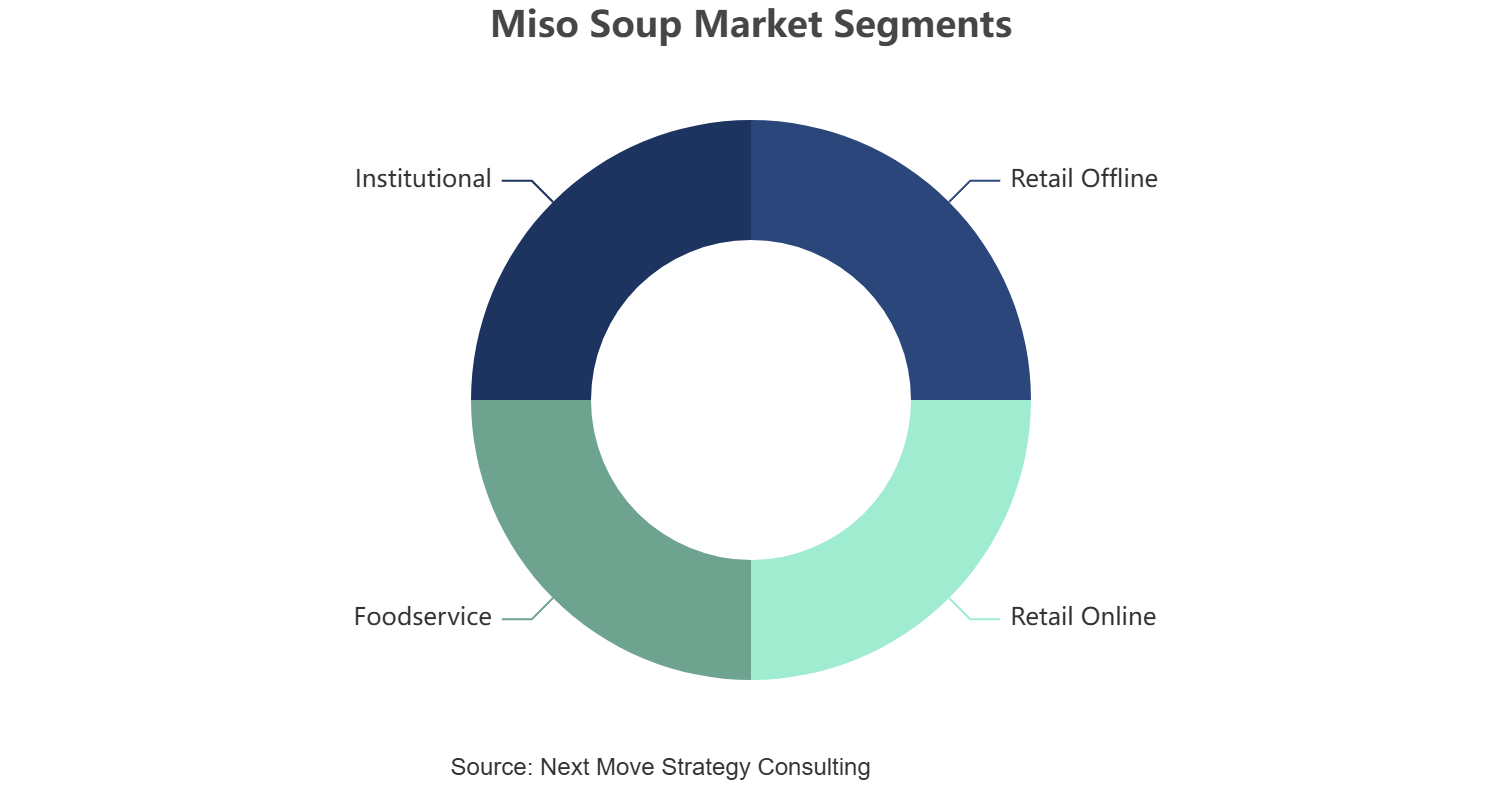
About the Author
 Mihul Sharma
— Mihul Sharma is Research Associate at Next Move Strategy Consulting, where he has covered technology, industrial, and healthcare markets for 3 years. His work applies structured business research, market analysis, and secondary-source review to assess market trends, competitive developments, and growth opportunities. He supports report development by fully synthesizing industry data, company information, and market signals into concise findings for strategy and investment-focused research teams.
Mihul Sharma
— Mihul Sharma is Research Associate at Next Move Strategy Consulting, where he has covered technology, industrial, and healthcare markets for 3 years. His work applies structured business research, market analysis, and secondary-source review to assess market trends, competitive developments, and growth opportunities. He supports report development by fully synthesizing industry data, company information, and market signals into concise findings for strategy and investment-focused research teams.
About the Reviewer
 Supradip Baul
— Supradip Baul is an accomplished business consultant and strategist with over a decade of rich experience in market intelligence, strategy, technology, and business transformation. His work has included rigorous qualitative and quantitative analysis across multiple industries, helping clients shape investment decisions and long-term roadmaps. Earlier in his career, he was associated with Gartner, where he contributed to industry-leading reports and market share analyses. He has worked with leading global companies and holds an MBA with a dual specialization in Marketing and Finance.
Supradip Baul
— Supradip Baul is an accomplished business consultant and strategist with over a decade of rich experience in market intelligence, strategy, technology, and business transformation. His work has included rigorous qualitative and quantitative analysis across multiple industries, helping clients shape investment decisions and long-term roadmaps. Earlier in his career, he was associated with Gartner, where he contributed to industry-leading reports and market share analyses. He has worked with leading global companies and holds an MBA with a dual specialization in Marketing and Finance.
At Next Move Strategy Consulting, we understand that insightful market research is the cornerstone of successful business decisions. That's why we employ a robust and multifaceted approach, combining various methodologies to deliver the most accurate and actionable data for our clients.

Research Landscape
We navigate the world of research with two primary approaches:
Qualitative Approach
Our qualitative research methodologies involve immersive techniques such as in-depth interviews, focus groups, and observational studies. By engaging directly with individuals and stakeholders, we uncover valuable insights that quantitative data alone may overlook.

Quantitative Research
In tandem with qualitative methodologies, NMSC leverages the power of Quantitative Research to provide a robust foundation of numerical insights. Through systematic data collection and analysis, we quantify patterns, preferences, and market trends, offering a comprehensive view of the business landscape.
Our quantitative research approach employs diverse tools, including surveys, experiments, and statistical modelling. These methodologies enable us to gather data from a large and representative sample, ensuring the statistical significance of our findings. By employing structured questionnaires and standardized data collection methods, we guarantee the reliability and validity of the information we present to our clients.
Quantitative research is particularly effective in measuring the prevalence of trends, assessing market size, and gauging the impact of various factors on consumer behavior. The numerical precision attained through this approach equips our clients with actionable insights, facilitating data-driven decision-making and strategy formulation.


Our Specialized Toolbox for Industry-Specific Market Research
We deploy a specialized arsenal of techniques tailored to meet your unique requirements. Here's a glimpse into our comprehensive toolbox:

Information Procurement
The stage entails acquiring market data or relevant information through various sources and methodologies.


Market Research Approach
We utilize both top-down and bottom-up approaches in market research analysis to achieve a comprehensive understanding of the market dynamics, leveraging the broad perspective of industry trends and macroeconomic factors alongside detailed insights from specific segments and individual companies.

Porters Five Forces Analysis
We conduct Porter's Five Forces analysis to evaluate the competitive landscape of an industry, providing us with insights into factors that affect profitability and strategic positioning.

SWOT Analysis

Forecasting
We utilize a forecasting model to predict future consumption by considering parameters like population, economics, regulations, market competition, drivers, constraints, technology, and pricing. We also employ statistical techniques such as multilinear regression, exponential smoothing, moving average, ARIMA, and Monte Carlo simulations for accurate predictions. In econometric forecasting, we analyzed short-term and long-term event impacts, attributing values based on regulatory frameworks, economic factors, and market events.





 Speak to Our Analyst