Plug Flow Reactor Market Size, Share, Trends and Growth Analysis, By Product Type (Tubular Reactor, Microreactor, Packed Bed Reactor, Oscillatory Plug Flow Reactor, Static Mixer Reactor, Photochemical Plug Flow Reactor, Electrochemical Plug Flow Reactor, Rotating Tube Reactor, and Other Reactor Types), By Material of Construction, By Scale, By Operating Pressure, By Revenue Stream, By Sales Channel, By End-Use Industry, and Region – Global Industry Report and Forecast, 2026–2035
Industry: Materials and Chemical | Publishing Date: July 20, 2026 | Last Updated: September 30, 2026 | No of Pages: N/A | No. of Tables: N/A | No. of Figures: N/A | Format: PDF | Report Code: MC5248
What Is the Plug Flow Reactor Market Size?
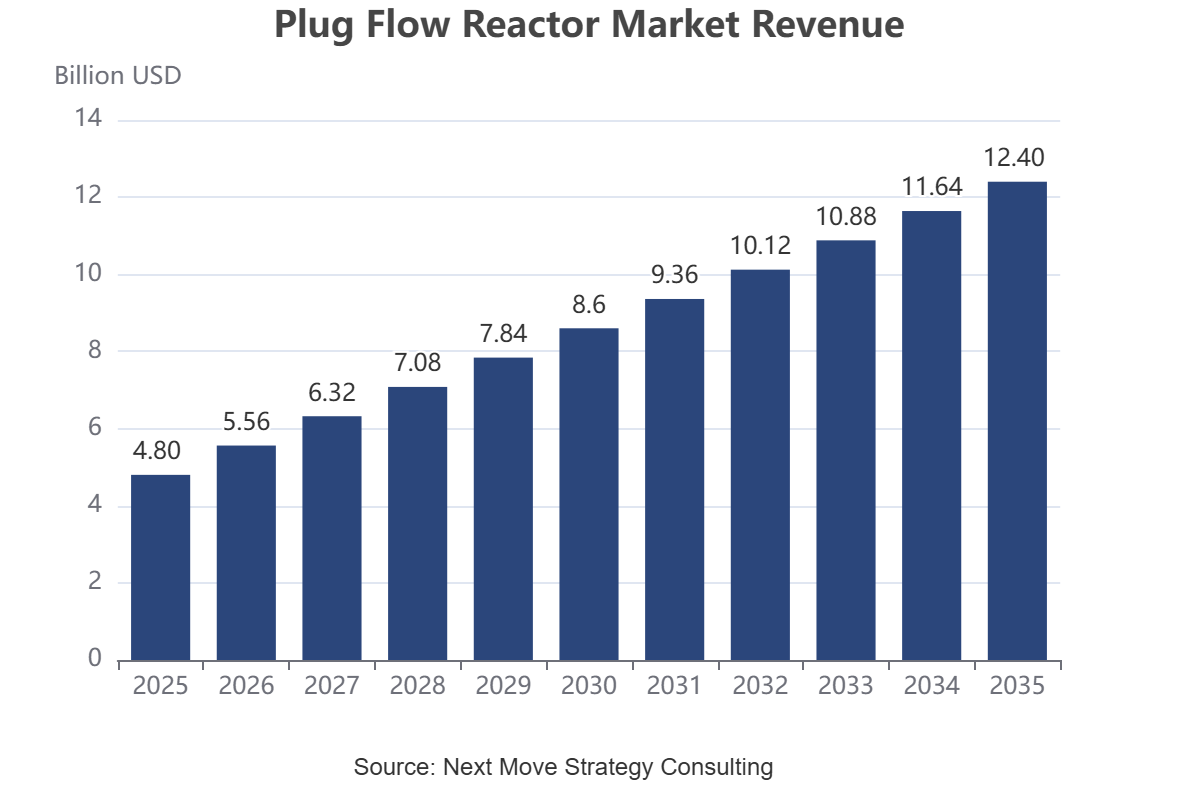
The global plug flow reactor market size was valued at USD 4.80 billion in 2025 and is estimated at USD 5.22 billion in 2026, forecast to reach USD 12.40 billion by 2035, expanding at a 10.1% CAGR between 2026 and 2035. Europe leads with approximately 34% share, while Tubular Reactor dominates all other product types with approximately 36% share.
We observed that the growth is broad-based across every segmentation axis, with silicon carbide reactor materials and pharmaceutical continuous manufacturing adoption driving the dominant structural shifts through 2035.
|
Key Takeaways |
|
By Product Type: Tubular Reactor held the largest share of approximately 36% (USD 1.73 billion) in 2025; Microreactor is the fastest-growing sub-segment at 13.5% CAGR from 2026–2035. |
|
By Material of Construction: Stainless Steel held the largest share of approximately 42% (USD 2.02 billion) in 2025; Silicon Carbide is the fastest-growing sub-segment at 15.5% CAGR from 2026–2035. |
|
By Scale: Production Scale held the largest share of approximately 50% (USD 2.40 billion) in 2025; Laboratory Scale is the fastest-growing sub-segment at 12.0% CAGR from 2026–2035. |
|
By Operating Pressure: Atmospheric Pressure held the largest share of approximately 48% (USD 2.31 billion) in 2025; High Pressure is the fastest-growing sub-segment at 12.6% CAGR from 2026–2035. |
|
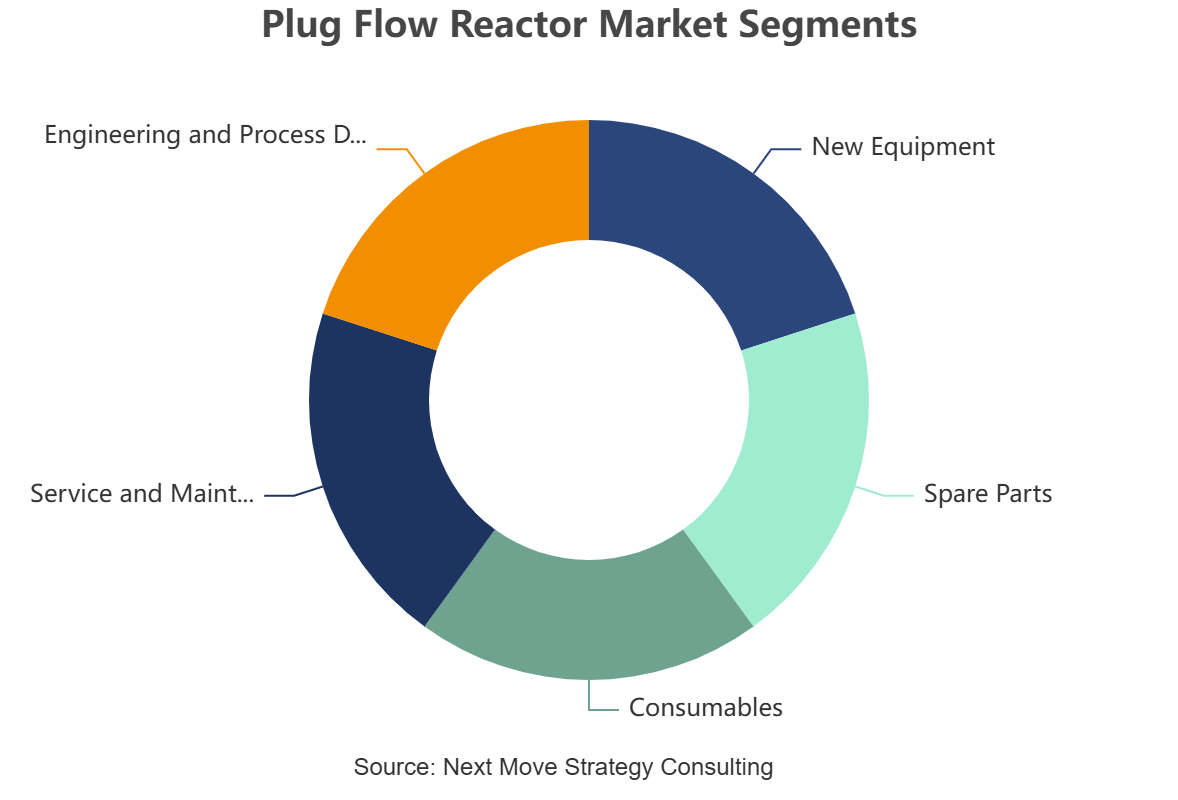
By Revenue Stream: New Equipment held the largest share of approximately 46% (USD 2.20 billion) in 2025; Engineering and Process Development is the fastest-growing sub-segment at 13.1% CAGR from 2026–2035. |
|
By Sales Channel: Direct Sales held the largest share of approximately 52% (USD 2.50 billion) in 2025; OEM Partner is the fastest-growing sub-segment at 13.2% CAGR from 2026–2035. |
|
By End-Use Industry: Petrochemical held the largest share of approximately 28% (USD 1.34 billion) in 2025; Pharmaceutical is the fastest-growing sub-segment at 12.2% CAGR from 2026–2035. |
|
Dominant Region: Europe dominated with approximately 34% revenue share (USD 1.63 billion) in 2025. |
|
Fastest-Growing Region: Asia-Pacific is expected to register the highest CAGR of 12.0% during 2026–2035. |
|
Dominant Country: U.S. led with approximately USD 1.01 billion in 2025. |
|
Fastest-Growing Country: India is the fastest-growing country at approximately 14.1% CAGR from 2026–2035. |
Market Opportunity: The plug flow reactor market is expected to create an absolute dollar opportunity of USD 7.18 billion between 2026 and 2035, presenting significant investment potential across the continuous manufacturing and flow chemistry equipment value chain.
According to NMSC analysis, pharmaceutical and specialty chemical manufacturers are increasingly standardizing on silicon carbide and high-performance alloy reactor modules to support multi-product continuous manufacturing lines, a shift that favors equipment suppliers with validated materials portfolios over single-material specialists as regulatory scrutiny of continuous processes intensifies through 2035.
What Does the Plug Flow Reactor Market Encompass?
The plug flow reactor market encompasses tubular, microreactor, packed bed, oscillatory, static mixer, photochemical, electrochemical, and rotating tube reactor systems that process fluids in a continuous, ordered stream rather than a mixed batch volume. We observed that the scope spans laboratory, pilot, and production-scale equipment constructed from stainless steel, high-performance alloys, borosilicate glass, silicon carbide, and fluoropolymer materials, supplied alongside spare parts, consumables, and engineering services to pharmaceutical, petrochemical, polymer, and specialty chemical manufacturers. The category has evolved from single-purpose industrial tubular reactors into modular, digitally monitored platforms supporting multi-product continuous manufacturing.
Regulatory frameworks such as the U.S. Food and Drug Administration's ICH Q13 guidance on continuous manufacturing and the European Medicines Agency's parallel adoption shape validation pathways for reactor-based production of drug substances and drug products. We observed that technology adoption is shifting from single-material stainless steel systems toward silicon carbide and high-performance alloy reactors that withstand corrosive, high-pressure, and photochemical processes. NMSC's analysis indicates that this convergence of regulatory encouragement and materials innovation is redefining how pharmaceutical, petrochemical, and specialty chemical producers plan capital investment and process validation.
|
Parameters |
Details |
|
Market Size in 2025 |
USD 4.80 Billion |
|
Market Size in 2026 |
USD 5.22 Billion |
|
Revenue Forecast in 2035 |
USD 12.40 Billion |
|
Growth Rate |
CAGR of 10.1% from 2026 to 2035 |
|
Analysis Period |
2025–2035 |
|
Base Year Considered |
2025 |
|
Forecast Period |
2026–2035 |
|
Market Size Estimation |
Revenue (USD Billion) |
|
Companies Profiled |
20 |
|
Countries Covered |
33 |
|
Market Share |
Available for Top 10 Companies |
Key Emerging Trends
We observed that four structural trends are reshaping equipment design, service models, and stakeholder engagement across the plug flow reactor Market.
How Is Silicon Carbide Reactor Technology Enabling Industrial-Scale Continuous Manufacturing?
Silicon carbide construction is extending continuous flow processing from laboratory feasibility to industrial-scale production. We observed that Corning Incorporated's Advanced-Flow G4 silicon carbide reactor supported a commercial-scale continuous production run of active pharmaceutical ingredients with Medichem S.A., while Nanjin Refinery Co. Ltd. installed a comparable system for an industrial nitration process in China. Equipment suppliers are positioning silicon carbide modules as the preferred material for corrosive, high-temperature reactions that stainless steel and glass systems cannot reliably support at production scale.
Why Are Pharmaceutical Companies Adopting AI-Assisted Flow Reactor Design?
Artificial intelligence tools are shortening the path from bench-scale reaction discovery to validated continuous processes. Based on research conducted by NMSC, we found that Vapourtec Ltd. launched Reac-Discovery, an artificial intelligence-driven platform for continuous-flow catalytic reactor discovery and optimization, in December 2025. Process chemists are using these tools to screen reaction conditions computationally before committing bench time, reducing the experimental burden of reactor and catalyst selection across academic and industrial flow chemistry programs.
How Is Continuous Oscillatory Baffled Reactor Technology Expanding Beyond Its Origins?
Continuous oscillatory baffled reactor technology is moving from specialty crystallization applications into broader reaction engineering use. We observed that NiTech Solutions Ltd. offers its COBR and COBC platforms across the DN15 to DN60 scale range, while Cambridge Reactor Design Ltd. commercializes its Rattlesnake continuous flow reactor built on the same oscillatory baffled principle. Our findings suggest that this technology's ability to decouple mixing from net flow is attracting interest from manufacturers seeking longer residence times without the footprint of conventional stirred tank reactors.
What Role Do Reactor-as-a-Service Models Play in Flow Chemistry Adoption?
Equipment suppliers are increasingly bundling process development services with reactor hardware rather than selling equipment alone. We observed that Corning Incorporated launched its Advanced Flow Pharmaceutical Technology services business in 2023 to help contract development and manufacturing organizations and pharmaceutical companies develop flow processes for key starting materials and active pharmaceutical ingredients. Our assessment indicates that this services-led model lowers the technical barrier for manufacturers transitioning from batch to continuous production without in-house flow chemistry expertise.
Growth Drivers and Restraints
Growth Catalyst and Risk Assessment Matrix
|
Factors |
Type |
(+/−) % Impact on CAGR |
Geographic Relevance |
Impact Timeline |
|
ICH Q13 continuous manufacturing regulatory adoption across FDA, EMA, and PMDA |
Driver |
+2.4% |
North America, Europe, Asia-Pacific |
2026–2035 |
|
Expansion of petrochemical and polymer production capacity in Asia-Pacific |
Driver |
+2.0% |
Asia-Pacific |
2026–2035 |
|
Rising pharmaceutical outsourcing of continuous API manufacturing to CDMOs |
Driver |
+1.8% |
North America, Europe |
2026–2035 |
|
Growing adoption of silicon carbide and high-performance alloy reactor materials |
Driver |
+1.6% |
Global |
2026–2035 |
|
Government incentive programs for domestic API and specialty chemical manufacturing |
Driver |
+1.4% |
Asia-Pacific, North America |
2026–2032 |
|
Increasing use of AI-assisted reactor design and optimization software |
Driver |
+1.3% |
Global |
2026–2032 |
|
High capital cost of production-scale continuous flow installations |
Restraint |
-1.2% |
Global |
2026–2035 |
|
Technical complexity of retrofitting batch facilities to continuous operation |
Restraint |
-1.0% |
North America, Europe |
2026–2032 |
|
Limited standardization across microreactor and flow chemistry platforms |
Restraint |
-0.8% |
Global |
2026–2032 |
What Is the Primary Growth Driver of This Market?
Regulatory harmonization around continuous manufacturing is the primary driver of the market. The U.S. Food and Drug Administration issued its final ICH Q13 guidance, Continuous Manufacturing of Drug Substances and Drug Products, in March 2023, clarifying the scientific and regulatory pathway for adopting continuous processes across chemical and biological drug production. We observed that the European Medicines Agency adopted a parallel effective date in July 2023, reinforcing global regulatory confidence in reactor-based continuous manufacturing among pharmaceutical and fine chemical producers.
How Is Pharmaceutical Outsourcing Driving Market Growth?
Growing pharmaceutical outsourcing of continuous manufacturing programs is accelerating reactor demand among contract development and manufacturing organizations. Our assessment indicates that Corning Incorporated's collaboration with Curia, which included the first installation of Corning's G1 production system, illustrates how CDMOs are investing directly in flow reactor infrastructure to serve pharmaceutical clients. We found that this outsourcing model is extending continuous manufacturing adoption to mid-sized pharmaceutical companies that lack the capital to build dedicated in-house continuous processing lines.
What Is Restraining Market Growth?
The high capital cost of production-scale continuous flow installations restrains broader market adoption, particularly among small and mid-sized specialty chemical producers. We found that retrofitting existing batch facilities for continuous operation requires significant process redevelopment and validation work, slowing conversion timelines even where regulatory pathways are established. Our analysis shows that limited standardization across microreactor and flow chemistry platforms compounds this restraint, as manufacturers must often commit to a single supplier's proprietary module architecture for multi-year production programs.
Segmentation Analysis
Segment Sizing: By Product Type
|
Segment |
2025 (USD) |
2035 (USD) |
CAGR% (2026–2035) |
|
Tubular Reactor |
USD 1.73 Billion |
USD 4.21 Billion |
9.3% |
|
Microreactor |
USD 0.77 Billion |
USD 2.73 Billion |
13.5% |
|
Packed Bed Reactor |
USD 0.91 Billion |
USD 2.11 Billion |
8.8% |
|
Oscillatory Plug Flow Reactor |
USD 0.34 Billion |
USD 0.81 Billion |
9.1% |
|
Static Mixer Reactor |
USD 0.43 Billion |
USD 0.99 Billion |
8.7% |
|
Photochemical Plug Flow Reactor |
USD 0.24 Billion |
USD 0.56 Billion |
8.8% |
|
Electrochemical Plug Flow Reactor |
USD 0.14 Billion |
USD 0.47 Billion |
12.9% |
|
Rotating Tube Reactor |
USD 0.14 Billion |
USD 0.31 Billion |
8.3% |
|
Other Reactor Type |
USD 0.10 Billion |
USD 0.21 Billion |
7.7% |
|
Total |
USD 4.80 Billion |
USD 12.40 Billion |
10.1% |
Which Product Type Segment Dominates the Market?
Tubular Reactor led the market with USD 1.73 billion in 2025, reflecting its established role in large-scale petrochemical and polymer production where straight, coiled, jacketed, and multi-tubular configurations handle high-volume continuous throughput. We observed that Microreactor is the fastest-growing product type, expanding at a 13.5% CAGR from 2026 to 2035, as chip-based, plate-based, and capillary microreactors gain adoption in pharmaceutical process development. Manufacturers increasingly pair large tubular installations with modular microreactor units to support both bulk and specialty production lines.
Segment Sizing: By End-Use Industry
|
Segment |
2025 (USD) |
2035 (USD) |
CAGR% (2026–2035) |
|
Petrochemical |
USD 1.34 Billion |
USD 3.10 Billion |
8.7% |
|
Polymer |
USD 0.96 Billion |
USD 2.23 Billion |
8.8% |
|
Pharmaceutical |
USD 0.86 Billion |
USD 2.73 Billion |
12.2% |
|
Fine Chemical |
USD 0.58 Billion |
USD 1.61 Billion |
10.7% |
|
Specialty Chemical |
USD 0.53 Billion |
USD 1.49 Billion |
10.9% |
|
Food and Beverage |
USD 0.24 Billion |
USD 0.62 Billion |
10.0% |
|
Academic and Government Research |
USD 0.19 Billion |
USD 0.37 Billion |
6.9% |
|
Other Industry |
USD 0.10 Billion |
USD 0.25 Billion |
9.6% |
|
Total |
USD 4.80 Billion |
USD 12.40 Billion |
10.1% |
Which End-Use Industry Leads Plug Flow Reactor Adoption?
Petrochemical remained the leading end-use industry, valued at USD 1.34 billion in 2025 on the strength of large-scale cracking, reforming, and nitration processes that rely on high-throughput tubular reactors. Our findings suggest that Pharmaceutical is the fastest-growing end-use industry, registering a 12.2% CAGR from 2026 to 2035, as ICH Q13 regulatory clarity accelerates continuous manufacturing adoption for active pharmaceutical ingredients across both branded and generic drug production.
Segment Sizing: By Material of Construction
|
Segment |
2025 (USD) |
2035 (USD) |
CAGR% (2026–2035) |
|
Stainless Steel |
USD 2.02 Billion |
USD 4.71 Billion |
8.8% |
|
Borosilicate Glass |
USD 0.77 Billion |
USD 1.86 Billion |
9.2% |
|
Hastelloy and High-Performance Alloy |
USD 0.72 Billion |
USD 1.74 Billion |
9.2% |
|
PTFE and Fluoropolymer |
USD 0.58 Billion |
USD 1.49 Billion |
9.9% |
|
Silicon Carbide |
USD 0.38 Billion |
USD 1.61 Billion |
15.5% |
|
Quartz |
USD 0.19 Billion |
USD 0.62 Billion |
12.6% |
|
Other Material |
USD 0.14 Billion |
USD 0.37 Billion |
10.2% |
|
Total |
USD 4.80 Billion |
USD 12.40 Billion |
10.1% |
Which Material of Construction Underpins the Largest Market Share?
Stainless Steel underpinned the largest material share, reaching USD 2.02 billion in 2025, as the standard construction material for general-purpose reactors across petrochemical and polymer production. Based on research conducted by NMSC, we found that Silicon Carbide is the fastest-growing material category, expanding at a 15.5% CAGR from 2026 to 2035, as commercial-scale deployments such as Corning's Advanced-Flow G4 and G5 reactors demonstrate its suitability for corrosive and high-temperature pharmaceutical and fine chemical processes.
Ecosystem Analysis of the Plug Flow Reactor Market
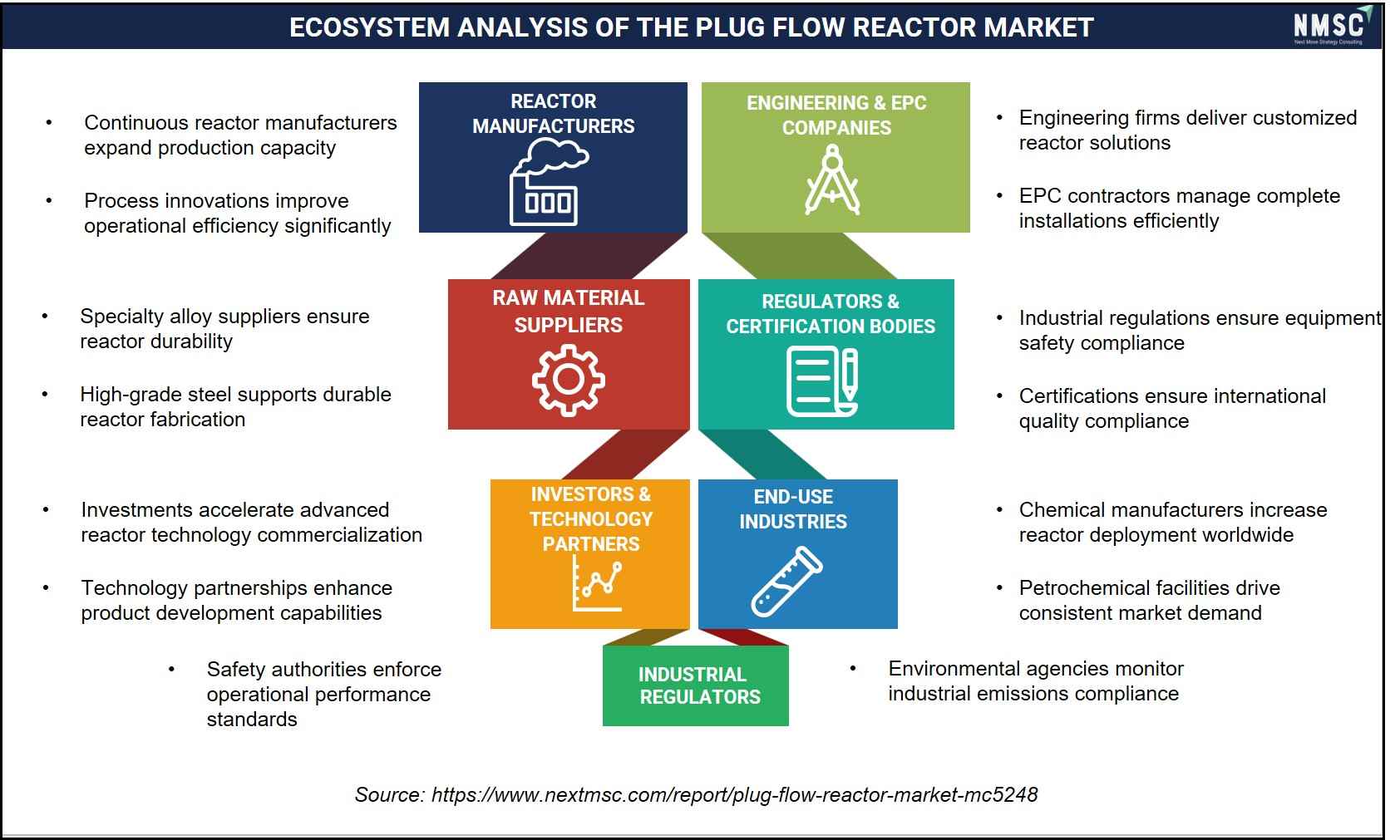
The plug flow reactor market ecosystem comprises raw material suppliers, reactor manufacturers, EPC companies, technology partners, regulatory authorities, and end-use industries working together to accelerate innovation and commercialization. Strategic investments, engineering expertise, and stringent regulatory compliance drive technology advancement, enabling wider deployment of high-performance reactors across chemical processing, petrochemical, and industrial manufacturing applications.
Growth Opportunities
We observed three forward-looking whitespace opportunities that vendors can pursue to capture above-market growth within the plug flow reactor Market.
How Can Suppliers Capture Value from Silicon Carbide Reactor Retrofits?
Pharmaceutical and fine chemical manufacturers converting corrosive or high-temperature processes to continuous operation represent a whitespace opportunity for silicon carbide reactor retrofits. Suppliers that offer modular silicon carbide upgrade paths for existing stainless steel installations can capture premium pricing, benefiting the Silicon Carbide material segment and CDMOs seeking validated hardware for regulatory submissions under ICH Q13 continuous manufacturing pathways.
Where Does AI-Assisted Process Development Create New Service Demand?
AI-assisted reactor design tools create an opportunity for suppliers to bundle computational screening with hardware sales. Vendors that extend platforms similar to Vapourtec's Reac-Discovery into paid process development services can capture recurring revenue beyond one-time equipment purchases, benefiting the Engineering and Process Development revenue stream as pharmaceutical and specialty chemical customers seek faster, lower-risk paths from bench-scale discovery to validated continuous production.
How Can OEM Partnerships Extend Reach in Asia-Pacific Petrochemical Markets?
Asia-Pacific's expanding petrochemical and polymer production capacity presents an opportunity for reactor suppliers to extend reach through OEM partnerships with regional engineering, procurement, and construction contractors. Suppliers that license or co-brand tubular and packed bed reactor designs with established Asia-Pacific plant integrators can accelerate market entry, benefiting the OEM Partner sales channel, which is already the fastest-growing channel tracked in this report.
Regional Outlook
|
Region |
2025 (USD) |
2035 (USD) |
CAGR% (2026–2035) |
Key Driver |
|
North America |
USD 1.30 Billion |
USD 2.98 Billion |
8.6% |
Established pharmaceutical CDMO base and FDA continuous manufacturing guidance |
|
Europe |
USD 1.63 Billion |
USD 3.84 Billion |
8.9% |
Concentration of flow chemistry equipment manufacturers and EMA regulatory alignment |
|
Asia-Pacific |
USD 1.34 Billion |
USD 4.15 Billion |
12.0% |
Expanding petrochemical capacity and government-backed API manufacturing incentives |
|
Middle East & Africa |
USD 0.29 Billion |
USD 0.87 Billion |
11.6% |
Petrochemical capacity expansion and downstream diversification investment |
|
Latin America |
USD 0.24 Billion |
USD 0.56 Billion |
8.8% |
Growing specialty chemical and agrochemical production capacity |
|
Total |
USD 4.80 Billion |
USD 12.40 Billion |
10.1% |
– |
North America Plug Flow Reactor Market Outlook
North America holds a substantial share of the market, anchored by an established pharmaceutical contract development and manufacturing base and active regulatory encouragement of continuous production. We observed that the U.S. Food and Drug Administration's ICH Q13 guidance and its Emerging Technology Team continue to support early adopters of continuous manufacturing among branded and generic drug producers. Technology adoption remains advanced, with reactor suppliers increasingly bundling process development services alongside hardware sales to regional CDMOs.
Europe Plug Flow Reactor Market Outlook
Europe leads the market, supported by a dense concentration of flow chemistry equipment manufacturers across the UK, Germany, and Switzerland alongside European Medicines Agency alignment with ICH Q13 continuous manufacturing guidance. Our findings suggest that this regional manufacturer base, spanning tubular, microreactor, and oscillatory baffled reactor specialists, gives European pharmaceutical and specialty chemical producers close access to equipment innovation and technical support. Regulatory influence remains significant, and competitive intensity is high among domestic reactor technology suppliers.
Asia-Pacific Plug Flow Reactor Market Outlook
Asia-Pacific is the fastest-growing regional market, propelled by expanding petrochemical and polymer production capacity in China alongside government-backed pharmaceutical manufacturing incentives in India. We found that China's installations of industrial-scale continuous flow reactors for nitration and other bulk chemical processes are extending beyond specialty applications into mainstream petrochemical production. Technology adoption is accelerating rapidly from a smaller base than Europe or North America, with domestic engineering contractors increasingly integrating reactor technology into new plant construction.
Middle East and Africa Plug Flow Reactor Market Outlook
The market in Middle East and Africa is expanding as Gulf Cooperation Council economies invest in downstream petrochemical diversification beyond crude oil export. Our analysis shows that Saudi Arabia and the UAE are funding domestic petrochemical and polymer production capacity to capture greater value from feedstock resources, supporting demand for large-scale tubular and packed bed reactor installations. Regulatory influence remains developing, while technology adoption is concentrated among large, capital-backed petrochemical operators.
Latin America Plug Flow Reactor Market Outlook
Latin America's market is supported by growing specialty chemical and agrochemical production capacity across Brazil and Argentina. We observed that expanding domestic chemical manufacturing and rising foreign direct investment in regional production facilities are extending plug flow reactor adoption beyond the largest petrochemical producers. Regulatory frameworks remain less harmonized than in North America or Europe, though multinational equipment suppliers operating locally continue to introduce reactor technology tailored to regional specialty and fine chemical portfolios.
U.S. Plug Flow Reactor Market Outlook
Based on our estimates, the U.S. market was valued at approximately USD 1.01 billion in 2025 and is projected to reach USD 2.27 billion by 2035, growing at a 8.4% CAGR. Demand is anchored by an extensive pharmaceutical CDMO base and active FDA encouragement of continuous manufacturing under ICH Q13. Technology penetration favors silicon carbide and high-performance alloy reactors, and competitive intensity remains high among established equipment suppliers and specialized microreactor vendors serving national pharmaceutical and specialty chemical producers.
Canada Plug Flow Reactor Market Outlook
The market in Canada reached roughly USD 0.18 billion in 2025 and is forecast to hit USD 0.39 billion by 2035 at a 7.8% CAGR. Demand structure reflects a smaller but growing specialty chemical and pharmaceutical manufacturing base, while national research funding shapes early adoption of continuous flow technology. Technology penetration is rising as equipment distributors extend U.S.-sourced reactor platforms into Canadian facilities, with competitive intensity moderate given reliance on cross-border suppliers.
UK Plug Flow Reactor Market Outlook
As per our estimate, the UK market stood at about USD 0.24 billion in 2025, advancing toward USD 0.54 billion by 2035 at a 8.2% CAGR. Demand is driven by a concentrated cluster of domestic flow chemistry equipment manufacturers serving pharmaceutical and academic research customers. Regulatory influence is significant under UK medicines regulation aligned with ICH Q13 principles, technology penetration favors microreactor and oscillatory baffled reactor platforms, and competitive intensity remains steady among domestic suppliers.
Germany Plug Flow Reactor Market Outlook
According to our analysis, Germany's market was valued near USD 0.52 billion in 2025 and is set to reach USD 1.15 billion by 2035, expanding at a 8.2% CAGR. Demand structure benefits from Germany's large chemical engineering and specialty chemical manufacturing base. European Medicines Agency continuous manufacturing alignment drives regulatory influence, while technology penetration favors high-performance alloy and microreactor systems integrated into established chemical production sites.
France Plug Flow Reactor Market Outlook
Based on our estimates, France's market reached approximately USD 0.21 billion in 2025, projected to climb to USD 0.46 billion by 2035 at a 8.1% CAGR. Demand is supported by France's established specialty chemical and pharmaceutical manufacturing sectors. Regulatory influence from European Medicines Agency continuous manufacturing guidance is notable, and competitive intensity remains moderate given a mix of domestic and international reactor technology suppliers.
China Plug Flow Reactor Market Outlook
The market in China stood at roughly USD 0.38 billion in 2025 and is forecast to reach USD 1.12 billion by 2035, registering a 11.6% CAGR. Demand is fueled by large-scale petrochemical capacity expansion and growing domestic reactor equipment manufacturing. Regulatory influence is increasing gradually, technology penetration is accelerating through domestic industrial-scale reactor installations, and competitive intensity remains elevated among numerous regional equipment suppliers.
India Plug Flow Reactor Market Outlook
As per our estimate, India's market was valued at about USD 0.32 billion in 2025, projected to reach USD 1.20 billion by 2035 at a 14.1% CAGR, the fastest among covered countries. Demand structure reflects government incentive programs supporting domestic active pharmaceutical ingredient manufacturing capacity. Regulatory support is strengthening rapidly, while technology penetration is rising quickly as domestic pharmaceutical and fine chemical producers adopt continuous flow reactor platforms.
Japan Plug Flow Reactor Market Outlook
According to our analysis, Japan's market reached close to USD 0.23 billion in 2025 and is expected to hit USD 0.54 billion by 2035, growing at a 9.0% CAGR. Demand is supported by Japan's established specialty chemical and pharmaceutical manufacturing base alongside precision engineering expertise. Regulatory influence is well established under PMDA alignment with ICH Q13, technology penetration is advanced for a mature market, and competitive intensity remains high among domestic equipment integrators.
South Plug Flow Reactor Korea Market Outlook
Based on our estimates, South Korea's market stood at approximately USD 0.13 billion in 2025, forecast to reach USD 0.37 billion by 2035 at a 10.8% CAGR. Demand structure benefits from concentrated petrochemical and specialty chemical production alongside a technologically sophisticated manufacturing sector. Technology penetration is high relative to facility count, with domestic engineering firms supplying integrated reactor systems, and competitive intensity remains pronounced amid rapid capacity expansion.
Australia Plug Flow Reactor Market Outlook
The market in Australia reached about USD 0.08 billion in 2025 and is projected to reach USD 0.21 billion by 2035, expanding at a 10.0% CAGR. Demand is supported by growing specialty chemical and pharmaceutical research capacity, including academic and government research institutions. Regulatory influence stems from national research funding programs, while technology penetration favors laboratory and pilot-scale reactor systems amid moderate competitive intensity among domestic and international suppliers.
UAE Plug Flow Reactor Market Outlook
As per our estimate, the UAE market was valued near USD 0.06 billion in 2025, projected to reach USD 0.17 billion by 2035 at a 10.5% CAGR. Demand structure is shaped by national downstream petrochemical diversification strategy and investment in domestic polymer production capacity. Regulatory influence remains moderate, technology penetration is improving through imported reactor platforms, and competitive intensity is rising as distributors expand offerings to serve Gulf petrochemical investment programs.
Saudi Arabia Plug Flow Reactor Market Outlook
According to our analysis, Saudi Arabia's market reached roughly USD 0.07 billion in 2025 and is expected to hit USD 0.23 billion by 2035, growing at a 12.4% CAGR. Demand is driven by Vision 2030-linked petrochemical diversification and rising domestic polymer and specialty chemical production investment. Regulatory influence is developing under national industrial modernization programs, and technology penetration is advancing as large petrochemical operators adopt production-scale continuous reactor systems.
South Africa Plug Flow Reactor Market Outlook
Based on our estimates, South Africa's market stood at about USD 0.04 billion in 2025, forecast to reach USD 0.11 billion by 2035 at a 10.1% CAGR. Demand structure reflects a commercially oriented petrochemical and specialty chemical sector serving both domestic and export markets. Regulatory influence remains moderate, technology penetration is gradually improving among larger commercial producers, and competitive intensity is limited given reliance on imported reactor platforms from Europe and North America.
Brazil Plug Flow Reactor Market Outlook
The market in Brazil reached approximately USD 0.12 billion in 2025 and is projected to reach USD 0.26 billion by 2035, registering a 8.6% CAGR. Demand is underpinned by Brazil's large specialty chemical and agrochemical production sectors and expanding domestic petrochemical capacity. Regulatory influence stems from national chemical industry standards, technology penetration favors stainless steel tubular reactor installations across large production facilities, and competitive intensity remains moderate among regional and international suppliers.
Argentina Plug Flow Reactor Market Outlook
As per our estimate, Argentina's market was valued near USD 0.04 billion in 2025, projected to reach USD 0.08 billion by 2035 at a 8.3% CAGR. Demand structure is supported by specialty and agrochemical production despite periodic macroeconomic volatility. Regulatory influence remains limited, technology penetration is modest relative to facility count, and competitive intensity is centered on a small number of international suppliers serving large commercial chemical producers.
Supply Chain Structure of the Plug Flow Reactor Market
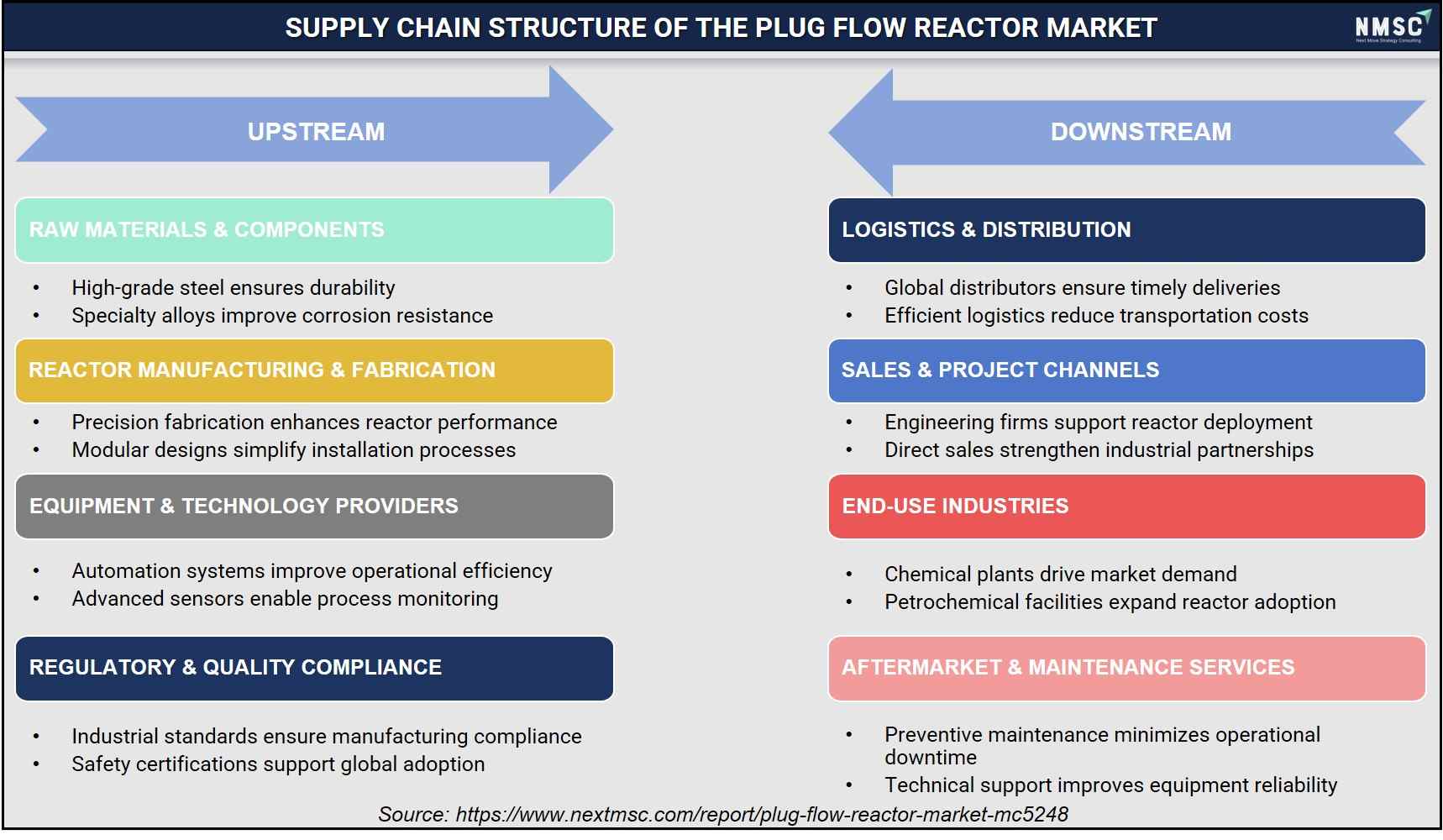
The plug flow reactor market supply chain integrates raw material suppliers, reactor manufacturers, technology providers, engineering firms, distributors, and end users to ensure reliable equipment delivery and operational efficiency. Compliance with industrial quality and safety standards, combined with advanced fabrication and automation technologies, strengthens product performance while supporting adoption across chemical, petrochemical, and process manufacturing industries.
Competitive Landscape
We observed that the plug flow reactor market features a moderately fragmented competitive landscape, with diversified materials science companies competing alongside specialized flow chemistry equipment manufacturers on reactor materials, scale-up capability, and process development support.
|
Dimension |
Description |
|
Market Structure |
Moderately fragmented; diversified materials science and process equipment companies compete alongside numerous specialized flow chemistry, microreactor, and oscillatory baffled reactor manufacturers concentrated in Europe and North America. |
|
Innovation Focus |
Silicon carbide and high-performance alloy reactor materials, AI-assisted reactor design software, and reactor-as-a-service process development models dominate current innovation pipelines among leading suppliers. |
|
M&A Activity |
Selective strategic collaborations and services expansion, exemplified by Corning Incorporated's collaboration with Curia and its Advanced Flow Pharmaceutical Technology services business supporting contract manufacturers. |
Source: www.nextmsc.com
How Do Companies Compete in This Market?
Companies compete primarily on reactor materials science, scale-up reliability, and process development support across the industry. Diversified materials science companies such as Corning Incorporated leverage decades of glass and ceramics expertise to offer industrial-scale silicon carbide reactors, while specialized flow chemistry vendors such as Vapourtec Ltd. and Syrris Ltd. compete on modularity and ease of use for laboratory and pilot-scale pharmaceutical and academic research customers.
Which Competitive Archetypes Dominate the Market?
Two archetypes dominate the market: diversified materials science and process equipment companies offering industrial-scale reactor platforms, and specialized flow chemistry vendors focused on laboratory and pilot-scale modular systems. Corning Incorporated exemplifies the diversified archetype through its Advanced-Flow reactor portfolio and pharmaceutical technology services, while NiTech Solutions Ltd. and Cambridge Reactor Design Ltd. exemplify the specialized archetype through patented oscillatory baffled reactor technology.
How Are Companies Differentiating Through Innovation?
Innovation and differentiation strategy increasingly center on reactor materials science and computationally assisted process design. Corning's silicon carbide Advanced-Flow reactors and Vapourtec's Reac-Discovery artificial intelligence platform both illustrate how suppliers are pairing hardware innovation with software and materials differentiation. Our analysis shows that vendors unable to demonstrate validated scale-up pathways from laboratory to production risk exclusion from pharmaceutical and petrochemical capital equipment procurement processes.
What M&A and Partnership Activity Is Shaping the Market?
Strategic partnerships and services expansion continue to consolidate capabilities within the industry rather than large-scale acquisitions. Corning Incorporated's collaboration with Curia, which included the first installation of Corning's G1 production system, illustrates how equipment suppliers are embedding themselves within contract development and manufacturing organization infrastructure. Academic-industry collaborations, such as continuous flow process development between University College Dublin and Pfizer using Vapourtec systems, further extend supplier relationships into pharmaceutical process innovation.
Key Market Players
Our assessment indicates that the following 20 companies are actively shaping product innovation, materials science, and go-to-market strategy within the global plug flow reactor market.
-
Corning Incorporated
-
Vapourtec Ltd
-
Syrris Ltd
-
AM Technology Ltd
-
Chemtrix B.V.
-
ThalesNano Inc.
-
Asynt Ltd
-
Parr Instrument Company
-
Ehrfeld Mikrotechnik GmbH
-
H.E.L Group Limited
-
Microinnova Engineering GmbH
-
Cambridge Reactor Design Ltd
-
YMC Co., Ltd.
-
Premex Solutions GmbH
-
NiTech Solutions Ltd
-
Xytel Corporation
-
Pilon Engineering Pvt. Ltd.
-
KNAUER Wissenschaftliche Geräte GmbH
-
FutureChem Co., Ltd.
-
Amar Equipments Pvt. Ltd.
Latest Developments
We observed a wave of regulatory clarification and product development activity across the industry between 2023 and 2026, concentrated among both diversified equipment suppliers and specialized flow chemistry manufacturers.
|
Date |
Event |
|
Jun 2025 |
ThalesNano highlighted a June 2025 study using its H-Cube Pro flow reactor for a continuous-flow synthesis method in pharmaceutical research. |
|
May 2025 |
Corning introduced the Low-Flow Reactor System 2, the latest line in its Advanced-Flow Reactor portfolio, aimed at safer and more flexible chemical development and processing. |
Investment Opportunities
What Capital Inflows Are Targeting The plug flow reactor market?
Capital inflows into the market are increasingly directed toward silicon carbide reactor manufacturing and AI-assisted process development capability rather than conventional stainless steel equipment alone. Strategic collaborations, such as Corning Incorporated's partnership with Curia, illustrate how contract manufacturers are directing resources toward dedicated flow reactor infrastructure rather than building comparable capability independently. We observed that investors favor vendors demonstrating validated regulatory pathways, viewing ICH Q13 alignment as a proxy for long-term pharmaceutical customer retention.
How Is Infrastructure Investment Supporting Market Deployment?
Infrastructure investment is expanding reactor manufacturing capacity and process development laboratory capability to support broader continuous manufacturing adoption. Our findings suggest that Corning's Advanced Flow Pharmaceutical Technology facility and equivalent process development centers operated by specialized flow chemistry vendors are lowering the technical barrier for manufacturers evaluating continuous production. Regional engineering contractors are simultaneously investing in local reactor fabrication and installation capability to serve expanding petrochemical capacity across Asia-Pacific and Middle East and Africa.
What ESG Considerations Are Shaping Investment Decisions?
Environmental, social, and governance considerations increasingly influence investment decisions across the industry, with process safety and resource efficiency as key criteria. We found that continuous flow reactors reduce reaction volume and improve heat and mass transfer relative to batch systems, directly lowering solvent use, energy consumption, and process waste per unit of output. Investors increasingly favor vendors demonstrating measurable safety improvements from inherently safer continuous processing, treating reduced hazardous material inventory as a governance indicator alongside conventional efficiency metrics.
Key Benefits for Stakeholders
How Does This Report Benefit Enterprise and Industry Leaders?
Enterprise and industry leaders gain access to validated segmentation, competitive benchmarking, and regional demand forecasts that support product-portfolio and go-to-market decisions across the plug flow reactor Market. Our analysis shows that detailed product type, material, and end-use industry breakdowns help equipment manufacturers align development priorities with regulatory and materials science requirements while identifying underserved scale and pressure segments for expansion.
How Does This Report Benefit Investors and Financial Analysts?
Investors and financial analysts benefit from consistent, single-point market size and CAGR estimates that support valuation and capital-allocation decisions across the plug flow reactor supply chain. We observed that the report's regional and segment-level growth differentials help identify which materials and end-use industries are best positioned to capture above-market growth in the Silicon Carbide and Pharmaceutical segments through 2035.
How Does This Report Benefit Technology Vendors and Product Teams?
Technology vendors and product teams gain insight into emerging design requirements, including AI-assisted reactor discovery and reactor-as-a-service process development models, that are reshaping the industry. Our findings suggest that this analysis helps product and engineering teams prioritize development roadmaps around materials innovation and regulatory-aligned scale-up capability that pharmaceutical and petrochemical customers increasingly require during vendor evaluation.
Key Market Segments
By Product Type
-
Tubular Reactor
-
Straight Tube
-
Coiled Tube
-
Jacketed Tube
-
Multi-Tubular
-
-
Microreactor
-
Chip-Based
-
Plate-Based
-
Capillary
-
-
Packed Bed Reactor
-
Fixed Bed
-
Trickle Bed
-
Catalytic Packed Bed
-
-
Oscillatory Plug Flow Reactor
-
Continuous Oscillatory Baffled Reactor
-
Mechanically Oscillated Reactor
-
-
Static Mixer Reactor
-
Photochemical Plug Flow Reactor
-
Electrochemical Plug Flow Reactor
-
Rotating Tube Reactor
-
Other Reactor Type
By Material of Construction
-
Stainless Steel
-
Hastelloy and High-Performance Alloy
-
Borosilicate Glass
-
Silicon Carbide
-
PTFE and Fluoropolymer
-
Quartz
-
Other Material
By Scale
-
Laboratory Scale
-
Pilot Scale
-
Production Scale
By Operating Pressure
-
Atmospheric Pressure
-
Medium Pressure
-
High Pressure
By Revenue Stream
-
New Equipment
-
Spare Parts
-
Consumables
-
Service and Maintenance
-
Engineering and Process Development
By Sales Channel
-
Direct Sales
-
Distributor
-
OEM Partner
By End-Use Industry
-
Pharmaceutical
-
Fine Chemical
-
Specialty Chemical
-
Petrochemical
-
Polymer
-
Food and Beverage
-
Academic and Government Research
-
Other Industry
By Region
-
North America: U.S., Canada, Mexico.
-
Europe: UK, Germany, France, Italy, Spain, Sweden, Denmark, Finland, Netherlands, Rest of Europe.
-
Asia-Pacific: China, India, Japan, South Korea, Taiwan, Indonesia, Vietnam, Australia, Philippines, Malaysia, Rest of APAC.
-
Middle East & Africa: Saudi Arabia, UAE, Egypt, Israel, Turkey, Nigeria, South Africa, Rest of MEA.
-
Latin America: Brazil, Argentina, Chile, Colombia, Rest of LATAM.
Conclusion and Recommendations
What Is the Long-Term Outlook for The plug flow reactor market?
The long-term outlook for the market remains positive, with global revenue projected to expand from USD 4.80 billion in 2025 to USD 12.40 billion by 2035 at a 10.1% CAGR. We observed that sustained regulatory harmonization around continuous manufacturing, expanding silicon carbide materials adoption, and rising petrochemical capacity in Asia-Pacific will continue underpinning growth across pharmaceutical, petrochemical, and specialty chemical applications through the forecast period.
What Strategic Positioning Should Vendors Pursue?
Vendors should prioritize embedding process development services within reactor hardware sales rather than pursuing standalone equipment transactions. Our assessment indicates that suppliers investing early in silicon carbide materials, AI-assisted reactor design, and validated ICH Q13 regulatory support will be best positioned to capture premium positioning within the plug flow reactor market as scale-up reliability becomes the primary basis of vendor selection.
How Attractive Is This Market for New Investment?
The market presents an attractive investment case, supported by a USD 7.18 billion absolute dollar opportunity between 2026 and 2035 and above-average growth in Asia-Pacific and the Silicon Carbide material segment. We found that investment attractiveness is highest for vendors combining validated materials science with distribution reach through direct sales, distributors, and OEM partners capable of serving both large petrochemical operators and smaller pharmaceutical and specialty chemical producers simultaneously.
What Market Shifts and Key Risks Should Stakeholders Monitor?
Stakeholders should monitor high capital costs, retrofitting complexity, and limited platform standardization as key risks to the market. Our analysis shows that vendors unable to demonstrate validated scale-up pathways risk losing distribution access to competitors with proven industrial-scale installations, particularly as pharmaceutical manufacturers continue formalizing preferred-supplier relationships for ICH Q13-aligned continuous manufacturing programs across major production regions.
What Are the Key Growth Pathways for This Market?
Key growth pathways include expanding silicon carbide and high-performance alloy materials capability, scaling AI-assisted reactor design and process development services, and deepening OEM partnerships across Asia-Pacific petrochemical capacity expansion. NMSC's analysis indicates that suppliers pursuing these pathways while maintaining regulatory-aligned validation support will be best positioned to capture the market's projected growth through 2035.
About the Author
 Mihul Sharma
— Mihul Sharma is Research Associate at Next Move Strategy Consulting, where he has covered technology, industrial, and healthcare markets for 3 years. His work applies structured business research, market analysis, and secondary-source review to assess market trends, competitive developments, and growth opportunities. He supports report development by fully synthesizing industry data, company information, and market signals into concise findings for strategy and investment-focused research teams.
Mihul Sharma
— Mihul Sharma is Research Associate at Next Move Strategy Consulting, where he has covered technology, industrial, and healthcare markets for 3 years. His work applies structured business research, market analysis, and secondary-source review to assess market trends, competitive developments, and growth opportunities. He supports report development by fully synthesizing industry data, company information, and market signals into concise findings for strategy and investment-focused research teams.
About the Reviewer
 Supradip Baul
— Supradip Baul is an accomplished business consultant and strategist with over a decade of rich experience in market intelligence, strategy, technology, and business transformation. His work has included rigorous qualitative and quantitative analysis across multiple industries, helping clients shape investment decisions and long-term roadmaps. Earlier in his career, he was associated with Gartner, where he contributed to industry-leading reports and market share analyses. He has worked with leading global companies and holds an MBA with a dual specialization in Marketing and Finance.
Supradip Baul
— Supradip Baul is an accomplished business consultant and strategist with over a decade of rich experience in market intelligence, strategy, technology, and business transformation. His work has included rigorous qualitative and quantitative analysis across multiple industries, helping clients shape investment decisions and long-term roadmaps. Earlier in his career, he was associated with Gartner, where he contributed to industry-leading reports and market share analyses. He has worked with leading global companies and holds an MBA with a dual specialization in Marketing and Finance.
At Next Move Strategy Consulting, we understand that insightful market research is the cornerstone of successful business decisions. That's why we employ a robust and multifaceted approach, combining various methodologies to deliver the most accurate and actionable data for our clients.

Research Landscape
We navigate the world of research with two primary approaches:
Qualitative Approach
Our qualitative research methodologies involve immersive techniques such as in-depth interviews, focus groups, and observational studies. By engaging directly with individuals and stakeholders, we uncover valuable insights that quantitative data alone may overlook.

Quantitative Research
In tandem with qualitative methodologies, NMSC leverages the power of Quantitative Research to provide a robust foundation of numerical insights. Through systematic data collection and analysis, we quantify patterns, preferences, and market trends, offering a comprehensive view of the business landscape.
Our quantitative research approach employs diverse tools, including surveys, experiments, and statistical modelling. These methodologies enable us to gather data from a large and representative sample, ensuring the statistical significance of our findings. By employing structured questionnaires and standardized data collection methods, we guarantee the reliability and validity of the information we present to our clients.
Quantitative research is particularly effective in measuring the prevalence of trends, assessing market size, and gauging the impact of various factors on consumer behavior. The numerical precision attained through this approach equips our clients with actionable insights, facilitating data-driven decision-making and strategy formulation.


Our Specialized Toolbox for Industry-Specific Market Research
We deploy a specialized arsenal of techniques tailored to meet your unique requirements. Here's a glimpse into our comprehensive toolbox:

Information Procurement
The stage entails acquiring market data or relevant information through various sources and methodologies.


Market Research Approach
We utilize both top-down and bottom-up approaches in market research analysis to achieve a comprehensive understanding of the market dynamics, leveraging the broad perspective of industry trends and macroeconomic factors alongside detailed insights from specific segments and individual companies.

Porters Five Forces Analysis
We conduct Porter's Five Forces analysis to evaluate the competitive landscape of an industry, providing us with insights into factors that affect profitability and strategic positioning.

SWOT Analysis

Forecasting
We utilize a forecasting model to predict future consumption by considering parameters like population, economics, regulations, market competition, drivers, constraints, technology, and pricing. We also employ statistical techniques such as multilinear regression, exponential smoothing, moving average, ARIMA, and Monte Carlo simulations for accurate predictions. In econometric forecasting, we analyzed short-term and long-term event impacts, attributing values based on regulatory frameworks, economic factors, and market events.





 Speak to Our Analyst