Agentic AI Orchestration Platforms Market By Platform Type (Platform Software, Orchestration Engine, and Others), By Deployment Model (SaaS, Multi Tenant, Single Tenant, and Others), By Company Size (Small Business, and Others), By Buyer Type (IT and Platform Teams, Line of Business Teams, and Others), By Sales Channel (Direct Enterprise Sales, and Others), and By End User Industry (Financial Services Healthcare and Others)– Global Analysis & Forecast, 2025–2035
Industry: ICT & Media | Publishing Date: April 28, 2026 | Last Updated: September 30, 2026 | No of Pages: N/A | No. of Tables: N/A | No. of Figures: N/A | Format: PDF | Report Code: IC4528
Industry Outlook
The global Agentic AI Orchestration Platforms Market size was valued at USD 6.27 billion in 2025, and is expected to be valued at USD 8.68 billion by the end of 2026. The industry is projected to grow, hitting USD 147.92 billion by 2035, with a CAGR of 37.13% between 2026 and 2035.
Agentic AI Orchestration Platforms Market Size & Forecast
|
Parameters |
Details |
|
Market Size in 2026 |
USD 8.68 Billion |
|
Revenue Forecast in 2035 |
USD 147.92 Billion |
|
Growth Rate |
CAGR of 37.13% from 2026 to 2035 |
|
Analysis Period |
2025–2035 |
|
Base Year Considered |
2025 |
|
Forecast Period |
2026–2035 |
|
Market Size Estimation |
Billion (USD) |
|
Companies Profiled |
20 |
|
Countries Covered |
33 |
|
Market Share |
Available for 10 companies |
Based on NMSC’s primary research, we found that the global agentic AI orchestration platforms market is witnessing rapid momentum as enterprises gradually transition from isolated AI deployments toward coordinated multi-agent systems capable of executing complex enterprise workflows. As organizations expand the use of generative AI, enterprise copilots, and autonomous digital agents across business functions, the need for orchestration platforms that coordinate agent interactions across applications, data environments, and operational systems is increasing significantly. Moreover, our discussions with enterprise platform architects and AI engineering teams indicate that agentic AI multi-agent orchestration frameworks, AI agent workflow observability tools, and enterprise AI agent context management software are emerging as critical infrastructure for managing agent behavior, maintaining workflow continuity, and ensuring operational transparency. Consequently, orchestration platforms are increasingly positioned as the foundational control layer enabling reliable coordination of autonomous AI agents across enterprise ecosystems.
Furthermore, through our evaluation of enterprise AI implementations across North America, Europe, and Asia-Pacific, we identified that adoption patterns in the agentic AI orchestration platforms market are shaped by cloud infrastructure maturity, enterprise data readiness, and developer ecosystem strength. North America currently leads enterprise deployment, supported by strong AI platform ecosystems and large-scale experimentation with agent-based automation. Meanwhile, Europe places greater emphasis on governance, observability, and responsible AI frameworks as enterprises scale multi-agent environments. At the same time, Asia-Pacific is rapidly expanding adoption, driven by digital commerce ecosystems and government-supported AI innovation programs. Key technology providers, including Microsoft Corporation, Amazon Web Services, Google LLC, IBM Corporation, and Salesforce, Inc., are strengthening market positions through orchestration frameworks, AI agent development platforms, and integrated observability capabilities. As a result, expanding developer ecosystems and innovations around open-source enterprise AI agents are accelerating enterprise experimentation and enabling scalable multi-agent AI architectures across diverse digital enterprise environments.
What Are the Key Agentic AI Orchestration Platforms Industry Trends?
How Are Enterprise AI Agent Operating Systems Reshaping Digital Enterprise Infrastructure?
NMSC’s analysis indicates that enterprises are increasingly transitioning from isolated AI tools toward coordinated AI agent operating environments where multiple autonomous agents collaborate across enterprise workflows. Within the agentic AI orchestration platforms market, organizations deploying agents across analytics, customer operations, and enterprise applications increasingly require orchestration platforms to coordinate agent interactions and maintain operational continuity. Discussions with enterprise platform engineers highlighted that agentic AI multi-agent orchestration frameworks enable organizations to synchronize agents operating across data platforms, enterprise software, and digital services. Consequently, enterprises are increasingly treating orchestration platforms as foundational control layers supporting scalable AI-driven enterprise operations.
How Are Persistent Context and Memory Systems Advancing Enterprise AI Agent Capabilities?
Our analysis suggests that enterprises are investing heavily in persistent context and memory infrastructure that allows AI agents to retain knowledge and execute multi-step workflows across enterprise systems. In the agentic AI orchestration platforms market, maintaining contextual awareness becomes essential as organizations deploy autonomous agents across operational environments. Technical evaluation indicates that enterprise AI agent context management software enables agents to preserve historical interactions, interpret operational states, and coordinate complex processes across enterprise platforms. Consequently, enterprises are developing more intelligent agent ecosystems capable of executing long-running workflows with greater consistency and operational intelligence.
How Are Observability Platforms Strengthening Enterprise Control Over Autonomous AI Agents?
Our primary research indicates that enterprises deploying autonomous AI systems increasingly prioritize operational transparency and monitoring capabilities. As organizations scale AI agents across enterprise workflows within the agentic AI orchestration platforms market, AI agent workflow observability tools enable teams to track agent execution paths, monitor system performance, and maintain visibility across distributed AI environments. Our operational analysis further indicates that orchestration platforms equipped with monitoring dashboards and workflow tracing capabilities improve oversight of agent interactions. Consequently, enterprises are integrating observability capabilities within open-source agentic workflows, enabling organizations to manage large-scale autonomous agent ecosystems with greater operational control and system transparency.
Ecosystem Analysis of the Agentic AI Orchestration Platforms Market
The image illustrates the key components and workflow of the agentic AI orchestration platforms market ecosystem, highlighting their interconnections and operational roles.
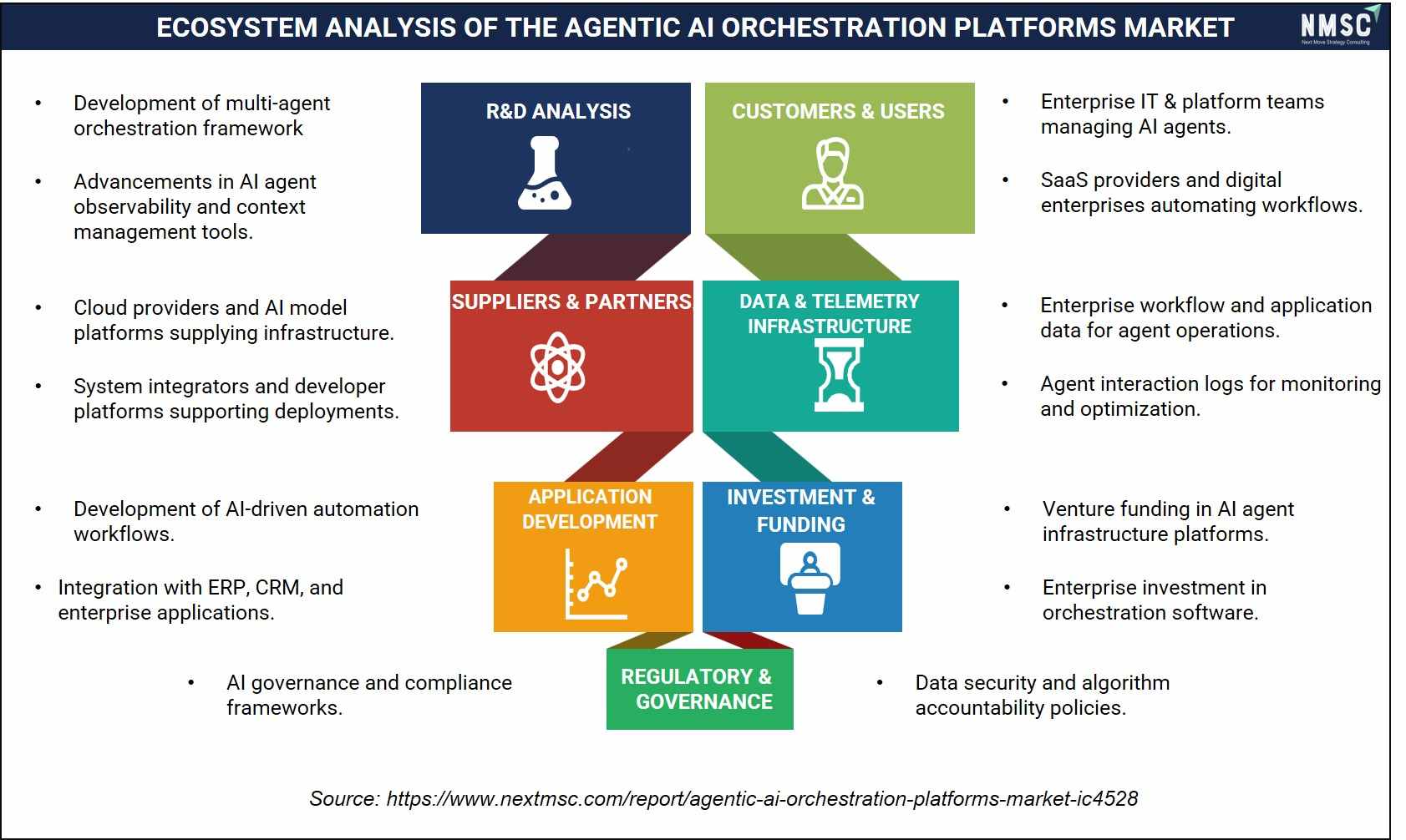
Based on our ecosystem assessment, we noticed that the agentic AI orchestration platforms market is shaped by continuous R&D innovation, enterprise adoption, and technology partnerships. Enterprises and SaaS providers deploy these platforms to automate workflows, while cloud providers and system integrators enable scalable deployments. At the same time, data and telemetry infrastructure supports agent monitoring and optimization, whereas investment and governance frameworks strengthen platform development and responsible AI adoption across enterprise environments.
What Are the Key Market Drivers, Breakthroughs, And Investment Opportunities That Will Shape the Agentic AI Orchestration Platforms Industry in the Next Decade?
Growth Catalyst & Risk Assessment Matrix
|
DRIVERS / TRENDS / RESTRAINTS |
(+/–) % IMPACT ON CAGR FORECAST |
GEOGRAPHIC RELEVANCE |
IMPACT TIMELINE |
|
Growing enterprise deployment of autonomous AI agents and multi-agent architectures increasing demand for orchestration platforms to coordinate complex AI workflows |
+1.2% |
North America; Europe; Asia-Pacific |
Short to medium term (1–3 years) |
|
Rising need for AI governance, agent observability, and lifecycle management tools supporting controlled deployment of enterprise autonomous agents |
+0.9% |
North America; Europe; Asia-Pacific |
Short term (1–2 years) |
|
Expansion of developer ecosystems and open-source agent frameworks enabling faster experimentation and enterprise deployment of agentic AI systems |
+0.7% |
North America; Asia-Pacific; Europe |
Medium term (2–4 years) |
|
Increasing enterprise deployment of multi-agent AI workflows requiring scalable orchestration, monitoring, and coordination infrastructure |
+0.8% |
North America; Asia-Pacific; Europe |
Medium term (2–4 years) |
|
Data governance concerns, AI reliability challenges, and integration complexity slowing enterprise adoption of large-scale autonomous agent systems |
-0.5% |
Global; particularly Europe and regulated industries |
Short to medium term (1–3 years) |
Based on our evaluation of enterprise AI deployment patterns, we observed growing demand for agentic AI multi-agent orchestration frameworks capable of coordinating multiple AI agents across enterprise applications and digital workflows. Organizations are increasingly adopting AI agent workflow observability tools to monitor agent performance, trace decision paths, and maintain operational transparency across complex AI environments. At the same time, enterprises are investing in enterprise AI agent context management software to ensure agents maintain memory, state awareness, and consistent interactions across tasks. These capabilities are becoming critical as organizations transition from isolated AI models toward interconnected agent ecosystems designed to automate multi-step decision processes and enterprise operations.
Furthermore, our analysis indicated that the emergence of automated B2B procurement AI agents is expanding the use cases for orchestration platforms, particularly in supply chain management, vendor negotiations, and procurement workflow automation. These agents enable organizations to streamline purchasing decisions, analyze supplier data, and coordinate procurement activities across enterprise systems. Meanwhile, developer communities are increasingly adopting open-source agentic AI orchestration platforms, which are accelerating experimentation and innovation within enterprise AI ecosystems. As a result, organizations are gaining greater flexibility to design scalable multi-agent architectures capable of supporting automation, decision intelligence, and digital transformation initiatives.
Growth Drivers:
How Is the Enterprise Shift Toward Multi-Agent AI Architectures Accelerating the Agentic AI Orchestration Platforms Market?
NMSC’s analysis indicates that the rapid shift toward multi-agent AI architectures is emerging as a major growth driver for the agentic AI orchestration platforms market. As enterprises increasingly deploy AI agents across customer service, analytics, procurement, and internal decision systems, organizations are managing a growing ecosystem of autonomous digital agents operating across enterprise applications. Consequently, orchestration platforms are becoming essential for coordinating agent interactions, managing task dependencies, and maintaining visibility across complex AI workflows. Furthermore, industry evidence indicates that orchestration platforms improve the reliability of multi-agent systems by enabling coordinated workflows across enterprise software and data environments. In addition, capabilities such as agent memory management, workflow orchestration, and real-time monitoring allow enterprises to automate complex decision processes. Therefore, organizations are increasingly integrating orchestration platforms into enterprise AI infrastructure to support scalable autonomous agent ecosystems and long-term intelligent automation strategies.
How Is the Growing Need for AI Governance and Agent Observability Driving Agentic AI Orchestration Platforms Market Expansion?
Our research suggests that the growing emphasis on AI governance, agent observability, and lifecycle management is accelerating demand within the agentic AI orchestration platforms market. As enterprises deploy autonomous agents across operational systems, organizations increasingly require centralized capabilities that monitor agent behavior, trace decision paths, and maintain accountability across automated workflows. Consequently, enterprise risk leaders and AI platform teams are prioritizing technologies that provide operational transparency and policy enforcement within agent-driven environments. Furthermore, operational analysis indicates that orchestration platforms enable organizations to establish structured governance frameworks that supervise AI agents across enterprise workflows. In addition, capabilities such as observability dashboards, audit trails, and context management improve operational visibility and strengthen confidence in agent-driven automation. Therefore, enterprises are increasingly integrating orchestration platforms as governance infrastructure to support controlled and scalable deployment of autonomous AI systems.
Growth Inhibitor:
How Are Enterprise Concerns Around AI Reliability and Governance Slowing Adoption of Agentic AI Orchestration Platforms Market?
Our analysis indicates that enterprise concerns around AI reliability, decision accuracy, and governance oversight are moderating adoption within the agentic AI orchestration platforms market. As organizations begin deploying autonomous agents across critical workflows, technology leaders remain cautious about system unpredictability, model hallucinations, and limited transparency in agent decision processes. Consequently, compliance teams and enterprise risk managers require stricter validation, monitoring, and governance controls before approving large-scale deployments. Furthermore, integration complexity and the need for robust oversight frameworks extend implementation timelines, thereby slowing enterprise-wide adoption of coordinated multi-agent systems.
Growth Opportunity:
How Is the Expansion of Open-Source Agent Frameworks Creating Opportunities for the Agentic AI Orchestration Platforms Market?
Our observations indicates that the rapid expansion of open-source agent frameworks is creating new opportunities within the agentic AI orchestration platforms market. As developer communities increasingly build frameworks that support autonomous agents, enterprises gain greater flexibility to experiment with multi-agent architectures and automation workflows. Consequently, organizations are accelerating innovation by developing specialized AI agents for analytics, knowledge management, and operational decision support, while open-source ecosystems continue expanding the global developer base participating in enterprise AI automation. Technical evaluation further indicates that enterprises are combining open-source agent frameworks with commercial orchestration platforms to build scalable multi-agent environments. Moreover, this hybrid approach enables organizations to maintain development flexibility while leveraging centralized orchestration, monitoring, and governance capabilities, thereby supporting the development of adaptable and scalable agent-driven enterprise systems.
SWOT Analysis of the Agentic AI Orchestration Platforms Industry
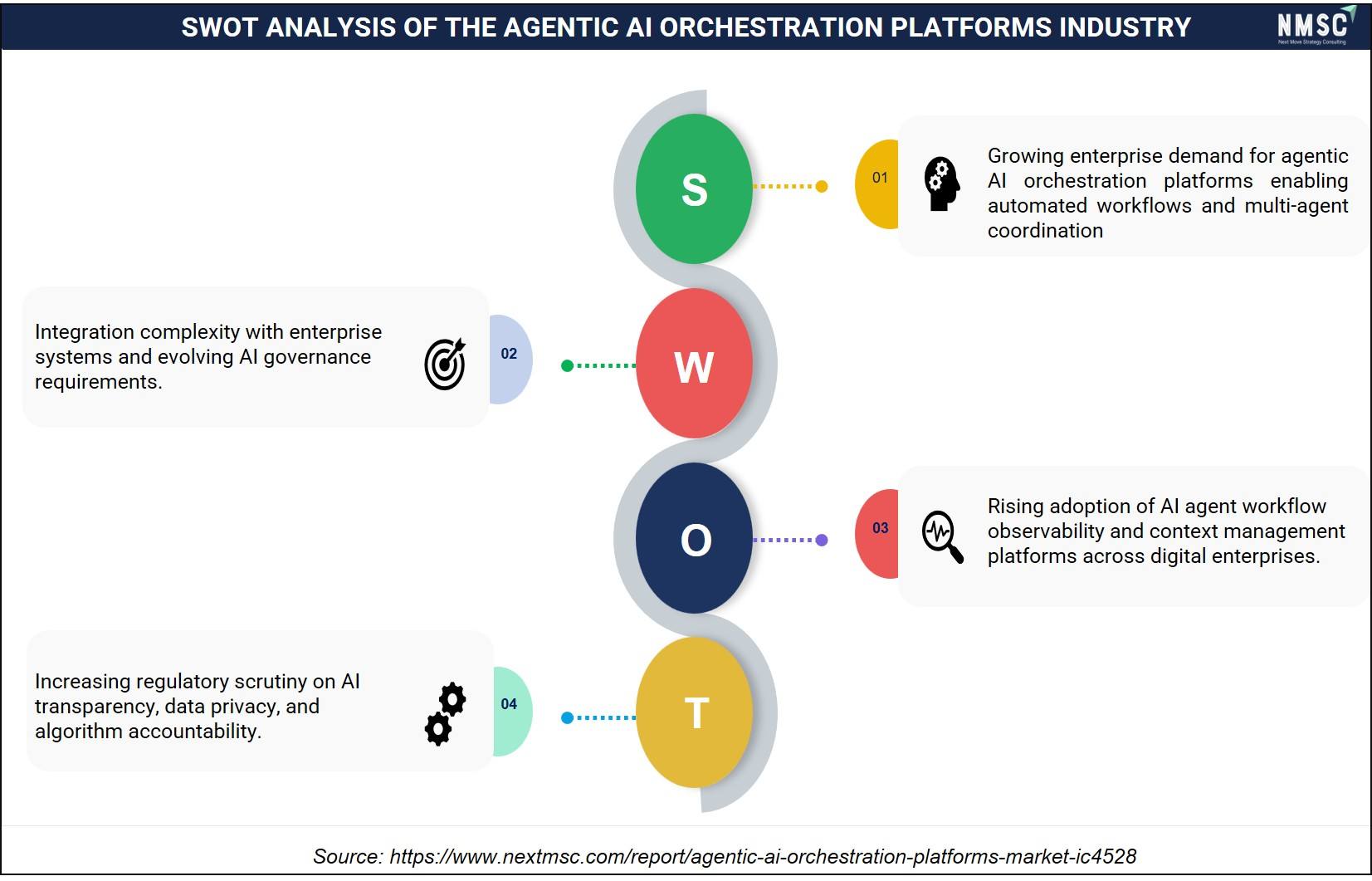
Based on our assessment of enterprise AI deployments, we identified that the agentic AI orchestration platforms market is expanding as enterprises adopt multi-agent automation and workflow orchestration. At the same time, rising demand for AI agent observability and context management platforms is creating new growth opportunities, while integration complexity and increasing AI governance regulations are shaping platform design and enterprise deployment strategies.
How Is the Agentic AI Orchestration Platforms Market Segmented in This Report, And What Are the Key Insights from the Segmentation Analysis?
Market Highlights & Strategic Insights – Agentic AI Orchestration Platforms Market:
|
Segments |
Key Takeaways |
|
Offering |
Software platforms dominated the agentic AI orchestration platforms market as enterprises prioritized orchestration engines, agent builders, and integration frameworks to manage multi-agent AI workflows. Infrastructure, professional, and managed services expanded steadily to support deployment, integration, and lifecycle management of enterprise AI agents. |
|
Deployment |
SaaS (multi-tenant) led adoption due to scalability and ease of deployment, while hybrid and dedicated cloud environments gained traction among regulated industries requiring greater control and security. |
|
Company Size |
Large enterprises represented the primary adopters as complex IT environments required coordinated AI agent management, while mid-market firms increasingly adopted cloud-based orchestration platforms. |
|
Buyer Type |
IT and platform teams dominated procurement as orchestration platforms function as core AI infrastructure, while product engineering teams increasingly used them to build AI-driven applications. |
|
Sales Channel |
Direct enterprise sales remained dominant in the agentic AI orchestration platforms market, supported by growing adoption through cloud marketplaces and system integrator-led deployments. |
|
End-User Industry |
Technology & SaaS companies led adoption, followed by financial services and healthcare organizations leveraging orchestration platforms for AI-driven automation and decision intelligence. |
By Offering Insights
How Do Different Offerings Shape the Agentic AI Orchestration Platforms Market?
Based on our evaluation of enterprise AI platform deployments, we identified that the agentic AI orchestration platforms market is segmented into software, infrastructure services, professional services, managed services, support & training, hardware, and other offerings.
From our analysis of enterprise adoption patterns, we found that software platforms dominated the market, as organizations increasingly prioritized orchestration engines and agent development environments to coordinate multiple AI agents across enterprise applications and data systems. At the same time, we noticed that infrastructure services supporting model serving, compute runtime, and data environments are expanding steadily as enterprises scale AI workloads. Meanwhile, our interactions with enterprise architects indicated that professional and managed services play a supporting role by enabling implementation, monitoring, and lifecycle management of enterprise AI agents. Consequently, vendors delivering integrated software platforms supported by scalable infrastructure and services are strengthening their competitive positioning.

By Deployment Insights
How Do Deployment Models Influence Adoption of Agentic AI Orchestration Platforms?
Based on our assessment of enterprise deployment strategies, we observed that the agentic AI orchestration platforms market is segmented into SaaS (multi-tenant), dedicated cloud, hybrid cloud, on-premises, edge deployments, and other deployment models.
From our evaluation of enterprise implementation programs, we identified that SaaS deployments led market adoption, as organizations benefit from rapid provisioning, continuous updates, and scalable environments capable of managing distributed AI agents. Meanwhile, we noticed that hybrid and dedicated cloud environments are gaining traction among regulated industries requiring stronger governance and customization. At the same time, our market interactions indicated that on-premises and edge deployments remain relevant for organizations handling sensitive data or latency-sensitive workloads. As enterprises scale AI adoption, flexible deployment architectures are becoming critical for supporting diverse operational requirements.
By Buyer Type Insights
Which Buyer Groups Are Driving Adoption of Agentic AI Orchestration Platforms?
Based on our analysis of enterprise procurement patterns, we identified that the agentic AI orchestration platforms market is segmented into IT & platform teams, line-of-business teams, product engineering teams, OEMs & ISVs, MSPs & integrators, and other buyers.
From our evaluation of purchasing behavior, we found that IT and platform teams represented the primary buyers, as orchestration platforms function as foundational infrastructure for managing enterprise AI systems. At the same time, we noticed that product engineering teams increasingly deploy these platforms to embed AI agents within digital products and SaaS applications. Meanwhile, our discussions with system integrators indicated that OEMs and service providers are integrating orchestration capabilities into broader enterprise automation solutions. As a result, purchasing decisions are increasingly shaped by cross-functional collaboration between IT leadership, product teams, and technology partners.

By End-User Industry Insights
Which Industries Are Accelerating Adoption of Agentic AI Orchestration Platforms?
Based on our review of enterprise AI implementation programs, we observed that the agentic AI orchestration platforms market spans technology & SaaS, financial services, healthcare & life sciences, retail & consumer goods, manufacturing & industrials, telecommunications, and other industries.
From our assessment of adoption patterns, we found that technology and SaaS companies represented the leading industry segment, as these organizations actively develop AI copilots, automation platforms, and multi-agent applications. Furthermore, we noticed that financial services and healthcare organizations are expanding deployments to support analytics, compliance monitoring, and operational decision automation. Meanwhile, our industry interactions indicated that sectors such as retail, telecommunications, and manufacturing are gradually increasing adoption as enterprises pursue coordinated AI workflows. Consequently, industry adoption is expected to broaden as organizations integrate AI agents into core operational processes.
Regional Outlook:
Geographic Performance Snapshot:
|
Geography |
Key Takeaways |
|
North America |
North America remains a major hub for the agentic AI orchestration platforms market. Strong cloud infrastructure, rapid generative AI adoption, and large enterprise technology investments continue to drive platform deployment across technology, financial services, and healthcare sectors. |
|
Europe |
Europe is steadily adopting agentic AI orchestration platforms as enterprises focus on automation and digital transformation. Additionally, strong regulatory frameworks for AI governance and data protection are encouraging organizations to adopt structured and compliant AI orchestration solutions. |
|
Asia Pacific |
Asia Pacific is rapidly expanding in the adoption of agentic AI orchestration platforms. Government-backed AI initiatives and increasing digital transformation across e-commerce, fintech, and technology sectors are supporting enterprise deployment. |
|
Latin America |
Latin America is gradually increasing its use of AI orchestration platforms as organizations pursue digital transformation and automation initiatives across banking, retail, and telecommunications sectors. |
|
Middle East & Africa |
Middle East & Africa region is witnessing growing interest in AI orchestration platforms as governments and enterprises invest in digital infrastructure and AI-driven automation initiatives. |
The agentic AI orchestration platforms market share is geographically studied across North America, Europe, Asia Pacific, Latin America and Middle East & Africa and each region is further studied across countries.
Agentic AI Orchestration Platforms Market in North America
North America represents one of the most advanced regions for the agentic AI orchestration platforms market, supported by mature cloud ecosystems, strong enterprise software adoption, and a highly active AI innovation landscape. From our regional assessments, we observed that enterprises increasingly view agent orchestration platforms as a strategic control layer capable of coordinating AI models, enterprise applications, and complex operational workflows. The United States continues to lead large-scale deployments across technology, financial services, and healthcare sectors, while Canada is steadily expanding adoption through enterprise automation initiatives. Furthermore, our discussions with enterprise solution architects and AI platform teams indicated that organizations are steadily moving from isolated AI experimentation toward integrated multi-agent systems, thereby reinforcing long-term demand for orchestration platforms across the region.
Agentic AI Orchestration Platforms Market in the United States
The United States remains the most dynamic market for agentic AI orchestration platforms, largely driven by deep enterprise technology investments and a robust developer ecosystem. Based on our direct engagements with enterprise IT leaders and system integrators, we identified that organizations are prioritizing orchestration platforms to coordinate AI agents across customer service, analytics, and operational decision environments. In practice, platforms developed by Microsoft, Amazon Web Services, and Google are frequently deployed to integrate AI services with enterprise applications and cloud infrastructures. Moreover, our implementation observations shows that companies are increasingly combining orchestration platforms with automation tools and enterprise data environments, which is gradually transforming enterprise AI systems into more cohesive and scalable digital operating environments.
Agentic AI Orchestration Platforms Market in Canada
In Canada, we observed a steady and structurally balanced expansion of agentic AI orchestration platforms adoption, supported by strong digital transformation initiatives and increasing enterprise focus on operational automation. Through our interactions with enterprise technology partners and automation consultants, we found that organizations across financial services, telecommunications, and public sector institutions are progressively exploring orchestration platforms to manage multiple AI tools within unified operational frameworks. At the same time, Canadian enterprises tend to prioritize reliability, governance, and regulatory compliance when selecting AI platforms. Consequently, many organizations are adopting scalable cloud-based orchestration solutions that enable controlled experimentation while supporting long-term enterprise automation strategies, thereby strengthening the region’s gradual yet sustainable agentic AI orchestration platforms market growth.
Agentic AI Orchestration Platforms Market in Europe
Across Europe’s enterprise technology landscape, the agentic AI orchestration platforms market is evolving through a blend of innovation ambitions and structured governance frameworks. From our regional market assessments, we observed that enterprises are increasingly turning to orchestration platforms to coordinate multiple AI agents, enterprise applications, and data environments within unified operational systems. Meanwhile, regulatory emphasis on responsible AI, transparency, and data protection is shaping platform selection criteria across the region. As organizations attempt to scale AI adoption beyond isolated pilots, buyers are prioritizing platforms capable of managing complex multi-agent workflows while maintaining compliance and operational control, thereby reinforcing long-term enterprise demand for orchestration technologies.
Agentic AI Orchestration Platforms Market in the United Kingdom
The United Kingdom continues to stand out as one of Europe’s most active hubs for enterprise AI orchestration. Based on our engagements with enterprise IT leaders and system integrators, we found that organizations are increasingly deploying orchestration platforms to manage AI copilots, automation tools, and enterprise software across operational workflows. Financial services, retail, and digital platforms are leading adoption as companies pursue faster decision intelligence and improved customer experience. At the same time, regulatory expectations around data governance and algorithmic transparency are influencing procurement strategies. Consequently, enterprises are steadily shifting toward scalable orchestration architectures capable of supporting sophisticated multi-agent enterprise environments.
Agentic AI Orchestration Platforms Market in Germany
In Germany, adoption of agentic AI orchestration platforms reflects the country’s well-known engineering discipline and emphasis on operational precision. Our research across enterprise automation initiatives indicates that organizations are exploring orchestration systems capable of connecting AI models with manufacturing software, industrial data platforms, and enterprise applications. German enterprises typically approach AI deployments cautiously, prioritizing reliability, cybersecurity architecture, and long-term interoperability before scaling implementations. Meanwhile, collaboration between software vendors, enterprise technology providers, and industrial companies continues to strengthen the local AI ecosystem. As these collaborations deepen, the agentic AI orchestration platforms market is gradually advancing toward resilient enterprise AI operating frameworks supporting large-scale industrial automation strategies.
Agentic AI Orchestration Platforms Market in France
From our interactions with enterprise automation consultants and digital transformation leaders, we found that France presents a steadily advancing environment for agentic AI orchestration adoption. Organizations across retail, banking, and public sector institutions are increasingly exploring AI agents to improve operational coordination and service delivery. At the same time, national focus on responsible AI practices and data governance is encouraging enterprises to adopt orchestration platforms that provide transparency and controllable AI workflows. Because enterprises seek solutions capable of balancing automation with regulatory compliance, vendors offering structured orchestration architectures and scalable cloud integrations are gaining stronger visibility across the French enterprise ecosystem.
Agentic AI Orchestration Platforms Market in Italy
Italy’s enterprise automation landscape is gradually embracing agentic AI orchestration as organizations modernize legacy digital infrastructures. Based on our evaluation of enterprise technology initiatives, we observed rising interest in platforms that integrates AI copilots, analytics engines, and operational software within coordinated workflows. Manufacturing, retail, and logistics organizations are particularly active as they pursue productivity improvements through intelligent automation. Given the diverse IT environments present across Italian enterprises, flexibility and modular deployment capabilities are becoming decisive factors in platform adoption. As a result, orchestration platforms that enable incremental automation while supporting long-term system integration are expected to gain increasing traction.
Agentic AI Orchestration Platforms Market in Spain
Spain’s enterprise technology ecosystem is increasingly recognizing the operational value of agentic AI orchestration platforms. During our discussions with enterprise technology advisors and AI implementation specialists, we noticed growing experimentation with AI agents across banking, telecommunications, and e-commerce organizations. Initially, many deployments focus on targeted automation pilots designed to streamline analytics, customer engagement, and operational workflows. However, as enterprises accumulate experience with AI-driven processes, interest in orchestration platforms capable of coordinating multiple AI tools within unified systems is strengthening. This gradual transition from experimentation to scaled deployment is positioning Spain for broader enterprise adoption in the coming years.
Agentic AI Orchestration Platforms Market in the Asia-Pacific
Across the Asia-Pacific enterprise technology landscape, the agentic AI orchestration platforms market is emerging as a highly dynamic environment shaped by rapid digitalization and expanding AI ecosystems. Based on enterprise deployment patterns, we found that organizations across technology, financial services, and digital commerce sectors are increasingly adopting orchestration platforms to coordinate AI models, enterprise software, and automation tools within unified operational frameworks. Meanwhile, industry trends indicate that large-scale cloud infrastructure expansion and government-backed AI innovation programs are accelerating enterprise experimentation with multi-agent systems. As organizations gradually transition from isolated AI deployments to coordinated agent environments, platform vendors capable of supporting scalable integration and flexible orchestration architectures are expected to gain stronger regional traction.
Agentic AI Orchestration Platforms Market in China
China represents one of the most influential markets for enterprise AI orchestration within the Asia-Pacific region. Industry evidence suggests that strong domestic AI development capabilities, large digital platforms, and extensive enterprise technology investments are driving rapid adoption of agent orchestration systems. Data analysis reveals that organizations across e-commerce, financial technology, and cloud service sectors are increasingly deploying orchestration platforms to manage AI agents operating across analytics, automation, and customer engagement environments. Furthermore, we noticed that domestic technology ecosystems continue shaping local platform architectures and integration standards. Consequently, vendors that align with domestic software ecosystems and localized AI infrastructure strategies are better positioned to scale their orchestration platforms within China’s fast-evolving enterprise technology environment.
Agentic AI Orchestration Platforms Market in Japan
In Japan, the enterprise AI landscape reflects a measured and reliability-focused approach toward orchestration platform adoption. Our evaluation indicates that organizations are gradually introducing agent orchestration systems to support automation initiatives across manufacturing, financial services, and enterprise software environments. Industry insights indicate that Japanese enterprises prioritize system reliability, cybersecurity architecture, and long-term operational stability when evaluating AI platforms. At the same time, enterprises increasingly recognize the potential of coordinated AI agents to enhance operational intelligence and decision support capabilities. As these deployments mature, platform providers delivering highly stable architectures and strong lifecycle support are expected to gain sustained traction within Japan’s enterprise technology ecosystem.
Agentic AI Orchestration Platforms Market in India
India is emerging as one of the most rapidly evolving environments for enterprise AI orchestration in the Asia-Pacific region. Market indicators show that expanding digital commerce ecosystems, growing enterprise cloud adoption, and strong national AI innovation initiatives are accelerating interest in agent-based automation platforms. Industry insights indicate that organizations across banking, technology services, and e-commerce sectors are actively exploring orchestration platforms capable of coordinating AI copilots, analytics engines, and automation workflows. Initially, many deployments begin with targeted operational pilots; however, our operational analysis suggests that enterprises are increasingly preparing for broader integration of AI agents across enterprise systems, positioning India as a significant growth frontier for orchestration platform providers.
Agentic AI Orchestration Platforms Market in South Korea
South Korea’s enterprise technology ecosystem continues to demonstrate one of the region’s most automation-forward digital environments. Industry patterns indicate that organizations across telecommunications, technology services, and digital commerce are steadily exploring agentic AI orchestration platforms to coordinate AI copilots, analytics engines, and enterprise software within unified operational frameworks. At the same time, the country’s advanced cloud infrastructure and high-speed connectivity enable enterprises to experiment with multi-agent architectures capable of managing complex digital workflows. As organizations deepen their investments in intelligent automation, orchestration platforms that support scalable integration and coordinated AI operations are increasingly viewed as a strategic foundation for future enterprise systems.
Agentic AI Orchestration Platforms Market in Taiwan
In Taiwan, the conversation around enterprise AI is gradually shifting from experimentation toward system coordination and operational integration. Our analysis suggests that companies are increasingly focusing on platforms capable of orchestrating AI models across semiconductor manufacturing environments, enterprise analytics systems, and digital service platforms. Moreover, the country’s strong engineering culture encourages enterprises to emphasize reliability, interoperability, and technical precision when deploying AI technologies. Pilot deployments across electronics manufacturing clusters have already demonstrated measurable productivity improvements. Consequently, orchestration platforms that integrate seamlessly with industrial software ecosystems are expected to scale more effectively as Taiwan’s enterprise AI initiatives continue to mature.
Agentic AI Orchestration Platforms Market in Indonesia
Indonesia’s rapidly expanding digital economy is steadily reshaping enterprise automation strategies across the country. Our analysis suggests that organizations within banking, telecommunications, and e-commerce sectors are beginning to explore orchestration platforms to coordinate AI tools supporting customer engagement, analytics, and operational decision workflows. Meanwhile, accelerating cloud adoption and expanding digital infrastructure are enabling enterprises to experiment with multi-agent AI environments at a growing pace. However, many organizations remain at an early stage of AI maturity, which makes scalability and ease of deployment particularly important. As a result, orchestration platforms offering modular integration pathways and flexible architecture are likely to gain stronger adoption momentum.
Agentic AI Orchestration Platforms Market in Australia
Australia’s enterprise technology landscape reflects a balanced approach to AI adoption, where innovation is accompanied by careful operational planning. In our evaluation of enterprise technology programs, we found that organizations are increasingly introducing orchestration platforms to manage AI tools across distributed operational systems. Financial services, retail, and technology service providers are particularly active, as they seek to enhance decision intelligence and operational visibility through coordinated AI systems. Furthermore, enterprises in the region typically place strong emphasis on governance, cybersecurity, and system transparency when selecting AI platforms. As AI deployments expand across business functions, orchestration solutions capable of combining operational control with scalable automation are expected to gain sustained enterprise confidence.
Agentic AI Orchestration Platforms Market in Latin America
From our regional assessments, we observed that Latin America’s enterprise technology environment is gradually embracing agentic AI orchestration platforms as organizations accelerate digital transformation and digital service expansion. Enterprises across banking, retail, and digital commerce sectors are increasingly exploring platforms capable of coordinating AI copilots, analytics systems, and automation workflows within unified operational environments. At the same time, cost considerations and varying levels of technology maturity encourage companies to adopt phased deployment strategies rather than large-scale system replacements. As organizations continue strengthening cloud adoption and enterprise data capabilities, orchestration platforms offering scalable integration and flexible deployment pathways are expected to gain stronger traction across the region.
Agentic AI Orchestration Platforms Market in the Middle East & Africa
From our analysis of enterprise AI initiatives across the Middle East and Africa, we identified two distinct adoption trajectories shaping the regional market. In the Gulf economies, strong investments in digital infrastructure and smart government initiatives are encouraging organizations to deploy orchestration platforms capable of coordinating multiple AI services across complex operational systems. Meanwhile, across several African economies, enterprises are gradually beginning to explore AI-driven automation as part of broader digital modernization efforts. Although adoption remains at an earlier stage in many markets, expanding cloud infrastructure and growing enterprise technology investments are steadily creating opportunities. As these initiatives mature, orchestration platforms designed for scalable deployment and structured governance are expected to support long-term enterprise adoption.
Competitive Landscape
Competitive Dynamics & M&A Landscape:
|
Key Takeaways |
|
The global agentic AI orchestration platforms market features a combination of major enterprise technology providers and emerging AI-native developers. Companies such as Microsoft, Amazon Web Services, Google, IBM, Salesforce, ServiceNow, SAP, and Oracle leverage large cloud ecosystems and enterprise platforms, while specialists including LangChain, Workato, Zapier, UiPath, and Automation Anywhere focus on developer frameworks and workflow automation for AI agent deployment. |
|
Companies increasingly prioritize modular orchestration architectures capable of coordinating multiple AI agents, enterprise applications, and data systems within unified workflows. Platforms from providers such as Databricks, Snowflake, Palantir Technologies, OpenAI, NVIDIA, and DataRobot emphasize scalable infrastructure, real-time data integration, and interoperability as key differentiators. |
|
Recent partnerships and ecosystem collaborations indicate a shift toward integrating foundation models, AI copilots, and enterprise automation tools into unified agent platforms. This strategy enables faster deployment of autonomous workflows and strengthens end-to-end AI automation capabilities across enterprise environments. |
Which Companies Dominate the Agentic AI Orchestration Platforms Industry and How Do They Compete?
Based on our analysis of enterprise AI platform deployments and vendor strategies, we observed that the agentic AI orchestration platforms market is led by major enterprise technology providers alongside rapidly evolving AI-native platform developers. Companies such as Microsoft, Amazon Web Services, Google, IBM, Salesforce, ServiceNow, SAP, and Oracle consistently lead large-scale enterprise deployments. From our implementation reviews and enterprise adoption assessments, we found that these vendors are frequently selected for environments where data security, platform reliability, and seamless integration with existing cloud and enterprise software ecosystems are critical decision factors. Furthermore, we identified that these companies benefit from extensive cloud infrastructure, global customer networks, and integrated AI development platforms, which together strengthen their competitive positioning in complex enterprise orchestration environments.
Market Dominated by Agentic AI Orchestration Platforms Giants and Specialists
From our observation of developer ecosystems and enterprise automation initiatives, we identified that the competitive landscape is also shaped by AI-native specialists including LangChain, Workato, Zapier, UiPath, and Automation Anywhere. Based on our enterprise deployment reviews and stakeholder discussions, we found that these companies gained traction by offering developer-centric orchestration frameworks, low-code automation platforms, and flexible integration tools that enable faster deployment of AI agents across enterprise workflows. Moreover, we observed that platforms such as UiPath and Automation Anywhere combine AI agents with robotic process automation to automate complex operational tasks, while LangChain enables developers to build advanced multi-agent systems. Consequently, we noticed that large enterprise vendors tend to establish platform standards, whereas specialist companies accelerate innovation through flexible and software-centric orchestration capabilities.
Innovation and Adaptability Drive Market Success
Innovation remains a critical determinant of competitive advantage in the agentic AI orchestration platforms market. Based on our monitoring of enterprise AI deployments and developer adoption patterns, we observed that companies such as Databricks, Snowflake, Palantir Technologies, OpenAI, NVIDIA, and DataRobot are advancing capabilities in AI model orchestration, real-time data integration, and scalable infrastructure for multi-agent systems. From our engagement with enterprise developers and solution architects, we found that vendors investing in modular orchestration frameworks, open APIs, and cloud-native architectures are better positioned to support complex AI-driven workflows. Furthermore, we identified that adaptability, interoperability, and scalable infrastructure are becoming essential requirements as organizations increasingly deploy agent-based automation across multiple business functions.
Market Players to Opt for Merger & Acquisition Strategies to Expand Their Presence
Based on our research and tracking of vendor expansion strategies, we observed that mergers and acquisitions are increasingly shaping competitive positioning in the agentic AI orchestration platforms market trends. From our analysis of recent industry developments, we identified that vendors are actively acquiring companies specializing in AI assistants, workflow automation, and enterprise data intelligence to strengthen their agent orchestration ecosystems. For example, in 2025, ServiceNow acquired Moveworks for approximately USD 2.85 billion to integrate conversational AI assistants with enterprise workflow automation platforms. Consequently, we found that such acquisitions enable vendors to accelerate product innovation and expand enterprise AI deployment.
Regulatory Framework Impacting the Agentic AI Orchestration Platforms Market

Based on our evaluation of enterprise AI deployments and global policy developments, we noticed that the agentic AI orchestration platforms market is increasingly shaped by regulations around responsible AI, data governance, and algorithm accountability. Government AI initiatives and global standards such as ISO/IEC governance frameworks are encouraging enterprises to adopt orchestration platforms with built-in monitoring, transparency, and compliance capabilities, while evolving cross-border data regulations continue to influence platform architecture and deployment strategies.
List of Key Agentic AI Orchestration Platforms Companies
-
Microsoft Corporation
-
Amazon Web Services, Inc.
-
Google LLC
-
Salesforce, Inc.
-
ServiceNow, Inc.
-
Oracle Corporation
-
SAP SE
-
International Business Machines Corporation
-
UiPath Inc.
-
Palantir Technologies Inc.
-
Automation Anywhere, Inc.
-
Appian Corporation
-
Workato, Inc.
-
Boomi LP
-
Camunda SE
-
NiCE Ltd.
-
Kore.ai, Inc.
-
Glean Technologies, Inc.
-
LangChain, Inc.
-
n8n GmbH
What are the Latest Key Industry Developments?
-
March 2026 – Microsoft and Tech Mahindra launched a first-of-its-kind ontology-driven Agentic AI platform for the Telecom industry. Built on Microsoft Fabric and Azure AI Foundry, the platform uses multi-agent orchestration to automate complex telecom tasks like churn prediction and network optimization with a "semantic-first" design to reduce hallucinations.
-
January 2026 – Microsoft announced Agentic Commerce solutions, moving beyond assistants to autonomous agents that handle the full retail value chain. This includes Brand Agents for Shopify and a Catalog Enrichment Agent that autonomously extracts and categorizes product data from images and social signals.
-
August 2025 – KPMG and Oracle entered a major strategic expansion to launch the Oracle AI Agent Studio. This partnership focuses on "Agentic Data Management," allowing KPMG’s Workbench platform to orchestrate interoperable agent-to-agent communications within Oracle Fusion Applications.
What are the Key Factors Influencing Investment Analysis & Opportunities in the Agentic AI Orchestration Platforms Market?
Investment analysis in the agentic AI orchestration platforms market has increasingly shifted toward platform-driven ecosystems rather than isolated AI model providers. From our evaluation of recent funding activity, strategic partnerships, and technology investments, we observed that investors are prioritizing vendors capable of delivering scalable orchestration platforms that coordinate multiple AI agents across enterprise applications and data environments. Companies offering recurring revenue through platform subscriptions, developer ecosystems, and enterprise workflow automation are consistently attracting stronger investment interest, particularly when supported by open integration frameworks and enterprise-grade security architectures.
Furthermore, our analysis indicates growing investment concentration around technologies that enhance multi-agent coordination, AI governance, and real-time workflow orchestration. Strategic investors including cloud providers, enterprise software firms, and infrastructure vendors are increasingly funding companies that enable seamless integration between large language models, enterprise systems, and automation platforms. As a result, platforms that combine technological differentiation with scalable enterprise deployment capabilities are emerging as the most attractive opportunities for long-term capital allocation in the evolving enterprise AI ecosystem.
Key Benefits for Stakeholders:
Next Move Strategy Consulting (NMSC) presents a comprehensive analysis of the market, covering historical developments from 2020 to 2025 and providing forward-looking forecasts through 2035. The study assesses the agentic AI orchestration platforms market at global, regional, and country levels, providing quantitative outlooks alongside qualitative insights into enterprise adoption trends, integration challenges, evolving AI architectures, and investment priorities shaping the broader enterprise AI ecosystem.
From our analysis, we identified that the agentic AI orchestration platforms market creates measurable value for a wide range of stakeholders. Investors benefit from recurring revenue opportunities driven by platform subscriptions, developer ecosystems, and enterprise-scale deployments. Enterprises and technology operators gain improved decision intelligence, workflow automation, and coordinated management of multiple AI agents across operational systems. Meanwhile, software vendors, cloud providers, and integration partners benefit from platform expansion, ecosystem collaboration, and long-term enterprise transformation initiatives. By enabling coordinated AI operations and scalable automation architectures, the market is steadily strengthening enterprise productivity while supporting the evolution of intelligent digital infrastructures.
|
Parameters |
Details |
|
Customization Scope |
Free customization (equivalent to up to 80 analyst-working hours) after purchase. Addition or alteration to country, regional & segment scope. |
|
Pricing and Purchase Options |
Avail customized purchase options to meet your exact research needs. |
|
Approach |
In-depth primary and secondary research; proprietary databases; rigorous quality control and validation measures. |
|
Analytical Tools |
Porter's Five Forces, SWOT, value chain, and Harvey ball analysis to assess competitive intensity, stakeholder roles, and relative impact of key factors. |
Agentic AI Orchestration Platforms Market Key Segments
By Platform Type
-
Platform Software
-
Orchestration Engine
-
Agent Builder
-
Model Management
-
Tool and Connector Management
-
Data and Memory Services
-
Observability and Governance
-
Platform APIs and SDKs
-
Developer Tools
-
Workflow Design
-
Testing and Evaluation
-
Human Approval and Escalation
-
Agent Lifecycle Management
-
-
Vertical Solutions
-
Prebuilt Industry Workflows
-
Domain Specific Agents
-
Packaged Use Case Apps
-
-
Professional Services
-
Implementation
-
Consulting and Design
-
Custom Development
-
Data Preparation Services
-
-
Managed Services
-
Managed Orchestration
-
Monitoring and Incident Management
-
Agent Lifecycle Management
-
-
Support and Training
By Deployment Model
-
SaaS
-
Multi Tenant
-
Single Tenant
-
-
Dedicated Cloud
-
Hybrid Cloud
-
On Premises
-
Edge Deployed
By Company Size
-
Small Business
-
Mid Market
-
Large Enterprise
By Buyer Type
-
IT and Platform Teams
-
Line of Business Teams
-
Product Engineering Teams
-
OEMs and ISVs
-
MSPs and Integrators
-
Other Buyers
By Sales Channel
-
Direct Enterprise Sales
-
Channel Partners and Resellers
-
Cloud Provider Marketplaces
-
OEM Embedded Licensing
-
System Integrator Led
-
Self Serve Online Sales
-
Managed Service Contracts
By End User Industry
-
Financial Services
-
Healthcare and Life Sciences
-
Retail and Consumer Goods
-
Manufacturing and Industrials
-
Telecommunications
-
Technology and SaaS
-
Public Sector and Government
-
Energy and Utilities
-
Education
-
Transportation and Logistics
-
Travel and Hospitality
-
Media and Entertainment
-
Other Industries
Geographical Breakdown
-
North America: U.S., Canada, and Mexico.
-
Europe: UK, Germany, France, Italy, Spain, Sweden, Denmark, Finland, the Netherlands, and the Rest of Europe.
-
Asia Pacific: China, India, Japan, South Korea, Taiwan, Indonesia, Vietnam, Australia, Philippines, Malaysia and the rest of APAC.
-
Middle East & Africa (MEA): Saudi Arabia, UAE, Egypt, Israel, Turkey, Nigeria, South Africa, and the rest of MEA.
-
Latin America: Brazil, Argentina, Chile, Colombia, and the rest of LATAM.
Conclusion & Recommendations
This report equips stakeholders, industry participants, investors, and consultants with actionable intelligence to capitalize on the structural transformation underway in the market. By combining rigorous market intelligence with structured strategic evaluation, NMSC’s agentic AI orchestration platforms market report provides decision-makers with a comprehensive framework for understanding a rapidly evolving enterprise AI landscape. Market evidence suggests that demand for orchestration platforms is accelerating as organizations move beyond isolated AI deployments toward coordinated multi-agent environments capable of managing analytics, automation, and decision workflows. Furthermore, enterprise adoption is increasingly influenced by the need for scalable AI governance, real-time data integration, and seamless interoperability with existing enterprise software ecosystems. Industry patterns indicate that vendors prioritizing modular architectures, open integration frameworks, and intelligent workflow orchestration are achieving stronger enterprise adoption while building durable long-term platform ecosystems.
For executives and investors, capturing value in this evolving market requires a strategic focus on high-impact enterprise use cases such as AI-driven decision automation, enterprise copilots, and intelligent workflow orchestration across customer service, analytics, and operational systems. At the same time, continued investments in AI infrastructure, developer ecosystems, and platform interoperability remain essential to sustaining competitive differentiation. Expanding presence in high-growth digital economies, particularly across Asia-Pacific and emerging enterprise technology markets, is further unlocking new opportunities for platform providers. As organizations continue scaling enterprise AI capabilities, orchestration platforms capable of delivering measurable productivity improvements and operational coordination are expected to play an increasingly central role in the global enterprise AI ecosystem.
Expert Insights
 “AI doesn’t replace enterprise orchestration, it depends on it. It depends on governance. It depends on scale”.
- McDermott, CEO, ServiceNow
Statement made while discussing the growing role of AI orchestration and enterprise platforms in scaling AI-driven workflows across organizations.
Market Interpretation
The statement highlights the growing importance of orchestration platforms in enabling enterprise AI adoption. As organizations deploy multiple AI agents and models across business operations, enterprises require centralized platforms that coordinate workflows, enforce governance, and ensure scalable integration across enterprise systems. Consequently, agentic AI orchestration platforms are emerging as critical infrastructure for managing autonomous AI agents, enabling reliable automation, operational oversight, and large-scale AI deployment across enterprise environments.


About the Author
 Saista Faiyaz
— Saista Faiyaz is Research Associate at Next Move Strategy Consulting, where she has covered consumer markets and healthcare technologies for 3 years. Her work includes primary interview review, secondary-source validation, market sizing, and structured analysis of company and industry data. She supports research by comparing evidence across sources, organizing findings into market narratives, and documenting assumptions used in analysis. Her scope includes cross-market benchmarking, and reports.
Saista Faiyaz
— Saista Faiyaz is Research Associate at Next Move Strategy Consulting, where she has covered consumer markets and healthcare technologies for 3 years. Her work includes primary interview review, secondary-source validation, market sizing, and structured analysis of company and industry data. She supports research by comparing evidence across sources, organizing findings into market narratives, and documenting assumptions used in analysis. Her scope includes cross-market benchmarking, and reports.
About the Reviewer
 Supradip Baul
— Supradip Baul is an accomplished business consultant and strategist with over a decade of rich experience in market intelligence, strategy, technology, and business transformation. His work has included rigorous qualitative and quantitative analysis across multiple industries, helping clients shape investment decisions and long-term roadmaps. Earlier in his career, he was associated with Gartner, where he contributed to industry-leading reports and market share analyses. He has worked with leading global companies and holds an MBA with a dual specialization in Marketing and Finance.
Supradip Baul
— Supradip Baul is an accomplished business consultant and strategist with over a decade of rich experience in market intelligence, strategy, technology, and business transformation. His work has included rigorous qualitative and quantitative analysis across multiple industries, helping clients shape investment decisions and long-term roadmaps. Earlier in his career, he was associated with Gartner, where he contributed to industry-leading reports and market share analyses. He has worked with leading global companies and holds an MBA with a dual specialization in Marketing and Finance.
At Next Move Strategy Consulting, we understand that insightful market research is the cornerstone of successful business decisions. That's why we employ a robust and multifaceted approach, combining various methodologies to deliver the most accurate and actionable data for our clients.

Research Landscape
We navigate the world of research with two primary approaches:
Qualitative Approach
Our qualitative research methodologies involve immersive techniques such as in-depth interviews, focus groups, and observational studies. By engaging directly with individuals and stakeholders, we uncover valuable insights that quantitative data alone may overlook.

Quantitative Research
In tandem with qualitative methodologies, NMSC leverages the power of Quantitative Research to provide a robust foundation of numerical insights. Through systematic data collection and analysis, we quantify patterns, preferences, and market trends, offering a comprehensive view of the business landscape.
Our quantitative research approach employs diverse tools, including surveys, experiments, and statistical modelling. These methodologies enable us to gather data from a large and representative sample, ensuring the statistical significance of our findings. By employing structured questionnaires and standardized data collection methods, we guarantee the reliability and validity of the information we present to our clients.
Quantitative research is particularly effective in measuring the prevalence of trends, assessing market size, and gauging the impact of various factors on consumer behavior. The numerical precision attained through this approach equips our clients with actionable insights, facilitating data-driven decision-making and strategy formulation.


Our Specialized Toolbox for Industry-Specific Market Research
We deploy a specialized arsenal of techniques tailored to meet your unique requirements. Here's a glimpse into our comprehensive toolbox:

Information Procurement
The stage entails acquiring market data or relevant information through various sources and methodologies.


Market Research Approach
We utilize both top-down and bottom-up approaches in market research analysis to achieve a comprehensive understanding of the market dynamics, leveraging the broad perspective of industry trends and macroeconomic factors alongside detailed insights from specific segments and individual companies.

Porters Five Forces Analysis
We conduct Porter's Five Forces analysis to evaluate the competitive landscape of an industry, providing us with insights into factors that affect profitability and strategic positioning.

SWOT Analysis

Forecasting
We utilize a forecasting model to predict future consumption by considering parameters like population, economics, regulations, market competition, drivers, constraints, technology, and pricing. We also employ statistical techniques such as multilinear regression, exponential smoothing, moving average, ARIMA, and Monte Carlo simulations for accurate predictions. In econometric forecasting, we analyzed short-term and long-term event impacts, attributing values based on regulatory frameworks, economic factors, and market events.





 Speak to Our Analyst