Supercapacitor Market By Offering (Cells, Modules, and Integrated Systems), By Technology (Electric Double-Layer Capacitors (EDLC), Pseudocapacitors, Hybrid Capacitors, and Other Technologies), By Electrode Material (Carbon-Based, Metal Oxides, Conducting Polymers, Composite-Based Materials, and Other Materials), By Capacitance Range (Small (<100 F), Medium (100 to 1000 F), and Large (>1000 F)), and Others – Global Analysis & Forecast, 2025–2035
Industry: Semiconductor & Electronics | Publishing Date: March 5, 2026 | Last Updated: September 16, 2026 | No of Pages: N/A | No. of Tables: N/A | No. of Figures: N/A | Format: PDF | Report Code: SE4236
Industry Outlook
The Supercapacitor Market size was valued at USD 5.26 billion in 2025, and is expected to be valued at USD 6.14 billion by the end of 2026. The industry is projected to grow, hitting USD 24.55 billion by 2035, with a CAGR of 16.65% between 2026 and 2035.
Supercapacitor Market Size & Forecast
|
Parameters |
Details |
|
Market Size in 2026 |
USD 6.14 Billion |
|
Revenue Forecast in 2035 |
USD 24.55 Billion |
|
Growth Rate |
CAGR of 16.65% from 2026 to 2035 |
|
Analysis Period |
2025–2035 |
|
Base Year Considered |
2025 |
|
Forecast Period |
2026–2035 |
|
Market Size Estimation |
Billion (USD) |
|
Companies Profiled |
20 |
|
Countries Covered |
33 |
|
Market Share |
Available for 10 companies |
Based on NMSC’s primary research, the global supercapacitor market is experiencing strong growth, driven by rising adoption in electric and hybrid vehicles, renewable energy integration, industrial automation, and grid stabilization. Supercapacitors are increasingly deployed for rapid charge-discharge applications, high power density, and long operational life, supporting regenerative braking, voltage stabilization, peak power buffering, and battery life extension. Our field assessments indicate that advances in materials science, hybrid capacitor designs, and AI-enabled lifecycle optimization are significantly enhancing system efficiency. Asia-Pacific leads adoption, supported by large-scale manufacturing capacity, government-backed clean energy initiatives, and strong demand from electric mobility and industrial sectors.
North America benefits from advanced electrification, renewable energy projects, and industrial automation, while Europe emphasizes energy efficiency, hybrid storage integration, and compliance with strict emissions regulations. Emerging regions such as India, Latin America, and the Middle East & Africa are seeing accelerated uptake, driven by infrastructure modernization and renewable energy projects. Key market players, including Eaton, TDK Corporation, CAP-XX, Skeleton Technologies, and Maxwell Technologies, compete through innovations in energy density, cycle life, hybrid architectures, and system-level integration, strengthening market trust, reliability, and long-term ROI.
What Are the Key Trends in the Supercapacitor Market?
How is AI-Driven Intelligence Influencing Market Efficiency?
AI-driven intelligence is increasingly improving efficiency across the market by optimizing manufacturing processes, performance monitoring, and lifecycle management. Based on our primary research with manufacturers and industrial users, we found that AI-enabled systems enhanced charge-discharge optimization, quality control, and predictive maintenance. Further, our analysis of production and deployment data showed that adaptive, data-driven controls reduced process variability and improved yield consistency compared to static control systems. However, limited transparency of AI decision-making and regulatory concerns continue to moderate adoption in safety- and compliance-sensitive applications.
How is Rapid Growth Driven by Electrification & Renewable Integration Accelerating Supercapacitor Market Adoption?
Accelerating electrification across transportation, industrial machinery, and urban infrastructure, coupled with large-scale renewable energy integration, is a primary growth driver for the supercapacitor market. Based on our interviews with EV OEMs and grid equipment suppliers, we noticed that demand is rising for energy storage solutions capable of high-power density, rapid charge–discharge cycles, and long operational lifespans. Supercapacitors are increasingly deployed in regenerative braking systems, grid frequency regulation, and renewable smoothing applications, where batteries alone face performance and degradation limitations. Our assessments confirm that hybrid battery–supercapacitor architectures improve energy efficiency, enhance system reliability, and reduce lifecycle costs. Nonetheless, adoption remains uneven, influenced by grid modernization levels, renewable penetration, and regulatory incentives across regions.
What Role does Miniaturization & New Form Factors for Consumer & IoT Use Play in the Growth of the Market?
Miniaturization and the development of new form factors have emerged as a key growth trend in the supercapacitor market, driven by rising demand from consumer electronics and IoT applications. Based on our research, we observed that manufacturers are increasingly engineering ultra-thin, flexible, and micro-scale supercapacitors that are embedded into wearables, smart sensors, medical devices, and compact IoT nodes. These advancements enable fast charging, high power density, and long cycle life within constrained design footprints. From our perspective, miniaturized supercapacitors are expanding addressable use cases, accelerating design wins with OEMs, and supporting higher-volume deployments, thereby strengthening long-term growth prospects for technology-focused vendors.
Ecosystem Analysis of the Supercapacitor Market
The supercapacitor market operates within a complex ecosystem where innovation, supply chains, regulations, and end-user needs collectively drive growth and development.
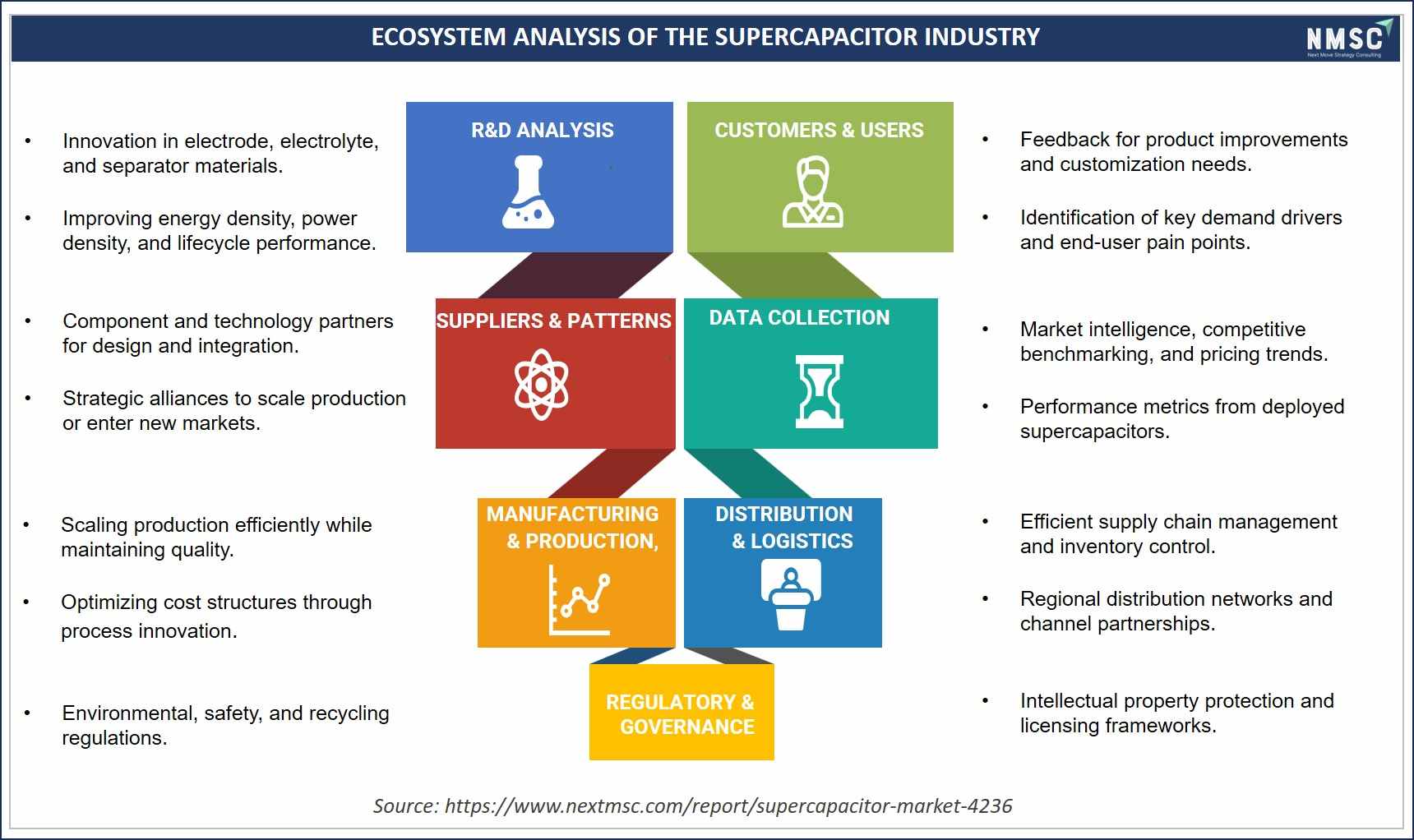
The image presents an ecosystem analysis of the supercapacitor market, highlighting key components that drive the industry. It identifies critical areas such as R&D, customers and users, suppliers and partners, data collection, manufacturing and production, distribution and logistics, and regulatory governance. Each segment plays a pivotal role in shaping market dynamics, from innovation and supply chain management to compliance and end-user engagement. Understanding these interconnected elements provides a comprehensive view of the operational, strategic, and regulatory factors influencing the market.
What are the Key Market Drivers, Breakthroughs, and Investment Opportunities that will Shape the Supercapacitor Market in the Next Decade?
Growth Catalyst & Risk Assessment Matrix
|
DRIVERS/TRENDS/ RESTRAINTS |
(+/-) % IMPACT ON CAGR FORECAST |
GEOGRAPHIC RELEVANCE |
IMPACT TIMELINE |
|
Rising adoption of supercapacitor in electric vehicles, regenerative braking systems, and start-stop applications |
+1.2% |
China, Europe, North America; accelerating adoption in Japan and South Korea |
Short to medium term (1–3 years) |
|
Expansion of renewable energy integration and grid stabilization requirements driving demand for fast-response energy storage |
+1.0% |
Global; strongest growth in Europe, China, and North America |
Medium term (2–4 years) |
|
Increasing deployment in industrial automation, backup power, and peak power management applications |
+0.9% |
North America, Europe, China; emerging adoption in Southeast Asia |
Medium term (2–4 years) |
|
Advancements in materials science (graphene, carbon nanotubes, hybrid Supercapacitor) improving energy density and cycle life |
+1.1% |
Global; R&D-led growth in USA, China, Japan, South Korea, Germany |
Medium to long term (3–5 years) |
|
High initial cost compared to conventional capacitors and lithium-ion batteries limiting price-sensitive adoption |
–0.8% |
Global; strongest impact in emerging markets and cost-sensitive industrial segments |
Short to medium term (1–3 years) |
The global supercapacitor market is experiencing steady growth, driven by rising adoption across electric and hybrid vehicles and increasing demand for fast-charging energy storage solutions. Based on NMSC’s primary research with automotive OEMs and energy storage manufacturers, we observed that Supercapacitors are gaining traction for applications requiring rapid charge–discharge cycles, high power density, and long operational life. Their ability to enhance regenerative braking efficiency, stabilize power delivery, and reduce battery stress is reinforcing adoption across transportation, industrial, and grid-adjacent applications.
However, the relatively high cost per unit energy compared to batteries continues to limit penetration in price-sensitive segments. Looking ahead, expanding deployment of hybrid energy storage systems is expected to unlock new growth opportunities by improving system efficiency and lifecycle economics.
Growth Drivers:
How is the Growing Adoption of Electric and Hybrid Vehicles Boosting the Market Demand?
The accelerating adoption of electric vehicles and hybrid electric vehicles represents a key structural driver for the global supercapacitor market. Based on our primary research with automotive component suppliers, we identified that Supercapacitors are increasingly deployed in EV and hybrid platforms to support high-power, short-duration energy requirements that conventional lithium-ion batteries are less suited to address. These include regenerative braking energy capture, start–stop functionality, acceleration power smoothing, and voltage stabilization for onboard electronics.
From our technical evaluations of vehicle power architectures, Supercapacitors deliver clear performance advantages due to their rapid charge–discharge capability, high cycle life, and operational reliability across wide temperature ranges. Further, integrating a Supercapacitor alongside batteries improves overall system efficiency, extends battery life, and enhances energy recovery rates, particularly in urban driving conditions with frequent braking events.
How is the Rising Demand for Fast-Charging Energy Storage Solutions Driving the Market Growth?
Based on our primary research with energy storage manufacturers and power electronics suppliers, we found that Supercapacitor are increasingly selected where rapid charge-discharge capability and high-power density are critical performance requirements. Unlike conventional batteries, Supercapacitors are charged within seconds and sustain millions of cycles without significant degradation, making them well-suited for high-frequency and high-duty applications.
Also, Supercapacitors are playing an expanding role in fast-charging infrastructure, regenerative energy capture, peak power buffering, and uninterruptible power supply (UPS) systems. Our analysis of operational data indicates that integrating Supercapacitors reduces system stress on batteries, improves energy efficiency, and enables higher utilization rates in fast-turnaround environments such as electric buses, rail systems, industrial machinery, and data centres.
Growth Inhibitor:
How is High Cost per Unit Energy Compared to Batteries Limiting the Market Growth?
One of the primary restraints in the market is their relatively high cost per unit of stored energy compared to lithium-ion and other battery technologies. Based on our analysis of procurement data and discussions with OEMs and system integrators, we confirmed that this cost differential limits supercapacitor adoption in energy-intensive and price-sensitive applications. While Supercapacitors offer superior power density and cycle life, their lower energy density requires pairing with batteries in many use cases, increasing system-level costs. This economic constraint is particularly pronounced in emerging markets and large-scale energy storage projects, where upfront capital expenditure remains a critical decision factor.
Growth Opportunity:
How is the Expansion of Hybrid Energy Storage Systems Creating Opportunities for the Market?
A significant growth opportunity lies in the expanding adoption of hybrid energy storage systems that combine Supercapacitor with batteries or other storage technologies. Our market evaluations indicate that hybrid architectures are gaining traction across electric vehicles, renewable energy integration, industrial automation, and grid stabilization applications. Supercapacitors enable rapid power delivery, regenerative energy capture, and load smoothing, while batteries provide sustained energy storage. This complementary integration improves system efficiency, extends battery lifespan, and reduces total cost of ownership. As system designers increasingly optimize for performance, durability, and lifecycle economics rather than standalone energy density, hybrid configurations are expected to drive sustained demand for Supercapacitor over the medium to long term.
Regulatory Framework Impacting the Supercapacitor Industry
The regulatory landscape plays a crucial role in shaping the growth and adoption of the supercapacitor market, ensuring safety, compliance, and standardized practices across industries.
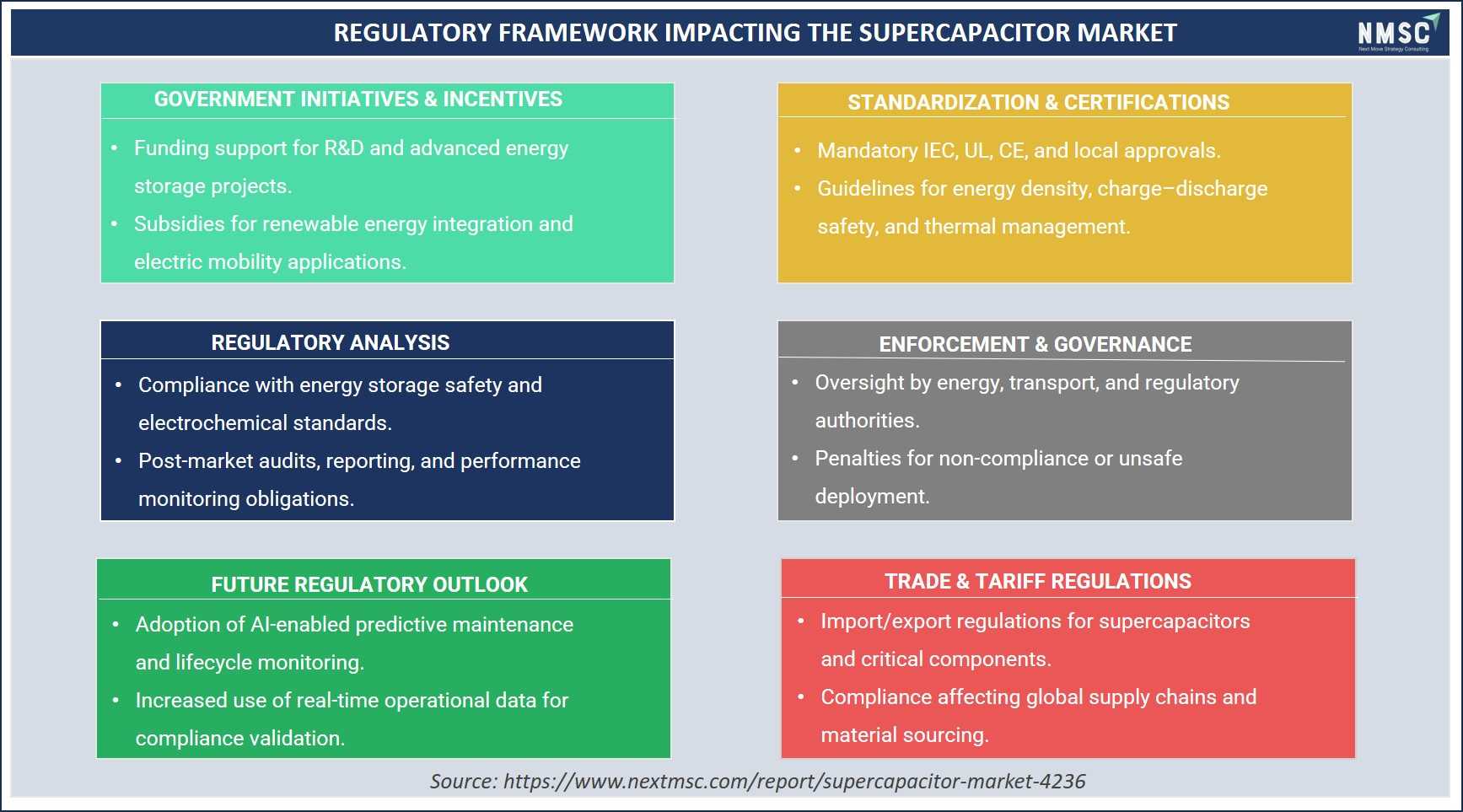
The image illustrates the regulatory framework impacting the Market, highlighting the key areas shaping market operations and compliance. It categorizes regulations into six segments, government initiatives & incentives, standardization & certifications, regulatory analysis, enforcement & governance, future regulatory outlook, and trade & tariff regulations. Each section emphasizes measures such as funding support, mandatory standards, safety compliance, penalties for non-compliance, adoption of AI-driven monitoring, and import/export regulations. Collectively, these factors ensure safe deployment, operational efficiency, and global market alignment for supercapacitor technologies.
How Is the Supercapacitor Industry Segmented in This Report, And What Are the Key Insights from the Segmentation Analysis?
Market Highlights & Strategic Insights – Supercapacitor Market:
|
Segments |
Key Takeaways |
|
Product Type |
EDLCs dominate current demand due to proven reliability, long cycle life, and cost efficiency across industrial, automotive, and consumer applications. Pseudocapacitors are gaining attention for higher energy density, though adoption remains limited by cost and scalability. Hybrid capacitors, including asymmetric cells and Li-ion capacitors, are witnessing strong growth as they bridge the gap between batteries and supercapacitors. Solid-state supercapacitors represent an emerging segment, driven by safety, miniaturization, and next-generation electronics. |
|
Form Factor |
Cylindrical and prismatic form factors lead due to robustness and ease of integration. Radial and radial-lead designs remain common in legacy and industrial electronics. Pouch cells are gaining traction in EVs and compact systems. Chip supercapacitors support miniaturized consumer and IoT devices, while module assemblies and embedded board modules are increasingly preferred for system-level integration and faster deployment. |
|
Energy Storage |
Mid-energy (100–500 F) supercapacitors currently dominate, supported by widespread use in backup power and regenerative braking. High-energy (>500 F) segments are expanding rapidly with renewable energy buffering, rail, and heavy-duty transport. Very low and low capacitance products continue to serve electronics and short-duration power smoothing applications. |
|
Voltage |
Low-voltage (<5 V) supercapacitors account for the largest share due to extensive use in consumer electronics. Medium-voltage (5–15 V) devices are gaining momentum as OEMs shift toward higher efficiency and reduced component complexity. High-voltage (>15 V) solutions are increasingly deployed in transportation, grid, and industrial power systems. |
|
Power |
High power density supercapacitors dominate current demand, reflecting strong use in fast charge–discharge applications such as UPS, robotics, and transportation. Balanced power & energy designs are gaining prominence for hybrid systems, while high energy density and long cycle life optimized variants support renewable energy and infrastructure-focused applications. |
|
Material Technology |
Activated carbon remains the leading material due to cost-effectiveness and mature manufacturing. Carbon nanotubes and metal oxides are advancing performance boundaries, particularly energy density. Conducting polymers and hybrid materials are emerging as next-generation solutions, supported by nanomaterials innovation and R&D investment. |
|
Electrolyte |
Organic electrolytes dominate commercial deployments owing to higher voltage capability. Aqueous electrolytes remain relevant for cost-sensitive and low-voltage applications. Ionic liquids and gel polymer electrolytes are gaining interest for high-temperature stability, safety, and solid-state designs. |
|
Lifecycle |
High and very high cycle life (>1M cycles) supercapacitors dominate the market, reflecting their core value proposition versus batteries. Medium and low lifecycle products remain limited to niche or cost-driven applications. Longevity continues to be a key purchasing criterion. |
|
Temperature Range |
Medium temperature range (-40°C to 125°C) products dominate due to their suitability for automotive and industrial environments. High-temperature (>125°C) supercapacitors are gaining adoption in aerospace, defence, and harsh industrial conditions, while low-range products serve consumer electronics. |
|
Integration Type |
Standalone cells remain widely used, but demand is shifting toward pre-balanced modules and fully integrated packs to reduce system complexity. Hybrid battery–supercapacitor systems are gaining strong traction to improve efficiency and extend battery life. |
|
Sustainability |
Recyclable supercapacitors lead sustainability initiatives due to their long lifespan and reduced waste. Bio-based materials and refurbishment models are emerging as differentiation strategies, aligned with ESG goals and circular economy frameworks. |
|
Sales Channel |
OEM channels dominate due to long-term supply agreements and design-in requirements. Distributors and system integrators play a key role in industrial and infrastructure projects. Direct online sales are expanding, particularly for standardised modules and small-volume buyers, while aftermarket demand remains stable. |
|
Application |
Automotive & transportation lead adoption through start-stop systems, regenerative braking, and heavy-duty buffering. Industrial applications drive steady demand via UPS, robotics, and material handling. Renewable energy & grid applications are growing rapidly, supported by frequency regulation and microgrids. Consumer electronics, telecom, aerospace & defence, and medical devices represent high-value, application-specific growth segments. |
|
End Use Industry |
Automotive, industrial & manufacturing, and energy & utilities constitute the largest demand base. Consumer electronics and telecommunications support volume-driven growth, while aerospace & defence and healthcare favour high-reliability, premium-grade supercapacitors. |
By Product Type Insights
Which Product Types Drive the Supercapacitor Market Growth in 2025?
Based on our product-level assessment of supercapacitor deployments, the market is segmented into electric double-layer capacitors (EDLCs), pseudocapacitors, hybrid capacitors, and solid-state supercapacitors.
Our evaluation indicates that EDLCs accounted for the largest share of market growth in 2025, supported by their high-power density, long cycle life, and proven reliability across industrial equipment, automotive start–stop systems, and power backup applications. Pseudocapacitors recorded rising adoption in applications requiring improved energy density and rapid charge-discharge performance, particularly in advanced electronics and specialized industrial systems. Hybrid capacitors continued to gain steady traction as OEMs increasingly favoured solutions that combine battery-like energy storage with supercapacitor-level power delivery, especially for electric mobility and grid-support use cases. Solid-state supercapacitors have attracted growing interest due to their enhanced safety, compact form factors, and suitability for next-generation consumer electronics and IoT applications.

By Voltage Insights
Which Voltage Ratings Drove Growth in the Market in 2025?
Based on our voltage-level analysis of supercapacitor deployments, the market is segmented into low voltage (<5 V), medium voltage (5–15 V), and high voltage (>15 V) supercapacitors.
From our analysis, low-voltage supercapacitors led market growth in 2025 due to their widespread use in modular designs, consumer electronics, and automotive subsystems, where flexibility and cost efficiency are critical. Medium-voltage supercapacitors followed, supported by rising adoption in industrial automation, material handling, and energy recovery systems that benefit from higher operating efficiency and reduced component count. High-voltage supercapacitors saw more selective deployment, primarily in grid support, heavy industrial, and transportation applications, but gained gradual traction as system integrators evaluated their role in high-power and high-reliability use cases.
By End-Use Industry Insights
Which End-Use Industries Accelerated Supercapacitor Adoption in 2025?
Based on our end-use industry analysis of supercapacitor deployments, the market is segmented into automotive, consumer electronics, industrial & manufacturing, energy & utilities, telecommunications, aerospace & defence, healthcare & medical devices, and others.
Industrial & manufacturing emerged as the largest contributor to supercapacitor market adoption in 2025, driven by expanding use in automation systems, robotics, material handling equipment, and power quality solutions. Automotive followed as a key end-use industry, supported by growing integration of supercapacitors in start–stop systems, regenerative braking, and hybrid vehicle platforms. Energy & utilities gained increasing momentum as supercapacitors were deployed for grid stabilization, renewable energy integration, and short-duration energy buffering.
Furthermore, consumer electronics and telecommunications maintained steady demand, primarily for backup power, fast-response energy support, and reliability enhancement. Aerospace & defense represented a smaller but high-value segment, focused on mission-critical, high-reliability, and pulse-power applications. Healthcare & medical devices accounted for a niche yet steadily expanding segment, driven by demand for compact, long-life, and highly reliable power sources. Other end-use industries, including rail, marine, and specialty industrial applications, contributed incremental demand and supported broader market diversification.

Regional Outlook:
Geographic Performance Snapshot:
|
Regions |
Key Takeaways |
|
North America |
North America accounted for a significant share of the global supercapacitor market in 2025, supported by strong adoption across electric vehicles, renewable energy systems, and industrial automation. High R&D intensity, early commercialization of advanced energy storage technologies, and increasing deployment in grid stabilization and data centre backup power applications continued to drive regional demand. |
|
Europe |
Europe held a notable market share in 2025, driven by stringent emissions regulations, accelerating vehicle electrification, and strong investment in renewable energy integration. Adoption of Supercapacitor was supported by their use in regenerative braking systems, hybrid energy storage architectures, and industrial energy efficiency initiatives aligned with regional sustainability goals. |
|
Asia-Pacific |
Asia-Pacific dominated the supercapacitor market share in 2025, reflecting large-scale manufacturing capacity, rapid EV penetration, and strong demand from consumer electronics and industrial sectors. China, Japan, and South Korea led regional growth, supported by government-backed clean energy policies, advanced materials R&D, and expanding applications in transportation and grid infrastructure. |
|
Middle East & Africa (MEA) |
The Middle East & Africa market showed emerging growth in 2025, supported by investments in renewable energy projects, grid reliability initiatives, and infrastructure modernization. Supercapacitor adoption was primarily driven by demand for high-temperature-tolerant energy storage solutions and backup power systems in energy, transportation, and industrial applications. |
|
Latin America (LATAM) |
Latin America represented a growing share of the Supercapacitor market, supported by increasing investments in renewable energy, public transportation electrification, and industrial modernization. Adoption remained gradual but steady, driven by pilot deployments in energy storage, grid resilience, and transportation infrastructure projects. |
The supercapacitor market is geographically studied across North America, Europe, Asia Pacific, the Middle East & Africa, and Latin America (LATAM), and each region is further studied across countries.
Supercapacitor Market in North America
North America represents a mature, innovation-driven supercapacitor market, supported by strong R&D capabilities, advanced power electronics ecosystems, and early adoption of electrification technologies. Based on our regional assessments and engagements with OEMs and system integrators, we assessed that demand is driven by applications in electric and hybrid vehicles, grid stabilization, industrial automation, and data centre backup power. The region benefits from high awareness of lifecycle performance advantages, including long cycle life and rapid charge-discharge capability. Regulatory focus on energy efficiency, resilience, and decarbonization continues to encourage the adoption of supercapacitors as complementary energy storage components in both transportation and industrial infrastructure.
Supercapacitor Market in the United States
Based on our primary research, we assessed that the United States continues to be the largest contributor to supercapacitor demand in North America. Growth is driven by widespread deployment across automotive electrification, renewable energy integration, and industrial power systems. Our interactions with manufacturers and technology adopters indicate that supercapacitors are increasingly incorporated into hybrid energy storage architectures to enhance system efficiency and mitigate battery degradation. A strong domestic innovation ecosystem, venture-backed advances in materials science, and rising investments in fast-charging infrastructure further underpin market expansion. Additionally, the U.S. market is evolving toward value-added offerings such as intelligent power modules and system-level integration, reinforcing long-term commercial opportunities for suppliers.
Supercapacitor Market in Canada
In Canada, the market shows steady and structurally stable growth, supported by investments in clean energy, public transportation electrification, and industrial modernization. Our research indicates growing adoption in rail systems, renewable energy buffering, and cold-climate applications, where Supercapacitors’ temperature resilience offers a clear advantage. Government emphasis on sustainability and grid reliability reinforces demand, while buyers prioritize durability, safety certifications, and long operational lifespans. Compared with the U.S., adoption volumes are lower, but project cycles tend to favour high-quality, long-term deployments.
Supercapacitor Market in Europe
Europe represents a regulation-driven and efficiency-focused supercapacitor market, shaped by stringent emissions standards, energy transition policies, and industrial decarbonization goals. Our EU-wide analysis indicates strong demand from automotive electrification, renewable energy systems, and industrial power management applications. European buyers place high importance on compliance, safety certifications, and interoperability with existing energy infrastructure. These requirements raise qualification thresholds but also enhance supplier credibility, contract longevity, and technology trust across the region.
Supercapacitor Market in the United Kingdom
Our market observations indicate rising demand for supercapacitors across rail transportation, electric vehicle infrastructure, and industrial energy-efficiency applications in the United Kingdom. Growth is supported by national energy-transition initiatives, expanding electrified transport programs, and increased investment in grid resilience. End users place strong emphasis on long lifecycle performance, high reliability, and transparent total cost of ownership. Despite ongoing global supply-chain uncertainties, the UK remains conducive to innovation-driven adoption, particularly for hybrid energy storage solutions that enable rapid, high-power response capabilities.
Supercapacitor Market in Germany
Germany demonstrates a highly disciplined, engineering-led approach to supercapacitor adoption. Our research shows strong deployment in automotive systems, industrial machinery, and energy recovery applications, where precision, safety, and reliability are critical. German buyers prioritize certified materials, predictable performance, and long-term supplier partnerships. The country’s strong manufacturing base and collaboration between industry, research institutions, and technology providers support sustained adoption of advanced supercapacitor solutions, particularly in hybrid configurations.
Supercapacitor Market in France
France exhibits consistent growth in supercapacitor adoption, supported by electrified public transport, renewable energy integration, and industrial power optimization initiatives. Our interactions with system developers indicate increasing use of supercapacitors in rail systems, grid buffering, and backup power applications. Regulatory emphasis on energy efficiency and safety encourages adoption of solutions that demonstrate measurable performance gains and operational resilience. Vendors with strong local integration capabilities and compliance expertise are better positioned to scale in the French market.
Supercapacitor Market in Italy
Italy’s market is evolving through gradual adoption in industrial automation, transportation, and energy efficiency projects. Our analysis highlights growing interest in modular and hybrid energy storage systems that are integrated into existing infrastructure. Government incentives supporting industrial modernisation and clean energy projects further encourage uptake. Due to fragmented infrastructure, Italian buyers value flexible system design, local technical support, and phased deployment models.
Supercapacitor Market in Spain
Based on our analysis, Spain is witnessing accelerating adoption of supercapacitors driven by renewable energy expansion, electrified transportation initiatives, and a growing emphasis on grid stability. Supercapacitors are increasingly deployed for energy smoothing, peak power support, and fast-response storage in solar and wind installations. Although cost sensitivity remains a key consideration, solutions that deliver measurable efficiency improvements and longer lifecycle performance are gaining traction, particularly in high-utilisation environments.
Supercapacitor Market in the Nordics
The Nordic region, comprising Sweden, Finland, Norway, and Denmark, represents an advanced and quality-driven supercapacitor market, supported by high digital maturity and strong sustainability mandates. Based on our observations, we observed that the demand is driven by applications across renewable energy systems, electrified public transportation, and industrial power management. Buyers in the region prioritise energy efficiency, environmental performance, and long-term system reliability, reflecting broader decarbonization and resilience objectives. Vendors offering energy-efficient designs, transparent lifecycle metrics, compliance with strict environmental standards, and strong local partnerships are well-positioned to secure premium deployments, long-term contracts, and repeat business across the Nordic markets.
Supercapacitor Market in the Asia-Pacific
Asia-Pacific is the fastest-growing supercapacitor market, supported by large-scale manufacturing capacity, rapid EV adoption, and strong government backing for clean energy technologies. From our regional analysis, we observed that China drives volume growth through domestic production and cost efficiency, Japan emphasizes precision, reliability, and materials innovation, South Korea leads in advanced electronics integration, and Southeast Asia shows rising adoption in transportation and industrial infrastructure. Strong local supply chains and policy support continue to accelerate deployment, making Asia-Pacific a critical region for both scale and innovation.
Supercapacitor Market in China
China represents the largest-scale and most cost-competitive supercapacitor market globally, supported by extensive domestic manufacturing capacity, strong materials supply chains, and government-backed clean energy and electrification initiatives. Based on our research, we analysed that the demand is driven by electric and hybrid vehicles, renewable energy systems, rail transportation, and industrial power buffering. Domestic manufacturers play a central role in shaping pricing dynamics and accelerating commercialisation, particularly through vertically integrated production of carbon-based materials and electrode technologies.
Supercapacitor Market in Japan
Based on our assessments, we identified that Japan demonstrates structurally stable and technology-driven growth in supercapacitor adoption, supported by advanced electronics manufacturing, infrastructure modernization, and a strong emphasis on reliability. Deployment is increasing across hybrid vehicles, rail systems, industrial automation, and backup power applications. Japanese buyers consistently prioritize precision engineering, stringent safety certifications, and long-term performance consistency over aggressive cost optimization. As a result, brand credibility, proven lifecycle performance, and robust after-sales support play a decisive role in purchasing decisions, favouring premium suppliers with deep technical expertise.
Supercapacitor Market in India
India represents a fast-emerging supercapacitor market, driven by expanding electric mobility initiatives, renewable energy deployment, and increasing grid stability requirements. Based on our market interactions, we observed that adoption is concentrated in electric buses, railways, industrial power backup, and energy smoothing applications. Cost sensitivity remains high, encouraging demand for modular and hybrid energy storage systems that combine Supercapacitor with batteries. Vendors offering cost-optimized designs, localized manufacturing, and strong integration support are better positioned to scale across infrastructure and transportation projects.
Supercapacitor Market in South Korea
South Korea is an advanced adopter of supercapacitor technologies, supported by strong electronics manufacturing, battery innovation ecosystems, and rapid adoption of next-generation energy storage solutions. Our research shows increasing use of Supercapacitors in electric vehicles, consumer electronics, industrial power systems, and renewable energy buffering. Domestic firms benefit from vertically integrated capabilities spanning materials, electronics, and system integration. Vendors that collaborate with local OEMs and align with South Korea’s high-performance and miniaturisation standards achieve faster market acceptance.
Supercapacitor Market in Taiwan
Taiwan exhibits strong technology affinity and early adoption of Supercapacitor, supported by its semiconductor, electronics, and advanced manufacturing ecosystem. Based on our assessment, we found that demand is growing in industrial automation, power conditioning, and high-reliability electronics applications. Buyers emphasize system reliability, compact form factors, and interoperability with existing power management architectures. Pilot deployments and proof-of-concept projects are commonly used to validate performance and ROI before scaling. Suppliers offering localized technical support and integration flexibility are able to expand more effectively.
Supercapacitor Market in Indonesia
Indonesia’s market remains at an early stage but is accelerating steadily, driven by rapid urbanization, expanding renewable energy deployment, and ongoing infrastructure modernization. As a result, initial adoption is emerging across public transportation electrification, grid support, and industrial backup power applications. Further, based on our assessment, we found that purchasing decisions are largely shaped by affordability, durability, and ease of deployment. Consequently, forming partnerships with local energy developers, system integrators, and infrastructure operators is critical for market entry and long-term growth.
Supercapacitor Market in Australia
Australia demonstrates a strong demand for supercapacitors in applications requiring high reliability and resilience, including renewable energy integration, grid stabilization, mining operations, and remote infrastructure. Our engagements indicate growing use of Supercapacitor for peak power support, energy smoothing, and backup systems in geographically dispersed environments. Buyers prioritize robust design, long operational life, and comprehensive service support. Also, vendors offering integrated solutions combining hardware, monitoring software, and lifecycle services achieve stronger commercial traction.
Supercapacitor Market in Latin America
Based on our regional market analysis, we observed that Latin America represents a developing yet increasingly attractive supercapacitor market, supported by renewable energy investments, electrified public transportation, and grid reliability initiatives. Adoption is primarily concentrated in rail systems, energy buffering, and industrial power applications. Price sensitivity and financing constraints continue to shape purchasing decisions, making phased deployment approaches and hybrid energy storage solutions more practical. In this context, suppliers that adopt local partnerships, regional assembly strategies, and flexible commercial structures are better positioned to manage economic variability and capture emerging opportunities.
Supercapacitor Market in the Middle East & Africa
The Middle East & Africa region presents a dual-speed supercapacitor market. In the Middle East, demand is driven by large-scale renewable energy projects, smart infrastructure, rail transport, and grid resilience initiatives, where high-performance and temperature-tolerant energy storage is critical. Africa remains an emerging market, with adoption focused on cost-effective solutions for power stabilization, transportation, and off-grid applications. Vendors adopting region-specific strategies, premium, integrated solutions in the Middle East and modular, scalable systems in Africa, are best positioned for long-term growth.
SWOT Analysis of the Supercapacitor Market
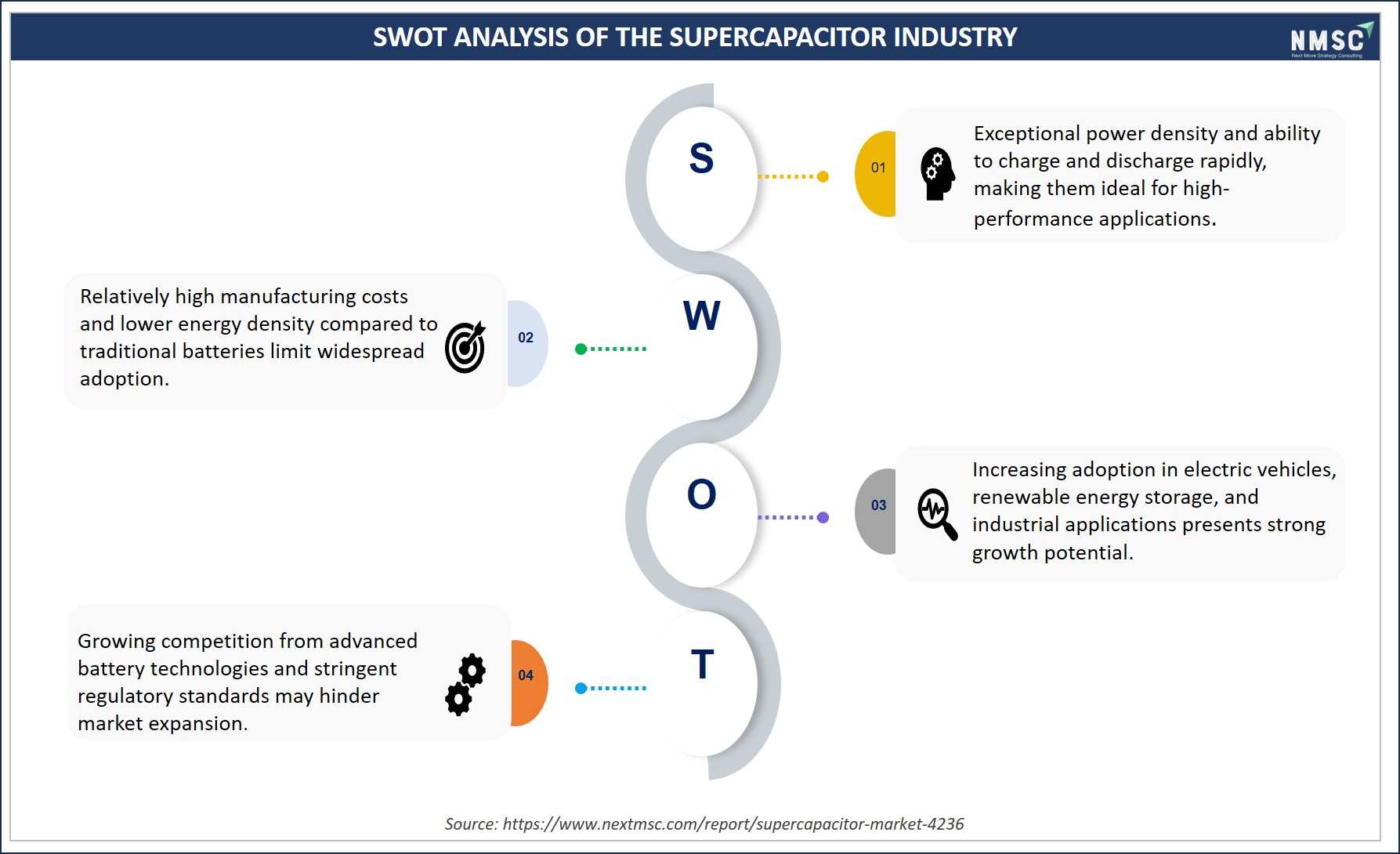
The image illustrates a SWOT analysis of the supercapacitor industry, where the key strengths includes rapid charging and discharging capability, along with high power density. Identified weaknesses centre on relatively high manufacturing costs and lower energy density compared with conventional batteries. On the opportunity side, the analysis highlights increasing adoption across electric vehicles and renewable energy applications.
Further, potential threats include intensifying competition from advanced battery technologies and the impact of stringent regulatory requirements. Overall, the framework provides a clear summary of the internal and external factors shaping the supercapacitor market’s competitive landscape and long-term growth potential.
Competitive Landscape
Competitive Dynamics & M&A Landscape:
|
Key Takeaways |
|
The global Supercapacitor market demand is driven by established industrial leaders and emerging specialists. Leading players include Eaton Corporation plc, YAGEO Corporation, LS Materials Co., Ltd., KYOCERA AVX Components Corporation, Nippon Chemi-Con Corporation, Cornell-Dubilier Electronics, Inc., Nichicon Corporation, Nantong Jianghai Capacitor Co., Ltd., Skeleton Technologies GmbH, IOXUS, Inc., VINATech Co., Ltd., Samwha Capacitor Co., Ltd., ELNA Co., Ltd., Clarios, CAP-XX Limited, Shanghai Aowei Technology Development Co., Ltd., Korchip Corporation, SECH SA, FastCap Ultracapacitors, Seiko Instruments Inc. and others. |
|
From our assessment of vendor strategies, companies are increasingly prioritizing material science innovations, hybrid energy storage solutions, advanced electrode technologies, and thermal management systems. Energy density, charge/discharge efficiency, lifecycle durability, and compatibility with IoT and renewable energy systems have emerged as critical competitive differentiators, particularly for customers in automotive, grid storage, industrial electronics, and consumer devices. |
|
Recent merger, acquisition, and partnership activities in the supercapacitor market reflect a strategic shift toward acquiring advanced carbon-based material expertise, solid-state and graphene technology, manufacturing process innovations, and systems integration capabilities, rather than merely expanding component portfolios. This approach enables accelerated R&D cycles, improved product performance, and stronger vertically integrated offerings, reinforcing long-term competitiveness in next-generation energy storage solutions. |
Which Companies Dominate the Supercapacitor Industry and How Do They Compete?
Based on our analysis, we noticed that the supercapacitor market is dominated by established electronic component leaders alongside fast-scaling energy storage specialists. CAP-XX, Skeleton Technologies, Eaton, TDK Corporation, and Nippon Chemi-Con Corporation consistently lead high-performance deployments where energy density, rapid charge-discharge capability, and long operational lifecycles are critical decision factors. From our assessments, we found that these vendors are frequently selected for automotive, industrial, and renewable energy applications requiring tight integration with power management systems, inverters, and energy storage modules.
Moreover, Fastcap Ultracapacitors, LLC., Cornell Dubilier Electronics, Inc. and SECH SA strengthened their market positions through application-specific platforms, particularly in heavy-duty industrial, grid stabilization, and high-temperature environments. Competition at this tier is primarily driven by product reliability, global technical support, and proven performance at scale.
Market Dominated by Supercapacitor Giants and Specialists
From our observation, we observed that the competitive landscape is shaped by specialized energy storage innovators such as CAP-XX, Skeleton Technologies, IOXUS, Fastcap Ultracapacitors, LLC., and Maxwell Technologies. Our deployment assessments and customer interviews indicate that these companies gained traction by offering high-energy-density ultracapacitors, rapid charge-discharge capabilities, and scalable module designs that minimize integration complexity. CAP-XX and Skeleton Technologies are frequently cited by operators for superior lifecycle performance and fast ROI in automotive and industrial energy storage applications, while IOXUS, and Fastcap Ultracapacitors, LLC. are preferred in environments requiring compact, high-power solutions with rigorous reliability standards. Maxwell Technologies differentiated itself through deep system-level integration expertise and proven performance in grid stabilization and renewable energy projects.
Established component manufacturers such as Eaton, TDK Corporation, Nippon Chemi-Con Corporation, Murata Manufacturing Co., Ltd., and Nichicon set technical and reliability standards, while specialized innovators accelerated adoption through flexible, high-performance ultracapacitor solutions, collectively driving broader acceptance of supercapacitors across automotive, industrial, and energy sectors.
Innovation and Adaptability Drive Market Success
Innovation remains a core determinant of competitive advantage in the supercapacitor market, as observed through our assessments of deployments and pilot programs across automotive, industrial, and renewable energy applications. Market leaders such as CAP-XX, Skeleton Technologies, Eaton, IOXUS, and Maxwell Technologies advanced capabilities in high-energy-density storage, rapid charge-discharge performance, and modular ultracapacitor architectures, enabling systems to adapt dynamically to varying power demands, harsh operating conditions, and high-cycle usage requirements.
Further, from integrator and end-user feedback, we observed that vendors investing in advanced chemistry, scalable module designs, and real-time energy management are better positioned to scale across multi-site industrial and automotive deployments. These innovations reflect deep expertise in electrochemical engineering, system integration, and power electronics, allowing suppliers to respond quickly to evolving energy storage requirements and sustain long-term customer engagement.
Market Players to Opt for Merger & Acquisition Strategies to Expand their Presence
Based on our research, mergers and acquisitions have emerged as a key growth lever in the supercapacitor market, as companies seek to accelerate technology access and broaden solution portfolios. Leading players increasingly targeted firms specializing in advanced ultracapacitor chemistries, module integration, energy management systems, and high-power electronics to strengthen end-to-end energy storage solutions. Rather than focusing solely on scale, acquisition strategies prioritized faster innovation cycles, improved system interoperability, and expansion into high-growth verticals such as electric mobility, renewable energy, and industrial automation.
Our analysis also indicates that these moves help vendors reduce deployment complexity, enhance integration with power electronics and battery systems, and improve overall return-on-investment for customers. As competition intensifies, consolidation is reshaping the landscape by reinforcing platform depth, technical expertise, and global service capabilities.
Strategic Framework for the Supercapacitor Market
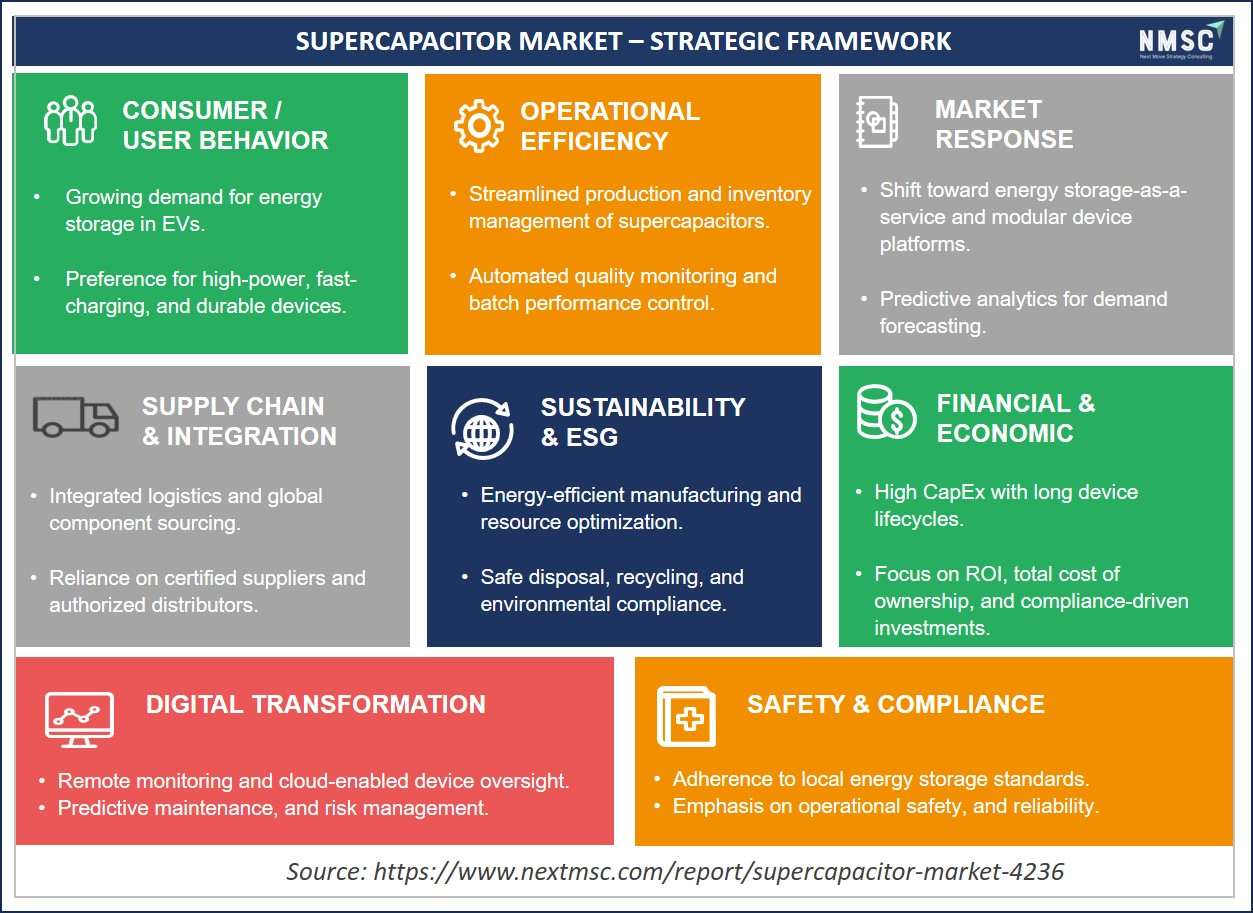
The image outlines a strategic framework for the supercapacitor market, mapping key industry dimensions. It spans consumer trends like demand for EVs, operational priorities such as efficient production, and market responses, including storage-as-a-service models. The framework also covers supply chain integration, sustainability practices, financial considerations like ROI, digital transformation for remote monitoring, and critical safety and compliance standards. This multi-faceted view highlights the interconnected factors driving the industry's evolution and competitive strategy.
List of Key Supercapacitor Companies
-
Eaton Corporation plc
-
YAGEO Corporation
-
LS Materials Co., Ltd.
-
KYOCERA AVX Components Corporation
-
Nippon Chemi-Con Corporation
-
Cornell-Dubilier Electronics, Inc.
-
Nichicon Corporation
-
Nantong Jianghai Capacitor Co., Ltd.
-
Skeleton Technologies GmbH
-
IOXUS, Inc.
-
VINATech Co., Ltd.
-
Samwha Capacitor Co., Ltd.
-
ELNA Co., Ltd.
-
Clarios
-
CAP-XX Limited
-
Shanghai Aowei Technology Development Co., Ltd.
-
Korchip Corporation
-
SECH SA
-
FastCap Ultracapacitors
-
Seiko Instruments Inc.
What Are The Latest Key Industry Developments?
-
March 2026 – LS Materials Co., Ltd. unveiled a new long-life ultracapacitor (UC) system designed specifically for AI data centers. The system delivers more than 6 million charge-discharge cycles—approximately six times the lifespan of conventional ultracapacitors—and is engineered to manage peak power demands in GPU servers, supporting the growing power requirements of AI infrastructure.
-
May 2025- Skeleton Technologies launched its GrapheneGPU power shelf, a next-generation supercapacitor-based energy storage solution designed specifically for high-performance and AI-driven data centres.
Expert Insights

“When it comes to the electrical grid, our mission is simple, keep the lights on in Europe.”
Taavi Madiberk — CEO & Co Founder (Skeleton Technologies OU)
What Are The Key Factors Influencing Investment Analysis & Opportunities in The Supercapacitor Market?
Investment analysis in the supercapacitor market is increasingly shaped by a shift toward technology platforms, materials innovation, and system-level integration, rather than standalone component manufacturing alone. Based on our review of recent funding activity, mergers and acquisitions, and strategic partnerships, we observed that investors favour companies with proprietary electrode materials, scalable manufacturing processes, and differentiated performance characteristics such as high-power density, extended cycle life, and temperature resilience.
Vendors that combine supercapacitor hardware with hybrid energy storage architectures, power management electronics, and monitoring software are consistently achieving stronger valuations due to their ability to address broader application needs and generate recurring revenue through system upgrades and services.
We also identified growing investment focus on advanced carbon materials, graphene-based supercapacitors, and hybrid battery-supercapacitor solutions, particularly for electric mobility, renewable energy integration, and grid stabilization. Strategic investments increasingly outweigh purely financial funding, as automotive OEMs, energy companies, and industrial players seek supply-chain security, faster commercialization, and technology control.
For investors, the most attractive opportunities lie in companies that demonstrate clear performance differentiation, cost-reduction pathways, validated end-use adoption, and scalable production economics, positioning supercapacitors as critical enablers within next-generation energy storage systems.
Key Benefits for Stakeholders:
Next Move Strategy Consulting (NMSC) provides a comprehensive and evidence-based analysis of the supercapacitor market trends, covering historical developments from 2020 to 2025 and offering forward-looking forecasts through 2035. Our study assesses the market at global, regional, and country levels, combining quantitative outlooks with qualitative insights into key growth drivers, adoption constraints, technology evolution, and investment dynamics across major supercapacitor segments, including transportation, energy, and industrial applications.
From our assessment, we observed that the supercapacitors industry delivers differentiated value to a wide range of stakeholders. Investors benefit from exposure to materials innovation, hybrid energy storage platforms, and system-level integration opportunities that support scalable and repeatable revenue streams. End users, including automotive OEMs, utilities, and industrial operators, gain improved energy efficiency, faster response times, extended battery life, and enhanced system reliability. Manufacturers, system integrators, and technology partners benefit from long-term supply agreements, application-specific customization, and growing demand for integrated energy storage solutions. Collectively, these dynamics support sustainable value creation, long-term profitability, and the advancement of next-generation energy infrastructure.
|
Parameters |
Details |
|
Customization Scope |
Free customization (equivalent to up to 80 analyst-working hours) after purchase. Addition or alteration to country, regional & segment scope. |
|
Pricing and Purchase Options |
Avail customized purchase options to meet your exact research needs. |
|
Approach |
In-depth primary and secondary research; proprietary databases; rigorous quality control and validation measures. |
|
Analytical Tools |
Porter's Five Forces, SWOT, value chain, and Harvey ball analysis to assess competitive intensity, stakeholder roles, and relative impact of key factors. |
Key Market Segments
By Offering
-
Cells
-
Cylindrical Cells
-
Prismatic Cells
-
Pouch Cells
-
Coin & Button Cells
-
Radial & Welded Tab Cells
-
Screw Terminal Cells
-
Other Form Factors
-
-
Modules
-
Low Voltage Modules (≤60V)
-
High Voltage Modules (>60V)
-
-
Integrated Systems
-
Pre-Engineered Packs
-
Custom Engineered Systems
-
By Technology
-
Electric Double-Layer Capacitors (EDLC)
-
Pseudocapacitors
-
Hybrid Capacitors
-
Other Materials
By Electrode Material
-
Carbon-Based
-
Activated Carbon
-
Graphene & CNT
-
Carbide-Derived Carbon
-
-
Metal Oxides
-
Conducting Polymers
-
Composite-Based Materials
-
Other Materials
By Capacitance Range
-
Small (<100 F)
-
Medium (100 to 1000 F)
-
Large (>1000 F)
By Sales Channel
-
Direct Enterprise Sales
-
Systems Integrator & EPC
-
Distributors & Wholesalers
-
Retail & E-Commerce
By End-User Industry
-
Auto & Transport
-
EVs & Hybrids
-
Rail & Mass Transit
-
Heavy Commercial & Off-Highway
-
Aerospace & Marine
-
-
Industrial
-
Automation & Robotics
-
Material Handling & Cranes
-
Power Quality & Backup
-
Renewable Energy Systems
-
-
Energy & Utilities
-
Grid & Stability
-
Microgrids
-
-
Consumer Electronics & IoT
-
Portable Devices
-
Wearables & Medical Devices
-
Smart Meters & Sensors
-
-
Telecom & Data Infrastructure
-
Other End-Users
Geographical Breakdown
-
North America: U.S., Canada, and Mexico.
-
Europe: UK, Germany, France, Italy, Spain, Sweden, Denmark, Finland, the Netherlands, and the Rest of Europe.
-
Asia Pacific: China, India, Japan, South Korea, Taiwan, Indonesia, Vietnam, Australia, Philippines, Malaysia and the rest of APAC.
-
Middle East & Africa (MEA): Saudi Arabia, UAE, Egypt, Israel, Turkey, Nigeria, South Africa, and the rest of MEA.
-
Latin America: Brazil, Argentina, Chile, Colombia, and the rest of LATAM.
Conclusion & Recommendations
Our report provides stakeholders, industry participants, investors, and consultants with actionable insights to navigate the structural evolution of the market. By combining data-driven analysis with established strategic frameworks, NMSC’s Supercapacitor Market Report serves as a reliable decision-support resource for evaluating technology pathways, investment priorities, and long-term growth opportunities. The market is positioned for sustained expansion, supported by accelerating electrification, rising demand for fast-response energy storage, and increasing emphasis on energy efficiency, system resilience, and lifecycle optimization across transportation, industrial, and grid applications.
Our strategic assessment also highlights the growing importance of materials innovation, hybrid energy storage architectures, and system-level integration in strengthening performance differentiation and return on investment. Vendors that prioritize scalable manufacturing, modular designs, and compatibility with power electronics and energy management systems are better positioned to achieve long-term customer adoption and repeat business.
For executives and investors, value creation increasingly depends on targeting high-growth applications such as electric mobility, renewable energy buffering, and grid stabilization, while continuing investments in R&D, cost-reduction pathways, and strategic partnerships. Expanding presence in high-growth regions, particularly Asia-Pacific and emerging energy infrastructure markets, further enhances growth potential and supports durable value creation across the global supercapacitor ecosystem.


About the Author
 Tushmi Dutta
— Tushmi Dutta is a focused researcher specializing in detailed analysis and insight-driven research across diverse business landscapes. She supports strategic initiatives through structured data interpretation, thorough validation, and clear communication of findings that aid informed decision-making. With a strong interest in writing, she enjoys presenting research insights in an engaging and accessible manner. Beyond work, she enjoys traveling, reading, painting, and continuously learning new skills that contribute to her creative and professional growth.
Tushmi Dutta
— Tushmi Dutta is a focused researcher specializing in detailed analysis and insight-driven research across diverse business landscapes. She supports strategic initiatives through structured data interpretation, thorough validation, and clear communication of findings that aid informed decision-making. With a strong interest in writing, she enjoys presenting research insights in an engaging and accessible manner. Beyond work, she enjoys traveling, reading, painting, and continuously learning new skills that contribute to her creative and professional growth.
About the Reviewer
 Supradip Baul
— Supradip Baul is an accomplished business consultant and strategist with over a decade of rich experience in market intelligence, strategy, technology, and business transformation. His work has included rigorous qualitative and quantitative analysis across multiple industries, helping clients shape investment decisions and long-term roadmaps. Earlier in his career, he was associated with Gartner, where he contributed to industry-leading reports and market share analyses. He has worked with leading global companies and holds an MBA with a dual specialization in Marketing and Finance.
Supradip Baul
— Supradip Baul is an accomplished business consultant and strategist with over a decade of rich experience in market intelligence, strategy, technology, and business transformation. His work has included rigorous qualitative and quantitative analysis across multiple industries, helping clients shape investment decisions and long-term roadmaps. Earlier in his career, he was associated with Gartner, where he contributed to industry-leading reports and market share analyses. He has worked with leading global companies and holds an MBA with a dual specialization in Marketing and Finance.
At Next Move Strategy Consulting, we understand that insightful market research is the cornerstone of successful business decisions. That's why we employ a robust and multifaceted approach, combining various methodologies to deliver the most accurate and actionable data for our clients.

Research Landscape
We navigate the world of research with two primary approaches:
Qualitative Approach
Our qualitative research methodologies involve immersive techniques such as in-depth interviews, focus groups, and observational studies. By engaging directly with individuals and stakeholders, we uncover valuable insights that quantitative data alone may overlook.

Quantitative Research
In tandem with qualitative methodologies, NMSC leverages the power of Quantitative Research to provide a robust foundation of numerical insights. Through systematic data collection and analysis, we quantify patterns, preferences, and market trends, offering a comprehensive view of the business landscape.
Our quantitative research approach employs diverse tools, including surveys, experiments, and statistical modelling. These methodologies enable us to gather data from a large and representative sample, ensuring the statistical significance of our findings. By employing structured questionnaires and standardized data collection methods, we guarantee the reliability and validity of the information we present to our clients.
Quantitative research is particularly effective in measuring the prevalence of trends, assessing market size, and gauging the impact of various factors on consumer behavior. The numerical precision attained through this approach equips our clients with actionable insights, facilitating data-driven decision-making and strategy formulation.


Our Specialized Toolbox for Industry-Specific Market Research
We deploy a specialized arsenal of techniques tailored to meet your unique requirements. Here's a glimpse into our comprehensive toolbox:

Information Procurement
The stage entails acquiring market data or relevant information through various sources and methodologies.


Market Research Approach
We utilize both top-down and bottom-up approaches in market research analysis to achieve a comprehensive understanding of the market dynamics, leveraging the broad perspective of industry trends and macroeconomic factors alongside detailed insights from specific segments and individual companies.

Porters Five Forces Analysis
We conduct Porter's Five Forces analysis to evaluate the competitive landscape of an industry, providing us with insights into factors that affect profitability and strategic positioning.

SWOT Analysis

Forecasting
We utilize a forecasting model to predict future consumption by considering parameters like population, economics, regulations, market competition, drivers, constraints, technology, and pricing. We also employ statistical techniques such as multilinear regression, exponential smoothing, moving average, ARIMA, and Monte Carlo simulations for accurate predictions. In econometric forecasting, we analyzed short-term and long-term event impacts, attributing values based on regulatory frameworks, economic factors, and market events.





 Speak to Our Analyst