Sweden Mobile Robot Market By Product Type (Pallet Transport Robots, Forklift Robots, Tow Tractor Robots, Tote & Bin Robots, Shelf & Rack Robots, Case Handling Robots, Piece Picking Robots, and Other Mobile Robots), By Technology (Automated Guided Vehicles (AGVs), Autonomous Mobile Robots (AMRs), and Hybrid Mobile Robots), By Payload Capacity, By Operating Environment, By Fleet Size, By Sales Channel, and By End User Industry – Opportunity Analysis and Industry Forecast, 2025–2035
Industry: ICT & Media | Latest Edition: September 30, 2026 | No of Pages: 333 | No. of Tables: 190 | No. of Figures: 176 | Format: PDF | Report Code: IC5266
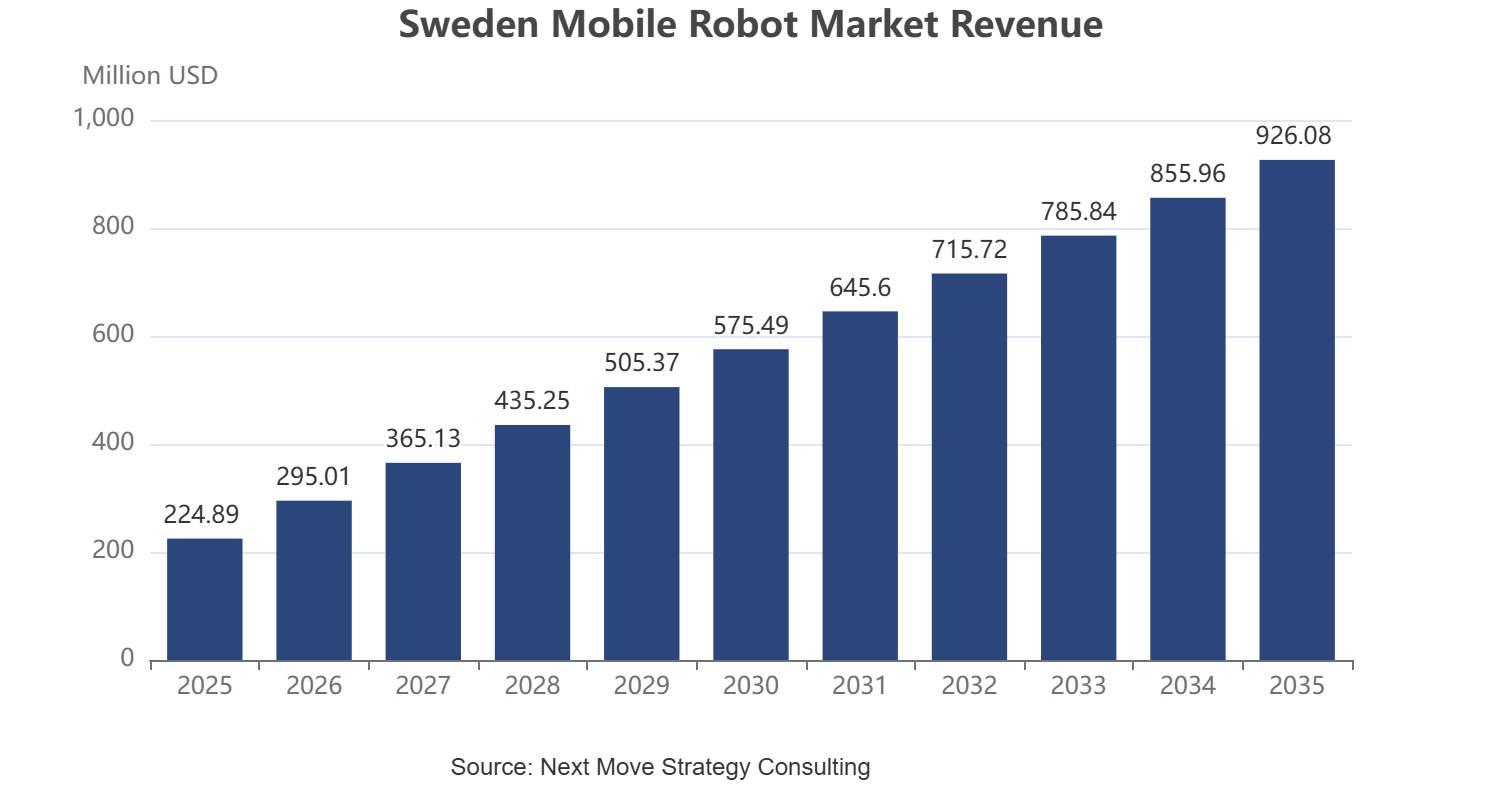
Sweden Mobile Robot Market Size & Forecast 2025–2035
|
Parameters |
Details |
|
Market Size in 2025 |
USD 224.89 Million |
|
Market Size in 2026 |
USD 281.73 Million |
|
Revenue Forecast in 2035 |
USD 926.08 Million |
|
Growth Rate |
CAGR of 14.14% from 2026 to 2035 |
|
Market Volume in 2025 |
4 Thousand Units |
|
Market Volume in 2026 |
5 Thousand Units |
|
Volume Forecast in 2035 |
20 Thousand Units |
|
Growth Rate |
CAGR of 15.94% from 2026 to 2035 |
|
Analysis Period |
2025–2035 |
|
Base Year Considered |
2025 |
|
Forecast Period |
2026–2035 |
|
Market Size Estimation |
Million (USD) |
|
Companies Profiled |
15 |
|
Market Share |
Available for 12 Companies |
Industry Outlook
The Sweden Mobile Robot Market was valued at USD 224.89 million in 2025 and reached USD 281.73 million in 2026. Looking ahead, the market is projected to grow strongly, reaching USD 926.08 million by 2035, registering a CAGR of 14.14% from 2026 to 2035. In terms of volume, the market recorded 4 thousand units in 2025, with forecasts indicating growth to 5 thousand units by 2026 and further to 20 thousand units by 2035, reflecting a CAGR of 15.94% over the same forecast period across the country.
What Are the Key Market Drivers, Restraints, and Opportunities Shaping the Sweden Mobile Robot Market?
Growth Catalyst & Risk Assessment Matrix
|
Drivers / Restraints / Opportunities |
(+/–) % Impact on CAGR Forecast |
Geographic Relevance |
Impact Timeline |
|
Sweden's pioneering underground mining automation is driving deployment of autonomous trucks and material handling robots to improve safety and efficiency |
+2.0% |
Northern Sweden mining regions |
Short to medium term (1–5 years) |
|
Sweden's established automotive and heavy vehicle manufacturing base is driving deployment of mobile robots for component transport and intralogistics |
+1.6% |
Gothenburg, Södertälje |
Medium term (2–7 years) |
|
Growing e-commerce and retail distribution networks are driving demand for automated warehousing and fulfillment solutions |
+1.4% |
Stockholm, major distribution hubs |
Medium term (2–7 years) |
|
Stringent workplace safety and environmental regulatory compliance requirements continue to restrain adoption by increasing certification costs and timelines |
–1.1% |
Sweden (nationwide) |
Short to medium term (1–5 years) |
|
Sweden's green industrial transition toward fossil-free steel and battery gigafactory production is creating new avenues for growth |
+1.5% |
Northern and central Sweden |
Long term (4–10 years) |
Through our market assessment, we observed that the Sweden Mobile Robot Market is witnessing strong growth driven by the country's pioneering underground mining automation, its established automotive and heavy vehicle manufacturing base, and expanding e-commerce and retail distribution networks. However, stringent workplace safety and environmental regulatory compliance requirements continue to restrain broader adoption, while Sweden's green industrial transition is creating meaningful long-term growth opportunities across the country.
Growth Drivers:
How Is Sweden's Pioneering Underground Mining Automation Driving the Mobile Robot Market?
Our market assessment indicates that Sweden's pioneering underground mining automation, led by large-scale iron ore operations deploying autonomous trucks and automated material handling systems deep beneath the surface, is a distinctive factor shaping the Market. Mining companies are investing in autonomous mobile robots and automated guided vehicles to transport ore, equipment, and supplies through hazardous underground environments, improving worker safety and operational efficiency. This unique industrial application positions Sweden as a global reference point for automated mining logistics.
How Is Sweden's Automotive and Heavy Vehicle Manufacturing Base Accelerating Market Growth?
Based on our market evaluation, Sweden's established automotive and heavy vehicle manufacturing base, anchored by major passenger car and commercial truck producers, is driving increased deployment of mobile robots across assembly and intralogistics operations. Manufacturers are investing in automated guided vehicles and autonomous mobile robots to transport components, subassemblies, and finished parts across large production facilities. This deep-rooted industrial heritage continues to support sustained demand for reliable, high-precision material handling automation nationwide.
How Is Growth in E-Commerce and Retail Distribution Accelerating Warehouse Automation?
According to NMSC research, the continued expansion of e-commerce platforms and organized retail distribution networks across Sweden, supported by globally recognized home furnishing and fashion retailers, is strengthening demand for mobile robots. Retailers and logistics providers are investing in automated material handling solutions to manage rising order volumes, shorten delivery times, and improve inventory accuracy across major distribution hubs. Mobile robots are becoming integral to modernizing Sweden's retail supply chain infrastructure.
Growth Inhibitor:
What Challenges Are Restraining Growth in the Sweden Mobile Robot Market?
Despite favorable growth prospects, stringent workplace safety and environmental regulatory compliance requirements continue to restrain market expansion across Sweden. Through our market analysis, we observed that ensuring compliance with rigorous occupational safety standards and environmental permitting processes increases certification timelines and project costs for mobile robot deployments. Limited availability of specialized integration expertise and high upfront capital requirements can further delay adoption, particularly among small and medium-sized manufacturing enterprises.
Growth Opportunity:
How Is Sweden's Green Industrial Transition Creating New Opportunities in the Mobile Robot Market?
Through NMSC's assessment, we found that Sweden's green industrial transition, marked by large-scale investment in fossil-free steel production and battery gigafactory development, is creating substantial new opportunities for mobile robot deployment. These emerging facilities are increasingly investing in autonomous mobile robots for material transport, component handling, and quality-controlled storage to support highly automated, sustainable production processes. As these green industrial projects scale up, they are expected to generate significant long-term demand for mobile robotics nationwide.
CONSUMER BEHAVIOR ANALYSIS OF THE SWEDEN MOBILE ROBOT MARKET
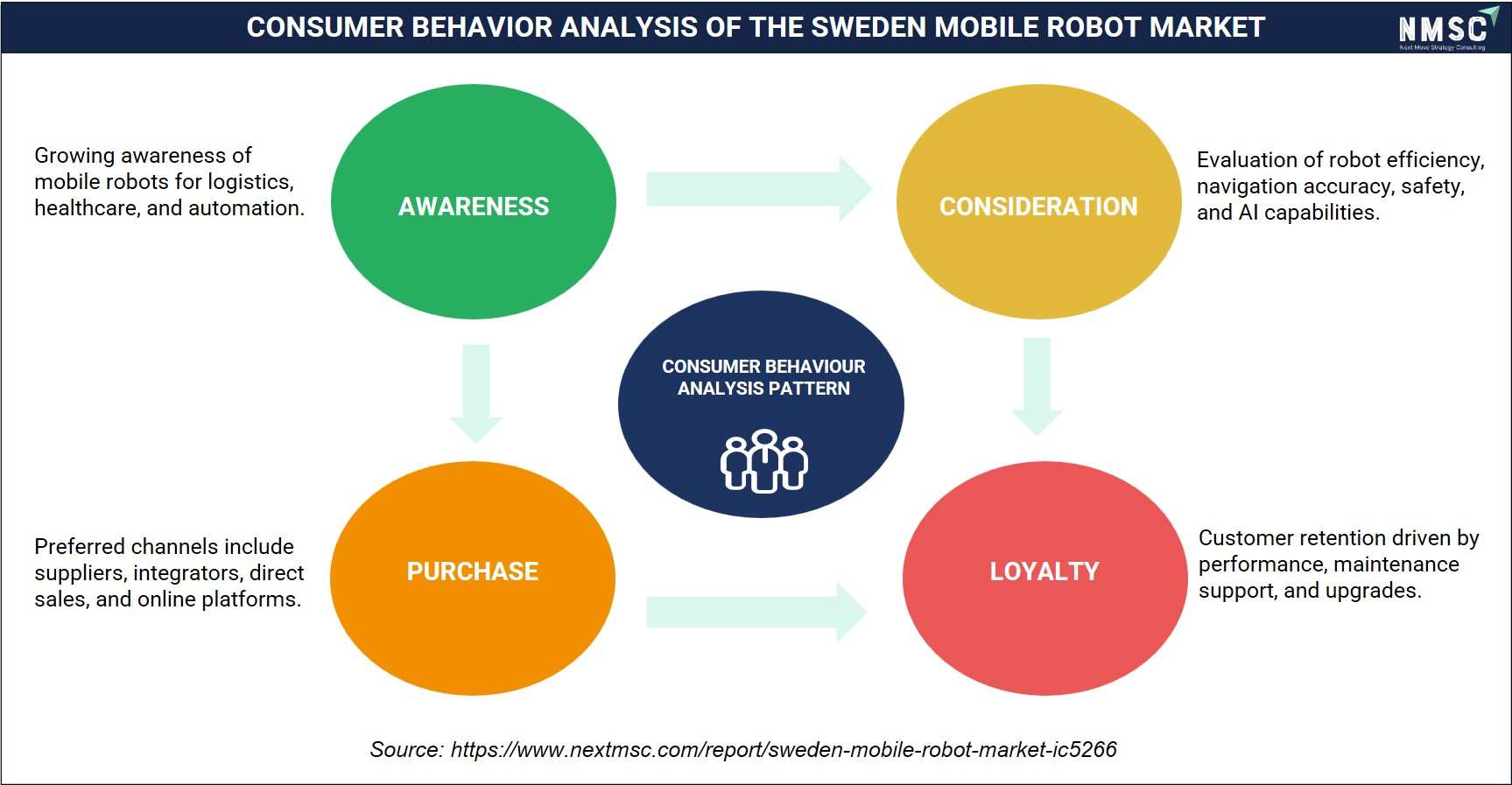
The consumer behavior analysis of the Market illustrates the customer journey from awareness to long-term loyalty. Buyers increasingly evaluate mobile robots based on navigation accuracy, AI capabilities, safety, and operational efficiency before making purchasing decisions through suppliers, system integrators, and direct sales channels. Ongoing maintenance support, software upgrades, and reliable performance play a key role in strengthening customer satisfaction and retention.
How Is the Sweden Mobile Robot Market Segmented in This Report, and What Are the Key Insights from the Segmentation Analysis?
By Sales Channel Insights
How Is Sales Channel Segmentation Supporting Market Expansion Across the Sweden Mobile Robot Market?
Based on sales channel, the market is segmented into Direct Sales, System Integrators, OEM Partners, Value Added Resellers, and Distributors.
Based on our analysis, we observed that system integrators are playing a crucial role in the Market by delivering customized automation solutions and seamless integration with existing manufacturing and warehouse systems. Direct sales continue to account for a significant share among large industrial enterprises seeking tailored robotic deployments, while OEM partners, value-added resellers, and distributors are expanding market reach by providing localized support, implementation services, and industry-specific automation solutions.
By End User Industry Insights
How Is End User Industry Segmentation Driving Demand Across the Sweden Mobile Robot Market?
Based on end user industry, the market is segmented into Automotive, Electronics and Semiconductor, General Manufacturing, Warehousing, Third Party Logistics, E-commerce, Retail Distribution, Food and Beverage, Consumer Goods, Pharmaceuticals, and Other Industries.
Based on our evaluation, we identified that the automotive and warehousing segments account for a substantial share of the Market, driven by increasing adoption of automated material handling, assembly line automation, and warehouse fulfillment solutions. Demand is also rising across third-party logistics, e-commerce, electronics and semiconductor, and general manufacturing sectors as businesses invest in intelligent mobile robots to improve operational efficiency, optimize inventory management, and address ongoing labor shortages.
Competitive Landscape
The Market is characterized by a competitive and innovation-driven landscape, supported by the presence of globally established mobile robot manufacturers, automation solution providers, and industrial robotics companies with strong local operations. Market growth is driven by increasing adoption of automation across mining, automotive, warehousing, and retail sectors, alongside the country's advanced industrial engineering heritage. Continuous advancements in AI-powered navigation and fleet management systems are strengthening automation capabilities and supporting long-term market growth.
Key Players of the Sweden Mobile Robot Market
-
JBT FoodTech AB
-
Jungheinrich Svenska AB
-
Daifuku BCS AB
-
Konecranes Lifttrucks AB
-
EA Mobile Robotics AB
-
FlexQube AB
-
MAXAGV AB
-
OpiFlex Automation AB
-
Zebra Technologies Sweden AB
-
KUKA Nordic AB
-
Dematic AB
-
Toyota Material Handling Europe AB
-
AGVE AB
NMSC's analysis indicates that competitive dynamics in the Sweden Mobile Robot Market are increasingly shaped by advancements in autonomous mobile robots, automated guided vehicles, and intelligent fleet management. Key companies such as ABB, Honeywell, JBT FoodTech, Jungheinrich Svenska, Daifuku BCS, Konecranes Lifttrucks, EA Mobile Robotics, FlexQube, MAXAGV, OpiFlex Automation, Zebra Technologies Sweden, KUKA Nordic, Dematic, Toyota Material Handling Europe, and AGVE are strengthening their market positions through partnerships and product innovation across mining, manufacturing, and logistics applications.
Key Segments
By Product Type
-
Pallet Transport Robots
-
Autonomous Pallet Trucks
-
Pallet Stackers
-
Underlift Pallet Movers
-
Pallet Shuttle Robots
-
-
Forklift Robots
-
Counterbalance Forklift Robots
-
Reach Truck Robots
-
VNA Forklift Robots
-
High-Lift Forklift Robots
-
Side Loader Robots
-
-
Tow Tractor Robots
-
Tugger Robots
-
Cart Pulling Robots
-
Milk Run Robots
-
Train Towing Robots
-
-
Tote and Bin Robots
-
Bin Transport Robots
-
Tote Transport Robots
-
Container Transport Robots
-
-
Workstation Delivery Robots
-
Shelf and Rack Robots
-
Shelf-to-Person Robots
-
Rack-to-Person Robots
-
Mobile Shelf Robots
-
Inventory Shelf Robots
-
-
Case Handling Robots
-
Carton Transport Robots
-
Case Transfer Robots
-
Cross Dock Robots
-
-
Piece Picking Robots
-
Mobile Piece Picking Robots
-
Goods-to-Person Picking Robots
-
Picking Assistant Robots
-
-
Other Mobile Robots
By Technology
-
Automated Guided Vehicles
-
Magnetic Guidance
-
Wire Guidance
-
Optical Guidance
-
QR Code Guidance
-
Laser Guidance
-
-
Autonomous Mobile Robots
-
LiDAR Navigation
-
Vision Navigation
-
SLAM Navigation
-
Natural Feature Navigation
-
AI-Based Navigation
-
-
Hybrid Mobile Robots
-
Mixed Guidance Systems
-
Switchable Navigation Systems
-
By Payload Capacity
-
Up to 100 kg
-
101-500 kg
-
501-1,000 kg
-
1,001-2,000 kg
-
Above 2,000 kg
By Operating Environment
-
Indoor
-
Outdoor
-
Hybrid
By Fleet Size
-
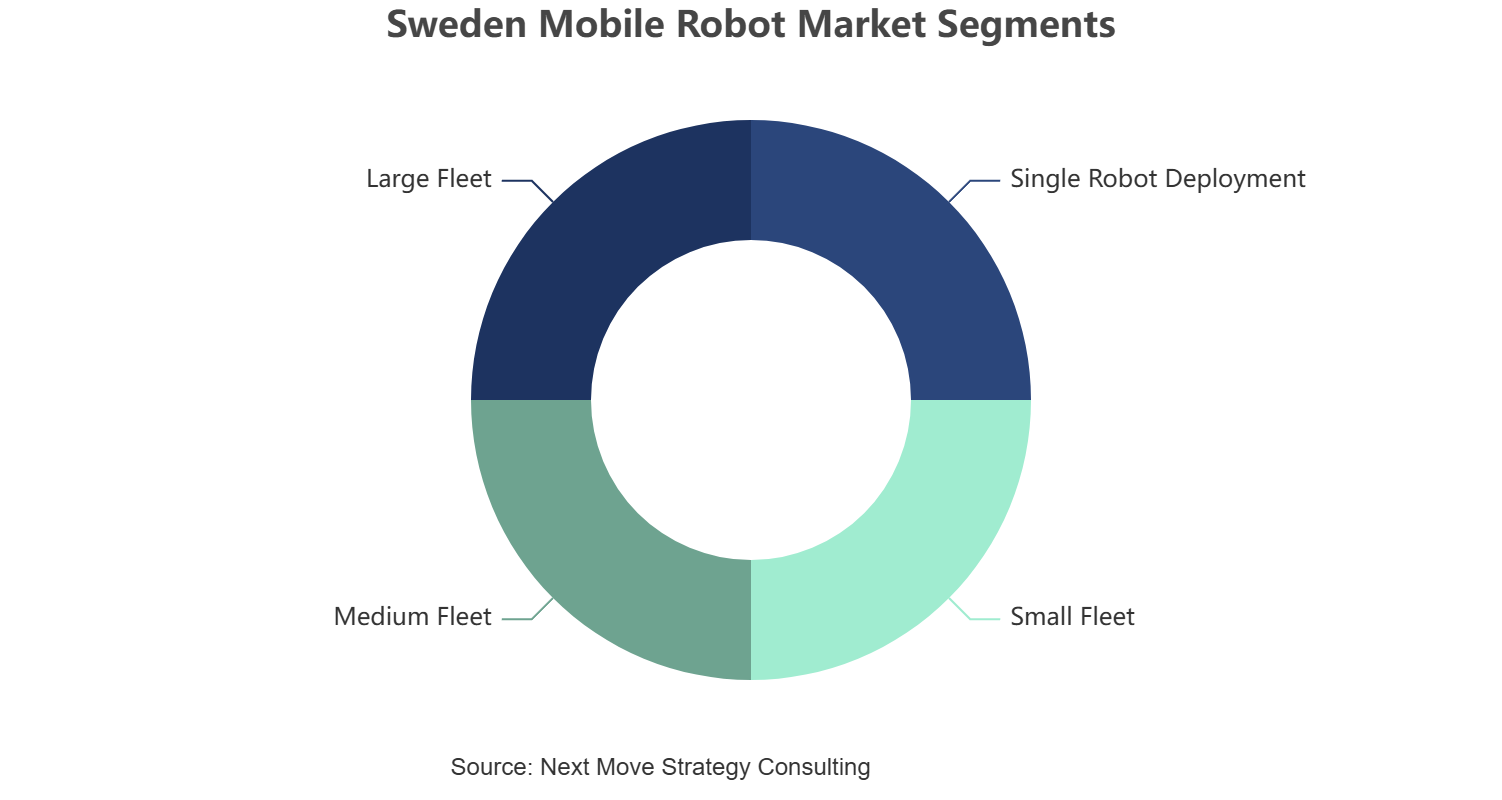
Single Robot Deployment
-
Small Fleet
-
Medium Fleet
-
Large Fleet
By Sales Channel
-
Direct Sales
-
System Integrators
-
OEM Partners
-
Value Added Resellers
-
Distributors
By End User Industry
-
Automotive
-
Electronics and Semiconductor
-
General Manufacturing
-
Warehousing
-
Third Party Logistics
-
E-commerce
-
Retail Distribution
-
Food and Beverage
-
Consumer Goods
-
Pharmaceuticals
-
Other Industries
PORTER'S FIVE FORCES ANALYSIS OF THE SWEDEN MOBILE ROBOT MARKET
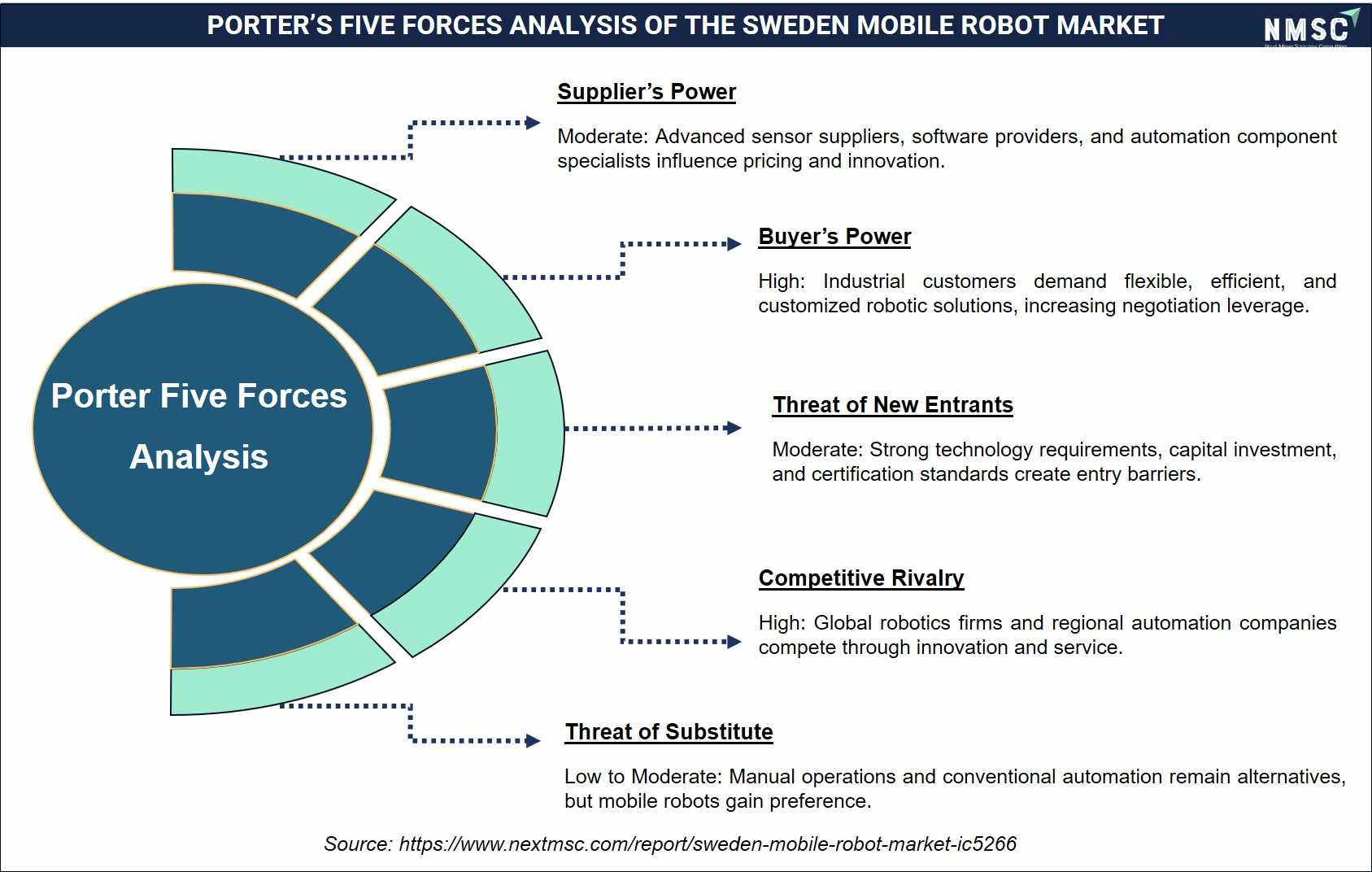
Porter's Five Forces analysis of the market evaluates the competitive dynamics influencing industry growth, including supplier and buyer bargaining power, the threat of new entrants and substitutes, and competitive rivalry. Continuous technological innovation, increasing demand for warehouse automation, and strategic collaborations intensify market competition, while high investment requirements and technical expertise create barriers for new market entrants.
Key Benefits for Stakeholders
Next Move Strategy Consulting (NMSC) presents a comprehensive analysis of the Market, covering historical developments from 2020 to 2025 and providing forecasts through 2035. Our study evaluates the market across Sweden's key industrial regions, delivering quantitative outlooks alongside qualitative insights into mobile robot adoption, Automated Guided Vehicle and Autonomous Mobile Robot deployment trends, automated mining logistics, and warehouse automation across the country's diverse industrial landscape.
Investors benefit from expanding opportunities in industrial automation and green manufacturing investment across Sweden's advanced economy, while mobile robot manufacturers, automation solution providers, system integrators, logistics providers, warehouse operators, mining companies, and end-user industries benefit from the growing demand for efficient, flexible, and autonomous material handling solutions. The report further supports strategic decision-making through detailed competitive benchmarking and segment-level growth analysis.
|
Parameters |
Details |
|
Customization Scope |
Free customization (equivalent to up to 80 analyst-working hours) after purchase. |
|
Pricing and Purchase Options |
Avail customized purchase options to meet your exact research needs. |
|
Approach |
In-depth primary and secondary research; proprietary databases; rigorous quality control and validation measures. |
|
Analytical Tools |
Porter's Five Forces, SWOT, value chain, and Harvey ball analysis to assess competitive intensity, stakeholder roles, and relative impact of key factors. |
Conclusion
The market is set for strong growth through 2035, supported by the country's pioneering underground mining automation, established automotive and heavy vehicle manufacturing base, and expanding e-commerce distribution networks. While stringent regulatory compliance requirements remain a restraint, Sweden's green industrial transition toward fossil-free steel and battery gigafactory production presents meaningful opportunities. With competitive dynamics shaped by established manufacturers strengthening local service networks, the market is expected to see continued investment in intelligent navigation and fleet management technologies nationwide.
About the Author
 Liza Phukan
— Liza Phukan is Research Associate at Next Move Strategy Consulting, where she has covered emerging industries and market research across sectors for 3.5 years. Her work includes analyzing industry developments, validating market data, and developing structured business content from research findings. She uses secondary research and data-validation practices to turn complex market information into clear decision-useful market analysis for business audiences and support report development and B2B.
Liza Phukan
— Liza Phukan is Research Associate at Next Move Strategy Consulting, where she has covered emerging industries and market research across sectors for 3.5 years. Her work includes analyzing industry developments, validating market data, and developing structured business content from research findings. She uses secondary research and data-validation practices to turn complex market information into clear decision-useful market analysis for business audiences and support report development and B2B.
About the Reviewer
 Supradip Baul
— Supradip Baul is an accomplished business consultant and strategist with over a decade of rich experience in market intelligence, strategy, technology, and business transformation. His work has included rigorous qualitative and quantitative analysis across multiple industries, helping clients shape investment decisions and long-term roadmaps. Earlier in his career, he was associated with Gartner, where he contributed to industry-leading reports and market share analyses. He has worked with leading global companies and holds an MBA with a dual specialization in Marketing and Finance.
Supradip Baul
— Supradip Baul is an accomplished business consultant and strategist with over a decade of rich experience in market intelligence, strategy, technology, and business transformation. His work has included rigorous qualitative and quantitative analysis across multiple industries, helping clients shape investment decisions and long-term roadmaps. Earlier in his career, he was associated with Gartner, where he contributed to industry-leading reports and market share analyses. He has worked with leading global companies and holds an MBA with a dual specialization in Marketing and Finance.
At Next Move Strategy Consulting, we understand that insightful market research is the cornerstone of successful business decisions. That's why we employ a robust and multifaceted approach, combining various methodologies to deliver the most accurate and actionable data for our clients.

Research Landscape
We navigate the world of research with two primary approaches:
Qualitative Approach
Our qualitative research methodologies involve immersive techniques such as in-depth interviews, focus groups, and observational studies. By engaging directly with individuals and stakeholders, we uncover valuable insights that quantitative data alone may overlook.

Quantitative Research
In tandem with qualitative methodologies, NMSC leverages the power of Quantitative Research to provide a robust foundation of numerical insights. Through systematic data collection and analysis, we quantify patterns, preferences, and market trends, offering a comprehensive view of the business landscape.
Our quantitative research approach employs diverse tools, including surveys, experiments, and statistical modelling. These methodologies enable us to gather data from a large and representative sample, ensuring the statistical significance of our findings. By employing structured questionnaires and standardized data collection methods, we guarantee the reliability and validity of the information we present to our clients.
Quantitative research is particularly effective in measuring the prevalence of trends, assessing market size, and gauging the impact of various factors on consumer behavior. The numerical precision attained through this approach equips our clients with actionable insights, facilitating data-driven decision-making and strategy formulation.


Our Specialized Toolbox for Industry-Specific Market Research
We deploy a specialized arsenal of techniques tailored to meet your unique requirements. Here's a glimpse into our comprehensive toolbox:

Information Procurement
The stage entails acquiring market data or relevant information through various sources and methodologies.


Market Research Approach
We utilize both top-down and bottom-up approaches in market research analysis to achieve a comprehensive understanding of the market dynamics, leveraging the broad perspective of industry trends and macroeconomic factors alongside detailed insights from specific segments and individual companies.

Porters Five Forces Analysis
We conduct Porter's Five Forces analysis to evaluate the competitive landscape of an industry, providing us with insights into factors that affect profitability and strategic positioning.

SWOT Analysis

Forecasting
We utilize a forecasting model to predict future consumption by considering parameters like population, economics, regulations, market competition, drivers, constraints, technology, and pricing. We also employ statistical techniques such as multilinear regression, exponential smoothing, moving average, ARIMA, and Monte Carlo simulations for accurate predictions. In econometric forecasting, we analyzed short-term and long-term event impacts, attributing values based on regulatory frameworks, economic factors, and market events.





 Speak to Our Analyst