Vegan Leather Market Size, Share, Growth & Forecast By Material Source (Plant-Based: Fruit Waste, Agricultural Waste, Fungal/Biological; Synthetic: Bio-Based Synthetics, Petrochemical-Based; Recycled: Post-Consumer, Post-Industrial), By Application (Footwear, Apparel, Accessories, Automotive, Furniture, Electronics, Stationery), By Texture/Finish (Smooth and Textured), and By Distribution Channel (Direct‑to‑Consumer, Indirect Retail, Business‑to‑Business)— Global Analysis 2025–2035
Industry: Materials and Chemical | Publishing Date: July 7, 2026 | Last Updated: July 7, 2026 | No of Pages: N/A | No. of Tables: N/A | No. of Figures: N/A | Format: PDF | Report Code: MC2107
What Is the Vegan Leather Market Size?
The global Vegan Leather Market was valued at USD 46.01 billion in 2025 and is projected to reach USD 51.62 billion in 2026. Driven by surging consumer demand for cruelty-free and sustainable materials, expanding automotive and fashion sector adoption, regulatory momentum restricting conventional leather, and breakthrough biomaterial innovations including mycelium and fruit-waste leathers, the market is forecast to reach USD 145.46 billion by 2035, registering a CAGR of 12.2% from 2026 to 2035. Plant-based and recycled sub-segments are leading the sustainability narrative, while synthetic alternatives retain volume dominance across mass-market applications.
|
Parameters |
Details |
|
Market Size in 2025 |
USD 46.01 Billion |
|
Market Size in 2026 |
USD 51.62 Billion |
|
Revenue Forecast in 2035 |
USD 145.46 Billion |
|
Growth Rate |
CAGR of 12.2% from 2026 to 2035 |
|
Analysis Period |
2025–2035 |
|
Base Year Considered |
2025 |
|
Forecast Period |
2026–2035 |
|
Market Size Estimation |
USD Billion |
|
Companies Profiled |
20 |
|
Countries Covered |
33 |
|
Market Share |
Top 10 |
Vegan Leather Market Overview
What Defines the Scope of the Vegan Leather Market?
The Vegan Leather Market encompasses all non-animal-derived leather substitutes including plant-based biomaterials, synthetic polymers, and recycled-material alternatives used across fashion, automotive, furniture, electronics, and accessories applications. NMSC's analysis indicates that the market report covers the entire commercial value chain from raw biomaterial sourcing and processing through finished-goods manufacturing, brand integration, and multi-channel distribution to end consumers. The scope includes DTC brand channels, indirect retail, B2B supply partnerships, and omnichannel hybrid models serving fashion houses, automakers, electronics OEMs, and stationery producers globally.
How Has the Vegan Leather Market Evolved Structurally?
The Vegan Leather Market has transitioned through three structural eras. The first era centered on polyurethane and PVC synthetic leathers delivering cost-effective animal leather substitution across mass-market footwear and accessories. The second era introduced bio-based synthetics blending partial plant-derived content with polymer substrates. Through NMSC's assessment, we found that the current era is defined by fully plant-based innovations including mycelium-derived leather from companies such as MycoWorks and Bolt Threads, fruit-waste leathers from Vegea and Ananas Anam, and closed-loop recycled alternatives targeting luxury and premium brand positioning globally.
How Is the Regulatory Environment Shaping the Vegan Leather Market?
Regulatory pressure is emerging as a structural demand catalyst for the Vegan Leather Market. The European Union's Strategy for Sustainable and Circular Textiles mandates minimum recycled content and traceability for textile and leather goods sold within the EU. The EU Ecodesign for Sustainable Products Regulation extends design-for-durability requirements to fashion products. The U.S. Customs and Border Protection's enforcement of import restrictions on animal-derived materials from certain origins is redirecting automotive and fashion supply chains toward vegan leather alternatives as compliant substitutes in regulated procurement environments.
How Is Technology Adoption Reshaping the Vegan Leather Market?
Technology adoption across the Vegan Leather Market is accelerating commercialisation of high-performance biomaterial alternatives to conventional leather. Precision fermentation is enabling mycelium-based and collagen-free leather production at industrial scale. Agricultural and food-waste upcycling technologies are transforming apple pomace, grape marc, pineapple leaf fibers, and cactus biomass into commercially viable leather substrates. Based on NMSC's research, we found that next-generation finishing technologies are enabling vegan leather to match conventional leather in abrasion resistance, breathability, and visual texture authenticity, removing performance barriers that previously limited premium brand adoption.
|
Key Takeaways |
|
Synthetic materials (Bio-Based Synthetics and Petrochemical-Based) collectively dominate the Vegan Leather Market at USD 18.80 billion in 2025, due to established manufacturing scale, lower unit cost, and broad availability across mass-market footwear and accessories applications globally. |
|
Plant-Based materials are the fastest-growing material source, projected to advance at a CAGR of 14.8% from 2026 to 2035, growing from USD 18.50 billion in 2025 to USD 65.00 billion by 2035, driven by mycelium leather, fruit-waste innovations, and premium brand sustainability mandates. |
|
Footwear is the largest application in the Vegan Leather Market at USD 14.00 billion in 2025, anchored by global athletic and fashion footwear brands committing to animal-free upper materials across performance and lifestyle product lines. |
|
Automotive is the fastest-growing application at a CAGR of 15.2% from 2026 to 2035, growing from USD 5.50 billion in 2025 to USD 18.00 billion by 2035, as EV manufacturers including Tesla, BMW, and Volvo adopt vegan leather interiors as standard or optional configurations. |
|
Smooth finish is the dominant texture in the Vegan Leather Market at USD 32.20 billion in 2025, with Glossy and Matte sub-segments collectively serving luxury handbag, footwear, and automotive interior applications requiring refined aesthetics. |
|
Textured finish vegan leather is the fastest-growing texture segment, as fashion and accessories designers seek grain and emboss patterns that replicate premium animal leather aesthetics in plant-based and recycled material substrates. |
|
Indirect Retail is the largest distribution channel in the Vegan Leather Market at USD 16.50 billion in 2025, reflecting the continued dominance of department stores, specialty fashion retail, and mass-market chains in vegan leather product distribution. |
|
Direct-to-Consumer (DTC) is the fastest-growing distribution channel at a CAGR of 13.8% from 2026 to 2035, as DTC-native sustainable fashion brands bypass wholesale intermediaries to communicate sustainability credentials directly to environmentally conscious consumers. |
|
Europe dominates the Vegan Leather Market at USD 13.00 billion in 2025, forecast to reach USD 38.50 billion by 2035 at a CAGR of 12.1%, underpinned by the strongest regulatory mandates for sustainable materials, the highest consumer sustainability engagement, and concentrated luxury fashion brand investment in alternative leather. |
|
Asia-Pacific is the fastest-growing major region, advancing from USD 12.00 billion in 2025 to USD 43.00 billion by 2035 at a CAGR of 13.6%, propelled by China's domestic EV industry vegan interior adoption, India's expanding fashion manufacturing base, and South Korea's K-fashion sustainability wave. |
|
Germany is the leading individual country market within Europe, driven by automotive OEM vegan interior programs from BMW, Mercedes-Benz, and Volkswagen alongside the EU's most advanced sustainable textiles regulatory framework governing vegan leather procurement. |
|
India is the fastest-growing national Vegan Leather Market, advancing at a CAGR of 16.4% from 2026 to 2035, supported by a large domestic footwear and accessories manufacturing base, growing export demand for vegan leather products, and increasing animal welfare policy activity. |
Key Emerging Trends in the Vegan Leather Market
How Is Mycelium-Based Leather Reshaping the Premium Segment of the Vegan Leather Market?
Mycelium-based leather is emerging as the most commercially significant biomaterial innovation in the Vegan Leather Market, offering a fully bio-based alternative that closely replicates the texture, durability, and breathability of conventional animal leather. Our analysis shows that MycoWorks' Reishi material, commercialized in partnership with Hermès, and Bolt Threads' Mylo product, adopted by Stella McCartney, represent pioneering examples of luxury-grade mycelium vegan leather entering the premium accessories market. This trend is transforming how luxury brands position vegan leather, elevating it from mass-market substitute to premium innovation platform.
How Is the Electric Vehicle Industry Accelerating Vegan Leather Interior Adoption?
The global electric vehicle industry's commitment to zero-emission and cruelty-free brand identities is creating a structural demand driver for the Vegan Leather Market across automotive interior applications. Through our market assessment, we observed that Tesla's standard vegan interior designation and Volvo's 2030 commitment to leather-free interiors are compelling traditional automotive OEMs to accelerate alternative materials programs. The European Union's Corporate Sustainability Reporting Directive compels automakers to disclose material sourcing practices, creating regulatory motivation for vegan leather interior adoption as a measurable ESG supply chain improvement.
How Is the Circular Economy Driving Recycled Vegan Leather Innovation?
Circular economy principles are reshaping material innovation within the Vegan Leather Market by stimulating commercial development of post-consumer and post-industrial recycled leather alternatives. Our findings suggest that Ecopel's recycled polyester-based vegan leather and Natural Fiber Welding's MIRUM material represent closed-loop production models that eliminate petroleum inputs entirely. The EU's Waste Framework Directive and the U.S. EPA's Sustainable Materials Management Program both prioritize post-consumer material valorization, creating policy alignment with recycled vegan leather investment and providing a compliance-driven commercial tailwind for brands sourcing recycled alternatives.
How Are Direct-to-Consumer Sustainable Fashion Brands Reshaping Vegan Leather Distribution?
Direct-to-consumer sustainable fashion brands are fundamentally altering the commercial distribution architecture of the Vegan Leather Market by capturing premium margin positions while communicating sustainability narratives directly to ethically engaged consumers. NMSC's analysis indicates that DTC-native brands across the U.S., Europe, and South Korea are driving above-average revenue growth in the accessories and footwear sub-segments, leveraging social commerce and transparency storytelling to build brand loyalty around vegan leather credentials. This trend is accelerating the Hybrid/Omnichannel distribution model as established retailers respond with dedicated sustainable product ranges.
What Are the Key Market Drivers, Breakthroughs, and Investment Opportunities that Will Shape the Vegan Leather Market in the Next Decade?
|
Drivers / Trends / Restraints |
(+/-) % Impact on CAGR Forecast |
Geographic Relevance |
Impact Timeline |
|
Rising Consumer Demand for Cruelty-Free Products |
+2.4% |
Global (led by Europe, North America) |
2025–2030 |
|
Automotive EV Interior Vegan Leather Adoption |
+2.1% |
Europe, North America, APAC |
2025–2032 |
|
EU Sustainable Textiles and Ecodesign Regulation |
+1.8% |
Europe, Global supply chains |
2025–2035 |
|
Biomaterial Innovation (Mycelium, Fruit Waste, Cactus) |
+1.6% |
Europe, North America |
2026–2035 |
|
DTC and E-Commerce Distribution Expansion |
+1.3% |
Global |
2025–2032 |
|
High Production Cost of Premium Plant-Based Materials |
-1.2% |
All regions |
Ongoing |
|
Performance Gap vs. Conventional Leather (durability) |
-0.9% |
Automotive, Industrial segments |
Ongoing |
|
Petrochemical Dependency of Synthetic Vegan Leather |
-0.7% |
All regions |
Ongoing |
|
Recycled Material Circular Economy Opportunity |
+1.1% |
Europe, North America |
2026–2035 |
|
Asia-Pacific Manufacturing Base Expansion |
+1.4% |
APAC (India, Vietnam, China) |
2026–2035 |
What Are the Growth Drivers of the Vegan Leather Market?
How Is Rising Consumer Preference for Ethical and Sustainable Fashion Driving the Vegan Leather Market?
Shifting consumer values toward cruelty-free, environmentally responsible materials represent the most fundamental demand driver for the Vegan Leather Market. Younger demographic cohorts, particularly Gen Z and Millennial consumers, are demonstrating measurable purchasing behaviour favouring animal-free alternatives in footwear, accessories, and apparel categories. The United Nations Environment Programme's Fashion Commitment for Climate highlights the fashion industry's accountability to halve greenhouse gas emissions by 2030, creating institutional pressure on brands to transition material portfolios toward vegan leather alternatives. This consumer and institutional alignment is accelerating brand-level sustainability commitments that drive sustained vegan leather procurement growth.
How Are Regulatory Mandates for Sustainable Materials Creating Structural Vegan Leather Market Demand?
Regulatory frameworks in Europe and North America are establishing legally binding sustainability requirements that create structural, non-discretionary demand for the Vegan Leather Market. The EU Strategy for Sustainable and Circular Textiles requires minimum recycled content thresholds and digital product passports enabling material traceability for textile and leather-adjacent products sold within the EU. The European Commission's Ecodesign for Sustainable Products Regulation mandates durability, repairability, and recyclability standards for apparel and footwear products, compelling brands to adopt vegan leather materials capable of satisfying circular design criteria. These frameworks create multi-year compliance-driven procurement demand.
How Is the Electric Vehicle Revolution Creating Structural Growth in the Automotive Vegan Leather Market?
The global transition to electric vehicles is generating a structurally significant new demand segment for the Vegan Leather Market as EV manufacturers align vegan interior offerings with their broader zero-emission and cruelty-free brand positioning. Volvo Cars has publicly committed to being leather-free across its full vehicle range by 2030, a pledge documented in its sustainability reporting. BMW and Mercedes-Benz have both introduced vegan interior options across multiple production models. The International Energy Agency's Global EV Outlook documents accelerating EV sales growth globally, directly expanding the automotive vegan leather addressable market throughout the forecast period.
What Are the Growth Inhibitors of the Vegan Leather Market?
How Do High Production Costs of Premium Biomaterials Constrain Vegan Leather Market Growth?
The production economics of premium plant-based vegan leather materials remain the primary constraint limiting broader Vegan Leather Market penetration. Mycelium cultivation, precision agricultural waste processing, and bio-based polymer synthesis involve capital-intensive manufacturing infrastructure and supply chain complexities that yield significantly higher per-meter material costs compared with conventional leather or petrochemical synthetic alternatives. Our assessment indicates that these cost differentials restrict premium biomaterial vegan leather adoption to luxury and upper-premium fashion segments, limiting the addressable market for high-ESG-value plant-based materials until manufacturing scale economics improve materially across the forecast period.
How Does the Durability Performance Gap of Vegan Leather Limit Its Penetration in Demanding Applications?
The durability and aging performance gap between current vegan leather materials and conventional animal leather constrains adoption in high-wear applications including automotive interiors, upholstered furniture, and performance footwear. Our market evaluation indicates that UV resistance, abrasion performance, and long-term breathability of many current synthetic and plant-based vegan leather formulations remain below the standards set by full-grain and top-grain conventional leather. The U.S. Consumer Product Safety Commission's material durability standards for furniture and automotive applications create regulatory performance thresholds that some current vegan leather products have not fully met, slowing adoption in these end-use segments.
What Are the Growth Opportunities in the Vegan Leather Market?
How Does Luxury Brand Adoption of Biomaterial Vegan Leather Create a Premium Market Opportunity?
Luxury fashion brand adoption of authenticated plant-based vegan leather is creating a high-margin premium market tier within the Vegan Leather Market that commands pricing parity or premium pricing over conventional leather goods. Our analysis shows that Hermès' partnership with MycoWorks to produce the Victoria bag using Reishi mycelium leather has demonstrated market readiness for luxury-grade biomaterial pricing. Stella McCartney, Gucci's parent Kering, and LVMH's sustainability programs are all investigating or actively adopting premium vegan leather materials, creating a commercially significant luxury tier projected to expand at above-market growth rates through 2035.
How Does the Asia-Pacific Manufacturing Base Expansion Represent a Strategic Opportunity for the Vegan Leather Market?
Asia-Pacific's established footwear, accessories, and automotive component manufacturing ecosystems represent a strategic supply-chain scale opportunity for the Vegan Leather Market. Our findings suggest that India's large leather goods manufacturing industry, Vietnam's growing footwear export sector, and China's expanding domestic EV industry are all transitioning manufacturing capacity toward vegan leather materials. India's Bureau of Indian Standards has introduced quality frameworks for synthetic and alternative leather products, creating standards infrastructure supporting scaled domestic production. Government-backed sustainability export promotion programs in Vietnam and India further accelerate the region's vegan leather manufacturing capacity development.
How Does the Circular Recycled Materials Segment Create Investment Opportunities Within the Vegan Leather Market?
Post-consumer and post-industrial recycled vegan leather materials represent a structurally distinct and investment-attractive segment within the Vegan Leather Market, combining sustainability credentials with circular economy compliance requirements. The European Commission's Waste Framework Directive's 2025 textile waste collection mandate creates institutionalized demand for recycled material content in fashion and accessories products sold within the EU. Our observation is that brands achieving EU Ecolabel certification for recycled vegan leather products gain measurable procurement advantages in public sector and corporate purchasing programs, creating a regulatory revenue premium for recycled vegan leather material suppliers throughout the forecast period.
How Is the Vegan Leather Market Segmented in This Report, and What Are the Key Insights from the Segmentation Analysis?
How Do Material Source Categories Define the Competitive Composition of the Vegan Leather Market?
|
Material Source Segment |
2025 (USD Bn) |
2035 (USD Bn) |
CAGR (%) |
|
Plant-Based |
18.50 |
65.00 |
14.8% |
|
Synthetic |
18.80 |
50.00 |
10.3% |
|
Recycled |
8.71 |
30.46 |
13.3% |
Based on our analysis of material innovation and supply chain dynamics in the Vegan Leather Market, we observed that the market is segmented by material source into Plant-Based, Synthetic, and Recycled categories. Synthetic materials, comprising Bio-Based Synthetics and Petrochemical-Based alternatives, hold the largest share at USD 18.80 billion in 2025, owing to established polyurethane and PVC manufacturing infrastructure and cost competitiveness across mass-market applications. Plant-Based materials, including Fruit Waste, Agricultural Waste, Fungal/Biological (mycelium), and Other Biomass sub-segments, represent the fastest-growing source at a CAGR of 14.8%, driven by luxury brand biomaterial adoption and regulatory sustainability mandates. Recycled materials are advancing at a CAGR of 13.3%, supported by EU circular economy legislation.
How Do Application Segments Reveal the Breadth of Commercial Demand Across the Vegan Leather Market?
|
Application Segment |
2025 (USD Bn) |
2035 (USD Bn) |
CAGR (%) |
|
Footwear |
14.00 |
42.00 |
11.6% |
|
Apparel and Clothing |
10.00 |
30.00 |
11.6% |
|
Accessories |
9.00 |
28.00 |
12.0% |
|
Automotive |
5.50 |
18.00 |
15.2% |
|
Furniture and Home Decor |
3.80 |
12.00 |
12.2% |
|
Electronics and Gadgets |
1.50 |
5.20 |
13.2% |
|
Stationery |
0.70 |
2.00 |
11.1% |
|
Others |
1.51 |
8.26 |
18.6% |
In our assessment of end-use adoption patterns, we found that the Vegan Leather Market is segmented into Footwear, Apparel and Clothing, Accessories, Automotive, Furniture and Home Decor, Electronics and Gadgets, Stationery, and Others. Footwear is the dominant application at USD 14.00 billion in 2025, driven by global athletic and fashion brands adopting animal-free upper materials at scale. Accessories (USD 9.00 billion in 2025) encompass Fashion Accessories and Bags and Wallets, both growing as luxury brands expand vegan material ranges. Automotive is the fastest-growing application at a CAGR of 15.2%, as EV manufacturers integrate vegan interior programs. Electronics is growing at 13.2%, driven by premium device case and laptop sleeve applications.
How Do Texture and Finish Preferences Drive Differentiation in the Vegan Leather Market?
|
Texture/Finish Segment |
2025 (USD Bn) |
2035 (USD Bn) |
CAGR (%) |
|
Smooth |
32.20 |
98.00 |
11.8% |
|
Textured |
13.81 |
47.46 |
13.2% |
Through NMSC's assessment, we found that the Vegan Leather Market is segmented by Texture and Finish into Smooth and Textured categories. Smooth finish dominates at USD 32.20 billion in 2025, encompassing both Glossy and Matte sub-categories that serve luxury handbag, footwear, and automotive interior applications requiring refined and consistent aesthetics. Textured finish is the faster-growing segment at a CAGR of 13.2%, as fashion designers and automotive interior studios seek embossed, grain-patterned, and structured vegan leather surfaces that visually and tactilely approximate premium animal leather grades. Advances in embossing technology and biomaterial substrate engineering are enabling increasingly authentic textured vegan leather finishes.
How Do Distribution Channels Shape Revenue Flow and Brand Strategy Within the Vegan Leather Market?
|
Distribution Channel Segment |
2025 (USD Bn) |
2035 (USD Bn) |
CAGR (%) |
|
Indirect Retail |
16.50 |
42.00 |
9.8% |
|
Direct-to-Consumer (DTC) |
13.00 |
47.00 |
13.8% |
|
Business-to-Business (B2B) |
10.50 |
33.00 |
12.1% |
|
Hybrid/Omnichannel |
6.01 |
23.46 |
14.6% |
Our findings suggest that the Vegan Leather Market is segmented by distribution channel into Indirect Retail, Direct-to-Consumer, Business-to-Business, and Hybrid/Omnichannel. Indirect Retail remains the largest channel at USD 16.50 billion in 2025, reflecting the continued role of department stores, specialty fashion chains, and mass-market retailers in reaching broad consumer segments. DTC is the fastest-growing dedicated channel at a CAGR of 13.8%, as sustainability-focused brands bypass wholesale to own the customer relationship and sustainability narrative. B2B is significant for raw material and semi-finished vegan leather supply to fashion manufacturers and automotive Tier 1 suppliers. Hybrid/Omnichannel is the fastest-growing combined model at 14.6% CAGR.
Consumer Behaviour Analysis of the Vegan Leather Market
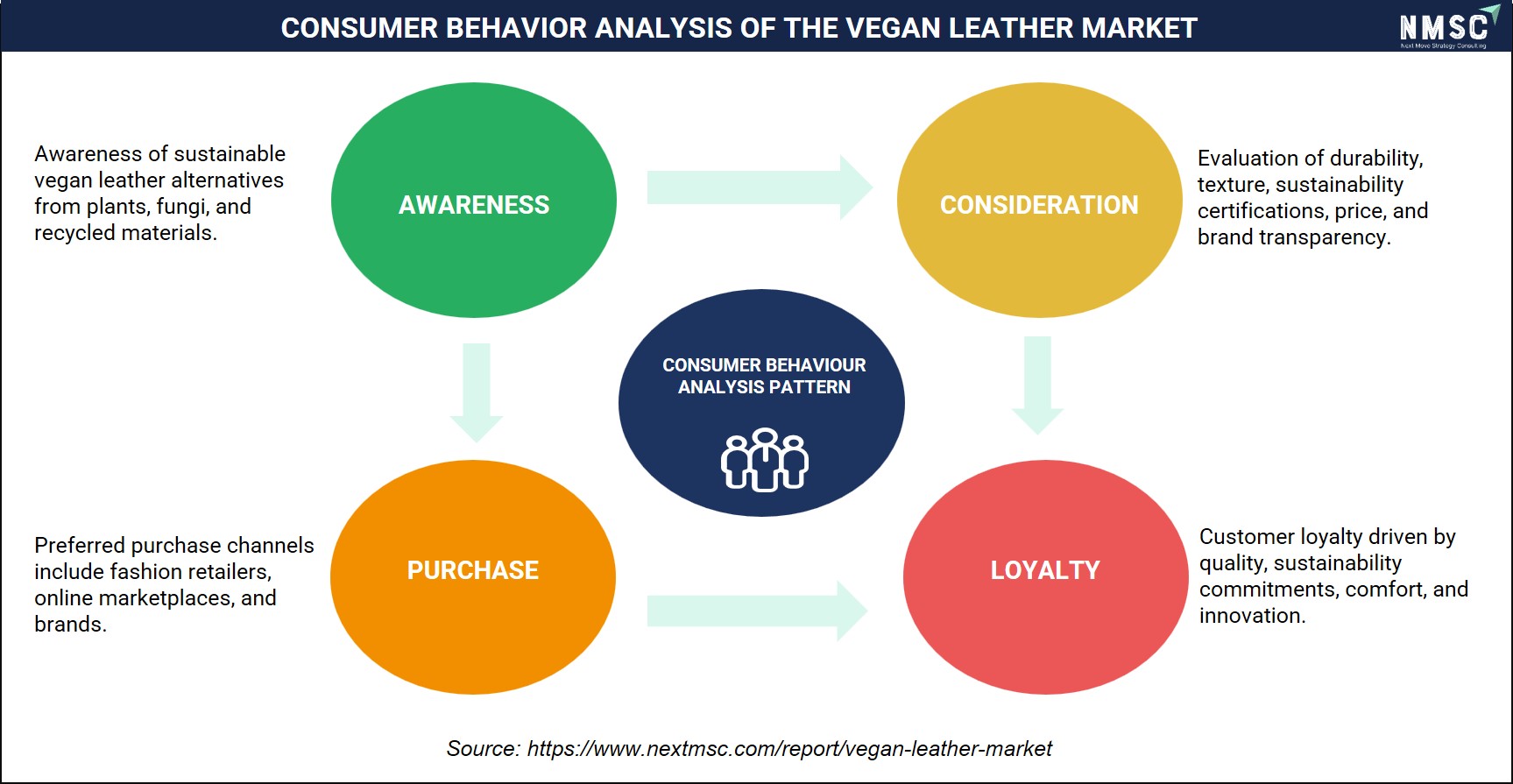
The above framework maps the consumer journey across awareness, consideration, purchase, and loyalty within the Vegan Leather Market. We observed that awareness flows through sustainable alternatives derived from plants, fungi, and recycled materials, while consideration hinges on durability, texture, certifications, price, and brand transparency. Fashion retailers, online marketplaces, and brand stores serve as key purchase channels, with loyalty ultimately driven by quality, sustainability commitments, comfort, and innovation.
Regional Outlook
Geographic Performance Snapshot
|
Region |
2025 (USD Bn) |
2035 (USD Bn) |
CAGR (%) |
Key Driver |
|
Europe |
13.00 |
38.50 |
12.1% |
Regulatory mandates, luxury brand adoption, automotive OEM programs |
|
North America |
13.50 |
41.00 |
11.8% |
DTC brand growth, EV adoption, consumer ethics movement |
|
Asia-Pacific |
12.00 |
43.00 |
13.6% |
EV manufacturing, fashion export, India and Vietnam production |
|
Latin America |
4.00 |
12.70 |
12.3% |
Footwear manufacturing, domestic fashion demand |
|
Middle East & Africa |
3.51 |
10.26 |
11.4% |
Luxury retail import demand, sustainability policy emergence |
Europe Vegan Leather Market
Europe leads the Vegan Leather Market at USD 13.00 billion in 2025, forecast to reach USD 38.50 billion by 2035 at a CAGR of 12.1%. The region's dominance is anchored by the world's most advanced regulatory framework for sustainable materials, the highest concentration of luxury fashion brands adopting vegan leather, and automotive OEM sustainability programs across Germany, Sweden, and Italy. The EU Sustainable Textiles Strategy, Ecodesign Regulation, and Corporate Sustainability Reporting Directive collectively create a compliance-driven procurement environment that structurally favours vegan leather material adoption across fashion, automotive, and furniture industries.
U.K. Vegan Leather Market
Based on our engagements, the United Kingdom is one of Europe's most commercially active Vegan Leather Markets, driven by a high concentration of ethically motivated consumers, a thriving DTC sustainable fashion ecosystem, and post-Brexit trade policies that maintain UK GDPR and sustainability procurement standards. London's fashion industry includes globally recognized vegan leather pioneers, including Stella McCartney, whose collaborations with Bolt Threads have elevated mycelium leather's luxury credentials. The UK Fashion and Textile Association's sustainability commitments amplify demand for traceable vegan leather materials across mid-market and premium brand tiers.
Germany Vegan Leather Market
Through our analysis, Germany is the single largest national Vegan Leather Market within Europe, driven by automotive OEM vegan interior programs and the EU's most stringent sustainability compliance expectations. BMW, Mercedes-Benz, and Volkswagen have all introduced vegan leather seating options, with Volkswagen's ID. Series and BMW's iX models offering standard vegan interior configurations. The Federal Environment Agency enforces stringent chemical and material standards under REACH that effectively favour bio-based and recycled vegan leather alternatives over conventional leather chemical finishing processes, creating systemic product substitution demand.
France Vegan Leather Market
From our assessment, France is a premium-tier Vegan Leather Market, driven by its global luxury fashion leadership and the LVMH and Kering groups' sustainability programs. The French Anti-Waste for a Circular Economy Law (AGEC Law) prohibits destruction of unsold manufactured goods and mandates sustainability transparency in fashion advertising, creating compliance incentives for vegan leather material adoption. French luxury brands including Hermès, Chanel, and Dior are actively investing in biomaterial research programs, creating demand for premium plant-based vegan leather materials at a quality tier that commands significant pricing premiums.
Italy Vegan Leather Market
According to our evaluation, Italy is a strategically important Vegan Leather Market combining premium fashion manufacturing heritage with growing sustainability material innovation. Alcantara S.p.A., headquartered in Milan, is a globally recognized producer of premium synthetic vegan leather materials used in luxury automotive and fashion applications. Italian fashion and accessories manufacturers are transitioning supply chains toward plant-based and recycled vegan leathers to satisfy the EU's sustainable textile mandates and meet the sustainability criteria of global luxury retail buyers integrating responsible sourcing requirements.
Spain Vegan Leather Market
Based on our evaluation, Spain demonstrates growing momentum in the Vegan Leather Market, supported by a large fashion manufacturing base, a rapidly growing e-commerce sector, and Inditex's Zara brand commitment to sustainable material sourcing across its global supply chain. Inditex's Join Life product line, governed by environmental and social criteria that include vegan leather alternatives, creates structured B2B demand for compliant alternative leather materials. Spain's Ley de Residuos y Suelos Contaminados aligns with EU circular economy directives, supporting recycled vegan leather adoption across Spanish manufacturing.
Sweden Vegan Leather Market
Based on our engagements, Sweden is a premium sustainability-driven Vegan Leather Market, with one of Europe's highest per-capita consumer sustainability engagement levels. Volvo Cars' publicly committed leather-free interior strategy across its full model range by 2030 represents the most decisive OEM vegan leather adoption commitment globally. H&M Group's Conscious Collection and transparency reporting create structured demand for certified vegan leather materials across Swedish fast-fashion supply chains. Sweden's Environmental Protection Agency regulations further incentivize bio-based and recycled material adoption in manufactured goods.
Denmark Vegan Leather Market
Through our analysis, Denmark consistently ranks among Europe's most sustainability-advanced consumer markets for the Vegan Leather Market, driven by high environmental awareness, premium fashion purchasing power, and government circular economy investment programs. Danish footwear and accessories brands are early adopters of certified vegan leather materials. The Danish Environment Agency's circular economy implementation guidelines support post-consumer recycled material content requirements that create compliance demand for recycled vegan leather alternatives within Danish fashion and furniture manufacturing sectors.
Finland Vegan Leather Market
From our assessment, Finland is a niche but premium-tier Vegan Leather Market, characterised by high consumer sustainability literacy and a government-backed bioeconomy strategy supporting bio-based material innovation. The Finnish Bioeconomy Strategy 2030 explicitly supports development of commercial plant-based and agricultural waste materials, creating policy tailwinds for vegan leather biomaterial innovation and investment. Finnish design brands in accessories and furniture are early adopters of plant-based and recycled vegan leathers as part of Nordic design-meets-sustainability brand positioning.
Netherlands Vegan Leather Market
According to our evaluation, the Netherlands is a significant Vegan Leather Market hub, combining strong consumer sustainability values with a sophisticated retail and e-commerce distribution infrastructure. Amsterdam hosts several DTC vegan fashion brands and serves as a European distribution center for plant-based leather material imports. The Netherlands Enterprise Agency actively supports circular economy transition programs for textile and leather-adjacent industries, providing co-investment for companies adopting recycled and bio-based vegan leather materials in their manufacturing operations.
Rest of Europe Vegan Leather Market
The Rest of Europe, comprising Poland, Belgium, Switzerland, Austria, Portugal, Czech Republic, and other nations, collectively represents a growing and commercially significant segment of the Vegan Leather Market. Poland and Portugal are significant footwear and accessories manufacturing exporters transitioning production toward vegan leather materials to meet Western European brand sustainability sourcing requirements. Switzerland hosts premium watch strap and accessories brands investing in high-quality plant-based vegan leather alternatives. Belgium, as the EU's administrative center, is an active policy environment shaping sustainable material procurement standards across European public and private sector buyers.
North America Vegan Leather Market
North America is the second-largest region in the Vegan Leather Market at USD 13.50 billion in 2025, forecast to reach USD 41.00 billion by 2035 at a CAGR of 11.8%. The United States drives regional growth through a large and ethically engaged consumer base, a concentrated cluster of vegan leather biomaterial innovators including MycoWorks, Bolt Threads, Modern Meadow, Natural Fiber Welding, and TomTex, and strong DTC brand investment in sustainable material alternatives. California's legislation restricting certain chemical finishes in consumer products and the CCPA-adjacent ESG disclosure environment further support vegan leather adoption.
U.S. Vegan Leather Market
Based on our engagements, the United States is the world's single largest individual Vegan Leather Market, representing approximately 80% of North American revenue in 2025. The U.S. hosts the global innovation cluster for mycelium leather and precision-fermented biomaterials. Von Holzhausen's partnerships with Tesla and other EV brands represent a commercially validated U.S. automotive vegan leather supply chain. The U.S. Department of Agriculture's BioPreferred Program designates bio-based products for preferential federal procurement, directly supporting commercial demand for plant-based vegan leather materials within the U.S. public sector supply chain.
Canada Vegan Leather Market
Through our analysis, Canada is a growing Vegan Leather Market within North America, driven by a highly sustainability-conscious urban consumer base and federal policy support for bio-based materials under the Canadian Bioeconomy Strategy. Canadian fashion brands and retailers including Lululemon and Hudson's Bay Company are integrating vegan leather alternatives into product ranges. Environment and Climate Change Canada's Extended Producer Responsibility frameworks are evolving to address fashion waste, creating compliance incentives for vegan leather adoption across Canadian apparel and accessories manufacturers.
Mexico Vegan Leather Market
From our assessment, Mexico is a strategically important Vegan Leather Market as both a consumer market and a manufacturing hub. Adriano Di Marti S.A. de C.V., creator of Desserto cactus-based vegan leather, is headquartered in Mexico and represents a globally recognized biomaterial innovation from the region. Polybion S.A. de C.V. produces bacterial cellulose-based vegan leather in Mexico. The country's large domestic footwear manufacturing sector, centered in Guanajuato and León, is increasingly integrating vegan leather materials to satisfy export demand from U.S. and European brand buyers with sustainability sourcing mandates.
Asia-Pacific Vegan Leather Market
Asia-Pacific is the fastest-growing major region in the Vegan Leather Market, advancing from USD 12.00 billion in 2025 to USD 43.00 billion by 2035 at a CAGR of 13.6%. China's domestic EV industry vegan interior requirements, India's large footwear and accessories manufacturing export base, South Korea's K-fashion sustainability movement, and Vietnam's growing vegan leather product export manufacturing are collectively driving above-global-average growth. Government sustainability and bioeconomy programs across the region are supporting domestic vegan leather material production investment and reducing dependence on imported synthetic leather inputs.
China Vegan Leather Market
Based on our engagements, China is the largest Asia-Pacific market for the Vegan Leather Market and the world's largest producer of synthetic vegan leather materials, with manufacturing concentration in Zhejiang, Guangdong, and Fujian provinces. China's new energy vehicle market, the world's largest by volume, is driving automotive vegan leather interior demand as domestic EV brands including BYD and NIO adopt vegan seating materials. China's 14th Five-Year Plan's emphasis on green manufacturing and circular economy practices is driving investment in recycled and bio-based vegan leather production within Chinese manufacturing enterprises.
India Vegan Leather Market
Through our analysis, India is the fastest-growing national Vegan Leather Market at a CAGR of 16.4% from 2026 to 2035. India's Agra and Kanpur leather manufacturing districts are transitioning production capacity toward vegan leather materials under government-backed clean technology programs. MALAI BIOMATERIALS DESIGN PRIVATE LIMITED, based in India, produces coconut water waste-derived biomaterial vegan leather, representing a globally recognized Indian biomaterial innovation. The Animal Cruelty Prevention Act and growing urban consumer ethicality are driving domestic vegan leather demand alongside strong export-oriented manufacturing growth.
Japan Vegan Leather Market
From our assessment, Japan is a mature and innovation-driven Vegan Leather Market, supported by leading biomaterial and textile technology companies including Teijin Frontier Co., Ltd. and Kuraray Co., Ltd. Teijin Frontier's SOLOTEX and Kuraray's CLARINO artificial suede represent globally marketed Japanese vegan leather products with premium performance characteristics. Japan's Ministry of Environment's Sustainable Fashion initiatives and the Japan Fashion Law framework promote sustainable material adoption across the domestic apparel and accessories industry, creating structured institutional demand for certified vegan leather alternatives.
South Korea Vegan Leather Market
According to our evaluation, South Korea is a high-growth Vegan Leather Market driven by K-fashion's global cultural influence, strong consumer sustainability consciousness among younger demographics, and domestic technology company investment in smart material innovation. South Korean conglomerates including Samsung and LG are investing in bio-based and synthetic polymer innovation that intersects with vegan leather material development. The Korean Ministry of Environment's K-Fashion Carbon Neutral initiative creates structured incentives for fashion brands adopting low-carbon vegan leather materials in their domestic and export-oriented product lines.
Taiwan Vegan Leather Market
Based on our engagements, Taiwan is a significant Vegan Leather Market in the manufacturing supply chain context, with San Fang Chemical Industry Co., Ltd. operating as a globally recognized vegan leather material producer. San Fang Chemical supplies bio-based and high-performance synthetic vegan leather to global footwear, automotive, and electronics brands. Taiwan's Industrial Technology Research Institute supports bio-based material research programs relevant to vegan leather substrate development. Taiwan's fashion accessories and electronics industries are active consumers of premium vegan leather materials for product design applications.
Indonesia Vegan Leather Market
Through our analysis, Indonesia is an emerging Vegan Leather Market supported by a large domestic footwear and accessories manufacturing sector, growing consumer sustainability awareness in Jakarta and major cities, and government investment in agro-industrial bioeconomy programs. Indonesia's Ministry of Industry has introduced green manufacturing standards encouraging bio-based and recycled material adoption. Tropical agricultural waste streams including coconut, pineapple, and banana biomass represent domestically available vegan leather feedstock materials with commercial development potential within Indonesia's growing biomaterial innovation ecosystem.
Vietnam Vegan Leather Market
From our assessment, Vietnam is a strategic manufacturing hub for the Vegan Leather Market, with a large and internationally oriented footwear and accessories production base serving global brands. Vietnam's footwear export sector, valued in the tens of billions of USD annually, is integrating vegan leather materials to satisfy the sustainability sourcing requirements of European and North American brand buyers subject to EU Sustainable Textiles mandates. The Vietnamese Ministry of Industry and Trade is supporting textile and footwear green manufacturing transitions through investment incentive programs that include vegan leather material adoption.
Australia Vegan Leather Market
According to our evaluation, Australia is a mature and sustainability-engaged Vegan Leather Market, driven by high consumer ethicality in vegan and cruelty-free product purchasing, active domestic DTC fashion brand investment, and government packaging and materials sustainability frameworks. The Australian Competition and Consumer Commission enforces greenwashing standards that require verified sustainability claims for vegan leather products, creating market quality standards. Australian retail chains including Country Road and David Jones are expanding vegan leather product ranges across accessories, footwear, and homewares in response to documented consumer preference shifts.
Philippines Vegan Leather Market
Based on our engagements, the Philippines is a developing but growing Vegan Leather Market, supported by a large domestic footwear and accessories manufacturing sector and a growing urban consumer base with increasing sustainability awareness. The Philippine Department of Trade and Industry is promoting green manufacturing adoption among export-oriented footwear producers, including vegan leather material integration to meet international brand sustainability sourcing criteria. Pineapple leaf fiber, available domestically as a Piña textile byproduct, represents a regionally significant vegan leather feedstock with growing commercial interest.
Malaysia Vegan Leather Market
Through our analysis, Malaysia is a mid-tier and growing Vegan Leather Market in Southeast Asia, supported by a manufacturing-oriented economy with active plastics and polymer technology capabilities relevant to synthetic vegan leather production. The Malaysian Green Technology and Climate Change Corporation supports bio-based material investment programs applicable to vegan leather substrate development. Malaysian automotive component manufacturers supplying global OEMs are increasing awareness of vegan interior material requirements as European and North American automaker sustainability sourcing standards propagate through Tier 1 and Tier 2 supply chains.
Rest of Asia-Pacific Vegan Leather Market
The Rest of Asia-Pacific, comprising Thailand, Singapore, Bangladesh, New Zealand, Sri Lanka, and smaller Pacific nations, collectively represents a growing share of the regional Vegan Leather Market. Bangladesh's massive ready-made garment manufacturing sector is beginning to engage with vegan leather materials for accessories and trim applications in export-oriented apparel production. Singapore functions as a regional headquarters and DTC distribution hub for Southeast Asian sustainable fashion brands. Thailand's leather goods manufacturing sector is exploring vegan leather integration to meet European buyer sustainability requirements across its furniture and accessories export categories.
Middle East and Africa Vegan Leather Market
The Middle East and Africa Vegan Leather Market is advancing from USD 3.51 billion in 2025 to USD 10.26 billion by 2035 at a CAGR of 11.4%, supported by luxury retail import demand across GCC countries, growing domestic fashion sectors in South Africa and Egypt, and Nigeria's emerging sustainable fashion movement. Vision 2030 diversification programs in Saudi Arabia and the UAE are supporting domestic retail and manufacturing development that includes sustainable material integration. Religious and cultural alignment with cruelty-free materials in Muslim-majority markets creates an additional demand driver unique to the MEA Vegan Leather Market.
Saudi Arabia Vegan Leather Market
Based on our engagements, Saudi Arabia is the largest Vegan Leather Market in the MEA region, driven by luxury consumer purchasing power, Vision 2030 diversification of retail and manufacturing, and cultural alignment with cruelty-free product categories. The Saudi Fashion Commission's support for domestic fashion brand development creates structured institutional demand for vegan leather materials within the Kingdom's emerging fashion industry. Saudi Arabia's extensive luxury retail infrastructure in Riyadh, Jeddah, and NEOM's upcoming lifestyle districts positions the country as a premium vegan leather product market.
UAE Vegan Leather Market
Through our analysis, the UAE is a premium import-driven Vegan Leather Market, anchored by Dubai's global luxury retail concentration and Abu Dhabi's sustainability policy frameworks under the UAE Net Zero 2050 strategy. Dubai's luxury fashion retail environment hosts global vegan leather brand flagships and represents the region's most commercially active consumer market for premium vegan accessories, footwear, and fashion products. The UAE Ministry of Climate Change and Environment's sustainable procurement guidelines are beginning to influence public sector material sourcing standards in favour of vegan leather alternatives.
Egypt Vegan Leather Market
From our assessment, Egypt is an emerging Vegan Leather Market with dual commercial relevance as a manufacturing hub and a growing domestic consumer market. Egypt's traditional leather goods manufacturing sector in Cairo and Fayoum is beginning to integrate vegan leather materials to satisfy export demand from European brand buyers. The Egyptian government's Industrial modernization Program supports technology adoption within the leather goods manufacturing sector, creating pathways for vegan leather material integration and export-oriented quality upgrading within Egypt's fashion and accessories manufacturing value chain.
Israel Vegan Leather Market
According to our evaluation, Israel is a highly sustainability-engaged and technology-innovative Vegan Leather Market. Israeli technology and biotech investment ecosystems have supported several biomaterial startups relevant to vegan leather innovation. Israel's high per-capita technology investment and strong vegan lifestyle movement, with one of the world's highest per-capita vegan population ratios, create a structurally receptive domestic consumer market for premium vegan leather products across footwear, accessories, and fashion categories.
Turkey Vegan Leather Market
Based on our engagements, Turkey is a significant Vegan Leather Market in MEA, operating both as a manufacturing producer and a growing consumer market. Turkey's large and internationally oriented textile, footwear, and accessories manufacturing sector is integrating vegan leather materials to satisfy European brand buyers operating under EU sustainability mandates. The Turkish Ministry of Industry and Technology's circular economy action plan supports transition toward bio-based and recycled material adoption within Turkey's manufacturing export sector, creating structural support for vegan leather material supply chain development.
Nigeria Vegan Leather Market
Through our analysis, Nigeria is Sub-Saharan Africa's largest and fastest-growing Vegan Leather Market, driven by a large and youthful urban consumer population, a growing domestic fashion design and manufacturing scene, and increasing social media exposure to global vegan fashion trends. Lagos-based fashion designers and retail brands are early adopters of vegan leather materials for accessories and footwear lines marketed to Nigeria's aspirational middle-class consumer base. Nigeria's Federal Ministry of Environment's National Circular Economy Roadmap framework supports transition toward sustainable materials including vegan leather alternatives.
South Africa Vegan Leather Market
From our assessment, South Africa is the most mature Vegan Leather Market in Sub-Saharan Africa, supported by a sophisticated domestic retail environment, a history of animal welfare advocacy, and active sustainability policy under the National Environmental Management Act. South African fashion retailers including Woolworths Holdings have published sustainability commitments addressing material sourcing that include preferences for vegan alternatives. Cape Town's growing sustainable design and fashion community is creating premium domestic demand for plant-based and recycled vegan leather products across accessories and footwear categories.
Rest of MEA Vegan Leather Market
The Rest of MEA, encompassing Kuwait, Qatar, Bahrain, Oman, Jordan, Morocco, Kenya, Ghana, and other nations, collectively represents a growing segment of the Vegan Leather Market. Morocco is a significant vegan leather opportunity market, combining a large traditional leather goods manufacturing sector with growing export demand from European brands seeking near-shore sustainable material sourcing. Kenya's growing creative economy and East Africa's emerging sustainable fashion ecosystem are creating early-stage demand for plant-based and recycled vegan leather materials in accessories and footwear applications targeted at urban consumer markets.
Latin America Vegan Leather Market
Latin America is a growing region in the Vegan Leather Market, advancing from USD 4.00 billion in 2025 to USD 12.70 billion by 2035 at a CAGR of 12.3%. Brazil and Mexico collectively account for approximately 68% of regional revenue. Brazil's large domestic footwear manufacturing industry centered in Rio Grande do Sul, Mexico's biomaterial innovation ecosystem including Desserto and Polybion, and Colombia's growing fashion sector are primary growth drivers. Latin America also benefits from regionally available tropical agricultural waste feedstocks including coconut, banana, and cactus biomass with commercial vegan leather development potential.
Brazil Vegan Leather Market
Based on our engagements, Brazil is the largest Vegan Leather Market in Latin America at approximately 36% of regional revenue in 2025. Brazil's Novo Hamburgo and Franca footwear manufacturing clusters are integrating vegan leather materials to satisfy export demand from European and North American brand buyers. The Brazilian government's National Policy on Solid Waste creates recycled material adoption incentives relevant to recycled vegan leather procurement. Natura and Arezzo are examples of Brazilian consumer brands that have integrated vegan leather materials into product lines aligned with growing domestic sustainability consumer demand.
Argentina Vegan Leather Market
Through our analysis, Argentina is the second-largest Vegan Leather Market in Latin America, with strong fashion design heritage and a growing sustainability-conscious urban consumer base. Argentine fashion designers based in Buenos Aires are early adopters of premium plant-based and recycled vegan leather materials for accessories and footwear collections. Argentina's National Secretariat of Environment and Sustainable Development support bio-based material innovation programs. Argentina's traditional leather goods industry is exploring vegan alternatives as a complementary product category targeting export markets with sustainability sourcing requirements.
Chile Vegan Leather Market
From our assessment, Chile represents a stable and growing Vegan Leather Market in Latin America, driven by one of the region's most sustainability-engaged urban consumer populations and government green procurement standards. Chile's Extended Producer Responsibility Law enacted in 2016 and expanded in 2020 creates recycled material mandates relevant to the vegan leather accessories and footwear sectors. Chilean retail brands and fashion companies are integrating certified vegan leather materials into product lines responding to documented domestic and export market sustainability demand.
Colombia Vegan Leather Market
According to our evaluation, Colombia is a growing Vegan Leather Market combining a significant domestic footwear and accessories manufacturing base with a rapidly expanding urban consumer sustainability awareness. Colombia's footwear manufacturing sector, traditionally centered in Medellín, is integrating vegan leather alternatives in response to export demand from North American and European brands. The Colombian government's Bioeconomy Mission supports bio-based material development, creating policy alignment for commercial vegan leather biomaterial investment. Colombian DTC fashion brands are increasingly positioning vegan leather credentials as a brand differentiation strategy for domestic and Latin American export markets.
Rest of LATAM Vegan Leather Market
The Rest of Latin America, comprising Peru, Ecuador, Uruguay, Bolivia, Paraguay, Costa Rica, Panama, and Central American nations, collectively represents a growing component of the regional Vegan Leather Market. Peru's alpaca and textile heritage is creating artisan crossover interest in plant-based and recycled vegan leather materials as export-oriented sustainable luxury accessories brands emerge. Uruguay has a progressive environmental policy framework supporting sustainable material adoption. Costa Rica's strong ecotourism and sustainability brand alignment is creating domestic consumer demand for premium vegan leather products in accessories and fashion categories.
Supply Chain Structure of the Vegan Leather Market
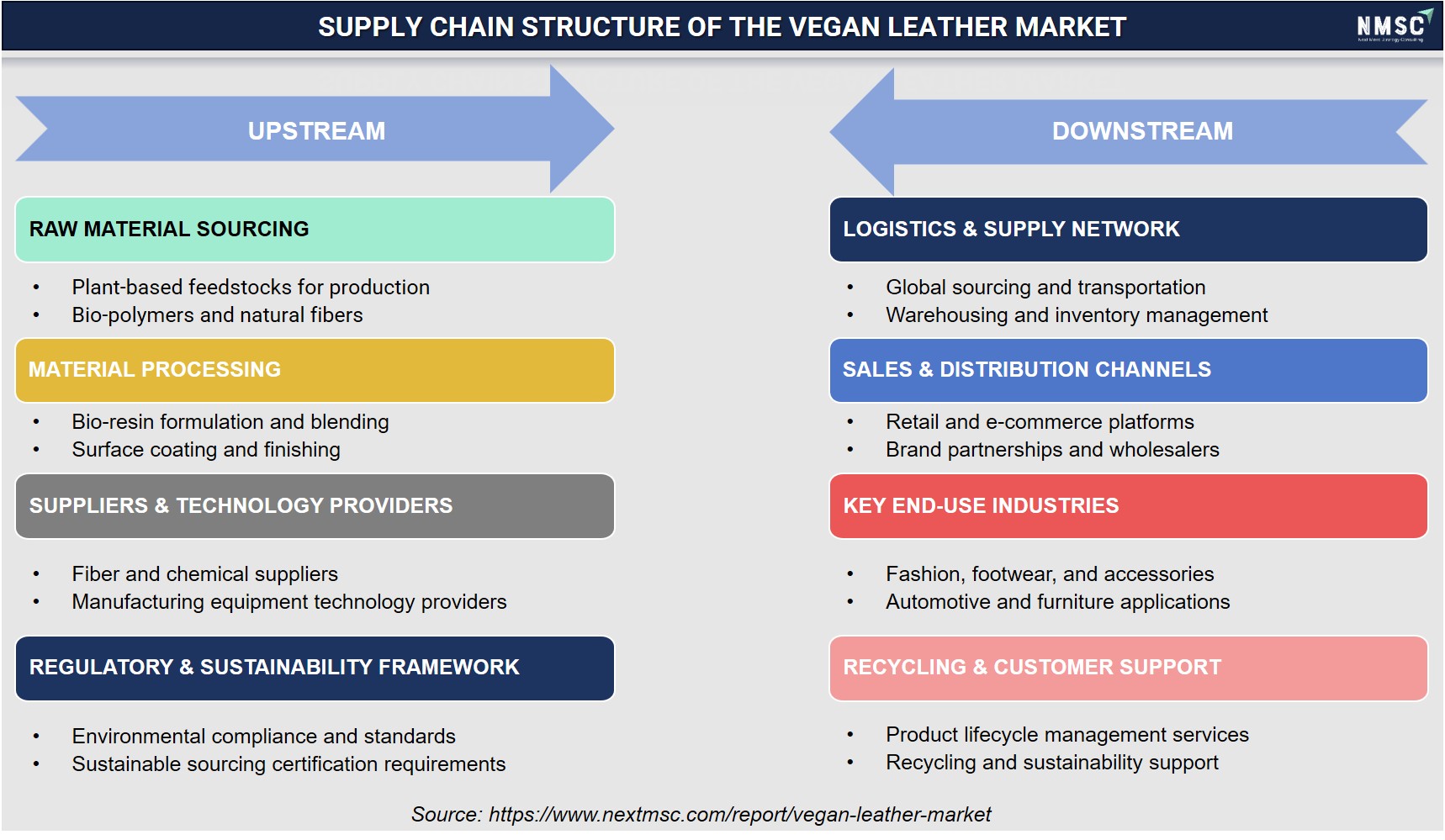
The above framework maps the Vegan Leather Market supply chain across upstream sourcing, processing, and downstream distribution. We noticed that plant-based feedstocks and bio-polymers drive raw material sourcing, while bio-resin formulation and surface coating define material processing, supported by chemical suppliers and technology providers. Regulatory compliance and sustainable certifications govern upstream operations, while downstream activities include global logistics, retail and e-commerce channels, and brand partnerships serving fashion, automotive, and furniture industries, with recycling support reinforcing sustainability commitments.
Competitive Landscape
Competitive Dynamics and M&A Landscape
|
Key Takeaways |
Details |
|
Market Structure |
The Vegan Leather Market features a highly fragmented competitive landscape spanning biomaterial innovators (MycoWorks, Bolt Threads, Modern Meadow, TomTex, Polybion, Ecovative Design, Ananas Anam, MALAI), established synthetic material producers (Kuraray, Teijin Frontier, Mitsubishi Chemical Group, San Fang Chemical, Mayur Uniquoters), and premium material specialists (Alcantara, Ultrafabrics, Ecopel, Natural Fiber Welding, Von Holzhausen, Vegea). Competition occurs across material innovation quality, brand partnership prestige, sustainability credential authenticity, and scalable manufacturing capability. |
|
Innovation Focus |
Innovation in the Vegan Leather Market centers on mycelium cultivation at commercial scale, precision fermentation for collagen-free leather protein production, agricultural waste valorisation for low-carbon biomaterial substrates, and advanced finishing technologies enabling textured and grain-patterned vegan leather surfaces that match conventional leather aesthetics. AI-assisted material design is an emerging innovation dimension within the biomaterial development process. |
|
M&A Activity |
M&A dynamics in the Vegan Leather Market include luxury brand-biomaterial startup strategic partnerships and co-development agreements rather than outright acquisitions. Hermès' investment in MycoWorks, Kering's materials innovation fund investments, and LVMH Ventures' sustainable material portfolio demonstrate how luxury groups are building proprietary vegan leather supply chains through strategic capital deployment. Manufacturing consolidation among synthetic vegan leather producers in Asia is an emerging M&A dynamic as scale competition intensifies. |
How Do Companies Compete in the Vegan Leather Market?
Competition in the Vegan Leather Market operates across three distinct tiers. Premium biomaterial innovators compete on technological differentiation, luxury brand partnership prestige, and authenticated sustainability credentials. Established synthetic and polymer-based producers compete on scale, cost, and performance consistency for mass-market applications. Recycled material specialists compete on circular economy compliance credentials, EU regulatory alignment, and certified post-consumer content verification. Geographic expansion strategies differ by tier: biomaterial innovators pursue luxury brand co-development globally, while Asian synthetic producers expand into European premium markets and U.S. EV supply chains.
Which Kind of Companies Dominate the Vegan Leather Market?
The Vegan Leather Market is currently dominated by three company archetypes. First, established synthetic leather producers from Japan, Taiwan, and Europe, including Kuraray, San Fang Chemical, and Alcantara, hold significant market share through proven performance track records and scale manufacturing. Second, U.S.-based biomaterial innovators including MycoWorks, Bolt Threads, and Natural Fiber Welding are capturing premium market positioning through luxury brand partnerships. Third, multi-material platform companies including Teijin Frontier and Mitsubishi Chemical Group are leveraging fiber and polymer technology breadth to serve multiple vegan leather application segments simultaneously.
Sustainable Innovation and Quality Standards Drive Growth in the Vegan Leather Market
The Vegan Leather Market is gaining momentum as manufacturers adopt advanced production technologies and sustainable raw materials such as mycelium, cactus, pineapple, and apple-based fibers. Enhanced quality control systems and compliance with recognized sustainability certifications are improving product performance and consumer trust. Companies that combine eco-friendly innovation with standardized quality assurance are strengthening brand value, expanding market reach, and creating a competitive advantage in the evolving Vegan Leather Market.
Market Players to Opt for Merger and Acquisition Strategies to Expand Their Presence in the Vegan Leather Market
NMSC's analysis indicates that M&A activity within the Vegan Leather Market is expected to intensify through the forecast period as luxury groups formalize supply chain ownership strategies for premium biomaterials and as synthetic leather producers seek to acquire bio-based technology capabilities. Luxury groups including LVMH, Kering, and Richemont have active sustainable material investment vehicles capable of acquiring or taking strategic stakes in biomaterial vegan leather innovators. Asian synthetic leather manufacturers are expected to pursue acquisition of recycled material specialists to integrate circular credentials into their product portfolios for European market compliance purposes.
Who Are the Key Market Players in the Vegan Leather Market?
-
Von Holzhausen Inc.
-
Vegea S.r.l.
-
Ultrafabrics, Inc.
-
TomTex Inc.
-
Teijin Frontier Co., Ltd.
-
Polybion S.A. de C.V.
-
Natural Fiber Welding, Inc.
-
MycoWorks, Inc.
-
Modern Meadow, Inc.
-
Mayur Uniquoters Limited
-
MALAI BIOMATERIALS DESIGN PRIVATE LIMITED
-
Bolt Threads, Inc.
-
Alcantara S.p.A.
-
Kuraray Co., Ltd.
-
Mitsubishi Chemical Group Corporation
-
Adriano Di Marti S.A. de C.V.
-
Ecovative Design LLC
-
Ananas Anam Ltd
-
San Fang Chemical Industry Co., Ltd.
-
Ecopel SAS
What Are the Latest Developments in the Vegan Leather Market?
|
Date |
Event |
|
October 2025 |
MycoWorks announced a restructuring strategy, shifting from cultivating mycelium internally to processing externally sourced mycelium. |
Expert Insights
 "This is the moment the luxury industry has been waiting for; a plastic-free leather alternative that offers undeniable beauty and performance—at scale."
— Patrick Thomas, former CEO of Hermès and MycoWorks Board Member
Statement made during MycoWorks' announcement regarding the opening of the world's first commercial-scale Fine Mycelium production facility.
Market Interpretation
The statement highlights a key transition in the vegan leather market from laboratory-scale innovation to commercial-scale production. Historically, scalability and performance have been major barriers to the adoption of bio-based leather alternatives. The commissioning of large-scale manufacturing capacity indicates that premium, plastic-free materials are increasingly capable of meeting luxury industry standards, which is expected to accelerate commercialisation and broader adoption across fashion, home furnishings, and automotive applications.
What Are the Investment Opportunities in the Vegan Leather Market?
Capital Inflows and Venture Activity
The Vegan Leather Market has attracted substantial venture and growth equity capital into biomaterial innovation. MycoWorks has raised over USD 125 million in total funding as of its Series C completion. Bolt Threads secured significant venture investment before commercializing Mylo mycelium leather. Modern Meadow raised over USD 53 million before pivoting its platform. Our findings suggest that the USDA BioPreferred Program and U.S. Department of Energy's Bioenergy Technologies Office have both directed investment-aligned program funding toward bio-based material innovation ecosystems that include vegan leather feedstock and processing technology development.
Infrastructure Investment
Infrastructure investment requirements for commercial-scale biomaterial vegan leather production represent a significant deployment opportunity for industrial biotechnology and materials technology investors. Mycelium cultivation facilities, precision fermentation bioreactors for collagen-alternative protein production, and agricultural waste processing infrastructure all require capital investment for scale-up from pilot to commercial production capacity. The European Innovation Council's Accelerator and Horizon Europe programs have funded multiple biomaterial startups at infrastructure scale, creating co-investment opportunities for private capital alongside EU public program funding.
ESG and Sustainable Material Mandates
ESG investment frameworks are creating institutionalized demand for vegan leather as a measurable supply chain sustainability improvement across fashion, automotive, and furniture sectors. The Task Force on Nature-related Financial Disclosures framework, supported by the Financial Stability Board, positions supply chain biodiversity impact reduction as a material financial risk disclosure requirement, directly incentivizing the replacement of livestock-derived leather with plant-based alternatives. The EU Sustainable Finance Taxonomy's classification of bio-based material investment as eligible sustainable economic activities creates favorable financing cost structures for vegan leather production infrastructure.
Digital Transformation and Material Traceability
Digital material traceability infrastructure represents an investment opportunity adjacent to the Vegan Leather Market, enabling brands to authenticate and communicate the sustainability credentials of their vegan leather material sourcing to consumers and regulators. The EU's Digital Product Passport, mandated under the Ecodesign for Sustainable Products Regulation, requires machine-readable product sustainability data including material origin and composition, creating essential infrastructure demand. Blockchain-based material traceability platforms and QR-enabled consumer transparency tools are investment-attracting adjacent technology categories driven by the Vegan Leather Market's credentialing requirements.
Private Equity and Strategic M&A Activity
Private equity and strategic corporate investment in the Vegan Leather Market are accelerating as luxury groups, chemical companies, and automotive Tier 1 suppliers seek to secure proprietary supply chain positions in premium biomaterial alternatives. Kering's Materials Innovation Lab and LVMH Ventures represent established luxury group investment vehicles actively evaluating vegan leather material investments. Industrial chemical companies including BASF and Lanxess are investing in bio-based polymer platforms applicable to vegan leather substrate production. Our assessment indicates that mid-market synthetic vegan leather manufacturers in Asia represent PE consolidation targets given established customer relationships and scale manufacturing assets.
Key Benefits for Stakeholders
For Fashion Brands and Retailers
Fashion brands and retailers gain access to a comprehensive and vendor-neutral assessment of the Vegan Leather Market, including quantitative market sizing across material source, application, texture, and distribution channel segments. The analysis supports product portfolio development, sustainable sourcing strategies, and supplier qualification decisions across plant-based, synthetic, and recycled vegan leather categories. Regional demand analysis and competitive benchmarking provide additional guidance for expansion and merchandising strategies in both premium and mass-market segments.
For Automotive OEMs and Tier 1 Suppliers
Automotive OEMs and Tier 1 suppliers gain actionable intelligence on the performance characteristics, commercial adoption, and competitive positioning of various vegan leather materials used in EV and ICE interior programs. The study provides benchmarking across material technologies along with analysis of evolving sustainability regulations, including the EU Corporate Sustainability Reporting Directive (CSRD) and Ecodesign requirements, enabling procurement teams to align material selection with compliance, lifecycle, and sustainability objectives across global vehicle platforms.
For Investors and Venture Capital Firms
Investors and venture capital firms access a structured and data-driven evaluation of the Vegan Leather Market's growth outlook, competitive landscape, and segment-level revenue opportunities through 2035. CAGR analysis by material type, application, and geography enables informed investment prioritization, while the assessment of emerging themes, including plant-based biomaterials, direct-to-consumer channel expansion, automotive interior applications, and circular economy initiatives—supports portfolio development and long-term valuation modelling.
For Biomaterial Innovators and Technology Companies
Biomaterial innovators and technology companies gain insights into commercial readiness, competitive positioning, and intellectual property differentiation across the global vegan leather ecosystem. The market sizing and adoption trend analysis provide evidence-based support for fundraising initiatives, licensing discussions, strategic partnerships, and go-to-market planning. Competitive assessments also help innovators identify high-growth applications and commercialisation pathways for next-generation bio-based materials.
For Government and Policy Makers
Government agencies and policymakers gain a structured analysis of how sustainability regulations, including the EU Sustainable Textiles Strategy, Corporate Sustainability Reporting Directive (CSRD), and Ecodesign Regulation, are shaping the adoption of vegan leather materials. Country- and region-level insights provide evidence-based perspectives on the effectiveness of circular economy policies and support the identification of additional intervention opportunities aimed at promoting sustainable materials, waste reduction, and responsible manufacturing practices.
For Supply Chain Participants and Raw Material Suppliers
Supply chain participants and raw material suppliers gain visibility into procurement opportunities across key applications and geographies for agricultural waste feedstocks, mycelium substrates, recycled polymers, and bio-based polymer inputs. Segment-level demand forecasts and regional market analysis enable suppliers to evaluate capacity expansion priorities, optimize investment decisions, and strengthen long-term supply agreements with branded goods manufacturers increasingly transitioning toward sustainable and animal-free material solutions.
Key Market Segments
By Material Source
-
Plant-Based
-
Fruit Waste
-
Agricultural Waste
-
Fungal/Biological
-
Other Biomass
-
-
Synthetic
-
Bio-Based Synthetics
-
Petrochemical-Based
-
-
Recycled
-
Post-Consumer Recycled
-
Post-Industrial Recycled
-
By Application
-
Footwear
-
Apparel and Clothing
-
Accessories
-
Fashion Accessories
-
Bags and Wallets
-
-
Automotive
-
Furniture and Home Decor
-
Electronics and Gadgets
-
Stationery
-
Others
By Texture/Finish
-
Smooth
-
Glossy
-
Matte
-
-
Textured
By Distribution Channel
-
Direct-to-Consumer (DTC)
-
Indirect Retail
-
Business-to-Business (B2B)
-
Hybrid/Omnichannel
By Region
-
North America: U.S., Canada, and Mexico.
-
Europe: UK, Germany, France, Italy, Spain, Sweden, Denmark, Finland, the Netherlands, and the rest of Europe.
-
Asia Pacific: China, India, Japan, South Korea, Taiwan, Indonesia, Vietnam, Australia, Philippines, Malaysia and the rest of APAC.
-
Middle East & Africa (MEA): Saudi Arabia, UAE, Egypt, Israel, Turkey, Nigeria, South Africa, and the rest of MEA.
-
Latin America: Brazil, Argentina, Chile, Colombia, and the rest of LATAM.
Conclusion and Recommendations
Long-Term Outlook for the Vegan Leather Market
The Vegan Leather Market is positioned for sustained high-growth trajectory through 2035 and beyond, driven by structural convergence of consumer ethics, regulatory mandates, luxury brand adoption, and technology-enabled material innovation. Advancing from USD 46.01 billion in 2025 to USD 145.46 billion by 2035 at a CAGR of 12.2%, the market is transitioning from a niche sustainability alternative to a mainstream material category across fashion, automotive, furniture, and electronics sectors. NMSC's long-term assessment indicates that biomaterial innovation will increasingly displace synthetic alternatives in premium segments while recycled materials capture compliance-driven growth in volume channels.
Strategic Positioning Recommendations
Brands and manufacturers should prioritize strategic partnerships with certified plant-based and recycled vegan leather suppliers to secure preferential access to premium biomaterial supply chains before commercial-scale availability normalizes competition. Investment in material traceability and digital product passport infrastructure ahead of EU mandatory requirements in 2027 will create compliance readiness advantages. Automotive sector stakeholders should accelerate vegan interior qualification programs given the Volvo 2030 leather-free commitment's catalytic influence on OEM peer procurement decisions across European and North American vehicle platforms.
Investment Attractiveness of the Vegan Leather Market
The Vegan Leather Market presents a compelling investment thesis combining durable secular demand drivers with multiple high-growth sub-segment opportunities across the forecast period. NMSC's assessment identifies the highest-conviction investment themes as: Plant-Based material growth at 14.8% CAGR, Automotive application expansion at 15.2% CAGR, India national market growth at 16.4% CAGR, DTC channel expansion at 13.8% CAGR, and Hybrid/Omnichannel distribution at 14.6% CAGR. Biomaterial innovators achieving manufacturing scale and luxury brand commercial validation represent the highest-return investment opportunities within the Vegan Leather Market landscape.
Key Market Shifts Reshaping the Vegan Leather Market
The most fundamental market shift underway within the Vegan Leather Market is the repositioning of vegan leather from a mass-market cost-parity substitute to a premium performance material competitive with and in some cases superior to conventional leather. Mycelium and fruit-waste biomaterials are enabling this repositioning, unlocking luxury brand adoption at price points previously inaccessible to synthetic alternatives. A parallel shift toward material traceability and authenticated sustainability credentials is redefining competitive advantage from product performance alone toward verified ESG supply chain provenance as a measurable brand value driver.
Key Risks for the Vegan Leather Market
The primary risks for the Vegan Leather Market include manufacturing scale economics failing to improve sufficiently to bring premium biomaterial prices within reach of mid-market brand procurement budgets within the forecast period, petrochemical price volatility affecting synthetic vegan leather input costs, greenwashing regulatory enforcement creating legal exposure for brands making unsubstantiated vegan leather sustainability claims, and consumer perception risks from high-profile quality failures of early-generation vegan leather products creating broader category skepticism that slows adoption across mass-market application segments.
Growth Pathways for Stakeholders in the Vegan Leather Market
Stakeholders maximizing value from the Vegan Leather Market should pursue a three-horizon strategy. In the near term from 2025 to 2027, establish certified vegan leather material supply chain relationships and invest in digital traceability infrastructure ahead of EU mandate timelines. In the mid-term from 2027 to 2031, scale plant-based biomaterial procurement as production economics improve and luxury brand partnerships provide quality validation. In the long term from 2031 to 2035, position for Asia-Pacific manufacturing scale leadership as India and Vietnam become the world's dominant vegan leather production centers for both domestic and export markets.
Forecast Summary for the Vegan Leather Market
The Vegan Leather Market is forecast to demonstrate consistent compound growth through 2035, underpinned by three non-cyclical structural drivers: regulatory mandates creating compliance demand, consumer ethics shifts creating preference demand, and technology innovation creating material performance demand. The combination of these simultaneously operating drivers positions the Vegan Leather Market as one of the most structurally resilient sustainable materials categories within the broader fashion, automotive, and materials industry investment landscape. Our market assessment confirms that organizations entering this market in 2025–2027 are positioned at the optimal inflection point between proven market validation and the full maturation of material scale economics.


About the Author
 Mayurima Roy
— Mayurima Roy is Research Analyst at Next Move Strategy Consulting, where she has spent 4 years working across the firm's full industry coverage rather than a single fixed vertical. Her work centers on structured research, ongoing trend tracking, competitive assessment, and insight-led content development, translating complex market data into clear, decision-ready narratives that support informed client decision-making across diverse global industries, market sectors, and world regions every day.
Mayurima Roy
— Mayurima Roy is Research Analyst at Next Move Strategy Consulting, where she has spent 4 years working across the firm's full industry coverage rather than a single fixed vertical. Her work centers on structured research, ongoing trend tracking, competitive assessment, and insight-led content development, translating complex market data into clear, decision-ready narratives that support informed client decision-making across diverse global industries, market sectors, and world regions every day.
About the Reviewer
 Supradip Baul
— Supradip Baul is an accomplished business consultant and strategist with over a decade of rich experience in market intelligence, strategy, technology, and business transformation. His work has included rigorous qualitative and quantitative analysis across multiple industries, helping clients shape investment decisions and long-term roadmaps. Earlier in his career, he was associated with Gartner, where he contributed to industry-leading reports and market share analyses. He has worked with leading global companies and holds an MBA with a dual specialization in Marketing and Finance.
Supradip Baul
— Supradip Baul is an accomplished business consultant and strategist with over a decade of rich experience in market intelligence, strategy, technology, and business transformation. His work has included rigorous qualitative and quantitative analysis across multiple industries, helping clients shape investment decisions and long-term roadmaps. Earlier in his career, he was associated with Gartner, where he contributed to industry-leading reports and market share analyses. He has worked with leading global companies and holds an MBA with a dual specialization in Marketing and Finance.
At Next Move Strategy Consulting, we understand that insightful market research is the cornerstone of successful business decisions. That's why we employ a robust and multifaceted approach, combining various methodologies to deliver the most accurate and actionable data for our clients.

Research Landscape
We navigate the world of research with two primary approaches:
Qualitative Approach
Our qualitative research methodologies involve immersive techniques such as in-depth interviews, focus groups, and observational studies. By engaging directly with individuals and stakeholders, we uncover valuable insights that quantitative data alone may overlook.

Quantitative Research
In tandem with qualitative methodologies, NMSC leverages the power of Quantitative Research to provide a robust foundation of numerical insights. Through systematic data collection and analysis, we quantify patterns, preferences, and market trends, offering a comprehensive view of the business landscape.
Our quantitative research approach employs diverse tools, including surveys, experiments, and statistical modelling. These methodologies enable us to gather data from a large and representative sample, ensuring the statistical significance of our findings. By employing structured questionnaires and standardized data collection methods, we guarantee the reliability and validity of the information we present to our clients.
Quantitative research is particularly effective in measuring the prevalence of trends, assessing market size, and gauging the impact of various factors on consumer behavior. The numerical precision attained through this approach equips our clients with actionable insights, facilitating data-driven decision-making and strategy formulation.


Our Specialized Toolbox for Industry-Specific Market Research
We deploy a specialized arsenal of techniques tailored to meet your unique requirements. Here's a glimpse into our comprehensive toolbox:

Information Procurement
The stage entails acquiring market data or relevant information through various sources and methodologies.


Market Research Approach
We utilize both top-down and bottom-up approaches in market research analysis to achieve a comprehensive understanding of the market dynamics, leveraging the broad perspective of industry trends and macroeconomic factors alongside detailed insights from specific segments and individual companies.

Porters Five Forces Analysis
We conduct Porter's Five Forces analysis to evaluate the competitive landscape of an industry, providing us with insights into factors that affect profitability and strategic positioning.

SWOT Analysis

Forecasting
We utilize a forecasting model to predict future consumption by considering parameters like population, economics, regulations, market competition, drivers, constraints, technology, and pricing. We also employ statistical techniques such as multilinear regression, exponential smoothing, moving average, ARIMA, and Monte Carlo simulations for accurate predictions. In econometric forecasting, we analyzed short-term and long-term event impacts, attributing values based on regulatory frameworks, economic factors, and market events.





 Speak to Our Analyst