Vegetable Seeds Market Global Industry Analysis and Forecast (2026–2035)

The global Vegetable Seeds Market size was valued at USD 8.10 billion in 2025 and is estimated at USD 8.55 billion in 2026, forecast to reach USD 14.95 billion by 2035, expanding at a 6.40% CAGR between 2026 and 2035. Asia-Pacific leads with approximately 38% share, while Solanaceous Vegetables dominate all other crop types with approximately 26% share.
Download Free Sample PDF
Base Year (2025)
$8.10 Billion
Forecast (2035)
$14.95 Billion
CAGR (2026-2035)
6.4%
Top Region
Asia-Pacific

What Is the Vegetable Seeds Market Size?

The global vegetable seeds market size was valued at USD 8.10 Billion in 2025 and is estimated at USD 8.55 Billion in 2026, forecast to reach USD 14.95 Billion by 2035, expanding at a 6.40% CAGR between 2026 and 2035. Asia-Pacific leads with approximately 38% share, while solanaceous vegetables dominate all other crop types with approximately 26% share.

We observed that growth is concentrated in protected cultivation and leafy vegetable categories, where hybrid genetics and disease-resistant breeding are the dominant structural drivers through 2035.

Vegetable Seeds Market Global Industry Analysis and Forecast (2026–2035) Revenue Forecast

Values in USD Billion

2025 $8.10 Billion
2025
2026 $8.55 Billion
2026
2027 $9.10 Billion
2027
2028 $9.68 Billion
2028
2029 $10.30 Billion
2029
2030 $10.96 Billion
2030
2031 $11.66 Billion
2031
2032 $12.41 Billion
2032
2033 $13.20 Billion
2033
2034 $14.04 Billion
2034
2035 $14.95 Billion
2035

Key Takeaways

By Crop Type: Solanaceous vegetables held the largest share of approximately 26% (USD 2.11 Billion) in 2025; Leafy vegetables is the fastest-growing sub-segment at 9.1% CAGR from 2026–2035.

By Breeding Technology: Hybrid seeds held the largest share of approximately 68% (USD 5.51 Billion) in 2025; Genetically improved seeds is the fastest-growing sub-segment at 8.2% CAGR from 2026–2035.

By Cultivation Mode: Open field cultivation held the largest share of approximately 74% (USD 5.99 Billion) in 2025; Protected cultivation is the fastest-growing sub-segment at 8.9% CAGR from 2026–2035.

By Distribution Channel: Institutional and direct sales held the largest share of approximately 55% (USD 4.46 Billion) in 2025; Online and e-commerce sales is the fastest-growing sub-segment at 9.5% CAGR from 2026–2035.

By Seed Treatment: Treated seeds held the largest share of approximately 62% (USD 5.02 Billion) in 2025; Untreated and organic-certified seeds is the fastest-growing sub-segment at 7.8% CAGR from 2026–2035.

Dominant Region: Asia-Pacific dominated with approximately 38% revenue share (USD 3.08 Billion) in 2025.

Fastest-Growing Region: Middle East and Africa is expected to register the highest CAGR of 10.7% during 2026–2035.

Dominant Country: China led with approximately USD 1.15 Billion in 2025.

Fastest-Growing Country: Saudi Arabia is the fastest-growing country at approximately 12.2% CAGR from 2026–2035.

Market Opportunity: The vegetable seeds market is expected to create an absolute dollar opportunity of USD 6.40 Billion between 2026 and 2035, presenting significant investment potential across hybrid breeding, protected cultivation genetics, and emerging-market seed distribution.

According to Next Move Strategy Consulting analysis, seed companies are increasingly prioritizing disease-resistant hybrid development over open-pollinated variety expansion, a shift that favors research-intensive breeders with strong intellectual property portfolios as growers demand higher yield reliability across volatile climate conditions through 2035.

Vegetable Seeds Market Overview

The vegetable seeds market encompasses the breeding, production, and commercial distribution of hybrid, open-pollinated, and genetically improved seeds used to cultivate solanaceous, cucurbit, brassica, root and bulb, leafy, and legume vegetable crops. Our assessment indicates that the scope spans breeding research, seed production contracts, treatment and coating services, and distribution through institutional, retail, and online channels serving commercial growers, protected cultivation operators, and home gardeners across developed and emerging markets alike.

Regulatory frameworks such as the International Seed Federation's variety registration standards and national plant variety protection laws shape intellectual property enforcement and cross-border seed trade, while national biosafety authorities govern the limited use of genetically improved vegetable traits. We observed that technology adoption is shifting toward marker-assisted breeding and precision-bred disease resistance, with companies such as Rijk Zwaan expanding dedicated breeding infrastructure to accelerate variety development for climate-resilient cultivation.

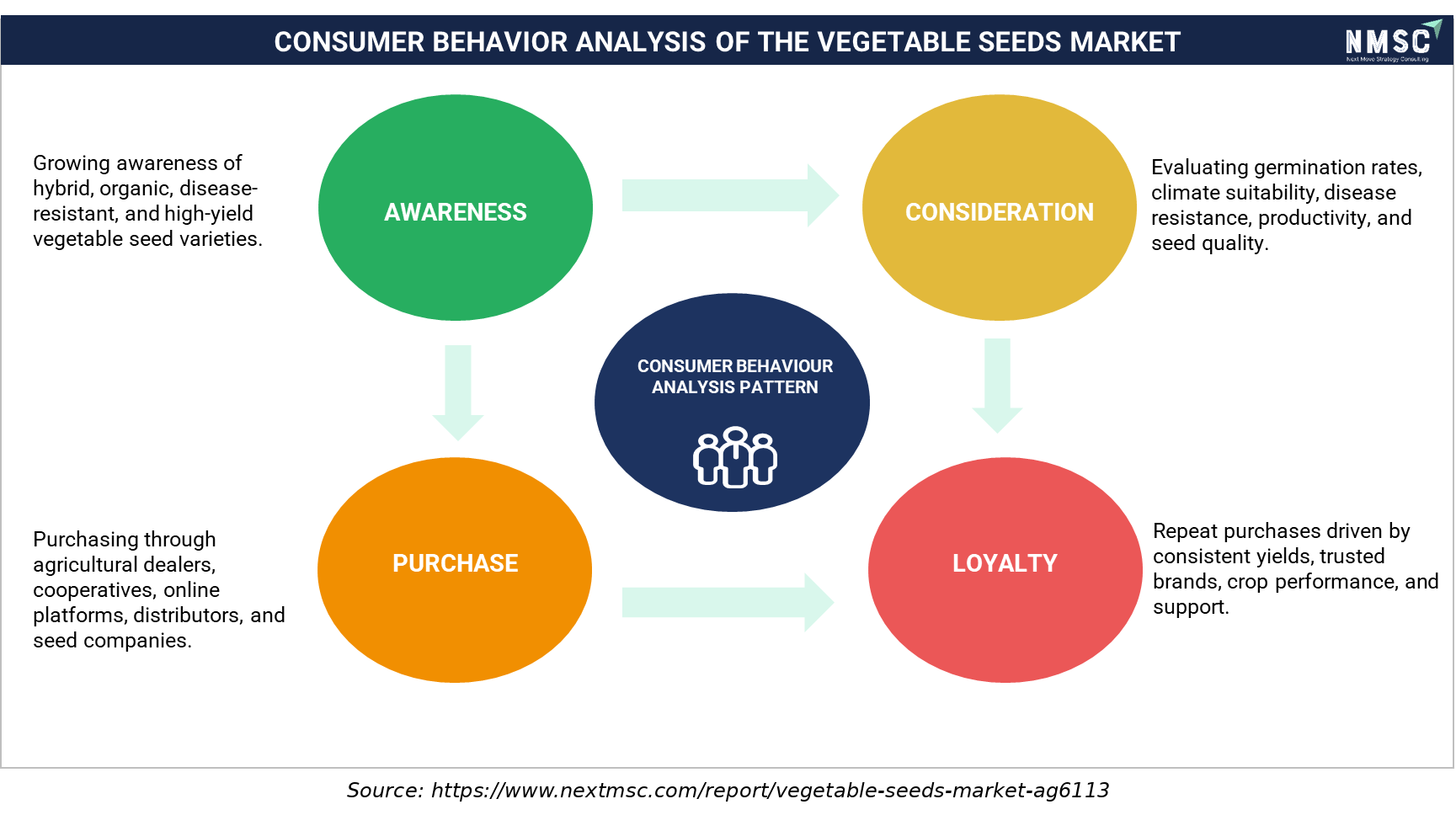
Consumer Behavior Analysis of the Vegetable Seeds Market

Consumer Behavior Analysis of the Vegetable Seeds Market

In our observation, consumer journey in the Vegetable Seed Market begins with growing awareness of hybrid, organic, and disease-resistant varieties. Consequently, buyers evaluate crucial factors like germination rates, climate suitability, and potential productivity during consideration. Procurement occurs through agricultural dealers, cooperatives, and online channels, while long-term brand loyalty is driven by consistent crop performance, trusted seed quality, and ongoing grower technical support.

Market Drivers & Dynamics

Interactive Dataset
Rising adoption of disease-resistant hybrid vegetable varieties driver +1.6% Global 2026–2035
Expansion of protected cultivation and greenhouse vegetable farming driver +1.3% Europe, Middle East and Africa 2026–2033
Growing demand for leafy and nutrient-dense vegetables driver +1.1% Global 2026–2035
Government food security investment in seed production capacity driver +0.9% Asia-Pacific, Middle East and Africa 2026–2032
Rising export-oriented vegetable acreage in emerging markets driver +0.8% Latin America, Asia-Pacific 2026–2035
Growth of online and direct-to-grower seed distribution driver +0.6% Global 2026–2033
High cost of hybrid seed production relative to open-pollinated varieties restraint −0.7% Global 2026–2030
Seed-saving practices among smallholder growers limiting repeat purchase restraint −0.6% Asia-Pacific, Latin America, Africa 2026–2032
Regulatory uncertainty surrounding genetically improved vegetable traits restraint −0.4% Europe 2026–2031
Source: Next Move Strategy Consulting

Growth Drivers

What Is the Primary Growth Driver for the Vegetable Seeds Market?

Rising adoption of disease-resistant hybrid varieties is the primary growth driver, as growers seek genetics that reduce crop loss under increasing pathogen and climate pressure. According to the Food and Agriculture Organization of the United Nations, global vegetable production area has expanded steadily over the past decade, reinforcing sustained demand for higher-performing hybrid seed genetics across commercial growing operations.

How Is Protected Cultivation Expansion Driving Market Growth?

Protected cultivation expansion is driving demand for greenhouse-specific hybrid seed varieties bred for controlled environment performance. We observed that the U.S. Department of Agriculture's National Agricultural Statistics Service reports continued growth in covered vegetable production acreage, supporting sustained premium hybrid seed demand among controlled-environment growers seeking consistent year-round output.

Growth Inhibitors

What Is Restraining Vegetable Seeds Market Growth?

The high cost of hybrid seed production relative to open-pollinated varieties restrains adoption among smallholder and price-sensitive growers, particularly across parts of Asia-Pacific, Latin America, and Africa. Our assessment indicates that widespread seed-saving practices among smallholder farmers further limit repeat commercial seed purchases, constraining addressable market expansion in select emerging regions.

Segmentation Analysis

2025 (USD Billion)
2035 (USD Billion)
Solanaceous vegetables 2025: $2.11 Billion | 2035: $3.59 Billion
Solanaceous
Cucurbits 2025: $1.62 Billion | 2035: $3.29 Billion
Cucurbits
Brassica vegetables 2025: $1.30 Billion | 2035: $2.24 Billion
Brassica veg
Root and bulb vegetables 2025: $1.22 Billion | 2035: $1.94 Billion
Root and bul
Leafy vegetables 2025: $0.97 Billion | 2035: $2.24 Billion
Leafy vegeta
Legume vegetables 2025: $0.65 Billion | 2035: $1.20 Billion
Legume veget
Other vegetables 2025: $0.24 Billion | 2035: $0.45 Billion
Other vegeta
Solanaceous vegetables $2.11 Billion $3.59 Billion 5.5%
Cucurbits $1.62 Billion $3.29 Billion 7.5%
Brassica vegetables $1.30 Billion $2.24 Billion 5.6%
Root and bulb vegetables $1.22 Billion $1.94 Billion 4.7%
Leafy vegetables $0.97 Billion $2.24 Billion 9.1%
Legume vegetables $0.65 Billion $1.20 Billion 6.4%
Other vegetables $0.24 Billion $0.45 Billion 6.4%

Which Crop Type Dominates the Vegetable Seeds Market?

Crop type is segmented into solanaceous, cucurbit, brassica, root and bulb, leafy, legume, and other vegetables. We found that solanaceous vegetables, comprising tomato, pepper, and eggplant, dominate at approximately 26% share in 2025 given their high per-hectare seed value and dense global cultivation footprint, while leafy vegetables is the fastest-growing category at 9.1% CAGR as urban and controlled-environment farming expands globally.

2025 (USD Billion)
2035 (USD Billion)
Hybrid seeds
Open-pollina
Genetically
Segment Item 2025 (USD Billion) 2035 (USD Billion) CAGR
Hybrid seeds $10.0 USD Billion $40.0 USD Billion 27.0%
Open-pollinated seeds $17.1 USD Billion $51.1 USD Billion 13.0%
Genetically improved seeds $24.2 USD Billion $62.2 USD Billion 19.0%

Segment-wise data is locked

Unlock complete segment-wise numbers for By Breeding Technology.

Unlock Full Data

Which Breeding Technology Leads the Vegetable Seeds Market?

Breeding technology is segmented into hybrid seeds, open-pollinated seeds, and genetically improved seeds. Hybrid seeds lead with approximately 68% share in 2025, reflecting growers' preference for uniform yield and disease resistance, while genetically improved seeds, supported by advances in gene editing research, form the fastest-growing category at 8.2% CAGR from a comparatively small base as approved traits gradually expand.

2025 (USD Billion)
2035 (USD Billion)
Open field c
Protected cu
Segment Item 2025 (USD Billion) 2035 (USD Billion) CAGR
Open field cultivation $10.0 USD Billion $40.0 USD Billion 22.0%
Protected cultivation $17.1 USD Billion $51.1 USD Billion 12.0%

Segment-wise data is locked

Unlock complete segment-wise numbers for By Cultivation Mode.

Unlock Full Data

Which Cultivation Mode Generates the Largest Revenue in the Vegetable Seeds Market?

Cultivation mode is segmented into open field cultivation and protected cultivation. Open field cultivation leads with approximately 74% share in 2025 given its dominant global acreage and continued reliance on crop protection chemicals to manage field-level pest and disease pressure, while protected cultivation is the fastest-growing category at 8.9% CAGR as growers in water-constrained and high-value markets invest in greenhouse infrastructure.

2025 (USD Billion)
2035 (USD Billion)
Institutiona
Retail and a
Online and e
Segment Item 2025 (USD Billion) 2035 (USD Billion) CAGR
Institutional and direct sales $10.0 USD Billion $40.0 USD Billion 25.0%
Retail and agri-input dealers $17.1 USD Billion $51.1 USD Billion 19.0%
Online and e-commerce sales $24.2 USD Billion $62.2 USD Billion 25.0%

Segment-wise data is locked

Unlock complete segment-wise numbers for By Distribution Channel.

Unlock Full Data
2025 (USD Billion)
2035 (USD Billion)
Treated seed
Untreated an
Segment Item 2025 (USD Billion) 2035 (USD Billion) CAGR
Treated seeds $10.0 USD Billion $40.0 USD Billion 17.0%
Untreated and organic-certified seeds $17.1 USD Billion $51.1 USD Billion 23.0%

Segment-wise data is locked

Unlock complete segment-wise numbers for By Seed Treatment.

Unlock Full Data

Growth Opportunities

Three forward-looking whitespace opportunities stand out for stakeholders positioning ahead of the vegetable seeds market's 2026–2035 growth curve.

Scaling Organic-Certified Seed Production for Certified Growers

Rising organic vegetable farming certification requirements present a scalable opportunity for seed companies offering untreated and organic-certified genetics compatible with organic fertilizer input regimes, benefiting seed producers and organic-certified growers seeking compliant, high-performance planting material.

Expansion of Direct-to-Grower Digital Seed Distribution

Online seed ordering platforms that bypass traditional multi-tier distribution present opportunity for seed companies to capture higher margins while offering growers faster access to newly released hybrid varieties, benefiting both breeders and mid-scale commercial growers underserved by traditional retail networks.

Scaling Drought-Tolerant Genetics for Water-Constrained Growing Regions

Water-constrained growing regions in the Middle East, North Africa, and parts of South Asia present a strong opportunity for breeders developing drought-tolerant root, bulb, and leafy vegetable genetics, benefiting seed companies with dedicated arid-climate breeding programs and government-backed food security initiatives in these regions.

Regional Outlook

2025 (USD Billion)
2035 (USD Billion)
Asia-Pacific
Europe
North Americ
Latin Americ
Middle East
Region 2025 (USD Billion) 2035 (USD Billion) CAGR (%)
Asia-Pacific $10.0 USD Billion $40.0 USD Billion 9.0%
Europe $17.1 USD Billion $51.1 USD Billion 27.0%
North America $24.2 USD Billion $62.2 USD Billion 25.0%
Latin America $31.3 USD Billion $73.3 USD Billion 23.0%
Middle East and Africa $38.4 USD Billion $84.4 USD Billion 12.0%

Regional data is locked

Unlock complete regional numbers for this market.

Unlock Full Data

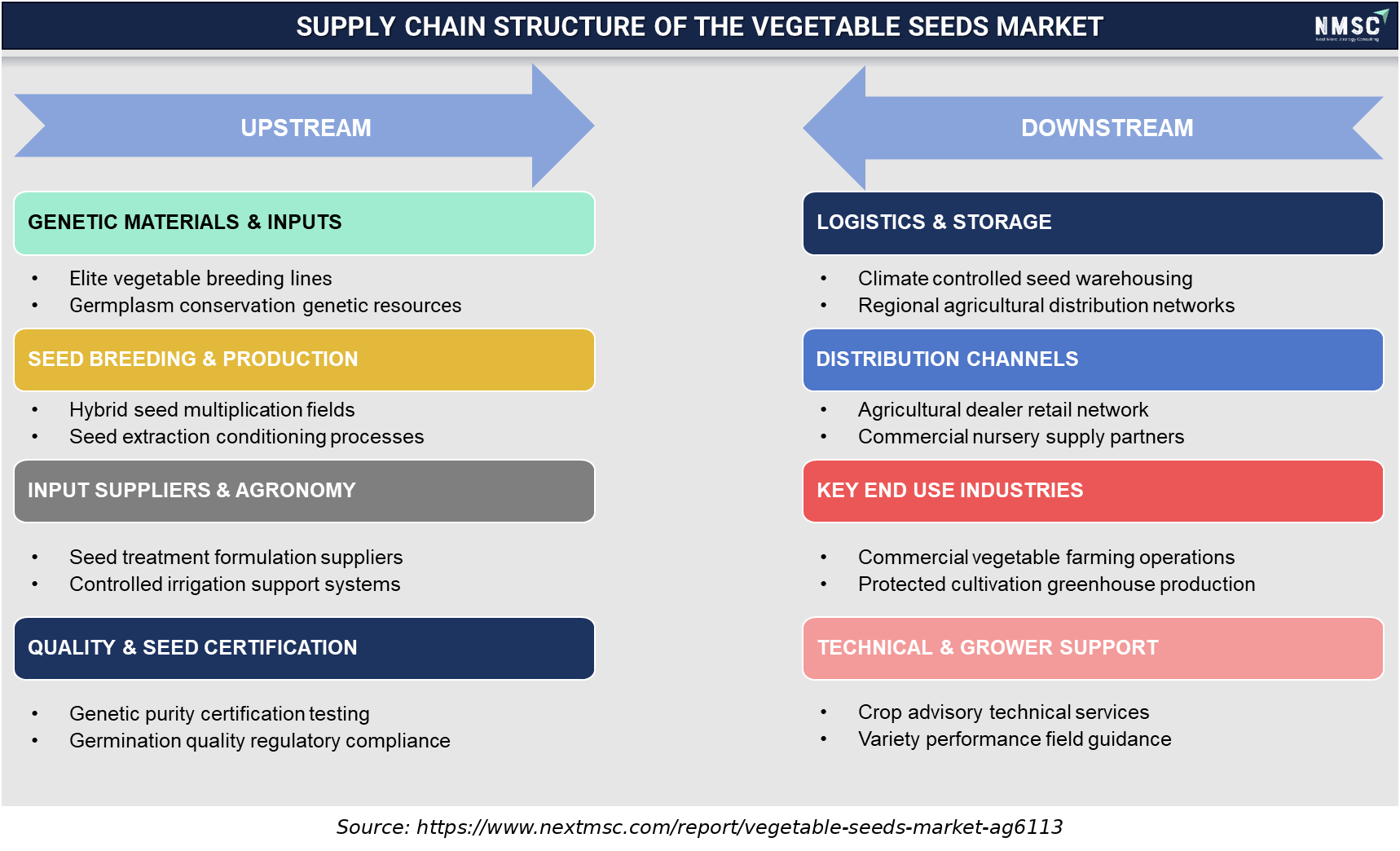
Supply Chain Structure of the Vegetable Seeds Market

Supply Chain Structure of the Vegetable Seeds Market

Our analysis shows that the supply chain of the Vegetable Seed Market seamlessly integrates upstream R&D with downstream distribution. Upstream operations focus on germplasm resources, hybrid seed multiplication, conditioning, and strict purity certifications. Subsequently, climate-controlled storage and agricultural dealer networks supply seeds to commercial farming and greenhouse operations, supported by expert crop advisory services to maximize field performance and yield outcomes.

Competitive Landscape

We found that the competitive landscape spans diversified agri-biotechnology conglomerates, family-owned vegetable breeding specialists, and regional hybrid seed producers, each competing on genetic depth and distribution reach.

Dimension Description
Market Structure Moderately consolidated; diversified agri-biotechnology conglomerates compete alongside family-owned vegetable breeding specialists, with the top companies profiled in this report collectively accounting for a significant share of global revenue.
Innovation Focus Disease-resistant hybrid breeding, protected cultivation-specific genetics, and marker-assisted variety development dominate current innovation pipelines across leading breeders.
M&A Activity Selective consolidation and capacity expansion, exemplified by Rijk Zwaan's investment in dedicated breeding greenhouse infrastructure to scale tomato, pepper, and aubergine variety development.

How Do Companies Compete in the Vegetable Seeds Market?

Companies compete primarily on breeding depth, disease-resistance portfolio breadth, and distribution reach across institutional and retail channels. Our analysis shows that vendors offering the broadest disease-resistant hybrid portfolios are winning larger commercial grower contracts against narrower regional specialists, while pricing strategies increasingly favor bundled agronomic support alongside seed sales.

Which Competitive Archetypes Dominate the Market?

Two archetypes dominate: diversified agri-biotechnology conglomerates such as Bayer AG and Corteva, Inc. that combine seed genetics with crop protection portfolios, and family-owned vegetable breeding specialists such as Rijk Zwaan and Enza Zaden that focus exclusively on vegetable genetics depth. The former wins on integrated crop-solution scale, while the latter wins on breeding specialization and faster variety iteration.

What Innovation and Differentiation Strategies Are Companies Pursuing?

Vendors are differentiating through dedicated breeding infrastructure investment and crop-specific genetic innovation tailored to evolving cultivation methods. We observed that Rijk Zwaan's new breeding greenhouse in the Netherlands, opened in December 2025, exemplifies this strategy of expanding dedicated research capacity for tomato, sweet pepper, and aubergine variety development to accelerate disease-resistant genetics.

Key Market Players

Our assessment identifies the following 20 companies as the leading vegetable seed breeders and producers, ranked by market-specific revenue and scale of operations as of 2026.

Bayer AG Corteva, Inc. Groupe Limagrain KWS SAAT SE & Co. KGaA Rijk Zwaan Zaadteelt en Zaadhandel B.V. Enza Zaden Beheer B.V. Takii & Co., Ltd. Sakata Seed Corporation Bejo Zaden B.V. DLF Seeds A/S East-West Seed International Limited UPL Limited Tokita Seed Co., Ltd. Known-You Seed Co., Ltd. Maharashtra Hybrid Seeds Company Pvt. Ltd. Namdhari Seeds Pvt. Ltd. Nirmal Seeds Pvt. Ltd. Sungro Seeds Limited

Latest Developments

We found that recent facility investments and product launches reflect accelerating investment in disease resistance breeding and direct-to-grower distribution across the industry.

Date Event
July 2026 Rijk Zwaan established a new subsidiary in South Korea to expand its international operational footprint. The expansion enables the company to respond more effectively to rising regional demand for high-quality vegetable seed varieties while providing direct localized technical support to growers across South Korea.
May 2026 Syngenta Vegetable Seeds opened a new $10 million R&D Technology Center in El Ejido, Almería, Spain, focused on combating emerging crop pathogens and developing resistant vegetable seeds. The facility brings together breeding, seed operations, trait development, fruit quality, applied data science and digital capabilities and is designed to reduce traditional breeding timelines.
July 2025 Sakata Seed Corporation acquired Brazilian onion seed company Agritu Sementes through its subsidiary Sakata Seed Sudamerica, with the acquisition completed on July 1, 2025. The deal strengthens Sakata’s onion seed business by expanding its product portfolio, R&D, seed production technology and sales capabilities, with the company aiming to enhance its presence across South America.

Expert Insights

Matthew Johnston

Matthew Johnston

Global Head for Vegetable Seeds and Flowers | Syngenta

"The vegetable seed industry has always faced emerging pests and pathogens. We’re seeing more frequency with more pathogens, with more impact, more rapid advancement. That puts huge pressure on our farmers, but it puts huge pressure on the industry to stay ahead of that and innovate so that we can help keep our customers ahead of those challenges."

Analyst Interpretation

The statement underscores the growing challenge posed by emerging pests and pathogens in vegetable production, which is driving demand for innovative seed technologies and improved breeding programs. As climate change accelerates the spread and evolution of crop diseases, seed companies are intensifying investments in disease-resistant, high-performing, and climate-resilient vegetable varieties. This trend is expected to support sustained innovation and growth in the global vegetable seeds market.

Investment Opportunities

Where Are Capital Inflows Concentrated in the Vegetable Seeds Market?

Capital inflows are concentrated in disease-resistant hybrid breeding programs and dedicated research infrastructure, where intellectual property protection supports premium pricing and recurring grower relationships. We observed that established breeders continue to prioritize reinvestment in proprietary genetics over acquisition-led growth, reflecting the long breeding cycles inherent to vegetable variety development.

How Significant Is Infrastructure Investment in the Vegetable Seeds Market?

Infrastructure investment spans dedicated breeding greenhouses, seed processing and treatment facilities, and cold-chain storage required to preserve seed viability across global distribution. Our findings suggest that companies in Asia-Pacific and the Middle East are making significant proportional infrastructure commitments, reflecting expanding domestic seed production capacity tied to national food security priorities.

What ESG Considerations Influence Investment in the Vegetable Seeds Market?

Environmental, social, and governance considerations increasingly shape investment decisions, with sustainable agriculture commitments directly supporting demand for water-efficient and disease-resistant genetics that reduce input intensity. We observed that growing interest in biofertilizer-compatible seed treatments is gaining investor attention as growers pursue integrated soil health and yield-efficiency strategies alongside genetic improvement.

Key Benefits for Stakeholders

How Does This Report Benefit Enterprise and Industry Leaders?

Industry leaders gain access to segmented revenue forecasts and competitive benchmarking that support breeding investment and distribution strategy decisions. The report's regional and country-level analysis helps seed companies prioritize markets for expansion, while segmentation data by crop type supports targeted investment in the highest-return breeding categories across diverse growing regions.

How Does This Report Benefit Investors and Financial Analysts?

Investors and financial analysts gain quantified market sizing, growth trajectories, and competitive landscape analysis that support valuation and due diligence for vegetable seed sector investments. The report's forecast methodology and company-level competitive positioning provide a structured basis for evaluating breeding-stage companies against established diversified agri-biotechnology conglomerates.

How Does This Report Benefit Seed Companies and Product Development Teams?

Seed companies and product development teams gain insight into fastest-growing crop type and cultivation mode segments, informing breeding pipeline prioritization. Emerging categories such as biofertilizer-compatible seed treatments and organic-certified genetics are highlighted as high-growth areas where product teams can differentiate ahead of broader market maturation.

Key Market Segments Evaluated

By Crop Type

  • Solanaceous vegetables
  • Cucurbits
  • Brassica vegetables
  • Root and bulb vegetables
  • Leafy vegetables
  • Legume vegetables
  • Other vegetables

By Breeding Technology

  • Hybrid seeds
  • Open-pollinated seeds
  • Genetically improved seeds

By Cultivation Mode

  • Open field cultivation
  • Protected cultivation

By Distribution Channel

  • Institutional and direct sales
  • Retail and agri-input dealers
  • Online and e-commerce sales

By Seed Treatment

  • Treated seeds
  • Untreated and organic-certified seeds

Conclusion & Recommendations

The long-term outlook remains positive, with the market projected to expand from USD 8.55 Billion in 2026 to USD 14.95 Billion by 2035 at a 6.40% CAGR. Our analysis shows that sustained growth will be driven by continued disease pressure, protected cultivation expansion, and government food security investment across Asia-Pacific and the Middle East through the forecast period.

What Strategic Positioning Do We Recommend?

We recommend seed companies prioritize dedicated breeding infrastructure investment over acquisition-led growth, given the long research cycles inherent to vegetable genetics. Our assessment indicates that companies combining disease-resistant breeding depth with direct-to-grower distribution capability will be best positioned to defend premium pricing as competitive intensity rises.

How Attractive Is the Market for New Investment?

The market presents a moderately attractive investment case, supported by a USD 6.40 Billion absolute dollar opportunity between 2026 and 2035 and above-average growth in Middle East and Africa and protected cultivation categories. We found that investment attractiveness is highest for breeders combining proprietary genetics with strong intellectual property enforcement.

What Market Shifts and Key Risks Should Stakeholders Monitor?

Stakeholders should monitor regulatory uncertainty around genetically improved vegetable traits, persistent seed-saving practices among smallholder growers, and rising breeding costs tied to escalating disease pressure. Our analysis shows that companies unable to sustain research investment risk losing competitive position as growers increasingly prioritize resistance-package depth over price alone.

What Are the Key Growth Pathways for the Vegetable Seeds Market?

Key growth pathways include expanding disease-resistant hybrid portfolios, scaling protected cultivation-specific genetics, and deepening direct-to-grower distribution in underserved emerging markets. Next Move Strategy Consulting's analysis indicates that companies pursuing these pathways while sustaining dedicated breeding infrastructure investment will be best positioned to capture the market's projected growth through 2035.

FAQs

About the Author

Saista Faiyaz

Saista Faiyaz

Saista Faiyaz is Research Associate at Next Move Strategy Consulting, where she has covered consumer markets and healthcare technologies for 3 years. Her work includes primary interview review, secondary-source validation, market sizing, and structured analysis of company and industry data. She supports research by comparing evidence across sources, organizing findings into market narratives, and documenting assumptions used in analysis. Her scope includes cross-market benchmarking, and reports.

About the Reviewer

Supradip Baul

Supradip Baul

Supradip Baul is an accomplished business consultant and strategist with over a decade of rich experience in market intelligence, strategy, technology, and business transformation. His work has included rigorous qualitative and quantitative analysis across multiple industries, helping clients shape investment decisions and long-term roadmaps. Earlier in his career, he was associated with Gartner, where he contributed to industry-leading reports and market share analyses. He has worked with leading global companies and holds an MBA with a dual specialization in Marketing and Finance.

Download Free Sample

Ross J Mckenzie

ROSS J MCKENZIE

Business Insight Manager

Staysure Group

“Next MSC have been incredibly helpful in providing detailed & robust information on our market, alongside quantifying growth by different segments. The process to procure was simple and easy, with sample reports and regular contact to ensure we had what we needed. Succinct detail on their sources & methodologies is also greatly received, allowing transparency in this respect helps build trust in the detail you pay for. Joseph in particular was fantastic, and helped ensure efficient provision of the insight pack – thank you NMSC!”.

Kevin Coker

KEVIN COKER

Founder, CEO and Board Diector

Proxima Clinical Research

I have been using Next MSC reports for product positioning in a new geography for a long time. They have by far the best reports I have found and the price is reasonable too!

Rishabh Jogani

RISHABH JOGANI

Strategy Analyst

Accenture Japan

We are incredibly impressed with the market report on the real estate market in India provided by Next Move Strategy Consulting. The report was thorough, insightful, and well-structured, offering deep analysis and actionable recommendations. It not only captured the current trends and dynamics but also provided a forward-looking perspective that has been invaluable for our strategic planning. Their team demonstrated exceptional professionalism, attention to detail, and a profound understanding of the industry. The data-driven insights and clarity of presentation exceeded our expectations, making complex market trends easy to understand. We highly recommend Next Move Strategy Consulting to anyone looking for reliable and comprehensive market research services. Their expertise has given us the confidence to navigate the complexities of the Indian real estate market with clarity and foresight.

Robert Sean Trevino

ROBERT SEAN TREVINO

Sr. Director, Head of Strategic Insights & Analytics

Foundation Medicine

I realized that it was a reliable source of information. These days, there are many people who are looking for authentic data, and this is one of the only sources that can offer them with what they need;

Gustaf Hummel Burstrom

GUSTAF HUMMEL BURSTROM

Founder

Revline Tools AB

Joseph and the team at Next Move Strategy Consulting have been excellent to work with, in supplying us with relevant market data and forecasts for our specific category. We had some special requirements and they were able to do a custom package to suit our needs. We would definitely recommend them to any other company needing market data and forecasts

Custom Market Research Services

We will customize the research for you if the listed report does not fully match your requirements.

Get 30% Free Customization

Select License

This website uses cookies to ensure you get the best experience on our website. Learn more

✖