How are Central Bank Decisions Shaping the Events Market in 2025?

In the dynamic world of the events market, where live experiences drive engagement and revenue, external forces like monetary policy can shift the landscape overnight. As a market research firm at Next Move Strategy Consulting, we track these intersections to help clients navigate uncertainties. The global Events Market size is expected to reach USD 1462 million by 2025. Looking ahead, the industry is projected to expand significantly, reaching USD 1936.3 million by 2030, registering a CAGR of 5.78%.
This blog dives into pivotal 2025 economic events and their ripple effects on events, blending macroeconomic insights with proven strategies from industry leaders like Disney. Whether you organize conferences, festivals, or corporate gatherings, understanding these trends equips you to thrive.
What Central Bank Meetings Mean for Global Markets Right Now?
Central banks hold immense sway over economic activity, dictating interest rates that influence borrowing, spending, and investment. In December 2025, two marquee events—the Reserve Bank of India (RBI) Monetary Policy Committee (MPC) meeting and the US Federal Reserve (Fed) meeting—stand out as potential game-changers. These gatherings do not merely announce rates; they signal broader economic health, affecting sectors from tourism to entertainment.
The RBI Monetary Policy Committee (MPC) meeting is scheduled for December 3–5, 2025, with the policy decision on December 5. In 2025, the RBI has already delivered 100 basis points of cumulative rate cuts across three meetings, though the last two MPC meetings kept rates unchanged. While markets are speculating about a potential 25 basis point cut, most economists expect no change, with greater focus on the RBI’s inflation and liquidity guidance.
The US Federal Reserve will hold its next policy meeting on December 9, 2025, with the rate decision expected on December 10. After a 25-basis point cut in October, markets are pricing in a possibility of another similar move in December.
These decisions cascade into real-world impacts. Lower rates could ease borrowing costs, spurring investments in event infrastructure like venues and technology. However, steady or hawkish tones might tighten liquidity, prompting caution among organizers.
Key takeaways from these meetings:
-
Inflation signals: India’s CPI for October 2025 stands at 0.25% year-over-year, with food inflation sharply lower at –5.02%. This deflationary pressure could boost disposable income for event attendance.
-
Sector-specific cues: India’s Manufacturing PMI rose to 59.2 in October 2025 from 57.7 in September, while the Services PMI eased to 58.9 from 60.9.
-
Global linkage: Fed outcomes often ripple to emerging markets like India through capital flows, exchange rate movements, and investor sentiment, influencing currency stability and international travel budgets.
In summary, these central bank events provide a forecast for economic stability, directly tying into event planning cycles.
How Do these Economic Indicators Influence the Events Market?
Diving deeper, let's examine how data releases tied to these meetings affect the events ecosystem. The events market, valued for its role in fostering connections and driving experiential spending, relies heavily on consumer confidence and sectoral health. Indicators like PMI readings and inflation metrics offer early warnings.
For instance, India's Manufacturing PMI for October 2025 climbed to 59.2 from September's 57.7, indicating robust expansion above the 50 threshold. This bodes well for B2B events in industrial hubs, where corporate gatherings fuel networking. On the services front, the slight PMI dip to 58.9 underscores resilience but highlights vulnerabilities in leisure-driven events.
Inflation trends further amplify this. Wholesale Price Index (WPI) inflation increased to 2.36% in October 2025, up from 1.8% in September, signaling rising input costs that could inflate event budgets for catering and logistics. Meanwhile, robust auto sales support consumer mobility. Maruti Suzuki recorded 229,021 units in November 2025, including 46,057 exports, which supports travel to regional events. Gross GST collections for November 2025 stood at ₹1,70,276 crore, marking a 0.7% YoY rise based on provisional data, indicating steady fiscal flows for public events.
At Next Move Strategy Consulting, we see these as interconnected threads. Low CPI enables price-sensitive attendees to splurge on tickets, while PMI strength predicts higher sponsorship inflows. However, if WPI pressures persist, hybrid events may surge to control costs. These indicators paint a cautiously optimistic picture: expansionary signals favor growth, but cost vigilance remains key.
Market Dominated by Events Giants and Specialists
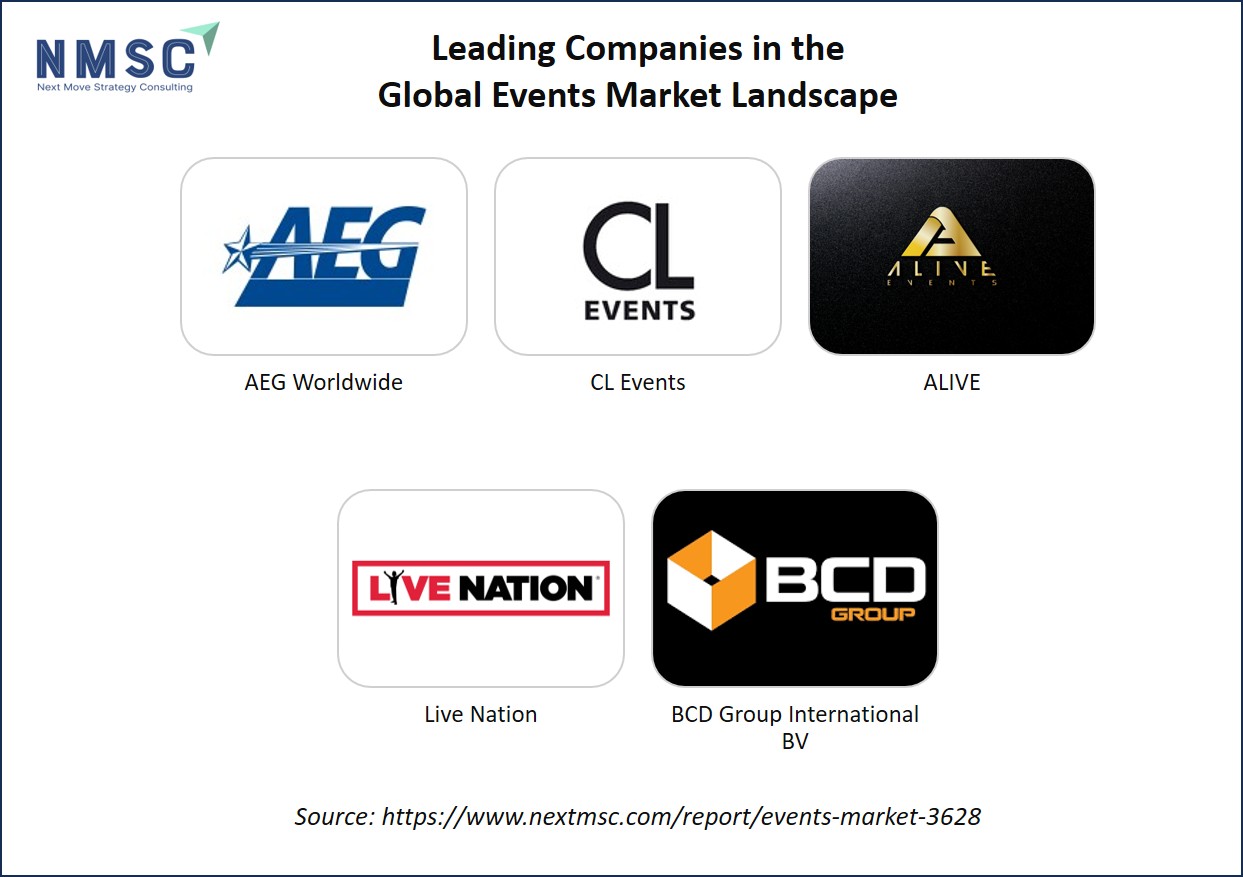
The global events market is characterized by a moderately concentrated structure, dominated by a mix of multinational leaders alongside numerous regional and local firms. Notable players in the sector include:
-
CL Events
-
Cvent Holding Corp
-
Access Destination Services
-
BCD Group International BV
-
DRPG Group
-
ATPI Ltd.
-
Entertaining Asia
-
Reed Exhibitions
-
Questex LLC
-
The Freeman Company
-
Penguins Limited
-
Versatile Event Management
-
ALIVE
Why is Experiential Marketing Thriving in the Events Space?
Shifting gears, experiential marketing—where brands create immersive, memorable interactions—has become a cornerstone of the events market. Companies like The Walt Disney Company exemplify this, leveraging events to build lasting loyalty. Disney's approach integrates storytelling across physical and digital touchpoints, turning one-off gatherings into cultural phenomena.
Disney's theme parks, such as Disneyland Paris and Shanghai Disney Resort, function as experiential hubs with attractions like Star Wars: Galaxy’s Edge, designed as a deeply immersive physical experience augmented by interactive digital elements. These spaces frequently host seasonal overlays and festive programming, which blend entertainment with merchandise-driven engagement. Beyond parks, Disney on Ice tours promote family bonding through live performances, while the annual D23 Expo unveils projects and behind-the-scenes access, drawing superfans globally.
In analytical terms, Disney employs full-spectrum strategies: cross-promotions link film launches to park events, nostalgia revivals target multi-generational attendees, and partnerships with subsidiaries like Marvel create exclusive crossover experiences. Community initiatives, such as Hispanic Heritage Month campaigns, infuse cultural relevance, fostering inclusivity. This model achieves high engagement, with parks serving as "living advertisements" that convert visitors into advocates.
For the events market, Disney's playbook underscores value creation. Amid economic signals, organizers can adopt similar tactics—think themed corporate retreats mirroring Galaxy’s Edge—to differentiate offerings.
Core elements of Disney's event strategies:
-
Immersive attractions with AR/VR for higher dwell times.
-
Seasonal tie-ins that boost attendance by aligning with cultural moments.
-
Fan conventions like D23 for direct feedback loops.
Ultimately, experiential marketing elevates events from transactions to transformations, a trend gaining momentum in 2025.
What Strategies Can Event Organizers Adopt from Disney?
Drawing from Disney's 2025 blueprint, event professionals can infuse creativity into their portfolios. Start with immersion: Incorporate interactive elements like character meet-and-greets or VR zones to mirror Disney's parks, enhancing attendee retention. Next, layer in seasonality—host pop-up events tied to holidays, much like Disney's festive overlays, to capitalize on peak demand.
Community focus matters too. Sponsor local festivals or cultural showcases, akin to Disney's heritage campaigns, to build goodwill and diverse audiences. For scalability, integrate cross-promotions: Partner with brands for co-branded sessions, echoing Disney's Marvel-Pixar synergies.
In practice, tools like Disney's Genie+ app for seamless navigation inspire event tech integrations, reducing friction and upping satisfaction scores.
Proven adaptations for your events:
-
Nostalgia hooks: Revive themes for anniversaries to attract more repeated visitors.
-
Hybrid formats: Blend live and virtual for global access, inspired by D23's digital previews.
-
Merchandise synergy: Offer branded keepsakes to extend event ROI post-attendance.
Next Steps: Actionable Takeaways for Events Pros
As we wrap up, the events market in late 2025 hinges on proactive adaptation. At Next Move Strategy Consulting, we recommend these steps to harness central bank insights and experiential prowess:
-
Monitor policy announcements: Tune into RBI and Fed outcomes on December 5 and 10—adjust budgets if rates ease, targeting a sponsorship uplift.
-
Diversify revenue streams: Adopt Disney-style merch and add-ons to buffer inflation risks from WPI trends.
-
Leverage data for immersion: Use PMI signals to theme events around services growth, incorporating AR for engagement boosts.
-
Build community ties: Launch cultural pop-ups quarterly, fostering loyalty within a relatively stable GST revenue environment.
- Scenario plan hybrids: Prepare for Fed ripple effects on travel with flexible formats, ensuring attendance resilience.
About the Author
 Sanyukta Deb
— Sanyukta Deb is Digital Marketing Team Lead at Next Move Strategy Consulting, where she has led content strategy and technical SEO for the firm's B2B market research publications for over 2 years. Her editorial process translates NextMSC's primary and secondary research — spanning technology, industrial, and consumer sectors — into commercial narratives, backed by search-intent, keyword, and competitive analysis. She brings 5 years of overall experience in digital marketing and content strategy.
Sanyukta Deb
— Sanyukta Deb is Digital Marketing Team Lead at Next Move Strategy Consulting, where she has led content strategy and technical SEO for the firm's B2B market research publications for over 2 years. Her editorial process translates NextMSC's primary and secondary research — spanning technology, industrial, and consumer sectors — into commercial narratives, backed by search-intent, keyword, and competitive analysis. She brings 5 years of overall experience in digital marketing and content strategy.
About the Reviewer
 Debashree Dey
— Debashree Dey is Assistant Manager at Next Move Strategy Consulting, where she supports cross-vertical market content and communications across diverse industries for 6 years. Her professional background includes senior content writing, communications, and published manuscript authorship, with experience developing audience-focused business narratives and maintaining clear, consistent messaging. Her role supports research-led content development and editorial quality across NextMSC publications.
Debashree Dey
— Debashree Dey is Assistant Manager at Next Move Strategy Consulting, where she supports cross-vertical market content and communications across diverse industries for 6 years. Her professional background includes senior content writing, communications, and published manuscript authorship, with experience developing audience-focused business narratives and maintaining clear, consistent messaging. Her role supports research-led content development and editorial quality across NextMSC publications.

















Add Comment