How Is Digital Banking Software Transforming Banking Operations in 2026?

Digital Banking Software Market is rapidly evolving from a customer convenience tool into the operational backbone of modern financial institutions. In 2026, banks are no longer focusing only on mobile apps or digital onboarding experiences.
The priority has shifted toward building connected banking ecosystems where artificial intelligence (AI), customer engagement, payments, operations, and risk systems work together seamlessly.
Recent developments from Backbase and Starling Bank show how financial institutions are increasingly investing in AI-native platforms and scalable banking software partnerships to modernize legacy infrastructure. This transformation is becoming strategically important for institutional investors, procurement leaders, and banking executives seeking operational resilience and long-term growth.
Major Trends Shaping Digital Banking Software in 2026
How Are AI-Native Banking Platforms Redefining Operations?
According to Business Wire, Backbase was named a Leader in The Forrester Wave™: Digital Banking Engagement Platforms, Q2 2026, based on evaluations covering platform strategy, customer feedback, and current capabilities.
The report highlighted Backbase’s AI-native Banking OS for its “agentic AI capabilities” and its ability to create a unified execution layer across banking systems. The company recently introduced Semantic Layer, Nexus, was identified as a competitive differentiator because it enables shared operational intelligence across fragmented workflows.
This shift reflects a broader industry challenge. Backbase stated that approximately 80% of frontline banking work occurs between disconnected systems. These operational gaps create inefficiencies for employees, customers, and AI tools attempting to coordinate processes.
Instead of replacing existing banking infrastructure, modern banking operating systems are increasingly designed to sit above core systems and connect payments, cards, customer relationship management (CRM), risk operations, and digital engagement channels into a single environment.
Core Components of a Digital Banking System Architecture
This image illustrates the foundational architecture of a digital banking system and highlights how different technological layers work together to support modern banking operations. At the center is the core banking system, labeled “PROFITS,” which acts as the central processing engine managing banking transactions, customer accounts, and financial operations.
Surrounding the core system are five major components that enable seamless banking functionality. The front-end interface represents customer-facing applications such as mobile banking apps, web portals, and digital dashboards that allow users to access banking services. The middleware layer acts as the communication bridge between applications and backend systems, ensuring smooth data exchange and operational coordination.
The backend systems manage transaction processing, databases, and operational logic required for daily banking activities. The integration framework enables the banking platform to connect with third-party applications, fintech services, and external systems through APIs and digital integration tools. Meanwhile, the security infrastructure ensures data protection, compliance, authentication, and secure transaction management across the entire ecosystem.

How Does Digital Banking Software Connect Modern Banking Operations?
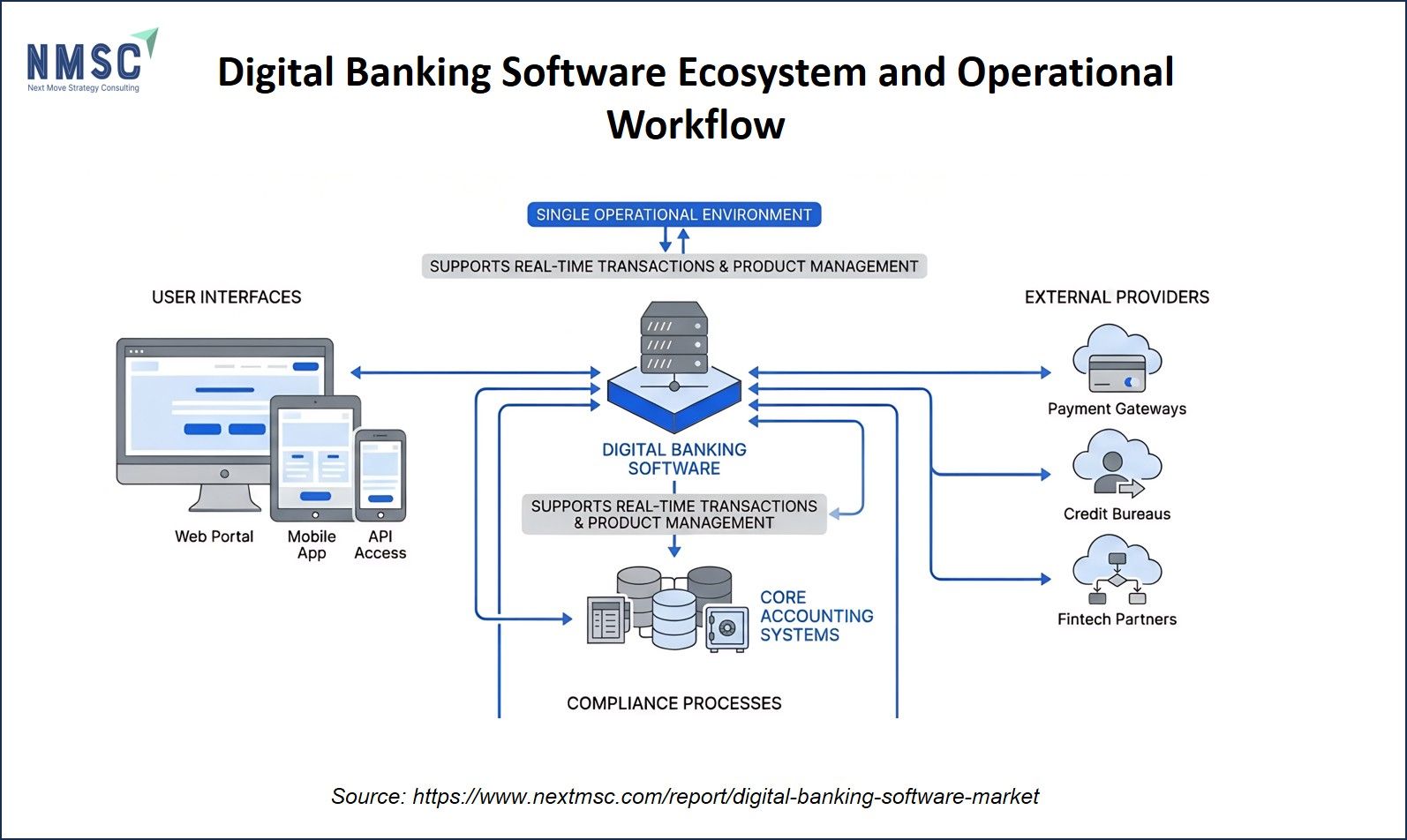
This image illustrates the operational architecture of digital banking software and how it acts as a centralized platform connecting customer interfaces, core banking systems, compliance functions, and external financial service providers.
At the center of the diagram is the digital banking software platform, which serves as the primary operational layer supporting real-time transactions and product management. The platform connects directly with customer-facing channels such as web portals, mobile applications, and API access systems, enabling users to perform banking activities seamlessly across multiple digital touchpoints.
The diagram also highlights how the software integrates with core accounting systems and compliance processes. This integration ensures secure transaction processing, financial record management, and regulatory oversight within a single operational environment. By centralizing these functions, banks can reduce operational fragmentation and improve workflow efficiency.
On the external side, the platform connects with payment gateways, credit bureaus, and fintech partners. These integrations enable services such as payment processing, credit assessments, and third-party financial solutions, which are increasingly important in modern banking ecosystems.
Why Is API-First Infrastructure Becoming Essential?
API-first architecture is becoming a core requirement for banks seeking modernization without full infrastructure replacement. Open integration frameworks allow financial institutions to connect older systems with newer AI-driven platforms while maintaining operational continuity.
This flexibility is especially valuable for banks managing large-scale digital transformation initiatives. However, open architecture also introduces implementation complexity, particularly for organizations with outdated operational structures or limited integration expertise.
How Is Global Expansion Influencing Banking Software Strategies?
The expansion of banking software licensing models is becoming another defining industry trend. Reuters, through Global Banking & Finance Review, reported in February 2026 that Starling Group signed a 10-year agreement with New Zealand’s SBS Bank to deploy its Engine banking platform.
The partnership marked Starling’s fourth international software deployment after similar agreements involving institutions in Canada, Romania, and Australia. This reflects a broader industry strategy in which digital banks are monetizing proprietary technology platforms through long-term licensing agreements.
For software providers, international expansion creates diversified revenue streams beyond traditional retail banking. For financial institutions, these partnerships offer access to proven banking infrastructure capable of accelerating modernization efforts.
The Asia-Pacific region is also emerging as an increasingly important market for banking technology adoption. As competition intensifies in domestic banking markets, software-driven expansion strategies are becoming more attractive for fintech firms and digital banks.

Leading Companies Operating in the Digital Banking Software Industry
The digital banking software industry includes several major technology and financial software providers such as Oracle Corporation, SAP SE, Tata Consultancy Services Limited, Capital Banking Solutions, EdgeVerve Systems Limited, Finastra International Limited, Fidelity National Information Services Inc., Fiserv Inc., Mambu GmbH, Temenos AG, Alkami Technology Inc., Crealogix AG, Sopra Banking Software, Revolut, and Q2 Software Inc., among others.

Industry Impact Analysis
Digital banking software is reshaping operational models across the financial services industry. Banks are increasingly treating software infrastructure as a strategic business asset rather than a supporting technology layer.
AI-enabled banking systems are improving workflow coordination and customer engagement consistency, while API-first infrastructure allows institutions to modernize gradually without replacing existing systems entirely. At the same time, software licensing models are creating new revenue opportunities for fintech providers seeking international growth.
However, modernization efforts also introduce operational challenges. Financial institutions must manage integration complexity, governance requirements, and interoperability risks while ensuring long-term scalability.
Future Outlook
The future direction of digital banking software is centered on unified operational ecosystems capable of supporting AI-driven banking environments. Financial institutions are increasingly prioritizing platforms that can integrate fragmented workflows, improve scalability, and support intelligent automation without requiring complete infrastructure replacement.
The competitive landscape is also likely to intensify as banking software vendors expand internationally through licensing agreements and long-term technology partnerships. Flexibility, interoperability, and operational resilience are expected to become major decision-making criteria for banks evaluating technology investments.
Next Steps
Financial institutions evaluating digital banking software strategies should focus on assessing operational fragmentation, integration readiness, and long-term scalability requirements. Organizations investing in flexible, AI-enabled platforms may be better positioned to manage modernization demands while improving operational efficiency.
Banking leaders should also evaluate vendor partnership models carefully, particularly as long-term software licensing agreements become more common across global markets.
-
Review long-term software partnership opportunities carefully
-
Strengthen governance frameworks for AI and data management
-
Align digital banking investments with customer experience goals
-
Monitor global banking software expansion and licensing trends
-
Develop modernization strategies without disrupting core operations
Conclusion
Digital banking software is becoming one of the most important strategic infrastructure investments in the financial services industry. Developments involving Backbase and Starling demonstrate how AI-native platforms, API-first architecture, and global software partnerships are reshaping operational priorities in 2026.
For institutional investors, procurement leaders, and banking executives, the focus is no longer limited to digital transformation alone. The greater challenge now lies in building connected banking ecosystems capable of supporting scalable operations, intelligent automation, and long-term competitive resilience.
About the Author
 Sanyukta Deb
— Sanyukta Deb is Digital Marketing Team Lead at Next Move Strategy Consulting, where she has led content strategy and technical SEO for the firm's B2B market research publications for over 2 years. Her editorial process translates NextMSC's primary and secondary research — spanning technology, industrial, and consumer sectors — into commercial narratives, backed by search-intent, keyword, and competitive analysis. She brings 5 years of overall experience in digital marketing and content strategy.
Sanyukta Deb
— Sanyukta Deb is Digital Marketing Team Lead at Next Move Strategy Consulting, where she has led content strategy and technical SEO for the firm's B2B market research publications for over 2 years. Her editorial process translates NextMSC's primary and secondary research — spanning technology, industrial, and consumer sectors — into commercial narratives, backed by search-intent, keyword, and competitive analysis. She brings 5 years of overall experience in digital marketing and content strategy.
About the Reviewer
 Debashree Dey
— Debashree Dey is Assistant Manager at Next Move Strategy Consulting, where she supports cross-vertical market content and communications across diverse industries for 6 years. Her professional background includes senior content writing, communications, and published manuscript authorship, with experience developing audience-focused business narratives and maintaining clear, consistent messaging. Her role supports research-led content development and editorial quality across NextMSC publications.
Debashree Dey
— Debashree Dey is Assistant Manager at Next Move Strategy Consulting, where she supports cross-vertical market content and communications across diverse industries for 6 years. Her professional background includes senior content writing, communications, and published manuscript authorship, with experience developing audience-focused business narratives and maintaining clear, consistent messaging. Her role supports research-led content development and editorial quality across NextMSC publications.


















Add Comment