Agile Project Management Market Size, Share, Growth & Forecast by Offering (Software: Work Management, Agile Portfolio & Program Management, Agile DevOps & ALM, Product Road Mapping, Vertical PM, Open Source; Services: Implementation, Training, Managed Services, Support), Deployment (Cloud, On-Premises), Licensing Model, Buyer Size (SMB, Mid-Market, Enterprise), Sales Channel, and End-User Industry — Global Analysis 2025–2035
Industry: ICT & Media | Publishing Date: July 6, 2026 | Last Updated: September 30, 2026 | No of Pages: N/A | No. of Tables: N/A | No. of Figures: N/A | Format: PDF | Report Code: IC4956
What Is the Agile Project Management Market Size?
The global Agile Project Management Market was valued at USD 8.5 billion in 2025 and is projected to reach USD 9.4 billion in 2026. Accelerating enterprise digital transformation, widespread adoption of hybrid work models, and the integration of artificial intelligence into project workflows are expected to propel the market to USD 25.6 billion by 2035, at a CAGR of 11.8% from 2026 to 2035. Key growth drivers include rapid cloud deployment of agile software platforms, the scaling of DevOps practices across enterprise IT operations, rising demand for enterprise agile planning tools, and growing investments in agile coaching and organizational transformation services.
|
Parameters |
Details |
|
Market Size in 2025 |
USD 8.5 Billion |
|
Market Size in 2026 |
USD 9.4 Billion |
|
Revenue Forecast in 2035 |
USD 25.6 Billion |
|
Growth Rate |
CAGR of 11.8% from 2026 to 2035 |
|
Analysis Period |
2025–2035 |
|
Base Year Considered |
2025 |
|
Forecast Period |
2026–2035 |
|
Market Size Estimation |
Billion USD |
|
Companies Profiled |
20 |
|
Countries Covered |
33 |
|
Market Share |
Top 10 |
Agile Project Management Market Overview
What Is the Agile Project Management Market?
The Agile Project Management Market encompasses software platforms, professional services, and managed solutions that enable organizations to plan, execute, and deliver projects using iterative, collaborative, and value-driven methodologies. These offerings include sprint planning tools, Kanban and Scrum boards, enterprise agile portfolio management platforms, DevOps lifecycle management solutions, and supporting services such as agile coaching, implementation, and continuous improvement. The Agile Project Management Market serves organizations across all sizes and industries seeking greater delivery speed, adaptability to change, and improved stakeholder alignment.
How Has the Agile Project Management Market Evolved?
The Agile Project Management Market has evolved through distinct phases of adoption. The initial phase focused on team-level agile practices, primarily using lightweight task boards and sprint tracking tools. The second phase expanded into scaled agile frameworks such as SAFe, LeSS, and Disciplined Agile, as enterprises sought to coordinate agile delivery across departments. Our analysis indicates the current phase is defined by AI-powered planning, intelligent workload balancing, and the convergence of agile methodologies with DevOps and enterprise portfolio management, creating comprehensive digital delivery platforms serving organizations from startup to global enterprise scale.
How Do Regulations Influence the Agile Project Management Market?
Regulatory developments are increasingly shaping procurement and adoption patterns within the Agile Project Management Market. In regulated industries including financial services, healthcare, and government, agile frameworks must align with compliance requirements such as DORA, HIPAA, SOC 2, and FedRAMP. The EU's Digital Operational Resilience Act (DORA) has elevated demand for agile governance and compliance tracking capabilities. Public sector agile adoption in the U.S. federal government, mandated under the Technology Modernization Fund and the Federal IT Acquisition Reform Act, is driving additional demand for FedRAMP-authorized agile project management platforms.
How Is Technology Adoption Expanding Across the Agile Project Management Market?
Technology adoption in the Agile Project Management Market is accelerating through AI integration, no-code configuration, and enterprise-grade cloud delivery. Subscription-based SaaS pricing models and cloud-native deployment have dramatically reduced barriers to adoption for small and medium-sized businesses. NMSC's analysis indicates that large enterprises are simultaneously investing in enterprise agile planning platforms that connect individual team delivery to organizational strategy and value stream outcomes. The integration of generative AI for automated backlog refinement, sprint retrospective analysis, and predictive delivery forecasting is reshaping platform differentiation across the competitive landscape.
|
Key Takeaways |
|
By offering, Software dominated the Agile Project Management Market, generating USD 6.4 billion in 2025 and forecast to reach USD 21.8 billion by 2035 at a CAGR of 12.8%, driven by the rapid expansion of cloud-based agile platforms across enterprise and mid-market segments globally. |
|
Work Management is the leading software sub-category with the largest installed base, while Agile DevOps and ALM represents the fastest-growing sub-segment at a CAGR of 14.2% from 2026 to 2035, fueled by enterprise DevOps adoption and continuous delivery pipeline integration requirements. |
|
Services generated USD 2.1 billion in 2025, accounting for approximately 25% of the global Agile Project Management Market revenue. Implementation and Migration services represent the largest services sub-segment, while Training and Advisory is growing fastest at a CAGR of 7.4%. |
|
Managed Services is also expanding rapidly as organizations increasingly outsource agile PMO functions and seek continuous improvement support to scale enterprise agile transformation programs across geographies. |
|
By deployment, Cloud dominated the Agile Project Management Market with USD 6.2 billion in 2025, representing over 72% of total market revenue, supported by SaaS agile platforms achieving rapid enterprise adoption through self-serve and marketplace channels. |
|
On-Premises deployment is the slower-growing segment at a CAGR of 7.6% but remains significant in regulated industries and large enterprises with strict data sovereignty, security, and integration requirements that limit full cloud migration. |
|
By licensing model, Subscription accounted for USD 5.8 billion in 2025, representing 68% of total Agile Project Management Market revenue, reflecting the dominant SaaS delivery model across agile platform vendors targeting recurring revenue economics. |
|
Perpetual License revenue at USD 2.7 billion in 2025 reflects on-premises enterprise deployments and legacy contract structures; this segment is expected to decline in share but sustain modest absolute growth through large enterprise maintenance renewals. |
|
By buyer size, Enterprise (5,000+ employees) is the largest segment at USD 3.8 billion in 2025, reflecting substantial investments in scaled agile platforms, enterprise portfolio management, and agile transformation programs spanning multiple business units. |
|
SMBs (1–999 employees) represent the fastest-growing buyer segment in the Agile Project Management Market at a CAGR of 11.8%, driven by accessible SaaS pricing, self-serve onboarding, and the proliferation of team-level agile tools targeting non-technical project teams. |
|
By sales channel, Direct Sales dominated at USD 2.8 billion in 2025 for complex enterprise deals, while Marketplace and Self-Serve combined represent the fastest-growing channels at a CAGR of approximately 13% as product-led growth strategies gain traction. |
|
By end-user industry, Technology and Software was the largest vertical at USD 2.1 billion in 2025, reflecting native agile adoption within software development organizations as the Agile Project Management Market's earliest and most established buyer segment. |
|
North America dominated the Agile Project Management Market at USD 3.4 billion in 2025 and is forecast to reach USD 9.8 billion by 2035 at a CAGR of 11.2%, supported by the highest concentration of agile software vendors and enterprise technology buyers globally. |
|
Asia-Pacific is the fastest-growing region in the Agile Project Management Market at a CAGR of 13.5% from 2026 to 2035, driven by accelerating digital transformation in India, expansion of technology sectors in Southeast Asia, and enterprise agile adoption in Japan and South Korea. |
|
The United States is the single largest country market, accounting for approximately 80% of North American Agile Project Management Market revenue in 2025, underpinned by the world's largest enterprise software buyer base and the highest concentration of agile methodology practitioners. |
|
India is the fastest-growing national market within Asia-Pacific at a CAGR of 16.8%, propelled by the country's large and rapidly expanding IT services sector, government Digital India initiatives, and increasing adoption of agile delivery frameworks across domestic enterprises and global capability centers. |
Key Emerging Trends in the Agile Project Management Market
How Is Artificial Intelligence Transforming Agile Project Management Platform Capabilities?
Artificial intelligence is fundamentally reshaping the Agile Project Management Market by embedding predictive and generative capabilities directly within agile workflows. Atlassian's Rovo AI integrates AI-powered work summarization, automated task triage, and sprint health diagnostics into Jira, reducing manual backlog management overhead significantly. Microsoft Copilot in Azure DevOps enables natural language sprint planning and automated test case generation. Our assessment indicates that AI-native capabilities are rapidly transitioning from competitive differentiators to baseline feature expectations across enterprise buyer evaluations, compelling every major agile platform vendor to accelerate generative AI integration across their product roadmaps.
How Is Value Stream Management Reshaping Enterprise Agile Project Management Adoption?
Value stream management is emerging as a critical enterprise capability within the Agile Project Management Market, enabling organizations to measure and optimize the flow of value from product ideation to customer delivery. Tools such as Planview's Viz and Digital.ai Value Stream Management Platform provide end-to-end visibility across agile delivery pipelines. NMSC's analysis indicates that Scaled Agile Framework (SAFe) adoption across Fortune 1000 enterprises is accelerating demand for value stream mapping tools that connect engineering delivery metrics to business outcomes, creating a distinct and fast-growing market sub-segment within enterprise agile planning platforms.
How Is the Open-Source Agile Tooling Ecosystem Influencing the Agile Project Management Market?
Open-source agile project management platforms such as OpenProject, GitLab, and community editions of enterprise tools are gaining enterprise relevance as organizations seek vendor flexibility, data sovereignty, and cost optimization. The rise of self-managed enterprise editions allows organizations to start with open-source tooling and upgrade to commercially supported tiers as requirements scale. Our research indicates that the Open Source Self-Managed segment is growing at approximately 13.8% CAGR in the Agile Project Management Market, with European enterprises and government organizations showing the strongest adoption due to data localization requirements and open standards preferences.
How Is Agile Adoption Expanding Beyond Technology Into Non-Technology Industries?
Agile methodologies are rapidly expanding beyond software development into construction, manufacturing, professional services, healthcare administration, and financial services sectors within the Agile Project Management Market. Construction project management tools incorporating agile sprint cycles and Kanban boards for subcontractor coordination are gaining traction globally. Our market assessment found that healthcare organizations are adopting agile frameworks for clinical operations improvement and digital health product development. Vertical-specific agile project management solutions are emerging as a distinct growth opportunity, with specialized platforms addressing industry-specific compliance, workflow, and reporting requirements beyond general-purpose agile tools.
SWOT Analysis of the Agile Project Management Market
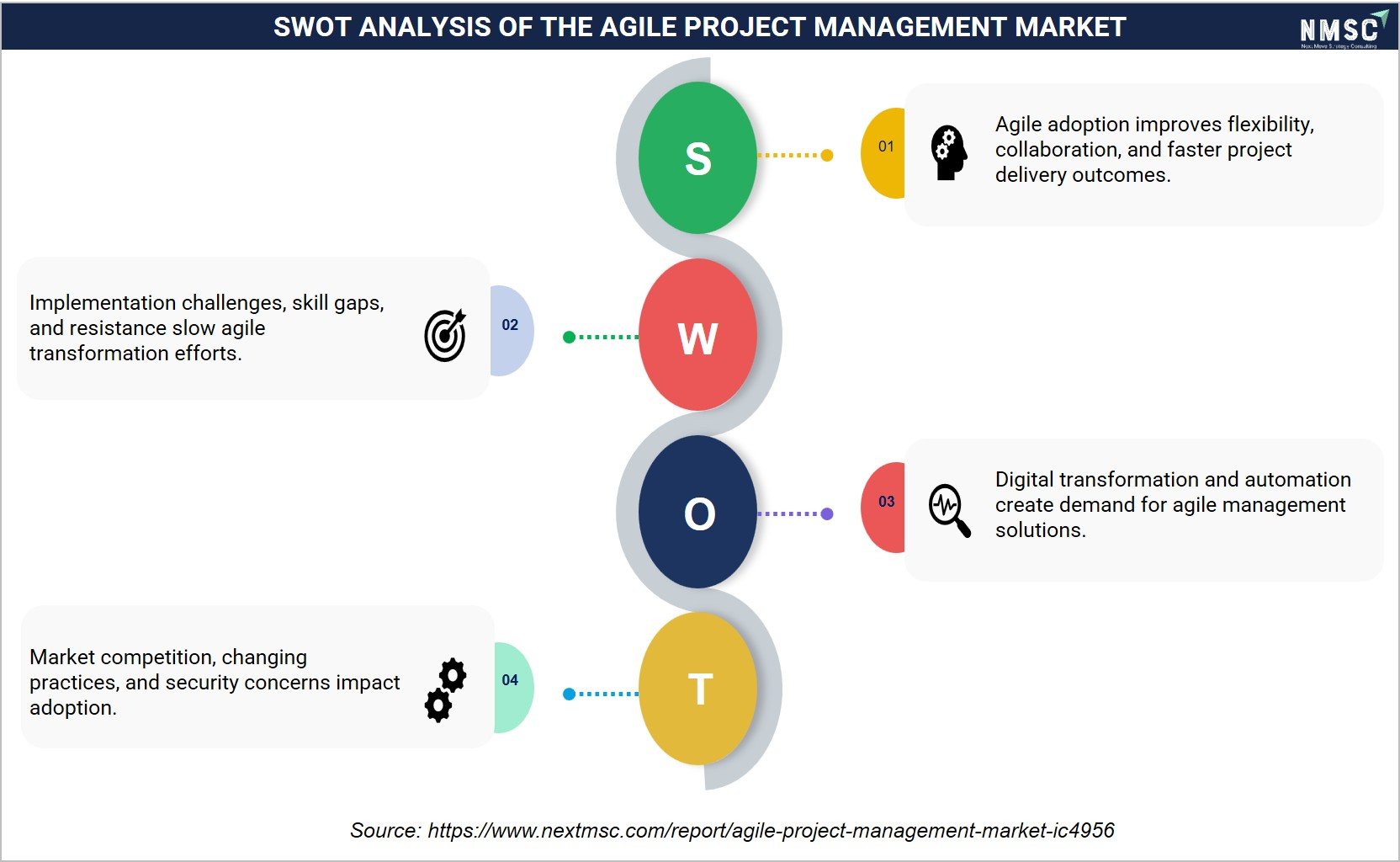
Our assessment indicates that the Agile Project Management Market benefits from widespread adoption of agile methodologies that improve flexibility, collaboration, and project delivery efficiency. Digital transformation and automation continue to create new growth opportunities across industries. However, implementation challenges, workforce skill gaps, and organizational resistance can limit adoption. Additionally, intensifying market competition, evolving project management practices, and increasing cybersecurity and data privacy concerns remain key challenges for market participants.
What Are the Key Market Drivers, Breakthroughs, and Investment Opportunities That Will Shape the Agile Project Management Market in the Next Decade?
|
Drivers / Trends / Restraints |
(+/-) % Impact on CAGR Forecast |
Geographic Relevance |
Impact Timeline |
|
Enterprise Digital Transformation Acceleration |
+2.4% |
Global (led by North America, APAC) |
2025–2030 |
|
AI-Powered Agile Platform Adoption |
+2.1% |
North America, Europe, APAC |
2025–2035 |
|
DevOps and Continuous Delivery Integration |
+1.8% |
North America, Europe, India |
2025–2030 |
|
Scaled Agile Framework Enterprise Rollouts |
+1.5% |
Global (Enterprise segment) |
2026–2035 |
|
Vertical-Specific Agile Platform Demand |
+1.2% |
North America, Europe, Australia |
2026–2035 |
|
Cloud Marketplace Distribution Expansion |
+1.0% |
North America, Europe |
2025–2032 |
|
High Total Cost of Enterprise Agile Transformation |
-1.0% |
SMB, Mid-Market globally |
2025–2028 |
|
Tool Sprawl and Integration Complexity |
-0.8% |
All regions, Enterprise |
Ongoing |
|
Skills Gap in Agile Methodology |
-0.6% |
Emerging Markets, SMB |
Ongoing |
|
Open-Source Platform Competitive Pressure |
-0.5% |
Europe, Asia-Pacific |
2025–2032 |
What Are the Growth Drivers of the Agile Project Management Market?
How Is Enterprise Digital Transformation Driving Demand for Agile Project Management Solutions?
Enterprise digital transformation programs represent the primary structural driver of the Agile Project Management Market. Organizations globally are migrating legacy project management practices to agile delivery frameworks to improve responsiveness, reduce time-to-market, and align technology delivery with business strategy. The U.S. federal government's commitment to agile software development, codified under the Office of Management and Budget's digital strategy guidance, has expanded public sector demand for FedRAMP-authorized agile platforms. From our research, we found that organizations adopting scaled agile practices report delivery cycle reductions of 20–40% compared to traditional waterfall methods, compelling continued enterprise investment in agile transformation infrastructure.
How Is DevOps Integration Accelerating the Agile Project Management Market?
The convergence of agile project management with DevOps practices and application lifecycle management is a major demand catalyst in the Agile Project Management Market. Organizations implementing end-to-end DevOps pipelines require integrated agile ALM platforms that connect sprint planning, code development, testing, deployment, and release coordination within a unified workflow. NMSC's analysis indicates that GitLab's unified DevSecOps platform and Atlassian's Jira integration with Bitbucket and Confluence demonstrate growing enterprise preference for tightly integrated agile-DevOps toolchains that reduce context-switching and improve development team velocity.
How Is the Global Expansion of Remote and Hybrid Work Driving Agile Project Management Adoption?
The structural shift to remote and distributed team environments has significantly elevated demand for cloud-based agile project management platforms. Organizations managing distributed engineering, product, and business teams require real-time visibility, asynchronous collaboration tools, and automated workflow coordination inherent in modern agile platforms. The U.S. Bureau of Labor Statistics reported that hybrid and remote work arrangements remained prevalent in knowledge-worker occupations through 2024–2025, sustaining enterprise investment in digital collaboration and project coordination tools. Based on our market evaluation, we noticed that cloud-native agile platforms with integrated video, documentation, and task management capabilities are capturing outsized share among hybrid-first enterprises across North America and Europe.
What Are the Growth Inhibitors of the Agile Project Management Market?
How Does Tool Sprawl and Integration Complexity Constrain the Agile Project Management Market?
Tool proliferation and integration fragmentation represent significant operational barriers within the Agile Project Management Market. Large enterprises frequently maintain multiple overlapping agile project management, DevOps, and collaboration platforms across departments, creating data silos, reporting inconsistencies, and workflow inefficiencies. The U.S. Government Accountability Office has documented analogous fragmentation challenges in federal IT project management, noting that inconsistent tooling across agencies impairs portfolio visibility and delivery performance. Through NMSC's assessment, we found that platform consolidation pressure is intensifying as Chief Information Officers prioritize integrated enterprise agile suites over best-of-breed point solutions, creating procurement complexity for vendors operating in narrower functional categories.
How Does the Agile Skills Gap Limit the Agile Project Management Market's Growth Potential?
A persistent shortage of certified agile practitioners and qualified scrum masters limits the pace of agile adoption and software utilization in the Agile Project Management Market, particularly in emerging economies and non-technology industry verticals. The Scrum Alliance reports that while agile certification adoption has grown globally, meaningful organizational agile maturity across non-IT departments remains limited. In our observation, organizations frequently invest in agile platform licenses but underutilize advanced capabilities due to insufficient practitioner training and change management investment, reducing platform ROI realization and increasing churn rates among small and mid-market buyers.
What Are the Growth Opportunities in the Agile Project Management Market?
How Does the Emergence of AI-Powered Agile Coaching Create New Revenue Opportunities in the Agile Project Management Market?
Generative AI is creating an entirely new service and platform capability layer within the Agile Project Management Market through AI-powered agile coaching, automated retrospective analysis, and intelligent team health diagnostics. Organizations seeking to scale agile coaching without proportionally expanding human coaching capacity represent a high-value, underserved addressable market. The National Institute of Standards and Technology (NIST) AI Risk Management Framework elevates the importance of governed AI deployment in enterprise software, creating a favorable environment for trusted AI-embedded agile platforms. Our findings suggest that agile platform vendors embedding validated AI coaching assistants within enterprise tiers will command premium pricing and superior net revenue retention.
How Does Public Sector Agile Transformation Present a Structural Growth Opportunity for the Agile Project Management Market?
Government modernization initiatives in the United States, European Union, Australia, and India represent a multi-billion dollar structural opportunity for the Agile Project Management Market. The U.S. Office of Management and Budget's requirement for agile software development practices across federal agencies has created mandatory procurement pathways for FedRAMP-authorized agile platforms. The UK Government Digital Service mandates agile delivery standards for digital transformation programs, creating recurring demand for certified agile tools and services. Based on NMSC's research, we found that public sector organizations represent a relatively untapped buyer segment with long contract tenures, high switching costs, and expanding multi-year platform investment budgets.
How Does the Expansion of Agile into Construction and Engineering Open New Vertical Markets for the Agile Project Management Market?
The application of agile methodologies to construction project management, engineering program delivery, and professional services represents a high-growth expansion opportunity beyond the Agile Project Management Market's traditional technology buyer base. Construction industry associations, including the Associated General Contractors of America, have begun documenting agile construction delivery frameworks that adapt sprint-based planning to physical project milestones and subcontractor coordination. Our assessment indicates that vertical-specific agile project management platforms addressing construction scheduling, BIM integration, and regulatory compliance reporting can access a large and underserved addressable market currently served by legacy project management software with limited agile methodology support.
How Is the Agile Project Management Market Segmented in This Report, and What Are the Key Insights from the Segmentation Analysis?
How Does the Software Segment Define the Commercial Foundation of the Agile Project Management Market?
|
Offering Segment |
2025 (USD Bn) |
2035 (USD Bn) |
CAGR (%) |
|
Software |
6.4 |
21.8 |
12.8% |
|
Services |
2.1 |
3.8 |
6.1% |
Based on our analysis of enterprise technology adoption trends, we observed that the Agile Project Management Market is segmented into Software and Services offerings, with Software commanding the dominant position at USD 6.4 billion in 2025. The Software segment encompasses Work Management, Agile Portfolio and Program Management, Agile DevOps and ALM, Product Road Mapping, Vertical Project Management, Open Source Self-Managed, and Other Software categories. Work Management tools including sprint planning, Kanban boards, backlog management, and collaboration platforms represent the largest software sub-segment by user count and installed base. Agile DevOps and ALM is the fastest-growing software sub-segment, driven by enterprise demand for integrated delivery pipeline visibility and continuous delivery planning capabilities within unified agile platforms.
How Does Deployment Mode Shape Revenue Distribution Across the Agile Project Management Market?
|
Deployment Segment |
2025 (USD Bn) |
2035 (USD Bn) |
CAGR (%) |
|
Cloud |
6.2 |
20.8 |
12.8% |
|
On-Premises |
2.3 |
4.8 |
7.6% |
On the basis of enterprise cloud adoption patterns and agile platform deployment strategies, we observed that the Agile Project Management Market is segmented into Cloud and On-Premises deployment modes. The Cloud segment dominates at USD 6.2 billion in 2025, driven by Public Cloud SaaS agile platforms that offer rapid deployment, elastic scalability, and seamless cross-team collaboration across distributed organizations. Private Cloud deployment within the Cloud segment is growing among regulated enterprises requiring enhanced data control. On-Premises deployment at USD 2.3 billion in 2025 remains relevant in financial services, government, and defense sectors with strict data sovereignty and network isolation requirements that preclude full public cloud migration of sensitive project and portfolio management data.
How Do Licensing Models Reflect the Commercial Evolution of the Agile Project Management Market?
|
Licensing Model Segment |
2025 (USD Bn) |
2035 (USD Bn) |
CAGR (%) |
|
Subscription |
5.8 |
18.6 |
12.4% |
|
Perpetual License |
2.7 |
7.0 |
10.0% |
In our analysis of enterprise software procurement trends, we assessed that the Agile Project Management Market is segmented into Subscription and Perpetual License models. Subscription licensing dominates at USD 5.8 billion in 2025, reflecting the SaaS delivery preference of cloud-native agile platforms. Within Subscription licensing, Per User pricing is the most prevalent model, while Enterprise Agreement structures are growing among large organizations seeking predictable total cost of ownership across unlimited user deployments. Usage-Based pricing is an emerging sub-model gaining traction in marketplace-distributed agile tools. Perpetual License at USD 2.7 billion in 2025 sustains demand from on-premises deployments, legacy enterprise contracts, and regulated-industry buyers with procurement constraints around recurring subscription commitments.
How Does Organization Size Influence Purchasing Patterns in the Agile Project Management Market?
|
Buyer Size Segment |
2025 (USD Bn) |
2035 (USD Bn) |
CAGR (%) |
|
SMB (1–999 Employees) |
1.9 |
5.8 |
11.8% |
|
Mid-Market (1,000–4,999 Employees) |
2.8 |
8.4 |
11.6% |
|
Enterprise (5,000+ Employees) |
3.8 |
11.4 |
11.6% |
We observed that the Agile Project Management Market is segmented into SMB (1–999 employees), Mid-Market (1,000–4,999 employees), and Enterprise (5,000+ employees) buyer categories. The Enterprise segment dominates at USD 3.8 billion in 2025, reflecting large-scale investments in enterprise agile planning platforms, scaled framework adoption, and agile transformation service programs. Mid-Market organizations at USD 2.8 billion are expanding their agile tooling investments as they pursue operational scalability and delivery standardization. SMBs at USD 1.9 billion represent the fastest-growing buyer segment, enabled by affordable per-user SaaS pricing, self-serve onboarding, and marketplace availability of comprehensive agile tools that previously required enterprise-level budgets to deploy effectively.
How Are Sales Channels Reshaping Go-to-Market Strategies in the Agile Project Management Market?
|
Sales Channel Segment |
2025 (USD Bn) |
2035 (USD Bn) |
CAGR (%) |
|
Self-Serve |
2.2 |
7.2 |
12.6% |
|
Direct Sales |
2.8 |
8.0 |
11.1% |
|
Partner-Led |
2.0 |
5.8 |
11.2% |
|
Marketplace |
1.0 |
3.4 |
12.9% |
|
OEM and Embedded |
0.5 |
1.2 |
9.1% |
Based on our market evaluation, we noticed that the Agile Project Management Market is served through Self-Serve, Direct Sales, Partner-Led, Marketplace, and OEM and Embedded channels. Direct Sales continues to dominate at USD 2.8 billion in 2025 for complex enterprise platform deployments requiring customized implementation support and strategic account management. Self-Serve at USD 2.2 billion reflects product-led growth strategies dominant among companies like monday.com and ClickUp, enabling rapid viral adoption within organizations. Marketplace distribution at USD 1.0 billion via AWS Marketplace, Microsoft Azure Marketplace, and Atlassian Marketplace is the fastest-growing channel at a CAGR of 12.9%, leveraging existing cloud procurement relationships and committed spend programs to streamline agile platform acquisition.
Which Industry Verticals Generate the Most Value in the Agile Project Management Market?
|
Industry Vertical |
2025 (USD Bn) |
2035 (USD Bn) |
CAGR (%) |
|
Technology and Software |
2.1 |
6.4 |
11.8% |
|
Financial Services |
1.1 |
3.4 |
11.9% |
|
Professional Services |
0.9 |
2.8 |
12.0% |
|
Manufacturing |
0.8 |
2.4 |
11.6% |
|
Construction and Engineering |
0.6 |
1.8 |
11.6% |
|
Healthcare and Life Sciences |
0.6 |
2.0 |
12.8% |
|
Retail and Consumer Goods |
0.5 |
1.6 |
12.3% |
|
Government and Public Sector |
0.5 |
1.4 |
10.8% |
|
Media and Advertising |
0.4 |
1.2 |
11.6% |
|
Education |
0.3 |
1.0 |
12.8% |
|
Energy and Utilities |
0.3 |
0.8 |
10.3% |
|
Transportation and Logistics |
0.2 |
0.6 |
11.6% |
|
Other Industries |
0.2 |
0.2 |
0.0% |
Our analysis of enterprise agile adoption across industries reveals that Technology and Software is the largest vertical in the Agile Project Management Market at USD 2.1 billion in 2025, reflecting native agile methodology adoption within software product companies and IT services organizations. Financial Services at USD 1.1 billion represents a large and rapidly growing segment driven by agile adoption in banking technology, insurance product development, and capital markets platform delivery. Healthcare and Life Sciences at USD 0.6 billion and Education at USD 0.3 billion are among the fastest-growing verticals at a CAGR of 12.8%, as both sectors accelerate digital product development and operational agility. Professional Services at USD 0.9 billion reflects strong consulting and legal services adoption of agile frameworks for client delivery management and internal operations optimization.
Regional Outlook
Geographic Performance Snapshot
|
Region |
2025 (USD Bn) |
2035 (USD Bn) |
CAGR (%) |
Key Driver |
|
North America |
3.4 |
9.8 |
11.2% |
Enterprise agile adoption, SAFe rollouts |
|
Europe |
2.2 |
6.6 |
11.6% |
GDPR compliance, agile in regulated industries |
|
Asia-Pacific |
1.8 |
6.4 |
13.5% |
India IT expansion, APAC digital transformation |
|
Middle East & Africa |
0.5 |
1.0 |
7.2% |
Vision 2030, government digitization programs |
|
Latin America |
0.6 |
1.8 |
11.6% |
Brazil digital economy, SMB agile adoption |
North America Agile Project Management Market
North America is the global leader in the Agile Project Management Market, accounting for USD 3.4 billion in 2025 and forecast to reach USD 9.8 billion by 2035 at a CAGR of 11.2%. The region benefits from the world's highest enterprise technology investment levels, headquarters of major agile platform vendors including Microsoft, Atlassian, ServiceNow, monday.com, and Smartsheet, and the deepest practitioner talent pool in agile, Scrum, and scaled agile frameworks. U.S. federal government digital transformation mandates and FedRAMP procurement pathways create durable public sector demand alongside the dominant commercial enterprise buyer base. Regulatory compliance needs in financial services and healthcare drive governance-focused agile platform investments.
U.S. Agile Project Management Market
Based on our engagements with enterprise software buyers across North America, the United States commands approximately 80% of North American Agile Project Management Market revenue, representing the world's single largest national market. The U.S. combines the highest concentration of technology enterprises, Fortune 500 digital transformation programs, and venture-backed software companies that natively adopt agile methodologies from inception. The federal government's Office of Management and Budget Digital Strategy, Technology Modernization Fund investments, and mandatory agile development requirements for new federal IT systems collectively sustain multi-year government sector demand. Market demand structure is driven by enterprise Direct Sales, Partner-Led implementation, and rapidly expanding Marketplace channels across cloud hyperscaler procurement platforms.
Canada Agile Project Management Market
Through our analysis, Canada represents approximately 12% of North American Agile Project Management Market revenue. Canadian financial institutions, telecom companies, and e-commerce organizations are sophisticated agile platform buyers investing in enterprise agile transformation programs and scaled delivery frameworks. The Government of Canada Digital Operations Strategic Plan and Treasury Board Secretariat cloud adoption policies are expanding public sector demand for cloud-based agile project management platforms. Canadian enterprises show strong adoption of Atlassian, ServiceNow, and Microsoft agile tooling within integrated DevOps and collaboration ecosystems. Data sovereignty requirements under Canadian privacy legislation influence deployment mode preferences, supporting growth in Canadian-region cloud deployments offered by major hyperscalers.
Mexico Agile Project Management Market
From our assessment, Mexico is the fastest-growing national market within North America in the Agile Project Management Market at a CAGR of 14.5%, driven by expanding technology and fintech sectors, nearshoring of software development operations, and growing adoption of agile delivery frameworks among domestic enterprises. The government's National Digital Strategy is accelerating public sector modernization investments. Mexico's growing developer community and rising enterprise IT maturity are supporting adoption of cloud-based agile platforms with Spanish-language localization and LATAM-specific pricing models. SMB and mid-market adoption of self-serve agile tools is growing rapidly as affordable per-user SaaS pricing lowers entry barriers for domestic technology and professional services companies.
Europe Agile Project Management Market
Europe is the second-largest region in the Agile Project Management Market, generating USD 2.2 billion in 2025 and forecast to reach USD 6.6 billion by 2035 at a CAGR of 11.6%. Europe's strong agile methodology adoption across financial services, telecommunications, and technology sectors underpins market maturity, while regulatory complexity from GDPR, EU AI Act, and DORA simultaneously creates demand for governance-enabled agile platforms and extends enterprise procurement cycles. The EU's Digital Decade policy framework, targeting widespread cloud adoption and digital skills development, is expanding the enterprise buyer base. Open-source agile platform adoption is higher in Europe relative to other regions, reflecting data sovereignty priorities and open standards preferences among European enterprises and government organizations.
UK Agile Project Management Market
Based on our engagements, the United Kingdom represents the largest individual national market in Europe for agile project management, accounting for approximately 22% of European regional revenue in 2025. The UK Government Digital Service has institutionalized agile delivery standards for public sector technology programs, creating sustained government demand. Post-Brexit regulatory alignment with UK GDPR sustains compliance requirements while enabling regulatory flexibility in some areas. London's financial services sector and thriving technology startup ecosystem collectively drive strong enterprise and SMB agile platform adoption. Strong presence of Atlassian, Microsoft, and ServiceNow partner networks supports enterprise platform deployment and ongoing agile coaching services across the UK market.
Germany Agile Project Management Market
Through our analysis, Germany is Europe's second-largest agile project management market, benefiting from the country's strong manufacturing, automotive, and industrial technology sectors that are actively transitioning to software-driven product development through agile methodologies. German enterprises exhibit high demand for SAFe and enterprise agile portfolio management platforms as they scale digital product programs. The German IT sector's preference for data residency within Germany is driving adoption of on-premises and private cloud agile deployments. Bitkom, Germany's digital industry association, has actively promoted agile methodology adoption across the German enterprise landscape, supporting market awareness and practitioner skill development.
France Agile Project Management Market
From our assessment, France demonstrates strong Agile Project Management Market adoption across its financial services, luxury goods technology, and public administration sectors. The French government's digital transformation agenda under the Agence Nationale de la Cohésion des Territoires and Dinum (Direction Interministérielle du Numérique) has introduced agile delivery requirements across government technology programs. French enterprises are among the early adopters of enterprise agile transformation programs combining SAFe framework implementation with digital product platforms, creating compound demand for both software and training advisory services across the Agile Project Management Market.
Italy Agile Project Management Market
According to evaluation, Italy's Agile Project Management Market is expanding at an accelerating pace, driven by digital transformation programs in banking, insurance, and manufacturing sectors. The Italian government's National Recovery and Resilience Plan (PNRR), allocating substantial funding to digital and cloud technology modernization, has increased public sector agile platform procurement. Italian mid-market enterprises are transitioning from traditional project management approaches to cloud-based agile tools, supported by a growing community of agile coaches and certified practitioners through Italian chapters of international agile organizations.
Spain Agile Project Management Market
Based on our engagements, Spain's Agile Project Management Market reflects growing adoption across its banking, telecom, and retail sectors as enterprises accelerate digital product development. Major Spanish financial institutions including BBVA and Santander have executed large-scale agile transformation programs that drive demand for enterprise agile planning and DevOps ALM platforms. The Spanish government's Spain Digital Agenda 2025 includes technology modernization investments creating public sector demand. Spain's vibrant startup and technology ecosystem in Barcelona and Madrid is supporting SMB and mid-market adoption of self-serve cloud agile tools.
Sweden Agile Project Management Market
Through our analysis, Sweden exhibits one of Europe's highest levels of agile methodology maturity, reflecting its strong technology innovation ecosystem and culture of iterative product development. Swedish enterprises and public sector organizations demonstrate sophisticated adoption of scaled agile frameworks and enterprise agile portfolio management capabilities. Sweden's high digital skills penetration and progressive public sector digitization support above-average per-capita Agile Project Management Market spending relative to comparable European markets. Open-source agile platform adoption is particularly strong among Swedish public sector organizations.
Denmark Agile Project Management Market
From our assessment, Denmark's Agile Project Management Market benefits from the country's advanced digitization leadership across public and private sectors. Denmark's government digital strategy and mandatory digital service delivery standards create institutional demand for agile project management capabilities across public sector technology programs. Danish enterprises in pharmaceuticals, logistics, and financial services are active agile adopters. The Agile Project Management Market in Denmark shows strong preference for cloud SaaS platforms with deep European data residency and GDPR compliance capabilities.
Finland Agile Project Management Market
According to evaluation, Finland's Agile Project Management Market reflects the country's strong technology heritage, including Nokia's influence on mobile software development and the resulting depth of agile methodology expertise in Finnish enterprise and public sector organizations. Finnish enterprises demonstrate high adoption of enterprise agile planning platforms among technology companies, public utilities, and banking institutions. Government digital transformation investments under Finland's public administration digitalization programs support continued market growth through the forecast period.
Netherlands Agile Project Management Market
Based on our engagements, the Netherlands is among Europe's more active Agile Project Management Market adopters, driven by its strong financial services, logistics technology, and agriculture technology sectors. Dutch enterprises demonstrate broad adoption of agile delivery frameworks across banking, insurance, and e-commerce organizations. The Netherlands Enterprise Agency (RVO) has promoted digital transformation and cloud adoption among Dutch SMBs, expanding the agile tools buyer base beyond large enterprises. Amsterdam's position as a European technology hub supports enterprise agile platform vendor operations and partner network presence.
Asia-Pacific Agile Project Management Market
Asia-Pacific is the fastest-growing region in the Agile Project Management Market, generating USD 1.8 billion in 2025 and forecast to reach USD 6.4 billion by 2035 at a CAGR of 13.5%. The region's growth is driven by India's expanding IT and global capability center sectors, Japan and South Korea's manufacturing and electronics industry digital transformation programs, and Southeast Asia's rapidly scaling technology startup ecosystems. NMSC's analysis indicates that cloud-first digital infrastructure investments across APAC, combined with government-led digital economy programs in India, Singapore, and Australia, are creating sustained demand for agile project management platforms across enterprise, mid-market, and SMB segments.
China Agile Project Management Market
Through our analysis, China represents the largest absolute market within Asia-Pacific for agile project management, generating approximately 30% of regional revenue in 2025. China's expansive technology sector, with major enterprise software buyers including Alibaba, Tencent, Baidu, Huawei, and thousands of mid-market technology companies, sustains strong demand for agile project management platforms. Domestic agile tool providers compete with international vendors across Chinese enterprise segments. China's emphasis on software-driven manufacturing and the Made in China 2025 industrial strategy are driving manufacturing sector agile adoption. Data localization requirements under China's Cybersecurity Law influence platform architecture choices, favoring locally-hosted agile deployments.
India Agile Project Management Market
Based on our engagements, India is the fastest-growing national market within Asia-Pacific in the Agile Project Management Market at a CAGR of 16.8%, driven by the country's world-leading IT and business process services sector, rapidly expanding startup ecosystem, and growing adoption of agile frameworks across domestic enterprises and global capability centers. India's IT industry body NASSCOM has promoted agile methodology adoption as a core delivery competency, elevating practitioner certification demand. The government's Digital India initiative and production-linked incentive schemes for technology manufacturing are creating additional demand for agile project management capabilities across both IT services and manufacturing sectors.
Japan Agile Project Management Market
From our assessment, Japan's Agile Project Management Market is expanding as Japanese enterprises accelerate digital transformation programs and transition away from traditional waterfall project management methodologies. Japan's DX (Digital Transformation) Promotion Guidelines from the Ministry of Economy, Trade and Industry have created institutional momentum for agile adoption across major industries. Japanese automotive manufacturers including Toyota, Honda, and Nissan are incorporating agile development practices into embedded software and connected vehicle platform programs, expanding agile project management demand beyond pure technology sectors. Enterprise agile training and advisory services show strong demand in Japan given the significant cultural transformation involved in agile adoption.
South Korea Agile Project Management Market
According to evaluation, South Korea's Agile Project Management Market benefits from the country's advanced digital infrastructure and technology-intensive economy. Korean conglomerates (chaebols) including Samsung, LG, SK, and Hyundai are investing in enterprise agile transformation programs within their software and electronics divisions. The South Korean government's Digital New Deal initiative has accelerated cloud adoption and digital skills development, expanding the addressable market for cloud-based agile platforms. Korea's strong developer community and growing SaaS adoption culture support self-serve and marketplace channel growth for agile project management tools.
Taiwan Agile Project Management Market
Based on our engagements, Taiwan's Agile Project Management Market is supported by the island's world-leading semiconductor and electronics manufacturing sectors, which are increasing software-driven product development and requiring agile coordination across hardware-software engineering teams. TSMC and MediaTek represent sophisticated enterprise technology buyers with complex multi-team development coordination requirements. Taiwan's technology export orientation and close integration with global technology supply chains create demand for agile project management platforms with strong integration capabilities into global enterprise toolchains.
Indonesia Agile Project Management Market
Through our analysis, Indonesia's Agile Project Management Market is in an early growth phase, accelerating as the country's digital economy expands and technology adoption matures across enterprise and government sectors. Indonesia's National Digital Economy and Finance Task Force has promoted digital adoption across government services, stimulating public sector demand. The country's large and growing startup ecosystem, centered on Jakarta and Bali, is driving SMB adoption of self-serve cloud agile tools. Indonesia represents a significant medium-term growth opportunity as enterprise technology spending scales with economic growth.
Vietnam Agile Project Management Market
From our assessment, Vietnam is one of Southeast Asia's fastest-growing Agile Project Management Market participants, supported by the country's rapidly expanding IT outsourcing and software development sector. Vietnam's software export industry, coordinated under the Vietnam Software and IT Services Association (VINASA), actively promotes agile delivery capabilities as a competitive differentiator for international clients. Growing numbers of global software development centers in Ho Chi Minh City and Hanoi are driving enterprise agile tool adoption. Government ICT development strategies are supporting digital infrastructure expansion that underpins agile platform adoption.
Australia Agile Project Management Market
According to evaluation, Australia exhibits a high level of agile maturity within the Asia-Pacific Agile Project Management Market, driven by its advanced financial services, technology, and government sectors. The Australian government's Digital Economy Strategy and Digital Transformation Agency (DTA) have institutionalized agile delivery requirements across federal government technology programs. Australian financial institutions including Commonwealth Bank and ANZ are among Asia-Pacific's most advanced enterprise agile adopters. Strong representation of international agile platform vendors and certified agile training providers supports sustained market growth across enterprise and SMB segments.
Philippines Agile Project Management Market
Based on our engagements, the Philippines Agile Project Management Market is expanding rapidly, driven by the country's large and growing IT and business process outsourcing sector serving global enterprises. Philippine BPO and IT service companies are increasingly adopting agile delivery frameworks to meet global client requirements and improve service delivery velocity. Government initiatives promoting digital economy development and the adoption of cloud services are creating enabling conditions for agile platform adoption across both domestic enterprises and internationally-oriented service providers.
Malaysia Agile Project Management Market
Through our analysis, Malaysia's Agile Project Management Market reflects the country's growing technology sector and government-led digital economy programs. Malaysia Digital Economy Corporation (MDEC) initiatives promoting technology adoption and digital skills development are expanding the addressable market for agile tools across domestic enterprises. Malaysia's financial services sector and growing multinational technology company presence support enterprise agile platform adoption. The country's strategic position as a regional technology hub is attracting cloud vendor investments that will support agile platform delivery infrastructure across the ASEAN region.
Middle East & Africa Agile Project Management Market
The Middle East and Africa (MEA) region generated USD 0.5 billion in the Agile Project Management Market in 2025, forecast to reach USD 1.0 billion by 2035 at a CAGR of 7.2%. The region's growth is driven by ambitious government digitization programs including Saudi Arabia's Vision 2030, UAE's Smart Government initiatives, and South Africa's digital economy strategy. Enterprise agile adoption in MEA is concentrated among technology, banking, and telecommunications sectors in the Gulf Cooperation Council (GCC) countries, with emerging adoption across sub-Saharan Africa as digital infrastructure investment expands. Cloud infrastructure development by major hyperscalers across the region is lowering barriers to cloud-based agile platform adoption.
Saudi Arabia Agile Project Management Market
Based on our engagements, Saudi Arabia is the largest national market within the Middle East for agile project management, driven by Vision 2030 digital transformation programs across government, financial services, and energy sectors. NEOM and Diriyah Gate Development Authority smart city programs require sophisticated agile project management capabilities across complex multi-stakeholder technology delivery environments. The Saudi government's Cloud-First policy is accelerating enterprise cloud adoption, enabling SaaS agile platform deployment. ZATCA (Zakat, Tax and Customs Authority) and Saudi Central Bank fintech initiatives are creating demand for agile product development capabilities within regulated financial sector organizations.
UAE Agile Project Management Market
Through our analysis, the UAE represents one of the MEA region's most advanced Agile Project Management Market adopters, driven by Dubai and Abu Dhabi's positioning as global smart city and innovation hubs. The UAE Government's UAE Digital Economy Strategy targets digital economy expansion to 20% of GDP, creating systemic demand for agile delivery capabilities across government and private sector technology programs. UAE-based enterprises in financial services, real estate technology, and logistics are active agile platform adopters
Egypt Agile Project Management Market
From our assessment, Egypt's Agile Project Management Market is expanding as the country invests in ICT sector development and digital transformation across government services and financial institutions. Egypt's Ministry of Communications and Information Technology has promoted software development capability building and agile methodology adoption through various national programs. Egypt's large and growing IT services sector, with increasing export orientation, is driving professional adoption of agile delivery frameworks and supporting demand for agile project management platforms among technology companies serving international clients.
Israel Agile Project Management Market
According to evaluation, Israel's Agile Project Management Market reflects the country's exceptional concentration of technology startups, defense technology companies, and enterprise software R&D centers. Israel's innovation ecosystem, one of the world's highest in venture capital investment per capita, reflects native agile adoption across its technology sector. Israeli technology companies routinely adopt agile delivery frameworks from product inception, creating a sophisticated and early-adopter buyer base for advanced agile portfolio management and DevOps ALM platforms within the Agile Project Management Market.
Turkey Agile Project Management Market
Based on our engagements, Turkey demonstrates growing Agile Project Management Market adoption driven by its expanding technology sector, banking industry digitization, and e-commerce growth. Turkish technology companies and software development firms are increasingly adopting agile frameworks to improve competitive delivery speed. Istanbul's growing fintech ecosystem is a particular growth driver for agile platform adoption within the financial services sector. The Turkish government's e-transformation programs are creating public sector demand for agile project management capabilities among technology suppliers serving government digitization programs.
Nigeria Agile Project Management Market
Through our analysis, Nigeria's Agile Project Management Market is at an emerging stage but growing rapidly as the country's fintech sector, technology startup ecosystem, and telecommunications industry expand. Lagos has established itself as a leading African technology hub, with companies like Flutterwave, Paystack, and Interswitch driving sophisticated technology product development that requires agile delivery capabilities. Nigeria's young and technology-oriented workforce and growing mobile-first digital economy create a favorable environment for cloud-based agile tool adoption as enterprise technology investment scales.
South Africa Agile Project Management Market
From our assessment, South Africa is the most mature Agile Project Management Market in sub-Saharan Africa, driven by the country's well-developed financial services sector, telecommunications industry, and mining technology applications. South African banks including Standard Bank, FirstRand, and Nedbank have executed large-scale agile transformation programs, creating substantial demand for enterprise agile platforms and agile coaching services. South Africa's National Development Plan 2030 digital economy objectives and growing government ICT investment are expanding public sector demand for agile project management capabilities across the country's Agile Project Management Market.
Latin America Agile Project Management Market
Latin America generated USD 0.6 billion in the Agile Project Management Market in 2025, forecast to reach USD 1.8 billion by 2035 at a CAGR of 11.6%. The region's growth is propelled by Brazil's expanding digital economy and fintech ecosystem, Argentina's technology services export sector, and growing enterprise agile adoption across Chile, Colombia, and Mexico. Cloud infrastructure investment by AWS, Microsoft Azure, and Google Cloud across major Latin American cities is enabling SaaS agile platform adoption at scale. Government digital transformation programs in Brazil, Chile, and Colombia are expanding public sector demand for agile delivery capabilities alongside commercially-driven enterprise adoption.
Brazil Agile Project Management Market
Based on our engagements, Brazil represents the largest national market in Latin America for agile project management, accounting for approximately 50% of regional revenue in 2025. Brazil's financial services sector is among the world's most digitally advanced, with institutions like Nubank, Itaú Unibanco, and Bradesco investing heavily in agile product development at scale. The Brazilian government's Digital Government Strategy and Secretaria de Governo Digital have promoted agile delivery methods across federal agencies. Brazil's expanding startup ecosystem in São Paulo and its large technology services industry are driving consistent enterprise and SMB agile platform adoption through the forecast period.
Argentina Agile Project Management Market
Through our analysis, Argentina's Agile Project Management Market is supported primarily by the country's substantial technology services export sector, which serves global enterprise clients and adopts agile delivery frameworks as standard practice. Buenos Aires is a significant Latin American technology hub with high agile practitioner density. Argentina's export-oriented technology companies represent sophisticated buyers of agile DevOps and ALM platforms. Economic volatility creates preference for flexible, subscription-based agile tools with USD-denominated pricing options that provide cost predictability.
Chile Agile Project Management Market
From our assessment, Chile exhibits one of Latin America's most stable and consistently growing Agile Project Management Market environments, supported by the country's strong financial services sector, mining technology applications, and progressive government digital transformation agenda. Chile's Digital Government Division has promoted agile methodology adoption within public sector technology programs. Chile's high internet penetration, relatively high per-capita technology spending, and business-friendly regulatory environment support SaaS agile platform adoption across enterprise and mid-market segments.
Colombia Agile Project Management Market
According to evaluation, Colombia's Agile Project Management Market is growing as the country's technology sector matures and digital transformation programs accelerate across financial services, retail, and public administration. Bogotá's growing technology startup ecosystem and the increasing presence of multinational technology companies are creating demand for professional agile delivery frameworks. Colombia's government digital economy strategy, supported by the Ministry of Information Technologies and Communications (MinTIC), is driving public sector agile adoption and creating institutional demand for agile project management platforms and training services.
Strategic Framework of the Agile Project Management Market
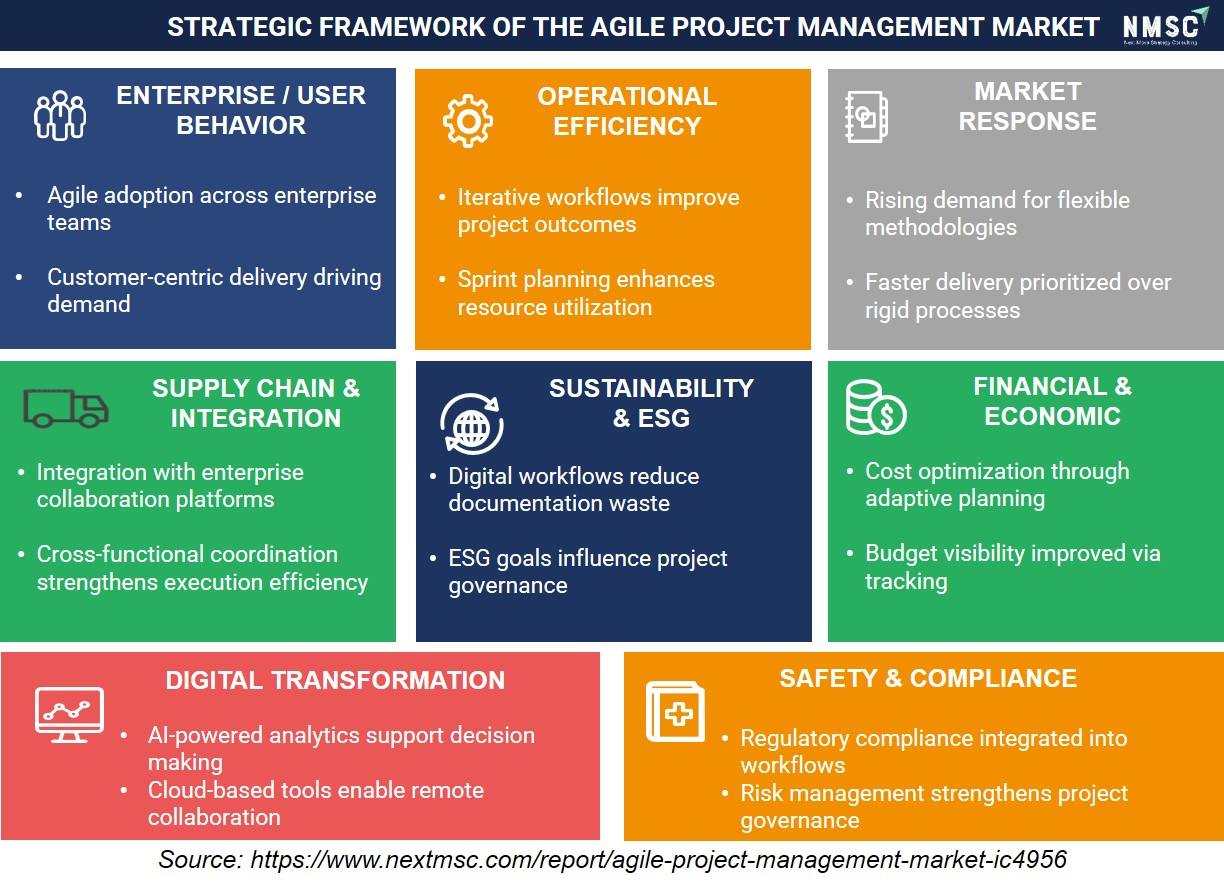
Based on our analysis, we found that the Agile Project Management Market is expanding as organizations adopt agile methodologies to improve project execution, collaboration, and operational efficiency. AI-powered analytics, cloud-based platforms, and digital workflows enhance decision-making and support distributed teams. Integration with enterprise collaboration tools strengthens coordination, while increasing emphasis on compliance, governance, and ESG initiatives promotes sustainable project management. These trends enable faster delivery, improved resource utilization, cost optimization, and greater business agility.
Competitive Landscape
Competitive Dynamics and M&A Landscape
|
Key Takeaways |
Details |
|
Market Structure |
Moderately consolidated; top 5 vendors (Microsoft, Atlassian, ServiceNow, monday.com, Smartsheet) account for approximately 55% of global Agile Project Management Market revenue. Long tail of niche and vertical-specific providers occupies the remaining share. |
|
Innovation Focus |
AI-powered sprint automation, natural language work intake, predictive resource allocation, value stream mapping, and enterprise scaled agile portfolio management represent the primary innovation investment areas across leading platforms. |
|
M&A Activity |
Heightened consolidation activity; platform vendors are acquiring niche agile DevOps, portfolio management, and road mapping tools to expand functional coverage, deepen enterprise relationships, and defend against emerging AI-native competitors. |
How Do Companies Compete in the Agile Project Management Market?
The Agile Project Management Market operates as a moderately consolidated competitive environment, with Microsoft Corporation and Atlassian Corporation Plc holding the largest revenue shares through deeply embedded enterprise product suites and large installed bases. Competition occurs across four primary dimensions: platform breadth (end-to-end agile to DevOps integration), AI capability (automated planning, intelligent prioritization), scalability (team-level to enterprise portfolio management), and pricing accessibility (per-user SaaS to enterprise agreement models). Established vendors compete through deep integration with existing enterprise ecosystems, while challengers such as monday.com and ClickUp compete on user experience, self-serve growth velocity, and product-led adoption.
Which Kind of Companies Dominate the Agile Project Management Market?
Enterprise software platforms with broad workflow management portfolios dominate the Agile Project Management Market revenue leadership. Microsoft's integration of Azure DevOps with GitHub, Microsoft Teams, and the Power Platform creates significant enterprise cross-sell advantages. Atlassian's ecosystem of Jira, Confluence, Jira Product Discovery, and Atlassian Intelligence embedded AI positions it as the preferred agile toolchain for engineering-led organizations. ServiceNow's Now Platform expansion into strategic portfolio management targets the intersection of ITSM and enterprise agile delivery. Purpose-built agile platforms including Planview, Digital.ai, and Broadcom's ValueOps compete for the large enterprise scaled agile market requiring enterprise portfolio management and value stream capabilities.
AI-Native Differentiation and Open Standards Drive Market Success in the Agile Project Management Market
AI-native differentiation is becoming the primary competitive battleground in the Agile Project Management Market as vendors race to embed generative AI throughout the product experience. Atlassian's Rovo, Microsoft Copilot in Azure DevOps, and GitLab Duo represent first-generation AI integration, while emerging AI-native challengers are designing platforms with AI as the foundational interaction layer rather than an added feature. Open standards support, REST API ecosystems, and marketplace integrations are simultaneously critical as enterprise buyers resist vendor lock-in and seek interoperability across their existing technology stacks. Our findings suggest that vendors combining deep AI capability with open integration standards will achieve superior competitive positioning.
Market Players to Opt for Merger and Acquisition Strategies to Expand Their Presence in the Agile Project Management Market
Merger and acquisition activity is intensifying within the Agile Project Management Market as established platform vendors seek to fill portfolio gaps, acquire AI capabilities, and expand into adjacent workflow management markets. Historical consolidation examples include Broadcom's acquisition of Rally Software (CA Technologies), Adobe's acquisition of Workfront, and ServiceNow's acquisition of LightStep. Our assessment indicates that the next wave of consolidation is likely to target AI-native agile planning startups, vertical-specific agile platforms for construction and healthcare, and product road mapping tools that extend existing platforms' product management capabilities. Private equity interest in the market is also expanding
Who Are the Key Market Players in the Agile Project Management Market?
-
Microsoft Corporation
-
Atlassian Corporation Plc
-
ServiceNow, Inc.
-
monday.com Ltd.
-
Smartsheet Inc.
-
Asana, Inc.
-
GitLab Inc.
-
Planview, Inc.
-
Broadcom Inc.
-
Adobe Inc.
-
Oracle Corporation
-
SAP SE
-
ClickUp, Inc.
-
Zoho Corporation Private Limited
-
Wrike, Inc.
-
Notion Labs, Inc.
-
Teamwork.com, Ltd.
-
OpenProject GmbH
-
Digital.ai Software, Inc.
-
Aha! Labs Inc.
What Are the Latest Developments in the Agile Project Management Market ?
|
Date |
Event |
|
June 2026 |
monday.com launched its "Vibe" AI platform updates, allowing users to consume multiple AI models (OpenAI, Anthropic) directly via their API, with no separate keys required. New features include automated document analysis (PDF/Image) and cross-board data integration for up to 20 boards. |
|
April 2026 |
ClickUp expanded its platform capabilities by adding the "@Codegen" AI coding teammate, enabling developers to generate code and create Pull Requests (PRs) directly from tasks within the ClickUp environment, following the release of "Super Agents" in late 2025. |
Expert Insights

— Pierre Le Manh, President & CEO, Project Management Institute
Statement made while discussing the role of project execution, stakeholder alignment, and complexity management in successful strategy delivery, as part of PMI’s latest research findings (2026).
Market Interpretation
The comment highlights the growing importance of agile project management practices in enabling effective strategy execution within modern enterprises. As organizations operate in increasingly complex and dynamic environments, traditional project approaches often fail to deliver intended outcomes. Agile methodologies address this challenge by promoting continuous collaboration, adaptive planning, and iterative execution. The emphasis on stable teams, active stakeholder engagement, and proactive complexity management reflects key agile principles that improve delivery success rates. Consequently, enterprises are increasingly adopting agile frameworks and tools to enhance execution efficiency, align projects with strategic objectives, and ensure faster response to market changes.
What Are the Investment Opportunities in the Agile Project Management Market?
AI-Native Agile Platform Investment
Capital inflows into AI-native agile project management startups accelerated through 2024 and 2025 as investors recognized the transformative potential of embedded AI within enterprise delivery workflows. NMSC's analysis indicates that venture capital investment in project management and DevOps tooling showed strong momentum, with AI-enhanced agile platforms commanding significant valuation premiums over traditional work management tools. The total addressable market expansion from team-level tools to enterprise portfolio management platforms broadens investment thesis optionality, while product-led growth economics in SMB and mid-market segments create attractive unit economics at early stages.
Infrastructure Investment Driving Platform Scalability
Infrastructure investment in cloud-native delivery and multi-region deployment capabilities is a prerequisite for Agile Project Management Market platform scaling across global enterprise accounts. Vendors investing in FedRAMP authorization, SOC 2 Type II certification, ISO 27001 compliance, and EU data residency infrastructure unlock regulated industry and government buyer segments with long contract tenures and high average contract values. Our findings suggest that infrastructure compliance investment, while capital-intensive in the near term, delivers durable competitive moats and superior net revenue retention in enterprise agile project management contract renewals through the 2026 to 2035 forecast period.
ESG and Sustainability Alignment in Agile Portfolio Management
Environmental, Social, and Governance (ESG) considerations are creating a new investment theme within the Agile Project Management Market, as organizations integrate ESG initiative tracking, sustainability sprint planning, and climate-related project governance capabilities into enterprise agile platforms. The U.S. Securities and Exchange Commission's climate disclosure requirements and the European Sustainability Reporting Standards (ESRS) under CSRD create demand for agile portfolio management platforms that connect delivery programs to ESG outcome reporting.
Private Equity Consolidation Strategies in the Agile Project Management Market
Private equity activity in the Agile Project Management Market is accelerating as PE firms identify platform consolidation opportunities among mid-market agile software vendors with strong recurring revenue profiles but insufficient scale to compete against enterprise suite vendors independently. Vertical buy-and-build strategies targeting construction project management, professional services delivery, and healthcare agile platforms represent compelling PE investment theses given the limited overlap with horizontal agile tool leaders. Our assessment indicates that PE-backed platform consolidation will reshape the competitive landscape of the Agile Project Management Market through the mid-forecast period of 2026 to 2031.
Key Benefits for Stakeholders
For Investors and Venture Capitalists
Investors and venture capitalists gain a structured, data-driven assessment of the Agile Project Management Market, including comprehensive market sizing, CAGR projections, segment-level revenue forecasts, and competitive landscape analysis through 2035. This intelligence supports investment evaluation across software platforms, AI-native agile tools, and industry-specific solutions while identifying high-growth segments, emerging vendors, and strategic acquisition opportunities.
For Agile Software Vendors
Agile software vendors benefit from comprehensive insights into market segmentation across offering type, deployment mode, licensing model, buyer size, sales channel, and end-user industry. The report enables data-driven product roadmap planning, competitive positioning, pricing strategy optimization, and go-to-market refinement while identifying white-space opportunities and the fastest-growing segments within the Agile Project Management Market.
For Enterprise Buyers and CIOs
Enterprise buyers and CIOs gain vendor-neutral intelligence on platform capabilities, competitive benchmarking, deployment models, pricing strategies, and adoption trends across organizations of varying sizes. These insights support informed technology procurement, platform selection, digital transformation planning, and long-term agile project management investment decisions.
For Agile Service Providers and Consultants
Implementation partners, agile consulting firms, managed service providers, and agile coaches gain actionable insights into demand forecasting, regional growth trends, and services market expansion. The report supports service portfolio optimization, geographic expansion planning, resource allocation, and partnership strategies aligned with emerging opportunities across the Agile Project Management Market.
For Regulatory and Government Bodies
Government agencies and regulatory authorities gain a structured understanding of how public sector digital transformation initiatives, agile delivery standards, procurement frameworks, and compliance requirements are shaping the Agile Project Management Market. Country-level insights help policymakers evaluate enterprise technology adoption trends, strengthen digital governance strategies, and support public-sector modernization initiatives.
For Academic and Research Institutions
Academic institutions, research organizations, and industry analysts gain quantitative market intelligence, technology adoption trends, competitive benchmarking, and industry evolution analysis. These insights support curriculum development, research initiatives, innovation programs, and evidence-based studies focused on agile methodologies, enterprise software adoption, and digital project management practices.
Key Market Segments
By Offering
-
Software
-
Work Management
-
Sprint Planning
-
Task and Workflow Management
-
Backlog Management
-
Kanban Boards
-
Scrum Boards
-
Collaboration and Documentation
-
Reporting and Analytics
-
-
Agile Portfolio and Program Management
-
Enterprise Agile Planning
-
Portfolio Planning
-
Capacity and Resource Planning
-
Governance and Compliance
-
Value Stream Management
-
-
Agile DevOps and ALM
-
Agile Application Lifecycle Management
-
DevOps Planning
-
Continuous Delivery Planning
-
Issue and Defect Tracking
-
Test and Release Coordination
-
-
Product Road Mapping
-
Product Planning
-
Feature Prioritization
-
Idea Management
-
Release Planning
-
-
Vertical Project Management
-
Construction Project Management
-
Engineering Project Management
-
Professional Services Project Management
-
-
Open Source Self-Managed
-
Community Edition
-
Enterprise Edition
-
-
Other Software
-
Niche Agile Planning Tools
-
Team-Specific Agile Tools
-
-
-
Services
-
Implementation and Migration
-
Tool Deployment
-
Workflow Configuration
-
Systems Integration
-
Data Migration
-
-
Training and Advisory
-
Agile Coaching
-
Certification Support
-
Leadership Training
-
Team Enablement
-
-
Managed Services
-
Agile PM Administration
-
Outsourced PMO Support
-
Continuous Improvement Services
-
-
Support and Maintenance
-
Technical Support
-
Platform Optimization
-
Upgrade Support
-
-
Other Services
-
By Deployment Mode
-
Cloud
-
Public Cloud
-
Private Cloud
-
-
On-Premises
By Licensing Model
-
Subscription
-
Per User
-
Usage-Based
-
Enterprise Agreement
-
-
Perpetual License
By Services Pricing Model
-
Fixed Price
-
Time and Materials
-
Retainer
By Buyer Size
-
SMB (1–999 Employees)
-
Mid-Market (1,000–4,999 Employees)
-
Enterprise (5,000+ Employees)
By Sales Channel
-
Self-Serve
-
Direct Sales
-
Partner-Led
-
Marketplace
-
OEM and Embedded
By End-User Industry
-
Technology and Software
-
Financial Services
-
Professional Services
-
Manufacturing
-
Construction and Engineering
-
Retail and Consumer Goods
-
Healthcare and Life Sciences
-
Government and Public Sector
-
Media and Advertising
-
Education
-
Energy and Utilities
-
Transportation and Logistics
-
Other Industries
By Region
-
North America: U.S., Canada, and Mexico
-
Europe: UK, Germany, France, Italy, Spain, Sweden, Denmark, Finland, the Netherlands, and the rest of Europe
-
Asia-Pacific: China, India, Japan, South Korea, Taiwan, Indonesia, Vietnam, Australia, Philippines, Malaysia, and the rest of APAC
-
Middle East & Africa (MEA): Saudi Arabia, UAE, Egypt, Israel, Turkey, Nigeria, South Africa, and the rest of MEA
-
Latin America: Brazil, Argentina, Chile, Colombia, and the rest of LATAM
Conclusion and Recommendations
Long-Term Outlook
The Agile Project Management Market is entering its most consequential growth decade, driven by AI integration, enterprise digital transformation acceleration, and the structural expansion of agile methodologies into non-technology industries. The market is forecast to grow from USD 9.4 billion in 2026 to USD 25.6 billion by 2035, at a CAGR of 11.8%. NMSC's analysis indicates that this growth trajectory reflects both the sustained expansion of the enterprise software buyer base and the increasing organizational recognition of agile delivery as a core competitive capability rather than a technology team methodology.
Strategic Positioning Recommendations
Agile platform vendors should prioritize AI-native differentiation through embedded generative AI for sprint planning automation, intelligent backlog management, and predictive delivery forecasting. Organizations that integrate AI as a foundational workflow layer rather than a feature add-on will command premium pricing and superior land-and-expand revenue growth. Enterprise vendors should simultaneously invest in enterprise agile portfolio management capabilities that connect engineering delivery to business value, capturing the growing buyer preference for platforms that address both team-level execution and executive-level portfolio visibility within a unified Agile Project Management Market offering.
Investment Attractiveness
The Agile Project Management Market represents a highly attractive investment environment given durable secular demand drivers, strong recurring SaaS revenue models, and the expanding scope of agile methodology adoption across non-traditional sectors. Our assessment indicates the highest-conviction investment themes include AI-native agile platforms (estimated 14%+ CAGR for AI-enabled sub-segments), vertical agile solutions for construction and healthcare, public sector FedRAMP-authorized deployments, and Asia-Pacific market expansion particularly in India and Southeast Asia. PE-backed consolidation of fragmented mid-market agile vendors represents an additional value creation pathway through the forecast horizon.
Market Shifts and Key Risks
The most significant structural shift underway is the consolidation from team-level agile tool procurement toward enterprise integrated agile suite acquisition, benefiting platform vendors with broad portfolio coverage over point-solution specialists. Key risks include macroeconomic enterprise software budget compression slowing seat expansion, AI commoditization accelerating competitive pricing pressure, open-source platform alternatives reducing monetization leverage, and tool consolidation by hyperscalers threatening standalone agile software vendor positioning. Geopolitical market segmentation in China and evolving data localization regulations may also create structural barriers in specific regional Agile Project Management Market growth trajectories.
Growth Pathways
Organizations and investors seeking to maximize value from the Agile Project Management Market should pursue a three-horizon strategy. In the near term through 2027, prioritize cloud agile platform deployment, practitioner certification investment, and AI feature adoption to establish delivery performance advantages. In the mid-term from 2027 to 2031, invest in enterprise agile portfolio management integration, value stream management capabilities, and vertical-specific agile platform development for construction, healthcare, and financial services. In the long term from 2031 to 2035, position for AI-autonomous delivery planning systems and cross-enterprise agile ecosystem interoperability as the next wave of platform differentiation within the global Agile Project Management Market.
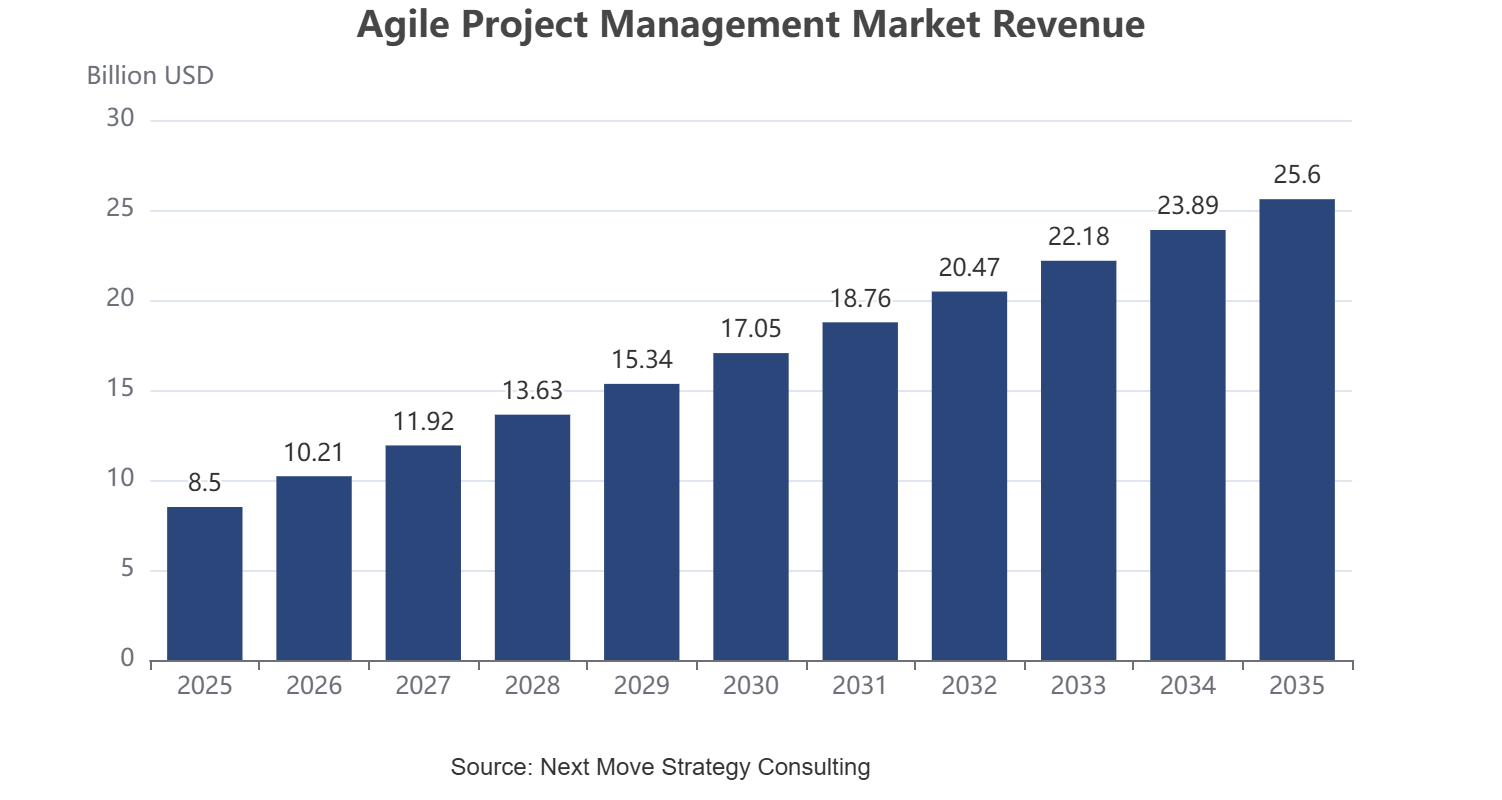
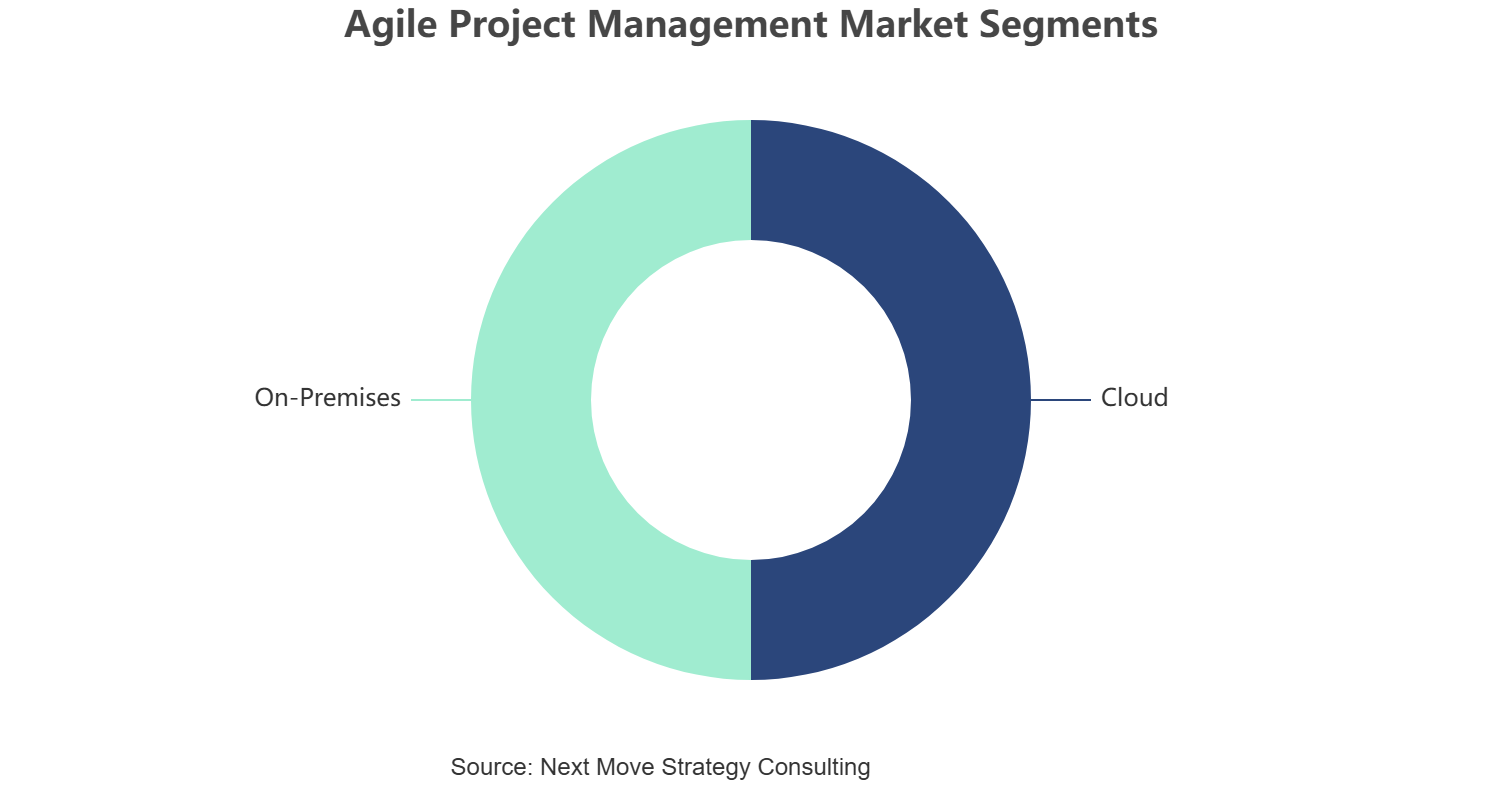
About the Author
 Saista Faiyaz
— Saista Faiyaz is Research Associate at Next Move Strategy Consulting, where she has covered consumer markets and healthcare technologies for 3 years. Her work includes primary interview review, secondary-source validation, market sizing, and structured analysis of company and industry data. She supports research by comparing evidence across sources, organizing findings into market narratives, and documenting assumptions used in analysis. Her scope includes cross-market benchmarking, and reports.
Saista Faiyaz
— Saista Faiyaz is Research Associate at Next Move Strategy Consulting, where she has covered consumer markets and healthcare technologies for 3 years. Her work includes primary interview review, secondary-source validation, market sizing, and structured analysis of company and industry data. She supports research by comparing evidence across sources, organizing findings into market narratives, and documenting assumptions used in analysis. Her scope includes cross-market benchmarking, and reports.
About the Reviewer
 Supradip Baul
— Supradip Baul is an accomplished business consultant and strategist with over a decade of rich experience in market intelligence, strategy, technology, and business transformation. His work has included rigorous qualitative and quantitative analysis across multiple industries, helping clients shape investment decisions and long-term roadmaps. Earlier in his career, he was associated with Gartner, where he contributed to industry-leading reports and market share analyses. He has worked with leading global companies and holds an MBA with a dual specialization in Marketing and Finance.
Supradip Baul
— Supradip Baul is an accomplished business consultant and strategist with over a decade of rich experience in market intelligence, strategy, technology, and business transformation. His work has included rigorous qualitative and quantitative analysis across multiple industries, helping clients shape investment decisions and long-term roadmaps. Earlier in his career, he was associated with Gartner, where he contributed to industry-leading reports and market share analyses. He has worked with leading global companies and holds an MBA with a dual specialization in Marketing and Finance.
At Next Move Strategy Consulting, we understand that insightful market research is the cornerstone of successful business decisions. That's why we employ a robust and multifaceted approach, combining various methodologies to deliver the most accurate and actionable data for our clients.

Research Landscape
We navigate the world of research with two primary approaches:
Qualitative Approach
Our qualitative research methodologies involve immersive techniques such as in-depth interviews, focus groups, and observational studies. By engaging directly with individuals and stakeholders, we uncover valuable insights that quantitative data alone may overlook.

Quantitative Research
In tandem with qualitative methodologies, NMSC leverages the power of Quantitative Research to provide a robust foundation of numerical insights. Through systematic data collection and analysis, we quantify patterns, preferences, and market trends, offering a comprehensive view of the business landscape.
Our quantitative research approach employs diverse tools, including surveys, experiments, and statistical modelling. These methodologies enable us to gather data from a large and representative sample, ensuring the statistical significance of our findings. By employing structured questionnaires and standardized data collection methods, we guarantee the reliability and validity of the information we present to our clients.
Quantitative research is particularly effective in measuring the prevalence of trends, assessing market size, and gauging the impact of various factors on consumer behavior. The numerical precision attained through this approach equips our clients with actionable insights, facilitating data-driven decision-making and strategy formulation.


Our Specialized Toolbox for Industry-Specific Market Research
We deploy a specialized arsenal of techniques tailored to meet your unique requirements. Here's a glimpse into our comprehensive toolbox:

Information Procurement
The stage entails acquiring market data or relevant information through various sources and methodologies.


Market Research Approach
We utilize both top-down and bottom-up approaches in market research analysis to achieve a comprehensive understanding of the market dynamics, leveraging the broad perspective of industry trends and macroeconomic factors alongside detailed insights from specific segments and individual companies.

Porters Five Forces Analysis
We conduct Porter's Five Forces analysis to evaluate the competitive landscape of an industry, providing us with insights into factors that affect profitability and strategic positioning.

SWOT Analysis

Forecasting
We utilize a forecasting model to predict future consumption by considering parameters like population, economics, regulations, market competition, drivers, constraints, technology, and pricing. We also employ statistical techniques such as multilinear regression, exponential smoothing, moving average, ARIMA, and Monte Carlo simulations for accurate predictions. In econometric forecasting, we analyzed short-term and long-term event impacts, attributing values based on regulatory frameworks, economic factors, and market events.





 Speak to Our Analyst