AI Ad Fraud Market Size, Share, Growth & Forecast by Product (Verification Software, Prevention Software, Data Intelligence, Services), Buyer Role (Advertiser, Agency, Publisher, Platform), Channel (Search, Social, Display), Fraud Type (General Invalid Traffic, Sophisticated Invalid Traffic, Click Fraud, Install Fraud), Deployment (Software Service, API, On-Premise), Pricing, and End Use Industry (Retail, Gaming, Finance) — Global Analysis, 2026–2035
Industry: ICT & Media | Publishing Date: July 4, 2026 | Last Updated: September 30, 2026 | No of Pages: N/A | No. of Tables: N/A | No. of Figures: N/A | Format: PDF | Report Code: IC4952
What Is the AI Ad Fraud Market Size?
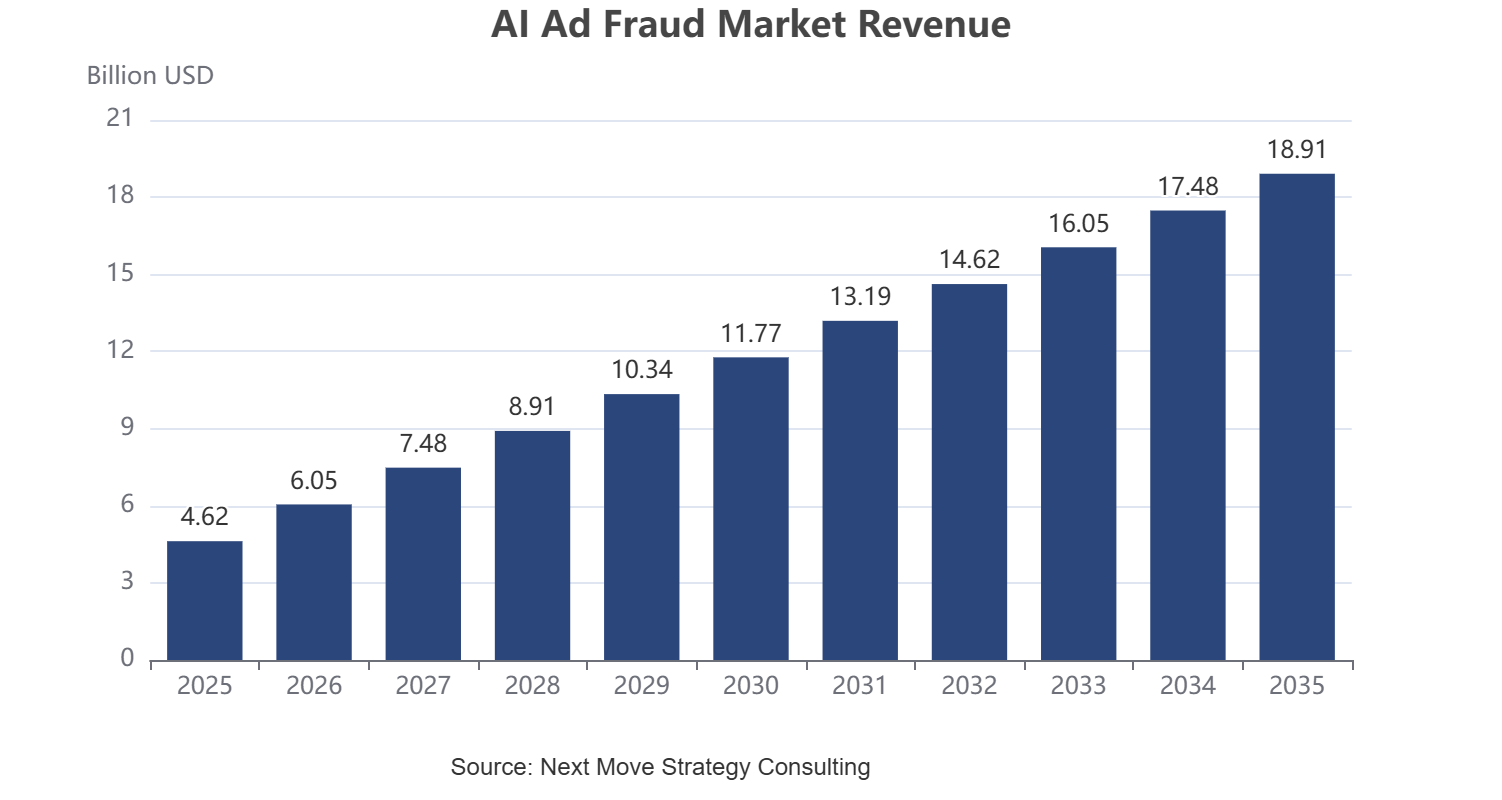
The AI Ad Fraud Market refers to the global ecosystem of verification software, prevention software, data intelligence, and services that detect, block, and remediate invalid traffic, click fraud, install fraud, and other forms of programmatic advertising fraud using machine learning and behavioural analytics. The AI Ad Fraud Market was valued at USD 4.62 billion in 2025 and is expected to reach USD 5.31 billion in 2026. Rising programmatic ad spend, the proliferation of sophisticated invalid traffic generated by AI-driven bots, growing CTV and mobile app fraud exposure, and tightening brand safety mandates from advertisers are collectively projected to expand the market to USD 18.91 billion by 2035, advancing at a CAGR of 15.1% from 2026 to 2035. Additional growth demand stems from agency-side accountability pressure and expanding affiliate marketing fraud across global digital ad channels.
|
Parameters |
Details |
|
Market Size in 2025 |
USD 4.62 Billion |
|
Market Size in 2026 |
USD 5.31 Billion |
|
Revenue Forecast in 2035 |
USD 18.91 Billion |
|
Growth Rate |
CAGR of 15.1% from 2026 to 2035 |
|
Analysis Period |
2025–2035 |
|
Base Year Considered |
2025 |
|
Forecast Period |
2026–2035 |
|
Market Size Estimation |
USD Billion |
|
Companies Profiled |
20 |
|
Countries Covered |
33 |
|
Market Share |
Top 10 |
AI Ad Fraud Market Overview
What Does the AI Ad Fraud Market Report Cover?
This AI Ad Fraud Market report covers verification software, prevention software, data intelligence platforms, and professional services that advertisers, agencies, publishers, platforms, and affiliate networks deploy to identify and stop invalid traffic, click fraud, install fraud, attribution fraud, and malvertising across search, social, display, mobile app, connected TV, video, and affiliate channels. From our research, we found that the Market revenue is increasingly concentrated in AI-native detection engines capable of distinguishing sophisticated invalid traffic from legitimate human engagement at the bid-request level, supporting the market size and revenue trajectory outlined throughout this market report.
How Has the AI Ad Fraud Market Evolved Structurally?
The AI Ad Fraud Market has progressed through three structural phases. The first phase relied on static blocklists and rule-based filters to flag known bot signatures and data center IP ranges. The second phase introduced post-bid verification tagging that measured invalid traffic after impressions were served. NMSC's analysis indicates that the current phase is defined by pre-bid, AI-driven risk scoring embedded directly within programmatic bidding workflows, enabling real-time blocking of sophisticated invalid traffic before advertiser spend is committed, alongside cross-channel data intelligence feeds shared across verification vendors and exchanges.
How Does the Regulatory Environment Shape the AI Ad Fraud Market?
Regulatory and self-regulatory frameworks are increasingly shaping AI Ad Fraud Market demand. The U.S. Federal Trade Commission enforces against deceptive traffic generation practices under its general consumer protection authority. The Media Rating Council accredits verification vendors against defined invalid traffic measurement standards, and IAB Tech Lab's ads.txt, sellers.json, and supply chain object standards create technical compliance benchmarks that advertisers increasingly require of their supply chain partners. Our assessment indicates that these accreditation and standards frameworks are converting ad fraud prevention from a discretionary purchase into a baseline supply chain requirement across the advertiser and agency buyer segments.
How Is Technology Adoption Advancing Within the AI Ad Fraud Market?
Technology adoption within the AI Ad Fraud Market is accelerating as machine learning models move from periodic batch scoring toward continuous, real-time inference embedded within programmatic bid streams. Based on our market evaluation, we noticed that vendors are deploying graph-based device and identity clustering to detect coordinated bot farms and SDK spoofing rings that evade single-signal detection. Connected TV fraud detection is advancing rapidly as streaming ad spend grows, requiring new device-fingerprinting and app-ads.txt verification techniques that did not exist in display-era fraud prevention architectures, broadening the AI Ad Fraud Market technology stack considerably.
|
Key Takeaways |
|
By product, Verification Software held the largest share of the AI Ad Fraud Market at USD 1.87 billion in 2025, forecast to reach USD 7.40 billion by 2035. Prevention Software is the fastest-growing product segment at a CAGR of 15.7% from 2026 to 2035, advancing from USD 1.52 billion in 2025 to USD 6.55 billion by 2035, as advertisers shift from passive measurement toward active, real-time AI-driven blocking. |
|
By buyer role, Advertiser is the dominant purchasing segment at USD 1.62 billion in 2025, holding the largest share of AI Ad Fraud Market revenue. Affiliate Network is the fastest-growing buyer role at a CAGR of 16.2%, rising from USD 0.32 billion in 2025 to USD 1.45 billion by 2035, reflecting intensifying fraud exposure across performance marketing and mobile app install funnels. |
|
By channel, Display commanded the largest channel share at USD 1.10 billion in 2025. Connected TV is the fastest-growing channel at a CAGR of 19.4% from 2026 to 2035, advancing from USD 0.28 billion in 2025 to USD 1.65 billion by 2035, driven by rapid streaming ad spend growth and the absence of mature CTV fraud controls relative to display and search. |
|
By fraud type, Sophisticated Invalid Traffic dominates at USD 1.25 billion in 2025, the largest fraud-type category in the AI Ad Fraud Market. Install Fraud is the fastest-growing fraud type at a CAGR of 16.5%, climbing from USD 0.62 billion in 2025 to USD 2.85 billion by 2035 as mobile gaming and app install budgets expand globally. |
|
By deployment, Software Service (SaaS) leads at USD 2.35 billion in 2025, representing approximately 51% of AI Ad Fraud Market revenue. API-based deployment is the fastest-growing mode at a CAGR of 16.2%, as real-time pre-bid fraud screening is increasingly embedded directly within programmatic bidding pipelines via API calls rather than standalone dashboards. |
|
By end use industry, Retail holds the largest vertical share at USD 1.25 billion in 2025. Gaming is the fastest-growing vertical at a CAGR of 16.6%, advancing from USD 0.95 billion in 2025 to USD 4.40 billion by 2035, driven by mobile gaming's exposure to install fraud and reward-motivated bot activity. |
|
North America held the largest regional share of the AI Ad Fraud Market at USD 1.95 billion in 2025, projected to reach USD 7.55 billion by 2035. The Middle East and Africa is the fastest-growing region at a CAGR of 17.2% from 2026 to 2035, while Asia-Pacific is the fastest-growing major region at a CAGR of 16.5%. |
|
The United States is the single largest country market in the AI Ad Fraud Market, representing approximately 79% of North American revenue in 2025, underpinned by the world's deepest programmatic ad spend and the global headquarters of DoubleVerify, Integral Ad Science, and HUMAN Security. India is among the fastest-growing national markets in Asia-Pacific, propelled by surging mobile app install volumes and expanding programmatic ad spend. |
Key Emerging Trends in the AI Ad Fraud Market
How Is Generative AI Reshaping the Sophistication of Invalid Traffic in the AI Ad Fraud Market?
Generative AI tools are enabling fraud operators to produce more convincing synthetic browsing behaviour, mimicking human mouse movement, scroll patterns, and session duration to evade signature-based bot detection. Our analysis of enterprise verification deployments across North America and Europe indicates that vendors including HUMAN Security and DoubleVerify are responding by deploying their own AI models trained on adversarial traffic patterns rather than static rules. This arms-race dynamic is driving continuous reinvestment in AI Ad Fraud Market detection infrastructure, as fraud operators and verification vendors both adopt machine learning, creating sustained demand for model retraining and threat intelligence subscription services.
How Is Connected TV Fraud Detection Becoming a Strategic Priority in the AI Ad Fraud Market?
Connected TV advertising has grown faster than mature fraud controls can be deployed, creating a structurally under protected channel within the AI Ad Fraud Market. Through NMSC's assessment, we found that device ID spoofing, fake app inventory mimicking premium streaming apps, and server-side ad insertion manipulation represent emerging CTV-specific fraud vectors that display-era verification tools were not originally designed to detect. DoubleVerify's 2025 launch of Verified Streaming TV illustrates how verification vendors are building CTV-native pre-bid and measurement capabilities, signalling that connected TV fraud detection adoption, while still nascent, is becoming a board-level priority for advertisers shifting linear television budgets into streaming.
How Is Supply Chain Transparency Becoming Central to AI Ad Fraud Market Demand?
Multi-hop programmatic supply chains, where an impression passes through several supply-side platforms and resellers before reaching a publisher, create blind spots that sophisticated invalid traffic exploits. Based on our market assessment, we observed that IAB Tech Lab's sellers.json and supply chain object standards are gaining mandatory adoption status among major demand-side platforms, compelling advertisers to procure data intelligence and threat intelligence feeds that map and score supply path complexity. This trend is expanding AI Ad Fraud Market demand beyond point-in-time verification toward continuous supply chain risk scoring as a standing governance requirement for media buyers.
How Is Affiliate and Mobile Attribution Fraud Driving New AI Ad Fraud Market Demand?
Mobile attribution platforms are increasingly bundling fraud prevention directly into their measurement stacks as install fraud, click injection, and SDK spoofing scale alongside global app install budgets. Our findings suggest that mobile measurement partners, including AppsFlyer, Kochava, Branch, and Singular, have all expanded anti-fraud attribution capabilities, with AppsFlyer's November 2025 product release explicitly introducing a new anti-fraud attribution model alongside agentic AI tooling. This convergence of attribution measurement and fraud prevention is creating a structurally distinct AI Ad Fraud Market demand layer centred on mobile app developers and performance marketing teams.
Porter's Five Forces Analysis of the AI Ad Fraud Market
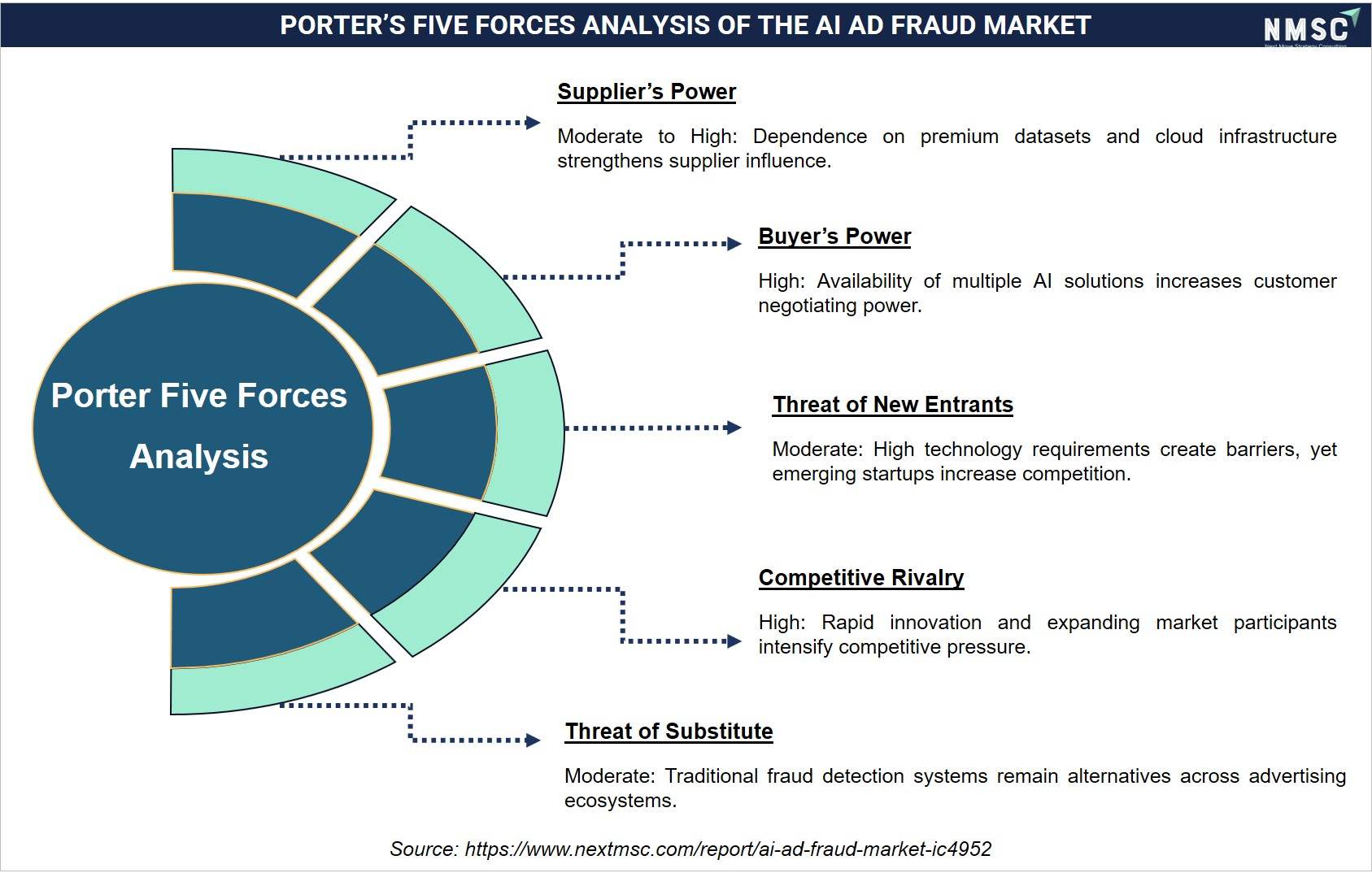
The above framework presents a Porter's Five Forces analysis of the AI Ad Fraud Market, evaluating competitive dynamics shaping industry profitability and growth. It examines competitive rivalry, bargaining power of buyers and suppliers, threat of new entrants, and substitutes. The framework further highlights increasing platform consolidation, rising technological barriers, and escalating demand for fraud detection solutions across digital advertising ecosystems, reflecting structural market pressures.
What Are the Key Market Drivers, Breakthroughs, and Investment Opportunities That Will Shape the AI Ad Fraud Market in the Next Decade?
|
Drivers / Trends / Restraints |
(+/-) % Impact on CAGR Forecast |
Geographic Relevance |
Impact Timeline |
|
Rising Programmatic Ad Spend Expanding Fraud Exposure |
+2.2% |
Global (led by North America, APAC) |
2025–2030 |
|
Sophisticated AI-Generated Invalid Traffic Outpacing Legacy Detection |
+1.8% |
Global |
2025–2035 |
|
Connected TV and Mobile App Fraud Creating New Demand |
+1.6% |
North America, Europe, APAC |
2026–2032 |
|
Supply Chain Transparency and Accreditation Standards |
+1.0% |
North America, Europe |
2025–2030 |
|
Brand Safety and Advertiser Accountability Pressure |
+0.9% |
Global |
2025–2035 |
|
Fraud Operator Adoption of Adversarial AI |
-1.1% |
Global |
Ongoing |
|
Walled Garden Data Restrictions Limiting Verification Access |
-0.7% |
North America, Europe |
Ongoing |
|
Budget Constraints Among SMB Advertisers and Publishers |
-0.5% |
Emerging markets globally |
Ongoing |
|
Emerging Market Digital Ad Spend Growth Creating Greenfield Demand |
+1.4% |
APAC, MEA, LATAM |
2026–2035 |
|
Affiliate and Mobile Attribution Fraud Prevention Convergence |
+1.1% |
Global |
2026–2035 |
What Are the Growth Drivers of the AI Ad Fraud Market?
How Is Rising Global Programmatic Ad Spend Driving AI Ad Fraud Market Growth?
Expanding programmatic advertising budgets directly enlarge the addressable surface for invalid traffic, click fraud, and domain spoofing, sustaining structural demand growth and rising revenue across the AI Ad Fraud Market. From our research, we found that the Association of National Advertisers' Q3 2025 Programmatic Transparency Benchmark identified USD 13.6 billion in efficiency gains as advertisers adopted greater supply chain accountability measures. The ANA's broader transparency research further found that of USD 88 billion in U.S. open web programmatic spend, only 36% reached viewable placements, leaving roughly USD 22 billion in unaccounted spend, reinforcing why advertisers continue increasing AI Ad Fraud Market investment as programmatic budgets grow.
How Are Sophisticated Invalid Traffic Techniques Accelerating AI Ad Fraud Market Demand?
The increasing sophistication of invalid traffic, including bots that replicate human browsing behaviour, device ID spoofing, and coordinated botnets, is outpacing legacy rule-based filters and compelling advertisers to procure AI-native detection platforms. Based on NMSC's research, we found that the Federal Trade Commission has pursued enforcement actions against deceptive traffic generation schemes under its general unfair and deceptive practices authority, validating the scale of the fraud challenge facing digital advertisers. This regulatory attention, combined with continuously evolving fraud techniques, is driving sustained reinvestment in machine learning-based AI Ad Fraud Market detection capabilities across the advertiser and agency buyer segments.
How Is Brand Safety and Advertiser Accountability Pressure Fueling AI Ad Fraud Market Trends?
Growing demand for verifiable, accountable media spend is pushing advertisers toward independent, third-party AI Ad Fraud Market solutions rather than relying solely on platform-reported metrics. Through our market assessment, we observed that the Media Rating Council's accreditation framework, which formally certifies invalid traffic detection methodologies, has become a procurement prerequisite for many large advertisers and agencies. This accreditation requirement, combined with growing C-suite scrutiny of marketing return on investment, is converting fraud prevention from a discretionary line item into a standing governance requirement, reinforcing durable Market growth and demand across both established and emerging advertiser segments.
What Are the Growth Inhibitors of the AI Ad Fraud Market?
How Does Fraud Operator Adoption of Adversarial AI Constrain AI Ad Fraud Market Effectiveness?
Fraud operators are adopting generative AI and adversarial machine learning techniques to defeat detection models, creating a continuous arms race that compresses the effective shelf life of any single detection methodology within the AI Ad Fraud Market. The U.S. Cybersecurity and Infrastructure Security Agency have published guidance on AI-enabled threat actor techniques, noting that adversarial manipulation of machine learning systems is an escalating concern across digital ecosystems. Our analysis shows that these dynamic forces drive verification vendors into continuous model retraining cycles, increasing operating costs and creating periods where newly emerged fraud techniques temporarily evade detection before being incorporated into updated models.
How Do Walled Garden Data Restrictions Limit AI Ad Fraud Market Verification Access?
Major social and search platforms restrict third-party verification vendors' access to granular impression-level and bid-stream data within their walled garden environments, limiting the depth of independent fraud detection achievable on these platforms. Our findings suggest that this data access constraint requires verification vendors to negotiate direct data-sharing partnerships with platform operators, a process that has historically been slower and less comprehensive than the open programmatic web. This restraint disproportionately affects smaller AI Ad Fraud Market vendors lacking the commercial leverage to secure walled garden API access comparable to that obtained by the largest accredited verification providers.
What Are the Growth Opportunities in the AI Ad Fraud Market?
How Does Emerging Market Digital Ad Spend Growth Create a Structural AI Ad Fraud Market Opportunity?
Rapidly expanding digital ad spend across Asia-Pacific, the Middle East, and Latin America is creating significant greenfield demand within the AI Ad Fraud Market as advertisers in these regions adopt programmatic buying at scale for the first time. India's Ministry of Electronics and Information Technology has documented rapid growth in domestic digital advertising activity tied to expanding smartphone and mobile internet penetration. Our assessment indicates that advertisers entering programmatic channels in these high-growth regions frequently lack mature in-house fraud detection capability, creating direct procurement opportunities for Market vendors offering localized, scalable verification and prevention software.
How Does Connected TV Expansion Create a High-Growth AI Ad Fraud Market Opportunity?
The rapid global shift of advertising budgets from linear television to connected TV and streaming platforms is creating a structurally underprotected channel that represents a high-growth opportunity for AI Ad Fraud Market vendors capable of building CTV-native detection capability. NMSC's analysis indicates that DoubleVerify's 2025 introduction of dedicated CTV pre-bid and measurement tools, alongside its IMDb data integration for show-level transparency, demonstrates the commercial opportunity vendors are pursuing as advertisers demand the same fraud accountability for streaming inventory that they have historically required for display and search advertising.
How Does Mobile Attribution and Affiliate Fraud Convergence Expand AI Ad Fraud Market Opportunities?
The convergence of mobile measurement and fraud prevention is opening a substantial cross-sell opportunity for AI Ad Fraud Market vendors serving app developers, affiliate networks, and performance marketing teams. Based on our market evaluation, we noticed that AppsFlyer's November 2025 release of eight new products, including an explicit anti-fraud attribution model alongside agentic AI tooling, demonstrates how mobile measurement partners are expanding fraud prevention as a core revenue line rather than a bundled feature. This convergence creates opportunities for vendors to capture wallet share from app developers and affiliate networks previously underserved by traditional display-focused verification platforms.
How Is the AI Ad Fraud Market Segmented in This Market Report, and What Are the Key Insights from the Segmentation Analysis?
How Does Product Segmentation Reveal the Structural Composition of the AI Ad Fraud Market?
|
Product Segment |
2025 (USD Bn) |
2035 (USD Bn) |
CAGR (%) |
|
Verification Software |
1.87 |
7.40 |
14.7% |
|
Prevention Software |
1.52 |
6.55 |
15.7% |
|
Data Intelligence |
0.83 |
3.55 |
15.6% |
|
Services |
0.40 |
1.41 |
13.4% |
Based on our analysis of enterprise procurement patterns, we observed that the AI Ad Fraud Market spans Verification Software, Prevention Software, Data Intelligence, and Services. Verification Software, encompassing post-bid invalid traffic detection, malvertising detection, ad quality monitoring, and pre-bid blocking, holds the largest segment share as it remains the most established procurement category among advertisers and agencies. Prevention Software, spanning click fraud, install fraud, attribution fraud, conversion fraud, lead fraud, and bot mitigation, is the fastest-growing segment as advertisers shift from passive measurement toward active, real-time AI-driven blocking. Data Intelligence, including risk scoring and threat intelligence feeds, is gaining adoption as a standalone procurement category among sophisticated buyers, while Services remains a smaller but steady segment supporting implementation and forensic investigation engagements.
Which Buyer Roles Are Shaping Procurement Decisions in the AI Ad Fraud Market?
|
Buyer Role |
2025 (USD Bn) |
2035 (USD Bn) |
CAGR (%) |
|
Advertiser |
1.62 |
6.55 |
15.0% |
|
Agency |
0.97 |
3.95 |
15.1% |
|
Publisher |
0.83 |
3.40 |
15.1% |
|
Platform |
0.60 |
2.60 |
15.8% |
|
Affiliate Network |
0.32 |
1.45 |
16.2% |
|
App Developer |
0.23 |
0.85 |
14.0% |
|
Other |
0.05 |
0.11 |
8.2% |
Through NMSC's assessment, we found that the AI Ad Fraud Market is segmented by buyer role into Advertiser, Agency, Publisher, Platform, Affiliate Network, App Developer, and Other categories. Advertiser holds the dominant buyer role share as brands directly bear the financial cost of wasted ad spend and increasingly mandate independent verification within media contracts. Affiliate Network is the fastest-growing buyer role as performance marketing programs face intensifying exposure to fraudulent lead generation and click fraud. Agency and Publisher both represent substantial and steadily growing procurement centers, while Platform and App Developer buyers are expanding their direct fraud prevention investment as walled garden accountability expectations rise.
Which Advertising Channels Generate the Most AI Ad Fraud Market Revenue?
|
Channel |
2025 (USD Bn) |
2035 (USD Bn) |
CAGR (%) |
|
Display |
1.10 |
4.10 |
14.1% |
|
Mobile App |
0.95 |
4.35 |
16.4% |
|
Social |
0.85 |
3.35 |
14.7% |
|
Search |
0.62 |
2.25 |
13.8% |
|
Video |
0.48 |
2.05 |
15.6% |
|
Connected TV |
0.28 |
1.65 |
19.4% |
|
Affiliate |
0.24 |
0.92 |
14.4% |
|
Other |
0.10 |
0.24 |
9.2% |
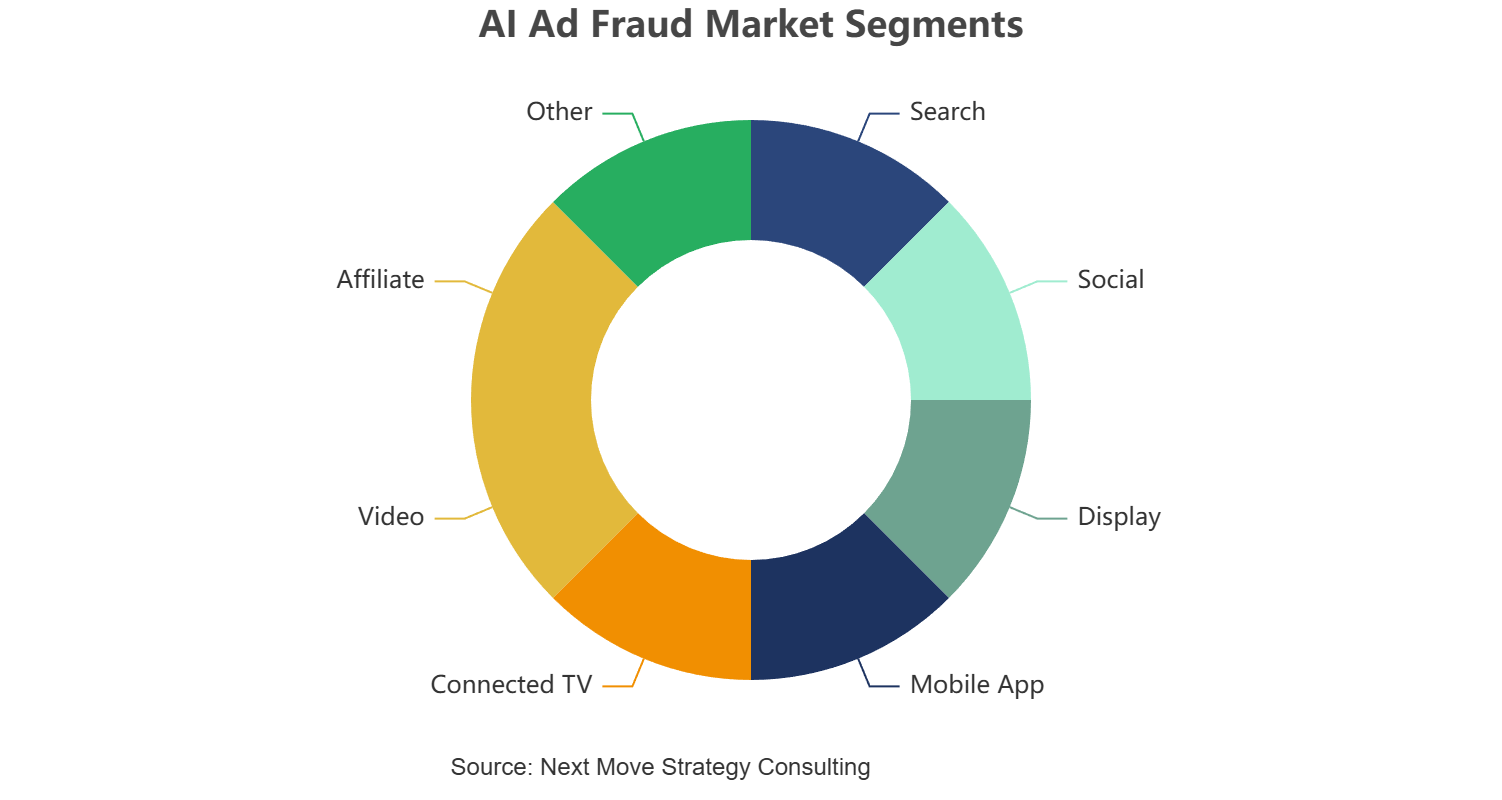
Our findings suggest that the AI Ad Fraud Market is segmented by channel into Display, Mobile App, Social, Search, Video, Connected TV, Affiliate, and Other categories. Display holds the largest channel share, reflecting its position as the most mature programmatic channel with the deepest installed base of verification tooling. Connected TV is by far the fastest-growing channel, as streaming ad budgets expand faster than fraud controls can mature, creating substantial unmet demand. Mobile App is the second-fastest-growing channel, driven by install fraud and SDK spoofing exposure, while Social, Search, and Video remain large, steadily growing channels supported by established verification integrations with major platforms.
Which Fraud Types Account for the Largest Share of AI Ad Fraud Market Revenue?
|
Fraud Type |
2025 (USD Bn) |
2035 (USD Bn) |
CAGR (%) |
|
Sophisticated Invalid Traffic |
1.25 |
5.65 |
16.3% |
|
General Invalid Traffic |
0.95 |
3.35 |
13.4% |
|
Click Fraud |
0.85 |
3.30 |
14.5% |
|
Install Fraud |
0.62 |
2.85 |
16.5% |
|
Attribution Fraud |
0.42 |
1.85 |
16.0% |
|
Malvertising |
0.28 |
1.10 |
14.7% |
|
Domain Spoofing |
0.17 |
0.62 |
13.8% |
|
Other |
0.08 |
0.19 |
9.0% |
NMSC's analysis indicates that the AI Ad Fraud Market is segmented by fraud type into Sophisticated Invalid Traffic, General Invalid Traffic, Click Fraud, Install Fraud, Attribution Fraud, Malvertising, Domain Spoofing, and Other categories. Sophisticated Invalid Traffic, which includes AI-driven bots designed to mimic genuine human behavior, holds the largest share as it represents the most advanced and costly fraud category to detect. Install Fraud is the fastest-growing fraud type, tracking the growth of mobile app advertising budgets globally. Click Fraud and General Invalid Traffic remain the largest legacy fraud categories, while Attribution Fraud is growing rapidly as performance marketing programs scale across affiliate and app install channels.
How Does Deployment Mode Influence AI Ad Fraud Market Adoption?
|
Deployment |
2025 (USD Bn) |
2035 (USD Bn) |
CAGR (%) |
|
Software Service |
2.35 |
9.45 |
14.9% |
|
API |
1.42 |
6.35 |
16.2% |
|
Hybrid |
0.55 |
2.45 |
16.1% |
|
On Premise |
0.30 |
0.66 |
8.2% |
Source: www.nextmsc.com
In our analysis of enterprise deployment preferences, we assessed that the AI Ad Fraud Market is segmented by deployment into Software Service, API, Hybrid, and On Premise models. Software Service, delivered as a hosted dashboard and reporting platform, holds the largest deployment share given its established role in post-bid verification reporting. API-based deployment is the fastest-growing mode, as real-time pre-bid fraud screening is increasingly embedded directly within programmatic bidding pipelines through direct API integration rather than standalone dashboards. Hybrid deployment is also growing rapidly among large advertisers that combine API-based real-time blocking with dashboard-based reporting, while On Premise deployment continues to decline as a share of new AI Ad Fraud Market procurement.
How Do Pricing Models Reflect the Commercial Structure of the AI Ad Fraud Market?
|
Pricing Model |
2025 (USD Bn) |
2035 (USD Bn) |
CAGR (%) |
|
Subscription |
1.75 |
6.80 |
14.5% |
|
Spend Based |
1.20 |
5.10 |
15.6% |
|
Usage Based |
0.95 |
4.35 |
16.4% |
|
Revenue Share |
0.47 |
1.85 |
14.7% |
|
Project Based |
0.25 |
0.81 |
12.5% |
Based on our assessment of vendor commercial structures, we noticed that the AI Ad Fraud Market is segmented by pricing into Subscription, Spend Based, Usage Based, Revenue Share, and Project Based models. Subscription pricing holds the largest share, reflecting the dominance of annually renewable verification and prevention software contracts. Usage Based pricing is the fastest-growing model, as vendors increasingly price prevention services per bid request scanned or per click screened, aligning costs directly with advertiser activity volumes. Spend Based pricing, where fees scale with protected media spend, remains a substantial and growing model among large advertisers, while Revenue Share and Project-based pricing serve niche services and forensic investigation engagements.
Which End Use Industries Generate the Most AI Ad Fraud Market Demand?
|
Industry |
2025 (USD Bn) |
2035 (USD Bn) |
CAGR (%) |
|
Retail |
1.25 |
4.85 |
14.5% |
|
Gaming |
0.95 |
4.40 |
16.6% |
|
Media and Entertainment |
0.83 |
3.35 |
15.0% |
|
Finance |
0.65 |
2.65 |
15.1% |
|
Telecom |
0.42 |
1.65 |
14.7% |
|
Travel |
0.32 |
1.25 |
14.6% |
|
Other |
0.20 |
0.76 |
14.3% |
Our analysis shows that the AI Ad Fraud Market serves Retail, Gaming, Media and Entertainment, Finance, Telecom, Travel, and Other end-use industries. Retail holds the largest vertical share, reflecting the scale of digital ad spend across e-commerce and omnichannel retail marketing programs. Gaming is the fastest-growing vertical, driven by mobile gaming's exposure to install fraud and reward-motivated bot installs tied to user acquisition campaigns. Media and Entertainment and Finance both represent substantial and steadily growing verticals, while Telecom and Travel continue to expand AI Ad Fraud Market investment as their digital marketing budgets shift further toward programmatic and performance channels.
Regional Outlook
AI Ad Fraud Market Geographic Performance Snapshot
|
Region |
2025 (USD Bn) |
2035 (USD Bn) |
CAGR (%) |
Key Driver |
|
North America |
1.95 |
7.55 |
14.5% |
Deep programmatic ad spend, vendor headquarters concentration |
|
Europe |
1.15 |
4.55 |
14.7% |
GDPR-aligned transparency standards, agency accountability pressure |
|
Asia-Pacific |
1.05 |
4.85 |
16.5% |
Mobile-first ad growth, expanding programmatic adoption |
|
Middle East & Africa |
0.27 |
1.32 |
17.2% |
Digital ad spend acceleration, government digital economy programs |
|
Latin America |
0.20 |
0.64 |
12.3% |
Ecommerce growth, expanding agency-led programmatic adoption |
North America AI Ad Fraud Market
North America is the largest regional AI Ad Fraud Market, contributing USD 1.95 billion in 2025 and forecast to reach USD 7.55 billion by 2035 at a CAGR of 14.5%. The region hosts the global headquarters of DoubleVerify, HUMAN Security, Pixalate, Kochava, and Branch, alongside the world's deepest programmatic ad spend base. Brand safety pressure from major advertisers, Media Rating Council accreditation standards, and IAB Tech Lab supply chain transparency initiatives sustain non-discretionary procurement. North America's advertiser and agency segments represent the most mature AI Ad Fraud Market buyers, with multi-year verification and prevention software contracts spanning display, search, social, and CTV channels.
United States AI Ad Fraud Market
Based on our engagements with advertiser and agency teams across North America, the United States represents approximately 79% of North American AI Ad Fraud Market revenue in 2025. The U.S. benefits from the world's highest concentration of verification vendors, the deepest programmatic and CTV ad spend, and active Federal Trade Commission enforcement against deceptive digital advertising practices. The Association of National Advertisers' Programmatic Transparency Benchmark studies have institutionalised supply chain accountability expectations among major U.S. advertisers, sustaining structural demand for independent verification and AI-driven fraud prevention software across every major advertising channel.
Canada AI Ad Fraud Market
Through our analysis, Canada accounts for approximately 14% of North American AI Ad Fraud Market revenue in 2025. Canadian advertisers and agencies increasingly mandate third-party verification within media buying contracts, consistent with practices established by U.S. headquartered global brands operating across the border. The Competition Bureau of Canada's oversight of deceptive marketing practices reinforces advertiser accountability expectations. Canada's concentrated agency landscape in Toronto creates efficient channels for AI Ad Fraud Market vendors to reach a large share of national programmatic ad spend through a relatively small number of agency relationships.
Mexico AI Ad Fraud Market
From our assessment, Mexico is the fastest-growing AI Ad Fraud Market within North America. Mexico's expanding ecommerce sector and growing programmatic ad adoption are generating new demand for invalid traffic detection and click fraud prevention among regional advertisers and agencies. Mexico's Federal Telecommunications Institute oversees broader digital advertising and telecommunications standards relevant to mobile ad fraud exposure. Hyperscaler cloud expansion into Mexico is supporting cloud-native verification platform deployments, while Mexico's growing affiliate marketing sector creates incremental demand for affiliate-focused fraud prevention services.
Europe AI Ad Fraud Market
Europe is the second-largest regional AI Ad Fraud Market, contributing USD 1.15 billion in 2025 and forecast to reach USD 4.55 billion by 2035 at a CAGR of 14.7%. Europe's regulatory environment, including GDPR-aligned data processing requirements for verification vendors and active agency-led transparency initiatives, creates structurally dense demand for accredited, privacy-compliant fraud detection. NMSC's analysis indicates that European advertisers demonstrate above-average reliance on independent third-party verification relative to platform-reported metrics, reflecting the region's comparatively assertive approach to advertiser accountability and media transparency standards across agency holding companies.
UK AI Ad Fraud Market
Based on our engagements, the United Kingdom represents the largest European AI Ad Fraud Market by national revenue share in 2025. The UK's Advertising Standards Authority and Competition and Markets Authority both maintain oversight relevant to deceptive digital advertising practices. London's position as Europe's leading agency holding company hub creates concentrated demand for verification and prevention software across major global advertiser accounts. UK advertisers have been particularly active adopters of programmatic transparency initiatives, mirroring practices pioneered by the Association of National Advertisers in the United States.
Germany AI Ad Fraud Market
According to evaluation, Germany is the second-largest European AI Ad Fraud Market, anchored by its large automotive, retail, and financial services advertiser base. German enterprises apply rigorous data protection scrutiny to verification vendor selection, requiring compliance with the Bundesdatenschutzgesetz and GDPR processing standards. Germany's concentrated programmatic ad spend among large industrial advertisers creates demand for enterprise-grade prevention software with detailed forensic investigation and consulting service attachments alongside core verification subscriptions.
France AI Ad Fraud Market
Through our analysis, France is a significant European AI Ad Fraud Market, supported by an active agency sector and growing programmatic ad adoption among French national advertisers. The Commission Nationale de l'Informatique et des Libertés enforces GDPR processing requirements relevant to verification vendors operating in France. French advertisers increasingly require independent fraud verification within media contracts, consistent with broader European agency transparency trends, sustaining steady AI Ad Fraud Market demand growth across display, video, and social channels.
Italy AI Ad Fraud Market
From our assessment, Italy is a growing European AI Ad Fraud Market, with expanding programmatic adoption among retail, finance, and telecom advertisers. Italy's Garante data protection authority enforces GDPR compliance requirements relevant to fraud detection vendors processing impression-level data. Italian advertisers and agencies are increasingly adopting independent verification standards consistent with broader European Union transparency expectations, supporting steady growth in AI Ad Fraud Market demand across the country's expanding digital advertising sector.
Spain AI Ad Fraud Market
According to our evaluation, Spain demonstrates growing AI Ad Fraud Market momentum, driven by an expanding ecommerce and retail advertiser base. The Agencia Española de Protección de Datos enforces GDPR compliance requirements for verification vendors. Spain's growing affiliate marketing and performance advertising sector creates incremental demand for click fraud and attribution fraud prevention software, while Spanish agencies are increasingly integrating third-party verification into standard media buying processes across major advertiser accounts.
Sweden AI Ad Fraud Market
Based on our engagements, Sweden is a mature Northern European AI Ad Fraud Market, with high enterprise adoption of programmatic advertising and associated verification tooling. Sweden enforces GDPR data protection requirements relevant to fraud detection vendors. Swedish advertisers in retail, telecom, and financial services are early adopters of AI-driven prevention software, reflecting the country's broader reputation for early digital technology adoption across the Nordic advertising ecosystem.
Denmark AI Ad Fraud Market
Through our analysis, Denmark represents a high-maturity Scandinavian AI Ad Fraud Market, with sophisticated enterprise adoption of programmatic advertising verification. Datatilsynet enforces GDPR compliance requirements for vendors processing Danish impression-level data. Danish advertisers across retail and financial services are increasingly procuring AI-driven prevention software as programmatic ad spend continues to expand across display, video, and social channels within the Danish digital advertising ecosystem.
Finland AI Ad Fraud Market
From our assessment, Finland is a digitally advanced Nordic AI Ad Fraud Market, with steady adoption across telecom, retail, and financial services advertisers. The Finnish Data Protection Ombudsman enforces GDPR compliance requirements relevant to fraud detection vendors. Finnish advertisers' growing programmatic ad spend, combined with the country's broader digital infrastructure maturity, supports continued adoption of verification and prevention software across the national advertising ecosystem.
Netherlands AI Ad Fraud Market
According to evaluation, the Netherlands is one of Europe's most active AI Ad Fraud Markets, anchored by a concentration of global advertiser regional headquarters and agency operations in Amsterdam. The Autoriteit Persoonsgegevens is among Europe's most active GDPR enforcement bodies, driving rigorous vendor data processing compliance requirements. The Netherlands' role as a regional advertising hub for multinational brands creates concentrated demand for enterprise-grade verification and prevention software across European campaign operations.
Rest of Europe AI Ad Fraud Market
Based on our engagements, the rest of Europe, encompassing Poland, Belgium, Austria, Switzerland, Portugal, Czech Republic, Romania, and other markets, collectively represents a growing segment of the European AI Ad Fraud Market. GDPR enforcement across all EU member states creates a uniform compliance baseline for verification vendors. Central and Eastern European markets are experiencing accelerating programmatic ad adoption, while Switzerland's financial services advertiser base and Belgium's EU institutional advertising presence create additional pockets of sophisticated AI Ad Fraud Market demand.
Asia-Pacific AI Ad Fraud Market
Asia-Pacific is the fastest-growing major regional AI Ad Fraud Market, contributing USD 1.05 billion in 2025 and forecast to reach USD 4.85 billion by 2035 at a CAGR of 16.5%. The region's growth is driven by China's large domestic digital advertising ecosystem, India's rapidly expanding mobile app economy, Japan's mature programmatic advertising sector, and Southeast Asia's accelerating e-commerce and mobile-first ad spend growth. Our assessment indicates that mobile app install fraud represents a disproportionately significant AI Ad Fraud Market driver across the region given the scale of APAC mobile gaming and ecommerce app advertising budgets.
China AI Ad Fraud Market
Based on our engagements, China is the largest AI Ad Fraud Market within Asia-Pacific, driven by its vast domestic digital advertising ecosystem spanning ecommerce, short-video, and mobile gaming platforms. Domestic technology platforms operate internal fraud detection capabilities alongside third-party verification adoption among multinational advertisers operating in China. China's State Administration for Market Regulation oversees deceptive advertising practices broadly, while the scale of China's mobile app economy creates substantial structural demand for install fraud and click fraud prevention software.
India AI Ad Fraud Market
Through our analysis, India is among the fastest-growing national AI Ad Fraud Markets in Asia-Pacific, propelled by its rapidly expanding mobile app economy and rising programmatic ad spend. India's Ministry of Electronics and Information Technology has documented sustained growth in domestic digital advertising activity tied to expanding smartphone penetration. India's large mobile gaming and ecommerce app install volumes create substantial demand for install fraud and attribution fraud prevention software among both domestic and multinational advertisers operating in the market.
Japan AI Ad Fraud Market
According to our evaluation, Japan is a mature Asia-Pacific AI Ad Fraud Market, driven by its sophisticated programmatic advertising sector and high enterprise adoption of verification standards among major Japanese advertisers. Japan's Consumer Affairs Agency oversees deceptive advertising practices relevant to digital media. Japanese advertisers in retail, automotive, and financial services demonstrate strong adoption of independent verification software, reflecting the country's broader emphasis on quality assurance and operational reliability across its advertising ecosystem.
South Korea AI Ad Fraud Market
From our assessment, South Korea is an advanced AI Ad Fraud Market, characterised by strong mobile gaming and e-commerce advertiser adoption of fraud prevention software. South Korea's Fair Trade Commission oversees deceptive advertising and unfair trade practices relevant to digital media. South Korean mobile gaming publishers represent sophisticated buyers of install fraud and attribution fraud prevention software, reflecting the country's globally significant mobile gaming export industry and associated user acquisition spend.
Taiwan AI Ad Fraud Market
Based on our engagements, Taiwan is a growing AI Ad Fraud Market, driven by its mobile gaming and electronics retail advertiser base. Taiwan's Fair Trade Commission oversees deceptive advertising practices relevant to digital media. Taiwan's mobile gaming publishers and ecommerce platforms represent active buyers of install fraud and click fraud prevention software, supporting steady AI Ad Fraud Market growth across the country's digital advertising ecosystem.
Indonesia AI Ad Fraud Market
According to evaluation, Indonesia is among the fastest-growing Southeast Asian AI Ad Fraud Markets, driven by its large mobile-first population and rapidly expanding ecommerce advertising sector. Indonesia's Ministry of Communication and Informatics oversees digital advertising and consumer protection standards. Indonesia's expanding mobile app economy and ecommerce platform advertising create substantial demand for install fraud and click fraud prevention software among both domestic and regional advertisers.
Vietnam AI Ad Fraud Market
Through our analysis, Vietnam represents a rapidly emerging AI Ad Fraud Market, driven by its growing mobile gaming and ecommerce advertiser base. Vietnam's Ministry of Information and Communications oversees digital advertising standards. Vietnam's expanding mobile app install volumes and growing programmatic ad adoption among regional and multinational advertisers are creating new demand for fraud prevention software across the country's developing digital advertising ecosystem.
Australia AI Ad Fraud Market
Based on our engagements, Australia is the most mature AI Ad Fraud Market in Oceania, with well-developed advertiser and agency adoption of verification standards. The Australian Competition and Consumer Commission actively oversees deceptive advertising practices relevant to digital media. Australian advertisers across retail, finance, and telecom represent sophisticated AI Ad Fraud Market buyers, with multi-year verification contracts spanning display, social, and growing connected TV advertising channels.
Philippines AI Ad Fraud Market
From our assessment, the Philippines is an emerging AI Ad Fraud Market, driven by rapid mobile app adoption and growing e-commerce advertising activity. The Philippine Department of Trade and Industry oversees consumer protection standards relevant to digital advertising. The Philippines' large BPO sector and expanding mobile gaming advertiser base are creating new demand for click fraud and install fraud prevention software across the country's growing digital advertising ecosystem.
Malaysia AI Ad Fraud Market
According to our evaluation, Malaysia is a growing AI Ad Fraud Market, driven by the government's MyDIGITAL national digital economy initiative and expanding regional advertiser activity. The Malaysian Communications and Multimedia Commission oversees digital advertising standards. Malaysia's position as a regional advertising and e-commerce hub creates demand for verification and prevention software supporting regional multinational advertiser operations across Southeast Asia.
Rest of Asia-Pacific AI Ad Fraud Market
Based on our engagements, the rest of Asia-Pacific, encompassing New Zealand, Thailand, Singapore, Bangladesh, Sri Lanka, and Pakistan, collectively represents a developing but growing segment of the regional AI Ad Fraud Market. Singapore's position as a regional advertising and technology hub creates sophisticated demand for verification software supporting multinational advertiser regional operations. Thailand and the broader Southeast Asian markets are experiencing accelerating mobile app and e-commerce advertising growth, supporting steady regional AI Ad Fraud Market expansion.
Middle East & Africa AI Ad Fraud Market
The Middle East and Africa region is the fastest-growing regional AI Ad Fraud Market at a CAGR of 17.2% from 2026 to 2035, contributing USD 0.27 billion in 2025 and forecast to reach USD 1.32 billion by 2035. Growth is driven by rapidly expanding digital ad spend in Saudi Arabia and the UAE, government digital economy programs, and growing e-commerce advertising activity across the region. Our findings suggest that advertisers entering programmatic channels across MEA markets for the first time are creating substantial greenfield demand for foundational verification and prevention software.
Saudi Arabia AI Ad Fraud Market
Based on our engagements, Saudi Arabia is the largest AI Ad Fraud Market in the Middle East, driven by Vision 2030's digital economy objectives and rapidly expanding e-commerce and retail advertising activity. The Saudi General Authority for Competition oversees deceptive advertising and unfair trade practices. Saudi advertisers in retail, finance, and telecom are increasingly adopting independent verification standards, supporting growing AI Ad Fraud Market demand across the country's expanding digital advertising ecosystem.
UAE AI Ad Fraud Market
Through our analysis, the UAE is the second-largest Middle Eastern AI Ad Fraud Market, anchored by Dubai's position as a regional advertising and media hub. The UAE Ministry of Economy oversees consumer protection standards relevant to digital advertising. The UAE's concentration of regional advertiser headquarters and agency operations creates demand for enterprise-grade verification and prevention software supporting campaigns across the broader Middle East and North Africa region.
Egypt AI Ad Fraud Market
According to evaluation, Egypt is an emerging AI Ad Fraud Market within North Africa, driven by growing e-commerce and mobile app advertising activity. Egypt's Consumer Protection Agency oversees deceptive advertising practices. Egypt's large population and expanding digital economy, supported by government digital transformation programs, are creating long-term demand for foundational fraud prevention software as programmatic ad spend continues to grow across the Egyptian market.
Israel AI Ad Fraud Market
From our assessment, Israel is a technologically advanced AI Ad Fraud Market, supported by its globally significant cybersecurity and adtech innovation sectors. Israel's Consumer Protection and Fair Trade Authority oversees deceptive advertising practices. Israeli technology companies and adtech startups represent sophisticated buyers and developers of fraud detection technology, with several global AI Ad Fraud Market vendors maintaining Israeli research and development operations supporting continued innovation in detection algorithms.
Turkey AI Ad Fraud Market
Based on our engagements, Turkey is a growing AI Ad Fraud Market, driven by a large retail and e-commerce advertiser base and expanding mobile app advertising activity. Turkey's Advertisement Board under the Ministry of Trade oversees deceptive advertising practices. Turkish advertisers are increasingly adopting independent verification standards as programmatic ad spend expands, supporting steady AI Ad Fraud Market growth across the country's digital advertising ecosystem.
Nigeria AI Ad Fraud Market
Through our analysis, Nigeria is the largest Sub-Saharan African AI Ad Fraud Market, driven by Africa's largest mobile-first population and growing e-commerce advertising activity. Nigeria's Federal Competition and Consumer Protection Commission oversees deceptive advertising practices. Lagos's growing technology and advertising ecosystem is attracting increased programmatic ad spend, creating new demand for foundational fraud prevention software among advertisers entering digital channels for the first time.
South Africa AI Ad Fraud Market
According to evaluation, South Africa is the most mature Sub-Saharan African AI Ad Fraud Market, with established advertiser adoption of programmatic advertising and associated verification standards. South Africa's National Consumer Commission oversees deceptive advertising practices. South African advertisers across retail, finance, and telecom represent the region's most sophisticated AI Ad Fraud Market buyers, with growing adoption of independent verification software across display and social advertising channels.
Rest of MEA AI Ad Fraud Market
Based on our engagements, the rest of the Middle East and Africa, encompassing Kuwait, Qatar, Bahrain, Oman, Morocco, Kenya, Ethiopia, Ghana, and other markets, collectively represents an emerging segment of the regional AI Ad Fraud Market. GCC states' growing digital economy programs and East African mobile-first advertising growth are creating new demand for foundational verification and prevention software as advertisers across these markets expand programmatic ad adoption.
Latin America AI Ad Fraud Market
Latin America represents a growing regional AI Ad Fraud Market, contributing USD 0.20 billion in 2025 and forecast to reach USD 0.64 billion by 2035 at a CAGR of 12.3%. Growth is driven by Brazil's large ecommerce and programmatic advertising sector, expanding agency-led adoption of independent verification standards, and growing mobile app advertising activity across the region. Our assessment indicates that ecommerce advertiser growth represents the primary AI Ad Fraud Market demand driver across Latin American markets through the forecast period.
Brazil AI Ad Fraud Market
Based on our engagements, Brazil is the largest AI Ad Fraud Market in Latin America, driven by its large ecommerce sector and expanding programmatic ad spend. Brazil's Conselho Nacional de Autorregulamentação Publicitária oversees advertising self-regulation standards. Brazilian advertisers and agencies are increasingly adopting independent verification standards as programmatic ad spend grows, supporting steady AI Ad Fraud Market growth across display, social, and mobile app advertising channels in Brazil.
Argentina AI Ad Fraud Market
Through our analysis, Argentina is a significant AI Ad Fraud Market within Latin America, supported by its developed media and advertising sectors. Argentina's National Consumer Defense Agency oversees deceptive advertising practices. Argentine advertisers and agencies are active buyers of verification and click fraud prevention software, with growing programmatic ad adoption supporting steady AI Ad Fraud Market growth despite broader macroeconomic constraints affecting media budgets.
Chile AI Ad Fraud Market
According to evaluation, Chile is a growing AI Ad Fraud Market anchored by its advanced retail and financial services advertiser base. Chile's National Consumer Service oversees deceptive advertising practices. Chilean advertisers represent some of the most digitally sophisticated buyers in Latin America, supporting growing adoption of AI-driven verification and prevention software across the country's expanding programmatic advertising ecosystem.
Colombia AI Ad Fraud Market
From our assessment, Colombia is an emerging AI Ad Fraud Market within South America, driven by growing ecommerce and fintech advertiser activity. Colombia's Superintendence of Industry and Commerce oversees deceptive advertising practices. Colombian advertisers in finance and ecommerce are increasingly adopting independent verification standards, supporting growing AI Ad Fraud Market demand as programmatic advertising expands across Bogotá's growing technology and advertising ecosystem.
Rest of Latin America AI Ad Fraud Market
Based on our engagements, the rest of Latin America, encompassing Peru, Ecuador, Panama, Uruguay, Paraguay, Costa Rica, and other markets, collectively represents a developing segment of the regional AI Ad Fraud Market. Central American and Andean advertisers are expanding programmatic ad adoption alongside growing ecommerce activity, creating new demand for foundational verification and prevention software across these smaller regional advertising markets.
Strategic Framework of the AI Ad Fraud Market
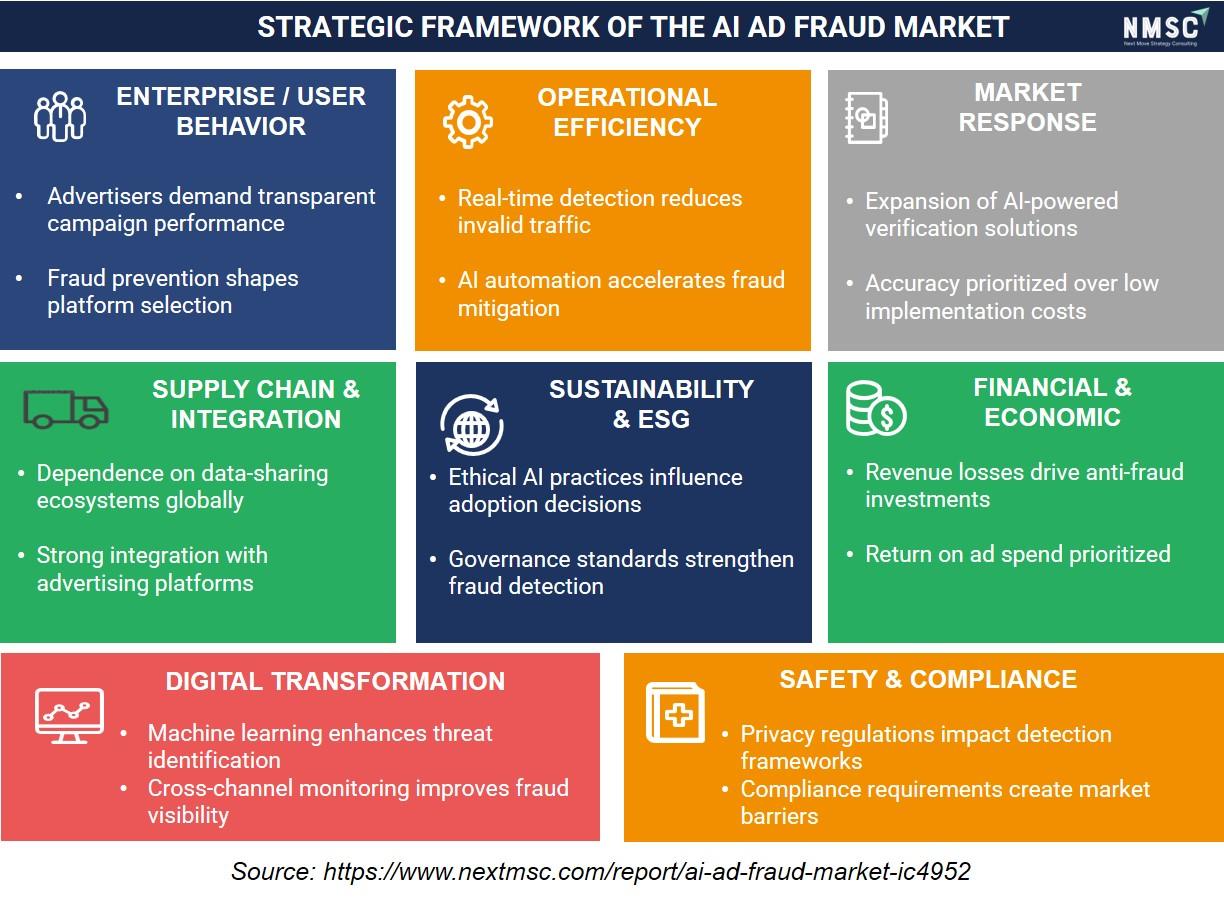
The above framework outlines key forces shaping the AI Ad Fraud Market across behaviour, operations, integration, compliance, and financial outcomes. We observed that advertisers demand transparent campaign performance, while real-time detection and AI automation reduce invalid traffic and accelerate fraud mitigation. Dependence on data-sharing ecosystems and integration with ad platforms define supply chain dynamics, with governance standards strengthening detection. Machine learning enhances threat identification, yet privacy regulations create compliance barriers. Revenue losses drive anti-fraud investments, with return on ad spend prioritized over implementation costs, reinforcing market growth.
Competitive Landscape
Competitive Dynamics and M&A Landscape
|
Key Takeaways |
Details |
|
Market Structure |
The AI Ad Fraud industry is moderately fragmented, combining large accredited verification platforms with specialized mobile attribution vendors and niche click fraud and CTV detection providers serving distinct buyer roles and channels. |
|
Innovation Focus |
Vendors are concentrating innovation on AI-native pre-bid risk scoring, adversarial machine learning resilience, CTV-specific detection, and agentic AI integration within mobile attribution and prevention workflows. |
|
M&A Activity |
Consolidation is active among mobile measurement and fraud prevention vendors, exemplified by AppsFlyer's 2025 to 2026 acquisition discussions, as larger platforms seek to bundle attribution, fraud prevention, and agentic AI capabilities. |
How Do Companies Compete in the AI Ad Fraud Market?
Competitive strategy within the AI Ad Fraud Market centers on accreditation credibility, detection breadth across channels, and AI model sophistication. From our research, we found that Media Rating Council accreditation functions as a key competitive moat, since many large advertisers restrict procurement to accredited vendors. Pricing strategies are bifurcating between spend-based models favoured by large advertisers seeking predictable budgeting and usage-based models favoured by performance marketers paying per click or bid request screened. Geographic expansion is concentrated on building Asia-Pacific and Middle Eastern operations to support multinational advertiser campaigns, while vendors increasingly bundle verification, prevention, and data intelligence into unified platform contracts rather than point solutions.
Which Kind of Companies Dominate the AI Ad Fraud Market?
Accredited, multi-channel verification platforms with established advertiser and agency relationships dominate the largest share of AI Ad Fraud Market revenue, given their breadth across display, social, video, and CTV channels. Mobile-focused attribution and fraud prevention vendors hold a strong secondary position, particularly among app developers and performance marketers, while specialised niche vendors serving CTV, affiliate, or click fraud detection occupy smaller but fast-growing positions as channel-specific fraud sophistication increases across the AI Ad Fraud Market competitive landscape.
AI-Native Differentiation and Open Standards Drive Market Success in the AI Ad Fraud Market
Vendors building AI-native detection architectures from inception, rather than retrofitting machine learning onto legacy rule engines, are achieving stronger differentiation as sophisticated invalid traffic accelerates. Compliance with IAB Tech Lab open standards, including sellers.json and supply chain object, further reinforces competitive credibility, as advertisers increasingly require demonstrable adherence to industry transparency frameworks before procuring AI Ad Fraud Market verification and prevention software from any given vendor.
Market Players to Opt for Merger and Acquisition Strategies to Expand Their Presence in the AI Ad Fraud Market
Mobile measurement and fraud prevention vendors are pursuing acquisition and consolidation strategies to expand platform breadth, exemplified by AppsFlyer's reported 2025 to 2026 acquisition discussions with private equity investors at a valuation near USD 3 billion. NMSC's analysis indicates that continued consolidation among mid-market AI Ad Fraud Market vendors is likely as larger platforms seek to bundle attribution, verification, and agentic AI capabilities into unified offerings for global advertiser accounts.
Who Are the Key Market Players in the AI Ad Fraud Market?
-
DoubleVerify
-
Integral Ad Science
-
Human Security
-
AppsFlyer
-
Impact.com
-
Kochava
-
Branch
-
Singular
-
Cheq
-
Pixalate
-
Pubmatic
-
Index Exchange
-
Trafficguard
-
Lunio
-
Mfilterit
-
Geoedge
-
Anura
-
Spider AF
-
Scalarr
-
Fraudlogix
What Are the Latest Developments in the AI Ad Fraud Market?
|
Date |
Event |
|
May 2026 |
DoubleVerify released findings showing a 140% surge in AI-driven CTV ad fraud schemes globally, highlighting rapid evolution of AI-enabled fraud in streaming environments. |
Expert Insights
 “2026 marks a turning point in digital advertising. As the boundaries between channels blur — and AI reshapes how content is created, consumed, and measured — industry experts are redefining what quality means in this new era.”
— Lisa Utzschneider, CEO of Integral Ad Science
Statement made during Integral Ad Science’s 2026 Industry Pulse Report.
Market Interpretation
NMSC's analysis indicates that the statement underscores a major structural inflection point in the AI ad fraud and digital advertising ecosystem, where blurred media boundaries and AI-generated content are increasing complexity in ad environments. This is driving stronger demand for verification, fraud detection, and media quality measurement solutions, reinforcing the role of ad fraud prevention technologies in maintaining transparency, trust, and performance accountability across digital channels.
What Are the Investment Opportunities in the AI Ad Fraud Market?
Capital Inflows and Venture Capital Activity
The AI Ad Fraud Market is experiencing strong capital inflows as investors respond to the structural expansion of programmatic advertising and the rising cost of invalid traffic. Fraud prevention is increasingly treated as a non-discretionary component of digital marketing budgets, strengthening its long-term investment appeal. From our research, we found that growing private equity and growth equity interest in ad measurement and fraud prevention platforms reflects durable demand fundamentals. For instance, acquisition-level discussions involving mobile attribution and fraud prevention leaders such as AppsFlyer highlight increasing valuation momentum as fraud detection becomes embedded within broader marketing intelligence ecosystems.
Data, Detection & Programmatic Infrastructure Investment
Infrastructure investment in the AI Ad Fraud Market is concentrated in real-time traffic validation systems, bid-stream filtering engines, and cross-platform identity verification frameworks. The rapid expansion of connected TV (CTV), in-app programmatic ecosystems, and retail media networks is driving demand for scalable fraud detection systems capable of processing billions of transactions in real time. Our assessment indicates that industry bodies such as the World Federation of Advertisers consistently highlight the economic burden of ad fraud, reinforcing the need for advanced detection infrastructure. This is creating long-duration investment opportunities in cloud-native verification systems, API-based fraud scoring engines, and shared threat intelligence networks.
Digital Transformation and Programmatic Ad Expansion
Digital transformation across advertisers, agencies, and publishers is a core structural driver of the AI Ad Fraud Market. As advertising ecosystems become increasingly automated, fraud prevention is shifting from a standalone function to an embedded layer within programmatic infrastructure. Growth in connected TV advertising, mobile-first ecosystems, and retail media networks is expanding the need for integrated fraud detection across multiple channels. Our analysis indicates that convergence between attribution, measurement, and fraud prevention platforms is emerging as a key investment theme, particularly as advertisers demand unified visibility across fragmented digital ecosystems.
Brand Safety, Governance & ESG-Linked Compliance
ESG considerations in the AI Ad Fraud Market are increasingly expressed through brand safety, media transparency, and governance compliance rather than traditional environmental metrics. Verified, fraud-free advertising is becoming a core component of corporate accountability frameworks, linking media quality directly to trust and reputational risk management. From our research, we found that large enterprises are gradually integrating invalid traffic reduction and ad verification into digital governance standards. This is driving investment in platforms that provide audit-ready reporting, transparent traffic validation, and measurable reductions in wasted advertising spend.
Private Equity Consolidation and Strategic M&A Activity
Private equity and strategic M&A activity are expected to intensify as larger ad-tech and martech firms pursue consolidation across verification, attribution, and fraud prevention capabilities. Our assessment indicates that investors are targeting companies with proprietary traffic intelligence data, scalable detection infrastructure, and cross-channel visibility. Platform consolidation is becoming a dominant trend, with acquirers seeking to embed fraud detection directly into broader marketing technology stacks. Vendors combining fraud prevention with identity resolution, analytics, and attribution are particularly attractive acquisition targets, as they enable end-to-end control over media quality, measurement accuracy, and performance optimization.
Key Benefits for Stakeholders
For Investors & Venture Capital Firms
Investors and venture capital firms gain access to a structured and data-rich evaluation of the AI Ad Fraud Market trends, including identification of the highest-growth segments such as Connected TV (19.4% CAGR) and Install Fraud (16.5% CAGR). The analysis supports investment thesis validation, risk-adjusted return assessment, and optimal entry point identification across rapidly evolving fraud detection and mitigation technologies within the global adtech ecosystem.
For Technology Vendors
Technology vendors receive competitive positioning intelligence, detailed segment-level market sizing, and roadmap prioritization insights across fraud types, channels, and geographies. The report enables vendors to identify white-space opportunities and prioritize product development investments across high-growth areas, while also supporting regional expansion strategies across 33 countries and seven key end-use industries.
For Advertisers & Agencies
Advertisers and media agencies gain comparative vendor landscape analysis, channel-specific fraud exposure benchmarks, and insights into regulatory and accreditation-driven market shifts. These insights support procurement decisions, media governance frameworks, and optimization of ad spend allocation across channels with varying fraud risk profiles, improving transparency and return on advertising investments.
For Publishers & Platforms
Publishers and digital platforms gain supply-side intelligence on fraud type distribution and channel-level risk exposure across the AI Ad Fraud Market. The analysis supports prioritization of investments in pre-bid blocking, traffic validation, and ad quality monitoring systems, enabling improved inventory integrity, revenue protection, and long-term advertiser trust.
For Regulators & Industry Bodies
Regulators and industry organizations gain visibility into advertiser spending patterns, technology adoption trends, and market maturity indicators within the AI Ad Fraud ecosystem. These insights support the development of transparency standards, accreditation frameworks, and policy interventions aimed at strengthening trust, accountability, and integrity across the digital advertising value chain.
For Research & Academic Institutions
Academic and research institutions gain a comprehensive analytical framework for studying the structure, segmentation, competitive dynamics, and geographic distribution of the AI Ad Fraud Market. The report serves as a reference foundation for adtech research programs, digital marketing studies, and policy analysis focused on fraud evolution, detection methodologies, and ecosystem resilience.
AI Ad Fraud Market Key Segments
By Product
-
Verification Software
-
Post-Bid Verification
-
Invalid Traffic Detection
-
Malvertising Detection
-
Ad Quality Monitoring
-
Pre-Bid Blocking
-
Invalid Traffic Blocking
-
Malvertising Blocking
-
-
Prevention Software
-
Click Fraud Protection
-
Install Fraud Protection
-
Attribution Fraud Detection
-
Conversion Fraud Prevention
-
Lead Fraud Prevention
-
Bot Mitigation
-
-
Data Intelligence
-
Risk Scoring
-
Blocklist Management
-
Allowlist Management
-
Threat Intelligence Feeds
-
Fraud Benchmarks
-
-
Services
-
Implementation and Integration
-
Managed Monitoring
-
Forensic Investigation
-
Consulting and Advisory
-
By Buyer Role
-
Advertiser
-
Agency
-
Publisher
-
Platform
-
Affiliate Network
-
App Developer
-
Other
By Channel
-
Search
-
Social
-
Display
-
Mobile App
-
Connected TV
-
Video
-
Affiliate
-
Other
By Fraud Type
-
General Invalid Traffic
-
Sophisticated Invalid Traffic
-
Click Fraud
-
Install Fraud
-
Attribution Fraud
-
Malvertising
-
Domain Spoofing
-
Other
By Deployment
-
Software Service
-
API
-
On Premise
-
Hybrid
By Pricing
-
Subscription
-
Usage Based
-
Spend Based
-
Project Based
-
Revenue Share
By End Use Industry
-
Retail
-
Gaming
-
Finance
-
Travel
-
Telecom
-
Media and Entertainment
-
Other
By Region
-
North America: U.S., Canada, and Mexico
-
Europe: UK, Germany, France, Italy, Spain, Sweden, Denmark, Finland, the Netherlands, and the rest of Europe
-
Asia-Pacific: China, India, Japan, South Korea, Taiwan, Indonesia, Vietnam, Australia, Philippines, Malaysia and the rest of APAC
-
Middle East & Africa (MEA): Saudi Arabia, UAE, Egypt, Israel, Turkey, Nigeria, South Africa, and the rest of MEA
-
Latin America: Brazil, Argentina, Chile, Colombia, and the rest of LATAM
Conclusion and Recommendations
Long-Term Outlook for the AI Ad Fraud Market
The AI Ad Fraud Market is forecast to grow from USD 5.31 billion in 2026 to USD 18.91 billion by 2035 at a CAGR of 15.1%, driven by rising programmatic ad spend, escalating fraud sophistication, and tightening advertiser accountability standards. Our analysis shows that this growth reflects both the expansion of addressable channels, particularly connected TV, and the deepening of Market investment per advertiser as fraud detection shifts from periodic measurement toward continuous, real-time prevention embedded within programmatic bidding infrastructure.
Strategic Positioning Within the AI Ad Fraud Market
Vendors should prioritize AI-native detection architecture, CTV-specific product development, and IAB Tech Lab standards compliance to differentiate from legacy rule-based competitors. Bundling verification, prevention, and data intelligence into unified platform contracts will strengthen retention against point-solution competitors, while expanding mobile attribution and affiliate fraud capabilities will capture cross-sell opportunities among app developers and performance marketing teams increasingly central to AI Ad Fraud Market growth.
Investment Attractiveness of the AI Ad Fraud Market
The AI Ad Fraud Market represents an attractive investment environment supported by non-discretionary advertiser demand, recurring subscription and usage-based revenue models, and structural expansion across emerging geographies and channels. Our findings suggest that the highest-conviction investment themes include Connected TV fraud detection at a 19.4% CAGR, Install Fraud prevention at 16.5%, and the Middle East and Africa region at a 17.2% regional CAGR, each representing durable above-market growth opportunities for investors.
Market Shifts Reshaping the AI Ad Fraud Market
The most significant structural shift underway is the migration from post-bid, reactive measurement toward pre-bid, AI-driven prevention embedded directly within programmatic bidding pipelines. This shift favours vendors with real-time API-based architecture over legacy dashboard-only verification tools, and is reshaping competitive positioning across the AI Ad Fraud Market as advertisers increasingly demand prevention rather than after-the-fact reporting of fraudulent spend.
Key Risks Facing the AI Ad Fraud Market
Key risks include the continuous arms race between fraud operators and detection vendors as adversarial AI techniques evolve, walled garden data access restrictions limiting independent verification depth, and budget constraints among smaller advertisers and publishers that slow adoption of comprehensive AI Ad Fraud Market platforms. Consolidation among mobile measurement vendors also introduces integration risk for advertisers dependent on acquired platforms during ownership transitions.
Growth Pathways for AI Ad Fraud Market Stakeholders
Stakeholders should pursue a three-horizon approach. In the near term, prioritize pre-bid blocking and accredited verification across core display, search, and social channels. In the mid-term, invest in connected TV and mobile attribution fraud prevention to capture the fastest-growing channel and buyer segments. In the long term, position for autonomous, self-adapting AI Ad Fraud Market detection systems capable of countering adversarial AI techniques without continuous manual model retraining cycles.
About the Author
 Mayurima Roy
— Mayurima Roy is Research Analyst at Next Move Strategy Consulting, where she has spent 4 years working across the firm's full industry coverage rather than a single fixed vertical. Her work centers on structured research, ongoing trend tracking, competitive assessment, and insight-led content development, translating complex market data into clear, decision-ready narratives that support informed client decision-making across diverse global industries, market sectors, and world regions every day.
Mayurima Roy
— Mayurima Roy is Research Analyst at Next Move Strategy Consulting, where she has spent 4 years working across the firm's full industry coverage rather than a single fixed vertical. Her work centers on structured research, ongoing trend tracking, competitive assessment, and insight-led content development, translating complex market data into clear, decision-ready narratives that support informed client decision-making across diverse global industries, market sectors, and world regions every day.
About the Reviewer
 Supradip Baul
— Supradip Baul is an accomplished business consultant and strategist with over a decade of rich experience in market intelligence, strategy, technology, and business transformation. His work has included rigorous qualitative and quantitative analysis across multiple industries, helping clients shape investment decisions and long-term roadmaps. Earlier in his career, he was associated with Gartner, where he contributed to industry-leading reports and market share analyses. He has worked with leading global companies and holds an MBA with a dual specialization in Marketing and Finance.
Supradip Baul
— Supradip Baul is an accomplished business consultant and strategist with over a decade of rich experience in market intelligence, strategy, technology, and business transformation. His work has included rigorous qualitative and quantitative analysis across multiple industries, helping clients shape investment decisions and long-term roadmaps. Earlier in his career, he was associated with Gartner, where he contributed to industry-leading reports and market share analyses. He has worked with leading global companies and holds an MBA with a dual specialization in Marketing and Finance.
At Next Move Strategy Consulting, we understand that insightful market research is the cornerstone of successful business decisions. That's why we employ a robust and multifaceted approach, combining various methodologies to deliver the most accurate and actionable data for our clients.

Research Landscape
We navigate the world of research with two primary approaches:
Qualitative Approach
Our qualitative research methodologies involve immersive techniques such as in-depth interviews, focus groups, and observational studies. By engaging directly with individuals and stakeholders, we uncover valuable insights that quantitative data alone may overlook.

Quantitative Research
In tandem with qualitative methodologies, NMSC leverages the power of Quantitative Research to provide a robust foundation of numerical insights. Through systematic data collection and analysis, we quantify patterns, preferences, and market trends, offering a comprehensive view of the business landscape.
Our quantitative research approach employs diverse tools, including surveys, experiments, and statistical modelling. These methodologies enable us to gather data from a large and representative sample, ensuring the statistical significance of our findings. By employing structured questionnaires and standardized data collection methods, we guarantee the reliability and validity of the information we present to our clients.
Quantitative research is particularly effective in measuring the prevalence of trends, assessing market size, and gauging the impact of various factors on consumer behavior. The numerical precision attained through this approach equips our clients with actionable insights, facilitating data-driven decision-making and strategy formulation.


Our Specialized Toolbox for Industry-Specific Market Research
We deploy a specialized arsenal of techniques tailored to meet your unique requirements. Here's a glimpse into our comprehensive toolbox:

Information Procurement
The stage entails acquiring market data or relevant information through various sources and methodologies.


Market Research Approach
We utilize both top-down and bottom-up approaches in market research analysis to achieve a comprehensive understanding of the market dynamics, leveraging the broad perspective of industry trends and macroeconomic factors alongside detailed insights from specific segments and individual companies.

Porters Five Forces Analysis
We conduct Porter's Five Forces analysis to evaluate the competitive landscape of an industry, providing us with insights into factors that affect profitability and strategic positioning.

SWOT Analysis

Forecasting
We utilize a forecasting model to predict future consumption by considering parameters like population, economics, regulations, market competition, drivers, constraints, technology, and pricing. We also employ statistical techniques such as multilinear regression, exponential smoothing, moving average, ARIMA, and Monte Carlo simulations for accurate predictions. In econometric forecasting, we analyzed short-term and long-term event impacts, attributing values based on regulatory frameworks, economic factors, and market events.





 Speak to Our Analyst