AI Dermatology Market Size, Share, Trends and Growth Analysis, By Type (Software, Hardware, and Services), By Deployment Mode (Cloud, On-Premise, Edge, Hybrid, and Embedded), By Revenue Model (Subscription, Usage Fee, Per Member Fee, Equipment Sale, and Project Fee), By Sales Channel (Direct Sales, Distributor Sales, Application Stores, and Others), By End User (Healthcare Providers, Diagnostic Laboratories, and Other End Users), and Region — Global Industry Report and Forecast, 2026–2035
Industry: Healthcare | Publishing Date: July 14, 2026 | Last Updated: September 30, 2026 | No of Pages: N/A | No. of Tables: N/A | No. of Figures: N/A | Format: PDF | Report Code: HC5141
What Is the AI Dermatology Market Size?
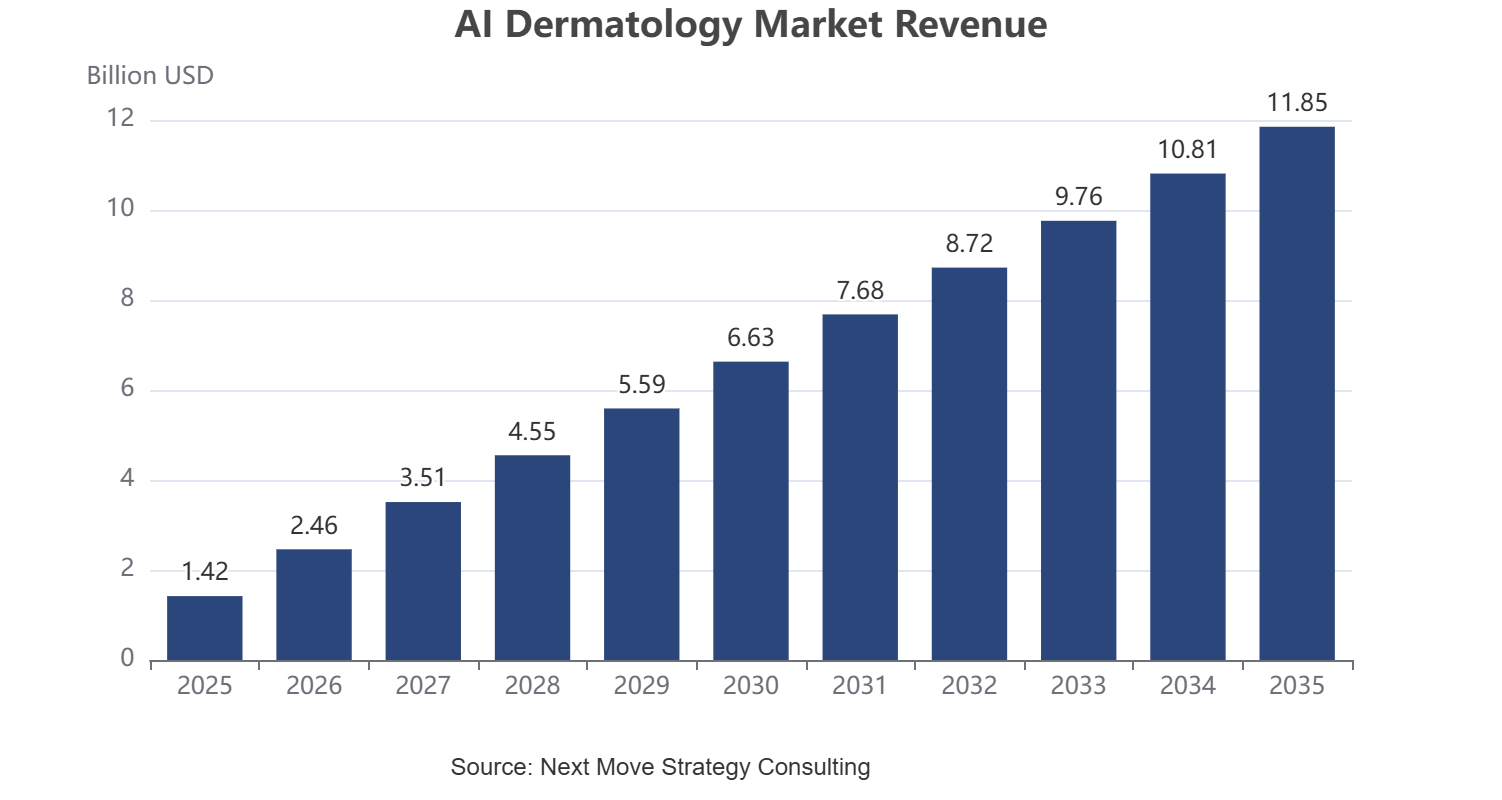
The global AI Dermatology Market size was valued at USD 1.42 Billion in 2025 and is estimated at USD 1.71 Billion in 2026, forecast to reach USD 11.85 Billion by 2035, expanding at a 24.0% CAGR between 2026 and 2035. North America leads with approximately 38% share, while under type, Software dominates with approximately 60% share.
We observed that the growth is broad-based across every segmentation axis, with cloud-deployed clinical decision support and consumer-facing skin analysis applications driving the dominant structural shifts through 2035.
|
Key Takeaways |
|
By Type: Software held the largest share of approximately 60% (USD 852 Million) in 2025; Services is the fastest-growing sub-segment at 30.3% CAGR from 2026–2035. |
|
By Deployment Mode: Cloud held the largest share of approximately 55% (USD 781 Million) in 2025; Edge is the fastest-growing sub-segment at 33.2% CAGR from 2026–2035. |
|
By Revenue Model: Subscription held the largest share of approximately 45% (USD 639 Million) in 2025; Usage Fee is the fastest-growing sub-segment at 27.0% CAGR from 2026–2035. |
|
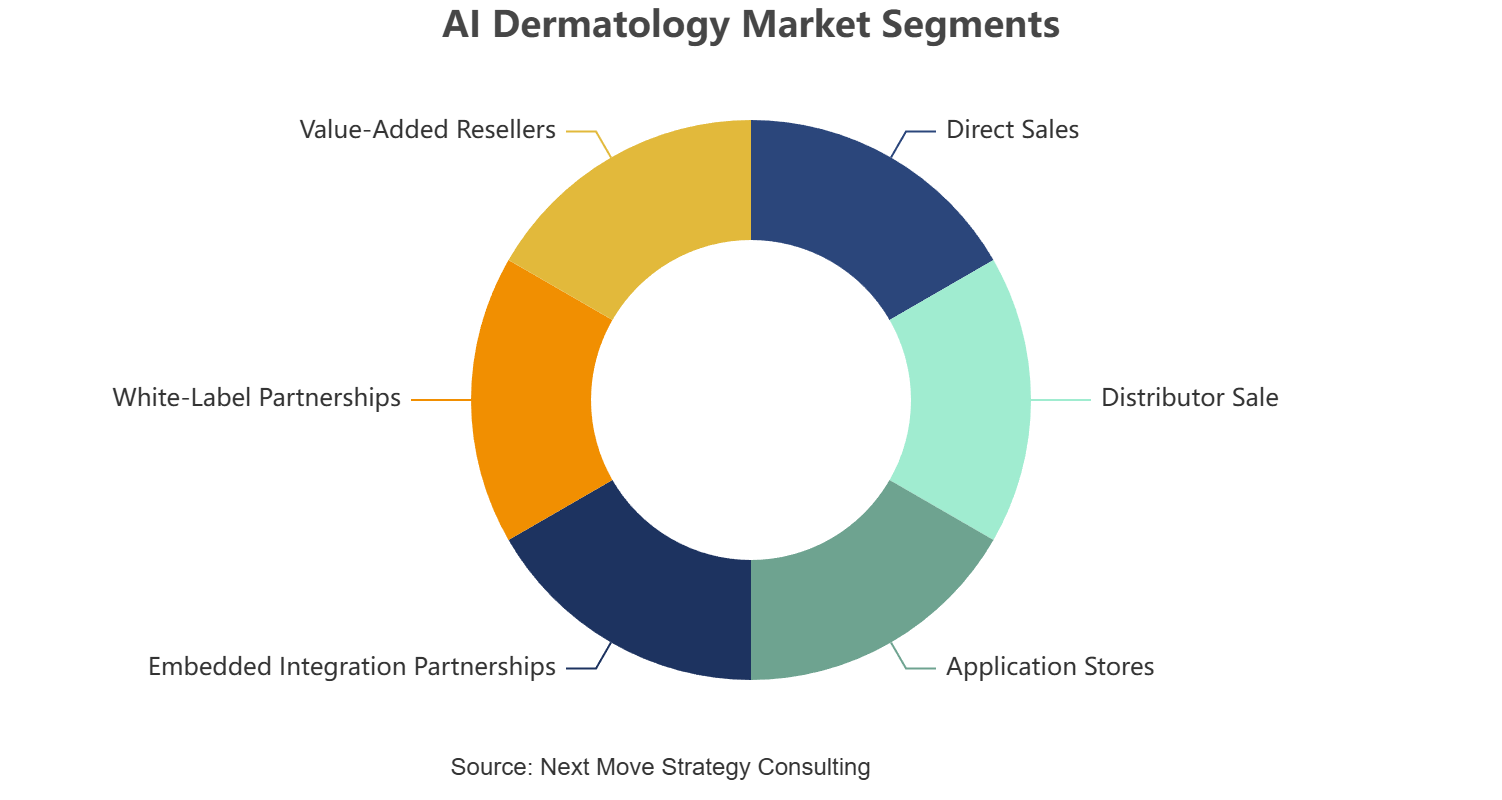
By Sales Channel: Direct Sales held the largest share of approximately 35% (USD 497 Million) in 2025; White-Label Partnerships is the fastest-growing sub-segment at 29.0% CAGR from 2026–2035. |
|
By End User: Healthcare Providers held the largest share of approximately 40% (USD 568 Million) in 2025; Beauty Care Companies is the fastest-growing sub-segment at 30.6% CAGR from 2026–2035. |
|
Dominant Region: North America dominated with approximately 38% revenue share (USD 540 Million) in 2025. |
|
Fastest-Growing Region: Asia-Pacific is expected to register the highest CAGR of 30.3% during 2026–2035. |
|
Dominant Country: U.S. led with approximately USD 425 Million in 2025. |
|
Fastest-Growing Country: India is the fastest-growing country at approximately 32.0% CAGR from 2026–2035. |
Between 2026 and 2035, the AI Dermatology Market is set to generate an absolute dollar opportunity of USD 10.14 Billion, positioning cloud-based clinical decision support and consumer skin analysis platforms as a compelling area for capital allocation.
According to Next Move Strategy Consulting analysis, sustained investment in edge-deployed diagnostic algorithms and dermatologist sign-off workflows is reshaping procurement criteria for healthcare providers, as regulatory clearance status increasingly determines vendor shortlisting across clinical and consumer channels.
What does the AI Dermatology Market Encompass?
The AI Dermatology Market encompasses software, hardware, and service offerings that apply machine learning and computer vision to skin image analysis, triage, and diagnostic support, without replacing clinician judgment. Our assessment indicates that the scope spans clinical decision support, teledermatology, consumer skin-check applications, beauty advisory tools, and licensable APIs deployed across healthcare providers, diagnostic laboratories, life sciences companies, contract research organizations, and beauty care companies worldwide. The category has evolved from experimental image-classification research into commercially deployed clinical and consumer products, driven by rising skin cancer incidence awareness, smartphone camera advances, and growing acceptance of AI-assisted triage in primary care.
Regulatory frameworks such as the U.S. Food and Drug Administration's Software as a Medical Device pathway and the European Union's Medical Device Regulation 2017/745 shape clearance requirements for clinical-grade dermatology algorithms, while national health technology assessment bodies increasingly evaluate AI diagnostic tools before reimbursement approval. We observed that technology adoption is shifting toward cloud and edge hybrid architectures that support real-time inference during clinical encounters. Next Move Strategy Consulting's analysis indicates that this structural shift, combined with expanding dermatologist sign-off service models, is redefining sourcing criteria across the AI Dermatology Market.
|
Parameters |
Details |
|
Market Size in 2025 |
USD 1.42 Billion |
|
Market Size in 2026 |
USD 1.71 Billion |
|
Revenue Forecast in 2035 |
USD 11.85 Billion |
|
Growth Rate |
CAGR of 24.0% from 2026 to 2035 |
|
Analysis Period |
2025–2035 |
|
Base Year Considered |
2025 |
|
Forecast Period |
2026–2035 |
|
Market Size Estimation |
Revenue (USD Billion) |
|
Companies Profiled |
20 |
|
Countries Covered |
38 |
|
Market Share |
Available for Top 10 Companies |
Key Emerging Trends
Based on research conducted by Next Move Strategy Consulting, we found that four structural trends are reshaping product development, clinical adoption, and stakeholder engagement across the AI Dermatology industry.
How Is Regulatory Clearance Reshaping Clinical AI Dermatology Adoption?
Regulatory clearance is becoming the primary gatekeeper for clinical-grade AI dermatology deployment, as healthcare providers increasingly restrict procurement to cleared or CE-marked algorithms. We observed that DermaSensor received U.S. FDA De Novo authorization for its point-of-care skin cancer detection device in January 2024, establishing a clearance benchmark that competitors now reference in commercial positioning. Hospitals and primary care networks are adopting clearance status as a procurement filter, while vendors accelerate regulatory submissions to unlock reimbursement-eligible clinical channels.
Why Is Teledermatology Integration Expanding Beyond Specialist Referral?
Teledermatology platforms are integrating AI triage directly into primary care and virtual-first care pathways, moving beyond traditional store-and-forward specialist referral. Our findings suggest that Skin Analytics' DERM platform, deployed across UK National Health Service trusts, screens suspicious lesions before dermatologist review, reducing specialist caseload. Primary care physicians are adopting these workflows to prioritize urgent referrals, while health systems redesign pathway protocols around AI-assisted triage checkpoints.
How Is Consumer Skin-Check Technology Expanding Beyond Cancer Screening?
Consumer-facing skin analysis applications are broadening from cancer-risk screening into mole tracking, acne care, and multi-condition monitoring embedded in everyday smartphone use. We observed that SkinVision's mobile application, used across more than 90 countries, combines risk scoring with longitudinal mole-tracking features to encourage repeat engagement. Consumers are adopting these tools for continuous self-monitoring, while insurers and employer wellness programs explore bundling access as a preventive-health benefit.
What Role Does Beauty-Tech AI Play in Retail Skin Advisory Services?
Beauty and personal care brands are embedding AI skin-advisor and virtual try-on capabilities directly into retail and e-commerce channels to personalize product recommendations. Our analysis shows that Perfect Corp.'s YouCam platform, integrated across major cosmetics retailers, analyzes facial skin conditions to recommend matched skincare regimens at point of sale. Retailers are adopting these kiosks and app integrations to lift conversion, while beauty brands license white-label modules to differentiate direct-to-consumer digital storefronts.
Consumer Behavior Analysis of the AI Dermatology Industry
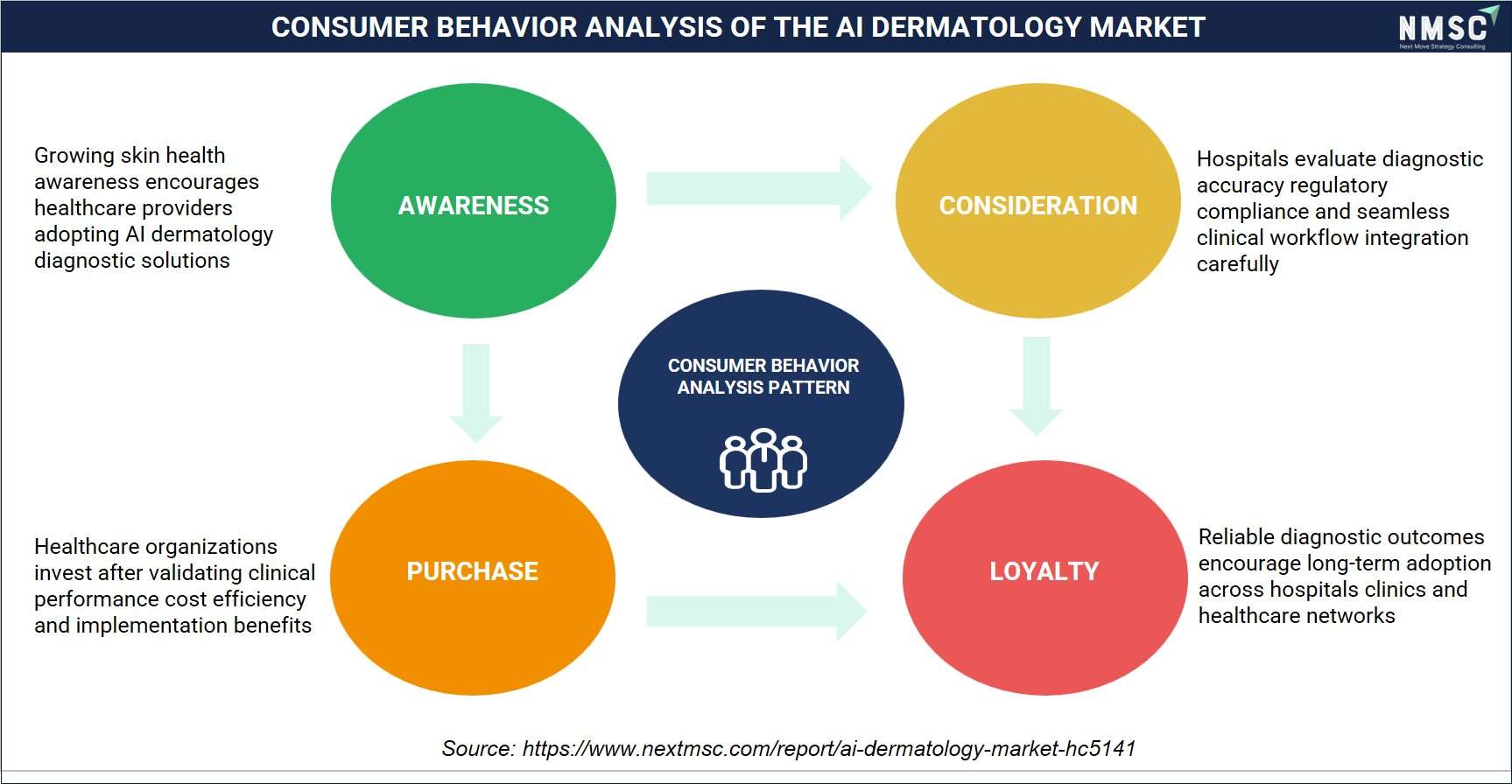
The consumer behavior analysis of the AI Dermatology industry highlights a structured adoption process among healthcare providers. Growing awareness of AI-assisted skin disease diagnosis encourages hospitals and clinics to explore advanced dermatology solutions. During evaluation, buyers prioritize diagnostic accuracy, regulatory compliance, interoperability with clinical workflows, and implementation costs. Purchasing decisions depend on validated clinical performance, operational efficiency, and return on investment. Long-term loyalty is driven by consistent diagnostic reliability, continuous software improvements, seamless integration, and dependable vendor support that strengthens confidence in AI-assisted dermatology applications.
Growth Drivers and Restraints
Growth Catalyst and Risk Assessment Matrix
|
Factors |
Type |
(+/−) % Impact on CAGR |
Geographic Relevance |
Impact Timeline |
|
Rising global skin cancer incidence |
Driver |
+3.4% |
Global |
2026-2035 |
|
FDA and EU MDR clearance pathways maturing |
Driver |
+2.6% |
North America, Europe |
2026-2035 |
|
Smartphone camera and edge-AI hardware advances |
Driver |
+2.1% |
Global |
2026-2035 |
|
Teledermatology reimbursement expansion |
Driver |
+1.7% |
North America, Europe |
2026-2032 |
|
Beauty-tech retail digitalization in Asia-Pacific |
Driver |
+1.9% |
Asia-Pacific |
2026-2035 |
|
Growing dermatologist shortage in primary care |
Driver |
+1.3% |
Global |
2026-2035 |
|
Data privacy and clinical-image governance requirements |
Restraint |
-1.4% |
Europe, North America |
2026-2035 |
|
Algorithmic bias across skin-tone representation |
Restraint |
-1.1% |
Global |
2026-2032 |
|
Limited reimbursement clarity in emerging markets |
Restraint |
-0.9% |
Latin America, MEA |
2028-2035 |
What Is the Primary Growth Driver of the AI Dermatology Market?
Rising global skin cancer incidence is the primary driver of the AI Dermatology industry. The World Health Organization estimates that between two and three million non-melanoma skin cancers occur globally each year, sustaining demand for early-detection screening tools. We observed that this epidemiological pressure, reinforced by aging populations in developed economies, continues to anchor baseline demand for clinical triage and consumer skin-check software across both mature and emerging healthcare systems.
How Is Regulatory Clearance Driving AI Dermatology Market Growth?
Maturing regulatory clearance pathways are accelerating market growth by de-risking clinical procurement decisions. The U.S. Food and Drug Administration's Digital Health Center of Excellence has cleared multiple dermatology-focused Software as a Medical Device product, while the European Union's Medical Device Regulation 2017/745 establishes conformity requirements for AI-based diagnostic software. Our assessment indicates that this regulatory maturation, combined with expanding hospital digital-health budgets, is compressing adoption timelines for clinical decision support and triage software.
What Is Restraining AI Dermatology Market Expansion?
Data privacy requirements and clinical-image governance obligations restrain deployment speed across the AI Dermatology industry. The European Union's General Data Protection Regulation imposes strict consent and cross-border transfer conditions on dermatological image data, delaying multi-country platform rollouts. We found that smaller vendors face particular exposure, as limited compliance infrastructure slows enterprise procurement cycles compared with larger, diversified health-technology suppliers.
Segmentation Analysis
Segment Sizing: By Type
|
Segment |
2025 (USD) |
2035 (USD) |
CAGR% (2026–2035) |
|
Software |
USD 852 Million |
USD 6.87 Billion |
23.5% |
|
Hardware |
USD 355 Million |
USD 2.21 Billion |
20.0% |
|
Services |
USD 213 Million |
USD 2.77 Billion |
30.3% |
|
Total |
USD 1.42 Billion |
USD 11.85 Billion |
24.0% |
Which Type Segment Dominates the AI Dermatology Market?
Software, encompassing clinical, telederm, consumer, beauty, and API-based offerings, led the AI Dermatology Market with USD 852 Million in 2025, supported by low deployment friction and scalable licensing economics. We observed that Services is the fastest-growing type segment, expanding at a 30.3% CAGR from 2026 to 2035, as dermatologist sign-off and screening-operations services scale alongside expanding clinical triage deployments requiring human oversight.
Segment Sizing: By Deployment Mode
|
Segment |
2025 (USD) |
2035 (USD) |
CAGR% (2026–2035) |
|
Cloud |
USD 781 Million |
USD 6.56 Billion |
24.1% |
|
On-Premise |
USD 213 Million |
USD 976 Million |
16.0% |
|
Edge |
USD 142 Million |
USD 2.25 Billion |
33.2% |
|
Hybrid |
USD 213 Million |
USD 1.66 Billion |
23.1% |
|
Embedded |
USD 71 Million |
USD 410 Million |
19.0% |
|
Total |
USD 1.42 Billion |
USD 11.85 Billion |
24.0% |
Which Deployment Mode Leads AI Dermatology Market Demand?
Cloud deployment remained the leading mode within the AI Dermatology Market, valued at USD 781 Million in 2025 on sustained adoption of centrally hosted clinical and consumer platforms. Our findings suggest that Edge is the fastest-growing deployment mode, registering a 33.2% CAGR from 2026 to 2035, as point-of-care devices increasingly run inference locally to support real-time triage without network dependency in clinical settings.
Segment Sizing: By End User
|
Segment |
2025 (USD) |
2035 (USD) |
CAGR% (2026–2035) |
|
Healthcare Providers |
USD 568 Million |
USD 4.26 Billion |
22.6% |
|
Diagnostic Laboratories |
USD 213 Million |
USD 1.38 Billion |
20.5% |
|
Life Sciences Companies |
USD 170 Million |
USD 1.38 Billion |
23.6% |
|
Contract Research Organizations |
USD 114 Million |
USD 680 Million |
19.5% |
|
Beauty Care Companies |
USD 284 Million |
USD 3.79 Billion |
30.6% |
|
Other End Users |
USD 71 Million |
USD 364 Million |
17.5% |
|
Total |
USD 1.42 Billion |
USD 11.85 Billion |
24.0% |
Which End User Segment Leads AI Dermatology Market Demand?
Healthcare Providers remained the leading end user within the AI Dermatology industry, valued at USD 568 Million in 2025 on sustained hospital and primary care clinical decision support adoption. Based on research conducted by Next Move Strategy Consulting, we found that Beauty Care Companies represent the fastest-growing end user, registering a 30.6% CAGR from 2026 to 2035, as retail skin-advisory and virtual try-on deployments scale across global cosmetics distribution networks.
Growth Opportunities
Our analysis shows that three forward-looking opportunities stand out for stakeholders positioning within the AI Dermatology industry over the 2026-2035 forecast period.
How Are Point-of-Care Diagnostic Devices Creating Opportunities for Primary Care Providers?
Point-of-care dermoscopy and spectroscopy devices present a whitespace opportunity for primary care providers seeking to triage suspicious lesions without specialist referral delay. Hardware vendors that secure regulatory clearance for handheld cancer-detection devices stand to capture recurring per-use revenue as primary care networks adopt early-screening protocols ahead of dermatologist consultation.
Why Are White-Label API Modules Emerging as a Growth Opportunity for Beauty Retailers?
Beauty and personal care retailers represent an underpenetrated opportunity for white-label skin-analysis APIs embedded directly into branded retail applications. Vendors that license modular skin-analysis and product-recommendation APIs can secure long-term partnership contracts with beauty care companies, benefiting from recurring per-scan revenue tied to retail engagement volume.
How Are Real-World Evidence Services Unlocking Opportunities for Life Sciences Companies?
Life sciences companies seeking dermatology-focused real-world evidence create an opportunity for research service providers offering AI-enabled endpoint and core lab services. Early movers that build validated image-analysis pipelines for clinical trials can differentiate with pharmaceutical sponsors pursuing dermatology drug development programs requiring standardized outcome measurement.
Regional Outlook
Geographic Performance Snapshot
|
Region |
2025 (USD) |
2035 (USD) |
CAGR% (2026–2035) |
Key Driver |
|
North America |
USD 540 Million |
USD 4.08 Billion |
22.6% |
FDA clearance pathway maturity and dermatologist shortage |
|
Europe |
USD 341 Million |
USD 2.22 Billion |
20.6% |
EU MDR conformity and NHS teledermatology adoption |
|
Asia-Pacific |
USD 312 Million |
USD 4.06 Billion |
30.3% |
Smartphone penetration and beauty-tech retail expansion |
|
Middle East & Africa |
USD 128 Million |
USD 897 Million |
21.6% |
Vision 2030-linked digital health investment |
|
Latin America |
USD 99 Million |
USD 597 Million |
19.6% |
Growing teledermatology access in underserved regions |
|
Total |
USD 1.42 Billion |
USD 11.85 Billion |
24.0% |
-- |
North America AI Dermatology Market Outlook
North America leads the AI Dermatology industry with an advanced regulatory-clearance ecosystem and a mature digital-health investment base. We observed that U.S. Food and Drug Administration Software as a Medical Device clearances sustain demand for clinical decision support tools, while healthcare providers increasingly specify cloud-hybrid architectures to meet interoperability requirements. Technology adoption remains advanced, with dermatologist-shortage pressure driving demand for AI-assisted triage across primary care networks.
Europe AI Dermatology Market Outlook
Europe's AI Dermatology industry reflects a mature but conformity-intensive landscape shaped by the European Union's Medical Device Regulation 2017/745 and General Data Protection Regulation requirements. Our findings suggest that healthcare systems across the UK, Germany, and France are accelerating adoption of teledermatology triage platforms to reduce dermatologist waiting times. Technology adoption favors on-premise and hybrid architectures, supported by national health service digitalization programs.
Asia-Pacific AI Dermatology Market Outlook
Asia-Pacific is the fastest-growing AI Dermatology industry region, propelled by expanding smartphone-based consumer skin-check adoption in China and India and rapidly digitalizing beauty retail channels. We found that regulatory frameworks remain less harmonized than in Europe, giving consumer-facing vendors flexibility to scale rapidly. Technology adoption is accelerating as regional beauty-tech suppliers expand across cosmetics e-commerce platforms.
Middle East & Africa AI Dermatology Market Outlook
The Middle East & Africa AI Dermatology industry is expanding as Gulf Cooperation Council economies invest in digital health infrastructure tied to national diversification strategies. Our analysis shows that Saudi Arabia and the UAE are attracting clinical AI investment tied to hospital modernization programs. Regulatory influence remains moderate, while technology adoption is gradually shifting toward cloud-hosted teledermatology platforms serving underserved rural populations.
Latin America AI Dermatology Market Outlook
Latin America's AI Dermatology industry is supported by growing teledermatology access initiatives in Brazil and Argentina addressing dermatologist scarcity in underserved regions. We observed that regulatory frameworks are less stringent than in North America or Europe, though public health systems are piloting AI-assisted triage to extend specialist reach. Technology adoption remains centered on cloud-hosted consumer applications, with competitive intensity increasing as regional distributors partner with global platform vendors.
U.S. AI Dermatology Market
Based on our engagements, the U.S. AI Dermatology industry was valued at approximately USD 425 Million in 2025 and is projected to reach USD 3,195 Million by 2035, growing at a 21.5% CAGR. Demand is anchored by mature regulatory-clearance infrastructure, high dermatologist-shortage pressure, and advanced hospital digital-health budgets. Technology penetration favors cloud-hybrid clinical decision support, with competitive intensity shaped by both global platform vendors and domestic health-technology suppliers.
Canada AI Dermatology Market
Through our analysis, the Canada AI Dermatology industry was valued at approximately USD 80 Million in 2025 and is projected to reach USD 827 Million by 2035, growing at a 27.0% CAGR. Demand is anchored by provincial telehealth expansion and Health Canada digital-health guidance. Technology penetration is rising as regional health authorities pilot AI-assisted triage, with competitive intensity shaped by both global platform vendors and domestic health-technology suppliers.
UK AI Dermatology Market
From our assessment, the UK AI Dermatology industry was valued at approximately USD 58 Million in 2025 and is projected to reach USD 334 Million by 2035, growing at a 19.0% CAGR. Demand is anchored by National Health Service teledermatology adoption and Medicines and Healthcare products Regulatory Agency clearance pathways. Technology penetration favors cloud-hosted triage platforms, with competitive intensity shaped by both global platform vendors and domestic health-technology suppliers.
Germany AI Dermatology Market
According to evaluation, the Germany AI Dermatology industry was valued at approximately USD 75 Million in 2025 and is projected to reach USD 502 Million by 2035, growing at a 21.0% CAGR. Demand is anchored by strong domestic digital-health reimbursement framework (DiGA) and a dense dermatology specialist network navigating capacity constraints. Technology penetration favors hybrid clinical deployments, with competitive intensity shaped by both global platform vendors and domestic health-technology suppliers.
France AI Dermatology Market
Based on our engagements, the France AI Dermatology industry was valued at approximately USD 52 Million in 2025 and is projected to reach USD 323 Million by 2035, growing at a 20.0% CAGR. Demand is anchored by national teledermatology reimbursement programs and a concentration of academic dermatology research centers. Technology penetration favors cloud-hosted consumer and clinical applications, with competitive intensity shaped by both global platform vendors and domestic health-technology suppliers.
China AI Dermatology Market
Through our analysis, the China AI Dermatology industry was valued at approximately USD 110 Million in 2025 and is projected to reach USD 1,222 Million by 2035, growing at a 28.0% CAGR. Demand is anchored by expanding domestic beauty-tech retail adoption and a dense base of consumer skin-analysis application developers. Technology penetration is accelerating through smartphone-embedded skin-check features, with competitive intensity shaped by both global platform vendors and domestic health-technology suppliers.
India AI Dermatology Market
From our assessment, the India AI Dermatology industry was valued at approximately USD 60 Million in 2025 and is projected to reach USD 878 Million by 2035, growing at a 32.0% CAGR. Demand is anchored by the fastest-growing country covered, driven by rapid smartphone penetration and expanding teledermatology access addressing acute dermatologist scarcity. Technology penetration favors mobile consumer applications, with competitive intensity shaped by both global platform vendors and domestic health-technology suppliers.
Japan AI Dermatology Market
According to evaluation, the Japan AI Dermatology industry was valued at approximately USD 55 Million in 2025 and is projected to reach USD 294 Million by 2035, growing at a 18.0% CAGR. Demand is anchored by an aging population driving skin cancer screening demand and a cautious regulatory environment favoring validated clinical devices. Technology penetration favors hospital-grade dermoscopy hardware, with competitive intensity shaped by both global platform vendors and domestic health-technology suppliers.
South Korea AI Dermatology Market
Based on our engagements, the South Korea AI Dermatology industry was valued at approximately USD 40 Million in 2025 and is projected to reach USD 288 Million by 2035, growing at a 22.0% CAGR. Demand is anchored by a globally influential beauty-tech industry and high consumer smartphone-app engagement. Technology penetration favors beauty advisory and virtual try-on applications, with competitive intensity shaped by both global platform vendors and domestic health-technology suppliers.
Australia AI Dermatology Market
Through our analysis, the Australia AI Dermatology industry was valued at approximately USD 25 Million in 2025 and is projected to reach USD 144 Million by 2035, growing at a 19.0% CAGR. Demand is anchored by among the world's highest skin cancer incidence rates and strong public-health screening initiatives. Technology penetration favors consumer skin-check and mole-mapping applications, with competitive intensity shaped by both global platform vendors and domestic health-technology suppliers.
UAE AI Dermatology Market
From our assessment, the UAE AI Dermatology industry was valued at approximately USD 30 Million in 2025 and is projected to reach USD 233 Million by 2035, growing at a 23.0% CAGR. Demand is anchored by hospital modernization investment tied to national digital-health strategy and growing medical tourism. Technology penetration favors cloud-hosted clinical decision support, with competitive intensity shaped by both global platform vendors and domestic health-technology suppliers.
Saudi Arabia AI Dermatology Market
According to evaluation, the Saudi Arabia AI Dermatology industry was valued at approximately USD 35 Million in 2025 and is projected to reach USD 292 Million by 2035, growing at a 24.0% CAGR. Demand is anchored by Vision 2030-linked digital health investment and expanding public hospital AI adoption programs. Technology penetration favors hybrid clinical deployments, with competitive intensity shaped by both global platform vendors and domestic health-technology suppliers.
South Africa AI Dermatology Market
Based on our engagements, the South Africa AI Dermatology industry was valued at approximately USD 20 Million in 2025 and is projected to reach USD 124 Million by 2035, growing at a 20.0% CAGR. Demand is anchored by growing teledermatology pilots addressing specialist scarcity in underserved provinces. Technology penetration remains centered on cloud-hosted consumer applications, with competitive intensity shaped by both global platform vendors and domestic health-technology suppliers.
Brazil AI Dermatology Market
Through our analysis, the Brazil AI Dermatology industry was valued at approximately USD 55 Million in 2025 and is projected to reach USD 317 Million by 2035, growing at a 19.0% CAGR. Demand is anchored by expanding public health teledermatology access programs and a growing private beauty-tech consumer base. Technology penetration favors cloud-hosted consumer applications, with competitive intensity shaped by both global platform vendors and domestic health-technology suppliers.
Argentina AI Dermatology Market
From our assessment, the Argentina AI Dermatology industry was valued at approximately USD 20 Million in 2025 and is projected to reach USD 107 Million by 2035, growing at a 18.0% CAGR. Demand is anchored by steady teledermatology adoption despite macroeconomic volatility affecting healthcare technology budgets. Technology penetration remains modest, centered on urban private clinics, with competitive intensity shaped by both global platform vendors and domestic health-technology suppliers.
Porter's Five Forces Analysis of the AI Dermatology Industry
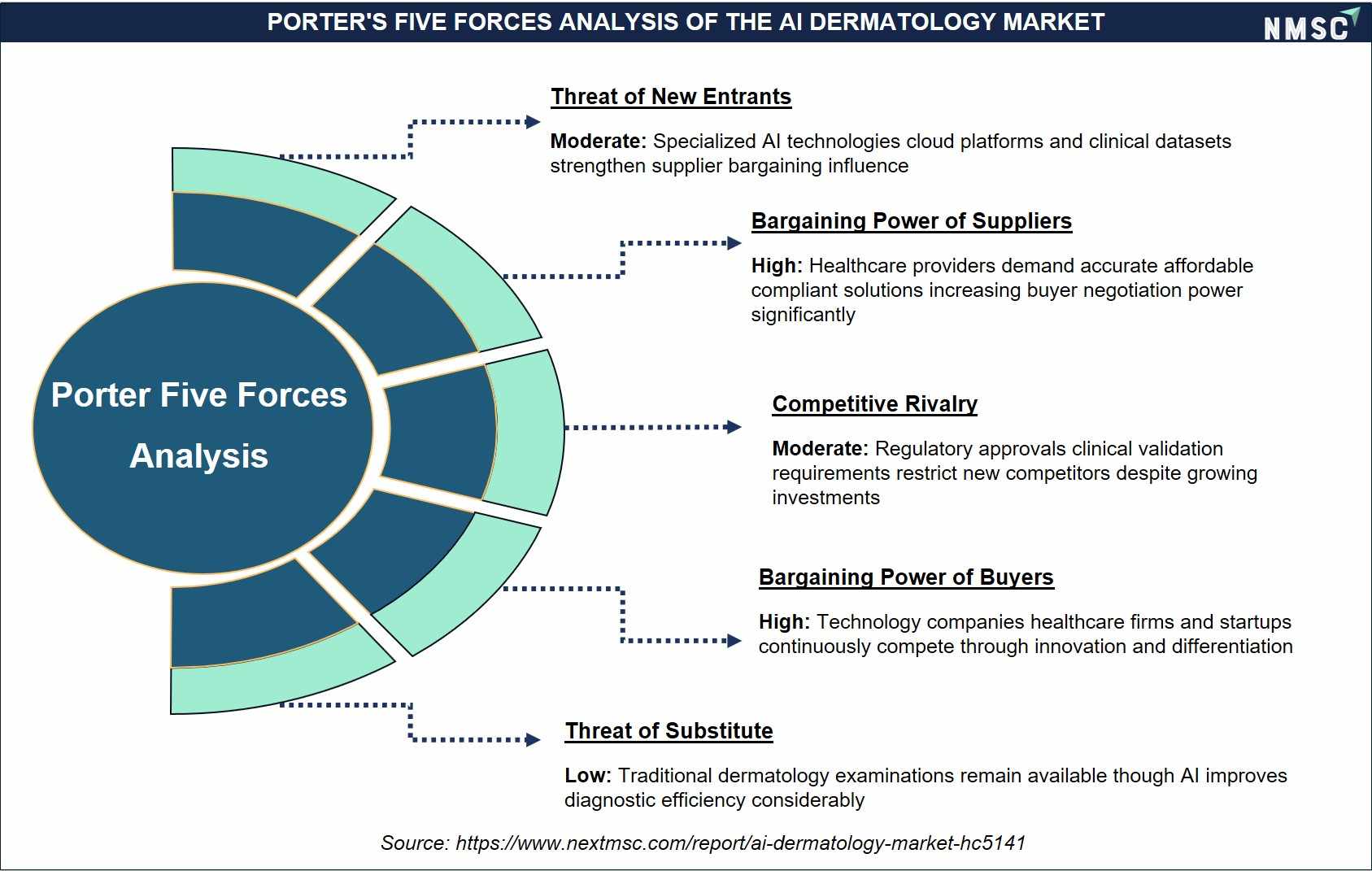
The Porter's Five Forces analysis of the AI Dermatology Market indicates moderate competitive rivalry driven by rapid technological innovation and increasing participation from healthcare AI providers. Buyer bargaining power remains high as healthcare organizations demand clinically validated, cost-effective, and regulatory-compliant solutions. Supplier power is moderate due to reliance on AI technology, cloud infrastructure, and specialized medical datasets. The threat of substitutes is limited because AI complements rather than replaces dermatologists, while barriers related to regulatory approvals and clinical validation moderate the threat of new entrants.
Competitive Landscape
We observed that the AI Dermatology industry features a moderately fragmented competitive landscape, with clinical-grade specialists, consumer beauty-tech platforms, and diversified personal care conglomerates competing across distinct deployment channels.
|
Key Takeaways |
|
Market Structure—Moderately fragmented; specialized clinical AI vendors compete alongside diversified beauty and personal care conglomerates that embed AI skin-analysis capabilities into broader consumer product portfolios. |
|
Innovation Focus—Regulatory-cleared clinical triage algorithms, edge-deployed point-of-care devices, and white-label skin-analysis APIs dominate current innovation pipelines across leading suppliers. |
|
M&A Activity—Selective consolidation and licensing partnerships, exemplified by beauty conglomerates licensing third-party skin-diagnostic technology to accelerate digital product launches. |
How Do Companies Compete in the AI Dermatology Market?
Companies compete primarily on regulatory clearance status, clinical validation depth, and platform integration flexibility across the AI Dermatology Market. Clinical specialists such as Skin Analytics and DermaSensor leverage regulatory clearance to secure hospital procurement, while beauty-technology platforms such as Perfect Corp. and Revieve compete on consumer engagement metrics and retail integration breadth supplied to global cosmetics brands.
Which Competitive Archetypes Dominate the AI Dermatology Market?
Two archetypes dominate the AI Dermatology Market: specialized clinical-grade AI developers pursuing regulatory clearance for diagnostic and triage use cases, and diversified beauty or personal care companies embedding AI advisory tools into existing consumer product ecosystems. Proscia and PathAI exemplify the clinical specialist archetype through pathology-focused image analysis, while L'Oréal and Shiseido exemplify the diversified consumer archetype through integrated skin-advisor applications.
How Are Companies Differentiating Through Innovation in AI Dermatology?
Innovation and differentiation strategy increasingly center on regulatory clearance breadth and multi-condition detection accuracy. DermaSensor's point-of-care device and Skin Analytics' DERM platform both anchor differentiation in clinical validation studies published through peer-reviewed channels. Our analysis shows that vendors unable to demonstrate credible clinical evidence risk exclusion from healthcare provider procurement shortlists in North America and Europe.
What M&A and Expansion Activity Is Shaping the AI Dermatology Market?
Licensing partnerships and geographic expansion continue to shape capability consolidation within the AI Dermatology Market. Beauty conglomerates including L'Oréal and Shiseido have expanded technology licensing and in-house digital innovation labs to accelerate skin-diagnostic feature deployment, while clinical vendors pursue geographic expansion into new national health system partnerships to broaden dermatologist sign-off service reach.
Key Market Players
Our assessment indicates that the following 20 companies represent the validated competitive set actively shaping product innovation, regulatory strategy, and commercial expansion within the global AI Dermatology Market.
-
Canfield Scientific
-
FotoFinder Systems
-
Skin Analytics
-
DermaSensor
-
VisualDx
-
MetaOptima
-
Perfect Corp.
-
Revieve
-
Haut.AI
-
SkinVision
-
Legit.Health
-
SkinIO
-
Skinive
-
Proscia
-
PathAI
-
L'Oréal
-
The Procter & Gamble Company
-
Shiseido
-
CureSkin
Latest Developments
We found that recent product and regulatory developments within the AI Dermatology Market are concentrated on clinical clearance milestones and consumer platform expansion, reflecting the industry's transition from pilot deployment to commercial scale.
|
Date |
Event |
|
July 2026 |
Haut.AI introduced its new "Body Analysis" platform, a first-of-its-kind AI-powered technology trained on over 100,000 skin images to provide objective, quantitative skin data across the entire body (including torso, arms, legs, and feet). This tool is designed for B2B partners to deliver hyper-personalized body care recommendations, addressing a historically underserved segment of the skincare market |
|
June 2026 |
At HLTH Europe, Skin Analytics unveiled DERM Zero, the world's first Class III regulated medical device technology that delivers autonomous, clinical-grade skin cancer assessments directly from a standard smartphone. Building on its success in NHS hospital pathways, this technology removes the need for specialized dermatoscope hardware or clinical wait times, enabling rapid, non-invasive triage. |
|
June 2026 |
Announced at VivaTech 2026, L'Oréal and OpenAI entered a landmark collaboration to pioneer "agentic commerce" and scientific innovation. L'Oréal is utilizing GPT-Rosalind, OpenAI's purpose-built life sciences model, to map the skin microbiome at an unprecedented scale, accelerating the development of the next generation of personalized, microbiome-conscious skincare products. |
Expert Insights

“We are entering the golden age of predictive and generative artificial intelligence in healthcare, and these capabilities are being paired with novel types of technology, like spectroscopy and genetic sequencing, to optimize disease detection and care.”
— Cody Simmons, CEO, DermaSensor
Statement was made during the official announcement of DermaSensor receiving U.S. FDA clearance for its AI-powered, non-invasive device designed to assist primary care physicians in detecting common skin cancers, including melanoma, basal cell carcinoma, and squamous cell carcinoma.
Market Interpretation
The statement highlights a significant technological convergence shaping the AI dermatology market, where artificial intelligence is increasingly integrated with advanced diagnostic modalities such as spectroscopy and genomic analysis. This convergence is enabling the development of highly accurate, non-invasive diagnostic tools for early detection of skin cancers and other dermatological conditions. As healthcare systems prioritize early diagnosis and precision medicine, AI-powered dermatology solutions are gaining traction across primary care and specialty settings. Furthermore, regulatory milestones, such as FDA clearances for AI-based dermatology devices, are accelerating commercialization and reinforcing market confidence, thereby driving broader adoption and investment in AI-driven skin diagnostic technologies.
Investment Opportunities
What Capital Inflows Are Targeting the AI Dermatology Market?
Capital inflows into the AI Dermatology Market are increasingly directed toward regulatory-clearance programs and clinical validation studies. Strategic acquirers and venture investors continue to fund clinical-grade vendors pursuing FDA and EU MDR pathways. We observed that investors favor companies demonstrating validated clinical evidence, viewing regulatory clearance as a proxy for long-term healthcare provider contract retention.
How Is Infrastructure Investment Supporting AI Dermatology Deployment?
Infrastructure investment is expanding cloud-hosting and edge-inference capacity to support real-time clinical triage across growing healthcare provider networks. Our findings suggest that vendors are investing in interoperability tooling to integrate with electronic health record systems, supporting the workflow integration required for clinical decision support and dermpath analysis deployments.
What ESG Considerations Are Shaping AI Dermatology Investment Decisions?
Environmental, social, and governance considerations are increasingly central to investment decisions across the AI Dermatology Market, with algorithmic fairness across diverse skin tones as a key governance criterion. The World Health Organization continues to highlight equitable access to skin cancer screening as a global health priority. We found that investors increasingly favor vendors with published bias-testing methodology, treating it as a governance indicator alongside data-privacy compliance.
Key Benefits for Stakeholders
How Does This Report Benefit Enterprise and Industry Leaders?
Enterprise and industry leaders gain access to validated segmentation, competitive benchmarking, and regional demand forecasts that support product-portfolio and go-to-market decisions across the AI Dermatology Market. Our analysis shows that detailed deployment-mode and end-user breakdowns help product teams align specifications with regulatory and reimbursement requirements while identifying underserved segments for portfolio expansion.
How Does This Report Benefit Investors and Financial Analysts?
Investors and financial analysts benefit from consistent, single-point market size and CAGR estimates that support valuation and capital-allocation decisions across the AI Dermatology Market supply chain. We observed that the report's regional and segment-level growth differentials help identify which vendors are best positioned to capture above-market growth in edge deployment and beauty-tech categories through 2035.
How Does This Report Benefit Technology Vendors and Product Teams?
Technology vendors and product teams gain insight into emerging clearance requirements, deployment architecture shifts, and clinical validation expectations reshaping the AI Dermatology Market. Our findings suggest that this analysis helps R&D teams prioritize development roadmaps around regulatory clearance and bias-testing methodology increasingly required by healthcare provider procurement processes.
Key Market Segments
By Type
-
Software
-
Clinical
-
Triage
-
Pathway
-
Referral
-
Decision Support
-
Differential Diagnosis
-
Dermpath Analysis
-
-
Telederm
-
Store and Forward
-
Live Video
-
-
Consumer
-
Skin Cancer Check
-
Mole Tracking
-
Risk Education
-
Symptom Checker
-
Multi-Condition Analysis
-
Acne Care
-
-
Beauty
-
Skin Advisor
-
Product Recommendation
-
Virtual Try-On
-
Retail Kiosk
-
-
API and SDK
-
Skin Analysis API
-
Detection Module
-
Simulation Module
-
White Label Module
-
Quiz Widget
-
-
-
Hardware
-
Dermoscopy
-
Phone Attachment
-
Standalone Device
-
-
Total Body Imaging
-
3D Imaging
-
Mole Mapping
-
-
Spectroscopy
-
Cancer Detection
-
Multi-Spectral Probe
-
-
Facial Analysis
-
Clinical Scanner
-
Retail Scanner
-
-
-
Services
-
Clinical Review
-
Dermatologist Sign-Off
-
Screening Ops
-
-
Implementation
-
Workflow Integration
-
EHR Integration
-
Custom Development
-
-
Research
-
Core Lab
-
Endpoint Services
-
Real-World Evidence
-
-
By Deployment Mode
-
Cloud
-
On-Premise
-
Edge
-
Hybrid
-
Embedded
By Revenue Model
-
Subscription
-
Usage Fee
-
Per Member Fee
-
Equipment Sale
-
Project Fee
By Sales Channel
-
Direct Sales
-
Distributor Sales
-
Application Stores
-
Embedded Integration Partnerships
-
White-Label Partnerships
-
Value-Added Resellers
By End User
-
Healthcare Providers
-
Diagnostic Laboratories
-
Life Sciences Companies
-
Contract Research Organizations
-
Beauty Care Companies
-
Other End Users
By Region
-
North America: U.S., Canada, Mexico
-
Europe: UK, Germany, France, Italy, Spain, Sweden, Denmark, Finland, Netherlands, Rest of Europe
-
Asia-Pacific: China, India, Japan, South Korea, Taiwan, Indonesia, Vietnam, Australia, Philippines, Malaysia, Rest of APAC
-
Middle East & Africa: Saudi Arabia, UAE, Egypt, Israel, Turkey, Nigeria, South Africa, Rest of MEA
-
Latin America: Brazil, Argentina, Chile, Colombia, Rest of LATAM
Conclusion and Recommendations
What Is the Long-Term Outlook for the AI Dermatology Market?
The long-term outlook for the AI Dermatology Market remains strongly positive, with global revenue projected to expand more than eightfold from USD 1.42 billion in 2025 to USD 11.85 billion by 2035 at a 24.0% CAGR. We observed that sustained skin cancer incidence, dermatologist-shortage pressure, and maturing regulatory clearance pathways will continue underpinning demand across clinical, consumer, and beauty-tech applications through the forecast period.
What Strategic Positioning Should AI Dermatology Vendors Pursue?
Vendors should prioritize regulatory clearance programs and peer-reviewed clinical validation to secure long-term healthcare provider contracts. Our assessment indicates that companies investing early in bias-tested, multi-skin-tone algorithm training and edge-deployment capability will be best positioned to capture premium clinical pricing within the AI Dermatology Market.
How Attractive Is the AI Dermatology Market for New Investment?
The AI Dermatology Market presents an attractive investment case, supported by a USD 10.14 billion absolute dollar opportunity between 2026 and 2035 and above-average growth in Asia-Pacific and beauty-tech categories. We found that investment attractiveness is highest for vendors combining clinical validation credentials with scalable cloud-edge hybrid infrastructure, positioning them to serve both regulated clinical and high-volume consumer segments simultaneously.
What Market Shifts and Key Risks Should Stakeholders Monitor?
Stakeholders should monitor data-privacy compliance costs, algorithmic bias scrutiny, and reimbursement uncertainty in emerging markets as key risks to the AI Dermatology Market. Our analysis shows that vendors unable to demonstrate equitable performance across diverse skin tones risk exclusion from healthcare provider procurement, particularly within Europe's increasingly regulated data-governance environment.
What Are the Key Growth Pathways for the AI Dermatology Market?
Key growth pathways include expanding point-of-care hardware portfolios, scaling dermatologist sign-off service capacity, and deepening penetration into beauty-tech retail channels. Next Move Strategy Consulting's analysis indicates that vendors pursuing these pathways while maintaining regulatory compliance across core clinical categories will be best positioned to capture the AI Dermatology Market's projected growth through 2035.
About the Author
 Saista Faiyaz
— Saista Faiyaz is Research Associate at Next Move Strategy Consulting, where she has covered consumer markets and healthcare technologies for 3 years. Her work includes primary interview review, secondary-source validation, market sizing, and structured analysis of company and industry data. She supports research by comparing evidence across sources, organizing findings into market narratives, and documenting assumptions used in analysis. Her scope includes cross-market benchmarking, and reports.
Saista Faiyaz
— Saista Faiyaz is Research Associate at Next Move Strategy Consulting, where she has covered consumer markets and healthcare technologies for 3 years. Her work includes primary interview review, secondary-source validation, market sizing, and structured analysis of company and industry data. She supports research by comparing evidence across sources, organizing findings into market narratives, and documenting assumptions used in analysis. Her scope includes cross-market benchmarking, and reports.
About the Reviewer
 Supradip Baul
— Supradip Baul is an accomplished business consultant and strategist with over a decade of rich experience in market intelligence, strategy, technology, and business transformation. His work has included rigorous qualitative and quantitative analysis across multiple industries, helping clients shape investment decisions and long-term roadmaps. Earlier in his career, he was associated with Gartner, where he contributed to industry-leading reports and market share analyses. He has worked with leading global companies and holds an MBA with a dual specialization in Marketing and Finance.
Supradip Baul
— Supradip Baul is an accomplished business consultant and strategist with over a decade of rich experience in market intelligence, strategy, technology, and business transformation. His work has included rigorous qualitative and quantitative analysis across multiple industries, helping clients shape investment decisions and long-term roadmaps. Earlier in his career, he was associated with Gartner, where he contributed to industry-leading reports and market share analyses. He has worked with leading global companies and holds an MBA with a dual specialization in Marketing and Finance.
At Next Move Strategy Consulting, we understand that insightful market research is the cornerstone of successful business decisions. That's why we employ a robust and multifaceted approach, combining various methodologies to deliver the most accurate and actionable data for our clients.

Research Landscape
We navigate the world of research with two primary approaches:
Qualitative Approach
Our qualitative research methodologies involve immersive techniques such as in-depth interviews, focus groups, and observational studies. By engaging directly with individuals and stakeholders, we uncover valuable insights that quantitative data alone may overlook.

Quantitative Research
In tandem with qualitative methodologies, NMSC leverages the power of Quantitative Research to provide a robust foundation of numerical insights. Through systematic data collection and analysis, we quantify patterns, preferences, and market trends, offering a comprehensive view of the business landscape.
Our quantitative research approach employs diverse tools, including surveys, experiments, and statistical modelling. These methodologies enable us to gather data from a large and representative sample, ensuring the statistical significance of our findings. By employing structured questionnaires and standardized data collection methods, we guarantee the reliability and validity of the information we present to our clients.
Quantitative research is particularly effective in measuring the prevalence of trends, assessing market size, and gauging the impact of various factors on consumer behavior. The numerical precision attained through this approach equips our clients with actionable insights, facilitating data-driven decision-making and strategy formulation.


Our Specialized Toolbox for Industry-Specific Market Research
We deploy a specialized arsenal of techniques tailored to meet your unique requirements. Here's a glimpse into our comprehensive toolbox:

Information Procurement
The stage entails acquiring market data or relevant information through various sources and methodologies.


Market Research Approach
We utilize both top-down and bottom-up approaches in market research analysis to achieve a comprehensive understanding of the market dynamics, leveraging the broad perspective of industry trends and macroeconomic factors alongside detailed insights from specific segments and individual companies.

Porters Five Forces Analysis
We conduct Porter's Five Forces analysis to evaluate the competitive landscape of an industry, providing us with insights into factors that affect profitability and strategic positioning.

SWOT Analysis

Forecasting
We utilize a forecasting model to predict future consumption by considering parameters like population, economics, regulations, market competition, drivers, constraints, technology, and pricing. We also employ statistical techniques such as multilinear regression, exponential smoothing, moving average, ARIMA, and Monte Carlo simulations for accurate predictions. In econometric forecasting, we analyzed short-term and long-term event impacts, attributing values based on regulatory frameworks, economic factors, and market events.





 Speak to Our Analyst