AI Red Teaming Market Global Industry Analysis and Forecast (2026–2035)

Rising enterprise exposure to prompt injection and agent misuse, new adversarial testing duties for providers of advanced models, and the shift to continuous automated testing lift AI Red Teaming Market revenue from USD 520.00 Million in 2025 to USD 4,100.00 Million by 2035, a 22.9% CAGR over 2026 to 2035, with North America holding the lead.
Download Free Sample PDF
Base Year (2025)
$520.0 Million
Forecast (2035)
$4,100.0 Million
CAGR (2026-2035)
22.9%
Top Region
North America

What Is the AI Red Teaming Market Size?
The global AI Red Teaming Market reached USD 520.00 Million in 2025 and is estimated at USD 640.00 Million in 2026, forecast to reach USD 4,100.00 Million by 2035 at a CAGR of 22.9% between 2026 and 2035. North America leads with approximately 40% revenue share in 2025, while professional and managed services hold approximately 44% of total revenue.

We observed that generative AI applications are moving from pilots into customer facing production, and every release now creates a fresh attack surface covering prompts, retrieval pipelines, plugins and autonomous agents. Buyers can no longer rely on vendor assurances alone, so adversarial testing is becoming a release gate in the same way penetration testing became one for web applications. This shift converts one off assessments into recurring spend across security, risk and engineering budgets.

Our assessment indicates that three dimensions explain most of the revenue concentration in 2025, and the table below summarizes the leaders and the fastest growing pockets.

AI Red Teaming Market Global Industry Analysis and Forecast (2026–2035) Revenue Forecast

Values in USD Million

2025 $520.0 Million
2025
2026 $640.0 Million
2026
2027 $786.6 Million
2027
2028 $966.7 Million
2028
2029 $1,188.1 Million
2029
2030 $1,460.1 Million
2030
2031 $1,794.5 Million
2031
2032 $2,205.4 Million
2032
2033 $2,710.5 Million
2033
2034 $3,331.2 Million
2034
2035 $4,100.0 Million
2035

Key Takeaways

By Offering: Professional and managed services held the largest share, expanding from USD 228.80 Million in 2025 to USD 1,271.00 Million by 2035; Automated platforms and software is the fastest growing at 27.3% CAGR from 2026–2035.

By AI System Under Test: Generative AI and LLM applications held the largest share, expanding from USD 322.40 Million in 2025 to USD 2,230.00 Million by 2035; Agentic AI systems are the fastest growing at 29.1% CAGR from 2026–2035.

By End User Industry: IT and technology held the largest share, expanding from USD 161.20 Million in 2025 to USD 1,066.00 Million by 2035; Healthcare and life sciences is the fastest growing at 27.2% CAGR from 2026–2035.

Dominant Region: North America dominated with approximately 40% revenue share in 2025, anchored by frontier model developers, hyperscale cloud providers and regulated financial institutions.

Fastest-Growing Region: Asia-Pacific is expected to register the highest CAGR of 26.1% during 2026–2035, driven by national AI programs and rapid enterprise adoption of generative AI.

Dominant Country: The U.S. led the market with an estimated USD 185.12 Million in 2025, supported by the deepest concentration of AI developers and security vendors.

Fastest-Growing Country: India is projected to expand from USD 11.44 Million in 2025 at a CAGR of approximately 33.8%, driven by fast growing enterprise AI deployment and services exports.

The AI Red Teaming Market offers an absolute opportunity of approximately USD 3,460.00 Million between 2026 and 2035, rising from USD 640.00 Million to USD 4,100.00 Million, which makes automated testing platforms for agentic systems the most attractive area for investors.

According to NMSC analysis, agentic AI systems will lift their share of revenue from 14.0% in 2025 to about 28.0% by 2035, and automated platforms are likely to overtake professional services around 2027 as testing moves from engagements to continuous pipelines.

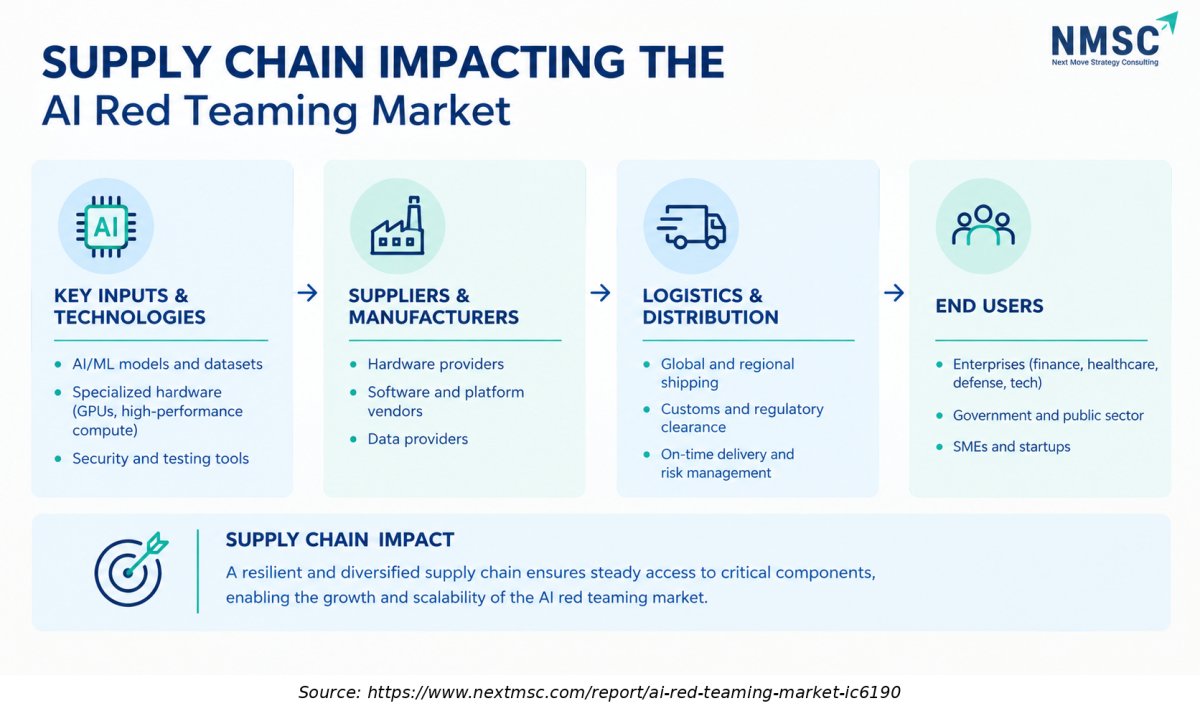
Supply Chain Impacting the AI Red Teaming Market

Supply Chain Impacting the AI Red Teaming Market

The supply chain of the AI Red Teaming Market includes AI model providers, computing infrastructure suppliers, red teaming solution providers, security researchers, and end users. A well-connected supply chain ensures access to advanced testing tools, specialized expertise, and reliable evaluation platforms, helping organizations identify AI vulnerabilities and improve model safety before deployment.

What Does the AI Red Teaming Market Encompass?

The Market covers structured adversarial testing of AI models, applications and agents to expose safety and security failures before attackers or users do. Typical findings include prompt injection, jailbreaks, sensitive data leakage, unsafe tool use and harmful content generation. Revenue comes from professional and managed services, automated platforms and software, and crowdsourced testing programs. Traditional network penetration testing and generic application scanning sit outside the scope.

Regulation and standards shape purchasing in this field. The EU AI Act requires providers of general-purpose models with systemic risk to conduct and document adversarial testing, and the NIST Generative AI Profile recommends red teaming as a way to find unexpected failure modes. Japan, the UK and Australia have published AI safety or testing guidance. These frameworks can inform procurement and governance reviews, although the extent to which red-team evidence is required varies by jurisdiction, organization and use case.

Market Drivers & Dynamics

Interactive Dataset
Enterprise generative AI production deployments and breach exposure driver +5.5% Global, strongest in North America 2026–2035
Mandated adversarial testing under the EU AI Act and national guidance driver +4.0% Europe, North America, Asia-Pacific 2026–2030
Agentic AI and tool connected systems widening the attack surface driver +4.5% Global 2026–2035
Cloud and security platform bundling of red teaming driver +2.0% North America, Europe 2026–2032
Shortage of AI security specialists restraint −3.0% Asia-Pacific, North America 2026–2030
Lack of standard benchmarks and success metrics restraint −2.0% Global 2026–2031
Budget pressure and bundled pricing squeezing independents restraint −1.5% Latin America, Middle East & Africa 2026–2029
Source: Next Move Strategy Consulting

Growth Drivers

What Is the Primary Growth Driver of the AI Red Teaming Market?

Exposure is the leading driver. Industry survey data from 2025 shows 13% of organizations reported breaches of AI models or applications, and 97% of those lacked proper AI access controls. About 60% of such incidents led to compromised data. These findings illustrate the risks associated with inadequate AI security controls. They support the rationale for pre-deployment adversarial testing, although the reported breach statistics do not directly measure enterprise spending on AI red-teaming services.

How Is Regulation Driving the AI Red Teaming Market Growth?
Rules convert good practice into obligation. Article 55 of the EU AI Act asks providers of general-purpose models with systemic risk to conduct and document adversarial testing. NIST's Generative AI Profile lists red teaming among recommended measurement actions, and Japan's AI Safety Institute updated its red teaming guide in March 2025. These regulatory and guidance frameworks can increase demand for documented AI risk assessments. However, their effects on testing budgets and reporting practices vary across jurisdictions and organizations.

Growth Inhibitors

What Is Restraining the AI Red Teaming Market?

Talent supply limits delivery capacity. The global cybersecurity workforce gap reached 4.8 million in 2024, and more than one third of respondents named AI as the largest skills shortfall on their teams. Our findings suggest that few practitioners combine machine learning knowledge with offensive security craft, so engagement backlogs lengthen and day rates stay high. Automation and crowdsourced programs soften the constraint, yet they cannot fully replace expert judgment on novel agent attacks.

Segmentation Analysis

2025 (USD Million)
2035 (USD Million)
Professional and managed services 2025: $228.8 Million | 2035: $1,271.0 Million
Professional
Automated platforms and software 2025: $197.6 Million | 2035: $2,214.0 Million
Automated pl
Crowdsourced testing programs 2025: $93.6 Million | 2035: $615.0 Million
Crowdsourced
Professional and managed services $228.8 Million $1,271.0 Million 18.8%
Automated platforms and software $197.6 Million $2,214.0 Million 26.7%
Crowdsourced testing programs $93.6 Million $615.0 Million 21.2%

Which Offering Leads the AI Red Teaming Market and Which Grows Fastest?

Professional and managed services led in 2025 with USD 228.80 Million because most buyers still rely on expert led engagements to scope risks and satisfy auditors. Automated platforms and software are projected to be the fastest-growing offering as organizations integrate repeatable adversarial tests into development pipelines rather than relying solely on one-off engagements. The reported CAGR must be reconciled with the underlying 2026 and 2035 segment estimates before publication. We observed that vendors such as Cisco, F5 and Zscaler bundle red teaming with guardrails, which pushes platform revenue toward USD 2,214.00 Million by 2035.

2025 (USD Million)
2035 (USD Million)
Generative A
Agentic AI s
Traditional
Segment Item 2025 (USD Million) 2035 (USD Million) CAGR
Generative AI and LLM applications $10.0 USD Million $40.0 USD Million 12.0%
Agentic AI systems $17.1 USD Million $51.1 USD Million 26.0%
Traditional ML and predictive models $24.2 USD Million $62.2 USD Million 20.0%

Segment-wise data is locked

Unlock complete segment-wise numbers for By AI System Under Test.

Unlock Full Data

Which AI System Segment Drives AI Red Teaming Market Revenue?

Generative AI and LLM applications dominated 2025 at USD 322.40 Million, since chatbots, copilots and retrieval systems form the bulk of enterprise deployments. Agentic AI systems grow fastest at 29.1% CAGR as autonomous tool use multiplies attack paths and testing complexity. Traditional ML and predictive models remain a steady base at USD 124.80 Million in 2025, supported by adversarial robustness work in fraud, vision and scoring models that HiddenLayer and others address.

2025 (USD Million)
2035 (USD Million)
IT and techn
BFSI
Government a
Healthcare a
Retail and c
Segment Item 2025 (USD Million) 2035 (USD Million) CAGR
IT and technology $10.0 USD Million $40.0 USD Million 20.0%
BFSI $17.1 USD Million $51.1 USD Million 26.0%
Government and defense $24.2 USD Million $62.2 USD Million 24.0%
Healthcare and life sciences $31.3 USD Million $73.3 USD Million 26.0%
Retail and consumer $38.4 USD Million $84.4 USD Million 9.0%

Segment-wise data is locked

Unlock complete segment-wise numbers for By End User Industry.

Unlock Full Data

Which End User Industries Lead Spending on AI Red Teaming Market?

IT and technology led with USD 161.20 Million in 2025 because model developers and software vendors test continuously before each release. BFSI followed at USD 135.20 Million, driven by model risk rules and fraud exposure in customer facing assistants. Healthcare and life sciences grow fastest at 27.2% CAGR as clinical documentation and patient triage tools raise safety stakes. Government and defense demand rises with national evaluation programs and procurement conditions.

2025 (USD Million)
2035 (USD Million)
North Americ
Canada
Mexico
Europe: UK
Germany
Segment Item 2025 (USD Million) 2035 (USD Million) CAGR
North America: U.S. $10.0 USD Million $40.0 USD Million 23.0%
Canada $17.1 USD Million $51.1 USD Million 21.0%
Mexico $24.2 USD Million $62.2 USD Million 27.0%
Europe: UK $31.3 USD Million $73.3 USD Million 17.0%
Germany $38.4 USD Million $84.4 USD Million 26.0%

Segment-wise data is locked

Unlock complete segment-wise numbers for By Region.

Unlock Full Data

Growth Opportunities

During our market evaluation, we noticed that three opportunities offer the clearest path to incremental revenue.

Where Does Agentic AI and MCP Server Testing Create New Revenue?

Enterprises are connecting agents to payment, ticketing and data systems through tool protocols, and each connection needs permission and injection testing. Vendors can sell scenario libraries and sandbox environments priced per agent. BFSI and IT operations teams benefit first, since a hijacked agent can move funds or alter infrastructure. Providers that certify agent workflows can also earn recurring retesting fees as tools and prompts change.

How Can Managed Continuous Red Teaming Reach Midsize Enterprises?

Midsize firms lack in house specialists, yet they deploy the same copilots as large peers. Managed security providers can package automated attack runs, triage and remediation advice into monthly subscriptions. Retail and consumer companies benefit from predictable pricing and faster fixes before campaigns. Vendors that integrate findings with guardrail tuning shorten time to fix and gain a defensible reason to renew each year.

What Compliance Led Demand Exists in Healthcare and Government?

Regulators and procurement officers increasingly ask for documented adversarial testing before approving AI tools. Vendors that map findings to the EU AI Act, NIST and national guidance can sell audit ready evidence packs. Hospitals, public agencies and defense contractors benefit by shortening approval cycles. Multilingual testing adds further value, because Netskope's red teaming covers 23 languages and public services serve diverse populations.

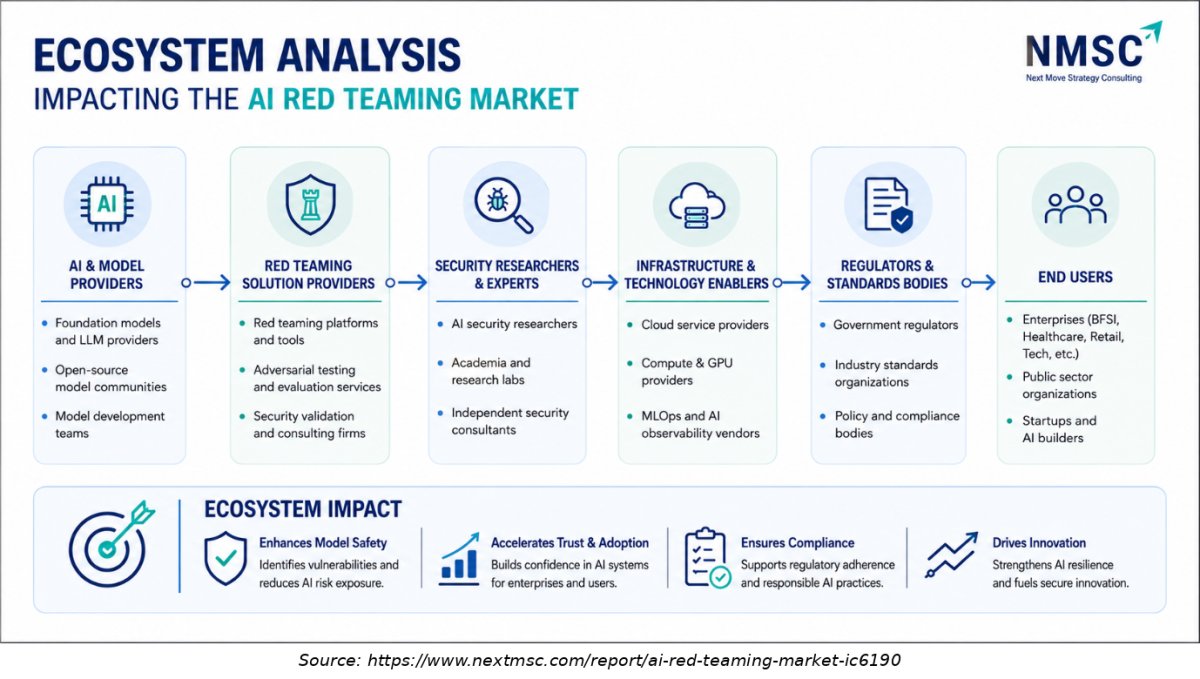
Ecosystem Analysis Impacting the AI Red Teaming Market

The AI red-teaming ecosystem connects AI developers and enterprise users with automated testing platform providers, security researchers, specialist consultancies, managed testing firms and cloud security vendors. Collaboration among these stakeholders supports vulnerability discovery, adversarial testing, remediation and integration of security testing throughout the AI lifecycle

Regional Outlook

2025 (USD Million)
2035 (USD Million)
North Americ
Europe
Asia-Pacific
Middle East
Latin Americ
Region 2025 (USD Million) 2035 (USD Million) CAGR (%)
North America $10.0 USD Million $40.0 USD Million 9.0%
Europe $17.1 USD Million $51.1 USD Million 27.0%
Asia-Pacific $24.2 USD Million $62.2 USD Million 25.0%
Middle East & Africa $31.3 USD Million $73.3 USD Million 23.0%
Latin America $38.4 USD Million $84.4 USD Million 12.0%

Regional data is locked

Unlock complete regional numbers for this market.

Unlock Full Data

Competitive Landscape

Our findings suggest that the competitive structure blends hyperscale’s, security platform vendors, specialist startups and crowdsourcing networks.

How Do Companies Compete in the AI Red Teaming Market?

Vendors compete on attack coverage, automation depth, integration and credibility. Hyperscalers such as Microsoft and Google integrate AI security capabilities into their cloud and model ecosystems, while security vendors such as Cisco, Palo Alto Networks and Check Point offer related AI security capabilities. Specific red-teaming offerings should be identified and sourced separately from runtime protection products. Consultancies including IBM and Accenture win on advisory depth and regulated client relationships. Pricing follows two models, project fees for services and annual subscriptions for platforms, and bundling pressures standalone vendors.

What Innovation and Differentiation Strategies Are Shaping Competition?

Innovation concentrates on automation, realism and measurement. Cisco describes an adaptive engine that plans multistage attacks from user defined objectives, and NVIDIA offers an auditor built on its open garak scanner. Vendors map results to OWASP, MITRE and NIST categories to ease audits. Research programs that disclose vulnerabilities, such as Mindgard's more than 150 reported issues, build credibility, which supports premium pricing for evidence rich reports.

How Are Mergers and Acquisitions Changing the Market?

Acquisitions move specialist capability into large platforms. Palo Alto Networks absorbed Protect AI, F5 acquired CalypsoAI, Check Point agreed to buy Lakera and Zscaler announced SPLX. Buyers gain integrated workflows and a single contract, while startups gain distribution. Geographic expansion follows, as acquirers sell testing through established channels in Europe and Asia. Independents such as Mindgard, which raised USD 30 Million in August 2026, are choosing to scale independently.

Key Market Players

Based on research conducted by NMSC, we found that 18 companies with verifiable AI red teaming offerings qualify for profiling, listed below in ranked order.

Microsoft Corporation Palo Alto Networks, Inc. Cisco Systems, Inc. Alphabet Inc. International Business Machines Corporation CrowdStrike Holdings, Inc. Check Point Software Technologies Ltd. Accenture plc F5, Inc. Zscaler, Inc. NVIDIA Corporation Netskope, Inc. HackerOne Inc. Bugcrowd Inc. Synack, Inc. HiddenLayer Mindgard Gray Swan Security Inc.

Latest Developments

We observed that recent announcements concentrate on agent testing, platform consolidation and community driven research.

Date Event
October 2026 Gray Swan launched a redesigned Arena platform and a USD 300,000 Indirect Prompt Injection challenge running October 15 to November 5, 2026.
August 2026 Mindgard raised a USD 30 Million Series A led by Album VC to expand its AI security platform.
November 2025 Microsoft announced enhancements to the AI Red Teaming Agent in Microsoft Foundry, covering models and agents with over 20 attack strategies.
November 2025 Zscaler announced the acquisition of SPLX to add automated AI red teaming across the AI lifecycle.
September 2025 F5 completed its acquisition of CalypsoAI and introduced F5 AI Guardrails and F5 AI Red Team.

Expert Insights

Dr. Peter Garraghan

Dr. Peter Garraghan

CEO & CTO, Mindgard; Professor of Computer Science, Lancaster University | Mindgard

"“Many organizations underestimate AI risk by applying legacy testing assumptions. Asking a model a series of harmful questions and observing refusals is not equivalent to red teaming. It does not reflect how real adversaries operate, nor does it account for indirect or multi-step exploitation.”"

Analyst Interpretation

Dr. Peter Garraghan emphasized the need for AI-specific red teaming to identify realistic, complex attacks that conventional testing may miss.

Investment Opportunities

Where Is Capital Flowing in the AI Red Teaming Market?

Capital is moving toward automated platforms and agent security. Mindgard raised USD 30 million in a Series A financing round in August 2026, while several major security vendors completed or pursued acquisitions of specialist AI security companies in 2025. Investors favor firms with proprietary attack research, enterprise references and integration with AI security controls. Returns are strongest where recurring subscriptions replace project fees, so platform startups with measurable detection coverage and cloud marketplace listings attract the most attention.

What Infrastructure Investments Support Market Expansion?

Infrastructure spending centers on test environments, attack libraries and research networks. Microsoft funds academic labs through grants to 18 universities, and F5 maintains a vulnerability database adding over 10,000 attack patterns monthly. Sandboxed agent environments and multilingual datasets require continuous investment. Providers that build these assets create barriers to entry, while buyers gain faster, more realistic assessments that run inside existing development pipelines.

How Do ESG Considerations Influence AI Red Teaming Investment?

Responsible AI commitments push adoption. Red teaming surfaces harmful content, bias and privacy leaks that carry reputational and legal cost. Investors increasingly ask portfolio companies for evidence of adversarial testing. Multilingual coverage matters for fairness, since weaknesses often appear in languages beyond English. Providers that publish methods and disclose vulnerabilities responsibly strengthen governance credentials and meet rising expectations from boards and procurement teams.

Key Benefits for Stakeholders

How Do Enterprise and Industry Leaders Benefit from This Report?

Enterprise leaders gain a clear view of budget benchmarks, segment growth and regulatory triggers. The segmentation shows where spending concentrates, from generative AI applications at USD 322.40 Million in 2025 to agentic systems growing at 29.1%. Security and risk heads can compare offering models, decide between services and platforms, and sequence investments with evidence from vendor developments and country level adoption patterns.

How Do Investors and Financial Analysts Benefit from This Report?

Investors receive a forecast built on triangulated estimates, with 2026 revenue of USD 640.00 Million rising to USD 4,100.00 Million by 2035. The competitive section maps acquisition activity and funding events, helping analysts judge valuation logic and exit routes. Regional and country tables identify faster growing markets such as India and China, while the restraints analysis highlights talent and pricing risks that affect margins.

How Do Technology Vendors and Product Teams Benefit from This Report?

Vendors and product managers gain insight into buyer priorities, including agent testing, continuous pipelines and audit ready reporting. The report outlines how competitors bundle red teaming with guardrails and cloud services, which informs roadmap and pricing choices. Regional guidance on language coverage and data residency supports go to market planning, and the opportunity analysis points to managed offerings for midsize customers as an expansion path.

Key Market Segments Evaluated

By Offering

  • Professional and managed services
  • Automated platforms and software
  • Crowdsourced testing programs

By AI System Under Test

  • Generative AI and LLM applications
  • Agentic AI systems
  • Traditional ML and predictive models

By End User Industry

  • IT and technology
  • BFSI
  • Government and defense
  • Healthcare and life sciences
  • Retail and consumer

By Region

  • North America 
    • U.S.
    • Canada
    • Mexico
  • Europe 
    • UK
    • Germany
    • France
    • Italy
    • Spain
    • Sweden
    • Denmark
    • Finland
    • Netherlands
    • Rest of Europe
  • Asia-Pacific 
    • China
    • India
    • Japan
    • South Korea
    • Taiwan
    • Indonesia
    • Vietnam
    • Australia
    • Philippines
    • Malaysia
    • Rest of APAC
  • Middle East & Africa 
    • Saudi Arabia
    • UAE
    • Egypt
    • Israel
    • Turkey
    • Nigeria
    • South Africa
    • Rest of MEA
  • Latin America 
    • Brazil
    • Argentina
    • Chile
    • Colombia
    • Rest of LATAM

Conclusion & Recommendations

Our assessment indicates a durable growth path, with revenue rising from USD 640.00 Million in 2026 to USD 4,100.00 Million in 2035. Testing becomes a standard control across the AI lifecycle as agents, regulation and procurement requirements mature. Platforms gain share from services, yet expert engagements persist for novel attacks. The outlook stays positive provided benchmark credibility and talent supply improve alongside demand.

What Strategic Positioning Recommendations Does NMSC Offer?

NMSC recommends that platform vendors prioritize agent and tool protocol coverage, publish transparent methods and link findings to guardrails. Consultancies should package recurring managed testing and audit evidence. Specialists should seek partnerships with larger platforms or defend neutrality across model providers. Buyers should require mapped reporting to OWASP, MITRE and NIST categories, and Favor vendors that integrate with development pipelines.

How Strong Is the Investment Attractiveness of the AI Red Teaming Market?

The market is attractive for investors seeking growth in security software with regulatory support. Recurring platform revenue, active consolidation and rising enterprise budgets provide multiple routes to returns. Healthcare, BFSI and Asia-Pacific offer the fastest expansion. Diligence should test attack research depth, customer retention and exposure to bundling by hyperscale’s, since these factors determine whether independents sustain premium valuations.

What Are the Market Shifts and Key Risks in the AI Red Teaming Market?

Key shifts include the move from point in time assessments to continuous testing and the rise of agentic risks. Risks include scarce specialist talent, inconsistent success metrics and price pressure from bundled offerings. Regulatory fragmentation across regions can slow standard setting. Vendors that automate routine tests and reserve experts for novel attacks are best placed to protect margins through the cycle.

What Are the Primary Growth Pathways Through 2035?

Growth pathways include agent security testing, managed continuous programs for midsize firms and compliance evidence for regulated sectors. Geographic expansion into Asia-Pacific, where revenue climbs from USD 114.40 Million in 2025 to USD 1,189.00 Million by 2035, adds further scale. Partnerships between platforms, integrators and crowdsourcing networks will broaden reach, while multilingual capability opens markets that English only tools cannot serve.

FAQs

Sources & References

1.

Microsoft Security Blog: Enhancing AI security through global AI red teaming (July 27, 2026)

microsoft.com
2.

Microsoft Foundry Blog: AI Red Teaming Agent enhancements (November 25, 2025)

devblogs.microsoft.com
3.

Palo Alto Networks: Completion of Protect AI acquisition (July 22, 2025)

paloaltonetworks.com
4.

Check Point Software Technologies: Acquisition of Lakera (September 16, 2025)

checkpoint.com
5.

Zscaler Investor Relations: Acquisition of SPLX (November 3, 2025)

ir.zscaler.com/node/15336
6.

F5: Acquisition of CalypsoAI and F5 AI Red Team (September 29, 2025)

f5.com
7.

Cisco: AI Defense solution overview

cisco.com
8.

CrowdStrike: AI Red Team Services (November 7, 2024)

crowdstrike.com
9.

IBM X-Force: Evolving red teaming for AI environments

ibm.com
10.

IBM Newsroom: 2025 Cost of a Data Breach Report on AI (July 30, 2025)

newsroom.ibm.com
11.

Google Cloud: Mandiant AI security consulting

cloud.google.com
12.

Accenture: Secure AI Solutions press release (November 19, 2024)

businesswire.com
13.

NVIDIA: NeMo Platform vulnerability scanning documentation

docs.nvidia.com
14.

Netskope: AI Red Teaming documentation

docs.netskope.com/en/ai-red-teaming
15.

HackerOne: Record Q2 pentesting and AI red teaming growth (August 5, 2024)

hackerone.com
16.

Bugcrowd: AI Penetration Testing press release (May 1, 2024)

bugcrowd.com
17.

Synack: AI/LLM pentesting press release (February 29, 2024)

synack.com
18.

HiddenLayer: Automated Red Teaming for AI (November 20, 2024)

hiddenlayer.com
19.

Mindgard: $8 million funding and DAST-AI platform

mindgard.ai
20.

Mindgard: $30 million Series A (August 12, 2026)

406ventures.com
21.

Gray Swan: Redesigned Arena platform and USD 300,000 challenge (October 20, 2026)

globenewswire.com
22.

European Commission AI Act Service Desk: Article 55

ai-act-service-desk.ec.europa.eu
23.

NIST: AI 600-1 Generative Artificial Intelligence Profile (July 2024)

doi.org
24.

ISC2: 2024 Cybersecurity Workforce Study

isc2.org
25.

UK AI Security Institute: 2025 year in review

aisi.gov.uk
26.

Japan AI Safety Institute: Guide to red teaming methodology on AI safety

aisi.go.jp
27.

Australian Department of Industry: Voluntary AI Safety Standard

industry.gov.au
28.

U.S. International Trade Administration: South Korea AI Basic Act

trade.gov

About the Author

Jayanta Das

Jayanta Das

Jayanta Das is Senior Analyst at Next Move Strategy Consulting, where he has spent 4.5 years covering the firm's full industry taxonomy — spanning aerospace and defense, healthcare, BFSI, energy and power, semiconductors, and beyond — rather than one specialization. His work follows NextMSC's research model, combining data mining, analytics, and secondary research to build market sizing and forecasts behind NextMSC's 2,000-plus research reports, trusted by more than 3,000 organizations globally.

About the Reviewer

Supradip Baul

Supradip Baul

Supradip Baul is an accomplished business consultant and strategist with over a decade of rich experience in market intelligence, strategy, technology, and business transformation. His work has included rigorous qualitative and quantitative analysis across multiple industries, helping clients shape investment decisions and long-term roadmaps. Earlier in his career, he was associated with Gartner, where he contributed to industry-leading reports and market share analyses. He has worked with leading global companies and holds an MBA with a dual specialization in Marketing and Finance.

Download Free Sample

Diana Trejo

DIANA TREJO

Assistant Manager

Sumitomo Corporation de Mexico, S.A. de C.V.

Recently, we purchased a report on the Mexico Data Center Market from Next Move Strategy Consulting. The service has been excellent, with support that is always timely and thoroughly professional. The information provided is interesting, highly useful, and delivered with clarity. I would highly recommend NextMSC for anyone seeking insightful and dependable analysis.

Ross J Mckenzie

ROSS J MCKENZIE

Business Insight Manager

Staysure Group

“Next MSC have been incredibly helpful in providing detailed & robust information on our market, alongside quantifying growth by different segments. The process to procure was simple and easy, with sample reports and regular contact to ensure we had what we needed. Succinct detail on their sources & methodologies is also greatly received, allowing transparency in this respect helps build trust in the detail you pay for. Joseph in particular was fantastic, and helped ensure efficient provision of the insight pack – thank you NMSC!”.

Henri Knyphausen

HENRI KNYPHAUSEN

Partner at Singulier [Ex-BCG]

Singulier

I recently engaged NEXTMSC.com for a commercial due diligence project within the intralogistics sector, and I am pleased to provide a reference based on my experience. In utilizing NEXTMSC.com's services, I found their report to offer valuable insights into market dynamics and key industry players. The initial report provided a solid foundation for our analysis. However, as we were investigating a smaller target in the market, and I had specific customization requests requiring additional research. These requests included detailed information on product portfolios of various players and sub-market sizes, both inclusive and exclusive of certain product categories. NEXTMSC.com demonstrated commendable responsiveness and agility in accommodating these customization requests. Within a timeframe of 1-2 weeks, they delivered a revised report that met our specific needs. Furthermore, they were receptive to my follow-up inquiries, ensuring clarity and understanding of the data provided. The final deliverable significantly contributed to our due diligence efforts. One of NEXTMSC.com's notable strengths lies in their qualitative research capabilities. However, for future engagements, I would recommend the inclusion of a quantified market model in Excel format. Such a model would offer the ability to conduct in-depth analyses and explore various market segments, including country-specific data and subcomponent breakdowns. Based on my positive experience, I would not hesitate to work with NEXTMSC.com again. Their responsiveness, willingness to accommodate customization requests, and commitment to delivering actionable insights make them a reliable partner for commercial research projects.

Kishu Kanda

KISHU KANDA

Strategy Analyst

Accenture

We purchased the AI Consumer Market Report from this company. Not only did they customize the report to meet our specific requirements, but they also showed great flexibility in accommodating our budget. The report we received fully met our expectations. Additionally, they provided prompt and thorough responses to both our pre-purchase and follow-up questions. We look forward to working with this company again in the future.

Semih Kavaklioglu

SEMIH KAVAKLIOGLU

Co-Founder & Sales Manager

Decortie

I work a lot in the marketing industry and I know that research is an essential part of any campaign. I have used Market research reports for my own products and I found them to be very informative and well-researched. The team here produces insightful reports for a good price

Custom Market Research Services

We will customize the research for you if the listed report does not fully match your requirements.

Get 30% Free Customization

Select License

This website uses cookies to ensure you get the best experience on our website. Learn more

✖