Australia Aluminum Market By Type (Primary, Secondary, Scrap), By Product Type (Flat-Rolled, Casting, Extrusions, Forgings, Powder & Paste, Billets, Wire Rods, Foundry Alloys, Silicon Alloy, Others), By Alloy Series (1xxx–7xxx), By Distribution Channel (OEM Direct, Distributors, Aftermarket, E-commerce, Scrap Traders), By End User (Transportation, Consumer Goods, Machinery & Equipment, Construction, Packaging, Electrical Engineering, Others) – Analysis & Forecast, 2025–2035
Industry: Materials and Chemical | Latest Edition: October 5, 2026 | No of Pages: 200 | No. of Tables: 112 | No. of Figures: 112 | Format: PDF | Report Code: MC1359
Australia Aluminum Market Size & Forecast
|
Parameters |
Details |
|
Market Size in 2026 |
USD 4.55 Billion |
|
Revenue Forecast in 2035 |
USD 7.37 Billion |
|
Growth Rate |
CAGR of 5.49% from 2026 to 2035 |
|
Market Volume in 2026 |
1.75 million Tons |
|
Volume Forecast in 2035 |
2.57 million Tons |
|
Growth Rate |
CAGR of 4.39% from 2026 to 2035 |
|
Analysis Period |
2025–2035 |
|
Base Year Considered |
2025 |
|
Forecast Period |
2026–2035 |
|
Market Size Estimation |
Billion |
|
Companies Profiled |
15 |
|
Market Share |
Available for 10 companies |
Industry Outlook
The Australia Aluminum Market size was valued at USD 4.02 billion in 2025 and is expected to reach USD 4.55 billion by 2026. Looking ahead, the industry is projected to expand significantly, reaching USD 7.37 billion by 2035, registering a CAGR of 5.49% from 2026 to 2035. In terms of volume, the market recorded 1.55 million Tons in 2025, with forecasts indicating growth to 1.75 million Tons by 2026 and further to 2.57 million Tons by 2035, reflecting a CAGR of 4.39% over the same period.
What Are the Key Market Drivers, Breakthroughs, and Investment Opportunities That Will Shape the Aluminum Industry in the Next Decade?
Growth Catalyst & Risk Assessment Matrix
|
DRIVERS / TRENDS / RESTRAINTS |
(+/–) % IMPACT ON CAGR FORECAST |
GEOGRAPHIC RELEVANCE |
IMPACT TIMELINE |
|
Strong bauxite mining and integrated refining base supporting stable aluminum feedstock supply |
+1.8% |
Western Australia, Queensland mining belts, national refining hubs |
Medium term (2–5 years) |
|
Construction and transportation sector growth driving demand for structural and mobility aluminum applications |
+1.7% |
Sydney, Melbourne, Brisbane, Perth, national infrastructure corridors |
Short to medium term (1–4 years) |
|
Sustainability-driven material shift increasing adoption of recyclable and low-emission aluminum |
+1.6% |
Nationwide construction, packaging, and industrial sectors |
Medium term (2–6 years) |
|
High production costs from energy, labor, and logistics reducing competitiveness and supply stability |
-1.9% |
Nationwide smelting and industrial zones |
Short to medium term (1–3 years) |
|
Expansion of value-added downstream manufacturing and low-carbon export positioning supporting premium growth |
+1.8% |
Victoria, New South Wales, Queensland industrial clusters |
Medium to long term (3–7 years) |
The Australia aluminum market is being shaped by a combination of upstream supply strength and strong end-use demand from core industrial sectors. Stable bauxite availability and integrated refining capacity are reinforcing raw material security, enabling smoother production flows across smelting and downstream fabrication. Our research indicates that demand from construction and transportation remains a key structural driver, supported by infrastructure development, mobility upgrades, and increasing use of lightweight materials in engineering applications. At the same time, sustainability-led procurement is strengthening aluminum adoption as industries prioritize recyclable and lower-emission materials in sourcing decisions, particularly across packaging and industrial manufacturing ecosystems.
On the cost and transformation side, rising energy expenses and production cost pressures continue to weigh on competitiveness, especially for energy-intensive smelting and processing operations. Our review of the data suggests that these challenges are being balanced by long-term structural shifts toward higher-value downstream manufacturing and low-carbon export positioning. Opportunities are emerging through engineered aluminum products and certified sustainable supply chains, which are expected to enhance value capture and improve global trade alignment. Overall, the Australia aluminum market is navigating rising production cost pressures through a gradual shift toward higher-value downstream manufacturing, engineered aluminum solutions, and low-carbon export positioning, while stable raw material availability and consistent demand from construction, transportation, and industrial sectors continue to support its medium- to long-term outlook.
Growth Drivers
How Does Growth in Bauxite Mining Support Aluminum Supply in Australia?
Australia’s extensive bauxite reserves, established alumina refining base, and integrated mining infrastructure create a reliable raw material foundation for smelters and downstream processors. Higher mining activity improves feedstock continuity, supports refinery utilization, and reduces dependence on imported intermediates. As a result, our analysis indicates that the aluminum market in Australia benefits from vertically connected supply chains that strengthen sourcing visibility, improve production planning, and support manufacturers requiring stable metal availability across construction, packaging, transportation, and industrial applications.
How Does Growing Demand from Construction and Transportation Sectors Fuel Market Expansion?
Our review of the data suggests that rising demand from construction and transportation continues to support aluminum consumption through building systems, facades, roofing products, bridges, automotive components, rail structures, trailers, and marine applications. Material preference is linked to durability, corrosion resistance, and lightweight performance advantages. Consequently, the Australian aluminum market gains from infrastructure development, commercial renovation activity, fleet modernization, and engineering requirements where efficient materials improve lifecycle value, payload efficiency, and long-term operational performance.
How Is the Transition Toward Sustainable Materials Supporting Australia Aluminum Demand?
Sustainability-focused procurement across packaging, consumer goods, construction, and industrial manufacturing is increasing the use of recyclable materials with lower lifecycle impact. Aluminum remains well positioned because it can be repeatedly recycled while maintaining core performance properties and functional strength. Therefore, our findings reveal that the Australia aluminum market benefits as buyers prioritize circular supply chains, recycled content, lower-emission sourcing strategies, and environmentally aligned materials that increasingly influence supplier selection, product design, and long-term procurement frameworks.
Growth Inhibitor:
How Do High Production Costs Affect Pricing Competitiveness and Supply Continuity?
Our assessment confirms that aluminum production in Australia faces persistent cost pressure from electricity pricing, gas exposure, labor expenses, maintenance obligations, and logistics complexity across geographically dispersed operations. Smelting remains energy intensive, so volatility in utility costs compresses producer margins and weaken contract competitiveness in export markets. As a result, the Australia aluminum market is particularly sensitive when global prices soften, as domestic producers may struggle to fully pass through elevated operating expenses to customers.
Our expert analysis points to secondary effects that extend beyond margins. Higher cost structures delay capital upgrades, reduce capacity utilization, and influence decisions on downstream expansion or product diversification. Customers may diversify sourcing toward lower-cost imported material when procurement budgets tighten, creating pressure on local processors. Therefore, the Australia Aluminum Market depends on productivity gains, renewable energy integration, and supply chain efficiencies to preserve manufacturing continuity and defend long-term industrial relevance.
Growth Opportunity:
How Can Higher-Value Downstream Manufacturing and Low-Carbon Exports Drive Future Australia Aluminum Market Expansion?
Moving further downstream into engineered products offers a strategic path for value capture beyond primary metal production. Extrusions, precision components, transport assemblies, packaging inputs, and fabricated construction systems provide stronger customer integration and specification-based demand. Consequently, our research demonstrates that the Australia aluminum market can benefit by converting domestic metal into specialized products where quality assurance, design collaboration, and shorter lead times matter more than commodity pricing alone.
Our study indicates that low-carbon alumina and aluminum exports represent a parallel expansion pathway as global buyers increasingly screen suppliers on emissions intensity. Producers using renewable power, cleaner refining methods, and transparent certification frameworks may gain preferred access to procurement programs. At the same time, the Australia Aluminum Market is well positioned to combine resource availability with decarbonization initiatives, supporting premium trade relationships while attracting investment into modernized processing and advanced manufacturing ecosystems.
Porter’s Five Forces Analysis of the Australia Aluminum Market
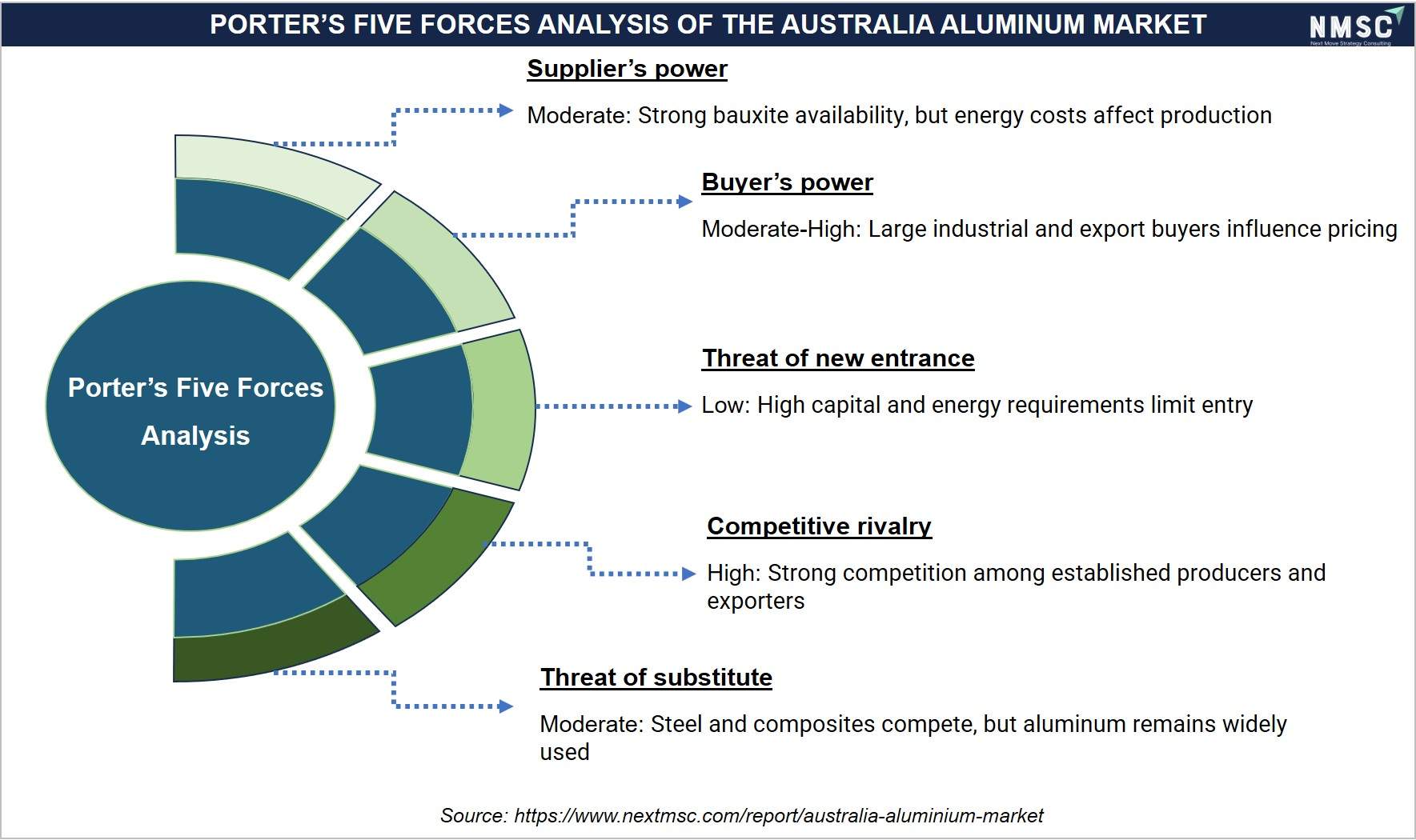
Our evaluation shows that the Australia aluminum market operates within a competitive structure defined by Porter’s Five Forces, where rivalry, supplier power, buyer influence, entry barriers, and substitution pressure interact continuously. Competitive rivalry exists among producers, recyclers, extruders, and fabricators competing through efficiency and product differentiation. Supplier power depends on energy costs and raw material access, while buyers seek quality and cost efficiency. Meanwhile, new entrants face high capital requirements and regulations, whereas substitutes such as composites and polymers affect demand, collectively influencing competitiveness and long-term market stability.
How Is the Australia Aluminum Market Segmented in This Report, and What Are the Key Insights From the Segmentation Analysis?
By Distribution Channel
How Do Distribution Channels Influence Commercial Access in The Market?
The market by distribution channel includes OEM Direct, Distributors, Aftermarket, E-commerce, and Scrap Traders, covering both primary supply routes and secondary material circulation channels across industrial and commercial applications.
Our expert analysis indicates that Distributors cater to customers requiring stocked inventory, mixed product ranges, and shorter replenishment cycles without direct mill engagement. Aftermarket channels address maintenance, replacement, and retrofit demand from construction, machinery, and transport assets where immediate availability is prioritized. Meanwhile, e-commerce platforms are gradually supporting standardized transactions, smaller lots, and transparent product comparison for repeat buyers. Scrap Traders remain commercially relevant by collecting and channeling recyclable feedstock into remelt operations, helping processors manage cost exposure and sustainability requirements. Collectively, these channels create a layered route-to-market model that balances scale buyers, fragmented demand centers, urgent orders, and circular material flows across the Australia aluminum market.
By End User
How Do End-User Industries Shape Demand Patterns in The Market?
The market by end user includes Transportation, which comprises Aerospace, Automotive, Marine, and Rail applications, along with Consumer Goods, Machinery & Equipment, Construction, Packaging serving Food & Beverage, Cosmetics, and other packaging uses, Electrical Engineering, and Other End Users, covering multiple industrial consumption areas across the economy.
From our review, we found that construction demand centers on window frames, curtain walls, roofing systems, and modular structures where durability and low maintenance are valued. Packaging requirements from food & beverage, cosmetics, and other consumer categories support demand for foil, can-stock, and lightweight containers emphasizing recyclability and shelf protection. Additionally, Machinery & Equipment buyers procure plates, castings, and fabricated components for industrial operations. Electrical Engineering applications rely on conductive and lightweight materials for cables, enclosures, and power systems. Consumer Goods manufacturers use aluminum in appliances, furniture, and lifestyle products where finish quality and design flexibility matter. Overall, these diverse end uses create balanced demand streams with different replacement cycles, procurement models, and technical specifications.
Competitive Landscape
Based on NMSC’s evaluation of the Australia aluminum market, we observe that the competitive structure is moderately consolidated, shaped by a mix of integrated mining and smelting operations alongside downstream processors and specialized fabrication firms. Major participants such as Rio Tinto Aluminium, Alcoa of Australia Limited, Tomago Aluminium Company Pty Ltd, South32 Limited, and Bell Bay Aluminium Pty Ltd hold a strong position across the value chain, spanning bauxite extraction, alumina refining, primary aluminium production, and large-scale supply capabilities. Alongside these upstream leaders, firms including Capral Aluminium Limited, Hydro Extrusion Australia Pty Ltd, InfraBuild Steel Pty Ltd, G. James Glass & Aluminium Pty Ltd, and Vulcan Ullrich Aluminium Pty Ltd strengthen the downstream ecosystem through extrusion systems, rolled products, distribution networks, and application-specific fabrication serving construction, transport, packaging, and industrial demand. In addition, smaller and niche-focused players such as Almax Pty Ltd, Independent Extrusions Pty Ltd, National Aluminium Pty Ltd, Extrusions Australia Pty Ltd, and Alushapes Pty Ltd enhance competition by catering to customized orders, architectural requirements, and specialized manufacturing needs. Overall, the market reflects a resource-backed and export-oriented structure with strong industrial integration and a growing emphasis on value-added and sustainable aluminium applications.
Strategic Developments:
December 2025 – Norsk Hydro received global recognition for its aluminium recycling innovation through its Hydro CIRCAL 100R and R100 projects, which promote 100% post-consumer recycled aluminium use. The projects were awarded for advancing circular economy practices and low-carbon material development in industrial applications. The initiative highlights Hydro’s progress in scaling sustainable aluminium solutions across design and manufacturing sectors.
December 2025 – Rio Tinto’s Tomago Aluminium continued its collaboration with the Australian Federal and New South Wales governments to secure a long-term energy solution beyond 2028. The discussions aimed to ensure a reliable and competitively priced electricity supply for the smelter’s future operations. The initiative reflected ongoing efforts to maintain Australia’s largest aluminium production facility.
Pestel Analysis Of the Australia Aluminum Market:
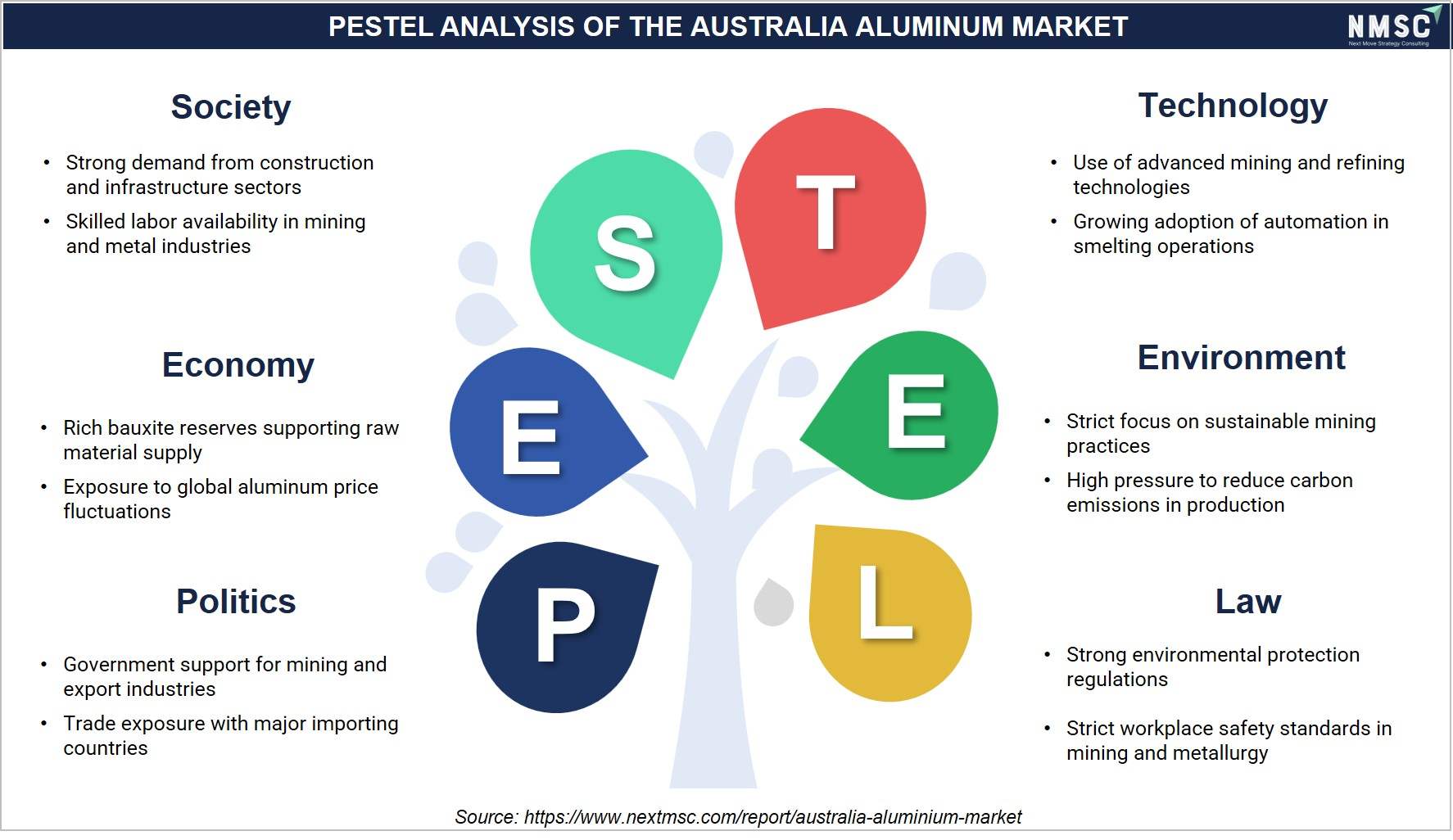
Australia’s aluminum industry operates within an external environment shaped by political, economic, social, technological, environmental, and legal factors. Mining rules, trade policy, and industrial support influence investment confidence, while aluminum prices, currency shifts, freight trends, and electricity costs affect profitability. Social factors such as workforce availability and sustainability expectations shape operations. Additionally, our review of the data suggests that technological progress in recycling, automation, and low-carbon processing supports productivity. Environmental pressures and compliance laws collectively determine competitiveness, while our findings reveal that regulatory readiness and innovation capability strengthen long-term positioning.
Key Players
-
Rio Tinto Aluminium
-
Alcoa of Australia Limited
-
Capral Aluminium Limited
-
Hydro Extrusion Australia Pty Ltd
-
InfraBuild Steel Pty Ltd
-
Tomago Aluminium Company Pty Ltd
-
South32 Limited
-
G. James Glass & Aluminium Pty Ltd
-
Almax Pty Ltd
-
Independent Extrusions Pty Ltd
-
National Aluminium Pty Ltd
-
Vulcan Ullrich Aluminium Pty Ltd
-
Bell Bay Aluminium Pty Ltd
-
Extrusions Australia Pty Ltd
-
Alushapes Pty Ltd
Our analysis indicates that competitive dynamics in the Australia aluminum market are increasingly shaped by production efficiency, low-carbon manufacturing capabilities, and value-added downstream product innovation rather than primary metal capacity alone. We observe that leading suppliers are actively investing in recycling infrastructure, advanced rolling and extrusion technologies, and energy-efficient smelting processes to address rising demand for sustainable and lightweight materials across transportation, construction, packaging, and aerospace applications. Moreover, the growing preference for recycled and secondary aluminum, in our view, reflects end-user focus on cost optimization, emission reduction, and circular supply chain strategies.
Furthermore, we identified that market leaders are strengthening their positions through domestic capacity expansions, localized supply chains, and long-term contracts with automotive, beverage packaging, and industrial customers. These strategies enable stronger market penetration while reducing exposure to import volatility, logistics disruptions, and trade policy uncertainty. Overall, we expect sustained investment in recycling capacity, fabrication technologies, and customer-specific alloy development to remain the key determinant of competitive positioning in the Australia aluminum market.
Australia Aluminum Market Key Segments
By Type
-
Primary Aluminum
-
Secondary (Recycled) Aluminum
-
Industrial Scrap
-
Post-Consumer Scrap
-
Remelted Secondary Production
-
By Product Type
-
Flat-Rolled
-
Sheet
-
Coil
-
Plate
-
Foil
-
Can-Stock
-
-
Casting
-
Extrusions
-
Profiles
-
Tubes & Pipes
-
-
Forgings
-
Powder & Paste
-
Billets
-
Wire Rods
-
Foundry Alloys
-
Aluminium Silicon (AlSi) Alloy
-
Other Products
By Alloy Series
-
1xxx Series
-
2xxx Series
-
3xxx Series
-
4xxx Series
-
5xxx Series
-
6xxx Series
-
7xxx Series
By Distribution Channel
-
OEM Direct
-
Distributors
-
Aftermarket
-
E-commerce
-
Scrap Traders
By End User
-
Transportation
-
Aerospace
-
Automotive
-
Marine
-
Rail
-
-
Consumer Goods
-
Machinery & Equipment
-
Construction
-
Packaging
-
Food & Beverage
-
Cosmetics
-
Others
-
-
Electrical Engineering
-
Other End Users
Key Benefits for Stakeholders:
Next Move Strategy Consulting (NMSC) presents a comprehensive analysis of the Australia Aluminum Market, covering historical developments from 2020 to 2025 and providing forward-looking forecasts through 2035. The study assesses the market at regional levels, combining quantitative market sizing with qualitative insights into key growth drivers, supply-demand dynamics, pricing trends, sustainability transitions, technology evolution, and investment activity across major aluminum product categories and end-use industries.
From our analysis, the Australia aluminum market delivers strong value across the industrial ecosystem. Manufacturers benefit from lightweight, durable, and recyclable materials that improve product performance and production efficiency. Investors gain exposure to long-term growth supported by infrastructure development, electric vehicle expansion, packaging demand, and rising adoption of recycled aluminum. Fabricators, processors, and technology providers benefit from recurring opportunities through value-added product development, recycling capacity expansion, and long-term supply agreements. Overall, the market supports industrial competitiveness, supply chain resilience, and Australia’s broader manufacturing transformation, reinforcing its strategic importance in the country’s industrial landscape.
|
Parameters |
Details |
|
Customization Scope |
Free customization (equivalent to up to 80 analyst-working hours) after purchase. |
|
Pricing and Purchase Options |
Avail customized purchase options to meet your exact research needs. |
|
Approach |
In-depth primary and secondary research; proprietary databases; rigorous quality control and validation measures. |
|
Analytical Tools |
Porter's Five Forces, SWOT, value chain, and Harvey ball analysis to assess competitive intensity, stakeholder roles, and relative impact of key factors. |


About the Author
 Tushmi Dutta
— Tushmi Dutta is a focused researcher specializing in detailed analysis and insight-driven research across diverse business landscapes. She supports strategic initiatives through structured data interpretation, thorough validation, and clear communication of findings that aid informed decision-making. With a strong interest in writing, she enjoys presenting research insights in an engaging and accessible manner. Beyond work, she enjoys traveling, reading, painting, and continuously learning new skills that contribute to her creative and professional growth.
Tushmi Dutta
— Tushmi Dutta is a focused researcher specializing in detailed analysis and insight-driven research across diverse business landscapes. She supports strategic initiatives through structured data interpretation, thorough validation, and clear communication of findings that aid informed decision-making. With a strong interest in writing, she enjoys presenting research insights in an engaging and accessible manner. Beyond work, she enjoys traveling, reading, painting, and continuously learning new skills that contribute to her creative and professional growth.
About the Reviewer
 Supradip Baul
— Supradip Baul is an accomplished business consultant and strategist with over a decade of rich experience in market intelligence, strategy, technology, and business transformation. His work has included rigorous qualitative and quantitative analysis across multiple industries, helping clients shape investment decisions and long-term roadmaps. Earlier in his career, he was associated with Gartner, where he contributed to industry-leading reports and market share analyses. He has worked with leading global companies and holds an MBA with a dual specialization in Marketing and Finance.
Supradip Baul
— Supradip Baul is an accomplished business consultant and strategist with over a decade of rich experience in market intelligence, strategy, technology, and business transformation. His work has included rigorous qualitative and quantitative analysis across multiple industries, helping clients shape investment decisions and long-term roadmaps. Earlier in his career, he was associated with Gartner, where he contributed to industry-leading reports and market share analyses. He has worked with leading global companies and holds an MBA with a dual specialization in Marketing and Finance.
At Next Move Strategy Consulting, we understand that insightful market research is the cornerstone of successful business decisions. That's why we employ a robust and multifaceted approach, combining various methodologies to deliver the most accurate and actionable data for our clients.

Research Landscape
We navigate the world of research with two primary approaches:
Qualitative Approach
Our qualitative research methodologies involve immersive techniques such as in-depth interviews, focus groups, and observational studies. By engaging directly with individuals and stakeholders, we uncover valuable insights that quantitative data alone may overlook.

Quantitative Research
In tandem with qualitative methodologies, NMSC leverages the power of Quantitative Research to provide a robust foundation of numerical insights. Through systematic data collection and analysis, we quantify patterns, preferences, and market trends, offering a comprehensive view of the business landscape.
Our quantitative research approach employs diverse tools, including surveys, experiments, and statistical modelling. These methodologies enable us to gather data from a large and representative sample, ensuring the statistical significance of our findings. By employing structured questionnaires and standardized data collection methods, we guarantee the reliability and validity of the information we present to our clients.
Quantitative research is particularly effective in measuring the prevalence of trends, assessing market size, and gauging the impact of various factors on consumer behavior. The numerical precision attained through this approach equips our clients with actionable insights, facilitating data-driven decision-making and strategy formulation.


Our Specialized Toolbox for Industry-Specific Market Research
We deploy a specialized arsenal of techniques tailored to meet your unique requirements. Here's a glimpse into our comprehensive toolbox:

Information Procurement
The stage entails acquiring market data or relevant information through various sources and methodologies.


Market Research Approach
We utilize both top-down and bottom-up approaches in market research analysis to achieve a comprehensive understanding of the market dynamics, leveraging the broad perspective of industry trends and macroeconomic factors alongside detailed insights from specific segments and individual companies.

Porters Five Forces Analysis
We conduct Porter's Five Forces analysis to evaluate the competitive landscape of an industry, providing us with insights into factors that affect profitability and strategic positioning.

SWOT Analysis

Forecasting
We utilize a forecasting model to predict future consumption by considering parameters like population, economics, regulations, market competition, drivers, constraints, technology, and pricing. We also employ statistical techniques such as multilinear regression, exponential smoothing, moving average, ARIMA, and Monte Carlo simulations for accurate predictions. In econometric forecasting, we analyzed short-term and long-term event impacts, attributing values based on regulatory frameworks, economic factors, and market events.





 Speak to Our Analyst