Automated Food Sorting Machines Market Size, Share, Trends and Growth Analysis, By Product Type (Optical Sorters, NIR Sorters, Hyperspectral Sorters, Laser Sorters, X Ray Sorters, Hybrid Sensor Sorters, and Other Sorters), By Machine Architecture, By Commodity Type, By Sorting Function, By Automation Level, By Throughput Capacity, By Revenue Stream, By Distribution Channel, By Customer Type, and Region – Global Industry Report and Forecast, 2026–2035
Industry: Construction & Manufacturing | Publishing Date: July 17, 2026 | Last Updated: September 30, 2026 | No of Pages: N/A | No. of Tables: N/A | No. of Figures: N/A | Format: PDF | Report Code: CM5210
What Is the Automated Food Sorting Machines Market Size?
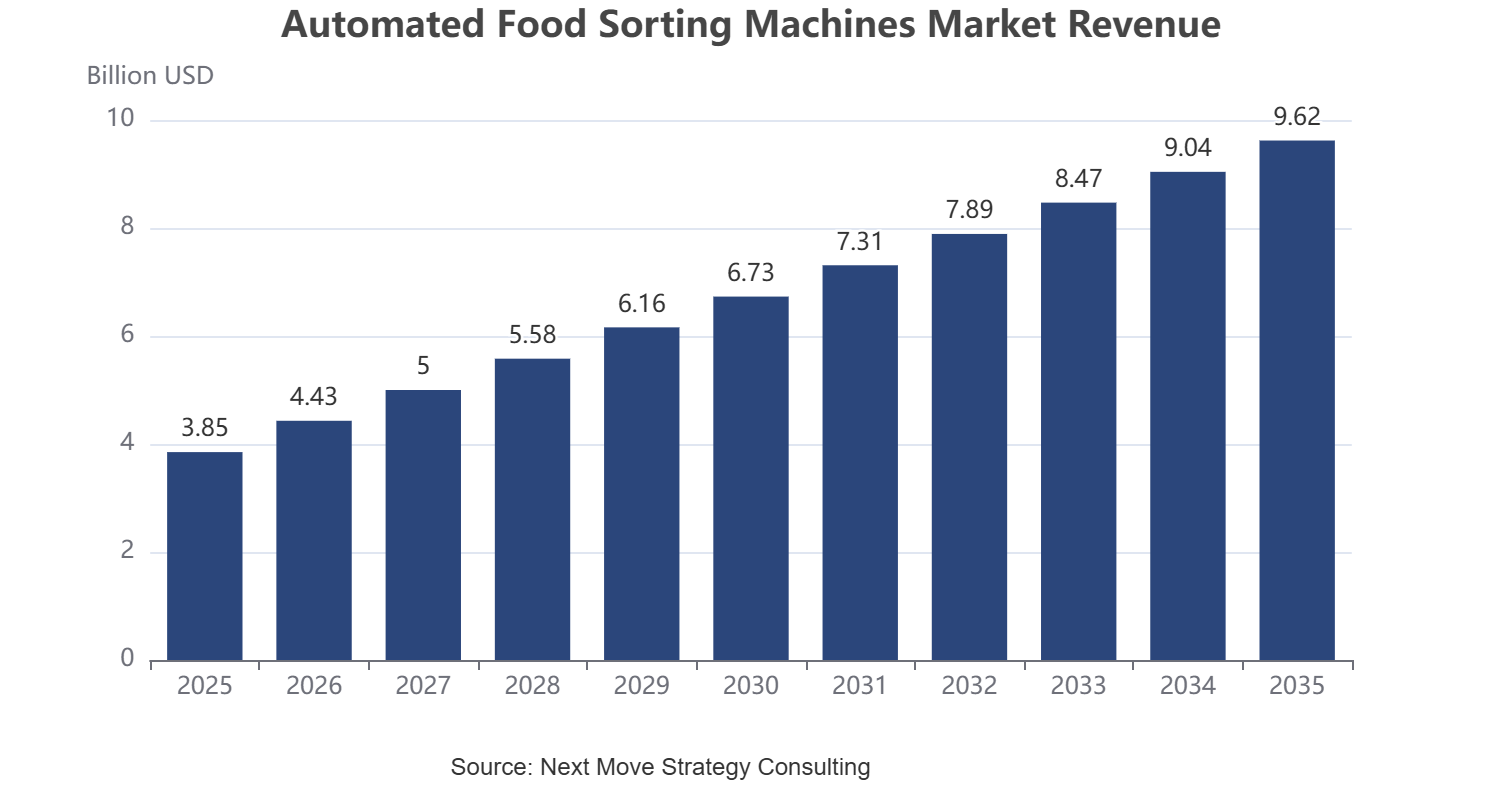
The global automated food sorting machines market size was valued at USD 3.85 billion in 2025 and is estimated at USD 4.18 billion in 2026, forecast to reach USD 9.62 billion by 2035, expanding at a 9.7% CAGR between 2026 and 2035. Asia-Pacific leads with approximately 34% share, while optical sorters dominate all other product types with approximately 34% share.
We observed that growth is broad based across every segmentation axis, with AI assisted sorting adoption and hybrid sensor architectures driving the dominant structural shifts through 2035.
|
Key Takeaways |
|
By Product Type: Optical Sorters held the largest share of approximately 34% (USD 1.31 billion) in 2025; Hybrid Sensor Sorters is the fastest-growing sub-segment at 12.2% CAGR from 2026–2035. |
|
By Machine Architecture: Belt Sorters held the largest share of approximately 30% (USD 1.16 billion) in 2025; Rotary Grading Sorters is the fastest-growing sub-segment at 12.8% CAGR from 2026–2035. |
|
By Commodity Type: Fruits held the largest share of approximately 29% (USD 1.12 billion) in 2025; Processed Foods is the fastest-growing sub-segment at 13.4% CAGR from 2026–2035. |
|
By Sorting Function: Multi Criteria Sorting held the largest share of approximately 26% (USD 1.00 billion) in 2025; Internal Quality Inspection is the fastest-growing sub-segment at 13.9% CAGR from 2026–2035. |
|
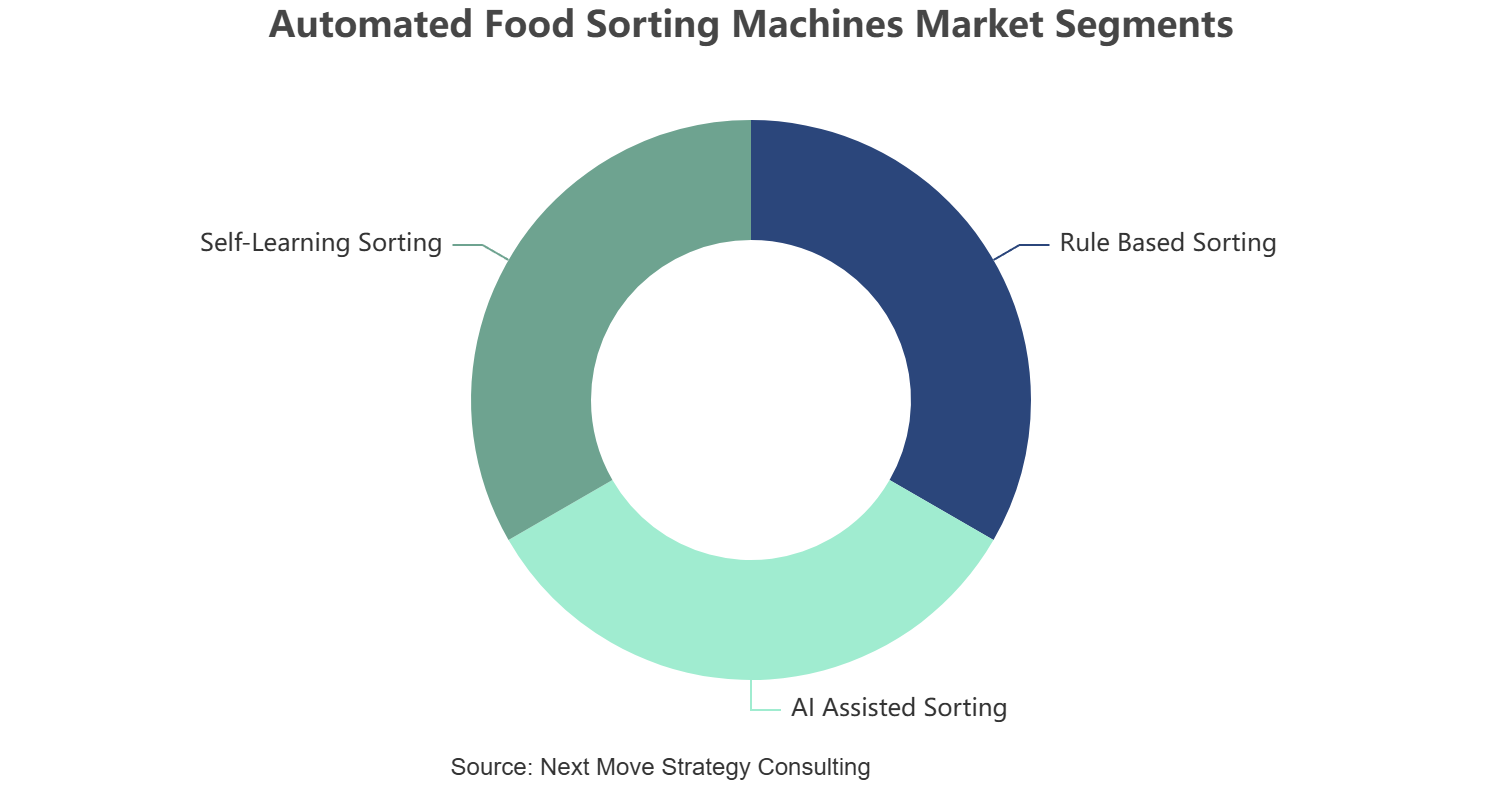
By Automation Level: AI Assisted Sorting held the largest share of approximately 45% (USD 1.73 billion) in 2025; Self-Learning Sorting is the fastest-growing sub-segment at 17.2% CAGR from 2026–2035. |
|
By Throughput Capacity: Medium Capacity held the largest share of approximately 38% (USD 1.46 billion) in 2025; Ultra-High Capacity is the fastest-growing sub-segment at 14.5% CAGR from 2026–2035. |
|
By Revenue Stream: New Equipment Sales held the largest share of approximately 48% (USD 1.85 billion) in 2025; Software Licenses is the fastest-growing sub-segment at 16.8% CAGR from 2026–2035. |
|
By Distribution Channel: Direct Sales held the largest share of approximately 41% (USD 1.58 billion) in 2025; System Integrators is the fastest-growing sub-segment at 12.9% CAGR from 2026–2035. |
|
By Customer Type: Food Processors held the largest share of approximately 42% (USD 1.62 billion) in 2025; Integrated Food Manufacturers is the fastest-growing sub-segment at 15.2% CAGR from 2026–2035. |
|
Dominant Region: Asia-Pacific dominated with approximately 34% revenue share (USD 1.31 billion) in 2025. |
|
Fastest-Growing Region: Latin America is expected to register the highest CAGR of 13.5% during 2026–2035. |
|
Dominant Country: China led with approximately USD 445 million in 2025. |
|
Fastest-Growing Country: India is the fastest-growing country at approximately 14.4% CAGR from 2026–2035. |
Market Opportunity: The automated food sorting machines market is expected to create an absolute dollar opportunity of USD 5.44 billion between 2026 and 2035, presenting significant investment potential across the fresh produce, grain, and processed food inspection value chain.
According to NMSC analysis, food processors are increasingly consolidating sorting-line procurement with vendors offering AI assisted and self-learning platforms that reduce manual grading labor, a shift that favors diversified equipment manufacturers with software and retrofit capabilities over single-technology specialists as food safety scrutiny intensifies through 2035.
What Does the Automated Food Sorting Machines Market Encompass?
The automated food sorting machines market encompasses optical, near infrared, hyperspectral, laser, X ray, and hybrid sensor equipment that inspects, grades, and removes defective or foreign material from fruits, vegetables, grains, pulses, nuts, seafood, and processed foods along packhouse and processing lines. Our assessment indicates that the scope spans free fall, belt, chute, lane, conveyor, and rotary grading architectures supplied to food processors, packhouses, agricultural cooperatives, exporters, and integrated food manufacturers across fresh produce, grain handling, protein processing, and packaged food end markets. The category has evolved from manual and semi-automated grading into camera and sensor driven inspection systems, driven by rising food safety regulation, labor shortages, and export quality compliance requirements worldwide.
Regulatory frameworks such as the U.S. Food Safety Modernization Act administered by the Food and Drug Administration and the European Union's General Food Law Regulation (EC) No 178/2002 shape foreign material detection and traceability requirements, while Codex Alimentarius guidelines increasingly influence export-grade sorting standards. We observed that technology adoption is shifting toward AI assisted and self-learning sorting platforms that combine multiple sensor types to improve defect detection accuracy. NMSC's analysis indicates that this structural shift, combined with rising automation in packhouse operations, is redefining procurement criteria across the automated food sorting machines market.
|
Field |
Details |
|
Market Size in 2025 |
USD 3.85 Billion |
|
Market Size in 2026 |
USD 4.18 Billion |
|
Revenue Forecast in 2035 |
USD 9.62 Billion |
|
Growth Rate |
CAGR of 9.7% from 2026 to 2035 |
|
Analysis Period |
2025–2035 |
|
Base Year Considered |
2025 |
|
Forecast Period |
2026–2035 |
|
Market Size Estimation |
Revenue (USD Billion) |
|
Companies Profiled |
20 |
|
Countries Covered |
33 |
|
Market Share |
Available for Top 10 Companies |
Key Emerging Trends
Based on research conducted by NMSC, we found that four structural trends are reshaping product development, sourcing, and stakeholder engagement across the industry.
How Is AI Assisted Grading Transforming Sorting Accuracy?
AI assisted and self-learning sorting platforms are replacing rule based systems to improve defect detection accuracy across variable produce characteristics. We observed that TOMRA Systems ASA's Halo spectral imaging technology, integrated across its sorting lines, uses neural network models trained on continuously expanding defect libraries. Food processors are adopting these platforms to reduce false rejects, while packhouses are retooling grading lines to accommodate self-learning software across fresh produce and nut sorting applications.
Why Are Hybrid Sensor Sorters Gaining Adoption?
Hybrid sensor sorters combining optical, near infrared, and X ray detection are gaining share as processors respond to stricter multi-criteria quality expectations. Our findings suggest that seafood and processed food applications increasingly specify combined sensor architectures to detect both surface defects and internal foreign material in a single pass. Manufacturers such as Buhler Holding AG and Sesotec GmbH are expanding hybrid portfolios, positioning these formats as a premium, higher-margin category within the broader market segmentation structure.
How Is Labor Scarcity Reshaping Sorting Line Automation?
Persistent shortages of manual grading labor across packhouses and processing facilities are pushing operators toward fully automated, high throughput sorting lines. We observed that ultra-high capacity conveyor and rotary grading systems are increasingly specified to replace multiple manual inspection stations. This trend is elevating demand for retrofit upgrades and service contracts among mid-sized processors, while system integrators redesign lines to minimize manual touchpoints during peak harvest seasons.
What Role Does Traceability Software Play in Sorting Innovation?
Software-driven traceability and data logging capabilities are emerging as a differentiator in sorting equipment procurement. Our analysis shows that exporters and integrated food manufacturers are prioritizing platforms that log rejection data by lot for compliance reporting. Key Technology, Inc.'s VERYX inspection platform, which pairs sorting with digital data capture, exemplifies this direction with software licensing models that extend equipment revenue beyond the initial hardware sale.
Growth Drivers and Restraints
Growth Catalyst and Risk Assessment Matrix
|
Factors |
Type |
(+/−) % Impact on CAGR |
Geographic Relevance |
Impact Timeline |
|
Rising food safety and traceability regulation |
Driver |
+2.2% |
Global |
2026-2035 |
|
Labor shortages in packhouses and processing plants |
Driver |
+1.9% |
North America, Europe |
2026-2035 |
|
Expansion of AI assisted and self-learning sorting |
Driver |
+1.7% |
Global |
2026-2035 |
|
Growth of export-grade fresh produce and nut trade |
Driver |
+1.4% |
Asia-Pacific, Latin America |
2026-2035 |
|
Rising processed and packaged food consumption |
Driver |
+1.1% |
Global |
2026-2032 |
|
Government modernization support for agri-processing |
Driver |
+0.8% |
Asia-Pacific, MEA |
2026-2035 |
|
High capital cost of hyperspectral and X ray systems |
Restraint |
-1.3% |
Global |
2026-2035 |
|
Limited automation readiness among small processors |
Restraint |
-0.9% |
Asia-Pacific, MEA, LATAM |
2026-2032 |
|
Integration complexity with legacy processing lines |
Restraint |
-0.6% |
North America, Europe |
2026-2032 |
What Is the Primary Growth Driver of the Automated Food Sorting Machines Market?
Rising food safety and traceability regulation is the primary driver of the market. The U.S. Food and Drug Administration's Food Safety Modernization Act rules continue to expand preventive-control and traceability recordkeeping requirements for high-risk foods. We observed that this regulatory pressure, reinforced by retailer quality scorecards, continues to anchor baseline demand for optical, NIR, and X ray sorting equipment across developed and emerging food processing economies alike.
How Is Labor Automation Driving Automated Food Sorting Machines Market Growth?
Persistent shortages of skilled manual grading labor are accelerating market growth toward fully automated sorting lines. The U.S. Bureau of Labor Statistics tracks continued tightness in agricultural and food processing labor markets, pushing processors to substitute automated inspection for manual sorting stations. Our assessment indicates that this labor pressure, combined with rising throughput requirements, is compressing adoption timelines for AI assisted and hybrid sensor sorting architectures across North America and Europe.
What Is Restraining Automated Food Sorting Machines Market Expansion?
High capital cost of hyperspectral and X ray sorting systems restrains adoption among small and mid-sized processors, particularly in price-sensitive emerging markets. The Food and Agriculture Organization highlights persistent capital constraints among smallholder-linked packhouses and cooperatives in developing economies. We found that limited access to financing and lower processing volumes reduce the payback justification for premium sorting technology compared with larger, export-oriented processing facilities.
Segmentation Analysis
Segment Sizing: By Product Type
|
Segment |
2025 (USD) |
2035 (USD) |
CAGR% (2026–2035) |
|
Optical Sorters |
USD 1.31 Billion |
USD 3.37 Billion |
11.1% |
|
NIR Sorters |
USD 0.77 Billion |
USD 1.73 Billion |
9.4% |
|
Hyperspectral Sorters |
USD 0.54 Billion |
USD 1.44 Billion |
11.6% |
|
Laser Sorters |
USD 0.39 Billion |
USD 0.87 Billion |
9.4% |
|
X Ray Sorters |
USD 0.46 Billion |
USD 1.15 Billion |
10.7% |
|
Hybrid Sensor Sorters |
USD 0.31 Billion |
USD 0.87 Billion |
12.2% |
|
Other Sorters |
USD 0.07 Billion |
USD 0.19 Billion |
10.7% |
|
Total |
USD 3.85 Billion |
USD 9.62 Billion |
9.7% |
Which Product Type Dominates the Automated Food Sorting Machines Market?
Optical sorters dominate the product type segmentation with approximately 34% share, reflecting their broad applicability across color and surface defect detection for fruits, vegetables, and grains. We observed that hybrid sensor sorters, which combine optical, NIR, and X ray detection in a single unit, are the fastest-growing sub-segment at 12.2% CAGR, as processors seek multi-criteria inspection to satisfy simultaneous quality, safety, and foreign material detection requirements within a single sorting pass.
Segment Sizing: By Automation Level
|
Segment |
2025 (USD) |
2035 (USD) |
CAGR% (2026–2035) |
|
Rule Based Sorting |
USD 1.54 Billion |
USD 2.41 Billion |
5.1% |
|
AI Assisted Sorting |
USD 1.73 Billion |
USD 4.81 Billion |
12.0% |
|
Self-Learning Sorting |
USD 0.58 Billion |
USD 2.41 Billion |
17.2% |
|
Total |
USD 3.85 Billion |
USD 9.62 Billion |
9.7% |
Which Automation Level Is Fastest-Growing in the Automated Food Sorting Machines Market?
AI assisted sorting held the largest share of the automation level segmentation in 2025 at approximately 45%, as processors balance accuracy gains against integration cost. Our findings suggest that self-learning sorting is the fastest-growing sub-segment at 17.2% CAGR, driven by continuous-improvement algorithms that reduce false rejects over time without manual recalibration, a capability increasingly demanded by high-volume export-oriented processing facilities across Asia-Pacific and North America.
Segment Sizing: By Customer Type
|
Segment |
2025 (USD) |
2035 (USD) |
CAGR% (2026–2035) |
|
Food Processors |
USD 1.62 Billion |
USD 3.85 Billion |
10.1% |
|
Packhouses |
USD 0.69 Billion |
USD 1.54 Billion |
9.3% |
|
Agricultural Cooperatives |
USD 0.39 Billion |
USD 0.87 Billion |
9.4% |
|
Exporters |
USD 0.46 Billion |
USD 1.25 Billion |
11.7% |
|
Contract Processing Facilities |
USD 0.31 Billion |
USD 0.87 Billion |
12.2% |
|
Integrated Food Manufacturers |
USD 0.27 Billion |
USD 0.96 Billion |
15.2% |
|
Other Customers |
USD 0.12 Billion |
USD 0.29 Billion |
10.7% |
|
Total |
USD 3.85 Billion |
USD 9.62 Billion |
9.7% |
Which Customer Type Leads the Automated Food Sorting Machines Market?
Food processors lead customer type segmentation with approximately 42% share, reflecting their scale requirements and multi-line sorting deployments across fruit, vegetable, and grain processing. We found that integrated food manufacturers are the fastest-growing customer segment at 15.2% CAGR, as vertically integrated companies increasingly install in-house sorting capacity to control quality across combined growing, processing, and packaging operations rather than outsourcing grading to third parties.
Growth Opportunities
NMSC's analysis indicates that three whitespace opportunities stand out for equipment manufacturers and technology vendors positioning for the next phase of market expansion.
How Can Retrofit Upgrades Unlock Value in Legacy Processing Lines?
Retrofitting existing rule based sorting lines with AI assisted software and upgraded sensor modules offers manufacturers a lower-cost entry point for mid-sized processors unable to justify full line replacement. This opportunity benefits packhouses and contract processing facilities seeking accuracy gains without full capital outlay.
What Opportunity Does Software Licensing Present for Recurring Revenue?
Subscription-based software licensing for defect libraries, traceability logging, and remote diagnostics creates recurring revenue beyond one-time equipment sales. This mechanism benefits equipment manufacturers seeking margin diversification and exporters requiring continuous compliance documentation across export destinations.
How Can System Integrators Expand Share in Emerging Processing Hubs?
Expanding processing capacity across Asia-Pacific and Latin American export hubs creates opportunity for system integrators bundling sorting equipment with line design and commissioning services. This mechanism benefits agricultural cooperatives and exporters in emerging economies scaling export-grade processing infrastructure.
Supply Chain Structure of the Automated Food Sorting Machines Market
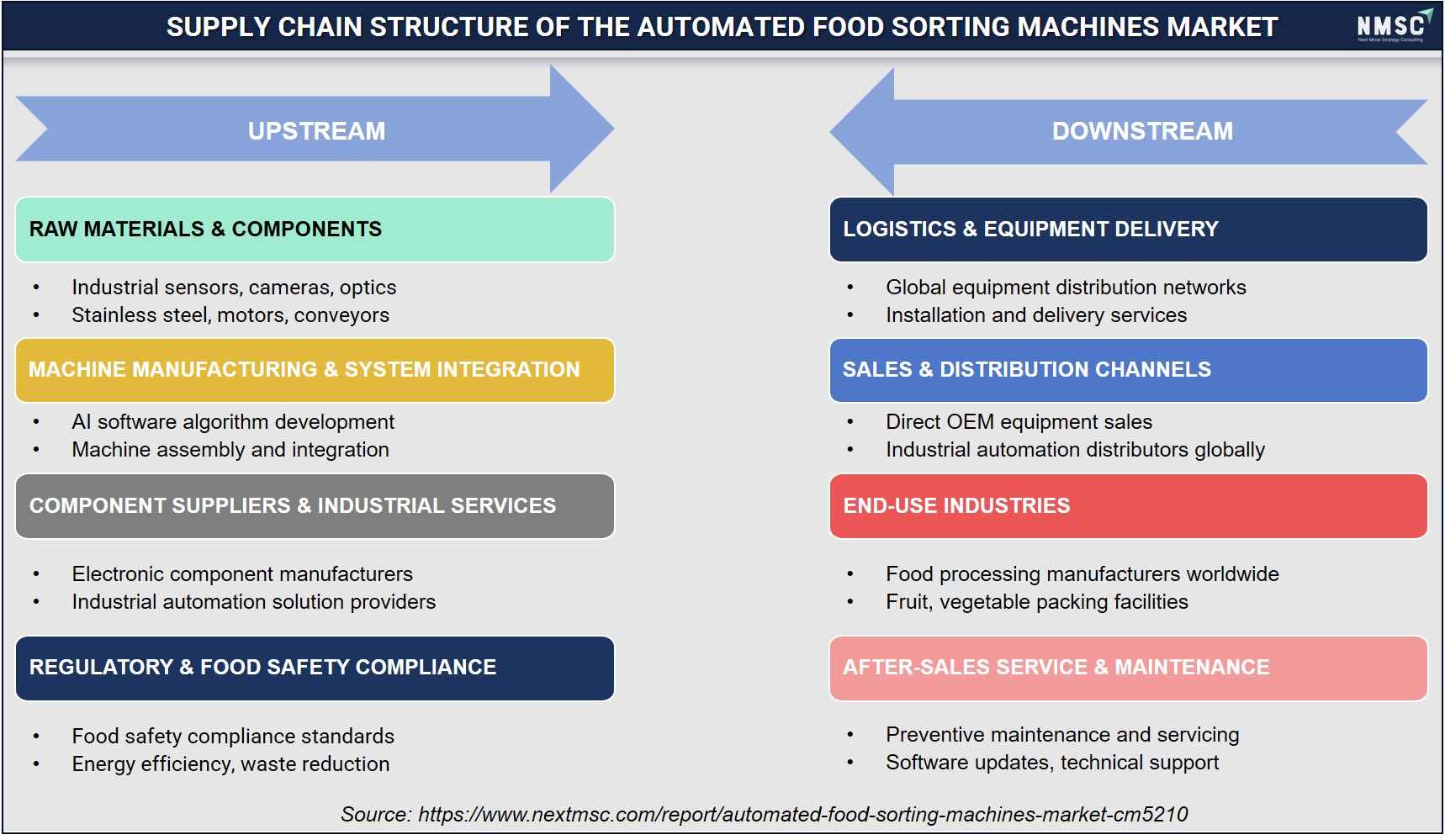
The supply chain structure illustrates the interconnected ecosystem supporting the Automated Food Sorting Machines Market, spanning raw material suppliers, component manufacturers, machine integrators, logistics providers, distributors, and end users. It highlights how advanced sensors, AI-enabled software, automation technologies, regulatory compliance, and after-sales services collectively ensure efficient production, reliable deployment, and sustained operational performance.
Regional Outlook
|
Region |
2025 (USD) |
2035 (USD) |
CAGR% (2026–2035) |
Key Driver |
|
Asia-Pacific |
USD 1.31 Billion |
USD 3.66 Billion |
12.1% |
Export-grade fresh produce processing growth |
|
North America |
USD 1.00 Billion |
USD 2.12 Billion |
8.7% |
Food safety and traceability regulation |
|
Europe |
USD 0.85 Billion |
USD 1.83 Billion |
8.9% |
General Food Law and quality compliance |
|
Middle East & Africa |
USD 0.39 Billion |
USD 1.06 Billion |
11.9% |
Agri-processing modernization investment |
|
Latin America |
USD 0.30 Billion |
USD 0.95 Billion |
13.5% |
Rising fruit and grain export volumes |
|
Total |
USD 3.85 Billion |
USD 9.62 Billion |
9.7% |
|
North America Automated Food Sorting Machines Market
North America's automated food sorting machines market reflects a mature adoption base shaped by stringent food safety regulation and high labor costs. We observed that processors increasingly prioritize AI assisted and X ray sorting to meet Food Safety Modernization Act preventive-control requirements. Technology adoption is advanced, with strategic outlook favoring retrofit upgrades and software licensing among established processors seeking incremental accuracy and traceability gains through 2035.
Europe Automated Food Sorting Machines Market
Europe's market is shaped by the General Food Law Regulation and rising retailer quality scorecards across fresh produce and processed food categories. Our assessment indicates that regulatory influence is strong, with technology adoption skewing toward hyperspectral and hybrid sensor systems for multi-criteria compliance. Strategic outlook favors manufacturers offering integrated traceability software alongside hardware across Germany, France, and the UK through the forecast period.
Asia-Pacific Automated Food Sorting Machines Market
Asia-Pacific leads global demand, driven by expanding export-grade fresh produce, rice, and seafood processing capacity across China and India. We found that technology adoption is accelerating from rule based toward AI assisted systems as processors scale export volumes. Regulatory influence from national food safety authorities and competitive intensity among domestic and international vendors position the region for sustained double-digit growth through 2035.
Middle East & Africa Automated Food Sorting Machines Market
The Middle East & Africa market reflects early-stage but accelerating adoption tied to agri-processing modernization programs and food import-substitution strategies. Our analysis shows that Gulf Cooperation Council governments are investing in domestic food processing infrastructure, supporting demand for mid-capacity sorting lines. Strategic outlook favors vendors offering financing-friendly, service-supported equipment packages across Saudi Arabia, UAE, and South Africa.
Latin America Automated Food Sorting Machines Market
Latin America is the fastest-growing region, anchored by expanding fruit, grain, and coffee export volumes from Brazil and Argentina. We observed that exporters are prioritizing X ray and NIR sorting to meet importing-country phytosanitary and foreign material standards. Technology adoption is rising quickly from a smaller base, with strategic outlook favoring distributors and system integrators supporting mid-sized cooperative and exporter customers through 2035.
U.S. Automated Food Sorting Machines Market
Based on our estimates the U.S. automated food sorting machines market is the largest in North America, supported by extensive FDA-driven food safety compliance and high processing automation among large fruit, vegetable, and grain processors. Demand structure favors AI assisted and X ray systems, with strong adoption levels, moderate regulatory influence beyond FSMA, high technology penetration, and intense competitive rivalry among established vendors. Strategic outlook favors software-enabled upgrade cycles over new equipment purchases as the installed base matures. The country's market was valued at approximately USD 681 million in 2025 and is projected to reach USD 1.38 billion by 2035, expanding at a 8.1% CAGR from 2026 to 2035.
Canada Automated Food Sorting Machines Market
The market in the Canadian automated food sorting machines market reflects steady demand from grain and pulse export processors seeking foreign material detection compliance. Demand structure is moderate, adoption levels trail the U.S. but are rising, regulatory influence stems from Canadian Food Inspection Agency standards, and technology penetration favors NIR and optical systems. Competitive intensity is moderate, with strategic outlook favoring distributor-supported sales to mid-sized cooperatives. The country's market was valued at approximately USD 228 million in 2025 and is projected to reach USD 450 million by 2035, expanding at a 7.8% CAGR from 2026 to 2035.
UK Automated Food Sorting Machines Market
As per our estimate the UK automated food sorting machines market is shaped by post-Brexit food safety alignment and retailer-driven quality standards for fresh produce. Demand structure favors mid-capacity optical and NIR systems, adoption levels are steady, regulatory influence from the Food Standards Agency is significant, and technology penetration is moderate. Competitive intensity is high among established European vendors, with strategic outlook favoring service contract renewals over new installations. The country's market was valued at approximately USD 186 million in 2025 and is projected to reach USD 366 million by 2035, expanding at a 7.8% CAGR from 2026 to 2035.
Germany Automated Food Sorting Machines Market
According to our analysis the German automated food sorting machines market leads Europe in hyperspectral and hybrid sensor adoption, supported by strong domestic engineering vendors and strict General Food Law compliance. Demand structure favors premium multi-criteria systems, adoption levels are advanced, regulatory influence is high, and technology penetration is strong. Competitive intensity is elevated given domestic manufacturer presence, with strategic outlook favoring innovation-led differentiation. The country's market was valued at approximately USD 220 million in 2025 and is projected to reach USD 457 million by 2035, expanding at a 8.5% CAGR from 2026 to 2035.
France Automated Food Sorting Machines Market
Based on our estimates the French automated food sorting machines market reflects steady demand from fruit, vegetable, and wine-adjacent processing sectors requiring quality grading. Demand structure is moderate, adoption levels are steady, regulatory influence from national food safety authorities aligns with EU law, and technology penetration favors optical and NIR systems. Competitive intensity is moderate, with strategic outlook favoring retrofit upgrades among mid-sized processors. The country's market was valued at approximately USD 136 million in 2025 and is projected to reach USD 274 million by 2035, expanding at a 8.1% CAGR from 2026 to 2035.
China Automated Food Sorting Machines Market
The market in the Chinese automated food sorting machines market is the largest in Asia-Pacific, driven by massive fruit, vegetable, rice, and seafood processing volumes and rapid export growth. Demand structure favors high-throughput belt and rotary grading systems, adoption levels are rising quickly, regulatory influence from national food safety administration standards is increasing, and technology penetration is expanding toward AI assisted systems. Competitive intensity is high among domestic and international vendors. The country's market was valued at approximately USD 445 million in 2025 and is projected to reach USD 1.21 billion by 2035, expanding at a 11.7% CAGR from 2026 to 2035.
India Automated Food Sorting Machines Market
As per our estimate the Indian automated food sorting machines market is the fastest-growing globally, supported by expanding grain, pulse, and spice export processing and government agri-infrastructure investment. Demand structure favors mid-capacity and NIR systems, adoption levels are rising from a smaller base, regulatory influence from the Food Safety and Standards Authority of India is increasing, and technology penetration is accelerating. Competitive intensity is rising as international vendors expand distribution. The country's market was valued at approximately USD 196 million in 2025 and is projected to reach USD 658 million by 2035, expanding at a 14.4% CAGR from 2026 to 2035.
Japan Automated Food Sorting Machines Market
According to our analysis the Japanese automated food sorting machines market reflects mature demand tied to strict domestic quality standards and an aging agricultural labor base. Demand structure favors precision optical and hyperspectral systems, adoption levels are advanced, regulatory influence from the Ministry of Health, Labour and Welfare is significant, and technology penetration is high. Competitive intensity favors established domestic vendors such as Satake Corporation. The country's market was valued at approximately USD 209 million in 2025 and is projected to reach USD 475 million by 2035, expanding at a 9.5% CAGR from 2026 to 2035.
South Korea Automated Food Sorting Machines Market
Based on our estimates the South Korean automated food sorting machines market reflects steady demand from processed food and seafood processing sectors emphasizing automation to offset labor costs. Demand structure favors mid-to-high capacity systems, adoption levels are advanced, regulatory influence from the Ministry of Food and Drug Safety is significant, and technology penetration is strong. Competitive intensity is moderate, with strategic outlook favoring domestic-international vendor partnerships. The country's market was valued at approximately USD 131 million in 2025 and is projected to reach USD 329 million by 2035, expanding at a 10.8% CAGR from 2026 to 2035.
Australia Automated Food Sorting Machines Market
The market in the Australian automated food sorting machines market is anchored by export-oriented fruit, grain, and nut processing requiring compliance with importing-country phytosanitary standards. Demand structure favors X ray and optical systems, adoption levels are advanced, regulatory influence from national food safety standards is significant, and technology penetration is strong. Competitive intensity is moderate, with strategic outlook favoring service contract-supported installations. The country's market was valued at approximately USD 92 million in 2025 and is projected to reach USD 219 million by 2035, expanding at a 10.1% CAGR from 2026 to 2035.
UAE Automated Food Sorting Machines Market
As per our estimate the UAE automated food sorting machines market reflects growing investment in domestic food processing capacity to reduce import dependence. Demand structure favors mid-capacity systems for date, grain, and processed food sorting, adoption levels are rising, regulatory influence from national food safety authorities is increasing, and technology penetration is moderate. Competitive intensity is rising as international distributors expand regional presence. The country's market was valued at approximately USD 77 million in 2025 and is projected to reach USD 212 million by 2035, expanding at a 11.9% CAGR from 2026 to 2035.
Saudi Arabia Automated Food Sorting Machines Market
According to our analysis the Saudi Arabian automated food sorting machines market is supported by Vision 2030-aligned agri-processing modernization and food security investment programs. Demand structure favors new equipment sales over retrofit, adoption levels are rising, regulatory influence from the Saudi Food and Drug Authority is increasing, and technology penetration is moderate. Competitive intensity is rising, with strategic outlook favoring vendors offering local service support. The country's market was valued at approximately USD 100 million in 2025 and is projected to reach USD 265 million by 2035, expanding at a 11.4% CAGR from 2026 to 2035.
South Africa Automated Food Sorting Machines Market
Based on our estimates the South African automated food sorting machines market reflects steady demand from fruit and grain export processors serving European and Asian destinations. Demand structure favors optical and NIR systems, adoption levels are moderate, regulatory influence from national agricultural standards aligns with export-market requirements, and technology penetration is moderate. Competitive intensity is moderate, with strategic outlook favoring distributor-led sales. The country's market was valued at approximately USD 54 million in 2025 and is projected to reach USD 138 million by 2035, expanding at a 10.9% CAGR from 2026 to 2035.
Brazil Automated Food Sorting Machines Market
The market in the Brazilian automated food sorting machines market is the largest in Latin America, driven by extensive coffee, fruit, and grain export processing volumes. Demand structure favors high-throughput and X ray systems, adoption levels are rising quickly, regulatory influence from national agricultural inspection standards is increasing, and technology penetration is expanding. Competitive intensity is rising as international vendors expand distributor networks. The country's market was valued at approximately USD 139 million in 2025 and is projected to reach USD 423 million by 2035, expanding at a 13.2% CAGR from 2026 to 2035.
Argentina Automated Food Sorting Machines Market
As per our estimate the Argentine automated food sorting machines market reflects growing demand from grain and fruit export processors seeking foreign material detection compliance for key export destinations. Demand structure favors mid-capacity systems, adoption levels are rising, regulatory influence from national food safety standards is increasing, and technology penetration is moderate. Competitive intensity is moderate, with strategic outlook favoring distributor-supported installations. The country's market was valued at approximately USD 46 million in 2025 and is projected to reach USD 144 million by 2035, expanding at a 13.5% CAGR from 2026 to 2035.
Competitive Landscape
Our findings suggest that the automated food sorting machines industry is moderately consolidated, with established sensor-technology specialists competing alongside diversified food processing equipment manufacturers.
|
Field |
Details |
|
Market Structure |
Moderately consolidated, with the top ten companies accounting for the majority share of global sorting equipment revenue. |
|
Innovation Focus |
AI assisted defect detection, hybrid multi-sensor architectures, and software-based traceability platforms. |
|
M&A Activity |
Active, with equipment manufacturers acquiring sensor technology specialists and inspection software providers to broaden portfolios. |
How Do Companies Compete in the Automated Food Sorting Machines Market?
Companies compete primarily on sorting accuracy, throughput capacity, and total cost of ownership across defect and foreign material detection applications. NMSC's analysis indicates that vendors differentiate through proprietary sensor algorithms, service network breadth, and financing-friendly commercial models. Competitive rivalry is most intense in optical and NIR sorter categories, where multiple established vendors offer comparable core detection capability, pushing differentiation toward software and after-sales service.
Which Competitive Archetypes Dominate the Automated Food Sorting Machines Industry?
Two archetypes dominate: global sensor-technology leaders such as TOMRA Systems ASA and Buhler Holding AG that combine deep R&D scale with global service networks, and specialized regional players such as Satake Corporation and Anzai Manufacturing Co., Ltd. that compete on application-specific expertise in commodities like rice and seafood. Our analysis shows that scale advantages favor global leaders in enterprise accounts, while specialists retain share in commodity-specific niches.
What Innovation and Differentiation Strategies Define Market Leadership?
Leading vendors are investing in AI assisted defect libraries, cloud-connected diagnostics, and hybrid sensor fusion to differentiate beyond hardware performance alone. We observed that software licensing and subscription-based traceability tools are increasingly bundled with hardware sales to create recurring revenue streams and deepen customer lock-in across multi-year service relationships.
How Active Is M&A Activity in the Automated Food Sorting Machines Market?
M&A activity is active, exemplified by JBT Corporation's 2025 merger with Marel hf. to form JBT Marel Corporation, combining food processing equipment with sorting and inspection technology under a single portfolio. We found that similar consolidation among mid-sized sensor technology providers is likely to continue as larger equipment manufacturers seek to broaden inspection capabilities across the food processing value chain.
Key Market Players
Our assessment identifies the following companies as the leading participants shaping competitive dynamics in the automated food sorting machines market.
-
Buhler Holding AG
-
JBT Marel Corporation
-
Key Technology, Inc.
-
Satake Corporation
-
Sesotec GmbH
-
Raytec Vision SpA
-
Cimbria A/S
-
De Greef's Wagen-, Carrosserie- en Machinebouw B.V. (Greefa)
-
Aweta G&P B.V.
-
Unitec S.p.A.
-
MAF RODA AGROBOTIC
-
Hefei Meyer Optoelectronic Technology Inc.
-
Ellips B.V.
-
Anzai Manufacturing Co., Ltd.
-
OPTIMUM nv
-
Newtec A/S
-
Shibuya Seiki Co., Ltd.
-
DAEWON GSI Co., Ltd.
-
Sorma S.p.A.
Latest Developments
We observed the following recent developments shaping competitive positioning across the automated food sorting machines industry.
|
Date |
Event |
|
Sep 2025 |
TOMRA introduced the TOMRA 4C, a next-generation optical sorting machine for nuts and IQF fruits and vegetables. The system features AI-powered defect detection, simplified operation, faster cleaning, and higher throughput to improve food sorting efficiency. |
|
Aug 2025 |
Bühler launched the SORTEX R500, an autonomous optical sorter designed for rice processors. The system improves sorting accuracy, minimizes operator intervention, increases yield, and reduces material waste using advanced automation. |
|
May 2025 |
Bühler unveiled the SORTEX AI700, its latest AI-enabled optical sorter using deep-learning technology to improve contaminant detection and allergen removal in oats and other food products while increasing yield. |
Investment Opportunities
Where Are Capital Inflows Concentrated in the Automated Food Sorting Machines Market?
Capital inflows are concentrated in AI software development and sensor fusion R&D, as equipment manufacturers seek to differentiate beyond hardware. We observed that private investment in agri-technology startups focused on machine vision grading has continued through 2025, supplementing incumbent vendor R&D budgets and accelerating the pace of self-learning platform development across the industry.
How Significant Is Infrastructure Investment in Supporting Market Growth?
Government-backed agri-processing infrastructure investment, particularly across Asia-Pacific and the Middle East, is expanding the addressable installed base for sorting equipment. Our assessment indicates that national food security and export-diversification programs are funding new packhouse and processing facility construction, directly supporting new equipment sales and system integrator revenue over the forecast period.
What ESG Considerations Are Shaping Investment in Sorting Technology?
Environmental, social, and governance considerations increasingly favor sorting technology that reduces food waste through improved defect and quality detection accuracy. We found that investors are prioritizing vendors demonstrating measurable waste-reduction outcomes and energy-efficient equipment design, aligning capital allocation with broader sustainability disclosure expectations across the food processing value chain.
Key Benefits for Stakeholders
How Does This Report Benefit Industry Leaders and Enterprise Decision-Makers?
This report equips food processing and packhouse leadership with segmented demand data, competitive benchmarking, and regional growth projections to prioritize capital allocation across sorting technology investments. NMSC's analysis indicates that decision-makers can use the segmentation and driver-restraint analysis to align procurement timing with regulatory and labor market pressures shaping their specific commodity and geography.
How Does This Report Benefit Investors and Financial Analysts?
Investors and financial analysts gain access to independently derived market sizing, CAGR trajectories, and competitive landscape analysis supporting valuation and diligence work across sorting equipment manufacturers and adjacent technology vendors. Our assessment indicates that the regional and segment-level detail supports comparative analysis of growth exposure across public and private company portfolios.
How Does This Report Benefit Technology Vendors and Product Teams?
Technology vendors and product teams can use the segmentation by automation level, sorting function, and revenue stream to identify underserved product categories and prioritize software versus hardware development investment. We observed that the driver-restraint and opportunity analysis directly informs go-to-market sequencing across regions with differing regulatory and adoption maturity.
PESTEL Analysis of the Automated Food Sorting Machines Market
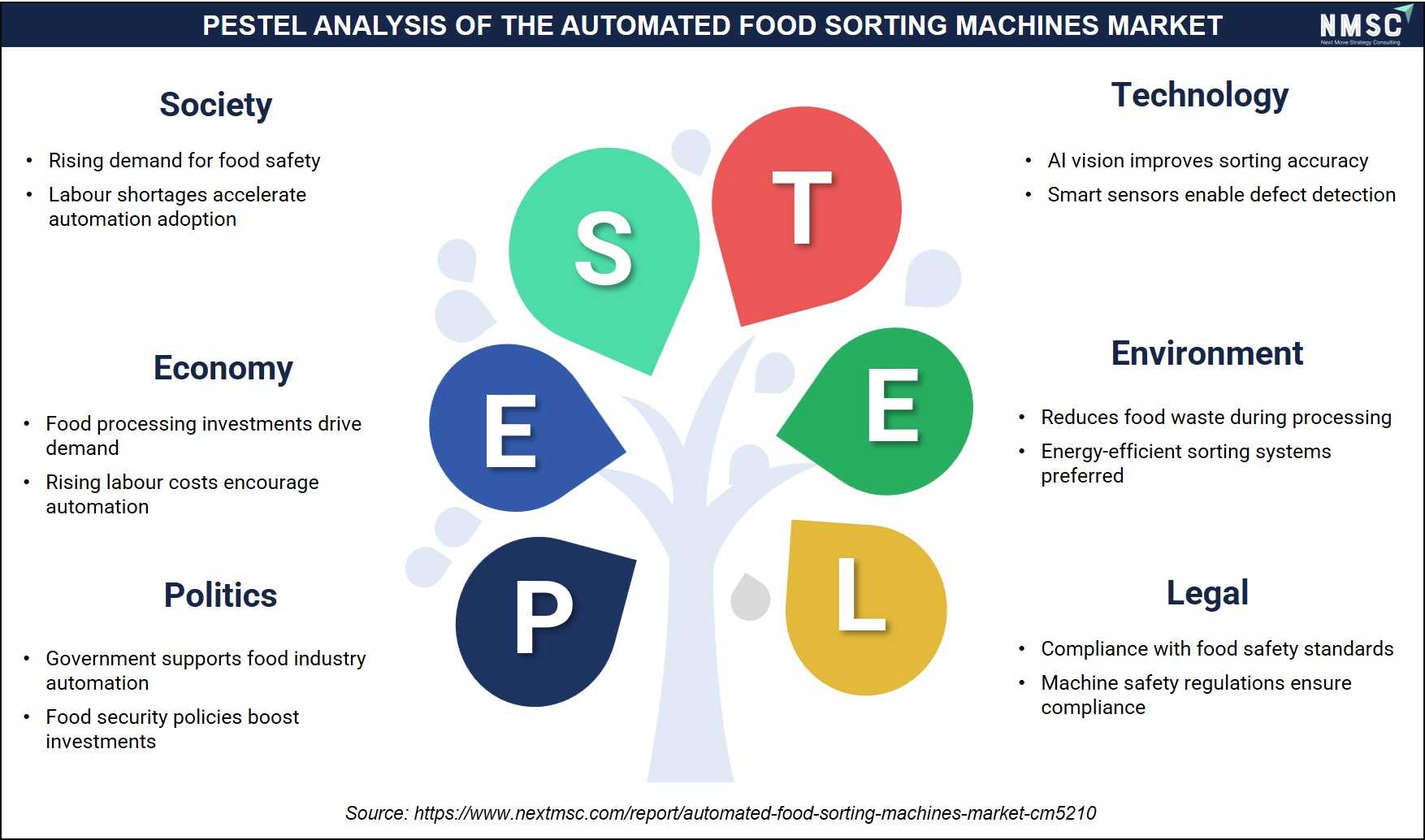
The PESTEL analysis examines the external factors influencing the Automated Food Sorting Machines Market across political, economic, social, technological, environmental, and legal dimensions. It highlights how food safety regulations, automation advancements, sustainability initiatives, labor shortages, investment in food processing, and evolving compliance requirements collectively drive innovation, adoption, competitiveness, and long-term market growth.
Key Market Segments
By Product Type
-
Optical Sorters
-
Colour Sorters
-
Vision Sorters
-
Multispectral Sorters
-
-
NIR Sorters
-
Standard NIR Sorters
-
Deep NIR Sorters
-
-
Hyperspectral Sorters
-
VIS NIR Sorters
-
SWIR Sorters
-
Full Spectrum Hyperspectral Sorters
-
-
Laser Sorters
-
Surface Defect Detection Sorters
-
Shape Recognition Sorters
-
-
X Ray Sorters
-
Foreign Material Detection Sorters
-
Internal Quality Inspection Sorters
-
-
Hybrid Sensor Sorters
-
Optical And NIR Sorters
-
Optical And Laser Sorters
-
Optical And X Ray Sorters
-
Multi Sensor Sorters
-
-
Other Sorters
By Machine Architecture
-
Free Fall Sorters
-
Belt Sorters
-
Chute Sorters
-
Lane Sorters
-
Conveyor Sorters
-
Rotary Grading Sorters
-
Other Machine Architectures
By Commodity Type
-
Fruits
-
Citrus Fruits
-
Pome Fruits > Apples
-
Pome Fruits > Pears
-
Stone Fruits > Peaches
-
Stone Fruits > Apricots
-
Stone Fruits > Plums
-
Stone Fruits > Cherries
-
Berries
-
Tropical Fruits
-
Other Fruits
-
-
Vegetables
-
Potatoes
-
Onions
-
Tomatoes
-
Leafy Vegetables
-
Root Vegetables
-
Other Vegetables
-
-
Grains
-
Rice
-
Wheat
-
Corn
-
Barley
-
Other Grains
-
-
Pulses
-
Lentils
-
Peas
-
Beans
-
Other Pulses
-
-
Nuts
-
Almonds
-
Cashews
-
Peanuts
-
Pistachios
-
Other Nuts
-
-
Seeds
-
Coffee
-
Tea
-
Spices
-
Dried Fruits
-
Meat
-
Poultry
-
Seafood
-
Dairy Products
-
Processed Foods
-
Frozen Foods
-
Snack Foods
-
Packaged Foods
-
Other Processed Foods
-
By Sorting Function
-
Colour Sorting
-
Defect Removal
-
Foreign Material Removal
-
Size Sorting
-
Shape Sorting
-
Density Sorting
-
Ripeness Grading
-
Internal Quality Inspection
-
Multi Criteria Sorting
By Automation Level
-
Rule Based Sorting
-
AI Assisted Sorting
-
Self-Learning Sorting
By Throughput Capacity
-
Low Capacity
-
Medium Capacity
-
High Capacity
-
Ultra-High Capacity
By Revenue Stream
-
New Equipment Sales
-
Software Licenses
-
Retrofit Upgrades
-
Spare Parts
-
Service Contracts
-
Training And Commissioning
By Distribution Channel
-
Direct Sales
-
Authorized Distributors
-
System Integrators
-
OEM Partnerships
By Customer Type
-
Food Processors
-
Large Food Processors
-
Mid-Sized Food Processors
-
Small Food Processors
-
-
Packhouses
-
Agricultural Cooperatives
-
Exporters
-
Contract Processing Facilities
-
Integrated Food Manufacturers
-
Other Customers
By Region
-
North America: U.S., Canada, Mexico.
-
Europe: UK, Germany, France, Italy, Spain, Sweden, Denmark, Finland, Netherlands, Rest of Europe.
-
Asia-Pacific: China, India, Japan, South Korea, Taiwan, Indonesia, Vietnam, Australia, Philippines, Malaysia, Rest of APAC.
-
Middle East & Africa: Saudi Arabia, UAE, Egypt, Israel, Turkey, Nigeria, South Africa, Rest of MEA.
-
Latin America: Brazil, Argentina, Chile, Colombia, Rest of LATAM.
Conclusion and Recommendations
What Is the Long-Term Outlook for the Automated Food Sorting Machines Market?
The long-term outlook remains strongly positive, with the market expected to more than double from USD 4.18 billion in 2026 to USD 9.62 billion by 2035 at a 9.7% CAGR. We observed that structural drivers, including food safety regulation and labor automation, are durable rather than cyclical, supporting sustained double-digit growth across AI assisted and self-learning sorting categories through the forecast period.
What Strategic Positioning Should Vendors Pursue?
Vendors should prioritize hybrid sensor and software-integrated platforms that address multi-criteria sorting needs, while building service and financing capabilities to reach mid-sized processors. Our assessment indicates that manufacturers combining hardware reliability with recurring software revenue will be best positioned to defend margin as competitive intensity rises across commoditizing optical and NIR categories.
How Attractive Is the Market for New Investment?
The market presents attractive investment characteristics given its high growth trajectory, recurring service and software revenue potential, and exposure to durable regulatory tailwinds. We found that AI assisted and self-learning sorting sub-segments, growing at 12.0% and 17.2% CAGR respectively, represent the most attractive entry points for technology-focused investors and strategic acquirers.
What Market Shifts and Key Risks Should Stakeholders Monitor?
Stakeholders should monitor the shift toward software-centric revenue models and the integration risk associated with combining multiple sensor types in hybrid platforms. Our analysis shows that high capital cost remains a key risk to adoption pace among small processors, while integration complexity with legacy processing lines could delay retrofit-driven demand in mature markets.
What Growth Pathways Should Companies Prioritize?
Companies should prioritize growth pathways centered on retrofit upgrades for the large installed base of rule based systems, software licensing for recurring revenue, and geographic expansion into Latin America and Asia-Pacific export processing hubs. NMSC's analysis indicates that these pathways offer the most direct route to capturing the USD 5.44 billion absolute dollar opportunity identified between 2026 and 2035.
About the Author
 Mihul Sharma
— Mihul Sharma is Research Associate at Next Move Strategy Consulting, where he has covered technology, industrial, and healthcare markets for 3 years. His work applies structured business research, market analysis, and secondary-source review to assess market trends, competitive developments, and growth opportunities. He supports report development by fully synthesizing industry data, company information, and market signals into concise findings for strategy and investment-focused research teams.
Mihul Sharma
— Mihul Sharma is Research Associate at Next Move Strategy Consulting, where he has covered technology, industrial, and healthcare markets for 3 years. His work applies structured business research, market analysis, and secondary-source review to assess market trends, competitive developments, and growth opportunities. He supports report development by fully synthesizing industry data, company information, and market signals into concise findings for strategy and investment-focused research teams.
About the Reviewer
 Supradip Baul
— Supradip Baul is an accomplished business consultant and strategist with over a decade of rich experience in market intelligence, strategy, technology, and business transformation. His work has included rigorous qualitative and quantitative analysis across multiple industries, helping clients shape investment decisions and long-term roadmaps. Earlier in his career, he was associated with Gartner, where he contributed to industry-leading reports and market share analyses. He has worked with leading global companies and holds an MBA with a dual specialization in Marketing and Finance.
Supradip Baul
— Supradip Baul is an accomplished business consultant and strategist with over a decade of rich experience in market intelligence, strategy, technology, and business transformation. His work has included rigorous qualitative and quantitative analysis across multiple industries, helping clients shape investment decisions and long-term roadmaps. Earlier in his career, he was associated with Gartner, where he contributed to industry-leading reports and market share analyses. He has worked with leading global companies and holds an MBA with a dual specialization in Marketing and Finance.
At Next Move Strategy Consulting, we understand that insightful market research is the cornerstone of successful business decisions. That's why we employ a robust and multifaceted approach, combining various methodologies to deliver the most accurate and actionable data for our clients.

Research Landscape
We navigate the world of research with two primary approaches:
Qualitative Approach
Our qualitative research methodologies involve immersive techniques such as in-depth interviews, focus groups, and observational studies. By engaging directly with individuals and stakeholders, we uncover valuable insights that quantitative data alone may overlook.

Quantitative Research
In tandem with qualitative methodologies, NMSC leverages the power of Quantitative Research to provide a robust foundation of numerical insights. Through systematic data collection and analysis, we quantify patterns, preferences, and market trends, offering a comprehensive view of the business landscape.
Our quantitative research approach employs diverse tools, including surveys, experiments, and statistical modelling. These methodologies enable us to gather data from a large and representative sample, ensuring the statistical significance of our findings. By employing structured questionnaires and standardized data collection methods, we guarantee the reliability and validity of the information we present to our clients.
Quantitative research is particularly effective in measuring the prevalence of trends, assessing market size, and gauging the impact of various factors on consumer behavior. The numerical precision attained through this approach equips our clients with actionable insights, facilitating data-driven decision-making and strategy formulation.


Our Specialized Toolbox for Industry-Specific Market Research
We deploy a specialized arsenal of techniques tailored to meet your unique requirements. Here's a glimpse into our comprehensive toolbox:

Information Procurement
The stage entails acquiring market data or relevant information through various sources and methodologies.


Market Research Approach
We utilize both top-down and bottom-up approaches in market research analysis to achieve a comprehensive understanding of the market dynamics, leveraging the broad perspective of industry trends and macroeconomic factors alongside detailed insights from specific segments and individual companies.

Porters Five Forces Analysis
We conduct Porter's Five Forces analysis to evaluate the competitive landscape of an industry, providing us with insights into factors that affect profitability and strategic positioning.

SWOT Analysis

Forecasting
We utilize a forecasting model to predict future consumption by considering parameters like population, economics, regulations, market competition, drivers, constraints, technology, and pricing. We also employ statistical techniques such as multilinear regression, exponential smoothing, moving average, ARIMA, and Monte Carlo simulations for accurate predictions. In econometric forecasting, we analyzed short-term and long-term event impacts, attributing values based on regulatory frameworks, economic factors, and market events.





 Speak to Our Analyst