Continuous Stirred Tank Reactor Market By Material (Stainless Steel, Glass-Lined Steel), Product Lifecycle (New Build, Installed Base), Pressure Rating (Atmospheric, Low Pressure), Process Duty, Mixing Technology, Configuration, Automation Level, and Sales Channel, and By End Use Industry (Chemicals, Pharmaceuticals, Biotechnology, Food and Beverage, Energy and Fuels, Water and Wastewater, Mining and Metallurgy, Academia and Research, CDMO, and Others) – Global Analysis and Forecast, 2026–2035
Industry: Construction & Manufacturing | Publishing Date: July 7, 2026 | Last Updated: September 30, 2026 | No of Pages: N/A | No. of Tables: N/A | No. of Figures: N/A | Format: PDF | Report Code: CM5001
What Is the Continuous Stirred Tank Reactor Market Size?
The Continuous Stirred Tank Reactor Market comprises the global industry supplying continuously operated, agitated vessel reactors used for liquid, gas-liquid, slurry, and bioprocess reactions across chemicals, pharmaceuticals, and biotechnology. The industry was valued at USD 4.05 billion in 2025 and is expected to be valued at USD 4.32 Billion by the end of 2026 and is projected to reach USD 7.81 billion by 2035, expanding at a CAGR of 6.80% between 2026 and 2035.
Continuous Stirred Tank Reactor Market growth through 2035 is supported by four converging forces: expanding biopharmaceutical and specialty chemical production capacity, regulatory encouragement of continuous manufacturing across major pharmaceutical markets, rising fermentation and cell-culture throughput in biotechnology, and accelerating automation of mixing, temperature, and reaction-control systems. Additional momentum comes from capacity build-out in renewable fuels, municipal water treatment, and contract development and manufacturing organizations, particularly across the Asia-Pacific. Together, these dynamics are reshaping demand toward higher-value, automated, and application-specific vessel configurations.
|
Parameters |
Details |
|
Market Size in 2025 |
USD 4.05 Billion |
|
Market Size in 2026 |
USD 4.32 Billion |
|
Revenue Forecast in 2035 |
USD 7.81 Billion |
|
Growth Rate |
CAGR of 6.80% from 2026 to 2035 |
|
Analysis Period |
2025–2035 |
|
Base Year Considered |
2025 |
|
Forecast Period |
2026–2035 |
|
Market Size Estimation |
USD Billion |
|
Companies Profiled |
20 |
|
Countries Covered |
33 |
|
Market Share |
Top 10 |
Continuous Stirred Tank Reactor Market Overview
What Defines the Scope of the Continuous Stirred Tank Reactor Market?
The Continuous Stirred Tank Reactor Market covers vessels, agitation systems, instrumentation, and ancillary equipment used to sustain continuous-flow reactions under controlled mixing, temperature, and residence-time conditions. Scope spans new-build vessels and the installed base of retrofit, spare-parts, and service activity across chemicals, pharmaceuticals, biotechnology, food and beverage, energy, water treatment, mining, academia, and contract manufacturing. NMSC's analysis indicates that scope boundaries exclude purely batch reactors, plug-flow tubular reactors, and packed-bed catalytic systems unless configured with continuous stirred-tank internals, keeping the estimate focused on genuinely continuous, agitated-vessel technology.
How Is the Continuous Stirred Tank Reactor Industry Evolving?
Through our analysis, we observed that the industry has evolved from standalone batch vessels toward integrated, instrumented systems embedded within broader process trains. Equipment suppliers increasingly bundle reactors with skid-mounted utilities, digital control platforms, and lifecycle service contracts rather than selling vessels in isolation. Consolidation among glass-lined and alloy equipment manufacturers has concentrated technical capability among a smaller group of full-system providers, while specialized laboratory and pilot-scale players continue to serve early-stage process development. This structural shift is gradually repositioning the industry around system-level value rather than discrete hardware.
How Is the Regulatory Environment Shaping Market Adoption?
Regulatory developments are directly shaping adoption patterns. The U.S. Food and Drug Administration finalized Q13 guidance on continuous manufacturing of drug substances and drug products under the International Council for Harmonisation, clarifying lifecycle and control-strategy expectations for converting batch pharmaceutical processes to continuous operation. In parallel, federal environmental agencies overseeing anaerobic digestion and biosolids management continue to set permitting and design requirements for stirred-vessel digesters used in wastewater treatment. Based on our market evaluation, we noticed that harmonized continuous-manufacturing guidance is reducing regulatory uncertainty and encouraging capital commitments toward reactor installations across regulated industries.
What Are the Key Technology Adoption Trends in the Continuous Stirred Tank Reactor Market?
Technology adoption is increasingly centered on digital instrumentation and automated process control rather than vessel design alone. Suppliers are integrating real-time temperature, pressure, and agitation-speed sensors with predictive-maintenance software, enabling operators to shift from manual to semi-automated and fully automated control schemes. Magnetic-drive agitation is gaining ground in high-purity pharmaceutical and biotechnology applications where seal-free operation reduces contamination risk. Our findings suggest that digital retrofit packages for the existing installed base are becoming as commercially significant as new-vessel sales, reflecting a maturing equipment population across process industries worldwide.
Key Takeaways
|
Key Takeaways |
|
The chemicals segment led the market in 2025 with a 32.0% share, equivalent to USD 1.30 billion, reflecting sustained commodity and specialty chemical production capacity worldwide. |
|
Biotechnology is the fastest-growing end-use segment, expanding at an 11.34% CAGR from 2026 to 2035 as fermentation and cell-culture capacity scales across biologics manufacturing. |
|
Stainless steel remained the leading material in 2025, accounting for 34.0% of global revenue, given its broad corrosion resistance and cost balance across general-purpose applications. |
|
Titanium and specialty alloys are projected to grow fastest among material types at a 10.62% CAGR, driven by demand for corrosion resistance in green hydrogen and high-purity bioprocessing. |
|
Semi-automated systems held the largest automation-level share in 2025 at 45.0%, reflecting the still-large population of partially digitized installed reactors. |
|
Fully automated systems are expanding fastest at a 12.39% CAGR, as digital control retrofits and Industry 4.0 adoption accelerate across chemical and pharmaceutical operations. |
|
Single-vessel configurations led with a 56.0% share in 2025, remaining the default choice for most commodity and specialty chemical applications. |
|
Multi vessel train configurations are growing fastest at a 10.82% CAGR, supported by continuous-manufacturing platforms requiring multiple linked reaction stages. |
|
Asia Pacific dominated the market in 2025 with a 39.0% revenue share, equivalent to USD 1.58 billion, led by chemical and pharmaceutical capacity expansion in China and India. |
|
Asia Pacific is also the fastest-growing region, advancing at an 8.74% CAGR through 2035 as biomanufacturing and specialty chemical investment continues to concentrate regionally. |
|
China represented the largest single-country market in 2025, supported by extensive chemical manufacturing capacity and continued pharmaceutical and biotechnology investment. |
|
India and Vietnam are among the fastest-growing national markets, reflecting expanding contract manufacturing capacity and new chemical and pharmaceutical investment across South and Southeast Asia. |
Key Emerging Trends in the Continuous Stirred Tank Reactor Market
How Is Continuous Manufacturing Adoption Reshaping Pharmaceutical Reactor Demand?
Pharmaceutical manufacturers are progressively converting batch synthesis lines into continuous platforms following finalized international guidance on continuous manufacturing of drug substances and drug products. Through our analysis, we observed that this transformation is increasing demand for smaller-footprint, precisely controlled stirred-tank reactors integrated with real-time release testing. Stakeholders, including contract development and manufacturing organizations, are adopting continuous trains to shorten changeover times and reduce inventory. For example, continuous active pharmaceutical ingredient synthesis lines now commonly incorporate cascades of two to four stirred vessels rather than a single large batch reactor, reflecting the broader shift redefining capital planning across the industry.
How Is Magnetic Drive Agitation Gaining Ground in High-Purity Applications?
Seal-free, magnetic-drive agitation systems are steadily displacing traditional mechanical seals in applications where product purity and containment are paramount. Based on our market evaluation, we noticed that biotechnology and high-potency pharmaceutical manufacturers are adopting magnetic-drive technology to eliminate seal-related contamination risk and reduce maintenance downtime. Equipment suppliers are responding by expanding magnetic-drive product lines across larger vessel volumes that were previously limited to mechanical-seal designs. For example, magnetic-drive agitators, once confined to laboratory and pilot vessels, are now specified in industrial-scale bioprocess and specialty chemical reactors, illustrating how this technology is moving toward a mainstream specification.
How Is Automation and Digital Control Transforming Reactor Operations?
Digital instrumentation is transforming stirred-tank reactors from passive vessels into actively monitored process assets. Our research indicates that operators are retrofitting installed reactors with sensor packages covering temperature, pH, dissolved oxygen, and agitation torque, feeding predictive-maintenance and process-analytical-technology platforms. This shift is reshaping stakeholder roles, as process engineers increasingly manage reactors through centralized control rooms rather than manual valve and dial adjustments. For example, several chemical producers have reported reduced batch-to-batch variability after deploying automated control loops on previously manual vessels, reinforcing why fully automated systems are now the fastest-growing automation category in the Continuous Stirred Tank Reactor Market.
How Are Renewable Fuels and Hydrogen Applications Expanding Reactor Demand?
Renewable fuel and hydrogen-related processing routes are creating new demand pools for continuous reactor technology beyond traditional chemical and pharmaceutical end uses. From our evaluation, we observed that sustainable aviation fuel and renewable diesel producers are deploying continuous, liquid-filled reactor platforms to process variable bio-based feedstocks at a commercial scale. Equipment suppliers serving this segment are extending engineering, modular-plant, and commissioning services to energy developers entering reactor-based processing for the first time. For example, recent technology-licensing agreements supporting sustainable aviation fuel projects across Southeast Asia and Latin America illustrate how energy-transition investment is broadening the addressable base for reactor suppliers.
What Are the Key Market Drivers, Breakthroughs, and Investment Opportunities That Will Shape the Continuous Stirred Tank Reactor Industry in the Next Decade?
Growth Catalyst and Risk Assessment Matrix
|
Drivers / Trends / Restraints |
(+/-) % Impact on CAGR Forecast |
Geographic Relevance |
Impact Timeline |
|
Regulatory harmonization supporting continuous pharmaceutical manufacturing |
+1.10% |
North America, Europe, select Asia Pacific markets |
Medium term (2027–2031) |
|
Expanding biotechnology fermentation and cell-culture capacity |
+0.95% |
North America, Europe, Asia Pacific |
Medium to long term (2027–2033) |
|
Automation and digital retrofit of the installed reactor base |
+0.70% |
Global, concentrated in mature manufacturing economies |
Short to medium term (2026–2030) |
|
High capital intensity of alloy and glass-lined vessel systems |
-0.55% |
Emerging markets, small and mid-sized manufacturers |
Throughout the forecast period (2026–2035) |
|
Extended commissioning timelines for large multi-vessel trains |
-0.35% |
Global |
Medium term (2027–2031) |
|
Reactor-based capacity build-out for sustainable aviation fuel and renewable diesel |
+0.60% |
Asia Pacific, Latin America, North America |
Medium to long term (2028–2035) |
|
Growth of contract development and manufacturing capacity in the Asia Pacific |
+0.50% |
Asia Pacific, select Latin America |
Medium term (2027–2032) |
|
Municipal and industrial water infrastructure investment is expanding digester capacity |
+0.45% |
North America, Europe, Middle East and Africa |
Medium to long term (2027–2034) |
What Are the Growth Drivers of the Continuous Stirred Tank Reactor Market?
How Is Regulatory Harmonization Accelerating Continuous Pharmaceutical Manufacturing?
Regulatory harmonization is removing a major barrier to continuous-manufacturing investment. The International Council for Harmonisation's Q13 guideline, adopted by the U.S. Food and Drug Administration as final guidance, establishes shared lifecycle and control-strategy expectations for converting batch drug-substance and drug-product manufacturing to continuous operation. NMSC's analysis indicates that this regulatory clarity is directly translating into capital commitments toward stirred-tank reactor trains for active pharmaceutical ingredient synthesis. The guidance covers both small-molecule and biologic manufacturing, broadening its relevance across pharmaceutical and biotechnology end uses within the market.
How Is Biotechnology Fermentation Capacity Expansion Driving Reactor Demand?
Expanding fermentation and cell-culture capacity is a sustained demand source for stirred-tank vessels suited to dissolved-oxygen, pH, and agitation control. The 2022 U.S. Executive Order on Advancing Biotechnology and Biomanufacturing Innovation launched a National Biotechnology and Biomanufacturing Initiative, with associated federal agencies announcing more than USD 2 billion in funding to expand domestic biomanufacturing capacity. Through our analysis, we observed that this policy emphasis on bioeconomy resilience is reinforcing capital allocation toward fermentation and cell-culture infrastructure relevant to reactor suppliers across both microbial and mammalian production platforms.
How Is Automation Investment Strengthening Reactor Market Demand?
Automation is increasingly determining purchasing decisions across chemical and pharmaceutical manufacturing. Based on our market evaluation, we noticed that operators are prioritizing digitally instrumented vessels capable of real-time process monitoring over conventional manually controlled designs. The U.S. National Institute of Standards and Technology maintains active smart-manufacturing and process-control standards programs that support interoperability across automated production equipment, including continuous reaction and mixing systems. NMSC's analysis indicates that this standards infrastructure is lowering integration costs for automated reactor retrofits, supporting the fully automated segment's double-digit growth rate within the market.
What Are the Growth Inhibitors of the Continuous Stirred Tank Reactor Market?
How Does High Capital Intensity Limit Reactor Adoption?
High capital intensity remains the most persistent constraint on adoption, particularly for alloy, glass-lined, and large multi-vessel train systems. We observed that procurement costs extend beyond the vessel itself to include agitation drives, instrumentation, utilities, and site integration, often doubling or tripling total project outlay relative to base equipment price. Industry evidence suggests that small and mid-sized manufacturers, particularly across emerging economies, frequently defer full-scale automation or premium-alloy upgrades in favor of incremental retrofits. This cost sensitivity is most pronounced where access to project financing remains limited, constraining near-term upgrade cycles within the market.
How Do Extended Commissioning Timelines Affect Market Growth?
Extended commissioning timelines for large, multi-vessel continuous trains represent a secondary but meaningful restraint. Through our analysis, we observed that cascade and multi-vessel-train configurations require extensive process validation, control-loop tuning, and regulatory qualification before reaching steady-state operation, often extending project timelines well beyond single-vessel installations. NMSC's analysis indicates that this complexity is a key reason single-vessel configurations continue to account for more than half of global revenue despite the structural shift toward continuous manufacturing. Engineering, procurement, and construction partners capable of compressing commissioning schedules are increasingly favored by manufacturers.
What Are the Growth Opportunities in the Continuous Stirred Tank Reactor Market?
How Is Sustainable Aviation Fuel Production Creating New Reactor Demand?
Sustainable aviation fuel and renewable diesel production are opening a new demand pool for continuous reactor technology beyond traditional chemical and pharmaceutical applications. Our research indicates that producers converting hydroprocessed esters and fatty acid feedstocks into finished fuel increasingly rely on continuous, liquid-full reactor platforms rather than legacy batch hydrotreating units. Equipment and technology-licensing providers are extending modular plant design, commissioning, and feedstock-flexibility services to energy developers entering reactor-based processing for the first time, broadening the addressable base for suppliers within the Continuous Stirred Tank Reactor Market.
How Is Contract Manufacturing Growth Expanding Reactor Investment in the Asia Pacific?
Growth in contract development and manufacturing capacity across the Asia Pacific represents a significant opportunity for reactor suppliers. From our evaluation, we observed that contract organizations serving global pharmaceutical and specialty chemical clients are commissioning new reactor trains to support multi-client production flexibility and faster scale-up from pilot to commercial volume. This expansion is particularly visible in India and China, where rising biologics and small-molecule outsourcing are translating into sustained capital expenditure on stirred-tank vessels, instrumentation, and supporting utilities across newly commissioned facilities.
How Does Water Infrastructure Investment Support Reactor Demand Growth?
Continued investment in municipal and industrial water infrastructure is supporting steady reactor demand within the water and wastewater segment. Federal biosolids and anaerobic-digestion technical guidance continues to inform the design and permitting of stirred-vessel digesters used to stabilize organic matter and generate biogas at treatment facilities. Based on our market evaluation, we noticed that combined heat-and-power and biogas-recovery upgrades at existing treatment plants are creating recurring retrofit and replacement demand for digester mixing equipment, reinforcing a stable, regulation-anchored opportunity within the broader market.
How Is the Continuous Stirred Tank Reactor Market Segmented in This Report, and What Are the Key Insights From the Segmentation Analysis?
By Material
Which Material Type Leads Continuous Stirred Tank Reactor Adoption?
|
Segments |
2025 (USD Billion) |
2035 (USD Billion) |
CAGR (%) |
|
Stainless Steel |
1.38 |
2.50 |
6.85% |
|
Glass-Lined Steel |
0.85 |
1.48 |
6.38% |
|
Glass |
0.36 |
0.63 |
6.17% |
|
Nickel Alloys |
0.41 |
0.86 |
8.71% |
|
Titanium and Specialty Alloys |
0.28 |
0.70 |
10.62% |
|
Polymer |
0.45 |
1.02 |
9.58% |
|
Other Materials |
0.32 |
0.63 |
7.57% |
On the basis of material, the market is segmented into stainless steel, glass-lined steel, glass, nickel alloys, titanium and specialty alloys, polymer, and other materials. Stainless steel led the segment in 2025, supported by broad corrosion resistance and favourable lifecycle cost across general-purpose chemical and food-grade applications. Glass-lined steel remains the preferred choice for highly corrosive pharmaceutical and specialty chemical reactions. Titanium and specialty alloys, while a smaller base, are growing fastest as green hydrogen and high-purity bioprocessing applications require superior corrosion resistance, with polymer vessels also gaining share in water treatment and lower-corrosivity duty.
By Product Lifecycle
Is New Build or Installed Base Activity Driving Market Revenue?
|
Segments |
2025 (USD Billion) |
2035 (USD Billion) |
CAGR (%) |
|
New Build |
2.35 |
4.22 |
6.72% |
|
Installed Base |
1.70 |
3.59 |
8.66% |
On the basis of product lifecycle, the market is divided into new build, comprising lab and benchtop, pilot, and industrial-scale vessels, and installed base, comprising retrofit and upgrade, spare parts, and service and maintenance activity. New build accounted for the larger share in 2025, led by industrial-scale installations supporting capacity expansion across chemicals and biotechnology. Installed-base activity is growing faster, however, as the global population of operating reactors matures and operators increasingly prioritize digital retrofit, spare-parts continuity, and service contracts over new-vessel purchases.
By Pressure Rating
Which Pressure Rating Category Holds the Largest Market Share?
|
Segments |
2025 (USD Billion) |
2035 (USD Billion) |
CAGR (%) |
|
Atmospheric |
1.54 |
2.66 |
6.25% |
|
Low Pressure |
1.26 |
2.34 |
7.18% |
|
Medium Pressure |
0.89 |
1.87 |
8.61% |
|
High Pressure |
0.36 |
0.94 |
11.06% |
On the basis of pressure rating, the market spans atmospheric, low-pressure, medium-pressure, and high-pressure systems. Atmospheric and low-pressure vessels together accounted for the majority of 2025 revenue, reflecting their predominant use in general chemical synthesis, fermentation, and water treatment, where reactions proceed near ambient conditions. High-pressure systems, while the smallest category, are expanding fastest as hydrogenation, hydroprocessing, and high-pressure bioprocessing applications scale, particularly within renewable fuels and specialty chemical manufacturing requiring elevated operating pressure for reaction efficiency.
By Process Duty
Which Process Duty Segment Is Expanding the Fastest?
|
Segments |
2025 (USD Billion) |
2035 (USD Billion) |
CAGR (%) |
|
Liquid-Liquid |
1.17 |
2.03 |
6.27% |
|
Gas-Liquid |
0.89 |
1.80 |
8.10% |
|
Slurry and Suspension |
0.65 |
1.25 |
7.57% |
|
Bioprocess |
0.69 |
1.64 |
10.12% |
|
Multiphase |
0.41 |
0.70 |
6.32% |
|
Other Process Duties |
0.24 |
0.39 |
5.41% |
On the basis of process duty, the market is segmented into liquid-liquid, gas-liquid, slurry and suspension, bioprocess, multiphase, and other process duties. Liquid-liquid reactions held the largest share in 2025, given their prevalence across commodity and specialty chemical synthesis. Bioprocess duty is the fastest-growing category, supported by expanding fermentation and cell-culture capacity in biotechnology and biopharmaceutical manufacturing, while gas-liquid applications continue to gain share in hydrogenation and absorption-based processes across chemicals and renewable fuels.
By Mixing Technology
How Is Magnetic Drive Agitation Changing the Mixing Technology Mix?
|
Segments |
2025 (USD Billion) |
2035 (USD Billion) |
CAGR (%) |
|
Mechanical Agitation |
2.88 |
5.08 |
6.52% |
|
Magnetic Drive Agitation |
0.65 |
1.56 |
10.27% |
|
Jet Mixing |
0.32 |
0.70 |
8.99% |
|
Other Mixing Technologies |
0.20 |
0.47 |
9.77% |
On the basis of mixing technology, the market is segmented into mechanical agitation, magnetic drive agitation, jet mixing, and other mixing technologies. Mechanical agitation remained dominant in 2025, reflecting its established cost-performance balance across general industrial applications. Magnetic drive agitation is the fastest-growing technology, as seal-free operation appeals to biotechnology and high-potency pharmaceutical manufacturers seeking to eliminate contamination risk and reduce maintenance downtime, while jet mixing continues to serve niche, low-viscosity blending applications across water treatment and food processing.
By Configuration
Why Are Multi-Vessel Train Configurations Gaining Momentum?
|
Segments |
2025 (USD Billion) |
2035 (USD Billion) |
CAGR (%) |
|
Single Vessel |
2.27 |
3.91 |
6.22% |
|
Cascade |
1.05 |
2.19 |
8.46% |
|
Multi-Vessel Train |
0.53 |
1.33 |
10.82% |
|
Other Configurations |
0.20 |
0.39 |
7.57% |
On the basis of configuration, the market is segmented into single vessel, cascade, multi-vessel train, and other configurations. Single-vessel systems led in 2025, remaining the default specification for most commodity and specialty chemical applications. Multi-vessel train configurations are growing fastest, as pharmaceutical and biotechnology manufacturers adopt linked-vessel continuous platforms requiring sequential reaction, neutralization, or crystallization stages, while cascade configurations continue to serve applications requiring staged residence-time control across chemicals and water treatment.
By Automation Level
How Fast Is Full Automation Penetrating the Installed Reactor Base?
|
Segments |
2025 (USD Billion) |
2035 (USD Billion) |
CAGR (%) |
|
Manual |
0.97 |
1.09 |
1.32% |
|
Semi-Automated |
1.82 |
3.12 |
6.17% |
|
Fully Automated |
1.26 |
3.59 |
12.39% |
On the basis of automation level, the market is segmented into manual, semi-automated, and fully automated systems. Semi-automated systems held the largest share in 2025, reflecting the substantial population of partially digitized reactors still operating across mature manufacturing facilities. Fully automated systems are growing fastest by a wide margin, as digital retrofit programs and Industry 4.0 adoption extend predictive-maintenance and process-analytical-technology capability to reactors that previously relied on manual or semi-automated control.
By Sales Channel
Which Sales Channel Dominates Continuous Stirred Tank Reactor Distribution?
|
Segments |
2025 (USD Billion) |
2035 (USD Billion) |
CAGR (%) |
|
Direct Sales |
2.11 |
3.83 |
6.86% |
|
Distributor |
0.97 |
1.72 |
6.53% |
|
System Integrator |
0.65 |
1.48 |
9.64% |
|
Online Sales |
0.12 |
0.39 |
13.85% |
|
Other Channels |
0.20 |
0.39 |
7.57% |
On the basis of sales channel, the market is segmented into direct sales, distributors, system integrators, online sales, and other channels. Direct sales remained the dominant channel in 2025, reflecting the engineered, project-specific nature of most reactor procurement, which typically requires close collaboration between manufacturers and end users. System integrators are the fastest-growing channel, as turnkey, modular reactor systems increasingly bundle vessels with utilities, controls, and commissioning services, while online sales remain a small but expanding channel for standardized laboratory and pilot-scale units.
By End Use Industry
Which End Use Industry Generates the Most Reactor Demand?
|
Segments |
2025 (USD Billion) |
2035 (USD Billion) |
CAGR (%) |
|
Chemicals |
1.30 |
2.19 |
5.99% |
|
Pharmaceuticals |
0.77 |
1.64 |
8.77% |
|
Biotechnology |
0.45 |
1.17 |
11.34% |
|
Food and Beverage |
0.36 |
0.63 |
6.17% |
|
Energy and Fuels |
0.32 |
0.86 |
11.44% |
|
Water and Wastewater |
0.32 |
0.55 |
5.99% |
|
Mining and Metallurgy |
0.20 |
0.31 |
4.94% |
|
Academia and Research |
0.12 |
0.16 |
2.83% |
|
Contract Development and Manufacturing |
0.16 |
0.23 |
4.19% |
|
Other Industries |
0.04 |
0.08 |
7.57% |
On the basis of end-use industry, the market spans chemicals, pharmaceuticals, biotechnology, food and beverage, energy and fuels, water and wastewater, mining and metallurgy, academia and research, contract development and manufacturing, and other industries. Chemicals remained the largest end-use segment in 2025, anchored by commodity, specialty, agrochemical, and polymer production. Biotechnology is the fastest-growing segment, supported by expanding fermentation and cell-culture capacity, while energy and fuels are gaining share as biofuel, hydrogen, and power-to-X projects scale across the market.
Supply Chain Analysis of the Continuous Stirred Tank Reactor Industry
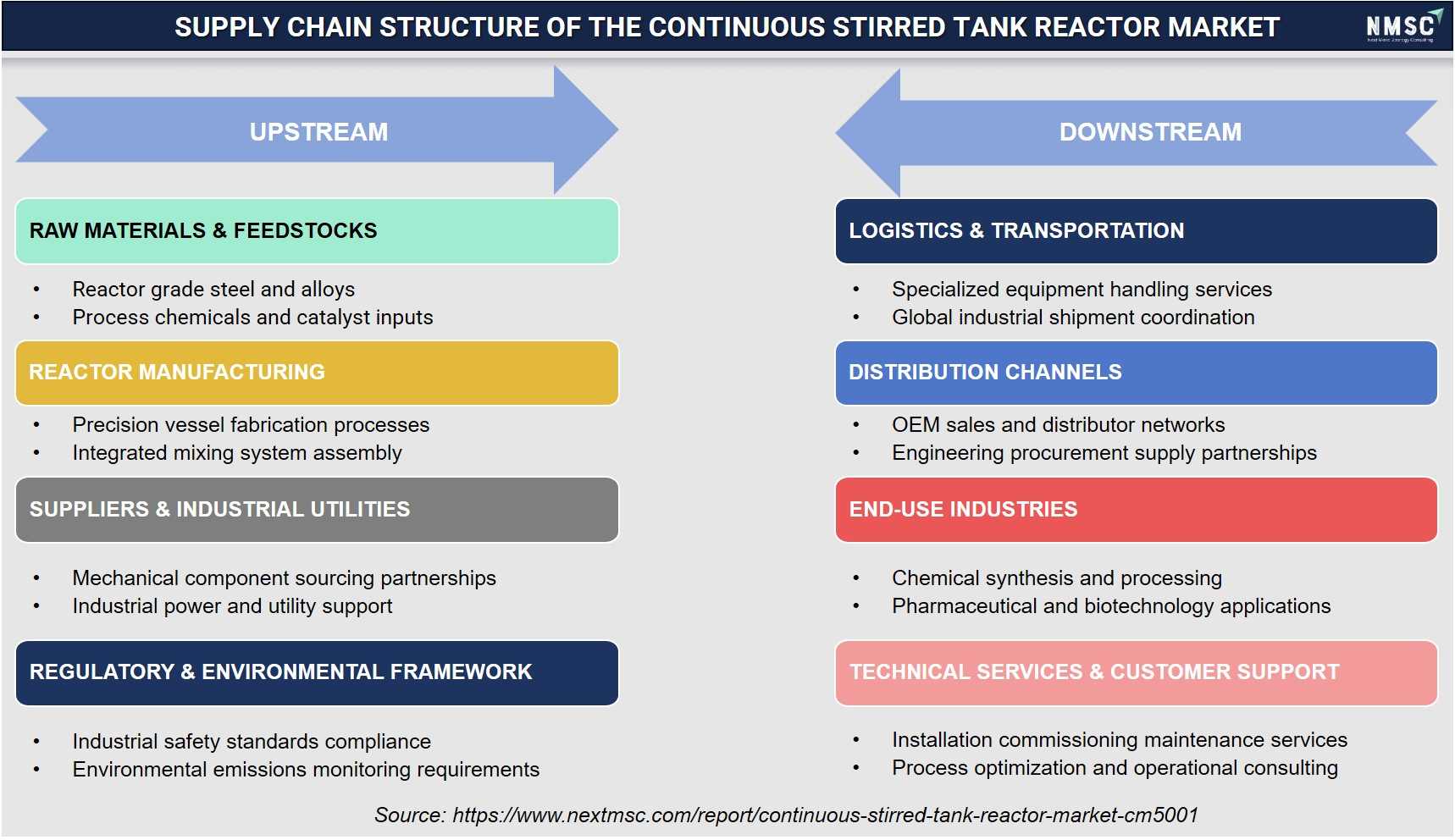
The above infographic presents the supply chain structure of the Continuous Stirred Tank Reactor Market, segmented into upstream and downstream activities. Upstream begins with reactor-grade steel, alloys, and chemical inputs, moving into vessel fabrication and mixing system assembly. Suppliers provide mechanical components and utilities, while compliance ensures industrial safety and environmental standards. Moving downstream, specialized logistics and OEM networks enable global distribution to chemical, pharmaceutical, and biotechnology sectors. Looking ahead, we observed that after-sales installation, maintenance, and process optimization services collectively ensure long-term operational reliability across the market.
Regional Outlook
Geographic Performance Snapshot
|
Region |
2025 (USD Billion) |
2035 (USD Billion) |
CAGR (2026–2035) |
Key Driver |
|
North America |
0.97 |
1.80 |
6.96% |
Strong pharmaceutical, specialty chemical, and biotechnology manufacturing with high process automation |
|
Europe |
0.93 |
1.64 |
5.83% |
Stringent environmental regulations, advanced chemical processing, and continuous manufacturing adoption |
|
Asia Pacific |
1.58 |
3.36 |
8.74% |
Rapid expansion of chemical production, pharmaceutical manufacturing, and industrial investments |
|
Middle East and Africa |
0.28 |
0.55 |
7.57% |
Growing petrochemical capacity, industrial diversification, and investments in process industries |
|
Latin America |
0.28 |
0.47 |
5.87% |
Expanding food processing, chemicals, and biofuel production supported by industrial modernization |
North America Continuous Stirred Tank Reactor Market
Through our market assessment, we observed that North America holds a mature but actively expanding position within the global market, accounting for USD 0.97 billion in 2025. Market maturity is moderate-to-high, with an installed reactor base across chemicals, pharmaceuticals, and water treatment that dates back several decades. Key growth drivers include FDA finalization of ICH Q13 continuous-manufacturing guidance and federally funded biomanufacturing capacity expansion programs. Regulatory influence is strong, with FDA and EPA standards directly shaping vessel design, materials, and control-system specifications. Technology adoption is advanced, with fully automated and digital-retrofit configurations gaining ground.
United States Continuous Stirred Tank Reactor Market
Based on our engagements across North American process-industry procurement cycles, the United States represents the largest single-country market in North America, underpinned by concentrated pharmaceutical, specialty chemical, and biomanufacturing capacity. Demand structure is broad, spanning API manufacturing, fermentation, water treatment, and advanced materials synthesis. Government and regulatory influence is pervasive, including FDA continuous-manufacturing guidance and National Biotechnology and Biomanufacturing Initiative funding. Technology penetration is high, with magnetic-drive and fully automated systems among the fastest-adopted configurations. Competitive intensity is elevated, with global suppliers and domestic specialists both actively present across key procurement channels.
Canada Continuous Stirred Tank Reactor Market
Through our analysis, we observed that Canada occupies a secondary but growing position within North American demand, supported by pharmaceutical contract manufacturing clusters in Ontario and Quebec and a growing renewable-fuels processing sector in Alberta. Industry adoption levels are high in regulated pharmaceutical and food-grade applications. Government influence includes Health Canada oversight of continuous-manufacturing processes in regulated settings. Technology penetration is intermediate, with semi-automated systems still predominant inolder installed-base facilities, while new-build installations increasingly specify automated control systems. Competitive intensity is moderate, with most equipment supplied by global manufacturers through Canadian distributors.
Mexico Continuous Stirred Tank Reactor Market
According to our evaluation of manufacturing investment patterns, Mexico is an emerging demand source within the North American Continuous Stirred Tank Reactor Market, benefiting from nearshoring trends in specialty chemical and pharmaceutical production. Demand structure is concentrated in commodity and specialty chemicals, with growing pharmaceutical contract manufacturing activity. Government influence includes Cofepris regulatory oversight for pharmaceutical applications. Technology penetration remains intermediate, with manual and semi-automated systems still common across established facilities, while newer investments increasingly incorporate automated control features aligned with global client quality standards. Competitive intensity is moderate and rising as international suppliers expand regional presence.
Europe Continuous Stirred Tank Reactor Market
Our assessment indicates that Europe represents the second-largest regional market, valued at USD 0.93 billion in 2025, anchored by a dense concentration of specialty chemicals, pharmaceutical, and biotechnology production across Germany, France, Italy, and the Netherlands. Market maturity is high, with a large installed base of glass-lined and alloy vessels serving established chemical and pharmaceutical producers. Key drivers include REACH chemical-substance compliance requirements, continuous-manufacturing adoption encouraged by the European Medicines Agency, and sustained investment in fermentation capacity for biopharmaceutical and enzyme production. Regulatory influence is strong, with EMA and ECHA frameworks shaping vessel design, materials, and waste-treatment requirements.
United Kingdom Continuous Stirred Tank Reactor Market
Based on our engagements with European process-industry stakeholders, the United Kingdom maintains a significant presence in pharmaceutical continuous manufacturing and specialty chemical processing. Demand structure is oriented toward high-value, regulated applications, including API synthesis and fermentation. Government influence includes Medicines and Healthcare products Regulatory Agency alignment with ICH Q13 continuous-manufacturing expectations post-Brexit. Technology penetration is high, with automated control and real-time process-analytical technology widely adopted in newer installations. Competitive intensity is moderate to high, with several global equipment suppliers maintaining UK-based engineering or technical-service presence.
Germany Continuous Stirred Tank Reactor Market
Through our analysis, we observed that Germany is the largest national market within Europe, driven by one of the world's most concentrated specialty and commodity chemical sectors and a substantial pharmaceutical manufacturing base. Demand structure spans large-scale continuous chemical synthesis, fermentation, and water-treatment digester applications. Government influence is strong, including Bundes-Immissionsschutzgesetz emissions and process-safety regulations, alongside German Chemical Industry Association sector standards. Technology penetration is advanced, with German manufacturers among the leading adopters of fully automated, sensor-integrated reactor systems. Competitive intensity is very high, with major global suppliers and German engineering specialists both active in the market.
France Continuous Stirred Tank Reactor Market
From our assessment, France demonstrates solid continuous stirred tank reactor demand across specialty chemicals, pharmaceuticals, and the growing French bioeconomy sector. Demand structure includes agrochemical synthesis, cosmetic-ingredient processing, and biopharmaceutical fermentation. Government influence includes ANSM pharmaceutical oversight and national bioeconomy strategy programs supporting fermentation-capacity investment. Technology penetration is intermediate to high, with automated systems gaining share across newer facilities while older installed bases remain partially manual. Competitive intensity is moderate, with French engineering groups and global suppliers both competing for large industrial projects.
Italy Continuous Stirred Tank Reactor Market
According to our evaluation of Italian process-industry investment trends, Italy supports a meaningful market concentrated in fine chemicals, pharmaceutical intermediates, and specialty polymers. Demand structure is weighted toward small and mid-sized manufacturers with strong export orientation in pharmaceutical and chemical specialties. Government influence includes AIFA pharmaceutical manufacturing regulation and national chemical industry environmental compliance requirements. Technology penetration is intermediate, with semi-automated systems prevalent and fully automated investments growing as Italian producers modernize facilities to meet global client quality requirements. Competitive intensity is moderate.
Spain Continuous Stirred Tank Reactor Market
Based on our engagements, Spain hosts a growing, Continuous Stirred Tank Reactor Market supported by pharmaceutical generic manufacturing, specialty chemicals, and expanding food-ingredient and bioethanol processing. Demand structure is balanced between established chemicals and growing regulated pharmaceutical applications. Government influence includes AEMPS pharmaceutical oversight and industrial environmental permitting frameworks. Technology penetration is intermediate, with new pharmaceutical installations increasingly specifying automated and GMP-compliant reactor systems, while food and beverage applications remain predominantly semi-automated. Competitive intensity is moderate, with procurement often routed through European distributors and system integrators.
Sweden Continuous Stirred Tank Reactor Market
Through our analysis, Sweden presents a focused but high-value demand profile within the market, anchored by advanced pharmaceutical fermentation, forest-biorefinery processing, and specialty chemicals. Government influence is strong through the Swedish Medical Products Agency and the Swedish Chemical Agency, which set material and environmental standards relevant to reactor design. Technology penetration is high, with Swedish industrial culture emphasizing automation and sustainability-driven process design. Competitive intensity is moderate, with global suppliers dominant and Swedish engineering companies active in skid-mounted and modular reactor system integration for biorefinery applications.
Denmark Continuous Stirred Tank Reactor Market
According to our evaluation of Danish industrial trends, Denmark's continuous stirred tank reactor demand is concentrated in enzyme and industrial biotechnology fermentation, pharmaceutical manufacturing, and food ingredient processing, reflecting the country's world-leading enzyme production sector. Government influence includes the Danish Medicines Agency and national biotechnology research-funding programs. Technology penetration is very high in fermentation applications, with Denmark serving as a technology reference site for large-scale magnetic-drive and automated bioprocess vessels. Competitive intensity is moderate, with specialized global suppliers supporting the concentrated enzyme and biotechnology customer base.
Finland Continuous Stirred Tank Reactor Market
From our assessment, Finland's Continuous Stirred Tank Reactor Market is shaped by chemical pulp processing, advanced biofuels and biorefinery applications, and mining-related leaching and precipitation operations. Government influence includes Fimea pharmaceutical oversight and Finland's national bioeconomy and circular-economy strategy programs that support reactor-based biomass conversion projects. Technology penetration is intermediate to high, with biorefinery applications driving adoption of automated, high-volume stirred reactor systems. Competitive intensity is moderate, and Finnish engineering expertise in process integration is relevant to the regional market for reactor installation and service.
Netherlands Continuous Stirred Tank Reactor Market
Based on our engagements with European chemical-cluster stakeholders, the Netherlands is a major continuous stirred tank reactor demand center, anchored by the Rotterdam-Antwerp chemical complex and a sophisticated biopharmaceutical and agri-food ingredient sector. Demand structure spans large-volume commodity and specialty chemical synthesis, biopharmaceutical fermentation, and water-treatment digester applications. Government influence includes the Dutch Healthcare Authority for pharmaceutical applications and robust industrial emissions permitting. Technology penetration is high, with Netherlands-based producers among early adopters of continuous-manufacturing platforms and real-time process-analytical-technology integration.
Rest of Europe Continuous Stirred Tank Reactor Market
Through our analysis, the rest of Europe, including Poland, Belgium, Switzerland, Austria, and other European countries, supports a collective continuous stirred tank reactor demand driven by pharmaceutical fine chemicals, food processing, and water treatment. Belgium's chemical cluster and Switzerland's pharmaceutical and life-science sector represent the most significant sub-markets within this group. Technology penetration is variable, generally higher in pharmaceutical applications and lower in food and water treatment. Regulatory influence from EMA, ECHA, and national environmental agencies continues to shape procurement specifications across the region.
Asia Pacific Continuous Stirred Tank Reactor Market
NMSC's analysis indicates that Asia Pacific is both the largest and fastest-growing region, valued at USD 1.58 billion in 2025 and projected to reach USD 3.36 billion by 2035 at an 8.74% CAGR. Regional growth is driven by accelerating chemical and pharmaceutical capacity expansion in China and India, rising contract manufacturing investment across Southeast Asia, and government programs targeting domestic biomanufacturing self-sufficiency. Technology adoption is advancing rapidly, with fully automated and magnetic-drive systems increasingly specified in new-build pharmaceutical and biotechnology installations. Regulatory influence from NMPA in China and CDSCO in India is increasingly aligned with ICH continuous-manufacturing guidelines.
China Continuous Stirred Tank Reactor Market
Based on our engagements with Asia Pacific manufacturing stakeholders, China is the dominant single-country market within the region, supported by the world's largest chemical manufacturing base and a rapidly expanding pharmaceutical and biotechnology sector. Demand structure encompasses commodity and specialty chemical synthesis, fermentation and cell-culture bioprocessing, and large-scale water-treatment digester applications. Government influence includes the National Medical Products Administration's pharmaceutical-manufacturing standards and Made in China 2025 industrial-upgrading programs prioritizing advanced manufacturing equipment. Technology penetration is advancing quickly, with domestic and global suppliers competing for automated, high-volume reactor contracts. Competitive intensity is very high.
India Continuous Stirred Tank Reactor Market
Through our analysis, India represents the fastest-growing major country market within Asia Pacific, driven by its position as the world's leading generic pharmaceutical exporter and a growing specialty chemicals manufacturing hub. Demand structure is concentrated in API manufacturing, pharmaceutical intermediates, agrochemicals, and specialty polymer synthesis. Government influence includes the Central Drugs Standard Control Organisation, pharmaceutical-manufacturing oversight, and Production-Linked Incentive schemes supporting domestic manufacturing investment. Technology penetration is intermediate, with newer pharmaceutical and contract manufacturing facilities increasingly adopting automated reactor systems while older installed assets remain predominantly semi-automated. Competitive intensity is high and rising.
Japan Continuous Stirred Tank Reactor Market
According to our evaluation of Japanese industrial trends, Japan maintains a high-value, mature market anchored by advanced specialty chemicals, pharmaceuticals, food ingredients, and precision biomanufacturing. Demand structure emphasizes high-purity, tightly controlled reactor systems suited to Japan's quality-intensive manufacturing culture. Government influence includes Pharmaceuticals and Medical Devices Agency alignment with ICH Q13 continuous-manufacturing guidance and Ministry of Economy, Trade and Industry support for smart-manufacturing investment. Technology penetration is among the highest globally, with fully automated and magnetic-drive agitation systems widely adopted. Competitive intensity is high, with both global and Japanese domestic suppliers active.
South Korea Continuous Stirred Tank Reactor Market
From our assessment, South Korea's continuous stirred tank reactor demand is driven by its large and growing biopharmaceutical contract manufacturing sector, semiconductor chemical processing, and food ingredient production. Demand structure is increasingly oriented toward high-purity, GMP-compliant bioprocess and specialty chemical vessels. Government influence includes the Ministry of Food and Drug Safety, pharmaceutical-manufacturing oversight, and national biohealth industry promotion programs. Technology penetration is advancing rapidly, with South Korean contract manufacturers investing in automated, large-scale bioprocess reactor systems to serve global biopharmaceutical clients. Competitive intensity is high, with global equipment suppliers and Korean engineering companies both active.
Taiwan Continuous Stirred Tank Reactor Market
Based on our engagements, Taiwan's Continuous Stirred Tank Reactor Market is shaped by its specialty chemicals, electronic materials, and growing pharmaceutical and biotechnology sectors. Demand structure emphasizes precision, specialty-chemical reactor systems supporting semiconductor and display-panel chemical supply chains. Government influence includes Taiwan FDA oversight for pharmaceutical applications and industrial chemical safety regulations. Technology penetration is high in specialty chemical and high-purity applications, with automated control increasingly standard in newer investments. Competitive intensity is moderate, with global suppliers dominant in high-specification applications and Taiwanese distributors serving smaller installations.
Indonesia Continuous Stirred Tank Reactor Market
Through our analysis, Indonesia's market reflects the country's growing agrochemical, palm-oil-derivative chemical processing, and pharmaceutical manufacturing base. Demand structure is led by commodity and specialty chemicals, with pharmaceutical manufacturing capacity expanding under government generic-drug production programs. Government influence includes BPOM pharmaceutical regulatory oversight and national industrial development programs. Technology penetration is intermediate, with semi-automated systems prevalent and newer investments increasingly incorporating digital monitoring. Competitive intensity is moderate, with equipment predominantly sourced through regional distributors and system integrators serving the Indonesian manufacturing sector.
Vietnam Continuous Stirred Tank Reactor Market
According to our evaluation of Vietnamese manufacturing investment trends, Vietnam is one of the fastest-growing CSTR demand markets within Southeast Asia, supported by rapidly expanding pharmaceutical manufacturing, food processing, and specialty chemical capacity drawn by foreign direct investment inflows. Government influence includes the Ministry of Health pharmaceutical oversight and government programs incentivizing domestic pharmaceutical self-sufficiency. Technology penetration is lower than regional peers but rising quickly as new manufacturing investments increasingly target international quality standards. Competitive intensity is moderate, with global suppliers entering through distributor and system integrator channels. The market is expected to sustain above-average growth through 2035.
Australia Continuous Stirred Tank Reactor Market
From our assessment, Australia's Continuous Stirred Tank Reactor Market is anchored by pharmaceutical manufacturing, mineral processing (leaching and precipitation), and water treatment across a geographically dispersed industrial base. Demand structure reflects Australia's advanced mining sector, which uses stirred reactors for hydrometallurgical leaching, alongside growing pharmaceutical and food-ingredient processing demand. Government influence includes the Therapeutic Goods Administration, pharmaceutical oversight, and environmental agency water-quality permitting. Technology penetration is intermediate to high, with mining applications favoring robust mechanical agitation and pharmaceutical installations increasingly specifying automated control systems. Competitive intensity is moderate.
Philippines Continuous Stirred Tank Reactor Market
Based on our engagements, the Philippines' market is emerging, driven by pharmaceutical manufacturing expansion, food and beverage processing, and water treatment infrastructure investment. Government influence includes the Food and Drug Administration Philippines oversight and national industrial development programs. Technology penetration is lower than more advanced regional peers, with semi-automated and manual systems predominant across the existing installed base. New pharmaceutical and contract manufacturing investments are increasingly specifying automated reactor systems aligned with international quality standards. Competitive intensity is moderate, with equipment predominantly sourced through regional distributors.
Malaysia Continuous Stirred Tank Reactor Market
Through our analysis, Malaysia's continuous stirred tank reactor demand is driven by its diversified chemical manufacturing sector, including oleochemicals and palm-oil derivatives, as well as growing pharmaceutical and biotechnology manufacturing. Government influence includes the National Pharmaceutical Regulatory Agency for pharmaceutical applications and national industrial policy supporting advanced manufacturing investment. Technology penetration is intermediate, with oleochemical and specialty chemical applications driving demand for robust, continuous agitated-vessel systems. Competitive intensity is moderate to high, with global suppliers competing through regional distributors and engineering firms for major capacity-expansion projects. Malaysia is expected to remain a consistently growing market through 2035.
Rest of Asia Pacific Continuous Stirred Tank Reactor Market
According to our evaluation of regional investment patterns, the rest of Asia Pacific, including Bangladesh, Thailand, Pakistan, New Zealand, and other markets, collectively supports growing demand for continuous stirred tank reactor systems, primarily in pharmaceutical, food processing, and water-treatment applications. Technology penetration is generally intermediate to low, with semi-automated systems dominant. Regulatory influence is strengthening as national pharmaceutical and food-safety agencies align progressively with international manufacturing quality standards. Competitive intensity is moderate, with equipment predominantly supplied through distributor networks extending from China, Japan, and European supplier bases.
Middle East and Africa Continuous Stirred Tank Reactor Market
Our findings suggest that the Middle East and Africa Continuous Stirred Tank Reactor Market, valued at USD 0.28 billion in 2025, is expanding at a 7.57% CAGR through 2035. Key demand drivers include petrochemical diversification programs across Gulf Cooperation Council states, expanding pharmaceutical manufacturing capacity in South Africa and Egypt, and significant municipal water and wastewater treatment infrastructure investment across both sub-regions. Regulatory influence is growing, with national pharmaceutical agencies and environmental ministries progressively adopting international manufacturing and process-safety standards. Technology adoption is variable, advanced in GCC petrochemical facilities and more intermediate across African pharmaceutical and water-treatment applications.
Saudi Arabia Continuous Stirred Tank Reactor Market
Based on our engagements, Saudi Arabia's Continuous Stirred Tank Reactor Market is driven by large-scale petrochemical and specialty chemical manufacturing, with growing pharmaceutical and water-treatment applications. Government influence includes the Saudi Food and Drug Authority's pharmaceutical oversight and Vision 2030 industrial-diversification initiatives, directing investment toward value-added chemical and pharmaceutical manufacturing. Technology penetration is high in petrochemical applications, with advanced automation and process control standards in major SABIC-affiliated and private-sector facilities. Competitive intensity is high, with global equipment suppliers competing for large petrochemical and pharmaceutical capacity-expansion projects. Pharmaceutical manufacturing expansion is expected to diversify demand through 2035.
UAE Continuous Stirred Tank Reactor Market
Through our analysis, the UAE's continuous stirred tank reactor demand is anchored by specialty chemical processing, pharmaceutical manufacturing expansion in Dubai and Abu Dhabi, and significant water-treatment infrastructure investment supporting the country's large desalination and wastewater-reuse network. Government influence includes the UAE Ministry of Health pharmaceutical oversight, and Emirates Authority for Standardization regulations. Technology penetration is high in pharmaceutical and water-treatment applications. Competitive intensity is moderate to high, with global suppliers dominant in regulated pharmaceutical and specialty chemical segments and regional distributors serving smaller industrial applications.
Egypt Continuous Stirred Tank Reactor Market
According to our evaluation of Egyptian industrial trends, Egypt's Continuous Stirred Tank Reactor Market is driven by pharmaceutical manufacturing, agrochemical production, and water-treatment infrastructure investment. Government influence includes the Egyptian Drug Authority pharmaceutical oversight, and national water infrastructure investment programs. Technology penetration is intermediate, with newer pharmaceutical investments increasingly adopting automated systems while legacy chemical and water-treatment facilities remain semi-automated. Egypt represents one of Africa's larger pharmaceutical manufacturing bases, and ongoing capacity expansion is translating into sustained demand for reactor systems aligned with WHO Good Manufacturing Practice standards. Competitive intensity is moderate.
Israel Continuous Stirred Tank Reactor Market
From our assessment, Israel supports a high-value, technology-intensive Continuous Stirred Tank Reactor Market anchored by pharmaceutical, agrochemical, and advanced materials manufacturing. Government influence includes the Israeli Ministry of Health pharmaceutical oversight. Technology penetration is high, reflecting Israel's innovation-driven manufacturing culture and the international quality standards required by its pharmaceutical export base. Competitive intensity is moderate to high, with global suppliers dominant and Israeli engineering firms active in process design and system integration. Agrochemical synthesis and pharmaceutical API manufacturing are the primary demand drivers, with water-treatment and biotechnology applications also contributing to market growth.
Turkey Continuous Stirred Tank Reactor Market
Based on our engagements, Turkey's Continuous Stirred Tank Reactor Market is driven by its large and growing pharmaceutical manufacturing sector, specialty chemicals, and food processing. Government influence includes the Turkish Medicines and Medical Devices Agency pharmaceutical oversight and national industrial development programs. Technology penetration is intermediate, with pharmaceutical applications increasingly specifying automated systems and chemical manufacturing facilities operating a largely semi-automated installed base. Competitive intensity is moderate, with global suppliers competing through Turkish distributors and engineering firms. Turkey's pharmaceutical capacity expansion is a primary growth driver, supported by government programs promoting domestic drug manufacturing self-sufficiency.
Nigeria Continuous Stirred Tank Reactor Market
Through our analysis, Nigeria's Continuous Stirred Tank Reactor Market remains at an early-growth stage, driven primarily by pharmaceutical manufacturing expansion and nascent specialty chemical production. Government influence includes National Agency for Food and Drug Administration and Control pharmaceutical oversight and national industrialization programs. Technology penetration is low relative to global peers, with manual and basic semi-automated systems predominant across existing facilities. New pharmaceutical investments increasingly seek internationally compliant reactor systems. Competitive intensity is low to moderate, with equipment predominantly sourced through import channels from European and Asian suppliers via regional distributors.
South Africa Continuous Stirred Tank Reactor Market
According to our evaluation of South African industrial trends, South Africa is the most advanced national market within sub-Saharan Africa for the Continuous Stirred Tank Reactor Market, driven by a developed pharmaceutical manufacturing sector, an established mining and metallurgy industry, and a growing water-treatment infrastructure. Government influence includes the South African Health Products Regulatory Authority pharmaceutical oversight and Department of Water and Sanitation municipal treatment standards. Technology penetration is intermediate, with pharmaceutical and mining applications more advanced than food and water treatment. Competitive intensity is moderate, with global suppliers entering through regional distributors and South African engineering firms providing integration services.
Rest of Middle East and Africa Continuous Stirred Tank Reactor Market
From our assessment, the rest of the Middle East and Africa, spanning Kuwait, Qatar, Morocco, Kenya, Ethiopia, and other countries, collectively support emerging continuous stirred tank reactor demand driven primarily by pharmaceutical manufacturing growth, water-treatment expansion, and agrochemical processing. Technology penetration is generally low to intermediate, with manual and semi-automated systems predominant. Regulatory alignment with WHO GMP and international environmental standards is gradually improving procurement quality expectations. Competitive intensity is low, with equipment predominantly sourced through distributor networks extending from European and Asian supplier bases.
Latin America Continuous Stirred Tank Reactor Market
Our analysis shows that Latin America contributes USD 0.28 billion to the global Continuous Stirred Tank Reactor Market in 2025, growing at a 5.87% CAGR through 2035. Regional demand is anchored by Brazil's large pharmaceutical and specialty chemical base and growing renewable-fuel processing capacity, complemented by Argentina's pharmaceutical sector and Chile's and Colombia's expanding chemical manufacturing. Government influence varies by country but generally includes national pharmaceutical and environmental agency oversight. Technology penetration is intermediate, with automated systems increasingly specified in new pharmaceutical and biofuel installations. Competitive intensity is moderate, with global suppliers competing through regional distributor and engineering networks.
Brazil Continuous Stirred Tank Reactor Market
Based on our engagements, Brazil is the dominant Latin American market, driven by a large domestic pharmaceutical manufacturing sector, specialty chemicals, sugarcane ethanol and renewable diesel production, and water-treatment infrastructure. Government influence includes ANVISA pharmaceutical oversight and federal programs supporting bioenergy and sustainable fuel production. Technology penetration is intermediate, with pharmaceutical and bioenergy applications driving adoption of automated reactor systems while legacy chemical installations remain predominantly semi-automated. Competitive intensity is moderate to high, with global suppliers active through Brazilian distributors and engineering firms. Brazil's renewable-fuel transition is expected to sustain new-build reactor demand through 2035.
Argentina Continuous Stirred Tank Reactor Market
Through our analysis, Argentina's Continuous Stirred Tank Reactor Market is concentrated in pharmaceutical manufacturing, agrochemical synthesis, and food-ingredient processing. Government influence includes ANMAT pharmaceutical oversight and national industrial programs. Technology penetration is intermediate, with pharmaceutical applications advancing toward automated systems and agrochemical facilities predominantly operating semi-automated reactors. Competitive intensity is moderate, with equipment typically sourced through distributors importing from European and North American suppliers. Economic volatility has periodically constrained capital expenditure cycles, but structural pharmaceutical-manufacturing demand provides a resilient demand base within the market.
Chile Continuous Stirred Tank Reactor Market
According to our evaluation of Chilean industrial trends, Chile's Continuous Stirred Tank Reactor Market is driven by mining and metallurgy applications, including copper and lithium processing, as well as pharmaceutical manufacturing and food processing. Government influence includes Instituto de Salud Pública pharmaceutical oversight, and mining environmental permitting. Technology penetration is intermediate, with mining applications using robust, high-volume stirred-reactor systems for hydrometallurgical processing and pharmaceutical installations increasingly adopting automated designs. Competitive intensity is moderate, with global suppliers active in mining-related applications and regional distributors serving pharmaceutical and food-sector clients.
Colombia Continuous Stirred Tank Reactor Market
From our assessment, Colombia's continuous stirred tank reactor demand is driven by pharmaceutical manufacturing, food and beverage processing, and a growing specialty chemicals sector. Government influence includes INVIMA pharmaceutical oversight and national industrial development programs. Technology penetration is lower than that of larger regional peers, with semi-automated systems predominant across existing installed-base facilities. Newer pharmaceutical and contract manufacturing investments are increasingly aligning with international quality standards, supporting growing demand for automated reactor systems. Competitive intensity is moderate, with procurement channeled primarily through Colombian distributors importing from European and North American equipment manufacturers.
Rest of Latin America Continuous Stirred Tank Reactor Market
Through our analysis, the rest of Latin America, encompassing Peru, Ecuador, Uruguay, Venezuela, and Central American markets, collectively represents an early-stage demand base for the Continuous Stirred Tank Reactor Market, driven primarily by pharmaceutical manufacturing, food processing, and mining-related chemical operations. Technology penetration is generally low to intermediate. Regulatory influence is strengthening as national pharmaceutical and environmental agencies incrementally align with international manufacturing standards. Competitive intensity is low, with equipment predominantly imported through distributors extending from Brazil, European, and North American supplier networks.
Competitive Landscape
Competitive Dynamics and M&A Landscape
|
Key Takeaways |
Details |
|
Market Structure |
Moderately fragmented; large full-system providers coexist with specialized laboratory and pilot-scale manufacturers across distinct product tiers. |
|
Innovation Focus |
Digital integration, magnetic-drive agitation scale-up, modular skid packaging, and materials advancement for high-purity and corrosive-duty applications. |
|
M&A Activity |
Selective acquisitions among large process-equipment groups targeting complementary mixing technology, automation capability, or geographic presence in growth markets. |
How Do Companies Compete in the Continuous Stirred Tank Reactor Market?
Based on NMSC's research, we found that competitive dynamics in the Continuous Stirred Tank Reactor Market are shaped by a combination of engineering depth, service-network reach, materials expertise, and digital integration capability. Large full-system providers such as GEA Group, Alfa Laval, Sulzer, and De Dietrich Process Systems compete primarily on total lifecycle cost, global service coverage, and the ability to deliver skid-mounted systems with integrated automation. Market structure is moderately fragmented, with a clear tier separation between global full-system providers and specialized laboratory, pilot, and niche-duty manufacturers.
AI-Native Differentiation and Open Standards Drive Market Success in the Continuous Stirred Tank Reactor Market
Digital capability is emerging as a primary competitive differentiator within the market. NMSC's analysis indicates that suppliers capable of delivering reactor systems with embedded process-analytical-technology sensor integration, interoperable control interfaces, and predictive-maintenance software platforms are achieving stronger retention rates across pharmaceutical and specialty chemical customers. Open-standards connectivity enabling reactor systems to communicate with third-party distributed-control system platforms is increasingly a procurement requirement rather than a premium feature, reshaping the competitive baseline across the industry.
Market Players to opt for Merger and Acquisition Strategies to Expand Their Presence in the Continuous Stirred Tank Reactor Market
Strategic acquisitions remain a key growth pathway for leading suppliers seeking to extend geographic reach, add complementary mixing or automation technology, or accelerate entry into high-growth end-use segments such as biotechnology and renewable fuels. Our findings suggest that M&A activity is most concentrated among mid-tier process-equipment groups seeking to close capability gaps in magnetic-drive agitation, modular plant engineering, or laboratory-to-industrial scale-up services. Pricing strategies are increasingly moving toward lifecycle-service bundling, with suppliers offering multi-year service agreements alongside reactor equipment to stabilize recurring revenue.
Who Are the Key Market Players in the Continuous Stirred Tank Reactor Market?
-
Alfa Laval AB
-
Sulzer Ltd
-
De Dietrich Process Systems
-
GMM Pfaudler Ltd
-
EKATO Holding GmbH
-
Zeton Inc.
-
Paul Mueller Company
-
Parr Instrument Company
-
H.E.L Group Ltd
-
Syrris Ltd
-
Vapourtec Ltd
-
Radleys Ltd
-
Chemglass Life Sciences LLC
-
Asynt Ltd
-
ThalesNano Inc.
-
Microinnova Engineering GmbH
-
Amar Equipment Pvt. Ltd.
-
K-JHIL Scientific Pvt. Ltd.
-
Nano-Mag Technologies Pvt. Ltd
What Are the Latest Developments in the Continuous Stirred Tank Reactor Industry?
|
Date |
Event |
|
October 2025 |
De Dietrich announced a strategic partnership with Alysophil to invest in continuous flow chemistry assisted by AI. Strategically, the move shows reactor suppliers are pairing process equipment with digital optimization to improve safety, precision, and production flexibility in pharmaceutical and specialty-chemicals applications. |
SWOT Analysis of the Continuous Stirred Tank Reactor Market
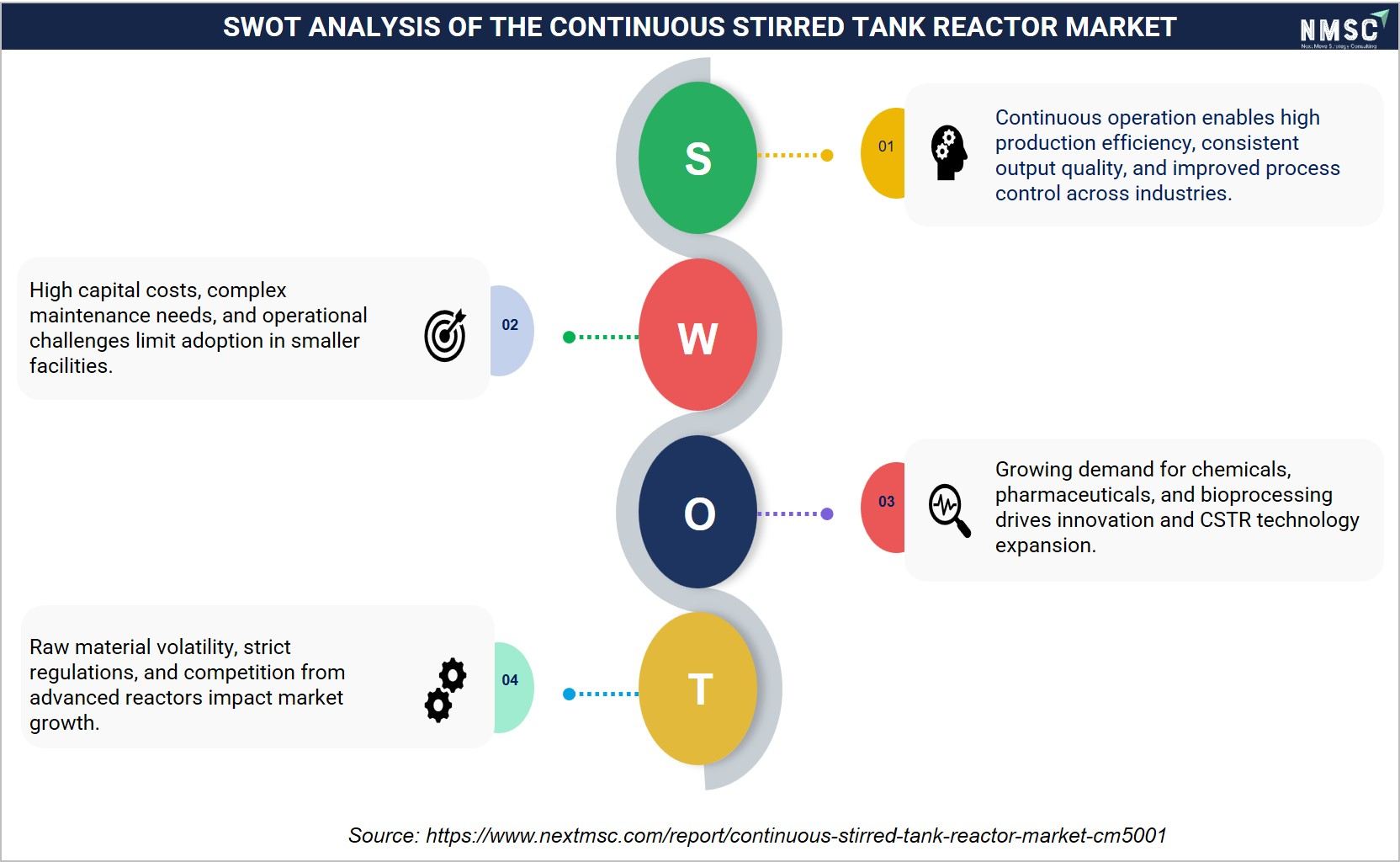
The above infographic presents a SWOT analysis of the Continuous Stirred Tank Reactor Market. Continuous operation enables high production efficiency, consistent output quality, and improved process control as key strengths. However, high capital costs, complex maintenance, and operational challenges limit adoption in smaller facilities. Looking ahead, we observed that growing demand for chemicals, pharmaceuticals, and bioprocessing drives innovation and technology expansion. That said, raw material volatility, strict regulations, and competition from advanced reactors continue to impact overall market growth and stability.
What Are the Investment Opportunities in the Continuous Stirred Tank Reactor Market?
Capital Inflows and Infrastructure Investment
Capital inflows into the Continuous Stirred Tank Reactor Market are being driven by pharmaceutical continuous-manufacturing infrastructure, biopharmaceutical fermentation capacity build-out, and renewable-fuels processing plant development. From our research, we found that the U.S. National Biotechnology and Biomanufacturing Initiative, backed by more than USD 2 billion in federal commitments, is directly channeling capital toward fermentation and bioprocess reactor infrastructure. Infrastructure investment opportunities are particularly significant in Asia Pacific, where new pharmaceutical and specialty chemical manufacturing facilities are specifying reactor systems at the project-design stage rather than retrofitting existing assets.
ESG Considerations Reshaping Reactor Procurement
Environmental, social, and governance considerations are increasingly influencing reactor procurement decisions, particularly for chemical and pharmaceutical manufacturers operating under sustainability commitments. Our assessment indicates that buyers are prioritizing reactor materials and energy consumption profiles alongside functional performance specifications. Polymer and specialty alloy reactor systems that enable cleaner process chemistry, reduced effluent generation, and lower energy consumption for heating and agitation are gaining preference. Suppliers with documented lifecycle environmental assessments and sustainability reporting for their reactor systems are achieving differentiation in procurement evaluations conducted by ESG-conscious multinational buyers.
Digital Transformation as a Value Creation Pathway
Digital transformation represents one of the clearest near-term value creation pathways within the Continuous Stirred Tank Reactor Market. Through our market assessment, we observed that retrofit programs adding sensor integration, predictive-maintenance analytics, and process-analytical-technology platforms to existing reactors are generating recurring software and service revenue streams alongside hardware sales. Private equity and strategic investors are identifying digital-retrofit capability as a key value driver in process-equipment businesses, given its potential to convert episodic capital-equipment revenue into predictable subscription and service income. Manufacturers that build modular, upgrade-ready digital platforms into new vessel designs are positioned to capture this long-duration revenue opportunity.
Private Equity and Venture Capital Activity
Private equity interest in the Continuous Stirred Tank Reactor Market is concentrated in specialized suppliers offering differentiated technology, including magnetic-drive agitation, modular pilot-plant systems, and bioprocess-specific vessel designs. NMSC's analysis indicates that smaller specialized suppliers, such as those serving laboratory-to-pilot scale-up, flow chemistry integration, and high-pressure bioprocessing represent attractive acquisition candidates for mid-market industrial equipment consolidators. Venture capital activity is less directly relevant to the mature vessel-manufacturing segment but is increasingly relevant to digital instrumentation and control-software companies whose platforms integrate with reactor systems, creating adjacent investment opportunities within the broader market ecosystem.
Key Benefits for Stakeholders
Manufacturers and Equipment Suppliers
This report provides detailed segmentation analysis across nine dimensions, enabling suppliers to identify the highest-growth application, material, and configuration categories for new-product development and portfolio prioritization within the Continuous Stirred Tank Reactor Market.
Process Industries and End Users
End users across chemicals, pharmaceuticals, biotechnology, and energy can leverage the regional and country-level demand analysis to benchmark procurement strategies, identify competitive supplier options, and align capital expenditure with growth-sector trajectories.
Investors and Financial Institutions
The report's competitive landscape, M&A activity analysis, and segment-level growth projections provide a structured basis for assessing investment attractiveness, identifying acquisition candidates, and evaluating value-creation potential within the market.
Regulatory Bodies and Policy Makers
Regulatory agencies and government bodies can use the market structure, adoption trend, and geographic analysis to understand industry capacity distribution and technology penetration relevant to continuous-manufacturing policy development and infrastructure planning.
Contract Development and Manufacturing Organizations
CDMOs can reference the segmentation and regional outlook to identify reactor technology investments that align with client demand for continuous-manufacturing capability across pharmaceutical, biotechnology, and specialty chemical production platforms.
Key Market Segments
By Material
-
Stainless Steel
-
Glass-Lined Steel
-
Glass
-
Nickel Alloys
-
Titanium and Specialty Alloys
-
Polymer
-
Other Materials
By Product Lifecycle
-
New Build
-
Lab and Benchtop
-
Pilot
-
Industrial
-
-
Installed Base
-
Retrofit and Upgrade
-
Spare Parts
-
Service and Maintenance
-
By Pressure Rating
-
Atmospheric
-
Low Pressure
-
Medium Pressure
-
High Pressure
By Process Duty
-
Liquid-Liquid
-
Gas-Liquid
-
Slurry and Suspension
-
Bioprocess
-
Multiphase
-
Other Process Duties
By Mixing Technology
-
Mechanical Agitation
-
Magnetic Drive Agitation
-
Jet Mixing
-
Other Mixing Technologies
By Configuration
-
Single Vessel
-
Cascade
-
Multi Vessel Train
-
Other Configurations
By Automation Level
-
Manual
-
Semi-Automated
-
Fully Automated
By Sales Channel
-
Direct Sales
-
Distributor
-
System Integrator
-
Online Sales
-
Other Channels
By End Use Industry
-
Chemicals
-
Commodity Chemicals
-
Specialty Chemicals
-
Agrochemicals
-
Polymers and Resins
-
-
Pharmaceuticals
-
API Manufacturing
-
Drug Intermediate Manufacturing
-
-
Biotechnology
-
Fermentation
-
Cell Culture
-
-
Food and Beverage
-
Energy and Fuels
-
Biofuels
-
Hydrogen & Power-to-X
-
Conventional Fuels
-
-
Water and Wastewater
-
Mining and Metallurgy
-
Academia and Research
-
Contract Development and Manufacturing
-
Other Industries
By Region
-
North America: U.S., Canada, Mexico
-
Europe: UK, Germany, France, Italy, Spain, Sweden, Denmark, Finland, Netherlands, Rest of Europe
-
Asia Pacific: China, India, Japan, South Korea, Taiwan, Indonesia, Vietnam, Australia, Philippines, Malaysia, Rest of APAC
-
Middle East and Africa: Saudi Arabia, UAE, Egypt, Israel, Turkey, Nigeria, South Africa, Rest of MEA
-
Latin America: Brazil, Argentina, Chile, Colombia, Rest of LATAM
Conclusion and Recommendations
Long-Term Outlook and Strategic Positioning
The Continuous Stirred Tank Reactor Market is on a sustained 6.80% CAGR growth trajectory from 2026 to 2035, underpinned by durable structural drivers including regulatory-driven pharmaceutical continuous-manufacturing adoption, biotechnology fermentation capacity expansion, and accelerating automation of the global reactor installed base. Our assessment indicates that the market will reach USD 7.81 billion by 2035, with Asia Pacific increasingly central to volume growth and North America and Europe anchoring high-value, technology-intensive demand.
Investment Attractiveness and Market Shifts
Investment attractiveness is highest in fully automated systems, magnetic-drive agitation technology, multi vessel train configurations, and biotechnology and energy-and-fuels end uses, which collectively represent the fastest-growing segments within the market. From our research, we found that the structural shift from new-build to installed-base service and retrofit revenue is also creating attractive recurring-revenue opportunities for suppliers with strong service networks and digital-retrofit capability. Investors should weight opportunities in Asia Pacific given the concentration of high-CAGR demand and the scale of greenfield pharmaceutical and specialty chemical investment anticipated through 2035.
Key Risks and Growth Pathways
Key risks include capital intensity constraining adoption among small and mid-sized manufacturers, extended commissioning timelines slowing multi-vessel-train projects, and commodity chemical end-use growth lagging the broader market CAGR. Growth pathways for suppliers include digital-retrofit bundling, modular pilot-plant system development for energy-transition clients, and geographic expansion into Asia Pacific and Middle East pharmaceutical manufacturing clusters. Manufacturers prioritizing total-lifecycle-cost selling, application-specific materials engineering, and integrated digital platforms will be best positioned to capture the market's long-term expansion.
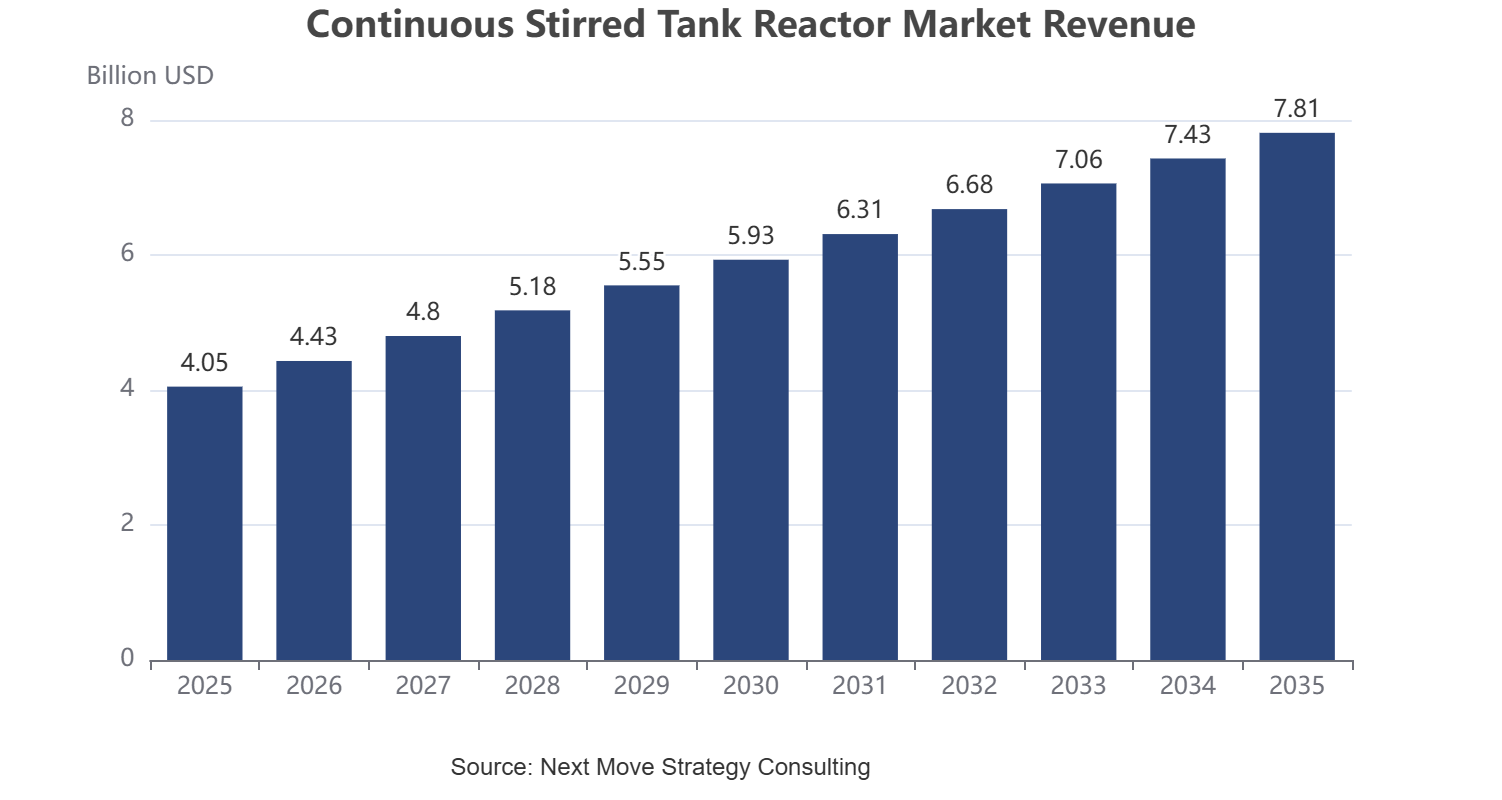
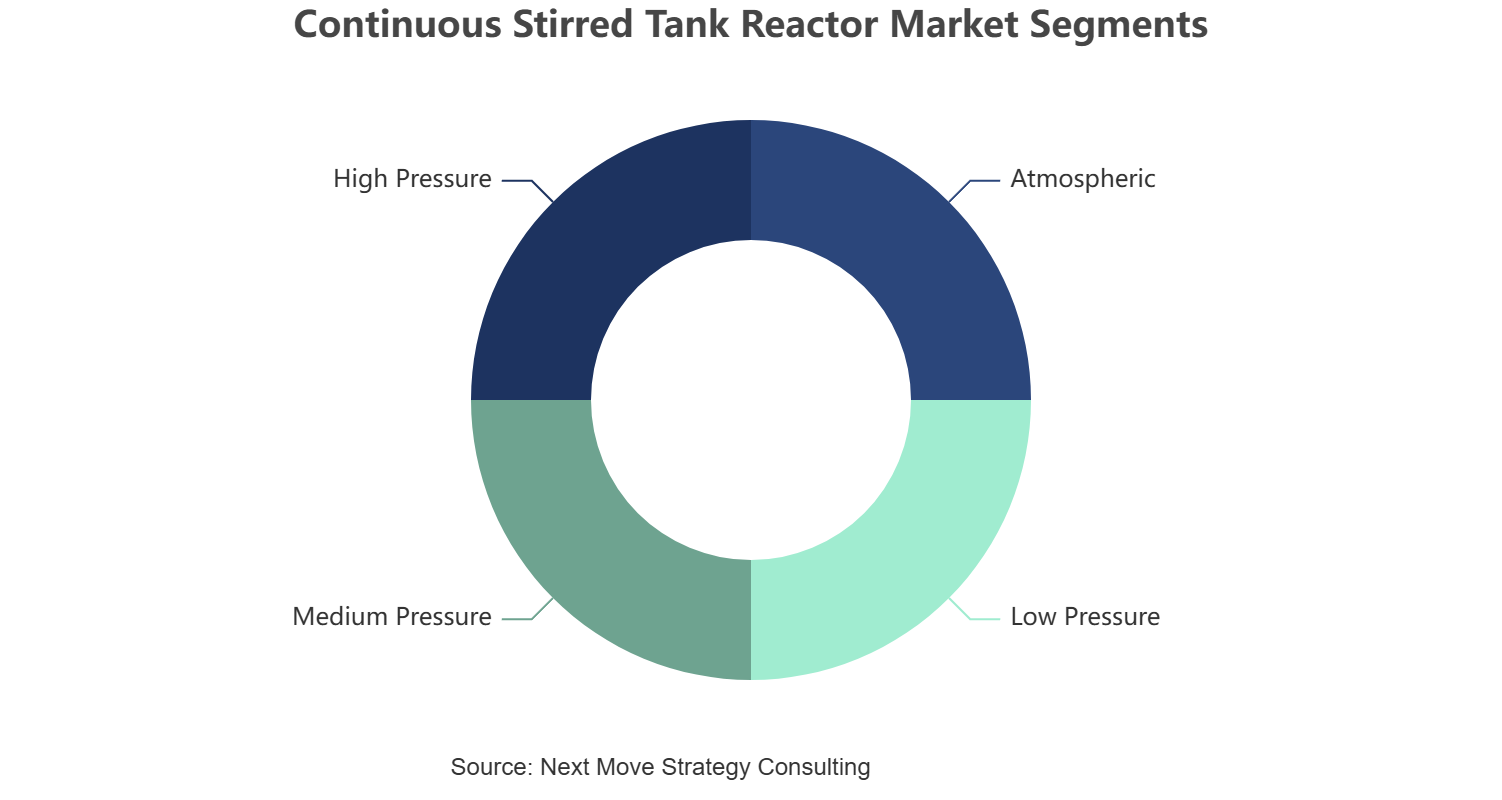
About the Author
 Mayurima Roy
— Mayurima Roy is Research Analyst at Next Move Strategy Consulting, where she has spent 4 years working across the firm's full industry coverage rather than a single fixed vertical. Her work centers on structured research, ongoing trend tracking, competitive assessment, and insight-led content development, translating complex market data into clear, decision-ready narratives that support informed client decision-making across diverse global industries, market sectors, and world regions every day.
Mayurima Roy
— Mayurima Roy is Research Analyst at Next Move Strategy Consulting, where she has spent 4 years working across the firm's full industry coverage rather than a single fixed vertical. Her work centers on structured research, ongoing trend tracking, competitive assessment, and insight-led content development, translating complex market data into clear, decision-ready narratives that support informed client decision-making across diverse global industries, market sectors, and world regions every day.
About the Reviewer
 Supradip Baul
— Supradip Baul is an accomplished business consultant and strategist with over a decade of rich experience in market intelligence, strategy, technology, and business transformation. His work has included rigorous qualitative and quantitative analysis across multiple industries, helping clients shape investment decisions and long-term roadmaps. Earlier in his career, he was associated with Gartner, where he contributed to industry-leading reports and market share analyses. He has worked with leading global companies and holds an MBA with a dual specialization in Marketing and Finance.
Supradip Baul
— Supradip Baul is an accomplished business consultant and strategist with over a decade of rich experience in market intelligence, strategy, technology, and business transformation. His work has included rigorous qualitative and quantitative analysis across multiple industries, helping clients shape investment decisions and long-term roadmaps. Earlier in his career, he was associated with Gartner, where he contributed to industry-leading reports and market share analyses. He has worked with leading global companies and holds an MBA with a dual specialization in Marketing and Finance.
At Next Move Strategy Consulting, we understand that insightful market research is the cornerstone of successful business decisions. That's why we employ a robust and multifaceted approach, combining various methodologies to deliver the most accurate and actionable data for our clients.

Research Landscape
We navigate the world of research with two primary approaches:
Qualitative Approach
Our qualitative research methodologies involve immersive techniques such as in-depth interviews, focus groups, and observational studies. By engaging directly with individuals and stakeholders, we uncover valuable insights that quantitative data alone may overlook.

Quantitative Research
In tandem with qualitative methodologies, NMSC leverages the power of Quantitative Research to provide a robust foundation of numerical insights. Through systematic data collection and analysis, we quantify patterns, preferences, and market trends, offering a comprehensive view of the business landscape.
Our quantitative research approach employs diverse tools, including surveys, experiments, and statistical modelling. These methodologies enable us to gather data from a large and representative sample, ensuring the statistical significance of our findings. By employing structured questionnaires and standardized data collection methods, we guarantee the reliability and validity of the information we present to our clients.
Quantitative research is particularly effective in measuring the prevalence of trends, assessing market size, and gauging the impact of various factors on consumer behavior. The numerical precision attained through this approach equips our clients with actionable insights, facilitating data-driven decision-making and strategy formulation.


Our Specialized Toolbox for Industry-Specific Market Research
We deploy a specialized arsenal of techniques tailored to meet your unique requirements. Here's a glimpse into our comprehensive toolbox:

Information Procurement
The stage entails acquiring market data or relevant information through various sources and methodologies.


Market Research Approach
We utilize both top-down and bottom-up approaches in market research analysis to achieve a comprehensive understanding of the market dynamics, leveraging the broad perspective of industry trends and macroeconomic factors alongside detailed insights from specific segments and individual companies.

Porters Five Forces Analysis
We conduct Porter's Five Forces analysis to evaluate the competitive landscape of an industry, providing us with insights into factors that affect profitability and strategic positioning.

SWOT Analysis

Forecasting
We utilize a forecasting model to predict future consumption by considering parameters like population, economics, regulations, market competition, drivers, constraints, technology, and pricing. We also employ statistical techniques such as multilinear regression, exponential smoothing, moving average, ARIMA, and Monte Carlo simulations for accurate predictions. In econometric forecasting, we analyzed short-term and long-term event impacts, attributing values based on regulatory frameworks, economic factors, and market events.





 Speak to Our Analyst