Canada Railway Traction Motor Market By Rolling Stock Application (Locomotives, Commuter and Regional Train, and Others), By Motor Architecture (Radial Flux, Axial Flux, and Others), By Power Rating (Low Power, Medium Power, and Others), By Cooling Method (Air-Cooled, Liquid-Cooled, and Hybrid Cooling), By Traction Voltage Class (Low Voltage, Medium Voltage, and High Voltage), and By Commercial Channel (OEM and Aftermarket) – Opportunity Analysis and Industry Forecast, 2025–2035
Industry: Automotive & Transportation | Latest Edition: September 30, 2026 | No of Pages: 260 | No. of Tables: 136 | No. of Figures: 120 | Format: PDF | Report Code: AT4960
Canada Railway Traction Motor Market Size & Forecast
|
Parameters |
Details |
|
Market Size in 2026 |
USD 223.3 Million |
|
Revenue Forecast in 2035 |
USD 817.7 Million |
|
Growth Rate |
CAGR of 15.51% from 2026 to 2035 |
|
Market Volume in 2026 |
11 thousand Units |
|
Volume Forecast in 2035 |
44 thousand Units |
|
Growth Rate |
CAGR of 16.83% from 2026 to 2035 |
|
Analysis Period |
2025–2035 |
|
Base Year Considered |
2025 |
|
Forecast Period |
2026–2035 |
|
Market Size Estimation |
Million (USD) |
|
Companies Profiled |
13 |
|
Market Share |
Available for 10 Companies |
Industry Outlook
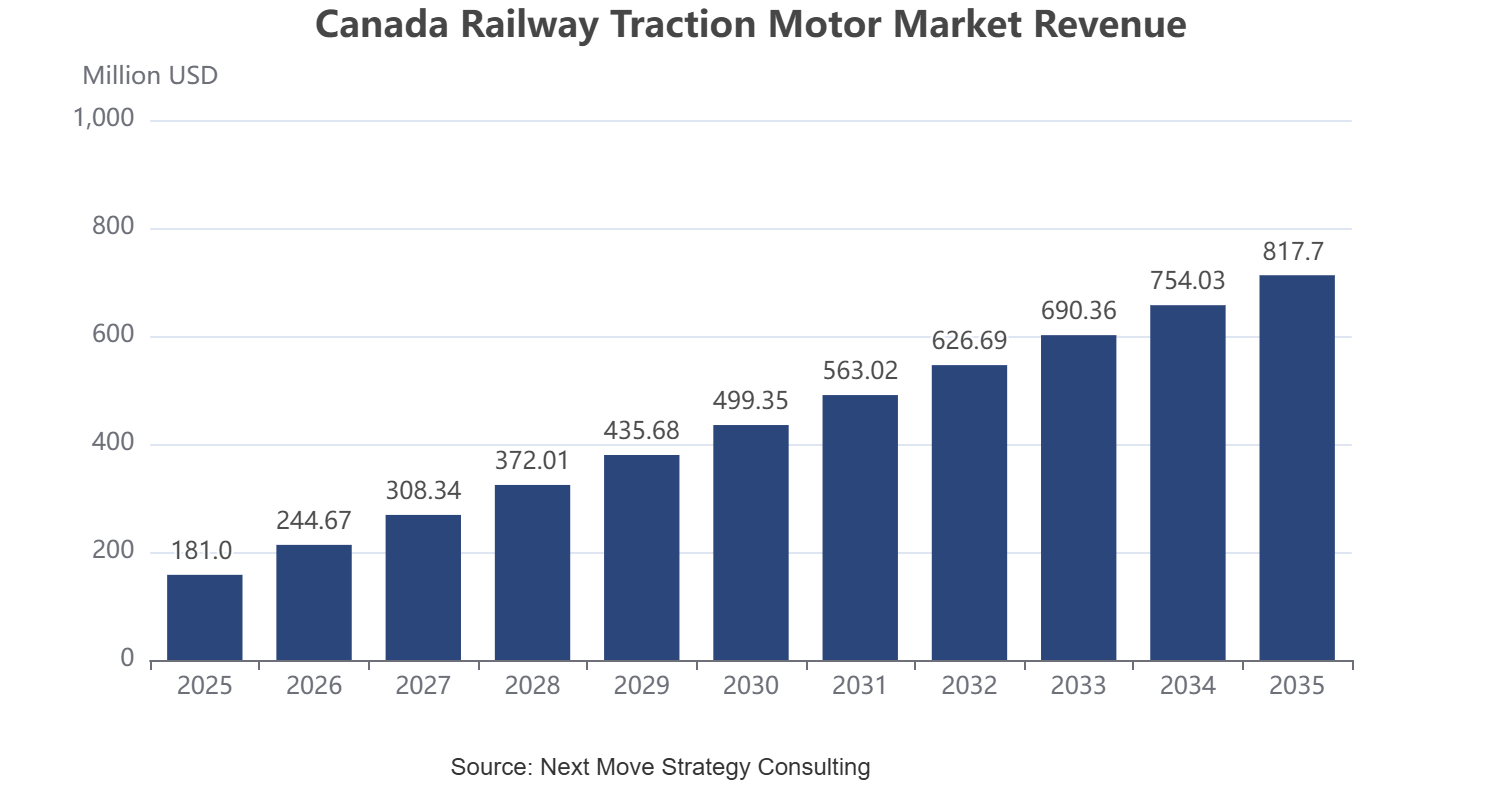
The Canada Railway Traction Motor Market was valued at USD 181.0 Million in 2025 and is estimated to reach USD 223.3 Million in 2026. Looking ahead, the market is projected to expand substantially, reaching USD 817.7 Million by 2035, registering a CAGR of 15.51% from 2026 to 2035. In terms of volume, the market recorded 8 thousand units in 2025, with forecasts indicating growth to 11 thousand units by 2026 and 44 thousand units by 2035, reflecting a volume CAGR of 16.83% over the same period.
What Are the Key Market Drivers, Restraints, and Opportunities Shaping the Canada Railway Traction Motor Market in the Next Decade?
Growth Catalyst & Risk Assessment Matrix
|
Drivers / Trends / Restraints |
(+/–) % Impact on CAGR Forecast |
Geographic Relevance |
Impact Timeline |
|
Federal rail electrification mandates and zero-emission transit policies are accelerating replacement of diesel traction systems with advanced electric motor technologies across Canada's passenger and commuter rail networks |
+2.1% |
Ontario, Quebec, British Columbia |
Short to medium term (1–4 years) |
|
Sustained public transit infrastructure investment programs are driving procurement of advanced traction motor systems across new light rail, metro, and commuter rail expansion projects throughout major urban corridors |
+1.8% |
Toronto, Vancouver, Montreal, Ottawa |
Medium term (2–5 years) |
|
Rising demand for energy-efficient propulsion technologies and lower lifecycle operational costs is accelerating adoption of permanent magnet synchronous motors across freight and passenger rail applications |
+1.6% |
Canada-wide |
Medium term (2–5 years) |
|
High capital investment requirements and complex procurement timelines are limiting faster deployment of advanced traction motor technologies across regional and commuter rail modernization programs |
–1.2% |
Canada |
Medium term (2–5 years) |
|
Growing deployment of zero-emission battery-electric and hydrogen-hybrid rail platforms is creating long-term opportunities for advanced traction motor technologies across Canada's green rail corridor development programs |
+1.5% |
Alberta, British Columbia, Ontario |
Medium to long term (3–7 years) |
Through our market assessment, we observed that the Canada Railway Traction Motor Market is witnessing substantial growth driven by accelerating rail electrification initiatives, strong federal investment in public transit infrastructure, and increasing demand for energy-efficient propulsion technologies. Rising sustainability mandates and zero-emission transportation targets are encouraging transit authorities and locomotive operators to upgrade traction motor systems throughout Canada. High capital expenditure requirements and complex procurement processes continue creating implementation challenges. Additionally, growing deployment of permanent magnet synchronous motors for urban rail modernization is creating long-term growth opportunities across Canada's railway sector.
Growth Drivers:
How Are Federal Rail Electrification Mandates Driving the Canada Railway Traction Motor Market Growth?
Through our assessment, we observed that accelerating electrification of railway networks is significantly driving market growth across Canada. Federal sustainability commitments and zero-emission transportation targets are encouraging transit operators to replace diesel-powered systems with advanced electric traction motors. Growing adoption of electric multiple units and battery-electric rolling stock across commuter and regional rail networks is reinforcing demand for high-performance traction motors. Moreover, infrastructure modernization programs supporting catenary and electrified corridor expansions are further accelerating traction motor procurement across Canada's expanding rail sector.
How Is Federal Investment in Public Transit Infrastructure Fueling the Canada Railway Traction Motor Market?
Based on our analysis, strong government funding commitments for public transit expansion are substantially fueling market growth across Canada. Major infrastructure investment programs targeting light rail transit, metro expansion, and commuter rail development are driving procurement of advanced traction motor systems throughout urban and suburban corridors. Federal and provincial funding initiatives are supporting deployment of modern rolling stock equipped with energy-efficient traction motors. Consequently, sustained public transit investment continues strengthening demand for high-performance railway traction motor technologies across Canada's growing transportation network.
How Is Growing Demand for Energy-Efficient Propulsion Technologies Supporting the Canada Railway Traction Motor Market?
Based on NMSC's research, increasing demand for energy-efficient propulsion technologies is substantially supporting market growth across Canada's railway sector. Rising operational cost pressures and carbon reduction commitments are encouraging rail operators to adopt permanent magnet synchronous motors and advanced AC traction systems offering superior efficiency and reduced energy consumption. Regulatory frameworks promoting lower lifecycle emissions and improved fleet sustainability are reinforcing the adoption of high-performance traction motors across freight and passenger rail operations throughout Canada.
Growth Restraint:
How Are High Capital Expenditure Requirements Acting as a Restraint for the Canada Railway Traction Motor Market?
High capital expenditure requirements and complex procurement processes continue acting as restraints for the market, limiting faster deployment of advanced traction motor technologies across Canada's railway sector. Based on our observation, significant upfront investment requirements for traction system upgrades and rolling stock modernization extend project timelines and create financial planning challenges for transit authorities and rail operators. Supply chain complexities for specialized motor components and skilled engineering workforce shortages further increase implementation costs and operational delays throughout the country.
Growth Opportunity:
How Is Modernization of Urban Rail and Zero-Emission Rail Corridors Unlocking Growth Opportunities for the Canada Railway Traction Motor Market?
Through NMSC's assessment, we found that growing deployment of urban rail modernization programs and zero-emission rail corridor developments is unlocking substantial growth opportunities across Canada's traction motor market. Rising demand for battery-electric and hydrogen-hybrid rail platforms, metro system expansions, and light rail vehicle electrification is driving procurement of advanced permanent magnet and axial flux traction motors. Consequently, transit network modernization and sustained green transportation investments continue creating long-term opportunities for innovative traction motor technologies across Canada.
SWOT Analysis of the Canada Railway Traction Motor Market
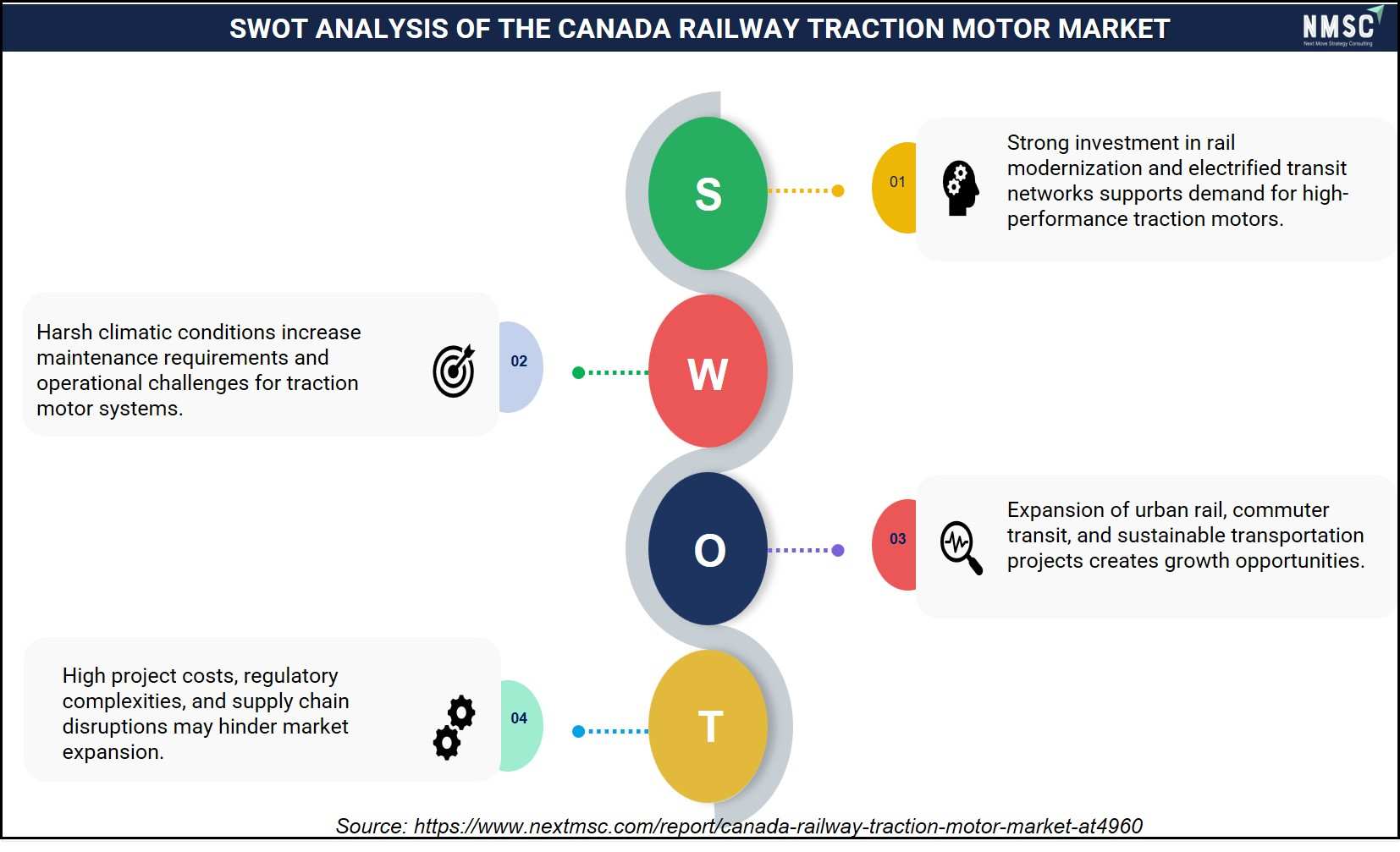
Our assessment indicates that the Canada Railway Traction Motor Market benefits from strong investments in rail modernization, transit electrification, and sustainable transportation infrastructure, which strengthen demand for advanced traction technologies. Further, expanding urban rail and commuter transit networks are creating substantial growth opportunities. However, severe climatic conditions increase maintenance complexity and operational requirements. Moreover, high project costs, regulatory compliance requirements, and supply chain disruptions continue to present challenges. Consequently, ongoing infrastructure development and transportation modernization initiatives are supporting long-term market advancement.
How Is the Canada Railway Traction Motor Market Segmented, and What Are the Key Insights from the Segmentation Analysis?
By Rolling Stock Application Insights
Is Rolling Stock Application Segmentation Reflecting the Diversity of Propulsion Demand Across Canada's Railway Sector?
Based on rolling stock application, the market is segmented into locomotives, commuter and regional trains, high-speed trains, urban rail, and other rail vehicles.
Based on our analysis, we observed that traction motor deployment across Canada's railway sector is influenced by fleet modernization initiatives, transportation infrastructure investments, and evolving operational requirements. Locomotive applications are incorporating traction motor technologies that support freight and passenger transportation activities across long-distance rail networks. Additionally, commuter and regional train programs are integrating advanced propulsion systems through rolling stock upgrades and transit expansion projects. Meanwhile, urban rail systems are implementing traction motor solutions designed to support efficient and continuous service operations. Furthermore, emerging high-speed rail initiatives and electrification programs are contributing to the diversification of traction motor applications across the Canadian market.
By Motor Architecture Insights
Is Motor Architecture Segmentation Capturing the Evolving Propulsion Technology Preferences in the Canada Railway Traction Motor Market?
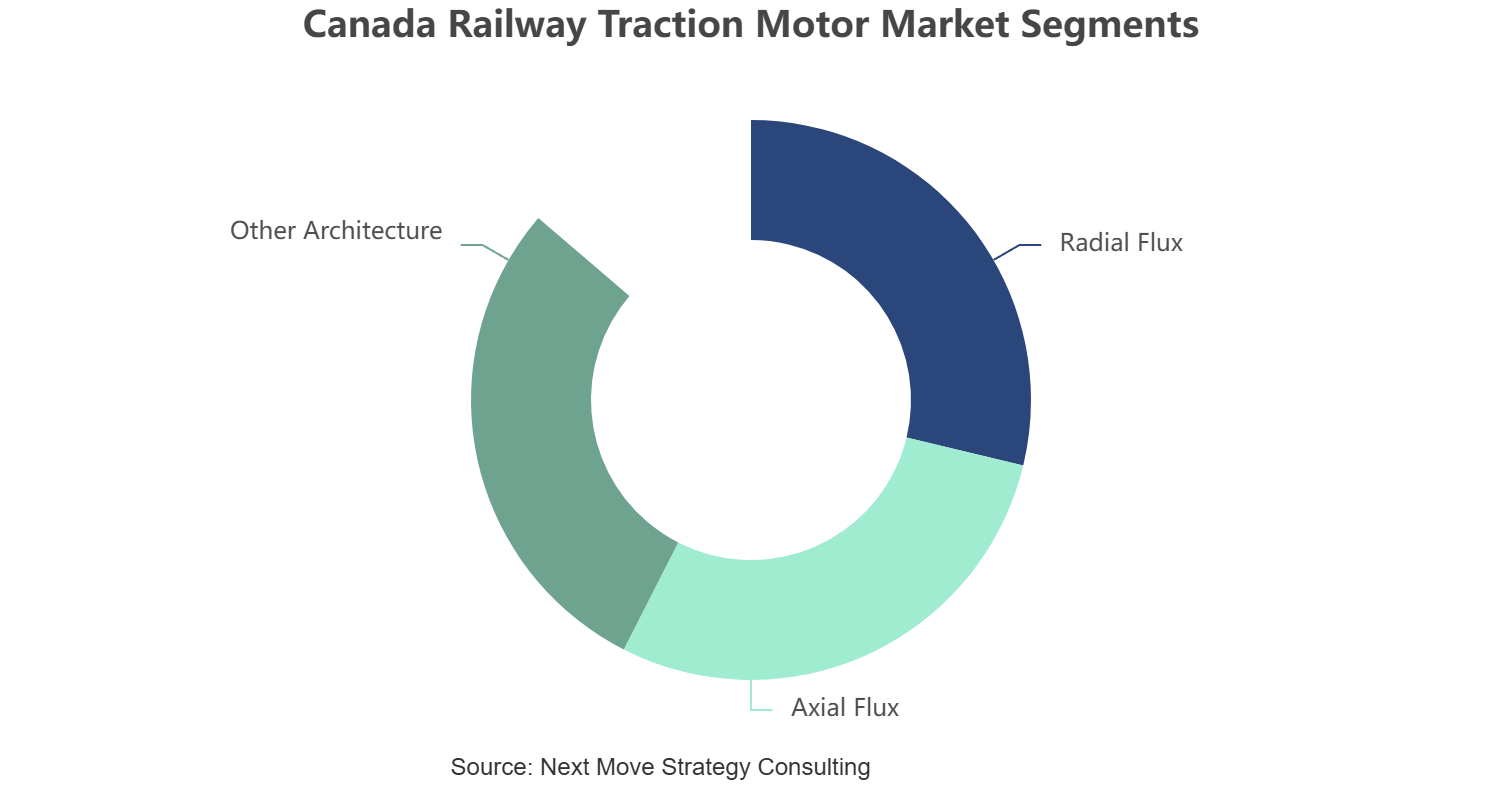
Based on motor architecture, the market is segmented into radial flux, axial flux, and other architectures.
Based on our evaluation, we identified that motor architecture selection across railway applications is influenced by factors such as installation requirements, power density objectives, thermal management considerations, and overall system integration needs. Radial flux motor architectures continue to be utilized across various railway platforms due to their compatibility with existing traction system configurations. In addition, axial flux architectures are being incorporated into selected propulsion system developments that emphasize compact design and efficient space utilization. Meanwhile, ongoing engineering advancements and product development activities are supporting continued innovation in motor architecture design. Furthermore, evolving rolling stock requirements are encouraging the assessment of multiple architectural approaches across diverse railway applications in Canada.
Key Segments
By Rolling Stock Application
-
Locomotives
-
Freight Locomotive
-
Passenger Locomotive
-
Shunting Locomotive
-
Work Locomotive
-
-
Commuter and Regional Train
-
Electric Multiple Unit
-
Diesel Multiple Unit
-
Dual Mode Multiple Unit
-
Battery Electric Multiple Unit
-
-
High-Speed Trains
-
Distributed Traction
-
Power Car
-
-
Urban Rail
-
Metro Trains
-
Light Rail Vehicles (LRV)
-
Trams
-
-
Other Rail Vehicle
By Motor Type
-
DC Motors
-
AC Induction Motors (Asynchronous)
-
Permanent Magnet Synchronous Motors (PMSM)
-
Interior Permanent Magnet
-
Surface Permanent Magnet
-
-
Wound Field Synchronous Motor
-
Reluctance Motor
-
Synchronous Reluctance
-
Switched Reluctance
-
-
Other Motor Type
By Motor Architecture
-
Radial Flux
-
Axial Flux
-
Other Architecture
By Mounting Type
-
Axle Hung
-
Nose Suspended
-
Frame Mounted
-
Other Mounting
By Power Rating
-
Low Power (< 300 KW)
-
Medium Power (300–800 KW)
-
High Power (800–1500 KW)
-
Very High Power (> 1500 KW)
By Cooling Method
-
Air-Cooled
-
Liquid-Cooled
-
Water Glycol
-
Oil Cooled
-
-
Hybrid Cooling
By Traction Voltage Class
-
Low Voltage (< 750 V)
-
Medium Voltage (750 V–3 KV)
-
High Voltage (> 3 KV)
By Commercial Channel
-
OEM
-
Aftermarket
-
Replacement Motors
-
Refurbishment and Rewinding
-
Competitive Landscape
The Canada Railway Traction Motor Market is characterized by a technically advanced and innovation-driven competitive structure, supported by established traction equipment manufacturers, specialized motor developers, and rail system integrators. Market growth is being reinforced by increasing electrification requirements, rising investments in public transit infrastructure, and growing demand for energy-efficient propulsion systems across freight, commuter, and urban rail applications. Additionally, advancement of permanent magnet synchronous motor technologies, digital traction control systems, and regenerative braking integration is strengthening operational efficiency and supporting broader market expansion across Canada.
Key Players of the Canada Railway Traction Motor Market
-
Toshiba Canada Limited
-
Siemens Mobility Limited / Siemens Mobilité Limitée
-
Alstom Transport Canada Inc.
-
Mitsubishi Electric Sales Canada Inc.
-
Hitachi Rail Canada Inc. / Voie Ferrée Hitachi Canada Inc.
-
VEM Motors North America, LLC (Operating in Canada via North American HQ)
-
Progress Rail Services Canada ULC
-
Upper Canada Railway Services Inc.
-
CAD Railway Industries Ltd. (Industries Ferroviaires CAD Ltée)
-
North Shore Rolling Stock Inc.
-
Talgo (Canada) Inc.
-
Wabtec Canada Inc.
Based on NMSC's research, we found that competitive dynamics in the Canada Railway Traction Motor Market are increasingly shaped by propulsion innovation, system integration expertise, and advanced motor performance capabilities. Key companies such as Toshiba Canada Limited, Siemens Mobility Limited, Alstom Transport Canada Inc., Mitsubishi Electric Sales Canada Inc., Hitachi Rail Canada Inc., ABB Electrification Canada Inc., VEM Motors North America LLC, Progress Rail Services Canada ULC, Upper Canada Railway Services Inc., CAD Railway Industries Ltd., North Shore Rolling Stock Inc., Talgo (Canada) Inc., and Wabtec Canada Inc. are strengthening their market presence through advanced traction motor technologies, rail propulsion system development, and strategic service capabilities across Canada.
Pain Point Analysis of the Canada Railway Traction Motor Market
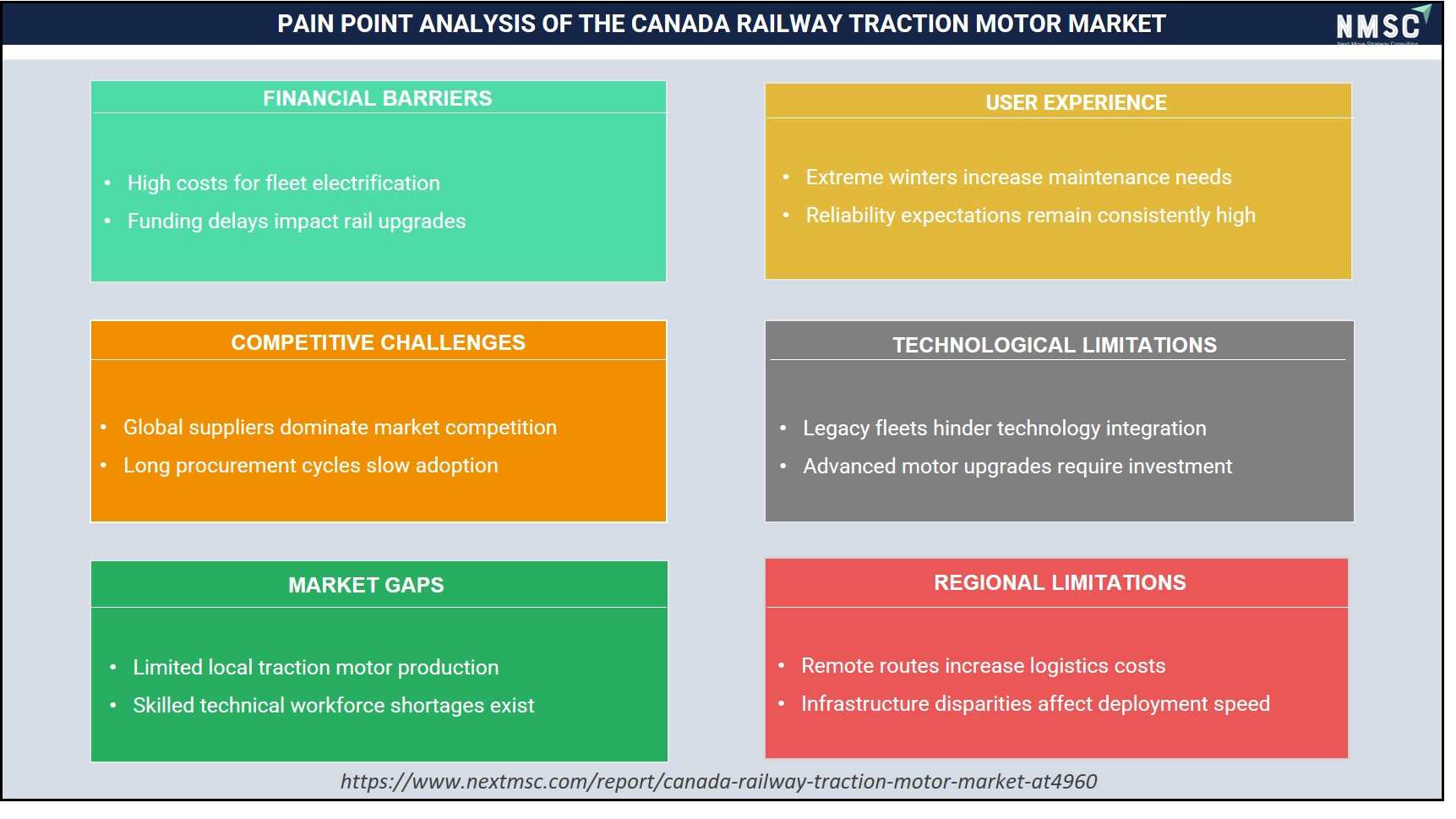
Our analysis indicates that the Canada Railway Traction Motor Market faces several operational and investment-related challenges that influence technology adoption and deployment. High fleet electrification costs and funding delays continue to impact modernization initiatives. Further, harsh winter conditions increase maintenance requirements and place greater performance demands on traction motor systems. Moreover, lengthy procurement cycles, limited domestic manufacturing capabilities, and shortages of skilled technical professionals create implementation challenges. Additionally, infrastructure disparities across remote regions and elevated logistics costs continue to affect deployment efficiency and project execution timelines.
Key Benefits for Stakeholders
Next Move Strategy Consulting (NMSC) presents a comprehensive analysis of the Canada Railway Traction Motor Market, covering historical developments from 2020 to 2025 and providing forecasts through 2035. Our study evaluates the market at national and provincial levels, delivering quantitative outlooks alongside qualitative insights into railway electrification initiatives, rolling stock modernization, sustainable transportation development, traction motor technology advancements, and transit infrastructure expansion. Investors benefit from increasing rail infrastructure investments, while rail operators, transit authorities, traction motor manufacturers, engineering firms, and technology developers benefit from growing demand for energy-efficient propulsion systems, advanced motor technologies, and next-generation railway solutions across commuter, freight, urban transit, and intercity rail applications throughout Canada.
|
Parameters |
Details |
|
Customization Scope |
Free customization (equivalent to up to 80 analyst-working hours) after purchase. |
|
Pricing and Purchase Options |
Avail customized purchase options to meet your exact research needs. |
|
Approach |
In-depth primary and secondary research; proprietary databases; rigorous quality control and validation measures. |
|
Analytical Tools |
Porter's Five Forces, SWOT, value chain, and Harvey ball analysis to assess competitive intensity, stakeholder roles, and relative impact of key factors. |
About the Author
 Saista Faiyaz
— Saista Faiyaz is Research Associate at Next Move Strategy Consulting, where she has covered consumer markets and healthcare technologies for 3 years. Her work includes primary interview review, secondary-source validation, market sizing, and structured analysis of company and industry data. She supports research by comparing evidence across sources, organizing findings into market narratives, and documenting assumptions used in analysis. Her scope includes cross-market benchmarking, and reports.
Saista Faiyaz
— Saista Faiyaz is Research Associate at Next Move Strategy Consulting, where she has covered consumer markets and healthcare technologies for 3 years. Her work includes primary interview review, secondary-source validation, market sizing, and structured analysis of company and industry data. She supports research by comparing evidence across sources, organizing findings into market narratives, and documenting assumptions used in analysis. Her scope includes cross-market benchmarking, and reports.
About the Reviewer
 Supradip Baul
— Supradip Baul is an accomplished business consultant and strategist with over a decade of rich experience in market intelligence, strategy, technology, and business transformation. His work has included rigorous qualitative and quantitative analysis across multiple industries, helping clients shape investment decisions and long-term roadmaps. Earlier in his career, he was associated with Gartner, where he contributed to industry-leading reports and market share analyses. He has worked with leading global companies and holds an MBA with a dual specialization in Marketing and Finance.
Supradip Baul
— Supradip Baul is an accomplished business consultant and strategist with over a decade of rich experience in market intelligence, strategy, technology, and business transformation. His work has included rigorous qualitative and quantitative analysis across multiple industries, helping clients shape investment decisions and long-term roadmaps. Earlier in his career, he was associated with Gartner, where he contributed to industry-leading reports and market share analyses. He has worked with leading global companies and holds an MBA with a dual specialization in Marketing and Finance.
At Next Move Strategy Consulting, we understand that insightful market research is the cornerstone of successful business decisions. That's why we employ a robust and multifaceted approach, combining various methodologies to deliver the most accurate and actionable data for our clients.

Research Landscape
We navigate the world of research with two primary approaches:
Qualitative Approach
Our qualitative research methodologies involve immersive techniques such as in-depth interviews, focus groups, and observational studies. By engaging directly with individuals and stakeholders, we uncover valuable insights that quantitative data alone may overlook.

Quantitative Research
In tandem with qualitative methodologies, NMSC leverages the power of Quantitative Research to provide a robust foundation of numerical insights. Through systematic data collection and analysis, we quantify patterns, preferences, and market trends, offering a comprehensive view of the business landscape.
Our quantitative research approach employs diverse tools, including surveys, experiments, and statistical modelling. These methodologies enable us to gather data from a large and representative sample, ensuring the statistical significance of our findings. By employing structured questionnaires and standardized data collection methods, we guarantee the reliability and validity of the information we present to our clients.
Quantitative research is particularly effective in measuring the prevalence of trends, assessing market size, and gauging the impact of various factors on consumer behavior. The numerical precision attained through this approach equips our clients with actionable insights, facilitating data-driven decision-making and strategy formulation.


Our Specialized Toolbox for Industry-Specific Market Research
We deploy a specialized arsenal of techniques tailored to meet your unique requirements. Here's a glimpse into our comprehensive toolbox:

Information Procurement
The stage entails acquiring market data or relevant information through various sources and methodologies.


Market Research Approach
We utilize both top-down and bottom-up approaches in market research analysis to achieve a comprehensive understanding of the market dynamics, leveraging the broad perspective of industry trends and macroeconomic factors alongside detailed insights from specific segments and individual companies.

Porters Five Forces Analysis
We conduct Porter's Five Forces analysis to evaluate the competitive landscape of an industry, providing us with insights into factors that affect profitability and strategic positioning.

SWOT Analysis

Forecasting
We utilize a forecasting model to predict future consumption by considering parameters like population, economics, regulations, market competition, drivers, constraints, technology, and pricing. We also employ statistical techniques such as multilinear regression, exponential smoothing, moving average, ARIMA, and Monte Carlo simulations for accurate predictions. In econometric forecasting, we analyzed short-term and long-term event impacts, attributing values based on regulatory frameworks, economic factors, and market events.





 Speak to Our Analyst