
China Electric Shaver Market By Type {(Rotary Shaver, Foil Shaver, and Clippers and Trimmers (Beard Trimmers, Body Trimmers, and Other Trimmers)), By Power Source (Battery Powered and Rechargeable/Cordless), By Usage (Dry Electric Shavers and Wet and Dry Electric Shavers), By Distribution Channel (Online, Health and Beauty Stores, Electronic Stores, Supermarkets, and Hypermarkets), and By End User (Men and Women)} – Opportunity Analysis and Industry Forecast, 2025–2035
Industry: Retail and Consumer | Latest Edition: July 29, 2026 | No of Pages: 162 | No. of Tables: 60 | No. of Figures: 50 | Format: PDF | Report Code: RC2549
China Electric Shaver Market Size & Forecast
|
Parameters |
Details |
|
Market Size in 2026 |
USD 286.2 Million |
|
Revenue Forecast in 2035 |
USD 556.7 Million |
|
Growth Rate |
CAGR of 7.67% from 2026 to 2035 |
|
Market Volume in 2026 |
4 million Units |
|
Volume Forecast in 2035 |
9 million Units |
|
Growth Rate |
CAGR of 9.45% from 2026 to 2035 |
|
Analysis Period |
2025–2035 |
|
Base Year Considered |
2025 |
|
Forecast Period |
2026–2035 |
|
Market Size Estimation |
Million (USD) |
|
Companies Profiled |
14 |
|
Market Share |
Available for 10 companies |
Industry Outlook
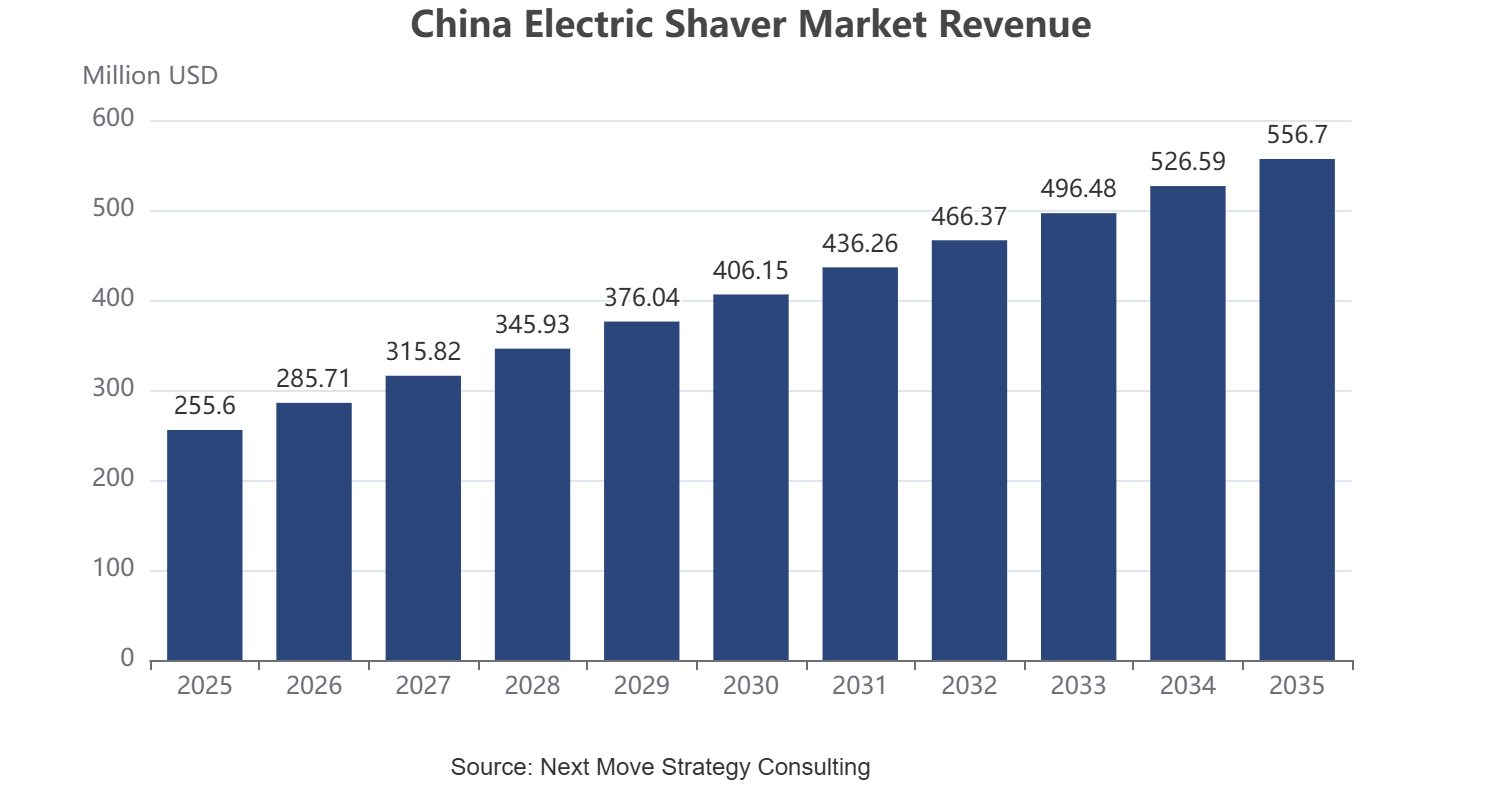
The China Electric Shaver Market size was valued at USD 255.6 Million in 2025 and reached USD 286.2 Million by 2026. Looking ahead, the industry is projected to expand significantly, reaching USD 556.7 Million by 2035, registering a CAGR of 7.67% from 2026 to 2035. In terms of volume, the market recorded 3 million units in 2025, with forecasts indicating growth to 4 million units by 2026 and further to 9 million units by 2035, reflecting a CAGR of 9.45% over the same period.
Ecosystem Analysis of the China Electric Shaver Industry
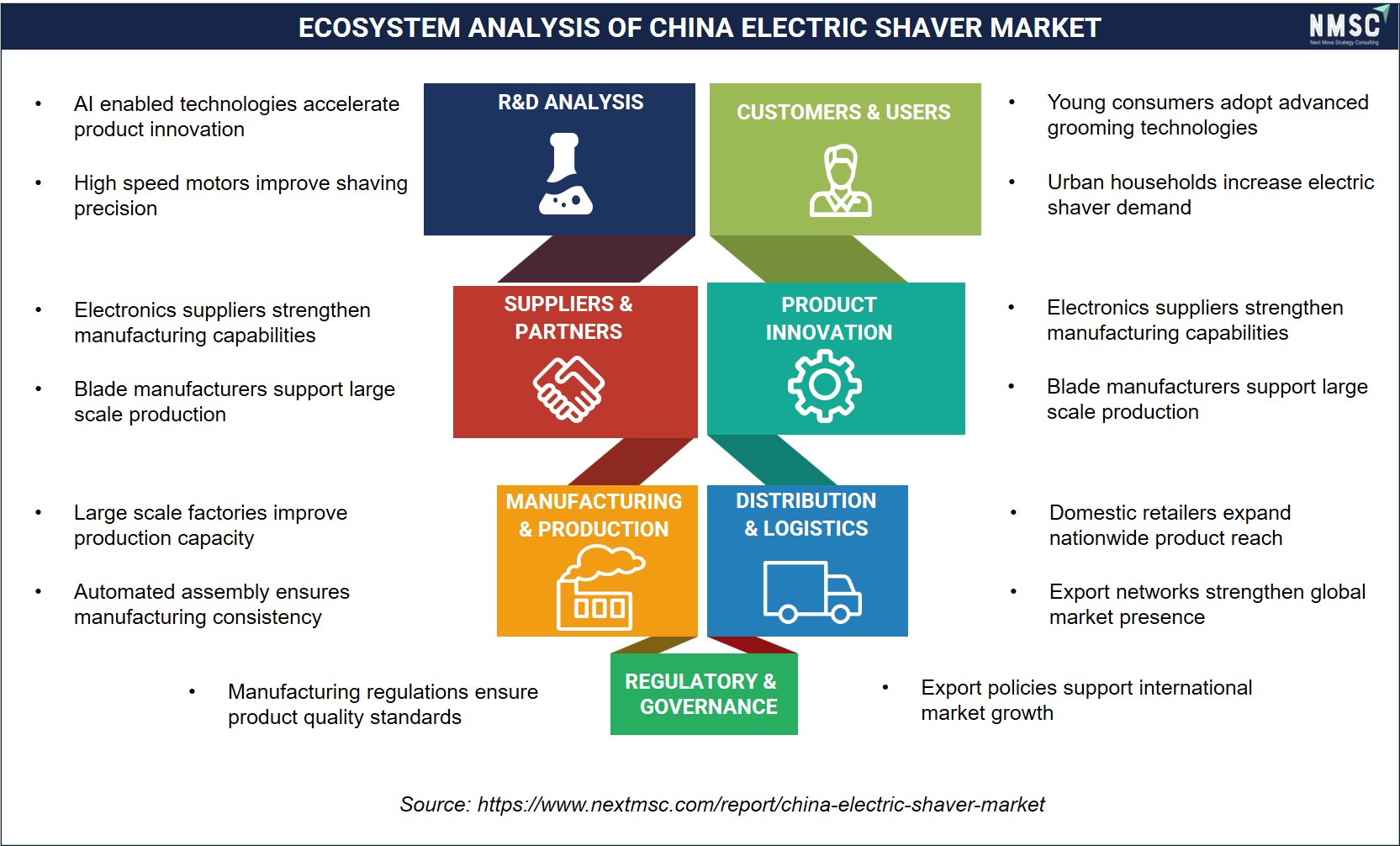
Through NMSC's assessment, we found that China's Electric Shaver Industry benefits from a well-established ecosystem driven by advanced research, large-scale manufacturing, robust supplier networks, and expanding domestic and international distribution channels. Furthermore, AI-enabled innovations, automation, and supportive regulatory frameworks strengthen production efficiency and product quality. Consequently, manufacturers leveraging technological capabilities, scalable operations, and export-oriented strategies are well-positioned to enhance competitiveness and achieve sustainable long-term market growth.
What Are the Key Market Drivers, Breakthroughs, and Investment Opportunities That Will Shape the China Electric Shaver Market in the Next Decade?
|
Drivers / Trends / Restraints |
(+/-) % Impact on CAGR Forecast |
Geographic Relevance |
Impact Timeline |
|
Rising grooming awareness and premiumization trends among urban male and female consumers are strengthening demand for advanced electric shaving devices |
+1.5% |
Shanghai, Beijing, Guangzhou |
Medium to long term (2–6 years) |
|
Expansion of domestic e-commerce platforms and livestream retail is accelerating product accessibility and consumer adoption across tier-2 and tier-3 cities |
+1.3% |
Zhejiang, Jiangsu, Sichuan |
Short to medium term (1–4 years) |
|
Growing preference for cordless and wet-and-dry electric shavers is increasing integration of advanced battery and waterproofing technologies |
+1.2% |
Guangdong, Shanghai, Beijing |
Medium term (2–5 years) |
|
Intense price competition from low-cost domestic manufacturers is creating margin pressure and constraining premium product penetration |
–1.1% |
Nationwide, especially lower-tier cities |
Medium term (2–5 years) |
|
Increasing investment in smart and app-connected grooming devices within domestic electronics manufacturing hubs is creating long-term opportunities for advanced shaver technologies |
+1.3% |
Shenzhen, Xiamen, Ningbo |
Medium to long term (3–7 years) |
Through our market assessment, we observed that the China Electric Shaver Market is witnessing steady growth driven by rising grooming awareness, expanding premiumization trends, and increasing e-commerce and livestream retail penetration across the country. Growing consumer preference for cordless and wet-and-dry electric shavers is accelerating adoption of advanced grooming technologies among urban and semi-urban households. Meanwhile, intense price competition from domestic low-cost manufacturers continues creating margin pressure for premium brands. Furthermore, rising investment in smart and app-connected grooming devices within domestic electronics manufacturing hubs is creating long-term growth opportunities for advanced electric shaver technologies across China.
Growth Drivers:
How Is Rising Grooming Awareness and Premiumization Driving the China Electric Shaver Market Growth?
Through our consumer electronics assessment, we observed that rising grooming awareness and premiumization trends among urban male and female consumers are significantly driving market growth across China's personal care sector. Increasing disposable income and growing focus on personal appearance are strengthening demand for advanced electric shaving devices offering superior comfort, precision, and durability. Electric shavers improve grooming efficiency, skin comfort, and convenience compared to traditional razors. Consequently, domestic and international brands are accelerating premium product launches to strengthen market presence throughout China's expanding consumer electronics landscape.
How Is Expansion of E-Commerce and Livestream Retail Fueling the China Electric Shaver Market Expansion?
Expansion of domestic e-commerce platforms and livestream retail formats is fueling market expansion across China's consumer electronics sector. Our findings suggest that rising online shopping penetration and increasing consumer trust in livestream product demonstrations are increasing accessibility of electric shavers across tier-2 and tier-3 cities. Online platforms improve product discovery, price comparison, and purchase convenience for consumers nationwide. Furthermore, brands are broadening digital retail partnerships to strengthen distribution reach and improve consumer engagement throughout China's rapidly evolving e-commerce ecosystem.
How Is Growing Preference for Cordless and Wet-and-Dry Shavers Driving the China Electric Shaver Market Growth?
Based on NMSC's research, we found that growing consumer preference for cordless and wet-and-dry electric shavers is substantially driving market growth across China's grooming device sector. Rising demand for flexible, travel-friendly, and shower-compatible grooming solutions is encouraging manufacturers to integrate advanced battery and waterproofing technologies into product designs. Electric shavers with rechargeable and wet-and-dry functionality improve usage convenience and product versatility for consumers. Additionally, brands are accelerating innovation in battery efficiency and water-resistant design to strengthen competitiveness throughout China's grooming appliance market.
Growth Restraint:
How Is Intense Price Competition Acting as a Constraint for the China Electric Shaver Market?
Intense price competition from low-cost domestic manufacturers continues acting as a constraint for the market by creating margin pressure across China's electric shaver sector. In our observation, we found that numerous local manufacturers offer budget-priced products that limit premium brand penetration among price-sensitive consumers. Fluctuations in raw material costs and component pricing frequently create additional pressure on manufacturer profitability. In addition, aggressive discounting during major e-commerce sales events reduces average selling prices across the category. Consequently, price-driven competition continues restricting consistent premiumization across China's electric shaver landscape.
Growth Opportunity:
How Is Development of Smart and App-Connected Grooming Devices Unlocking New Growth Opportunities for the China Electric Shaver Market?
Through NMSC's assessment, we found that development of smart and app-connected grooming devices within domestic electronics manufacturing hubs is unlocking new growth opportunities for the market across China's consumer technology ecosystem. Rising investment in connected personal care technologies and integrated skin-sensing features is increasing adoption of intelligent grooming devices among tech-savvy consumers. Smart electric shavers improve usage tracking, maintenance alerts, and personalized grooming experiences. Additionally, manufacturers are accelerating research and development to strengthen product differentiation and improve consumer engagement throughout China's evolving grooming technology landscape.
How Is the China Electric Shaver Market Segmented in This Report, and What Are the Key Insights From the Segmentation Analysis?
By Type Insights
Is Type Segmentation Supporting Product Diversification in the China Electric Shaver Market?
Based on type, the market is segmented into rotary shaver, foil shaver, and clippers and trimmers, which is further categorized into beard trimmers, body trimmers, and other trimmers.
Based on our analysis, we observed that rotary shavers are being adopted across households requiring efficient handling of longer or coarser facial hair, while foil shavers continue supporting consumers seeking close and precise shaving experiences for sensitive skin. Clippers and trimmers, including beard and body trimmers, are being integrated into grooming routines requiring styling flexibility and multi-purpose functionality. Consequently, diverse product availability across type categories is strengthening consumer choice and supporting broader adoption throughout China's grooming device market.
By Distribution Channel Insights
Is Distribution Channel Segmentation Supporting Market Accessibility in the China Electric Shaver Market?
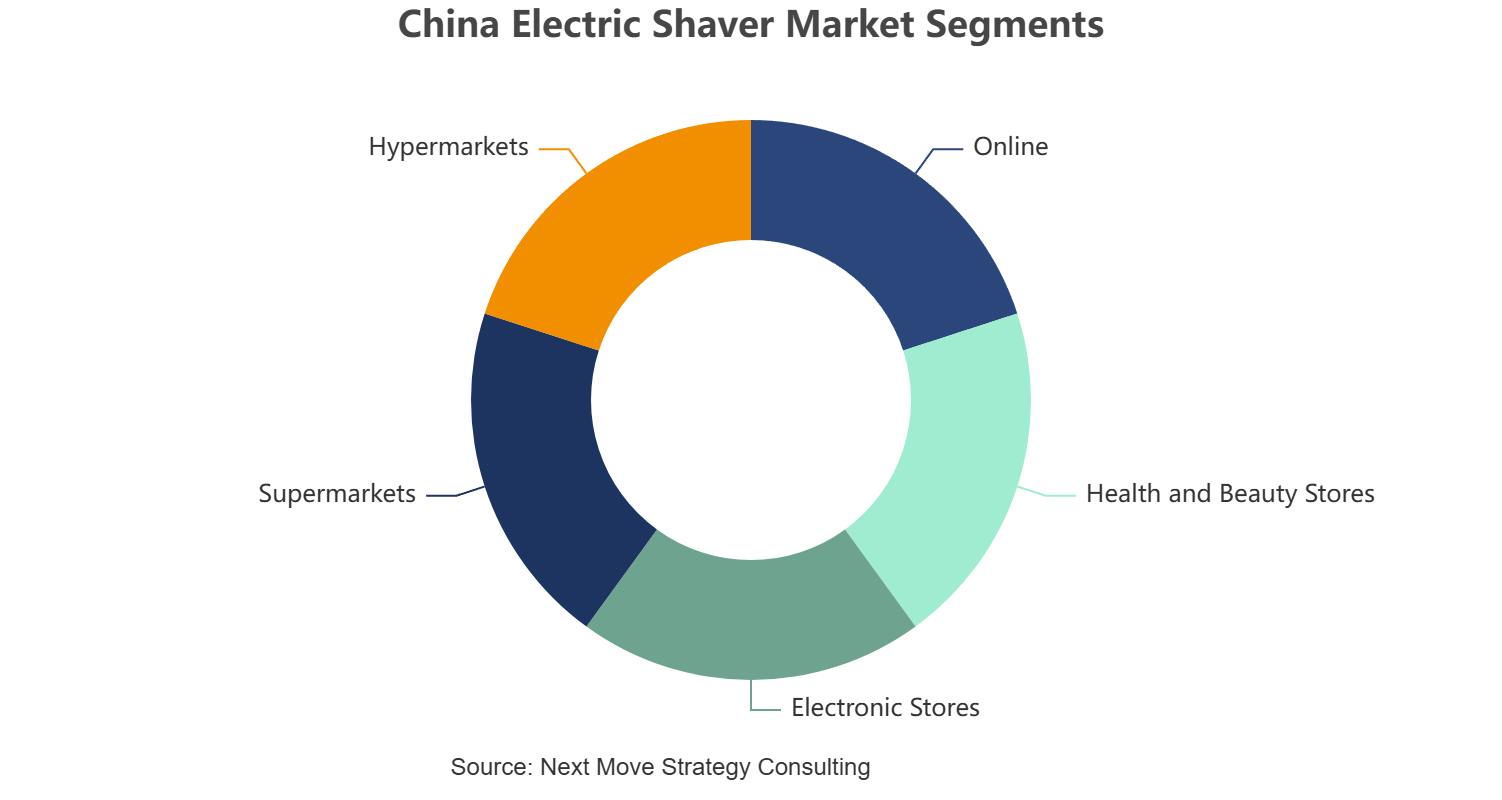
Based on distribution channel, the market is segmented into online, health and beauty stores, electronic stores, supermarkets, and hypermarkets.
Based on our evaluation, we identified that online channels are supporting convenient product discovery and doorstep delivery for consumers across urban and rural regions throughout China. Electronic stores and health and beauty stores continue assisting consumers seeking in-person product demonstrations and personalized purchase guidance. Supermarkets and hypermarkets are also strengthening product accessibility through wide-reaching retail networks. Consequently, expanding multi-channel distribution strategies are strengthening product availability and consumer convenience across China's electric shaver market.
Key Segments
By Type
-
Rotary Shaver
-
Foil Shaver
-
Clippers and Trimmers
-
Beard Trimmers
-
Body Trimmers
-
Other Trimmers
-
By Power Source
-
Battery Powered
-
Rechargeable/Cordless
By Usage
-
Dry Electric Shavers
-
Wet and Dry Electric Shavers
By Distribution Channel
-
Online
-
Health and Beauty Stores
-
Electronic Stores
-
Supermarkets
-
Hypermarkets
By End-User
-
Men
-
Women
Competitive Landscape
The China Electric Shaver Market is characterised by a highly competitive and rapidly evolving structure, supported by the presence of established consumer electronics manufacturers, personal care appliance specialists, and emerging domestic brands. Market growth is being driven by increasing grooming awareness, expanding e-commerce distribution, and rising demand for advanced cordless and multi-functional shaving devices across urban and semi-urban regions. In addition, continuous innovation in battery technology and precision cutting systems is strengthening product differentiation and supporting broader market expansion.
Strategic Developments:
-
April 2026 – Panasonic Appliances Air-conditioning (China) Co., Ltd. completed a major organizational restructuring, establishing a new consumer-appliance-focused Panasonic Corporation with continued emphasis on beauty and personal-care appliances, including electric shavers. The reorganization reinforces long-term investment in R&D, manufacturing, and consumer appliance innovation supporting Panasonic's grooming business in China.
-
December 2025 – Xiaomi Communications Co. Ltd. launched the Mijia Electric Shaver Pro in China, featuring dual-ring stainless-steel blades, an intelligent high-speed motor, wireless charging support, and up to 90–95 days of battery life. The launch strengthens Xiaomi's premium grooming portfolio in China's electric shaver market through product innovation and smart personal-care technology.
Key Players of the China Electric Shaver Industry
-
Andis Electric Suzhou Co. Ltd.
-
Focus Technology Co. Ltd.
-
Xiamen Intretech Inc.
-
Xiaomi Communications Co. Ltd.
-
Beurer Electric Shanghai Co. Ltd.
-
Pangaea Holdings Inc.
-
Wenzhou Pritech Industrial Co. Ltd.
-
Schick China Co. Ltd.
-
Wahl Clipper Ningbo Co. Ltd.
-
Yiwu Kemei Electric Appliance Co. Ltd.
-
Ningbo VGR Electric Appliance Co. Ltd.
-
Shanghai Gillette Co. Ltd.
Based on NMSC's research, we found that competitive dynamics are increasingly shaped by product innovation, battery technology advancements, and expanding distribution networks. Key companies such as Andis Electric Suzhou Co. Ltd., Focus Technology Co. Ltd., Xiamen Intretech Inc., Xiaomi Communications Co. Ltd., and Panasonic Appliances Air-conditioning (China) Co., Ltd., Beurer Electric Shanghai Co. Ltd., Pangaea Holdings Inc., Wenzhou Pritech Industrial Co. Ltd., Schick China Co. Ltd., Wahl Clipper Ningbo Co. Ltd., Spectrum Brands Shanghai Co. Ltd., Yiwu Kemei Electric Appliance Co. Ltd., Ningbo VGR Electric Appliance Co. Ltd., Shanghai Gillette Co. Ltd. are strengthening their market presence through new product launches, precision engineering improvements, and broader retail partnerships. Consequently, the competitive landscape is advancing toward a more innovation-focused and consumer-centric structure in the China Electric Shaver Industry.
Strategic Framework of the China Electric Shaver Industry
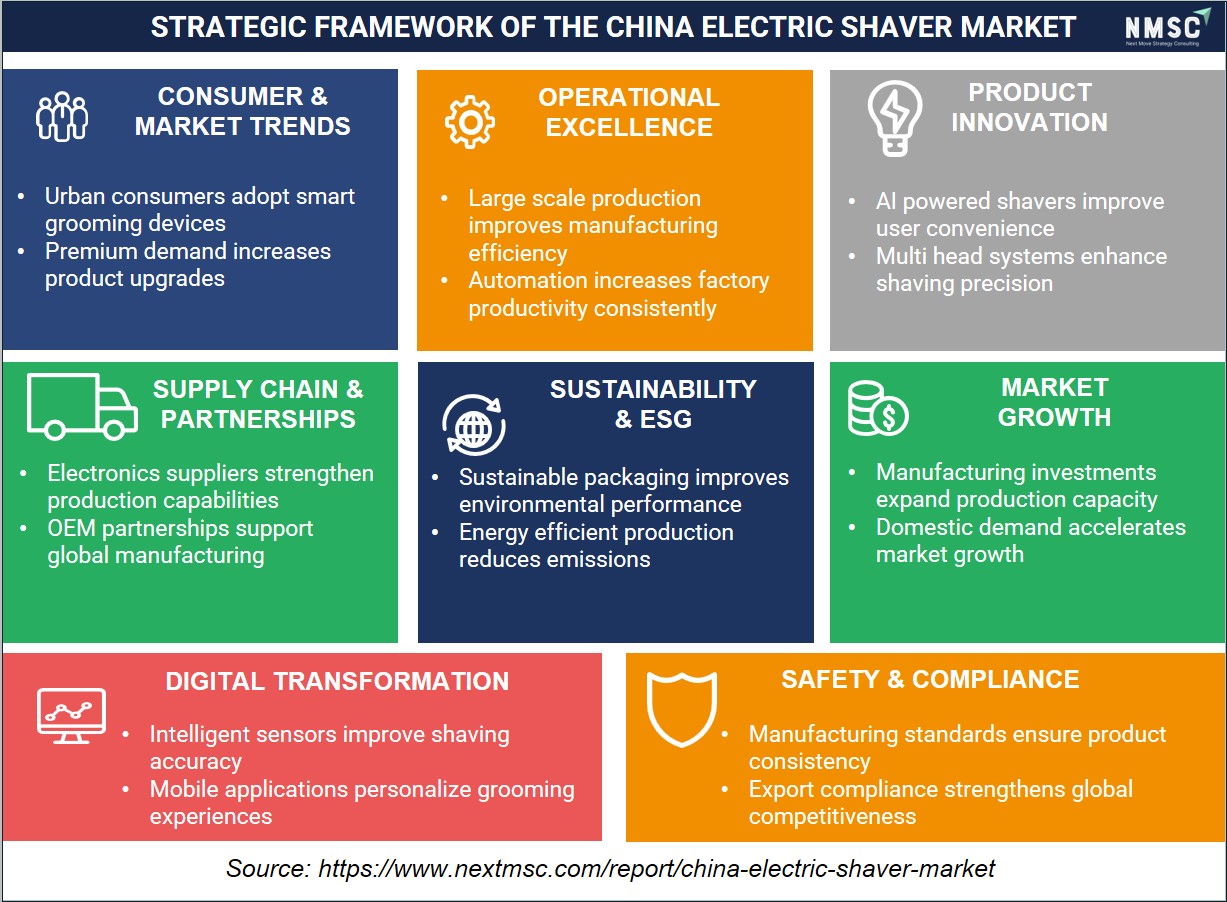
Our assessment indicates that China's Electric Shaver Industry is advancing through smart manufacturing, AI-powered product innovation, sustainable production practices, and expanding OEM partnerships. Moreover, rising domestic demand, digital transformation, and manufacturing investments accelerate product development while enhancing operational efficiency. Additionally, strong compliance standards and export competitiveness reinforce global market positioning, enabling industry participants to strengthen innovation capabilities, expand production capacity, and sustain long-term business growth.
Key Benefits for Stakeholders:
Next Move Strategy Consulting (NMSC) provides a comprehensive analysis of the China Electric Shaver Market, covering historical trends from 2020–2025 and forecasts through 2035. The study evaluates market performance across key segments, highlighting product innovation, distribution channel expansion, and consumer adoption patterns. Investors benefit from rising premiumization trends, while retailers gain from improved product assortment and consumer engagement strategies across online and offline channels.
Manufacturers benefit from increasing demand for advanced electric shavers, battery technologies, and precision cutting systems across major end-use segments. Technology providers gain from growing integration of smart and app-connected grooming features within domestic electronics manufacturing hubs. Distribution partners benefit from expanding multi-channel retail strategies supporting broader product accessibility. Consequently, stakeholders across the value chain gain actionable insights to strengthen strategic positioning throughout China's evolving electric shaver market landscape.
|
Parameters |
Details |
|
Customization Scope |
Free customization (equivalent to up to 80 analyst-working hours) after purchase. |
|
Pricing and Purchase Options |
Avail customized purchase options to meet your exact research needs. |
|
Approach |
In-depth primary and secondary research; proprietary databases; rigorous quality control and validation measures. |
|
Analytical Tools |
Porter's Five Forces, SWOT, value chain, and Harvey ball analysis to assess competitive intensity, stakeholder roles, and relative impact of key factors. |
Conclusion
The China Electric Shaver Market is set for steady expansion through 2035, supported by rising grooming awareness, growing premiumization trends, and expanding e-commerce and livestream retail penetration across the country. Increasing consumer preference for cordless and wet-and-dry electric shavers is strengthening adoption of advanced grooming technologies among urban and semi-urban households. While intense price competition from domestic manufacturers presents ongoing challenges, continued investment in smart and app-connected grooming devices is expected to unlock long-term growth opportunities. Overall, the market is projected to grow from USD 255.6 Million in 2025 to USD 556.7 Million by 2035, at a CAGR of 7.67%.
About the Author
 Saista Faiyaz
— Saista Faiyaz is Research Associate at Next Move Strategy Consulting, where she has covered consumer markets and healthcare technologies for 3 years. Her work includes primary interview review, secondary-source validation, market sizing, and structured analysis of company and industry data. She supports research by comparing evidence across sources, organizing findings into market narratives, and documenting assumptions used in analysis. Her scope includes cross-market benchmarking, and reports.
Saista Faiyaz
— Saista Faiyaz is Research Associate at Next Move Strategy Consulting, where she has covered consumer markets and healthcare technologies for 3 years. Her work includes primary interview review, secondary-source validation, market sizing, and structured analysis of company and industry data. She supports research by comparing evidence across sources, organizing findings into market narratives, and documenting assumptions used in analysis. Her scope includes cross-market benchmarking, and reports.
About the Reviewer
 Supradip Baul
— Supradip Baul is an accomplished business consultant and strategist with over a decade of rich experience in market intelligence, strategy, technology, and business transformation. His work has included rigorous qualitative and quantitative analysis across multiple industries, helping clients shape investment decisions and long-term roadmaps. Earlier in his career, he was associated with Gartner, where he contributed to industry-leading reports and market share analyses. He has worked with leading global companies and holds an MBA with a dual specialization in Marketing and Finance.
Supradip Baul
— Supradip Baul is an accomplished business consultant and strategist with over a decade of rich experience in market intelligence, strategy, technology, and business transformation. His work has included rigorous qualitative and quantitative analysis across multiple industries, helping clients shape investment decisions and long-term roadmaps. Earlier in his career, he was associated with Gartner, where he contributed to industry-leading reports and market share analyses. He has worked with leading global companies and holds an MBA with a dual specialization in Marketing and Finance.
At Next Move Strategy Consulting, we understand that insightful market research is the cornerstone of successful business decisions. That's why we employ a robust and multifaceted approach, combining various methodologies to deliver the most accurate and actionable data for our clients.

Research Landscape
We navigate the world of research with two primary approaches:
Qualitative Approach
Our qualitative research methodologies involve immersive techniques such as in-depth interviews, focus groups, and observational studies. By engaging directly with individuals and stakeholders, we uncover valuable insights that quantitative data alone may overlook.

Quantitative Research
In tandem with qualitative methodologies, NMSC leverages the power of Quantitative Research to provide a robust foundation of numerical insights. Through systematic data collection and analysis, we quantify patterns, preferences, and market trends, offering a comprehensive view of the business landscape.
Our quantitative research approach employs diverse tools, including surveys, experiments, and statistical modelling. These methodologies enable us to gather data from a large and representative sample, ensuring the statistical significance of our findings. By employing structured questionnaires and standardized data collection methods, we guarantee the reliability and validity of the information we present to our clients.
Quantitative research is particularly effective in measuring the prevalence of trends, assessing market size, and gauging the impact of various factors on consumer behavior. The numerical precision attained through this approach equips our clients with actionable insights, facilitating data-driven decision-making and strategy formulation.


Our Specialized Toolbox for Industry-Specific Market Research
We deploy a specialized arsenal of techniques tailored to meet your unique requirements. Here's a glimpse into our comprehensive toolbox:

Information Procurement
The stage entails acquiring market data or relevant information through various sources and methodologies.


Market Research Approach
We utilize both top-down and bottom-up approaches in market research analysis to achieve a comprehensive understanding of the market dynamics, leveraging the broad perspective of industry trends and macroeconomic factors alongside detailed insights from specific segments and individual companies.

Porters Five Forces Analysis
We conduct Porter's Five Forces analysis to evaluate the competitive landscape of an industry, providing us with insights into factors that affect profitability and strategic positioning.

SWOT Analysis

Forecasting
We utilize a forecasting model to predict future consumption by considering parameters like population, economics, regulations, market competition, drivers, constraints, technology, and pricing. We also employ statistical techniques such as multilinear regression, exponential smoothing, moving average, ARIMA, and Monte Carlo simulations for accurate predictions. In econometric forecasting, we analyzed short-term and long-term event impacts, attributing values based on regulatory frameworks, economic factors, and market events.





 Speak to Our Analyst