Composite Aerostructure Market By Component Type (Fuselage Structures, Wing Structures, Empennage Structures, Flight Control Structures, & Others), By Aircraft Type (Commercial Aircraft, Military Aircraft, Business Jets, General Aviation Aircraft, Helicopters,), By Fiber Type (Carbon Fiber, Glass Fiber, Aramid Fiber, Hybrid Fiber, & Others), By Resin Type (Thermoset & Thermoplastic), By Manufacturing Process, By Revenue Stream, By End User – Global Analysis & Forecast, 2026–2035
Industry: Materials and Chemical | Publishing Date: July 7, 2026 | Last Updated: September 30, 2026 | No of Pages: N/A | No. of Tables: N/A | No. of Figures: N/A | Format: PDF | Report Code: MC5005
What Is the Composite Aerostructure Market Size?
The global Composite Aerostructure Market was valued at USD 48.2 billion in 2025 and is projected to reach USD 53.65 billion by the end of 2026. The industry is forecast to expand significantly, reaching USD 140.6 billion by 2035, registering a CAGR of 11.3% from 2026 to 2035. Growth is fueled by accelerating commercial aircraft deliveries, escalating defense modernization programs, rapid adoption of advanced manufacturing automation, and the emergence of Urban Air Mobility platforms demanding next-generation lightweight structural solutions.
|
Parameters |
Details |
|
Market Size in 2025 |
USD 48.2 billion |
|
Market Size in 2026 |
USD 53.65 billion |
|
Revenue Forecast in 2035 |
USD 140.6 billion |
|
Growth Rate |
CAGR of 11.3% from 2026 to 2035 |
|
Analysis Period |
2025–2035 |
|
Base Year Considered |
2025 |
|
Forecast Period |
2026–2035 |
|
Market Size Estimation |
USD Billion |
|
Companies Profiled |
20 |
|
Countries Covered |
33 |
|
Market Share |
Top 10 |
Composite Aerostructure Market Overview
What Is the Composite Aerostructure Market?
The Composite Aerostructure Market encompasses the design, manufacturing, and supply of lightweight structural assemblies produced using advanced composite materials, primarily carbon fiber reinforced polymers (CFRP), glass fiber reinforced polymers (GFRP), and aramid fiber composites. These structures replace conventional metallic components across aircraft fuselages, wings, empennage systems, nacelles, engine pylons, and flight control surfaces to improve structural efficiency and operational performance. NMSC's analysis indicates that the market is fundamentally driven by the aviation industry's pursuit of higher fuel efficiency, superior weight-to-strength ratios, enhanced fatigue resistance, corrosion protection, and lower life-cycle maintenance costs across commercial, military, business, and emerging aerospace platforms.
How Has the Composite Aerostructure Market Evolved?
The market has undergone a decades-long transition from aluminum-intensive aircraft structures toward highly integrated composite airframes. Initial adoption was concentrated within military aviation, where performance and weight reduction justified the higher material and manufacturing costs. Based on research conducted by NMSC, we found that the commercialization of large-scale composite airframes through programs such as the Boeing 787 Dreamliner and Airbus A350 XWB marked the industry's most significant structural transformation, with composites accounting for more than half of the aircraft's structural weight. This commercial success has established composites as the preferred material platform for future narrowbody aircraft development, advanced air mobility vehicles, unmanned aerial systems, and next-generation defense aircraft.
How Do Regulations Influence the Composite Aerostructure Market?
Regulatory and certification frameworks play a critical role in shaping the market. Airworthiness authorities require comprehensive qualification of composite materials, manufacturing processes, structural integrity, damage tolerance, and fatigue performance before aircraft certification. Certification requirements under FAR Part 25 and CS-25 establish rigorous standards for commercial aircraft structural components, while military procurement agencies enforce additional performance and durability specifications for defense platforms. Our findings suggest that these stringent certification pathways create high barriers to entry, while simultaneously strengthening customer confidence in the long-term safety, reliability, and operational performance of composite aerostructures.
How Is Technology Adoption Expanding Across the Composite Aerostructure Market?
Technology adoption across the Composite Aerostructure Market is accelerating as aircraft manufacturers invest in highly automated production technologies to improve manufacturing efficiency, scalability, and structural consistency. NMSC's assessment indicates that Automated Fiber Placement (AFP) and Automated Tape Laying (ATL) systems are significantly reducing manual labor requirements while improving production precision for large composite structures. At the same time, digital twin technologies, thermoplastic composite processing, out-of-autoclave manufacturing techniques, additive manufacturing for tooling, and AI-enabled quality inspection are expanding production capabilities and reducing manufacturing costs. These technological advancements are reshaping industry competitiveness by favoring manufacturers with advanced automation expertise, proprietary composite processing technologies, and vertically integrated production capabilities.
|
Key Takeaways |
|
By Component Type, Fuselage Structures dominated the Composite Aerostructure Market with USD 13.6 billion in 2025, driven by their extensive use in primary aircraft structures. Flight Control Structures are projected to be the fastest-growing segment at a CAGR of 11.5% from 2026 to 2035. |
|
By Aircraft Type, Commercial Aircraft led the market with USD 22.8 billion in 2025, supported by strong commercial aircraft production and order backlogs. Uncrewed Aerial Vehicles (UAVs) are expected to register the fastest growth at a CAGR of 13.8% through 2035. |
|
By Fiber Type, Carbon Fiber Composites accounted for the largest share with USD 32.6 billion in 2025, owing to their superior strength-to-weight performance. Hybrid Fiber Composites are forecast to grow the fastest at a CAGR of 11.8% through 2035. |
|
By Resin Type, Thermoset Resin Systems dominated the market with USD 35.8 billion in 2025 due to their proven aerospace performance and certification history. Thermoplastic Resin Systems are projected to be the fastest-growing segment at a CAGR of 12.3% from 2026 to 2035. |
|
By Manufacturing Process, Automated Fiber Placement generated the highest revenue at USD 11.8 billion in 2025, supported by its precision and production efficiency. Other Manufacturing Processes are expected to witness the fastest growth at a CAGR of 14.9% through 2035. |
|
By Revenue Stream, Production Programs held the largest market share with USD 30.4 billion in 2025, driven by new aircraft manufacturing. Engineering Services are projected to be the fastest-growing revenue stream at a CAGR of 12.9% through 2035. |
|
By End User, Commercial Aircraft OEMs led the market with USD 20.6 billion in 2025, supported by large-scale commercial aircraft production. UAV OEMs are expected to record the fastest growth at a CAGR of 13.9% from 2026 to 2035. |
|
North America was the largest regional market with USD 17.8 billion in 2025, driven by its well-established aerospace manufacturing ecosystem. Asia-Pacific is projected to be the fastest-growing region at a CAGR of 12.1% through 2035. |
|
The United States remained the largest country market, supported by the presence of leading aerospace OEMs and suppliers. India is projected to be the fastest-growing country market through 2035, driven by expanding domestic aerospace manufacturing and defense investments. |
|
By Component Type, Fuselage Structures dominated the Composite Aerostructure Market with USD 13.6 billion in 2025, driven by their extensive use in primary aircraft structures. Flight Control Structures are projected to be the fastest-growing segment at a CAGR of 11.5% from 2026 to 2035. |
|
By Aircraft Type, Commercial Aircraft led the market with USD 22.8 billion in 2025, supported by strong commercial aircraft production and order backlogs. Uncrewed Aerial Vehicles (UAVs) are expected to register the fastest growth at a CAGR of 13.8% through 2035. |
|
By Fiber Type, Carbon Fiber Composites accounted for the largest share with USD 32.6 billion in 2025, owing to their superior strength-to-weight performance. Hybrid Fiber Composites are forecast to grow the fastest at a CAGR of 11.8% through 2035. |
|
By Resin Type, Thermoset Resin Systems dominated the market with USD 35.8 billion in 2025 due to their proven aerospace performance and certification history. Thermoplastic Resin Systems are projected to be the fastest-growing segment at a CAGR of 12.3% from 2026 to 2035. |
|
By Manufacturing Process, Automated Fiber Placement generated the highest revenue at USD 11.8 billion in 2025, supported by its precision and production efficiency. Other Manufacturing Processes are expected to witness the fastest growth at a CAGR of 14.9% through 2035. |
|
By Revenue Stream, Production Programs held the largest market share with USD 30.4 billion in 2025, driven by new aircraft manufacturing. Engineering Services are projected to be the fastest-growing revenue stream at a CAGR of 12.9% through 2035. |
|
By End User, Commercial Aircraft OEMs led the market with USD 20.6 billion in 2025, supported by large-scale commercial aircraft production. UAV OEMs are expected to record the fastest growth at a CAGR of 13.9% from 2026 to 2035. |
|
North America was the largest regional market with USD 17.8 billion in 2025, driven by its well-established aerospace manufacturing ecosystem. Asia-Pacific is projected to be the fastest-growing region at a CAGR of 12.1% through 2035. |
|
The United States remained the largest country market, supported by the presence of leading aerospace OEMs and suppliers. India is projected to be the fastest-growing country market through 2035, driven by expanding domestic aerospace manufacturing and defense investments. |
Ecosystem Analysis of the Composite Aerostructure Market
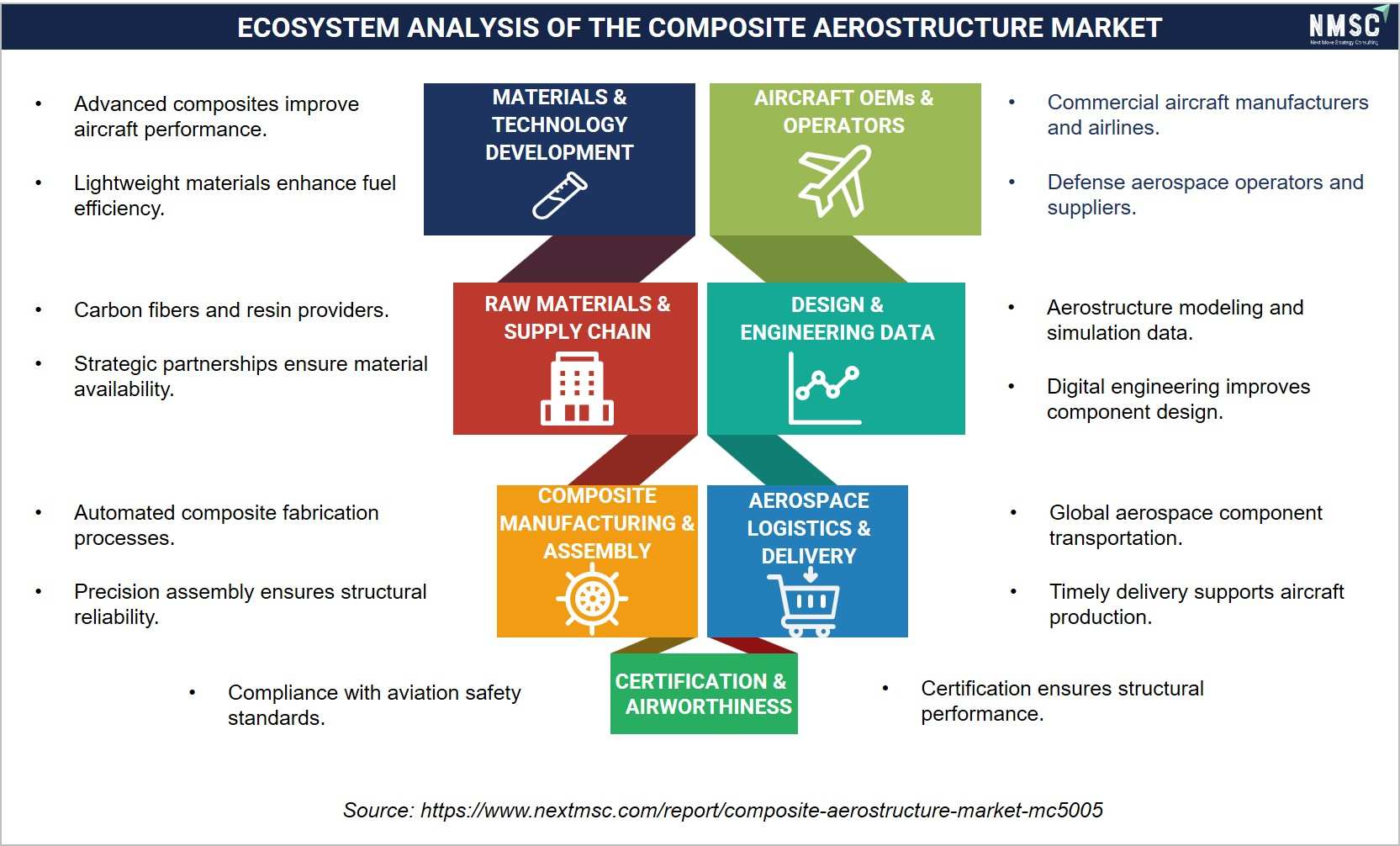
The above infographic presents an ecosystem analysis of the composite aerostructure market, covering materials, supply chain, manufacturing, design data, logistics, OEMs, and certification. We noticed that advanced composites and lightweight materials are improving aircraft performance and fuel efficiency, supported by carbon fiber suppliers and strategic partnerships for material availability. Further, automated fabrication and precision assembly ensure structural reliability, while digital engineering and simulation data enhance component design. Global logistics enable timely delivery to aircraft OEMs and operators, all within a framework of aviation safety standards and certification. These interconnected elements collectively shape the market's evolution across the sector.
Key Emerging Trends in the Composite Aerostructure Market
How Is the Adoption of Thermoplastic Composites Reshaping the Composite Aerostructure Market?
Thermoplastic composite adoption represents a structural inflection point for the Composite Aerostructure Market. Unlike thermoset systems requiring autoclave curing, thermoplastics enable welding instead of mechanical fastening, reducing part count and structural weight simultaneously. Programs including the Airbus A350 rear fuselage shell, processed using PEEK-based thermoplastic panels, demonstrate industrial-scale applicability. NMSC's analysis indicates that thermoplastics are increasingly adopted in wing leading-edge components, ribs, and floor structures. Major aerostructure manufacturers are investing heavily in induction welding and resistance welding facilities, establishing competitive differentiation in next-generation platform competitions where lightweighting and repairability are critical evaluation criteria.
How Is Advanced Automation Transforming Manufacturing Economics in the Composite Aerostructure Market?
Our assessment indicates that automation-driven manufacturing transformation is fundamentally altering cost structures within the market. Automated Fiber Placement machines, capable of 100+ kg/hr laydown rates with sub-millimeter fiber placement accuracy, are now deployed across major fuselage and wing barrel programs. Companies including Electroimpact, MTorres, and Coriolis Composites are delivering increasingly capable AFP platforms. NMSC's research shows that the integration of in-process laser inspection, real-time compaction monitoring, and digital twin quality feedback loops is reducing scrap rates below 3%, compared to 8-12% in manual processes. This manufacturing competitiveness evolution is reshaping competitive positioning for tier-one aerostructure integrators globally.
How Are Sustainability and Recyclability Mandates Influencing the Composite Aerostructure Market?
Based on our market evaluation, we noticed that sustainability mandates are driving material and process innovation throughout the market. The aviation industry's commitment to net-zero carbon by 2050, as articulated through IATA's Fly Net Zero initiative, is accelerating the adoption of bio-based resins, recyclable thermoplastic matrices, and dry fiber process technologies that eliminate hazardous solvents. Airbus's ZEROe hydrogen aircraft development program explicitly requires composite aerostructures capable of withstanding liquid hydrogen cryogenic environments, opening an entirely new material qualification challenge. European regulatory frameworks under the EU Green Deal are also pressuring OEMs to establish composite recycling programs that recover structural-grade carbon fiber at end-of-life.
How Is the Advanced Air Mobility Revolution Driving New Demand in the Composite Aerostructure Market?
From our research, we found that the Advanced Air Mobility sector is creating a structurally distinct demand vector for the market. Electric Vertical Takeoff and Landing aircraft, including the Joby S4, Lilium Jet, and Archer Midnight, rely extensively on composite airframes to manage weight penalties imposed by battery energy density constraints. NMSC's assessment indicates that eVTOL aerostructures require high-rate, low-cost manufacturing compatible with automotive-style production volumes rather than traditional aerospace unit economics. This demands process innovations including compression molding of structural components, automated preforming, and rapid out-of-autoclave cure. The FAA's Special Class certification framework for powered-lift aircraft is also establishing new structural validation requirements that aerostructure suppliers must navigate.
What Are the Key Market Drivers, Breakthroughs, and Investment Opportunities That Will Shape the Composite Aerostructure Market in the Next Decade?
|
Drivers / Trends / Restraints |
(+/-) % Impact on CAGR Forecast |
Geographic Relevance |
Impact Timeline |
|
Accelerating commercial aircraft OEM deliveries and record backlogs |
+1.8% |
North America, Europe |
Near-term (2025–2027) |
|
Defense modernization and next-gen fighter / transport procurement |
+1.2% |
North America, Europe, Asia-Pacific |
Near-to-mid-term (2025–2030) |
|
Rapid UAV and eVTOL platform proliferation |
+0.9% |
Global |
Mid-to-long-term (2027–2035) |
|
Adoption of automated manufacturing (AFP/ATL) |
+0.7% |
North America, Europe, Asia-Pacific |
Near-term (2025–2028) |
|
Thermoplastic composite material transition |
+0.5% |
Europe, North America |
Mid-term (2027–2033) |
|
Sustainability and recyclability regulatory mandates |
+0.4% |
Europe, Global |
Mid-term (2027–2035) |
|
High raw material cost volatility (carbon fiber precursors) |
−0.6% |
Global |
Near-to-mid-term (2025–2030) |
|
Stringent airworthiness certification timelines |
−0.4% |
Global |
Near-term (2025–2028) |
|
Digital manufacturing and Industry 4.0 integration |
+0.5% |
North America, Europe |
Mid-term (2026–2032) |
|
Advanced Air Mobility certification and commercialization |
+0.6% |
North America, Europe, Asia-Pacific |
Long-term (2029–2035) |
What Are the Growth Drivers of the Composite Aerostructure Market?
How Are Record Commercial Aircraft Order Backlogs Fueling Composite Aerostructure Market Growth?
The sustained build-up of commercial aircraft order backlogs at Boeing and Airbus is generating long-term structural demand across the market. Airbus reported a backlog exceeding 8,000 aircraft as of its 2024 annual results, while Boeing's order book similarly reflects multi-year delivery commitments for 737 MAX and 787 programs. Based on NMSC's research, we found that each widebody aircraft, such as the Boeing 787, incorporates approximately 35 tonnes of composite material, the majority sourced from tier-one aerostructure integrators under long-term supply agreements. These committed production volumes provide revenue visibility extending well into the 2030s for qualified composite aerostructure suppliers.
How Is Rising Defense Expenditure Accelerating Demand for Composite Aerostructures?
Global defense modernization programs are generating sustained investment in composite-intensive military aircraft platforms, supporting the market demand across the forecast period. The U.S. Department of Defense's Fiscal Year 2025 budget request allocated over USD 37 billion for aircraft procurement and R&D, including next-generation fighter and long-range strike programs heavily dependent on advanced composite primary structures. NATO member nations, guided by the 2024 Washington Summit commitments to increase defense investment beyond 2% of GDP, are similarly accelerating procurement of composite-intensive platforms, including the F-35 Lightning II, Eurofighter Typhoon successor studies, and transport aircraft modernization programs. Our assessment indicates that military demand provides counter-cyclical revenue stability for composite aerostructure manufacturers.
How is the UAV and eVTOL Revolution Creating New Composite Aerostructure Market Demand?
The rapid proliferation of Uncrewed Aerial Vehicles and Advanced Air Mobility platforms is establishing an entirely new demand vertical within the market. The U.S. Federal Aviation Administration's UAV Integration Pilot Program and the European Union Aviation Safety Agency's Urban Air Mobility regulatory frameworks are providing certification pathways that accelerate commercial deployment. NMSC's analysis indicates that eVTOL manufacturers, constrained by battery energy density limitations, require structural weight reductions of 30-40% compared to conventional helicopter airframes, driving near-universal adoption of composite primary and secondary structures. This demand vector is structurally distinct from traditional aerospace procurement, requiring high-volume, cost-efficient composite manufacturing processes incompatible with conventional aerospace production economics.
What Are the Growth Inhibitors of the Composite Aerostructure Market?
How Does Raw Material Cost Volatility Impact the Composite Aerostructure Industry?
Carbon fiber precursor prices, primarily polyacrylonitrile, are subject to significant cost volatility tied to petrochemical feedstock pricing and concentrated supplier geography. Japan-based producers Toray Industries, Toho Tenax (Teijin), and Mitsubishi Chemical Holdings collectively account for a dominant share of aerospace-grade carbon fiber supply, creating geographic concentration risk. Through NMSC's assessment, we found that raw material costs represent 40-55% of the composite aerostructure's total production cost, making margin management acutely sensitive to fiber pricing cycles. Supply chain disruptions evidenced during 2020-2021 demonstrated how production shutdowns at key precursor facilities translate directly into delivery delays for tier-one integrators and OEMs.
How Do Stringent Certification Requirements Constrain Composite Aerostructure Market Growth?
The rigorous airworthiness certification process mandated by the FAA and EASA creates significant time and cost barriers to new composite aerostructure market entrants and material qualification programs. Composite structural components require extensive coupon, element, sub-component, and full-scale testing under FAA Advisory Circular AC 20-107B and equivalent EASA Certification Memoranda, with qualification programs often requiring 3-5 years and substantial capital investment. Our findings suggest that these requirements effectively protect incumbent qualified suppliers while limiting the speed at which new materials, thermoplastic systems, and novel manufacturing processes can be industrialized. Smaller aerostructure suppliers frequently lack the financial resources to sustain multi-year qualification campaigns without OEM co-investment commitments.
What Are the Growth Opportunities in the Composite Aerostructure Market?
How Are Out-of-Autoclave Manufacturing Advances Opening New Market Opportunities?
Out-of-autoclave composite processing technologies, including Vacuum Assisted Resin Infusion and resin film infusion, are reducing capital investment requirements for composite aerostructure manufacturing by eliminating dependency on high-pressure autoclaves costing USD 5-15 million per unit. The FAA has issued Technical Standard Orders and supporting guidance validating OOA composite structures for primary structural applications, expanding the addressable market for suppliers previously excluded by autoclave capital constraints. Based on NMSC's research, we found that the development of OOA-compatible prepreg systems by material suppliers, including Cytec Solvay and Hexcel, is enabling secondary and tertiary aerostructure applications to shift toward lower-cost manufacturing routes, improving program economics for both OEMs and their supply chains.
How Does Composite Aerostructure Repair Services Represent a Growing Revenue Opportunity?
The expanding installed base of composite-intensive commercial and military aircraft is generating compounding aftermarket demand for inspection, repair, and overhaul services within the Composite Aerostructure Market. The International Air Transport Association estimates the global MRO market at approximately USD 100 billion annually, with composite repair representing a structurally growing sub-segment as Boeing 787, Airbus A350, and F-35 fleets mature. NMSC's analysis indicates that specialized composite repair capability, including scarf repair, resin injection, and co-cure patch bonding, requires certified facility qualification and experienced technical personnel, representing significant competitive barriers. Tier-one aerostructure manufacturers with co-located MRO capabilities can capture incremental margin through lifecycle support agreements that extend beyond initial production contracts.
How Are Emerging Economies Creating New Investment Opportunities in the Composite Aerostructure Market?
Emerging aerospace manufacturing economies, including India, Vietnam, Malaysia, and Mexico, are attracting significant foreign direct investment in composite aerostructure production, driven by labor cost advantages, government incentive programs, and OEM supplier diversification strategies. India's Ministry of Defence Production and Export Promotion Policy 2020 targets aerospace and defense exports of USD 5 billion by 2025, with composite aerostructure manufacturing identified as a strategic priority. Our assessment indicates that CTRM Aero Composites in Malaysia, HAL in India, and Vietjet-linked supply chain investments in Vietnam represent early indicators of a broader manufacturing geography shift. These emerging production centers are progressively attracting technology transfer programs from established OEMs seeking geopolitical and cost diversification.
How Is the Composite Aerostructure Market Segmented in This Report, and What Are the Key Insights from the Segmentation Analysis?
Which Component Type Segments Are Driving the Composite Aerostructure Market?
|
Segment |
2025 (USD Billion) |
2035 (USD Billion) |
CAGR (2026–2035) |
|
Fuselage Structures |
13.6 |
39.6 |
11.3% |
|
Wing Structures |
11.4 |
33.2 |
11.2% |
|
Empennage Structures |
4.8 |
14.0 |
11.3% |
|
Flight Control Structures |
5.1 |
15.2 |
11.5% |
|
Nacelle Structures |
4.5 |
13.1 |
11.3% |
|
Pylon Structures |
1.8 |
5.1 |
10.9% |
|
Door Structures |
2.2 |
6.4 |
11.3% |
|
Fairing Structures |
2.0 |
6.0 |
11.6% |
|
Other Composite Aerostructures |
2.8 |
8.0 |
11.1% |
Fuselage Structures constitute the dominant component segment at USD 13.6 billion in 2025, driven by the composite-intensive barrel sections of widebody commercial jets such as the Boeing 787 and Airbus A350. Wing Structures follow at USD 11.4 billion, underpinned by composite wing box programs spanning commercial, business jet, and military applications. Flight Control Structures, at USD 5.1 billion in 2025, represent the fastest growing sub-segment at an 11.5% CAGR, driven by composite control surface adoption across eVTOL and next-generation UAV platforms. Fairing Structures also exhibit above-average growth at 11.6% CAGR, supported by the widening adoption of composite radomes, belly fairings, and wing-to-body fairings across both commercial and military programs.
How Does Aircraft Type Segmentation Define Composite Aerostructure Market Demand Patterns?
|
Segment |
2025 (USD Billion) |
2035 (USD Billion) |
CAGR (2026–2035) |
|
Commercial Aircraft |
22.8 |
65.8 |
11.2% |
|
Military Aircraft |
12.4 |
35.4 |
11.1% |
|
Business Jets |
5.8 |
17.2 |
11.5% |
|
General Aviation Aircraft |
1.4 |
3.8 |
10.5% |
|
Helicopters |
2.8 |
7.9 |
11.0% |
|
Uncrewed Aerial Vehicles |
1.7 |
6.2 |
13.8% |
|
Advanced Air Mobility Aircraft |
1.3 |
4.3 |
12.7% |
Commercial Aircraft commands the largest aircraft type segment share at USD 22.8 billion in 2025, reflecting composite content exceeding 50% by weight on widebody programs and growing adoption across narrowbody platforms. Military Aircraft at USD 12.4 billion encompasses F-35, C-130J derivatives, transport platforms, and next-generation fighter programs relying on composite primary structures for stealth and weight performance. Business Jets at USD 5.8 billion reflect the high composite intensity of ultra-long-range platforms from Dassault, Bombardier, and Gulfstream. Uncrewed Aerial Vehicles represent the fastest growing aircraft type segment at 13.8% CAGR through 2035, driven by defense tactical UAV program expansion and commercial cargo drone scale-up. Advanced Air Mobility Aircraft, though early-stage at USD 1.3 billion in 2025, is projected to reach USD 4.3 billion by 2035 at a 12.7% CAGR, driven by eVTOL fleet deployment.
Which Fiber Types Are Most Preferred in the Composite Aerostructure Market?
|
Segment |
2025 (USD Billion) |
2035 (USD Billion) |
CAGR (2026–2035) |
|
Carbon Fiber Composites |
32.6 |
96.4 |
11.4% |
|
Glass Fiber Composites |
6.8 |
18.5 |
10.5% |
|
Aramid Fiber Composites |
3.9 |
11.2 |
11.1% |
|
Hybrid Fiber Composites |
3.4 |
10.4 |
11.8% |
|
Other Fiber Composites |
1.5 |
4.1 |
10.6% |
Carbon Fiber Composites dominate the fiber type segment at USD 32.6 billion in 2025, representing 67.6% of total market revenue in 2025 and projected to reach USD 96.4 billion by 2035. Standard Modulus, Intermediate Modulus, and High Modulus variants serve differentiated structural roles, with Intermediate Modulus most broadly deployed across primary commercial aerostructures. Glass Fiber Composites retain relevance in secondary and interior structural applications at USD 6.8 billion, while Aramid Fiber Composites serve specialized ballistic protection and vibration damping roles at USD 3.9 billion. Hybrid Fiber Composites represent the fastest growing fiber segment at an 11.8% CAGR, as program engineers increasingly blend carbon and glass fibers to optimize structural performance, production cost, and weight across next-generation platforms.
How Are Resin System Preferences Evolving in the Composite Aerostructure Market?
|
Segment |
2025 (USD Billion) |
2035 (USD Billion) |
CAGR (2026–2035) |
|
Thermoset Resin Systems |
35.8 |
101.2 |
11.0% |
|
Epoxy Resin Systems |
24.6 |
70.0 |
11.0% |
|
Phenolic Resin Systems |
3.8 |
10.8 |
11.0% |
|
Bismaleimide Resin Systems |
3.4 |
9.7 |
11.0% |
|
Other Thermoset Resin Systems |
4.0 |
10.7 |
10.4% |
|
Thermoplastic Resin Systems |
12.4 |
39.4 |
12.3% |
|
PEEK Resin Systems |
5.6 |
18.2 |
12.5% |
|
PEKK Resin Systems |
3.8 |
12.0 |
12.2% |
|
Other Thermoplastic Resin Systems |
3.0 |
9.2 |
11.9% |
Thermoset Resin Systems, valued at USD 35.8 billion in 2025, continue to dominate due to Epoxy Resin Systems' established qualification status, high strength-to-weight performance, and compatibility with autoclave and OOA manufacturing routes. Epoxy systems alone account for USD 24.6 billion and are the foundation of Boeing 787, Airbus A350, and F-35 aerostructure programs. Bismaleimide systems serve elevated-temperature military applications at USD 3.4 billion, retaining structural integrity at temperatures exceeding 180°C. Thermoplastic Resin Systems, at USD 12.4 billion in 2025, represent the fastest growing resin category at a 12.3% CAGR, with PEEK leading adoption in structural applications where weldability and improved damage tolerance provide compelling processing and maintenance advantages over thermoset incumbents.
Which Manufacturing Processes Are Most Widely Adopted in the Composite Aerostructure Market?
|
Segment |
2025 (USD Billion) |
2035 (USD Billion) |
CAGR (2026–2035) |
|
Automated Fiber Placement |
11.8 |
36.2 |
11.8% |
|
Automated Tape Laying |
9.4 |
27.4 |
11.3% |
|
Resin Transfer Molding |
7.2 |
20.6 |
11.1% |
|
Vacuum Assisted Resin Infusion |
5.8 |
16.8 |
11.2% |
|
Hand Lay Up |
5.2 |
13.6 |
10.1% |
|
Compression Molding |
3.8 |
10.6 |
10.8% |
|
Filament Winding |
2.4 |
6.8 |
10.9% |
|
Pultrusion |
1.6 |
4.6 |
11.1% |
|
Other Manufacturing Processes |
1.0 |
4.0 |
14.9% |
Automated Fiber Placement leads the manufacturing process segment at USD 11.8 billion in 2025, progressing to USD 36.2 billion by 2035 at an 11.8% CAGR. AFP's ability to deposit carbon fiber tows with computer-controlled precision across complex double-curvature geometries makes it indispensable for fuselage barrel and wing skin programs. Automated Tape Laying at USD 9.4 billion serves flat and mildly contoured structures, including wing skin panels and floor beams. Hand Lay-Up, though declining in growth rate at 10.1% CAGR, retains presence in low-volume military and aftermarket applications. Other Manufacturing Processes represent the fastest growing category at 14.9% CAGR, encompassing emerging automated patch placement, robotic fiber spray, and hybrid additive-subtractive techniques increasingly evaluated across defense and AAM production programs.
How Do Different Revenue Streams Contribute to Composite Aerostructure Market Value?
|
Segment |
2025 (USD Billion) |
2035 (USD Billion) |
CAGR (2026–2035) |
|
Production Programs |
30.4 |
86.8 |
11.0% |
|
Spare Parts |
8.6 |
25.2 |
11.4% |
|
Repair Services |
5.8 |
17.2 |
11.5% |
|
Engineering Services |
3.4 |
11.4 |
12.9% |
Production Programs constitute the revenue backbone of the Composite Aerostructure Market at USD 30.4 billion in 2025, underpinned by long-term agreements with Boeing, Airbus, Lockheed Martin, and other major OEMs under multi-year supply contracts. Spare Parts at USD 8.6 billion reflect the growing installed base of composite-intensive aircraft requiring ongoing structural consumables and qualified replacement components. Repair Services at USD 5.8 billion are expanding as aging composite fleets accumulate damage incidents requiring certified scarf repair and structural patch bonding. Engineering Services, growing at the fastest rate at a 12.9% CAGR from USD 3.4 billion in 2025 to USD 11.4 billion in 2035, reflects OEM outsourcing of structural analysis, FEA simulation, certification data packages, and design-to-manufacture support to specialized composite aerostructure engineering firms.
Who Are the Primary End Users Driving Composite Aerostructure Market Demand?
|
Segment |
2025 (USD Billion) |
2035 (USD Billion) |
CAGR (2026–2035) |
|
Commercial Aircraft OEMs |
20.6 |
59.2 |
11.1% |
|
Military Aircraft OEMs |
10.8 |
30.6 |
11.0% |
|
Business Jet OEMs |
5.4 |
15.8 |
11.3% |
|
General Aviation OEMs |
1.3 |
3.6 |
10.7% |
|
Helicopter OEMs |
2.6 |
7.4 |
11.0% |
|
UAV OEMs |
1.6 |
5.9 |
13.9% |
|
Tier One Integrators |
4.2 |
12.4 |
11.4% |
|
Aftermarket Providers |
1.7 |
5.7 |
12.9% |
Commercial Aircraft OEMs lead end-user demand at USD 20.6 billion in 2025, concentrated in Boeing Commercial Airplanes and Airbus Commercial Aircraft divisions, whose widebody programs define structural composite intensity benchmarks globally. Military Aircraft OEMs at USD 10.8 billion encompass Lockheed Martin F-35 production, Northrop Grumman B-21 Raider, Boeing Military, and international defense programs. Business Jet OEMs at USD 5.4 billion reflect strong composite adoption across Bombardier Global 7500, Gulfstream G700, and Dassault Falcon 10X platforms. UAV OEMs represent the fastest-growing end-user category at a 13.9% CAGR, growing from USD 1.6 billion in 2025 to USD 5.9 billion by 2035, driven by defense tactical UAV proliferation and commercial last-mile delivery drone programs. Aftermarket Providers are growing at 12.9% CAGR as composite MRO capabilities become a strategic revenue stream for established aerostructure manufacturers.
Supply Chain Analysis of the Composite Aerostructure Market
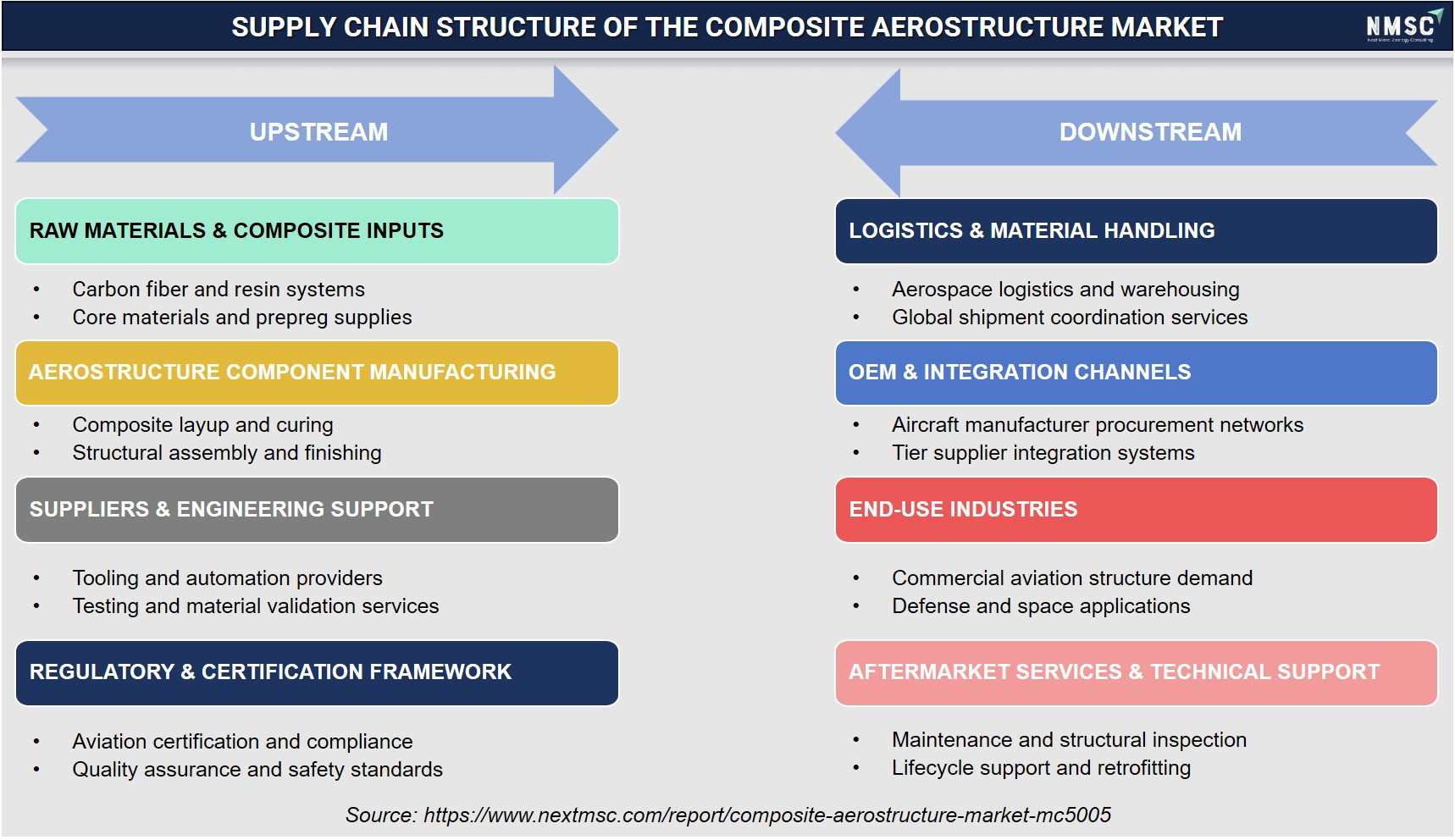
The above infographic presents the supply chain structure of the composite aerostructure market, segmented into upstream and downstream activities. Upstream begins with carbon fiber, resin systems, and prepreg supplies, moving into composite layup, curing, and structural assembly. Suppliers provide tooling, automation, and testing services, while compliance ensures aviation certification and quality standards. Moving downstream, aerospace logistics and OEM procurement networks enable global distribution to commercial aviation, defense, and space sectors. Looking ahead, we observed that aftermarket maintenance, structural inspection, and lifecycle support services collectively ensure long-term operational reliability across the market.
Composite Aerostructure Market Regional Outlook
Geographic Performance Snapshot
|
Region |
2025 (USD Billion) |
2035 (USD Billion) |
CAGR (2026–2035) |
Key Driver |
|
North America |
17.8 |
51.0 |
11.1% |
Strong commercial aircraft production, defense modernization, and high composite material adoption |
|
Europe |
12.5 |
36.2 |
11.2% |
Presence of major aircraft manufacturers, sustainability regulations, and lightweight aircraft initiatives |
|
Asia-Pacific |
12.3 |
38.8 |
12.1% |
Expanding aerospace manufacturing, rising aircraft deliveries, and increasing domestic aviation demand |
|
Middle East & Africa |
3.2 |
8.7 |
10.5% |
Airline fleet expansion, MRO investments, and government support for aviation infrastructure |
|
Latin America |
2.4 |
5.9 |
9.4% |
Growing regional aircraft manufacturing, fleet modernization, and increasing commercial aviation activity |
North America Composite Aerostructure Market
North America commands the largest regional share of the Composite Aerostructure Market at USD 17.8 billion in 2025, advancing to USD 51.0 billion by 2035 at an 11.1% CAGR. The region's dominance is anchored by the Boeing Commercial Airplanes production infrastructure in Everett and Charleston, Lockheed Martin's F-35 production line in Fort Worth, and Northrop Grumman's B-21 Raider program. A deeply integrated supply chain of specialized tier-one composite aerostructure manufacturers, including Triumph Group, Ducommun, and Magellan Aerospace, provides broad structural production capability. Defense appropriations under the U.S. National Defense Authorization Act sustain military composite procurement, while FAA certification leadership globally influences material and process qualification pathways that shape North American supplier competitive positioning.
U.S. Composite Aerostructure Industry
Based on our engagements across the U.S. aerospace manufacturing base, the United States represents the single largest country-level composite aerostructure market globally, driven by Boeing's dual commercial and defense production programs, Lockheed Martin's F-35 production ramp, and Northrop Grumman's advanced bomber and surveillance aircraft programs. Commercial aircraft demand is sustained by robust airline order commitments with both Boeing 737 MAX and 787 programs. The U.S. Department of Defense's continued investment in next-generation strike aircraft and advanced UAV platforms ensures durable military demand. FAA regulations under FAR 25 and MIL-SPEC qualification requirements define the competitive qualification landscape. The adoption of AFP and ATL automation is highest among U.S. tier-one aerostructure suppliers, establishing a technology leadership position within the global Composite Aerostructure Market competitive structure.
Canada Composite Aerostructure Industry
Through our analysis of the Canadian aerospace sector, the composite aerostructure market in Canada is concentrated around the Montreal and Toronto aerospace clusters, with Magellan Aerospace Corporation serving as the primary tier-one composite aerostructure manufacturer. Bombardier's business jet production in Montreal sustains regional demand for composite fuselage and wing structures. The National Research Council of Canada's Aerospace Manufacturing Technology Centre provides material and process R&D support to industry participants. Transport Canada's regulatory framework aligns closely with FAA standards, reducing bilateral certification barriers for Canadian-produced composite components supplied to U.S. and European OEMs. The composite aerostructure market in Canada benefits from the Aerospace Industries Association of Canada's advocacy for sustained federal procurement commitments.
Mexico Composite Aerostructure Industry
According to our evaluation of Mexico's aerospace manufacturing sector, the country has emerged as a significant nearshore composite aerostructure production hub, hosting facilities from Safran, Bombardier, Honeywell, and over 300 aerospace manufacturers concentrated in Mexicali, Chihuahua, and Querétaro. Mexico's participation in the Aerospace Industry Competitiveness Plan (PIADAC) has structured government support for supplier capability development. Labor cost advantages and proximity to U.S. OEM facilities drive growing composite component sourcing from Mexico. The Mexican Secretaría de Economía's FDI incentives under the North American aviation production network have attracted investment in structural composite sub-assembly operations, progressively elevating Mexico's composite aerostructure role beyond component machining into integrated structural assembly.
Europe Composite Aerostructure Market
The European Composite Aerostructure Market is valued at USD 12.5 billion in 2025, projected to reach USD 36.2 billion by 2035 at an 11.2% CAGR. Europe's composite aerostructure ecosystem is structured around the Airbus commercial production network spanning Toulouse, Hamburg, Broughton, and Seville, supported by a tier-one supply chain including Leonardo, GKN Aerospace, Aernnova, FACC AG, Aciturri, and Sonaca. The European Defence Fund under the European Commission finances collaborative composite R&D programs across member nations. Regulatory alignment under EASA CS-25 and the European Union's Aviation Safety Strategy defines qualification standards for structural composite materials. NMSC's analysis indicates that Europe leads global investment in thermoplastic composite manufacturing infrastructure, particularly in the Netherlands, Germany, and the UK.
UK Composite Aerostructure Industry
Based on our engagements with the UK aerospace industrial base, the United Kingdom represents a world-leading composite aerostructure center, anchored by GKN Aerospace's operations in Filton and Isle of Wight, and BAE Systems' advanced composite manufacturing at Samlesbury and Warton. Airbus UK in Broughton manufactures carbon fiber composite wings for the A320neo, A330, A350, and A380 families, making it Europe's most advanced composite wing production center. The Aerospace Technology Institute's Wing of Tomorrow program is developing next-generation composite wing manufacturing architectures for future narrowbody platforms. The UK's Civil Aviation Authority certifies composite structures under bilateral EASA arrangements, and the UK government's Composite Technology Cluster Initiative supports supply chain capability development throughout the Composite Aerostructure Market ecosystem.
Germany Composite Aerostructure Industry
Through our analysis of Germany's aerospace composite capabilities, the market is driven by Hamburg's position as Airbus's primary narrowbody and widebody composite fuselage assembly center, complemented by Airbus Stade's carbon fiber component manufacturing for A380 and A350 vertical tail planes. Tier-one suppliers Premium AEROTEC (now Airbus Aerostructures), AEROTEC Peissenberg, and DLR's composite technology institute at Stuttgart and Braunschweig form the industrial and research backbone of the German composite aerostructure supply chain. Germany's Federal Ministry for Economic Affairs provides R&D co-funding for composite process innovation under the Lufo national aviation research program. Strong regulatory alignment with EASA headquarters in Cologne ensures seamless certification support for German-manufactured composite structural components.
France Composite Aerostructure Industry
From our assessment of France's composite aerostructure manufacturing capabilities, Airbus's primary engineering and program management headquarters in Toulouse drives France's dominant position in composite aerostructure design and system integration. Safran's nacelle composite structures division and Daher Aerospace's composite aerostructure operations form key nodes in the French supply chain. The CORAC Civil Aviation Research Council coordinates national composite R&D investment, including the CLEANSKY2 and HORIZON programs, financed through the European Commission. Direction Générale de l'Aviation Civile's bilateral FAA/EASA framework governs certification of French-produced composite structural components, while the Programme d'Investissements d'Avenir funds composite manufacturing scale-up at French aerospace SMEs.
Italy Composite Aerostructure Industry
According to our evaluation of Italy's aerospace composite sector, Leonardo S.p.A. is the dominant composite aerostructure manufacturer, producing composite fuselage sections, empennage structures, and wing components for Boeing 787, Airbus programs, and ATR turboprop aircraft from its facilities in Grottaglie, Foggia, and Pomigliano d'Arco. The Italian Ministry of Economic Development's Aerospace Technology Cluster (DTC Aerospace) provides co-investment frameworks supporting composite R&D at Leonardo and its supply chain partners. ENAC, the Italian civil aviation authority, certifies composite aerostructures under EASA delegation, providing regulatory efficiency for Italian-manufactured components destined for European and international platforms. Italy's composite aerostructure manufacturing capability is progressively extending into military platforms, with Leonardo's M346 trainer and C-27J transport incorporating composite structural elements.
Spain Composite Aerostructure Industry
Based on our engagements across Spain's aerospace cluster, Aernnova Aerospace and Aciturri Aeronáutica are the primary composite aerostructure manufacturers, producing wing components, control surfaces, and fuselage sections for Airbus A320neo, A330, A350, A400M, and Boeing 787 programs from their facilities in Vitoria-Gasteiz, Berantevilla, and Agoncillo. Airbus's Getafe facility near Madrid manufactures composite control surfaces and military transport structures. CDTI (Centre for Industrial Technological Development) provides R&D co-financing for composite process and material technology programs in Spain. AESA, the Spanish aviation regulatory body, operates under EASA delegation, streamlining composite component certification across Spain's aerostructure supply chain within the broader European certification framework.
Sweden Composite Aerostructure Industry
Through our analysis of Sweden's aerospace composite base, Saab AB stands as the primary composite aerostructure manufacturer, producing composite-intensive primary structures for the Gripen E/F fighter and Swordfish maritime patrol aircraft from its Linköping facility. Saab's composite center features advanced AFP systems, autoclave curing facilities, and in-house material qualification capabilities aligned with Försvarets Materielverk Swedish Defence Materiel Administration requirements. The Vinnova Swedish Innovation Agency co-funds composite manufacturing R&D through the FFI National Aeronautics Research Programme. EASA-delegated certification authority resides with Transportstyrelsen, which aligns Swedish composite qualification pathways with pan-European standards, enabling exports across the Composite Aerostructure Market globally.
Denmark Composite Aerostructure Industry
According to our assessment of Denmark's aerospace sector, the composite aerostructure market is characterized by specialized composite component manufacturers operating primarily as tier-two suppliers within the Airbus and Boeing supply chains. Terma A/S is a leading Danish aerospace manufacturer, producing composite aerostructure components for F-35 Lightning II and other NATO platform programs. The Danish Business Authority supports aerospace R&D co-investment through the Innovation Fund Denmark. Trafikstyrelsen, Denmark's civil aviation authority, operates under EASA delegation for composite structural certification. Denmark's strong wind turbine composite manufacturing base provides a transferable talent and process infrastructure that supports aerospace composite capability development and workforce scalability.
Finland Composite Aerostructure Industry
From our assessment of Finland's aerospace composite capabilities, the market remains emerging but strategically positioned within the Nordic aerospace cluster. Patria Aviation OYJ is the primary Finnish aerospace manufacturer with composite maintenance and modification capabilities, while smaller specialized manufacturers serve tier-two supply chain roles within European aerostructure programs. Tekes (Business Finland) provides R&D funding for composite process development at Finnish aerospace companies, building an indigenous manufacturing capability aligned with NATO interoperability requirements. Traficom, Finland's transport and communications agency, oversees civil aviation composite certification under EASA delegation. Finland's increasing NATO membership status is expected to stimulate defense composite aerostructure demand over the forecast period.
Netherlands Composite Aerostructure Industry
Based on our engagements with Dutch aerospace industry stakeholders, the Netherlands hosts GKN Aerospace's most advanced thermoplastic composite manufacturing facility at Hoogeveen, producing thermoplastic composite brackets, clips, and structural components for Airbus A350 and next-generation programs using PEEK matrix systems. Fokker Technologies (a GKN subsidiary) contributes composite aerostructure manufacturing capability across control surfaces and interior structural components. The Netherlands Aerospace Centre NLR provides advanced composite testing, certification support, and manufacturing R&D across the Dutch aerospace supply chain. The Netherlands Enterprise Agency RVO supports composite manufacturing FDI and supply chain development, reinforcing the country's position as a European leader in thermoplastic composite aerostructure industrialization.
Rest of Europe Composite Aerostructure Industry
Through our analysis of the broader European composite aerostructure manufacturing landscape, countries including Poland, Romania, Austria, and Belgium are developing progressively integrated roles within the European composite supply chain. FACC AG (Austria) is among Europe's most vertically integrated composite aerostructure manufacturers, producing engine nacelles, fuselage panels, and flight control surfaces for Airbus and Boeing programs from its Ried im Innkreis headquarters. Sonaca S.A. (Belgium) supplies composite and metallic leading-edge structures for Airbus programs across European and international production sites. Poland's Polskie Zakłady Lotnicze (PZL) is receiving increased tier-two composite subcontract work within the Airbus and Leonardo supply chains, supported by the Polish Development Fund's aerospace investment incentive programs.
Asia-Pacific Composite Aerostructure Market
Asia-Pacific represents the fastest-growing regional composite aerostructure market at USD 12.3 billion in 2025, expanding to USD 38.8 billion by 2035 at a 12.1% CAGR. Growth is driven by COMAC's C919 and CR929 production ramp in China, Mitsubishi Heavy Industries' and Kawasaki Heavy Industries' Boeing 787 and 777X structural composite supply in Japan, Korea Aerospace Industries' F-35 component manufacturing in South Korea, and India's expanding Make-in-India defense aerospace composite manufacturing base. NMSC's analysis indicates that Asian governments are prioritizing domestic aerospace composite capability development as a strategic industrial objective, financing technology transfer agreements and greenfield manufacturing investments across the region.
China Composite Aerostructure Industry
Based on our engagements with China's aerospace industrial stakeholders, COMAC's C919 single-aisle and CR929 widebody development programs are the primary drivers of composite aerostructure demand domestically. The C919 program incorporates approximately 12% composite material by weight, with ongoing material transition programs targeting higher composite content in successor configurations. AVIC Composite Corporation produces composite structural components across primary and secondary aerostructures. China's Ministry of Industry and Information Technology's civil aviation and defense Five-Year Plans allocate significant capital to domestic composite material and manufacturing capability development. Military programs, including J-20, J-31, and Y-20 transport aircraft, are driving parallel composite demand within the PLAAF procurement budget, supplemented by expanding UAV programs from DJI Industrial and CASC.
India Composite Aerostructure Industry
Through our analysis of India's aerospace composite manufacturing trajectory, the market is benefiting from the Defence Acquisition Procedure 2020, which mandates increasing indigenous content in defense platform procurement, directly stimulating composite aerostructure manufacturing investment at Hindustan Aeronautics Limited and Tata Advanced Systems. India's Civil Aviation Policy 2016 and UDAN regional connectivity scheme are driving commercial aircraft demand that supports MRO and ultimately manufacturing scale-up. The Aero India biennial event reflects growing international OEM interest in India as a composite supply chain partner. NMSC's assessment indicates that India's composite aerostructure market will be among the fastest growing nationally within Asia-Pacific, with HAL, Tata Boeing Aerospace, and Mahindra Aerospace positioning as tier-one composite integrators for both domestic and export programs.
Japan Composite Aerostructure Industry
According to our evaluation of Japan's aerospace composite manufacturing capability, the country hosts the most technologically advanced composite aerostructure production base in Asia-Pacific. Mitsubishi Heavy Industries manufactures the 787 composite fuselage Section 44 at its Nagoya facility, while Kawasaki Heavy Industries produces composite fuselage Section 43 and forward fuselage components. Subaru Corporation manufactures composite center wing boxes and aft body structures for the 787. Japan's Ministry of Economy, Trade, and Industry supports aerospace composite R&D through the New Energy and Industrial Technology Development Organization. JCAB civil certification under bilateral FAA/EASA mutual recognition agreements enables Japanese-manufactured composite structures to meet international airworthiness standards, supporting export competitiveness across the global Composite Aerostructure Market supply chain.
South Korea Composite Aerostructure Industry
From our assessment of South Korea's aerospace composite sector, Korea Aerospace Industries Ltd. serves as the primary composite aerostructure manufacturer, supplying composite fuselage sections for the Boeing 787, producing KF-21 Boramae fighter composite primary structures, and participating in international defense offset programs requiring domestic composite manufacturing investment. The Korean Defense Acquisition Program Administration drives composite procurement requirements across KAI-led defense programs. KARI (Korea Aerospace Research Institute) co-funds composite material and manufacturing R&D with KAI and industrial partners. South Korea's Ministry of Trade, Industry and Energy supports civilian composite manufacturing capability development through R&D co-investment programs, positioning the country as a progressively capable composite aerostructure export base.
Taiwan Composite Aerostructure Industry
Based on our engagements with Taiwan's aerospace manufacturing industry, the composite aerostructure sector is driven by integration within Boeing and Airbus tier-two supply chains, with manufacturers including AIDC (Aerospace Industrial Development Corporation) producing composite structural components for international programs. Taiwan's Aerospace and Defense Research Institute provides composite process R&D support. The Civil Aeronautics Administration aligns certification requirements with bilateral FAA standards, enabling Taiwanese-produced composite components to supply U.S. programs. Taiwan's advanced precision manufacturing base and established semiconductor supply chain disciplines provide transferable manufacturing excellence attributes to composite aerostructure production, supporting quality and yield performance across the Composite Aerostructure Market supply chain.
Indonesia Composite Aerostructure Industry
Through our analysis of Indonesia's aerospace composite capabilities, PT Dirgantara Indonesia (Indonesian Aerospace) is the primary manufacturer of composite aerostructures, producing components for CN-235, NC-212, and N-219 regional aircraft programs. The Indonesian Ministry of Defense's aerospace procurement strategy includes progressive composite content requirements for domestically developed platforms. Badan Ekonomi Kreatif and the Bekraf agency support aerospace manufacturing capability through industrial co-investment frameworks. Indonesia's geographic position within Southeast Asia's growing aviation market is generating increasing MRO demand for composite repair services. NMSC's assessment indicates that Indonesia will progressively expand its composite aerostructure manufacturing role within ASEAN's aerospace supply chain ecosystem over the forecast period.
Vietnam Composite Aerostructure Industry
According to our evaluation of Vietnam's aerospace manufacturing development, the country is attracting FDI in aerospace composite manufacturing, positioned within the tier-two and tier-three supply chains of European and American OEMs. AeroSpaceVN and international joint ventures operating in the Binh Duong and Dong Nai industrial zones are progressively developing composite manufacturing capabilities aligned with supply chain quality standards. Vietnam's Ministry of Planning and Investment incentivizes aerospace manufacturing through export processing zones and R&D tax relief programs. The ASEAN Open Skies Agreement is expanding Vietnam's commercial aviation market, supporting MRO service demand and long-term domestic manufacturing development within the broader composite aerostructure ecosystem.
Australia Composite Aerostructure Industry
From our assessment of Australia's aerospace composite sector, the market is driven by defense procurement under the Australian Defence Force's Force Structure Plan 2020, including F-35A JSF program, indigenous supply chain participation and P-8A Poseidon maritime patrol aircraft support. BAE Systems Australia and Boeing Defence Australia participate in composite structural component production and MRO for international programs. The Australian Defence Industry Policy Statement supports domestic composite manufacturing capability investment through offset and AIC requirements. Australian universities, including Monash University and RMIT, maintain advanced composite manufacturing research programs that supply qualified engineering talent to the composite aerostructure supply chain. The Civil Aviation Safety Authority aligns with FAA and EASA standards under bilateral air safety agreements.
Philippines Composite Aerostructure Industry
Based on our engagements with the Philippines aerospace sector, the composite aerostructure market is primarily concentrated in MRO services and limited tier-three composite component manufacturing, predominantly serving the Asia-Pacific commercial aviation fleet maintenance market. Cebu Pacific and Philippine Airlines' fleet growth is generating incremental MRO demand for composite repair services. The Civil Aeronautics Board and Civil Aviation Authority of the Philippines are progressively aligning with international ICAO standards, facilitating quality system certifications for Philippine-based composite MRO providers. The Board of Investments' aerospace manufacturing incentive program is attracting initial FDI in composite component manufacturing, with growth prospects tied to the country's competitive labour cost structure and improving technical skills ecosystem.
Malaysia Composite Aerostructure Industry
Through our analysis of Malaysia's aerospace composite manufacturing base, CTRM Aero Composites Sdn. Bhd. is the primary composite aerostructure manufacturer, producing composite fuselage components, flap track fairings, and empennage structures for Airbus A320, A330, and ATR programs from its Batu Berendam, Melaka facility. CTRM's participation in the Airbus supply chain represents Malaysia's most significant composite aerostructure export capability. The Malaysian Investment Development Authority's National Aerospace Industry Masterplan identifies composite manufacturing as a strategic sector, providing investment incentives and capability development support. Malaysia Airports Holdings' aviation sector expansion is growing domestic MRO demand for composite repair and overhaul services across its commercial fleet management operations.
Rest of Asia-Pacific Composite Aerostructure Industry
According to our evaluation of the broader Asia-Pacific composite aerostructure market, emerging manufacturing economies, including Thailand, New Zealand, Bangladesh, and Sri Lanka, are developing aerospace composite manufacturing presence within global supply chains. Thailand's Eastern Economic Corridor aerospace zone is attracting investment from Japanese and European OEMs seeking Southeast Asian manufacturing diversification. New Zealand's Pacific Aerospace produces composite structural components for general aviation and military trainer aircraft. NMSC's research indicates that the Rest of Asia-Pacific will collectively grow at above-average rates through 2035 as supply chain geographic diversification programs implemented by Boeing, Airbus, and tier-one integrators redistribute composite manufacturing volume across the region's emerging industrial centers.
Middle East & Africa Composite Aerostructure Market
The Middle East & Africa Composite Aerostructure Market is valued at USD 3.2 billion in 2025, advancing to USD 8.7 billion by 2035 at a 10.5% CAGR. Growth is driven by Gulf state defense modernization programs, the UAE's expanding aerospace manufacturing base under Abu Dhabi's Industrial Strategy, Saudi Arabia's Vision 2030 aerospace manufacturing objectives, and Turkey's indigenous defense aviation platform development. Africa's contribution remains nascent but is supported by South Africa's Denel Group composite capabilities and Egypt's Arab Organization for Industrialization aerospace programs. NMSC's assessment indicates that the MEA region represents a structurally growing composite aerostructure demand center, particularly within defense procurement programs aligned with Gulf Cooperation Council military modernization objectives.
Saudi Arabia Composite Aerostructure Industry
Based on our engagements across Saudi Arabia's aerospace industrial development, the composite aerostructure market is being shaped by Vision 2030's Aerospace and Defence National Industrial Strategy, which targets 50% domestic manufacturing content for Saudi Armed Forces procurement by 2030. Saudia Aerospace Engineering Industries (SAEI) is progressively developing composite maintenance and manufacturing capability, aligned with Royal Saudi Air Force and Royal Saudi Naval Forces platform requirements. GAMI (General Authority for Military Industries) regulates defense aerospace procurement and incentivizes foreign direct investment in domestic composite manufacturing capacity. Saudi Arabia's rapidly expanding commercial aviation sector through Saudi Airlines and Flynas is also generating growing composite MRO service demand within the Middle East composite aerostructure ecosystem.
UAE Composite Aerostructure Industry
Through our analysis of the UAE's aerospace manufacturing capabilities, Strata Manufacturing LLC (a Mubadala Investment Company subsidiary) in Al Ain is the primary composite aerostructure manufacturer in the region, producing composite rudders, ailerons, elevators, slats, and spoilers for Airbus A320, A330, A380, and A350 programs. The UAE's Offset Programme Bureau mandates defense offset investment in domestic manufacturing, driving composite capability development at Strata and partner facilities. Dubai Airshow procurement commitments by Emirates Airline and Etihad Airways for widebody composite-intensive platforms sustain regional aftermarket demand. GCAA (General Civil Aviation Authority) certification frameworks under EASA bilateral agreements enable UAE-manufactured composite components to supply global programs competitively.
Egypt Composite Aerostructure Industry
According to our evaluation of Egypt's aerospace composite sector, the Arab Organization for Industrialization's Aircraft Factory at Helwan produces composite structural components for the K-8E Karakorum trainer and Egyptian Air Force platform maintenance requirements. The Egyptian Ministry of Military Production's investment in composite tooling and autoclave facilities supports indigenous defense aerospace manufacturing. EgyptAir Engineering's MRO capabilities include composite repair certification for commercial fleet maintenance. The Egyptian Cabinet's "Egypt Makes It" industrial development program provides co-investment incentives for aerospace composite manufacturing FDI. Egypt's strategic aerospace geographic position between African and Middle Eastern markets supports a growing regional MRO hub role for composite aerostructure maintenance and repair services.
Israel Composite Aerostructure Industry
From our assessment of Israel's defense aerospace composite manufacturing base, Elbit Systems Ltd. and Israel Aerospace Industries produce composite structural components and integrated aerostructures for F-16 Israeli Air Force modifications, the Heron UAV family, and export programs across NATO and allied nations. Rafael Advanced Defense Systems incorporates composite structural elements in its unmanned combat aerial vehicle programs. The Israel Innovation Authority co-funds advanced composite manufacturing R&D through its aerospace technology programs. The Israel Civil Aviation Authority's bilateral agreements with the FAA and EASA facilitate composite aerostructure certification for both commercial and export defense programs. Israel's advanced UAV composite manufacturing capability positions the country as a global export reference for tactical and MALE UAV composite structures.
Turkey Composite Aerostructure Industry
Based on our engagements with Turkey's defense aerospace industrial base, Turkish Aerospace Industries (TUSAS/TAI) is the primary composite aerostructure manufacturer, producing primary and secondary composite structures for the KAAN 5th-generation fighter, T625 GÖKBEY helicopter, HÜRKUŞ trainer, ANKA MALE UAV, and AKINCI UCAV programs from its Akıncı and Fethiye facilities. The SSB (Presidency of Defence Industries) mandates indigenous content requirements that are driving TAI and ROKETSAN composite manufacturing scale-up. Aselsan and Roketsan incorporate composite structural elements in directed energy and missile programs. NMSC's analysis indicates that Turkey's indigenous defense aerospace program expansion makes it the fastest-growing composite aerostructure market within the MEA region through 2035.
Nigeria Composite Aerostructure Industry
Through our analysis of Nigeria's aerospace manufacturing capabilities, the composite aerostructure market remains at an early developmental stage, with demand currently concentrated in commercial aviation MRO services serving the Nigerian Eagle Airlines, Air Peace, and Arik Air fleets. The Nigerian Civil Aviation Authority's alignment with ICAO standards is facilitating quality system certification for MRO providers, including Aero Contractors. Nigeria's Aerospace Human Capital Development Programme, through the Ministry of Aviation and Aerospace Development, is building technical workforce capacity that will support longer-term composite manufacturing capability development. NMSC's assessment indicates that Nigeria's composite aerostructure market growth will primarily be driven by expanding MRO activity rather than original composite manufacturing during the 2025-2035 forecast period.
South Africa Composite Aerostructure Industry
According to our evaluation of South Africa's aerospace industrial base, Denel Aerostructures (previously Denel Aviation) has historically served as the primary composite aerostructure manufacturer, producing wing leading edges, control surfaces, and structural sub-assemblies for international programs. The South African Department of Trade, Industry and Competition's Aerospace Industry Support Initiative provides incentives for composite manufacturing capability development. South African National Defence Force platform requirements, including the Rooivalk attack helicopter sustain defense composite demand. However, Denel's financial restructuring challenges in recent years have constrained the company's composite manufacturing investment capacity, creating an opportunity for private sector composite MRO and manufacturing investment within South Africa's broader aerospace industrial ecosystem.
Rest of Middle East & Africa Composite Aerostructure Industry
From our assessment of composite aerostructure activity across the broader MEA region, countries including Jordan, Morocco, Kenya, and Ethiopia are developing emerging aerospace composite manufacturing and MRO capabilities. Jordan's Aqaba Special Economic Zone hosts aerospace manufacturing investments by Jordan Aeronautical Systems Company. Morocco's Casablanca and Nouaceur aerospace clusters, supported by the Moroccan Investment Authority, are attracting Safran and Airbus tier-two supply chain investments that include composite component production. Ethiopian Airlines Engineering's expanding MRO complex in Addis Ababa is developing composite repair capabilities for the airline's Boeing 787 fleet. These nascent market centers collectively represent longer-term composite aerostructure growth potential across the southern and eastern MEA geography.
Latin America Composite Aerostructure Market
The Latin America Composite Aerostructure Market is valued at USD 2.4 billion in 2025, growing to USD 5.9 billion by 2035 at a 9.4% CAGR. Brazil's Embraer is the dominant demand anchor, with its composite-intensive E2 regional jet and C-390 military transport programs defining regional composite aerostructure manufacturing concentration. Mexico's growing nearshore aerospace manufacturing base supplements Brazilian demand, while Argentina's INVAP and Chile's ENAER contribute military composite programs. Regional growth is constrained by limited domestic material supply chains, currency volatility, and aerospace certification infrastructure maturity relative to North American and European markets.
Brazil Composite Aerostructure Industry
Based on our engagements with Brazil's aerospace sector, Embraer S.A. is the defining force in Brazil's composite aerostructure market, producing carbon fiber composite winglets, control surfaces, and structural elements for the E175-E2, E190-E2, and E195-E2 regional jets, and composite primary structures for the C-390 Millennium military transport. Embraer's São José dos Campos and Gavião Peixoto manufacturing facilities incorporate AFP systems and autoclave cure capability aligned with global aerospace quality standards. The Brazilian Development Bank BNDES has co-financed composite manufacturing technology investment at Embraer and its supply chain partners. ANAC's bilateral agreements with FAA and EASA certify Brazilian composite aerostructures for global commercial and defense export programs, reinforcing Embraer's competitive positioning within the global Composite Aerostructure Market.
Argentina Composite Aerostructure Industry
Through our analysis of Argentina's aerospace composite capabilities, the market is anchored by INVAP SE's aerospace and defense manufacturing activities, which include composite structural components for Argentine Ministry of Defence platforms and satellite structures. Fábrica Argentina de Aviones Juan de la Cierva (FAdeA) produces composite structural elements for the IA-63 Pampa trainer and IA-100 composite training aircraft development program. Argentina's CONAE National Space Activities Commission incorporates composite structures in satellite programs. The Argentine Secretaría de Ciencia, Tecnología e Innovación Productiva supports composite manufacturing R&D through national innovation programs. ANAC's certification authority aligns with ICAO Annex 8 standards, providing regulatory foundations for composite component certification within domestic and regional markets.
Chile Composite Aerostructure Industry
According to our evaluation of Chile's aerospace composite sector, ENAER (Empresa Nacional de Aeronáutica de Chile) is the primary composite aerostructure manufacturer, producing composite structural elements for the T-35 Pillán trainer, EMB-314 Super Tucano under co-production arrangements, and Chilean Air Force maintenance programs. The Chilean Ministerio de Defensa Nacional's procurement requirements drive ENAER's composite manufacturing capability development. DGAC Chile, the civil aviation directorate, maintains bilateral agreements supporting composite component certification aligned with ICAO standards. Chile's stable macroeconomic environment and strategic Pacific positioning support potential aerospace manufacturing FDI from Asian and North American aerospace companies seeking South American supply chain diversification within the composite aerostructure market.
Colombia Composite Aerostructure Industry
From our assessment of Colombia's aerospace manufacturing sector, the composite aerostructure market is primarily characterized by MRO services and limited tier-three composite component manufacturing. Aerocivil, Colombia's civil aviation authority, is investing in regulatory infrastructure to support growing commercial fleet MRO demand from Avianca and LATAM Colombia. Colombia's Ministerio de Comercio, Industria y Turismo has identified aerospace manufacturing as a strategic FDI attraction sector within its Productive Development Policy framework. NMSC's research indicates that Colombia's composite aerostructure market growth will be primarily MRO-driven through the mid-forecast period, with manufacturing investment potential emerging as regional aviation fleet growth builds sufficient MRO scale to justify composite repair infrastructure investment over the longer term.
Rest of Latin America Composite Aerostructure Industry
Through our analysis of the broader Latin American composite aerostructure market, countries including Peru, Venezuela, Ecuador, Uruguay, and Central American nations collectively contribute limited but progressively growing composite MRO and basic component manufacturing activity. Peru's Grupo de Aviación 8 military aviation facility maintains composite repair capabilities for Peruvian Air Force aircraft. Uruguay's PLUNA Airlines fleet management history generated limited composite MRO capability, while Ecuador's TAME and regional carriers are developing composite maintenance capacity aligned with growing fleet requirements. NMSC's assessment indicates that the Rest of Latin America composite aerostructure market will grow at a moderate pace through 2035, primarily driven by commercial aviation fleet expansion, generating incremental MRO demand across the region.
Competitive Landscape
Competitive Dynamics & M&A Landscape
|
Key Takeaways |
Details |
|
Market Structure |
Moderately concentrated at the tier-one supplier level, with a fragmented ecosystem of tier-two and tier-three manufacturers. The leading global aerostructure companies account for a significant share of market revenue, supported by long-term supply agreements with major aircraft OEMs and geographically distributed manufacturing facilities aligned with commercial and defense aerospace production hubs. |
|
Innovation Focus |
Development efforts are centered on advanced carbon fiber composite materials, automated fiber placement (AFP), robotic assembly systems, thermoplastic composite processing, out-of-autoclave manufacturing, digital twin-enabled production monitoring, and sustainable composite recycling technologies to enhance structural performance, manufacturing efficiency, and lifecycle sustainability. |
|
M&A Activity |
Merger and acquisition activity remains active across the aerostructure supply chain as manufacturers pursue portfolio expansion, advanced composite manufacturing capabilities, production capacity enhancement, vertical integration, and regional footprint growth to strengthen positions in next-generation commercial, military, and urban air mobility aircraft programs. |
How Do Companies Compete in the Composite Aerostructure Market?
Competitive dynamics in the Composite Aerostructure Market are shaped by the high qualification and certification barriers that define long-term OEM supply relationships. Tier-one integrators compete on total program cost, quality performance metrics including first-article acceptance rates and defect per unit, delivery reliability, and engineering design-to-manufacture support. Geographic alignment with OEM production sites reduces logistics cost and facilitates just-in-time delivery for structural sub-assemblies. Pricing strategies are predominantly structured under long-term supply agreements with annual learning curve productivity commitments, aligning supplier cost reduction trajectories with OEM target pricing. Our assessment indicates that investment in manufacturing automation technology is increasingly the primary competitive differentiator, as AFP and ATL-equipped suppliers achieve structural cost advantages that manual lay-up competitors cannot replicate over multi-year production runs.
Which Kind of Companies Dominate the Composite Aerostructure Market?
The Composite Aerostructure Market is dominated by large, diversified aerospace tier-one structural integrators with multi-program OEM supply relationships, certified composite manufacturing infrastructure, and proprietary process technology capabilities. Companies including GKN Aerospace, Leonardo, Mitsubishi Heavy Industries, Kawasaki Heavy Industries, and Aernnova hold foundational supply positions within both Boeing and Airbus structural programs, providing composite fuselage, wing, empennage, and control surface assemblies under long-term agreements that extend 15-20 years. These dominant players maintain competitive positions through sustained capital investment in AFP automation, material qualification programs, and co-investment in OEM new aircraft development programs that lock in supply relationships from concept phase through production.
AI-Native Differentiation and Open Standards Drive Market Success in the Composite Aerostructure Market
Digital transformation is reshaping competitive positioning across the Composite Aerostructure Market, with AI-native quality management systems, real-time fiber placement monitoring, and digital twin-enabled structural validation providing measurable performance differentiation. Leading manufacturers are deploying machine learning algorithms for in-process defect detection during AFP laydown, reducing costly post-cure inspection cycles and improving first-time acceptance rates. Open manufacturing data standards, including the Aerospace Manufacturing Digital Thread Initiative, are progressively enabling interoperability across OEM-supplier digital ecosystems, reducing program management friction. NMSC's analysis indicates that manufacturers who integrate AI-driven process optimization with open digital thread standards will establish sustainable competitive advantages as OEMs increasingly evaluate suppliers on data transparency and digital manufacturing maturity.
Market Players to opt for Merger and Acquisition Strategies to Expand Their Presence in the Composite Aerostructure Market
Mergers and acquisitions activity within the Composite Aerostructure Market has intensified as tier-one integrators seek to consolidate capabilities, expand geographic manufacturing footprints, and acquire proprietary process technology. GKN Aerospace's separation from Melrose Industries and subsequent strategic repositioning has driven capability consolidation in thermoplastic composite manufacturing. Triumph Group's divestiture program has restructured its composite aerostructure portfolio toward higher-value integrated assemblies. Spirit AeroSystems' acquisition by Boeing and sale of European operations to Airbus represents the most significant composite aerostructure M&A transaction in recent years, reshaping the North American and European supply chain geography. Our findings suggest that ongoing OEM supply chain rationalization pressure will sustain M&A activity through 2035 as OEMs reduce supplier counts and favor financially robust, multi-program tier-one partners.
Who Are the Key Market Players in the Composite Aerostructure Market?
-
Mitsubishi Heavy Industries, Ltd.
-
Kawasaki Heavy Industries, Ltd.
-
Korea Aerospace Industries, Ltd.
-
Subaru Corporation
-
Aernnova Aerospace, S.A.U.
-
FACC AG
-
Triumph Group, Inc.
-
Sonaca S.A.
-
Saab AB
-
Ducommun Incorporated
-
Magellan Aerospace Corporation
-
ShinMaywa Industries, Ltd.
-
RUAG Aerostructures Holding AG
-
Daher Aerospace SA
-
Elbit Systems Ltd.
-
Aciturri Aeronáutica, S.L.
-
CTRM Aero Composites Sdn. Bhd.
-
Aerotec Peissenberg GmbH
What Are the Latest Developments in the Composite Aerostructure Industry?
|
Date |
Event |
|
June 2025 |
Aernnova signed a USD 300 million multi-year agreement with Mahindra Aerostructures to manufacture structural assemblies and components for Airbus, Embraer, and military aircraft programs. |
|
June 2025 |
GKN Aerospace launched the USD 16.1 million ASPIRE programme to develop next-generation composite wingtip and flap structures integrating automated manufacturing and sustainable composite technologies. |
|
March 2025 |
GKN Aerospace and its partners completed the ASCEND programme, advancing high-rate composite manufacturing technologies using Industry 4.0 automation and sustainable production methods for next-generation aircraft structures. |
What Are the Investment Opportunities in the Composite Aerostructure Market?
Capital Inflows and Infrastructure Investment
The Composite Aerostructure Market is attracting significant capital investment across manufacturing automation, material qualification infrastructure, and geographic capacity expansion. OEMs including Airbus and Boeing, are co-investing with tier-one suppliers in AFP production line upgrades to support planned aircraft production rate increases targeting 65 A320neo per month and 38+ 787 per month by 2025. The European Aviation Safety Agency's CLEAN Aviation and Clean Sky 2 programs have collectively committed over EUR 4 billion in co-investment for composite manufacturing technology development, representing a direct public infrastructure investment stimulus for the Composite Aerostructure Market. NMSC's findings suggest that capital allocation toward out-of-autoclave process facilities represents the highest-return manufacturing investment opportunity, given the cost reduction potential relative to conventional autoclave infrastructure.
ESG and Sustainability-Driven Investment Opportunities
Environmental, Social, and Governance mandates are creating parallel investment opportunities within the Composite Aerostructure Market through sustainability-aligned composite manufacturing initiatives. The aviation industry's commitment to the IATA Fly Net Zero 2050 pledge requires structural weight reduction, fuel efficiency optimization, and end-of-life composite material management programs. Investment opportunities in composite fiber recycling infrastructure, including pyrolysis carbon fiber recovery and solvolysis recycling for thermoset composites, are receiving venture and corporate venture funding from aerospace majors. Airbus's participation in the WindEEE and HERON composite recycling programs demonstrates OEM-level capital commitment to circular economy composite material strategies that will progressively create commercial recycled carbon fiber supply chains serving secondary aerostructure applications within the broader Composite Aerostructure Market ecosystem.
Digital Transformation and Industry 4.0 Investment
Digital manufacturing transformation represents a high-priority investment domain within the Composite Aerostructure Market, with composite production facilities deploying Industry 4.0 architectures integrating real-time manufacturing execution systems, AI-driven quality management, and digital twin process models. The U.S. Air Force Research Laboratory's Integrated Digital Composite Design and Manufacturing initiative demonstrates government co-investment in digital composite manufacturing capability development. Private equity investment in composite manufacturing software companies, including Composicad, Simutech, and Hexagon Manufacturing Intelligence, reflects capital market recognition of the software value layer in composite aerostructure production optimization. NMSC's assessment indicates that suppliers who successfully integrate digital thread manufacturing capability will command premium pricing in competitive OEM supply selections, where digital program transparency is becoming a contractual requirement.
Private Equity and Venture Capital Activity
Private equity and venture capital activity within the Composite Aerostructure Market is concentrated in advanced manufacturing technology companies, specialized composite material developers, and eVTOL airframe manufacturers. Joby Aviation, Archer Aviation, and Lilium's capital raises have collectively attracted over USD 5 billion in venture and strategic investment, a substantial portion dedicated to composite airframe development and manufacturing infrastructure. PE-backed consolidation within the composite aerostructure tier-two supply chain is progressing, with investment platforms such as HEICO Corporation and TransDigm Group pursuing niche composite component acquisition strategies. NMSC's research indicates that the intersection of defense UAV program growth and composite manufacturing technology creates a particularly compelling investment thesis for middle-market PE platforms seeking high-growth defense aerospace composite exposure through the 2025-2035 period.
Key Benefits for Stakeholders
For Composite Aerostructure Manufacturers
Composite aerostructure manufacturers gain access to a comprehensive assessment of the Composite Aerostructure Market, including market sizing and forecasts across component types, aircraft platforms, fiber materials, resin systems, manufacturing processes, and regions. The report provides competitive benchmarking of leading industry participants and identifies the fastest-growing market segments, enabling informed decisions on production capacity expansion, technology investments, operational optimization, and long-term business strategy.
For Aircraft OEMs
Aircraft manufacturers and OEMs benefit from detailed supply chain intelligence covering composite material adoption trends, platform-specific composite content, supplier capability mapping across 33 countries, and procurement dynamics. The analysis supports strategic sourcing, supplier qualification, production planning, and risk management by evaluating raw material availability, manufacturing capacity, qualification timelines, and regional supply chain resilience across commercial, military, business aviation, and emerging aircraft programs.
For Investors and Private Equity Firms
Investors, private equity firms, and financial institutions receive a structured evaluation of the Composite Aerostructure Market's growth outlook, including market size, CAGR forecasts through 2035, competitive dynamics, and high-growth opportunities across aircraft platforms, engineering services, and advanced manufacturing technologies. The report also analyzes merger and acquisition activity, industry consolidation trends, and strategic positioning, supporting investment screening, valuation analysis, portfolio diversification, and acquisition strategy development.
For Government and Defense Agencies
Government organizations, defense procurement authorities, and aerospace policy bodies gain evidence-based insights into military aircraft demand, domestic composite manufacturing capabilities, regional industrial capacity, and strategic supply chain resilience. The report supports procurement planning, defense industrial base development, technology investment prioritization, and aerospace policy formulation by evaluating manufacturing capabilities across NATO members and other key aerospace-producing regions.
For Material and Process Technology Suppliers
Fiber manufacturers, resin suppliers, automation providers, and composite processing technology companies gain valuable insights into evolving material preferences, manufacturing process adoption, and emerging technology requirements within the Composite Aerostructure Market. The analysis identifies growth opportunities in thermoplastic composites, automated fiber placement, resin transfer molding, out-of-autoclave manufacturing, and next-generation structural applications, enabling companies to align product development and commercialization strategies with future industry demand.
For Academic and Research Institutions
Universities, research organizations, and innovation centers gain a comprehensive analytical framework covering market structure, segmentation, technology evolution, and competitive dynamics within the Composite Aerostructure Market. The report supports research initiatives in advanced composite materials, aerospace manufacturing, lightweight structures, and production economics while providing valuable insights for research grant development, technology commercialization, and industry collaboration programs.
Key Market Segments
By Component Type
-
Fuselage Structures
-
Fuselage Barrels
-
Fuselage Panels
-
Fuselage Frames
-
Bulkheads
-
Nose Sections
-
Floor Structures
-
Other Fuselage Structures
-
-
Wing Structures
-
Wing Boxes
-
Wing Skins
-
Spars
-
Ribs
-
Winglets
-
Other Wing Structures
-
-
Empennage Structures
-
Horizontal Stabilizers
-
Vertical Stabilizers
-
Tail Cones
-
Other Empennage Structures
-
-
Flight Control Structures
-
Ailerons
-
Flaps
-
Slats
-
Elevators
-
Rudders
-
Spoilers
-
Other Flight Control Structures
-
-
Nacelle Structures
-
Fan Cowls
-
Thrust Reversers
-
Core Cowls
-
Exhaust Structures
-
Other Nacelle Structures
-
-
Pylon Structures
-
Engine Pylons
-
Other Pylon Structures
-
-
Door Structures
-
Passenger Doors
-
Cargo Doors
-
Landing Gear Doors
-
Service Doors
-
Other Door Structures
-
-
Fairing Structures
-
Wing To Body Fairings
-
Belly Fairings
-
Engine Fairings
-
Radomes
-
Other Fairing Structures
-
-
Other Composite Aerostructures
By Aircraft Type
-
Commercial Aircraft
-
Narrow Body Aircraft
-
Wide Body Aircraft
-
Regional Aircraft
-
Freighter Aircraft
-
-
Military Aircraft
-
Fighter Aircraft
-
Transport Aircraft
-
Trainer Aircraft
-
Bomber Aircraft
-
Special Mission Aircraft
-
-
Business Jets
-
Large Cabin Jets
-
Mid-Size Jets
-
Light Jets
-
-
General Aviation Aircraft
-
Piston Aircraft
-
Turboprop Aircraft
-
-
Helicopters
-
Civil Helicopters
-
Military Helicopters
-
-
Uncrewed Aerial Vehicles
-
Tactical UAVs
-
MALE UAVs
-
HALE UAVs
-
Combat UAVs
-
-
Advanced Air Mobility Aircraft
-
Passenger EVTOL Aircraft
-
Cargo EVTOL Aircraft
-
By Fiber Type
-
Carbon Fiber Composites
-
Standard Modulus Carbon Fiber
-
Intermediate Modulus Carbon Fiber
-
High Modulus Carbon Fiber
-
-
Glass Fiber Composites
-
Aramid Fiber Composites
-
Hybrid Fiber Composites
-
Other Fiber Composites
By Resin Type
-
Thermoset Resin Systems
-
Epoxy Resin Systems
-
Phenolic Resin Systems
-
Polyester Resin Systems
-
Vinyl Ester Resin Systems
-
Bismaleimide Resin Systems
-
Polyimide Resin Systems
-
Other Thermoset Resin Systems
-
-
Thermoplastic Resin Systems
-
PEEK Resin Systems
-
PEKK Resin Systems
-
PPS Resin Systems
-
Other Thermoplastic Resin Systems
-
By Manufacturing Process
-
Automated Fiber Placement
-
Automated Tape Laying
-
Resin Transfer Molding
-
Vacuum Assisted Resin Infusion
-
Hand Lay Up
-
Compression Molding
-
Filament Winding
-
Pultrusion
-
Other Manufacturing Processes
By Revenue Stream
-
Production Programs
-
Spare Parts
-
Repair Services
-
Engineering Service
By End User
-
Commercial Aircraft OEMs
-
Military Aircraft OEMs
-
Business Jet OEMs
-
General Aviation OEMs
-
Helicopter OEMs
-
UAV OEMs
-
Tier One Integrators
-
Aftermarket Providers
By Region:
-
North America: U.S., Canada, and Mexico.
-
Europe: UK, Germany, France, Italy, Spain, Sweden, Denmark, Finland, the Netherlands, and the rest of Europe.
-
Asia Pacific: China, India, Japan, South Korea, Taiwan, Indonesia, Vietnam, Australia, Philippines, Malaysia and the rest of APAC.
-
Middle East & Africa (MEA): Saudi Arabia, UAE, Egypt, Israel, Turkey, Nigeria, South Africa, and the rest of MEA.
-
Latin America: Brazil, Argentina, Chile, Colombia, and the rest of LATAM
Conclusion and Recommendations
Long-Term Outlook
The Composite Aerostructure Market is positioned for sustained structural growth through 2035, underpinned by irreversible material transition dynamics within commercial and military aviation, the emergence of structurally new UAV and eVTOL platform demand, and manufacturing technology maturation that is progressively reducing composite aerostructure total unit cost. Our analysis shows that the global market will approximately triple from USD 48.2 billion in 2025 to USD 140.6 billion by 2035, registering a CAGR of 11.3%, reflecting both volume growth from rising aircraft deliveries and value expansion from increasing composite content per airframe. The thermoplastic composite transition, though multi-decade in scope, represents the defining material shift of the next decade, with progressive certification acceptance expanding thermoplastic application across primary structural categories.
Strategic Positioning
NMSC's assessment indicates that composite aerostructure manufacturers should prioritize three strategic positioning imperatives over the 2025-2030 horizon. First, investment in AFP and ATL manufacturing automation is non-negotiable for tier-one integrators seeking to remain competitive in high-rate commercial programs where automation-driven labour cost reduction defines margin sustainability. Second, early thermoplastic composite manufacturing capability development positions suppliers favourably in next-generation narrowbody platform competitions anticipated for the 2030s, where thermoplastic structures will likely be specified as a baseline design requirement. Third, geographic manufacturing expansion into Asia-Pacific and MEA markets enables participation in the fastest-growing demand centers while providing the production network diversification that OEMs increasingly require from strategic suppliers managing geopolitical supply chain risk.
Investment Attractiveness
Based on NMSC's research, the composite aerostructure sector presents a highly attractive long-term investment profile characterized by long-cycle revenue visibility from multi-year OEM supply agreements, high barriers to entry that protect incumbent competitive positions, and exposure to multiple secular growth themes, including commercial aviation recovery, defense modernization, and AAM platform commercialization. The 11.3% CAGR through 2035 compares favorably with the broader aerospace manufacturing sector average, reflecting the composite-specific premium driven by intensifying material adoption trends. Investors should prioritize exposure to automation technology-intensive manufacturers, thermoplastic composite process capability leaders, and suppliers with expanding roles in UAV and eVTOL programs, as these three vectors represent above-average CAGR segments within the composite aerostructure market landscape.
Key Risks
Material cost volatility in aerospace-grade carbon fiber, driven by concentrated polyacrylonitrile precursor supply in Japan, represents the primary input cost risk for composite aerostructure manufacturers. Supply chain disruption events, including geopolitical tensions affecting Japanese precursor supply, could create significant margin compression without contractual cost pass-through provisions. Certification timeline delays for thermoplastic composite and novel manufacturing process applications pose commercialization risk for suppliers who have made forward capital commitments ahead of program wins. Commercial aviation demand cyclicality, evidenced by the 2020 COVID-19 disruption that reduced aircraft deliveries by over 40%, remains a structural demand risk that composite aerostructure manufacturers must manage through supply chain flexibility and defense program revenue diversification.
Growth Pathways
NMSC's analysis identifies four primary growth pathways for composite aerostructure market participants over the forecast horizon. The UAV and eVTOL pathway offers the highest CAGR potential at 13.8% and 12.7%, respectively, requiring manufacturers to develop high-rate, cost-efficient composite manufacturing capabilities adapted from automotive-influenced production economics. The engineering services pathway at 12.9% CAGR provides margin-accretive revenue diversification for manufacturers who can offer design, FEA certification support, and digital manufacturing services alongside physical production. The aftermarket services pathway at 12.9% CAGR leverages maturing composite fleet installed bases to generate recurring maintenance revenue. Finally, the thermoplastic composite manufacturing capability pathway positions suppliers for premium pricing in next-generation platform competitions where thermoplastic structural solutions offer compelling OEM lifecycle cost reduction versus thermoset incumbents.
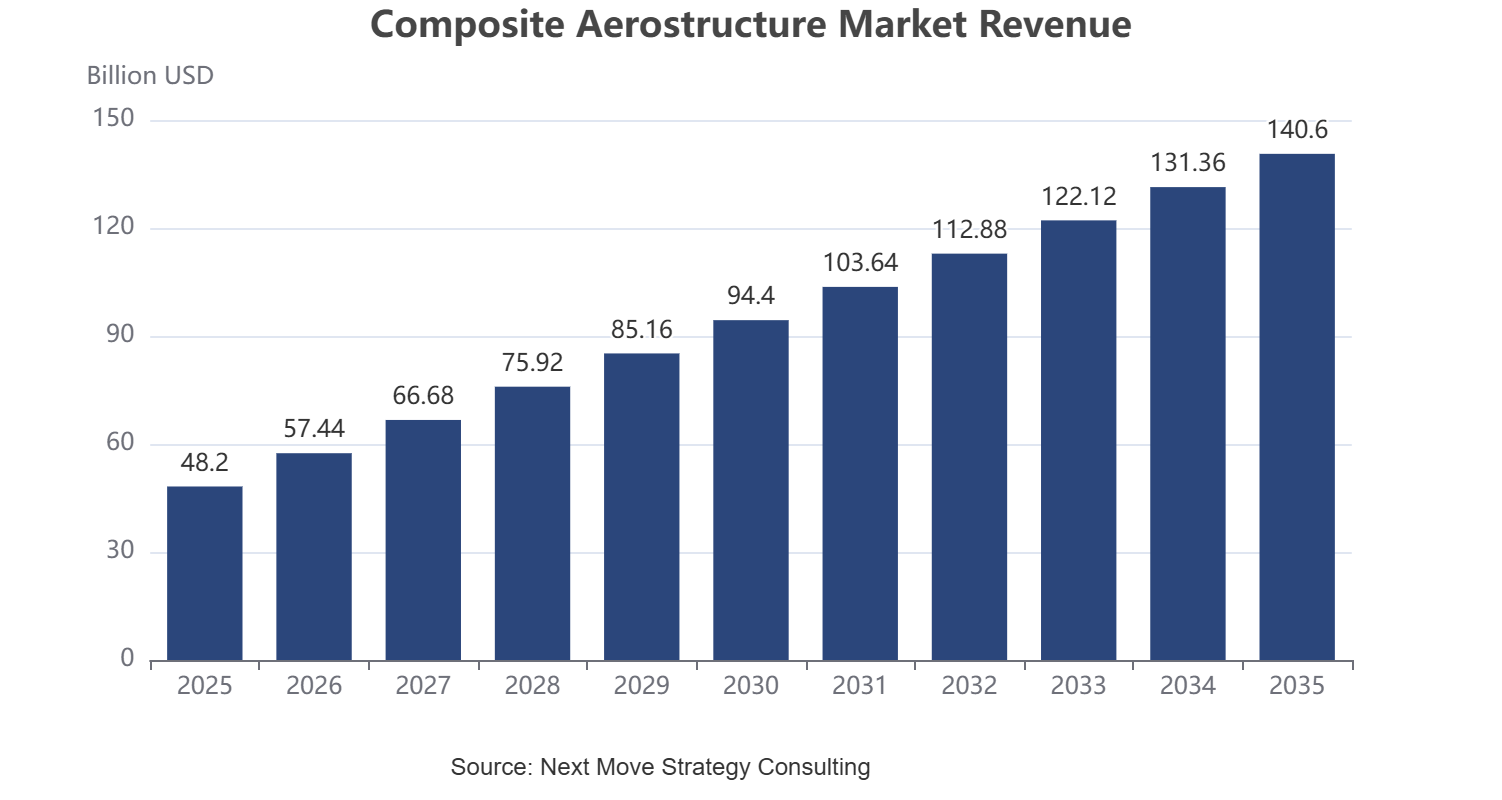
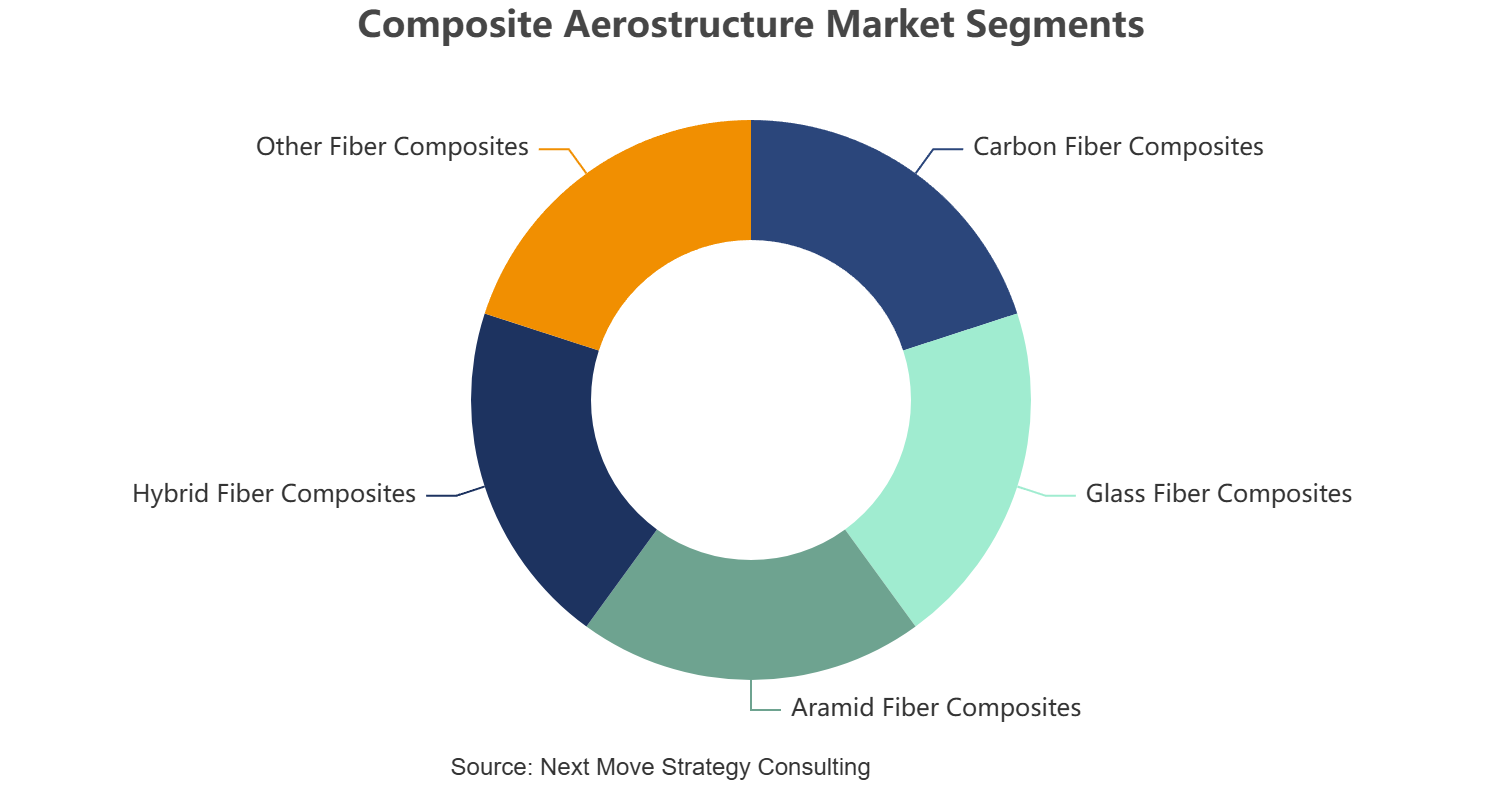
About the Author
 Mayurima Roy
— Mayurima Roy is Research Analyst at Next Move Strategy Consulting, where she has spent 4 years working across the firm's full industry coverage rather than a single fixed vertical. Her work centers on structured research, ongoing trend tracking, competitive assessment, and insight-led content development, translating complex market data into clear, decision-ready narratives that support informed client decision-making across diverse global industries, market sectors, and world regions every day.
Mayurima Roy
— Mayurima Roy is Research Analyst at Next Move Strategy Consulting, where she has spent 4 years working across the firm's full industry coverage rather than a single fixed vertical. Her work centers on structured research, ongoing trend tracking, competitive assessment, and insight-led content development, translating complex market data into clear, decision-ready narratives that support informed client decision-making across diverse global industries, market sectors, and world regions every day.
About the Reviewer
 Supradip Baul
— Supradip Baul is an accomplished business consultant and strategist with over a decade of rich experience in market intelligence, strategy, technology, and business transformation. His work has included rigorous qualitative and quantitative analysis across multiple industries, helping clients shape investment decisions and long-term roadmaps. Earlier in his career, he was associated with Gartner, where he contributed to industry-leading reports and market share analyses. He has worked with leading global companies and holds an MBA with a dual specialization in Marketing and Finance.
Supradip Baul
— Supradip Baul is an accomplished business consultant and strategist with over a decade of rich experience in market intelligence, strategy, technology, and business transformation. His work has included rigorous qualitative and quantitative analysis across multiple industries, helping clients shape investment decisions and long-term roadmaps. Earlier in his career, he was associated with Gartner, where he contributed to industry-leading reports and market share analyses. He has worked with leading global companies and holds an MBA with a dual specialization in Marketing and Finance.
At Next Move Strategy Consulting, we understand that insightful market research is the cornerstone of successful business decisions. That's why we employ a robust and multifaceted approach, combining various methodologies to deliver the most accurate and actionable data for our clients.

Research Landscape
We navigate the world of research with two primary approaches:
Qualitative Approach
Our qualitative research methodologies involve immersive techniques such as in-depth interviews, focus groups, and observational studies. By engaging directly with individuals and stakeholders, we uncover valuable insights that quantitative data alone may overlook.

Quantitative Research
In tandem with qualitative methodologies, NMSC leverages the power of Quantitative Research to provide a robust foundation of numerical insights. Through systematic data collection and analysis, we quantify patterns, preferences, and market trends, offering a comprehensive view of the business landscape.
Our quantitative research approach employs diverse tools, including surveys, experiments, and statistical modelling. These methodologies enable us to gather data from a large and representative sample, ensuring the statistical significance of our findings. By employing structured questionnaires and standardized data collection methods, we guarantee the reliability and validity of the information we present to our clients.
Quantitative research is particularly effective in measuring the prevalence of trends, assessing market size, and gauging the impact of various factors on consumer behavior. The numerical precision attained through this approach equips our clients with actionable insights, facilitating data-driven decision-making and strategy formulation.


Our Specialized Toolbox for Industry-Specific Market Research
We deploy a specialized arsenal of techniques tailored to meet your unique requirements. Here's a glimpse into our comprehensive toolbox:

Information Procurement
The stage entails acquiring market data or relevant information through various sources and methodologies.


Market Research Approach
We utilize both top-down and bottom-up approaches in market research analysis to achieve a comprehensive understanding of the market dynamics, leveraging the broad perspective of industry trends and macroeconomic factors alongside detailed insights from specific segments and individual companies.

Porters Five Forces Analysis
We conduct Porter's Five Forces analysis to evaluate the competitive landscape of an industry, providing us with insights into factors that affect profitability and strategic positioning.

SWOT Analysis

Forecasting
We utilize a forecasting model to predict future consumption by considering parameters like population, economics, regulations, market competition, drivers, constraints, technology, and pricing. We also employ statistical techniques such as multilinear regression, exponential smoothing, moving average, ARIMA, and Monte Carlo simulations for accurate predictions. In econometric forecasting, we analyzed short-term and long-term event impacts, attributing values based on regulatory frameworks, economic factors, and market events.





 Speak to Our Analyst