Digital Radio Frequency Memory (DRFM) Market Size, Share, Growth & Forecast by Product Type, Platform (Airborne, Naval, Land, Expendable), Technology Architecture (Digital RF Memory Core, Signal Processing, Technique Generation), Function (Radar Deception, Electronic Attack, Survivability, Threat Simulation), End User (Defense Forces, Defense Integrators, Government Research), Revenue Stream, Sales Channel — Global Analysis 2026–2035
Industry: Semiconductor & Electronics | Publishing Date: June 26, 2026 | Last Updated: September 8, 2026 | No of Pages: N/A | No. of Tables: N/A | No. of Figures: N/A | Format: PDF | Report Code: SE4804
What Is the Digital Radio Frequency Memory (DRFM) Market Size?
The global Digital Radio Frequency Memory (DRFM) Market was valued at USD 1.8 billion in 2025 and is projected to reach USD 1.96 billion in 2026. Escalating geopolitical tensions, the rapid modernization of adversary radar and missile guidance systems, and defense force investments in advanced electronic warfare capabilities are projected to propel the market to USD 4.2 billion by 2035, advancing at a CAGR of 8.9% from 2026 to 2035. Key growth drivers include expanding airborne electronic attack programs across NATO and Indo-Pacific nations, the proliferation of unmanned aerial vehicle platforms requiring integrated self-protection systems, rising demand for software-defined DRFM architectures, and surging investments in naval and ground-based electronic warfare modernization globally.
|
Parameters |
Details |
|
Market Size in 2025 |
USD 1.8 Billion |
|
Market Size in 2026 |
USD 1.96 Billion |
|
Revenue Forecast in 2035 |
USD 4.2 Billion |
|
Growth Rate |
CAGR of 8.9% from 2026 to 2035 |
|
Analysis Period |
2025–2035 |
|
Base Year Considered |
2025 |
|
Forecast Period |
2026–2035 |
|
Market Size Estimation |
Industry-derived estimate |
|
Companies Profiled |
20 |
|
Countries Covered |
33 |
|
Market Share |
Top 10 |
Digital Radio Frequency Memory (DRFM) Market Overview
What Is the Digital Radio Frequency Memory (DRFM) Market?
Digital Radio Frequency Memory (DRFM) is an advanced electronic warfare technology that digitally captures, stores, and retransmits enemy radar signals with high fidelity to generate deceptive countermeasures. Unlike passive jamming techniques, DRFM systems produce coherent and highly realistic false targets, range deceptions, and velocity deceptions that exploit radar tracking algorithms. The Digital Radio Frequency Memory (DRFM) Market encompasses decoy systems, jamming platforms, electronic attack subsystems, countermeasure payloads, mission systems software, and lifecycle sustainment products deployed across airborne, naval, land, and expendable platforms operated by defense forces worldwide.
How Has the Digital Radio Frequency Memory (DRFM) Market Evolved?
The Digital Radio Frequency Memory (DRFM) Market has progressed through distinct technological generations. Initial DRFM systems relied on narrowband architectures and analog-to-digital converters with limited instantaneous bandwidth. Subsequent generations introduced wideband and ultra-wideband digital sampling, enabling simultaneous coverage of complex multi-band radar environments. NMSC's analysis indicates that the current generation emphasizes software-defined signal processing, FPGA-based real-time technique generation, open architecture systems, and AI-assisted adaptive jamming, enabling platform-agnostic upgrades and dramatically reducing system integration timelines for both legacy and next-generation defense platforms.
How Do Regulations Influence the Digital Radio Frequency Memory (DRFM) Market?
Regulatory frameworks governing defense export controls, foreign military sales, and electronic warfare technology transfers are critical structural determinants of the Digital Radio Frequency Memory (DRFM) Market. The U.S. International Traffic in Arms Regulations (ITAR) and the Export Administration Regulations (EAR) tightly govern DRFM technology transfers, shaping the global competitive landscape and limiting which allied nations can receive U.S.-manufactured systems. The Wassenaar Arrangement, an international export control regime covering dual-use goods and technologies, similarly governs allied nation transfers. Our assessment indicates that these regulatory structures compel non-U.S. defense primes to develop indigenous DRFM capabilities, particularly across Europe, Israel, and India.
How Is Technology Adoption Expanding Across the Digital Radio Frequency Memory (DRFM) Market?
Technology adoption within the Digital Radio Frequency Memory (DRFM) Market is accelerating as defense forces globally transition from legacy analog electronic warfare systems to fully digital, software-reprogrammable DRFM architectures. NMSC's analysis indicates that open architecture standards promoted by the U.S. Department of Defense, including the Open Mission Systems (OMS) and Universal Command and Control Interface (UCI) frameworks, are enabling modular DRFM integration across diverse airborne and naval platforms. Simultaneously, increasing reliance on UAV and attritable aircraft platforms is driving demand for miniaturized, low-power DRFM modules that maintain full-spectrum electronic attack capability within constrained payload envelopes.
|
Key Takeaways |
|
By product type, DRFM Jamming Systems held the largest share of the Digital Radio Frequency Memory (DRFM) Market at USD 0.72 billion in 2025. Self-Protection Jammers, particularly internal and podded variants integrated into fourth- and fifth-generation fighter aircraft, represent the dominant sub-segment driven by growing self-protection upgrade programs across NATO air forces. |
|
DRFM Electronic Attack Subsystems represent the fastest-growing product type in the Digital Radio Frequency Memory (DRFM) Market, projected to expand from USD 0.29 billion in 2025 to USD 0.74 billion by 2035 at a CAGR of 9.8%, driven by demand for modular FPGA-based signal processing units and software-defined technique generators integrated into open architecture electronic warfare systems. |
|
By platform, Airborne Platforms commanded the largest share at USD 1.1 billion in 2025, representing approximately 61% of total Digital Radio Frequency Memory (DRFM) Market revenue. Fighter aircraft and electronic warfare aircraft remain the primary demand drivers, reflecting sustained investment in aerial electronic attack capability across U.S., European, and Indo-Pacific defense programs. |
|
Unmanned Aerial Vehicles (UAVs) are the fastest-growing platform segment in the Digital Radio Frequency Memory (DRFM) Market at a CAGR of 12.4% from 2026 to 2035, driven by the proliferation of attritable and expendable drone platforms requiring miniaturized DRFM payloads for both self-protection and offensive electronic attack missions. |
|
By technology architecture, Wideband DRFM systems dominate the Digital RF Memory Core segment due to their ability to simultaneously capture and replay complex multi-band radar environments encountered in modern contested airspace, making them the preferred architecture for advanced self-protection and escort jamming programs worldwide. |
|
FPGA-Based Processing is the dominant signal processing architecture in the Digital Radio Frequency Memory (DRFM) Market, while Software Defined Processing is the fastest-growing sub-segment at a CAGR of 11.2% from 2026 to 2035, reflecting defense force demands for field-reprogrammable electronic warfare systems capable of rapid response to evolving threat environments. |
|
By function, Radar Deception is the largest functional segment in the Digital Radio Frequency Memory (DRFM) Market at USD 0.68 billion in 2025, led by false target generation and range deception techniques deployed on self-protection jamming systems carried by tactical aircraft. |
|
Survivability applications represent the fastest-growing functional segment in the Digital Radio Frequency Memory (DRFM) Market at a CAGR of 10.1% from 2026 to 2035, as missile countermeasure requirements intensify across airborne, naval, and ground force protection programs globally. |
|
By end user, Defense Forces held the largest share at USD 1.26 billion in 2025, with the Air Force representing the dominant sub-segment within defense end users due to sustained investment in airborne electronic attack and self-protection programs across major air forces. |
|
By revenue stream, New System Procurement accounted for the largest share at USD 1.02 billion in 2025 in the Digital Radio Frequency Memory (DRFM) Market. Sustainment is the fastest-growing revenue stream at a CAGR of 9.4% from 2026 to 2035, as aging DRFM fleet inventories require increasing levels of repair, software updates, and mission data maintenance. |
|
North America held the largest regional share of the Digital Radio Frequency Memory (DRFM) Market at USD 0.81 billion in 2025, projected to reach USD 1.78 billion by 2035 at a CAGR of 8.2%, anchored by the U.S. Department of Defense's dominant global electronic warfare spending and the headquartering of the world's leading DRFM prime contractors. |
|
Asia-Pacific is the fastest-growing major region in the Digital Radio Frequency Memory (DRFM) Market at a CAGR of 12.0% from 2026 to 2035, driven by China's expanding electronic warfare modernization, India's defense indigenous procurement programs, and South Korea's and Japan's F-35 and next-generation fighter electronic warfare upgrade initiatives. |
|
The United States is the single largest country market in the Digital Radio Frequency Memory (DRFM) Market, representing over 75% of North American revenue in 2025, underpinned by the world's largest defense electronics budget and the most advanced operational electronic warfare requirements across all domain platforms. |
|
India is the fastest-growing national market in Asia-Pacific within the Digital Radio Frequency Memory (DRFM) Market at a CAGR of 13.6% from 2026 to 2035, propelled by the Atma Nirbhar Bharat defense indigenization policy, expanding fighter fleet modernization programs, and growing indigenous DRFM development partnerships between DRDO and private defense integrators. |
Key Emerging Trends in the Digital Radio Frequency Memory (DRFM) Market
How Is the Shift to Software-Defined DRFM Architectures Transforming the Digital Radio Frequency Memory (DRFM) Market?
Software-defined DRFM architectures are fundamentally reshaping how defense forces procure and sustain electronic warfare capabilities. From our research, we found that U.S. Navy and Air Force programs are increasingly mandating Open Mission Systems (OMS) and Sensor Open Systems Architecture (SOSA) compliance for new DRFM procurements, enabling rapid software upgrades without hardware replacement. BAE Systems' Electronic Combat Solutions and Northrop Grumman's Litening pod upgrades both exemplify this transition. This architectural shift enables faster threat library updates, reduces lifecycle sustainment costs, and future-proofs DRFM investments against rapidly evolving adversary radar technologies across contested operational environments.
What Role Are Miniaturized DRFM Modules Playing in the Expanding UAV Electronic Warfare Market?
The proliferation of unmanned aerial vehicles across military inventories is generating intense demand for miniaturized, low-size-weight-and-power (SWaP) DRFM modules capable of performing full-spectrum electronic attack within constrained payload envelopes. Based on NMSC's research, we found that the U.S. Air Force's Golden Horde Vanguard program and the DARPA Gremlins initiative demonstrate how attritable and expendable drone platforms are being designed with integrated EW payloads including DRFM-based jammers. Companies including L3Harris Technologies and Leonardo DRS have developed compact DRFM transceiver modules specifically optimized for UAV integration, signaling a structural long-term expansion in this sub-market.
How Is Artificial Intelligence Enhancing Adaptive Jamming Capabilities in the Digital Radio Frequency Memory (DRFM) Market?
Artificial intelligence and machine learning are being integrated into DRFM technique generators to enable real-time, adaptive jamming responses that autonomously select and apply optimal countermeasure techniques against dynamic radar environments. Through our market assessment, we observed that DARPA's Behavioral Learning for Adaptive Electronic Warfare (BLADE) program pioneered this approach, achieving in-flight machine learning of countermeasures against previously unknown radar threats. AI-enhanced DRFM systems can identify radar mode changes, frequency hopping patterns, and pulse compression techniques in milliseconds, applying tailored countermeasures that dramatically increase survivability over static pre-programmed technique libraries deployed on legacy electronic warfare platforms.
How Are Multi-Domain Electronic Warfare Programs Creating New Demand Vectors in the Digital Radio Frequency Memory (DRFM) Market?
Modern defense force doctrines centered on multi-domain operations are expanding the application scope of Digital Radio Frequency Memory (DRFM) systems beyond traditional airborne self-protection into naval, ground, and space domain electronic warfare. Based on our market evaluation, we noticed that the U.S. Army's Electronic Warfare Planning and Management Tool (EWPMT) and Multi-Function Electronic Warfare (MFEW) programs are driving land-based DRFM deployments on mobile electronic warfare vehicles. Simultaneously, increasing naval DRFM integration on destroyers and frigates across the U.S. Navy, Royal Navy, and French Marine Nationale reflects the expansion of coherent jamming and false target generation into maritime self-protection architectures.
What Are the Key Market Drivers, Breakthroughs, and Investment Opportunities That Will Shape the Digital Radio Frequency Memory (DRFM) Market Industry in the Next Decade?
|
Drivers / Trends / Restraints |
(+/-) % Impact on CAGR Forecast |
Geographic Relevance |
Impact Timeline |
|
Surging Defense Modernization & EW Investment |
+1.8% |
Global (led by North America, Asia-Pacific) |
2025–2035 |
|
UAV Platform Proliferation Driving DRFM Demand |
+1.4% |
North America, Europe, APAC |
2025–2032 |
|
Software-Defined & Open Architecture Mandates |
+1.2% |
North America, Europe |
2025–2030 |
|
AI-Enhanced Adaptive Jamming Integration |
+1.0% |
North America, Israel, Europe |
2026–2035 |
|
Multi-Domain EW Program Expansion |
+0.9% |
Global |
2026–2035 |
|
Indigenous DRFM Development Programs |
+0.7% |
India, South Korea, Turkey, Australia |
2026–2035 |
|
ITAR and Export Control Restrictions |
-1.1% |
Asia-Pacific, Middle East |
Ongoing |
|
High System Development and Integration Cost |
-0.7% |
SME Defense Contractors Globally |
2025–2028 |
|
Classified Nature of Operational Programs |
-0.4% |
All Regions |
Ongoing |
|
Naval DRFM Self-Protection Modernization |
+0.8% |
North America, Europe, Asia-Pacific |
2025–2032 |
|
FMS-Led Allied Nation Procurement |
+0.6% |
Middle East, Europe, APAC |
2025–2030 |
What Are the Growth Drivers of the Digital Radio Frequency Memory (DRFM) Market?
How Is the Escalation of Global Defense Electronic Warfare Budgets Driving the Digital Radio Frequency Memory (DRFM) Market?
Rising defense budgets across NATO member states, the Indo-Pacific, and the Middle East are the primary structural driver of the Digital Radio Frequency Memory (DRFM) Market. The U.S. Department of Defense's FY2025 budget allocated over USD 130 billion toward research, development, test, and evaluation, with electronic warfare modernization receiving sustained priority investment. NATO members, responding to the post-2022 security environment, have collectively committed to increasing defense spending toward the 2% of GDP benchmark. These budget expansions directly fund advanced DRFM procurement, self-protection system upgrades, and electronic attack platform integration across allied air forces, navies, and ground forces.
How Is the Rapid Proliferation of Unmanned Aerial Systems Fueling Growth in the Digital Radio Frequency Memory (DRFM) Market?
The accelerating global proliferation of unmanned aerial systems across military inventories is creating a structurally significant new demand segment for compact DRFM payloads. Based on our analysis, the U.S. Air Force's Collaborative Combat Aircraft (CCA) program and the broader attritable UAS expansion under the Replicator initiative are generating direct procurement requirements for miniaturized electronic warfare systems including DRFM-based jammers. The Federal Aviation Administration (FAA) and U.S. Air Force have documented the increasing operational integration of UAS into joint military operations, reinforcing the demand trajectory for SWaP-optimized DRFM module development across airborne unmanned platform categories.
How Are Adversary Radar Modernization Programs Compelling Investment in Advanced Digital Radio Frequency Memory (DRFM) Systems?
The rapid modernization of adversary integrated air defense systems (IADS) using advanced AESA radars, low probability of intercept waveforms, and multi-static radar architectures is compelling NATO and allied defense forces to invest in next-generation DRFM systems capable of defeating these sophisticated threats. Our findings suggest that the U.S. Congressional Budget Office (CBO) and DoD have published threat assessments highlighting the proliferation of advanced surface-to-air missile systems across peer and near-peer adversaries. DRFM systems capable of generating highly coherent, multi-target false returns and adaptive range gate pull-off techniques are essential for maintaining aircraft survivability and electronic dominance in contested airspace environments across the forecast period.
What Are the Growth Inhibitors of the Digital Radio Frequency Memory (DRFM) Market?
How Do International Traffic in Arms Regulations (ITAR) and Export Control Regimes Constrain Digital Radio Frequency Memory (DRFM) Market Growth?
ITAR and equivalent export control frameworks represent the most significant structural constraint on international Digital Radio Frequency Memory (DRFM) Market growth. The U.S. State Department's Directorate of Defense Trade Controls (DDTC) maintains strict licensing requirements for DRFM technology exports, limiting technology transfer to allied nations and compelling foreign buyers to develop independent domestic capabilities. Our assessment indicates that these controls restrict the speed of Foreign Military Sales (FMS) programs, extend procurement timelines for allied defense forces, and create market fragmentation across regions. Countries including India, South Korea, and Turkey have accelerated indigenous DRFM development programs in direct response to ITAR access limitations on U.S.-origin systems.
How Do the High Development Costs and Classified Program Structures Limit Broader Participation in the Digital Radio Frequency Memory (DRFM) Market?
The high nonrecurring engineering (NRE) costs, extensive testing and qualification requirements, and predominantly classified nature of advanced DRFM development programs create significant barriers to entry that limit competitive market participation. Through our market assessment, we observed that the U.S. DoD's extensive use of Special Access Programs (SAPs) for leading-edge electronic warfare technologies limits market transparency and restricts competition to a small number of cleared prime contractors. This concentration reduces pricing competition, limits innovation from non-traditional defense suppliers, and extends procurement cycles for allied nations seeking to acquire advanced DRFM capabilities through Foreign Military Sales or direct commercial sales channels.
What Are the Growth Opportunities in the Digital Radio Frequency Memory (DRFM) Market?
How Does the Global Expansion of Indigenous Defense Manufacturing Create Structural Digital Radio Frequency Memory (DRFM) Market Opportunities?
Government-mandated defense indigenization programs across India, South Korea, Australia, Turkey, and the UAE are creating substantial long-term demand for domestic DRFM development partnerships and technology transfer agreements. Our analysis shows that India's Defence Acquisition Procedure (DAP) 2020 and the Atma Nirbhar Bharat initiative explicitly prioritize domestic development of electronic warfare systems including DRFM, creating funded program opportunities for Indian defense integrators partnering with global DRFM technology leaders. The U.S. DoD's Security Cooperation programs, as administered through the Defense Security Cooperation Agency (DSCA), further facilitate structured technology transfer to qualified allied defense industrial partners within ITAR-permissible boundaries.
How Does the Growing Market for Sustainment, Software Updates, and Mission Data Services Represent a High-Value Opportunity in the Digital Radio Frequency Memory (DRFM) Market?
Expanding installed base inventories of fielded DRFM systems across global air forces and navies are creating a growing and recurring revenue opportunity in sustainment, software reprogramming, and mission data update services. From our research, we found that the U.S. Air Force's Electronic Warfare Reprogramming services, administered by the Air Force Information Warfare Center (AFIWC), represent a structured and well-funded model for ongoing DRFM software and threat library maintenance. As DRFM systems become increasingly software-defined, the recurring value of technique update packages, mission programming software refreshes, and capability upgrade programs will generate durable long-term revenue for original equipment manufacturers and defense sustainment contractors across the 2026 to 2035 forecast horizon.
How Is the Expansion of Multispectral and Cognitive Electronic Warfare Creating Breakthrough Opportunities in the Digital Radio Frequency Memory (DRFM) Market?
The convergence of cognitive electronic warfare concepts with DRFM technology is creating a breakthrough opportunity tier within the Digital Radio Frequency Memory (DRFM) Market. DARPA's Radio Frequency Machine Learning Systems (RFMLS) program and the Air Force Research Laboratory's Cognitive EW programs are directly funding next-generation DRFM technique generation architectures that autonomously adapt to uncharacterized radar threats without preprogrammed responses. Our assessment indicates that defense contractors embedding cognitive EW capabilities within DRFM systems will command premium program values and achieve structurally differentiated competitive positioning. These advanced DRFM systems are expected to become the defining platform-level electronic warfare requirement for next-generation fighter and unmanned combat aircraft programs through 2035.
Strategic Framework of the Digital Radio Frequency Memory (DRFM) Market
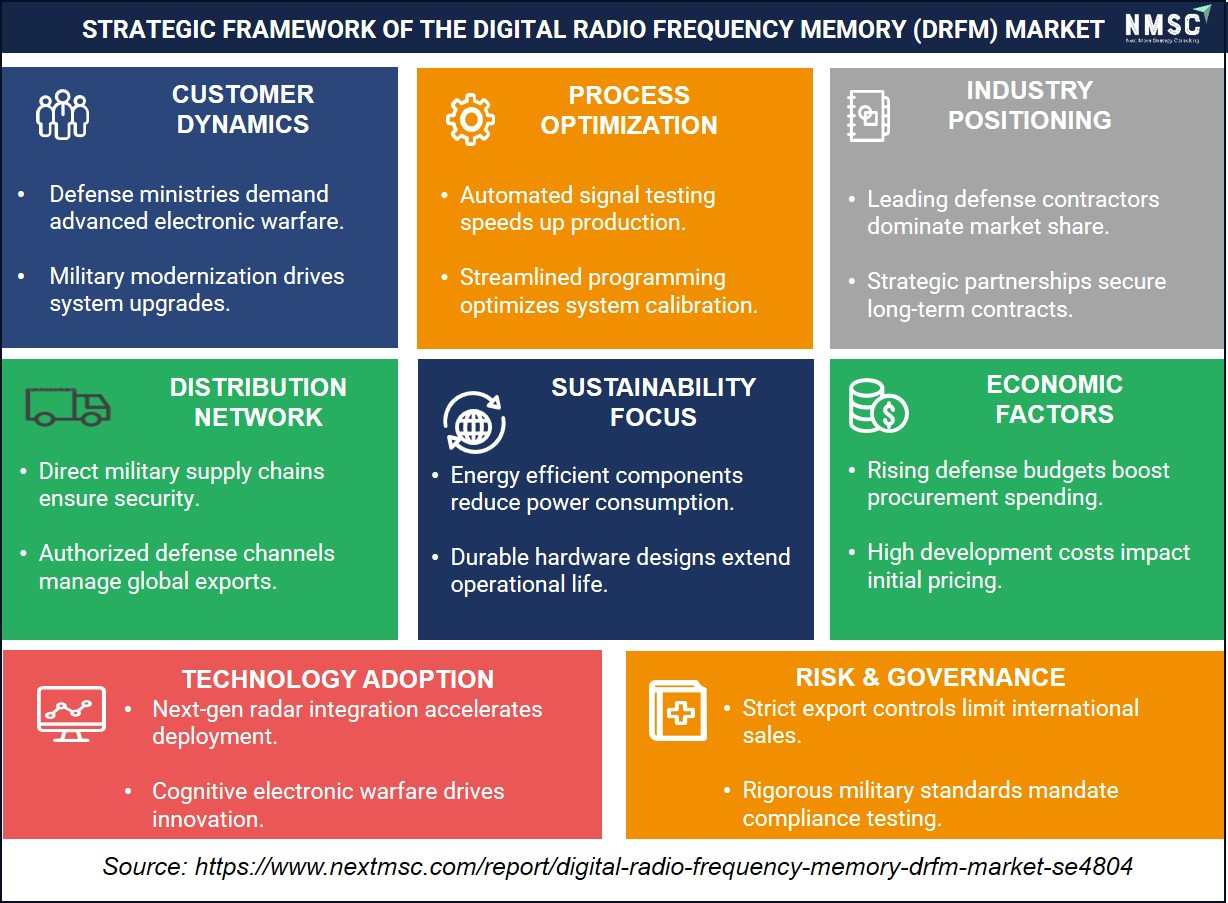
The market is driven by increasing defense modernization programs, rising electronic warfare requirements, and the integration of advanced radar and signal intelligence systems. Market growth is supported by investments in automated testing, next-generation cognitive electronic warfare technologies, and durable, energy-efficient hardware designs. Strong participation from leading defense contractors, secure military distribution networks, and growing defense budgets further strengthen demand. However, stringent export regulations, compliance requirements, and high development costs remain key factors influencing Digital Radio Frequency Memory (DRFM) market expansion and competitive dynamics.
How Is the Digital Radio Frequency Memory (DRFM) Market Segmented in This Report, and What Are the Key Insights from the Segmentation Analysis?
Which Product Type Segments Are Driving Revenue in the Digital Radio Frequency Memory (DRFM) Market?
|
Product Type Segment |
2025 (USD Bn) |
2035 (USD Bn) |
CAGR (%) |
|
DRFM Jamming Systems |
0.72 |
1.68 |
8.9% |
|
DRFM Electronic Attack Subsystems |
0.29 |
0.74 |
9.8% |
|
DRFM Countermeasure Payloads |
0.24 |
0.55 |
8.6% |
|
DRFM Decoys |
0.21 |
0.48 |
8.6% |
|
DRFM Mission Systems |
0.18 |
0.42 |
8.9% |
|
DRFM Sustainment Products |
0.16 |
0.33 |
7.5% |
Based on our analysis of global defense electronic warfare program investments, the Digital Radio Frequency Memory (DRFM) Market is segmented into DRFM Jamming Systems, Electronic Attack Subsystems, Countermeasure Payloads, Decoys, Mission Systems, and Sustainment Products. Our findings suggest that DRFM Jamming Systems hold the dominant share due to continued investment in self-protection jammers, particularly internal jammers and podded jammers integrated into tactical fighter aircraft operating across NATO and Indo-Pacific air forces. Escort and Stand-Off Jammers represent growing sub-segments as multi-aircraft electronic attack architectures replace single-platform jamming concepts. Meanwhile, Electronic Attack Subsystems including FPGA-based receivers, exciter modules, and technique generators are the fastest-growing product segment, driven by demand for modular open-architecture components compatible with software-defined DRFM platforms.
How Does Platform Segmentation Reveal the Structural Demand Distribution Across the Digital Radio Frequency Memory (DRFM) Market?
|
Platform Segment |
2025 (USD Bn) |
2035 (USD Bn) |
CAGR (%) |
|
Airborne Platforms |
1.10 |
2.44 |
8.3% |
|
Naval Platforms |
0.32 |
0.76 |
9.0% |
|
Land Platforms |
0.22 |
0.54 |
9.4% |
|
Expendable Platforms |
0.16 |
0.46 |
11.1% |
Through our market assessment, we observed that the Digital Radio Frequency Memory (DRFM) Market is segmented across Airborne, Naval, Land, and Expendable Platforms. Airborne platforms remain dominant, led by fighter aircraft and electronic warfare aircraft that represent the primary operational environments for advanced self-protection and escort jamming systems. Among airborne sub-segments, UAVs and attritable aircraft are the fastest-growing categories as defense forces globally expand unmanned combat and electronic attack capabilities. Naval platforms, including destroyers and frigates, represent a growing segment driven by surface ship self-protection modernization programs. Land platforms including mobile electronic warfare vehicles and air defense systems are expanding as multi-domain electronic warfare doctrine is operationalized across major armies.
How Does Technology Architecture Define Competitive Positioning in the Digital Radio Frequency Memory (DRFM) Market?
|
Architecture Segment |
2025 (USD Bn) |
2035 (USD Bn) |
CAGR (%) |
|
Wideband DRFM |
0.82 |
1.92 |
8.9% |
|
Narrowband DRFM |
0.54 |
0.96 |
5.9% |
|
Ultra-Wideband DRFM |
0.44 |
1.32 |
11.6% |
|
FPGA-Based Processing |
0.68 |
1.48 |
8.1% |
|
Software Defined Processing |
0.30 |
0.90 |
11.6% |
NMSC's analysis indicates that the Digital Radio Frequency Memory (DRFM) Market is structured around Digital RF Memory Core architectures including Narrowband, Wideband, and Ultra-Wideband DRFM, with signal processing sub-segments encompassing FPGA-Based, Software Defined, and Hybrid Processing approaches. Wideband DRFM architectures currently dominate due to their superior ability to simultaneously capture and replay complex multi-band radar environments encountered in modern contested airspace. Ultra-Wideband DRFM represents the fastest-growing architecture at a CAGR of 11.6%, reflecting investment in next-generation systems capable of countering advanced multi-static and AESA radar threats. Software Defined Processing is the fastest-growing signal processing sub-segment, driven by open architecture mandates across U.S. and European defense programs.
What Functional Capabilities Are Generating the Highest Digital Radio Frequency Memory (DRFM) Market Demand?
|
Function Segment |
2025 (USD Bn) |
2035 (USD Bn) |
CAGR (%) |
|
Radar Deception |
0.68 |
1.54 |
8.5% |
|
Electronic Attack |
0.48 |
1.12 |
8.8% |
|
Survivability |
0.44 |
1.16 |
10.1% |
|
Threat Simulation |
0.20 |
0.38 |
6.6% |
Based on NMSC's research, we found that the Digital Radio Frequency Memory (DRFM) Market is functionally segmented into Radar Deception, Electronic Attack, Survivability, and Threat Simulation applications. Radar Deception, encompassing false target generation, range deception, velocity deception, and angle deception techniques, represents the largest functional segment due to its fundamental role in tactical aircraft and naval self-protection. Electronic Attack applications including coherent jamming and adaptive jamming are expanding as defense forces transition from reactive to proactive electronic warfare doctrines. Survivability applications covering missile countermeasures and platform self-protection are the fastest-growing function at a CAGR of 10.1%, reflecting intensified investment in defeating advanced radar-guided missile threats across all platform categories.
Which End Users Drive the Most Demand Across the Digital Radio Frequency Memory (DRFM) Market?
|
End User Segment |
2025 (USD Bn) |
2035 (USD Bn) |
CAGR (%) |
|
Defense Forces |
1.26 |
2.90 |
8.7% |
|
Defense Integrators |
0.42 |
1.00 |
9.0% |
|
Government Research Organizations |
0.12 |
0.30 |
9.6% |
Our analysis shows that the Digital Radio Frequency Memory (DRFM) Market is served across Defense Forces, Defense Integrators, and Government Research Organizations. Defense Forces represent the dominant end user segment, with Air Forces accounting for the largest share within this category due to sustained investment in airborne self-protection and electronic attack programs. Navy and Army end users are growing segments driven by naval self-protection modernization and multi-domain electronic warfare initiatives. Defense Integrators including aircraft OEMs, naval OEMs, and electronic warfare integrators represent a growing procurement channel as prime contractors embed DRFM capabilities directly into platform development programs. Government research organizations including defense laboratories and test centers are expanding DRFM procurement for evaluation and threat simulation purposes.
How Do Revenue Stream Dynamics Shape the Commercial Structure of the Digital Radio Frequency Memory (DRFM) Market?
|
Revenue Stream Segment |
2025 (USD Bn) |
2035 (USD Bn) |
CAGR (%) |
|
New System Procurement |
1.02 |
2.14 |
7.7% |
|
Sustainment |
0.54 |
1.42 |
10.1% |
|
Engineering Services |
0.24 |
0.64 |
10.3% |
From our assessment, the Digital Radio Frequency Memory (DRFM) Market is structured across three primary revenue streams: New System Procurement, Sustainment, and Engineering Services. New System Procurement, covering platform installation, retrofit, and capability upgrade programs, currently represents the largest revenue stream, reflecting active modernization cycles across global defense forces. Sustainment services including repair, software support, and mission data updates are the fastest-growing revenue stream at a CAGR of 10.1%, driven by expanding DRFM fleet inventories requiring continuous threat library updates and hardware lifecycle management. Engineering Services including qualification, integration, testing, and mission support represent a high-growth segment as complex system integration requirements expand alongside open architecture program mandates.
How Do Sales Channel Strategies Define Go-to-Market Approaches in the Digital Radio Frequency Memory (DRFM) Market?
|
Sales Channel Segment |
2025 (USD Bn) |
2035 (USD Bn) |
CAGR (%) |
|
Direct Government Contracts |
0.94 |
2.10 |
8.3% |
|
Prime Contractor Subcontracts |
0.58 |
1.34 |
8.7% |
|
OEM Supply Agreements |
0.28 |
0.76 |
10.5% |
Through NMSC's assessment, we found that the Digital Radio Frequency Memory (DRFM) Market operates through three primary sales channels: Direct Government Contracts, Prime Contractor Subcontracts, and OEM Supply Agreements. Direct Government Contracts, encompassing domestic awards, Foreign Military Sales, and direct commercial sales, represent the dominant channel due to the defense-specific nature of DRFM procurement. Prime Contractor Subcontracts represent a growing channel as major defense integrators embed DRFM capabilities from specialist suppliers into larger platform development programs. OEM Supply Agreements covering aircraft, naval, and ground systems OEM supply chains are the fastest-growing channel at a CAGR of 10.5%, reflecting increasing DRFM integration at the original equipment manufacturing stage rather than post-delivery retrofit programs.
Regional Outlook
Geographic Performance Snapshot
|
Region |
2025 (USD Bn) |
2035 (USD Bn) |
CAGR (%) |
Key Driver |
|
North America |
0.81 |
1.78 |
8.2% |
U.S. DoD EW modernization, FMS programs |
|
Europe |
0.45 |
1.02 |
8.5% |
NATO capability mandates, sovereign EW programs |
|
Asia-Pacific |
0.34 |
1.06 |
12.0% |
China modernization, India indigenization, F-35 programs |
|
Middle East & Africa |
0.12 |
0.26 |
8.0% |
FMS procurement, regional security investment |
|
Latin America |
0.08 |
0.18 |
8.4% |
Fleet modernization, U.S. FMS relationships |
North America Digital Radio Frequency Memory (DRFM) Market
North America is the global anchor of the Digital Radio Frequency Memory (DRFM) Market, contributing USD 0.81 billion in 2025 and forecast to reach USD 1.78 billion by 2035 at a CAGR of 8.2%. The region benefits from the world's largest defense electronics budget administered through the U.S. Department of Defense, the headquarters of leading DRFM prime contractors, and the deepest global concentration of electronic warfare engineering expertise. Robust Foreign Military Sales programs and NATO interoperability requirements further extend North American DRFM technology influence across allied defense forces worldwide throughout the forecast period.
United States Digital Radio Frequency Memory (DRFM) Market
Based on our engagements with defense procurement data and program reporting, the United States represents over 75% of North American Digital Radio Frequency Memory (DRFM) Market revenue in 2025. The U.S. benefits from sustained DoD investment in airborne electronic attack programs including the EA-18G Growler fleet, Next Generation Jammer program, and Stand-in Attack Weapon development. The U.S. Air Force's Advanced Battle Management System and multi-domain operations doctrine are expanding DRFM requirements across land and space domain electronic warfare platforms. ITAR-compliant export frameworks position the U.S. as the primary supplier of advanced DRFM technologies to NATO and Indo-Pacific allies.
Canada Digital Radio Frequency Memory (DRFM) Market
Through our analysis, Canada represents a moderate but strategically significant market within the North America Digital Radio Frequency Memory (DRFM) landscape. Canadian defense modernization, centered on the Future Fighter Capability Project involving F-35 procurement, is the primary DRFM demand driver. The Royal Canadian Air Force's self-protection requirements and Canada's participation in NORAD and NATO electronic warfare interoperability programs create ongoing procurement opportunities. Defence Research and Development Canada (DRDC) is engaged in advanced electronic warfare research, supporting indigenous capability development in signal processing and technique generation technologies.
Europe Digital Radio Frequency Memory (DRFM) Market
Europe is the second-largest region in the Digital Radio Frequency Memory (DRFM) Market, contributing USD 0.45 billion in 2025 and forecast to reach USD 1.02 billion by 2035 at a CAGR of 8.5%. Europe's security environment, shaped by NATO collective defense obligations and heightened threat perception following geopolitical developments since 2022, is compelling accelerated investment in electronic warfare modernization across member state air forces, navies, and armies. European defense industrial policy prioritizing sovereignty is fostering indigenous DRFM development programs across the UK, France, Italy, Germany, and Sweden, shaping a distinctly European competitive landscape.
United Kingdom Digital Radio Frequency Memory (DRFM) Market
Based on our engagements, the United Kingdom represents the largest individual country market for Digital Radio Frequency Memory (DRFM) in Europe, anchored by BAE Systems' extensive electronic warfare heritage and the Royal Air Force and Royal Navy's sustained investment in self-protection systems. The Typhoon aircraft's electronic warfare suite and Tempest next-generation fighter program define the UK's DRFM modernization roadmap. The UK Ministry of Defence's Future Combat Air System participation and GCAP international fighter program create long-term DRFM development and procurement opportunities. The Defence and Security Industrial Strategy reinforces indigenous DRFM capability as a sovereign priority.
Germany Digital Radio Frequency Memory (DRFM) Market
According to our evaluation, Germany is expanding its position within the European Digital Radio Frequency Memory (DRFM) Market following the Bundeswehr's post-2022 Zeitenwende defense investment acceleration. HENSOLDT, headquartered in Taufkirchen, is Germany's primary DRFM technology developer, providing electronic warfare systems for Tornado and Eurofighter Typhoon aircraft. Germany's Eurofighter Electronic Combat Suite upgrade program and planned FCAS participation define the country's DRFM modernization trajectory. The Federal Government's Special Fund for the Bundeswehr is providing additional procurement capacity for advanced electronic warfare systems across airborne and ground force platforms through the forecast period.
France Digital Radio Frequency Memory (DRFM) Market
Through our analysis, France is a significant contributor to the European Digital Radio Frequency Memory (DRFM) Market, driven by Thales and MBDA's advanced electronic warfare development programs. The French Air and Space Force's Rafale aircraft electronic warfare suite, developed by Thales, incorporates advanced DRFM-based self-protection capabilities. France's SCAF next-generation fighter program and naval frigate modernization initiatives create ongoing DRFM procurement demand. The Direction Générale de l'Armement (DGA) actively funds domestic electronic warfare research, reinforcing France's policy of maintaining full sovereign capability in advanced DRFM system design and production throughout the forecast period.
Italy Digital Radio Frequency Memory (DRFM) Market
From our assessment, Italy is a mid-tier but strategically active market within the European Digital Radio Frequency Memory (DRFM) landscape, supported by Leonardo's significant electronic warfare manufacturing and engineering capabilities. The Italian Air Force's Eurofighter Typhoon and F-35 programs drive primary DRFM self-protection demand, while the Italian Navy's FREMM frigate fleet creates naval self-protection modernization requirements. Leonardo's Electronic Warfare division, operating through subsidiaries including Elettronica, provides advanced DRFM-based jamming and countermeasure systems. Italy's participation in GCAP and NATO integrated air defense programs further supports medium-term DRFM investment across all service branches.
Nordic Countries Digital Radio Frequency Memory (DRFM) Market
Based on our engagements, Nordic nations collectively represent a growing sub-regional market for Digital Radio Frequency Memory (DRFM) systems, driven by Sweden's Saab Gripen electronic warfare heritage, Finland and Denmark's F-35 procurement programs, and Norway's advanced naval electronic warfare investments. Saab AB's Electronic Warfare capabilities, including the Arexis system, provide world-class DRFM-based self-protection for Gripen operators. The Nordic region's heightened security environment since Finland and Sweden's NATO accession is accelerating EW modernization spending. The Finnish Defence Forces' and Royal Danish Air Force's F-35 transition introduces new DRFM integration and support requirements across Scandinavian defense budgets.
Rest of Europe Digital Radio Frequency Memory (DRFM) Market
According to our evaluation, the Rest of Europe market for Digital Radio Frequency Memory (DRFM) systems encompasses Poland, the Netherlands, Belgium, Spain, Greece, Romania, and other NATO member states investing in electronic warfare modernization as part of collective defense capability building. Poland's significant defense budget expansion and F-35 procurement are generating new DRFM integration requirements. Spain's Eurofighter and future FCAS participation create ongoing procurement demand. Netherlands and Belgium, as F-35 operators, require DRFM-compatible self-protection sustainment and upgrade services. Greece's advanced fleet modernization program including Rafale procurement further contributes to Rest of Europe DRFM market growth.
Asia-Pacific Digital Radio Frequency Memory (DRFM) Market
Asia-Pacific is the fastest-growing major region in the Digital Radio Frequency Memory (DRFM) Market, contributing USD 0.34 billion in 2025 and forecast to reach USD 1.06 billion by 2035 at a CAGR of 12.0%. The region's growth reflects China's broad electronic warfare modernization, India's defense indigenization mandate, Japan and South Korea's F-35 integration and next-generation fighter programs, and Australia's enhanced defense investment under the AUKUS partnership. Competitive threat dynamics across the Taiwan Strait and South China Sea are compelling accelerated DRFM investment across regional defense forces.
China Digital Radio Frequency Memory (DRFM) Market
Through our analysis, China represents the dominant indigenous Digital Radio Frequency Memory (DRFM) development market within Asia-Pacific, driven by the People's Liberation Army Air Force's and Navy's comprehensive electronic warfare modernization under the 14th Five-Year Plan. China's AVIC and state-owned defense enterprises are known to be developing advanced DRFM capabilities integrated into J-20 stealth fighters, JH-7 strike aircraft, and Y-9 electronic warfare aircraft. China's expanding surface ship and submarine electronic self-protection programs contribute to naval DRFM demand. The scale of China's electronic warfare investment reflects strategic recognition of electromagnetic spectrum dominance as a prerequisite for modern military operations.
India Digital Radio Frequency Memory (DRFM) Market
Based on our engagements, India is the fastest-growing national market within Asia-Pacific for Digital Radio Frequency Memory (DRFM) at a CAGR of 13.6% from 2026 to 2035. India's Defence Research and Development Organisation (DRDO) has developed indigenous DRFM systems deployed on IAF platforms, while the Tejas Light Combat Aircraft program incorporates indigenous electronic warfare suites. The Atma Nirbhar Bharat initiative and the Defence Acquisition Procedure 2020 prioritize domestic DRFM manufacturing, creating partnership opportunities for global suppliers transferring technology to Indian defense firms. India's expanding fighter fleet, multi-role helicopter procurement, and maritime patrol aircraft programs collectively drive sustained DRFM demand.
Japan Digital Radio Frequency Memory (DRFM) Market
According to our evaluation, Japan is a significant and growing market for Digital Radio Frequency Memory (DRFM) systems, driven by Japan Air Self-Defense Force's F-35A and F-35B integration programs and the sixth-generation fighter initiative under the Global Combat Air Programme (GCAP). The Japan Defense Agency's procurement of advanced self-protection systems and electronic warfare training ranges reflects expanding DRFM investment. Mitsubishi Electric and Japan's domestic defense electronics sector are developing indigenous EW capabilities supplementing ITAR-licensed DRFM systems from U.S. suppliers. Japan's expanded defense budget under the National Security Strategy provides substantial additional funding for electronic warfare modernization across all service branches.
South Korea Digital Radio Frequency Memory (DRFM) Market
From our assessment, South Korea is actively expanding its Digital Radio Frequency Memory (DRFM) market driven by the Republic of Korea Air Force's F-35A integration, KF-21 Boramae indigenous fighter development, and active electronic warfare research through Agency for Defense Development (ADD). The KF-21 program includes indigenous electronic warfare suites incorporating DRFM-based self-protection, representing a significant indigenous development milestone. South Korea's ADD is investing in advanced radar jamming techniques and electronic countermeasure systems. The security environment created by North Korean electronic warfare capabilities is a persistent driver of DRFM modernization investment across Korean Air Force and Navy platforms.
Australia Digital Radio Frequency Memory (DRFM) Market
Based on our engagements, Australia is experiencing accelerated Digital Radio Frequency Memory (DRFM) market growth, shaped by the AUKUS security partnership, F-35A integration across the Royal Australian Air Force, and expanded defense investment under the Defence Strategic Review. Australia's investment in advanced self-protection systems for F-35, E-7A Wedgetail, and P-8 Poseidon aircraft creates sustained DRFM procurement demand. The Australian Defence Science and Technology Group (DSTG) collaborates on electronic warfare research with U.S. and UK partners. AUKUS Pillar II advanced capabilities program includes electronic warfare as a priority investment domain, creating additional DRFM-adjacent program funding through the forecast period.
Southeast Asia Digital Radio Frequency Memory (DRFM) Market
Through our analysis, Southeast Asia represents an emerging market for Digital Radio Frequency Memory (DRFM) systems, driven by regional military modernization programs in Singapore, Vietnam, the Philippines, Indonesia, and Malaysia. Singapore's Defence Science and Technology Agency (DSTA) and the Republic of Singapore Air Force's F-35 transition program create growing DRFM self-protection requirements. Vietnam, Indonesia, and Malaysia are modernizing fighter fleets with aircraft that incorporate varying levels of electronic warfare capability. Regional security dynamics in the South China Sea are compelling increased defense spending and EW investment across ASEAN member states, creating progressive DRFM market development across the forecast period.
Rest of Asia-Pacific Digital Radio Frequency Memory (DRFM) Market
According to our evaluation, the Rest of Asia-Pacific market for Digital Radio Frequency Memory (DRFM) encompasses Taiwan, Pakistan, New Zealand, and other Asia-Pacific defense markets with active electronic warfare modernization requirements. Taiwan's defense modernization program, supported by significant U.S. Foreign Military Sales of advanced fighter aircraft and self-protection systems, creates DRFM procurement demand. Pakistan's JF-17 program and air defense modernization generate EW system requirements. New Zealand's participation in Five Eyes intelligence sharing and ANZUS creates electronic warfare interoperability requirements aligned with U.S. and Australian DRFM technology standards across airborne and maritime patrol platforms.
Middle East and Africa Digital Radio Frequency Memory (DRFM) Market
The Middle East and Africa region contributes USD 0.12 billion in 2025 to the Digital Radio Frequency Memory (DRFM) Market and is forecast to reach USD 0.26 billion by 2035 at a CAGR of 8.0%. The region's demand is primarily driven by Foreign Military Sales of advanced fighter aircraft and associated self-protection systems to Gulf Cooperation Council member states, Israel's indigenous and world-class electronic warfare industry, and Turkey's expanding domestic defense manufacturing capability. Elevated regional security dynamics and active air operations across the Middle East sustain demand for advanced DRFM-based self-protection and electronic attack capabilities across regional air forces.
Israel Digital Radio Frequency Memory (DRFM) Market
Based on our engagements, Israel is the most technologically advanced indigenous DRFM developer within the Middle East and Africa region, with Israel Aerospace Industries and Elbit Systems producing world-class electronic warfare systems incorporating advanced DRFM architectures. The Israeli Air Force's extensive operational experience with DRFM-based self-protection and electronic attack systems drives continuous technology advancement. Israel's IAI Elta division provides DRFM-based electronic warfare systems for Israeli platforms and for export to allied nations through government-to-government sales programs. Israel's active defense research and development ecosystem, supported by the Israeli Ministry of Defense, sustains a globally competitive DRFM industrial base.
Gulf States Digital Radio Frequency Memory (DRFM) Market
Through our analysis, the Gulf States, principally Saudi Arabia, the UAE, Qatar, and Kuwait, represent the largest DRFM procurement market in the Middle East through Foreign Military Sales of advanced tactical aircraft and self-protection systems. Saudi Arabia's Royal Saudi Air Force, operating Eurofighter Typhoon, F-15SA, and Tornado aircraft, requires ongoing DRFM self-protection system support and capability upgrades. The UAE's F-35 acquisition program, supported by U.S. Foreign Military Sales, introduces new DRFM platform integration requirements. Qatar's Rafale and Eurofighter procurements similarly drive DRFM system demand. Regional defense spending growth plans underpinned by Vision 2030 and UAE Centennial strategies sustain long-term procurement capacity.
Turkey Digital Radio Frequency Memory (DRFM) Market
According to our evaluation, Turkey represents a strategically significant market for Digital Radio Frequency Memory (DRFM) systems, driven by ASELSAN's active indigenous electronic warfare development programs and Turkey's ambitious KAAN next-generation fighter program. ASELSAN has developed domestic DRFM-based electronic warfare systems including the MLWS-700 and POET-400 self-protection suites deployed on Turkish military platforms. Turkey's exclusion from the F-35 program has accelerated indigenous DRFM development as a matter of national defense industrial policy. The Presidency of Defence Industries (SSB) actively funds DRFM-related research and procurement programs supporting the Turkish Armed Forces' growing electronic warfare capability requirements.
Rest of Middle East and Africa Digital Radio Frequency Memory (DRFM) Market
From our assessment, the Rest of Middle East and Africa market for Digital Radio Frequency Memory (DRFM) encompasses Egypt, Morocco, Jordan, Nigeria, South Africa, and other regional defense markets with active military aircraft procurement programs. Egypt's Rafale procurement and ongoing air force modernization create DRFM self-protection requirements. Morocco's F-16 and Rafale fleet operations generate sustainment-related DRFM demand. South Africa's historically advanced domestic defense electronics industry, anchored by Denel Dynamics, maintains limited DRFM-adjacent capability. Nigeria and other Sub-Saharan African nations represent early-stage markets, primarily accessing DRFM-equipped platforms through international procurement agreements and military assistance programs.
Latin America Digital Radio Frequency Memory (DRFM) Market
Latin America contributes USD 0.08 billion in 2025 to the Digital Radio Frequency Memory (DRFM) Market, with forecast growth reflecting progressive military modernization across Brazil, Mexico, Chile, Colombia, and Argentina. The region's DRFM demand is primarily accessed through Foreign Military Sales and direct commercial sales of advanced aircraft platforms incorporating self-protection systems. Brazil's F-39 Gripen program represents the most significant DRFM platform introduction in the region, with Saab providing integrated electronic warfare capabilities. Regional defense budget constraints moderate growth expectations, but progressive fleet renewal programs across the region's air forces and navies provide steady DRFM procurement opportunities through the forecast horizon.
Brazil Digital Radio Frequency Memory (DRFM) Market
Based on our engagements, Brazil is the largest market for Digital Radio Frequency Memory (DRFM) in Latin America, driven by the Brazilian Air Force's F-39 Gripen E/F program with Saab providing advanced electronic warfare capabilities including DRFM-based self-protection. The Brazilian Navy's ongoing fleet modernization program, including submarine and surface combatant upgrades, introduces naval DRFM requirements. Brazil's Embraer defense division actively participates in the country's electronic warfare ecosystem. The Brazilian government's commitment to defense industrial development through the Embraer-Saab partnership for Gripen production supports gradual indigenous electronic warfare capability building, with implications for long-term DRFM sustainment and integration activities within the country.
Mexico Digital Radio Frequency Memory (DRFM) Market
Through our analysis, Mexico represents a smaller but moderately growing market for Digital Radio Frequency Memory (DRFM) systems, primarily driven by the Mexican Air Force's aircraft self-protection requirements and U.S.-Mexico defense cooperation under bilateral security frameworks. Mexico's proximity to the United States and active collaboration through the Merida Initiative create access to U.S.-origin electronic warfare systems through FMS and direct commercial sales channels. The Mexican Navy's maritime patrol operations also create limited demand for platform self-protection systems. Budget constraints and the predominantly domestic security focus of Mexican defense spending moderate the scale of DRFM-specific procurement across the forecast period.
Rest of Latin America Digital Radio Frequency Memory (DRFM) Market
According to our evaluation, the Rest of Latin America market for Digital Radio Frequency Memory (DRFM) encompasses Chile, Colombia, Argentina, Peru, and other South American nations with active air force modernization programs. Chile's F-16 fleet and potential future fighter replacement program create ongoing DRFM self-protection requirements. Colombia's expanding air force, supported by U.S. security assistance, operates platforms with integrated self-protection systems. Argentina's defense modernization ambitions, constrained by fiscal pressures, represent a developing DRFM market. Peru's recent fighter procurement activities, including the Su-30MK2 fleet, create a limited but distinct DRFM demand environment that may expand as fleet sustainment and upgrade requirements intensify through the forecast period.
Supply Chain Structure of the Digital Radio Frequency (DRFM) Market
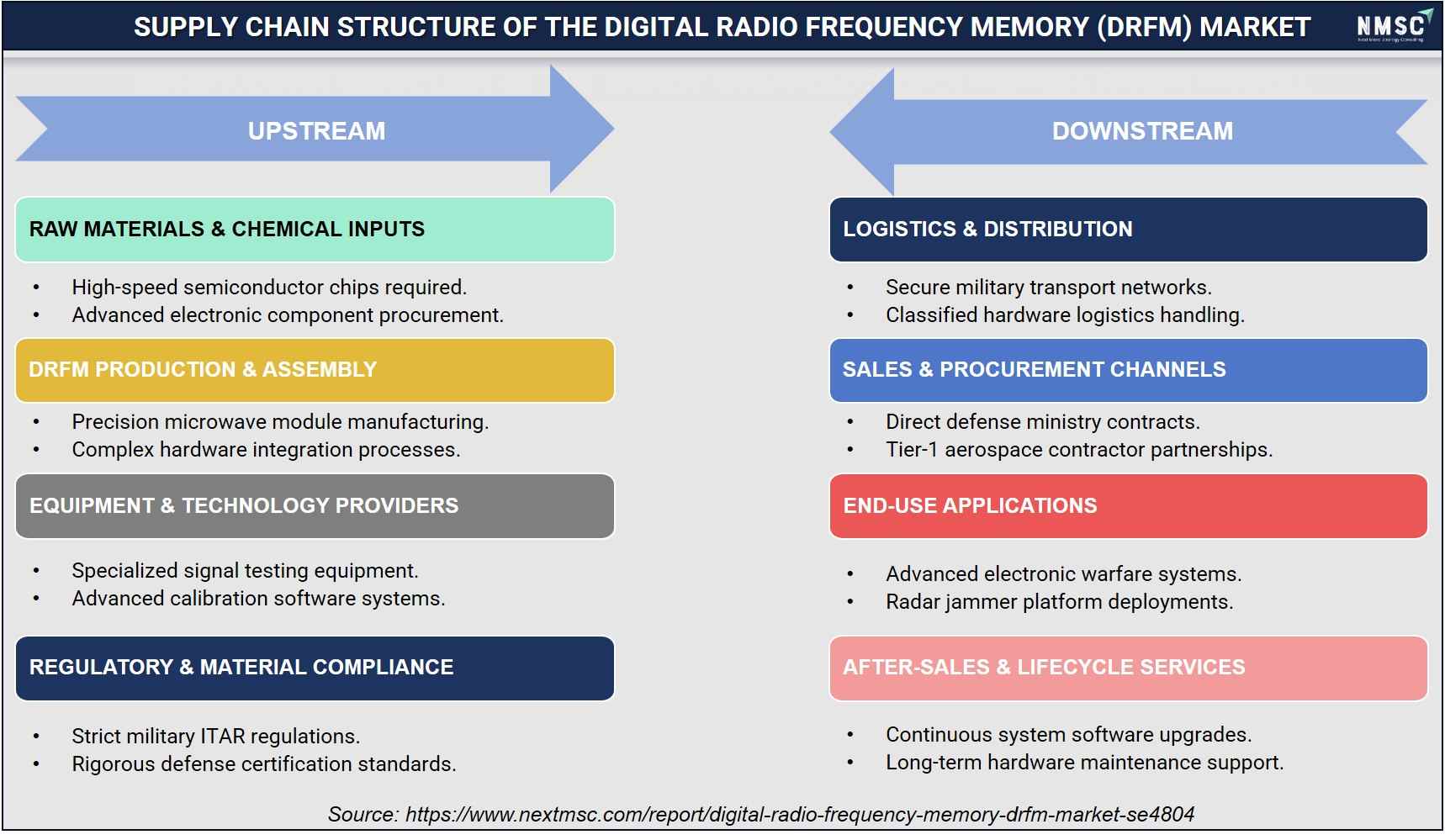
The Digital Radio Frequency Memory (DRFM) market supply chain is characterized by a highly specialized and regulated ecosystem spanning advanced semiconductor sourcing, precision manufacturing, system integration, and defense-focused distribution channels. Upstream activities involve high-performance electronic components, signal testing technologies, and strict regulatory compliance, while downstream operations focus on secure logistics, military procurement, electronic warfare applications, and long-term maintenance services. Strong collaboration among technology providers, defense contractors, and government agencies is essential to ensure operational reliability, security, and compliance across the DRFM value chain.
Competitive Landscape
Competitive Dynamics and M&A Landscape
|
Key Takeaways |
Details |
|
Market Structure |
Oligopolistic; dominated by defense prime contractors and specialist EW system developers with high barriers to entry driven by ITAR controls, clearance requirements, and high NRE investment thresholds |
|
Innovation Focus |
Software-defined DRFM architectures, miniaturized SWaP-optimized modules for UAV integration, AI-enhanced adaptive jamming, and open architecture SOSA/OMS-compliant system designs |
|
M&A Activity |
Consolidation ongoing; driven by prime contractors acquiring specialist DRFM and EW subsystem suppliers to expand organic capabilities and address open architecture integration requirements across multi-domain platforms |
How Do Companies Compete in the Digital Radio Frequency Memory (DRFM) Market?
From our research, we found that the Digital Radio Frequency Memory (DRFM) Market operates as an oligopoly anchored by a small number of defense prime contractors and specialist electronic warfare systems developers. Market structure is defined by high barriers to entry, including ITAR compliance requirements, security clearance obligations, and multi-year weapon system integration cycles. Competitive strategies center on technological differentiation through wideband and ultra-wideband DRFM architectures, FPGA-based signal processing performance, and software-defined technique generation capabilities that enable rapid threat library updates. Innovation focus is concentrated on AI-enhanced adaptive jamming, open architecture SOSA-compliant designs, and SWaP-optimized modules for UAV platform integration, which represents the market's highest-growth segment.
Which Kind of Companies Dominate the Digital Radio Frequency Memory (DRFM) Market?
Defense prime contractors with deep government customer relationships, security-cleared engineering workforces, and vertically integrated electronic warfare development capabilities dominate the Digital Radio Frequency Memory (DRFM) Market. Companies such as RTX Corporation, Northrop Grumman, BAE Systems, L3Harris Technologies, and Thales leverage their prime contractor status to win large platform-level electronic warfare system contracts that incorporate proprietary DRFM architectures. Specialist EW developers including Elbit Systems, Israel Aerospace Industries, HENSOLDT, ASELSAN, and Elettronica hold competitive positions in regional markets, offering export-eligible DRFM-based solutions unconstrained by U.S. ITAR restrictions and tailored to the specific platform needs of allied and partner nation defense forces.
AI-Native Differentiation and Open Standards Drive Market Success in the Digital Radio Frequency Memory (DRFM) Market
Our findings suggest that companies investing in AI-enhanced adaptive jamming and open architecture compliance are establishing durable competitive advantages in the Digital Radio Frequency Memory (DRFM) Market. The U.S. DoD's mandates for SOSA and OMS compliance are compelling DRFM system developers to redesign legacy proprietary architectures into modular, interchangeable hardware and software building blocks. Companies that achieve SOSA compliance early, including L3Harris Technologies and Northrop Grumman, are positioning themselves as preferred suppliers across the next generation of airborne, naval, and land-based electronic warfare programs. AI-enabled technique generation that autonomously adapts to uncharacterized threats is becoming the decisive differentiator for premium program capture across the global DRFM market.
Market Players to Opt for Merger and Acquisition Strategies to Expand Their Presence in the Digital Radio Frequency Memory (DRFM) Market
Merger and acquisition activity continues to reshape the competitive structure of the Digital Radio Frequency Memory (DRFM) Market as prime contractors seek to internalize specialist signal processing, software-defined architecture, and cognitive EW capabilities. L3Harris Technologies, formed through the merger of L3 Technologies and Harris Corporation, exemplifies the consolidation trend that has concentrated DRFM capability within a smaller number of larger, vertically integrated suppliers. European consolidation through Thales's and Leonardo's strategic acquisitions similarly reflects the industry-wide drive to build comprehensive DRFM system development capabilities within fewer organizational entities. NMSC's analysis indicates that further M&A activity is anticipated particularly in sustainment-focused companies offering mission data update and software reprogramming services across growing DRFM fleet inventories.
Who Are the Key Market Players in the Digital Radio Frequency Memory (DRFM) Market?
-
RTX Corporation
-
Northrop Grumman Corporation
-
BAE Systems plc
-
Leonardo S.p.A.
-
L3Harris Technologies, Inc.
-
Thales S.A.
-
Elbit Systems Ltd.
-
Israel Aerospace Industries Ltd.
-
Lockheed Martin Corporation
-
Saab AB
-
ASELSAN A.S.
-
HENSOLDT AG
-
Cobham Limited
-
Ultra Electronics Holdings Limited
-
Elettronica S.p.A.
-
Indra Sistemas, S.A.
-
Terma A/S
-
Leonardo DRS, Inc.
-
SRC, Inc.
-
Chemring Group PLC
What Are the Latest Developments in the Digital Radio Frequency Memory (DRFM) Market Industry?
|
Date |
Event |
|
April 2026 |
L3Harris demonstrated an autonomous electronic warfare capability during a U.S. Army experiment, showing real-time threat detection, location, and neutralization. |
|
November 2025 |
Saab received orders from Airbus Defence and Space for the Arexis Electronic Warfare (EW) sensor suite to equip German Eurofighters; Saab booked about EUR 258 million in Q4 2025 order intake. |
|
September 2025 |
Thales and Autonomous Devices announced a drone-based electronic warfare solution for naval and land forces at DSEI 2025. |
Expert Insights
 "People mistakenly think that electronic warfare is synonymous with jamming when it’s so much more. For example, protecting our advanced radars and sensors from enemy jamming, transmitting radio frequency (RF) cyber-attacks, and intercepting enemy signals – there’s such a large breadth to the electronic warfare mission area."
— John “JJ” Thompson, Director of Strategic Planning, Northrop Grumman
Statement made in Northrop Grumman’s discussion on electronic warfare and electromagnetic spectrum operations.
Market Interpretation
John Thompson’s statement highlights the expanding role of electronic warfare beyond traditional jamming activities, encompassing radar protection, RF cyber operations, signal interception, and spectrum dominance. Our analysis indicates that modern defense forces are increasingly prioritizing advanced electronic countermeasure capabilities to address sophisticated radar-guided and networked threats. This trend is driving demand for Digital Radio Frequency Memory (DRFM) technologies, which enable high-fidelity radar deception, false target generation, signal replication, and advanced electronic attack functions. As military modernization programs continue to emphasize electromagnetic spectrum superiority, investments in DRFM-based electronic warfare systems are expected to accelerate across airborne, naval, and land-based defense platforms.
Market Interpretation
From our research, we found that this assessment directly reflects the investment priorities observable across the Digital Radio Frequency Memory (DRFM) Market. NMSC's analysis indicates that defense program offices in the United States, the United Kingdom, France, and Australia are actively mandating cognitive EW capabilities and open architecture compliance in new DRFM procurements, validating the commercial demand trajectory for AI-enhanced DRFM technique generators. The shift from static threat libraries to autonomous adaptive jamming is expected to command premium program values and create a distinct performance tier within the DRFM market, with first-mover advantages accruing to companies such as Northrop Grumman, BAE Systems Electronic Combat Solutions, and L3Harris that have advanced cognitive EW investments beyond the research stage into qualified system development programs. This technology trajectory is consistent with NMSC's forecast of sustained above-market-average growth in DRFM Electronic Attack Subsystems through 2035.
What Are the Investment Opportunities in the Digital Radio Frequency Memory (DRFM) Market?
Capital Inflows and Defense Technology Investments
The Digital Radio Frequency Memory (DRFM) Market continues to attract substantial investment from defense contractors, government agencies, and private investors due to the growing importance of electronic warfare (EW) capabilities in modern military operations. Rising geopolitical tensions and increasing defense modernization programs have accelerated funding for advanced radar jamming, electronic countermeasure (ECM), and electronic attack systems that rely on DRFM technology. We observed that major defense companies are expanding their electronic warfare portfolios through internal R&D investments and strategic acquisitions, while venture capital and private equity firms are increasingly exploring opportunities in defense electronics, spectrum dominance technologies, and next-generation signal processing solutions. Growing defense budgets across North America, Europe, and Asia-Pacific are further strengthening investor confidence in the long-term growth potential of the DRFM Market.
Defense Infrastructure and Military Modernization Investment
Military modernization initiatives worldwide are creating a strong foundation for DRFM Market expansion. Governments are allocating significant capital toward upgrading airborne, naval, and land-based electronic warfare systems to address evolving threats from advanced radar and missile defense platforms. We found that investments in next-generation fighter aircraft, unmanned aerial vehicles (UAVs), naval combat systems, and integrated air defense networks are driving demand for sophisticated DRFM-based jamming and deception technologies. Furthermore, increasing procurement of electronic warfare pods, self-protection suites, and radar countermeasure systems is creating sustained opportunities for DRFM manufacturers and subsystem suppliers throughout the defense value chain.
Secure and Resilient Defense Technologies
Security, resilience, and operational superiority have become critical considerations influencing investments in the DRFM Market. Modern military forces require highly reliable electronic warfare systems capable of operating in contested electromagnetic environments while countering increasingly sophisticated radar threats. Defense organizations are therefore investing in advanced DRFM architectures that offer higher bandwidth, faster processing speeds, improved signal fidelity, and enhanced resistance to electronic counter-countermeasures (ECCM). Companies developing next-generation DRFM solutions with software-defined capabilities, artificial intelligence-assisted threat recognition, and multi-band electronic attack functionality are expected to attract significant investment attention over the coming decade.
Digital Battlefield Transformation Enablement
DRFM technologies serve as a core component of broader digital battlefield transformation initiatives, making them strategically important within long-term defense modernization programs. Network-centric warfare, multi-domain operations, autonomous systems, and integrated electronic warfare architectures increasingly depend on advanced DRFM capabilities to provide electronic protection and spectrum superiority. We further analyzed that government programs focused on electromagnetic spectrum operations, cognitive electronic warfare, and integrated sensing and defense networks are creating durable demand for DRFM solutions. As military platforms become more connected and data-driven, DRFM systems will play an essential role in protecting critical assets and enhancing mission effectiveness.
Strategic Acquisitions and Defense Industry Consolidation
Strategic mergers and acquisitions are creating attractive investment opportunities across the DRFM ecosystem. Major defense contractors are actively pursuing acquisitions that strengthen their electronic warfare, radar technology, and signal intelligence capabilities. We assessed that companies specializing in high-speed signal processing, RF semiconductor technologies, software-defined electronic warfare systems, and advanced DRFM architectures are likely acquisition targets as defense primes seek to expand their technological advantages. Investors should closely monitor consolidation activity involving electronic warfare subsystem providers, RF component manufacturers, and defense electronics specialists, as these segments are expected to remain strategically attractive between 2025 and 2030 within the Digital Radio Frequency Memory (DRFM) Market.
Key Benefits for Stakeholders
For Defense Organizations and Military Procurement Agencies
Defense organizations and military procurement agencies gain comprehensive, vendor-neutral insights into the Digital Radio Frequency Memory (DRFM) Market, including quantitative assessments across platform types, application areas, end users, and regional defense programs. This intelligence supports electronic warfare modernization planning, procurement strategy development, and long-term defense capability investments. Our competitive landscape analysis enables acquisition teams to benchmark technology providers, evaluate system performance capabilities, and make informed procurement decisions regarding radar jamming, deception, and electronic countermeasure solutions.
For Investors and Financial Analysts
Investors and financial analysts gain access to a structured, data-driven assessment of the Digital Radio Frequency Memory (DRFM) Market's growth prospects, competitive environment, defense spending trends, and technological innovation pipeline through 2035. Segment-level forecasts by platform, application, and geography support detailed valuation modeling and investment analysis. Comprehensive profiles of leading defense electronics companies, combined with tracking of contracts, partnerships, and technology developments, provide an early-warning framework for identifying emerging market leaders, acquisition candidates, and high-growth opportunities within the global DRFM ecosystem.
For DRFM Manufacturers and Electronic Warfare Solution Providers
DRFM manufacturers, defense contractors, and electronic warfare solution providers benefit from actionable intelligence regarding emerging opportunities, competitive positioning, and rapidly expanding market segments. Platform-level analysis highlights growing demand across airborne electronic warfare systems, naval defense platforms, unmanned systems, and integrated air defense applications. Regional market assessments identify expansion opportunities based on defense modernization programs, procurement priorities, and geopolitical security requirements. Additionally, end-user and procurement trend analysis enables vendors to optimize product development strategies, strengthen market positioning, and align sales efforts with evolving military requirements.
For Government Agencies and Defense Policymakers
Government agencies, defense ministries, and regulatory authorities gain a comprehensive understanding of how national defense strategies, military modernization initiatives, and electronic warfare capability development are shaping the Digital Radio Frequency Memory (DRFM) Market. Country-level analysis provides policymakers with evidence-based insights into procurement trends, indigenous defense manufacturing opportunities, and strategic technology investments. The report also supports decision-making related to defense industrial base development, military readiness enhancement, and long-term electronic warfare capability planning, helping governments strengthen national security and maintain technological superiority in increasingly contested electromagnetic environments.
Key Market Segments
By Product Type
-
DRFM Decoys
-
Expendable DRFM Decoys
-
Airborne Expendable Decoys
-
Naval Expendable Decoys
-
-
Towed DRFM Decoys
-
Airborne Towed Decoys
-
Naval Towed Decoys
-
-
-
DRFM Jamming Systems
-
Self-Protection Jammers
-
Internal Jammers
-
Podded Jammers
-
-
Escort Jammers
-
Stand-Off Jammers
-
Training and Threat Simulation Jammers
-
-
DRFM Electronic Attack Subsystems
-
DRFM Receivers
-
DRFM Exciters
-
DRFM Signal Processing Units
-
DRFM Technique Generators
-
DRFM Transceiver Modules
-
-
DRFM Countermeasure Payloads
-
Aircraft Payloads
-
UAV Payloads
-
Naval Payloads
-
Ground Payloads
-
-
DRFM Mission Systems
-
Threat Libraries
-
Mission Programming Software
-
Electronic Attack Software Packages
-
Technique Update Packages
-
-
DRFM Sustainment Products
-
Replacement Modules
-
Hardware Upgrades
-
Software Upgrades
-
Lifecycle Support
-
Depot Repair
-
By Platform
-
Airborne Platforms
-
Fighter Aircraft
-
Attack Aircraft
-
Electronic Warfare Aircraft
-
ISR Aircraft
-
Transport Aircraft
-
Helicopters
-
Unmanned Aerial Vehicles
-
Attritable Aircraft
-
-
Naval Platforms
-
Aircraft Carriers
-
Destroyers
-
Frigates
-
Corvettes
-
Patrol Vessels
-
Amphibious Ships
-
Submarines
-
Auxiliary Ships
-
-
Land Platforms
-
Air Defense Systems
-
Mobile Electronic Warfare Vehicles
-
Tactical Vehicles
-
Fixed Military Sites
-
Command Centers
-
-
Expendable Platforms
-
Decoys
-
Targets
-
Loitering Systems
-
By Technology Architecture
-
Digital RF Memory Core
-
Narrowband DRFM
-
Wideband DRFM
-
Ultra-Wideband DRFM
-
-
Signal Processing
-
FPGA-Based Processing
-
Software Defined Processing
-
Hybrid Processing
-
-
Technique Generation
-
False Target Generation
-
Range Gate Pull-Off
-
Velocity Gate Pull-Off
-
Coherent Repeater Techniques
-
Multi-Target Generation
-
-
RF Architecture
-
Analog RF Front End
-
Digital RF Front End
-
Open Architecture Systems
-
-
Power Architecture
-
Low Power Systems
-
Medium Power Systems
-
High Power Systems
-
By Function
-
Radar Deception
-
False Target Generation
-
Range Deception
-
Velocity Deception
-
Angle Deception
-
-
Electronic Attack
-
Noise Augmentation
-
Coherent Jamming
-
Adaptive Jamming
-
-
Survivability
-
Missile Countermeasures
-
Aircraft Self-Protection
-
Naval Self-Protection
-
Ground Force Protection
-
-
Threat Simulation
-
Test and Evaluation
-
Training Systems
-
Target Systems
-
By Revenue Stream
-
New System Procurement
-
Platform Installation
-
Platform Retrofit
-
Capability Upgrade Programs
-
-
Sustainment
-
Repair
-
Maintenance
-
Refurbishment
-
Software Support
-
Mission Data Updates
-
-
Engineering Services
-
Integration
-
Qualification
-
Testing
-
Training
-
Mission Support
-
By Sales Channel
-
Direct Government Contracts
-
Domestic Awards
-
Foreign Military Sales
-
Direct Commercial Sales
-
-
OEM Supply Agreements
-
Aircraft OEM Supply
-
Naval OEM Supply
-
Ground Systems OEM Supply
-
-
Prime Contractor Subcontracts
-
Domestic Programs
-
International Programs
-
By End User
-
Defense Forces
-
Air Force
-
Navy
-
Army
-
Joint Command
-
-
Defense Integrators
-
Aircraft OEMs
-
Naval OEMs
-
Land Systems OEMs
-
Electronic Warfare Integrators
-
-
Government Research Organizations
-
Defense Laboratories
-
Test Centers
-
Evaluation Agencies
-
By Region
-
North America: U.S., Canada, and Mexico.
-
Europe: UK, Germany, France, Italy, Spain, Sweden, Denmark, Finland, the Netherlands, and the rest of Europe.
-
Asia Pacific: China, India, Japan, South Korea, Taiwan, Indonesia, Vietnam, Australia, Philippines, Malaysia and the rest of APAC.
-
Middle East & Africa (MEA): Saudi Arabia, UAE, Egypt, Israel, Turkey, Nigeria, South Africa, and the rest of MEA.
-
Latin America: Brazil, Argentina, Chile, Colombia, and the rest of LATAM.
Conclusion and Recommendations
Long-Term Outlook
The Digital Radio Frequency Memory (DRFM) Market is entering a sustained multi-year expansion phase driven by the convergence of global defense modernization investment, proliferating adversary radar capabilities, and the structural shift toward software-defined, AI-enhanced electronic warfare architectures. The market is forecast to grow from USD 1.96 billion in 2026 to USD 4.2 billion by 2035, at a CAGR of 8.9%. Our assessment indicates that this growth reflects both the expanding installed base of DRFM-equipped platforms and the increasing complexity and per-unit value of DRFM systems required to counter the evolving integrated air defense threat environment projected across the forecast period.
Strategic Positioning Recommendations
DRFM system developers should prioritize software-defined architecture investment and SOSA/OMS compliance certification as non-negotiable competitive prerequisites for U.S. and allied market access. Companies that can deliver AI-enhanced adaptive jamming capabilities within open architecture frameworks will command premium capture rates and superior program retention economics. Investment in UAV-optimized miniaturized DRFM modules is strategically essential, as attritable and expendable platforms represent the fastest-growing platform segment through 2035. Sustainment-as-a-service models combining hardware lifecycle support, software subscription updates, and mission data management services represent a high-margin recurring revenue opportunity for established DRFM system suppliers building on existing platform relationships.
Investment Attractiveness
The Digital Radio Frequency Memory (DRFM) Market represents an attractive investment environment characterized by durable secular demand drivers, high barriers to entry, and significant recurring sustainment revenue streams. Our analysis shows that the highest-conviction investment themes include Electronic Attack Subsystems, UAV DRFM payloads, software-defined open architecture systems, and sustainment services, all of which are forecast to outperform overall market CAGR through 2035. Investors should monitor potential consolidation activity among specialist DRFM subsystem suppliers as prime contractors execute vertical integration strategies, and should assess the emerging software-as-a-service opportunity in mission programming and threat library management platforms.
Market Shifts and Key Risks
The most significant structural market shift underway is the transition from platform-specific proprietary DRFM architectures toward open architecture modular systems that can be upgraded across multiple platforms through software rather than hardware replacement. This shift benefits companies with strong software engineering capability and open architecture compliance at the expense of legacy proprietary system developers. Key risks for the Digital Radio Frequency Memory (DRFM) Market include potential defense budget compression in major Western economies during economic downturns, ITAR regulatory tightening reducing FMS program velocity, classified program scope reductions limiting commercial visibility, and quantum radar technology development potentially challenging current DRFM coherent jamming technique effectiveness beyond 2030.
Growth Pathways
Organizations seeking to maximize value creation in the market should pursue a three-horizon strategy aligned with technology and market maturation trajectories. In the near term (2025 to 2027), prioritize software-defined DRFM architecture qualification and SOSA compliance certification to position for the next wave of U.S. and allied airborne EW program captures. In the mid-term (2027 to 2031), invest in AI-enhanced adaptive jamming technique development and UAV-optimized DRFM module productization to capture the fastest-growing demand segments. In the long term (2031 to 2035), develop multi-domain DRFM capabilities spanning airborne, naval, land, and space domain electronic warfare to achieve comprehensive platform coverage and sustain competitive differentiation across the broadening Digital Radio Frequency Memory (DRFM) Market landscape.
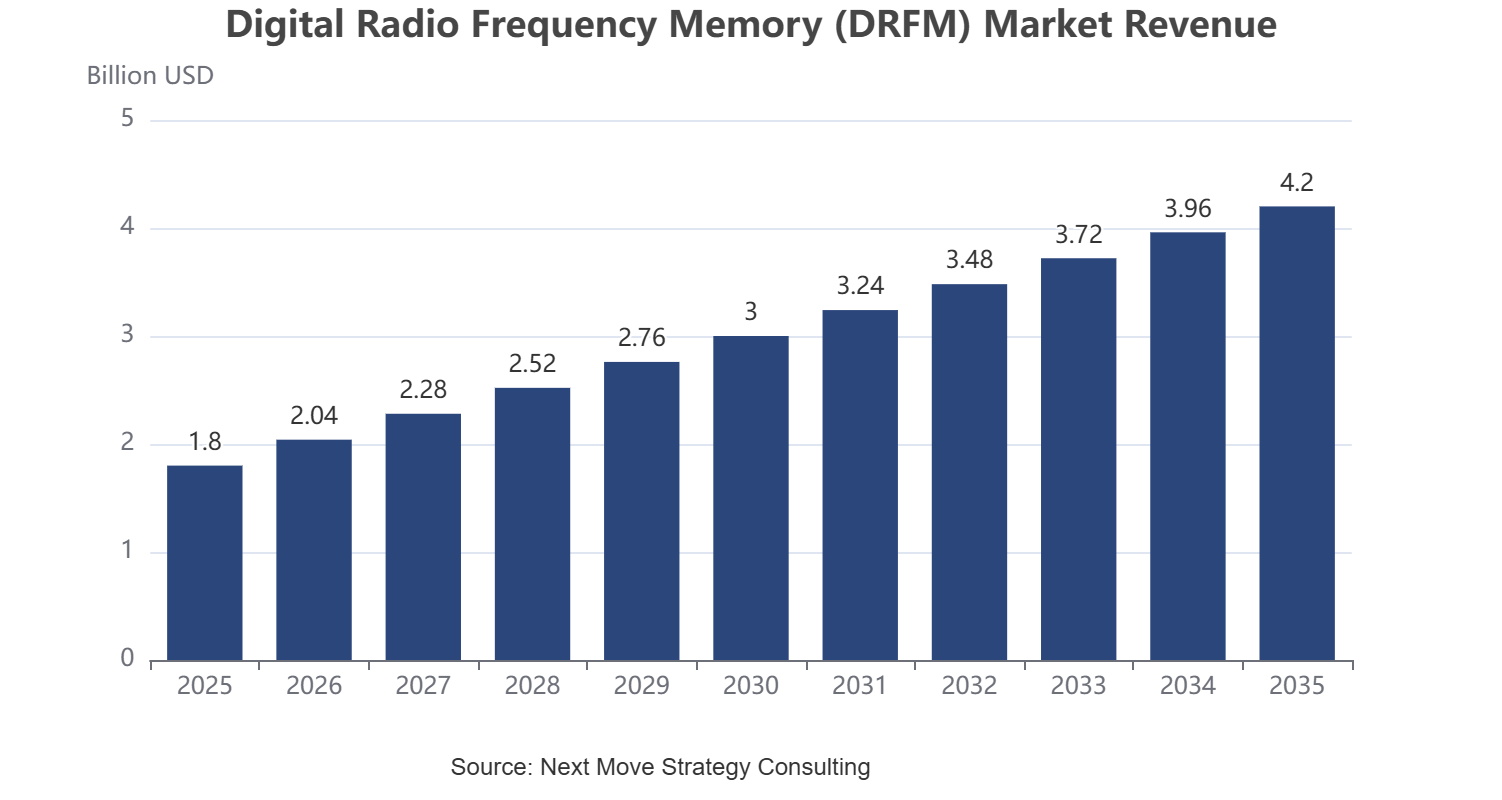
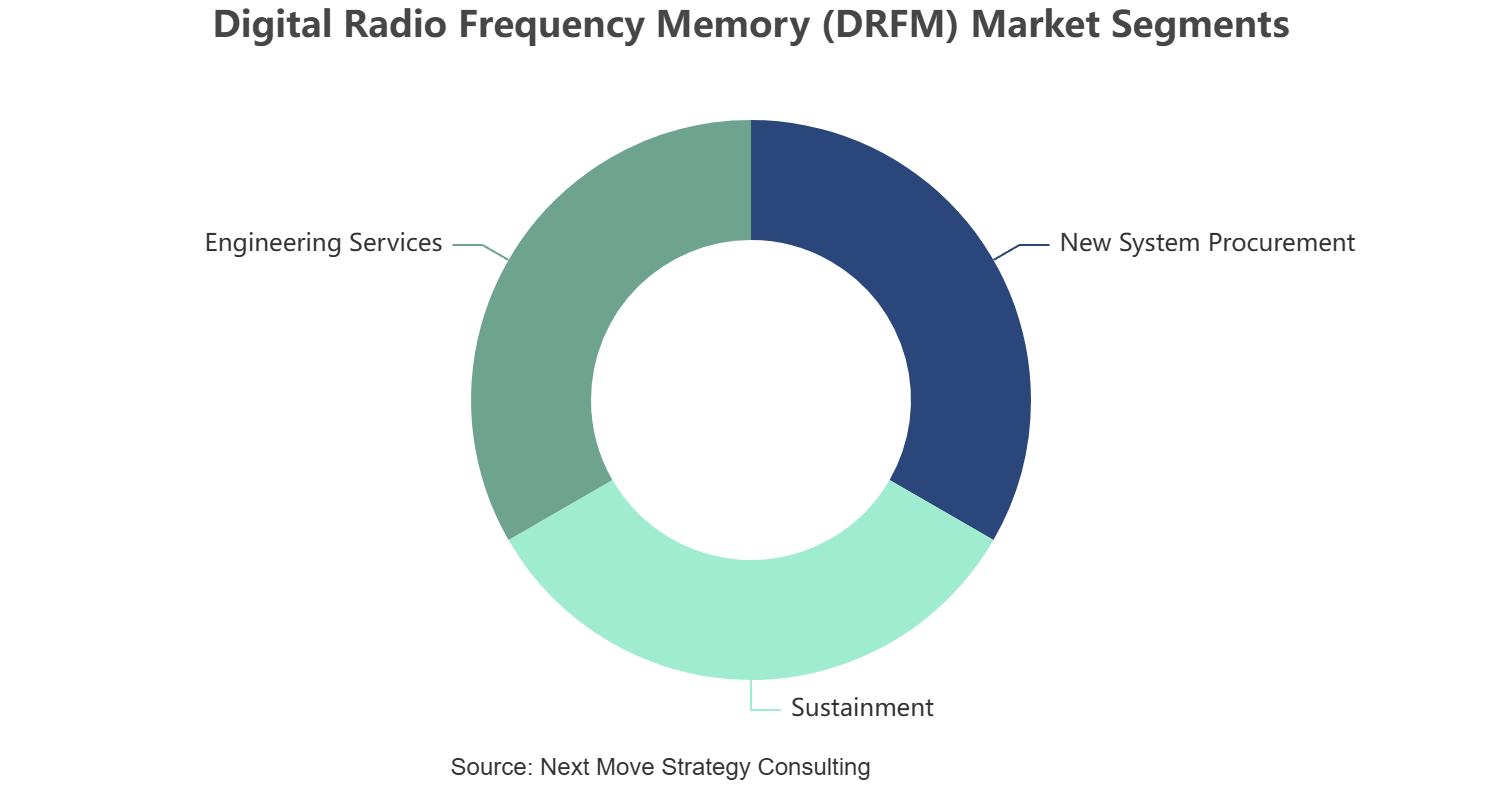
About the Author
 Mihul Sharma
— Mihul Sharma is Research Associate at Next Move Strategy Consulting, where he has covered technology, industrial, and healthcare markets for 3 years. His work applies structured business research, market analysis, and secondary-source review to assess market trends, competitive developments, and growth opportunities. He supports report development by fully synthesizing industry data, company information, and market signals into concise findings for strategy and investment-focused research teams.
Mihul Sharma
— Mihul Sharma is Research Associate at Next Move Strategy Consulting, where he has covered technology, industrial, and healthcare markets for 3 years. His work applies structured business research, market analysis, and secondary-source review to assess market trends, competitive developments, and growth opportunities. He supports report development by fully synthesizing industry data, company information, and market signals into concise findings for strategy and investment-focused research teams.
About the Reviewer
 Supradip Baul
— Supradip Baul is an accomplished business consultant and strategist with over a decade of rich experience in market intelligence, strategy, technology, and business transformation. His work has included rigorous qualitative and quantitative analysis across multiple industries, helping clients shape investment decisions and long-term roadmaps. Earlier in his career, he was associated with Gartner, where he contributed to industry-leading reports and market share analyses. He has worked with leading global companies and holds an MBA with a dual specialization in Marketing and Finance.
Supradip Baul
— Supradip Baul is an accomplished business consultant and strategist with over a decade of rich experience in market intelligence, strategy, technology, and business transformation. His work has included rigorous qualitative and quantitative analysis across multiple industries, helping clients shape investment decisions and long-term roadmaps. Earlier in his career, he was associated with Gartner, where he contributed to industry-leading reports and market share analyses. He has worked with leading global companies and holds an MBA with a dual specialization in Marketing and Finance.
At Next Move Strategy Consulting, we understand that insightful market research is the cornerstone of successful business decisions. That's why we employ a robust and multifaceted approach, combining various methodologies to deliver the most accurate and actionable data for our clients.

Research Landscape
We navigate the world of research with two primary approaches:
Qualitative Approach
Our qualitative research methodologies involve immersive techniques such as in-depth interviews, focus groups, and observational studies. By engaging directly with individuals and stakeholders, we uncover valuable insights that quantitative data alone may overlook.

Quantitative Research
In tandem with qualitative methodologies, NMSC leverages the power of Quantitative Research to provide a robust foundation of numerical insights. Through systematic data collection and analysis, we quantify patterns, preferences, and market trends, offering a comprehensive view of the business landscape.
Our quantitative research approach employs diverse tools, including surveys, experiments, and statistical modelling. These methodologies enable us to gather data from a large and representative sample, ensuring the statistical significance of our findings. By employing structured questionnaires and standardized data collection methods, we guarantee the reliability and validity of the information we present to our clients.
Quantitative research is particularly effective in measuring the prevalence of trends, assessing market size, and gauging the impact of various factors on consumer behavior. The numerical precision attained through this approach equips our clients with actionable insights, facilitating data-driven decision-making and strategy formulation.


Our Specialized Toolbox for Industry-Specific Market Research
We deploy a specialized arsenal of techniques tailored to meet your unique requirements. Here's a glimpse into our comprehensive toolbox:

Information Procurement
The stage entails acquiring market data or relevant information through various sources and methodologies.


Market Research Approach
We utilize both top-down and bottom-up approaches in market research analysis to achieve a comprehensive understanding of the market dynamics, leveraging the broad perspective of industry trends and macroeconomic factors alongside detailed insights from specific segments and individual companies.

Porters Five Forces Analysis
We conduct Porter's Five Forces analysis to evaluate the competitive landscape of an industry, providing us with insights into factors that affect profitability and strategic positioning.

SWOT Analysis

Forecasting
We utilize a forecasting model to predict future consumption by considering parameters like population, economics, regulations, market competition, drivers, constraints, technology, and pricing. We also employ statistical techniques such as multilinear regression, exponential smoothing, moving average, ARIMA, and Monte Carlo simulations for accurate predictions. In econometric forecasting, we analyzed short-term and long-term event impacts, attributing values based on regulatory frameworks, economic factors, and market events.





 Speak to Our Analyst