In-Memory Database Market Size, Share, Growth & Forecast by Product Family (Relational In-Memory Database, Distributed SQL, Key-Value Store, Data Grid, Multi-Model Operational Database, Embedded Database), Deployment (On-Premises, Public Cloud, Private Cloud, Hybrid Cloud, Embedded), Commercial Model, Buyer Type, Workload (OLTP, Caching, HTAP, Event Processing, Analytics, AI Retrieval), and End Use Industry — Global Analysis 2025-2035
Industry: ICT & Media | Publishing Date: June 26, 2026 | Last Updated: September 10, 2026 | No of Pages: N/A | No. of Tables: N/A | No. of Figures: N/A | Format: PDF | Report Code: IC4809
What Is the In-Memory Database Market Size?
The global In-Memory Database Market was valued at USD 8.6 billion in 2025 and is expected to reach USD 10.1 billion in 2026. Accelerating enterprise adoption of real-time analytics, AI-driven workloads, and cloud-native architectures is projected to propel the market to USD 42.3 billion by 2035, at a CAGR of 17.3% from 2026 to 2035. Key growth drivers include the rapid proliferation of low-latency OLTP and HTAP workloads, increasing deployment of in-memory caching layers in digital commerce, rising demand for AI retrieval infrastructure including vector search, and the migration of mission-critical applications to cloud-native in-memory platforms across the BFSI, telecom, and retail sectors.
|
Parameters |
Details |
|
Market Size in 2025 |
USD 8.6 Billion |
|
Market Size in 2026 |
USD 10.1 Billion |
|
Revenue Forecast in 2035 |
USD 42.3 Billion |
|
Growth Rate |
CAGR of 17.3% from 2026 to 2035 |
|
Analysis Period |
2025–2035 |
|
Base Year Considered |
2025 |
|
Forecast Period |
2026–2035 |
|
Market Size Estimation |
Billion USD |
|
Companies Profiled |
12 |
|
Countries Covered |
38 |
|
Market Share |
Top 10 |
In-Memory Database Market Overview
What Is the In-Memory Database Market?
The In-Memory Database (IMDB) Market encompasses software platforms and engines that store and process data primarily within a system's main memory (RAM) rather than on traditional disk-based storage. This architectural approach dramatically reduces data retrieval and write latency, enabling microsecond-to-millisecond response times for transactional, analytical, and mixed workloads. In-memory databases support a wide spectrum of deployment models including on-premises, public cloud, private cloud, hybrid cloud, and embedded environments. They serve workloads spanning OLTP, caching, HTAP, event processing, session state management, analytics, AI retrieval, and embedded control systems, making them foundational infrastructure for modern digital enterprises.
How Has the In-Memory Database Market Evolved?
The In-Memory Database Market has progressed through several distinct architectural phases. The first generation focused on relational in-memory databases targeting financial trading systems and telecom billing requiring deterministic sub-millisecond latency. The second phase introduced distributed key-value stores and data grids, epitomized by Redis and Hazelcast, enabling horizontal scaling across commodity hardware clusters. NMSC's analysis indicates that the current phase centers on multi-model in-memory platforms capable of simultaneously handling transactional, caching, analytical, and AI retrieval workloads, with cloud-native deployment models enabling elastic scaling. The integration of vector search capabilities for AI inference retrieval represents the frontier of market evolution.
How Do Regulations Influence the In-Memory Database Market?
Regulatory frameworks significantly shape investment patterns and deployment architectures within the In-Memory Database Market. Financial services regulations, including Basel III capital adequacy requirements, MiFID II real-time trade reporting mandates, and the Dodd-Frank Act's intraday risk monitoring obligations, drive BFSI adoption of low-latency in-memory OLTP platforms. The EU's GDPR, the California Consumer Privacy Act, and equivalent data protection regulations worldwide compel vendors to embed data encryption at rest and in memory, access audit logging, and data residency controls within their in-memory database products. Healthcare data protection requirements under HIPAA in the United States further drive secure in-memory session management investment.
How Is Technology Adoption Expanding Across the In-Memory Database Market?
Technology adoption within the In-Memory Database Market is broadening as cloud-native deployment models lower the barriers to enterprise-grade in-memory infrastructure. Managed in-memory database services on AWS (ElastiCache, MemoryDB), Microsoft Azure (Azure Cache for Redis, Azure SQL Hyperscale), and Google Cloud (Cloud Memorystore) are accelerating adoption among mid-market organizations that previously lacked the hardware investment capacity for on-premises in-memory deployments. From our research, we found that the convergence of HTAP architectures enabling simultaneous transactional and analytical processing within a single in-memory engine is reducing the need for separate operational and analytical data stores, fundamentally simplifying enterprise data architectures.
|
Key Takeaways |
|
By product family, Relational In-Memory Database held the largest share of the In-Memory Database Market at USD 2.8 billion in 2025, driven by SAP HANA and Oracle In-Memory Database deployments in BFSI and enterprise resource planning workloads. The Key-Value Store segment is the fastest-growing sub-segment, projected to expand from USD 1.9 billion in 2025 to USD 10.2 billion by 2035 at a CAGR of 18.3%, fueled by demand for Redis-compatible caching and AI session state management platforms. |
|
By deployment, Public Cloud commanded the largest share at USD 3.8 billion in 2025, representing approximately 44% of total market revenue. Hybrid Cloud is the fastest-growing deployment mode in the In-Memory Database Market at a CAGR of 19.1% from 2026 to 2035, driven by enterprises requiring seamless workload portability between on-premises in-memory clusters and cloud-native managed services. |
|
By commercial model, Subscription accounted for USD 2.9 billion in 2025, the largest revenue share in the In-Memory Database Market. The Consumption model is the fastest-growing at a CAGR of 20.4% from 2026 to 2035, as cloud-managed in-memory database services align billing with actual memory utilization and request volumes. |
|
By buyer type, Enterprise IT held USD 3.4 billion in 2025. Platform Engineering is the fastest-growing buyer segment at a CAGR of 19.6% from 2026 to 2035, as internal platform teams independently procure and standardize in-memory database layers for developer self-service infrastructure. |
|
By workload, Caching led at USD 2.6 billion in 2025, reflecting the ubiquity of Redis-based caching layers across web applications and API services. AI Retrieval is the fastest-growing workload type in the In-Memory Database Market at a CAGR of 24.8% from 2026 to 2035, driven by the rapid adoption of vector indexing and retrieval-augmented generation infrastructure. |
|
By end use industry, BFSI held USD 2.2 billion in 2025 and is forecast to reach USD 9.8 billion by 2035 at a CAGR of 16.1%. Technology and Software is the fastest-growing vertical in the In-Memory Database Market at a CAGR of 19.2%, advancing from USD 1.4 billion in 2025 to USD 7.8 billion by 2035. |
|
North America held the largest regional share at USD 3.8 billion in 2025, projected to reach USD 18.2 billion by 2035 at a CAGR of 17.0%, anchored by leading in-memory database vendors, the highest enterprise technology budgets, and mature cloud infrastructure deployment. |
|
Asia-Pacific is the fastest-growing major region in the In-Memory Database Market at a CAGR of 20.1%, propelled by rapid digital transformation in India, China's industrial internet expansion, and Southeast Asia's growing cloud-native application ecosystem. The United States represents the single largest country market, accounting for over 75% of North American revenue in 2025. |
|
The United States dominated the In-Memory Database Market in 2025, accounting for the largest share of global revenue. Its leadership is supported by the presence of major database and cloud technology providers, extensive enterprise IT spending, widespread adoption of real-time analytics, and strong deployment of in-memory computing solutions across industries such as finance, healthcare, retail, and telecommunications. The country's advanced cloud infrastructure and high demand for low-latency data processing continue to strengthen its position as the largest national market for in-memory databases. |
|
China is projected to be the fastest-growing country in the In-Memory Database Market during the forecast period. Growth is driven by large-scale digital transformation initiatives, rapid expansion of industrial internet platforms, increasing adoption of cloud-native applications, and growing investments in artificial intelligence and big data analytics. Government-backed digital economy programs and the rising demand for high-performance database systems across manufacturing, e-commerce, financial services, and smart city projects are accelerating the adoption of in-memory database technologies throughout the country. |
Key Emerging Trends in the In-Memory Database Market
How Is the Convergence of HTAP Architectures Reshaping the In-Memory Database Market?
HTAP (Hybrid Transactional/Analytical Processing) architectures are fundamentally redefining the structural boundaries of the In-Memory Database Market by eliminating the traditional separation between operational and analytical data stores. Through our market assessment, we observed that vendors including SingleStore, SAP HANA, and Oracle Database In-Memory have achieved production-grade HTAP capabilities that enable organizations to run complex analytical queries directly against live transactional data without batch ETL pipelines. For example, global retail banks are leveraging HTAP in-memory engines to calculate intraday risk exposure across millions of live trades simultaneously with customer onboarding OLTP workloads, reducing operational complexity and improving decision velocity.
How Is Generative AI Driving Demand for In-Memory Vector Search Within the In-Memory Database Market?
The rapid enterprise adoption of generative AI and retrieval-augmented generation (RAG) architectures is creating a structurally new demand category within the In-Memory Database Market centered on in-memory vector indexing and similarity search. Based on our market evaluation, we noticed that organizations deploying large language models require high-throughput, low-latency retrieval of semantically relevant document embeddings from vector indexes maintained in memory. Vendors including Redis, Aerospike, and SingleStore have introduced native vector search capabilities within their in-memory engines, positioning themselves as foundational AI retrieval infrastructure. This trend is driving the AI Retrieval workload category toward the highest CAGR of 24.8% within the market through 2035.
What Role Is Cloud-Native Managed In-Memory Services Playing in the Democratization of the In-Memory Database Market?
Cloud-native managed in-memory database services are systematically lowering the adoption barrier that previously restricted enterprise-grade in-memory infrastructure to organizations with substantial capital expenditure budgets. Our findings suggest that hyperscaler-managed services such as AWS ElastiCache, Azure Cache for Redis, and Google Cloud Memorystore provide fully managed provisioning, patching, replication, and failover, abstracting the operational complexity of distributed in-memory cluster management. This shift is enabling mid-market and SMB organizations to consume in-memory database capabilities on a consumption basis, directly contributing to the Public Cloud segment's 44% market share dominance in 2025 and its continued expansion through 2035.
How Is the Rise of Multi-Model In-Memory Databases Transforming Enterprise Data Architecture in This Market?
Multi-model in-memory databases that simultaneously support key-value, document, graph, time-series, and relational data models within a single engine are displacing narrowly specialized point solutions across enterprise data architectures. NMSC's analysis indicates that organizations across e-commerce, gaming, and financial services are consolidating Redis, Cassandra, and relational databases onto unified multi-model in-memory platforms to reduce operational overhead and inter-system data movement latency. Couchbase and Aerospike exemplify this trend by expanding their core key-value engines to support SQL querying, document storage, and vector search within a single clustered in-memory platform, streamlining developer experience and reducing infrastructure cost.
What Are the Key Market Drivers, Breakthroughs, and Investment Opportunities that will Shape the In-Memory Database Market Industry in the Next Decade?
|
Drivers / Trends / Restraints |
(+/-) % Impact on CAGR Forecast |
Geographic Relevance |
Impact Timeline |
|
Generative AI and Vector Search Demand |
+2.4% |
Global (led by North America, APAC) |
2025-2030 |
|
HTAP Architecture Adoption |
+1.8% |
North America, Europe, APAC |
2025-2032 |
|
Cloud-Native Managed In-Memory Services |
+1.6% |
Global |
2025-2030 |
|
Real-Time Financial Risk and Fraud Analytics |
+1.2% |
North America, Europe |
2025-2035 |
|
Telecom 5G Session State Management |
+0.9% |
APAC, Europe, MEA |
2026-2035 |
|
High Memory Hardware Costs for On-Premises Deployments |
-1.1% |
SMB, Mid-market globally |
2025-2028 |
|
Data Persistence and Durability Concerns |
-0.8% |
All regions |
Ongoing |
|
Multi-Model Operational Database Consolidation |
+1.4% |
Global |
2026-2035 |
|
Embedded In-Memory in IoT and Automotive |
+1.1% |
Europe, APAC, North America |
2026-2035 |
|
Open-Source Redis Fragmentation |
-0.6% |
North America, Europe |
2025-2030 |
What Are the Growth Drivers of the In-Memory Database Market?
How Is the Explosion of Real-Time Transactional and Analytical Workloads Driving the In-Memory Database Market Growth?
The proliferation of real-time digital commerce, financial services, and telecommunications applications requiring microsecond-to-millisecond data access latency is the primary structural driver of the In-Memory Database Market. Based on NMSC's research, we found that the U.S. Federal Reserve's real-time gross settlement system processes millions of payment transactions daily, each requiring deterministic sub-second account balance lookups that only in-memory databases can reliably support at scale. Globally, the migration from batch-oriented business processing to event-driven, always-on digital architectures is compelling enterprises across every vertical to adopt in-memory database layers as non-negotiable performance infrastructure.
How Is the Rapid Adoption of AI and Machine Learning Workloads Fueling the In-Memory Database Market Demand?
Artificial intelligence and machine learning inference workloads impose strict latency requirements on the data retrieval layer that position in-memory databases as essential AI infrastructure. Our assessment indicates that online AI inference serving for recommendation engines, fraud scoring, and dynamic pricing models requires feature retrieval from in-memory feature stores in under five milliseconds to meet user-facing latency budgets. The National Institute of Standards and Technology's AI Risk Management Framework references the importance of low-latency, governed data access for trustworthy AI systems, indirectly elevating the architectural importance of in-memory databases within enterprise AI stacks. Demand for vector search capabilities further reinforces in-memory adoption as the AI retrieval layer.
How Is the Global 5G Network Expansion Creating Structural Demand for In-Memory Databases in the Telecom Sector?
The global rollout of 5G networks is generating massive new volumes of session state, subscriber profile, and network function data that require ultra-low-latency in-memory storage to support 5G core network operations. From our research, we found that the International Telecommunication Union (ITU) has identified sub-millisecond control plane latency as a core 5G performance requirement, directly necessitating in-memory database deployments for subscriber data management and charging function operations. Telecom equipment vendors and network operators across South Korea, Japan, China, and Europe are deploying Redis and proprietary in-memory platforms as 5G subscriber data management layers, creating a durable multi-year demand driver for the In-Memory Database Market.
What Are the Growth Inhibitors of the In-Memory Database Market?
How Do High Memory Hardware Costs and Scalability Constraints Limit In-Memory Database Market Adoption?
Despite declining DRAM prices, the cost of provisioning sufficient main memory capacity for large-scale in-memory database deployments remains a significant adoption barrier, particularly for SMB and mid-market organizations managing multi-terabyte datasets. Our analysis shows that provisioning a 10-terabyte in-memory database cluster on-premises requires substantial server-grade DRAM investment that far exceeds equivalent disk-based database infrastructure. The U.S. Department of Energy's Advanced Scientific Computing Research program has documented memory capacity as a persistent constraint for large-scale computational workloads, reflecting a systemic challenge that also affects commercial in-memory database deployments. This cost barrier extends sales cycles and limits near-term penetration among smaller enterprise buyers.
How Do Data Persistence and Durability Concerns Constrain the Adoption of In-Memory Databases for Mission-Critical Workloads?
The inherent volatility of RAM storage raises legitimate data durability concerns that slow adoption of in-memory databases for workloads where data loss is unacceptable. While modern in-memory database platforms implement persistence mechanisms including append-only file logging, write-ahead logging, and periodic snapshotting, these approaches introduce performance trade-offs and recovery complexity that require careful architectural planning. Based on our engagements with enterprise buyers, we found that financial services organizations subject to stringent regulatory record-keeping requirements under SEC Rule 17a-4 and MiFID II are particularly cautious about relying solely on in-memory storage for audit-relevant transactional records, often maintaining hybrid architectures with secondary disk-based persistence layers.
What Are the Growth Opportunities in the In-Memory Database Market?
How Does the Embedding of In-Memory Databases in Edge and IoT Architectures Create a Multi-Billion Dollar Opportunity?
The rapid proliferation of edge computing deployments and industrial IoT sensor networks is creating a substantial growth opportunity for embedded and lightweight in-memory database engines optimized for resource-constrained devices. Through NMSC's assessment, we found that the Industrial Internet Consortium has identified real-time data processing at the edge as a foundational requirement for Industry 4.0 manufacturing architectures, directly driving demand for embedded in-memory engines capable of operating within programmable logic controllers, industrial gateways, and autonomous vehicle compute platforms. Automotive OEMs including those developing ADAS (Advanced Driver Assistance Systems) require in-memory databases for real-time sensor fusion and decision-making, representing a structurally significant embedded market expansion.
How Is the Open Banking and Real-Time Payments Infrastructure Creating New Demand for In-Memory Database Deployments?
Open banking regulatory frameworks and real-time payment infrastructure mandates are creating durable demand for in-memory database deployments within BFSI institutions globally. The Bank for International Settlements' CPMI has identified real-time gross settlement and instant payment systems as core global financial infrastructure, with payment processing platforms across the United States (FedNow), Europe (SEPA Instant), India (UPI), and Brazil (PIX) each requiring in-memory database layers for account balance validation and transaction deduplication at payment execution speeds. Our findings suggest that financial institutions upgrading legacy payment systems to comply with real-time payment mandates represent a high-conviction enterprise buyer segment for the In-Memory Database Market through 2035.
How Does the Expansion of AI-Native Application Development Create a Structural Opportunity for In-Memory Database Vendors?
The emergence of AI-native application development as a mainstream enterprise software paradigm is creating a structural opportunity for in-memory database vendors that can position their platforms as the performance backbone of AI inference serving infrastructure. Based on NMSC's research, we found that the U.S. National AI Initiative Act emphasizes the importance of high-performance computing infrastructure for maintaining national AI competitiveness, indirectly supporting federal investment in low-latency data access infrastructure. In-memory database vendors offering native vector search, feature store capabilities, and sub-millisecond AI feature retrieval are positioned to capture premium pricing from AI application development teams, representing a high-growth market expansion opportunity beyond traditional database buyers.
Ecosystem Analysis of the In-Memory Database Market
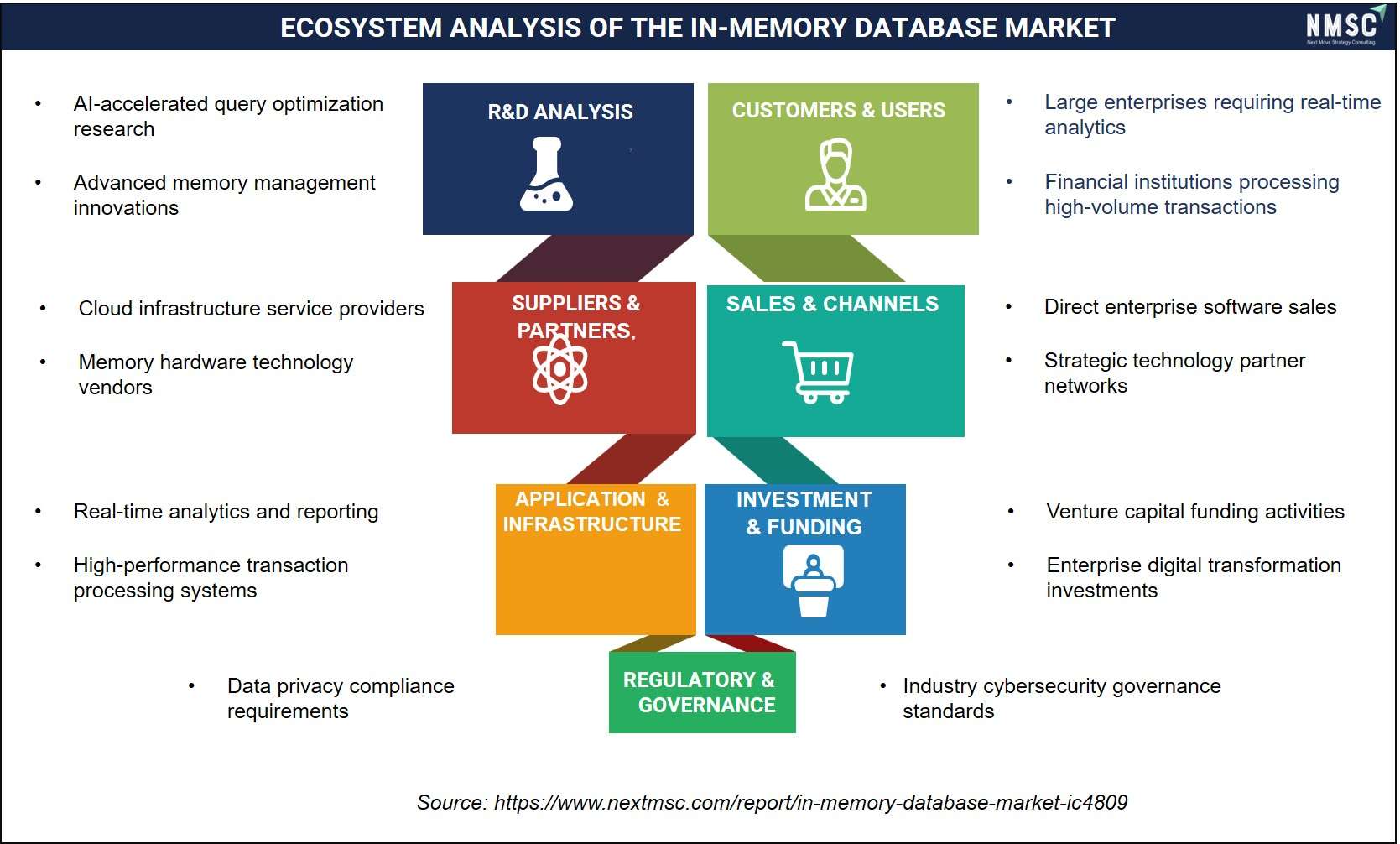
The in-memory database market ecosystem is driven by continuous R&D investments, technology suppliers, cloud infrastructure providers, and strategic funding initiatives that support innovation in real-time data processing. The chart highlights the interconnected roles of suppliers & partners, application infrastructure, sales channels, regulatory frameworks, and end users. Demand is primarily generated by large enterprises and financial institutions that require ultra-low latency, high-speed transaction processing, and real-time analytics to support mission-critical business operations and digital transformation initiatives.
How Is the In-Memory Database Market Segmented in This Report, and What Are the Key Insights from the Segmentation Analysis?
How Do Different Product Families Define the Competitive Boundaries of the In-Memory Database Market?
|
Product Family Segment |
2025 (USD Bn) |
2035 (USD Bn) |
CAGR (%) |
|
Relational In-Memory Database |
2.8 |
12.1 |
15.7% |
|
Distributed SQL |
0.8 |
4.6 |
19.2% |
|
Key-Value Store |
1.9 |
10.2 |
18.3% |
|
Data Grid |
0.9 |
4.1 |
16.4% |
|
Multi-Model Operational Database |
1.1 |
6.4 |
19.3% |
|
Embedded Database |
0.7 |
3.8 |
18.5% |
|
Other |
0.4 |
1.1 |
10.6% |
Based on our analysis of enterprise database procurement and cloud-native application development trends, the In-Memory Database Market is structured across Relational In-Memory Database, Distributed SQL, Key-Value Store, Data Grid, Multi-Model Operational Database, Embedded Database, and Other product families. The Relational In-Memory Database segment dominates, generating USD 2.8 billion in 2025, with SAP HANA and Oracle Database In-Memory driving adoption in ERP, financial consolidation, and real-time risk analytics workloads that demand SQL compatibility alongside in-memory performance. Key-Value Store is the second-largest segment at USD 1.9 billion, anchored by Redis and its enterprise-licensed derivatives, while Multi-Model Operational Databases are the fastest-growing product family at a CAGR of 19.3%, reflecting enterprises' preference for consolidating multiple data model requirements within a single in-memory engine rather than maintaining separate specialized systems.
Which Deployment Models Are Reshaping the Architecture of the In-Memory Database Market?
|
Deployment Segment |
2025 (USD Bn) |
2035 (USD Bn) |
CAGR (%) |
|
On-Premises |
2.4 |
8.6 |
13.6% |
|
Public Cloud |
3.8 |
19.2 |
17.6% |
|
Private Cloud |
1.2 |
5.8 |
17.0% |
|
Hybrid Cloud |
0.8 |
4.7 |
19.1% |
|
Embedded |
0.4 |
4.0 |
25.8% |
Through our market assessment, we observed that the In-Memory Database Market's deployment landscape spans On-Premises, Public Cloud, Private Cloud, Hybrid Cloud, and Embedded configurations. Public Cloud leads at USD 3.8 billion in 2025, driven by managed services from AWS, Azure, and Google Cloud that abstract operational complexity and enable elastic scaling of in-memory capacity. On-Premises remains significant at USD 2.4 billion, sustained by latency-sensitive financial trading, telecom core network, and government workloads requiring deterministic microsecond performance that managed cloud services cannot consistently guarantee. The Embedded segment, though smallest at USD 0.4 billion in 2025, is the fastest-growing deployment category at a CAGR of 25.8%, propelled by automotive ADAS, industrial IoT edge controllers, and 5G network function virtualization deployments requiring in-memory processing within constrained hardware environments.
How Do Commercial Licensing Models Reflect the Maturity Evolution of the In-Memory Database Market?
|
Commercial Model |
2025 (USD Bn) |
2035 (USD Bn) |
CAGR (%) |
|
Perpetual License |
1.4 |
4.2 |
11.6% |
|
Subscription |
2.9 |
13.8 |
16.9% |
|
Consumption |
1.6 |
9.4 |
20.4% |
|
Support and Maintenance |
1.8 |
7.2 |
14.9% |
|
OEM and Embedded Licensing |
0.9 |
7.7 |
24.0% |
Based on our evaluation of vendor revenue models and enterprise procurement patterns, the In-Memory Database Market is commercially structured across Perpetual License, Subscription, Consumption, Support and Maintenance, and OEM and Embedded Licensing models. The Subscription segment dominates at USD 2.9 billion in 2025, reflecting the broad enterprise shift toward recurring software cost models that align cash outflow with usage and enable more predictable IT budgeting. The Consumption model at USD 1.6 billion represents the fastest commercially growing model at a CAGR of 20.4%, aligned with cloud-native billing paradigms where memory utilization and request processing volumes directly drive vendor revenue. OEM and Embedded Licensing is the highest-CAGR commercial model at 24.0%, driven by automotive OEMs, industrial automation vendors, and network equipment manufacturers embedding in-memory engines as firmware-level components within their products.
Which Buyer Archetypes Are Shaping Procurement Dynamics in the In-Memory Database Market?
|
Buyer Type |
2025 (USD Bn) |
2035 (USD Bn) |
CAGR (%) |
|
Enterprise IT |
3.4 |
15.6 |
16.4% |
|
Developer-Led Teams |
1.6 |
8.4 |
18.0% |
|
Platform Engineering |
1.2 |
7.2 |
19.6% |
|
OEM and Embedded Partners |
1.4 |
7.9 |
18.9% |
|
Public Sector |
1.0 |
3.2 |
12.3% |
Our findings suggest that the In-Memory Database Market is served by five distinct buyer archetypes: Enterprise IT, Developer-Led Teams, Platform Engineering, OEM and Embedded Partners, and Public Sector organizations. Enterprise IT remains the largest buyer at USD 3.4 billion in 2025, procuring in-memory databases as centrally governed infrastructure for production OLTP, analytics, and caching workloads. Platform Engineering teams are the fastest-growing buyer segment at a CAGR of 19.6%, as internal infrastructure engineering organizations independently select and standardize in-memory database technologies for developer self-service internal developer platforms. Developer-Led Teams are increasingly significant buyers in cloud-native application contexts, selecting Redis-compatible services through cloud marketplaces without formal central IT involvement.
How Does Workload Diversity Define the Revenue Architecture of the In-Memory Database Market?
|
Workload |
2025 (USD Bn) |
2035 (USD Bn) |
CAGR (%) |
|
OLTP |
1.8 |
7.9 |
16.0% |
|
Caching |
2.6 |
11.4 |
15.9% |
|
HTAP |
0.9 |
4.8 |
18.3% |
|
Event Processing |
0.7 |
3.6 |
17.8% |
|
Session State |
0.9 |
3.8 |
15.5% |
|
Analytics |
0.6 |
3.2 |
18.2% |
|
AI Retrieval |
0.4 |
4.6 |
24.8% |
|
Embedded Control |
0.5 |
2.6 |
17.9% |
|
Other |
0.2 |
0.4 |
7.2% |
Based on NMSC's research, the In-Memory Database Market supports nine distinct workload categories, each reflecting a unique performance requirement profile. Caching leads at USD 2.6 billion in 2025, representing the most universally deployed in-memory database use case across web applications, API gateways, and content delivery systems. OLTP is the second-largest workload at USD 1.8 billion, driven by financial transaction processing, e-commerce order management, and telecom billing platforms. AI Retrieval is decisively the fastest-growing workload at a CAGR of 24.8%, expanding from USD 0.4 billion in 2025 to USD 4.6 billion by 2035, as vector indexing and similarity search become foundational components of enterprise AI inference stacks. HTAP and Event Processing workloads are both growing at approximately 18% CAGR, reflecting enterprises' desire for unified in-memory platforms that eliminate data movement latency across operational and analytical processing boundaries.
Which Industries Are Generating the Most Value Within the In-Memory Database Market?
|
End Use Industry |
2025 (USD Bn) |
2035 (USD Bn) |
CAGR (%) |
|
BFSI |
2.2 |
9.8 |
16.1% |
|
Technology and Software |
1.4 |
7.8 |
19.2% |
|
Telecom |
1.1 |
5.2 |
16.8% |
|
Retail and E-commerce |
0.9 |
4.6 |
17.7% |
|
Manufacturing |
0.6 |
2.8 |
16.7% |
|
Public Sector |
0.5 |
1.8 |
13.7% |
|
Healthcare |
0.5 |
2.4 |
17.0% |
|
Media and Entertainment |
0.4 |
2.0 |
17.5% |
|
Transport and Logistics |
0.5 |
2.4 |
17.0% |
|
Automotive and IoT |
0.3 |
2.6 |
24.0% |
|
Other |
0.2 |
0.9 |
16.2% |
Through our analysis of enterprise database adoption patterns across industries, the In-Memory Database Market is distributed across BFSI, Technology and Software, Telecom, Retail and E-commerce, Manufacturing, Public Sector, Healthcare, Media and Entertainment, Transport and Logistics, Automotive and IoT, and Other end use verticals. BFSI dominates at USD 2.2 billion in 2025, driven by real-time trading systems, payment processing engines, fraud detection platforms, and regulatory risk reporting workloads that demand in-memory performance. Technology and Software is the fastest-growing major vertical at a CAGR of 19.2%, as software companies embed in-memory caching, AI retrieval, and session state management within their own product architectures. Automotive and IoT represents the highest individual vertical CAGR at 24.0%, reflecting the structural adoption of embedded in-memory engines within connected vehicle platforms and industrial IoT edge systems.
Regional Outlook
Geographic Performance Snapshot
|
Region |
2025 (USD Bn) |
2035 (USD Bn) |
CAGR (%) |
Key Driver |
|
North America |
3.8 |
18.2 |
17.0% |
Leading vendor HQ, financial sector OLTP, AI adoption |
|
Europe |
2.1 |
9.8 |
16.6% |
GDPR-compliant deployments, BFSI real-time processing |
|
Asia-Pacific |
1.8 |
10.6 |
20.1% |
5G telecom, digital banking, cloud-native adoption |
|
Middle East & Africa |
0.5 |
2.2 |
16.0% |
Vision 2030 digitization, smart city infrastructure |
|
Latin America |
0.4 |
1.5 |
14.2% |
Digital banking, e-commerce real-time personalization |
North America In-Memory Database Market
North America is the dominant region in the global In-Memory Database Market, contributing USD 3.8 billion in 2025 and forecast to reach USD 18.2 billion by 2035 at a CAGR of 17.0%. The region benefits from the headquarters of the leading in-memory database vendors including Redis Ltd., SingleStore, Aerospike, InterSystems, Hazelcast, and KX Systems, alongside hyperscaler managed service platforms from AWS, Microsoft, and Google. Mature enterprise technology budgets within financial services, technology, and retail sectors drive consistent in-memory database procurement. Regulatory requirements including SEC real-time trade reporting mandates and FedNow real-time payment infrastructure create durable BFSI demand.
U.S. In-Memory Database Market
Based on our engagements with enterprise buyers, the United States represents over 75% of North American market revenue in 2025 and is the world's single largest national in-memory database market. The U.S. benefits from the world's highest concentration of financial trading systems, digital commerce platforms, and AI-native application developers requiring low-latency data access. The U.S. Federal Reserve's FedNow instant payment system, launched in 2023, compels participating financial institutions to deploy in-memory processing layers for real-time transaction validation. The Department of Defense's Joint Warfighting Cloud Capability program creates federal demand for secure in-memory database deployments.
Canada In-Memory Database Market
Through our analysis, Canada represents approximately 16% of North American In-Memory Database Market revenue, driven by its significant financial services sector and growing technology industry in Toronto, Vancouver, and Montreal. Canadian financial institutions including RBC, TD Bank, and Scotiabank are significant enterprise in-memory database buyers for fraud detection, trading analytics, and real-time customer intelligence platforms. The Government of Canada's Digital Ambition strategy and cloud adoption mandate are driving public sector in-memory database investment. Canada's data residency requirements under PIPEDA influence deployment architecture selection, favoring Canadian cloud regions offered by AWS, Azure, and Google Cloud.
Mexico In-Memory Database Market
From our assessment, Mexico is the fastest-growing In-Memory Database Market within North America, advancing at a CAGR of 19.2%, driven by a rapidly expanding fintech ecosystem, nearshoring-driven manufacturing digitization, and growing e-commerce sector adoption of real-time personalization platforms. The Comision Nacional Bancaria y de Valores (CNBV) financial digitization initiatives are driving Mexican bank technology investment. OXXO Pay, Mercado Pago, and Clip represent leading fintech buyers of real-time in-memory caching and fraud detection infrastructure. Mexico's manufacturing sector, expanding through nearshoring investments, is driving industrial IoT and edge in-memory database adoption.
Europe In-Memory Database Market
Europe is the second-largest region in the In-Memory Database Market, contributing USD 2.1 billion in 2025 and forecast to reach USD 9.8 billion by 2035 at a CAGR of 16.6%. The region's regulatory environment, shaped by GDPR, the EU AI Act, and MiFID II real-time reporting requirements, drives structured investment in governed in-memory database deployments. SAP SE's headquarters in Walldorf, Germany, and its SAP HANA in-memory platform enjoy significant home market advantage. European financial services institutions face strict real-time risk reporting and transaction monitoring requirements that mandate low-latency in-memory processing infrastructure.
U.K. In-Memory Database Market
Based on our engagements, the United Kingdom is Europe's largest individual In-Memory Database Market, representing approximately 23% of European revenue in 2025. London's global financial center status makes BFSI the dominant buyer vertical, with investment banks, clearing houses, and algorithmic trading firms requiring deterministic microsecond-latency in-memory OLTP platforms. The Financial Conduct Authority's real-time market surveillance requirements drive adoption of high-throughput in-memory event processing systems. Post-Brexit, the UK maintains GDPR-equivalent standards through UK GDPR, with data adequacy decisions governing cross-border data flows that influence hybrid and sovereign cloud deployment architectures.
Germany In-Memory Database Market
According to our evaluation, Germany is Europe's second-largest In-Memory Database Market, strongly anchored by SAP HANA's dominant position in the enterprise ERP and S/4HANA deployment ecosystem. German manufacturing conglomerates including Siemens, BMW, and Volkswagen are significant in-memory database buyers for industrial IoT data processing, supply chain optimization, and real-time production analytics. The Federal Office for Information Security (BSI) cloud security guidelines shape enterprise cloud in-memory deployment architectures. Germany's industrial sector is also a major driver of embedded in-memory database adoption within programmable logic controllers and manufacturing execution systems.
France In-Memory Database Market
Through our analysis, France represents the third-largest European In-Memory Database Market, driven by strong financial services adoption and government digital transformation investment. BNP Paribas, Societe Generale, and Credit Agricole are major in-memory database buyers for trading infrastructure and real-time risk management platforms. The France 2030 investment plan is directing public sector technology spending that includes cloud data infrastructure. The CNIL enforces GDPR compliance stringently, driving French enterprises to select in-memory database platforms with robust encryption, access logging, and data residency controls appropriate for regulated financial data.
Italy In-Memory Database Market
Based on our assessment, Italy is a developing but growing In-Memory Database Market within Europe, with adoption concentrated in financial services, manufacturing, and telecommunications. Italian banks are implementing real-time fraud detection and payment processing platforms requiring in-memory database infrastructure aligned with Bank of Italy and European Central Bank regulatory requirements. The Piano Nazionale di Ripresa e Resilienza (PNRR) is directing investment toward enterprise digital modernization, including database infrastructure upgrades. UniCredit and Intesa Sanpaolo represent the largest Italian in-memory database buyers within the BFSI vertical.
Spain In-Memory Database Market
From our assessment, Spain shows consistent growth within the European In-Memory Database Market, driven by BFSI, retail, and telecommunications adoption. Banco Santander, BBVA, and CaixaBank are among the largest enterprise in-memory database buyers for real-time payment processing and fraud analytics. The Agenda Espana Digital 2026 is supporting digital transformation investment across the Spanish economy. Telefonica's telecommunications operations create significant demand for in-memory subscriber data management and 5G session state processing platforms. The AEPD enforces GDPR actively, influencing enterprise in-memory database architecture toward privacy-compliant deployment patterns.
Sweden In-Memory Database Market
Through our analysis, Sweden is among the most advanced digital economies in Europe within the In-Memory Database Market, supported by Ericsson's global telecommunications equipment operations and a sophisticated financial sector. Ericsson's 5G subscriber data management platforms are significant drivers of in-memory database adoption within the telecom vertical. Swedish banks and the e-krona central bank digital currency research initiative create demand for real-time payment infrastructure. The IMY (Integritetsskyddsmyndigheten) enforces GDPR compliance that drives enterprise in-memory database security investment. Sweden's advanced cloud adoption creates strong demand for public cloud in-memory managed services.
Denmark In-Memory Database Market
According to our evaluation, Denmark is a high-per-capita In-Memory Database Market consumer, driven by one of Europe's most digitally advanced economies and concentrated financial services and pharmaceutical sectors. Danish banks and pension funds are sophisticated buyers of real-time analytics and fraud detection in-memory platforms. The Novo Nordisk life sciences ecosystem creates healthcare data processing demand. The Danish Business Authority's digital company registry and e-government platforms represent structured public sector in-memory database buyers. Denmark's Datatilsynet actively enforces GDPR, driving compliance-driven enterprise database security investment.
Finland In-Memory Database Market
Based on our market evaluation, Finland's In-Memory Database Market is characterized by Nokia's significant telecommunications infrastructure operations creating enterprise in-memory database demand, alongside strong public sector digital transformation driven by the Finnish government's MyData initiative. Finnish banks and insurance companies are buyers of real-time fraud analytics platforms. The Office of the Data Protection Ombudsman enforces GDPR compliance. Finland's status as a growing European cloud data center hub, driven by favorable climate for energy-efficient cooling, is supporting cloud-native in-memory database service adoption within enterprise workloads.
Netherlands In-Memory Database Market
From our assessment, the Netherlands is a strategically important hub within the European In-Memory Database Market, hosting major European cloud data center infrastructure and serving as the gateway for transatlantic digital commerce. Dutch financial institutions including ING and ABN AMRO are major in-memory database buyers for real-time payment processing and fraud detection within Europe's most advanced instant payments ecosystem. The Netherlands' position as a European internet exchange hub drives demand for ultra-low-latency in-memory caching within CDN and e-commerce infrastructure. The Dutch Data Protection Authority is an active GDPR enforcement body influencing database compliance architectures.
Rest of Europe In-Memory Database Market
The Rest of Europe segment within the In-Memory Database Market encompasses Poland, Belgium, Switzerland, Austria, Czech Republic, Portugal, and other European nations. Poland and Czech Republic are emerging as in-memory database adoption leaders within Central and Eastern Europe, driven by growing financial services technology hubs and business process outsourcing operations. Switzerland, home to major global banks and pharmaceutical companies, represents a significant in-memory database buyer for financial risk analytics and clinical data processing. Belgium hosts EU regulatory institutions creating compliance-driven data infrastructure demand. The nFADP in Switzerland and equivalent national laws are shaping enterprise database architecture across this diverse regional segment.
Asia-Pacific In-Memory Database Market
Asia-Pacific is the fastest-growing major region in the In-Memory Database Market, advancing from USD 1.8 billion in 2025 to an estimated USD 10.6 billion by 2035 at a CAGR of 20.1%. The region's growth is driven by China's industrial internet expansion, India's rapid cloud adoption, 5G telecom rollouts across South Korea, Japan, and Southeast Asia, and the growth of digital commerce platforms requiring real-time personalization and fraud detection infrastructure. Regulatory frameworks including Japan's APPI, South Korea's PIPA, and India's DPDPA are shaping enterprise in-memory database investment across the region.
China In-Memory Database Market
Based on our engagements, China is the largest individual In-Memory Database Market in Asia-Pacific, driven by the world's largest digital payment volumes processed through Alipay and WeChat Pay, and the most extensive industrial internet platform deployments globally. China's domestic in-memory database market is served by Alibaba Cloud PolarDB and Tencent Cloud TencentDB alongside international vendors. China's Data Security Law (DSL) and Personal Information Protection Law (PIPL) mandate data localization that drives investment in domestically hosted in-memory database platforms. The Ministry of Industry and Information Technology's industrial internet standards drive structured IoT data processing demand for embedded and distributed in-memory engines.
India In-Memory Database Market
Through our analysis, India is the fastest-growing In-Memory Database Market in Asia-Pacific, advancing at a CAGR of 23.4%, propelled by the India Stack digital infrastructure, UPI's 10+ billion monthly transaction volumes requiring real-time payment processing, and rapid growth of cloud-native SaaS companies. The Digital Personal Data Protection Act 2023 (DPDPA), overseen by MeitY, is driving enterprise data governance investment. Indian BFSI institutions including HDFC Bank, ICICI Bank, and Paytm are major in-memory database buyers. All major hyperscalers operate India cloud regions, supporting cloud-native in-memory database service adoption across the country's growing technology sector.
Japan In-Memory Database Market
According to our evaluation, Japan is the second-largest Asia-Pacific In-Memory Database Market, supported by mature financial services, automotive manufacturing, and semiconductor sectors. Toyota's connected vehicle platform, Sony's media streaming operations, and major Japanese banks are significant in-memory database buyers. Japan's Society 5.0 vision and Digital Agency cloud strategy are driving public sector in-memory technology adoption. The Act on Protection of Personal Information (APPI), enforced by the Personal Information Protection Commission, provides the regulatory governance framework. Japan's advanced robotics and precision manufacturing sectors also drive embedded in-memory database demand within industrial automation systems.
South Korea In-Memory Database Market
From our assessment, South Korea demonstrates high In-Memory Database Market maturity, supported by one of the world's most advanced 5G network deployments creating telecom subscriber data management demand, and global semiconductor and electronics manufacturers including Samsung and SK Hynix requiring manufacturing intelligence platforms. The PIPA, enforced by the Personal Information Protection Commission (PIPC), governs enterprise data handling. South Korea's K-Cloud initiative and national AI strategy are directing investment toward cloud data infrastructure. Korean financial institutions are buyers of real-time fraud detection and credit scoring in-memory platforms.
Taiwan In-Memory Database Market
Based on our engagements, Taiwan's In-Memory Database Market is concentrated in semiconductor manufacturing intelligence and electronics supply chain data processing, with TSMC, Foxconn, and MediaTek representing enterprise-class in-memory database buyers with complex real-time equipment telemetry and yield optimization requirements. Taiwan's Personal Data Protection Act (PDPA) provides the regulatory framework. The government's digital economy acceleration programs are supporting technology sector cloud adoption. Taiwan's dense ecosystem of electronics contract manufacturers creates significant embedded in-memory database demand for real-time production monitoring and quality control systems.
Indonesia In-Memory Database Market
Through our analysis, Indonesia is among the fastest-growing In-Memory Database Markets in Southeast Asia, driven by a rapidly expanding digital banking sector, Gojek and Tokopedia's e-commerce platforms requiring real-time session state and fraud detection, and government digital transformation under Visi Indonesia 2045. The Personal Data Protection Law enacted in 2022 establishes governance requirements. Bank Indonesia's open banking framework is driving financial data API infrastructure investment. All major hyperscalers have established Jakarta cloud regions, enabling cloud-native in-memory database service adoption across the country's large and young digital economy.
Vietnam In-Memory Database Market
Based on our assessment, Vietnam is an emerging but high-growth In-Memory Database Market in Southeast Asia, driven by manufacturing sector expansion through China-plus-one supply chain strategies, a rapidly growing digital banking sector, and government digital transformation ambitions. Vietnam's Cybersecurity Law and Decree 13 on personal data protection are establishing a domestic governance framework that drives enterprise database compliance investment. VPBank, Techcombank, and VNG Corporation are early in-memory database adopters. The electronics manufacturing sector, hosting Samsung's largest global production hub, creates demand for real-time manufacturing data processing platforms.
Australia In-Memory Database Market
From our assessment, Australia is the most mature In-Memory Database Market in Asia-Pacific outside Northeast Asia, with strong adoption in financial services, mining, and healthcare. The Australian Prudential Regulation Authority's real-time risk monitoring requirements for banks drive BFSI in-memory database investment. The Consumer Data Right (CDR) framework creates demand for real-time financial data API and consent management platforms. All major hyperscalers operate Australian sovereign cloud regions. The Privacy Legislation Amendment Act 2024's enhanced requirements are compelling enterprise investment in secure, governed in-memory database architectures across Australian regulated industries.
Philippines In-Memory Database Market
According to our evaluation, the Philippines is a developing but growing In-Memory Database Market in Southeast Asia, supported by a large business process outsourcing industry creating demand for high-throughput customer interaction data processing, a rapidly growing digital banking sector, and government ICT modernization. The Data Privacy Act of 2012, enforced by the National Privacy Commission, governs enterprise data handling. BSP's Digital Payment Transformation Roadmap is compelling Philippine banks to invest in real-time payment and fraud detection infrastructure. GCash and Maya's digital financial services operations represent significant in-memory database buyers within the fintech vertical.
Malaysia In-Memory Database Market
Based on our engagements, Malaysia is a mid-tier and growing In-Memory Database Market within Southeast Asia, characterized by Bank Negara Malaysia's financial sector digitization mandates, Kuala Lumpur's emergence as a regional cloud data center hub, and the MyDigital strategy targeting 25% digital GDP contribution. The Personal Data Protection Act 2010 (PDPA) and its ongoing GDPR-alignment reform are shaping enterprise database governance investment. Maybank, CIMB, and Petronas are among the largest Malaysian in-memory database buyers. Hyperscaler investments in Malaysian data center regions are expanding cloud-native in-memory database service availability.
Rest of APAC In-Memory Database Market
The Rest of Asia-Pacific segment within the In-Memory Database Market encompasses Singapore, Thailand, Bangladesh, New Zealand, and smaller Pacific nations. Singapore serves as a major APAC in-memory database vendor hub, hosting regional headquarters and benefiting from MAS data governance guidelines and the PDPA regulatory framework. OCBC, DBS, and UOB are sophisticated in-memory database buyers for real-time banking analytics. Thailand's PDPA, enacted in 2022, and national AI strategy are driving enterprise governance investment. New Zealand's cloud-native government and financial services infrastructure creates structured demand for managed in-memory database services.
Middle East and Africa (MEA) In-Memory Database Market
The Middle East and Africa region represents a growing segment of the In-Memory Database Market, advancing from USD 0.5 billion in 2025 to USD 2.2 billion by 2035 at a CAGR of 16.0%. Vision-driven national digital transformation programs in Saudi Arabia and the UAE are the primary growth engines, supplemented by South Africa's financial services hub and Nigeria's large fintech ecosystem. National data residency requirements across the GCC are compelling vendors to establish in-country cloud regions that support governed in-memory database deployments for regulated enterprise buyers.
Saudi Arabia In-Memory Database Market
Based on our engagements, Saudi Arabia is the largest In-Memory Database Market within MEA, driven by Vision 2030's digital transformation agenda, ARAMCO's industrial IoT and supply chain data modernization, and NEOM smart city real-time data processing requirements. The Saudi Authority for Data and Artificial Intelligence (SDAIA) has published the National Data Management Framework compelling public and regulated private sector data governance investment. All major hyperscalers have established Saudi Arabia cloud regions supporting in-memory database managed service deployment. BFSI and energy sectors are the dominant in-memory database buyers within the Saudi market.
UAE In-Memory Database Market
Through our analysis, the UAE is the second-largest In-Memory Database Market in MEA, powered by Dubai and Abu Dhabi's ambitions as global AI and smart city hubs. The UAE National AI Strategy 2031 and UAE Data Law provide the governance framework for enterprise in-memory database investment. DIFC and ADGM financial free zones maintain global-standard data protection regimes attracting international financial firms requiring advanced in-memory trading and analytics infrastructure. Emirates NBD, First Abu Dhabi Bank, and Etisalat (e&) are significant in-memory database buyers within the UAE's technology-forward enterprise landscape.
Egypt In-Memory Database Market
From our assessment, Egypt is an emerging In-Memory Database Market within Africa, driven by a large population of digital banking adopters, a rapidly growing e-commerce sector, and government digitization under Egypt Vision 2030. The Personal Data Protection Law (Law No. 151 of 2020) establishes data governance requirements. The National Telecommunications Regulatory Authority (NTRA) oversees digital infrastructure policy. Egyptian banks and telecom operators Vodafone Egypt and Orange Egypt are primary in-memory database buyers for real-time payment processing and network subscriber management applications.
Israel In-Memory Database Market
According to our evaluation, Israel occupies a unique position within the MEA In-Memory Database Market as both a significant technology vendor origin country and an enterprise buyer. Israel's dense AI startup ecosystem creates significant internal consumption of in-memory vector search and AI retrieval infrastructure. The Privacy Protection Authority (PPA) governs data practices aligned with EU adequacy. Israeli defense and intelligence organizations are significant buyers of high-performance in-memory analytics platforms. Israel's per-capita in-memory database investment and technology sophistication are among the highest in the MEA region.
Turkey In-Memory Database Market
Based on our market assessment, Turkey is a growing In-Memory Database Market within the broader MEA region, supported by a dynamic financial services sector, large manufacturing industry, and the National Artificial Intelligence Strategy 2021-2025. The Personal Data Protection Law (KVKK), enforced by the KVK Kurumu, mandates data governance practices driving enterprise database security investment. Turkish banks Is Bankasi and Garanti BBVA are significant buyers of real-time fraud detection and credit scoring in-memory platforms. Turkey's Istanbul-based technology startup ecosystem creates growing developer-led in-memory database adoption.
Nigeria In-Memory Database Market
Through our analysis, Nigeria is Sub-Saharan Africa's largest In-Memory Database Market, powered by its 220 million population, a rapidly growing fintech ecosystem including Flutterwave, Paystack, and Interswitch, and the Central Bank of Nigeria's open banking regulatory framework mandating financial data API sharing. The Nigeria Data Protection Act 2023 (NDPA) establishes enterprise governance requirements. Lagos-based financial institutions and telecoms MTN Nigeria and Airtel Africa are the primary in-memory database buyers. Digital identity verification, payment fraud detection, and real-time credit scoring represent the highest-demand in-memory database use cases within Nigeria.
South Africa In-Memory Database Market
Based on our engagements, South Africa is the most mature In-Memory Database Market in Sub-Saharan Africa, driven by Johannesburg's financial capital status and the Protection of Personal Information Act (POPIA) compliance requirements. Standard Bank, FirstRand, and Nedbank are sophisticated in-memory database buyers for real-time credit analytics, fraud detection, and digital banking infrastructure. The JSE (Johannesburg Stock Exchange) real-time trading infrastructure creates demand for deterministic low-latency in-memory transaction processing. South Africa's growing fintech sector and e-commerce market are expanding in-memory caching and session state management demand.
Rest of MEA In-Memory Database Market
The Rest of MEA segment within the In-Memory Database Market encompasses Kuwait, Qatar, Bahrain, Oman, Morocco, Kenya, Ethiopia, Ghana, and other African and Middle Eastern nations. GCC nations including Kuwait and Qatar are advancing smart city and financial sector digitization under national vision programs that include cloud data infrastructure investment. Kenya's M-Pesa mobile payments ecosystem and growing fintech hub create demand for real-time payment processing in-memory platforms. Morocco's growing technology outsourcing sector and financial services industry represent developing in-memory database buyer segments within this geographically diverse region.
Latin America In-Memory Database Market
Latin America is an emerging segment of the global In-Memory Database Market, advancing from USD 0.4 billion in 2025 to USD 1.5 billion by 2035 at a CAGR of 14.2%. Brazil's PIX instant payment ecosystem, Argentina's fintech growth, and regional e-commerce expansion are the primary demand drivers. Brazil's LGPD data protection law, modeled on GDPR, is compelling enterprise governance investment across the region. Cloud infrastructure expansion by AWS, Azure, and Google Cloud in Sao Paulo and Santiago is enabling cloud-native in-memory database service adoption across enterprise buyers.
Brazil In-Memory Database Market
Based on our engagements, Brazil is the largest In-Memory Database Market in Latin America, driven by the Banco Central do Brasil's PIX instant payment system processing over 140 million transactions daily, requiring real-time account balance validation and fraud scoring in-memory infrastructure. The ANPD, Brazil's data protection authority, enforces the LGPD data protection law compelling enterprise database governance investment. Nubank, Itau, and Bradesco are significant in-memory database buyers. Brazil's large digital commerce sector anchored by Mercado Libre creates demand for high-throughput in-memory caching and real-time personalization platforms.
Argentina In-Memory Database Market
Through our analysis, Argentina is the second-largest In-Memory Database Market in Latin America, characterized by a growing fintech sector, significant e-commerce adoption, and technology talent hub in Buenos Aires. Mercado Pago's digital financial services operations create demand for real-time payment processing and fraud detection in-memory infrastructure. The Agencia de Acceso a la Informacion Publica enforces Argentina's data protection framework. Despite economic volatility, Argentina's technology sector maintains strong growth, with software exports creating enterprise demand for cloud-native in-memory database services accessed through global cloud provider regions.
Chile In-Memory Database Market
From our assessment, Chile is a growing In-Memory Database Market in Latin America, supported by one of the region's most stable economies, a mature financial services sector, and Santiago's emergence as a regional technology hub hosting AWS and Google Cloud data center regions. The Comision para el Mercado Financiero (CMF) financial regulation drives BFSI in-memory database investment for real-time risk monitoring. Chile's Ley Marco de Ciberseguridad and personal data protection reform are strengthening enterprise governance requirements. BancoEstado and Banco de Chile represent significant in-memory database buyers within the financial sector.
Colombia In-Memory Database Market
According to our evaluation, Colombia is an emerging In-Memory Database Market in Latin America, driven by Bogota's growing fintech ecosystem, a rapidly expanding digital banking sector, and the government's Digital Economy policy framework. The Superintendencia de Industria y Comercio enforces the Habeas Data data protection law. Bancolombia and Davivienda are significant in-memory database buyers for real-time fraud detection and digital banking infrastructure. Colombia's e-commerce growth, driven by platforms including Rappi and Linio, creates demand for high-throughput in-memory caching and session state management solutions.
Rest of LATAM In-Memory Database Market
The Rest of Latin America segment within the market includes Peru, Uruguay, Ecuador, Paraguay, and other nations. Peru and Uruguay are developing in-memory database markets with growing fintech and digital banking sectors driving initial adoption. Uruguay's advanced digital government infrastructure and strong data protection law create a governance-compliant environment for cloud-native in-memory deployments. Central American nations are in earlier stages of in-memory database adoption, primarily driven by shared services operations and financial institution digital transformation programs supported by multilateral development bank technology investment.
SWOT Analysis of the In-Memory Database Market
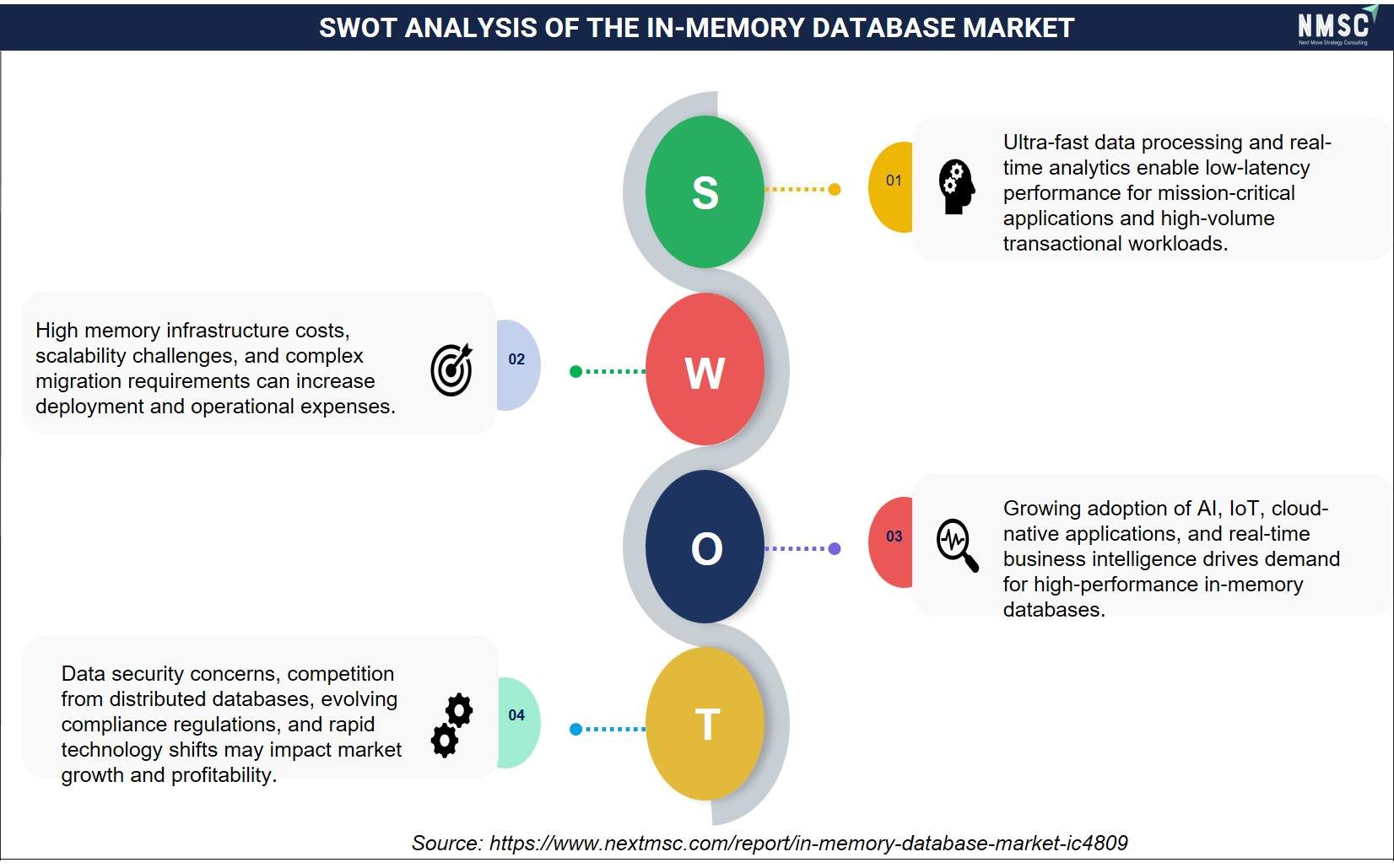
The SWOT analysis highlights the strong growth potential of the in-memory database market, driven by its ability to deliver ultra-fast data processing, real-time analytics, and low-latency performance for mission-critical applications. Opportunities are expanding with increasing adoption of AI, IoT, cloud-native architectures, and real-time business intelligence. However, high memory infrastructure costs, scalability complexities, data security concerns, evolving regulatory requirements, and competition from alternative database technologies remain key challenges influencing market adoption and long-term profitability.
Competitive Landscape
Competitive Dynamics and M&A Landscape
|
Key Takeaways |
Details |
|
Market Structure |
The In-Memory Database Market is moderately concentrated, with SAP, Oracle, and Microsoft holding dominant positions in enterprise segments, while Redis Ltd., SingleStore, and Aerospike lead in cloud-native and developer-driven segments. The market supports numerous specialized vendors across key-value, HTAP, and embedded sub-categories. |
|
Innovation Focus |
Vendors are prioritizing AI retrieval capabilities (vector search, RAG infrastructure), HTAP convergence, cloud-native managed service portfolios, and multi-model engine architectures. Embedded in-memory for automotive and IoT represents the most active new product development frontier. |
|
M&A Activity |
The in-memory database sector has seen strategic consolidation activity including Redis Inc.'s acquisition of Speedb for high-performance storage, IBM's acquisition of Instana for in-memory observability, and continued PE investment in specialist vendors. Hyperscaler acquisitions of in-memory technology startups remain a structural market risk for independent vendors. |
How Do Companies Compete in the In-Memory Database Market?
The In-Memory Database Market is characterized by multi-dimensional competition across performance benchmarks, cloud ecosystem integration depth, open-source community position, and enterprise support quality. SAP and Oracle compete on enterprise integration breadth and mission-critical reliability, while Redis Ltd. and Aerospike compete on throughput performance and developer ecosystem size. NMSC's analysis indicates that market structure is evolving from discrete product-line competition toward platform ecosystem competition, where vendors differentiate through the completeness of their in-memory data service portfolio spanning caching, OLTP, vector search, and HTAP within a unified managed offering.
Competitive strategies in the In-Memory Database Market span multiple dimensions. On innovation focus, leading vendors are investing heavily in native vector search integration, HTAP query optimization, and multi-cloud deployment tooling. M&A activity reflects the imperative to acquire AI retrieval capabilities and expand geographic cloud footprint. Geographic expansion strategies prioritize sovereign cloud compliance in Europe and the GCC, while pricing strategies are shifting from perpetual licensing toward consumption-based cloud billing models that reduce buyer switching costs and lower initial adoption barriers for developer-led and platform engineering buyer segments.
Which Kind of Companies Dominate the In-Memory Database Market?
The In-Memory Database Market is dominated by two structural archetypes: large enterprise software vendors with integrated in-memory capabilities embedded within broader database and ERP platforms, and specialized pure-play in-memory database vendors optimized for specific workload profiles. SAP and Oracle represent the first archetype, leveraging existing enterprise relationships and compliance certifications to deploy in-memory capabilities within mission-critical operational systems. Redis Ltd., Aerospike, SingleStore, Hazelcast, and KX Systems represent specialized vendors competing on workload-specific performance, open-source community advantage, and developer ecosystem depth across their respective target workload categories.
AI-Native Differentiation and Open Standards Drive Market Success in the In-Memory Database Market
Our assessment indicates that AI-native differentiation has become the primary competitive frontier in the In-Memory Database Market, with vendors racing to embed native vector indexing, semantic similarity search, and LLM inference caching within their core in-memory engines. Open standards adoption, including compatibility with the Redis Serialization Protocol (RESP), SQL:2023, and emerging vector database interchange formats, is becoming a key competitive strategy enabling vendor lock-in reduction and developer adoption at scale. Vendors that successfully combine RESP protocol compatibility with AI retrieval capabilities and cloud-native managed service delivery are capturing disproportionate market share in the developer-led and platform engineering buyer segments.
Market Players to Opt for Merger and Acquisition Strategies to Expand Their Presence in the In-Memory Database Market
Merger and acquisition activity is expected to intensify within the In-Memory Database Market through 2035, driven by hyperscalers seeking to acquire best-of-breed in-memory technology assets, private equity firms consolidating specialist vendors into broader data platform portfolios, and established database vendors acquiring AI retrieval and vector search capabilities. Embedded in-memory database vendors serving automotive and industrial IoT markets are attractive acquisition targets for semiconductor manufacturers and automotive technology suppliers seeking vertical integration of software and hardware data processing capabilities. Based on our analysis, the most likely consolidation targets include mid-tier specialist vendors with strong developer communities and established cloud marketplace distribution.
Key Market Players in the In-Memory Database Market
-
SAP SE
-
Oracle Corporation
-
Microsoft Corporation
-
International Business Machines Corporation
-
Redis Ltd.
-
SingleStore, Inc.
-
Couchbase, Inc.
-
Aerospike, Inc.
-
InterSystems Corporation
-
Exasol AG
-
KX Systems, Inc.
-
Hazelcast, Inc.
What Are the Latest Developments in the In-Memory Database Market Industry?
|
Date |
Event |
|
July 2025 |
Redis introduced Redis 8 in 2025 with Vector Sets, enhanced vector similarity search, semantic caching capabilities, and AI-focused database functions designed to support retrieval-augmented generation (RAG) and generative AI applications. |
|
May 2025 |
Microsoft announced SQL Server 2025 Preview in May 2025, positioning it as an AI-ready enterprise database with built-in AI functionality, enhanced performance optimization, deeper Azure integration, and support for modern enterprise data workloads. |
|
March 2025 |
SAP announced major enhancements to SAP HANA Cloud in its March 2025 release, including a new Knowledge Graph Engine, AI-driven data modeling capabilities, and expanded support for advanced analytics and enterprise AI workloads. These updates further strengthen SAP's position in the in-memory database and AI-ready data platform market. |
Expert Insights
 “We provide you with a gen AI stack including vectors that allows you to build and model gen AI applications. What we believe is that a vector-only database is a feature set and not a database that is going to be around in probably two maximum three years, because it adds a further layer of complexity in your AI stack and what you want to have an effective gen AI stack is to take complexity out, not add further complexity.”
— Raj Verma, CEO, SingleStore
Verma discussed the future of AI databases and the need for unified data platforms capable of supporting transactional, analytical, and vector workloads within a single architecture.
Market Interpretation
This insight highlights an important shift in the in-memory database market toward consolidation of data services. Enterprises increasingly prefer unified real-time platforms that reduce architectural complexity while supporting AI applications, analytics, and operational workloads. The trend is driving innovation in multi-model and distributed in-memory database platforms that combine high-speed processing with vector search and AI capabilities.
What Are the Investment Opportunities in the In-Memory Database Market?
Capital Inflows and Venture Investment in the In-Memory Database Market
The In-Memory Database Market is attracting significant venture capital and private equity investment, concentrated in AI-native in-memory platforms, cloud-native managed database services, and embedded in-memory solutions for automotive and IoT applications. The National Venture Capital Association has documented sustained AI infrastructure investment as the highest-priority category within enterprise software VC deployment in 2024 and 2025. In-memory database vendors with native vector search, RAG infrastructure support, and Redis-compatible interfaces are capturing disproportionate funding attention as AI application development platforms. Our assessment indicates that the USD 42.3 billion market opportunity by 2035 creates compelling long-term return profiles for investors entering through early growth-stage positions in specialist vendors.
Infrastructure Investment Driving the In-Memory Database Market Expansion
Cloud hyperscaler infrastructure investment is creating a structural tailwind for the In-Memory Database Market as the managed in-memory database service category expands across AWS, Azure, and Google Cloud global regions. The U.S. CHIPS and Science Act, which allocates USD 52 billion toward semiconductor manufacturing, indirectly supports the cost reduction of DRAM production that is fundamental to on-premises in-memory database hardware affordability. European sovereign cloud infrastructure programs including GAIA-X and national cloud initiatives are creating public sector procurement channels for compliant in-memory database vendors. These infrastructure investments are expanding the addressable market for in-memory database managed services across geographic regions that previously lacked sufficient local cloud data center capacity.
ESG Considerations in the In-Memory Database Market
ESG considerations are increasingly influencing enterprise technology procurement decisions within the In-Memory Database Market, as organizations seek to demonstrate responsible technology investment aligned with sustainability commitments. In-memory databases offer a compelling ESG narrative through reduced storage infrastructure footprint, lower disk I/O energy consumption, and improved computational efficiency relative to traditional disk-based database architectures for equivalent query performance. The U.S. Department of Energy has identified memory-centric computing architectures as a pathway toward improved energy efficiency in data center operations. Vendors that can quantify and certify energy efficiency improvements delivered by their in-memory platforms are increasingly able to satisfy enterprise sustainability procurement criteria and ESG reporting requirements.
Digital Transformation Investment Creating In-Memory Database Market Opportunities
Enterprise digital transformation programs across BFSI, telecommunications, retail, and healthcare are creating structured multi-year investment cycles for in-memory database technology. The World Bank's Digital Economy for Africa initiative and similar multilateral development bank programs are directing infrastructure investment toward cloud data platforms in emerging markets that create initial in-memory database adoption. Organizations modernizing legacy batch-oriented systems toward real-time event-driven architectures require in-memory database infrastructure as a foundational component, creating both greenfield and displacement opportunities. Our findings suggest that digital transformation investment cycles in Asia-Pacific, MEA, and Latin America will generate approximately 38% of In-Memory Database Market revenue growth between 2025 and 2035.
Private Equity and M&A Activity in the In-Memory Database Market
Private equity activity within the In-Memory Database Market reflects growing recognition of the sector's durable revenue model characteristics, including high switching costs, recurring subscription and consumption revenue, and embedded deployment lock-in within mission-critical operational systems. Francisco Partners' acquisition of the commercial Redis business represents a significant PE commitment to the in-memory database sector. The PE investment thesis is supported by the In-Memory Database Market's structural positioning at the intersection of AI infrastructure, real-time payments, and cloud-native application development, three of the most durable enterprise technology spending categories through 2035. NMSC's analysis indicates that consolidation plays combining complementary in-memory workload capabilities represent the highest-conviction PE strategy within this market.
Key Benefits for Stakeholders
Benefits for Enterprise Technology Leaders and CIOs
The In-Memory Database Market report equips enterprise technology leaders and CIOs with detailed market sizing, growth forecasts, and adoption trends from 2025 to 2035, supporting long-term infrastructure and cloud database investment planning. The analysis covers workload-specific deployments across OLTP, caching, HTAP, AI retrieval, and embedded applications, enabling organizations to align database strategies with operational requirements. Additionally, competitive benchmarking of major vendors and country-level market intelligence across 34 countries supports technology selection, risk assessment, and geographic expansion planning.
Benefits for Investors and Financial Analysts
The report provides investors and financial analysts with reliable market estimates and growth projections through 2035, enabling informed investment evaluation and portfolio planning. Detailed analysis of high-growth segments, including AI retrieval and embedded deployments, helps identify attractive opportunities within the in-memory database ecosystem. The study also examines competitive dynamics, acquisition activity, and industry expansion trends, allowing stakeholders to assess market attractiveness, benchmark growth assumptions, and evaluate strategic investment opportunities across emerging and established markets.
Benefits for Technology Vendors and Product Teams
Technology vendors and product teams can leverage the report to better understand customer demand patterns, technology adoption trends, and competitive positioning within the In-Memory Database Market. The analysis highlights the fastest-growing buyer categories, evolving deployment preferences, and the shift toward cloud-native and consumption-based commercial models. Furthermore, geographic insights across 34 countries provide valuable intelligence on regulatory environments, adoption maturity, and competitive intensity, helping organizations prioritize product development, market expansion, and go-to-market investments.
Key Market Segments
By Product Family
-
Relational In-Memory Database
-
Distributed SQL
-
Key-Value Store
-
Data Grid
-
Multi-Model Operational Database
-
Embedded Database
-
Other
By Deployment
-
On-Premises
-
Public Cloud
-
Private Cloud
-
Hybrid Cloud
-
Embedded
By Commercial Model
-
Perpetual License
-
Subscription
-
Consumption
-
Support and Maintenance
-
OEM and Embedded Licensing
By Buyer Type
-
Enterprise IT
-
Developer-Led Teams
-
Platform Engineering
-
OEM and Embedded Partners
-
Public Sector
By Workload
-
OLTP
-
Caching
-
HTAP
-
Event Processing
-
Session State
-
Analytics
-
AI Retrieval
-
Embedded Control
-
Other
By End Use Industry
-
BFSI
-
Technology and Software
-
Telecom
-
Retail and E-commerce
-
Manufacturing
-
Public Sector
-
Healthcare
-
Media and Entertainment
-
Transport and Logistics
-
Automotive and IoT
-
Other
By Region
-
North America: U.S., Canada, Mexico
-
Europe: UK, Germany, France, Italy, Spain, Sweden, Denmark, Finland, Netherlands, Rest of Europe
-
Asia-Pacific: China, India, Japan, South Korea, Taiwan, Indonesia, Vietnam, Australia, Philippines, Malaysia, Rest of APAC
-
Middle East & Africa (MEA): Saudi Arabia, UAE, Egypt, Israel, Turkey, Nigeria, South Africa, Rest of MEA
-
Latin America: Brazil, Argentina, Chile, Colombia, Rest of LATAM
Conclusion and Recommendations
Long-Term Outlook
The In-Memory Database Market is positioned for sustained high-growth expansion through 2035, driven by structural secular forces including AI inference infrastructure demand, real-time payment ecosystem expansion, 5G network data management requirements, and the enterprise-wide migration from batch-oriented to event-driven application architectures. The market is forecast to grow from USD 10.1 billion in 2026 to USD 42.3 billion by 2035 at a CAGR of 17.3%, reflecting both the expanding addressable workload base and the premium pricing commanded by in-memory performance within mission-critical operational systems. AI Retrieval and Embedded deployment sub-segments represent the highest-growth frontiers within this expanding market landscape.
Strategic Positioning Recommendations
In-memory database vendors should prioritize native AI retrieval capability development, including vector indexing, semantic similarity search, and RAG infrastructure support, as the foundational competitive differentiator through 2030. Cloud-native managed service delivery across major hyperscaler marketplaces is non-negotiable for vendors targeting developer-led and platform engineering buyer segments. Multi-model engine consolidation, supporting key-value, document, SQL, and vector data models within a single managed in-memory platform, will determine competitive positioning in enterprise technology consolidation procurement cycles. Geographic expansion into sovereign cloud compliant architectures for European, GCC, and Southeast Asian regulated markets represents the highest-priority internationalization investment.
Investment Attractiveness
The In-Memory Database Market represents a structurally attractive investment environment characterized by high switching costs within mission-critical operational deployments, expanding recurring revenue from subscription and consumption commercial models, and multi-decade secular demand growth driven by AI adoption and digital commerce expansion. The highest-conviction investment themes within this market are AI Retrieval workloads at a CAGR of 24.8%, Embedded deployment at 25.8% CAGR driven by automotive and IoT integration, and OEM and Embedded Licensing commercial model growth at 24.0% CAGR. Investors should monitor consolidation activity among mid-tier specialist vendors and hyperscaler acquisitions as primary value realization pathways.
Market Shifts and Key Risks
The most significant structural shift underway in the In-Memory Database Market is the migration from specialized point-solution in-memory database procurement toward integrated multi-model in-memory platform selection, favoring full-stack vendors and hyperscaler managed services over narrowly specialized key-value or time-series-only vendors. Key risks include DRAM price volatility increasing on-premises deployment costs, open-source fragmentation of the Redis ecosystem following the license change to SSPL, competition from purpose-built vector database vendors targeting the AI retrieval workload, and hyperscaler managed service commoditization compressing margins for independent in-memory database vendors without substantial differentiation.
Growth Pathways
Organizations seeking to maximize value from the In-Memory Database Market should pursue a three-horizon architecture strategy. In the near term (2025-2027), prioritize cloud-native in-memory caching and OLTP modernization to establish the real-time data processing foundation required for AI application deployment. In the mid-term (2027-2031), invest in HTAP architecture adoption, native vector search integration, and AI retrieval infrastructure to capture the highest-growth workload categories. In the long term (2031-2035), position for embedded in-memory platform standardization across automotive, industrial IoT, and edge computing environments as connected device volumes exceed current edge data processing architectural constraints.
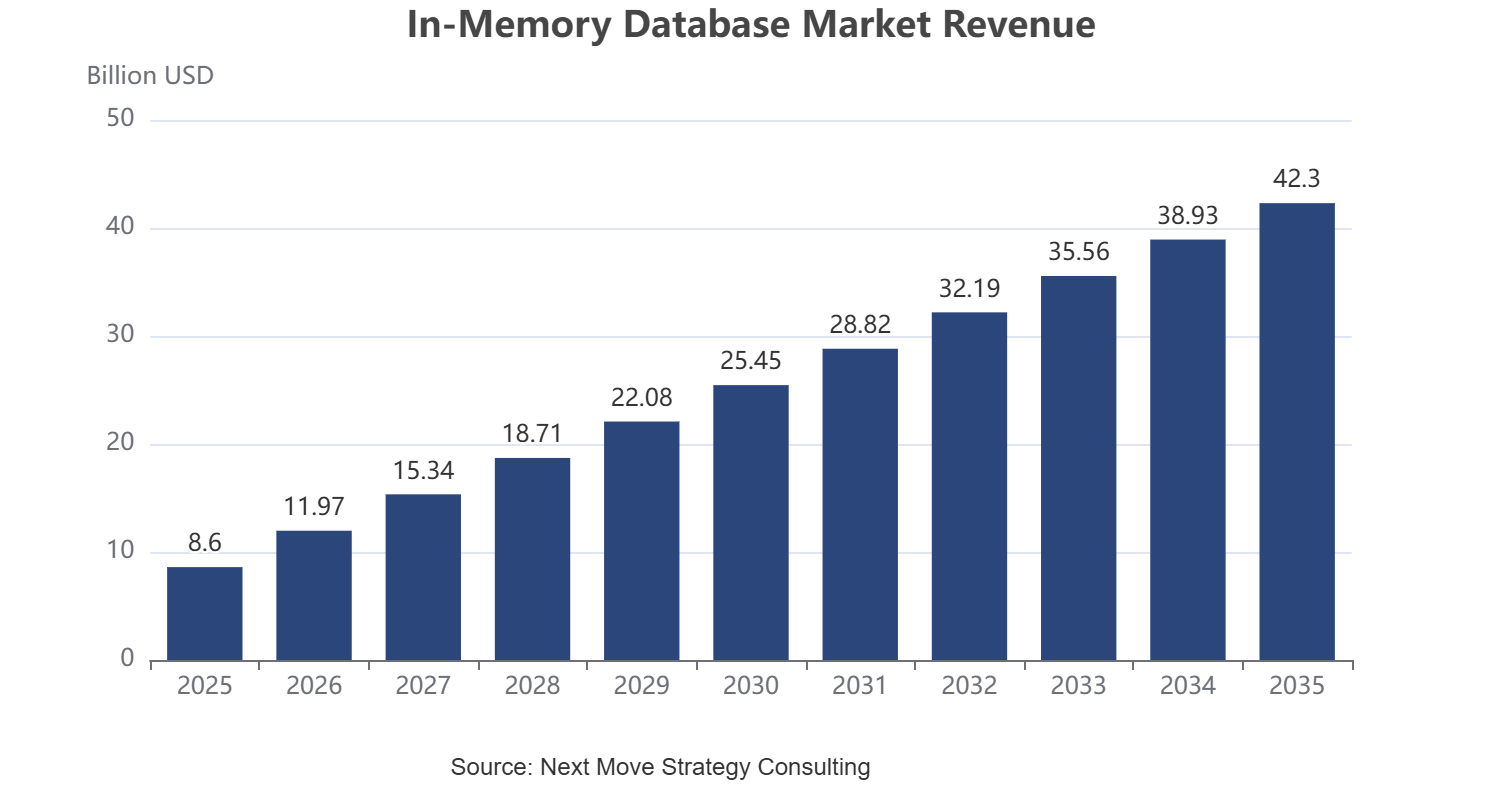
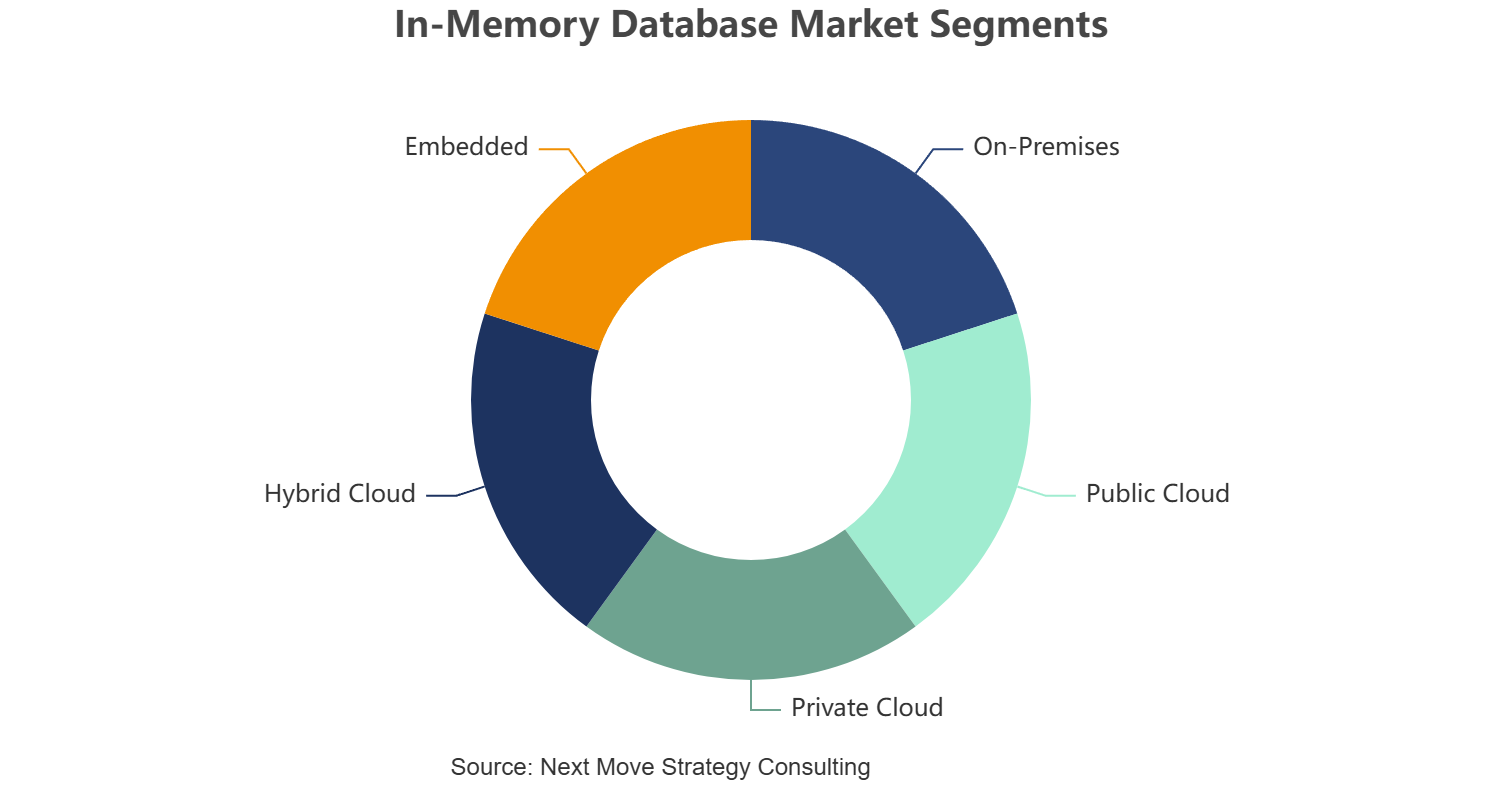
About the Author
 Mayurima Roy
— Mayurima Roy is Research Analyst at Next Move Strategy Consulting, where she has spent 4 years working across the firm's full industry coverage rather than a single fixed vertical. Her work centers on structured research, ongoing trend tracking, competitive assessment, and insight-led content development, translating complex market data into clear, decision-ready narratives that support informed client decision-making across diverse global industries, market sectors, and world regions every day.
Mayurima Roy
— Mayurima Roy is Research Analyst at Next Move Strategy Consulting, where she has spent 4 years working across the firm's full industry coverage rather than a single fixed vertical. Her work centers on structured research, ongoing trend tracking, competitive assessment, and insight-led content development, translating complex market data into clear, decision-ready narratives that support informed client decision-making across diverse global industries, market sectors, and world regions every day.
About the Reviewer
 Supradip Baul
— Supradip Baul is an accomplished business consultant and strategist with over a decade of rich experience in market intelligence, strategy, technology, and business transformation. His work has included rigorous qualitative and quantitative analysis across multiple industries, helping clients shape investment decisions and long-term roadmaps. Earlier in his career, he was associated with Gartner, where he contributed to industry-leading reports and market share analyses. He has worked with leading global companies and holds an MBA with a dual specialization in Marketing and Finance.
Supradip Baul
— Supradip Baul is an accomplished business consultant and strategist with over a decade of rich experience in market intelligence, strategy, technology, and business transformation. His work has included rigorous qualitative and quantitative analysis across multiple industries, helping clients shape investment decisions and long-term roadmaps. Earlier in his career, he was associated with Gartner, where he contributed to industry-leading reports and market share analyses. He has worked with leading global companies and holds an MBA with a dual specialization in Marketing and Finance.
At Next Move Strategy Consulting, we understand that insightful market research is the cornerstone of successful business decisions. That's why we employ a robust and multifaceted approach, combining various methodologies to deliver the most accurate and actionable data for our clients.

Research Landscape
We navigate the world of research with two primary approaches:
Qualitative Approach
Our qualitative research methodologies involve immersive techniques such as in-depth interviews, focus groups, and observational studies. By engaging directly with individuals and stakeholders, we uncover valuable insights that quantitative data alone may overlook.

Quantitative Research
In tandem with qualitative methodologies, NMSC leverages the power of Quantitative Research to provide a robust foundation of numerical insights. Through systematic data collection and analysis, we quantify patterns, preferences, and market trends, offering a comprehensive view of the business landscape.
Our quantitative research approach employs diverse tools, including surveys, experiments, and statistical modelling. These methodologies enable us to gather data from a large and representative sample, ensuring the statistical significance of our findings. By employing structured questionnaires and standardized data collection methods, we guarantee the reliability and validity of the information we present to our clients.
Quantitative research is particularly effective in measuring the prevalence of trends, assessing market size, and gauging the impact of various factors on consumer behavior. The numerical precision attained through this approach equips our clients with actionable insights, facilitating data-driven decision-making and strategy formulation.


Our Specialized Toolbox for Industry-Specific Market Research
We deploy a specialized arsenal of techniques tailored to meet your unique requirements. Here's a glimpse into our comprehensive toolbox:

Information Procurement
The stage entails acquiring market data or relevant information through various sources and methodologies.


Market Research Approach
We utilize both top-down and bottom-up approaches in market research analysis to achieve a comprehensive understanding of the market dynamics, leveraging the broad perspective of industry trends and macroeconomic factors alongside detailed insights from specific segments and individual companies.

Porters Five Forces Analysis
We conduct Porter's Five Forces analysis to evaluate the competitive landscape of an industry, providing us with insights into factors that affect profitability and strategic positioning.

SWOT Analysis

Forecasting
We utilize a forecasting model to predict future consumption by considering parameters like population, economics, regulations, market competition, drivers, constraints, technology, and pricing. We also employ statistical techniques such as multilinear regression, exponential smoothing, moving average, ARIMA, and Monte Carlo simulations for accurate predictions. In econometric forecasting, we analyzed short-term and long-term event impacts, attributing values based on regulatory frameworks, economic factors, and market events.





 Speak to Our Analyst