Italy Autonomous Mobile Robot (AMR) Market By Product Type (Autonomous Transport Robots, Autonomous Picking Robots, & Others), By Navigation Technology (LiDAR, Vision Navigation, & Others), By Payload Capacity (<100 KG, 100–1000 KG, & Others), By Deployment Environment (Indoor & Outdoor), By Commercial Model (Direct Sales, System Integrator Sales, & Others), By End-User Industry (Warehousing and Distribution, Manufacturing, & Others) – Opportunity Analysis & Forecast, 2025–2035
Industry: Semiconductor & Electronics | Latest Edition: August 22, 2026 | No of Pages: 339 | No. of Tables: 192 | No. of Figures: 180 | Format: PDF | Report Code: SE4253
What Is the Italy Autonomous Mobile Robot (AMR) Market Size?
The Italy Autonomous Mobile Robot (AMR) Market size was valued at USD 155.9 million in 2025 and is estimated at USD 193.1 million in 2026, forecast to reach USD 783.8 million by 2035, expanding at a 16.85% CAGR between 2026 and 2035. Autonomous Transport Robots dominate the market by product type. In terms of volume, the Italy AMR market recorded 3 thousand units in 2025, with forecasts indicating growth to 4 thousand units by 2026 and further to 25 thousand units by 2035, reflecting a CAGR of 20.99% over the forecast period.
We observed that market growth is supported by rising labor costs, expanding e-commerce fulfillment volumes, and continuous innovation in navigation, fleet management, and artificial intelligence (AI) chip integration through 2035.
|
Key Takeaways |
|
By Product Type: Autonomous Transport Robots is the dominant segment, while Autonomous Mobile Manipulators is the fastest-growing segment. |
|
By Navigation Technology: LiDAR is the dominant segment, while Sensor Fusion Navigation is the fastest-growing segment. |
|
By Payload Capacity: 100 Kgs to 1000 Kgs is the dominant segment, while 1001 Kgs to 5000 Kgs is the fastest-growing segment. |
|
By Deployment Environment: Indoor Autonomous Mobile Robots is the dominant segment, while Outdoor Autonomous Mobile Robots is the fastest-growing segment. |
|
By Commercial Model: Direct Sales is the dominant segment, while Robotics as a Service is the fastest-growing segment. |
|
By Revenue Stream: Robot Hardware is the dominant segment, while Software is the fastest-growing segment. |
|
By End User Industry: Warehousing and Distribution is the dominant segment, while Healthcare is the fastest-growing segment. |
Market Opportunity: The Italy Autonomous Mobile Robot (AMR) market is expected to create an absolute dollar opportunity of USD 590.7 million between 2026 and 2035, presenting significant investment potential across warehousing automation, healthcare robotics, and Robotics as a Service adoption.
According to NMSC's analysis, rising demand for Robotics as a Service commercial models is lowering adoption barriers for small and mid-sized Italian manufacturers and logistics operators across the Italy Autonomous Mobile Robot (AMR) Market.
Italy Autonomous Mobile Robot (AMR) Market Overview
What does the Italy Autonomous Mobile Robot (AMR) Market Encompass?
The Italy Autonomous Mobile Robot (AMR) Market encompasses transport robots, picking robots, mobile manipulators, forklift robots, and specialized robots deployed across warehousing, manufacturing, healthcare, and retail facilities. Our assessment indicates that the market includes LiDAR, vision, and sensor fusion navigation technologies delivered through direct sales, system integrator sales, and Robotics as a Service commercial models. Italy's industrial robotics ecosystem, concentrated across Lombardy, Emilia-Romagna, and Piedmont, anchors demand for these systems.
The market has evolved from fixed-path automated guided vehicles toward dynamically navigating, sensor-driven robots capable of adapting to changing facility layouts. We observed that European Union machinery safety regulations and Italy's Industry 4.0 and Transizione 5.0 incentive frameworks are accelerating factory automation adoption among small and mid-sized manufacturers. NMSC's analysis indicates that growing integration of simultaneous localization and mapping technology, cloud-based fleet orchestration, and Robotics as a Service adoption continues to reshape deployment models, competitive positioning, and purchasing decisions across the Italy AMR Market.
|
Parameters |
Details |
|
Market Size in 2025 |
USD 155.9 Million |
|
Market Size in 2026 |
USD 193.1 Million |
|
Revenue Forecast in 2035 |
USD 783.8 Million |
|
Market Size Growth Rate |
CAGR of 16.85% from 2026 to 2035 |
|
Market Volume in 2025 |
3 Thousand Units |
|
Market Volume in 2026 |
4 Thousand Units |
|
Volume Forecast in 2035 |
25 Thousand Units |
|
Market Volume Growth Rate |
CAGR of 20.99% from 2026 to 2035 |
|
Analysis Period |
2025–2035 |
|
Base Year Considered |
2025 |
|
Forecast Period |
2026–2035 |
|
Market Size Estimation |
Million (USD) |
|
Companies Profiled |
15 |
|
Market Share |
Available for 10 companies |
Key Emerging Trends
Based on research conducted by NMSC, we found that four structural trends are reshaping deployment models, fleet economics, and competitive dynamics across the Italy Autonomous Mobile Robot (AMR) Market.
How Is AI-Enabled Fleet Orchestration Transforming Warehouse Operations?
Cloud-based fleet management platforms embedding AI-driven task allocation are becoming central to mid-sized AMR deployments across Italian logistics hubs. We observed that operators expanding automated fulfillment capacity, such as facilities using Comau's MyMR platform, increasingly rely on adaptive routing software to coordinate mixed fleets across inbound, picking, and processing zones without manual intervention, improving throughput and reducing on-site labor workload.
Why Are Labor Shortages Accelerating Factory-Floor Automation Adoption?
Persistent skilled-labor shortages in logistics and manufacturing are pushing Italian operators toward robotic in-plant material transport. Our findings suggest that automotive, food and beverage, and third-party logistics providers are prioritizing AMR fleets to offset workforce constraints, with international vendors such as Locus Robotics citing demand from Italian fulfillment operators as a direct trigger for market entry.
How Is European Interoperability Standardization Reshaping Deployment?
Open interoperability frameworks that allow AMRs from different vendors to share warehouse infrastructure are gaining traction across Italian automation hubs. We observed that system integrators are increasingly building mixed-vendor fleets around common safety and communication standards, enabling operators to coordinate movement, reduce integration costs, and address space constraints common in dense northern Italian logistics corridors.
What Role Does Mobile-Manipulation Convergence Play in Innovation?
Convergence between mobile bases and manipulator arms is emerging as a distinct innovation trend among Italian robotics developers. Our analysis indicates that companies including Comau are extending mobile-robot platforms with modular manipulation attachments for picking, sorting, and material handling tasks, signaling a gradual shift from pure transport robots toward multi-function autonomous systems within Italian facilities.
Strategic Framework of the Italy Autonomous Mobile Robot (AMR) Market
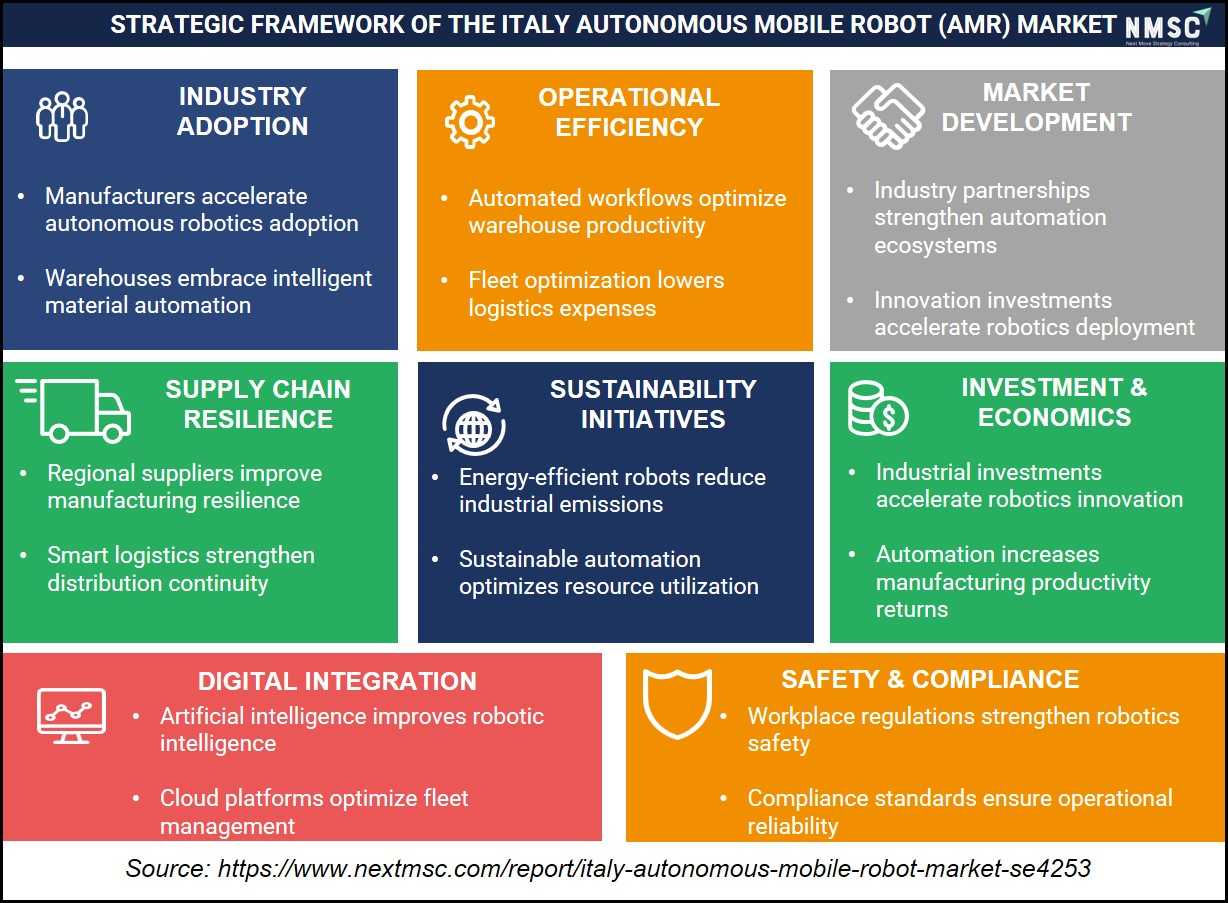
The above strategic framework analysis maps the key strategic components, such as industry adoption, operational efficiency, market development, supply chain resilience, sustainability initiatives, investment and economics, digital integration, and safety and compliance, shaping the Italy AMR market. From our analysis, we observed that manufacturers accelerate autonomous adoption and warehouses embrace intelligent automation, while automated workflows optimize productivity and fleet optimization lowers expenses. Innovation investments accelerate deployment, and artificial intelligence improves robotic intelligence, whereas workplace regulations strengthen safety and compliance standards ensure operational reliability.
Growth Drivers and Restraints
Growth Catalyst and Risk Assessment Matrix
|
Factors |
Type |
(+/−) % Impact on CAGR |
Geographic Relevance |
Impact Timeline |
|
Rising labor costs and skilled-worker shortages across logistics and manufacturing increasing AMR adoption for material transport |
Driver |
+3.65% |
Lombardy, Veneto, Emilia-Romagna |
Medium to Long term (2–6 years) |
|
Government-backed Transizione 5.0 and Industry 4.0 incentive schemes promoting factory automation investment |
Driver |
+3.10% |
Nationwide Italy |
Long term (2–9 years) |
|
Rapid growth of e-commerce fulfillment and third-party logistics capacity expanding demand for picking and transport robots |
Driver |
+2.55% |
Lombardy, Lazio, Piedmont |
Long term (2–7 years) |
|
Expansion of automotive and food and beverage manufacturing automation footprints across northern Italy |
Driver |
+2.05% |
Piedmont, Emilia-Romagna |
Long term (2–8 years) |
|
High upfront capital costs and integration complexity limiting adoption among small and mid-sized manufacturers |
Restraint |
−1.85% |
Southern Italy |
Short to Medium term (1–4 years) |
|
Fragmented interoperability standards across vendors constraining mixed-fleet deployment efficiency |
Restraint |
−1.35% |
Nationwide Italy |
Short to Medium term (1–3 years) |
What Is the Primary Growth Driver of the Italy Autonomous Mobile Robot (AMR) Market?
Rising labor costs and persistent skilled-worker shortages across Italian logistics and manufacturing hubs are the primary growth drivers of the Italy Autonomous Mobile Robot (AMR) market. Italy's working-age population has continued to decline according to the Italian National Institute of Statistics (ISTAT), pressuring manufacturers to substitute manual material handling with autonomous transport. We observed that this demographic pressure is directly cited by system integrators deploying AMR fleets across automotive and food and beverage plants.
How Is Transizione 5.0 Driving Market Growth?
Italy's Transizione 5.0 incentive scheme, administered under the Ministry of Enterprises and Made in Italy, offers tax credits for digital and energy-efficient factory upgrades, according to the Ministry of Enterprises and Made in Italy. Manufacturers are deploying autonomous transport robots and autonomous forklift robots to modernize intralogistics under these incentive frameworks. Our assessment indicates that this policy support is enabling small and mid-sized manufacturers to offset upfront capital costs and accelerate automation timelines.
What Is Restraining Italy Autonomous Mobile Robot (AMR) Market Expansion?
High upfront capital investment and system integration complexity continue to restrain broader market expansion, particularly among small and mid-sized manufacturers in southern Italy. Fragmented interoperability standards across vendors further complicate mixed-fleet deployments in shared facilities. We found that companies with limited automation budgets face longer payback periods, constraining adoption pace despite favorable long-term productivity and labor-substitution economics nationwide.
Segmentation Analysis
By Navigation Technology Insights
How Is the Italy Autonomous Mobile Robot (AMR) Market Segmented by Navigation Technology?
Based on navigation technology, the Italy Autonomous Mobile Robot (AMR) Market is segmented into LiDAR, vision navigation, sensor fusion navigation, magnetic and marker navigation, and other navigation technology.
LiDAR-based systems rely on laser ranging to build precise facility maps and detect obstacles in real time, while vision navigation uses camera arrays and image processing to interpret surroundings at comparatively lower hardware cost. Sensor fusion navigation combines LiDAR, cameras, and inertial data to improve reliability in cluttered or variable environments, whereas magnetic and marker navigation depends on fixed infrastructure such as embedded strips or reflective tags for simpler, lower-cost deployments.
Facilities requiring dynamic rerouting around unpredictable obstacles increasingly favor sensor fusion approaches over single-sensor systems. Our findings suggest that Italian operators managing mixed indoor and outdoor deployments are prioritizing navigation technologies capable of handling variable lighting and irregular surfaces, pushing continued innovation toward multi-sensor architectures that reduce dependency on facility-specific infrastructure modifications.
By Revenue Stream Insights
How Is the Italy Autonomous Mobile Robot (AMR) Market Segmented by Revenue Stream?
Based on revenue stream, the Italy Autonomous Mobile Robot (AMR) Market is segmented into robot hardware, software, and services.
Robot hardware covers the physical chassis, motors, sensors, and payload mechanisms that form the foundation of every deployed unit. Software spans fleet management, navigation, robot operating, analytics, and AI platforms that coordinate robot behavior across a facility. Services encompass installation and deployment, integration, maintenance, and Robotics as a Service arrangements that support ongoing fleet operation for Italian manufacturers and logistics providers.
Operators seeking to minimize upfront capital exposure are increasingly drawn toward bundled service arrangements that combine hardware access with ongoing maintenance and software updates. Our analysis indicates that this shift toward service-oriented revenue models is reshaping vendor strategies, encouraging providers to prioritize recurring contracts over one-time equipment sales across the Italy AMR Market.
Growth Opportunities
We observed that three forward-looking opportunities are emerging for stakeholders positioned across hardware, software, and systems integration within the Italy Autonomous Mobile Robot (AMR) Market.
How Can E-Commerce Fulfillment Operators Benefit from Robotics as a Service?
Rapid growth of e-commerce fulfillment volumes across Lombardy and Lazio creates substantial opportunity for vendors offering subscription-based Robotics as a Service models. Companies packaging goods-to-person picking robots into service contracts can capture recurring revenue while lowering adoption barriers for fulfillment operators seeking to scale capacity without large upfront capital commitments.
Where Does Healthcare Facility Automation Create New Revenue Streams?
Hospitals and pharmaceutical facilities across Italy are gradually adopting specialized healthcare and laboratory robots for material transport and delivery tasks. Vendors that develop compliant, safety-certified mobile robots tailored to healthcare environments can capture premium pricing while addressing staffing shortages in hospital logistics and laboratory sample handling operations.
How Can Outdoor-Capable AMRs Unlock Value in Logistics Terminals?
Logistics terminal and industrial yard operators at Italian ports and inland freight hubs require ruggedized AMRs capable of operating in outdoor conditions with variable weather and uneven surfaces. Vendors offering sensor fusion navigation systems calibrated for outdoor deployment can capture premium contracts while helping terminal operators automate container and pallet movement.
Competitive Landscape
We observed that the Italy Autonomous Mobile Robot (AMR) market features a highly competitive landscape, with domestic robotics and automation specialists competing alongside global industrial automation conglomerates and material handling equipment manufacturers.
Key Takeaways
|
Dimension |
Description |
|
Market Structure |
Moderately consolidated with domestic specialists including Comau S.p.A., E80 Group S.p.A., and INDEVA S.p.A. competing alongside multinational industrial automation companies such as ABB S.p.A., KUKA Roboter Italia S.p.A., and Honeywell S.r.l. |
|
Innovation Focus |
AI-enabled fleet orchestration, modular mobile-manipulation platforms, and Robotics as a Service commercial models dominate current product development strategies across leading manufacturers serving Italy. |
|
M&A Activity |
Strategic partnerships, distribution agreements, and technology licensing continue to shape the competitive landscape as companies strengthen positions in warehousing and manufacturing end-user segments. |
How Do Companies Compete in the Italy Autonomous Mobile Robot (AMR) Market?
Companies compete primarily through navigation precision, payload versatility, fleet-management software, and integration capability with existing production lines. Leading manufacturers such as ABB S.p.A. and KUKA Roboter Italia S.p.A. leverage established industrial automation portfolios and extensive distribution networks to maintain market leadership. Meanwhile, domestic specialists including Comau S.p.A. and E80 Group S.p.A. differentiate through tailored system design and rapid deployment capability for Italian manufacturing facilities.
Which Competitive Archetypes Dominate the Italy Autonomous Mobile Robot (AMR) Market?
Two primary competitive archetypes characterize the market. The first comprises diversified industrial automation conglomerates offering AMRs alongside broader factory automation portfolios, including ABB S.p.A., Honeywell S.r.l., and Toyota Material Handling Italia S.r.l. The second includes dedicated AMR and warehouse robotics specialists such as Comau S.p.A., E80 Group S.p.A., and INDEVA S.p.A., which focus on mobile robotics innovation and fleet software tailored to Italian industry.
How Are Companies Differentiating Through Innovation in Italy AMR Deployment?
Innovation strategies increasingly focus on AI-driven navigation, cloud-based fleet orchestration, and modular manipulation attachments for manufacturing applications. Companies are investing in interoperability standards and subscription-based commercial models, extending transport robots with picking and sorting capability. Our analysis indicates that manufacturers combining software differentiation with hardware reliability are strengthening competitive positioning across warehousing, manufacturing, and healthcare end-user segments.
What Expansion Activity Is Shaping the Italy Autonomous Mobile Robot (AMR) Market?
Distribution partnerships, subsidiary establishment, and fleet deployment agreements with international vendors continue to shape competition across the market. Leading companies are strengthening positions through expanded local service capacity, deeper integration with automotive and food and beverage manufacturers, and increased research and development investment. These initiatives enable manufacturers to broaden product portfolios and respond more effectively to evolving automation demand across Italy.
Key Players
Our assessment indicates that the following 15 companies are actively shaping fleet innovation, distribution expansion, and competitive dynamics within the Italy Autonomous Mobile Robot (AMR) Market.
-
Zebra Technologies Italy S.r.l.
-
KUKA Roboter Italia S.p.A.
-
Dematic Italia S.r.l.
-
Toyota Material Handling Italia S.r.l.
-
AGILOX Italia S.r.l.
-
AGVE Italia S.r.l.
-
ABB S.p.A.
-
Swisslog Italia S.p.A.
-
Jungheinrich Italiana S.r.l.
-
ek robotics Italia S.r.l.
-
Comau S.p.A.
-
E80 Group S.p.A.
-
INDEVA S.p.A.
Latest Developments
We found that recent developments within the Italy Autonomous Mobile Robot (AMR) market are concentrated on new product launches, distribution expansion, and system integrator partnerships, reflecting the industry's growing emphasis on labor substitution and precision automation.
|
Date |
Event (short description) |
|
June 2025 |
Comau S.p.A. launched the MyMR Autonomous Mobile Robot (AMR) family at Automatica 2025, expanding its AMR portfolio with hybrid navigation and intelligent fleet management for autonomous manufacturing and warehouse intralogistics. |
Investment Opportunities
What Capital Inflows Are Targeting the Italy Autonomous Mobile Robot (AMR) Market?
Capital inflows are increasingly directed toward distribution capacity, navigation software development, and expansion into healthcare and warehousing end-user segments. Leading robotics companies continue to invest in local service infrastructure and research and development to strengthen competitive positioning. We observed that investors favor companies demonstrating scalable deployment track records as key indicators of long-term commercial viability in the Italian market.
How Is Infrastructure Investment Supporting the Italy Autonomous Mobile Robot (AMR) Market?
Infrastructure investment is expanding logistics automation capacity and digital manufacturing readiness under Italy's Transizione 5.0 program, according to the Ministry of Enterprises and Made in Italy. Our findings suggest that companies are investing in local distribution and service centers to support mixed-fleet coordination and address logistics challenges including labor scarcity, strengthening long-term market penetration across Italian manufacturing hubs.
What ESG Considerations Are Shaping Investment Decisions in the Italy Autonomous Mobile Robot (AMR) Market?
Environmental, social, and governance considerations increasingly influence investment decisions, with energy-efficient battery systems, workplace safety improvements, and labor-condition enhancements emerging as key priorities. We found that investors favor companies demonstrating measurable progress in reducing energy consumption per deployed unit and improving worker safety outcomes through automation of physically demanding material-handling tasks across Italian facilities.
Key Benefits for Stakeholders
How Does This Report Benefit Enterprise and Industry Leaders?
Enterprise and industry leaders gain access to validated market segmentation, competitive benchmarking, and demand forecasts that support strategic planning and fleet procurement decisions across the Italy Autonomous Mobile Robot (AMR) Market. Our analysis shows that detailed assessments of product type, payload capacity, and end-user industry trends help companies identify high-growth opportunities and strengthen automation roadmaps.
How Does This Report Benefit Investors and Financial Analysts?
Investors and financial analysts benefit from consistent market size estimates, growth forecasts, and competitive assessments that support capital allocation decisions across the Italy AMR Market. We observed that detailed analysis of healthcare, warehousing, and manufacturing end-user segments enables stakeholders to identify companies and categories with the strongest long-term growth potential through 2035.
How Does This Report Benefit Technology Vendors and Product Teams?
Technology vendors and product development teams gain insights into emerging innovation trends, including AI-enabled fleet orchestration, modular mobile-manipulation platforms, and Robotics as a Service adoption transforming Italy's robotics industry. Our findings suggest that this analysis helps research and development teams prioritize product pipelines and align offerings with evolving manufacturer requirements across the country.
Supply Chain Structure of the Italy Autonomous Mobile Robot (AMR) Market
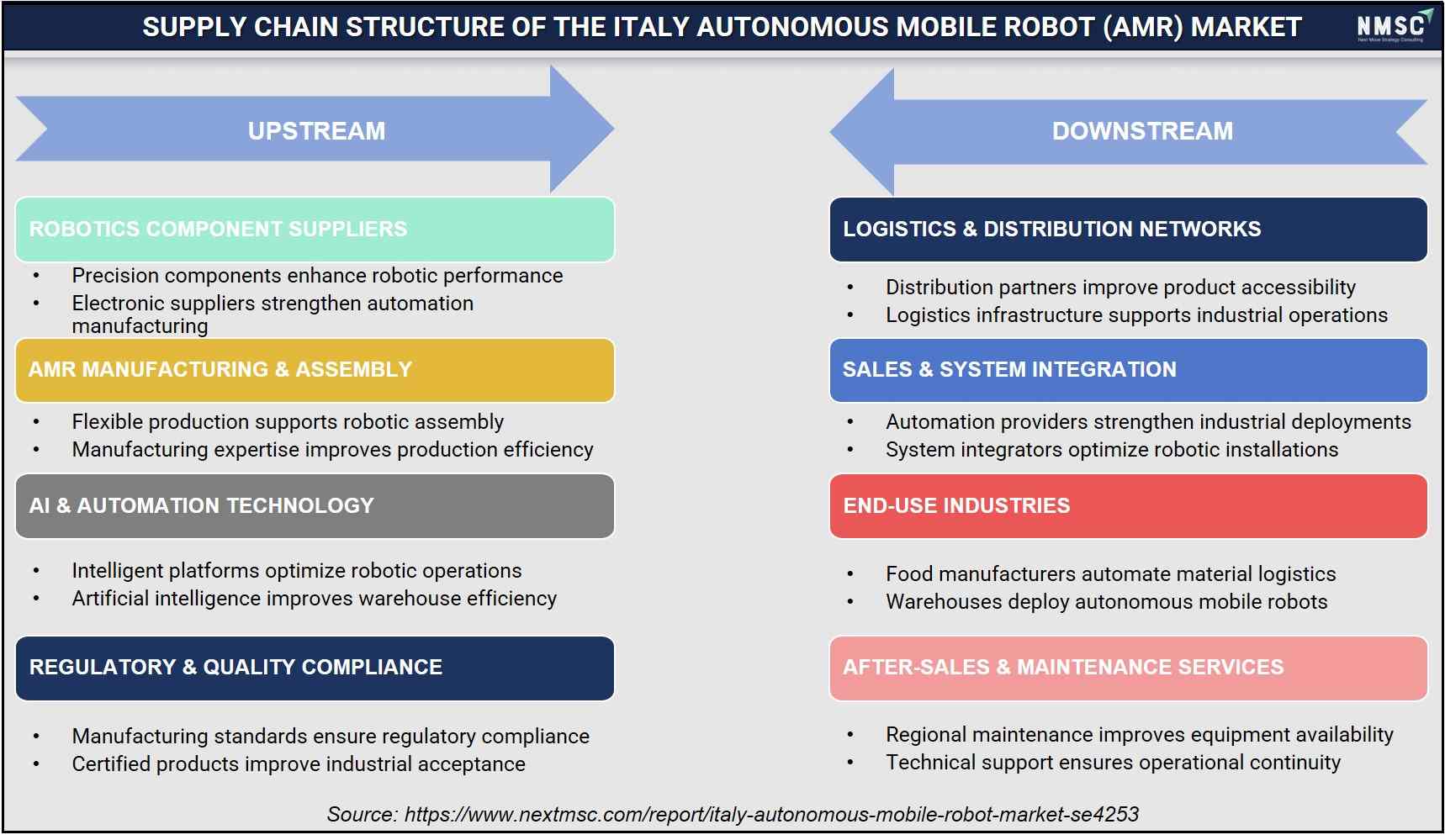
The above supply chain analysis maps the key operational stages, such as upstream and downstream, shaping the Italy AMR market. From our analysis, we observed that upstream activities include precision components, electronic suppliers, flexible production, manufacturing expertise, intelligent platforms, artificial intelligence, and manufacturing standards, while downstream activities encompass distribution partners, automation providers, system integrators, food manufacturers, warehouses, and regional maintenance, reflecting a well-integrated supply chain across the market.
Key Market Segments
By Product Type
-
Autonomous Transport Robots
-
Tugger
-
Cart
-
Pallet
-
Shelf and Rack
-
Conveyor
-
Other Transport Robots
-
-
Autonomous Picking Robots
-
Goods to Person
-
Person to Goods
-
Piece Picking
-
Case Picking
-
Other Picking Robots
-
-
Autonomous Mobile Manipulators
-
Robotic Arm
-
Inspection Manipulators
-
Maintenance Manipulators
-
Other Mobile Manipulators
-
-
Autonomous Forklift Robots
-
Counterbalance Forklift
-
Reach Forklift
-
Stacker Forklift
-
Pallet Truck
-
Other Forklift Robots
-
-
Specialized AMRs
-
Healthcare Robots
-
Laboratory Robots
-
Retail Robots
-
Security Robots
-
Other Specialized Robots
-
By Navigation Technology
-
LiDAR
-
Vision Navigation
-
Sensor Fusion Navigation
-
Magnetic and Marker Navigation
-
Other Navigation Technology
By Payload Capacity
-
< 100 Kgs
-
100 Kgs to 1000 Kgs
-
1001 Kgs to 5000 Kgs
-
> 5000 Kgs
By Deployment Environment
-
Indoor Autonomous Mobile Robots
-
Warehouse Environment
-
Manufacturing Environment
-
Healthcare Environment
-
Retail Environment
-
Laboratory Environment
-
-
Outdoor Autonomous Mobile Robots
-
Industrial Yard Environment
-
Logistics Terminal Environment
-
Other Outdoor Environment
-
By Commercial Model
-
Direct Sales
-
System Integrator Sales
-
Robotics as a Service
By Revenue Stream
-
Robot Hardware
-
Software
-
Fleet Management Software
-
Navigation Software
-
Robot Operating Software
-
Analytics Software
-
AI Software
-
-
Services
-
Installation and Deployment
-
Integration Services
-
Maintenance Services
-
Robotics as a Service
-
By End User Industry
-
Warehousing and Distribution
-
E-commerce Fulfillment
-
Third Party Logistics
-
Retail Distribution
-
-
Manufacturing
-
Automotive
-
Electronics and Semiconductors
-
Machinery and Equipment
-
Food and Beverage Manufacturing
-
Other Manufacturing
-
-
Healthcare
-
Hospitals
-
Laboratories
-
Pharmaceutical Facilities
-
-
Retail
-
Other Industries
Conclusion and Recommendations
What Is the Long-Term Outlook for the Italy Autonomous Mobile Robot (AMR) Market?
The long-term outlook remains positive, supported by persistent labor shortages, expanding e-commerce fulfillment capacity, and continued government-backed automation incentives under Transizione 5.0. We observed that growing adoption of AI-enabled fleet orchestration and modular mobile-manipulation platforms will continue to drive market expansion across warehousing, manufacturing, and healthcare segments throughout the forecast period to 2035.
What Strategic Positioning Should AMR Companies Pursue?
Manufacturers should prioritize investments in interoperable navigation software, modular manipulation capability, and Robotics as a Service commercial models while strengthening partnerships with system integrators serving Italian small and mid-sized manufacturers. Our assessment indicates that companies expanding subscription-based fleet access and payload versatility will be well positioned to capture premium segments within the Italy AMR Market.
How Attractive Is the Italy Autonomous Mobile Robot (AMR) Market for New Investment?
The market presents an attractive investment opportunity, supported by a 20.99% volume CAGR and rapid expansion of e-commerce fulfillment and healthcare automation. We found that investment potential is particularly strong for companies focused on fleet-management software, precision navigation, and mobile-manipulation convergence, enabling them to capitalize on sustained domestic automation demand.
What Market Shifts and Key Risks Should Stakeholders Monitor?
Stakeholders should monitor fragmented interoperability standards, high upfront capital costs limiting adoption among smaller manufacturers, and intensifying competition from international entrants. Our analysis shows that companies unable to demonstrate software differentiation or scalable deployment economics may face increasing competitive pressure as hardware costs continue to compress across the Italy Autonomous Mobile Robot (AMR) Market.
What Are the Key Growth Pathways for the Italy Autonomous Mobile Robot (AMR) Market?
Key growth pathways include expanding Robotics as a Service adoption, accelerating interoperability standardization, and strengthening mobile-manipulation product lines. NMSC's analysis indicates that companies successfully combining software differentiation, precision hardware, and local system integrator partnerships will be best positioned to capture the market's projected growth through 2035.


About the Author
 Mayurima Roy
— Mayurima Roy is Research Analyst at Next Move Strategy Consulting, where she has spent 4 years working across the firm's full industry coverage rather than a single fixed vertical. Her work centers on structured research, ongoing trend tracking, competitive assessment, and insight-led content development, translating complex market data into clear, decision-ready narratives that support informed client decision-making across diverse global industries, market sectors, and world regions every day.
Mayurima Roy
— Mayurima Roy is Research Analyst at Next Move Strategy Consulting, where she has spent 4 years working across the firm's full industry coverage rather than a single fixed vertical. Her work centers on structured research, ongoing trend tracking, competitive assessment, and insight-led content development, translating complex market data into clear, decision-ready narratives that support informed client decision-making across diverse global industries, market sectors, and world regions every day.
About the Reviewer
 Supradip Baul
— Supradip Baul is an accomplished business consultant and strategist with over a decade of rich experience in market intelligence, strategy, technology, and business transformation. His work has included rigorous qualitative and quantitative analysis across multiple industries, helping clients shape investment decisions and long-term roadmaps. Earlier in his career, he was associated with Gartner, where he contributed to industry-leading reports and market share analyses. He has worked with leading global companies and holds an MBA with a dual specialization in Marketing and Finance.
Supradip Baul
— Supradip Baul is an accomplished business consultant and strategist with over a decade of rich experience in market intelligence, strategy, technology, and business transformation. His work has included rigorous qualitative and quantitative analysis across multiple industries, helping clients shape investment decisions and long-term roadmaps. Earlier in his career, he was associated with Gartner, where he contributed to industry-leading reports and market share analyses. He has worked with leading global companies and holds an MBA with a dual specialization in Marketing and Finance.
At Next Move Strategy Consulting, we understand that insightful market research is the cornerstone of successful business decisions. That's why we employ a robust and multifaceted approach, combining various methodologies to deliver the most accurate and actionable data for our clients.

Research Landscape
We navigate the world of research with two primary approaches:
Qualitative Approach
Our qualitative research methodologies involve immersive techniques such as in-depth interviews, focus groups, and observational studies. By engaging directly with individuals and stakeholders, we uncover valuable insights that quantitative data alone may overlook.

Quantitative Research
In tandem with qualitative methodologies, NMSC leverages the power of Quantitative Research to provide a robust foundation of numerical insights. Through systematic data collection and analysis, we quantify patterns, preferences, and market trends, offering a comprehensive view of the business landscape.
Our quantitative research approach employs diverse tools, including surveys, experiments, and statistical modelling. These methodologies enable us to gather data from a large and representative sample, ensuring the statistical significance of our findings. By employing structured questionnaires and standardized data collection methods, we guarantee the reliability and validity of the information we present to our clients.
Quantitative research is particularly effective in measuring the prevalence of trends, assessing market size, and gauging the impact of various factors on consumer behavior. The numerical precision attained through this approach equips our clients with actionable insights, facilitating data-driven decision-making and strategy formulation.


Our Specialized Toolbox for Industry-Specific Market Research
We deploy a specialized arsenal of techniques tailored to meet your unique requirements. Here's a glimpse into our comprehensive toolbox:

Information Procurement
The stage entails acquiring market data or relevant information through various sources and methodologies.


Market Research Approach
We utilize both top-down and bottom-up approaches in market research analysis to achieve a comprehensive understanding of the market dynamics, leveraging the broad perspective of industry trends and macroeconomic factors alongside detailed insights from specific segments and individual companies.

Porters Five Forces Analysis
We conduct Porter's Five Forces analysis to evaluate the competitive landscape of an industry, providing us with insights into factors that affect profitability and strategic positioning.

SWOT Analysis

Forecasting
We utilize a forecasting model to predict future consumption by considering parameters like population, economics, regulations, market competition, drivers, constraints, technology, and pricing. We also employ statistical techniques such as multilinear regression, exponential smoothing, moving average, ARIMA, and Monte Carlo simulations for accurate predictions. In econometric forecasting, we analyzed short-term and long-term event impacts, attributing values based on regulatory frameworks, economic factors, and market events.





 Speak to Our Analyst