Japan Military Robots Market By Platform Type {Airborne Robots (Fixed-Wing UAV, Rotary-Wing UAV, and Others), Land Robots, and Maritime Robots}, By Mission (Intelligence Surveillance and Reconnaissance (ISR), Combat Operations, and Other Missions), By Autonomy Level (Teleoperated, Semi-Autonomous, and Fully Autonomous), and By End User (Army, Navy, Air Force, and Other Defense Forces) – Opportunity Analysis and Industry Forecast, 2025–2035
Industry: Aerospace & Defense | Latest Edition: September 30, 2026 | No of Pages: 186 | No. of Tables: 76 | No. of Figures: 68 | Format: PDF | Report Code: AD5195
Japan Military Robots Market Size & Forecast
|
Parameters |
Details |
|
Market Size in 2026 |
USD 916.7 Million |
|
Revenue Forecast in 2035 |
USD 2,273.8 Million |
|
Growth Rate |
CAGR of 10.62% from 2026 to 2035 |
|
Market Volume in 2026 |
20 thousand Units |
|
Volume Forecast in 2035 |
48 thousand Units |
|
Growth Rate |
CAGR of 10.56% from 2026 to 2035 |
|
Analysis Period |
2025–2035 |
|
Base Year Considered |
2025 |
|
Forecast Period |
2026–2035 |
|
Market Size Estimation |
Million (USD) |
|
Companies Profiled |
15 |
|
Market Share |
Available for 10 companies |
Industry Outlook
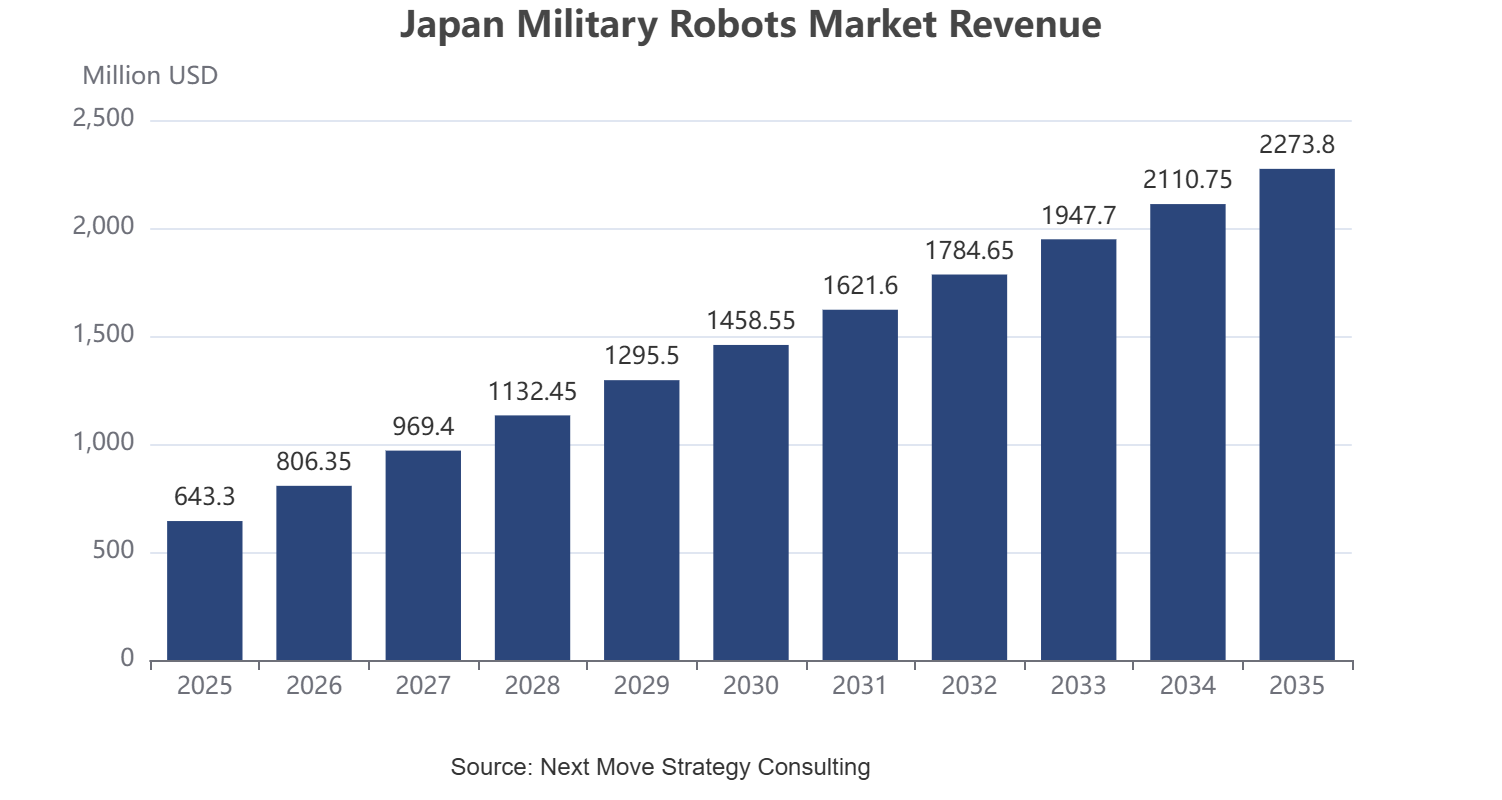
The Japan Military Robots Market size was valued at USD 643.3 Million in 2025 and reached USD 916.7 Million by 2026. Looking ahead, the industry is projected to expand significantly, reaching USD 2,273.8 Million by 2035, registering a CAGR of 10.62% from 2026 to 2035. In terms of volume, the market recorded 14 thousand units in 2025, with forecasts indicating growth to 20 thousand units by 2026 and further to 48 thousand units by 2035, reflecting a CAGR of 10.56% over the same period.
Ecosystem Analysis of the Japan Military Robots Industry
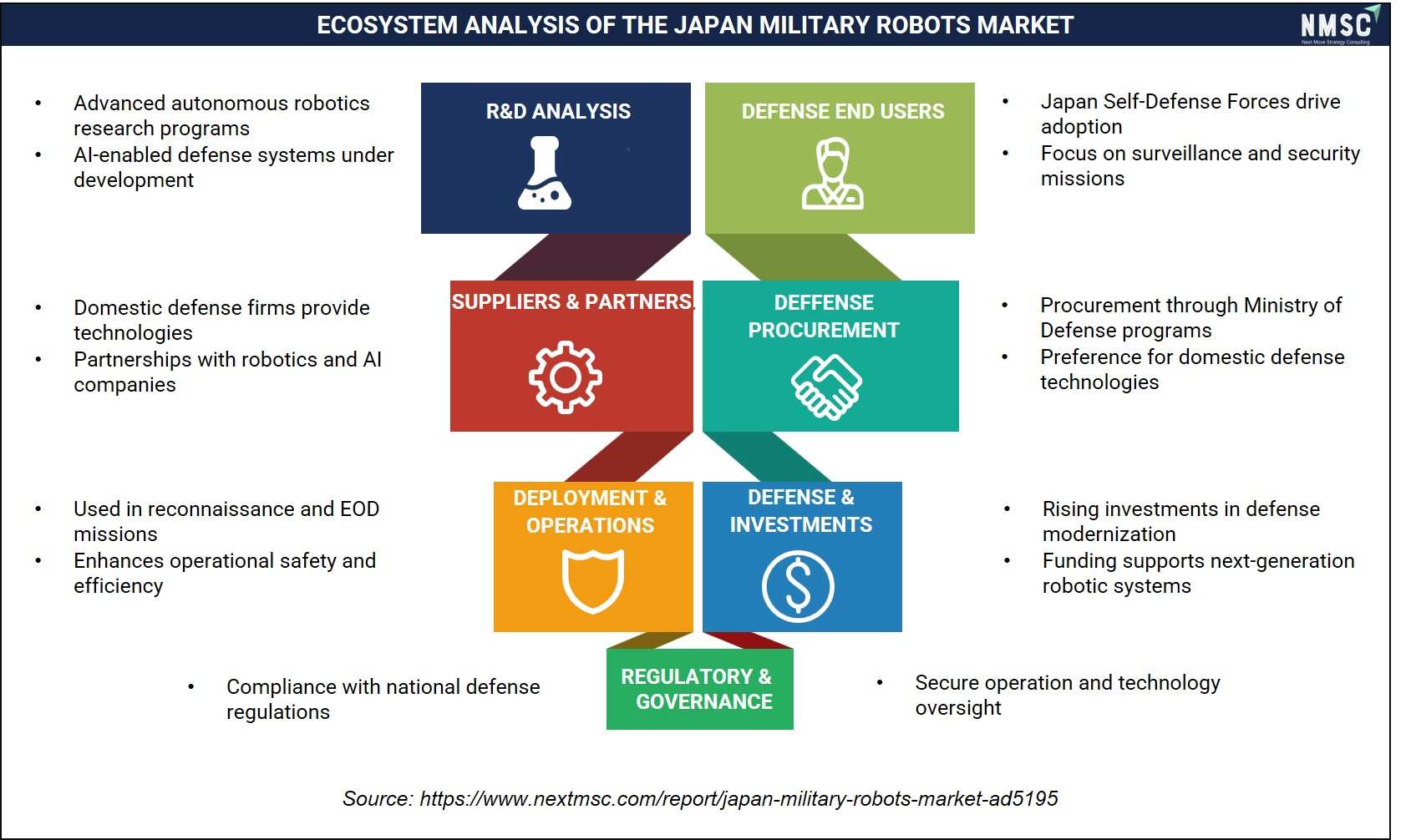
Through our market assessment, we observed that the Japan military robots market operates through a coordinated ecosystem involving defense research organizations, technology suppliers, procurement agencies, and military end users. Strong collaboration between robotics developers, electronics manufacturers, and defense stakeholders supports innovation and system integration. Furthermore, defense investments, operational deployment programs, and regulatory oversight strengthen the adoption of autonomous platforms across surveillance, reconnaissance, and combat support missions.
What are the Key Market Drivers, Breakthroughs, and Investment Opportunities that will Shape the Japan Military Robots Market in the Next Decade?
Growth Catalyst & Risk Assessment Matrix
|
Drivers / Trends / Restraints |
(+/–) % Impact on CAGR Forecast |
Geographic Relevance |
Impact Timeline |
|
Japan's defense budget expansion and national security modernization strengthening procurement of advanced unmanned systems across all military branches |
+1.5% |
Hokkaido, Okinawa, Tokyo defense corridors |
Medium to long term (2–6 years) |
|
Growing ISR mission requirements accelerating deployment of airborne and maritime robotic platforms for regional security operations across the Indo-Pacific |
+1.3% |
Pacific maritime zones, Northern Japan, Okinawa |
Medium term (2–5 years) |
|
Rising investment in autonomous EOD and mine countermeasure technologies supporting safe and effective handling across forward operational areas |
+1.2% |
Western Pacific, Japan Sea, Okinawa theater |
Short to medium term (1–4 years) |
|
Complex export control regulations and multilateral technology transfer restrictions limiting rapid procurement and integration of advanced foreign-developed robotic platforms |
–1.1% |
National defense procurement corridors, Tokyo, Osaka defense industrial zones |
Medium term (2–5 years) |
|
Expansion of indigenous defense robotics development programs creating opportunities for domestic autonomous platform production and next-generation military technology deployment |
+1.3% |
Kanagawa, Nagoya, Tokyo defense industrial corridors |
Medium to long term (3–7 years) |
Through our market assessment, we observed that the Japan Military Robots Market is witnessing robust growth driven by national defense modernization initiatives, rising budgetary allocations toward autonomous military systems, and increasing deployment of unmanned platforms across airborne, land, and maritime domains. Sustained geopolitical considerations across the Indo-Pacific region continue accelerating integration of advanced robotics technologies within Japan's defense forces. Meanwhile, export control regulations and technology licensing complexities create operational challenges for foreign-developed robotic system integration, while emerging domestic defense programs focused on autonomous capabilities are creating substantial long-term growth opportunities across military robotics domains.
Growth Drivers:
How Are Japan's Defense Modernization Initiatives Driving the Japan Military Robots Market Growth?
Through our defense sector assessment, we observed that Japan's defense modernization initiatives and increasing national security budgetary allocations are significantly driving market growth across unmanned systems domains. Rising investment in autonomous platforms under Japan's defense capability enhancement programs is expanding procurement of airborne, land, and maritime robots across all military branches. Military robotics technologies improve operational situational awareness, mission effectiveness, and personnel safety across complex defense environments. Consequently, defense procurement agencies are accelerating integration of advanced unmanned systems to strengthen operational capabilities throughout Japan's expanding military infrastructure.
How Are Expanding ISR Mission Requirements Accelerating Japan Military Robots Market Expansion?
Expansion of intelligence, surveillance, and reconnaissance mission requirements is fueling market expansion across Japan's military robotics sector. Our findings suggest that rising demand for persistent aerial observation, maritime domain awareness, and ground-based intelligence gathering is increasing deployment of autonomous platforms capable of supporting continuous mission operations effectively. Military robots improve reconnaissance coverage, data collection accuracy, and operational responsiveness across multi-domain ISR environments. Furthermore, defense forces are broadening unmanned system integration to strengthen situational awareness capabilities and improve intelligence coordination throughout regional security operations.
How Is Rising Investment in Autonomous EOD and Mine Countermeasure Operations Driving Japan Military Robots Market Growth?
Based on NMSC's research, we found that rising investment in explosive ordnance disposal and mine countermeasure operations is substantially driving market growth across Japan's defense robotics sector. Increasing operational requirements for safe handling of unexploded ordnance and maritime mine neutralization are encouraging defense forces to implement autonomous robotic platforms capable of supporting high-risk mission activities effectively. Military robots improve mission precision, personnel safety, and operational continuity across EOD and mine clearance environments. As a result, defense investment in specialized unmanned platforms is reinforcing long-term implementation of advanced military robotics technologies.
Growth Inhibitor:
How Are Export Control Regulations and Technology Transfer Restrictions Acting as a Constraint for the Japan Military Robots Market?
Heavy reliance on internationally developed military robotic technologies and complex export control regulatory frameworks continue acting as constraints for the market. In our observation, we found that several advanced unmanned system components and robotic platform technologies remain subject to multilateral export control agreements and licensing restrictions. Compliance requirements associated with international technology transfer protocols frequently create procurement delays and integration challenges for defense agencies. In addition, dependency on foreign-sourced components increases supply chain vulnerability for domestic military robotics programs, and regulatory complexity continues restricting broader deployment of advanced unmanned systems across Japan's defense forces.
Growth Opportunity:
How Is Expansion of Indigenous Defense Robotics Programs Unlocking New Growth Opportunities for the Japan Military Robots Market?
Through NMSC's assessment, we found that expansion of indigenous defense robotics development programs and domestic autonomous systems manufacturing initiatives is unlocking new growth opportunities for the market across Japan's defense ecosystem. Rising government investment in domestically developed unmanned platforms, AI-integrated robotic systems, and next-generation autonomous technologies is increasing adoption of advanced military robotics across all defense branches. Indigenous robotic platforms improve operational independence, mission adaptability, and strategic supply chain resilience. Additionally, defense operators are accelerating domestic robotics integration to strengthen national security capabilities throughout Japan's evolving defense infrastructure.
How is the Japan Military Robots Market segmented in this report, and what are the key insights from the segmentation analysis?
By Autonomy Level Insights
Is Autonomy Level Segmentation Supporting Military Robotics Advancement in the Japan Military Robots Market?
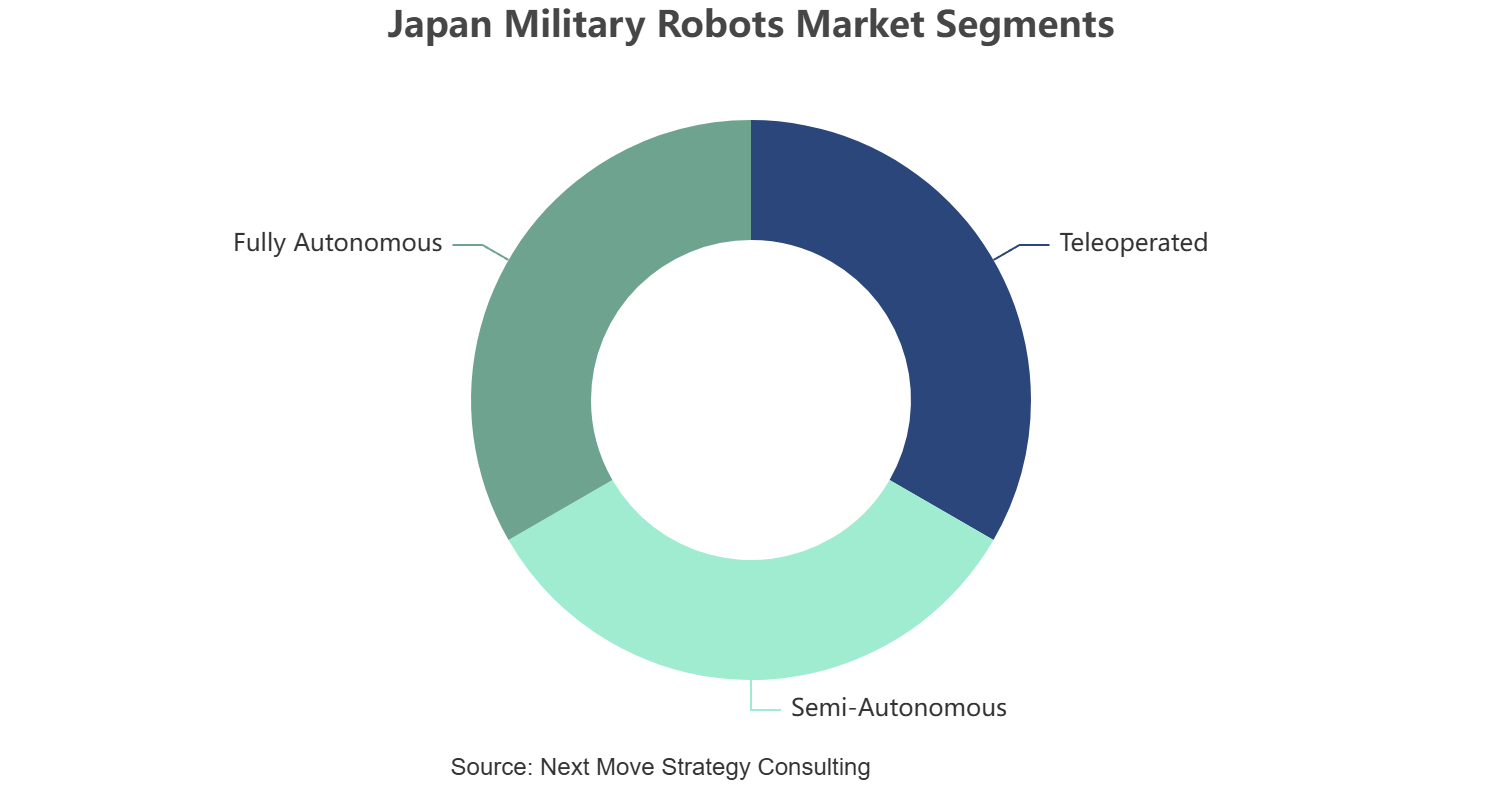
Based on autonomy level, the market is segmented into teleoperated, semi-autonomous, and fully autonomous.
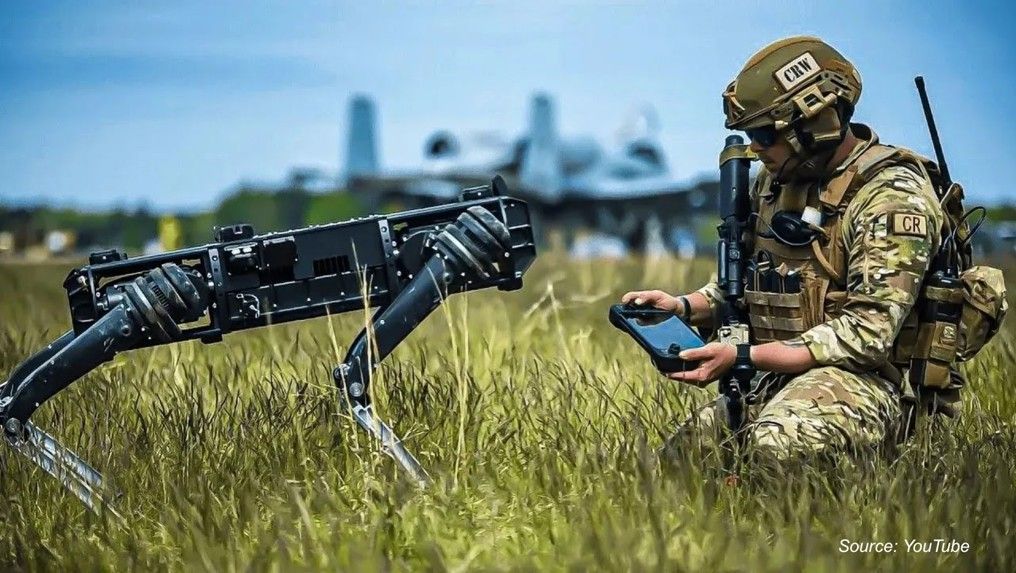
Based on our analysis, we observed that teleoperated robotic systems are supporting missions requiring direct operator supervision across surveillance, reconnaissance, and explosive ordnance disposal activities. Semi-autonomous platforms continue integrating automated navigation, target tracking, and mission support functions to improve operational coordination across defense environments. Fully autonomous systems are also being incorporated into military programs requiring persistent monitoring, independent mission execution, and extended operational endurance. Consequently, advancements in autonomous technologies are strengthening military robotics deployment across defense operations throughout Japan.
By Mission Insights
Is Mission-Based Segmentation Enhancing Operational Effectiveness in the Japan Military Robots Market?
Based on mission, the market is segmented into intelligence, surveillance and reconnaissance (ISR), combat operations, explosive ordnance disposal (EOD), mine clearance, mine countermeasures (maritime MCM), logistics support, electronic warfare, training and simulation, and other missions.
Based on our evaluation, we identified that ISR missions are utilizing military robotic platforms to support aerial surveillance, ground monitoring, and maritime observation activities across Japan's multi-domain defense operations. Combat operations continue integrating autonomous systems for precision engagement, force protection, and battlefield situational awareness across defense environments. EOD and mine clearance missions are strengthening robotic platform adoption for safe handling of explosive ordnance across operational theaters. Furthermore, logistics support and electronic warfare missions are supporting integration of specialized unmanned systems across supply chain and signal management activities.
Competitive Landscape
The Japan Military Robots Market is characterised by a competitive and technologically advancing structure, supported by the presence of defense aerospace manufacturers, robotic systems developers, and unmanned systems integrators. Market growth is being driven by increasing defense procurement investments, expanding autonomous platform requirements, and rising demand for advanced military robotics across airborne, land, and maritime domains. In addition, AI-integrated robotic systems and next-generation autonomous technologies are strengthening mission effectiveness and supporting broader market expansion across Japan's defense ecosystem.
Strategic Development:
-
June 2026 – The Japan Ministry of Defense (MoD) is developing a domestically produced unmanned amphibious armored vehicle (AAV). Designed for "Manned-Unmanned Teaming" (MUM-T), these vehicles will be able to operate autonomously or be remote-controlled to lead landing waves during island-recapture missions, minimizing personnel casualties. Practical testing is scheduled to begin in 2027, with plans to field approximately 97 units.
-
April 2026 – India's ideaForge and Japan’s Digital Media Professionals (DMP) signed an MOU to integrate DMP’s edge AI chips (Di1 SoC) into high-endurance VTOL (Vertical Take-Off and Landing) drones for the Japanese defense and border security markets. This signals a move to leverage AI for real-time situational awareness in complex terrain.
Key Players of the Japan Military Robots Market
-
THE BOEING COMPANY
-
Thales S.A.
-
L3Harris Technologies, Inc.
-
Rheinmetall AG
-
BAE Systems plc
-
Saab AB
-
Teledyne Technologies Incorporated
-
Skydio, Inc.
-
Northrop Grumman Corporation
-
Parrot S.A.
-
Kratos Defense & Security Solutions, Inc.
-
Autel Robotics Co., Ltd.
-
Airbus SE
Based on NMSC's research, we found that competitive dynamics are increasingly shaped by autonomous platform development expertise, AI integration capabilities, and mission-specific robotic systems engineering. Key companies such as THE BOEING COMPANY, Lockheed Martin Corporation, Thales S.A., Leonardo S.p.A., L3Harris Technologies, Inc., Rheinmetall AG, BAE Systems plc, Saab AB, Teledyne Technologies Incorporated, Skydio, Inc., Northrop Grumman Corporation, Parrot S.A., Kratos Defense & Security Solutions, Inc., Autel Robotics Co., Ltd., and Airbus SE are strengthening their market presence through advanced robotics integration and autonomous defense technologies, advancing the competitive landscape toward a more intelligent and automation-focused structure in the Japan Military Robots Market.
Supply Chain Structure Analysis of the Japan Military Robots Industry
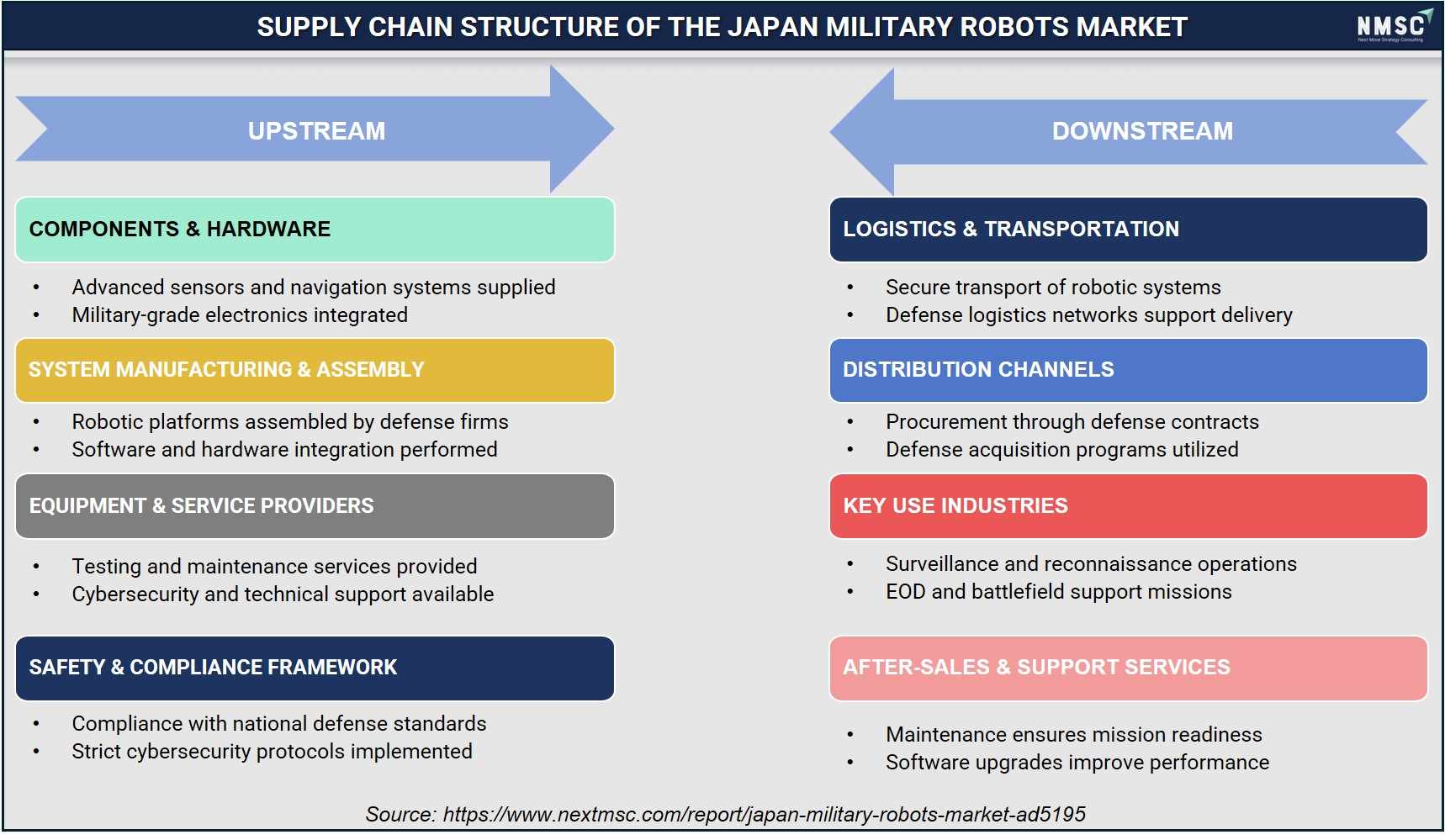
Based on research conducted by NMSC, we found that the Japan military robots market is supported by an integrated supply chain spanning advanced sensors, navigation systems, military-grade electronics, platform assembly, logistics networks, and lifecycle support services. Defense contractors oversee procurement and system integration, while maintenance, cybersecurity, and software upgrade activities strengthen operational readiness. Furthermore, surveillance, reconnaissance, EOD, and battlefield support applications drive demand across the value chain.
Key Segments
By Platform Type
-
Airborne Robots
-
Fixed-Wing UAV
-
Rotary-Wing UAV
-
Hybrid VTOL UAV
-
Loitering Munition
-
Target Drone
-
Other Airborne Robots
-
-
Land Robots
-
Wheeled UGV
-
Tracked UGV
-
Legged Robots
-
Optionally Manned Combat Vehicle
-
Other Land Robots
-
-
Maritime Robots
-
Uncrewed Surface Vessel (USV)
-
Underwater Vehicle
-
Remotely Operated Vehicle (ROV)
-
Autonomous Underwater Vehicle (AUV)
-
Large Displacement XLUUV
-
-
Other Maritime Robots
-
By Mission
-
Intelligence, Surveillance, Reconnaissance (ISR)
-
Combat Operations
-
Explosive Ordnance Disposal (EOD)
-
Mine Clearance
-
Mine Countermeasures (Maritime MCM)
-
Logistics Support
-
Electronic Warfare
-
Training and Simulation
-
Other Mission
By Autonomy Level
-
Teleoperated
-
Semi-Autonomous
-
Fully Autonomous
By End User
-
Army
-
Navy
-
Air Force
-
Marine Corps
-
Special Forces
-
Other Defense Forces
Key Benefits for Stakeholders
Next Move Strategy Consulting (NMSC) provides a comprehensive analysis of the Japan Military Robots Market, covering historical trends from 2020–2025 and forecasts through 2035. The study evaluates market performance across key segments, highlighting autonomous platform adoption, defense modernization investment, ISR mission expansion, and unmanned systems integration. Investors benefit from rising defense robotics procurement allocations, while defense operators gain from improved mission effectiveness, operational efficiency, and force protection capabilities. Technology providers benefit from increasing demand for autonomous systems, robotics platforms, and advanced defense technologies across military branches.
The report also provides stakeholders with detailed competitive intelligence covering key market participants, strategic developments, and technology innovation trends shaping the Japan Military Robots Market. Defense procurement agencies benefit from structured insights into platform type performance, mission effectiveness data, and autonomy level deployment analysis. Research institutions and policy organizations gain from comprehensive market forecasts and regulatory environment assessments supporting strategic planning and investment decision-making. Furthermore, defense contractors and system integrators benefit from market entry intelligence, partnership opportunity analysis, and demand forecasting data across Japan's evolving military robotics ecosystem.
|
Parameters |
Details |
|
Customization Scope |
Free customization (equivalent to up to 80 analyst-working hours) after purchase. |
|
Pricing and Purchase Options |
Avail customized purchase options to meet your exact research needs. |
|
Approach |
In-depth primary and secondary research; proprietary databases; rigorous quality control and validation measures. |
|
Analytical Tools |
Porter's Five Forces, SWOT, value chain, and Harvey ball analysis to assess competitive intensity, stakeholder roles, and relative impact of key factors. |
Conclusion
The Japan Military Robots Market is positioned for sustained growth over the forecast period, supported by increasing defense modernization investment, expanding multi-domain autonomous platform requirements, and rising demand for intelligent unmanned systems across Japan's military forces. Defense budgetary expansions, indigenous robotics development initiatives, and growing ISR mission requirements are collectively advancing market development across airborne, land, and maritime segments. Stakeholders across defense procurement, technology development, and investment ecosystems are well-positioned to leverage opportunities emerging from Japan's evolving military robotics landscape through 2035.
About the Author
 Saista Faiyaz
— Saista Faiyaz is Research Associate at Next Move Strategy Consulting, where she has covered consumer markets and healthcare technologies for 3 years. Her work includes primary interview review, secondary-source validation, market sizing, and structured analysis of company and industry data. She supports research by comparing evidence across sources, organizing findings into market narratives, and documenting assumptions used in analysis. Her scope includes cross-market benchmarking, and reports.
Saista Faiyaz
— Saista Faiyaz is Research Associate at Next Move Strategy Consulting, where she has covered consumer markets and healthcare technologies for 3 years. Her work includes primary interview review, secondary-source validation, market sizing, and structured analysis of company and industry data. She supports research by comparing evidence across sources, organizing findings into market narratives, and documenting assumptions used in analysis. Her scope includes cross-market benchmarking, and reports.
About the Reviewer
 Supradip Baul
— Supradip Baul is an accomplished business consultant and strategist with over a decade of rich experience in market intelligence, strategy, technology, and business transformation. His work has included rigorous qualitative and quantitative analysis across multiple industries, helping clients shape investment decisions and long-term roadmaps. Earlier in his career, he was associated with Gartner, where he contributed to industry-leading reports and market share analyses. He has worked with leading global companies and holds an MBA with a dual specialization in Marketing and Finance.
Supradip Baul
— Supradip Baul is an accomplished business consultant and strategist with over a decade of rich experience in market intelligence, strategy, technology, and business transformation. His work has included rigorous qualitative and quantitative analysis across multiple industries, helping clients shape investment decisions and long-term roadmaps. Earlier in his career, he was associated with Gartner, where he contributed to industry-leading reports and market share analyses. He has worked with leading global companies and holds an MBA with a dual specialization in Marketing and Finance.
At Next Move Strategy Consulting, we understand that insightful market research is the cornerstone of successful business decisions. That's why we employ a robust and multifaceted approach, combining various methodologies to deliver the most accurate and actionable data for our clients.

Research Landscape
We navigate the world of research with two primary approaches:
Qualitative Approach
Our qualitative research methodologies involve immersive techniques such as in-depth interviews, focus groups, and observational studies. By engaging directly with individuals and stakeholders, we uncover valuable insights that quantitative data alone may overlook.

Quantitative Research
In tandem with qualitative methodologies, NMSC leverages the power of Quantitative Research to provide a robust foundation of numerical insights. Through systematic data collection and analysis, we quantify patterns, preferences, and market trends, offering a comprehensive view of the business landscape.
Our quantitative research approach employs diverse tools, including surveys, experiments, and statistical modelling. These methodologies enable us to gather data from a large and representative sample, ensuring the statistical significance of our findings. By employing structured questionnaires and standardized data collection methods, we guarantee the reliability and validity of the information we present to our clients.
Quantitative research is particularly effective in measuring the prevalence of trends, assessing market size, and gauging the impact of various factors on consumer behavior. The numerical precision attained through this approach equips our clients with actionable insights, facilitating data-driven decision-making and strategy formulation.


Our Specialized Toolbox for Industry-Specific Market Research
We deploy a specialized arsenal of techniques tailored to meet your unique requirements. Here's a glimpse into our comprehensive toolbox:

Information Procurement
The stage entails acquiring market data or relevant information through various sources and methodologies.


Market Research Approach
We utilize both top-down and bottom-up approaches in market research analysis to achieve a comprehensive understanding of the market dynamics, leveraging the broad perspective of industry trends and macroeconomic factors alongside detailed insights from specific segments and individual companies.

Porters Five Forces Analysis
We conduct Porter's Five Forces analysis to evaluate the competitive landscape of an industry, providing us with insights into factors that affect profitability and strategic positioning.

SWOT Analysis

Forecasting
We utilize a forecasting model to predict future consumption by considering parameters like population, economics, regulations, market competition, drivers, constraints, technology, and pricing. We also employ statistical techniques such as multilinear regression, exponential smoothing, moving average, ARIMA, and Monte Carlo simulations for accurate predictions. In econometric forecasting, we analyzed short-term and long-term event impacts, attributing values based on regulatory frameworks, economic factors, and market events.





 Speak to Our Analyst