
MLOps Platform Market Size, Share, Trends and Growth Analysis, By Offering (Hyperscaler Managed Platform, Enterprise End-To-End Suite, Specialist Point Solution, Open Source Led Platform), By Capability Layer (Data & Feature Management, Experimentation & Model Development, Orchestration & Pipeline Automation, Deployment & Others), By Deployment Model, Organization Size, Revenue Stream, Sales Channel, End Use Industry, and Region — Global Industry Report and Forecast, 2025–2035
Industry: ICT & Media | Publishing Date: July 27, 2026 | Last Updated: September 30, 2026 | No of Pages: N/A | No. of Tables: N/A | No. of Figures: N/A | Format: PDF | Report Code: IC5416
What Is the MLOps Platform Market Size?
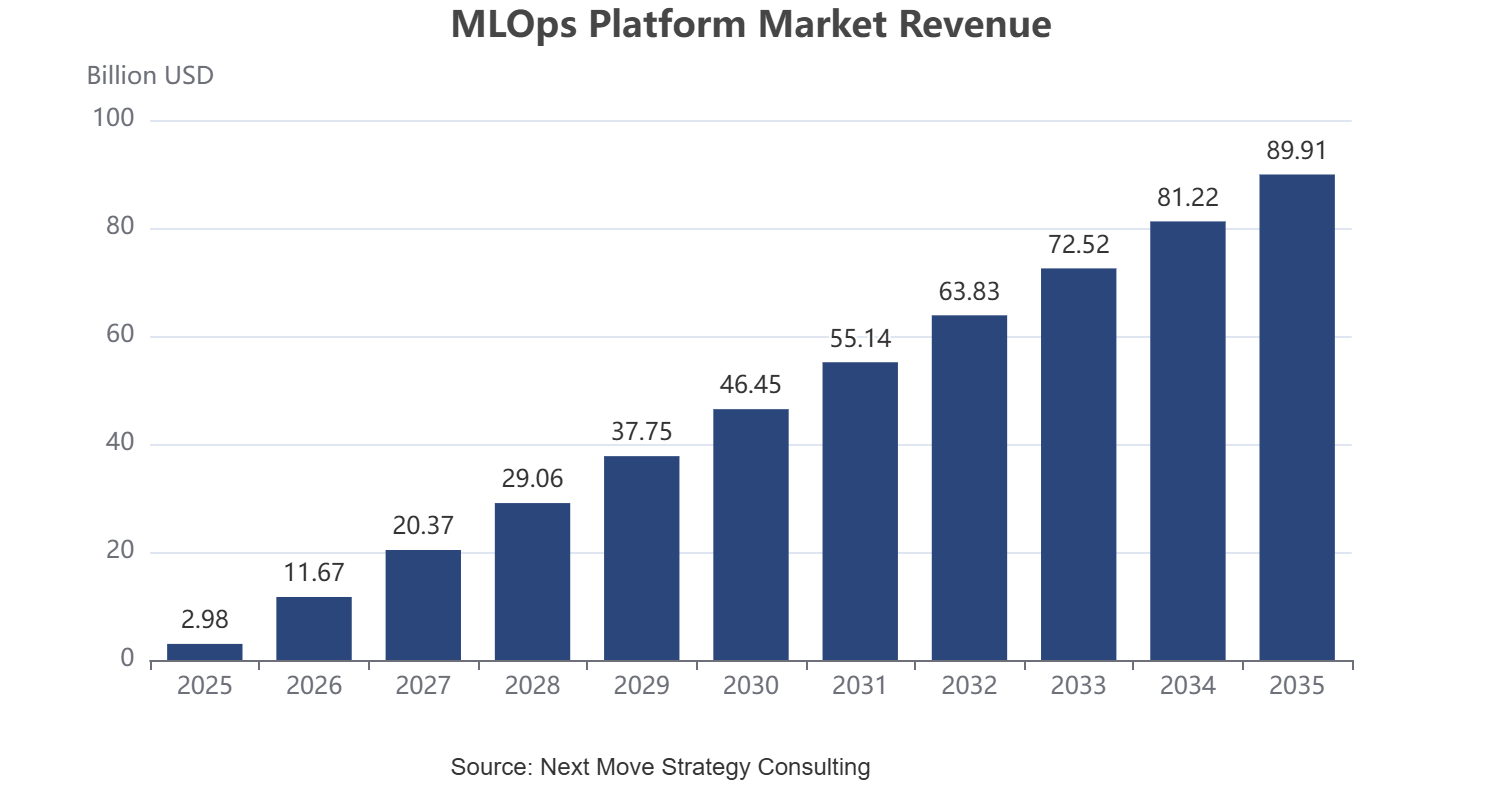
The global MLOps Platform Market size was valued at USD 2.98 billion in 2025 and is estimated at USD 4.39 billion in 2026, forecast to reach USD 89.91 billion by 2035, expanding at a 45.8% CAGR between 2026 and 2035. North America leads with approximately 46% share, while hyperscaler managed platforms dominate all other offerings with approximately 34% share.
We observed that growth is broad-based across every segmentation axis, with governance and compliance tooling and public cloud deployment driving the dominant structural shifts through 2035.
|
Key Takeaways |
|
By Offering: Hyperscaler Managed Platform held the largest share of approximately 34% (USD 1.01 Billion) in 2025; Open Source Led Platform is the fastest-growing sub-segment at 47.1% CAGR from 2026–2035. |
|
By Capability Layer: Deployment and Model Serving held the largest share of approximately 22% (USD 0.66 Billion) in 2025; Governance and Compliance is the fastest-growing sub-segment at 48.9% CAGR from 2026–2035. |
|
By Deployment Model: Public Cloud held the largest share of approximately 56% (USD 1.67 Billion) in 2025; Hybrid is the fastest-growing sub-segment at 44.1% CAGR from 2026–2035. |
|
By Organization Size: Large Enterprise held the largest share of approximately 68% (USD 2.03 Billion) in 2025; Small and Medium Enterprise is the fastest-growing sub-segment at 46.1% CAGR from 2026–2035. |
|
By Revenue Stream: Subscription held the largest share of approximately 58% (USD 1.73 Billion) in 2025; Consumption is the fastest-growing sub-segment at 44.1% CAGR from 2026–2035. |
|
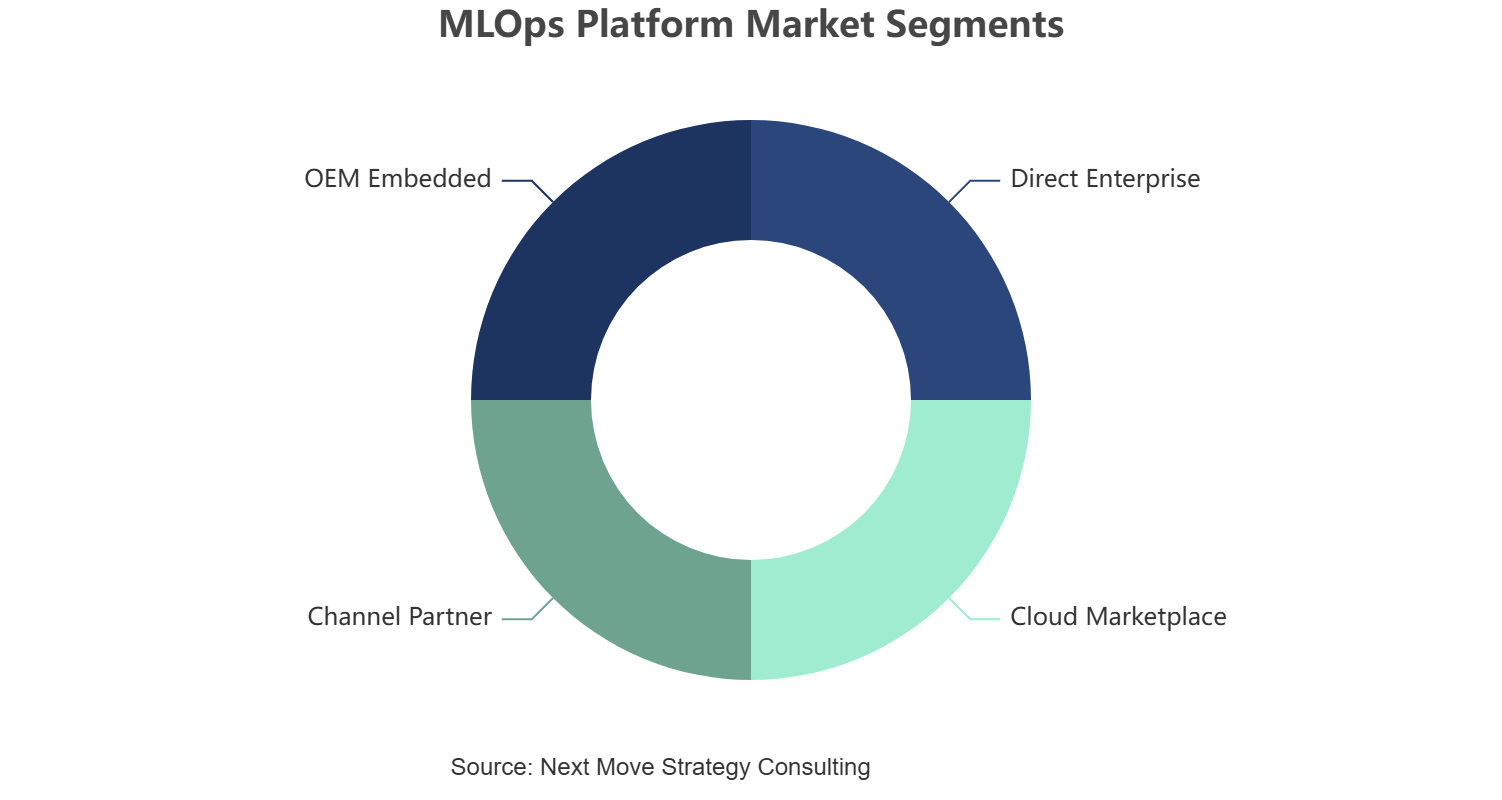
By Sales Channel: Direct Enterprise held the largest share of approximately 44% (USD 1.31 Billion) in 2025; Cloud Marketplace is the fastest-growing sub-segment at 44.5% CAGR from 2026–2035. |
|
By End Use Industry: Technology and Telecommunications held the largest share of approximately 22% (USD 0.66 Billion) in 2025; Healthcare and Life Sciences is the fastest-growing sub-segment at 52.4% CAGR from 2026–2035. |
|
Dominant Region: North America dominated with approximately 46% revenue share (USD 1.37 billion) in 2025. |
|
Fastest-Growing Region: Asia-Pacific is expected to register the highest CAGR of 47.1% during 2026–2035. |
|
Dominant Country: U.S. led with approximately USD 1.11 billion in 2025. |
|
Fastest-Growing Country: India is the fastest-growing country at approximately 58.9% CAGR from 2026–2035. |
Market Opportunity: The MLOps platform market is expected to create an absolute dollar opportunity of USD 85.52 billion between 2026 and 2035, presenting significant investment potential across the enterprise AI lifecycle management value chain.
According to Next Move Strategy Consulting analysis, enterprises are increasingly consolidating experimentation, deployment, and monitoring tools onto unified platforms to reduce integration overhead, a shift that favors end-to-end suite and hyperscaler-managed providers over narrow point solutions as agentic AI workloads expand governance and observability requirements through 2035.
What Does the MLOps Platform Market Encompass?
The MLOps platform market encompasses software and tooling that manage the full machine learning lifecycle, from data and feature preparation through experimentation, orchestration, deployment, monitoring, and governance. Our assessment indicates that the scope spans hyperscaler-managed platforms, enterprise end-to-end suites, specialist point solutions, and open source-led platforms supplied to large enterprises and small and medium enterprises across BFSI, technology, retail, healthcare, and manufacturing sectors seeking to operationalize machine learning and generative AI models at production scale.
Structural evolution in the market reflects a shift from siloed experiment tracking tools toward unified platforms that manage models, agents, and data pipelines under a single governance layer. We observed that artificial intelligence agent workloads are pushing more than 40% of enterprise applications toward task-specific AI agents by the end of 2026, according to industry commentary, intensifying demand for orchestration and monitoring capability. Next Move Strategy Consulting's analysis indicates that this structural shift, combined with rising regulatory scrutiny of automated decision systems, is redefining procurement criteria across the MLOps platform market.
|
Field |
Details |
|
Market Size in 2025 |
USD 2.98 Billion |
|
Market Size in 2026 |
USD 4.39 Billion |
|
Revenue Forecast in 2035 |
USD 89.91 Billion |
|
Growth Rate |
CAGR of 45.8% from 2026 to 2035 |
|
Analysis Period |
2025–2035 |
|
Base Year Considered |
2025 |
|
Forecast Period |
2026–2035 |
|
Market Size Estimation |
USD Billion |
|
Companies Profiled |
20 |
|
Countries Covered |
33 |
|
Market Share |
Available for Top 10 Companies |
Key Emerging Trends
Based on research conducted by Next Move Strategy Consulting, we found that four structural trends are reshaping platform design, enterprise adoption, and stakeholder engagement across the industry.
How Are Data and AI Platforms Converging into Unified Lakehouse Architectures?
Data platforms and MLOps tooling are converging as vendors extend data warehousing capability into full AI lifecycle management. We observed that Databricks reported its data warehousing business more than doubled to a USD 1.5 billion annual run rate during 2025, fueled primarily by AI workloads and customers migrating from other platforms. Enterprises and cloud marketplace buyers are adopting unified data lakes architectures that combine analytics and model development to eliminate custom data movement between systems.
Why Are Vendors Racing to Add Transactional Postgres for AI Agents?
Vendors are racing to add operational, transactional database capability to support autonomous AI agent workloads that require real-time state management rather than analytical-only access. Our findings suggest that Databricks acquired Neon for approximately USD 1 billion and launched Lakebase in general availability during February 2026, while Snowflake acquired Crunchy Data for approximately USD 250 million to launch Snowflake Postgres. This trend is elevating demand for deployment and model serving capability among enterprises building agentic applications.
How Is AI Cloud Infrastructure Consolidating with Developer Tooling?
AI cloud infrastructure providers are acquiring developer-facing experimentation and monitoring tools to offer end-to-end platforms. We observed that CoreWeave completed its acquisition of Weights & Biases in May 2025, combining compute infrastructure with experiment tracking, evaluation, and monitoring tools used by more than 1,400 organizations. This consolidation is elevating demand for experimentation and model development capability among AI labs and enterprises seeking infrastructure and tooling from a single vendor.
What Role Does Generative AI Play in Reshaping Governance Requirements?
Generative and agentic AI adoption is reshaping governance requirements as enterprises deploy autonomous systems requiring continuous monitoring and audit management. Our analysis shows that Databricks is investing in its Unity AI Gateway multi-AI governance solution following a 2026 financing round, while Snowflake's Cortex Analyst layers natural-language access on top of governed data. This trend, driven by expanding generative AI deployment, is elevating governance and compliance tooling as a distinct, fast-growing capability layer.
ECOSYSTEM ANALYSIS OF THE MLOPS PLATFORM MARKET
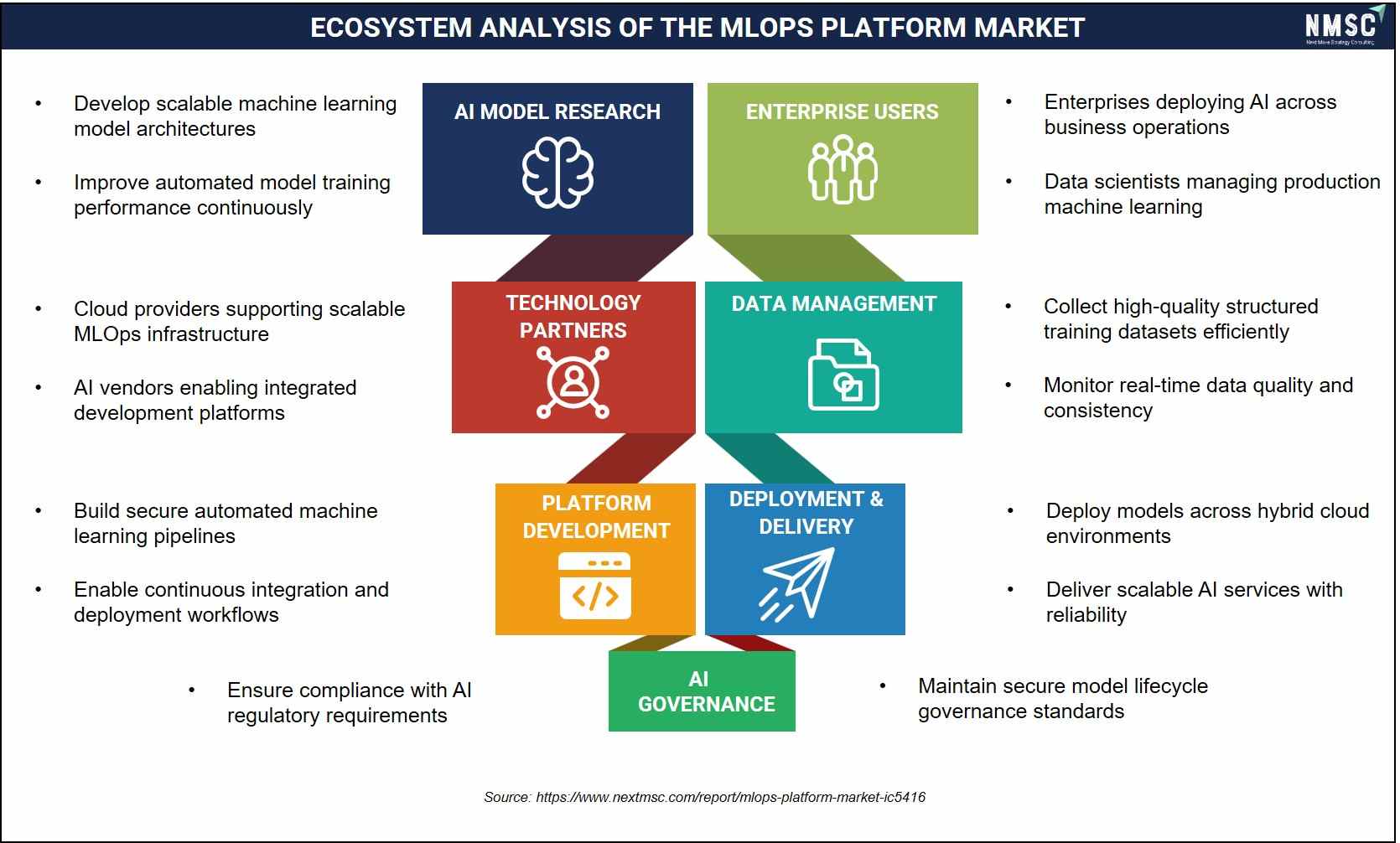
The ecosystem of the MLOps platform market integrates AI model research, enterprise users, technology partners, data management, platform development, deployment & delivery, and AI governance to enable efficient AI lifecycle management. AI models are developed and refined using enterprise data, supported by technology partners and scalable platforms. Robust deployment, continuous monitoring, and governance frameworks ensure reliable, secure, and compliant AI operations, driving widespread enterprise adoption and long-term business value.
Growth Drivers and Restraints
Growth Catalyst and Risk Assessment Matrix
|
Factors |
Type |
(+/−) % Impact on CAGR |
Geographic Relevance |
Impact Timeline |
|
Rising enterprise deployment of generative and agentic AI applications |
Driver |
+6.8% |
Global |
2026–2035 |
|
Expanding regulatory scrutiny requiring model governance and audit trails |
Driver |
+4.9% |
North America, Europe |
2026–2035 |
|
Growing enterprise investment in AI infrastructure and cloud consumption |
Driver |
+4.1% |
Global |
2026–2035 |
|
Rising demand for unified data and AI lifecycle platforms |
Driver |
+3.2% |
Global |
2026–2032 |
|
Expanding small and medium enterprise adoption of managed AI platforms |
Driver |
+2.1% |
Asia-Pacific, Latin America |
2026–2035 |
|
Government AI investment and digital infrastructure programmes |
Driver |
+1.6% |
Global |
2026–2035 |
|
Shortage of skilled machine learning engineering talent |
Restraint |
−2.4% |
Global |
2026–2035 |
|
High integration cost across fragmented point solution tool stacks |
Restraint |
−1.6% |
North America, Europe |
2026–2032 |
|
Data privacy and cross-border AI governance uncertainty |
Restraint |
−1.1% |
Global |
2028–2035 |
What Is the Primary Growth Driver of the MLOps Platform Market?
Rising enterprise deployment of generative and agentic AI applications is the primary driver of the market. Industry commentary referencing Gartner-adjacent enterprise software forecasts indicates that task-specific AI agents are expected in roughly 40% of enterprise applications by the end of 2026, up from under 5% in 2025. We observed that this rapid deployment pace, reinforced by rising annualized AI product revenue disclosed by major platform vendors, continues to anchor baseline demand for orchestration and deployment tooling.
How Is Regulatory Scrutiny Driving MLOps Platform Market Growth?
Expanding regulatory scrutiny of automated decision systems is accelerating market growth toward governance and compliance capability. U.S. Securities and Exchange Commission filings from major cloud AI vendors increasingly disclose AI governance investment as a material business risk factor. Our assessment indicates that this compliance pressure, combined with enterprise risk management requirements, is compressing adoption timelines for model lineage, explainability, and audit management tooling across North America and Europe.
What Is Restraining MLOps Platform Market Expansion?
Shortage of skilled machine learning engineering talent restrains adoption among enterprises lacking in-house data science capability to operationalize models. Trade and workforce data continues to document persistent technical talent gaps across AI-adjacent occupations. We found that hyperscaler-managed and enterprise end-to-end suite providers are beginning to offset this restraint by embedding automated training and low-code tooling, though full adoption among resource-constrained small and medium enterprises remains gradual.
Segmentation Analysis
Segment Sizing: By Offering
|
Segment |
2025 (USD) |
2035 (USD) |
CAGR% (2026–2035) |
|
Hyperscaler Managed Platform |
USD 1.01 Billion |
USD 23.91 Billion |
36.1% |
|
Enterprise End-To-End Suite |
USD 0.81 Billion |
USD 15.55 Billion |
33.1% |
|
Specialist Point Solution |
USD 0.71 Billion |
USD 29.24 Billion |
44.7% |
|
Open Source Led Platform |
USD 0.45 Billion |
USD 21.22 Billion |
47.1% |
|
Total |
USD 2.98 Billion |
USD 89.91 Billion |
45.8% |
Which Offering Segment Dominates the MLOps Platform Market?
Hyperscaler Managed Platform, encompassing native cloud MLOps and managed AI platform offerings, led the market with USD 1.01 billion in 2025, supported by enterprises' preference for tightly integrated tooling bundled with existing cloud infrastructure commitments. We observed that Open Source Led Platform is the fastest-growing offering, expanding at a 47.1% CAGR from 2026 to 2035, as enterprises increasingly adopt commercially supported open source distributions to avoid vendor lock-in for critical AI workloads.
Segment Sizing: By End Use Industry
|
Segment |
2025 (USD) |
2035 (USD) |
CAGR% (2026–2035) |
|
BFSI |
USD 0.57 Billion |
USD 14.27 Billion |
37.1% |
|
Technology and Telecommunications |
USD 0.66 Billion |
USD 14.48 Billion |
35.1% |
|
Retail and Consumer Packaged Goods |
USD 0.36 Billion |
USD 10.27 Billion |
39.1% |
|
Healthcare and Life Sciences |
USD 0.39 Billion |
USD 25.24 Billion |
52.4% |
|
Manufacturing and Industrial |
USD 0.33 Billion |
USD 10.04 Billion |
40.1% |
|
Government and Public Sector |
USD 0.24 Billion |
USD 4.86 Billion |
33.9% |
|
Energy and Utilities |
USD 0.18 Billion |
USD 4.23 Billion |
36.1% |
|
Transportation and Logistics |
USD 0.15 Billion |
USD 4.00 Billion |
38.1% |
|
Media and Entertainment |
USD 0.09 Billion |
USD 1.96 Billion |
35.1% |
|
Other Industries |
USD 0.03 Billion |
USD 0.54 Billion |
32.1% |
|
Total |
USD 2.98 Billion |
USD 89.91 Billion |
45.8% |
Which End Use Industry Leads MLOps Platform Market Demand?
Technology and Telecommunications remained the leading end use industry, valued at USD 0.66 billion in 2025 as software and telecom companies were earliest to operationalize machine learning at scale. Based on research conducted by Next Move Strategy Consulting, we found that Healthcare and Life Sciences is the fastest-growing end use industry at a 52.4% CAGR from 2026 to 2035, reflecting rising healthcare artificial intelligence software deployment for diagnostic and drug discovery model operationalization.
Segment Sizing: By Capability Layer
|
Segment |
2025 (USD) |
2035 (USD) |
CAGR% (2026–2035) |
|
Data and Feature Management |
USD 0.54 Billion |
USD 11.85 Billion |
35.1% |
|
Experimentation and Model Development |
USD 0.57 Billion |
USD 14.27 Billion |
37.1% |
|
Orchestration and Pipeline Automation |
USD 0.51 Billion |
USD 10.34 Billion |
33.9% |
|
Deployment and Model Serving |
USD 0.66 Billion |
USD 19.04 Billion |
39.3% |
|
Monitoring and Observability |
USD 0.42 Billion |
USD 18.62 Billion |
46.1% |
|
Governance and Compliance |
USD 0.30 Billion |
USD 15.79 Billion |
48.9% |
|
Total |
USD 2.98 Billion |
USD 89.91 Billion |
45.8% |
Which Capability Layer Leads MLOps Platform Adoption?
Deployment and Model Serving remained the dominant capability layer, reaching USD 0.66 billion in 2025 due to its central role in delivering trained models into production inference environments. Our findings suggest that Governance and Compliance is the fastest-growing capability layer at a 48.9% CAGR from 2026 to 2035, reflecting rising enterprise investment in model lineage, explainability, and audit management tooling as regulatory scrutiny of AI systems intensifies.
Growth Opportunities
Our analysis shows that three forward-looking opportunities stand out for stakeholders positioning within the MLOps platform market over the 2026–2035 forecast period.
How Can Edge Deployment Unlock Value for Manufacturing and Industrial Buyers?
Edge-deployed model serving presents a whitespace opportunity for vendors targeting manufacturing and industrial buyers requiring low-latency inference on factory floors. Suppliers that scale edge computing integration alongside centralized model governance stand to capture recurring platform revenue as industrial enterprises deploy computer vision and predictive maintenance models beyond centralized cloud environments, benefiting the deployment and model serving capability layer.
Where Does Cloud Marketplace Distribution Create New Demand?
Small and medium enterprises seeking simplified procurement represent an underpenetrated opportunity for vendors distributing through cloud marketplaces. Suppliers that list consumption-priced MLOps tooling on hyperscaler marketplaces can secure faster sales cycles and lower customer acquisition costs, benefiting from procurement budget consolidation as buyers increasingly prefer committed cloud spend over separate vendor contracts.
How Can Synthetic Data Tooling Benefit Regulated Industries?
Regulated industries such as BFSI and healthcare seeking to train models without exposing sensitive records create an opportunity for vendors offering synthetic data generation integrated into experimentation platforms. Early movers that embed privacy-preserving data generation into feature engineering workflows can differentiate with data and feature management buyers pursuing compliant model development without compromising training data quality.
PORTER’S FIVE FORCES ANALYSIS OF THE MLOPS PLATFORM MARKET
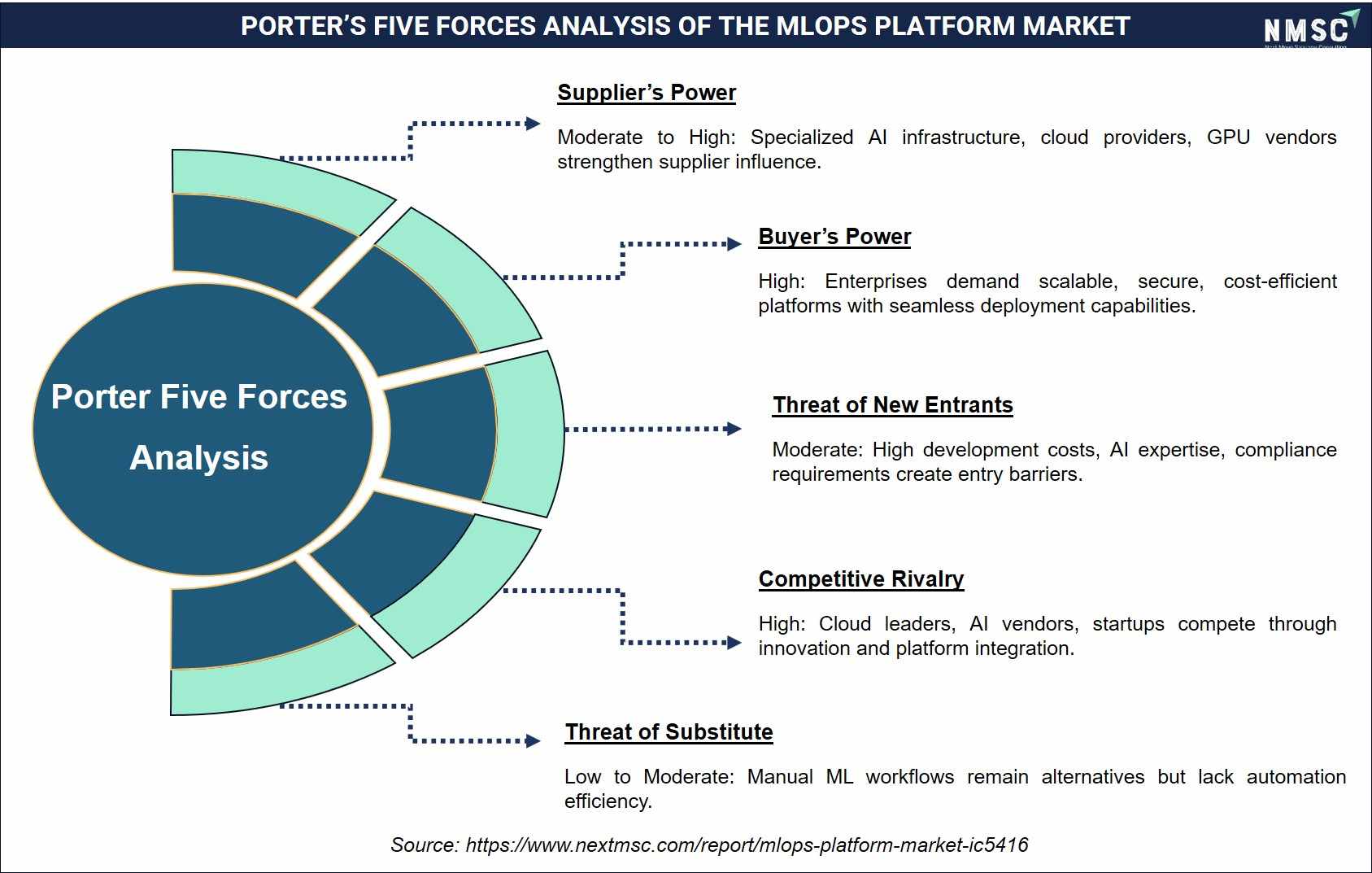
Porter's Five Forces analysis of the MLOps platform market evaluates the competitive dynamics shaping industry growth, including the bargaining power of buyers and suppliers, the threat of new entrants and substitute solutions, and the intensity of competitive rivalry. The market is characterized by rapid technological innovation, strong competition among cloud and AI platform providers, increasing enterprise demand, and evolving governance requirements, encouraging continuous product innovation, strategic partnerships, and differentiated AI lifecycle management capabilities.
Regional Outlook
Geographic Performance Snapshot
|
Region |
2025 (USD) |
2035 (USD) |
CAGR% (2026–2035) |
Key Driver |
|
North America |
USD 1.37 Billion |
USD 30.50 Billion |
35.2% |
Hyperscaler platform leadership and dense enterprise AI investment |
|
Europe |
USD 0.71 Billion |
USD 20.53 Billion |
39.1% |
AI Act compliance requirements and national digital sovereignty programmes |
|
Asia-Pacific |
USD 0.63 Billion |
USD 29.73 Billion |
47.1% |
Expanding enterprise cloud adoption and rising domestic AI investment |
|
Middle East & Africa |
USD 0.15 Billion |
USD 5.51 Billion |
43.1% |
Vision-linked digital transformation and sovereign AI infrastructure investment |
|
Latin America |
USD 0.12 Billion |
USD 3.64 Billion |
40.1% |
Growing enterprise cloud migration and expanding AI infrastructure investment |
|
Total |
USD 2.98 Billion |
USD 89.91 Billion |
45.8% |
— |
North America MLOps Platform Market Outlook
North America leads the MLOps platform market with the deepest concentration of hyperscaler and specialized AI infrastructure vendors globally. We observed that Databricks' reported annualized revenue run rate reached USD 5.4 billion by early 2026, illustrating the scale of enterprise AI platform investment in the region. Technology adoption remains advanced, with cloud computing consumption-based pricing and agentic AI deployment accelerating across the region's technology, BFSI, and healthcare sectors.
Europe MLOps Platform Market Outlook
Europe's MLOps platform market reflects a mature but regulation-intensive landscape shaped by the EU AI Act and national digital sovereignty programmes. Our findings suggest that enterprises across Germany, France, and the UK are accelerating adoption of governance and compliance tooling to satisfy algorithmic transparency obligations. Technology adoption favors hybrid deployment models, supported by regional integrators investing in sovereign cloud-compatible MLOps infrastructure.
Asia-Pacific MLOps Platform Market Outlook
Asia-Pacific is the fastest-growing MLOps platform market region, propelled by expanding enterprise cloud adoption in China and India alongside rising domestic AI investment. We found that regulatory frameworks remain less harmonized than in Europe, giving platform vendors flexibility to scale standard deployments rapidly. Technology adoption is accelerating as regional cloud providers, including several China-based hyperscalers, expand MLOps platform portfolios to serve growing domestic enterprise demand.
Middle East & Africa MLOps Platform Market Outlook
The MLOps platform market in Middle East & Africa is expanding as Gulf Cooperation Council economies invest in sovereign AI infrastructure and national digital transformation programmes. Our analysis shows that Saudi Arabia and the UAE are attracting MLOps platform investment tied to Vision 2030-linked technology diversification. Regulatory influence remains moderate, while technology adoption is gradually shifting toward hybrid cloud-deployed platforms as regional enterprises align with global AI governance standards.
Latin America MLOps Platform Market Outlook
Latin America's MLOps platform market is supported by growing enterprise cloud migration in Brazil and Argentina and expanding AI infrastructure investment. We observed that regulatory frameworks are less stringent than in North America or Europe, though multinational enterprises operating locally are introducing AI governance specifications aligned with global standards. Technology adoption remains centered on direct enterprise sales channels, with competitive intensity increasing as regional distributors partner with global hyperscalers.
U.S. MLOps Platform Market
Based on our estimates, the U.S. market was valued at approximately USD 1.11 billion in 2025, projected to reach USD 32.96 billion by 2035 at a 39.6% CAGR. Demand structure is anchored by the deepest hyperscaler and specialized AI vendor concentration globally and rapid enterprise AI product revenue growth. Technology penetration favors public cloud and agentic AI deployment, and competitive intensity remains high among established hyperscalers and specialized MLOps companies serving national enterprise accounts.
Canada MLOps Platform Market
The market in Canada was valued at approximately USD 0.15 billion in 2025 and is projected to reach USD 4.93 billion by 2035, growing at a 41.1% CAGR. Demand is reflecting demand patterns similar to the U.S. market, while national AI strategy funding shapes enterprise adoption timelines. Technology penetration is rising as enterprises request cloud marketplace-distributed platforms, with competitive intensity moderate given reliance on cross-border platform supply from U.S.-based vendors.
UK MLOps Platform Market
As per our estimate, the UK market was valued at approximately USD 0.17 billion in 2025, projected to reach USD 5.80 billion by 2035 at a 41.6% CAGR. Demand structure is driven by financial services AI governance requirements and growing enterprise cloud migration. Regulatory influence from UK data protection and AI governance guidance is significant, technology penetration favors hybrid deployment and compliance tooling, and competitive intensity remains steady among domestic and global integrators.
Germany MLOps Platform Market
According to our analysis, the Germany market was valued at approximately USD 0.18 billion in 2025, projected to reach USD 6.23 billion by 2035 at a 42.1% CAGR. Demand structure is benefiting from a strong domestic manufacturing and industrial base pursuing AI-driven automation under national digital strategy. Germany's data sovereignty requirements drive regulatory influence, while technology penetration favors private cloud and hybrid deployment among leading industrial enterprises.
France MLOps Platform Market
Based on our estimates, the France market was valued at approximately USD 0.10 billion in 2025, projected to reach USD 3.06 billion by 2035 at a 40.1% CAGR. Demand structure is supported by France's national AI strategy and prominent enterprise software sector shaping platform adoption. Regulatory influence from French and EU AI governance frameworks is notable, and competitive intensity remains high given the concentration of premium enterprise software providers headquartered domestically.
China MLOps Platform Market
The market in China was valued at approximately USD 0.19 billion in 2025 and is projected to reach USD 11.05 billion by 2035, growing at a 50.1% CAGR. Demand is fueled by expanding domestic enterprise cloud adoption and a dense base of regional AI platform suppliers. Regulatory influence is increasing gradually under national AI governance guidelines, technology penetration is accelerating through hyperscaler expansion, and competitive intensity remains elevated among numerous China-based integrators.
India MLOps Platform Market
As per our estimate, the India market was valued at approximately USD 0.15 billion in 2025, projected to reach USD 14.27 billion by 2035 at a 58.9% CAGR. Demand structure is the fastest among covered countries, reflecting rapid enterprise cloud adoption and expanding domestic technology sector investment. Regulatory influence remains developing, while technology penetration is rising quickly as multinational vendors localize MLOps platform sourcing to serve India's growing enterprise and technology services base.
Japan MLOps Platform Market
According to our analysis, the Japan market was valued at approximately USD 0.09 billion in 2025, projected to reach USD 3.47 billion by 2035 at a 44.1% CAGR. Demand structure is supported by Japan's precision-engineered manufacturing heritage and growing enterprise AI adoption among domestic technology conglomerates. Regulatory influence is well established, technology penetration is advanced, and competitive intensity remains high among long-standing domestic and global platform providers.
South Korea MLOps Platform Market
Based on our estimates, the South Korea market was valued at approximately USD 0.06 billion in 2025, projected to reach USD 3.81 billion by 2035 at a 51.1% CAGR. Demand structure is benefiting from the country's globally influential technology manufacturing base and rising AI infrastructure investment. Technology penetration is high, with domestic integrators supplying premium MLOps tooling, and competitive intensity remains pronounced amid rapid product innovation cycles.
Australia MLOps Platform Market
The market in Australia was valued at approximately USD 0.04 billion in 2025 and is projected to reach USD 2.09 billion by 2035, growing at a 47.1% CAGR. Demand is supported by a well-established enterprise cloud adoption base and growing government-backed AI investment. Regulatory influence stems from Australia's AI governance frameworks, while technology penetration favors imported hyperscaler-managed platforms amid moderate competitive intensity.
UAE MLOps Platform Market
As per our estimate, the UAE market was valued at approximately USD 0.04 billion in 2025, projected to reach USD 2.60 billion by 2035 at a 51.1% CAGR. Demand structure is shaped by the UAE's role as a regional digital transformation and sovereign AI infrastructure hub. Regulatory influence remains moderate, technology penetration is improving through imported hybrid cloud-deployed formats, and competitive intensity is rising as integrators expand portfolios to serve Gulf enterprise accounts.
Saudi Arabia MLOps Platform Market
According to our analysis, the Saudi Arabia market was valued at approximately USD 0.05 billion in 2025, projected to reach USD 2.95 billion by 2035 at a 52.1% CAGR. Demand structure is driven by Vision 2030-linked technology diversification and rising sovereign AI infrastructure investment. Regulatory influence is developing under national AI governance guidelines, and technology penetration is advancing as domestic enterprises scale MLOps platform adoption.
South Africa MLOps Platform Market
Based on our estimates, the South Africa market was valued at approximately USD 0.02 billion in 2025, projected to reach USD 0.73 billion by 2035 at a 42.1% CAGR. Demand structure is reflecting a growing enterprise technology sector that continues to drive investment in cloud-deployed AI platforms. Regulatory influence is moderate, technology penetration favors imported hyperscaler-managed formats, and competitive intensity is increasing as regional distributors expand product breadth.
Brazil MLOps Platform Market
The market in Brazil was valued at approximately USD 0.05 billion in 2025 and is projected to reach USD 2.41 billion by 2035, growing at a 46.1% CAGR. Demand is supported by growing enterprise cloud migration and expanding AI infrastructure investment. We observed that regulatory frameworks are less stringent than in North America or Europe, though multinational enterprises are introducing AI governance specifications across major metropolitan technology markets.
Argentina MLOps Platform Market
As per our estimate, the Argentina market was valued at approximately USD 0.02 billion in 2025, projected to reach USD 0.78 billion by 2035 at a 43.1% CAGR. Demand structure is reflecting rising enterprise cloud adoption amid gradual AI governance framework development. Regulatory influence remains developing, technology penetration is gradually increasing through imported hyperscaler-managed platforms, and competitive intensity is moderate among regional distributors serving enterprise accounts.
Competitive Landscape
We observed that the MLOps platform market remains moderately consolidated among hyperscaler cloud providers and diversified enterprise software groups, with specialized AI infrastructure companies competing for developer and enterprise accounts.
|
Field |
Details |
|
Market Structure |
Moderately consolidated, led by hyperscaler cloud providers and diversified enterprise software groups |
|
Innovation Focus |
Unified lakehouse architectures, agentic AI governance, and transactional database integration |
|
M&A Activity |
Highly active, concentrated in data infrastructure, observability, and developer tooling acquisitions |
How Do Companies Compete in the MLOps Platform Market?
Companies compete primarily on platform breadth, AI workload performance, and integration depth with existing enterprise data infrastructure across the industry. Hyperscalers such as Microsoft Corporation and Amazon.com, Inc. leverage broad cloud infrastructure to bundle MLOps tooling with committed spend agreements, while specialized companies such as Databricks, Inc. and Dataiku, Inc. compete on unified lakehouse and enterprise AI platform depth for data science teams.
Which Competitive Archetypes Dominate the MLOps Platform Market?
Two archetypes dominate the market: hyperscaler cloud providers offering natively integrated, consumption-priced MLOps tooling, and specialized data and AI platform companies focused on unified lifecycle management. Alphabet Inc. and Amazon.com, Inc. exemplify the hyperscaler archetype through cloud-bundled managed AI platforms, while Databricks, Inc. and Snowflake Inc. exemplify the specialized archetype through end-to-end lakehouse and AI data platform depth.
How Are Companies Differentiating Through Innovation in MLOps?
Innovation and differentiation strategy increasingly center on transactional database integration and unified governance layers for agentic AI. Databricks' Lakebase, built on its Neon acquisition and reaching general availability in February 2026, and Snowflake's Postgres offering, built on its Crunchy Data acquisition, both target the operational memory layer required by autonomous AI agents. Our analysis shows that suppliers unable to support both analytical and transactional workloads risk losing data integration and platform consolidation deals to competitors offering unified architectures.
What M&A and Expansion Activity Is Shaping the MLOps Platform Market?
Mergers, acquisitions, and large financing rounds continue to consolidate capability within the industry. CoreWeave's completed acquisition of Weights & Biases in May 2025, combining AI cloud infrastructure with experiment tracking and evaluation tooling used by more than 1,400 organizations, illustrates how infrastructure providers are acquiring developer platforms, while Databricks' reported financing discussions at a USD 165 billion to USD 175 billion valuation in 2026 demonstrate continued capital concentration among leading platform vendors.
Key Market Players
Our assessment indicates that the following 20 companies are actively shaping platform innovation, capacity expansion, and commercial strategy within the global MLOps platform market.
-
Microsoft Corporation
-
Amazon.com, Inc.
-
Oracle Corporation
-
Databricks, Inc.
-
Snowflake Inc.
-
NVIDIA Corporation
-
SAP SE
-
SAS Institute Inc.
-
Hewlett Packard Enterprise Company
-
DataRobot, Inc.
-
Dataiku, Inc.
-
Domino Data Lab, Inc.
-
Cloudera, Inc.
-
H2O.ai, Inc.
-
Weights & Biases, Inc.
-
Hugging Face, Inc.
-
C3.ai, Inc.
-
Anyscale, Inc.
Latest Developments
We found that recent M&A activity and product launches within the MLOps platform market are concentrated on agentic AI governance and lakehouse-native platform expansion, reflecting the industry's broader shift toward unified, governed AI operations.
|
Date |
Event |
|
February 2025 |
SAP and Databricks jointly launched SAP Business Data Cloud, integrating SAP enterprise data with Databricks' AI and machine learning capabilities. The platform enables organizations to prepare trusted business data, develop AI models, and operationalize them with governance and lifecycle management, supporting enterprise-scale MLOps adoption. |
Expert Insights
 “Multi-agent systems are the digital workforce of tomorrow, equipped not only to act but to adapt, collaborate, and evolve. Our pioneering work with agentic AI allows organizations to unlock the potential of converged predictive and generative intelligence moving beyond automation to true transformation of enterprise workflows. It’s about amplifying human potential and democratizing AI, so every business can achieve exponential growth.”
— Sri Ambati, Founder & CEO, H2O.ai
The statement was made during H2O.ai's official announcement introducing its Agentic AI platform, highlighting the role of multi-agent AI systems in transforming enterprise workflows through the convergence of predictive AI and generative AI technologies.
Market Interpretation:
The statement reflects the industry's shift toward autonomous, collaborative AI systems that require robust lifecycle management, governance, orchestration, and continuous monitoring. As enterprises increasingly deploy multi-agent AI applications combining predictive and generative AI, demand is expected to rise for advanced MLOps platforms capable of managing complex AI workflows, ensuring model reliability, automating deployment, and maintaining regulatory compliance across production environments. This trend is expected to accelerate innovation and adoption within the global MLOps platform market
Investment Opportunities
What Capital Inflows Are Targeting the MLOps Platform Market?
Capital inflows into the MLOps platform market are increasingly directed toward companies combining infrastructure scale with developer tooling depth. Databricks' financing discussions at a USD 165 billion to USD 175 billion valuation and CoreWeave's acquisition of Weights & Biases for a reported USD 1.7 billion illustrate how investors are funding both infrastructure-first and tooling-first platform strategies. We observed that investors favor vendors demonstrating strong net revenue retention, viewing enterprise account expansion as a proxy for platform stickiness.
How Is Infrastructure Investment Supporting MLOps Platform Scaling?
Infrastructure investment is expanding compute capacity and transactional database capability to support production-scale AI agent deployment. Our findings suggest that Databricks' roughly USD 2 billion in total debt capacity, alongside its 2026 equity financing discussions, illustrates how platform vendors are funding both compute expansion and strategic acquisitions to support growing enterprise AI product revenue that reportedly surpassed a USD 1.4 billion run rate.
What ESG Considerations Are Shaping MLOps Platform Investment Decisions?
Environmental, social, and governance considerations are increasingly relevant to investment decisions across the industry, with data center energy consumption and AI governance transparency as key criteria. U.S. Securities and Exchange Commission filings from major platform vendors increasingly disclose AI-related risk factors and compute energy use. We found that investors increasingly favor companies with validated AI data management and governance practices, treating algorithmic transparency as a governance indicator alongside data center energy efficiency.
Key Benefits for Stakeholders
How Does This Report Benefit Enterprise and Industry Leaders?
Enterprise and industry leaders gain access to validated segmentation, competitive benchmarking, and regional demand forecasts that support sourcing and AI infrastructure investment decisions across the MLOps platform industry. Our analysis shows that detailed offering, capability layer, and deployment model breakdowns help technology procurement teams align platform investment with governance and scalability requirements while identifying underserved end-use industry segments for expansion.
How Does This Report Benefit Investors and Financial Analysts?
Investors and financial analysts benefit from consistent, single-point market size and CAGR estimates that support valuation and capital-allocation decisions across the MLOps platform market supply chain. We observed that the report's regional and segment-level growth differentials help identify which hyperscalers and specialized platform companies are best positioned to capture above-market growth in open source and governance categories through 2035.
How Does This Report Benefit Technology Vendors and Product Teams?
Technology vendors and product teams gain insight into emerging design requirements, including transactional database integration, agentic AI governance, and consumption-based commercial models, that are reshaping the industry. Our findings suggest that this analysis helps R&D teams prioritize development roadmaps around unified lifecycle management and cloud marketplace distribution that are increasingly required by enterprise and small and medium enterprise procurement processes.
Key Market Segments
By Offering
-
Hyperscaler Managed Platform
-
Native Cloud MLOps Platform
-
Managed AI Platform
-
-
Enterprise End-To-End Suite
-
AI Lifecycle Platform
-
Enterprise AI Platform
-
-
Specialist Point Solution
-
Experiment Management
-
Pipeline Orchestration
-
Model Deployment
-
Model Monitoring
-
AI Governance
-
Feature Store
-
-
Open Source Led Platform
-
Enterprise Distribution
-
Managed Open Source Platform
-
Commercial Support Platform
-
By Capability Layer
-
Data and Feature Management
-
Data Versioning
-
Data Validation
-
Feature Engineering
-
Feature Store
-
-
Experimentation and Model Development
-
Experiment Tracking
-
Model Registry
-
Collaborative Development
-
Automated Training
-
-
Orchestration and Pipeline Automation
-
Workflow Orchestration
-
CI and CD Automation
-
Pipeline Scheduling
-
Resource Management
-
-
Deployment and Model Serving
-
Batch Inference
-
Real-Time Inference
-
Edge Deployment
-
API Serving
-
-
Monitoring and Observability
-
Model Performance Monitoring
-
Data Drift Detection
-
Concept Drift Detection
-
Alerting
-
-
Governance and Compliance
-
Model Lineage
-
Explainability
-
Audit Management
-
Policy Enforcement
-
By Deployment Model
-
Public Cloud
-
Private Cloud
-
Hybrid
-
On Premises
By Organization Size
-
Large Enterprise
-
Small and Medium Enterprise
By Revenue Stream
-
Subscription
-
Consumption
-
Support and Maintenance
By Sales Channel
-
Direct Enterprise
-
Cloud Marketplace
-
Channel Partner
-
OEM Embedded
By End Use Industry
-
BFSI
-
Technology and Telecommunications
-
Retail and Consumer Packaged Goods
-
Healthcare and Life Sciences
-
Manufacturing and Industrial
-
Government and Public Sector
-
Energy and Utilities
-
Transportation and Logistics
-
Media and Entertainment
-
Other Industries
By Region
-
North America: U.S., Canada, Mexico.
-
Europe: UK, Germany, France, Italy, Spain, Sweden, Denmark, Finland, Netherlands, Rest of Europe.
-
Asia-Pacific: China, India, Japan, South Korea, Taiwan, Indonesia, Vietnam, Australia, Philippines, Malaysia, Rest of APAC.
-
Middle East & Africa: Saudi Arabia, UAE, Egypt, Israel, Turkey, Nigeria, South Africa, Rest of MEA.
-
Latin America: Brazil, Argentina, Chile, Colombia, Rest of LATAM.
Conclusion and Recommendations
What Is the Long-Term Outlook for the MLOps Platform Market?
The long-term outlook for the market remains exceptionally strong, with global revenue projected to grow more than twentyfold from USD 2.98 billion in 2025 to USD 89.91 billion by 2035 at a 45.8% CAGR. We observed that sustained enterprise AI agent deployment, expanding regulatory scrutiny, and unified data-AI platform convergence will continue underpinning demand across technology, BFSI, and healthcare applications through the forecast period.
What Strategic Positioning Should MLOps Platform Suppliers Pursue?
Suppliers should prioritize unified lakehouse architectures and transactional database capability while pursuing governance and compliance tooling to secure long-term enterprise contracts. Our assessment indicates that companies investing early in agentic AI infrastructure and cloud marketplace distribution will be best positioned to capture premium pricing within the MLOps platform market.
How Attractive Is the MLOps Platform Market for New Investment?
The MLOps platform industry presents an exceptionally attractive investment case, supported by a USD 85.52 billion absolute dollar opportunity between 2026 and 2035 and above-average growth in Asia-Pacific and open source-led categories. We found that investment attractiveness is highest for companies combining infrastructure scale with developer tooling depth, positioning them to serve both hyperscaler-dependent and open source-oriented enterprise customers simultaneously.
What Market Shifts and Key Risks Should Stakeholders Monitor?
Stakeholders should monitor talent shortages, integration cost across fragmented tool stacks, and competitive pressure from hyperscalers bundling MLOps tooling into broader cloud commitments as key risks to the MLOps platform market. Our analysis shows that specialist point solution vendors unable to differentiate on governance or transactional capability risk losing enterprise contracts to unified platform competitors, particularly within North America's increasingly consolidation-driven procurement environment.
What Are the Key Growth Pathways for the MLOps Platform Market?
Key growth pathways include expanding governance and compliance tooling, scaling cloud marketplace distribution, and deepening penetration into healthcare and manufacturing end use industries. Next Move Strategy Consulting's analysis indicates that suppliers pursuing these pathways while maintaining integration depth with existing enterprise data infrastructure will be best positioned to capture the MLOps platform market's projected growth through 2035.
About the Author
 Liza Phukan
— Liza Phukan is Research Associate at Next Move Strategy Consulting, where she has covered emerging industries and market research across sectors for 3.5 years. Her work includes analyzing industry developments, validating market data, and developing structured business content from research findings. She uses secondary research and data-validation practices to turn complex market information into clear decision-useful market analysis for business audiences and support report development and B2B.
Liza Phukan
— Liza Phukan is Research Associate at Next Move Strategy Consulting, where she has covered emerging industries and market research across sectors for 3.5 years. Her work includes analyzing industry developments, validating market data, and developing structured business content from research findings. She uses secondary research and data-validation practices to turn complex market information into clear decision-useful market analysis for business audiences and support report development and B2B.
About the Reviewer
 Supradip Baul
— Supradip Baul is an accomplished business consultant and strategist with over a decade of rich experience in market intelligence, strategy, technology, and business transformation. His work has included rigorous qualitative and quantitative analysis across multiple industries, helping clients shape investment decisions and long-term roadmaps. Earlier in his career, he was associated with Gartner, where he contributed to industry-leading reports and market share analyses. He has worked with leading global companies and holds an MBA with a dual specialization in Marketing and Finance.
Supradip Baul
— Supradip Baul is an accomplished business consultant and strategist with over a decade of rich experience in market intelligence, strategy, technology, and business transformation. His work has included rigorous qualitative and quantitative analysis across multiple industries, helping clients shape investment decisions and long-term roadmaps. Earlier in his career, he was associated with Gartner, where he contributed to industry-leading reports and market share analyses. He has worked with leading global companies and holds an MBA with a dual specialization in Marketing and Finance.
At Next Move Strategy Consulting, we understand that insightful market research is the cornerstone of successful business decisions. That's why we employ a robust and multifaceted approach, combining various methodologies to deliver the most accurate and actionable data for our clients.

Research Landscape
We navigate the world of research with two primary approaches:
Qualitative Approach
Our qualitative research methodologies involve immersive techniques such as in-depth interviews, focus groups, and observational studies. By engaging directly with individuals and stakeholders, we uncover valuable insights that quantitative data alone may overlook.

Quantitative Research
In tandem with qualitative methodologies, NMSC leverages the power of Quantitative Research to provide a robust foundation of numerical insights. Through systematic data collection and analysis, we quantify patterns, preferences, and market trends, offering a comprehensive view of the business landscape.
Our quantitative research approach employs diverse tools, including surveys, experiments, and statistical modelling. These methodologies enable us to gather data from a large and representative sample, ensuring the statistical significance of our findings. By employing structured questionnaires and standardized data collection methods, we guarantee the reliability and validity of the information we present to our clients.
Quantitative research is particularly effective in measuring the prevalence of trends, assessing market size, and gauging the impact of various factors on consumer behavior. The numerical precision attained through this approach equips our clients with actionable insights, facilitating data-driven decision-making and strategy formulation.


Our Specialized Toolbox for Industry-Specific Market Research
We deploy a specialized arsenal of techniques tailored to meet your unique requirements. Here's a glimpse into our comprehensive toolbox:

Information Procurement
The stage entails acquiring market data or relevant information through various sources and methodologies.


Market Research Approach
We utilize both top-down and bottom-up approaches in market research analysis to achieve a comprehensive understanding of the market dynamics, leveraging the broad perspective of industry trends and macroeconomic factors alongside detailed insights from specific segments and individual companies.

Porters Five Forces Analysis
We conduct Porter's Five Forces analysis to evaluate the competitive landscape of an industry, providing us with insights into factors that affect profitability and strategic positioning.

SWOT Analysis

Forecasting
We utilize a forecasting model to predict future consumption by considering parameters like population, economics, regulations, market competition, drivers, constraints, technology, and pricing. We also employ statistical techniques such as multilinear regression, exponential smoothing, moving average, ARIMA, and Monte Carlo simulations for accurate predictions. In econometric forecasting, we analyzed short-term and long-term event impacts, attributing values based on regulatory frameworks, economic factors, and market events.





 Speak to Our Analyst