Pharmacovigilance Signal Detection Market Size, Share, Growth & Forecast by Offering (Software: Standalone Platform, Suite Module; Services: Managed Services, Professional Services, Implementation and Validation), Deployment Model (Cloud, On-Premises, Hybrid), Buyer Type (Pharma and Biotech, Contract Research Organizations), Signal Source (Spontaneous Reports), and Commercial Model (Subscription, Perpetual License, Transaction Based, Project Based) — Global Analysis 2025-2035
Industry: Healthcare | Publishing Date: July 8, 2026 | Last Updated: September 30, 2026 | No of Pages: N/A | No. of Tables: N/A | No. of Figures: N/A | Format: PDF | Report Code: HC5025
What Is the Pharmacovigilance Signal Detection Market Size?
The global Pharmacovigilance Signal Detection Market was valued at USD 2.1 billion in 2025 and is expected to reach USD 2.4 billion in 2026. Accelerating regulatory mandates, expanding post-market surveillance obligations, and rapid adoption of artificial intelligence in drug safety operations are projected to propel the market to USD 6.8 billion by 2035, advancing at a CAGR of 12.5% from 2025 to 2035. Key growth drivers include the global rise in biologic and specialty drug pipelines, growing spontaneous adverse event report volumes submitted to agencies such as the FDA and EMA, increasing real-world data integration into safety surveillance workflows, and escalating demand for cloud-based signal detection platforms among pharmaceutical and biotech companies of all sizes.
|
Parameters |
Details |
|
Market Size in 2025 |
USD 2.1 Billion |
|
Market Size in 2026 |
USD 2.4 Billion |
|
Revenue Forecast in 2035 |
USD 6.8 Billion |
|
Growth Rate |
CAGR of 12.5% from 2025 to 2035 |
|
Analysis Period |
2025–2035 |
|
Base Year Considered |
2025 |
|
Forecast Period |
2026–2035 |
|
Market Size Estimation |
Billion USD |
|
Companies Profiled |
20 |
|
Countries Covered |
33 |
|
Market Share |
Top 10 |
Pharmacovigilance Signal Detection Market Overview
What Is the Pharmacovigilance Signal Detection Market?
The Pharmacovigilance Signal Detection Market encompasses the software platforms, managed services, and professional service engagements that pharmaceutical companies, biotechs, contract research organizations, and regulators deploy to identify, evaluate, and communicate potential safety signals from medicinal products. Signal detection involves statistical and qualitative analyses of adverse event data derived from spontaneous reports, clinical studies, scientific literature, real-world data sources, and digital media. The market supports the full signal management lifecycle, from detection and validation through prioritization and regulatory reporting, across both pre-approval and post-market environments.
How Has the Pharmacovigilance Signal Detection Market Evolved?
The Pharmacovigilance Signal Detection Market has evolved significantly over the past two decades. Early implementations relied on manual case-by-case review supported by basic disproportionality statistics such as the Reporting Odds Ratio and the Proportional Reporting Ratio. From our research, we found that subsequent phases introduced automated signal detection engines integrated into enterprise safety databases such as Oracle Argus Safety and Veeva Vault Safety. The current phase is defined by AI-native and machine learning-augmented signal detection, integration of real-world evidence from electronic health records and claims databases, and cloud-based platform deployments enabling global safety teams to collaborate across jurisdictions in near real time.
How Do Regulations Influence the Pharmacovigilance Signal Detection Market?
Regulatory frameworks are the primary structural driver of the Pharmacovigilance Signal Detection Market. The European Medicines Agency's EudraVigilance database mandates electronic submission of Individual Case Safety Reports and requires Marketing Authorization Holders to conduct ongoing signal detection and evaluation. The U.S. Food and Drug Administration's MedWatch program and Sentinel System initiative establish analogous obligations for marketed drug and biologic sponsors. ICH E2B(R3) standards harmonize electronic case report formats globally, while the ICH E2C(R2) guideline on Periodic Benefit-Risk Evaluation Reports institutionalizes signal management documentation requirements across major markets.
How Is Technology Adoption Expanding Across the Pharmacovigilance Signal Detection Market?
Technology adoption across the Pharmacovigilance Signal Detection Market is accelerating as safety organizations face mounting pressure to process larger adverse event volumes with constrained pharmacovigilance headcount. Through our market assessment, we observed that natural language processing is being deployed to automate case intake from scientific literature, social media, and call center transcripts. Machine learning algorithms including neural network-based disproportionality analysis are augmenting traditional Bayesian and frequentist methods. Cloud deployment is rapidly replacing on-premises legacy databases, enabling globally distributed signal review committees and streamlined integration with regulatory submission portals such as the FDA Electronic Submissions Gateway.
|
Key Takeaways |
|
By offering, the Software segment held the largest share of the Pharmacovigilance Signal Detection Market in 2025, driven by widespread adoption of integrated drug safety and signal management platforms across pharmaceutical organizations. The Suite Module sub-segment remains the dominant category within software due to its ability to support end-to-end signal detection, assessment, validation, and regulatory workflow management. The Services segment is the fastest-growing offering category, supported by increasing outsourcing of pharmacovigilance operations and signal detection activities to specialized service providers and CROs. |
|
By deployment model, Cloud-based deployment accounted for the largest share of the Pharmacovigilance Signal Detection Market in 2025, reflecting growing demand for scalable, centralized, and globally accessible pharmacovigilance platforms. Hybrid deployment is the fastest-growing model from 2026 to 2035, as life sciences organizations increasingly combine legacy on-premises infrastructure with cloud-native signal analytics and AI-driven safety monitoring capabilities. |
|
By buyer type, Pharma and Biotech companies represented the largest share of the Pharmacovigilance Signal Detection Market in 2025, supported by extensive regulatory compliance requirements, expanding drug portfolios, and continuous safety surveillance obligations. Contract Research Organizations (CROs) are the fastest-growing buyer segment, driven by increasing outsourcing trends and growing demand for specialized pharmacovigilance expertise across global clinical and post-marketing environments. |
|
By signal source, Spontaneous Reports held the largest share of the Pharmacovigilance Signal Detection Market in 2025, as adverse event reports submitted through regulatory reporting systems remain the primary foundation for signal detection activities. Real World Data (RWD) is the fastest-growing signal source segment, fueled by the increasing utilization of electronic health records, claims databases, patient registries, and digital health data to enhance signal identification and risk assessment. |
|
By commercial model, Subscription-based licensing led the Pharmacovigilance Signal Detection Market in 2025, reflecting the growing adoption of SaaS-based pharmacovigilance platforms and preference for predictable recurring expenditure models. Transaction-Based and Project-Based engagement models are emerging as high-growth commercial structures, particularly among smaller pharmaceutical companies, biotechnology firms, and contract research organizations seeking flexible operational arrangements. |
|
North America held the largest regional share of the Pharmacovigilance Signal Detection Market in 2025, supported by a mature regulatory framework, advanced adverse event reporting infrastructure, and a high concentration of pharmacovigilance technology vendors and life sciences companies. The region continues to benefit from strong investments in AI-enabled drug safety monitoring and regulatory compliance solutions. |
|
Asia-Pacific is the fastest-growing major region in the Pharmacovigilance Signal Detection Market from 2026 to 2035, driven by expanding pharmaceutical manufacturing capacity, rising clinical trial activity, increasing regulatory harmonization, and growing adoption of digital pharmacovigilance technologies across emerging healthcare markets. |
|
The United States is the single largest country market in the Pharmacovigilance Signal Detection Market, underpinned by extensive regulatory reporting requirements, significant pharmaceutical R&D spending, and the presence of leading drug safety technology providers. |
|
India is the fastest-growing national market in Asia-Pacific within the Pharmacovigilance Signal Detection Market, supported by the expansion of the domestic pharmaceutical industry, increasing participation in global clinical research programs, rising investments in pharmacovigilance infrastructure, and growing adoption of advanced safety surveillance platforms. |
Key Emerging Trends in the Pharmacovigilance Signal Detection Market
How Is Artificial Intelligence Transforming Signal Detection Accuracy in the Pharmacovigilance Signal Detection Market?
Artificial intelligence is fundamentally reshaping signal detection accuracy and throughput across the Pharmacovigilance Signal Detection Market. NMSC's analysis indicates that machine learning models trained on historical FAERS and EudraVigilance data are demonstrating superior sensitivity and specificity compared to traditional disproportionality metrics such as the Empirical Bayes Geometric Mean. IQVIA's Signal Manager platform incorporates predictive algorithms that triage incoming case volumes and flag signals requiring expedited clinical assessment. AI-driven signal detection reduces the manual review burden on pharmacovigilance scientists while improving the speed and consistency of regulatory safety signal documentation across enterprise safety teams.
How Is Real-World Evidence Integration Reshaping the Pharmacovigilance Signal Detection Market?
Real-world evidence integration is one of the most consequential structural trends reshaping the Pharmacovigilance Signal Detection Market. Based on NMSC's research, we found that pharmaceutical companies are increasingly supplementing spontaneous reporting data with structured electronic health record data, insurance claims, patient registries, and genomic databases to conduct confirmatory and hypothesis-generating signal analyses. FDA's Sentinel System, which analyzes data from over 200 million patient records, exemplifies this approach at the regulatory level. Vendors such as TriNetX and Oracle are enabling sponsors to link pharmacovigilance case data with real-world patient populations, enhancing signal detection sensitivity for rare adverse events.
How Is Cloud-Native Architecture Adoption Reshaping Deployment Strategies in the Pharmacovigilance Signal Detection Market?
Cloud-native architecture adoption is rapidly displacing on-premises pharmacovigilance system deployments across the Pharmacovigilance Signal Detection Market. Our findings suggest that validated cloud platforms such as Veeva Vault Safety and Oracle Health Sciences Cloud are enabling global safety teams to access unified case databases, automate signal detection workflows, and submit cases to regulatory portals without managing server infrastructure. Cloud deployment reduces total cost of ownership through elimination of hardware refresh cycles and streamlines computer system validation under FDA 21 CFR Part 11 and EMA Annex 11 requirements. Mid-sized and emerging pharmaceutical companies particularly benefit from subscription-based SaaS access to enterprise-grade signal detection capabilities.
How Is Social Media and Digital Source Integration Emerging as a Signal Source in the Pharmacovigilance Signal Detection Market?
Social media and digital data source integration is emerging as a material signal detection input within the Pharmacovigilance Signal Detection Market. From our assessment, we observed that natural language processing technologies are being applied to patient forums, online health communities, and social media platforms to extract potential adverse drug reactions not captured through formal spontaneous reporting channels. Companies such as Ennov and RxLogix have incorporated social media listening modules into their signal detection suites. The FDA has published guidance on the utility of internet-based patient outcomes data for pharmacovigilance purposes, lending institutional validation to this emerging signal source category.
Regulatory Framework Impacting the Pharmacovigilance Signal Detection Market
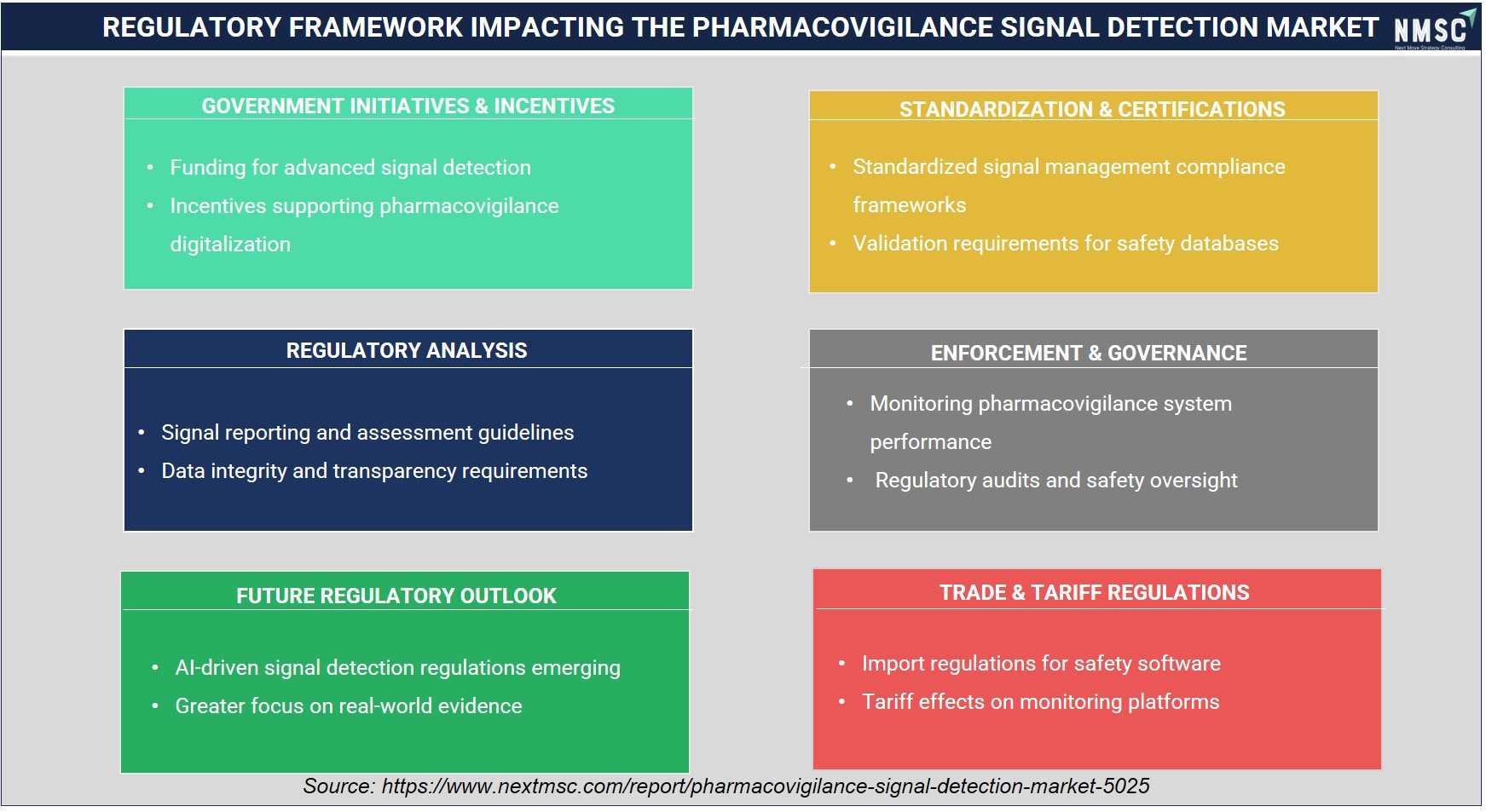
The regulatory framework shaping the Pharmacovigilance Signal Detection Market is driven by government initiatives, compliance standards, safety oversight requirements, and evolving digital health regulations. Regulatory agencies emphasize signal reporting accuracy, data integrity, safety database validation, and continuous monitoring of pharmacovigilance systems. Increasing support for pharmacovigilance digitalization and real-world evidence integration is accelerating technology adoption. Future regulations are expected to focus on AI-enabled signal detection capabilities, while governance frameworks and certification standards continue to strengthen patient safety, transparency, and global regulatory compliance across the pharmaceutical industry.
What Are the Key Market Drivers, Breakthroughs, and Investment Opportunities that Will Shape the Pharmacovigilance Signal Detection Market in the Next Decade?
|
Drivers / Trends / Restraints |
(+/-) % Impact on CAGR Forecast |
Geographic Relevance |
Impact Timeline |
|
Rising Global ICSR Reporting Volumes |
+2.1% |
Global (North America, Europe) |
2025–2030 |
|
AI and Machine Learning Integration in Signal Detection |
+1.8% |
North America, Europe, APAC |
2025–2035 |
|
Real-World Evidence Adoption for Signal Validation |
+1.6% |
North America, Europe, Japan |
2026–2035 |
|
Expanding Biologic and Biosimilar Drug Pipelines |
+1.4% |
Global (all regions) |
2025–2030 |
|
Regulatory Mandates: EMA, FDA, ICH Harmonization |
+1.2% |
Global |
Ongoing |
|
Cloud Migration and SaaS Platform Adoption |
+1.1% |
North America, Europe, APAC |
2025–2030 |
|
Social Media and Digital Signal Source Expansion |
+0.9% |
North America, Europe |
2026–2035 |
|
Data Privacy and Patient Confidentiality Regulations |
-1.3% |
Europe, North America, APAC |
Ongoing |
|
Shortage of Qualified Pharmacovigilance Personnel |
-1.0% |
Global |
Ongoing |
|
High Validation Costs for New Signal Detection Systems |
-0.7% |
Global (SMB, mid-market) |
2025–2028 |
|
Emerging Market Digital Infrastructure Opportunities |
+1.5% |
APAC, LATAM, MEA |
2026–2035 |
What Are the Growth Drivers of the Pharmacovigilance Signal Detection Market?
How Are Rising Global Adverse Event Reporting Volumes Driving the Pharmacovigilance Signal Detection Market?
Rising global adverse event reporting volumes are the primary structural driver of the Pharmacovigilance Signal Detection Market. The FDA's FAERS database received approximately 2.6 million Individual Case Safety Reports in fiscal year 2023 alone, representing continued double-digit growth in annual reporting volumes. The European Medicines Agency's EudraVigilance database similarly processes millions of ICSRs from Marketing Authorization Holders across the European Economic Area each year. This relentless expansion in data volumes is compelling pharmaceutical companies, CROs, and regulators to invest in automated signal detection platforms capable of processing large datasets without proportional increases in pharmacovigilance staffing resources.
How Is Regulatory Harmonization Under ICH and WHO Frameworks Expanding Market Demand?
Regulatory harmonization under International Council for Harmonisation guidelines is expanding the global addressable market for pharmacovigilance signal detection solutions. The ICH E2B(R3) standard for electronic ICSR submission is being adopted across North America, Europe, Japan, and increasingly across emerging markets under WHO frameworks. Our assessment indicates that harmonization of Individual Case Safety Report formats and signal management documentation requirements creates a standardized technology integration surface that benefits enterprise pharmacovigilance platform vendors offering multi-jurisdictional submission capabilities alongside integrated signal detection modules to serve global pharmaceutical company requirements.
How Is the Growing Biologic and Specialty Drug Pipeline Structurally Expanding Pharmacovigilance Signal Detection Market Demand?
The expanding global biologic and specialty drug pipeline is a structural long-term growth driver for the Pharmacovigilance Signal Detection Market. According to data published by the U.S. FDA's Center for Drug Evaluation and Research, novel drug approvals including biologics, gene therapies, and cell-based therapies have trended upward over recent years, each generating post-market pharmacovigilance obligations spanning the commercial lifecycle of the product. Biologic and specialty medicines typically carry more complex safety profiles and require more sophisticated signal detection approaches than small molecule drugs, driving demand for advanced statistical algorithms and real-world evidence integration capabilities within signal detection platforms.
What Are the Growth Inhibitors of the Pharmacovigilance Signal Detection Market?
How Do Patient Data Privacy Regulations Constrain Signal Detection Capabilities in the Pharmacovigilance Signal Detection Market?
Patient data privacy regulations represent a significant structural constraint on the Pharmacovigilance Signal Detection Market, particularly with respect to real-world evidence integration and cross-border data sharing. The EU's General Data Protection Regulation establishes strict requirements for the processing of health data, including anonymization, pseudonymization, and explicit consent mechanisms that complicate the use of electronic health records for signal detection purposes. The European Medicines Agency's guidelines on data protection for pharmacovigilance activities add compliance layers that extend implementation timelines for real-world data-enabled signal detection programs and increase total cost of system validation for cloud-hosted platforms operating across multiple EU Member States.
How Does the Global Shortage of Qualified Pharmacovigilance Personnel Limit Signal Detection Market Expansion?
The chronic global shortage of qualified pharmacovigilance professionals represents a persistent inhibitor of the Pharmacovigilance Signal Detection Market. The International Society of Pharmacovigilance and pharmaceutical industry employer surveys consistently identify pharmacovigilance as one of the most acutely talent-constrained functional areas in the life sciences sector. Signal detection activities require personnel with specialized expertise spanning clinical pharmacology, biostatistics, regulatory affairs, and medical writing. While AI-assisted triage tools are reducing per-case manual review time, the validation, interpretation, and regulatory documentation of detected signals requires physician-level pharmacovigilance expertise that cannot be fully automated, limiting the pace at which organizations can scale their signal detection programs.
What Are the Growth Opportunities in the Pharmacovigilance Signal Detection Market?
How Does the Expansion of Real-World Data Programs Create Multi-Billion Dollar Opportunities in the Pharmacovigilance Signal Detection Market?
The global expansion of real-world data infrastructure programs creates a substantial growth opportunity within the Pharmacovigilance Signal Detection Market. The FDA's Sentinel System, operated by the FDA Center for Excellence in Regulatory Science and Innovation, provides scalable infrastructure for active pharmacovigilance surveillance using administrative claims and electronic health data from over 200 million patient records. Our analysis shows that the FDA is progressively expanding Sentinel's signal detection mandate to encompass vaccines and medical devices in addition to drugs and biologics. Commercial vendors capable of integrating with Sentinel-compatible data models and validated real-world evidence methodologies are well-positioned to capture incremental revenue from FDA-mandated post-market pharmacovigilance commitments.
How Are Emerging Markets Presenting Structural Opportunities for the Pharmacovigilance Signal Detection Market?
Emerging markets across Asia-Pacific, Latin America, and the Middle East are presenting structurally significant opportunities for the Pharmacovigilance Signal Detection Market as national regulatory agencies upgrade their pharmacovigilance frameworks in alignment with WHO and ICH standards. India's Central Drugs Standard Control Organization has strengthened post-market surveillance requirements under the Drugs Rules amendments, creating demand for validated signal detection platforms among domestic pharmaceutical manufacturers. China's National Medical Products Administration is expanding its adverse drug reaction reporting infrastructure. Brazil's ANVISA is aligning with ICH E2B(R3) standards. Based on our market evaluation, these regulatory modernization programs are unlocking demand across geographies that historically underinvested in signal detection technology.
How Do Artificial Intelligence and Automation Create a Platform Differentiation Opportunity in the Pharmacovigilance Signal Detection Market?
Artificial intelligence and process automation capabilities represent the primary product differentiation and premium pricing opportunity within the Pharmacovigilance Signal Detection Market. Through NMSC's assessment, we found that signal detection platforms embedding validated machine learning algorithms, natural language processing, and automated case narratives command measurable pricing premiums over conventional rule-based statistical engines. The U.S. FDA's action plan on the use of AI and machine learning in pharmacovigilance operations explicitly endorses AI-augmented safety surveillance tools, lending regulatory support to vendor AI investment programs. Organizations that achieve early FDA alignment on AI-enabled signal detection methodologies will establish durable competitive differentiation in this growing market.
Ecosystem Analysis of the Pharmacovigilance Signal Detection Market
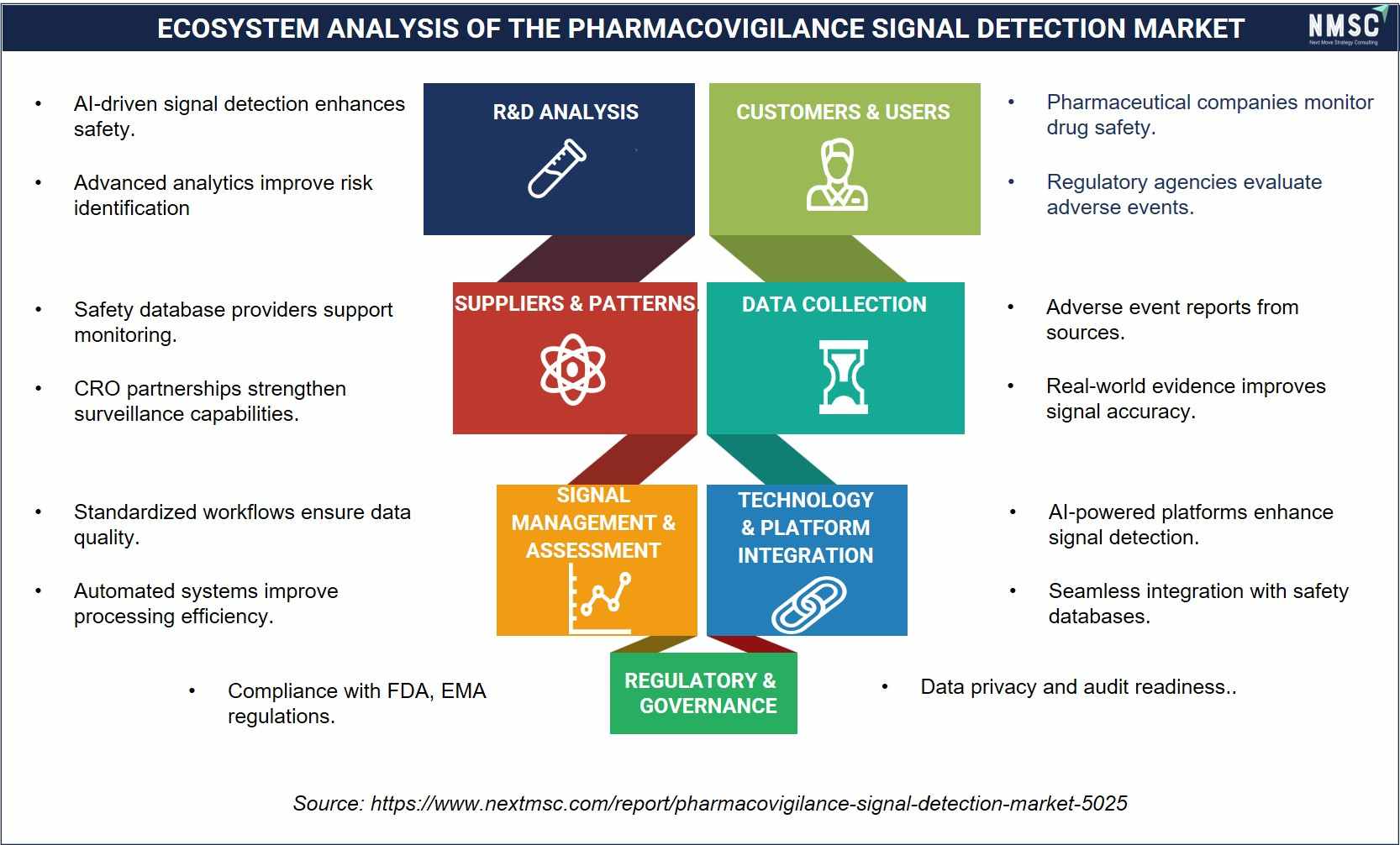
The Pharmacovigilance Signal Detection Market ecosystem comprises interconnected stakeholders involved in drug safety monitoring, adverse event analysis, and regulatory compliance. Research and development activities drive innovation in signal detection methodologies, while data collection systems gather safety information from clinical trials, spontaneous reports, and real-world evidence sources. Technology and platform providers enable advanced analytics and signal management capabilities, supporting efficient assessment and validation processes. Pharmaceutical companies, regulatory agencies, and service providers collaborate within a structured governance framework to ensure patient safety, regulatory compliance, and continuous improvement of pharmacovigilance operations across global healthcare markets.
How Is the Pharmacovigilance Signal Detection Market Segmented in This Report, and What Are the Key Insights from the Segmentation Analysis?
How Do Software and Service Offerings Define Value Creation Across the Pharmacovigilance Signal Detection Market?
|
Offering Segment |
2025 (USD Bn) |
2035 (USD Bn) |
CAGR (%) |
|
Software |
1.20 |
3.64 |
11.7% |
|
Standalone Platform |
0.51 |
1.38 |
10.5% |
|
Suite Module |
0.69 |
2.26 |
12.6% |
|
Services |
0.90 |
3.16 |
13.4% |
|
Managed Services |
0.36 |
1.35 |
14.2% |
|
Professional Services |
0.28 |
0.96 |
13.1% |
|
Implementation and Validation |
0.16 |
0.52 |
12.5% |
|
Advisory and Training |
0.10 |
0.33 |
12.7% |
Based on our analysis of enterprise pharmacovigilance technology procurement patterns, the Pharmacovigilance Signal Detection Market is segmented into Software and Services offerings. The Software segment currently dominates, led by Suite Modules that provide end-to-end signal management workflow integration within broader safety database ecosystems. Standalone platforms serve smaller organizations seeking point-solution signal analytics without a full pharmacovigilance database replacement. The Services segment is the faster-growing category, driven by Managed Services demand from mid-sized pharmaceutical and biotech companies that prefer to outsource signal detection operations to specialist vendors. Implementation and Validation services benefit from the ongoing wave of cloud migration projects requiring FDA 21 CFR Part 11 and EMA Annex 11 system validation compliance.
Which Deployment Model Is Reshaping Infrastructure Priorities in the Pharmacovigilance Signal Detection Market?
|
Deployment Segment |
2025 (USD Bn) |
2035 (USD Bn) |
CAGR (%) |
|
Cloud |
0.90 |
3.12 |
13.3% |
|
On-Premises |
0.74 |
1.97 |
10.3% |
|
Hybrid |
0.46 |
1.71 |
14.0%\ |
Through our market assessment, we observed that the Pharmacovigilance Signal Detection Market is segmented by Deployment Model into Cloud, On-Premises, and Hybrid environments. Cloud-based deployment currently leads the market, as validated SaaS pharmacovigilance platforms offer rapid deployment, automatic regulatory update cycles, and elimination of hardware refresh investments that burden on-premises implementations. On-Premises deployment remains relevant for large innovator pharmaceutical companies with established validated legacy infrastructure and strict internal data governance policies. Hybrid deployment is the fastest-growing model as organizations bridge existing on-premises safety databases with cloud-native signal detection analytics layers, enabling gradual modernization without complete system replacement.
Which Buyer Types Are Driving Purchasing Decisions Across the Pharmacovigilance Signal Detection Market?
|
Buyer Type Segment |
2025 (USD Bn) |
2035 (USD Bn) |
CAGR (%) |
|
Pharma and Biotech |
1.26 |
3.81 |
11.7% |
|
Contract Research Organizations |
0.38 |
1.36 |
13.6% |
|
Medical Device Companies |
0.23 |
0.72 |
12.1% |
|
Regulators and Public Sector |
0.11 |
0.45 |
15.1% |
|
Other Life Sciences |
0.12 |
0.46 |
14.4% |
Our findings suggest that the Pharmacovigilance Signal Detection Market is segmented by Buyer Type into Pharma and Biotech companies, Contract Research Organizations, Medical Device Companies, Regulators and Public Sector agencies, and Other Life Sciences entities. Pharmaceutical and biotech companies represent the dominant buyer segment, underpinned by extensive post-market pharmacovigilance obligations for marketed drugs, biologics, and vaccines. Contract Research Organizations are the fastest-growing buyer type as sponsor companies increasingly outsource signal detection functions to full-service CROs capable of providing integrated data management, signal detection, and regulatory reporting services. Medical device companies represent a growing buyer category as drug-device combination product convergence blurs traditional pharmacovigilance boundaries.
How Do Different Signal Sources Contribute to Safety Surveillance in the Pharmacovigilance Signal Detection Market?
|
Signal Source Segment |
2025 (USD Bn) |
2035 (USD Bn) |
CAGR (%) |
|
Spontaneous Reports |
0.84 |
2.25 |
10.4% |
|
Scientific Literature |
0.35 |
1.03 |
11.4% |
|
Real World Data |
0.42 |
1.70 |
15.0% |
|
Digital and Social Media |
0.16 |
0.74 |
16.6% |
|
Multi Source |
0.33 |
1.08 |
12.6% |
Based on NMSC's research, we found that the Pharmacovigilance Signal Detection Market is segmented by Signal Source into Spontaneous Reports, Scientific Literature, Real World Data, Digital and Social Media, and Multi Source integration. Spontaneous Reports remain the dominant signal source as statutory ICSR submission requirements under FDA MedWatch, EudraVigilance, and equivalent national pharmacovigilance programs form the legally mandated foundation of post-market safety surveillance. Scientific Literature monitoring, driven by EMA requirements for Marketing Authorization Holders, is a well-established technology-enabled segment. Real World Data is the fastest-growing signal source, propelled by FDA Sentinel System expansion and electronic health record linkage programs. Digital and Social Media sources are emerging rapidly, with NLP-powered platforms enabling patient-reported safety information extraction from health forums and social networks.
How Do Commercial Models Reflect the Evolving Procurement Preferences in the Pharmacovigilance Signal Detection Market?
|
Commercial Model Segment |
2025 (USD Bn) |
2035 (USD Bn) |
CAGR (%) |
|
Subscription |
0.92 |
3.13 |
13.0% |
|
Perpetual License |
0.63 |
1.50 |
9.1% |
|
Transaction Based |
0.28 |
1.02 |
13.8% |
|
Project Based |
0.27 |
1.15 |
15.5% |
NMSC's analysis indicates that the Pharmacovigilance Signal Detection Market is segmented by Commercial Model into Subscription, Perpetual License, Transaction Based, and Project Based engagements. Subscription-based licensing leads the market as pharmaceutical companies and CROs migrate from legacy perpetual license agreements toward SaaS pharmacovigilance platforms with predictable operating expenditure and automatic regulatory content updates. Perpetual License models persist among large innovator companies with established on-premises infrastructure. Transaction-Based models are gaining traction among CROs processing variable signal detection workloads. Project-Based engagements are expanding for signal validation studies, cumulative benefit-risk assessments, and regulatory-specific signal reporting deliverables.
Regional Outlook
Geographic Performance Snapshot
|
Region |
2025 (USD Bn) |
2035 (USD Bn) |
CAGR (%) |
Key Driver |
|
North America |
1.00 |
3.20 |
12.3% |
FDA FAERS, Sentinel System, mature vendor ecosystem |
|
Europe |
0.65 |
2.04 |
12.1% |
EMA EudraVigilance mandates, GDPR-compliant platforms |
|
Asia-Pacific |
0.27 |
1.09 |
15.0% |
PMDA, CDSCO, NMPA regulatory modernization |
|
Middle East & Africa |
0.08 |
0.27 |
12.9% |
Saudi SFDA, GCC pharma expansion |
|
Latin America |
0.10 |
0.20 |
7.2% |
ANVISA alignment, local pharma sector growth |
North America Pharmacovigilance Signal Detection Market
North America is the global epicenter of the Pharmacovigilance Signal Detection Market, accounting for USD 1.0 billion in 2025 and forecast to reach USD 3.2 billion by 2035 at a CAGR of 12.3%. The region benefits from the FDA's expansive adverse event reporting infrastructure including FAERS and the Sentinel System, and hosts the global headquarters of most leading pharmacovigilance technology vendors. Strong pharmaceutical industry investment in post-market safety operations, mature regulatory environment, and widespread enterprise adoption of cloud-based safety platforms underpin sustained market leadership across North America through the forecast period.
U.S. Pharmacovigilance Signal Detection Market
Based on our engagements with industry stakeholders, the United States represents over 80% of North American Pharmacovigilance Signal Detection Market revenue. The FDA's MedWatch program, FAERS adverse event reporting database, and the Sentinel System's real-world evidence infrastructure create a uniquely complex pharmacovigilance operating environment that drives continuous enterprise investment in signal detection platforms. The FDA's 21 CFR Part 11 requirements for electronic records and signatures govern system validation obligations for pharmacovigilance technology deployments, creating a compliance framework that favors established cloud platform vendors. Leading U.S.-based vendors including IQVIA and Oracle maintain the largest installed bases among pharmaceutical company enterprise buyers.
Canada Pharmacovigilance Signal Detection Market
Through our analysis, Canada represents approximately 12% of North American Pharmacovigilance Signal Detection Market revenue. Health Canada's MedEffect Canada vigilance reporting program and the Canada Vigilance Adverse Reaction Online Database govern ICSR submission obligations for drug sponsors. Canadian pharmaceutical manufacturers are significant buyers of signal detection technology. The government's mandate to modernize federal regulatory submissions through digital platforms is accelerating cloud-based pharmacovigilance adoption among federally licensed manufacturers and contract organizations operating across the Canadian healthcare and life sciences sectors.
Mexico Pharmacovigilance Signal Detection Market
From our assessment, Mexico is an emerging market within North America for the Pharmacovigilance Signal Detection Market. COFEPRIS, Mexico's Federal Commission for Protection Against Sanitary Risks, regulates adverse event reporting and pharmacovigilance obligations for pharmaceutical market authorization holders. Growing pharmaceutical manufacturing activity is increasing the number of companies with statutory signal detection responsibilities. Adoption of validated signal detection software remains in early stages relative to the U.S. and Canada, presenting a development opportunity for enterprise platform vendors pursuing Latin American and broader regional expansion strategies.
Europe Pharmacovigilance Signal Detection Market
Europe is the second-largest region in the Pharmacovigilance Signal Detection Market, contributing USD 0.65 billion in 2025 and forecast to reach USD 2.04 billion by 2035 at a CAGR of 12.1%. The European Medicines Agency's EudraVigilance database and the associated signal detection and management process framework create mandatory signal detection obligations for all Marketing Authorization Holders operating in the European Economic Area. GDPR compliance requirements shape platform architecture choices, while the EMA's progressive expansion of EudraVigilance access for national pharmacovigilance centers and academic researchers is broadening the market's institutional base across all EU member states.
UK Pharmacovigilance Signal Detection Market
According to evaluation, the United Kingdom is among Europe's largest individual country markets for pharmacovigilance signal detection. The Medicines and Healthcare products Regulatory Agency operates the Yellow Card pharmacovigilance reporting system and maintains post-Brexit pharmacovigilance regulatory obligations broadly aligned with EMA GVP guidelines. UK Marketing Authorization Holders must conduct signal detection against both MHRA Yellow Card data and EudraVigilance data for products with EU approvals, creating dual-system signal management requirements that drive platform investment. London's concentration of global pharmaceutical company regional headquarters amplifies enterprise demand for advanced signal detection solutions.
Germany Pharmacovigilance Signal Detection Market
Based on our market evaluation, Germany represents one of Europe's largest pharmacovigilance signal detection markets, driven by its concentration of major global pharmaceutical companies including Bayer and Merck KGaA. The Federal Institute for Drugs and Medical Devices serves as the national competent authority for pharmacovigilance, operating in alignment with EMA GVP Module IX signal management guidelines. German pharmaceutical companies are among the most rigorous adopters of validated pharmacovigilance technology, often requiring on-premises or German-hosted cloud deployments to satisfy internal data governance policies and Federal Data Protection Act requirements for sensitive health data.
France Pharmacovigilance Signal Detection Market
Through our analysis, France is a significant European market for pharmacovigilance signal detection, characterized by strong public sector regulatory leadership and the presence of major pharmaceutical companies including Sanofi. The Agence nationale de securite du medicament et des produits de sante serves as France's national pharmacovigilance authority and operates a national pharmacovigilance database integrated with EudraVigilance. France's regional pharmacovigilance center network creates a sophisticated national signal detection infrastructure. Enterprise platform adoption among French pharmaceutical manufacturers reflects both regulatory obligations and corporate-level commitment to pharmacovigilance excellence.
Italy Pharmacovigilance Signal Detection Market
From our assessment, Italy is a mid-tier but growing European market in the Pharmacovigilance Signal Detection Market. The Italian Medicines Agency manages the national pharmacovigilance database and participates in EudraVigilance signal detection activities. Italy hosts significant pharmaceutical manufacturing operations and an active generic pharmaceutical industry. Regulatory modernization programs under the Agenzia Italiana del Farmaco are driving pharmaceutical companies to upgrade their pharmacovigilance IT infrastructure, creating incremental demand for validated signal detection platforms among Italian pharmaceutical market authorization holders and their contract research partners.
Spain Pharmacovigilance Signal Detection Market
Based on our market evaluation, Spain demonstrates steady growth momentum in the Pharmacovigilance Signal Detection Market. The Spanish Agency of Medicines and Medical Devices coordinates national pharmacovigilance activities and contributes to EudraVigilance signal detection. Spain's pharmaceutical sector includes major multinational company operations and a growing domestic generics industry, generating consistent demand for pharmacovigilance signal detection technology. The AEMPS's progressive adoption of digital submission standards and alignment with EMA GVP Module IX signal management requirements are compelling pharmaceutical sponsors to invest in validated enterprise signal detection platforms.
Sweden Pharmacovigilance Signal Detection Market
Through our analysis, Sweden is an established Pharmacovigilance Signal Detection Market with a technologically advanced pharmaceutical industry base. The Medical Products Agency manages national pharmacovigilance and participates in the EMA's signal management process for centrally authorized products. Sweden is home to AstraZeneca's global research headquarters and multiple major clinical research organizations, creating sophisticated institutional demand for enterprise signal detection platforms. The country's strong digital health infrastructure and high adoption of electronic health records provide a favorable environment for real-world evidence integration in signal detection workflows.
Denmark Pharmacovigilance Signal Detection Market
According to evaluation, Denmark is a high-income, specialized market within the European Pharmacovigilance Signal Detection Market. The Danish Medicines Agency administers national pharmacovigilance and collaborates with EudraVigilance. Denmark is home to Novo Nordisk, one of the world's largest pharmaceutical companies by market capitalization and a major biologic drug innovator, which drives enterprise-level pharmacovigilance technology investment. The country's advanced healthcare IT infrastructure, including comprehensive electronic health records, supports real-world data integration for pharmacovigilance signal detection and benefit-risk assessment programs.
Finland Pharmacovigilance Signal Detection Market
Based on our market evaluation, Finland is a small but technologically advanced participant in the Pharmacovigilance Signal Detection Market. The Finnish Medicines Agency Fimea manages national pharmacovigilance reporting and participates in the EMA signal management ecosystem. Finland's pharmaceutical and medical technology industry, including companies such as Orion Pharma, generates domestic demand for signal detection platforms. Finland's nationally interoperable electronic health record infrastructure administered under the Kanta services system provides unique opportunities for real-world evidence-based signal corroboration using high-quality national health data.
Netherlands Pharmacovigilance Signal Detection Market
From our assessment, the Netherlands is a strategically important market in the European Pharmacovigilance Signal Detection Market, partly due to the EMA's headquarters in Amsterdam. The Netherlands Pharmacovigilance Centre Lareb coordinates national adverse drug reaction reporting and contributes to EudraVigilance. The presence of the EMA and multiple major pharmaceutical company European headquarters in the Netherlands creates a dense concentration of pharmacovigilance technology buyers. Dutch pharmaceutical companies are sophisticated adopters of validated signal detection platforms and frequently participate in EMA pilot programs for novel pharmacovigilance methodologies.
Rest of Europe Pharmacovigilance Signal Detection Market
Through our analysis, the Rest of Europe encompasses pharmacovigilance signal detection markets across Central and Eastern European nations, Scandinavia excluding covered countries, and the Balkans. Markets such as Poland, Czech Republic, Switzerland, Belgium, Austria, and Portugal are characterized by growing pharmaceutical manufacturing sectors and national regulatory agencies progressively aligning with EMA GVP signal management guidelines. These markets collectively represent a growing opportunity for pharmacovigilance technology vendors as EU regulatory harmonization compels signal detection program formalization among local and multinational pharmaceutical operators.
Asia-Pacific Pharmacovigilance Signal Detection Market
Asia-Pacific is the fastest-growing major region in the Pharmacovigilance Signal Detection Market, forecast to advance at a CAGR of 15.0% from 2025 to 2035, reaching USD 1.09 billion by 2035. Regulatory modernization by the Japanese PMDA, India's CDSCO, China's NMPA, South Korea's MFDS, and Australia's TGA is systematically expanding post-market pharmacovigilance obligations across the region. Rapid growth of domestic pharmaceutical industries, expansion of clinical research activity, and increasing alignment with ICH guidelines are collectively driving demand for validated signal detection platforms across major Asia-Pacific jurisdictions.
China Pharmacovigilance Signal Detection Market
Based on our engagements with life sciences sector participants, China represents the largest single market in Asia-Pacific for pharmacovigilance signal detection. The National Medical Products Administration has significantly expanded pharmacovigilance requirements for domestic and foreign pharmaceutical companies in China, including mandatory individual case safety report submission to the National Adverse Drug Reaction Monitoring Center. China's pharmaceutical market generates substantial adverse event reporting volumes that drive demand for automated signal detection platforms. Domestic pharmacovigilance technology companies are developing solutions aligned with NMPA regulatory requirements for the Chinese market.
India Pharmacovigilance Signal Detection Market
Through our analysis, India is the fastest-growing national market in Asia-Pacific for pharmacovigilance signal detection. The Central Drugs Standard Control Organization has strengthened pharmacovigilance requirements under the Drugs and Cosmetics Act amendments, creating statutory signal detection obligations for Indian pharmaceutical manufacturers. India's large generic pharmaceutical industry, with extensive export activities requiring compliance with FDA and EMA pharmacovigilance standards, drives significant demand for validated signal detection technology. The country's growing CRO sector, serving global pharmaceutical sponsors, is a major adopter of enterprise pharmacovigilance signal detection platforms.
Japan Pharmacovigilance Signal Detection Market
According to evaluation, Japan is a mature and technology-advanced market in the Asia-Pacific Pharmacovigilance Signal Detection Market. The Pharmaceuticals and Medical Devices Agency manages an extensive pharmacovigilance program including the Japanese Adverse Drug Event Report database. Japanese pharmaceutical companies including Takeda, Astellas, and Daiichi Sankyo are significant global buyers of pharmacovigilance technology. Japan's participation in ICH harmonization and its progressive adoption of real-world data from medical information databases for signal detection are expanding the technological sophistication of the Pharmacovigilance Signal Detection Market.
South Korea Pharmacovigilance Signal Detection Market
From our assessment, South Korea is a growing pharmacovigilance signal detection market anchored by its dynamic pharmaceutical and biotechnology sector. The Ministry of Food and Drug Safety oversees pharmacovigilance and adverse drug reaction reporting for Korean-licensed pharmaceutical products. South Korea hosts major biopharmaceutical companies and a thriving biosimilar industry generating extensive post-market pharmacovigilance obligations. Government investments in biopharmaceutical innovation are expanding the pipeline of marketed products requiring ongoing signal detection programs, driving incremental platform demand from Korean pharmaceutical companies and their contract research partners.
Taiwan Pharmacovigilance Signal Detection Market
Based on our market evaluation, Taiwan is a specialized market within the Asia-Pacific Pharmacovigilance Signal Detection Market. The Taiwan Food and Drug Administration administers national pharmacovigilance and adverse event reporting programs. Taiwan's pharmaceutical industry includes significant generic drug manufacturers and a growing biotechnology sector. The country's alignment with ICH technical standards for electronic submission and pharmacovigilance reporting is driving modernization of enterprise safety systems among local pharmaceutical market authorization holders across the Pharmacovigilance Signal Detection Market.
Indonesia Pharmacovigilance Signal Detection Market
Through our analysis, Indonesia is an emerging growth market in the Asia-Pacific Pharmacovigilance Signal Detection Market, driven by its large domestic pharmaceutical sector and expanding National Health Insurance program. The National Agency of Drug and Food Control manages Indonesia's national pharmacovigilance program. Indonesia's pharmaceutical manufacturing growth and regulatory alignment with WHO good pharmacovigilance practices are creating demand for validated signal detection platforms among domestic and multinational pharmaceutical companies manufacturing or marketing products within the country.
Vietnam Pharmacovigilance Signal Detection Market
According to evaluation, Vietnam is a nascent but growing participant in the Asia-Pacific Pharmacovigilance Signal Detection Market. The Drug Administration of Vietnam manages pharmacovigilance obligations under the Ministry of Health's pharmaceutical regulatory framework. Vietnam's pharmaceutical market is growing rapidly, driven by rising healthcare expenditure and government investment in domestic pharmaceutical manufacturing capacity. Regulatory harmonization with ASEAN common technical requirements and progressive alignment with ICH standards are creating the institutional foundation for expanded pharmacovigilance technology adoption among market authorization holders.
Australia Pharmacovigilance Signal Detection Market
Based on our engagements, Australia is a mature and sophisticated pharmacovigilance signal detection market within the Asia-Pacific region. The Therapeutic Goods Administration manages Australia's pharmacovigilance program including adverse event reporting and signal detection activities. Australia's pharmaceutical market hosts major multinational company operations and an active clinical research sector. The TGA's progressive adoption of digital submission standards and its participation in international pharmacovigilance collaboration networks, including the Uppsala Monitoring Centre's VigiBase, positions Australia as a technologically advanced market for Pharmacovigilance Signal Detection platform adoption.
Philippines Pharmacovigilance Signal Detection Market
From our assessment, the Philippines is an emerging market in the Asia-Pacific Pharmacovigilance Signal Detection Market. The Food and Drug Administration Philippines administers pharmacovigilance and adverse event reporting requirements. The Philippines pharmaceutical market is growing, supported by domestic manufacturing expansion and increasing foreign pharmaceutical investment. Government initiatives to modernize the FDA Philippines regulatory framework and align with WHO good pharmacovigilance practices are creating early-stage demand for validated signal detection technology among pharmaceutical market authorization holders serving the Philippine market.
Malaysia Pharmacovigilance Signal Detection Market
Through our analysis, Malaysia is a growing pharmacovigilance signal detection market within Southeast Asia. The National Pharmaceutical Regulatory Agency manages Malaysia's pharmacovigilance program and adverse drug reaction reporting system. Malaysia's pharmaceutical sector includes both domestic manufacturers and major multinational company operations. The country's progressive pharmaceutical regulatory modernization and alignment with ICH technical guidelines are expanding signal detection technology adoption among licensed pharmaceutical manufacturers and clinical research organizations operating in Malaysia.
Rest of Asia-Pacific Pharmacovigilance Signal Detection Market
According to evaluation, the Rest of Asia-Pacific encompasses pharmacovigilance signal detection markets across Bangladesh, Sri Lanka, Thailand, Singapore, Pakistan, New Zealand, and other markets. Singapore, as a major regional pharmaceutical hub and clinical research center, represents a specialized high-value segment with sophisticated enterprise pharmacovigilance technology requirements. Thailand and Bangladesh, with growing domestic pharmaceutical industries, are progressively expanding their pharmacovigilance regulatory frameworks, creating incremental demand for validated signal detection solutions as their domestic drug industries expand international registration activities.
Middle East & Africa Pharmacovigilance Signal Detection Market
The Middle East and Africa region is an emerging growth market in the Pharmacovigilance Signal Detection Market, valued at USD 0.08 billion in 2025 and forecast to reach USD 0.27 billion by 2035 at a CAGR of 12.9%. Saudi Arabia's SFDA is driving regional pharmacovigilance regulatory modernization, while GCC countries are expanding pharmaceutical manufacturing and import-dependent drug supply chains that require enhanced adverse event monitoring capabilities. Across Africa, countries including South Africa are establishing national pharmacovigilance centers aligned with WHO prequalification standards, creating early-stage demand for signal detection technology as regulatory infrastructure matures.
Saudi Arabia Pharmacovigilance Signal Detection Market
Based on our engagements, Saudi Arabia is the dominant Pharmacovigilance Signal Detection Market within the Middle East. The Saudi Food and Drug Authority has established comprehensive pharmacovigilance requirements for pharmaceutical products registered in the Kingdom, including mandatory adverse event reporting and signal detection obligations aligned with international GVP standards. Saudi Vision 2030's healthcare investment programs and the country's ambition to develop a domestic pharmaceutical manufacturing industry are expanding the base of companies requiring pharmacovigilance signal detection technology investments across both commercial and government healthcare sectors.
UAE Pharmacovigilance Signal Detection Market
Through our analysis, the United Arab Emirates represents an emerging market in the MEA Pharmacovigilance Signal Detection Market. The UAE Ministry of Health and Prevention and Dubai Health Authority manage pharmacovigilance reporting requirements for pharmaceutical market authorization holders. The UAE's ambition to establish itself as a regional pharmaceutical and biotechnology hub is attracting pharmaceutical companies that carry pharmacovigilance obligations. The country's advanced digital health infrastructure also supports adoption of cloud-based Pharmacovigilance Signal Detection platforms across both private and government-affiliated healthcare organizations.
Egypt Pharmacovigilance Signal Detection Market
From our assessment, Egypt is the largest pharmaceutical market in Africa and an emerging pharmacovigilance signal detection market. The Egyptian Drug Authority manages national pharmacovigilance programs and adverse event reporting. Egypt's significant domestic pharmaceutical manufacturing sector, which supplies both the domestic market and regional export markets, creates demand for pharmacovigilance technology among local manufacturers increasingly required to implement WHO-aligned pharmacovigilance systems as a condition of international product registration and market access activities.
Israel Pharmacovigilance Signal Detection Market
According to evaluation, Israel is a high-value, specialized pharmacovigilance signal detection market driven by its globally significant pharmaceutical and biotechnology industries. The Israeli Ministry of Health's Pharmaceutical Division manages pharmacovigilance in close alignment with FDA and EMA standards, reflecting the extensive international regulatory footprint of Israeli pharmaceutical companies. Israel's biopharmaceutical sector, including Teva Pharmaceutical Industries and numerous innovative biotech companies, generates substantial pharmacovigilance obligations that drive enterprise-grade signal detection platform adoption and investment.
Turkey Pharmacovigilance Signal Detection Market
Based on our market evaluation, Turkey is a significant emerging market in the MEA Pharmacovigilance Signal Detection Market. The Turkish Medicines and Medical Devices Agency manages national pharmacovigilance and adverse event reporting requirements. Turkey has a large and growing pharmaceutical manufacturing sector producing both domestic and export products. The TITCK's progressive alignment with EMA GVP Module IX signal management requirements is compelling Turkish pharmaceutical manufacturers to invest in validated signal detection platforms, particularly those preparing for European market registration activities requiring EU-compatible pharmacovigilance systems.
Nigeria Pharmacovigilance Signal Detection Market
Through our analysis, Nigeria is an emerging pharmacovigilance signal detection market within Sub-Saharan Africa. The National Agency for Food and Drug Administration and Control manages Nigeria's pharmacovigilance program. Nigeria's pharmaceutical market is the largest in West Africa and encompasses significant domestic manufacturing activity. Progressive regulatory reforms under NAFDAC's strategic modernization plan and alignment with WHO good pharmacovigilance practices are creating the regulatory foundation for expanded signal detection technology adoption among Nigerian pharmaceutical market authorization holders.
South Africa Pharmacovigilance Signal Detection Market
According to evaluation, South Africa is the most mature pharmacovigilance signal detection market in Sub-Saharan Africa. The South African Health Products Regulatory Authority manages pharmacovigilance through the MedEasy adverse event reporting system. South Africa's pharmaceutical market includes significant multinational company operations and a growing domestic biosimilar and generic industry. SAHPRA's progressive alignment with WHO and ICH pharmacovigilance standards, combined with the country's advanced healthcare infrastructure, supports growing adoption of enterprise pharmacovigilance signal detection technology among South African-registered pharmaceutical sponsors.
Rest of MEA Pharmacovigilance Signal Detection Market
From our assessment, the Rest of MEA encompasses pharmacovigilance signal detection markets across Kuwait, Qatar, Bahrain, Oman, Jordan, Morocco, Kenya, Ethiopia, and other markets. GCC countries collectively represent a significant and growing pharmacovigilance technology market, driven by regulatory harmonization under the Gulf Central Committee for Drug Registration and Vision 2030-aligned healthcare investment programs. East African markets, led by Kenya and Ethiopia, are at nascent stages of pharmacovigilance system development but represent long-term structural opportunities as healthcare regulatory infrastructure matures and domestic pharmaceutical industries expand.
Latin America Pharmacovigilance Signal Detection Market
Latin America contributes USD 0.10 billion in 2025 to the Pharmacovigilance Signal Detection Market and is forecast to reach USD 0.20 billion by 2035 at a CAGR of 7.2%. Brazil's ANVISA is the region's dominant regulatory authority, progressively aligning national pharmacovigilance requirements with ICH standards. Mexico, Argentina, Colombia, and Chile are also expanding adverse event reporting obligations for pharmaceutical market authorization holders. The region's growing domestic pharmaceutical and biosimilar industries are expanding the base of companies with statutory signal detection requirements throughout the forecast period.
Brazil Pharmacovigilance Signal Detection Market
Based on our engagements, Brazil is the largest Pharmacovigilance Signal Detection Market in Latin America. ANVISA's pharmacovigilance regulatory framework requires pharmaceutical market authorization holders to establish and maintain pharmacovigilance systems including adverse event signal detection and periodic benefit-risk evaluation reporting. Brazil's pharmaceutical industry includes the largest generic drug sector in Latin America and growing biosimilar manufacturing capacity, generating substantial demand for pharmacovigilance signal detection technology. ANVISA's progressive ICH E2B(R3) electronic submission implementation is driving platform modernization investments among Brazilian pharmaceutical sponsors.
Argentina Pharmacovigilance Signal Detection Market
Through our analysis, Argentina is a growing pharmacovigilance signal detection market within Latin America. The National Administration of Drugs, Foods and Medical Devices manages pharmacovigilance obligations for pharmaceutical market authorization holders in Argentina. Argentina's pharmaceutical industry is the second largest in Latin America and includes significant domestic formulation and biopharmaceutical manufacturing operations. Progressive regulatory reforms under the ANMAT pharmacovigilance modernization program are expanding signal detection obligations and driving pharmaceutical companies to invest in validated pharmacovigilance technology platforms.
Chile Pharmacovigilance Signal Detection Market
From our assessment, Chile is an emerging pharmacovigilance signal detection market within Latin America. The Institute of Public Health of Chile manages pharmacovigilance programs and adverse event reporting under the Health Ministry's regulatory framework. Chile's pharmaceutical market features above-average regulatory standards for the region, with alignment to WHO good pharmacovigilance practices. The country's advanced healthcare system and progressive regulatory environment create a stable foundation for pharmacovigilance technology adoption among pharmaceutical market authorization holders and clinical research organizations active in Chile.
Colombia Pharmacovigilance Signal Detection Market
According to evaluation, Colombia is a growing pharmacovigilance signal detection market within the Andean region. The National Food and Drug Surveillance Institute manages pharmacovigilance and adverse drug reaction reporting in Colombia. Colombia's pharmaceutical market is expanding, supported by healthcare system reform and government health expenditure growth. INVIMA's progressive alignment with Pan American Health Organization pharmacovigilance guidelines and Mercosur pharmacovigilance harmonization initiatives is creating the regulatory framework for expanded signal detection technology adoption among Colombian pharmaceutical sponsors and their contract research partners.
Rest of LATAM Pharmacovigilance Signal Detection Market
Through our analysis, the Rest of Latin America encompasses pharmacovigilance signal detection markets across Peru, Ecuador, Venezuela, Uruguay, Paraguay, Central American nations, and Caribbean markets. Markets such as Peru and Ecuador are progressively expanding pharmacovigilance regulatory frameworks under DIGEMID and ARCSA respectively. Regional pharmacovigilance harmonization initiatives under the Pan American Health Organization's regional network are collectively raising the regulatory baseline across Latin America, creating incremental demand for pharmacovigilance signal detection technology as pharmaceutical companies expand regional registration and market access activities.
Competitive Landscape
Competitive Dynamics and M&A Landscape
|
Parameters |
Details |
|
Market Structure |
The Pharmacovigilance Signal Detection Market is led by global software providers such as IQVIA, Oracle, Veeva Systems, and ArisGlobal, alongside specialized vendors including RxLogix, Ennov, and EXTEDO that focus on signal detection, safety analytics, and regulatory compliance. |
|
Innovation Focus |
Innovation is focused on AI-powered signal detection, machine learning-based adverse event analysis, real-world evidence integration, automated literature screening, and cloud-based pharmacovigilance platforms. |
|
M&A Activity |
Strategic acquisitions and partnerships are strengthening market positions. IQVIA expanded through the DDL acquisition, Oracle enhanced capabilities via Cerner integration, and CROs such as ICON and Parexel continue to broaden their pharmacovigilance services through collaborations and regional expansion |
How Do Companies Compete in the Pharmacovigilance Signal Detection Market?
The Pharmacovigilance Signal Detection Market is characterized by competition among pharmacovigilance software providers, contract research organizations (CROs), and specialized drug safety technology vendors. Enterprise platform providers such as IQVIA, Oracle, Veeva Systems, and ArisGlobal compete on platform breadth, regulatory compliance capabilities, global deployment scale, and integration across the pharmacovigilance lifecycle. Specialized vendors including RxLogix, Ennov, and EXTEDO differentiate through advanced signal detection analytics, literature monitoring solutions, and regulatory document management capabilities. CROs such as ICON, Parexel, and Syneos Health compete by combining technology-enabled signal detection with outsourced pharmacovigilance services and global operational expertise.
Which Kind of Companies Dominate the Pharmacovigilance Signal Detection Market?
Three distinct categories of companies dominate the Pharmacovigilance Signal Detection Market. First, global pharmacovigilance platform providers including IQVIA, Oracle, Veeva Systems, and ArisGlobal leverage comprehensive safety management platforms, large customer bases, and extensive regulatory expertise to serve multinational pharmaceutical companies. Second, specialized pharmacovigilance technology vendors such as RxLogix, Ennov, and EXTEDO provide purpose-built signal detection, literature monitoring, and regulatory compliance solutions. Finally, CROs including ICON, Parexel, and Syneos Health dominate outsourced pharmacovigilance and safety operations by offering integrated clinical development, risk management, and signal detection services across global markets.
AI-Driven Analytics and Real-World Evidence Integration Drive Market Success in the Pharmacovigilance Signal Detection Market
Innovation focus across the Pharmacovigilance Signal Detection Market is concentrated on artificial intelligence-enabled signal detection algorithms, machine learning-based adverse event analysis, natural language processing for automated literature screening, and real-world evidence integration. Vendors are increasingly investing in predictive safety analytics, automated case processing, cloud-native pharmacovigilance platforms, and advanced visualization tools to improve signal identification accuracy and regulatory compliance. Companies that successfully combine AI-driven insights with validated safety workflows are strengthening customer retention and gaining competitive advantages in highly regulated pharmaceutical environments.
Market Players to Opt for Merger and Acquisition Strategies to Expand Their Presence in the Pharmacovigilance Signal Detection Market
Mergers, acquisitions, and strategic partnerships continue to reshape the competitive landscape of the Pharmacovigilance Signal Detection Market. IQVIA's acquisition of DDL strengthened its pharmacovigilance and regulatory services portfolio, while Oracle expanded healthcare data integration capabilities through Oracle Cerner. Technology providers are actively pursuing partnerships to enhance AI-based safety analytics, regulatory intelligence, and real-world data access. In addition, CROs and software vendors are expanding their global service delivery networks and investing in specialized pharmacovigilance capabilities to address evolving regulatory requirements and increasing drug safety monitoring demands.
Who Are the Key Market Players in the Pharmacovigilance Signal Detection Market?
-
IQVIA Holdings Inc.
-
Oracle Corporation
-
Veeva Systems Inc.
-
Accenture plc
-
Cognizant Technology Solutions Corporation
-
Tata Consultancy Services Limited
-
Labcorp Holdings Inc.
-
ICON plc
-
Parexel International Corporation
-
Syneos Health, Inc.
-
Medpace Holdings, Inc.
-
Capgemini SE
-
Infosys Limited
-
HCL Technologies Limited
-
Genpact Limited
-
ArisGlobal LLC
-
RxLogix Corporation
-
TriNetX, LLC
-
Ennov SAS
-
EXTEDO GmbH
What Are the Latest Developments in the Pharmacovigilance Signal Detection Market?
|
Date |
Event |
|
Oct 2025 |
Veeva announced Veeva AI Agents across its applications, including Safety, Regulatory, Clinical, and Quality. The rollout includes AI-powered agents specifically designed for safety operations and pharmacovigilance workflows. |
|
Jul 2025 |
ArisGlobal expanded its AI-driven LifeSphere NavaX platform with new capabilities targeting pharmacovigilance and regulatory operations. The company reported growing adoption of AI-powered automation for safety monitoring and decision-making. |
Expert Insights
 "Bringing cutting-edge technologies like Generative AI to life as part of the LifeSphere R&D ecosystem is a strategic objective for ArisGlobal. Digital process transformation is vital for companies bringing ambitious, novel treatments and therapies to market efficiently. We're harnessing advanced technology, hand in hand with insights from comprehensive Real-World Data, to transform drug discovery and development."
— Aman Wasan, CEO, ArisGlobal
Statement made during ArisGlobal's official press release announcing its next-generation Safety and Regulatory product offerings powered by Generative AI, highlighting the role of AI and Real-World Data in transforming life sciences and drug safety operations.
Market Interpretation
This statement directly reflects one of the strongest trends in the pharmacovigilance signal detection market the integration of Generative AI and Real-World Data (RWD) into drug safety workflows. Modern signal detection platforms increasingly rely on AI algorithms to analyze large volumes of adverse event reports and identify emerging safety signals more rapidly than traditional manual approaches. The emphasis on digital transformation is accelerating demand for advanced pharmacovigilance software and AI-enabled signal management solutions.
What Are the Investment Opportunities in the Pharmacovigilance Signal Detection Market?
Capital Inflows and Venture Activity
The Pharmacovigilance Signal Detection Market is attracting growing interest from private equity firms, venture capital investors, and strategic healthcare technology acquirers. Investment activity is increasingly concentrated around AI-enabled signal detection platforms that improve adverse event identification accuracy, automate case prioritization, and enhance regulatory compliance workflows. We observed that investors are particularly focused on companies developing machine learning-based safety analytics, natural language processing tools, and next-generation pharmacovigilance platforms capable of supporting global regulatory requirements. The growing adoption of digital drug safety solutions continues to strengthen investor confidence in the long-term growth potential of the market.
Infrastructure Investment
Infrastructure investment remains a critical growth enabler within the Pharmacovigilance Signal Detection Market. Capital is being deployed toward cloud-based pharmacovigilance platforms, real-world data integration frameworks, advanced analytics engines, and validated regulatory-compliant environments. Moreover, we found that organizations investing in cloud infrastructure capable of meeting global regulatory requirements gain significant competitive advantages through enhanced scalability, security, and operational efficiency. Expansion of multi-region data hosting capabilities and interoperable safety data ecosystems is further supporting global deployment of signal detection solutions.
ESG and Patient Safety Enablement
Environmental, Social, and Governance (ESG) considerations are increasingly influencing investment decisions across the Pharmacovigilance Signal Detection Market. Drug safety monitoring and adverse event detection directly support patient protection, public health outcomes, and responsible pharmaceutical product stewardship. Investors applying ESG frameworks increasingly view pharmacovigilance technologies as essential healthcare infrastructure that strengthens transparency, risk management, and regulatory accountability. The continued expansion of safety reporting obligations and regulatory oversight further reinforces the market's alignment with governance and patient safety investment priorities.
Digital Transformation Enablement
Pharmacovigilance signal detection platforms play a central role in pharmaceutical digital transformation initiatives, making them strategically important components of long-term technology modernization programs. Pharmaceutical companies are increasingly replacing legacy safety systems with cloud-native platforms that integrate artificial intelligence, real-world evidence, and automated regulatory reporting capabilities. We further analyzed that ongoing modernization efforts across drug safety operations are creating sustained demand for advanced signal detection technologies, while broader digital transformation strategies continue to accelerate adoption of integrated pharmacovigilance ecosystems.
Private Equity and Strategic M&A Activity
Private equity and strategic acquisition activity is accelerating across the Pharmacovigilance Signal Detection Market as investors seek exposure to recurring revenue software businesses and compliance-driven technology segments. Buyout firms are actively evaluating established pharmacovigilance software vendors, while growth investors are targeting emerging AI-based safety analytics companies. We assessed that attractive investment characteristics include strong customer retention, subscription-based revenue models, regulatory-driven demand resilience, and expanding adoption among pharmaceutical companies, biotechnology firms, and CROs. Consolidation activity is expected to remain robust as market participants pursue broader safety platform capabilities and global service expansion opportunities.
Key Benefits for Stakeholders
For Pharmaceutical and Biotech Companies
Pharmaceutical and biotechnology companies gain comprehensive insights into the Pharmacovigilance Signal Detection Market, including quantitative market sizing, segmentation analysis across offerings, deployment models, buyer types, signal sources, and commercial models. This intelligence supports pharmacovigilance platform selection, technology investment planning, vendor evaluation, and long-term drug safety strategy development. Our competitive landscape assessment enables organizations to benchmark solution providers and align technology procurement decisions with evolving global regulatory requirements and operational objectives.
For Contract Research Organizations (CROs)
Contract Research Organizations gain valuable market intelligence on buyer trends, regional growth opportunities, and service adoption patterns within the Pharmacovigilance Signal Detection Market. The report supports business development planning, pharmacovigilance service expansion strategies, and geographic market prioritization. Detailed analysis of outsourcing trends and buyer requirements enables CROs to identify emerging demand areas and strengthen their positioning within the global drug safety ecosystem.
For Pharmacovigilance Technology Vendors and Platform Providers
Technology vendors and platform providers benefit from actionable insights into competitive positioning, technology adoption trends, investment activity, and high-growth market segments within the Pharmacovigilance Signal Detection Market. Our analysis identifies opportunities across AI-enabled signal detection, cloud deployment models, real-world data integration, and regulatory automation capabilities. Regional and buyer-type assessments support product roadmap development, go-to-market optimization, pricing strategy refinement, and expansion planning across global markets.
For Investors and Financial Analysts
Investors and financial analysts receive a structured assessment of the Pharmacovigilance Signal Detection Market's growth outlook, competitive environment, M&A activity, and long-term revenue opportunities. Segment-level forecasts, regional growth analysis, and investment trend evaluations support valuation modeling, due diligence processes, and portfolio allocation decisions. Detailed coverage of technology innovation, consolidation activity, and regulatory-driven demand dynamics provides a framework for identifying emerging market leaders and attractive acquisition targets.
For Government Agencies and Regulatory Bodies
Government agencies and regulatory authorities gain insights into the evolving regulatory landscape shaping the Pharmacovigilance Signal Detection Market. Analysis of global pharmacovigilance frameworks, safety reporting requirements, and technology adoption trends provides policymakers with evidence-based perspectives on drug safety infrastructure development and regulatory modernization initiatives. Country-level and regional assessments further support policy planning, compliance oversight, and public health surveillance strategies.
For Academic and Research Institutions
Academic organizations, public health researchers, and research institutions gain access to comprehensive market data, trend analysis, and signal source evaluations across the Pharmacovigilance Signal Detection Market. The report serves as a valuable reference for pharmacovigilance research, drug safety studies, healthcare analytics initiatives, and public health policy evaluation. Detailed segmentation and market forecasting also support research programs focused on real-world evidence, adverse event monitoring, and emerging safety surveillance methodologies.
Key Market Segments
By Offering
-
Software
-
Standalone Platform
-
Suite Module
-
Services
-
Managed Services
-
Professional Services
-
Implementation and Validation
-
Advisory and Training
By Deployment Model
-
Cloud
-
On-Premises
-
Hybrid
By Buyer Type
-
Pharma and Biotech
-
Contract Research Organizations
-
Medical Device Companies
-
Regulators and Public Sector
-
Other Life Sciences
By Signal Source
-
Spontaneous Reports
-
Scientific Literature
-
Real World Data
-
Digital and Social Media
-
Multi Source
By Commercial Model
-
Subscription
-
Perpetual License
-
Transaction Based
-
Project Based
By Region
-
North America: U.S., Canada, and Mexico.
-
Europe: UK, Germany, France, Italy, Spain, Sweden, Denmark, Finland, the Netherlands, and the rest of Europe.
-
Asia Pacific: China, India, Japan, South Korea, Taiwan, Indonesia, Vietnam, Australia, Philippines, Malaysia and the rest of APAC.
-
Middle East & Africa (MEA): Saudi Arabia, UAE, Egypt, Israel, Turkey, Nigeria, South Africa, and the rest of MEA.
-
Latin America: Brazil, Argentina, Chile, Colombia, and the rest of LATAM.
Conclusion and Recommendations
Long-Term Outlook
The Pharmacovigilance Signal Detection Market is entering a structurally expansive decade driven by converging forces of rising adverse event reporting volumes, regulatory mandate strengthening, AI technology maturation, and real-world evidence integration. The market is forecast to grow at a CAGR of 12.5% from 2025 to 2035, reaching USD 6.8 billion by 2035. Our further analysis indicates that this growth reflects both the increasing regulatory complexity of global pharmacovigilance obligations and the pharmaceutical industry's accelerating shift from manual signal detection toward AI-augmented, multi-source surveillance platforms capable of processing unprecedented data volumes with improved detection accuracy.
Strategic Positioning Recommendations
Platform vendors should prioritize AI capability differentiation through validated machine learning signal detection algorithms, integrated natural language processing for literature and social media monitoring, and real-world evidence data partnerships. Organizations that achieve FDA and EMA validation of AI signal detection methodologies will establish durable premium pricing advantages. Cloud infrastructure investment across U.S., EU, and Asia-Pacific data centers with validated compliance for FDA 21 CFR Part 11 and EMA Annex 11 requirements is non-negotiable for vendors targeting global pharmaceutical company enterprise procurement within the Pharmacovigilance Signal Detection Market.
Investment Attractiveness
The Pharmacovigilance Signal Detection Market represents an exceptionally attractive investment environment characterized by compliance-driven demand, high customer retention rates, and accelerating regulatory complexity that sustains technology investment cycles. The highest-conviction investment themes include cloud-validated pharmacovigilance platform buildouts with real-world evidence integration, AI signal detection technology companies demonstrating measurable accuracy improvements over traditional disproportionality methods, and CRO service platforms with embedded signal detection capabilities serving the growing pharmaceutical outsourcing trend among mid-sized and emerging biotech organizations.
Market Shifts and Key Risks
The most significant market shift underway is the migration from traditional spontaneous report-only signal detection toward integrated multi-source surveillance architectures combining ICSR data, scientific literature, real-world evidence, and digital signal sources within unified AI-powered platforms. This shift benefits full-platform vendors at the expense of single-source point solutions. Key risks for the Pharmacovigilance Signal Detection Market include data privacy regulatory escalation constraining real-world data access, macroeconomic pressures reducing pharmaceutical R&D and post-market safety investment budgets, and cybersecurity vulnerabilities in cloud-hosted pharmacovigilance platforms containing sensitive patient safety data.
Growth Pathways
Organizations seeking to maximize value from the Pharmacovigilance Signal Detection Market should pursue a three-horizon strategy. In the near term from 2025 to 2027, pharmaceutical companies and CROs should prioritize cloud-based signal detection platform deployment with validated integration to FDA FAERS and EMA EudraVigilance submission channels. In the mid-term from 2027 to 2031, invest in real-world evidence data partnerships, AI signal detection algorithm validation, and multi-source signal integration capabilities. In the long term from 2031 to 2035, position for AI-native signal management platforms with autonomous signal lifecycle management as pharmacovigilance workforce constraints compel further automation of safety surveillance workflows globally.
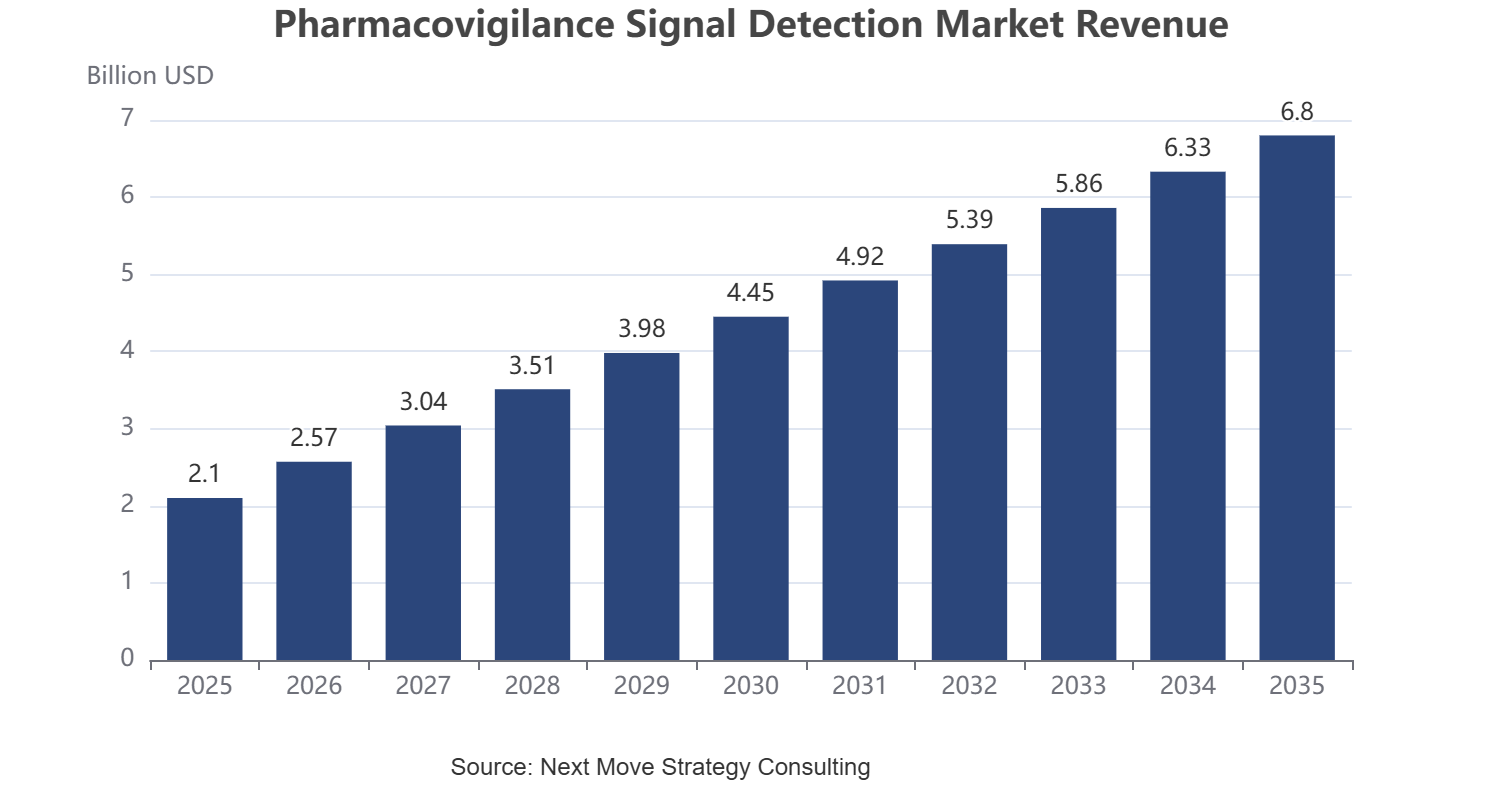
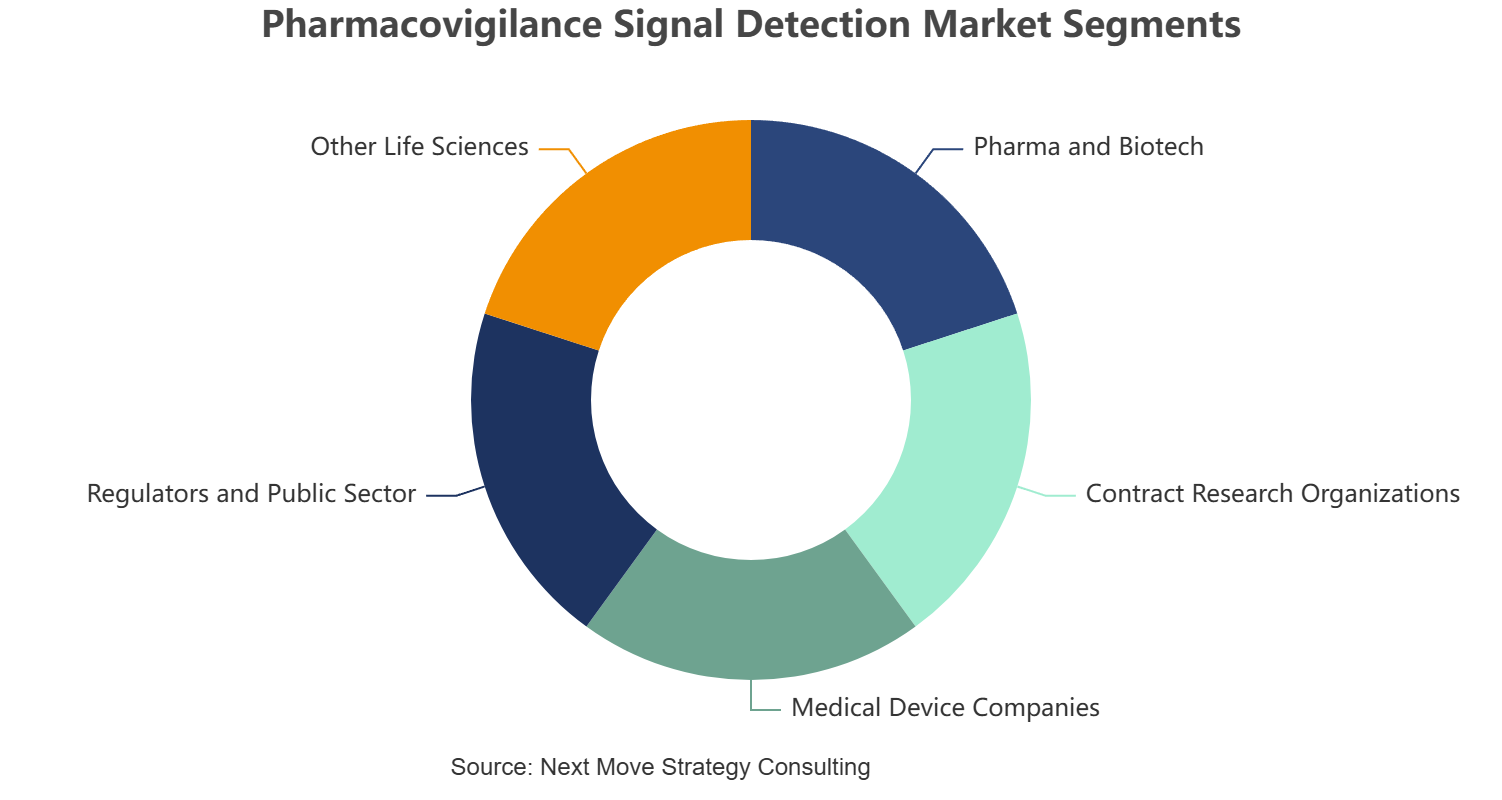
About the Author
 Liza Phukan
— Liza Phukan is Research Associate at Next Move Strategy Consulting, where she has covered emerging industries and market research across sectors for 3.5 years. Her work includes analyzing industry developments, validating market data, and developing structured business content from research findings. She uses secondary research and data-validation practices to turn complex market information into clear decision-useful market analysis for business audiences and support report development and B2B.
Liza Phukan
— Liza Phukan is Research Associate at Next Move Strategy Consulting, where she has covered emerging industries and market research across sectors for 3.5 years. Her work includes analyzing industry developments, validating market data, and developing structured business content from research findings. She uses secondary research and data-validation practices to turn complex market information into clear decision-useful market analysis for business audiences and support report development and B2B.
About the Reviewer
 Supradip Baul
— Supradip Baul is an accomplished business consultant and strategist with over a decade of rich experience in market intelligence, strategy, technology, and business transformation. His work has included rigorous qualitative and quantitative analysis across multiple industries, helping clients shape investment decisions and long-term roadmaps. Earlier in his career, he was associated with Gartner, where he contributed to industry-leading reports and market share analyses. He has worked with leading global companies and holds an MBA with a dual specialization in Marketing and Finance.
Supradip Baul
— Supradip Baul is an accomplished business consultant and strategist with over a decade of rich experience in market intelligence, strategy, technology, and business transformation. His work has included rigorous qualitative and quantitative analysis across multiple industries, helping clients shape investment decisions and long-term roadmaps. Earlier in his career, he was associated with Gartner, where he contributed to industry-leading reports and market share analyses. He has worked with leading global companies and holds an MBA with a dual specialization in Marketing and Finance.
At Next Move Strategy Consulting, we understand that insightful market research is the cornerstone of successful business decisions. That's why we employ a robust and multifaceted approach, combining various methodologies to deliver the most accurate and actionable data for our clients.

Research Landscape
We navigate the world of research with two primary approaches:
Qualitative Approach
Our qualitative research methodologies involve immersive techniques such as in-depth interviews, focus groups, and observational studies. By engaging directly with individuals and stakeholders, we uncover valuable insights that quantitative data alone may overlook.

Quantitative Research
In tandem with qualitative methodologies, NMSC leverages the power of Quantitative Research to provide a robust foundation of numerical insights. Through systematic data collection and analysis, we quantify patterns, preferences, and market trends, offering a comprehensive view of the business landscape.
Our quantitative research approach employs diverse tools, including surveys, experiments, and statistical modelling. These methodologies enable us to gather data from a large and representative sample, ensuring the statistical significance of our findings. By employing structured questionnaires and standardized data collection methods, we guarantee the reliability and validity of the information we present to our clients.
Quantitative research is particularly effective in measuring the prevalence of trends, assessing market size, and gauging the impact of various factors on consumer behavior. The numerical precision attained through this approach equips our clients with actionable insights, facilitating data-driven decision-making and strategy formulation.


Our Specialized Toolbox for Industry-Specific Market Research
We deploy a specialized arsenal of techniques tailored to meet your unique requirements. Here's a glimpse into our comprehensive toolbox:

Information Procurement
The stage entails acquiring market data or relevant information through various sources and methodologies.


Market Research Approach
We utilize both top-down and bottom-up approaches in market research analysis to achieve a comprehensive understanding of the market dynamics, leveraging the broad perspective of industry trends and macroeconomic factors alongside detailed insights from specific segments and individual companies.

Porters Five Forces Analysis
We conduct Porter's Five Forces analysis to evaluate the competitive landscape of an industry, providing us with insights into factors that affect profitability and strategic positioning.

SWOT Analysis

Forecasting
We utilize a forecasting model to predict future consumption by considering parameters like population, economics, regulations, market competition, drivers, constraints, technology, and pricing. We also employ statistical techniques such as multilinear regression, exponential smoothing, moving average, ARIMA, and Monte Carlo simulations for accurate predictions. In econometric forecasting, we analyzed short-term and long-term event impacts, attributing values based on regulatory frameworks, economic factors, and market events.





 Speak to Our Analyst