Remote Power Panel Market Size, Share, Growth & Forecast by Product Architecture (Standard RPP, Configurable RPP, Custom RPP), Form Factor (Floor Standing, Wall Mounted, Rack Mounted, Compact), Monitoring Level (Basic, Metered, Monitored, Switched, Revenue Grade), End User (Data Center, Hyperscale, Colocation, Enterprise, Edge, Telecom, Industrial, Commercial), and Distribution Channel (Direct Sales, System Integrator, Electrical Distributor, OEM) — Global Analysis 2025–2035
Industry: Energy & Power | Publishing Date: June 11, 2026 | Last Updated: September 30, 2026 | No of Pages: N/A | No. of Tables: N/A | No. of Figures: N/A | Format: PDF | Report Code: EP3273
What Is the Remote Power Panel Market Size?
The global Remote Power Panel Market size was valued at USD 2.1 billion in 2025 and is expected to reach USD 2.2 billion in 2026. Driven by accelerating data center construction, hyperscale cloud infrastructure expansion, and the broad digitization of industrial and commercial facilities, the market is projected to reach USD 3.1 billion by 2035, advancing at a CAGR of 4.1% from 2026 to 2035. Key growth drivers include rising demand for intelligent power distribution in data centers, growth in edge computing deployments requiring compact RPP solutions, expanding telecom infrastructure rollouts supporting 5G connectivity, and increasing focus on energy efficiency within critical power environments globally.
|
Parameters |
Details |
|
Market Size in 2025 |
USD 2.1 Billion |
|
Market Size in 2026 |
USD 2.2 Billion |
|
Revenue Forecast in 2035 |
USD 3.1 Billion |
|
Growth Rate |
4.1% from 2026 to 2035 |
|
Analysis Period |
2025–2035 |
|
Base Year Considered |
2025 |
|
Forecast Period |
2026–2035 |
|
Market Size Estimation |
Billion USD |
|
Companies Profiled |
20 |
|
Countries Covered |
38 |
|
Market Share |
Top 10 |
Remote Power Panel Market Overview
What Is a Remote Power Panel?
A remote power panel (RPP) is a secondary electrical distribution unit that receives high-amperage power feeds from a main switchgear or UPS system and distributes lower-amperage branch circuits to end-use equipment such as servers, networking hardware, telecom systems, and industrial machinery. Unlike conventional panelboards, remote power panels are engineered for mission-critical environments and are typically deployed within da
ta centers, industrial facilities, telecommunications hubs, and commercial buildings. NMSC's analysis indicates that modern RPPs increasingly integrate monitoring and switching intelligence to provide granular, real-time visibility over power consumption and circuit health across distributed critical infrastructure.
How Has the Remote Power Panel Market Evolved?
The remote power panel market has transitioned through three distinct phases of structural evolution. The first phase centered on passive, fixed-configuration panelboards supplying basic overcurrent protection to data centers and industrial facilities. The second phase introduced configurable and modular RPP architectures enabling operators to customize breaker ratings, busbar configurations, and output circuit counts. From our market assessment, we observed that the current phase is defined by intelligent, software-integrated RPPs featuring metered, monitored, and switched monitoring tiers that support automated load balancing, predictive maintenance alerts, and integration with data center infrastructure management (DCIM) platforms across hyperscale and enterprise environments.
How Does Regulation Shape the Remote Power Panel Market?
Regulatory frameworks governing electrical safety, energy efficiency, and data center operations exert a material influence on the remote power panel market. In the United States, the National Electrical Code (NEC) published by the National Fire Protection Association (NFPA) establishes mandatory standards for panel wiring, overcurrent protection, and labeling. The Uptime Institute's Tier Classification System further defines power redundancy requirements that directly drive RPP configuration specifications in mission-critical deployments. In Europe, IEC 61439 standards for low-voltage switchgear and controlgear assemblies govern RPP design and safety certification. Our findings suggest that tightening energy efficiency mandates and evolving data center sustainability regulations are accelerating adoption of metered and monitored RPP variants globally.
How Is Technology Adoption Expanding Across the Remote Power Panel Market?
Technology adoption across the remote power panel market is accelerating as operators of data centers, edge facilities, and industrial plants demand more granular power visibility and control. Revenue-grade metering capabilities, previously reserved for utility-scale deployments, are now being integrated into RPP designs targeting enterprise colocation and hyperscale clients. Based on NMSC's research, we found that Ethernet-enabled monitoring modules, SNMP and Modbus RTU protocol support, and cloud-based energy management integrations are becoming standard expectations rather than premium options. This shift toward intelligent, connected RPP solutions is reshaping procurement criteria across the data center, telecom, and industrial end-user segments worldwide throughout the forecast period.
|
Key Takeaways |
|
By product architecture, Standard RPP held the largest share of the Remote Power Panel Market at approximately USD 1.1 billion in 2025. The Configurable RPP segment is the fastest-growing sub-segment, projected to expand at a CAGR of 5.2% from 2026 to 2035, fueled by hyperscale and colocation operators requiring flexible circuit configurations to match rapidly evolving IT load profiles. |
|
By form factor, Floor Standing RPPs dominated the Remote Power Panel Market with an estimated USD 0.9 billion in 2025, driven by large-scale data center deployments requiring high-density power distribution. Rack Mounted RPPs represent the fastest-growing form factor at a CAGR of 5.8% from 2026 to 2035, driven by edge computing and compact enterprise IT deployments. |
|
By monitoring level, Metered RPPs held the largest revenue share at approximately USD 0.6 billion in 2025, as they represent the baseline intelligent monitoring standard for most data center and colocation deployments. Switched RPPs are the fastest-growing monitoring segment at a CAGR of 5.5% from 2026 to 2035, driven by operator demand for remote outlet-level control in high-density environments. |
|
By end user, the Data Center segment (comprising Hyperscale, Colocation, Enterprise, and Edge) is the dominant end-user category, collectively representing over 65% of Remote Power Panel Market revenue in 2025. The Edge Computing sub-segment is the fastest-growing end-user category at a CAGR of 7.2% from 2026 to 2035, reflecting rapid rollout of distributed edge infrastructure globally. |
|
By distribution channel, Direct Sales represented the largest share of the Remote Power Panel Market at approximately USD 0.9 billion in 2025, as hyperscale and large enterprise buyers procure RPP solutions directly from manufacturers. System Integrators are the fastest-growing channel at a CAGR of 5.0% from 2026 to 2035, as complex data center projects require integrated design and deployment expertise. |
|
North America dominated the Remote Power Panel Market with approximately USD 0.8 billion in 2025, supported by the world's highest density of hyperscale data centers, robust colocation market activity, and strong industrial and commercial construction activity. Asia-Pacific is the fastest-growing region at a CAGR of 5.8% from 2026 to 2035, driven by massive data center investment in China, India, and Southeast Asia. |
|
Asia-Pacific is the fastest-growing major region in the Remote Power Panel Market, supported by rapid data center construction, accelerating cloud adoption, and large-scale digital infrastructure investments across China, India, Southeast Asia, and Japan. Rising deployment of edge computing facilities and expanding telecom infrastructure are further strengthening regional demand for remote power panels. |
|
The United States is the single largest country market in the Remote Power Panel Market, accounting for over 70% of North American revenue in 2025, anchored by hyperscale campuses operated by AWS, Microsoft, Google, and Meta. China is the fastest-growing major national market at a CAGR of 6.5% from 2026 to 2035, powered by state-directed digital infrastructure investment and rapid data center capacity expansion. |
|
India is emerging as one of the fastest-growing national markets in the Remote Power Panel Market, propelled by rapid expansion of hyperscale and edge data centers, strong government-led digitalization initiatives, and rising enterprise cloud migration. Growth in fintech, e-commerce, telecom, and AI infrastructure deployment is significantly increasing demand for scalable and intelligent power distribution systems. |
Key Emerging Trends in the Remote Power Panel Market
How Is the Rise of Intelligent Monitoring Transforming Remote Power Panel Design?
Intelligent monitoring capabilities are fundamentally reshaping the remote power panel market by embedding real-time measurement, alerting, and control intelligence directly within power distribution hardware. From our research, we found that data center operators are increasingly specifying RPPs with branch-level current metering, environmental sensors, and DCIM integration APIs to achieve the granular power visibility required for capacity planning and energy benchmarking. Schneider Electric's PowerLogic series and Eaton's ePDU G3 platforms exemplify this shift, offering per-circuit watt-hour measurement and cloud-accessible dashboards that enable proactive load balancing and predictive maintenance across enterprise and colocation deployments.
How Is Edge Computing Expansion Driving Innovation in Remote Power Panel Form Factors?
The proliferation of edge computing infrastructure is creating structural demand for compact, space-efficient remote power panel configurations that can be deployed in distributed telecommunications huts, retail back offices, healthcare facilities, and industrial edge nodes. Through our market assessment, we observed that rack-mounted RPP designs capable of fitting within standard 19-inch cabinets are gaining significant traction as operators deploy micro-data centers in locations with severe space constraints. Vertiv's Geist RPP series and Delta Electronics' compact power distribution solutions are responding to this demand by offering edge-optimized units with full monitoring capabilities in minimal rack unit footprints.
What Role Is Sustainability and Energy Efficiency Playing in the Remote Power Panel Market?
Growing regulatory and corporate sustainability mandates are compelling data center and industrial facility operators to prioritize energy efficiency in every element of their power chain, including remote power panels. Our analysis shows that revenue-grade metering RPPs enable accurate power usage effectiveness (PUE) calculation, which is increasingly required under frameworks such as the European Union's Energy Efficiency Directive and voluntary standards including the Green Grid's data center sustainability metrics. Organizations such as ABB and Legrand are embedding eco-monitoring features into their RPP portfolios, allowing operators to identify inefficient loads, right-size electrical infrastructure, and demonstrate compliance with sustainability reporting obligations.
How Is Hyperscale Data Center Growth Reshaping the Remote Power Panel Market Competitive Landscape?
Hyperscale data center operators are among the most influential buyers in the remote power panel market, imposing stringent specifications on panel architecture, busbar ratings, short circuit withstand capacity, and monitoring integration. Based on NMSC's research, we found that hyperscale procurement is shifting toward custom RPP configurations tailored to specific power density targets, often exceeding 20 kW per rack, which drives significant unit value uplift versus standard off-the-shelf designs. Companies including LayerZero Power Systems, Raptor Power Systems, and Hyper Solutions are capturing market share in this high-specification segment by offering fully custom-engineered RPP assemblies with rapid lead times and rigorous factory acceptance testing protocols.
Pain Point Analysis of the Remote Power Panel Market
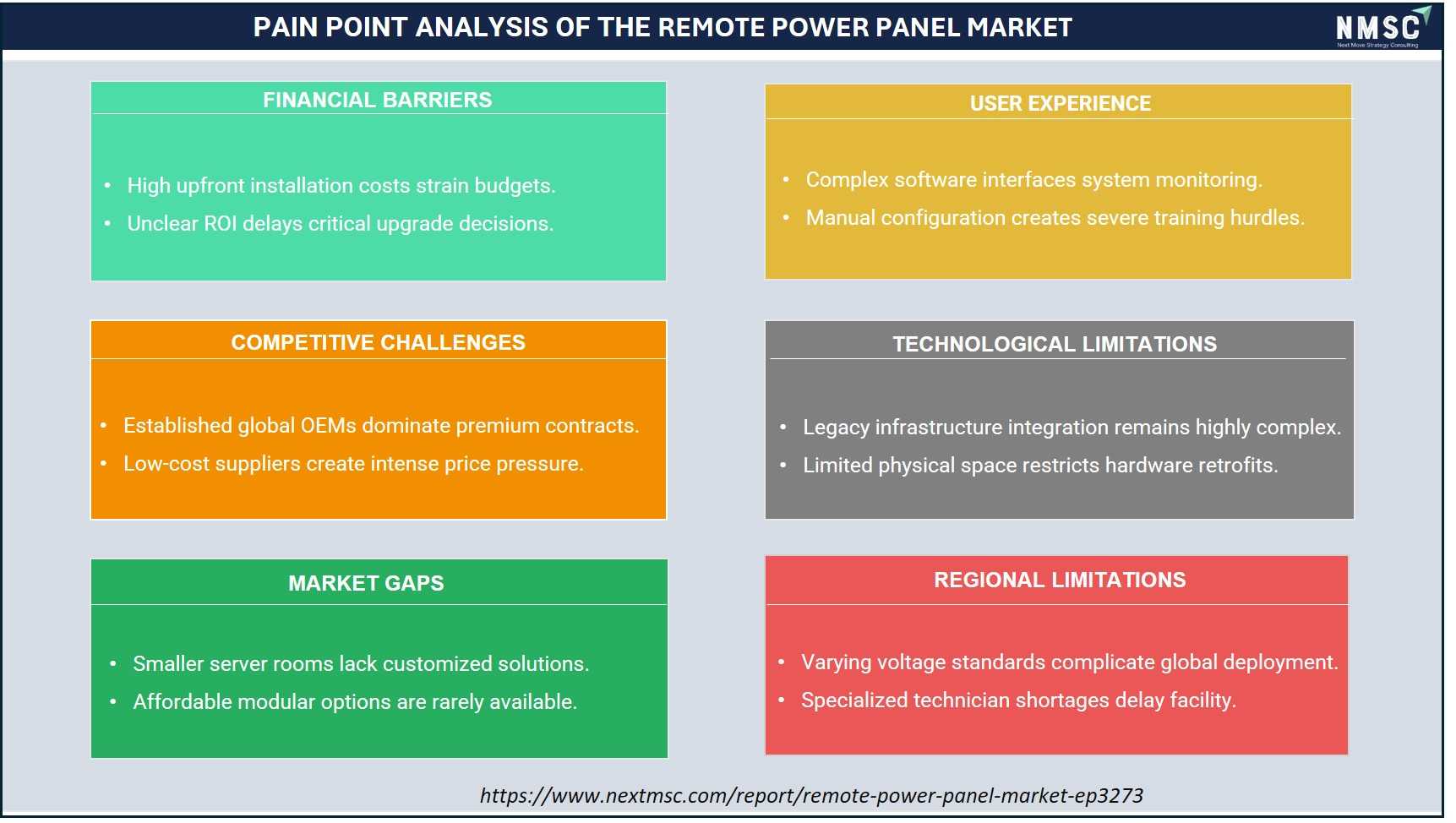
The remote power panel market faces multiple operational and adoption challenges across financial, technological, and regional dimensions. High installation costs and uncertain ROI often delay infrastructure upgrades, while complex software interfaces and manual configurations create user training difficulties. The market is also pressured by strong competition from established OEMs and low-cost suppliers. In addition, integrating RPPs with legacy infrastructure remains technically challenging, especially in space-constrained facilities. Regional voltage variations and shortages of skilled technicians further complicate global deployment and maintenance activities.
What Are the Key Market Drivers, Breakthroughs, and Investment Opportunities that Will Shape the Remote Power Panel Industry in the Next Decade?
|
Drivers / Trends / Restraints |
(+/-) % Impact on CAGR Forecast |
Geographic Relevance |
Impact Timeline |
|
Hyperscale Data Center Expansion |
+1.4% |
Global (led by North America, APAC) |
2025–2030 |
|
Edge Computing Infrastructure Rollout |
+0.9% |
North America, Europe, APAC |
2025–2032 |
|
5G Telecom Infrastructure Investment |
+0.7% |
Global (all regions) |
2025–2030 |
|
Industrial Digitization and Smart Grid |
+0.6% |
North America, Europe, China |
2026–2035 |
|
Intelligent Monitoring Adoption |
+0.5% |
Global |
2025–2028 |
|
High Capital Cost of Premium RPP Systems |
-0.8% |
Emerging markets, SMBs globally |
Ongoing |
|
Supply Chain Disruptions for Electrical Components |
-0.5% |
All regions |
2025–2027 |
|
Energy Efficiency and Sustainability Mandates |
+0.6% |
Europe, North America, Australia |
2026–2035 |
|
Rapid Expansion of Colocation Market |
+0.8% |
North America, Europe, APAC |
2025–2032 |
|
AI-Driven Data Center Power Demand Surge |
+1.1% |
Global (North America, APAC led) |
2025–2035 |
What Are the Growth Drivers of the Remote Power Panel Market?
How Is the Global Surge in Data Center Construction Driving Remote Power Panel Market Demand?
The unprecedented expansion of data center infrastructure globally represents the single most significant growth driver for the remote power panel market. The U.S. Department of Energy has documented a doubling of data center energy consumption in the United States over the past decade, and continued hyperscale investment by AWS, Microsoft Azure, and Google Cloud is creating sustained demand for high-ampacity, intelligent power distribution solutions. Based on our market evaluation, we noticed that each new hyperscale data center hall typically requires hundreds of RPP units to distribute power from centralized UPS and switchgear to IT racks, making new data center construction a direct and reliable demand generator for the remote power panel market throughout the forecast period.
How Is Edge Computing Expansion Creating New Demand Segments in the Remote Power Panel Market?
The rapid buildout of edge computing infrastructure is creating a structurally new and fast-growing demand segment within the remote power panel market. The U.S. Federal Communications Commission (FCC) has documented widespread investment in distributed network infrastructure to support 5G wireless broadband, autonomous systems, and IoT applications, all of which require local compute and power distribution at the network edge. Our findings suggest that edge deployments typically utilize compact, rack-mounted RPPs with integrated monitoring to manage power in space-constrained environments without dedicated electrical engineering staff on-site. This remote operability requirement is driving adoption of switched and monitored RPP variants specifically designed for unattended edge facilities.
How Is the Growth of Telecom and 5G Infrastructure Boosting Remote Power Panel Market Revenue?
Global investment in 5G network infrastructure is generating significant incremental demand for remote power panels across telecommunications end users. The International Telecommunication Union (ITU) has documented that 5G network densification requires orders of magnitude more active antenna units and small cell nodes compared to 4G networks, all of which require reliable, monitored power distribution at the facility level. Through NMSC's assessment, we found that telecom operators are specifying RPPs with compact form factors, high ambient temperature ratings, and remote monitoring capabilities to support network equipment installed in equipment huts, roadside cabinets, and co-location facilities. This drives both unit volume growth and average selling price uplift for RPP solutions targeting the telecom segment.
What Are the Growth Inhibitors of the Remote Power Panel Market?
How Do High Capital Costs Constrain Remote Power Panel Market Adoption Among Smaller Buyers?
Premium remote power panel configurations, particularly custom-engineered and revenue-grade monitored variants, carry significant upfront capital costs that constrain adoption among smaller enterprise buyers, emerging market operators, and budget-constrained municipal or educational facility managers. The U.S. Small Business Administration has documented that SMB organizations consistently cite capital expenditure constraints as the primary barrier to infrastructure upgrades, and RPP procurement is not immune to this dynamic. Our assessment indicates that custom RPP assemblies can cost multiples of standard panelboard alternatives, leading price-sensitive buyers to defer intelligent power distribution upgrades or opt for lower-specification alternatives that do not fully address their monitoring or flexibility requirements.
How Do Supply Chain Vulnerabilities Affect the Remote Power Panel Market?
The remote power panel market is exposed to supply chain vulnerabilities stemming from global dependence on electrical components including molded case circuit breakers, busbars, metering integrated circuits, and power monitoring modules. The U.S. Department of Commerce has highlighted that semiconductor shortages affecting electronic control and monitoring components have created lead time extensions across the electrical equipment manufacturing sector. Through our analysis, we found that these disruptions have periodically constrained RPP manufacturers' ability to fulfill large project orders on schedule, introducing delivery risk into hyperscale and industrial construction timelines. This supply chain unpredictability has prompted some large buyers to pursue dual-source procurement strategies and longer blanket order commitments to secure component availability.
What Are the Growth Opportunities in the Remote Power Panel Market?
How Does the AI-Driven Data Center Power Surge Create a Multi-Billion Dollar Opportunity in the Remote Power Panel Market?
Artificial intelligence workloads are fundamentally changing data center power architecture by driving rack densities well beyond the design parameters of traditional power distribution infrastructure. The U.S. Department of Energy's Lawrence Berkeley National Laboratory has documented that AI accelerator clusters can exceed 50–100 kW per rack, requiring the redesign of power distribution from UPS to the rack level. Our analysis shows that this power density transformation is directly creating demand for high-ampacity, custom-configured RPPs capable of delivering 200A or greater per circuit, well above the 100A–125A range of conventional designs. RPP manufacturers that can engineer and deliver high-density, high-availability power distribution solutions for AI compute environments stand to capture premium contract values throughout the forecast period.
How Is the Expansion of Colocation Data Centers Creating Structural Opportunity in the Remote Power Panel Market?
The global colocation data center market is one of the most reliable structural demand drivers for remote power panels, as colocation operators must install metered and monitored RPP solutions to accurately bill tenants for their power consumption at the circuit level. Based on our engagements with industry infrastructure planning data, we found that revenue-grade metered RPPs are a near-mandatory specification for multi-tenant colocation facilities seeking to offer utility-grade power billing transparency to enterprise and hyperscale tenants. Organizations such as Equinix, Digital Realty, and NTT Communications operate hundreds of colocation facilities globally, each requiring ongoing RPP procurement for capacity expansion and technology refresh cycles, making the colocation segment a durable and growing revenue source for RPP suppliers.
How Do Industrial Digitization and Smart Grid Investment Generate New Remote Power Panel Market Opportunities?
The digitization of industrial manufacturing facilities, commercial real estate, and smart grid infrastructure is generating incremental demand for intelligent remote power panels beyond the traditional data center segment. The U.S. Department of Energy's Grid Modernization Initiative has documented significant public and private investment in advanced metering infrastructure, distributed energy resources, and smart building automation that requires granular, real-time power monitoring at the circuit distribution level. Our assessment indicates that industrial-grade RPPs with hardened enclosures, extended temperature ratings, and IEC 61439-certified assemblies are increasingly specified in manufacturing plants, utility substations, and commercial buildings undergoing smart energy management upgrades, expanding the remote power panel market's total addressable footprint beyond conventional IT infrastructure environments.
How Is the Remote Power Panel Market Segmented in This Report, and What Are the Key Insights from the Segmentation Analysis?
How Does Product Architecture Segmentation Reveal the Structural Composition of the Remote Power Panel Market?
|
Product Architecture Segment |
2025 (USD Bn) |
2035 (USD Bn) |
CAGR (%) |
|
Standard RPP |
1.05 |
1.42 |
3.1% |
|
Configurable RPP |
0.71 |
1.24 |
5.2% |
|
Custom RPP |
0.34 |
0.44 |
2.6% |
Based on our analysis of data center construction activity and power infrastructure investment trends, we assessed that the remote power panel market is segmented into Standard RPP, Configurable RPP, and Custom RPP product architectures. Standard RPPs continue to dominate due to their broad applicability across enterprise, commercial, and mid-tier colocation environments, where standardized circuit configurations meet the majority of deployment requirements at lower procurement costs. Configurable RPPs are the fastest-growing architecture, driven by hyperscale and large colocation operators requiring adaptable breaker ratings, busbar configurations, and output circuit counts that can be tailored to evolving IT load profiles. Custom RPPs, while representing a smaller overall share, command premium pricing and are specified primarily for high-density AI compute deployments and mission-critical industrial environments.
How Does Form Factor Segmentation Reflect Deployment Diversity Across the Remote Power Panel Market?
|
Form Factor Segment |
2025 (USD Bn) |
2035 (USD Bn) |
CAGR (%) |
|
Floor Standing |
0.88 |
1.21 |
3.2% |
|
Wall Mounted |
0.42 |
0.59 |
3.5% |
|
Rack Mounted |
0.42 |
0.79 |
5.8% |
|
Compact |
0.25 |
0.41 |
5.1% |
|
Other |
0.13 |
0.10 |
−2.6% |
From our research, we found that the remote power panel market is segmented by form factor into Floor Standing, Wall Mounted, Rack Mounted, Compact, and other configurations. Floor Standing RPPs hold the dominant share, as large-scale hyperscale and enterprise data center halls require high-ampacity, free-standing panels capable of distributing 400A to 800A feeds to large rows of IT equipment. Wall Mounted RPPs serve commercial buildings, telecom exchange rooms, and smaller enterprise IT closets where floor space is at a premium. Rack Mounted RPPs represent the fastest-growing form factor, driven by edge computing and micro-data center deployments requiring full monitoring capability within constrained 19-inch or 23-inch equipment racks. Compact RPPs are gaining traction in distributed edge and retail IT installations.
How Does Monitoring Level Segmentation Capture the Intelligence Spectrum of the Remote Power Panel Market?
|
Monitoring Level Segment |
2025 (USD Bn) |
2035 (USD Bn) |
CAGR (%) |
|
Basic |
0.47 |
0.52 |
1.0% |
|
Metered |
0.63 |
0.89 |
3.5% |
|
Monitored |
0.47 |
0.72 |
4.3% |
|
Switched |
0.31 |
0.56 |
5.5% |
|
Revenue Grade |
0.22 |
0.41 |
6.4% |
Through our market assessment, we observed that the remote power panel market is segmented by monitoring level into Basic, Metered, Monitored, Switched, and Revenue Grade tiers. Basic RPPs, offering essential overcurrent protection without electronic measurement, retain a meaningful share in industrial and commercial applications where monitoring investments are not prioritized. Metered RPPs represent the current market mainstream in data center deployments, providing branch-circuit current and power measurement for energy management. Monitored RPPs add environmental sensing and network communication for proactive fault detection. Switched RPPs are the fastest-growing conventional segment, enabling remote outlet-level power cycling critical in lights-out data center operations. Revenue Grade RPPs are experiencing the highest CAGR, driven by colocation billing accuracy requirements.
How Do Distribution Channel Dynamics Shape Go-to-Market Strategy in the Remote Power Panel Market?
|
Distribution Channel |
2025 (USD Bn) |
2035 (USD Bn) |
CAGR (%) |
|
Direct Sales |
0.84 |
1.16 |
3.3% |
|
System Integrator |
0.50 |
0.83 |
5.0% |
|
Electrical Distributor |
0.46 |
0.62 |
3.0% |
|
OEM |
0.25 |
0.37 |
4.0% |
|
Other |
0.05 |
0.12 |
3.5% |
Our analysis shows that the remote power panel market is distributed through Direct Sales, System Integrator, Electrical Distributor, OEM, and other channels. Direct Sales retains the largest share, as hyperscale operators and large enterprise buyers procure RPP systems directly from manufacturers under negotiated supply agreements that include engineering support, factory acceptance testing, and project-specific customization. System Integrators are the fastest-growing distribution channel, reflecting the complexity of modern data center power infrastructure projects that require integrated design, electrical engineering, installation, and commissioning expertise. Electrical distributors serve the commercial, industrial, and standard enterprise segments with in-stock, catalog-configured RPP solutions. OEM partnerships enable RPP technology to be bundled within larger power system deployments.
How Does End-User Segmentation Reflect Demand Diversity Across the Remote Power Panel Market?
|
End User Segment |
2025 (USD Bn) |
2035 (USD Bn) |
CAGR (%) |
|
Hyperscale Data Center |
0.42 |
0.71 |
5.4% |
|
Colocation Data Center |
0.38 |
0.65 |
5.5% |
|
Enterprise Data Center |
0.40 |
0.53 |
2.8% |
|
Edge Data Center |
0.21 |
0.47 |
7.2% |
|
Telecom |
0.29 |
0.42 |
3.7% |
|
Industrial |
0.25 |
0.33 |
2.8% |
|
Commercial |
0.15 |
0.20 |
2.9% |
|
Other Critical |
0.01 |
0.20 |
3.0% |
Based on our market evaluation, we noticed that the remote power panel market is segmented across Hyperscale, Colocation, Enterprise, Edge, Telecom, Industrial, Commercial, and Other Critical end users. The combined data center segment, spanning hyperscale, colocation, and enterprise facilities, constitutes the majority of market revenue, driven by continuous capacity expansion and technology refresh procurement cycles. Hyperscale operators represent the highest per-project spend intensity, requiring custom, high-ampacity RPP assemblies for new campus construction. Edge computing is the fastest-growing individual sub-segment at a CAGR of 7.2% through 2035, reflecting the rapid proliferation of distributed compute at telecom nodes, retail locations, and industrial facilities. Telecom and industrial end users provide stable, recurring demand throughout the forecast period.
Regional Outlook
Geographic Performance Snapshot
|
Region |
2025 (USD Bn) |
2035 (USD Bn) |
CAGR (%) |
Key Driver |
|
North America |
0.84 |
1.22 |
3.8% |
Hyperscale construction, industrial modernization |
|
Europe |
0.50 |
0.72 |
3.7% |
Colocation growth, energy efficiency mandates |
|
Asia-Pacific |
0.52 |
0.87 |
5.3% |
Data center investment, 5G rollout |
|
Middle East & Africa |
0.15 |
0.25 |
5.1% |
Smart city projects, Vision programs |
|
Latin America |
0.09 |
0.14 |
4.4% |
Colocation expansion, telecom buildout |
North America Remote Power Panel Market
North America is the largest regional market for remote power panels, contributing approximately USD 0.84 billion in 2025 and projected to reach USD 1.22 billion by 2035 at a CAGR of 3.8%. The region hosts the world's highest concentration of hyperscale data center campuses, operated by AWS, Microsoft Azure, Google Cloud, and Meta, each requiring significant RPP deployments during new hall construction and capacity expansion. Industrial automation investment, supported by U.S. federal manufacturing policy initiatives, adds a robust secondary demand layer. NMSC's analysis indicates that advanced metered and switched RPP adoption rates are highest in North America, driven by data center operator energy benchmarking requirements and sustainability reporting obligations.
United States Remote Power Panel Market
Based on our engagements with industry infrastructure planning data, the United States dominates the North America remote power panel market, accounting for over 70% of regional revenue in 2025. U.S. hyperscale data center construction activity is at multi-year highs, particularly in Northern Virginia, Phoenix, and Dallas-Fort Worth, driving sustained RPP procurement. The National Electrical Code (NFPA 70) governs panel installations, while Department of Energy efficiency initiatives drive adoption of monitored and revenue-grade RPP variants. The U.S. industrial sector, supported by the CHIPS and Science Act and Infrastructure Investment and Jobs Act, is a growing secondary demand source for industrial-rated RPP systems.
Canada Remote Power Panel Market
Through our analysis, Canada represents approximately 20% of North American remote power panel market revenue, supported by a growing colocation data center industry concentrated in Toronto, Montreal, and Vancouver, alongside significant industrial and resource sector power infrastructure investment. Canada's National Energy Code for Buildings and provincial electrical codes align with NEC standards, creating a familiar procurement environment for U.S.-based RPP manufacturers. Federal investment in green energy transition and smart grid infrastructure under Canada's National Adaptation Strategy creates additional demand for monitored and revenue-grade RPP deployments in utility and industrial settings throughout the forecast period.
Mexico Remote Power Panel Market
From our assessment, Mexico is the fastest-growing market within North America for remote power panels, driven by expanding nearshore manufacturing facilities, growing data center investment in Mexico City and Queretaro, and ongoing telecommunications infrastructure modernization. U.S. and European manufacturers establishing supply chain operations in Mexico under nearshoring trends are creating direct demand for industrial-rated RPP systems in new factory facilities. Mexico's Federal Electricity Commission and regulatory framework for electrical installations provide the compliance baseline for RPP procurement. The country's digital transformation agenda under the National Digital Strategy is driving modest but growing demand in the enterprise and commercial facility segments.
Europe Remote Power Panel Market
Europe is the second-largest regional market for remote power panels, contributing approximately USD 0.50 billion in 2025 and projected to reach USD 0.72 billion by 2035 at a CAGR of 3.7%. The European market is shaped by the IEC 61439 low-voltage switchgear standard, which governs RPP design and safety certification across all member states, and by progressive energy efficiency regulation under the EU Energy Efficiency Directive. The European colocation data center sector is experiencing robust growth in Amsterdam, Frankfurt, London, Paris, and Dublin, driving steady incremental RPP demand. Sustainability reporting requirements under the EU Corporate Sustainability Reporting Directive are elevating metered and monitored RPP adoption among European facility operators.
United Kingdom Remote Power Panel Market
Based on our engagements with regional market data, the UK is the largest individual country market for remote power panels in Europe. London's position as Europe's largest data center market drives strong hyperscale and colocation RPP demand. The UK Building Regulations and BS 7671 (IET Wiring Regulations) govern low-voltage electrical installations including RPP deployments. Post-Brexit regulatory continuity has maintained alignment with IEC standards. The UK government's Digital Strategy and data center investment incentives have attracted hyperscale campuses from AWS, Microsoft, and Google Cloud, creating sustained RPP procurement activity concentrated in the Slough-Reading corridor and London Docklands areas.
Germany Remote Power Panel Market
Through our analysis, Germany represents the second-largest European market for remote power panels, driven by its world-leading manufacturing sector, significant industrial automation investment, and a growing data center industry anchored in Frankfurt, Europe's largest financial and internet exchange hub. The VDE Institute governs electrical equipment certification, and DIN EN 61439 compliance is mandatory for commercial and industrial RPP deployments. Germany's Energiewende energy transition program and industrial smart grid initiatives create incremental demand for monitored RPP solutions in manufacturing facilities and utility infrastructure. German data center operators are among Europe's most sophisticated buyers of revenue-grade metered RPP systems.
France Remote Power Panel Market
From our assessment, France is the third-largest European market for remote power panels, with strong demand from a growing data center industry in Paris and Lyon, industrial manufacturing facilities, and public sector infrastructure projects. NF C 15-100 governs low-voltage electrical installations in France, creating a distinct national compliance baseline for RPP procurement. France 2030 and the broader digital sovereignty agenda are driving public sector data center investment that generates direct RPP demand. French operators are increasingly specifying energy-efficient, metered RPP configurations to comply with ADEME energy efficiency guidelines and corporate carbon reporting requirements under the Loi Energie-Climat framework.
Italy Remote Power Panel Market
According to our evaluation, Italy represents a mid-tier European market for remote power panels, with growing adoption across financial services data centers in Milan, industrial manufacturing in the northern industrial belt, and public administration infrastructure. CEI (Italian Electrotechnical Committee) standards govern electrical panel installations, aligned with IEC 61439. Italy's Piano Nazionale di Ripresa e Resilienza (PNRR) has directed significant investment toward public sector digital transformation, including cloud infrastructure upgrades that generate RPP procurement. Industrial automation investment, particularly in the automotive and machinery manufacturing sectors, creates additional demand for industrial-rated RPP enclosures and assemblies.
Spain Remote Power Panel Market
Based on our market evaluation, Spain demonstrates growing momentum in the remote power panel market, driven by an expanding data center sector in Madrid and Barcelona, telecom infrastructure investment, and industrial modernization under the Agenda España Digital 2026 framework. Spain's Reglamento Electrotécnico de Baja Tensión (REBT) governs low-voltage electrical installations. The country's growing renewable energy sector and smart grid investment are creating incremental demand for monitored power distribution in utility and energy facilities. International data center operators including Microsoft, Google, and Amazon have announced significant Spanish data center investments, creating durable RPP demand throughout the forecast period.
Sweden Remote Power Panel Market
Through our analysis, Sweden is a high-value market for remote power panels, supported by a growing data center industry in Stockholm and Gothenburg, advanced industrial automation investment, and a government committed to sustainable energy infrastructure. Sweden's ELSÄK-FS electrical safety regulations align with IEC standards. The country's energy efficiency leadership, reflected in consistently low PUE data centers, drives adoption of metered RPP solutions that enable precise energy benchmarking. Swedish data center operators benefit from abundant renewable hydroelectric power, attracting hyperscale operators including Facebook (Meta) whose Lulea campus is among the world's most energy-efficient facilities, requiring purpose-engineered RPP deployments.
Denmark Remote Power Panel Market
From our assessment, Denmark is an advanced market for remote power panels, characterized by high data center industry growth driven by Copenhagen's emergence as a Nordic digital infrastructure hub. The Danish Electricity Supply Act and DS/EN 61439 standards govern RPP procurement. Denmark's commitment to 100% renewable energy by 2030 and its robust industrial internet sector create demand for monitored and revenue-grade RPP systems that support sustainability and operational reporting requirements. Danish data center operators, including the growing presence of AWS, Microsoft, and IBM facilities in the Copenhagen metropolitan area, represent consistent RPP procurement demand throughout the analysis period.
Finland Remote Power Panel Market
According to our evaluation, Finland's remote power panel market is characterized by high cloud adoption, strong industrial electrification investment, and growing data center activity in Helsinki. Finland's SFS standards for low-voltage electrical installations align with IEC 61439. The Finnish government's digitalization agenda and significant investment from Microsoft, which operates one of its largest European data centers in Helsinki, create material RPP demand. Nokia's global telecommunications engineering operations create enterprise demand for RPP solutions in R&D and manufacturing facilities. Finland's cold climate provides natural free cooling advantages that attract energy-efficiency-focused hyperscale data center investment, sustaining RPP procurement activity.
Netherlands Remote Power Panel Market
Based on our engagements with European market intelligence, the Netherlands is a strategically critical market for remote power panels, hosting one of the world's largest data center clusters in and around Amsterdam, anchored by the AMS-IX internet exchange point. NEN-EN 61439 governs RPP compliance in the Dutch market. Equinix, Digital Realty, NTT, and CyrusOne all operate significant Amsterdam colocation campuses that require ongoing RPP investment for new builds and capacity expansions. Dutch data center operators face increasingly stringent sustainability requirements under the Amsterdam Metropolitan Area data center moratorium policies, driving adoption of monitored and revenue-grade RPP solutions for precise energy consumption reporting to municipal authorities.
Rest of Europe Remote Power Panel Market
From our assessment, the Rest of Europe, comprising Poland, Belgium, Switzerland, Austria, Portugal, Czech Republic, Ireland, and other European nations, collectively represents a growing portion of the European remote power panel market. Ireland has emerged as a major European data center hub, with Dublin hosting hyperscale facilities operated by AWS, Microsoft, Google, and Meta, creating substantial RPP demand. Poland and the Czech Republic are experiencing rapid industrial automation growth. Switzerland's financial services sector and pharmaceutical manufacturing generate premium RPP demand. Belgium serves as an EU institutional and logistics hub with growing data center and industrial power distribution requirements throughout the forecast period.
Asia-Pacific Remote Power Panel Market
Asia-Pacific is the fastest-growing major region in the remote power panel market, advancing from approximately USD 0.52 billion in 2025 to USD 0.87 billion by 2035 at a CAGR of 5.3%. The region's growth is driven by massive data center construction activity in China, India, Singapore, and Australia, 5G network infrastructure rollout across all major economies, and accelerating industrial automation investment particularly in manufacturing-intensive economies. Regulatory frameworks including China's Data Security Law, Japan's JEAC electrical codes, India's Bureau of Indian Standards, and Australia's AS/NZS 3000 Wiring Rules collectively define RPP compliance requirements across the diverse Asia-Pacific landscape.
China Remote Power Panel Market
Based on our engagements with regional infrastructure data, China is the largest and fastest-growing national market for remote power panels in Asia-Pacific, advancing at a CAGR of 6.5% from 2026 to 2035. China's government-directed data center construction policy, including national data center corridors in Inner Mongolia, Guizhou, and Gansu, creates enormous RPP procurement volume. The Ministry of Industry and Information Technology's data center construction standards and GB/T electrical safety standards govern RPP specifications. China's dominant domestic RPP manufacturers, alongside international vendors including Schneider Electric and Eaton with local manufacturing operations, compete for significant state-directed infrastructure contracts throughout the forecast period.
India Remote Power Panel Market
Through our analysis, India is the fastest-growing major national market for remote power panels outside of China, driven by rapid data center capacity expansion across Mumbai, Chennai, Hyderabad, Pune, and Delhi NCR. The Bureau of Indian Standards (BIS) and National Electrical Code India (NBC 2016) govern RPP compliance. India's Digital India initiative and expanding cloud adoption by enterprises are creating sustained data center construction activity that drives direct RPP demand. International hyperscalers including AWS, Microsoft, and Google Cloud have all committed major data center investments in India, while domestic operators such as NxtGen, CtrlS, and Yotta Infrastructure represent a growing colocation RPP demand base.
Japan Remote Power Panel Market
According to our evaluation, Japan is the second-largest Asia-Pacific market for remote power panels, supported by mature financial services data center infrastructure, advanced automotive and electronics manufacturing, and a rapidly growing cloud adoption trend. Japan's JIS C 8480 and JEAC electrical standards govern low-voltage panel installations. Tokyo and Osaka host major data center clusters serving financial institutions and technology companies that require premium RPP configurations with high reliability specifications. Japan's Society 5.0 vision and Digital Agency's cloud migration strategy are driving public sector data center investment, creating additional RPP demand from government cloud facilities operated by domestic and international providers.
South Korea Remote Power Panel Market
From our assessment, South Korea demonstrates high RPP market maturity, driven by a world-leading semiconductor and electronics manufacturing sector, advanced broadband infrastructure, and a major data center industry anchored in Seoul and Incheon. Korea's Electrical Equipment Safety Management Act and KS C standards govern RPP compliance. Samsung, SK Hynix, and LG Electronics operate hyperscale manufacturing and R&D facilities that require significant industrial-rated RPP deployments. South Korea's K-Cloud initiative and government push for domestic AI computing infrastructure are creating new hyperscale data center RPP demand. Korea's technology conglomerates represent premium, high-specification RPP buyers with stringent reliability and monitoring requirements.
Taiwan Remote Power Panel Market
Based on our engagements with technology sector infrastructure data, Taiwan's remote power panel market is concentrated in semiconductor fabrication, electronics manufacturing, and financial services data centers. TSMC, Foxconn, and ASE Technology are among the largest industrial RPP buyers, requiring mission-critical power distribution for 24/7 fab operations. Taiwan's CNS electrical standards align with IEC frameworks. The government's Digital Nation program and investment in domestic cloud and AI computing infrastructure by ASUS, Acer, and domestic data center operators create growing demand for advanced monitored and switched RPP configurations. Taiwan's unique position as a global semiconductor hub creates specialized high-power RPP requirements for advanced fab environments.
Indonesia Remote Power Panel Market
Through our analysis, Indonesia is among the most rapidly growing RPP markets in Southeast Asia, driven by a large and youthful digital population, fast-growing fintech and e-commerce sectors, and government-backed digital infrastructure investment under Visi Indonesia 2045. SNI electrical standards and PUIL wiring regulations govern RPP compliance in Indonesia. Jakarta's growing data center market, supported by hyperscale investments from Alibaba Cloud, AWS, and Microsoft, is the primary RPP demand center. Indonesia's national data center development program aims to establish regional cloud sovereignty, creating public sector RPP procurement alongside commercial market demand throughout the forecast period.
Vietnam Remote Power Panel Market
According to our evaluation, Vietnam is an emerging and high-growth market for remote power panels in Southeast Asia, supported by accelerating digital economy development and expanding electronics manufacturing driven by China-plus-one supply chain diversification. QCVN electrical technical standards govern RPP installations. Hanoi and Ho Chi Minh City host growing data center and industrial parks that generate RPP demand from both international technology companies and domestic operators. Vietnam's National Digital Transformation Program and government targets for digital economy expansion are creating incremental enterprise and public sector RPP procurement. Samsung Vietnam's massive manufacturing operations in Bac Ninh and Thai Nguyen represent significant industrial RPP demand.
Australia Remote Power Panel Market
Based on our engagements with Asia-Pacific infrastructure intelligence, Australia is the most mature RPP market in Asia-Pacific outside Northeast Asia, with strong adoption in data centers, mining, and government facilities. AS/NZS 3000 Wiring Rules govern RPP installations. Sydney and Melbourne host major colocation campuses operated by Equinix, NEXTDC, and AirTrunk, creating consistent RPP procurement demand. The Australian Energy Market Operator's (AEMO) grid modernization initiatives and the government's Data Availability and Transparency Act are driving investment in monitored power distribution across utility and government sectors. Australia's mining sector, one of the world's largest, requires rugged, industrial-grade RPP systems for remote operational facilities.
Philippines Remote Power Panel Market
From our assessment, the Philippines is a developing but growing RPP market in Southeast Asia, supported by a large BPO industry generating consistent data center and commercial facility power distribution demand. Philippine Electrical Code (PEC) governs RPP installations. Manila and Cebu host growing colocation data centers serving BPO companies, financial services firms, and government agencies. The government's ICT modernization program and eGov digital transformation initiatives are creating incremental public sector RPP demand. Philippine banks including BDO, BPI, and Metrobank represent enterprise data center RPP buyers. The country's telecom sector, investing in 5G rollout under NTC regulations, generates compact RPP demand for distributed network infrastructure.
Malaysia Remote Power Panel Market
According to our evaluation, Malaysia is a mid-tier and growing RPP market in Southeast Asia, supported by Kuala Lumpur's emergence as a regional cloud data center hub with announced hyperscale investments from AWS, Microsoft, Google, and Oracle. The Suruhanjaya Tenaga (Energy Commission) governs electrical standards under MS IEC 61439. Malaysia's MyDigital strategy and government's National Data Center initiative are driving public sector RPP procurement. The country's palm oil, petrochemical, and manufacturing sectors represent industrial RPP buyers. Malaysia's growing colocation market, with established operators such as CX, Celcom Axiata, and TIME dotCom, provides consistent commercial RPP demand throughout the forecast period.
Rest of Asia-Pacific Remote Power Panel Market
From our assessment, the Rest of Asia-Pacific, comprising Thailand, Singapore, New Zealand, Bangladesh, Sri Lanka, and smaller Pacific economies, collectively represents a growing share of the regional remote power panel market. Singapore punches well above its geographic size as an RPP demand center, hosting Southeast Asia's largest colocation data center market with Equinix, Digital Realty, and Keppel Data Centres operating major facilities under stringent IMDA data center standards. Thailand's Eastern Economic Corridor is attracting manufacturing and data center investment. New Zealand's growing cloud adoption and government digital services investment create incremental RPP demand alongside Australia's established market.
Middle East and Africa Remote Power Panel Market
The Middle East and Africa represent one of the fastest-growing regions in the remote power panel market, advancing from approximately USD 0.15 billion in 2025 to USD 0.25 billion by 2035 at a CAGR of 5.1%. National transformation programs in Saudi Arabia and the UAE are the primary growth engines, supplemented by Israel's advanced technology sector, South Africa's financial infrastructure, and Nigeria's rapidly digitizing economy. Sovereign cloud and smart city infrastructure investment across the GCC is creating structural demand for RPP systems that integrate monitoring, switching, and energy reporting capabilities for newly constructed hyperscale and government cloud facilities.
Saudi Arabia Remote Power Panel Market
Based on our engagements with MEA infrastructure investment data, Saudi Arabia is the largest RPP market in the Middle East and Africa, driven by Vision 2030 digital transformation projects, NEOM smart city construction, and ARAMCO's industrial digitization initiatives. Saudi Electrical Safety regulations and SASO standards govern RPP compliance. The National Data Center Program, overseen by the Saudi Authority for Data and Artificial Intelligence (SDAIA), is creating government cloud facilities that require advanced monitored and revenue-grade RPP deployments. All major hyperscalers have established Saudi cloud regions, generating direct RPP procurement demand for new data center construction alongside domestic industrial facilities.
UAE Remote Power Panel Market
Through our analysis, the UAE is the second-largest RPP market in the MEA region, powered by Dubai and Abu Dhabi's hyperscale data center ambitions, free zone data center clusters, and smart city deployments across the Dubai 2040 Urban Master Plan and Abu Dhabi's Ghadan 21 program. UAE electrical standards align with IEC and BS frameworks. The Abu Dhabi Global Market (ADGM) and Dubai International Financial Centre (DIFC) host regulated financial services data centers requiring premium RPP configurations. The UAE National AI Strategy 2031 is directing significant public sector cloud infrastructure investment that creates sustained RPP demand. International and domestic colocation operators maintain growing facility footprints.
Egypt Remote Power Panel Market
According to our evaluation, Egypt is an emerging RPP market in Africa, supported by government Egypt Vision 2030 digital transformation investments, a rapidly growing digital banking sector serving a population of 106 million, and expanding industrial zones around Cairo and Alexandria. Egypt's Electricity Act and NTRA electrical standards govern RPP installations. The government's G-Cloud national cloud program is creating initial public sector RPP demand alongside commercial data center development. Egyptian telecommunications operators, including Telecom Egypt and Orange Egypt, represent growing RPP buyers for network infrastructure modernization. Industrial free zones are generating additional manufacturing-sector RPP procurement throughout the forecast period.
Israel Remote Power Panel Market
Based on our engagements with MEA technology sector data, Israel occupies a unique position in the remote power panel market as both a significant technology vendor ecosystem and an enterprise RPP buyer. Israeli Standard SI 60439 aligns RPP compliance with IEC 61439. Israel's defense and intelligence technology sectors represent specialized, high-specification RPP buyers for mission-critical government and defense facilities. Tel Aviv's growing commercial data center market, serving the country's world-class technology startup ecosystem, generates enterprise colocation RPP demand. Israeli clean energy investment, including utility-scale solar farm control buildings, creates incremental industrial RPP procurement for power distribution in renewable energy infrastructure.
Turkey Remote Power Panel Market
From our assessment, Turkey is a mid-sized and growing RPP market within the MEA region, characterized by a dynamic manufacturing sector, a major data center industry in Istanbul, and significant telecom infrastructure investment. Turkish Electrical Installation Rules (IEK) and TS EN 61439 standards govern RPP compliance. Istanbul's growing colocation market, anchored by Turk Telekom and Comnet data center operations, generates consistent RPP demand. Turkey's National Artificial Intelligence Strategy 2021–2025 and investments in domestic cloud infrastructure create public sector RPP procurement. The manufacturing sector's ongoing Industry 4.0 transition drives industrial-grade RPP demand for automation and smart factory deployments throughout the forecast period.
Nigeria Remote Power Panel Market
According to our evaluation, Nigeria is Sub-Saharan Africa's largest RPP market, powered by its 220 million population, rapid fintech infrastructure growth, and the Central Bank of Nigeria's digital payment infrastructure modernization. SON (Standards Organisation of Nigeria) and NEMSA electrical standards govern RPP installations. Lagos hosts a growing data center market serving financial institutions, telecoms including MTN Nigeria and Airtel Africa, and e-commerce platforms. Nigeria's National Broadband Plan is driving telecom infrastructure investment that creates compact RPP demand for distributed network equipment sites. The country's industrial and oil-and-gas sectors represent additional buyers of rugged, industrial-rated RPP assemblies.
South Africa Remote Power Panel Market
Based on our engagements with Sub-Saharan Africa infrastructure data, South Africa is the most mature RPP market on the African continent, driven by Johannesburg's position as Africa's financial capital, a well-established mining sector with critical power requirements, and a growing data center industry anchored by Teraco Data Environments, Africa Data Centres, and Liquid Intelligent Technologies. SANS 10142 (South African National Standard for Electrical Installations) governs RPP compliance. South African financial institutions and mining operations represent the highest-specification RPP buyers. The government's South Africa Digital Economy Master Plan is creating incremental public sector data center RPP demand alongside the established commercial market.
Rest of MEA Remote Power Panel Market
From our assessment, the Rest of MEA, encompassing Kuwait, Qatar, Bahrain, Oman, Jordan, Morocco, Kenya, Ghana, and other nations, collectively represents a growing segment of the remote power panel market. GCC countries outside Saudi Arabia and UAE are investing in national cloud infrastructure aligned with Vision-type digital transformation programs, creating public sector RPP demand. Kenya is East Africa's most significant digital economy, with Nairobi's Konza Technopolis and growing data center market generating RPP procurement from financial services and technology sector buyers. Morocco serves as a nearshore technology hub for European companies establishing African digital operations, driving data center and enterprise RPP demand.
Latin America Remote Power Panel Market
Latin America represents an emerging and growing market for remote power panels, advancing from approximately USD 0.09 billion in 2025 to USD 0.14 billion by 2035 at a CAGR of 4.4%. Brazil and Mexico collectively account for approximately 65% of regional RPP revenue. Growing data center investment driven by hyperscaler expansion, colocation market development, and increasing industrial automation are the primary growth drivers. Evolving data protection legislation across major economies and government digital transformation programs are generating incremental public sector RPP demand. The region's telecom sector, investing in 4G coverage expansion and 5G rollout, provides consistent compact RPP demand for distributed network infrastructure.
Brazil Remote Power Panel Market
Based on our engagements with Latin American infrastructure data, Brazil is the largest RPP market in Latin America, accounting for approximately 40% of regional revenue in 2025. Sao Paulo and Rio de Janeiro host South America's most significant data center clusters, with Equinix, Digital Realty, and domestic operators such as UOL Diveo and ODATA expanding capacity to meet surging cloud demand. ABNT electrical standards and NR-10 regulations govern RPP installations. AWS, Microsoft Azure, and Google Cloud all operate Brazilian data center regions, generating direct RPP procurement. Brazil's industrial sector, including automotive manufacturing and petrochemicals, represents a material secondary buyer of industrial-grade RPP assemblies throughout the forecast period.
Argentina Remote Power Panel Market
Through our analysis, Argentina is the second-largest RPP market in Latin America, supported by a strong technology sector in Buenos Aires and one of the region's highest concentrations of technology talent. IRAM electrical standards govern RPP compliance. Argentine financial institutions, including Banco Galicia and Banco Santander Argentina, and major industrial operations are consistent enterprise RPP buyers. The country's growing technology outsourcing sector and government cloud modernization initiatives create incremental demand. Despite economic volatility, RPP procurement remains resilient given the mission-critical nature of power distribution in data center environments that cannot tolerate infrastructure deferrals.
Chile Remote Power Panel Market
According to our evaluation, Chile represents a small but stable and growing RPP market, supported by one of Latin America's highest broadband penetration rates, a proactive regulatory environment, and significant data center investment in Santiago from Microsoft, Google Cloud, and domestic operators. Chile's Reglamento de Instalaciones de Corrientes Fuertes (RICF) governs electrical panel installations. The financial sector and growing e-commerce industry represent enterprise RPP buyers. Chile's Lithium and mining sector digitization is creating specialized industrial RPP demand for remote mine site power distribution infrastructure. Google Cloud and Microsoft Azure operate Chilean cloud regions that drive ongoing hyperscale RPP procurement.
Colombia Remote Power Panel Market
From our assessment, Colombia is among the fastest-growing RPP markets in Latin America, driven by Bogota's emergence as a regional technology hub, a dynamic fintech sector, and the government's Colombia Digital policy agenda. Colombia's RETIE electrical regulations govern RPP installations. AWS and Google Cloud operate Colombian cloud regions that generate hyperscale data center RPP demand. Major financial institutions including Bancolombia and Davivienda represent enterprise RPP buyers. Colombia's industrial sector, including petroleum, manufacturing, and agribusiness, provides additional demand for industrial-rated RPP assemblies. The country's expanding colocation market is creating growing demand for metered and revenue-grade RPP configurations throughout the forecast period.
Rest of Latin America Remote Power Panel Market
Based on our engagements with Latin American market assessment data, the Rest of Latin America, comprising Peru, Ecuador, Uruguay, Bolivia, Paraguay, Costa Rica, Panama, and Caribbean nations, represents a smaller but growing component of the regional remote power panel market. Costa Rica serves as a nearshore technology services hub for North American enterprises, generating enterprise data center and commercial facility RPP demand. Panama's role as a regional logistics and financial hub creates demand for commercial and industrial RPP systems in its growing data center and free trade zone infrastructure. Uruguay and Peru have notable fintech and data center development activity driving incremental RPP procurement.
Regulatory Framework Impacting the Remote Power Panel Market
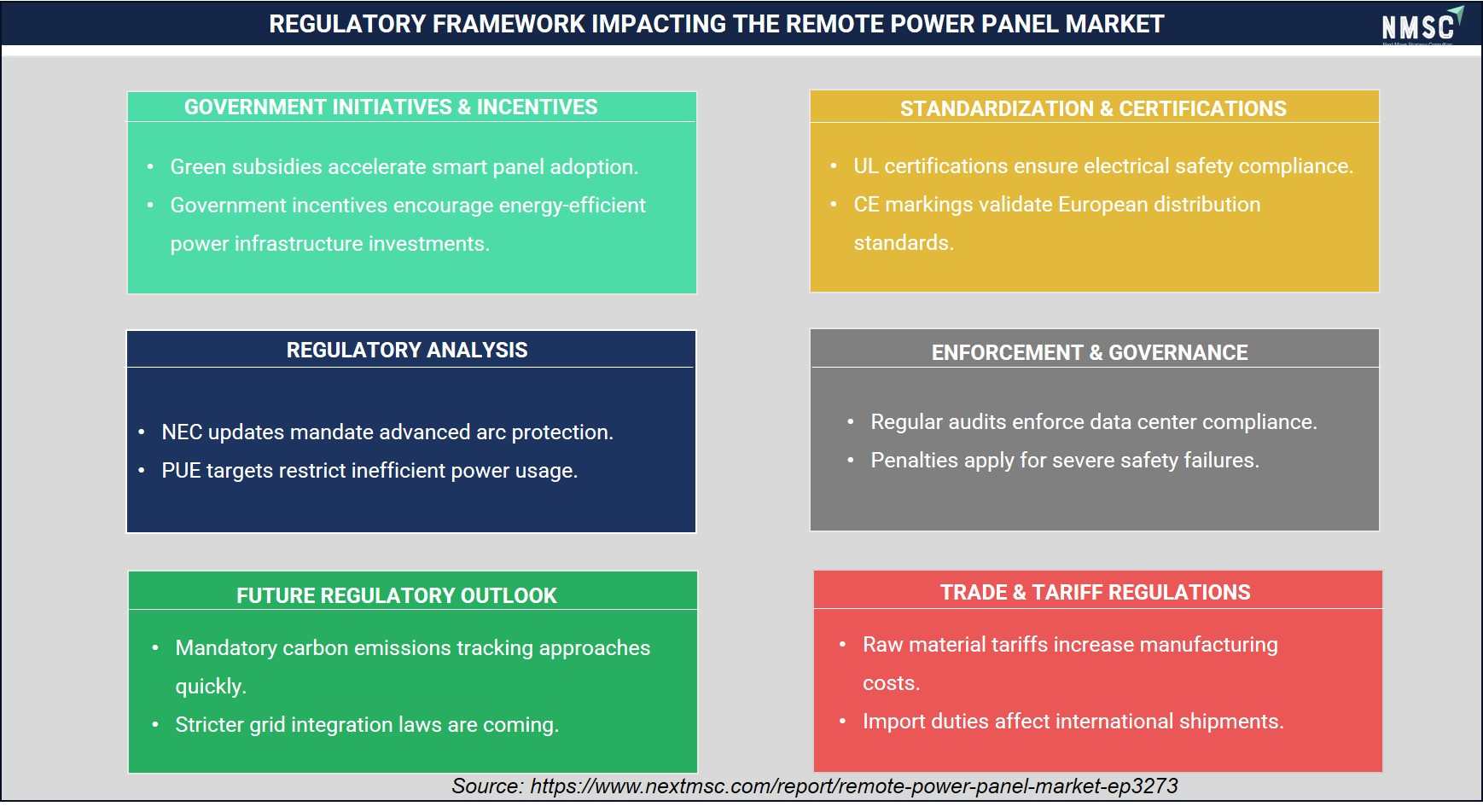
The Remote Power Panel (RPP) market is increasingly shaped by evolving regulatory frameworks focused on energy efficiency, electrical safety, and infrastructure reliability. Government incentives and green subsidies are accelerating adoption of smart and energy-efficient power distribution systems. Compliance standards such as UL certifications and CE markings are becoming essential for market access and operational safety. Regulatory bodies are also enforcing stricter power usage effectiveness (PUE) targets and advanced protection requirements. Additionally, rising trade tariffs and import duties are impacting manufacturing costs, while future regulations are expected to emphasize carbon emissions tracking and grid integration standards.
Competitive Landscape
Competitive Dynamics and M&A Landscape
|
Key Takeaways |
Details |
|
Market Structure |
The Remote Power Panel Market features a tiered competitive structure comprising global power management conglomerates (Schneider Electric, Eaton, ABB), specialist RPP manufacturers (LayerZero, Raptor Power Systems, C&C Power), and regional players, each competing on engineering depth, customization capability, and service responsiveness. |
|
Innovation Focus |
Innovation in the Remote Power Panel Market centers on intelligent monitoring integration (branch-level metering, cloud DCIM connectivity), high-density power distribution for AI compute environments, edge-optimized compact form factors, and modular configurable architectures that reduce deployment lead times. |
|
M&A Activity |
nVent Electric plc has pursued strategic acquisitions in critical power infrastructure to expand its enclosure and power distribution portfolio. Vertiv Holdings Co continues to invest in power management ecosystem integration. Private equity-backed consolidation among regional RPP specialists is expected to continue through 2028, driven by hyperscale supply chain concentration demand. |
How Do Companies Compete in the Remote Power Panel Market?
The remote power panel market exhibits a multi-tiered competitive structure. Global power management conglomerates including Schneider Electric, Eaton Corporation, ABB, Vertiv, and Legrand compete on breadth of product portfolio, global sales and service network, and integration with broader power management and DCIM software ecosystems. Specialist RPP manufacturers including LayerZero Power Systems, Raptor Power Systems, C&C Power, and Hyper Solutions differentiate on engineering customization depth, rapid delivery for complex configurations, and deep expertise in mission-critical applications. Our analysis shows that competitive success increasingly depends on the ability to offer configurable, monitored RPP solutions with seamless DCIM integration at competitive lead times for hyperscale buyers.
Which Kind of Companies Dominate the Remote Power Panel Market?
Three distinct categories of companies dominate the remote power panel market. First, electrical infrastructure manufacturers with expertise in power distribution and critical facility management provide integrated remote power panel systems designed for data centers, industrial facilities, and commercial buildings. Second, power monitoring and energy management solution providers focus on intelligent distribution technologies, circuit-level monitoring, and advanced load management capabilities to support operational efficiency and uptime reliability. At last, specialized critical power and modular infrastructure providers deliver customized remote power panel configurations for high-density computing environments, telecom facilities, and mission-critical applications requiring scalable and resilient power distribution architectures.
Digital Monitoring and Intelligent Power Management Drive Market Success in the Remote Power Panel Market
Innovation focus across the remote power panel market is concentrated in intelligent monitoring capabilities, real-time circuit analytics, predictive maintenance integration, modular power distribution architecture, and remote management functionalities. Vendors that successfully integrate advanced monitoring, automation, and energy optimization capabilities within power distribution systems are strengthening their competitive positioning across critical infrastructure applications. Open communication protocols, interoperability with building management systems, and scalable deployment flexibility are differentiating solutions that support evolving enterprise power infrastructure requirements while minimizing operational complexity and downtime risks.
Market Players to Opt for Merger and Acquisition Strategies to Expand Their Presence in the Remote Power Panel Market
Mergers and acquisitions are reshaping the competitive landscape of the remote power panel market. Companies are pursuing strategic acquisitions to strengthen intelligent power distribution portfolios, expand critical infrastructure capabilities, and enhance digital monitoring competencies. Market participants are also focusing on partnerships and consolidation strategies to improve geographic reach, broaden product customization capabilities, and strengthen integration across power management ecosystems. Consolidation activities involving electrical infrastructure providers, energy management technology developers, and critical facility solution specialists are expected to accelerate as demand for intelligent and scalable power distribution systems continues to expand across data center and industrial environments
Who Are the Key Market Players in the Remote Power Panel Market?
The leading companies operating in the Remote Power Panel Market include:
-
Schneider Electric SE
-
Eaton Corporation plc
-
ABB Ltd
-
Vertiv Holdings Co
-
Legrand SA
-
Flex Ltd.
-
Delta Electronics, Inc.
-
Toshiba International Corporation
-
nVent Electric plc
-
Socomec SAS
-
Hanley Energy Limited
-
Industrial Electric Mfg., Inc.
-
LayerZero Power Systems, LLC
-
Hyper Solutions, Inc.
-
Forgent
-
C&C Power, Inc.
-
Raptor Power Systems, LLC
-
Butcher Power Products, Inc.
-
DEI Power Solutions, LLC
-
Rishab Industries Pvt. Ltd.
What Are the Latest Developments in the Remote Power Panel Industry?
|
Date |
Event |
|
October 2025 |
Vertiv Holdings Co introduced OCP-compliant power ecosystem featuring Vertiv™ PowerIT intelligent rack PDUs with advanced monitoring, load balancing, and cybersecurity features for AI data center deployments. |
|
October 2025 |
Vertiv Holdings CoLaunched new high-density PowerIT rack PDUs targeting AI data centers and high-performance computing facilities with three-phase power distribution capability. |
|
September 2025 |
Expanded Vertiv™ PowerIT rack PDU portfolio with monitored and switched rack power distribution units supporting up to 57.6 kW for AI and HPC environments. |
|
June 2025 |
Schneider Electric launched AI-focused data center infrastructure portfolio including rack PDUs, prefabricated power distribution systems, and modular electrical architecture. |
|
June 2025 |
ABB Ltd partnered with Applied Digital to deploy medium-voltage UPS and electrical distribution infrastructure for a 400 MW AI data center campus. |
Expert Insights
 “With AI driving rack densities into three- and four-digit kWs, the need for advanced and scalable solutions to power and cool those racks, minimize their environmental footprint, and empower these emerging AI Factories has never been higher.”
- Vertiv Holdings Co CEO Giordano Albertazzi
Statement made in Vertiv’s “Data Center Trends 2025” industry outlook discussing AI-driven data center infrastructure evolution and rising demand for advanced power and cooling systems.
Market Interpretation
Albertazzi’s statement highlights how AI workloads are fundamentally reshaping power distribution requirements within modern data centers. Increasing rack densities are accelerating demand for scalable electrical infrastructure solutions such as remote power panels, intelligent power distribution systems, and modular energy management architectures. The insight reflects a broader market transition toward high-capacity, energy-efficient, and digitally monitored power ecosystems capable of supporting hyperscale AI facilities while maintaining operational reliability and sustainability objectives.
What Are the Investment Opportunities in the Remote Power Panel Market?
Capital Inflows and Infrastructure Expansion
The remote power panel market continues to attract substantial investment due to accelerating hyperscale data center expansion, AI infrastructure deployment, and increasing demand for mission-critical power distribution systems. Major electrical infrastructure companies including Schneider Electric, Vertiv, Eaton, and ABB continue to expand investments in intelligent power management technologies, modular power systems, and digital monitoring capabilities. We observed that rising investments in hyperscale cloud campuses, colocation facilities, and edge computing infrastructure are creating sustained procurement demand for remote power panels integrated with real-time monitoring and branch circuit management functionalities. Industry investment momentum remains strong as global data center operators expand capacity to support AI, cloud computing, and high-density server deployments.
Data Center and Digital Infrastructure Investment
Large-scale investments in global data center infrastructure are serving as a foundational growth catalyst for the remote power panel market. Hyperscale cloud providers, colocation operators, and telecom companies are collectively investing hundreds of billions of dollars into new digital infrastructure construction. Moreover, we found that AI-oriented data center expansion across North America, Europe, the Middle East, and Asia-Pacific is significantly increasing demand for scalable and energy-efficient power distribution architecture. Remote power panels are increasingly deployed to improve operational visibility, power redundancy, and load balancing capabilities within high-density computing environments. The rapid expansion of edge data centers and 5G infrastructure is further widening the addressable market for intelligent power distribution systems globally.
ESG and Energy-Efficient Power Distribution
Environmental, Social, and Governance (ESG) considerations are increasingly shaping investment decisions within the remote power panel market. Rising regulatory scrutiny regarding energy efficiency, carbon emissions, and power utilization effectiveness (PUE) in data centers is accelerating adoption of intelligent and energy-optimized electrical distribution systems. We noticed that data center operators are prioritizing remote power panels equipped with advanced monitoring, predictive maintenance, and load optimization capabilities to improve energy efficiency and reduce operational waste. In addition, sustainability commitments from hyperscalers and colocation providers are encouraging investments in smart electrical infrastructure that supports renewable energy integration and more efficient facility management.
AI, Edge Computing, and Digital Transformation Enablement
Remote power panels are becoming strategically important components within enterprise digital transformation and AI infrastructure modernization initiatives. Expanding AI workloads, high-performance computing environments, and edge computing deployments require highly reliable and scalable electrical distribution systems capable of supporting dynamic power densities. We further analysed that enterprises modernizing their digital infrastructure are increasingly integrating intelligent remote power panels to improve uptime reliability, operational monitoring, and power management efficiency across mission-critical facilities. The global expansion of smart manufacturing, industrial automation, telecom infrastructure, and cloud-native application ecosystems is expected to create durable long-term demand for advanced power distribution solutions.
Private Equity and Strategic M&A Activity
Private equity firms and strategic investors are increasingly targeting companies operating within critical power infrastructure, electrical distribution, and intelligent facility management ecosystems. Strategic acquisitions are accelerating as major power infrastructure vendors seek to strengthen capabilities in digital monitoring, smart power management, modular electrical systems, and data center infrastructure solutions. We assessed that investors should closely monitor consolidation activity involving intelligent power distribution manufacturers, edge infrastructure specialists, and digital power monitoring solution providers as attractive acquisition targets during the 2025–2028 period within the remote power panel market.
Key Benefits for Stakeholders
For Enterprise Buyers
Enterprise buyers gain comprehensive, vendor-neutral insights into the remote power panel market, including quantitative analysis across product configurations, power capacities, mounting types, monitoring technologies, and end-use industries. This intelligence supports critical infrastructure planning, power distribution optimization, and long-term facility modernization strategies. Our competitive landscape analysis enables procurement teams to benchmark supplier capabilities, evaluate intelligent power management solutions, and assess scalability requirements for hyperscale data centers, colocation facilities, telecom infrastructure, and industrial applications with greater operational confidence.
For Investors and Financial Analysts
Investors and financial analysts gain access to a structured and data-rich assessment of the remote power panel market’s growth outlook, competitive intensity, investment trends, and segment-level revenue forecasts through 2035. CAGR analysis across regions, end-use sectors, and deployment environments supports informed capital allocation and infrastructure investment strategies. Detailed profiles of leading market participants, combined with latest development tracking, provide an early-stage framework for identifying emerging technology leaders, acquisition opportunities, and high-growth infrastructure segments within the global critical power distribution ecosystem.
For Remote Power Panel Manufacturers and Solution Providers
Remote power panel manufacturers and power infrastructure solution providers gain actionable intelligence regarding white-space opportunities, competitive differentiation strategies, and the fastest-growing application segments within the remote power panel market. Product and technology analysis highlights increasing demand for intelligent monitoring systems, modular power architectures, branch circuit analytics, and energy-efficient electrical distribution solutions. Our regional outlook analysis identifies strategic expansion opportunities based on data center construction activity, digital infrastructure investment, and industrial modernization trends. In addition, end-user analysis enables vendors to optimize go-to-market strategies, strengthen channel partnerships, and target high-growth sectors including hyperscale data centers, edge computing facilities, healthcare infrastructure, and telecom networks.
For Government and Regulatory Bodies
Government agencies and regulatory bodies gain structured insights into how energy efficiency regulations, electrical safety standards, and digital infrastructure development initiatives are influencing the remote power panel market’s competitive landscape and technology adoption patterns. Country-level analysis provides policymakers with evidence-based perspectives regarding the impact of data center expansion, smart grid modernization, and industrial electrification programs on demand for advanced power distribution systems. The report further supports infrastructure planning initiatives related to energy resilience, critical facility reliability, and sustainable electrical infrastructure development across public and private sector environments.
Remote Power Panel Market Key Segments
By Product Architecture
-
Standard RPP
-
Configurable RPP
-
Custom RPP
By Form Factor
-
Floor Standing
-
Wall Mounted
-
Rack Mounted
-
Compact
-
Other
By Monitoring Level
-
Basic
-
Metered
-
Monitored
-
Switched
-
Revenue Grade
By End User
-
Data Center
-
Hyperscale
-
Colocation
-
Enterprise
-
Edge
-
-
Telecom
-
Industrial
-
Commercial
-
Other Critical
By Distribution Channel
-
Direct Sales
-
System Integrator
-
Electrical Distributor
-
OEM
-
Other
By Region
-
North America: U.S., Canada, Mexico
-
Europe: UK, Germany, France, Italy, Spain, Sweden, Denmark, Finland, Netherlands, Rest of Europe
-
Asia-Pacific: China, India, Japan, South Korea, Taiwan, Indonesia, Vietnam, Australia, Philippines, Malaysia, Rest of APAC
-
Middle East & Africa: Saudi Arabia, UAE, Egypt, Israel, Turkey, Nigeria, South Africa, Rest of MEA
-
Latin America: Brazil, Argentina, Chile, Colombia, Rest of LATAM
Conclusion and Recommendations
Long-Term Outlook
The remote power panel market is positioned for steady and sustained growth through 2035, underpinned by two powerful secular demand drivers: the global data center construction boom and the accelerating digitization of industrial and commercial facilities worldwide. NMSC's analysis indicates that the market will advance from USD 2.2 billion in 2026 to USD 3.1 billion by 2035 at a CAGR of 4.1%, with above-average growth concentrated in intelligent RPP variants (switched, monitored, and revenue-grade metered configurations) and compact form factors serving edge computing deployments. The long-term outlook is further supported by the AI-driven data center power density escalation that is creating a multi-year hardware replacement cycle for existing RPP installations across hyperscale and enterprise facilities.
Strategic Positioning Recommendations
RPP manufacturers should prioritize investment in intelligent monitoring integration as a core product differentiator, as branch-level metering, DCIM connectivity, and cloud energy management APIs are transitioning from premium options to baseline expectations in the data center and colocation segments. Geographic expansion into Asia-Pacific, particularly India, Vietnam, and Indonesia, should be a strategic priority given the region's above-market CAGR and the current relative underrepresentation of international RPP brands in fast-growing Southeast Asian markets. Custom engineering capability for high-density AI compute environments represents the highest-margin growth opportunity within the remote power panel market and warrants dedicated investment in application engineering and customer-specific design services.
Investment Attractiveness
The remote power panel market represents an attractive investment environment given the mission-critical nature of RPP systems, recurring demand from ongoing data center capacity expansion and technology refresh cycles, and the structural growth of intelligent monitoring variants that command premium pricing. Our assessment indicates that the highest-conviction investment themes within the market include Edge RPP solutions (7.2% CAGR), Revenue Grade metered systems (6.4% CAGR), Configurable RPP architectures (5.2% CAGR), and Asia-Pacific regional expansion (5.3% CAGR). Consolidation among specialist RPP manufacturers, driven by hyperscale operators seeking fewer, more capable supply chain partners, is expected to create M&A opportunities throughout the forecast period.
Market Shifts and Key Risks
The most significant structural market shift is the migration from passive, fixed-configuration RPP procurement toward intelligent, software-integrated power distribution systems that are managed as part of the broader DCIM and energy management ecosystem. This shift benefits manufacturers with strong monitoring software capabilities and hyperscaler customer relationships. Key risks include potential deceleration of hyperscale capital expenditure in response to macroeconomic headwinds, ongoing electrical component supply chain vulnerabilities, competitive pricing pressure from Asian manufacturers in standard RPP categories, and the possibility of stricter data center construction moratoriums in European markets that could temporarily suppress regional RPP demand.
Growth Pathways
Organizations seeking to maximize value from the remote power panel market should pursue a three-horizon strategy. In the near term (2025–2027), prioritize intelligent monitoring capability across the product portfolio and establish supply chain resilience through component diversification to capture accelerating hyperscale demand for monitored and switched RPPs. In the mid-term (2027–2031), invest in custom high-density RPP engineering for AI compute environments and expand distribution channel presence in Asia-Pacific through system integrator partnerships in India, Southeast Asia, and South Korea. In the long term (2031–2035), position for leadership in edge-optimized, cloud-connected RPP platforms that integrate with next-generation DCIM and AI-driven energy management systems as edge computing becomes a major infrastructure investment theme globally.


About the Author
 Tushmi Dutta
— Tushmi Dutta is a focused researcher specializing in detailed analysis and insight-driven research across diverse business landscapes. She supports strategic initiatives through structured data interpretation, thorough validation, and clear communication of findings that aid informed decision-making. With a strong interest in writing, she enjoys presenting research insights in an engaging and accessible manner. Beyond work, she enjoys traveling, reading, painting, and continuously learning new skills that contribute to her creative and professional growth.
Tushmi Dutta
— Tushmi Dutta is a focused researcher specializing in detailed analysis and insight-driven research across diverse business landscapes. She supports strategic initiatives through structured data interpretation, thorough validation, and clear communication of findings that aid informed decision-making. With a strong interest in writing, she enjoys presenting research insights in an engaging and accessible manner. Beyond work, she enjoys traveling, reading, painting, and continuously learning new skills that contribute to her creative and professional growth.
About the Reviewer
 Supradip Baul
— Supradip Baul is an accomplished business consultant and strategist with over a decade of rich experience in market intelligence, strategy, technology, and business transformation. His work has included rigorous qualitative and quantitative analysis across multiple industries, helping clients shape investment decisions and long-term roadmaps. Earlier in his career, he was associated with Gartner, where he contributed to industry-leading reports and market share analyses. He has worked with leading global companies and holds an MBA with a dual specialization in Marketing and Finance.
Supradip Baul
— Supradip Baul is an accomplished business consultant and strategist with over a decade of rich experience in market intelligence, strategy, technology, and business transformation. His work has included rigorous qualitative and quantitative analysis across multiple industries, helping clients shape investment decisions and long-term roadmaps. Earlier in his career, he was associated with Gartner, where he contributed to industry-leading reports and market share analyses. He has worked with leading global companies and holds an MBA with a dual specialization in Marketing and Finance.
At Next Move Strategy Consulting, we understand that insightful market research is the cornerstone of successful business decisions. That's why we employ a robust and multifaceted approach, combining various methodologies to deliver the most accurate and actionable data for our clients.

Research Landscape
We navigate the world of research with two primary approaches:
Qualitative Approach
Our qualitative research methodologies involve immersive techniques such as in-depth interviews, focus groups, and observational studies. By engaging directly with individuals and stakeholders, we uncover valuable insights that quantitative data alone may overlook.

Quantitative Research
In tandem with qualitative methodologies, NMSC leverages the power of Quantitative Research to provide a robust foundation of numerical insights. Through systematic data collection and analysis, we quantify patterns, preferences, and market trends, offering a comprehensive view of the business landscape.
Our quantitative research approach employs diverse tools, including surveys, experiments, and statistical modelling. These methodologies enable us to gather data from a large and representative sample, ensuring the statistical significance of our findings. By employing structured questionnaires and standardized data collection methods, we guarantee the reliability and validity of the information we present to our clients.
Quantitative research is particularly effective in measuring the prevalence of trends, assessing market size, and gauging the impact of various factors on consumer behavior. The numerical precision attained through this approach equips our clients with actionable insights, facilitating data-driven decision-making and strategy formulation.


Our Specialized Toolbox for Industry-Specific Market Research
We deploy a specialized arsenal of techniques tailored to meet your unique requirements. Here's a glimpse into our comprehensive toolbox:

Information Procurement
The stage entails acquiring market data or relevant information through various sources and methodologies.


Market Research Approach
We utilize both top-down and bottom-up approaches in market research analysis to achieve a comprehensive understanding of the market dynamics, leveraging the broad perspective of industry trends and macroeconomic factors alongside detailed insights from specific segments and individual companies.

Porters Five Forces Analysis
We conduct Porter's Five Forces analysis to evaluate the competitive landscape of an industry, providing us with insights into factors that affect profitability and strategic positioning.

SWOT Analysis

Forecasting
We utilize a forecasting model to predict future consumption by considering parameters like population, economics, regulations, market competition, drivers, constraints, technology, and pricing. We also employ statistical techniques such as multilinear regression, exponential smoothing, moving average, ARIMA, and Monte Carlo simulations for accurate predictions. In econometric forecasting, we analyzed short-term and long-term event impacts, attributing values based on regulatory frameworks, economic factors, and market events.





 Speak to Our Analyst