Southeast Asia Air Compressor Market By Type (Portable, and Stationary), By Technology (Rotary Screw, Centrifugal, and Reciprocating), By Lubrication Type (Oil-Free, and Oil-Injected/Flooded), By Power Rating (0-100 kW, 101-300 kW, 301-500 kW, and 501 kW & Above), By Cooling Method (Air-Cooled, and Water-Cooled), and By Industry Vertical (Manufacturing, Construction, Oil & Gas, Healthcare, and Others) – Southeast Asia Analysis & Forecast, 2025–2030
Industry: Construction & Manufacturing | Latest Edition: October 16, 2026 | No of Pages: 301 | No. of Tables: 244 | No. of Figures: 189 | Format: PDF | Report Code: CM3924
Industry Outlook
The Southeast Asia Air Compressor Market size was valued at USD 1891.7 million in 2024 and is expected to reach USD 1995 million by 2025. Looking ahead, the industry is projected to expand significantly, reaching USD 2437.1 million by 2030, registering a CAGR of 4.08% from 2025 to 2030. In terms of volume, the market recorded 252756 units in 2024, with forecasts indicating growth to 274470 units by 2025 and further to 365155 units by 2030, reflecting a CAGR of 5.88% over the same period.
The Southeast Asia air compressor market is experiencing robust growth, driven by rapid industrialization and increasing demand for energy-efficient solutions. Key sectors such as manufacturing, construction, automotive, and oil & gas heavily rely on air compressors for powering pneumatic tools, machinery, and automation systems. Technological advancements have led to the development of oil-free and variable-speed drive compressors, which offer enhanced energy efficiency and reduced maintenance costs. Countries like Thailand, Vietnam, and Indonesia are witnessing significant investments in infrastructure and industrial projects, further boosting the demand for reliable and efficient air compression systems.
Looking ahead, the Southeast Asia air compressor market is poised for continued expansion, fueled by the adoption of smart manufacturing practices and the increasing emphasis on sustainability. The integration of Internet of Things (IoT) technologies into air compressor systems enables real-time monitoring and predictive maintenance, enhancing operational efficiency.
Additionally, the growing focus on reducing carbon footprints and adhering to stringent environmental regulations is driving the preference for eco-friendly compressor solutions. As industries strive for automation and energy optimization, the Southeast Asia air compressor market is set to play a pivotal role in supporting the region's industrial evolution.
What Are the Key Southeast Asia Air Compressor Industry Trends?
How is the Southeast Asia Air Compressor Market Adopting IoT and Predictive-maintenance Capabilities?
Manufacturers and end users across Southeast Asia are increasingly embedding sensors and cloud connectivity into compressors to enable condition monitoring and predictive maintenance, a shift that reduces unexpected downtime and optimises energy use. Industry writeups note that smart, IoT-enabled compressors now commonly feed performance data into plant asset systems, enabling predictive alerts and remote tuning that cut unplanned outages and lower lifecycle costs. This trend is especially relevant for high-uptime industries, such as, pharma, food & beverage, and large automated plants where uptime and air quality matter; companies are therefore prioritizing modular sensor packages and open APIs so service partners and OEMs can offer value-added analytics as a subscription. Embedding telemetry also creates new service revenue streams. Vendors that pair basic hardware with clear dashboards and pay-as-you-save contracts find faster adoption among mid-sized manufacturers and multinationals expanding operations in the region.
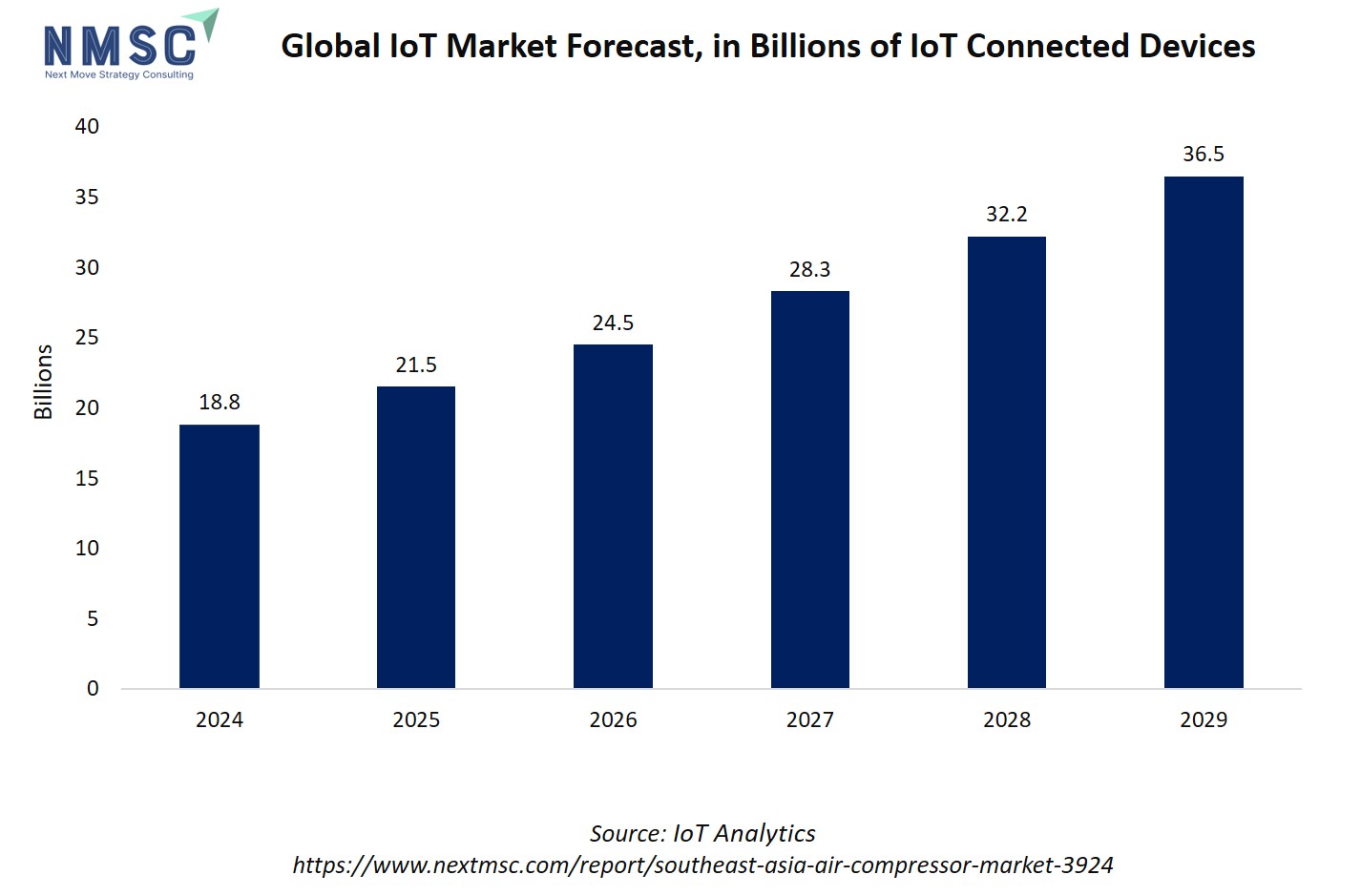
For the Southeast Asia air compressor market, the surge in IoT adoption translates to accelerating growth opportunities, as manufacturers and end-users increasingly integrate IoT-enabled air compressors to enhance operational efficiency, predictive maintenance, and energy savings. This integration supports regional development of smart factories and automated production environments, driving investments in technologically advanced air compressors tailored for connected, data-driven enterprises.
How is the Southeast Asia Air Compressor Market Shifting to Energy-efficient Variable-speed and Oil-free Technologies?
There’s a clear move toward variable-speed drives (VSD/VFD) and oil-free compressor technologies as companies chase operational savings and regulatory compliance. Recent research highlights rapid growth in the VSD segment globally and rising demand for oil-free machines driven by hygiene and contamination concerns. Analytically, combining VSD control with oil-free compression delivers dual benefits; first, it lowers electricity consumption during partial-load operation, and second, it eliminates contamination risk in sensitive processes, which is compelling in ASEAN food, pharma, and electronics clusters.
How is the Southeast Asia Air Compressor Market Evolving Toward Rental, Portable, and Service-centric Business Models?
Infrastructure build-outs and episodic construction projects across Southeast Asia are increasing demand for rental and portable compressor solutions, while small and medium manufacturers prefer service contracts to CAPEX buys; global rental market analyses show robust post-2023 growth in rental revenues and rising share in Asia-Pacific. Looking deeper, rental and managed-service models lower entry barriers for SMEs, shorten lead times for projects, and shift value toward uptime guarantees and rapid replacement, a dynamic that favours providers with national service footprints, digital dispatching, and flexible financing. Practically, equipment OEMs and distributors pilot subscription offers and partners with local rental firms to co-brand fleets; doing so lets them capture rental margins while learning utilisation patterns that inform product development. This pivot toward OPEX-first procurement is a strategic lever to broaden Southeast Asia air compressor market reach beyond large industrial buyers.
How is the Southeast Asia Air Compressor Market Aligning with Sustainability and Green-manufacturing Goals?
Southeast Asian manufacturers and regulators are increasingly focused on energy efficiency and emissions reduction, pushing compressed-air systems into energy-management conversations; regional reports and market briefs underline strong interest in efficiency upgrades and the role of compressors in factory decarbonisation strategies. In practice, energy audits that target leak detection, pressure optimisation, and heat recovery from compressor discharge are becoming low-hanging fruit for plants seeking rapid ROI and carbon reductions. For companies, the actionable insight is packaging efficiency projects (VSD retrofits, waste-heat recovery, smart controls) as measurable, financeable programmes that tie to clients’ sustainability KPIs. Collaborating with energy service companies and utilities on incentive schemes or demand-response pilots further accelerates uptake.
What Are the Key Market Drivers, Breakthroughs, and Investment Opportunities That Will Shape the Southeast Asia Air Compressor Industry in the Next Decade?
The air compressor market in Southeast Asia is at a pragmatic growth inflection as manufacturing, construction, and energy sectors expand across ASEAN. Rising factory activity and stronger trade-related production are increasing baseline demand for reliable compressed-air systems used in assembly, pneumatics, painting, and process utilities; buyers are increasingly weighing lifecycle costs, energy use, and air quality when choosing equipment.
Technical advances, IoT condition monitoring, variable-speed drives (VSD), and heat-recovery attachments are tightening the link between compressors and plant digitalisation, improving uptime and lowering total cost of ownership. Energy-price volatility and SME financing limits remain constraints, but tightening efficiency policies and corporate decarbonisation goals are improving paybacks for retrofits and new installs, nudging the Southeast Asia air compressor market toward cleaner, smarter compressed-air solutions.
Growth Drivers:
How are Southeast Asia’s Industrial and Manufacturing Expansions Driving Air Compressor Demand?
Across ASEAN, renewed factory investments and capacity growth, especially in electronics, food & beverage, and automotive clusters, are increasing the baseline need for compressed-air capacity used in assembly lines, pneumatic actuation, painting, and process utilities. That growth raises not just unit shipments but aftermarket service demand (spares, maintenance, retrofits) because plants prioritise uptime and contamination control. Suppliers therefore map fast-growing industrial clusters, build regional service hubs, and bundle retrofit offerings (VSD, dryness/oil-free options) so they shorten response times and demonstrate quick TCO wins to plant procurement teams.
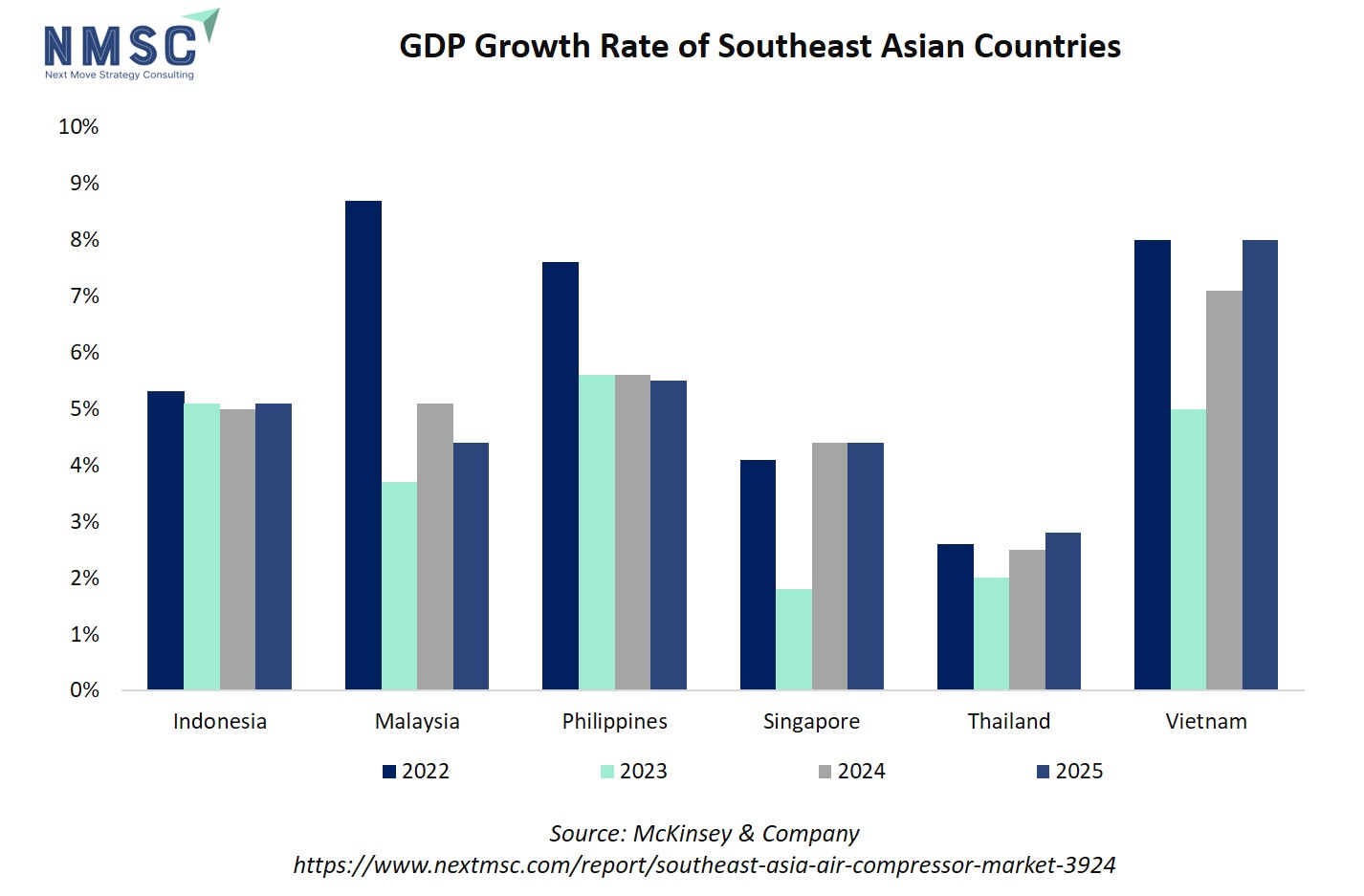
The above chart shows the GDP growth which significantly affects the air compressor market, especially in Southeast Asia, as rising GDP directly correlates with increased industrial activity, infrastructure development, and expanding manufacturing sectors, which collectively drive greater demand for electric air compressor. Robust economic growth in the region enhances investments in factories, construction, energy, and other sectors that are major users of air compressors, thus supporting sustained Southeast Asia air compressor market expansion.
How are Energy-efficiency Mandates and Operating-cost Pressures Accelerating the Uptake of VSD and Oil-free Compressors?
Compressed-air systems are a material electricity user in many plants, and targeted improvements, such as, leak remediation, VSD drives, and controls, regularly deliver double-digit energy savings, with well-executed retrofits sometimes targeting ~30% energy reductions. Those economics, together with corporate decarbonisation and tightening efficiency rules, shift procurement from first-cost to lifecycle-cost metrics. Suppliers offer measured pilot trials, provide clear TCO/energy-savings models, and pair equipment sales with remote-monitoring contracts so buyers can validate kWh and CO₂ reductions during payback windows.
Growth Inhibitors:
What Financing and Capability Gaps Could Slow Compressor Upgrades Across Smes in Southeast Asia?
Many SMEs face constrained formal credit access, tight capital budgets, and limited local technical capability to evaluate total-cost-of-ownership for higher-efficiency compressors or heat-recovery kits. ADB monitoring shows persistent SME financing shortfalls and low formal credit uptake across the region, which keeps many buyers on low-capex purchase paths even when OPEX savings are attractive. To accelerate adoption, equipment OEMs and service providers scale leasing/rental/subscription offers, partner with local banks or credit-guarantee schemes, and provide bundled operator training so upgrades become low-risk, OPEX-friendly projects for smaller plants.
How Significant is the Opportunity for Waste-heat Recovery and Energy Services in Air Compressors?
A large portion of the energy used by portable air compressor is released as heat, with recovery potential often reaching around 50% or more, depending on the system. This recovered heat can be reused for applications such as process hot water, space heating, or preheating, significantly improving project economics. Companies that offer heat-recovery systems combined with remote monitoring, guaranteed energy savings, and flexible financing create attractive industrial energy-service solutions with measurable electricity and CO₂ reductions. Facilities with continuous operations, such as food processing, chemicals, and textiles, stand to benefit the most from aligning thermal demand with the recovered heat.
How is the Southeast Asia Air Compressor Market Segmented in this Report, and What are the Key Insights from the Segmentation Analysis?
By Type Insights
Are Portable and Stationary Compressors Following Separate Growth Paths in Southeast Asia in 2024?
Based on type, the Southeast Asia air compressor market is segmented into portable and stationary.
Portable units, common on construction sites, roadworks, mining, and field-service jobs are benefiting from a post-2023 surge in infrastructure activity. Because these projects need fast deployment and flexible capacity, rental fleets, telematics for asset-tracking, and low-emissions engine options are becoming competitive differentiators. Regulators’ safety rules for on-site compressed air also shape specifications. Providers scale rental partnerships, local service networks, and short-term financing to capture episodic demand and shorten procurement cycles.
Stationary compressors, on the other hand, anchor manufacturing and process plants (assembly, pneumatics, drying, CIP systems) where compressed air can represent a material share of power use, where studies cite roughly 10% of industrial electricity for compressed air in manufacturing. With rising regional electricity demand and industrialisation, buyers prioritise VSD drives, controls and heat-recovery to cut lifecycle costs. Vendors lead with measured TCO cases, energy audits and bundled retrofit offers to turn efficiency gains into financed projects that meet plant uptime and sustainability targets.
By Technology Insights
Is Rotary Screw, Centrifugal, and Reciprocating Compressors Defining the Technology Split in Southeast Asia in 2025?
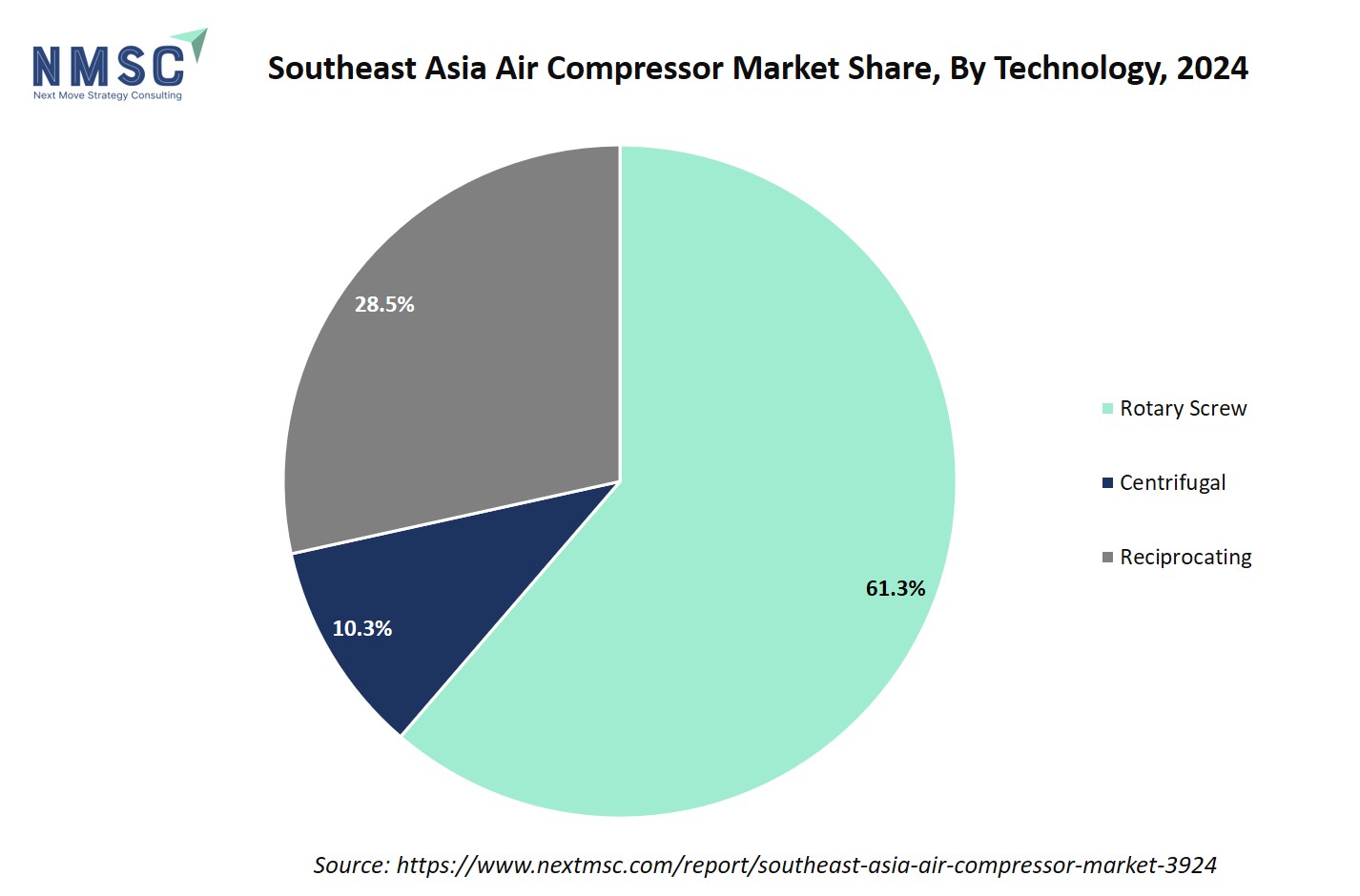
On the basis of technology, the Southeast Asia air compressor market is segmented into rotary screw, centrifugal, and reciprocating.
Rotary-screw machines are the workhorses for continuous industrial demand, favoured in manufacturing plants because they tolerate 100% duty cycles and pair well with variable-speed drives and condition monitoring to cut energy use. Buyers aiming to lower lifecycle costs prefer screw packages with VSD, oil-management and remote telemetry, making them the logical choice for medium-to-large plants.
Centrifugal compressors address very high flow, continuous-duty needs in large process operations where multi-stage designs deliver high-volume output with smoother flow and lower pulsation. Their economics improve at scale and constant load; integration with plant control and heat-recovery systems yields strong savings in energy-intensive facilities. On the other hand, reciprocating (piston) compressors remain preferred for intermittent, high-pressure, or small-to-medium duty applications because of good high-pressure performance and lower upfront cost for low-duty cycles. They require more frequent maintenance in continuous use, so vendors focus on package designs that ease servicing, provide clear duty-cycle guidance, and pair sales with rental or retrofit options for SMEs.
By Lubrication Type Insights
Are Oil-free or Oil-injected (Flooded) Compressors Leading the Choice for Southeast Asia?
On the basis of lubrication type, the Southeast Asia air compressor market is segmented into oil-free and oil-injected/flooded.
Oil-free air compressor machine are increasingly specified because they avoid any risk of oil contamination and help meet compressed-air quality standards. This makes oil-free the obvious choice for regulated sectors, even if capex is higher; buyers value guaranteed air-quality classes and easier validation for GMP and sterile processes. On the other hand, for heavy industrial and continuous-duty plants, oil-injected (flooded) compressors, especially rotary-screw designs with VSD, deliver better energy performance and lower upfront cost per kW, so they remain dominant in general manufacturing where advanced downstream filtration suffices.
By Power Rating Insights
Are Different Power-rating Segments Shaping the Southeast Asia Air Compressor Market in 2024?
Based on power rating, the Southeast Asia air compressor market is divided into 0-100 kW, 101-300 kW, 301-500 kW, and 501 kW & above.
Small-capacity compressors (0–100 kW) dominate workshops, small factories, and service facilities, where air demand is intermittent and mobility matters. Their lower upfront cost and easier installation make them ideal for SMEs, while adoption of energy-saving features like VSD remains selective. Vendors can gain an edge by offering compact, low-maintenance units with flexible financing or rental options, enabling smaller enterprises to upgrade without major capital outlay. Medium-capacity compressors (101–300 kW) are widely used in medium-sized manufacturing plants, processing units, and automotive or electronics clusters. They balance energy efficiency, output capacity, and reliability, particularly when paired with VSD and monitoring systems.
Large-capacity compressors (301–500 kW) serve heavy industrial facilities, continuous-process operations, and large OEM plants. Energy use is significant, so buyers focus on VSD integration, heat recovery, and predictive maintenance to optimize lifecycle costs. Suppliers should emphasize measured energy savings and uptime benefits in proposals, while offering service contracts to mitigate maintenance concerns. Extra-large compressors (>501 kW) cater to refineries, chemical plants, and massive manufacturing operations requiring continuous high-volume output. These systems demand multi-stage designs, advanced controls, and integration with plant-wide energy management.
By Cooling Method Insights
Are Air-cooled and Water-cooled Compressors Defining Cooling Preferences in Southeast Asia?
Based on the cooling method, the market is divided into air-cooled and water-cooled.
Air-cooled compressors dominate small to medium industrial setups, workshops, and temporary construction sites where installation simplicity and lower maintenance are key. They rely on ambient air to dissipate heat, avoiding the need for external water sources, which makes them ideal for areas with limited water availability. On the other hand, water-cooled compressors are preferred in large, continuous-duty industrial operations where heat loads are high, such as chemical, petrochemical, and food processing plants. By using water for heat dissipation, these units maintain consistent temperatures, improving efficiency and enabling higher output.
By Industry Vertical Insights
Which Industry Verticals are Shaping the Southeast Asia Air Compressor Market?
On the basis of industry vertical, the market is segmented into manufacturing, construction, oil & gas, healthcare, and others.
Manufacturing remains the largest consumer of compressed air in Southeast Asia, powering assembly lines, pneumatic tools, material handling systems, and process utilities. Industries such as electronics, automotive, and food & beverage prioritize uptime, energy efficiency, and air quality. Construction sites rely heavily on portable and medium-capacity compressors to power pneumatic tools, concrete spraying, and temporary plant equipment. The rapid infrastructure expansion in ASEAN, particularly in urban development and transport projects, drives short-term and rental-based demand.
Healthcare and pharmaceutical sectors require oil-free, high-purity compressed air for hospitals, labs, and sterile manufacturing. Compliance with ISO 8573 air quality standards is mandatory, particularly in medical gas and cleanroom applications. While, the others including food & beverage, textiles, and SMEs, require a mix of portable, stationary, oil-free, or oil-injected compressors depending on specific process needs. These sectors often prioritize energy efficiency, operational reliability, and cost-effective solutions.
Regional Outlook
The market is geographically studied across Malaysia, Vietnam, Indonesia, Philippines, Thailand, Singapore, and the rest of Southeast Asia.
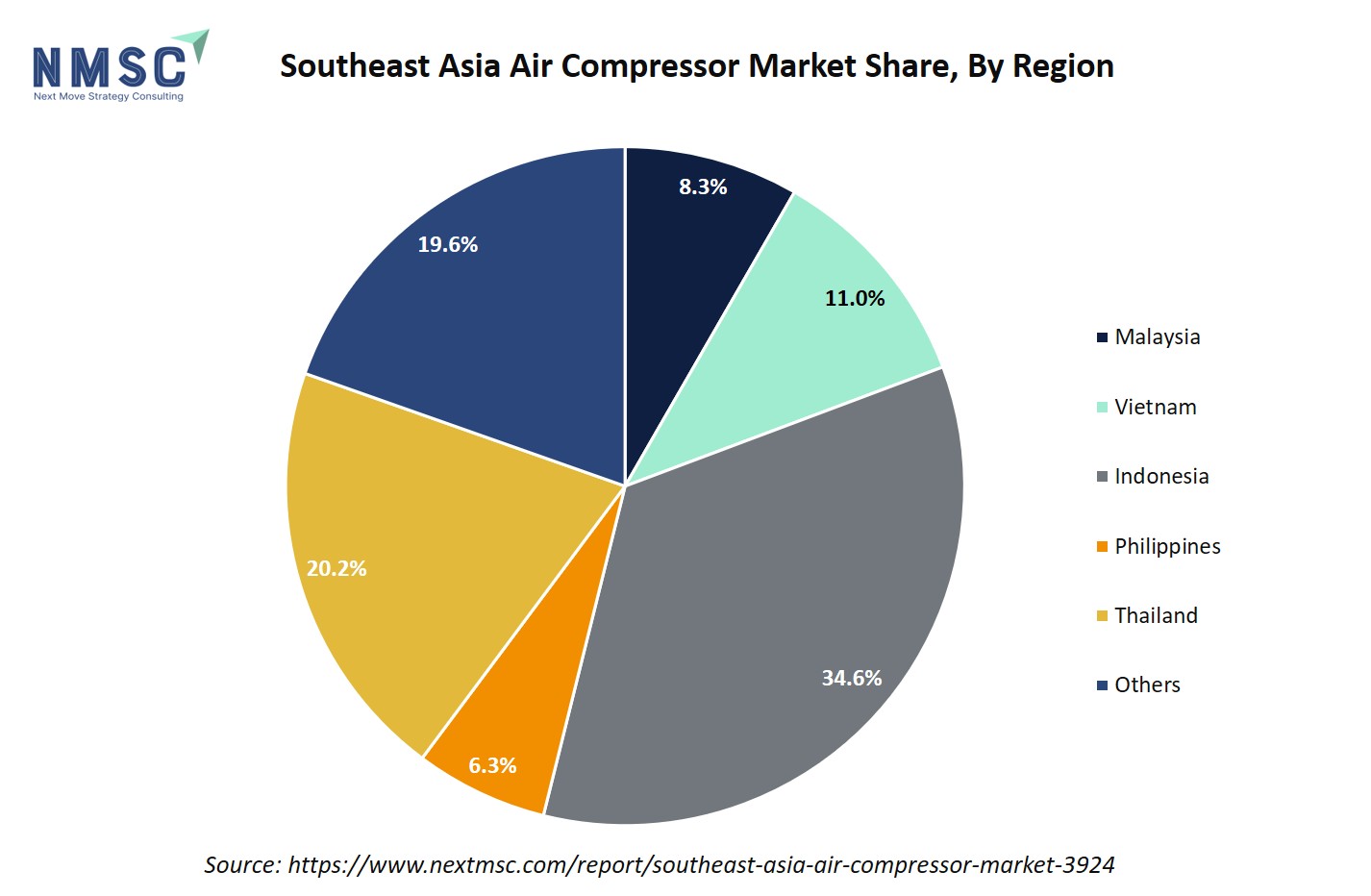
Southeast Asia Air Compressor Market in Malaysia
Malaysia’s air-compressor demand is being shaped by steady manufacturing clusters and an active green transition that’s pushing energy-efficiency investments. Malaysia’s official manufacturing dashboards show ongoing output activity and capacity monitoring. Because plants face higher electricity scrutiny and new sector roadmaps emphasise decarbonisation, buyers favour VSD-equipped rotary-screw units, heat-recovery kits, and condition monitoring to cut kWh and meet regulatory expectations. These trends accelerate replacement and retrofit cycles. Vendors that offer measured TCO savings, financing, or energy-service contracts win more projects across Peninsular industrial hubs.
Southeast Asia Air Compressor Market in Vietnam
Vietnam’s fast-growing export-oriented manufacturing drives significant compressed-air requirements. Vietnam’s industrial production rose strongly in recent months by about +8.9% year-on-year, according to the Index of Industrial Production. That export-led buildout increases demand for oil-free compressors in regulated processes and for robust rotary-screw systems in continuous lines. The country’s vulnerability to extreme weather also emphasizes resilient rental fleets and portable units for rapid recovery. Suppliers that combine purity-certified packages, remote monitoring, and quick service coverage across industrial zones capture growth as foreign investment and factory expansions continue.
Southeast Asia Air Compressor Market in Indonesia
Indonesia’s large manufacturing base and rising value-added share of GDP keep baseline demand strong; Trading Economics show manufacturing value-added near 18.9% of GDP in 2024. This scale favours a broad tech mix where screw compressors with VSDs for medium-to-large plants, centrifugal for very high-flow users, and piston units for smaller or remote operations. Infrastructure and construction growth also lift portable and rental needs. The market rewards suppliers that localise spare parts, train service networks, and structure leasing or OPEX models to bridge SME financing gaps, particularly in outer islands where uptime and fast service matter.
Southeast Asia Air Compressor Market in the Philippines
In the Philippines, manufacturing has been mixed but remains a growth engine in specific clusters where government stats show manufacturing contributing to recent Southeast Asia air compressor market growth. Given the archipelagic geography and many SMEs, rental, portable compressors and service-centric models perform well alongside sales of compact, efficient 0–100 kW units. Energy-efficiency measures and leak-reduction projects are attractive because they deliver quick paybacks in high-electricity-cost settings. Partners offer packaged audits, financing, and nationwide service logistics and unlock upgrades across dispersed manufacturing and construction sites.
Southeast Asia Air Compressor Market in Thailand
Thailand’s industrial landscape is more cyclical, recent factory-output readings have shown declines in some months. For instance, Thailand’s industrial production fell by 4.19% year-on-year in August 2025, but the country still hosts major automotive and electronics clusters that demand high-reliability compressed-air systems. For large, continuous plants, centrifugal and multi-unit rotary solutions plus heat-recovery and VSDs justify CAPEX through energy savings. Where auto production softens, short-term rental and retrofit demand spikes as plants optimise costs. Suppliers remain flexible, offering long-term service agreements and demonstrable energy-savings pilots to win approvals during cyclical slowdowns.
Southeast Asia Air Compressor Market in Singapore
Singapore’s advanced manufacturing and strong electronics and biomedical clusters demand high-quality, oil-free air and smart system integration. Buyers in Singapore prioritise validated purity, integration with plant automation, and sustainability credentials, making VSD, IoT-enabled compressors and heat-recovery systems standard procurement items. Multinationals and high-tech fabs located here also act as lighthouse accounts, successful energy-service pilots or documented CO₂ savings in Singapore used as regional case studies to replicate across ASEAN hubs.
Southeast Asia Air Compressor Market in the Rest of Southeast Asia
The rest of Southeast Asia, like Cambodia, Laos, Myanmar, Brunei, Timor-Leste, and smaller markets, shows heterogeneous but rising demand tied to infrastructure, resource projects, and nascent manufacturing. In these markets, portable units, rental fleets, and simple, rugged reciprocating or small screw compressors often lead; the commercial opportunity is service-first, suppliers that provide financing, rapid mobile servicing, and durable low-maintenance packages find faster penetration than those focused solely on high-spec capital sales.
Competitive Landscape
Which Companies Dominate the Air Compressor Industry in Southeast Asia and How do they Compete?
Top companies in the market include global giants such as Atlas Copco, Ingersoll Rand, KAESER, Fusheng Group, ELGi and others, each combining broad product lines with deep regional service networks to compete on reliability and uptime. Atlas Copco and Ingersoll Rand emphasize wide service footprints and aftermarket contracts to keep plants running smoothly, while KAESER and ELGi push energy-efficient rotary-screw and oil-free options to meet Southeast Asia air compressor industry demand These firms compete on product breadth, energy-efficiency features (VSD, oil-free), aftermarket service networks, and increasingly digital offerings and rental/OPEX models. Market share battles often play out as service-and-solutions contests rather than pure price wars: companies with fast parts logistics, local service hubs, and proven energy-savings cases close larger industrial and multinational accounts.
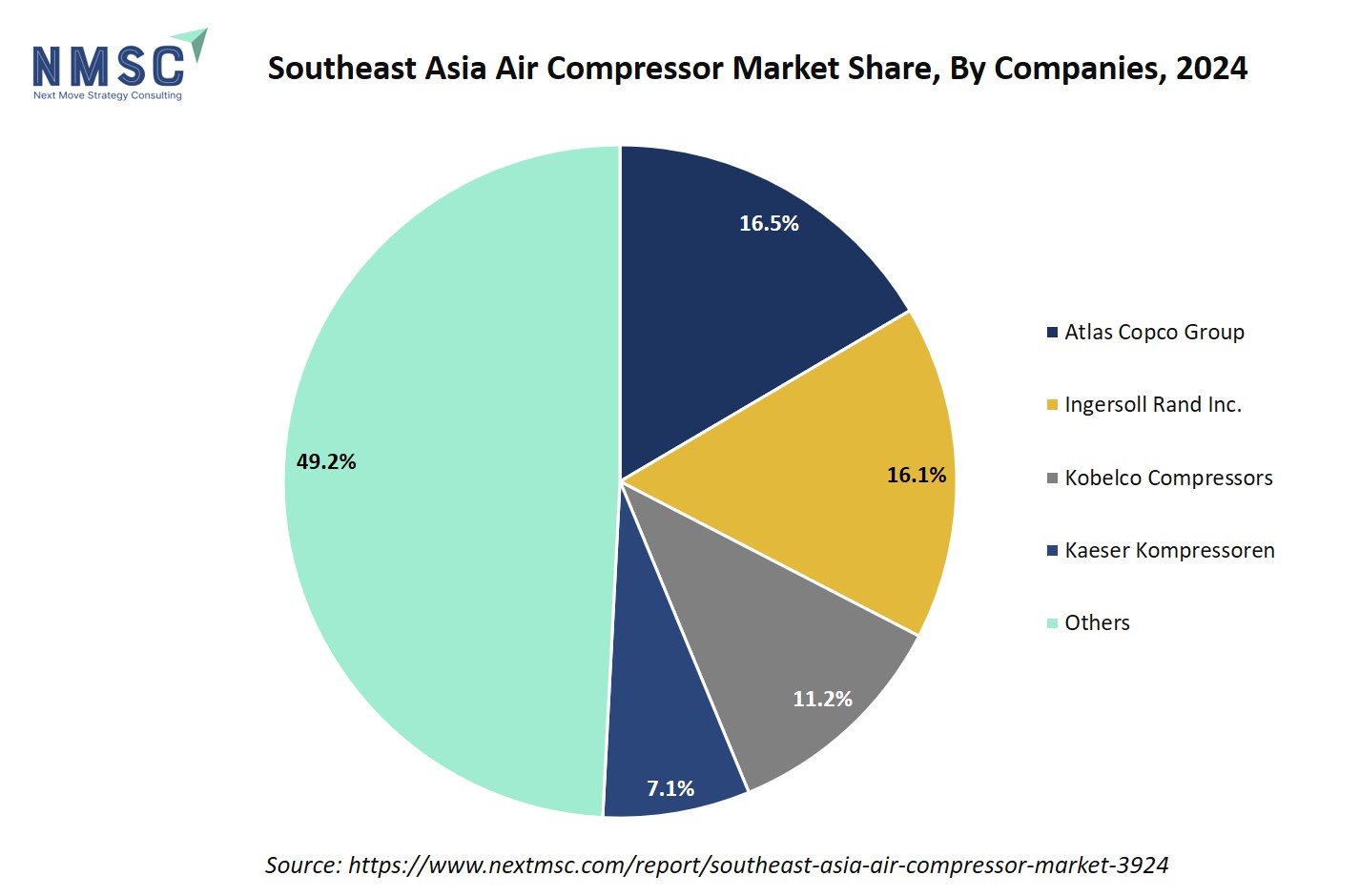
Market Dominated by Southeast Asia Air Compressor Giants and Specialists
The market exhibits a two-speed structure. Global giants command large, multi-site industrial and infrastructure contracts while specialised regional or niche players focus on rental, portable units, or highly regulated oil-free segments (pharma/medical). Giants leverage acquisitions and global service platforms to offer bundled energy-service and financing solutions, whereas specialists win by speed, local relationships, and tailored low-capex options for SMEs and contractors. These dynamic drives geographic differentiation, advanced hubs such as Singapore, Malaysia see high-spec, integrated solutions, while price-sensitive or infrastructure-driven markets favour rental and service-first models.
Innovation and Adaptability Drive Market Success
Leaders are pushing IoT-enabled monitoring, VSD integration, oil-free technologies, modular heat-recovery and remote service platforms to turn compressors into measurable energy assets. Many now sell outcome-based contracts and deploy pilots that prove kWh and CO₂ reductions, shortening procurement cycles. Product updates and small acquisitions extend capability quickly, where recent rollouts and product expansions emphasise hybrid/electric drivetrains, telemetry, and lifecycle services that appeal to sustainability-focused buyers and multinationals seeking standardised regional suppliers.
Market Players to Opt for Merger & Acquisition Strategies to Expand their Presence
M&A is a clear route to fill technology, channel or regional gaps. Ingersoll Rand’s life sciences push via the ILC Dover acquisition illustrates how buyers use deals to enter high-margin, regulated markets. Atlas Copco’s recent purchases of niche compressor and vacuum/blower makers show how giants bolt on capability and channels quickly. Regional players like ELGi and Aerzen have also expanded via targeted acquisitions, example, ELGi’s North American deals and Aerzen’s US acquisitions to strengthen distribution and service in priority markets. These deals shorten market entry time and give an immediate service footprint and aftermarket revenue.
List of Key Southeast Asia Air Compressor Companies
-
Kobelco Compressors (Kobe Steel Group)
-
Kaeser Kompressoren
-
Fusheng Group
-
Kaishan Group
-
Siemens Energy
-
Mitsubishi Heavy Industries Ltd.
-
Aerzener Maschinenfabrik GmbH
-
Elgi Equipment Limited
-
Boge Compressoren
-
Enest Iwata corporation
-
Sulzer Ltd
-
Denair Energy Saving Technology
-
BAUER COMP Holding GmbH
What Are the Latest Key Industry Developments?
-
March 2025- Siemens Energy secured a large EPC contract of USD 1.6 billion for topside modules, including compression systems for an FPSO project. The award underscores demand for integrated, energy-efficient compression and power systems in large offshore and industrial projects, areas that drive demand for high-spec centrifugal and packaged compressors.
-
November 2024- Kaeser Kompressoren announced AI-driven data initiatives, in partnership with SAP to improve customer service and predictive maintenance. Embedding AI/analytics into its service platform increases uptime guarantees and positions Kaeser to sell higher-value outcome contracts across ASEAN industrial customers.
-
October 2024- Kaishan Group received Frost & Sullivan’s 2024 Global Competitive Strategy Leadership Award. The recognition highlights Kaishan’s R&D, energy-efficient product push and manufacturing scale, validating its strategy to compete globally with cost-efficient, energy-focused compressor solutions.
-
May 2024- Atlas Copco completed the acquisition of MEISA, a Mexican vacuum pump and service specialist. The deal strengthens Atlas Copco’s Vacuum Technique service footprint and channel access in the Americas, bolstering its aftermarket and rental capabilities that regional customers prize for uptime.
-
March 2024- Ingersoll Rand announced the acquisition of ILC Dover at USD 2.33 billion to build a life-sciences platform. The purchase pivots IR toward regulated, high-margin healthcare and pharma markets where oil-free and contamination-controlled air solutions are critical, expanding product- and service-cross-sell opportunities.
What Are the Key Factors Influencing Investment Analysis & Opportunities in the Southeast Asia Air Compressor Market?
Investment interest in the Southeast Asia air-compressor space is increasingly driven by energy-efficiency and decarbonisation plays, which attract both corporate buyers and project financiers. Investors favour business models that convert capital expenditure into predictable operating savings, ESCO-style retrofits, heat-recovery add-ons, and monitored VSD retrofits because they produce measurable kWh and CO₂ reductions and easier underwriting. Regional climate-tech and ESCO funding have been growing, reinforcing project finance for industrial efficiency.
Valuations and hotspot interest cluster where industrial scale meets policy support. Malaysia, Vietnam, Indonesia and Singapore stand out for manufacturing expansion, incentives and available project pipelines, while fragmented markets, like, Philippines, parts of Rest-SEA favour rental and OPEX models that reduce buyer risk. Funders and PE firms are seeking scalable, service-led platforms that can be rolled out regionally.
Key Benefits for Stakeholders:
Next Move Strategy Consulting (NMSC) presents a comprehensive analysis of the Southeast Asia air compressor market, covering historical trends from 2020 through 2024 and offering detailed forecasts through 2030. Our study examines the market at country levels, providing quantitative projections and insights into key growth drivers, challenges, and investment opportunities across all major Southeast Asia Air Compressor segments.
The Southeast Asia air compressor industry creates shared value for multiple stakeholders. For investors, the sector offers stable, asset-backed opportunities tied to manufacturing growth, infrastructure projects, and the region’s energy-efficiency agenda. Customers benefit from advanced compressor technologies, such as variable-speed drives, oil-free units, and heat-recovery systems, that reduce operating costs, improve reliability, and align with stricter environmental regulations. Industrial users also gain flexibility through rental and service-based models that lower upfront capital risk. Together, these dynamics foster a sustainable ecosystem where capital providers see predictable returns, while end-users secure long-term efficiency, compliance, and productivity gains.
Report Scope
|
Parameters |
Details |
|
Market Size in 2025 |
USD 1995 Million |
|
Revenue Forecast in 2030 |
USD 2437.1 Million |
|
Growth Rate |
CAGR of 4.08% from 2025 to 2030 |
|
Analysis Period |
2024–2030 |
|
Market Volume in 2025 |
274470 units |
|
Volume Forecast in 2030 |
365155 units |
|
Growth Rate |
CAGR of 5.88% from 2025 to 2030 |
|
Base Year Considered |
2024 |
|
Forecast Period |
2025–2030 |
|
Market Size Estimation |
Million (USD) |
|
Growth Factors |
|
|
Companies Profiled |
15 |
|
Market Share |
Available for 10 companies |
|
Customization Scope |
Free customization (equivalent to up to 80 analyst-working hours) after purchase. Addition or alteration to country, regional & segment scope. |
|
Pricing and Purchase Options |
Avail customized purchase options to meet your exact research needs. |
|
Approach |
In-depth primary and secondary research; proprietary databases; rigorous quality control and validation measures. |
|
Analytical Tools |
Porter's Five Forces, SWOT, value chain, and Harvey ball analysis to assess competitive intensity, stakeholder roles, and relative impact of key factors. |
Key Market Segments
By Type
-
Portable
-
Stationary
By Technology
-
Rotary Screw
-
Centrifugal
-
Reciprocating
By Lubrication Type
-
Oil-Free
-
Oil-Injected/Flooded
By Power Rating
-
0-100 kW
-
101-300 kW
-
301-500 kW
-
501 kW & Above
By Cooling Method
-
Air-Cooled
-
Water-Cooled
By Industry Vertical
-
Manufacturing
-
Construction
-
Oil & Gas
-
Healthcare
-
Others
Conclusion & Recommendations
Our report equips stakeholders, industry participants, investors, and consultants with actionable intelligence to capitalize on Southeast Asia Air Compressor’s transformative potential. By combining robust data-driven analysis with strategic frameworks, NMSC’s Southeast Asia air compressor market report serves as an indispensable resource for navigating the evolving landscape.
The Southeast Asia air compressor market is poised for steady growth, driven by industrial expansion, infrastructure projects, and rising demand for energy-efficient, high-performance systems. Strategic takeaways include the importance of adopting advanced technologies such as VSD, oil-free designs, IoT-enabled monitoring, and heat-recovery solutions, as well as leveraging service-led and financing models to capture SMEs and cost-sensitive segments. Regional adoption varies, with mature hubs favouring high-spec integrated systems and emerging markets prioritizing portable, rental, and retrofit solutions. Looking ahead, the market outlook remains positive, with opportunities for consolidation, cross-border partnerships, and investment in energy-efficient solutions likely to shape competitive advantage and long-term value creation across Southeast Asia.


About the Author
 Tushmi Dutta
— Tushmi Dutta is a focused researcher specializing in detailed analysis and insight-driven research across diverse business landscapes. She supports strategic initiatives through structured data interpretation, thorough validation, and clear communication of findings that aid informed decision-making. With a strong interest in writing, she enjoys presenting research insights in an engaging and accessible manner. Beyond work, she enjoys traveling, reading, painting, and continuously learning new skills that contribute to her creative and professional growth.
Tushmi Dutta
— Tushmi Dutta is a focused researcher specializing in detailed analysis and insight-driven research across diverse business landscapes. She supports strategic initiatives through structured data interpretation, thorough validation, and clear communication of findings that aid informed decision-making. With a strong interest in writing, she enjoys presenting research insights in an engaging and accessible manner. Beyond work, she enjoys traveling, reading, painting, and continuously learning new skills that contribute to her creative and professional growth.
About the Reviewer
 Supradip Baul
— Supradip Baul is an accomplished business consultant and strategist with over a decade of rich experience in market intelligence, strategy, technology, and business transformation. His work has included rigorous qualitative and quantitative analysis across multiple industries, helping clients shape investment decisions and long-term roadmaps. Earlier in his career, he was associated with Gartner, where he contributed to industry-leading reports and market share analyses. He has worked with leading global companies and holds an MBA with a dual specialization in Marketing and Finance.
Supradip Baul
— Supradip Baul is an accomplished business consultant and strategist with over a decade of rich experience in market intelligence, strategy, technology, and business transformation. His work has included rigorous qualitative and quantitative analysis across multiple industries, helping clients shape investment decisions and long-term roadmaps. Earlier in his career, he was associated with Gartner, where he contributed to industry-leading reports and market share analyses. He has worked with leading global companies and holds an MBA with a dual specialization in Marketing and Finance.
At Next Move Strategy Consulting, we understand that insightful market research is the cornerstone of successful business decisions. That's why we employ a robust and multifaceted approach, combining various methodologies to deliver the most accurate and actionable data for our clients.

Research Landscape
We navigate the world of research with two primary approaches:
Qualitative Approach
Our qualitative research methodologies involve immersive techniques such as in-depth interviews, focus groups, and observational studies. By engaging directly with individuals and stakeholders, we uncover valuable insights that quantitative data alone may overlook.

Quantitative Research
In tandem with qualitative methodologies, NMSC leverages the power of Quantitative Research to provide a robust foundation of numerical insights. Through systematic data collection and analysis, we quantify patterns, preferences, and market trends, offering a comprehensive view of the business landscape.
Our quantitative research approach employs diverse tools, including surveys, experiments, and statistical modelling. These methodologies enable us to gather data from a large and representative sample, ensuring the statistical significance of our findings. By employing structured questionnaires and standardized data collection methods, we guarantee the reliability and validity of the information we present to our clients.
Quantitative research is particularly effective in measuring the prevalence of trends, assessing market size, and gauging the impact of various factors on consumer behavior. The numerical precision attained through this approach equips our clients with actionable insights, facilitating data-driven decision-making and strategy formulation.


Our Specialized Toolbox for Industry-Specific Market Research
We deploy a specialized arsenal of techniques tailored to meet your unique requirements. Here's a glimpse into our comprehensive toolbox:

Information Procurement
The stage entails acquiring market data or relevant information through various sources and methodologies.


Market Research Approach
We utilize both top-down and bottom-up approaches in market research analysis to achieve a comprehensive understanding of the market dynamics, leveraging the broad perspective of industry trends and macroeconomic factors alongside detailed insights from specific segments and individual companies.

Porters Five Forces Analysis
We conduct Porter's Five Forces analysis to evaluate the competitive landscape of an industry, providing us with insights into factors that affect profitability and strategic positioning.

SWOT Analysis

Forecasting
We utilize a forecasting model to predict future consumption by considering parameters like population, economics, regulations, market competition, drivers, constraints, technology, and pricing. We also employ statistical techniques such as multilinear regression, exponential smoothing, moving average, ARIMA, and Monte Carlo simulations for accurate predictions. In econometric forecasting, we analyzed short-term and long-term event impacts, attributing values based on regulatory frameworks, economic factors, and market events.





 Speak to Our Analyst