Surveillance Radar Market Size, Share, Trends and Growth Analysis, By Mission (Air Surveillance, Maritime Surveillance, Land Surveillance, Space Surveillance, Multi Mission, and Other), By Platform (Fixed Ground, Mobile Ground, Transportable, Airborne, Shipborne, Spaceborne, and Other Platform), By Technology, By Frequency Band, By Range Class, By Dimension, By Revenue Stream, By Sales Channel, By Buyer Type, and Region — Global Industry Report and Forecast, 2026–2035
Industry: Aerospace & Defense | Publishing Date: July 22, 2026 | Last Updated: September 30, 2026 | No of Pages: N/A | No. of Tables: N/A | No. of Figures: N/A | Format: PDF | Report Code: AD5305
What Is the Surveillance Radar Market Size?
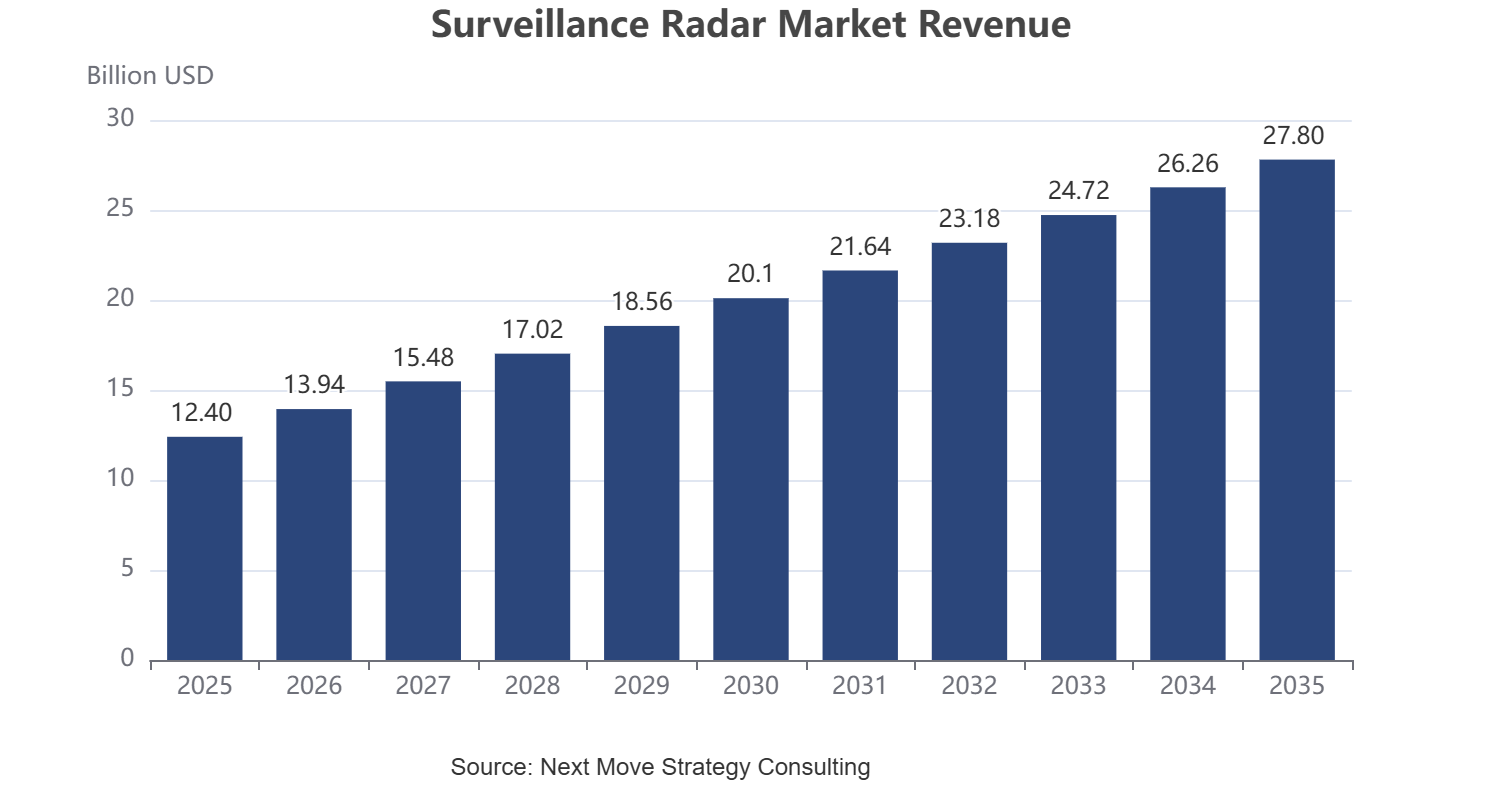
The global surveillance radar market size was valued at USD 12.40 Billion in 2025 and is estimated at USD 13.35 Billion in 2026, forecast to reach USD 27.80 Billion by 2035, expanding at an 8.5% CAGR between 2026 and 2035. North America leads with approximately 34% share, while air surveillance dominates all other mission categories with approximately 40% share.
We observed that the growth is broad-based across every segmentation axis, with active electronically scanned array adoption and counter-UAS proliferation driving the dominant structural shifts through 2035.
|
Key Takeaways |
||
|
By Mission: Air Surveillance held the largest share of approximately 40% (USD 4.96 billion) in 2025; Space Surveillance is the fastest-growing sub-segment at 12.0% CAGR from 2026–2035. |
By Platform: Fixed Ground held the largest share of approximately 30% (USD 3.72 billion) in 2025; Spaceborne is the fastest-growing sub-segment at 13.2% CAGR from 2026–2035. |
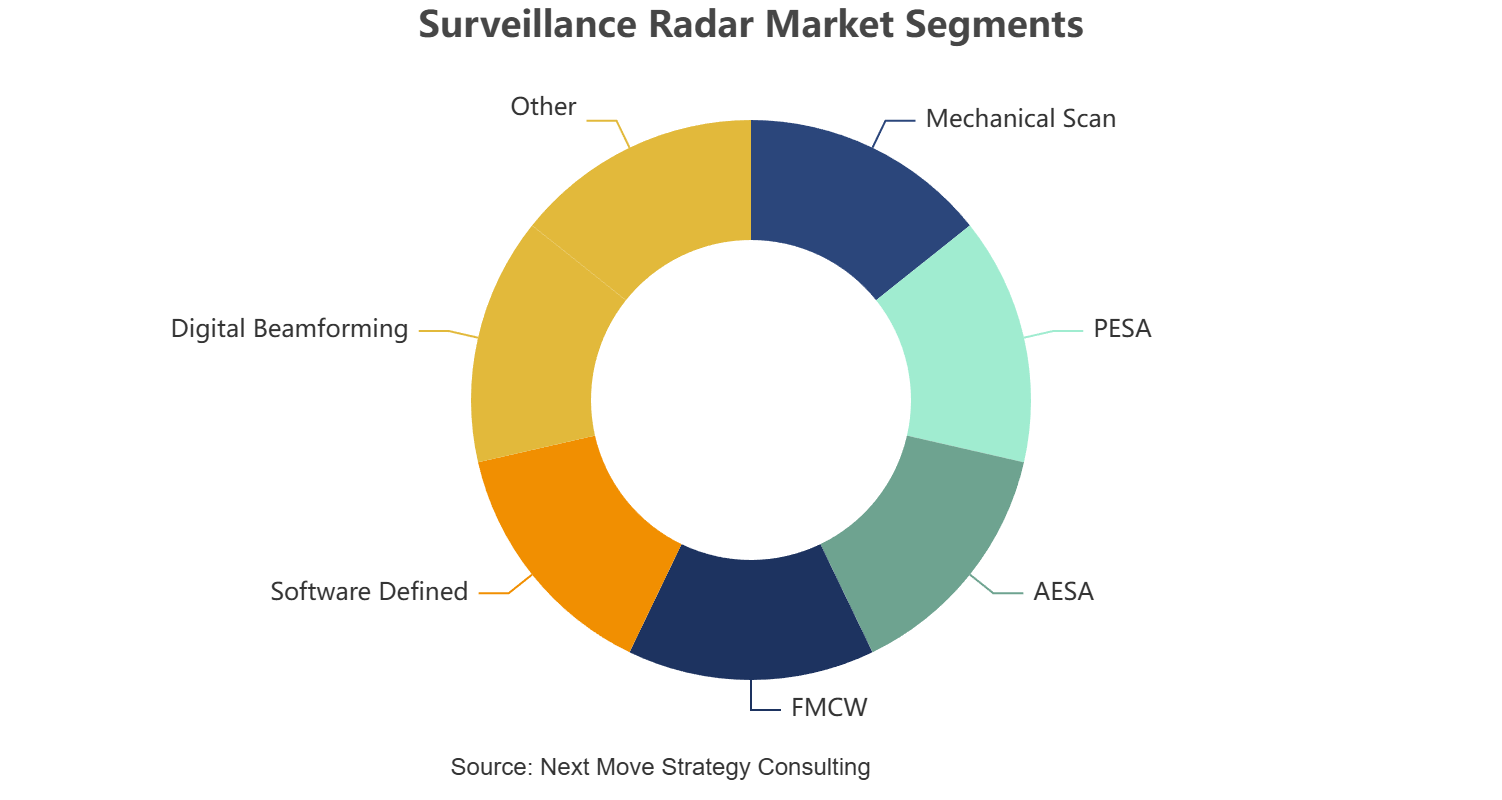
By Technology: AESA held the largest share of approximately 38% (USD 4.71 billion) in 2025; Digital Beamforming is the fastest-growing sub-segment at 13.3% CAGR from 2026–2035. |
|
By Frequency Band: X Band held the largest share of approximately 24% (USD 2.98 billion) in 2025; Ka Band is the fastest-growing sub-segment at 12.8% CAGR from 2026–2035. |
By Range Class: Long Range held the largest share of approximately 34% (USD 4.22 billion) in 2025; Very Long Range is the fastest-growing sub-segment at 11.5% CAGR from 2026–2035. |
By Dimension: 3D held the largest share of approximately 44% (USD 5.46 billion) in 2025; 4D is the fastest-growing sub-segment at 14.0% CAGR from 2026–2035. |
|
By Revenue Stream: New System Sales held the largest share of approximately 46% (USD 5.70 billion) in 2025; Software is the fastest-growing sub-segment at 13.5% CAGR from 2026–2035. |
By Sales Channel: Prime Contract held the largest share of approximately 40% (USD 4.96 billion) in 2025; Framework Agreement is the fastest-growing sub-segment at 10.8% CAGR from 2026–2035. |
By Buyer Type: Defence held the largest share of approximately 58% (USD 7.19 billion) in 2025; Space Agencies is the fastest-growing sub-segment at 13.0% CAGR from 2026–2035. |
|
Dominant Region: North America dominated with approximately 34% revenue share (USD 4.22 billion) in 2025. |
Fastest-Growing Region: Asia-Pacific is expected to register the highest CAGR of 10.9% during 2026–2035. |
Dominant Country: U.S. led with approximately USD 3.54 billion in 2025. |
|
Fastest-Growing Country: India is the fastest-growing country at approximately 13.2% CAGR from 2026–2035. |
|
|
Market Opportunity: The surveillance radar market is expected to create an absolute dollar opportunity of USD 14.45 Billion between 2026 and 2035, presenting significant investment potential across the defense, homeland security, and civil aviation radar value chain.
According to NMSC analysis, buyers across defence and civil aviation are increasingly consolidating radar sourcing with fewer, gallium nitride-capable prime contractors to simplify multi-domain interoperability, a shift that favors diversified integrators over single-band specialists as procurement modernization accelerates through 2035.
What Does the Surveillance Radar Market Encompass?
The surveillance radar market encompasses systems that transmit electromagnetic energy to detect, track, and classify airborne, maritime, ground, and space-based objects across civil and defense missions. Our assessment indicates that the scope spans primary and secondary air traffic control radar, ground-based air defense and airborne early warning systems, naval and coastal surveillance radar, border and perimeter security radar, counter-UAS sensors, and space object tracking and missile warning radar supplied to defence ministries, civil aviation authorities, homeland security agencies, and space agencies worldwide.
Regulatory frameworks such as the U.S. Federal Aviation Administration's National Airspace System modernization mandates and the U.S. Department of Defense's missile warning and space domain awareness requirements shape radar procurement cycles, while North Atlantic Treaty Organization interoperability standards increasingly influence multi-domain radar architecture. We observed that technology adoption is shifting toward active electronically scanned array and gallium nitride-based electronic warfare-resilient designs that replace mechanically scanned legacy systems. NMSC's analysis indicates that this structural shift, combined with rising counter-drone and space situational awareness demand, is redefining sourcing criteria across the market.
|
Parameter |
Details |
|
Market Size in 2025 |
USD 12.40 Billion |
|
Market Size in 2026 |
USD 13.35 Billion |
|
Revenue Forecast in 2035 |
USD 27.80 Billion |
|
Growth Rate |
CAGR of 8.5% from 2026 to 2035 |
|
Analysis Period |
2025–2035 |
|
Base Year Considered |
2025 |
|
Forecast Period |
2026–2035 |
|
Market Size Estimation |
USD Billion |
|
Companies Profiled |
20 |
|
Countries Covered |
38 |
|
Market Share |
Available for Top 10 Companies |
Ecosystem Analysis of the Surveillance Radar Industry
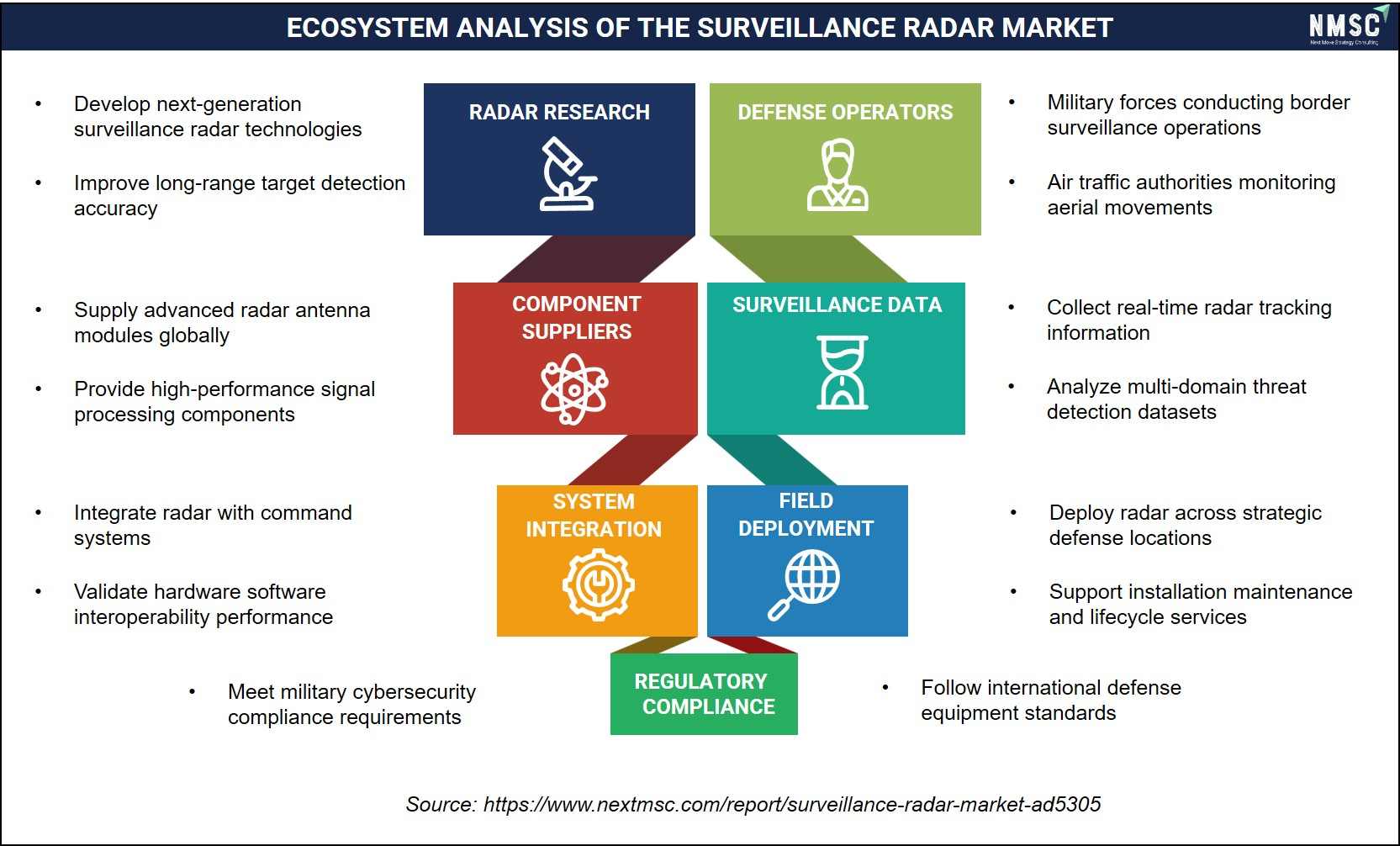
The above infographic presents an ecosystem analysis of the surveillance radar market, covering radar research, component suppliers, system integration, regulatory compliance, defense operators, surveillance data, and field deployment. Advanced radar technologies are being developed to improve long-range target detection, supported by global suppliers of antenna modules and signal processing components. Integration efforts ensure interoperability with command systems, while rigorous testing validates hardware-software performance. At the same time, regulatory compliance with military and cybersecurity standards remains critical for deployment. Looking ahead, we observed that defense operators and surveillance data networks collectively rely on these interconnected elements to enhance operational readiness and national security.
Key Emerging Trends
Based on research conducted by NMSC, we found that four structural trends are reshaping radar architecture, sourcing, and stakeholder engagement across the industry.
How Is Gallium Nitride Transforming Radar Performance?
Gallium nitride semiconductor components are replacing legacy gallium arsenide transmit and receive modules to extend detection range and reduce power consumption across military and civil radar. We observed that RTX's Raytheon delivered its first AN/TPY-2 missile defense radar with a complete gallium nitride populated array to the U.S. Missile Defense Agency in May 2025, expanding surveillance capacity for hypersonic threat tracking. Manufacturers, including Raytheon and HENSOLDT, are retrofitting fielded radar families with gallium nitride arrays to meet extended-range and lower-lifecycle-cost requirements.
Why Is Multi-Domain, Software-Defined Radar Gaining Adoption?
Software-defined and multi-domain radar architectures are gaining share as defence buyers seek platform-agnostic sensors deployable across manned and unmanned systems. Our findings suggest that RTX's Raytheon launched initial production of its SharpSight multi-domain surveillance radar in October 2025, fusing established synthetic aperture and maritime radar families into a single open-architecture platform. Raytheon separately secured a 2026 Office of Naval Research contract to develop software-defined naval radar apertures capable of independent, spectrum-sharing operation.
How Is Counter-UAS Demand Reshaping Land Surveillance Radar?
Counter-UAS and short-range battlefield radar are gaining adoption as militaries and critical infrastructure operators respond to proliferating small drone threats. We observed that Thales is multiplying production of its Ground Observer 12 short-range battlefield radar fivefold in Germany following a Bundeswehr order for 60 units, while HENSOLDT's TRML-4D radar continues to anchor European Sky Shield Initiative air defense deployments. Manufacturers are positioning layered, AI-assisted detection as the standard response to low radar cross-section threats.
What Role Does Space Domain Awareness Play in Radar Innovation?
Space domain awareness and missile-warning radar digitization are emerging as a dedicated innovation track distinct from terrestrial surveillance missions. Our analysis shows that the U.S. Space Force is digitizing eight legacy ground-based early-warning and space-tracking radars under its Ground Based Radar Digitization program, while the U.S. Space Force formally accepted Lockheed Martin's Long Range Discrimination Radar at Clear Space Force Station in December 2025. This trend reflects growing demand for persistent, discrimination-quality tracking of both missile threats and orbital objects.
Growth Drivers and Restraints
Growth Catalyst and Risk Assessment Matrix
|
Factors |
Type |
(+/−) % Impact on CAGR |
Geographic Relevance |
Impact Timeline |
|
Rising geopolitical tension and defense budget growth |
Driver |
+2.3% |
Global |
2026-2035 |
|
Civil air traffic control radar replacement cycles |
Driver |
+1.6% |
North America, Europe |
2026-2032 |
|
Proliferation of small unmanned aerial threats |
Driver |
+1.9% |
Global |
2026-2035 |
|
NATO and European Sky Shield Initiative interoperability demand |
Driver |
+1.4% |
Europe |
2026-2035 |
|
Space domain awareness and missile-warning modernization |
Driver |
+1.2% |
North America, Asia-Pacific |
2026-2035 |
|
Gallium nitride semiconductor cost reduction |
Driver |
+0.9% |
Global |
2026-2032 |
|
Lengthy defense procurement and certification cycles |
Restraint |
-1.1% |
Global |
2026-2035 |
|
Gallium nitride and semiconductor supply chain constraints |
Restraint |
-0.8% |
Global |
2026-2032 |
|
Frequency spectrum congestion and allocation constraints |
Restraint |
-0.6% |
North America, Europe |
2026-2035 |
|
Legacy analog radar cybersecurity vulnerabilities |
Restraint |
-0.5% |
Global |
2028-2035 |
What Is the Primary Growth Driver of the Surveillance Radar Market?
Rising geopolitical tension and sustained defense budget growth are the primary drivers of the market. The U.S. Federal Aviation Administration has committed to replacing up to 612 aging surveillance radars across the National Airspace System by June 2028 under contracts awarded to RTX and Indra, while the U.S. Missile Defense Agency continues to expand gallium nitride-equipped missile defense radar deliveries. We observed that this procurement momentum, reinforced by NATO interoperability requirements, continues to anchor baseline demand for air, land, and space surveillance radar across developed and emerging economies alike.
How Is Counter-UAS Demand Driving Market Growth?
Proliferation of low-cost unmanned aerial threats is accelerating demand for short-range and perimeter security radar across military and critical infrastructure applications. Thales's Ground Observer 12 radar production is scaling fivefold in Germany following a Bundeswehr order, and HENSOLDT holds contracts for more than 150 radars under the European Sky Shield Initiative. Our assessment indicates that this threat-driven procurement, combined with homeland security modernization budgets, is compressing adoption timelines for AI-assisted detection and classification radar across Europe and North America.
What Is Restraining Surveillance Radar Market Expansion?
Lengthy defense procurement and certification cycles, combined with gallium nitride semiconductor supply chain constraints, restrain the pace of radar fleet modernization. The U.S. Space Force's Ground Based Radar Digitization program targets full operational capability only by fiscal year 2031, illustrating multi-year qualification timelines even for funded programs. We found that smaller regional manufacturers face particular exposure to defense cybersecurity compliance costs tied to legacy analog radar vulnerabilities, as limited scale reduces their ability to fund digitization compared with larger, vertically integrated prime contractors.
Segmentation Analysis
Segment Sizing: By Mission
|
Segment |
2025 (USD) |
2035 (USD) |
CAGR% (2026–2035) |
|
Air Surveillance |
USD 4.96 Billion |
USD 9.72 Billion |
7.0% |
|
Land Surveillance |
USD 3.22 Billion |
USD 8.15 Billion |
9.7% |
|
Maritime Surveillance |
USD 2.23 Billion |
USD 4.54 Billion |
7.4% |
|
Space Surveillance |
USD 1.12 Billion |
USD 3.48 Billion |
12.0% |
|
Multi Mission |
USD 0.62 Billion |
USD 1.49 Billion |
9.1% |
|
Other |
USD 0.25 Billion |
USD 0.43 Billion |
5.6% |
|
Total |
USD 12.40 Billion |
USD 27.80 Billion |
8.5% |
Which Mission Segment Dominates the Surveillance Radar Industry?
Air Surveillance, encompassing civil air traffic control and military air surveillance radar, led the market with USD 4.96 billion in 2025, supported by sustained civil aviation modernization budgets and ground-based air defense procurement. We observed that Space Surveillance is the fastest-growing mission category, expanding at a 12.0% CAGR from 2026 to 2035, as missile-warning digitization and orbital object tracking programs scale across the United States and allied space agencies.
Segment Sizing: By Platform
|
Segment |
2025 (USD) |
2035 (USD) |
CAGR% (2026–2035) |
|
Fixed Ground |
USD 3.72 Billion |
USD 7.47 Billion |
7.2% |
|
Mobile Ground |
USD 2.23 Billion |
USD 5.65 Billion |
9.7% |
|
Airborne |
USD 2.48 Billion |
USD 5.37 Billion |
8.1% |
|
Shipborne |
USD 1.74 Billion |
USD 3.70 Billion |
8.0% |
|
Transportable |
USD 1.49 Billion |
USD 3.44 Billion |
8.8% |
|
Spaceborne |
USD 0.50 Billion |
USD 1.72 Billion |
13.2% |
|
Other Platform |
USD 0.25 Billion |
USD 0.45 Billion |
6.2% |
|
Total |
USD 12.40 Billion |
USD 27.80 Billion |
8.5% |
Which Platform Segment Leads Surveillance Radar Market Demand?
Fixed Ground platforms remained the leading category within the market, valued at USD 3.72 billion in 2025 on sustained air traffic control and homeland border radar installations. Our findings suggest that Spaceborne platforms are the fastest-growing category, registering a 13.2% CAGR from 2026 to 2035, as space agencies scale orbital surveillance constellations, while Mobile Ground platforms supporting unmanned ground vehicle integration expand rapidly across battlefield and border surveillance applications.
Segment Sizing: By Technology
|
Segment |
2025 (USD) |
2035 (USD) |
CAGR% (2026–2035) |
|
AESA |
USD 4.71 Billion |
USD 11.49 Billion |
9.3% |
|
Mechanical Scan |
USD 2.48 Billion |
USD 3.44 Billion |
3.3% |
|
Software Defined |
USD 1.24 Billion |
USD 3.96 Billion |
12.3% |
|
FMCW |
USD 1.24 Billion |
USD 2.89 Billion |
8.9% |
|
PESA |
USD 1.49 Billion |
USD 2.17 Billion |
3.8% |
|
Digital Beamforming |
USD 0.99 Billion |
USD 3.46 Billion |
13.3% |
|
Other |
USD 0.25 Billion |
USD 0.40 Billion |
4.8% |
|
Total |
USD 12.40 Billion |
USD 27.80 Billion |
8.5% |
Which Technology Segment Is Most Widely Used in Surveillance Radar?
Active Electronically Scanned Array technology remained the dominant technology across the market, reaching USD 4.71 billion in 2025 due to its beam agility, multi-target tracking, and resistance to jamming. Based on research conducted by NMSC, we found that Digital Beamforming is the fastest-growing technology at a 13.3% CAGR from 2026 to 2035, reflecting demand for software-configurable transmit and receive module architectures that support multi-mission, spectrum-sharing radar operation across defence and civil buyers.
Growth Opportunities
Our analysis shows that three forward-looking opportunities stand out for stakeholders positioning within the surveillance radar market over the 2026-2035 forecast period.
How Can the Civil Radar Replacement Cycle Unlock Value for Prime Contractors?
The FAA's commitment to replace up to 612 aging surveillance radars by June 2028 presents a whitespace opportunity for suppliers offering commercially available, consolidated radar configurations. Contractors that reduce the National Airspace System's 14 legacy configurations into standardized, low-maintenance platforms stand to capture recurring multi-year sustainment revenue across the Civil Aviation buyer segment as similar fleet-replacement programs emerge internationally.
Where Do Counter-UAS and Perimeter Security Systems Create New Demand?
Critical infrastructure operators and homeland security agencies represent an underpenetrated opportunity for compact, AI-assisted counter-UAS radar engineered for urban and perimeter deployment. Manufacturers that pair short-range detection with AI-driven video analytics can secure long-term procurement contracts with airport, energy, and border security operators, benefiting from recurring upgrade-cycle revenue tied to evolving drone threat classes.
How Can Space Agencies Benefit From Orbital and Missile-Warning Radar Investment?
Space agencies and defence ministries pursuing space domain awareness create an opportunity for suppliers offering discrimination-quality tracking radar validated for orbital debris and hypersonic threat missions. Early movers that secure operational acceptance for gallium nitride-based, fixed-site tracking radar can differentiate with space agency and missile defense buyers pursuing persistent, multi-mission space surveillance capacity through the forecast period.
Regional Outlook
Geographic Performance Snapshot
|
Region |
2025 (USD) |
2035 (USD) |
CAGR% (2026–2035) |
Key Driver |
|
North America |
USD 4.22 Billion |
USD 8.36 Billion |
7.1% |
FAA radar replacement and mature defense procurement |
|
Europe |
USD 2.98 Billion |
USD 5.80 Billion |
6.9% |
NATO and European Sky Shield Initiative interoperability |
|
Asia-Pacific |
USD 3.22 Billion |
USD 9.07 Billion |
10.9% |
Defense modernization and indigenous radar production |
|
Middle East & Africa |
USD 1.24 Billion |
USD 2.96 Billion |
9.1% |
Vision 2030-linked diversification and border security demand |
|
Latin America |
USD 0.74 Billion |
USD 1.62 Billion |
8.2% |
Growing border and maritime surveillance investment |
|
Total |
USD 12.40 Billion |
USD 27.80 Billion |
8.5% |
— |
North America
North America leads the surveillance radar market with an established defense industrial base and an active civil aviation radar replacement program. We observed that FAA contracts with RTX and Indra to replace up to 612 aging radars sustain demand for consolidated, commercially available configurations, while the U.S. Missile Defense Agency and Space Force continue expanding gallium nitride-equipped systems. Technology adoption remains advanced, with software-defined and multi-domain radar driving demand across the region's defense and homeland security sectors.
Europe
Europe's market reflects a mature but alliance-driven landscape shaped by NATO interoperability standards and the German-led European Sky Shield Initiative. Our findings suggest that Germany, France, and Sweden are accelerating the adoption of AESA-based air defense and counter-UAS radar to satisfy ESSI obligations. Technology adoption favors gallium nitride architectures, supported by regional primes including Thales and HENSOLDT expanding radar production capacity across France, the Netherlands, and Germany.
Asia-Pacific
Asia-Pacific is the fastest-growing region, propelled by expanding indigenous defense manufacturing in China and India and rising AI-enabled military and defense modernization spending. We found that regulatory frameworks remain less harmonized than in Europe, giving domestic manufacturers flexibility to scale production rapidly. Technology adoption is accelerating as regional integrators, including India's DRDO, expand indigenous radar development to serve national defense and space surveillance requirements.
Middle East & Africa
The surveillance radar market in the Middle East & Africa is expanding as Gulf Cooperation Council economies diversify into domestic defense manufacturing and border security demand rises. Our analysis shows that the UAE and Saudi Arabia are attracting radar production investment tied to a Vision 2030-linked industrial strategy. Regulatory influence remains moderate, while technology adoption is gradually shifting toward locally assembled AESA air surveillance systems as regional programs align with global defense partners.
Latin America
Latin America's surveillance radar market is supported by growing border and maritime surveillance investment in Brazil and Argentina. We observed that regulatory frameworks are less stringent than in North America or Europe, though multinational defense contractors operating locally are introducing modernized radar specifications. Technology adoption remains centered on ground surveillance and coastal radar, with competitive intensity increasing as regional defense ministries partner with global integrators to expand sensor coverage.
U.S.
Based on our estimates, the U.S. market was valued at approximately USD 3.54 billion in 2025 and is projected to reach USD 6.96 billion by 2035, growing at a 7.0% CAGR. Demand is anchored by FAA radar replacement contracts, Missile Defense Agency gallium nitride upgrades, and Space Force digitization programs. Technology penetration favors AESA and software-defined systems, and competitive intensity remains high among established prime contractors serving federal procurement channels.
Canada
The market in Canada reached roughly USD 0.42 billion in 2025 and is forecast to hit USD 0.82 billion by 2035 at a 7.0% CAGR. Demand structure mirrors U.S. air defense and border surveillance consumption patterns, while binational NORAD cooperation shapes long-range early-warning radar specifications. Technology penetration is rising as national programs request digitized replacements for legacy systems, with competitive intensity moderate given reliance on cross-border supply from U.S.-based primes.
UK
As per our estimate, the UK market stood at about USD 1.05 billion in 2025, advancing toward USD 2.03 billion by 2035 at a 6.8% CAGR. Demand is driven by established air defense and coastal surveillance programs navigating post-Brexit procurement autonomy. Regulatory influence is significant, technology penetration favors AESA adoption through the Eurofighter radar programs, and competitive intensity remains steady among domestic and European contractors serving UK defense procurement.
Germany
According to our analysis, Germany's market was valued at USD 0.95 billion in 2025 and is set to reach USD 1.84 billion by 2035, expanding at a 6.8% CAGR. Demand structure benefits from Germany's role as the European Sky Shield Initiative's lead nation and a strong domestic radar manufacturing base. Germany's Bundeswehr equipment orders drive regulatory influence, while technology penetration favors gallium nitride and counter-UAS radar architectures among leading suppliers.
France
Based on our estimates, France's market reached approximately USD 0.65 billion in 2025, projected to climb to USD 1.26 billion by 2035 at a 6.8% CAGR. Demand is supported by France's prominent air defense industrial base, which shapes Ground Fire and Ground Master radar production. Regulatory influence from French armament procurement policy is notable, and competitive intensity remains high given the concentration of premium radar manufacturers headquartered domestically.
China
The market in China stood at roughly USD 1.15 billion in 2025 and is forecast to reach USD 3.42 billion by 2035, registering an 11.5% CAGR. Demand is fueled by expanding indigenous defense manufacturing and a dense base of regional radar integrators. Regulatory influence is increasing gradually, technology penetration is accelerating through domestic AESA production upgrades, and competitive intensity remains elevated among numerous China-based state suppliers.
India
As per our estimate, India's market was valued at about USD 0.55 billion in 2025, projected to reach USD 1.90 billion by 2035 at a 13.2% CAGR, the fastest among covered countries. Demand structure reflects DRDO's indigenous radar development and expanding border and space surveillance requirements. Regulatory influence remains in development, while technology penetration is rising quickly as India localizes VHF-band and AESA radar sourcing under self-reliance initiatives.
Japan
According to our analysis, Japan's market reached close to USD 0.48 billion in 2025 and is expected to hit USD 0.99 billion by 2035, growing at a 7.5% CAGR. Demand is supported by Japan's precision-engineered defense electronics heritage, led by domestic suppliers including Mitsubishi Electric and NEC. Regulatory influence is well established, technology penetration is advanced, and competitive intensity remains high among long-standing domestic manufacturers.
South Korea
Based on our estimates, South Korea's market stood at approximately USD 0.30 billion in 2025, forecast to reach USD 0.71 billion by 2035 at a 9.0% CAGR. Demand structure benefits from the country's globally influential defense export industry and Korea Aerospace Industries' fighter radar integration programs. Technology penetration is high, with domestic suppliers such as Hanwha Systems supplying premium AESA radar, and competitive intensity remains pronounced amid rapid product innovation cycles.
Australia
The surveillance radar market in Australia reached about USD 0.18 billion in 2025 and is projected to reach USD 0.41 billion by 2035, expanding at an 8.5% CAGR. Demand is supported by the Deep-Space Advanced Radar Capability program hosted on Australian territory and growing coastal surveillance requirements. Regulatory influence stems from Australia's alliance-based procurement framework, while technology penetration favors imported AESA and space-tracking radar systems amid moderate competitive intensity.
UAE
As per our estimate, the UAE market was valued at USD 0.20 billion in 2025, projected to reach USD 0.52 billion by 2035 at a 10.0% CAGR. Demand structure is shaped by the UAE's Tawazun Council-backed strategy to co-produce Ground Master air surveillance radar domestically. Regulatory influence remains moderate, technology penetration is improving through joint-venture radar assembly, and competitive intensity is rising as distributors expand product portfolios to serve Gulf markets.
Saudi Arabia
According to our analysis, Saudi Arabia's market reached roughly USD 0.28 billion in 2025 and is expected to hit USD 0.78 billion by 2035, growing at a 10.8% CAGR. Demand is driven by Vision 2030-linked defense industrial diversification and rising border and critical infrastructure protection spending. Regulatory influence is developing under national defense procurement guidelines, and technology penetration is advancing as domestic integrators scale production.
South Africa
Based on our estimates, South Africa's market stood at about USD 0.09 billion in 2025, forecast to reach USD 0.19 billion by 2035 at a 7.5% CAGR. Demand structure reflects a developing defense electronics base serving regional Southern African markets. Regulatory influence remains moderate, technology penetration is gradually improving, and competitive intensity is limited given reliance on imported radar components from Europe and Asia.
Brazil
The market in Brazil reached approximately USD 0.34 billion in 2025 and is projected to reach USD 0.75 billion by 2035, registering an 8.2% CAGR. Demand is underpinned by Brazil's expanding border and Amazon surveillance programs and growing naval modernization spending. Regulatory influence stems from national defense procurement policy, technology penetration favors ground and coastal surveillance radar, and competitive intensity remains moderate among regional integrators.
Argentina
As per our estimate, Argentina's market was valued at USD 0.11 billion in 2025, projected to reach USD 0.23 billion by 2035 at a 7.5% CAGR. Demand structure is supported by steady air defense and border surveillance consumption despite macroeconomic volatility. Regulatory influence remains limited, technology penetration is modest, and competitive intensity is centered on a small number of regional distributors serving national defense ministries.
SWOT Analysis of the Surveillance Radar Industry
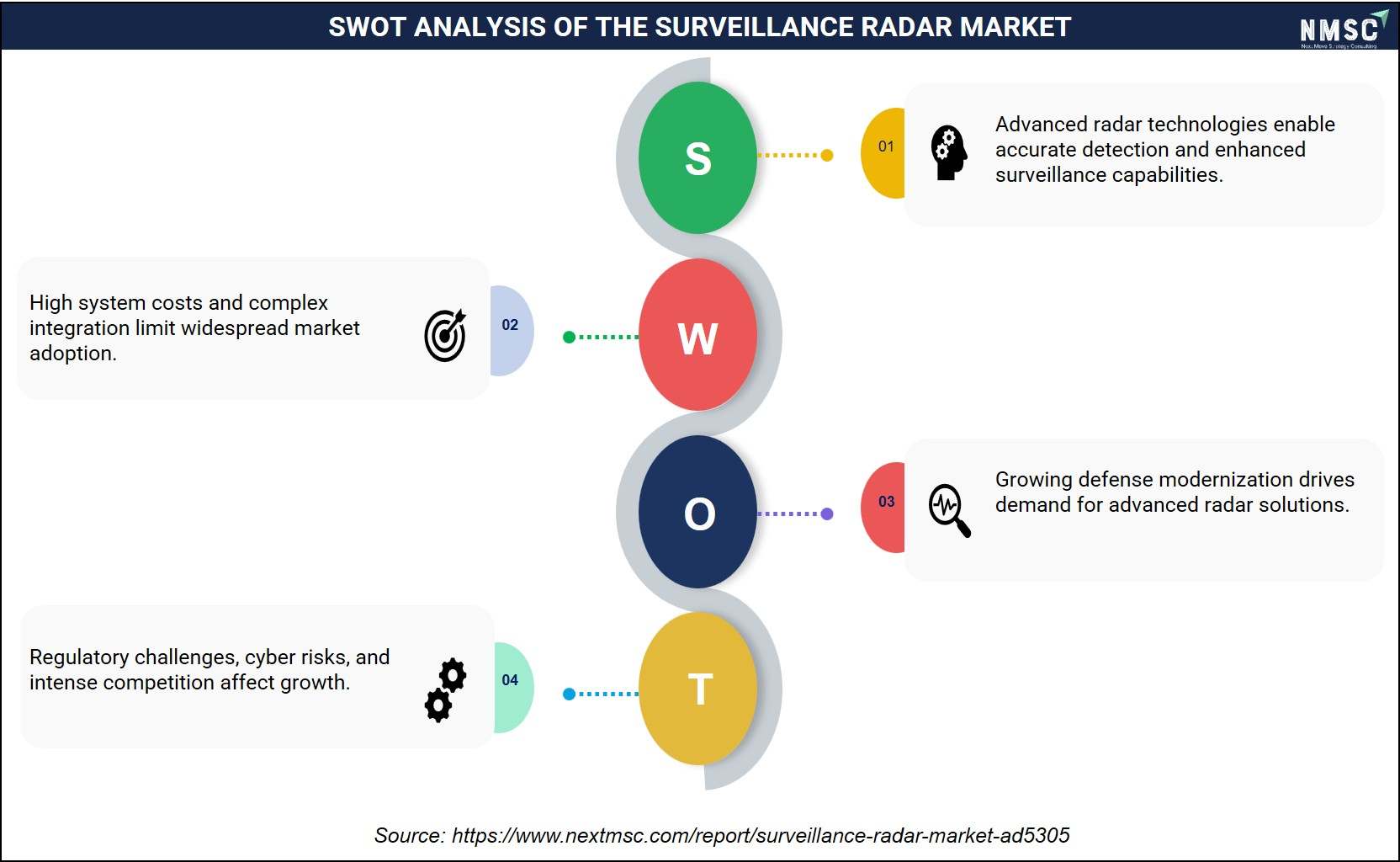
The above infographic presents a SWOT analysis of the surveillance radar market. We analysed that advanced radar technologies enable accurate detection and enhanced surveillance capabilities as key strengths. However, high system costs and complex integration limit widespread adoption, posing notable weaknesses. Looking ahead, we observed that growing defense modernization drives demand for advanced radar solutions. That said, regulatory challenges, cyber risks, and intense competition continue to affect overall market growth and long-term stability.
Competitive Landscape
We observed that the surveillance radar market features a moderately consolidated competitive landscape, with global defense primes competing alongside specialized national integrators on capability, interoperability, and sovereign production credentials.
Key Takeaways
|
Dimension |
Description |
|
Market Structure |
Moderately consolidated; the top companies profiled in this report collectively account for a majority of global surveillance radar market revenue, while numerous national integrators such as DRDO-linked and Bharat Electronics-led programs serve indigenization-driven procurement. |
|
Innovation Focus |
Gallium nitride transmit and receive modules, software-defined and multi-domain radar architectures, and AI-assisted counter-UAS detection dominate current innovation pipelines across leading suppliers. |
|
M&A Activity |
Selective consolidation through capability partnerships, exemplified by Leonardo's supply of AESA radar technology for Saab's GlobalEye platform broadens multi-domain airborne surveillance offerings. |
How Do Companies Compete in the Surveillance Radar Industry?
Companies compete primarily on interoperability credentials, indigenization flexibility, and manufacturing scale across the industry. Global primes such as RTX and Thales leverage broad mission and frequency-band portfolios to serve multinational defence and civil aviation buyers, while national integrators including Bharat Electronics and ASELSAN compete on cost efficiency and sovereign production mandates for domestic homeland security and border surveillance programs.
Which Competitive Archetypes Dominate the Surveillance Radar Market?
Two archetypes dominate the market: diversified global defense primes offering full-service, multi-domain radar families, and specialized national manufacturers focused on indigenized, cost-competitive systems. RTX and Thales exemplify the diversified archetype through integrated air, land, and space radar portfolios, while Bharat Electronics and ASELSAN exemplify the sovereign-production archetype serving national self-reliance mandates.
How Are Companies Differentiating Through Innovation in Radar?
Innovation and differentiation strategy increasingly center on gallium nitride engineering and multi-mission software-defined architecture. RTX's PhantomStrike and APG-82(V)X radar and HENSOLDT's TRML-4D family both integrate rugged military computing and digital processing to secure export approval and NATO interoperability. Our analysis shows that suppliers unable to demonstrate credible gallium nitride and open-architecture roadmaps risk exclusion from allied buyer shortlists across Europe and North America.
What M&A and Expansion Activity Is Shaping the Surveillance Radar Market?
Partnerships and geographic expansion continue to consolidate radar capabilities within the industry. Leonardo's AESA radar integration on Saab's GlobalEye platform broadened its multi-domain airborne surveillance reach, while Thales's strategic partnership with the UAE's Tawazun Council to co-produce Ground Master radar illustrates how diversified primes pursue geographic expansion and sovereign-production access across defence and homeland security end markets.
Key Market Players
Our assessment indicates that the following 20 companies are actively shaping product innovation, capacity expansion, and interoperability strategy within the global surveillance radar market.
-
RTX Corporation
-
Northrop Grumman Corporation
-
BAE Systems plc
-
Thales S.A.
-
L3Harris Technologies, Inc.
-
Saab AB
-
Mitsubishi Electric Corporation
-
NEC Corporation
-
Israel Aerospace Industries Ltd.
-
Elbit Systems Ltd.
-
Indra Sistemas, S.A.
-
HENSOLDT AG
-
ASELSAN Elektronik Sanayi ve Ticaret A. Ş.
-
Bharat Electronics Limited
-
Hanwha Systems Co., Ltd.
-
Terma A/S
-
SRC, Inc.
-
Blighter Surveillance Systems
Latest Developments
We found that recent product launches and program milestones within the surveillance radar market are concentrated on gallium nitride upgrades and multi-domain radar architectures, reflecting the industry's broader modernization transition.
|
Date |
Event |
|
July 2026 |
Saab received an order to equip four German Navy MEKO A-200 DEU frigates with Sea Giraffe 4A Fixed Face long-range surveillance radar and Sea Giraffe 1X lightweight multi-mission surveillance radar. The agreement strengthens naval surveillance capabilities and expands deployment of Saab's radar portfolio across Germany's next-generation naval fleet. |
|
May 2026 |
Saab and Scania France secured a contract to supply 17 Giraffe 1X radars for the French Armed Forces, with 16 systems integrated onto tactical vehicles. The mobile 3D radars will modernize France's short- and very-short-range air-defense capabilities, demonstrating growing demand for compact, deployable surveillance radar solutions. |
|
December 2025 |
Saab signed a framework agreement with Sweden's Defence Materiel Administration and received an order for Giraffe 1X compact 3D radars for the Swedish Armed Forces. The radar can support air defense, counter-UAS, site protection, and maritime applications, reflecting expanding demand for flexible, software-upgradable surveillance radar platforms. |
Expert Insights
 “Saab’s Giraffe 1X radars bring the U.S. Army a combat-proven capability that can be rapidly deployed to meet the growing spectrum of global threats, including unmanned aerial systems. With continuous, real-time air surveillance, Giraffe 1X equips the U.S. and its security co-operation partners with a decisive operational advantage, ensuring they can stay ahead of emerging challenges.”
— Erik Smith, head of Saab in the U.S.
Statement made following the U.S. Army's order for Saab Giraffe 1X radars.
Market Interpretation
The statement highlights the growing strategic value of continuous, real-time surveillance in addressing emerging aerial threats. NMSC's analysis indicates that radar systems combining real-time detection, mobility, compact designs, and counter-UAS capabilities are becoming increasingly important for modern defense operations. The rising requirement for persistent situational awareness is expected to support demand for advanced surveillance radar technologies.
Investment Opportunities
What Capital Inflows Are Targeting the Surveillance Radar Market?
Capital inflows into the surveillance radar market are increasingly directed toward gallium nitride tooling and multi-domain software development. Defense primes and strategic investors continue to fund production ramp-ups, as seen in Thales's committed capital expenditure of EUR 830-850 million in 2026 for radar and defense electronics capacity. We observed that investors favor suppliers demonstrating validated interoperability credentials, viewing NATO and allied qualification as a proxy for long-term contract retention with government buyers.
How Is Infrastructure Investment Supporting Surveillance Radar Manufacturing?
Infrastructure investment is expanding radar production and test capacity across Europe and Asia, particularly in the Netherlands and India, to serve rising domestic and allied demand. Our findings suggest that regional integrators are investing in antenna production capacity, with Thales's Hengelo facility targeting a 60% increase in antenna output between 2025 and 2028 to support Ground Master radar deliveries across NATO member states.
What ESG Considerations Are Shaping Surveillance Radar Investment Decisions?
Environmental, social, and governance considerations are increasingly relevant to investment decisions across the industry, with energy-efficient gallium nitride components and reduced lifecycle maintenance as key criteria. Defence buyers' sustainment cost disclosures continue to inform procurement scoring for radar replacement programs. We found that investors increasingly favor manufacturers demonstrating transparent export-compliance governance, treating it as a risk indicator alongside labor and supply chain resilience standards.
Key Benefits for Stakeholders
How Does This Report Benefit Defence and Industry Leaders?
Defence and industry leaders gain access to validated segmentation, competitive benchmarking, and regional demand forecasts that support sourcing and product-portfolio decisions across the surveillance radar industry. Our analysis shows that detailed mission, platform, and technology breakdowns help procurement teams align specifications with interoperability and modernization requirements while identifying underserved buyer segments for portfolio expansion.
How Does This Report Benefit Investors and Financial Analysts?
Investors and financial analysts benefit from consistent, single-point market size and CAGR estimates that support valuation and capital-allocation decisions across the surveillance radar market supply chain. We observed that the report's regional and segment-level growth differentials help identify which integrators and component suppliers are best positioned to capture above-market growth in space surveillance and counter-UAS categories through 2035.
How Does This Report Benefit Technology Vendors and Product Teams?
Technology vendors and product teams gain insight into emerging design requirements, including gallium nitride engineering, software-defined architectures, and multi-domain sensor fusion, that are reshaping the industry. Our findings suggest that this analysis helps R&D teams prioritize development roadmaps around interoperability certification and counter-UAS detection mechanisms that are increasingly required by defence buyer procurement processes.
Key Market Segments
By Mission
-
Air Surveillance
-
Civil Air Traffic Control
-
Primary Surveillance Radar
-
Secondary Surveillance Radar
-
Precision Approach Radar
-
Airport Surface Radar
-
-
Military Air Surveillance
-
Ground Based Air Defence Radar
-
Airborne Early Warning Radar
-
Airborne Ground Surveillance Radar
-
Airborne Maritime Patrol Radar
-
Tactical Acquisition Radar
-
-
Maritime Surveillance
-
Naval Air Search Radar
-
Naval Surface Search Radar
-
Coastal Surveillance Radar
-
Port Surveillance Radar
-
-
Land Surveillance
-
Ground Surveillance Radar
-
Border Surveillance Radar
-
Perimeter Security Radar
-
Counter UAS Radar
-
Weapon Locating Radar
-
Battlefield Surveillance Radar
-
-
Space Surveillance
-
Space Object Tracking Radar
-
Missile Warning Radar
-
-
Multi Mission
-
Multi Domain Radar
-
-
Other
By Platform
-
Fixed Ground
-
Mobile Ground
-
Transportable
-
Airborne
-
Shipborne
-
Spaceborne
-
Other Platform
By Technology
-
Mechanical Scan
-
PESA
-
AESA
-
FMCW
-
Software Defined
-
Digital Beamforming
-
Other
By Frequency Band
-
VHF and UHF
-
L Band
-
S Band
-
C Band
-
X Band
-
Ku Band
-
Ka Band
-
Multi Band
By Range Class
-
Short Range
-
Medium Range
-
Long Range
-
Very Long Range
By Dimension
-
2D
-
3D
-
4D
-
Multi Beam
By Revenue Stream
-
New System Sales
-
Upgrades
-
Spares
-
Support
-
Software
-
Integration
-
Other
By Sales Channel
-
Direct Tender
-
Prime Contract
-
Framework Agreement
-
Partner Delivered
-
Distributor
-
Other
By Buyer Type
-
Defence
-
Civil Aviation
-
Homeland Security
-
Maritime Security
-
Space Agencies
-
Critical Infrastructure
-
Other Civil
By Region
-
North America: U.S., Canada, Mexico
-
Europe: UK, Germany, France, Italy, Spain, Sweden, Denmark, Finland, Netherlands, Rest of Europe
-
Asia-Pacific: China, India, Japan, South Korea, Taiwan, Indonesia, Vietnam, Australia, Philippines, Malaysia, Rest of APAC
-
Middle East & Africa: Saudi Arabia, UAE, Egypt, Israel, Turkey, Nigeria, South Africa, Rest of MEA
-
Latin America: Brazil, Argentina, Chile, Colombia, Rest of LATAM
Conclusion and Recommendations
What Is the Long-Term Outlook for the Surveillance Radar Market?
The long-term outlook for the market remains positive, with global revenue projected to more than double from USD 12.40 Billion in 2025 to USD 27.80 Billion by 2035 at an 8.5% CAGR. We observed that sustained defense budget growth, civil radar replacement cycles, and space domain awareness expansion will continue underpinning demand across air, land, maritime, and space surveillance missions through the forecast period.
What Strategic Positioning Should Surveillance Radar Suppliers Pursue?
Suppliers should prioritize gallium nitride and software-defined product platforms while pursuing NATO or allied interoperability certification to secure long-term defence buyer contracts. Our assessment indicates that integrators investing early in multi-domain architecture and counter-UAS detection capability will be best positioned to capture premium pricing within the surveillance radar market.
How Attractive Is the Surveillance Radar Market for New Investment?
The surveillance radar industry presents an attractive investment case, supported by a USD 14.45 Billion absolute dollar opportunity between 2026 and 2035 and above-average growth in Asia-Pacific and space surveillance categories. We found that investment attractiveness is highest for integrators combining interoperability credentials with scaled gallium nitride manufacturing capacity, positioning them to serve both cost-sensitive and premium defence buyer segments simultaneously.
What Market Shifts and Key Risks Should Stakeholders Monitor?
Stakeholders should monitor gallium nitride supply chain constraints, lengthy defense procurement cycles, and frequency spectrum congestion as key risks to the surveillance radar market. Our analysis shows that suppliers unable to adapt to digitized, open-architecture specifications risk losing contract share to competitors with certified interoperable platforms, particularly within Europe's increasingly alliance-coordinated procurement environment.
What Are the Key Growth Pathways for the Surveillance Radar Market?
Key growth pathways include expanding counter-UAS and perimeter security radar portfolios, scaling gallium nitride production capacity, and deepening penetration into space domain awareness and civil aviation replacement channels. NMSC's analysis indicates that suppliers pursuing these pathways while maintaining cost competitiveness in standard air surveillance categories will be best positioned to capture the surveillance radar market's projected growth through 2035.
About the Author
 Mayurima Roy
— Mayurima Roy is Research Analyst at Next Move Strategy Consulting, where she has spent 4 years working across the firm's full industry coverage rather than a single fixed vertical. Her work centers on structured research, ongoing trend tracking, competitive assessment, and insight-led content development, translating complex market data into clear, decision-ready narratives that support informed client decision-making across diverse global industries, market sectors, and world regions every day.
Mayurima Roy
— Mayurima Roy is Research Analyst at Next Move Strategy Consulting, where she has spent 4 years working across the firm's full industry coverage rather than a single fixed vertical. Her work centers on structured research, ongoing trend tracking, competitive assessment, and insight-led content development, translating complex market data into clear, decision-ready narratives that support informed client decision-making across diverse global industries, market sectors, and world regions every day.
About the Reviewer
 Supradip Baul
— Supradip Baul is an accomplished business consultant and strategist with over a decade of rich experience in market intelligence, strategy, technology, and business transformation. His work has included rigorous qualitative and quantitative analysis across multiple industries, helping clients shape investment decisions and long-term roadmaps. Earlier in his career, he was associated with Gartner, where he contributed to industry-leading reports and market share analyses. He has worked with leading global companies and holds an MBA with a dual specialization in Marketing and Finance.
Supradip Baul
— Supradip Baul is an accomplished business consultant and strategist with over a decade of rich experience in market intelligence, strategy, technology, and business transformation. His work has included rigorous qualitative and quantitative analysis across multiple industries, helping clients shape investment decisions and long-term roadmaps. Earlier in his career, he was associated with Gartner, where he contributed to industry-leading reports and market share analyses. He has worked with leading global companies and holds an MBA with a dual specialization in Marketing and Finance.
At Next Move Strategy Consulting, we understand that insightful market research is the cornerstone of successful business decisions. That's why we employ a robust and multifaceted approach, combining various methodologies to deliver the most accurate and actionable data for our clients.

Research Landscape
We navigate the world of research with two primary approaches:
Qualitative Approach
Our qualitative research methodologies involve immersive techniques such as in-depth interviews, focus groups, and observational studies. By engaging directly with individuals and stakeholders, we uncover valuable insights that quantitative data alone may overlook.

Quantitative Research
In tandem with qualitative methodologies, NMSC leverages the power of Quantitative Research to provide a robust foundation of numerical insights. Through systematic data collection and analysis, we quantify patterns, preferences, and market trends, offering a comprehensive view of the business landscape.
Our quantitative research approach employs diverse tools, including surveys, experiments, and statistical modelling. These methodologies enable us to gather data from a large and representative sample, ensuring the statistical significance of our findings. By employing structured questionnaires and standardized data collection methods, we guarantee the reliability and validity of the information we present to our clients.
Quantitative research is particularly effective in measuring the prevalence of trends, assessing market size, and gauging the impact of various factors on consumer behavior. The numerical precision attained through this approach equips our clients with actionable insights, facilitating data-driven decision-making and strategy formulation.


Our Specialized Toolbox for Industry-Specific Market Research
We deploy a specialized arsenal of techniques tailored to meet your unique requirements. Here's a glimpse into our comprehensive toolbox:

Information Procurement
The stage entails acquiring market data or relevant information through various sources and methodologies.


Market Research Approach
We utilize both top-down and bottom-up approaches in market research analysis to achieve a comprehensive understanding of the market dynamics, leveraging the broad perspective of industry trends and macroeconomic factors alongside detailed insights from specific segments and individual companies.

Porters Five Forces Analysis
We conduct Porter's Five Forces analysis to evaluate the competitive landscape of an industry, providing us with insights into factors that affect profitability and strategic positioning.

SWOT Analysis

Forecasting
We utilize a forecasting model to predict future consumption by considering parameters like population, economics, regulations, market competition, drivers, constraints, technology, and pricing. We also employ statistical techniques such as multilinear regression, exponential smoothing, moving average, ARIMA, and Monte Carlo simulations for accurate predictions. In econometric forecasting, we analyzed short-term and long-term event impacts, attributing values based on regulatory frameworks, economic factors, and market events.





 Speak to Our Analyst