Fertilizers Additive Market Size, Share, Growth & Forecast by Product Type (Anti-Caking Additives, Flow Enhancement Additives, Dust Control Additives, Anti-Foaming Additives, Enhanced-Efficiency Fertilizer Additives, Granulation Additives, Specialty Additives), Fertilizer Type {Nitrogen (Urea, Ammonium Nitrate), Phosphate (Monoammonium Phosphate, Diammonium Phosphate), Potash, Compound, Specialty}, and Form (Liquid, Powder, Granular, Flake, and Emulsion Additives) — Global Analysis 2025-2035
What Is the Fertilizers Additive Market Size?
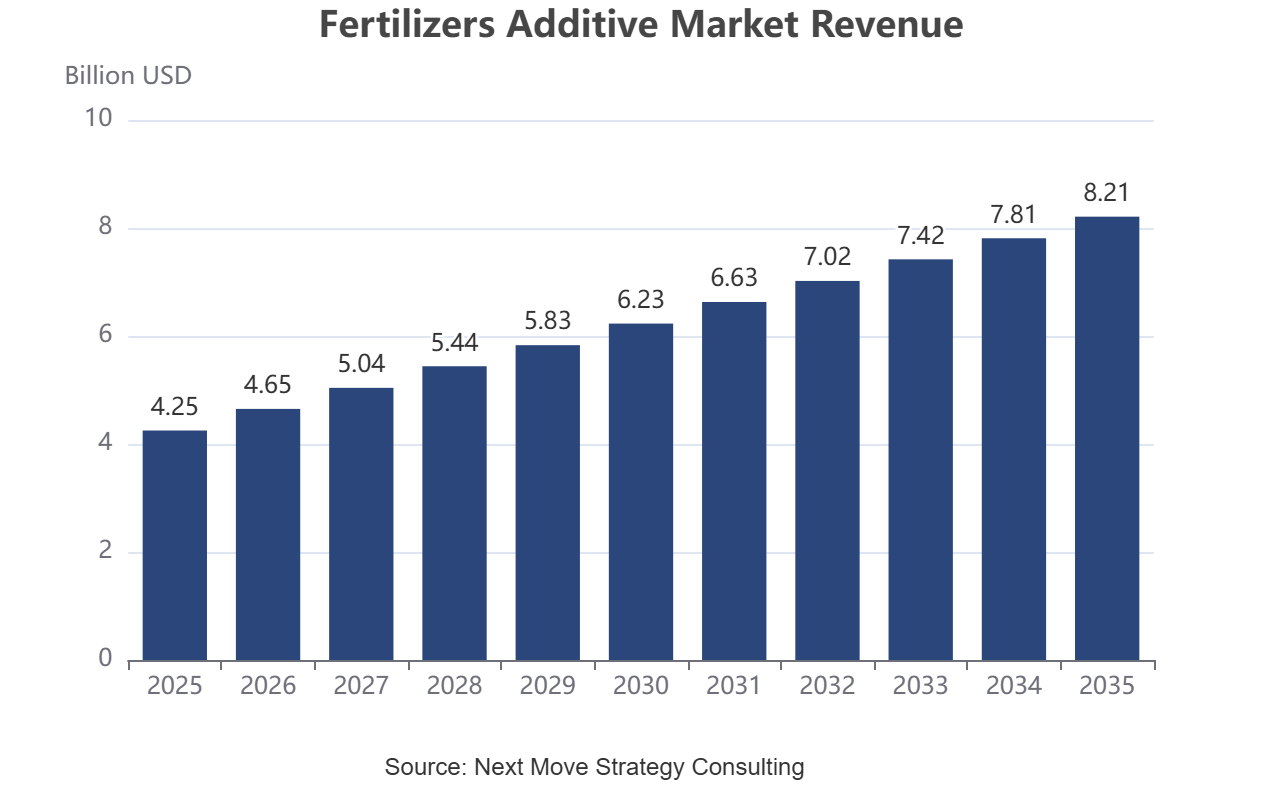
The global Fertilizers Additive Market was valued at USD 4.25 billion in 2025 and is expected to reach USD 4.54 billion in 2026. Rising demand for nutrient-efficient fertilizer formulations, expanding adoption of anti-caking and enhanced-efficiency fertilizer additives among large-scale producers, and tightening nutrient loss regulations are projected to propel the market to USD 8.21 billion by 2035, at a CAGR of 6.81% from 2026 to 2035. Growth is driven by rising demand for controlled-release nitrogen technologies, increasing fertilizer production volumes, and regulatory tightening on nutrient runoff across major agricultural economies.
|
Parameters |
Details |
|
Market Size in 2025 |
USD 4.25 Billion |
|
Market Size in 2026 |
USD 4.54 Billion |
|
Revenue Forecast in 2035 |
USD 8.21 Billion |
|
Growth Rate |
CAGR of 6.81% from 2026 to 2035 |
|
Analysis Period |
2025–2035 |
|
Base Year Considered |
2025 |
|
Forecast Period |
2026–2035 |
|
Market Size Estimation |
Revenue (USD Billion) |
|
Companies Profiled |
20 |
|
Countries Covered |
38 |
|
Market Share |
Available for Top 10 Companies |
Fertilizers Additive Market Overview
The Fertilizers Additive Market spans anti-caking, flow enhancement, dust control, anti-foaming, enhanced-efficiency, granulation, and specialty additives used across nitrogen, phosphate, potash, compound, and specialty fertilizer production. Based on our market evaluation, we noticed that the industry has evolved from basic anti-caking treatments toward nutrient stabilization chemistries, including urease and nitrification inhibitors, as producers respond to nutrient use efficiency mandates. Regulatory frameworks, including the EU Fertilising Products Regulation (EU) 2019/1009 and USDA-EPA nutrient management guidance, are accelerating adoption, while fertilizer manufacturers increasingly integrate polymer coating and dual-inhibitor technologies into large-scale granulation lines.
|
Key Takeaways |
|
By product type, Anti-Caking Additives held the largest share of the Fertilizer Additives Market at USD 1.10 billion in 2025 and are projected to reach USD 1.81 billion by 2035, driven by their widespread use in improving fertilizer storage and handling. Enhanced-Efficiency Fertilizer Additives are the fastest-growing segment, expanding at a CAGR of 12.18% from 2026 to 2035 due to rising demand for improved nutrient-use efficiency. |
|
By fertilizer type, Nitrogen Fertilizers led the market with USD 1.78 billion in 2025 and are expected to reach USD 2.96 billion by 2035. Specialty Fertilizers are projected to be the fastest-growing segment at a CAGR of 17.35% during 2026–2035, supported by precision agriculture and crop-specific nutrition. |
|
By form, Granular Additives dominated with USD 1.87 billion in 2025 and are forecast to reach USD 3.12 billion by 2035. Liquid Additives are the fastest-growing form, registering a CAGR of 12.72% from 2026 to 2035 due to increasing use in precision farming. |
|
Asia-Pacific held the largest regional share at USD 1.53 billion in 2025 and is projected to reach USD 3.12 billion by 2035, growing at a CAGR of 7.45%, supported by strong agricultural production and fertilizer demand. |
|
The Middle East & Africa is the fastest-growing region, expected to expand at a CAGR of 10.27% from 2026 to 2035, driven by agricultural modernization and improving crop productivity. |
|
The United States dominated the Fertilizer Additives Market in 2025 with USD 0.59 billion and is projected to reach USD 0.93 billion by 2035, supported by advanced farming practices and high adoption of fertilizer performance enhancers. |
|
Saudi Arabia is projected to be the fastest-growing country, registering a CAGR of 11.55% from 2026 to 2035, driven by investments in sustainable agriculture, food security initiatives, and advanced fertilizer technologies. |
Key Emerging Trends in the Fertilizers Additive Market
Our findings suggest that three structural trends are redefining additive formulation and adoption through 2035.
How Is Regulatory Tightening on Nutrient Loss Reshaping Additive Formulation?
Regulatory frameworks are directly expanding demand for nutrient stabilization additives across major fertilizer-producing regions. Through our market assessment, we observed that the EU's Regulation (EU) 2019/1009 formally defines inhibitors as a distinct fertilizing product category requiring a demonstrated 20% reduction in ammoniacal nitrogen oxidation, compelling producers to adopt verified urease and nitrification inhibitor chemistries rather than generic anti-caking treatments to maintain EU market access.
How Is the EPA-USDA Next Gen Fertilizer Initiative Accelerating Enhanced-Efficiency Additive Adoption?
The joint EPA-USDA Next Gen Fertilizer Challenges program is validating new enhanced-efficiency fertilizer technologies through greenhouse and field trials at the International Fertilizer Development Center. NMSC's analysis indicates that this public-private validation pathway is lowering commercialization risk for coating and inhibitor additive suppliers, encouraging large agricultural input companies to bring next-generation controlled-release and dual-inhibitor products to market faster than prior single-company validation cycles allowed.
How Are Higher-Concentration Nitrogen Stabilizer Formulations Changing Application Economics?
Suppliers are launching higher-concentration nitrogen stabilizer formulations that reduce required application volumes while improving handling economics for large-scale fertilizer blenders. Our findings suggest that Koch Agronomic Services' 2025 introduction of a higher-concentration CENTURO formulation, requiring less on-site storage and lower use rates in anhydrous ammonia and UAN applications, reflects a broader industry shift toward concentrated, EPA-registered stabilizer chemistries that reduce total handled volume without sacrificing nitrogen protection performance.
What Are the Key Market Drivers, Restraints, and Investment Opportunities Shaping the Fertilizers Additive Industry?
|
Driver / Trend / Restraint |
(+/-) % Impact on CAGR Forecast |
Geographic Relevance |
Impact Timeline |
|
Enhanced-Efficiency Additive Adoption |
+1.4% |
North America, Europe |
2026–2035 |
|
EU Fertilising Products Regulation Compliance Demand |
+0.9% |
Europe |
2025–2032 |
|
Rising Fertilizer Production Volumes in Asia-Pacific |
+1.1% |
Asia-Pacific, Latin America |
2026–2035 |
|
Raw Material Price Volatility |
-0.7% |
Global |
2025–2030 |
|
Smallholder Farm Cost Sensitivity |
-0.5% |
Asia-Pacific, MEA, Latin America |
Ongoing |
What Are the Growth Drivers of the Fertilizers Additive Market?
How Is Rising Fertilizer Production Volume Driving Demand for Fertilizer Additives?
Expanding global fertilizer production capacity is the primary structural driver of additive demand, as every tonne of granulated or coated fertilizer requires anti-caking, flow enhancement, or dust control treatment to remain storable and transportable. Based on NMSC's research, we found that USDA and EPA nutrient management guidance increasingly favors coated and stabilized nitrogen products, reinforcing additive attachment rates as production scales across nitrogen and compound fertilizer lines globally.
How Is Regulatory Demand for Nutrient Efficiency Fueling the Fertilizers Additive Industry?
Regulatory frameworks, including the EU Fertilising Products Regulation (EU) 2019/1009 and USDA-NRCS enhanced-efficiency fertilizer standards, are formalizing performance thresholds for inhibitor and coating additives. Our assessment indicates that producers seeking compliant market access are prioritizing verified urease and nitrification inhibitor chemistries over legacy anti-caking-only treatments, structurally shifting additive spend toward the higher-value enhanced-efficiency category.
What Is the Key Growth Restraint of the Fertilizers Additive Industry?
How Does Raw Material Price Volatility Constrain Fertilizer Additive Market Growth?
Volatility in petrochemical and specialty polymer feedstock pricing constrains margin stability for additive manufacturers supplying coating agents and polymer binders. Our analysis shows that producers reliant on sulfur-based and polymer coating inputs face periodic cost pass-through pressure from fertilizer blenders resistant to price increases during periods of depressed crop commodity pricing, limiting the pace of premium additive adoption among cost-sensitive producers.
What Is the Key Growth Opportunity in the Fertilizers Additive Market?
How Does Expansion of Controlled-Release Coating Technology Create Growth Opportunities?
The expansion of controlled-release coating technology into mainstream nitrogen and compound fertilizer production creates a structural opportunity for additive suppliers with proven agronomic performance data. Through NMSC's assessment, we found that EPA-USDA Next Gen Fertilizer Challenge-validated coating and inhibitor technologies are positioned to capture premium pricing as large producers seek field-trial-backed additive chemistries over unverified alternatives entering the market.
How Is the Fertilizers Additive Industry Segmented in This Report, and What Are the Key Insights?
How Is the Fertilizers Additive Market Segmented by Product Type?
|
Product Type Segment |
2025 (USD Bn) |
2035 (USD Bn) |
CAGR % (2026–2035) |
|
Anti-Caking Additives |
1.10 |
1.81 |
4.84% |
|
Flow Enhancement Additives |
0.59 |
0.98 |
4.99% |
|
Dust Control Additives |
0.51 |
0.82 |
4.66% |
|
Anti-Foaming Additives |
0.34 |
0.57 |
5.23% |
|
Enhanced-Efficiency Fertilizer Additives |
0.77 |
2.30 |
12.18% |
|
Granulation Additives |
0.59 |
1.07 |
5.93% |
|
Specialty Additives |
0.34 |
0.66 |
6.80% |
NMSC's analysis indicates that the market spans seven product categories, with Anti-Caking Additives dominant at USD 1.10 billion in 2025, reflecting their near-universal use across granular fertilizer storage and handling. Enhanced-Efficiency Fertilizer Additives are the fastest-growing category at a CAGR of 12.18%, propelled directly by EU inhibitor performance requirements and USDA-EPA enhanced-efficiency validation programs that are shifting producer spend toward nutrient stabilization chemistries.
How Is the Fertilizers Additive Market Segmented by Fertilizer Type?
|
Fertilizer Type Segment |
2025 (USD Bn) |
2035 (USD Bn) |
CAGR % (2026–2035) |
|
Nitrogen Fertilizers |
1.78 |
2.96 |
4.99% |
|
Phosphate Fertilizers |
1.02 |
1.72 |
5.23% |
|
Potash Fertilizers |
0.68 |
1.23 |
6.04% |
|
Compound Fertilizers |
0.51 |
1.15 |
8.65% |
|
Specialty Fertilizers |
0.26 |
1.15 |
17.35% |
Based on our evaluation of additive attachment across fertilizer categories, Nitrogen Fertilizers command the largest share of the market at USD 1.78 billion in 2025, consistent with nitrogen's dominant share of global fertilizer consumption and its high susceptibility to volatilization losses requiring stabilizer treatment. Specialty Fertilizers is the fastest-growing fertilizer type at a CAGR of 17.35%, reflecting rising demand for micronutrient and controlled-release formulations in high-value horticultural and precision agriculture applications.
How Is the Fertilizers Additive Market Segmented by Form?
|
Form Segment |
2025 (USD Bn) |
2035 (USD Bn) |
CAGR % (2026–2035) |
|
Granular Additives |
1.87 |
3.12 |
5.08% |
|
Powder Additives |
0.94 |
1.48 |
4.45% |
|
Liquid Additives |
0.68 |
2.13 |
12.72% |
|
Flake Additives |
0.42 |
0.74 |
5.56% |
|
Emulsion Additives |
0.34 |
0.74 |
8.21% |
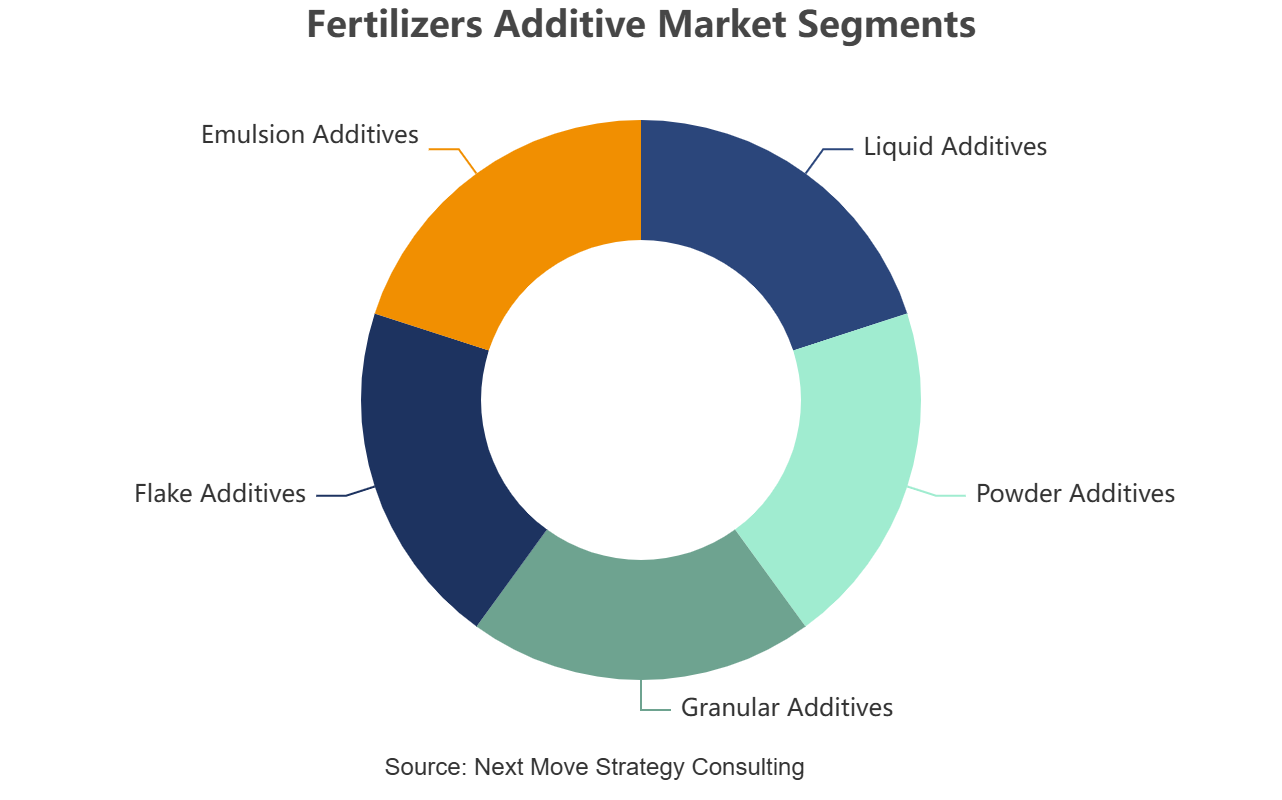
Our assessment shows that Granular Additives hold the largest share of the market by form at USD 1.87 billion in 2025, reflecting granular fertilizer's continued dominance as the primary physical distribution format worldwide. Liquid Additives is the fastest-growing form at a CAGR of 12.72%, driven by expanding fertigation and precision liquid application adoption across intensive row-crop and horticultural operations.
Supply Chain Analysis of the Fertilizers Additive Industry
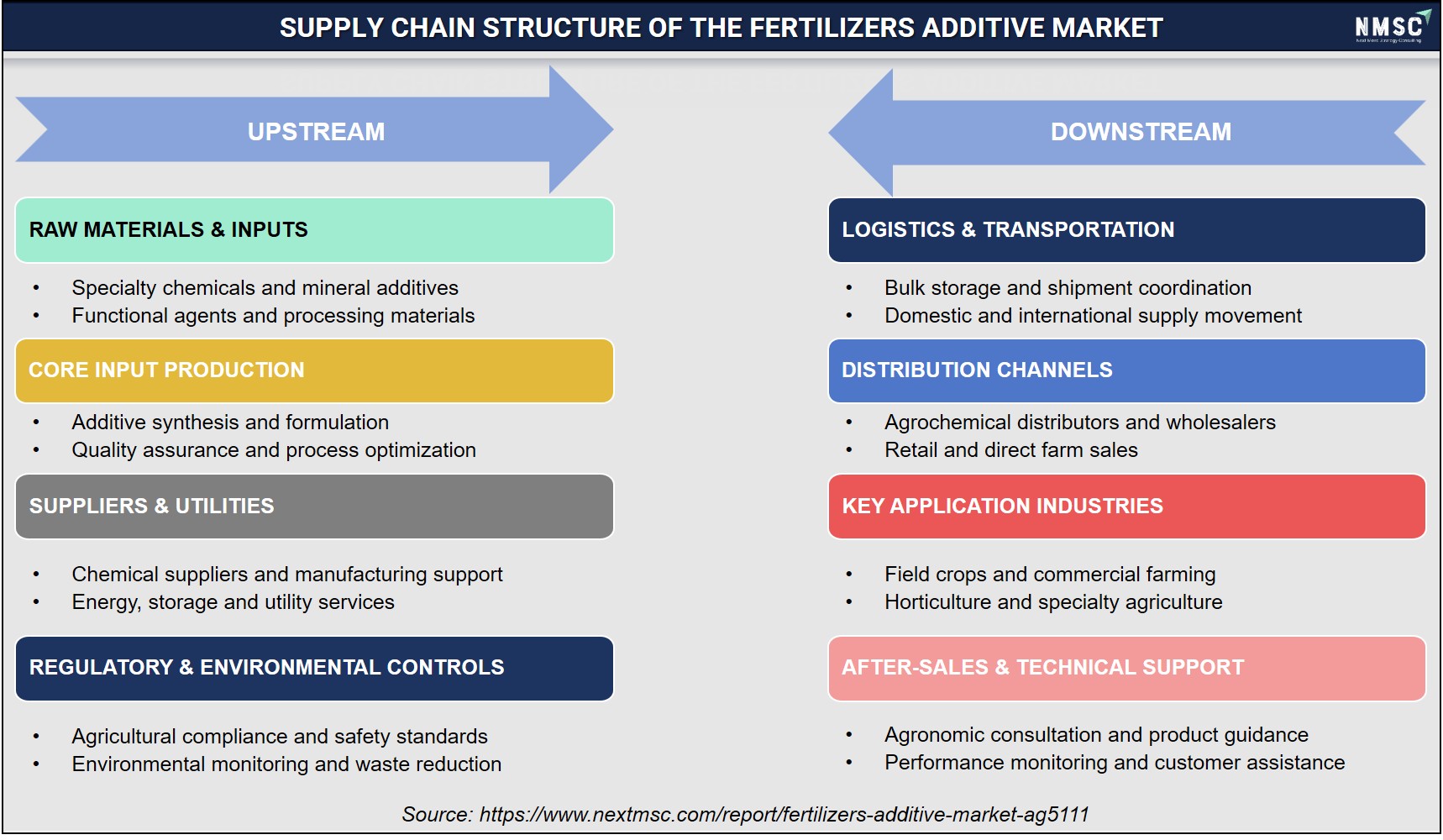
The supply chain structure below maps the key stages, such as upstream raw materials and inputs, core input production, suppliers and utilities, regulatory controls, logistics and transportation, distribution channels, key application industries, and after-sales support, shaping the fertilizers additive industry. From our analysis, we observed that regulatory and environmental controls are increasingly influencing upstream production decisions, compelling suppliers to integrate compliance measures early in the formulation process rather than treating them as an afterthought.
Regional Outlook
Geographic Performance Snapshot
|
Region |
2025 (USD Bn) |
2035 (USD Bn) |
CAGR % (2026–2035) |
Key Driver |
|
North America |
1.02 |
1.72 |
5.23% |
USDA-NRCS enhanced-efficiency standards; EPA stabilizer registration |
|
Europe |
0.77 |
1.31 |
5.42% |
EU Fertilising Products Regulation compliance demand |
|
Asia-Pacific |
1.53 |
3.12 |
7.45% |
China/India fertilizer production volume growth |
|
Middle East & Africa |
0.26 |
0.66 |
10.27% |
Nitrogen/phosphate capacity expansion; industrial diversification |
|
Latin America |
0.68 |
1.40 |
7.53% |
Brazil/Argentina export-oriented grain production |
North America
North America is a mature, high-attachment-rate market for fertilizer additives, anchored by large-scale nitrogen and compound fertilizer production integrated with EPA-registered stabilizer chemistries. Our assessment indicates that USDA-NRCS enhanced-efficiency fertilizer standards and EPA's Next Gen Fertilizer Challenges program are reinforcing sustained additive attachment across the region's corn belt production base, even as overall fertilizer volume growth moderates relative to faster-scaling emerging markets.
U.S.
Based on our engagements, we found that the market in the U.S. was valued at approximately USD 0.59 Billion in 2025 and is projected to reach USD 0.93 Billion by 2035, advancing at a CAGR of 4.40% from 2026 to 2035. Demand is shaped by USDA-NRCS enhanced-efficiency fertilizer standards and EPA-registered nitrogen stabilizer adoption across corn belt production. Competitive intensity is rising as suppliers expand enhanced-efficiency portfolios, reinforcing a strategic outlook for continued additive investment in the U.S. through the forecast period.
Canada
Through our analysis, we observed that the market in Canada was valued at approximately USD 0.15 Billion in 2025 and is projected to reach USD 0.28 Billion by 2035, advancing at a CAGR of 6.03% from 2026 to 2035. Demand is shaped by strong alignment with U.S. EPA stabilizer registration standards and expanding prairie-region nitrogen additive demand. Continued adoption of nitrogen stabilization and enhanced-efficiency fertilizer additives is expected to support sustained market growth through the forecast period.
Europe
Europe's fertilizer additive market is shaped directly by the EU Fertilising Products Regulation (EU) 2019/1009, which formally defines inhibitor performance thresholds and has applied since July 2022, with subsequent 2024 amendments on digital labelling and polymer component materials. Based on our engagements with regional stakeholders, we found that Germany and the UK anchor regional demand, while compliance-driven reformulation is accelerating adoption of verified nitrification and urease inhibitor chemistries across the bloc.
UK
Based on our engagements, we found that the Fertilizers Additive Market in the UK was valued at approximately USD 0.12 Billion in 2025 and is projected to reach USD 0.18 Billion by 2035, advancing at a CAGR of 4.58% from 2026 to 2035. Demand is shaped by post-EU regulatory alignment with inhibitor performance thresholds under retained fertilising products rules. Growing emphasis on regulatory compliance and nutrient-use efficiency is expected to drive wider adoption of advanced fertilizer additives through 2035.
Germany
Through our analysis, we observed that the market in Germany was valued at approximately USD 0.15 Billion in 2025 and is projected to reach USD 0.25 Billion by 2035, advancing at a CAGR of 4.87% from 2026 to 2035. Demand is shaped by the region’s largest fertilizer production base and early compliance with EU Regulation (EU) 2019/1009 inhibitor standards. Ongoing innovation in enhanced-efficiency fertilizer formulations and specialty additive technologies is expected to reinforce steady market growth over the forecast period.
France
From our assessment, we noticed that the market in France was valued at approximately USD 0.11 Billion in 2025 and is projected to reach USD 0.17 Billion by 2035, advancing at a CAGR of 4.61% from 2026 to 2035. Demand is shaped by a large arable farming sector, driving sustained granulation and anti-caking additive demand. Rising demand for performance-enhancing fertilizer additives that improve product quality and application efficiency is expected to support continued market expansion.
Asia-Pacific
Asia-Pacific is the largest and fastest-scaling regional market for fertilizer additives, propelled by China and India's dominant share of global fertilizer production volume. NMSC's analysis indicates that rising domestic nutrient use efficiency initiatives across both countries are gradually expanding enhanced-efficiency additive penetration beyond legacy anti-caking treatments, even as cost sensitivity among smallholder-oriented supply chains continues to favour lower-cost additive categories.
China
Based on our engagements, we found that the market in China was valued at approximately USD 0.46 Billion in 2025 and is projected to reach USD 0.91 Billion by 2035, advancing at a CAGR of 7.05% from 2026 to 2035. Demand is shaped by the world’s largest fertilizer production volume, supporting broad-based anti-caking and dust-control additive demand. Expanding production of enhanced-efficiency fertilizers and increasing use of performance additives are expected to strengthen the market growth outlook through 2035.
India
Through our analysis, we observed that the market in India was valued at approximately USD 0.34 Billion in 2025 and is projected to reach USD 0.81 Billion by 2035, advancing at a CAGR of 9.44% from 2026 to 2035. Demand is shaped by rapidly expanding domestic nitrogen production capacity and rising government nutrient use efficiency initiatives. Government-backed nutrient efficiency initiatives and increasing domestic fertilizer production are expected to accelerate demand for fertilizer additives during the forecast period.
Japan
From our assessment, we noticed that the market in Japan was valued at approximately USD 0.18 Billion in 2025 and is projected to reach USD 0.31 Billion by 2035, advancing at a CAGR of 5.24% from 2026 to 2035. Demand is shaped by a mature, quality-focused fertilizer market with established specialty and compound fertilizer additive use. Strong preference for high-quality specialty fertilizer formulations is expected to sustain demand for advanced fertilizer additives through 2035.
South Korea
According to evaluation, the market in South Korea was valued at approximately USD 0.12 Billion in 2025 and is projected to reach USD 0.22 Billion by 2035, advancing at a CAGR of 5.91% from 2026 to 2035. Demand is shaped by a technologically advanced, compact fertilizer production base with high-specification additive requirements. Continued focus on high-performance fertilizer formulations and manufacturing efficiency is expected to support steady market expansion over the forecast period.
Middle East & Africa
The Middle East and Africa region is the fastest-growing market for fertilizer additives, led by Saudi Arabia and the UAE's expanding nitrogen and phosphate production capacity tied to broader industrial diversification strategies. Our findings suggest that regional producers are increasingly specifying dust control and anti-caking additives to support export-grade fertilizer quality standards as production capacity scales from a comparatively low base.
UAE
Based on our engagements, we found that the Fertilizers Additive Market in UAE was valued at approximately USD 0.04 Billion in 2025 and is projected to reach USD 0.10 Billion by 2035, advancing at a CAGR of 11.23% from 2026 to 2035. Demand is shaped by expanding nitrogen and phosphate production capacity, supporting export-grade additive specification. Rising export-oriented fertilizer production and increasing quality requirements are expected to drive sustained demand for fertilizer additives through the forecast period.
Saudi Arabia
Through our analysis, we observed that the market in Saudi Arabia was valued at approximately USD 0.05 Billion in 2025 and is projected to reach USD 0.13 Billion by 2035, advancing at a CAGR of 11.55% from 2026 to 2035. Demand is shaped by large-scale ammonia and phosphate production investment under the national industrial diversification strategy. Expansion of integrated fertilizer manufacturing capacity and growing export focus are expected to strengthen demand for advanced fertilizer additives through 2035.
South Africa
From our assessment, we noticed that the market in South Africa was valued at approximately USD 0.03 Billion in 2025 and is projected to reach USD 0.08 Billion by 2035, advancing at a CAGR of 10.19% from 2026 to 2035. Demand is shaped by the region’s most established fertilizer production and distribution infrastructure. Improving fertilizer manufacturing capabilities and increasing demand for quality-enhancing additive solutions are expected to support steady market growth over the forecast period.
Latin America
Latin America's fertilizer additive market is anchored by Brazil, the region's largest fertilizer consumer and importer, supporting sustained demand for anti-caking and granulation additives across its intensive row-crop production base. Through our market assessment, we observed that Argentina's export-oriented grain sector is similarly reinforcing steady additive demand, with regional producers gradually incorporating enhanced-efficiency chemistries into nitrogen fertilizer supply chains.
Brazil
Based on our engagements, we found that the market in Brazil was valued at approximately USD 0.31 Billion in 2025 and is projected to reach USD 0.61 Billion by 2035, advancing at a CAGR of 7.25% from 2026 to 2035. Demand is shaped by the region’s largest fertilizer consumption base, anchoring sustained granulation and anti-caking additive demand. Strong fertilizer consumption from commercial agriculture and rising adoption of enhanced-efficiency fertilizer products are expected to reinforce long-term demand for fertilizer additives.
Argentina
Through our analysis, we observed that the market in Argentina was valued at approximately USD 0.12 Billion in 2025 and is projected to reach USD 0.27 Billion by 2035, advancing at a CAGR of 8.23% from 2026 to 2035. Demand is shaped by a large export-oriented grain sector supporting steady nitrogen fertilizer additive consumption. Increasing demand for higher fertilizer performance in export-oriented crop production is expected to support continued adoption of advanced fertilizer additives through the forecast period.
PESTEL Analysis of the Fertilizers Additive Industry
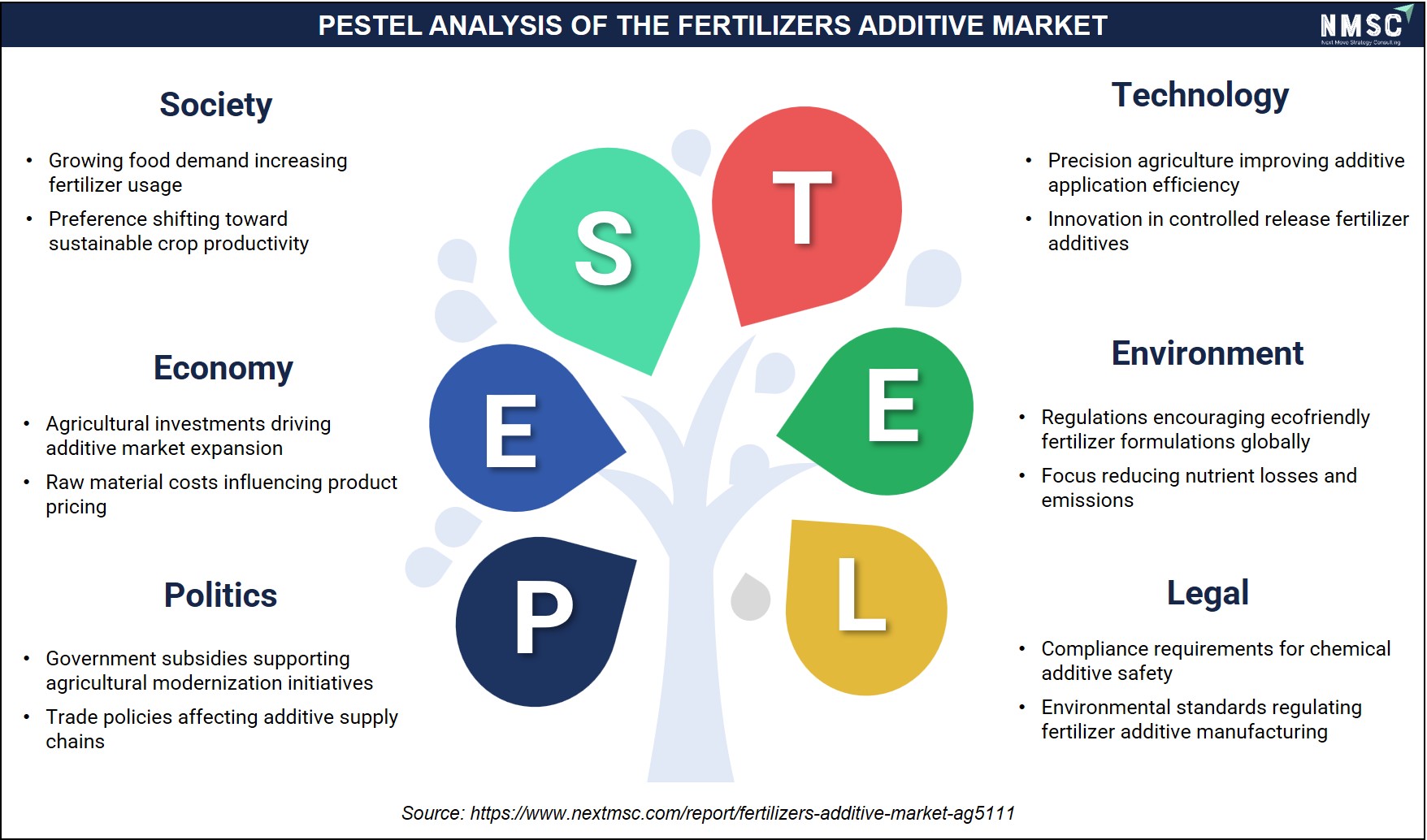
The PESTEL analysis below maps the key external forces, such as political, economic, social, technological, environmental, and legal factors, shaping the fertilizers additive market. From our analysis, we observed that environmental regulations and sustainability pressures are now overtaking cost as the primary market driver, pushing manufacturers to prioritize eco-friendly formulations and compliance-led innovation over traditional price-based competition.
Competitive Landscape of the Fertilizers Additive Market
|
Dimension |
Key Takeaways |
|
Market Structure |
The Fertilizers Additive Market is moderately consolidated, combining large diversified specialty chemical producers, including BASF SE and Evonik Industries AG, with focused agronomic input specialists such as Koch Agronomic Services and Corteva Agriscience. |
|
Innovation Focus |
Leading suppliers are investing in higher-concentration nitrogen stabilizer formulations and EPA-registered inhibitor chemistries, differentiating on verified agronomic performance data rather than price alone. |
|
M&A Activity |
Consolidation is concentrated on portfolio expansion into enhanced-efficiency chemistries, exemplified by large diversified chemical producers acquiring specialized stabilizer and coating technology providers. |
How Do Companies Compete in the Fertilizers Additive Market?
Companies in the Fertilizers Additive Market compete on the breadth of additive portfolio, verified agronomic performance data, and integration capability with large-scale fertilizer granulation lines. Our analysis shows that suppliers with EPA-registered or EU-compliant inhibitor chemistries are increasingly favored over unverified alternatives as producers prioritize regulatory-ready formulations across nitrogen and compound fertilizer production.
What Innovation and Differentiation Strategies Explain Dominance in the Fertilizers Additive Market?
Dominant suppliers differentiate through proprietary inhibitor chemistries and higher-concentration formulations that reduce required application volumes for large-scale blenders. NMSC's analysis indicates that Koch Agronomic Services' higher-concentration CENTURO stabilizer exemplifies this trend, positioning proven agronomic trial data as a durable competitive moat against smaller regional additive suppliers.
What M&A and Geographic Expansion Activity Is Shaping the Fertilizers Additive Market?
M&A activity is concentrated on capability expansion into enhanced-efficiency chemistries and geographic footprint extension into Asia-Pacific and Latin American production hubs. Our findings suggest that large diversified specialty chemical producers are prioritizing bolt-on acquisitions of stabilizer and coating technology providers to broaden their enhanced-efficiency additive portfolios ahead of tightening regional nutrient efficiency regulations.
Key Market Players in the Fertilizers Additive Market
-
Hubei Forbon Technology Co., Ltd.
-
Clariant AG
-
Kao Corporation
-
Arkema S.A.
-
Nouryon Chemicals Holding B.V.
-
Koch Agronomic Services, LLC
-
Corteva Agriscience LLC
-
Nutrien Ltd.
-
Michelman, Inc.
-
Chemipol S.A.
-
Tolsa, S.A.
-
Filtra Catalysts and Chemicals Ltd.
-
Dorf Ketal Chemicals Pvt. Ltd.
-
Eastman Chemical Company
-
Ashland Inc.
-
Huntsman Corporation
-
Instral B.V.
What Are the Latest Developments in the Fertilizers Additive Market?
|
Date |
Event |
|
July 2025 |
Koch Agronomic Services launched CENTURO A-PRO nitrogen stabilizer for the Canadian market. The higher-concentration formulation delivers the same nitrification inhibition with lower application rates while improving handling, storage, and operational efficiency for fertilizer retailers and growers. |
|
June 2025 |
BASF and Yunnan Yuntianhua announced successful independent verification of greenhouse-gas reductions achieved using Limus urease inhibitor-treated urea fertilizer. The pilot demonstrated more than 46,000 tonnes of CO₂e reductions and established a framework for expanding verified climate-smart fertilizer programs globally. |
|
April 2025 |
BASF introduced Ampliqan, a new nitrification inhibitor designed to improve nitrogen-use efficiency by reducing nitrate leaching and nitrous oxide emissions. The product is intended for fertilizer manufacturers seeking climate-smart nitrogen management solutions and broader commercialization across Asia-Pacific and other global markets beginning in 2026. |
What Are the Investment Opportunities in the Fertilizers Additive Market?
Capital inflows into the Fertilizers Additive Market are concentrated on enhanced-efficiency chemistry development, with suppliers directing infrastructure investment toward EPA-registered and EU-compliant inhibitor production capacity. Based on NMSC's research, we found that public-private validation pathways, including the EPA-USDA Next Gen Fertilizer Challenges program, are lowering commercialization risk for new coating and stabilizer technologies. ESG considerations are increasingly central to investment decisions, as nutrient loss reduction directly supports water quality and greenhouse gas mitigation goals under frameworks including the EU Fertilising Products Regulation.
Key Benefits for Stakeholders
Enterprise technology leaders benefit from this report's Product Type and Form segmentation, which identify where enhanced-efficiency and liquid additive investment is concentrated across production lines. Investors and financial analysts benefit from the regional outlook and competitive landscape sections, which quantify revenue concentration by geography and supplier positioning, supporting capital allocation decisions across a moderately consolidated field. Technology vendors and product teams benefit from the Key Emerging Trends section, which identifies EPA and EU regulatory validation pathways as the primary drivers of next-generation additive adoption.
Key Market Segments
By Product Type
-
Anti-Caking Additives
-
Fatty Amine-Based
-
Fatty Acid-Based
-
Wax-Based
-
Polymer-Based
-
Mineral-Based
-
-
Flow Enhancement Additives
-
Flow Conditioners
-
Surface Modification Additives
-
Moisture Control Additives
-
-
Dust Control Additives
-
Oil-Based
-
Water-Based
-
Polymer-Based
-
Surfactant-Based
-
-
Anti-Foaming Additives
-
Silicone-Based
-
Oil-Based
-
Water-Based
-
Polyether-Based
-
-
Enhanced-Efficiency Fertilizer Additives
-
Controlled-Release Coating Agents
-
Nutrient Stabilization Additives
-
Nutrient Protection Additives
-
-
Granulation Additives
-
Organic Binders
-
Inorganic Binders
-
Polymer Binders
-
Process Conditioners
-
-
Specialty Additives
-
Organic Colorants
-
Inorganic Colorants
-
Corrosion Inhibitors
-
Hydrophobic Agents
-
Other Specialty Additives
-
By Fertilizer Type
-
Nitrogen Fertilizers
-
Urea
-
Ammonium Nitrate
-
Ammonium Sulfate
-
Calcium Ammonium Nitrate
-
Urea Ammonium Nitrate
-
-
Phosphate Fertilizers
-
Monoammonium Phosphate
-
Diammonium Phosphate
-
Triple Superphosphate
-
Single Superphosphate
-
-
Potash Fertilizers
-
Potassium Chloride
-
Potassium Sulfate
-
Potassium Nitrate
-
-
Compound Fertilizers
-
NPK Fertilizers
-
NP Fertilizers
-
NK Fertilizers
-
PK Fertilizers
-
Customized Blends
-
-
Specialty Fertilizers
-
Micronutrient Fertilizers
-
Water-Soluble Fertilizers
-
Controlled-Release Fertilizers
-
Organic Mineral Fertilizers
-
By Form
-
Liquid Additives
-
Powder Additives
-
Granular Additives
-
Flake Additives
-
Emulsion Additives
By Region
-
North America: U.S., Canada, Mexico
-
Europe: UK, Germany, France, Italy, Spain, Sweden, Denmark, Finland, Netherlands, Rest of Europe
-
Asia-Pacific: China, India, Japan, South Korea, Taiwan, Indonesia, Vietnam, Australia, Philippines, Malaysia, Rest of APAC
-
Middle East & Africa: Saudi Arabia, UAE, Egypt, Israel, Turkey, Nigeria, South Africa, Rest of MEA
-
Latin America: Brazil, Argentina, Chile, Colombia, Rest of LATAM
Conclusion & Recommendations
The Fertilizers Additive Market is positioned for steady growth through 2035, advancing from USD 4.25 billion in 2025 to USD 8.21 billion by 2035 at a CAGR of 6.81% from 2026 to 2035, driven by rising fertilizer production volumes and tightening nutrient efficiency regulations across major agricultural economies. Suppliers should prioritize EPA-registered and EU-compliant enhanced-efficiency chemistries to capture premium positioning as regulatory frameworks, including the EU Fertilising Products Regulation and USDA-NRCS enhanced-efficiency standards, continue to shift producer demand toward verified inhibitor and coating technologies. The most durable growth pathway lies in expanding enhanced-efficiency additive penetration across Asia-Pacific and Latin American production bases, where fertilizer volume growth remains structurally ahead of mature North American and European markets.
About the Author
 Mayurima Roy is a research analyst delivering data-driven insights that support strategic planning and market understanding. She combines analytical rigor with strong content development skills, translating complex information into clear, actionable narratives for diverse audiences. Her work includes structured research, trend tracking, competitive assessment, and insight-led content creation that supports informed decision-making. Curious and detail-oriented by nature, she continually deepens her understanding of evolving markets while pursuing creative interests such as crafting and video creation.
About the Reviewer
 Supradip Baul is an accomplished business consultant and strategist with over a decade of rich experience in market intelligence, strategy, technology, and business transformation. His work has included rigorous qualitative and quantitative analysis across multiple industries, helping clients shape investment decisions and long-term roadmaps. Earlier in his career, he was associated with Gartner, where he contributed to industry-leading reports and market share analyses. He has worked with leading global companies and holds an MBA with a dual specialization in Marketing and Finance.
At Next Move Strategy Consulting, we understand that insightful market research is the cornerstone of successful business decisions. That's why we employ a robust and multifaceted approach, combining various methodologies to deliver the most accurate and actionable data for our clients.

Research Landscape
We navigate the world of research with two primary approaches:
Qualitative Approach
Our qualitative research methodologies involve immersive techniques such as in-depth interviews, focus groups, and observational studies. By engaging directly with individuals and stakeholders, we uncover valuable insights that quantitative data alone may overlook.

Quantitative Research
In tandem with qualitative methodologies, NMSC leverages the power of Quantitative Research to provide a robust foundation of numerical insights. Through systematic data collection and analysis, we quantify patterns, preferences, and market trends, offering a comprehensive view of the business landscape.
Our quantitative research approach employs diverse tools, including surveys, experiments, and statistical modelling. These methodologies enable us to gather data from a large and representative sample, ensuring the statistical significance of our findings. By employing structured questionnaires and standardized data collection methods, we guarantee the reliability and validity of the information we present to our clients.
Quantitative research is particularly effective in measuring the prevalence of trends, assessing market size, and gauging the impact of various factors on consumer behavior. The numerical precision attained through this approach equips our clients with actionable insights, facilitating data-driven decision-making and strategy formulation.


Our Specialized Toolbox for Industry-Specific Market Research
We deploy a specialized arsenal of techniques tailored to meet your unique requirements. Here's a glimpse into our comprehensive toolbox:

Information Procurement
The stage entails acquiring market data or relevant information through various sources and methodologies.


Market Research Approach
We utilize both top-down and bottom-up approaches in market research analysis to achieve a comprehensive understanding of the market dynamics, leveraging the broad perspective of industry trends and macroeconomic factors alongside detailed insights from specific segments and individual companies.

Porters Five Forces Analysis
We conduct Porter's Five Forces analysis to evaluate the competitive landscape of an industry, providing us with insights into factors that affect profitability and strategic positioning.

SWOT Analysis

Forecasting
We utilize a forecasting model to predict future consumption by considering parameters like population, economics, regulations, market competition, drivers, constraints, technology, and pricing. We also employ statistical techniques such as multilinear regression, exponential smoothing, moving average, ARIMA, and Monte Carlo simulations for accurate predictions. In econometric forecasting, we analyzed short-term and long-term event impacts, attributing values based on regulatory frameworks, economic factors, and market events.





 Speak to Our Analyst