AI Process Optimization Market Size, Share, Growth & Forecast by Software (Process Mining and Intelligence, and Others), Services (Consulting and Advisory, Implementation and Integration, and others), Technology Type (Machine Learning and Deep Learning, Computer Vision, and Others), Deployment Model (Cloud, On-Premises, Edge), Sales Channel (Direct Sales, Partner Channel, and others), Buyer Type, Organization Size, and End User Industry — Global Analysis 2025–2035
Industry: ICT & Media | Publishing Date: July 7, 2026 | Last Updated: September 30, 2026 | No of Pages: N/A | No. of Tables: N/A | No. of Figures: N/A | Format: PDF | Report Code: IC5009
What Is the AI Process Optimization Market Size?
The global AI Process Optimization Market was valued at USD 18.6 billion in 2025 and is projected to reach USD 22.8 billion in 2026. Accelerating enterprise adoption of process intelligence, generative AI-powered workflow automation, and industrial optimization platforms is expected to propel the market to USD 142.4 billion by 2035, advancing at a CAGR of 22.6% from 2026 to 2035. Key growth drivers include the proliferation of machine learning-based decision intelligence platforms, rising demand for real-time industrial process control, expanding robotic process automation adoption, and enterprise investment in AIOps to reduce operational costs and improve IT service delivery.
|
rameters |
Details |
|
Market Size in 2025 |
USD 18.6 Billion |
|
Market Size in 2026 |
USD 22.8 Billion |
|
Revenue Forecast in 2035 |
USD 142.4 Billion |
|
Growth Rate |
CAGR of 22.6% from 2026 to 2035 |
|
Analysis Period |
2025–2035 |
|
Base Year Considered |
2025 |
|
Forecast Period |
2026–2035 |
|
Market Size Estimation |
Billion USD |
|
Companies Profiled |
20 |
|
Countries Covered |
33 |
|
Market Share |
Top 10 |
AI Process Optimization Market Overview
What Is the AI Process Optimization Market?
AI Process Optimization is an enterprise technology domain encompassing software platforms, algorithms, and services that apply artificial intelligence to identify, redesign, automate, and continuously improve business and industrial processes. The market spans process mining, intelligent workflow orchestration, decision intelligence, industrial advanced process control, and AIOps. These solutions integrate machine learning, generative AI, reinforcement learning, and optimization algorithms to reduce process cycle times, lower operational costs, improve asset utilization, and enhance service quality across diverse industry verticals.
How Has the AI Process Optimization Market Evolved?
The AI Process Optimization Market has evolved through distinct technology generations. The first generation centered on rule-based business process management and early robotic process automation tools that handled structured, repetitive tasks. The second generation introduced machine learning-based process mining, allowing organizations to automatically discover process variants from event log data. NMSC's analysis indicates that the current phase integrates large language models, generative AI agents, reinforcement learning, and agentic automation, enabling systems to reason, adapt, and orchestrate complex multi-step processes with minimal human intervention.
How Do Regulations Influence the AI Process Optimization Market?
Regulatory developments have become a structurally important force shaping the AI Process Optimization Market. The European Union's AI Act, adopted in 2024, introduces tiered compliance requirements for AI systems used in high-risk decision-making processes, compelling vendors to build explainability, audit trail, and bias-monitoring capabilities into their platforms. In the United States, the National Institute of Standards and Technology (NIST) AI Risk Management Framework provides voluntary guidance that is increasingly referenced in enterprise procurement. Sector-specific regulations in financial services, pharmaceuticals, and energy further drive demand for compliant AI optimization deployments.
How Is Technology Adoption Expanding Across the AI Process Optimization Market?
Technology adoption across the AI Process Optimization Market is accelerating as organizations transition from isolated automation deployments to enterprise-wide intelligent process platforms. Cloud-native deployment, consumption-based pricing, and pre-built industry connectors are reducing time-to-value and lowering adoption barriers. From our research, we found that manufacturing, logistics, and financial services organizations are leading enterprise adoption, integrating AI process optimization with ERP, MES, and CRM systems to unlock end-to-end operational intelligence. Meanwhile, generative AI and agentic automation are expanding the addressable scope of optimization across previously unstructured and knowledge-intensive workflows.
|
Key Takeaways |
|
By Software, Industrial Process Optimization held the largest market share at USD 5.8 billion in 2025, driven by extensive adoption of advanced process control, real-time optimization, and predictive maintenance across energy, chemicals, and manufacturing industries. Workflow Automation and Orchestration is the fastest-growing named software sub-segment at a CAGR of 24.8% from 2026 to 2035, fueled by rising enterprise demand for robotic process automation, intelligent workflow orchestration, and agentic process automation capabilities. |
|
By Services, Implementation and Integration dominated at USD 1.9 billion in 2025, reflecting the complexity of deploying AI optimization platforms across enterprise IT landscapes. Training and Change Management is the fastest-growing service segment at a CAGR of 24.2% from 2026 to 2035, as organizations increasingly invest in workforce adoption and organizational change management to maximize AI process optimization ROI. |
|
By Technology Type, Machine Learning and Deep Learning dominated the AI Process Optimization Market, accounting for USD 7.2 billion in 2025, underpinned by broad deployment in predictive maintenance, process anomaly detection, and forecasting applications. Generative AI is the fastest-growing technology type at a CAGR of 38.4% from 2026 to 2035, transforming unstructured process data into actionable optimization recommendations and enabling conversational process intelligence interfaces. |
|
By Deployment Model, Cloud deployment dominated at USD 12.4 billion in 2025, reflecting enterprise preference for scalable, subscription-based AI optimization platforms. Edge deployment is the fastest-growing model at a CAGR of 28.6% from 2026 to 2035, driven by real-time industrial process control requirements in manufacturing, oil and gas, and energy sectors. |
|
By Revenue Stream, Subscription revenue led at USD 8.4 billion in 2025, reflecting the dominance of SaaS-based AI process optimization platforms. Professional Services is the fastest-growing revenue stream at a CAGR of 27.8% from 2026 to 2035, as enterprises increasingly invest in implementation, customization, integration, and managed optimization services to support large-scale AI deployments. |
|
By Sales Channel, Direct Sales dominated at USD 10.2 billion in 2025, reflecting the enterprise focus and complex deployment requirements of AI process optimization solutions. Cloud Marketplace is the fastest-growing sales channel at a CAGR of 29.8% from 2026 to 2035, driven by hyperscaler procurement integration and expanding enterprise cloud commitments. |
|
By Buyer Type, Operations and Manufacturing organizations represented the dominant buyer segment, accounting for USD 5.6 billion in 2025, driven by industrial AI adoption across manufacturing process control, predictive maintenance, and production scheduling. Supply Chain and Logistics is the fastest-growing buyer type at a CAGR of 25.4% from 2026 to 2035 as supply chain resilience and demand optimization investments accelerate. |
|
By Organization Size, Large Enterprises dominated the AI Process Optimization Market at USD 11.8 billion in 2025, reflecting extensive technology budgets, complex operational environments, and long-term AI transformation roadmaps. Small Enterprises represent the fastest-growing size segment at a CAGR of 25.8% from 2026 to 2035, supported by cloud-native and pre-configured AI optimization solutions that reduce deployment complexity and upfront investment requirements. |
|
By End User Industry, Manufacturing (Discrete) led at USD 3.2 billion in 2025, supported by strong adoption of industrial AI for yield optimization, defect detection, and production scheduling. Public Sector is the fastest-growing end-user industry at a CAGR of 28.0% from 2026 to 2035, driven by government digital transformation initiatives, intelligent service delivery programs, and AI-enabled operational modernization efforts. |
|
North America held the largest regional share in the AI Process Optimization Market at USD 7.8 billion in 2025, projected to reach USD 57.4 billion by 2035 at a CAGR of 22.1%, supported by high enterprise technology spending, leading AI platform vendors, and robust cloud infrastructure ecosystems. |
|
Latin America is the fastest-growing region in the AI Process Optimization Market at a CAGR of 26.2% from 2026 to 2035, driven by accelerating industrial digitization, enterprise cloud adoption, supply chain modernization initiatives, and growing investment in AI-enabled operational efficiency solutions. |
|
The United States is the largest individual country market in the AI Process Optimization Market, supported by strong enterprise AI adoption, extensive cloud infrastructure, significant investment in industrial automation, and the presence of leading AI software vendors. |
|
Brazil is the fastest-growing country market within Latin America in the AI Process Optimization Market, driven by accelerating industrial digitization initiatives, increasing adoption of AI-powered manufacturing optimization solutions, growing investment in supply chain modernization, and expanding deployment of cloud-based enterprise automation platforms. |
Key Emerging Trends in the AI Process Optimization Market
How Is Agentic AI Transforming Process Automation Across the AI Process Optimization Market?
Agentic AI represents the most consequential transformation currently reshaping the AI Process Optimization Market. Unlike traditional RPA bots that execute predefined scripts, AI agents reason, plan, and autonomously orchestrate multi-step workflows across enterprise systems. Based on our market assessment, we observed that enterprises in financial services and supply chain management are deploying agentic automation for end-to-end invoice processing, procurement workflows, and customer onboarding, with agents that can interpret unstructured documents, make conditional decisions, and invoke downstream system actions. This shift is compressing process cycle times and redefining human-in-the-loop boundaries across enterprise operations.
How Is Process Mining Evolving into a Strategic Enterprise Intelligence Layer in the AI Process Optimization Market?
Process mining has evolved from a diagnostic tool into a continuous enterprise intelligence layer within the AI Process Optimization Market. Modern platforms combine event log analysis with AI-powered conformance checking, predictive bottleneck detection, and simulation capabilities to support continuous process improvement. Through NMSC's assessment, we found that global industrial organizations are embedding process mining directly within ERP and CRM platforms, enabling real-time visibility into procurement-to-pay, order-to-cash, and incident management cycles. The integration of task mining alongside process mining is further extending visibility to individual knowledge worker activities.
What Role Is Generative AI Playing in Expanding the Scope of AI Process Optimization?
Generative AI is expanding the scope of the AI Process Optimization Market by enabling optimization of previously unstructured, knowledge-intensive, and language-driven processes. Large language models are being deployed to automate policy interpretation, contract analysis, customer correspondence, and regulatory compliance workflows that were not accessible to traditional RPA. Our analysis shows that enterprises are integrating generative AI with process orchestration platforms to create conversational process optimization interfaces where users can query process performance, receive AI-generated improvement recommendations, and trigger automated remediation actions through natural language.
How Is Real-Time Edge AI Reshaping Industrial Process Optimization in Manufacturing and Energy?
Real-time edge AI deployment is becoming a foundational capability within the industrial segment of the AI Process Optimization Market. Manufacturing, energy, and oil and gas organizations require sub-millisecond control loop adjustments that cannot tolerate cloud round-trip latencies. NMSC's analysis indicates that edge AI platforms are being deployed at the plant level to execute advanced process control, predictive maintenance, and real-time yield optimization algorithms locally on industrial hardware, while transmitting aggregated insights to cloud analytics layers. This architecture is enabling continuous optimization without sacrificing operational resilience or connectivity constraints.
Ecosystem Analysis of the AI Process Optimization Market
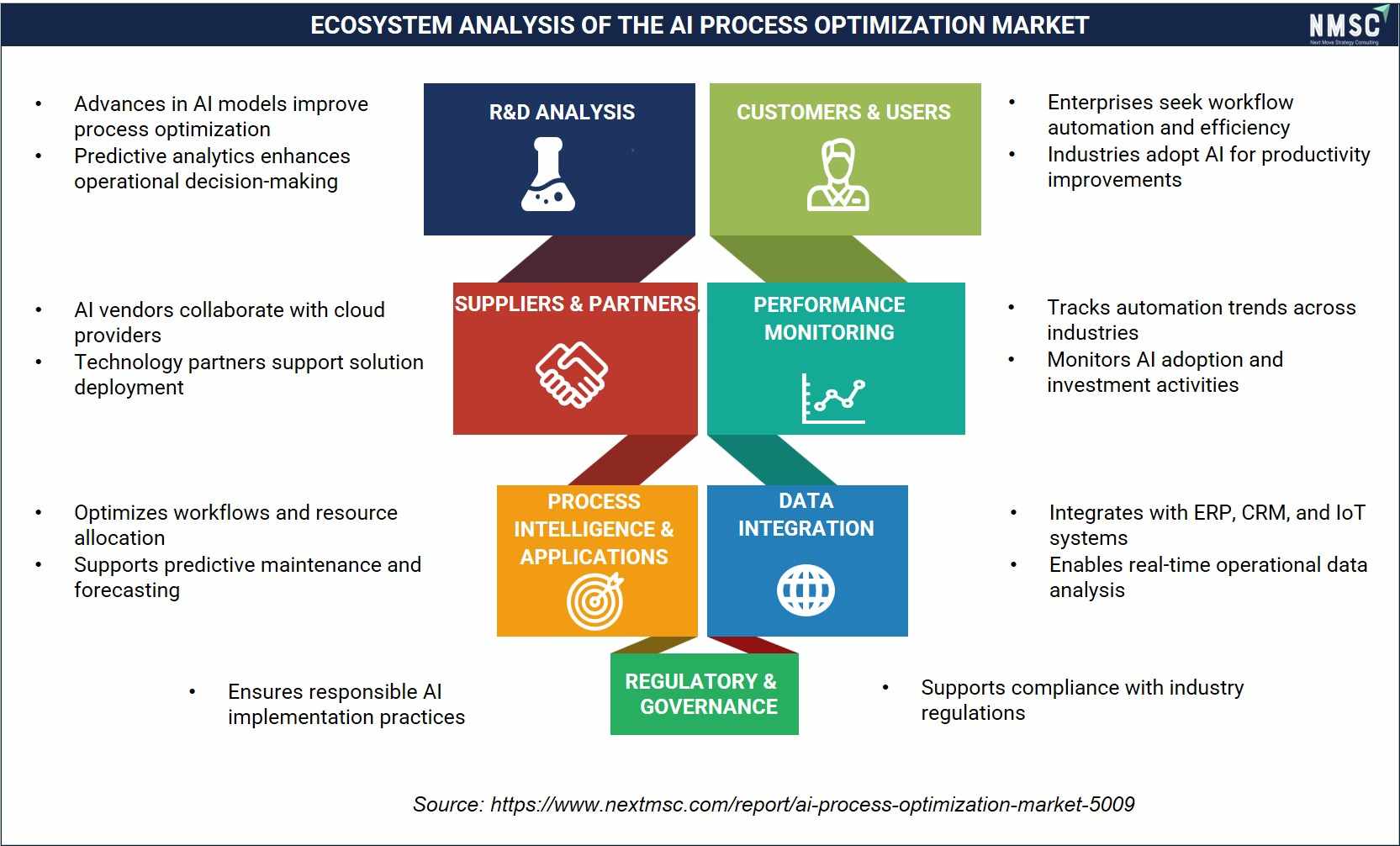
Based on our comprehensive assessment, we found that the AI Process Optimization Market operates through a connected ecosystem comprising technology providers, AI developers, enterprise users, system integrators, and regulatory bodies. AI algorithms, process intelligence platforms, performance monitoring tools, and data integration solutions drive value creation. Our analysis indicates that collaboration across these stakeholders enhances operational efficiency, decision-making accuracy, and scalable business process transformation.
What Are the Key Market Drivers, Breakthroughs, and Investment Opportunities that Will Shape the AI Process Optimization Market in the Next Decade?
|
Drivers / Trends / Restraints |
(+/-) % Impact on CAGR Forecast |
Geographic Relevance |
Impact Timeline |
|
Surging Enterprise AI Adoption and Digital Transformation |
+3.2% |
Global (led by North America, APAC) |
2025–2035 |
|
Expansion of Agentic and Generative AI in Workflows |
+2.8% |
North America, Europe, APAC |
2026–2035 |
|
Industrial AI and Advanced Process Control Demand |
+2.4% |
APAC, North America, Europe |
2025–2032 |
|
AIOps Platform Adoption in IT Operations |
+1.8% |
Global |
2025–2030 |
|
Cloud-Native and Edge Deployment Expansion |
+1.6% |
Global |
2025–2032 |
|
Subscription and Usage-Based Pricing Models |
+1.2% |
North America, Europe |
2025–2030 |
|
High Implementation Complexity and Integration Cost |
-1.4% |
Mid-market globally |
2025–2028 |
|
Data Quality and Process Event Log Deficiencies |
-0.9% |
All regions |
Ongoing |
|
Regulatory and AI Governance Compliance Overhead |
-0.7% |
Europe, North America |
Ongoing |
|
GenAI-Powered Optimization Monetization |
+2.2% |
Global |
2026–2035 |
|
Emerging Market Industrial Digitization |
+1.4% |
APAC, MEA, LATAM |
2026–2035 |
What Are the Growth Drivers of the AI Process Optimization Market?
How Is Accelerating Enterprise AI Adoption Driving the AI Process Optimization Market?
Enterprise-wide AI adoption is the primary catalyst driving sustained investment in the AI Process Optimization Market. Organizations across manufacturing, financial services, healthcare, and logistics are embedding AI into core operational workflows to reduce costs, improve throughput, and enhance customer experience. Based on NMSC's research, we found that the U.S. Bureau of Labor Statistics identifies technology-driven productivity improvement as a key structural priority for enterprise competitiveness, directly supporting AI process optimization investment. Furthermore, national AI strategies in the United States, the European Union, China, and Japan have institutionalized AI adoption across government and private sector operations, creating durable and policy-backed demand across the market.
How Is the Rise of Industrial AI and Advanced Process Control Fueling AI Process Optimization Market Growth?
The industrial segment of the AI Process Optimization Market is experiencing structural demand growth driven by the imperative to optimize energy consumption, maximize throughput, and reduce unplanned downtime across capital-intensive operations. Advanced process control systems powered by AI are enabling chemical plants, refineries, and semiconductor fabs to operate continuously at near-optimal parameters. Through our analysis, we found that the U.S. Department of Energy's Office of Energy Efficiency and Renewable Energy has documented that advanced process control and AI-powered energy optimization in industrial settings can reduce energy intensity by up to 15%, creating a compliance and cost-reduction incentive that directly accelerates adoption of AI industrial optimization platforms.
How Is Cloud-Native Architecture and Edge AI Deployment Expanding the AI Process Optimization Market?
Cloud-native deployment architectures and edge AI capabilities are expanding both the geographic and organizational reach of the AI Process Optimization Market. Cloud deployment reduces capital expenditure barriers, enabling mid-sized and smaller enterprises to access enterprise-grade optimization capabilities through subscription-based models. Simultaneously, edge AI deployment is enabling real-time optimization in environments where cloud connectivity is limited or where latency-sensitive industrial control requires local inference. Our assessment indicates that the convergence of cloud and edge architectures through hybrid deployment models is enabling organizations to optimize processes across the entire operational spectrum from data center to plant floor.
What Are the Inhibitors of the AI Process Optimization Market Growth?
How Does High Implementation Complexity and Integration Cost Constrain AI Process Optimization Market Growth?
High implementation complexity and total cost of integration represent significant structural constraints on the AI Process Optimization Market, particularly for mid-sized and smaller enterprises. Deploying AI process optimization platforms requires substantial data engineering investment to extract, clean, and structure process event logs from legacy ERP, MES, and CRM systems. Change management, model training, and employee upskilling further contribute to implementation costs and extended deployment timelines. Our findings suggest that the U.S. Government Accountability Office has documented analogous challenges in federal IT modernization programs, noting that data complexity and workforce skills gaps are primary barriers to technology adoption that are equally applicable to enterprise AI optimization deployments.
How Do Data Quality and Process Event Log Deficiencies Inhibit AI Process Optimization Market Expansion?
Data quality and process event log completeness are foundational requirements for effective AI process optimization, and their absence represents a structural inhibitor across the market. Process mining, machine learning model training, and decision intelligence applications depend on consistent, timestamped, and attribute-rich event data. In our observation, many organizations operate legacy enterprise systems that generate incomplete, inconsistent, or siloed process data that cannot be directly consumed by AI optimization platforms without extensive preprocessing and data governance investment. This barrier extends the time-to-value period for AI optimization deployments and constrains adoption among organizations with fragmented technology landscapes.
What Are the Growth Opportunities in the AI Process Optimization Market?
How Does Generative AI Process Intelligence Create a Multi-Billion Dollar Opportunity in the AI Process Optimization Market?
Generative AI is creating a structural revenue expansion opportunity within the AI Process Optimization Market by extending optimization capabilities to knowledge-intensive and language-driven processes that were previously inaccessible to algorithmic automation. Enterprises with large repositories of process documentation, regulatory filings, and operational procedure manuals can now leverage large language models to automatically generate process improvement recommendations, compliance gap analyses, and workflow redesign blueprints. Our analysis shows that the NIST AI Risk Management Framework's emphasis on explainable and governed AI systems is elevating enterprise requirements for auditable AI process optimization, creating demand for premium platforms with built-in AI governance and compliance documentation capabilities.
How Does the Industrial Digitization Wave in Emerging Markets Represent a Structural Opportunity for the AI Process Optimization Market?
The accelerating industrial digitization programs across Asia-Pacific, the Middle East, and Latin America are generating significant new addressable market for AI Process Optimization vendors. Government-mandated smart manufacturing initiatives in China, India's National Manufacturing Competitiveness Programme, and Saudi Arabia's Vision 2030 industrial transformation agenda are directly funding AI adoption in manufacturing, energy, and logistics sectors. From our assessment, we found that the International Labour Organization's analysis of automation adoption trends in developing economies highlights industrial AI as a priority investment for competitiveness, indicating sustained policy-backed demand that will expand the geographic footprint of the AI Process Optimization Market through 2035.
How Is the Expansion of AI-Powered Supply Chain Optimization Creating Investment Opportunities in the AI Process Optimization Market?
Supply chain disruptions experienced during the COVID-19 pandemic and subsequent geopolitical uncertainties have accelerated enterprise investment in AI-powered supply chain optimization platforms, creating a high-growth opportunity segment within the broader AI Process Optimization Market. AI-driven demand forecasting, inventory optimization, and logistics routing platforms are enabling organizations to reduce supply chain costs, improve on-time delivery performance, and build operational resilience. Based on our market evaluation, we noticed that the U.S. Department of Commerce has identified supply chain AI as a strategic technology priority, with initiatives to support domestic technology development in logistics optimization directly expanding enterprise adoption of AI process optimization platforms.
How Is the AI Process Optimization Market Segmented in This Report, and What Are the Key Insights from the Segmentation Analysis?
Which Software Segment Dominates and Drives AI Process Optimization Market Revenue?
|
Software Segment |
2025 (USD Bn) |
2035 (USD Bn) |
CAGR (%) |
|
Process Mining and Intelligence |
2.8 |
19.6 |
21.5% |
|
Workflow Automation and Orchestration |
4.2 |
38.8 |
24.8% |
|
Decision Intelligence and Optimization |
2.4 |
17.2 |
21.8% |
|
Industrial Process Optimization |
5.8 |
38.4 |
20.8% |
|
IT Operations Optimization |
2.6 |
19.6 |
22.4% |
|
Other AI Process Optimization Software |
0.8 |
8.8 |
27.0% |
Based on our analysis of enterprise AI software procurement trends and technology adoption patterns, we observed that the AI Process Optimization Market software segment encompasses Process Mining and Intelligence, Workflow Automation and Orchestration, Decision Intelligence and Optimization, Industrial Process Optimization, IT Operations Optimization, and Other AI Process Optimization Software. The Industrial Process Optimization segment dominates, anchored by advanced process control, real-time optimization, and predictive maintenance deployments in energy and manufacturing industries. Workflow Automation and Orchestration is the fastest-growing sub-segment, driven by the convergence of RPA, business process management, and agentic process automation capabilities. Process Mining and Intelligence is expanding steadily as organizations invest in continuous process discovery and conformance analysis. Decision Intelligence and Optimization is gaining traction across financial services and supply chain verticals.
How Do Service Offerings Shape Value Delivery in the AI Process Optimization Market?
|
Service Segment |
2025 (USD Bn) |
2035 (USD Bn) |
CAGR (%) |
|
Consulting and Advisory |
1.2 |
7.8 |
20.5% |
|
Implementationand Integration |
1.9 |
13.4 |
21.6% |
|
Managed Services and Support |
1.4 |
10.6 |
22.4% |
|
Training and Change Management |
0.6 |
5.4 |
24.2% |
|
Other AI Process Optimization Services |
0.3 |
2.6 |
24.0% |
Through our market assessment, we observed that the AI Process Optimization Market services segment is structured across Consulting and Advisory, Implementation and Integration, Managed Services and Support, Training and Change Management, and Other Services. Implementation and Integration commands the largest share, reflecting the complexity of deploying AI optimization platforms across heterogeneous enterprise IT environments that include legacy ERP, MES, and CRM systems. Consulting and Advisory services remain essential for strategy formulation and AI readiness assessment, particularly among enterprises initiating their process optimization journey. Managed Services and Support is experiencing accelerating demand as organizations seek to outsource model monitoring, MLOps, and optimization platform maintenance. Training and Change Management is the fastest-growing service segment, reflecting enterprise recognition that workforce adoption is a critical determinant of AI optimization ROI.
Which Technologies Are Driving Innovation in the AI Process Optimization Market?
|
Technology Type |
2025 (USD Bn) |
2035 (USD Bn) |
CAGR (%) |
|
Machine Learning and Deep Learning |
7.2 |
46.8 |
20.5% |
|
Computer Vision |
1.4 |
11.6 |
23.6% |
|
Natural Language Processing |
2.2 |
18.4 |
23.6% |
|
Generative AI |
1.6 |
28.4 |
38.4% |
|
Reinforcement Learning |
1.8 |
13.6 |
22.5% |
|
Optimization Algorithms |
3.4 |
17.6 |
17.8% |
|
Other Technologies |
1.0 |
6.0 |
19.6% |
From our research, we found that the AI Process Optimization Market is underpinned by a diverse technology portfolio encompassing Machine Learning and Deep Learning, Computer Vision, Natural Language Processing, Generative AI, Reinforcement Learning, Optimization Algorithms, and Other Technologies. Machine Learning and Deep Learning dominates, forming the foundational inference engine for predictive maintenance, anomaly detection, demand forecasting, and process optimization applications. Generative AI is the fastest-growing technology type, transforming unstructured operational data into process insights and enabling conversational optimization interfaces. NLP is gaining importance for automating document-intensive processes in financial services, legal, and compliance functions. Reinforcement learning is emerging as a critical technology for dynamic scheduling, resource optimization, and adaptive process control applications.
How Does Deployment Model Selection Shape AI Process Optimization Market Adoption?
|
Deployment Segment |
2025 (USD Bn) |
2035 (USD Bn) |
CAGR (%) |
|
Cloud – Public Cloud |
8.4 |
64.2 |
22.4% |
|
Cloud – Private Cloud |
2.6 |
16.8 |
20.4% |
|
Cloud – Hybrid Cloud |
1.4 |
10.4 |
22.2% |
|
On-Premises |
4.8 |
24.4 |
17.6% |
|
Edge |
1.4 |
26.6 |
28.6% |
Based on our market evaluation, we noticed that the AI Process Optimization Market deployment model segment covers Cloud (Public, Private, and Hybrid), On-Premises, and Edge deployments. Cloud deployment dominates the market, with Public Cloud capturing the largest share due to scalability, subscription pricing, and rapid onboarding capabilities. On-Premises deployment remains significant among regulated industries and large industrial operators with strict data sovereignty and operational continuity requirements. Hybrid Cloud deployment is growing as organizations seek to balance operational flexibility with compliance obligations. Edge deployment is the fastest-growing model, driven by real-time industrial process control requirements in manufacturing, oil and gas, and energy sectors where local inference is operationally critical.
How Do Revenue Streams Reflect the Commercial Evolution of the AI Process Optimization Market?
|
Revenue Stream |
2025 (USD Bn) |
2035 (USD Bn) |
CAGR (%) |
|
Subscription |
8.4 |
56.8 |
21.0% |
|
Perpetual License |
3.8 |
16.4 |
15.7% |
|
Usage Based |
2.6 |
24.8 |
26.4% |
|
Professional Services |
3.8 |
44.4 |
27.8% |
Our findings suggest that the AI Process Optimization Market revenue structure reflects a clear transition toward recurring, usage-aligned commercial models. Subscription revenue leads the market, supported by the dominance of SaaS-based AI process optimization platforms that provide continuous updates, model improvements, and managed infrastructure. Usage-Based pricing is the fastest-growing revenue stream, aligning costs with computational consumption for AI inference, process mining analysis, and optimization workloads. Professional Services revenue is experiencing strong growth as enterprises invest in implementation, customization, and managed optimization services. Perpetual License revenue is declining in relative share as the market transitions toward cloud-native consumption models.
How Are Sales Channels Reshaping Go-to-Market Strategies in the AI Process Optimization Market?
|
Sales Channel |
2025 (USD Bn) |
2035 (USD Bn) |
CAGR (%) |
|
Direct Sales |
10.2 |
66.8 |
20.6% |
|
Partner Channel |
5.4 |
38.8 |
21.8% |
|
Embedded OEM |
1.6 |
12.4 |
22.8% |
|
Cloud Marketplace |
1.4 |
24.4 |
29.8% |
NMSC's analysis indicates that the AI Process Optimization Market sales channel landscape is structured across Direct Sales, Partner Channel, Embedded OEM, and Cloud Marketplace channels. Direct Sales commands the largest share, reflecting the enterprise focus, long sales cycles, and complex deployment requirements of AI process optimization solutions that benefit from dedicated account management and solution engineering support. Partner Channel remains essential for geographic market coverage and industry-specific implementation expertise. Cloud Marketplace is the fastest-growing channel, driven by enterprise procurement integration with hyperscaler spend commitments and the expanding availability of AI optimization solutions on AWS, Azure, and Google Cloud marketplaces. Embedded OEM channels are growing as software vendors integrate AI optimization capabilities into ERP software, MES, and industrial automation platforms.
Which Buyer Types Are Leading AI Process Optimization Procurement Decisions?
|
Buyer Type |
2025 (USD Bn) |
2035 (USD Bn) |
CAGR (%) |
|
Operations and Manufacturing |
5.6 |
40.4 |
21.8% |
|
Information Technology |
4.2 |
29.6 |
21.4% |
|
Supply Chain and Logistics |
2.8 |
26.4 |
25.4% |
|
Finance and Risk |
2.4 |
19.6 |
23.2% |
|
Customer Service and Shared Services |
1.8 |
12.8 |
21.6% |
|
Sustainability and Energy Management |
1.0 |
8.4 |
24.0% |
|
Other Buyer Types |
0.8 |
5.2 |
20.6% |
Based on our research, we found that the AI Process Optimization Market is segmented by buyer type into Operations and Manufacturing, Information Technology, Supply Chain and Logistics, Finance and Risk, Customer Service and Shared Services, Sustainability and Energy Management, and Other Buyer Types. Operations and Manufacturing organizations are the dominant buyer segment, investing in industrial AI, advanced process control, and predictive maintenance to optimize asset performance and production yields. Information Technology buyers represent the second-largest segment, deploying AIOps and IT service optimization platforms. Supply Chain and Logistics is the fastest-growing buyer type, driven by AI-powered demand forecasting, inventory optimization, and logistics routing investments following supply chain disruptions that exposed critical operational vulnerabilities.
How Does Organization Size Influence AI Process Optimization Market Adoption Patterns?
|
Organization Size |
2025 (USD Bn) |
2035 (USD Bn) |
CAGR (%) |
|
Large Enterprise |
11.8 |
78.4 |
20.8% |
|
Mid-Sized Enterprise |
4.6 |
42.6 |
25.6% |
|
Small Enterprise |
2.2 |
21.4 |
25.8% |
Through our market assessment, we observed that the AI Process Optimization Market is segmented by organization size into Large Enterprise, Mid-Sized Enterprise, and Small Enterprise categories. Large Enterprises dominate the market, supported by significant technology budgets, complex multi-site operational environments, and long-term AI transformation roadmaps that justify enterprise-wide optimization platform investments. Mid-Sized Enterprises represent the fastest-growing segment, as cloud-native, pre-configured AI optimization solutions with rapid deployment capabilities are making enterprise-grade process intelligence accessible at lower total cost of ownership. Small Enterprise adoption is also accelerating, supported by marketplace-distributed, consumption-based AI optimization tools that offer pay-per-use access without significant upfront investment.
Which End User Industries Are Driving AI Process Optimization Market Revenue?
|
End User Industry |
2025 (USD Bn) |
2035 (USD Bn) |
CAGR (%) |
|
Manufacturing Discrete |
3.2 |
21.4 |
20.8% |
|
Manufacturing Process |
2.6 |
16.8 |
20.4% |
|
Energy and Utilities |
2.2 |
14.2 |
20.5% |
|
Oil and Gas |
1.8 |
11.4 |
20.2% |
|
Chemicals and Materials |
1.2 |
7.6 |
20.3% |
|
Automotive and Mobility |
1.0 |
7.2 |
21.8% |
|
Aerospace and Defense |
0.6 |
3.8 |
20.2% |
|
Pharmaceuticals and Life Sciences |
0.8 |
6.4 |
23.2% |
|
Food and Beverage |
0.6 |
3.8 |
20.2% |
|
Metals and Mining |
0.4 |
2.6 |
20.4% |
|
Retail and Consumer Goods |
0.8 |
6.6 |
23.4% |
|
Logistics and Transportation |
1.0 |
8.6 |
24.2% |
|
BFSI |
0.8 |
9.6 |
26.8% |
|
Healthcare |
0.6 |
5.8 |
25.8% |
|
Public Sector |
0.4 |
4.8 |
28.0% |
|
Telecommunications |
0.6 |
5.6 |
25.2% |
|
Other Industries |
0.4 |
6.6 |
32.2% |
According to evaluation of industry-level AI investment trends and operational complexity profiles, we found that the AI Process Optimization Market spans a diverse range of end user industries including Manufacturing Discrete, Manufacturing Process, Energy and Utilities, Oil and Gas, Chemicals, Automotive, Aerospace and Defense, Pharmaceuticals, Food and Beverage, Metals and Mining, Retail, Logistics, BFSI, Healthcare, Public Sector, Telecommunications, and Others. Manufacturing Discrete leads in absolute revenue, supported by extensive AI adoption for production scheduling, quality optimization, and predictive maintenance. BFSI is the fastest-growing end user industry, driven by AI-powered decisioning, fraud detection, and intelligent process automation across banking, insurance, and capital markets operations.
Regional Outlook
Geographic Performance Snapshot
|
Region |
2025 (USD Bn) |
2035 (USD Bn) |
CAGR (%) |
Key Driver |
|
North America |
7.8 |
57.4 |
22.1% |
Enterprise AI spend, leading platform vendors |
|
Europe |
4.2 |
28.6 |
21.0% |
AI Act compliance, industrial AI in Germany |
|
Asia-Pacific |
4.4 |
36.8 |
24.8% |
China industrial AI, India digital transformation |
|
Middle East & Africa |
1.2 |
9.4 |
22.8% |
Vision 2030, UAE AI strategy |
|
Latin America |
1.0 |
10.2 |
26.2% |
Digital economy growth, industrial modernization |
North America AI Process Optimization Market
North America is the global leader of the AI Process Optimization Market, accounting for USD 7.8 billion in 2025 and forecast to reach USD 57.4 billion by 2035 at a CAGR of 22.1%. The region benefits from the headquarters concentration of leading AI platform vendors including Microsoft, IBM, Oracle, ServiceNow, UiPath, and Automation Anywhere. Strong enterprise technology investment, mature cloud infrastructure, and comprehensive AI research ecosystems underpin market leadership. Regulatory frameworks including the NIST AI Risk Management Framework are guiding enterprise AI governance investments, while the Inflation Reduction Act's industrial incentives are stimulating energy sector AI process optimization adoption.
U.S. AI Process Optimization Market
Based on our engagements with enterprise stakeholders and analysis of technology investment patterns, the United States represents approximately 82% of the North American AI Process Optimization Market, making it the world's single largest national market. The U.S. benefits from the highest global concentration of Fortune 500 enterprises actively deploying AI optimization platforms, a mature cloud marketplace ecosystem, and the deepest talent pool in AI engineering and data science. The National AI Initiative Act and the AI Executive Orders issued by successive administrations have institutionalized AI adoption across federal agencies and defense organizations, generating significant public sector demand for AI process optimization solutions.
Canada AI Process Optimization Market
Through our analysis, the Canadian AI Process Optimization Market is driven by strong technology adoption in financial services, natural resources, and advanced manufacturing sectors. Canadian banks and insurance companies are among the most sophisticated enterprise buyers of AI decisioning and workflow optimization platforms globally. The Government of Canada's Pan-Canadian AI Strategy and the Innovation, Science and Economic Development Canada initiatives are supporting AI commercialization and enterprise adoption. Data sovereignty considerations under the Personal Information Protection and Electronic Documents Act (PIPEDA) are driving demand for Canadian cloud regions, with major hyperscalers expanding local infrastructure to serve compliance-conscious enterprise buyers.
Mexico AI Process Optimization Market
From our assessment, Mexico is the fastest-growing AI Process Optimization market within North America, driven by accelerating industrial digitization, nearshoring investments in manufacturing, and growing fintech sector adoption of AI automation platforms. Mexico's manufacturing sector, anchored by automotive, aerospace, and electronics production, is driving adoption of industrial AI process optimization for quality control, production scheduling, and supply chain intelligence. The federal government's digital transformation agenda is catalyzing public sector automation investment. Regulatory developments in data protection are compelling enterprises to invest in governed AI optimization platforms.
Europe AI Process Optimization Market
Europe is the second-largest region in the AI Process Optimization Market, contributing USD 4.2 billion in 2025 and forecast to reach USD 28.6 billion by 2035 at a CAGR of 21.0%. Europe's regulatory environment, led by the EU AI Act, GDPR, and the EU Data Act, is driving enterprise investment in explainable, auditable, and governed AI optimization platforms. Germany's industrial AI leadership, the UK's advanced financial services sector, and France's growing enterprise AI adoption are key regional demand pillars. The European Commission's AI investment programs and Horizon Europe research funding further support market expansion across the region.
UK AI Process Optimization Market
Based on our engagements with enterprise stakeholders, the United Kingdom is Europe's largest individual AI Process Optimization market, driven by advanced financial services, manufacturing, and professional services sectors. The Financial Conduct Authority's (FCA) regulatory technology (RegTech) framework is driving AI-powered compliance process optimization in banking and insurance. The UK Government's National AI Strategy and the Office for AI's regulatory sandbox initiatives are fostering innovation and enterprise adoption. Post-Brexit regulatory divergence is creating opportunities for vendors to serve the UK market with tailored governance frameworks that align with UK GDPR and evolving domestic AI policy.
Germany AI Process Optimization Market
According to evaluation of Germany's industrial and technology landscape, the country is the largest industrial AI process optimization market in Europe. Germany's automotive, chemicals, machinery, and industrial manufacturing sectors are adopting AI process control, predictive maintenance, and production optimization platforms at scale. The German government's Plattform Industrie 4.0 initiative and Federal Ministry of Economics' AI strategy are directly funding industrial AI adoption. Siemens, Bosch, and BASF are notable early adopters and co-innovators of industrial AI process optimization. GDPR compliance requirements are shaping data governance investments in AI optimization deployments.
France AI Process Optimization Market
Through our analysis, France is experiencing strong AI Process Optimization Market growth, supported by the government's national AI strategy France 2030 and significant public and private sector investment in AI research and enterprise adoption. The French energy, aerospace, and defense sectors are prominent adopters of industrial AI process optimization. TotalEnergies, Airbus, and major French banks are deploying AI optimization platforms across process control, maintenance, and financial decisioning workflows. The French data protection authority (CNIL) is providing guidance on responsible AI deployment, shaping governance requirements for enterprise AI process optimization implementations.
Italy AI Process Optimization Market
From our assessment, Italy's AI Process Optimization Market is driven by strong adoption in manufacturing, energy, and utilities sectors. Italy's industrial manufacturing base, particularly in the Emilia-Romagna and Lombardy regions, is integrating AI process optimization for quality management, production efficiency, and supply chain coordination. The National Recovery and Resilience Plan (PNRR) is funding digital transformation and AI adoption across Italian enterprises. Regulatory alignment with the EU AI Act and GDPR frameworks is shaping platform governance requirements for Italian enterprise buyers.
Spain AI Process Optimization Market
Based on our engagements, Spain is expanding AI Process Optimization adoption across telecommunications, retail, logistics, and energy sectors. Telefonica's AI optimization programs and Iberdrola's energy AI initiatives are prominent market-building examples. The Spanish government's National AI Strategy and the Digital Spain 2026 agenda are supporting enterprise AI adoption through regulatory guidance and public sector investment. Spain's growing startup ecosystem in AI and process automation is contributing to localized market development alongside global platform providers.
Sweden AI Process Optimization Market
Through our analysis, Sweden demonstrates strong AI Process Optimization adoption in manufacturing, telecom, and energy sectors, supported by a highly digitized economy and progressive regulatory environment. Swedish enterprises including Ericsson, Volvo, and Sandvik are integrating AI process optimization into telecommunications network management, automotive manufacturing, and mining operations. Sweden's national AI strategy and Vinnova innovation agency programs are supporting AI research commercialization. The country's early adoption of responsible AI governance frameworks is creating demand for explainable and auditable optimization platforms.
Denmark AI Process Optimization Market
According to evaluation of Denmark's enterprise technology landscape, the country exhibits strong AI Process Optimization adoption in energy, pharmaceuticals, and shipping sectors. Novo Nordisk's AI-powered pharmaceutical process optimization and Maersk's supply chain AI initiatives are significant demand drivers. Denmark's National Strategy for Artificial Intelligence and the Danish Digitisation Agency's public sector AI adoption programs are supporting market growth. The country's strong data infrastructure and high digital maturity provide an enabling environment for sophisticated AI process optimization deployments.
Finland AI Process Optimization Market
From our assessment, Finland's AI Process Optimization Market is supported by strong industrial AI adoption in paper and pulp manufacturing, telecom, and energy sectors. Nokia's network optimization AI platforms and Fortum's energy optimization programs are key demand catalysts. The Finnish government's Artificial Intelligence Programme and Business Finland's AI commercialization initiatives are supporting enterprise adoption. Finland's advanced robotics and industrial automation ecosystem provides an enabling environment for industrial AI process optimization integration.
Netherlands AI Process Optimization Market
Based on our engagements with European enterprise stakeholders, the Netherlands is a prominent AI Process Optimization hub in Europe, supported by advanced logistics, financial services, and agriculture sectors. Port of Rotterdam's digital twin and logistics optimization initiatives and ASML's semiconductor manufacturing AI programs are significant market contributors. The Netherlands Enterprise Agency (RVO) and Dutch AI Coalition (NL AIC) are supporting AI adoption and commercialization across enterprise sectors. The country's strategic position as a European logistics gateway drives strong demand for supply chain AI optimization platforms.
Rest of Europe AI Process Optimization Market
Through our analysis, the Rest of Europe market includes Poland, Austria, Belgium, Switzerland, Norway, Portugal, Greece, and other European nations. These markets are experiencing growing AI Process Optimization adoption across manufacturing, financial services, and public sector organizations. EU membership and regulatory alignment with the AI Act and GDPR frameworks are shaping platform requirements. National digital transformation strategies and EU structural funds are supporting AI adoption in less digitally mature member states. Switzerland's precision manufacturing and financial services sectors are notable early adopters outside the EU.
Asia-Pacific AI Process Optimization Market
Asia-Pacific is the fastest-growing region in the AI Process Optimization Market, valued at USD 4.4 billion in 2025 and forecast to reach USD 36.8 billion by 2035 at a CAGR of 24.8%. The region's growth is driven by China's large-scale industrial AI deployment, India's digital transformation momentum, Japan's advanced manufacturing automation, and South Korea's semiconductor and electronics sector AI adoption. Government-led AI strategies across APAC, combined with expanding cloud infrastructure investment by AWS, Azure, Google, and regional hyperscalers, are enabling rapid enterprise adoption of AI process optimization platforms.
China AI Process Optimization Market
Based on our engagements, China is the largest individual country market in Asia-Pacific for AI Process Optimization, supported by the government's New Generation Artificial Intelligence Development Plan and the Made in China 2025 manufacturing modernization initiative. Chinese manufacturing, energy, and chemicals sectors are adopting AI process control, production optimization, and predictive maintenance at significant scale. Domestic AI platform vendors including Baidu, Alibaba Cloud, and Huawei are developing Chinese-language AI optimization solutions tailored for domestic industrial requirements. China's AI Process Optimization Market is advancing at a CAGR of 26.4%, representing the fastest-growing country-level market globally.
India AI Process Optimization Market
Through our analysis, India is the second-fastest-growing market in Asia-Pacific for AI Process Optimization, with strong adoption in IT services, BFSI, manufacturing, and pharmaceuticals sectors. The National Programme on AI led by NITI Aayog and the Digital India initiative are embedding AI adoption across enterprise and government operations. India's large technology services sector is both a significant buyer and a key implementation partner for global AI process optimization platforms. Pharmaceutical GMP compliance requirements are driving AI process control adoption in API manufacturing and quality management across Indian drug manufacturers.
Japan AI Process Optimization Market
According to evaluation of Japan's advanced manufacturing and industrial automation landscape, the country is a leading adopter of AI process optimization in robotics, automotive, electronics, and semiconductor manufacturing. Japan's Society 5.0 initiative and the Ministry of Economy, Trade and Industry (METI) AI strategy are driving enterprise adoption of intelligent process control and predictive maintenance platforms. Toyota, Panasonic, and Fanuc are prominent industrial AI adopters. Japan's aging workforce is also driving automation investment, creating additional structural demand for AI-powered process optimization across manufacturing and service operations.
South Korea AI Process Optimization Market
From our assessment, South Korea's AI Process Optimization Market is driven by strong semiconductor, electronics, and automotive manufacturing sectors. Samsung and SK Hynix are deploying AI process control and yield optimization platforms in semiconductor fabrication. The Korean government's AI National Strategy and the Digital New Deal program are accelerating enterprise and government AI adoption. South Korea's Advanced Manufacturing Cluster initiatives are integrating AI process optimization into electronics supply chains and battery manufacturing operations to support EV market leadership ambitions.
Taiwan AI Process Optimization Market
Based on our engagements, Taiwan's AI Process Optimization Market is concentrated in semiconductor manufacturing, electronics, and precision machinery sectors. TSMC's AI-powered manufacturing process control and yield optimization programs represent some of the most sophisticated industrial AI deployments globally. The Taiwan government's AI Action Plan and the Industrial Technology Research Institute (ITRI) AI programs are supporting enterprise adoption and technology commercialization. Taiwan's semiconductor ecosystem creates unique demand for ultra-high-precision AI process optimization capable of managing nanometer-scale manufacturing parameters.
Indonesia AI Process Optimization Market
Through our analysis, Indonesia represents a high-growth AI Process Optimization market driven by rapid digital transformation across banking, retail, and energy sectors. The government's Making Indonesia 4.0 initiative is driving manufacturing digitization and industrial AI adoption. Bank Indonesia and major commercial banks are deploying AI-powered workflow automation and fraud detection platforms. Indonesia's large consumer base and growing digital economy are creating expanding demand for AI optimization in e-commerce operations and supply chain management.
Vietnam AI Process Optimization Market
According to evaluation of Vietnam's manufacturing and digital economy trajectory, the country is an emerging AI Process Optimization market driven by expanding electronics manufacturing, growing BFSI sector automation, and government-led digital transformation programs. Vietnam's National Digital Transformation Programme is supporting enterprise AI adoption across government services and priority economic sectors. Foreign direct investment in electronics manufacturing is driving demand for AI-powered production optimization and quality management systems aligned with global manufacturer standards.
Australia AI Process Optimization Market
From our assessment, Australia is a mature AI Process Optimization market with strong adoption in mining, energy, financial services, and government sectors. BHP and Rio Tinto are global leaders in AI-powered mining process optimization, deploying autonomous systems and AI process control at scale. The Australian government's AI Action Plan and the Digital Economy Strategy are supporting enterprise adoption and providing regulatory guidance. Australia's advanced cloud infrastructure and strong regulatory alignment with international data governance standards are enabling sophisticated AI optimization deployments.
Philippines AI Process Optimization Market
Based on our engagements, the Philippines is experiencing growing AI Process Optimization adoption driven by its large business process outsourcing sector, expanding banking and financial services industry, and government digital transformation programs. AI workflow automation and intelligent document processing are being deployed by BPO organizations to improve service efficiency and reduce operational costs. The Department of Information and Communications Technology (DICT) is advancing national AI adoption frameworks. The Philippines' young, tech-savvy workforce and expanding digital infrastructure are supporting market growth.
Malaysia AI Process Optimization Market
Through our analysis, Malaysia's AI Process Optimization Market is driven by semiconductor manufacturing, electronics, oil and gas, and financial services sectors. Petronas is deploying AI process optimization in upstream and downstream operations. The Malaysian government's National Industry 4WRD Policy and the National AI Roadmap are supporting industrial AI adoption. Malaysia's position as a significant global semiconductor manufacturing hub is generating demand for AI-powered process control and yield optimization aligned with global electronics supply chain requirements.
Rest of APAC AI Process Optimization Market
According to evaluation of remaining Asia-Pacific markets, the Rest of APAC segment includes Thailand, Bangladesh, Sri Lanka, New Zealand, Singapore, and other regional economies. Singapore is a prominent AI hub, with the Smart Nation initiative and the National AI Strategy 2.0 driving enterprise adoption across financial services, healthcare, and logistics. Thailand's Eastern Economic Corridor is attracting AI-enabled manufacturing investments. New Zealand's agriculture and dairy sectors are adopting AI process optimization for precision farming and supply chain management.
Middle East and Africa AI Process Optimization Market
The Middle East and Africa region represents a high-growth AI Process Optimization market, valued at USD 1.2 billion in 2025 and forecast to reach USD 9.4 billion by 2035 at a CAGR of 22.8%. Saudi Arabia's Vision 2030 industrial transformation agenda, the UAE's National AI Strategy 2031, and significant oil and gas sector AI investments are driving regional demand. Africa's growing digital economy, expanding mobile connectivity, and increasing enterprise technology investment are creating new addressable markets across financial services, agriculture, and telecommunications sectors.
Saudi Arabia AI Process Optimization Market
Based on our engagements, Saudi Arabia is the largest AI Process Optimization market in the Middle East, driven by Vision 2030's industrial diversification and the oil and gas sector's AI investment programs. Saudi Aramco's AI-powered process optimization, predictive maintenance, and digital twin initiatives are among the most significant industrial AI deployments in the region. The National Data and AI Authority (NDAIA) is establishing AI governance frameworks that are shaping platform procurement requirements. Saudi Arabia's smart city development programs (NEOM, The Line) are driving AI process optimization adoption in urban infrastructure management.
UAE AI Process Optimization Market
Through our analysis, the UAE is a leading AI Process Optimization adopter in the Middle East, supported by the National AI Strategy 2031 and the Mohammed Bin Rashid AI Centre's enterprise programs. Dubai's financial services, logistics, and government sectors are prominent AI optimization adopters. Abu Dhabi National Energy Company (TAQA) and ADNOC are deploying AI process control in energy operations. The UAE's position as a regional business hub is attracting global AI optimization vendors, creating a competitive marketplace and accelerating enterprise technology adoption.
Egypt AI Process Optimization Market
According to evaluation of Egypt's enterprise technology landscape, the country is emerging as an AI Process Optimization adoption center in North Africa, driven by manufacturing, financial services, and government digitization programs. The Egyptian government's Egypt Vision 2030 and the National AI Strategy are supporting enterprise AI adoption. Egypt's large manufacturing sector and growing fintech ecosystem are generating demand for process automation and intelligent workflow orchestration platforms. The Central Bank of Egypt's financial inclusion and digitization programs are driving banking sector AI adoption.
Israel AI Process Optimization Market
From our assessment, Israel is a significant AI Process Optimization market and a key technology innovation hub globally. Israeli AI startups and enterprise technology companies are developing advanced process mining, decision intelligence, and AIOps platforms with global market reach. The government's National AI Plan and the Israel Innovation Authority programs support AI research commercialization. Israel's defense and security sector adoption of AI process optimization is notable, alongside growing financial services and manufacturing applications. Israel's concentration of AI talent and startup activity positions it as a leading innovation contributor to the global AI optimization market.
Turkey AI Process Optimization Market
Based on our engagements, Turkey's AI Process Optimization Market is driven by manufacturing, telecommunications, and financial services sectors. Turkish automotive and electronics manufacturers are integrating AI process control and quality optimization as they deepen integration with European supply chains. The Turkish government's National AI Strategy and the Ministry of Industry and Technology's digital transformation programs are supporting enterprise adoption. Turkey's growing domestic AI software sector is developing localized process optimization solutions serving Turkish enterprises and regional markets.
Nigeria AI Process Optimization Market
Through our analysis, Nigeria represents an emerging AI Process Optimization market in Sub-Saharan Africa, driven by fintech sector growth, telecommunications sector AI adoption, and expanding enterprise digital transformation programs. Nigerian banks and fintech companies are deploying AI workflow automation and fraud detection platforms to serve a large and rapidly growing digital financial services user base. The National Centre for Artificial Intelligence and Robotics (NCAIR) is supporting AI capability development. Nigeria's large population and growing digital economy create significant long-term addressable market potential for AI process optimization.
South Africa AI Process Optimization Market
According to evaluation of South Africa's enterprise technology landscape, the country is the most advanced AI Process Optimization market in Sub-Saharan Africa, driven by mining, financial services, and manufacturing sectors. Anglo American, Glencore, and other major mining companies are deploying AI process optimization for mineral processing, predictive maintenance, and mine planning. South African banks are integrating AI decision intelligence into credit risk, fraud management, and customer service workflows. The South African government's National AI Policy is supporting responsible enterprise AI adoption.
Rest of MEA AI Process Optimization Market
From our assessment, the Rest of MEA includes Kuwait, Qatar, Bahrain, Oman, Morocco, Kenya, Ethiopia, and other regional markets. Gulf Cooperation Council (GCC) countries are experiencing strong AI adoption driven by oil and gas sector investment, smart city programs, and government-led digital transformation. African markets such as Kenya and Ethiopia are early-stage adopters with growing mobile-first digital economies generating demand for accessible AI automation platforms. International development organization programs and expanding mobile connectivity are supporting AI capability development.
Latin America AI Process Optimization Market
Latin America is the fastest-growing AI Process Optimization region outside Asia-Pacific, valued at USD 1.0 billion in 2025 and forecast to reach USD 10.2 billion by 2035 at a CAGR of 26.2%. Brazil's large financial services sector, expanding manufacturing base, and growing technology ecosystem are primary regional demand drivers. Colombia and Chile are emerging fintech and enterprise AI adoption centers. Expanding cloud infrastructure investment and growing regional availability of hyperscaler services are enabling enterprise AI process optimization adoption across financial services, logistics, and manufacturing sectors.
Brazil AI Process Optimization Market
Based on our engagements, Brazil is the dominant AI Process Optimization market in Latin America, driven by a large BFSI sector, significant manufacturing operations, and a growing technology startup ecosystem. Brazilian banks including Itau Unibanco and Bradesco are deploying AI decisioning and workflow automation platforms at scale. The Brazilian government's AI strategy and the Ministry of Science, Technology and Innovation programs are supporting AI adoption. Brazil's Lei Geral de Protecao de Dados (LGPD) is shaping data governance requirements for AI process optimization deployments, driving demand for compliant platforms with built-in privacy management.
Argentina AI Process Optimization Market
Through our analysis, Argentina's AI Process Optimization Market is driven by financial services, agriculture, and energy sectors. Argentine banks and insurance companies are deploying AI workflow automation and fraud detection platforms. The agricultural sector is integrating AI process optimization for precision farming, supply chain coordination, and commodity trading decision support. The Argentine government's AI initiatives, despite macroeconomic challenges, are supporting technology sector growth. Argentina's strong technology talent base and growing software export industry are supporting domestic AI optimization platform development.
Chile AI Process Optimization Market
According to evaluation of Chile's enterprise technology landscape, the country is an advanced AI Process Optimization adopter in Latin America, supported by a stable regulatory environment, strong mining sector, and growing financial services industry. Codelco and other major copper mining companies are deploying AI process optimization for mineral processing, energy efficiency, and predictive maintenance. Chile's National AI Policy provides a structured framework for enterprise AI adoption. The country's advanced digital infrastructure and high technology literacy position it as a regional leader in AI optimization adoption.
Colombia AI Process Optimization Market
From our assessment, Colombia is an emerging AI Process Optimization market in Latin America, driven by fintech sector growth, government digitization programs, and expanding manufacturing sector AI adoption. The Colombian government's National Digital Transformation Plan and AI policy frameworks are supporting enterprise adoption. Colombia's banking and insurance sectors are deploying AI workflow automation and customer service optimization platforms. Bogota's growing startup ecosystem is contributing to localized AI optimization solutions development serving Colombian and regional enterprise markets.
Rest of LATAM AI Process Optimization Market
Based on our engagements, the Rest of LATAM includes Mexico (covered under North America), Peru, Ecuador, Uruguay, Costa Rica, and other regional markets. Peru's mining sector AI adoption, Uruguay's advanced digital economy, and Costa Rica's growing technology services sector are notable demand contributors. Regional development bank programs from the Inter-American Development Bank (IDB) are supporting AI and digital technology adoption across Latin American economies, expanding the addressable market for enterprise AI process optimization beyond the major country markets.
Strategic Framework Analysis of the AI Process Optimization Market
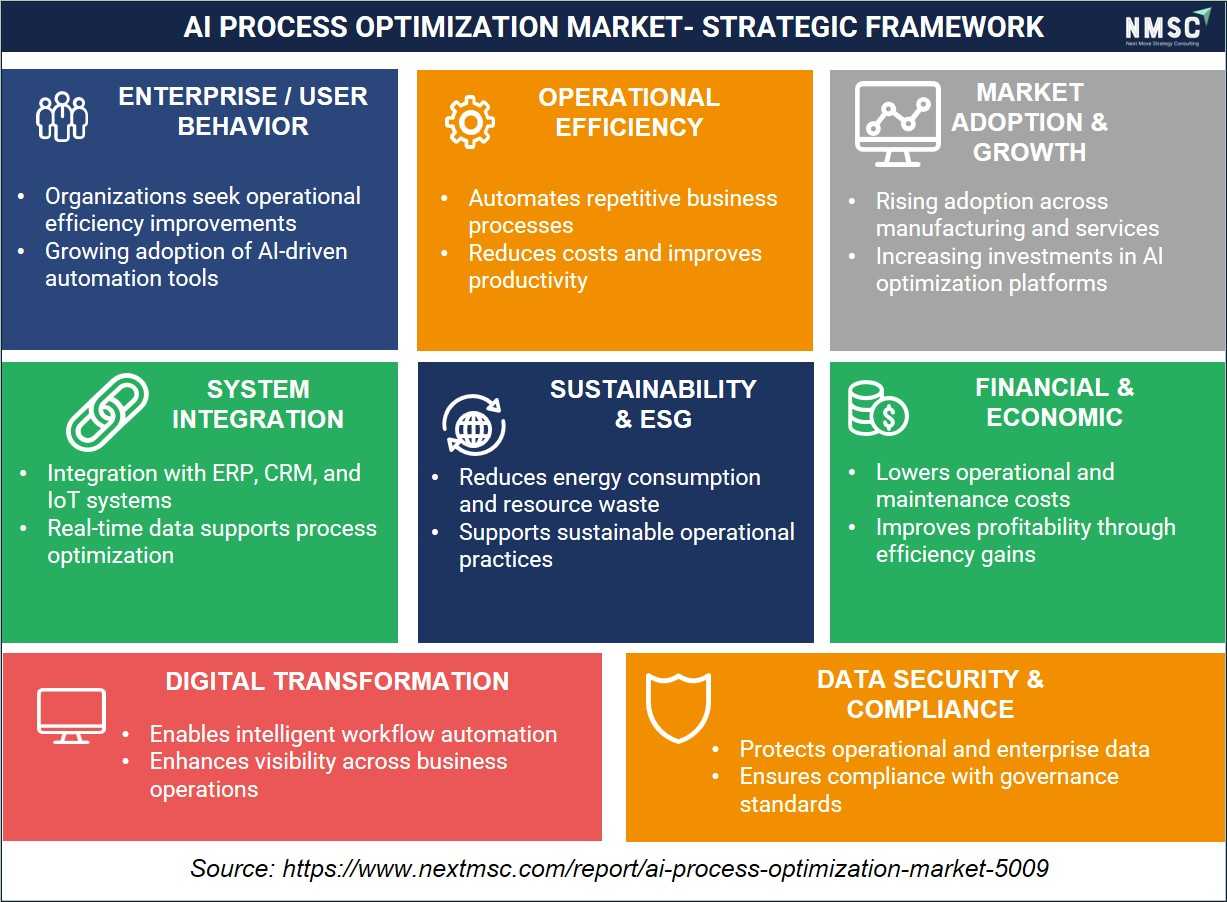
Based on our comprehensive assessment, we found that the AI Process Optimization Market is driven by enterprise demand for automation, productivity enhancement, and real-time operational intelligence. Organizations increasingly deploy AI-powered platforms to optimize workflows, reduce costs, and improve resource utilization. Our analysis indicates that system integration, data security, sustainability initiatives, and digital transformation strategies remain critical factors supporting market expansion and long-term competitive advantage.
Competitive Landscape
Competitive Dynamics and M&A Landscape
|
Key Takeaways |
Details |
|
Market Structure |
Moderately concentrated with Microsoft, IBM, SAP, Oracle, and ServiceNow holding significant share alongside specialized pure-play vendors including Celonis, UiPath, Automation Anywhere, and industrial specialists such as Siemens, Honeywell, and ABB. |
|
Innovation Focus |
Generative AI integration, agentic automation capabilities, process co-pilots, no-code/low-code optimization tools, industrial digital twin platforms, and cloud-native AIOps platforms with embedded ML inference. |
|
M&A Activity |
Active M&A with strategic acquisitions targeting process mining, AIOps, and industrial AI capabilities. Notable activity includes enterprise software vendors acquiring specialized optimization platforms to build integrated end-to-end intelligent process suites. |
How Do Companies Compete in the AI Process Optimization Market?
The AI Process Optimization Market features a multi-layered competitive structure encompassing global enterprise software giants, specialized pure-play vendors, and industrial automation leaders. Market structure is moderately concentrated at the platform level, with Microsoft, IBM, SAP, Oracle, and ServiceNow commanding enterprise relationships built on existing ERP, cloud, and IT service management footprints. Specialized vendors including Celonis in process mining, UiPath in RPA, and Automation Anywhere in intelligent automation compete on technology depth and ecosystem breadth. Industrial automation leaders Siemens, Honeywell, ABB, and Rockwell Automation dominate the industrial process optimization sub-segment through deep operational technology integration and domain expertise.
Which Kind of Companies Dominate the AI Process Optimization Market?
The AI Process Optimization Market is dominated by three distinct company archetypes. First, enterprise software platforms including Microsoft, IBM, SAP, Oracle, and ServiceNow leverage existing enterprise relationships, broad integration ecosystems, and significant R&D investment to embed AI optimization into comprehensive platform offerings. Second, pure-play AI optimization specialists including Celonis, UiPath, Automation Anywhere, Appian, Pegasystems, C3.ai, and FICO compete through technology specialization, domain expertise, and superior product performance in specific optimization use cases. Third, industrial automation conglomerates including Siemens, Honeywell, ABB, Emerson, Rockwell, and Yokogawa dominate the industrial process optimization segment through operational technology integration.
AI-Native Differentiation and Open Standards Drive Market Success in the AI Process Optimization Market
Competitive positioning in the AI Process Optimization Market is increasingly determined by AI-native differentiation and commitment to open standards. Vendors that have built AI capabilities as foundational platform architecture rather than as product overlays are demonstrating superior performance, scalability, and total cost of ownership advantages. Open API architectures, pre-built industry connector libraries, and certification on major cloud marketplaces are becoming baseline competitive requirements. Our assessment indicates that vendors offering explainable AI optimization, built-in audit trails, and AI governance tooling are gaining competitive advantage among enterprise buyers navigating EU AI Act compliance requirements and internal risk management mandates.
Market Players to Opt for Merger and Acquisition Strategies to Expand Their Presence in the AI Process Optimization Market
Merger and acquisition activity is accelerating across the AI Process Optimization Market as established vendors seek to expand capabilities, acquire AI talent, and broaden platform offerings. Enterprise software giants are acquiring specialized process mining, AIOps, and industrial AI platforms to add depth without multi-year organic development timelines. Pure-play AI optimization vendors are acquiring complementary analytics, data integration, and no-code automation tools to build end-to-end intelligent process platforms. Industrial automation companies are investing in AI software startups to accelerate the intelligence layer of their OT product portfolios. NMSC's analysis indicates that M&A activity will remain elevated through 2035 as vendors compete to build comprehensive AI process optimization platform suites.
Who Are the Key Market Players in the AI Process Optimization Market?
-
Microsoft Corporation
-
International Business Machines Corporation
-
SAP SE
-
Oracle Corporation
-
ServiceNow, Inc.
-
Celonis SE
-
UiPath Inc.
-
Automation Anywhere, Inc.
-
Appian Corporation
-
Pegasystems Inc.
-
Siemens AG
-
Schneider Electric SE
-
ABB Ltd
-
Honeywell International Inc.
-
Emerson Electric Co.
-
Rockwell Automation, Inc.
-
C3.ai, Inc.
-
Fair Isaac Corporation
-
SAS Institute Inc.
-
Yokogawa Electric Corporation
What Are the Latest Developments in the AI Process Optimization Industry?
|
Date |
Event |
|
June 2026 |
Microsoft Corporation announced the general availability of the Work IQ APIs, a semantic engine that continuously processes enterprise data (email, meetings, chats) to create a real-time "digital twin" of organizational operations, allowing AI agents to work with deep business context rather than just raw data |
|
April 2026 |
SAP SE expanded its Business AI portfolio with a suite of conversational "Agents" for procurement and supply chain management, designed to automate complex tasks like statement-of-work creation and MRO inventory analysis, reportedly reducing administrative prep time by up to 50%. |
|
June 2025 |
Celonis SE unveiled its Orchestration Engine and major upgrades to its AgentC framework, allowing enterprises to develop custom AI agents that leverage Celonis’s "Process Intelligence Graph"a digital twin of operations, to coordinate actions across diverse legacy systems. |
Expert Insights
 “AI is not fully replacing developers. AI is going to give you a productivity increase, and at that point you can invest that productivity increase in cost cutting or improving revenues.”
— Marco Caronna, Field CTO, GitLab
Statement made during an interview with ITPro discussing the impact of artificial intelligence on software development, developer productivity, and business performance.
Market Interpretation
The statement highlights a core driver of the AI Process Optimization Market: organizations are increasingly adopting AI to improve operational productivity rather than replace employees outright. AI-powered process optimization solutions automate repetitive tasks, accelerate decision-making, reduce operational costs, and improve resource utilization across business functions. As enterprises realize measurable productivity gains, investments are shifting toward AI-enabled workflow automation, intelligent process orchestration, and revenue-enhancing optimization strategies, supporting long-term market expansion.
What Are the Investment Opportunities in the AI Process Optimization Market?
Capital Inflows and Infrastructure Investment Opportunities
The AI Process Optimization Market is attracting significant capital inflows from private equity, venture capital, and corporate strategic investment. AI-native process optimization startups focused on vertical-specific applications in financial services, manufacturing, and healthcare are commanding premium valuations. Infrastructure investments in AI computing hardware, cloud AI services, and edge inference platforms are creating a strong foundation for market expansion. NMSC's analysis indicates that investors with exposure to cloud platforms, industrial AI, and enterprise software ecosystems are well-positioned to capture returns from the market's projected CAGR of 22.6% through 2035. The convergence of AI and operational technology is opening new investment theses around industrial AI platforms that were previously inaccessible to technology investors.
ESG and Sustainability-Driven AI Process Optimization Investment Themes
ESG considerations are emerging as a distinct investment driver within the AI Process Optimization Market. AI-powered energy optimization, emissions monitoring, and sustainability reporting platforms are attracting dedicated ESG investment capital. The EU's Corporate Sustainability Reporting Directive (CSRD) and the SEC's climate disclosure rules are creating regulatory compliance demand for AI platforms that can automate sustainability data collection, process analysis, and reporting workflows. Our findings suggest that industrial AI vendors offering certified carbon footprint reduction capabilities through advanced process control are gaining competitive differentiation and attracting sustainability-focused institutional investors who view AI process efficiency as a direct ESG performance enhancer.
Private Equity and Venture Capital Activity in the AI Process Optimization Market
Private equity and venture capital activity in the AI Process Optimization Market has intensified significantly, with investors targeting both growth-stage pure-play AI optimization platforms and carve-out opportunities from established enterprise software portfolios. Process mining, AIOps, and industrial AI sub-segments have attracted the highest venture capital concentration, reflecting their clear enterprise ROI metrics and strong adoption tailwinds. PE firms are pursuing buy-and-build strategies, acquiring complementary AI process optimization assets to build integrated platform businesses. Our assessment indicates that the market's recurring SaaS revenue model, high retention rates among enterprise customers, and strong expansion revenue characteristics make AI process optimization assets particularly attractive for long-term value creation strategies.
Key Benefits for Stakeholders
For Enterprise Buyers
Enterprise buyers gain comprehensive insights into the AI Process Optimization Market trends, including detailed market sizing across software types, deployment models, organization sizes, and industry verticals. This intelligence supports digital transformation planning, process modernization initiatives, and AI investment prioritization. Our analysis enables decision-makers to identify high-impact automation opportunities, evaluate deployment models, and benchmark technology adoption trends across peer industries. The segmentation analysis further helps enterprises align AI process optimization investments with operational efficiency goals, workforce productivity objectives, and long-term business growth strategies.
For Investors and Financial Analysts
Investors and financial analysts gain access to a structured assessment of the AI Process Optimization Market’s growth outlook, competitive landscape, regional expansion opportunities, and segment-level revenue forecasts through 2035. Detailed CAGR analysis across software categories, deployment modes, and end-user industries supports valuation modeling, investment screening, and portfolio development activities. Company profiling, competitive benchmarking, and strategic development tracking provide early visibility into emerging market leaders, acquisition opportunities, and high-growth technology segments within the AI process optimization ecosystem.
For Technology Vendors and Platform Providers
Technology vendors and platform providers obtain actionable intelligence regarding competitive positioning, whitespace opportunities, and evolving customer requirements across the AI Process Optimization Market. The analysis highlights the fastest-growing software segments, deployment preferences, and industry adoption patterns, enabling vendors to refine product development roadmaps and go-to-market strategies. Regional insights further support geographic expansion planning, while buyer analysis helps vendors optimize channel strategies, partnership development, and customer acquisition initiatives.
For Industrial Automation and Digital Transformation Companies
Industrial automation providers and digital transformation specialists benefit from detailed insights into the convergence of artificial intelligence, process intelligence, robotic process automation, and workflow optimization technologies. The report identifies emerging integration opportunities, potential acquisition targets, and technology adoption trends across manufacturing, logistics, healthcare, financial services, and other major sectors. This intelligence supports innovation planning, solution portfolio expansion, and strategic positioning within the rapidly evolving process optimization landscape.
For Government and Regulatory Bodies
Government agencies and regulatory organizations gain a structured understanding of AI process optimization adoption trends, workforce transformation dynamics, compliance considerations, and technology governance requirements. Country-level and regional insights help policymakers evaluate the economic impact of AI-enabled operational efficiency initiatives and develop evidence-based regulatory frameworks. The analysis also provides visibility into AI deployment challenges, ethical considerations, and industry readiness factors that influence national digital transformation strategies.
For System Integrators and Consulting Firms
System integrators and consulting firms gain detailed visibility into enterprise adoption patterns, implementation priorities, and service opportunities across the AI Process Optimization Market. The segmentation and regional analysis help consulting organizations identify high-growth sectors, develop specialized service offerings, and strengthen expertise in AI-driven workflow automation, process mining, intelligent document processing, and operational analytics. This intelligence supports business development initiatives and long-term practice expansion strategies.
For Academic and Research Institutions
Academic institutions and research organizations benefit from a comprehensive overview of the AI Process Optimization Market's technology landscape, adoption drivers, industry applications, and future innovation trends. The report provides a structured framework for evaluating emerging AI optimization technologies, supporting research initiatives, curriculum development, and industry collaboration programs. Detailed market segmentation and regional analysis also help researchers identify evolving areas of commercial and technological significance.
AI Process Optimization Market Key Segments
By Software
-
Process Mining and Intelligence
-
Process Discovery
-
Conformance Analysis
-
Process Monitoring
-
Task Mining
-
Process Benchmarking
-
Other Process Intelligence
-
-
Workflow Automation and Orchestration
-
Robotic Process Automation
-
Business Process Management
-
Intelligent Workflow Orchestration
-
Document and Task Automation
-
Agentic Process Automation
-
Other Workflow Automation
-
-
Decision Intelligence and Optimization
-
Decision Management
-
Prescriptive Optimization
-
Forecasting and Scenario Planning
-
Scheduling and Resource Optimization
-
Next Best Action Optimization
-
Other Decision Intelligence
-
-
Industrial Process Optimization
-
Advanced Process Control
-
Real Time Optimization
-
Asset Performance Optimization
-
Predictive Maintenance
-
Production Planning and Scheduling
-
Yield and Quality Optimization
-
Energy and Emissions Optimization
-
Plant Simulation and Digital Operations
-
Other Industrial Optimization
-
-
IT Operations Optimization
-
AIOps
-
Incident Optimization
-
Service Workflow Optimization
-
Infrastructure Performance Optimization
-
Other IT Operations Optimization
-
-
Other AI Process Optimization Software
-
Industry Specific Embedded Optimization
-
Niche Optimization Applications
-
By Services
-
Consulting and Advisory
-
Strategy and Readiness Assessment
-
Process Redesign
-
AI Feasibility Assessment
-
-
Implementation and Integration
-
Configuration and Deployment
-
Data Integration
-
Model Development and Customization
-
Enterprise System Integration
-
-
Managed Services and Support
-
Model Monitoring
-
MLOps
-
Technical Support
-
Software Maintenance
-
Managed Optimization Services
-
-
Training and Change Management
-
User Training
-
Adoption and Enablement
-
Organizational Change Management
-
-
Other AI Process Optimization Services
By Technology Type
-
Machine Learning and Deep Learning
-
Computer Vision
-
Natural Language Processing
-
Generative AI
-
Reinforcement Learning
-
Optimization Algorithms
-
Other Technologies
By Deployment Model
-
Cloud
-
Public Cloud
-
Private Cloud
-
Hybrid Cloud
-
-
On-Premises
-
Edge
By Revenue Stream
-
Subscription
-
Perpetual License
-
Usage Based
-
Professional Services
By Sales Channel
-
Direct Sales
-
Partner Channel
-
Embedded OEM
-
Cloud Marketplace
By Buyer Type
-
Operations and Manufacturing
-
Information Technology
-
Supply Chain and Logistics
-
Finance and Risk
-
Customer Service and Shared Services
-
Sustainability and Energy Management
-
Other Buyer Types
By Organization Size
-
Large Enterprise
-
Mid-Sized Enterprise
-
Small Enterprise
By End User Industry
-
Manufacturing Discrete
-
Manufacturing Process
-
Energy and Utilities
-
Oil and Gas
-
Chemicals and Materials
-
Automotive and Mobility
-
Aerospace and Defense
-
Pharmaceuticals and Life Sciences
-
Food and Beverage
-
Metals and Mining
-
Retail and Consumer Goods
-
Logistics and Transportation
-
BFSI
-
Healthcare
-
Public Sector
-
Telecommunications
-
Other Industries
By Region
-
North America: U.S., Canada, and Mexico
-
Europe: UK, Germany, France, Italy, Spain, Sweden, Denmark, Finland, the Netherlands, and the Rest of Europe
-
Asia-Pacific: China, India, Japan, South Korea, Taiwan, Indonesia, Vietnam, Australia, Philippines, Malaysia, and the Rest of APAC
-
Middle East and Africa: Saudi Arabia, UAE, Egypt, Israel, Turkey, Nigeria, South Africa, and the Rest of MEA
-
Latin America: Brazil, Argentina, Chile, Colombia, and the Rest of LATAM
Conclusion and Recommendations
The AI Process Optimization Market is positioned at the intersection of enterprise digital transformation, industrial AI adoption, and generative AI commercialization, creating one of the most structurally compelling technology markets of the decade. The market's projected expansion from USD 18.6 billion in 2025 to USD 142.4 billion by 2035 at a CAGR of 22.6% reflects the broad applicability of AI optimization across process, industrial, IT, and decision-making contexts that span virtually every enterprise and industrial organization globally.
Long-Term Outlook and Strategic Positioning
The long-term outlook for the AI Process Optimization Market is highly favorable, underpinned by structural drivers including enterprise AI adoption, industrial digitization, and regulatory compliance imperatives that will sustain demand well beyond the forecast period. NMSC's analysis indicates that vendors achieving leadership positions in process mining, agentic automation, and industrial AI before 2028 will benefit from significant switching cost advantages and expanding network effects as their platforms accumulate proprietary process intelligence data. Strategic positioning should prioritize generative AI integration, domain-specific industry solutions, and cloud marketplace distribution to capture the fastest-growing market segments.
Investment Attractiveness and Key Risks
The AI Process Optimization Market presents high investment attractiveness across software platform, managed services, and industrial AI sub-segments. The market's recurring SaaS revenue characteristics, strong enterprise retention rates, and expanding usage-based monetization models support favorable unit economics for platform investments. Key risks include implementation complexity inhibiting mid-market adoption, data quality constraints limiting AI model performance, and regulatory compliance costs reducing near-term deployment velocity in Europe. Geopolitical factors affecting cross-border data flows and AI technology access represent additional risk factors for internationally diversified platform vendors. These risks are manageable through focused investment in implementation acceleration tools, data governance capabilities, and local cloud deployment infrastructure.
Growth Pathways and Market Shifts
Primary growth pathways for the AI Process Optimization Market through 2035 include the expansion of agentic AI automation into knowledge-intensive workflows, the integration of AI process optimization with industrial digital twins, the democratization of process intelligence through no-code and conversational AI interfaces, and the extension of AI optimization into sustainability and ESG reporting workflows. Market shifts to monitor include the migration from specialized point solutions toward integrated AI process platforms, the increasing importance of AI governance and explainability as regulatory requirements mature, and the growing role of cloud marketplace ecosystems as the dominant distribution channel for enterprise AI optimization solutions across all geographic markets.
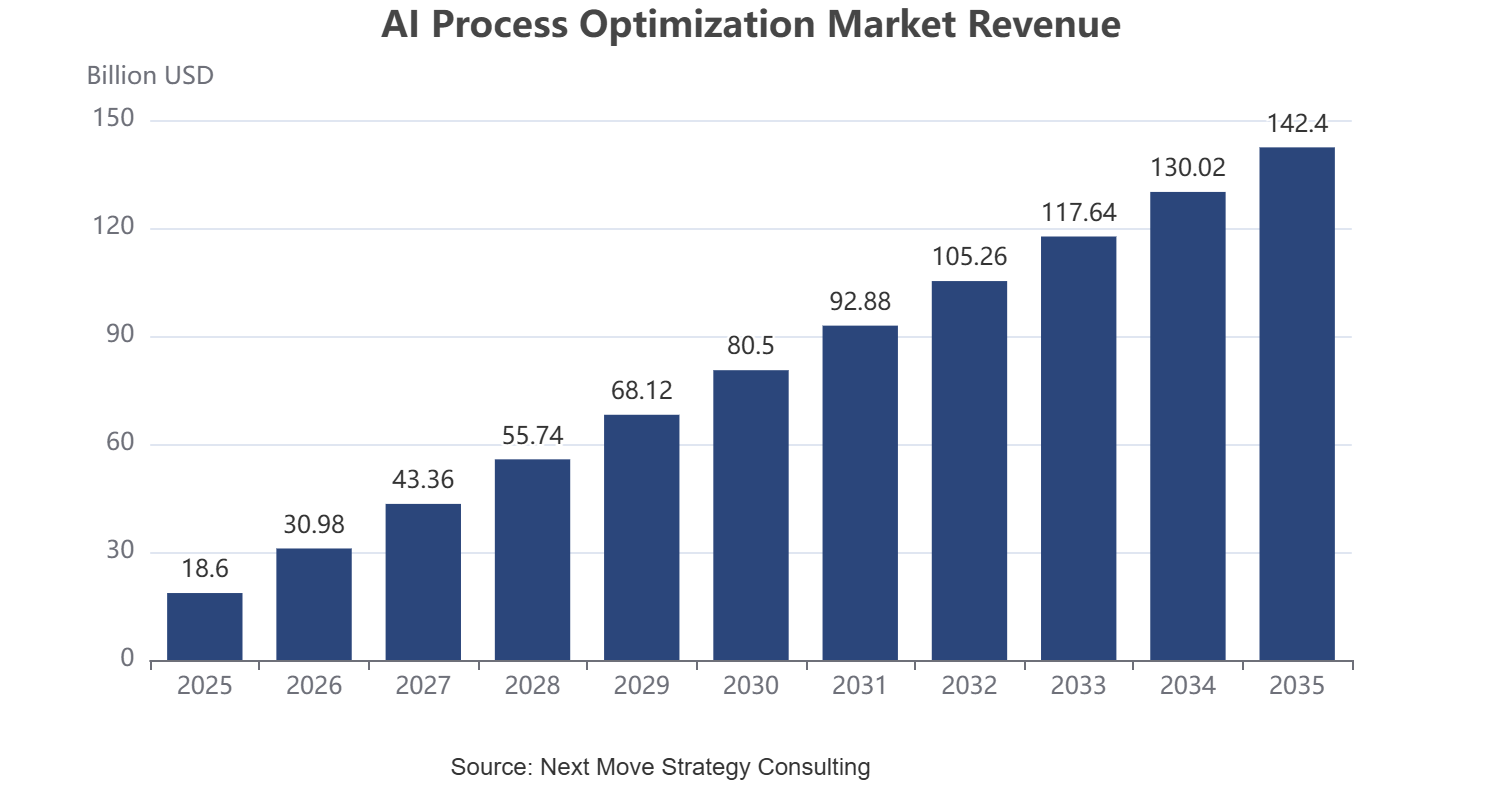
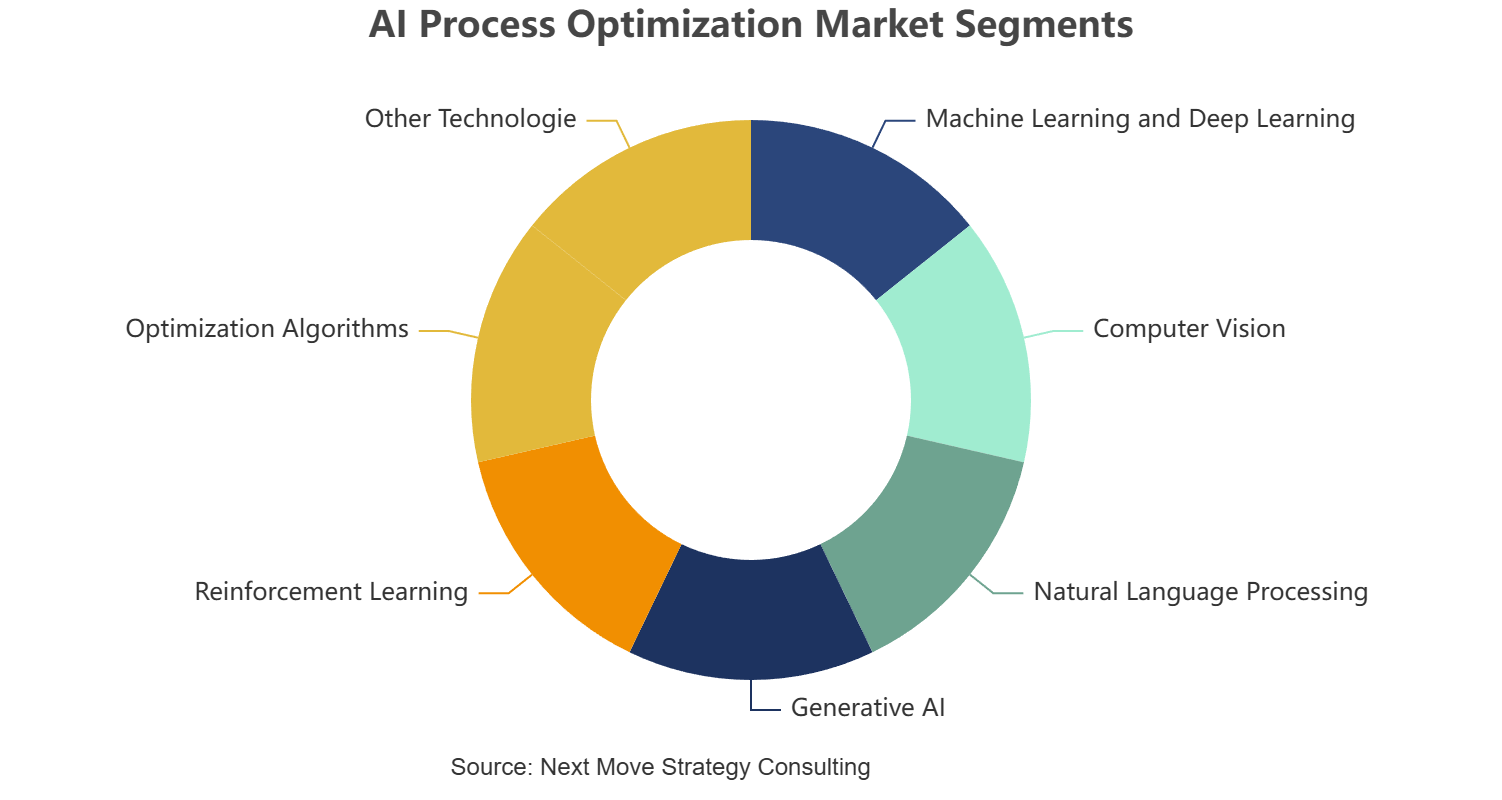
About the Author
 Saista Faiyaz
— Saista Faiyaz is Research Associate at Next Move Strategy Consulting, where she has covered consumer markets and healthcare technologies for 3 years. Her work includes primary interview review, secondary-source validation, market sizing, and structured analysis of company and industry data. She supports research by comparing evidence across sources, organizing findings into market narratives, and documenting assumptions used in analysis. Her scope includes cross-market benchmarking, and reports.
Saista Faiyaz
— Saista Faiyaz is Research Associate at Next Move Strategy Consulting, where she has covered consumer markets and healthcare technologies for 3 years. Her work includes primary interview review, secondary-source validation, market sizing, and structured analysis of company and industry data. She supports research by comparing evidence across sources, organizing findings into market narratives, and documenting assumptions used in analysis. Her scope includes cross-market benchmarking, and reports.
About the Reviewer
 Supradip Baul
— Supradip Baul is an accomplished business consultant and strategist with over a decade of rich experience in market intelligence, strategy, technology, and business transformation. His work has included rigorous qualitative and quantitative analysis across multiple industries, helping clients shape investment decisions and long-term roadmaps. Earlier in his career, he was associated with Gartner, where he contributed to industry-leading reports and market share analyses. He has worked with leading global companies and holds an MBA with a dual specialization in Marketing and Finance.
Supradip Baul
— Supradip Baul is an accomplished business consultant and strategist with over a decade of rich experience in market intelligence, strategy, technology, and business transformation. His work has included rigorous qualitative and quantitative analysis across multiple industries, helping clients shape investment decisions and long-term roadmaps. Earlier in his career, he was associated with Gartner, where he contributed to industry-leading reports and market share analyses. He has worked with leading global companies and holds an MBA with a dual specialization in Marketing and Finance.
At Next Move Strategy Consulting, we understand that insightful market research is the cornerstone of successful business decisions. That's why we employ a robust and multifaceted approach, combining various methodologies to deliver the most accurate and actionable data for our clients.

Research Landscape
We navigate the world of research with two primary approaches:
Qualitative Approach
Our qualitative research methodologies involve immersive techniques such as in-depth interviews, focus groups, and observational studies. By engaging directly with individuals and stakeholders, we uncover valuable insights that quantitative data alone may overlook.

Quantitative Research
In tandem with qualitative methodologies, NMSC leverages the power of Quantitative Research to provide a robust foundation of numerical insights. Through systematic data collection and analysis, we quantify patterns, preferences, and market trends, offering a comprehensive view of the business landscape.
Our quantitative research approach employs diverse tools, including surveys, experiments, and statistical modelling. These methodologies enable us to gather data from a large and representative sample, ensuring the statistical significance of our findings. By employing structured questionnaires and standardized data collection methods, we guarantee the reliability and validity of the information we present to our clients.
Quantitative research is particularly effective in measuring the prevalence of trends, assessing market size, and gauging the impact of various factors on consumer behavior. The numerical precision attained through this approach equips our clients with actionable insights, facilitating data-driven decision-making and strategy formulation.


Our Specialized Toolbox for Industry-Specific Market Research
We deploy a specialized arsenal of techniques tailored to meet your unique requirements. Here's a glimpse into our comprehensive toolbox:

Information Procurement
The stage entails acquiring market data or relevant information through various sources and methodologies.


Market Research Approach
We utilize both top-down and bottom-up approaches in market research analysis to achieve a comprehensive understanding of the market dynamics, leveraging the broad perspective of industry trends and macroeconomic factors alongside detailed insights from specific segments and individual companies.

Porters Five Forces Analysis
We conduct Porter's Five Forces analysis to evaluate the competitive landscape of an industry, providing us with insights into factors that affect profitability and strategic positioning.

SWOT Analysis

Forecasting
We utilize a forecasting model to predict future consumption by considering parameters like population, economics, regulations, market competition, drivers, constraints, technology, and pricing. We also employ statistical techniques such as multilinear regression, exponential smoothing, moving average, ARIMA, and Monte Carlo simulations for accurate predictions. In econometric forecasting, we analyzed short-term and long-term event impacts, attributing values based on regulatory frameworks, economic factors, and market events.





 Speak to Our Analyst