AI in Climate Market Size, Share & Forecast by Offering Type (Application Software and SaaS: Carbon Management and Sustainability Reporting, Climate Risk and Resilience Analytics, Weather and Climate Forecasting, Energy and Grid Optimization, Land and Agriculture Intelligence, Environmental Monitoring and Response; Data and API Services), Deployment Mode, Application, Data Source, Revenue Model, Customer Type, Sales Channel, End Industry — Global Analysis 2025–2035
Industry: ICT & Media | Publishing Date: July 7, 2026 | Last Updated: September 30, 2026 | No of Pages: N/A | No. of Tables: N/A | No. of Figures: N/A | Format: PDF | Report Code: IC4995
What Is the AI in Climate Market Size?
The global AI in Climate Market was valued at USD 26.8 billion in 2025 and is projected to reach USD 34.87 billion in 2026. Propelled by mandatory corporate climate disclosures under SEC and ISSB frameworks, the rapid scale-up of generative AI applied to weather modelling, rising institutional demand for physical climate risk analytics, and accelerating government investment in digital climate infrastructure, the market is forecast to reach USD 372.31 billion by 2035 at a CAGR of 30.1% from 2026 to 2035. The convergence of foundation model architectures with climate science, coupled with the explosion of satellite earth observation data, is creating an entirely new category of climate-intelligence infrastructure that spans enterprise software, API data services, and AI compute platforms globally.
|
Parameters |
Details |
|
Market Size in 2025 |
USD 26.8 Billion |
|
Market Size in 2026 |
USD 34.87 Billion |
|
Revenue Forecast in 2035 |
USD 372.31 Billion |
|
Growth Rate |
CAGR of 30.1% from 2026 to 2035 |
|
Analysis Period |
2025–2035 |
|
Base Year Considered |
2025 |
|
Forecast Period |
2026–2035 |
|
Market Size Estimation |
USD Billion |
|
Companies Profiled |
20 |
|
Countries Covered |
33 |
|
Market Share |
Top 10 |
AI in Climate Market Overview
What Is the AI in Climate Market and What Does It Cover?
The AI in Climate Market encompasses all commercially deployed artificial intelligence solutions, application software, data and API services, model hosting platforms, and professional services, whose primary function is to address climate-related challenges, including emissions management, climate risk quantification, weather forecasting, energy optimization, agricultural intelligence, and environmental monitoring. The market is measured at the point of sale from the software vendor or platform provider to the first institutional or enterprise buyer. It excludes general-purpose AI infrastructure that is not climate-specific, and adjacent markets such as renewable energy equipment or carbon credit trading platforms where AI is incidental rather than the primary value driver.
How Has the AI in Climate Market Structurally Evolved?
The AI in Climate Market has evolved through three structural phases. The first phase, from roughly 2015 to 2020, was characterized by point solutions, satellite imagery analytics for deforestation monitoring, weather API services, and early emissions tracking tools, deployed by specialist startups. The second phase, from 2020 to 2023, saw major cloud providers embed climate workloads into their AI platforms and established enterprise software vendors acquire climate analytics capabilities. From our research, we found that the current third phase is defined by foundation model architectures trained on climate and earth observation data, exemplified by Google's NeuralGCM and Microsoft's Aurora, that are collapsing the cost and latency of climate modeling at a global scale.
How Does the Regulatory Environment Shape the AI in Climate Market?
Regulatory mandates are the most powerful structural demand accelerator for AI in Climate Market. The U.S. Securities and Exchange Commission's Climate Disclosure Rule, adopted in 2024, requires public companies to report material climate risks and Scope 1 and 2 emissions, directly stimulating demand for AI-powered carbon management and climate risk platforms. The International Sustainability Standards Board's IFRS S2 standard mandates climate-related financial disclosures for its adopting jurisdictions globally. The European Union's Corporate Sustainability Reporting Directive (CSRD) extends mandatory sustainability reporting to approximately 50,000 companies across the EU. NMSC's assessment indicates that regulatory compliance is converting discretionary AI climate spending into obligatory enterprise procurement across financial services, energy, andmanufacturing sectors.
How Is Technology Adoption Progressing Across the AI in Climate Market?
Technology adoption within the AI in Climate Market is accelerating faster than in most enterprise software categories, driven by the simultaneous maturation of three enabling technologies: large-scale earth observation satellite constellations providing continuous global coverage at meter-scale resolution; foundation models that can be fine-tuned on climate datasets at dramatically lower cost than custom model development; and cloud-native AI compute platforms that make previously supercomputer-scale climate simulation accessible to enterprise buyers. Our assessment indicates that adoption is most advanced in financial services, where physical and transition climate risk quantification is now a regulatory requirement, and in the energy sector, where AI-driven grid optimization and virtual power plant management deliver measurable operational return on investment.
Ecosystem Analysis of the AI in Climate Market
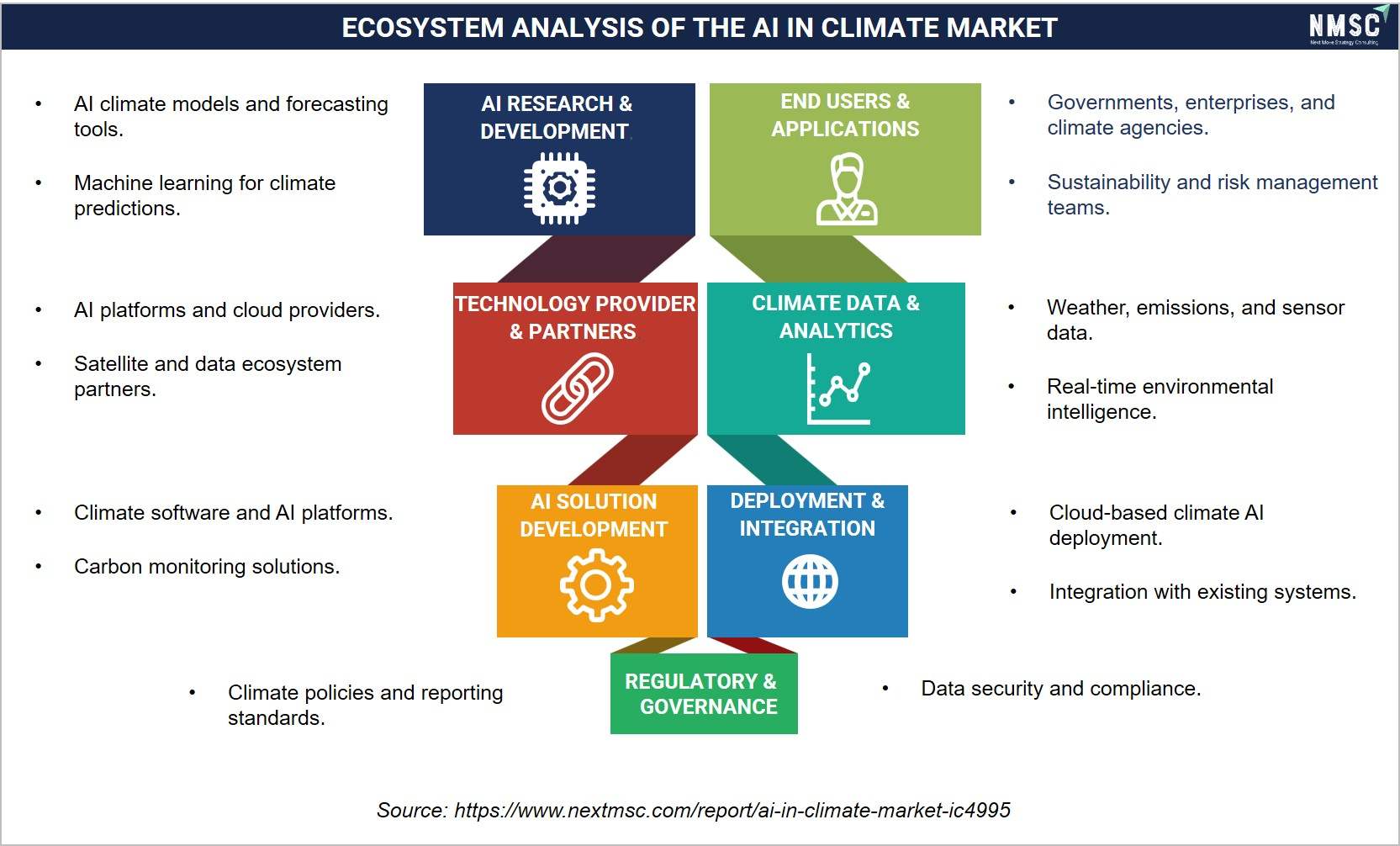
The above infographic presents an ecosystem analysis of the AI in climate market, organized across key pillars including R&D, technology providers, climate data, solution development, deployment, governance, and end users. We observed that AI research focuses on climate modelling and predictive analytics, supported by technology partners and data providers. Solution development and integration enable real-world deployment, while regulatory governance ensures compliance and ethical use. End users, further span governments, enterprises, and climate agencies. Looking ahead, we found that these interconnected elements collectively shape the market's evolution across the sector.
|
Key Takeaways |
|
Application Software and SaaS is the dominant offering segment at USD 12.08 billion in 2025 (45.1% global share), led by carbon management platforms whose adoption is being mandated by SEC, CSRD, and ISSB disclosure requirements. |
|
Climate AI Platforms and Infrastructure is the fastest-growing offering segment at a CAGR of 35.2% from 2026 to 2035, driven by the rapid commercialisation of foundation climate models and AI compute infrastructure purpose-built for climate simulation workloads. |
|
Cloud deployment commands the dominant share at USD 18.76 billion in 2025 (70.0% share), enabling the scalable processing of petabyte-scale earth observation and weather data without on-premises infrastructure investment. |
|
Cloud remains the fastest-growing deployment mode at a CAGR above 31%, as hyperscalers, Microsoft Azure, Google Cloud, and AWS, launch purpose-built climate AI services and data marketplace offerings that reduce buyer onboarding friction. |
|
Energy and Utilities is the largest end industry at USD 6.97 billion in 2025, driven by AI-powered grid optimization, virtual power plant management, and renewable energy forecasting that deliver direct operational return on investment. |
|
Financial Services and Insurance is growing at a CAGR of 32.4% from 2026 to 2035, driven by mandatory physical climate risk disclosure, portfolio stress testing against IPCC climate scenarios, and AI-enhanced catastrophe underwriting models. |
|
Carbon Management and Sustainability Reporting is the largest application at USD 4.82 billion in 2025, underpinned by SEC, CSRD, and ISSB regulatory compliance cycles across global enterprises. |
|
Environmental Monitoring and Response, encompassing wildfire intelligence, flood analytics, and methane detection, is the fastest-growing application at a CAGR of 34.1%, driven by escalating climate event frequency and government emergency response investment. |
|
Subscription is the dominant revenue model, reflecting the SaaS transition of carbon management, climate risk analytics, and weather forecasting platforms from perpetual license to recurring revenue structures. |
|
Usage-Based pricing is the fastest-growing revenue model at a CAGR exceeding 36%, as data and API services and AI inference platforms adopt consumption pricing aligned with developer and enterprise buyer preferences for variable-cost access. |
|
North America held USD 11.22 billion in 2025 (41.9% share), anchored by SEC climate disclosure mandates, the world's largest enterprise software procurement base, and the highest concentration of AI climate companies globally. |
|
Asia-Pacific is the fastest-growing major region at a CAGR of 34.8% from 2026 to 2035, rising from USD 5.36 billion in 2025 to USD 111.69 billion by 2035, driven by climate-resilience investment in China, India, and Southeast Asia. |
|
The United States is the dominant country market, representing approximately 76% of North American AI in Climate Market revenue in 2025, anchored by regulatory mandates, venture capital concentration, and the presence of all major hyperscale AI platform providers. |
|
India is the fastest-growing individual country in the AI in Climate Market, driven by the government's National Action Plan on Climate Change, the proliferation of agritech and climate resilience startups, and increasing CSRD-driven demand from multinational exporters. |
Key Emerging Trends in the AI in Climate Market
How Are Foundation Climate Models Transforming the AI in Climate Market?
Foundation models trained on climate and earth observation data represent the most transformative structural shift in the AI in Climate Market since the emergence of commercial weather APIs. Google DeepMind's GraphCast and Microsoft's Aurora models, both published in peer-reviewed journals in 2024, have demonstrated forecast accuracy at or above leading numerical weather prediction systems, at a fraction of the compute cost. Our analysis shows that these models are collapsing the cost of global-scale weather and climate forecasting from millions of dollars per model run on supercomputer infrastructure to tens of dollars on cloud AI compute, fundamentally democratising access to high-resolution climate intelligence for mid-market enterprise buyers.
How Is the SEC Climate Disclosure Rule Driving Enterprise Adoption in the AI in Climate Market?
The SEC's final climate disclosure rule, which requires registrants to disclose material climate risks and Scope 1 and 2 GHG emissions, is generating a compliance-driven procurement cycle that NMSC's analysis estimates is adding several billion dollars in incremental carbon management and climate risk software demand annually across U.S. public companies. Enterprise buyers across financial services, energy, and industrials are migrating from spreadsheet-based carbon accounting to AI-powered platforms that automate Scope 3 attribution, validate supplier emissions data, and generate audit-ready XBRL disclosures. Watershed Technology and Microsoft Cloud for Sustainability are among the platforms directly benefiting from this regulatory demand signal.
How Is Satellite Earth Observation Becoming the Primary Data Layer for the AI in Climate Market?
The proliferation of commercial satellite constellations, Planet Labs operates over 200 satellites providing daily global coverage, while Spire Global's RF constellation tracks atmospheric and maritime data, is creating a petabyte-scale earth observation data layer that is the essential feedstock for AI-driven environmental monitoring, deforestation tracking, methane detection, and agricultural intelligence. Through our market assessment, we observed that the cost per satellite observation has fallen by over 90% in the past decade, converting earth observation from a government-funded research resource into a commercially viable enterprise data service. Geospatial AI APIs built on this data are the fastest-growing sub-category within the AI in Climate Market's Data and API Services segment.
How Is AI-Driven Energy and Grid Optimization Reshaping the AI in Climate Market?
AI-powered energy and grid optimization is emerging as one of the highest return-on-investment application categories in the AI in Climate Market, attracting enterprise procurement from utilities, grid operators, and energy retailers seeking to manage the volatility introduced by high renewable energy penetration. Virtual power plant platforms, which aggregate distributed energy resources including rooftop solar, batteries, and demand response assets into a single dispatchable resource, rely on AI forecasting models that predict generation, consumption, and grid conditions at sub-hourly resolution. Schneider Electric and Siemens report deployments of AI grid optimization tools across multiple utility customers globally, with measurable reductions in balancing costs and curtailment events.
What Are the Key Market Drivers, Breakthroughs, and Investment Opportunities That Will Shape the AI in Climate Market Industry in the Next Decade?
The AI in Climate Market's 30.1% CAGR from 2026 to 2035 is supported by regulatory mandates that are converting discretionary climate software spending into obligatory enterprise procurement, a technology step-change in foundation model performance applied to climate data, and an unprecedented scale-up of satellite earth observation infrastructure. NMSC's analysis identifies these as the three primary growth pillars, counterbalanced by structural risks including data sovereignty barriers, AI energy consumption concerns, and model explainability requirements for regulatory climate disclosures. The following matrix maps each major market force to its directional CAGR impact, geographic applicability, and expected activation timeline.
|
Driver / Trend / Restraint |
(+/–) % CAGR Impact |
Geographic Relevance |
Impact Timeline |
|
SEC and ISSB Mandatory Climate Disclosure |
+ 3.8% |
North America, Europe, Global Multinationals |
2025–2030 |
|
CSRD Corporate Sustainability Reporting Directive |
+ 2.9% |
Europe, EU-Trade Partners |
2025–2029 |
|
Foundation Climate Model Commercialisation |
+ 4.2% |
Global |
2025–2035 |
|
Satellite EO Data Cost Reduction |
+ 2.6% |
Global |
2025–2032 |
|
Physical Climate Risk Insurance and Lending Mandates |
+ 2.1% |
North America, Europe, APAC |
2026–2035 |
|
AI Grid Optimization for Renewable Integration |
+ 1.8% |
Europe, North America, APAC |
2025–2033 |
|
AI Energy Consumption and Carbon Backlash Risk |
– 1.2% |
Global |
2025–2035 |
|
Data Sovereignty and Cross-Border Data Restrictions |
– 0.9% |
MEA, APAC |
2025–2032 |
|
Model Explainability Requirements for Regulatory Use |
– 0.7% |
Global |
2026–2035 |
What Are the Growth Drivers of the AI in Climate Market?
How Do Mandatory Climate Disclosure Frameworks Create Structural Demand in the AI in Climate Market?
Mandatory climate disclosure is converting the AI in Climate Market from an innovation-driven to a compliance-driven procurement category, a structural shift that dramatically accelerates revenue growth and reduces buyer adoption risk. The U.S. SEC's final rule on climate-related disclosures, published in the Federal Register in March 2024, requires all registrants to report material climate risks and large accelerated filers to disclose Scope 1 and 2 GHG emissions beginning with fiscal year 2025. The ISSB's IFRS S2 Climate Disclosures standard has been adopted by 29 jurisdictions as of 2025. The EU's CSRD extends mandatory sustainability reporting to approximately 50,000 companies, creating the world's largest single regulatory demand cohort for AI-powered carbon management and climate risk platforms.
How Does the Commercialisation of Foundation Climate Models Accelerate Growth in the AI in Climate Market?
Foundation model breakthroughs are expanding the AI in Climate Market's total addressable market by making high-accuracy climate intelligence accessible to buyers who previously could not afford numerical weather prediction or bespoke climate modeling. Google's publication of NeuralGCM in Nature in 2024 demonstrated that a neural network-based atmospheric model can match the accuracy of ECMWF's leading ensemble forecast at a compute cost several orders of magnitude lower. Microsoft's Aurora model, released in 2024, demonstrated state-of-the-art performance across air quality, ocean wave, and weather forecasting tasks within a single unified model. NMSC's analysis indicates these advances are enabling a new class of AI climate API businesses to offer sub-kilometre forecast resolution at commercially viable price points for the first time.
How Is the Physical Climate Risk Imperative Driving Enterprise Procurement in the AI in Climate Market?
Physical climate risk, the financial exposure of assets, supply chains, and operations to climate hazards, including floods, wildfires, heatwaves, and sea-level rise, has become a mandatory disclosure category under SEC, TCFD, and ISSB frameworks, creating a sustained procurement cycle for AI-powered physical risk analytics platforms. The U.S. Federal Reserve's guidance on climate risk management for large financial institutions, published in 2023, explicitly requires scenario analysis capabilities that map to physical risk metrics. Jupiter Intelligence, Four Twenty Seven (a Moody's company), and similar platforms are seeing enterprise procurement driven directly by these regulatory risk management expectations across banking, insurance, and real estate investment.
What Are the Growth Inhibitors of the AI in Climate Market?
How Does AI Energy Consumption Create a Credibility Risk for the AI in Climate Market?
The AI in Climate Market faces a structurally uncomfortable contradiction: AI model training and inference consume substantial electricity, and large language model training runs have documented carbon footprints that critics argue undermine the sector's climate credentials. The International Energy Agency's 2024 Energy and AI report documented that data centre electricity consumption is projected to at least double by 2030 globally, a trajectory that intersects directly with the AI in Climate Market's growth narrative. NMSC's assessment indicates that vendors without credible renewable energy sourcing for their AI compute infrastructure face increasing reputational risk from enterprise ESG procurement teams and NGO scrutiny, creating a material procurement barrier, particularly in European markets with mature sustainability governance standards.
How Do Data Sovereignty Barriers and Cross-Border Restrictions Constrain AI in Climate Market Expansion?
Data sovereignty regulations are creating fragmentation in the AI in Climate Market's global TAM, particularly for cloud-hosted climate AI platforms that rely on the aggregation of satellite, weather, and enterprise emissions data across jurisdictions. The European Union's Data Act and Data Governance Act restrict cross-border transfer of certain categories of public-sector data, limiting the ability of U.S.-based AI climate platforms to ingest EU public data at scale without establishing locally compliant data processing infrastructure. China's Cybersecurity Law and Data Security Law create parallel restrictions that effectively segment the Chinese AI climate market as a closed ecosystem, requiring separate product development and data governance investment for market entry.
What Are the Growth Opportunities in the AI in Climate Market?
How Does the Emerging Physical Climate Risk Insurance Market Create a Billion-Dollar Opportunity in the AI in Climate Market?
The global reinsurance and specialty insurance industry is at an inflection point where traditional actuarial models, calibrated on historical loss data, are systematically under-pricing physical climate risk as climate change accelerates the frequency and severity of extreme weather events. The result is a structural demand shift toward AI-powered underwriting analytics that can incorporate forward-looking climate scenario data, high-resolution physical risk scores, and real-time satellite monitoring of insured assets. Munich Re's 2024 Natural Disaster Figures documented global insured losses of USD 60 billion in the first half of 2024 alone, creating regulatory and competitive pressure on insurers to invest in AI climate analytics capabilities as a matter of solvency risk management.
How Does Agricultural Climate Intelligence Represent a Scalable Growth Opportunity in the AI in Climate Market?
Agriculture contributes approximately 10% of global greenhouse gas emissions and is simultaneously among the economic sectors most exposed to physical climate risk, creating a double-sided demand signal for AI in Climate Market applications across both emissions management and climate resilience. The USDA's Foreign Agricultural Service and India's Ministry of Agriculture are among government bodies investing in AI-powered crop monitoring and yield forecasting capabilities. Commercial platforms, including SatSure Analytics and Planet Labs, are deploying AI models trained on satellite imagery and weather data to deliver field-level crop health monitoring, yield prediction, and drought early warning services to agricultural enterprises and financial institutions providing agri-credit in climate-vulnerable regions.
How Does the UNFCCC Global Stocktake Create a Multi-Year Government Procurement Opportunity in the AI in Climate Market?
The UNFCCC's Global Stocktake process, which assesses collective progress against Paris Agreement commitments, is creating a recurring government procurement cycle for national greenhouse gas inventory systems, Measurement Reporting and Verification (MRV) infrastructure, and climate adaptation planning tools, all of which increasingly incorporate AI components. The UNFCCC Secretariat's 2023 synthesis report on Nationally Determined Contributions identified significant gaps between stated national commitments and verifiable implementation, creating political pressure for governments to deploy AI-powered MRV systems that can demonstrate emissions reductions with satellite-verified evidence. This government procurement driver is most concentrated in APAC, MEA, and Latin America, where NDC implementation gaps are largest and donor-funded AI climate technology deployment is accelerating.
How Is the AI in Climate Market Segmented in This Report, and What Are the Key Insights from the Segmentation Analysis?
Which Offering Type Generates the Largest Share of AI in Climate Market Revenue?
|
Segments |
2025 (USD Bn) |
2035 (USD Bn) |
CAGR (%) |
|
Application Software and SaaS |
12.08 |
160.00 |
29.5% |
|
Data and API Services |
7.51 |
89.36 |
31.6% |
|
Climate AI Platforms and Infrastructure |
4.02 |
74.46 |
38.5% |
|
Professional Services |
3.19 |
48.49 |
31.5% |
The AI in Climate Market's Offering Type segmentation confirms Application Software and SaaS as the dominant revenue category at USD 12.08 billion in 2025, led by carbon management and sustainability reporting platforms whose adoption is being mandated by SEC, CSRD, and ISSB compliance cycles; within this segment, emissions tracking and ESG disclosure sub-applications are currently the highest-revenue sub-categories, while climate risk and resilience analytics, covering physical risk assessment, portfolio stress testing, and underwriting analytics., is the fastest-growing sub-category as financial institution regulatory requirements escalate. Data and API Services at USD 7.51 billion in 2025 are growing at 31.6% CAGR as earth observation data APIs and risk score products convert satellite infrastructure investment into recurring API revenue. Climate AI Platforms and Infrastructure is the fastest-growing primary offering at 38.5% CAGR, driven by the commercialisation of foundation climate models and climate-specific AI compute infrastructure. Professional Services at USD 3.19 billion reflects the implementation, systems integration, and custom model development work required to deploy AI climate platforms into enterprise environments.
How Do Deployment Modes Shape Revenue Distribution in the AI in Climate Market?
|
Segments |
2025 (USD Bn) |
2035 (USD Bn) |
CAGR (%) |
|
Cloud |
18.76 |
297.85 |
32.0% |
|
On-Premises |
4.02 |
37.23 |
25.1% |
|
Hybrid |
4.02 |
37.23 |
25.1% |
Cloud deployment dominates the AI in Climate Market at USD 18.76 billion in 2025, representing 70.0% of global revenue, because the data volumes involved in climate AI workloads, spanning petabyte-scale satellite imagery, global weather model outputs, and enterprise emissions datasets, make on-premises processing economically and technically impractical for all but the most resource-rich government agencies. Cloud is also the fastest-growing deployment mode at a CAGR of 32.0% as hyperscalers, including Microsoft Azure, Google Cloud Platform, and Amazon Web Services, invest in purpose-built climate data lakes, foundation model inference APIs, and sustainability software marketplaces that reduce enterprise buyer onboarding friction. On-premises and hybrid deployments retain relevance in regulated financial services and government defense contexts where data residency requirements and classified climate intelligence applications preclude full cloud adoption.
How Do Application Areas Define Revenue Distribution in the AI in Climate Market?
|
Segments |
2025 (USD Bn) |
2035 (USD Bn) |
CAGR (%) |
|
Carbon Management and Sustainability Reporting |
4.82 |
65.16 |
29.5% |
|
Climate Risk and Resilience |
4.56 |
64.42 |
30.3% |
|
Weather and Climate Forecasting |
5.36 |
74.46 |
29.8% |
|
Energy and Grid Optimization |
4.02 |
74.46 |
38.5% |
|
Land and Agriculture Intelligence |
2.68 |
37.23 |
29.8% |
|
Environmental Monitoring and Response |
3.22 |
44.68 |
29.8% |
|
Other Applications |
2.14 |
11.90 |
18.7% |
Weather and Climate Forecasting is the single largest application at USD 5.36 billion in 2025, reflecting the established commercial history of meteorological data services and their expansion into AI-enhanced nowcasting, medium-range, and climate-scale products; The Tomorrow Companies, AccuWeather, and Meteomatics represent the commercial incumbent tier, increasingly challenged by foundation model entrants from Google and Microsoft. Energy and Grid Optimization is the fastest-growing application at a CAGR of 38.5%, driven by utility procurement of AI virtual power plant and distributed energy resource management platforms as renewable energy penetration creates grid volatility requiring sub-hourly AI forecasting. Carbon Management and Sustainability Reporting and Climate Risk and Resilience are each growing above 29% CAGR, driven by regulatory compliance mandates across enterprise, financial institution, and government buyer segments globally.
Which Data Sources Are Most Critical to the AI in Climate Market?
|
Segments |
2025 (USD Bn) |
2035 (USD Bn) |
CAGR (%) |
|
Satellite and Earth Observation |
8.04 |
130.31 |
32.1% |
|
Weather Station and Radar |
6.70 |
89.35 |
29.5% |
|
IoT and Sensors |
4.02 |
74.46 |
38.5% |
|
Enterprise Systems |
4.02 |
44.68 |
27.1% |
|
Public and Open Data |
2.68 |
22.34 |
23.6% |
|
Other Data Sources |
1.34 |
11.17 |
23.5% |
Satellite and Earth Observation is the largest and fastest-growing data source segment in the AI in Climate Market at USD 8.04 billion in 2025, reflecting the central role of satellite imagery, hyperspectral data, and synthetic aperture radar in powering environmental monitoring, deforestation tracking, methane detection, and agricultural intelligence applications; Planet Labs and Spire Global are primary commercial data providers enabling this sub-segment's expansion. IoT and sensors are the fastest-growing data sources at a CAGR of 38.5%, driven by the proliferation of industrial emissions sensors, smart grid devices, and agricultural IoT networks that generate the real-time measurement data required for AI-powered emissions monitoring and energy optimization platforms.
How Are Revenue Models Evolving in the AI in Climate Market?
|
Segments |
2025 (USD Bn) |
2035 (USD Bn) |
CAGR (%) |
|
Subscription |
13.40 |
178.71 |
29.5% |
|
Usage Based |
6.70 |
111.69 |
32.5% |
|
Perpetual License |
2.68 |
22.34 |
23.6% |
|
Professional Services |
4.02 |
59.57 |
31.2% |
Subscription is the dominant revenue model in the AI in Climate Market at USD 13.40 billion in 2025, representing 50.0% of total revenue, reflecting the SaaS transition of carbon management, climate risk analytics, and weather forecasting platforms from perpetual license to annual recurring revenue structures that align vendor incentives with ongoing customer success and regulatory compliance cycles. Usage-Based pricing is the fastest-growing model at a CAGR of 32.5%, driven by the proliferation of AI climate API services and foundation model inference platforms, where consumption-based pricing aligns with developer and enterprise buyer preferences for variable-cost access that scales with deployment volume. Perpetual License revenue is declining in relative share as established vendors migrate existing customers to subscription models.
Which Customer Types Are Driving Revenue Growth in the AI in Climate Market?
|
Segments |
2025 (USD Bn) |
2035 (USD Bn) |
CAGR (%) |
|
Enterprise |
12.08 |
163.82 |
29.6% |
|
Financial Institutions |
7.51 |
111.69 |
31.3% |
|
Public Sector |
4.56 |
59.57 |
29.4% |
|
Developers |
1.88 |
26.06 |
29.8% |
|
Consumers |
0.77 |
11.17 |
30.8% |
Enterprise is the dominant customer segment in the AI in Climate Market at USD 12.08 billion in 2025, encompassing large corporations in energy, manufacturing, logistics, and retail sectors deploying AI climate tools for carbon management, supply chain emissions monitoring, and physical risk assessment driven by regulatory disclosure requirements. Financial Institutions represent the fastest-growing customer segment among institutional buyers at a CAGR of 31.3%, as banks, asset managers, insurers, and pension funds face mandatory climate risk disclosure obligations under SEC, ECB, and PRA frameworks that require AI-powered portfolio stress testing, physical risk scoring, and transition risk scenario analysis capabilities. Public Sector procurement is growing at 29.4% as government agencies invest in national MRV systems, climate adaptation planning tools, and emergency response analytics.
How Do Sales Channels Shape Go-to-Market Strategy in the AI in Climate Market?
|
Segments |
2025 (USD Bn) |
2035 (USD Bn) |
CAGR (%) |
|
Direct Sales |
13.40 |
156.37 |
27.7% |
|
Self-Serve API |
5.36 |
89.35 |
32.5% |
|
Channel Partner |
5.36 |
89.35 |
32.5% |
|
Embedded OEM |
2.68 |
37.24 |
29.8% |
Direct Sales remains the dominant channel in the AI in Climate Market at USD 13.40 billion in 2025, driven by the enterprise and financial institution buyer segments, where complex, multi-stakeholder procurement processes and high contract values, typically ranging from six to eight figures annually, require dedicated sales, solution engineering, and regulatory expertise that self-serve models cannot support. Self-Serve API and Channel Partner channels are both growing at a CAGR of 32.5%, reflecting the dual motion of AI climate platforms that serve enterprise buyers through direct sales while simultaneously building developer ecosystems through API marketplaces and distributing through cloud provider marketplaces and sustainability consulting partner networks. Embedded OEM integration, where AI climate capabilities are embedded within ERP, treasury, and risk management platforms, is the emerging model expected to deliver the most scalable distribution reach through 2035.
How Do End Industry Verticals Compare in the AI in Climate Market?
|
Segments |
2025 (USD Bn) |
2035 (USD Bn) |
CAGR (%) |
|
Energy and Utilities |
6.97 |
89.35 |
29.2% |
|
Financial Services and Insurance |
4.56 |
74.46 |
32.4% |
|
Agriculture and Food |
4.02 |
55.85 |
29.8% |
|
Government and Defense |
3.48 |
44.68 |
29.2% |
|
Logistics and Transportation |
2.41 |
29.78 |
28.7% |
|
Built Environment and Real Estate |
2.14 |
26.06 |
28.4% |
|
Industrial and Manufacturing |
1.88 |
22.34 |
27.9% |
|
Retail and Consumer Goods |
0.80 |
18.61 |
36.8% |
|
Other Industries |
0.54 |
11.18 |
35.6% |
Energy and Utilities is the largest end industry in the AI in Climate Market at USD 6.97 billion in 2025, driven by AI-powered grid optimization, renewable energy forecasting, virtual power plant management, and decarbonisation pathway planning, applications that deliver measurable operational return on investment rather than purely compliance-driven value. Financial Services and Insurance is the fastest-growing major industry vertical at a CAGR of 32.4%, directly driven by mandatory physical and transition climate risk disclosure requirements under the SEC, ECB, and Bank of England Prudential Regulation Authority frameworks. Retail and Consumer Goods is the fastest-growing smaller vertical at 36.8% CAGR, driven by scope 3 supply chain emissions tracking obligations under CSRD and consumer-facing sustainability claims verification requirements.
Regional Outlook
Geographic Performance Snapshot
|
Region |
2025 (USD Bn) |
2035 (USD Bn) |
CAGR (%) |
Primary Driver |
|
North America |
11.22 |
130.31 |
27.8% |
SEC climate disclosure rule, largest enterprise software base, hyperscale AI infrastructure |
|
Europe |
7.24 |
89.35 |
28.9% |
CSRD mandate, ISSB adoption, EU Taxonomy, Green Deal digital infrastructure |
|
Asia-Pacific |
5.36 |
111.69 |
34.8% |
Climate resilience investment, APEC NDC commitments, agritech and satellite growth |
|
Middle East and Africa |
1.88 |
26.06 |
29.8% |
Green vision programs, MENA energy transition, African NDC MRV investment |
|
Latin America |
1.10 |
14.90 |
29.8% |
Amazon monitoring, carbon market development, UNFCCC NDC implementation |
North America AI in Climate Market
North America is the dominant region in the AI in Climate Market at USD 11.22 billion in 2025, forecast to reach USD 130.31 billion by 2035 at a CAGR of 27.8%. The region's leadership is anchored by the world's highest concentration of AI climate companies, spanning Microsoft, Google, Amazon, IBM, Jupiter Intelligence, and Watershed Technology, the SEC's mandatory climate disclosure framework creating enterprise compliance demand, and the U.S. federal government's Inflation Reduction Act directing over USD 369 billion toward clean energy and climate programs that generate data infrastructure and AI monitoring requirements. Canada's OSFI climate risk guidance for financial institutions adds a parallel regulatory demand signal.
United States AI in Climate Market
Based on our engagements, the United States is the dominant country in the AI in Climate Market, representing approximately 76% of North American revenue in 2025. The SEC's Climate Disclosure Rule, the Federal Reserve's climate risk guidance for large financial institutions, and the EPA's methane monitoring requirements collectively create the most comprehensive regulatory demand stack for AI climate solutions of any single jurisdiction globally. Technology penetration is at the global frontier, foundation climate models from Google and Microsoft are commercially deployed, and the U.S. venture ecosystem has funded the largest cohort of climate AI startups globally. Competitive intensity is the highest in the world, with all major platform players and specialist vendors present.
Canada AI in Climate Market
Through our analysis, Canada's AI in Climate Market is driven by the Office of the Superintendent of Financial Institutions (OSFI)'s climate risk management guidance, which imposes mandatory scenario analysis requirements on federally regulated financial institutions, and by Environment and Climate Change Canada's investments in national climate observation and MRV infrastructure. Natural Resources Canada funds AI-powered forest monitoring and wildfire risk assessment programs. Technology adoption is above the global average, with several AI climate companies, including Pachama, active in Canadian forestry carbon markets, and domestic energy utilities deploying AI grid optimization platforms. Competitive intensity is moderate, with a mix of domestic and U.S. AI climate vendors serving enterprise and government buyers.
Mexico AI in Climate Market
From our assessment, Mexico's AI in Climate Market is at an earlier adoption stage, with primary demand driven by SEMARNAT's (Secretaría de Medio Ambiente y Recursos Naturales) national climate program, Mexico's NDC commitments under the Paris Agreement, and the agricultural sector's growing exposure to drought and extreme heat. Technology penetration is below North American peers, concentrated at large energy companies, particularly PEMEX under decarbonisation pressure, and multinational manufacturers with CSRD-linked Scope 3 reporting requirements. Government investment in AI-powered environmental monitoring is growing. The primary AI climate vendors active in Mexico are U.S.-based SaaS platforms accessed through cloud distribution channels rather than dedicated local entities.
Europe AI in Climate Market
Europe is the second-largest region in the AI in Climate Market at USD 7.24 billion in 2025, projected to reach USD 89.35 billion by 2035 at a CAGR of 28.9%. The region's growth is defined by the most comprehensive regulatory climate disclosure ecosystem globally, the CSRD extending mandatory sustainability reporting to 50,000 companies, the EU Taxonomy for sustainable finance directing capital allocation, and the European Green Deal's digital and data infrastructure investments. SAP SE and Siemens AG are dominant domestic enterprise climate AI vendors, while U.S. hyperscalers compete through European data centre investments designed to meet EU data sovereignty requirements.
United Kingdom AI in Climate Market
Based on our engagements, the United Kingdom AI in Climate Market is shaped by the FCA's climate-related financial disclosure requirements for listed companies and asset managers, the Bank of England PRA's climate risk supervisory expectations, and the UK's legally binding net-zero 2050 commitment under the Climate Change Act. NMSC's analysis indicates that UK financial services, encompassing Lloyd's of London, major UK banks, and the large asset management sector, represent the highest-value enterprise buyer segment for climate risk analytics platforms. Technology adoption is advanced, with Jupiter Intelligence and IBM Environmental Intelligence Suite among vendors with established UK financial services deployment references. Competitive intensity is high given London's status as a global financial centre with concentrated climate risk disclosure demand.
Germany AI in Climate Market
Through our analysis, Germany's AI in Climate Market is driven by the CSRD's early application to large German companies, the German Federal Ministry for Economic Affairs and Climate Action's (BMWK) digital climate infrastructure investments, and the energy sector's urgent AI-powered grid management requirements as Germany accelerates its Energiewende renewable transition. Siemens AG and SAP SE hold strong domestic positions, with Siemens deploying AI grid optimization tools across German utility customers and SAP's sustainability cloud gaining adoption among large industrial enterprises for Scope 3 emissions tracking. Technology penetration is high at the enterprise level; mid-market adoption is growing as CSRD obligations cascade to smaller suppliers through value chain reporting requirements.
France AI in Climate Market
From our assessment, France's AI in Climate Market is shaped by ADEME (Agence de l'Environnement et de la Maîtrise de l'Énergie)'s national climate program investments and CSRD obligations affecting French corporates across energy, manufacturing, and financial services. Électricité de France (EDF)'s AI-powered nuclear and renewable grid optimization programs represent a distinctive demand driver unique to the French energy mix. The Autorité des Marchés Financiers requires climate risk disclosures from listed companies, creating financial sector demand for AI climate risk platforms. Alstef Automation and domestic technology firms are beginning to deploy AI environmental monitoring capabilities, though U.S. and German vendors dominate the enterprise AI climate software landscape in France.
Italy AI in Climate Market
According to evaluation, Italy's AI in Climate Market is driven by CSRD adoption among Italian large enterprises, the National Recovery and Resilience Plan (PNRR)'s digital and green transition investments, and the agricultural sector's significant exposure to Mediterranean climate change impacts including drought and heatwave. ISPRA (the Italian National Institute for Environmental Protection and Research) invests in AI-powered environmental monitoring capabilities. Enel and Eni, Italy's largest energy companies, are deploying AI optimization and emissions management tools as part of their disclosed sustainability strategies. Technology penetration is moderate at the enterprise level; the agricultural and built environment verticals represent under-penetrated markets with growing demand for climate intelligence platforms.
Spain AI in Climate Market
Based on our engagements, Spain's AI in Climate Market is growing under CSRD compliance pressure affecting large Spanish companies, MITECO (Ministry for Ecological Transition)'s national climate investment program, and the energy sector's AI grid management requirements as Spain advances toward 100% renewable power generation by 2050. Iberdrola and Endesa are active deployers of AI-powered renewable energy forecasting and grid optimization platforms. Agricultural AI climate intelligence, particularly for water resource management in drought-stressed Spanish farming regions, is a growing demand vertical. Technology adoption is progressing above the EU average at large enterprises, with the CSRD cascade effect driving mid-market adoption through 2030.
Sweden AI in Climate Market
Through our analysis, Sweden's AI in Climate Market benefits from Finansinspektionen's climate risk guidance for financial institutions, Naturvårdsverket's (Swedish Environmental Protection Agency) AI-enhanced national emissions monitoring programs, and one of the world's highest corporate climate disclosure maturity levels, given Sweden's early adoption of voluntary TCFD reporting frameworks. Swedish energy companies, including Vattenfall are deploying AI grid optimization tools for their pan-European operations. Vaisala Oyj, headquartered in neighbouring Finland but with significant Swedish operations, provides weather and environmental monitoring solutions widely used across Nordic markets. Sweden's AI research ecosystem at KTH and Chalmers is generating climate AI academic-to-commercial spinout activity.
Denmark AI in Climate Market
From our assessment, Denmark's AI in Climate Market is driven by Finanstilsynet's climate risk supervision, the Danish Climate Act's legally binding 70% emissions reduction by 2030 target, and the wind energy sector's sophisticated AI-powered forecasting and maintenance requirements. Orsted, the world's leading offshore wind developer, deploys AI-powered turbine performance optimization and energy yield forecasting tools as part of its commercial operations. The Danish Meteorological Institute (DMI) is integrating AI into national weather and climate services. Technology penetration is among the highest in Europe for energy sector climate AI applications given Denmark's globally leading renewable energy infrastructure.
Finland AI in Climate Market
According to evaluation, Finland's AI in Climate Market is anchored by Vaisala Oyj, a global leader in weather observation and environmental monitoring technology, which increasingly embeds AI analytics into its measurement infrastructure and data services, representing a unique domestic champion in the global AI in Climate Market. Fingrid, the Finnish transmission system operator, is deploying AI-powered grid balancing tools as Finland's high nuclear and renewable energy mix creates grid management requirements. The Finnish Meteorological Institute's AI-enhanced numerical weather prediction capabilities are being commercialised through data service partnerships. Technology adoption is advanced relative to Finland's market size due to Vaisala's global commercial presence and the country's strong engineering culture.
Netherlands AI in Climate Market
Based on our engagements, the Netherlands' AI in Climate Market is shaped by AFM and DNB climate risk supervision for financial institutions, the CSRD's early application to large Dutch multinationals, and the delta management imperative, the Netherlands' unique geographic exposure to sea-level rise and flood risk, creating government investment in AI-powered flood intelligence and coastal resilience monitoring platforms. Shell, ING, and Philips represent three large corporate buyers across energy, financial services, and industrial sectors deploying AI climate solutions. KNMI (Royal Netherlands Meteorological Institute) is developing AI-enhanced climate services. The Netherlands also benefits from Amsterdam's status as a European data centre hub, supporting cloud-hosted AI climate platform deployments across the region.
Rest of Europe AI in Climate Market
The Rest of Europe segment in the AI in Climate Market encompasses Poland, Belgium, Switzerland, Austria, Portugal, Norway, Czech Republic, and other European nations. Switzerland's financial regulator FINMA has issued climate risk disclosure guidance affecting Swiss banks and insurers, creating demand for AI climate risk analytics from UBS, Credit Suisse (now integrated into UBS), and Zurich Insurance. Norway's sovereign wealth fund, Norges Bank Investment Management, has published climate integration requirements for investee companies that indirectly stimulate AI climate adoption. Belgium and Austria represent growing CSRD compliance markets. Collectively, these markets contribute material AI climate software and data services revenue, particularly within financial services and energy verticals.
Asia-Pacific AI in Climate Market
Asia-Pacific is the fastest-growing major region in the AI in Climate Market, advancing from USD 5.36 billion in 2025 to USD 111.69 billion by 2035 at a CAGR of 34.8%. The region's extraordinary growth trajectory reflects the scale of climate vulnerability across China, India, Southeast Asia, and Pacific island nations, the rapid maturation of domestic AI research and commercial AI ecosystems, and the scale of government investment in climate resilience infrastructure. IUCN data confirms that Asia-Pacific accounts for over 70% of global climate disaster economic losses. The region is also the fastest-growing satellite earth observation market globally, providing the data infrastructure that underpins AI climate application growth.
China AI in Climate Market
Based on our engagements, China's AI in Climate Market is experiencing state-directed investment growth aligned with the 14th Five-Year Plan's dual carbon goals, carbon peak by 2030, carbon neutrality by 2060, and the Ministry of Ecology and Environment's (MEE) national carbon trading system (ETS) which requires AI-powered MRV capabilities from over 2,000 covered enterprises. China's domestic AI ecosystem, including Huawei, Alibaba Cloud, and Baidu, is developing proprietary climate AI capabilities aligned with national data sovereignty requirements. The China Meteorological Administration is advancing AI-enhanced numerical weather prediction. Technology penetration is growing rapidly at state enterprises and financial institutions under PBOC's green finance guidelines, though the market is largely served by domestic vendors.
India AI in Climate Market
Through our analysis, India's AI in Climate Market is the fastest-growing individual country market globally, driven by the Ministry of Environment's National Action Plan on Climate Change, SEBI's Business Responsibility and Sustainability Reporting (BRSR) framework mandating climate disclosures for listed companies, and the agricultural sector's extreme vulnerability to monsoon variability and drought. SatSure Analytics India provides AI-powered agricultural intelligence to financial institutions providing crop credit. ISRO's expanding satellite observation infrastructure provides earth observation data underpinning domestic climate AI applications. Competitive intensity is growing, with both domestic AI climate startups and international SaaS vendors competing for enterprise and public sector procurement. India's large software engineering workforce supports custom climate model development at a competitive cost.
Japan AI in Climate Market
From our assessment, Japan's AI in Climate Market is driven by FSA (Financial Services Agency) climate risk disclosure requirements for listed companies under the TCFD-aligned guidelines, METI's green transformation (GX) program directing JPY 150 trillion in public and private investment toward decarbonisation, and the Japan Meteorological Agency's AI-enhanced weather forecasting capabilities. Toyota, Hitachi, and Panasonic represent major industrial corporations deploying AI sustainability tools. Japan's aging energy infrastructure is a driver for AI-powered predictive maintenance and grid optimization. Technology adoption is high at large enterprises; mid-market adoption is growing under supply chain sustainability reporting pressure from global customers. Competitive intensity includes both domestic technology vendors and international AI climate platforms.
South Korea AI in Climate Market
According to evaluation, South Korea's AI in Climate Market is shaped by the FSC's climate risk financial disclosure requirements, the Ministry of Environment's national carbon trading system, and the K-ESG Guidelines encouraging large corporations to adopt standardised sustainability reporting. Samsung Electronics and SK Group, both with global Scope 3 supply chain emissions tracking obligations, represent anchor enterprise buyers. KEPCO's AI-powered smart grid investment program creates energy sector demand. KMA (Korea Meteorological Administration) is advancing AI-enhanced weather services. Technology adoption is above the regional average at large conglomerates. The domestic AI research ecosystem at KAIST and Seoul National University is generating climate AI academic-commercial crossover activity.
Taiwan AI in Climate Market
Based on our engagements, Taiwan's AI in Climate Market is driven by FSC sustainability reporting requirements for listed companies, TSMC's significant energy and water consumption creating operational climate risk management imperatives, and the semiconductor industry's supply chain Scope 3 emissions disclosure obligations under customer CSRD requirements. Taiwan faces acute physical climate risk from typhoons and flooding, creating government investment in AI-powered disaster response and flood intelligence systems. Technology adoption is above regional average at large technology manufacturers. International AI climate platforms are gaining traction through enterprise sales to semiconductor and electronics manufacturers, while Taiwan's IT services sector supports climate AI implementation services.
Indonesia AI in Climate Market
Through our analysis, Indonesia's AI in Climate Market is driven by the country's significant deforestation and land-use change emissions, the primary driver of Indonesia's GHG profile, creating government and international development institution demand for AI-powered deforestation monitoring and land-use change tracking via satellite. The Ministry of Environment and Forestry's FOLU Net Sink 2030 program requires MRV infrastructure that increasingly relies on AI earth observation analytics. Agricultural AI climate intelligence is growing as Indonesia's smallholder farming sector faces increasing climate vulnerability. International development bank financing, from ADB and World Bank, is enabling AI climate technology deployment across government agencies. Competitive intensity is low, representing a market access opportunity for specialist vendors.
Vietnam AI in Climate Market
From our assessment, Vietnam's AI in Climate Market is at an early but rapidly expanding stage, driven by Vietnam's significant physical climate vulnerability, the Mekong Delta is among Asia's most climate-threatened agricultural regions, government NDC commitments under the Paris Agreement, and the growing Scope 3 emissions reporting obligations that international manufacturing customers are imposing on Vietnamese suppliers. The Ministry of Natural Resources and Environment is investing in AI-enhanced climate and weather monitoring capabilities. Agricultural AI climate intelligence for rice cultivation monitoring in the Mekong Delta represents a high-value application domain. International development bank programs are a primary channel for AI climate technology introduction across Vietnamese government agencies.
Australia AI in Climate Market
According to evaluation, Australia's AI in Climate Market is growing under ASIC's mandatory climate risk disclosure framework for large listed entities, APRA's climate risk prudential standard, and the acute physical climate risk posed by bushfires, floods, and cyclones that have inflicted documented billion-dollar economic losses. Bureau of Meteorology's AI-enhanced weather services and CSIRO's climate research programs provide scientific infrastructure. Insurance Australia Group and QBE Insurance represent large financial sector buyers of AI climate risk analytics. The Clean Energy Regulator's safeguard mechanism is creating enterprise demand for AI-powered emissions tracking. Technology adoption is advancing at financial institutions and resource sector companies. Competitive intensity includes both domestic and international vendors.
Philippines AI in Climate Market
Based on our engagements, the Philippines' AI in Climate Market is driven by the country's extreme physical climate vulnerability, consistently ranked among the world's most cyclone and flood-exposed economies, creating government demand for AI-powered disaster response analytics and early warning systems. PAGASA (Philippine Atmospheric, Geophysical and Astronomical Services Administration) is investing in AI-enhanced weather forecasting. ODA-funded programs from ADB and World Bank are enabling AI climate resilience technology deployment. Agricultural AI intelligence for rice and sugar production monitoring is a growing commercial application. Technology penetration is below regional average, with primary AI climate investment flowing through government and development institution channels rather than commercial enterprise procurement.
Malaysia AI in Climate Market
Through our analysis, Malaysia's AI in Climate Market is shaped by Securities Commission Malaysia's climate risk disclosure guidelines, the government's National Energy Transition Roadmap, and the palm oil sector's significant exposure to deforestation monitoring and sustainability certification requirements that are creating demand for AI-powered land use and supply chain intelligence. PETRONAS, Malaysia's national oil company, is deploying AI-powered methane detection and emissions management tools under its climate strategy. The Department of Meteorology Malaysia is advancing AI-enhanced weather services. Technology adoption is above the Southeast Asian average at large listed companies and financial institutions facing ESG investor scrutiny. International SaaS platforms are gaining traction through enterprise and financial institution sales channels.
Rest of Asia-Pacific AI in Climate Market
The Rest of Asia-Pacific AI in Climate Market segment encompasses Singapore, Thailand, New Zealand, Bangladesh, Sri Lanka, and the Pacific island nations. Singapore's MAS (Monetary Authority of Singapore) climate risk disclosure requirements for financial institutions, among the most advanced in Southeast Asia, create demand for AI climate risk analytics from DBS, OCBC, and UOB. New Zealand's mandatory climate reporting standards, applying to large financial entities and listed companies, create comparable demand. Thailand's energy transition and agritech programs are stimulating AI climate adoption. Pacific island nations, among the world's most climate-vulnerable, are deploying AI-powered sea level monitoring and resilience planning tools through UNDP and UNEP-funded programs.
Middle East and Africa AI in Climate Market
The Middle East and Africa AI in Climate Market is valued at USD 1.88 billion in 2025, forecast to reach USD 26.06 billion by 2035 at a CAGR of 29.8%. The region's growth is driven by Gulf state energy transition programs, Saudi Arabia's Vision 2030, UAE's Net Zero 2050, and the broader MENA energy diversification agenda, which requires AI-powered energy optimization and emissions management capabilities, and by African government investment in AI-enhanced MRV infrastructure to demonstrate NDC progress to international climate finance providers. The UNFCCC's Article 6 carbon market framework is creating AI-powered carbon credit MRV demand across sub-Saharan Africa.
Saudi Arabia AI in Climate Market
Based on our engagements, Saudi Arabia's AI in Climate Market is primarily driven by Saudi Aramco's methane detection and emissions management programs, one of the world's largest corporate climate AI deployments in the fossil fuel sector, and by NEOM's green city development, which requires integrated AI-powered energy management, weather forecasting, and environmental monitoring infrastructure from inception. The Saudi Green Initiative targets 278 million tons of annual carbon removal, creating MRV investment requirements. The Capital Market Authority is advancing ESG disclosure requirements for listed companies. Technology adoption is growing rapidly at Aramco, SABIC, and Vision 2030 giga-projects, with Microsoft Azure and Google Cloud competing for AI platform preference.
UAE AI in Climate Market
Through our analysis, the UAE's AI in Climate Market is the most advanced in the MEA region, driven by the UAE Net Zero 2050 Strategy, ADNOC's AI-powered methane monitoring program, and the UAE's hosting of COP28 in 2023, which accelerated domestic climate technology investment and international vendor market entry. The Securities and Commodities Authority is advancing ESG disclosure requirements. Masdar's renewable energy investments create AI grid optimization demand. The Ministry of Climate Change and Environment is deploying AI-enhanced environmental monitoring capabilities. Technology penetration is among the highest in the region, with Microsoft, Google, and IBM all maintaining regional AI infrastructure specifically targeting climate applications for the UAE government and enterprise buyers.
Egypt AI in Climate Market
From our assessment, Egypt's AI in Climate Market is at an early stage, driven by the Ministry of Environment's NDC implementation requirements, COP27 commitments, and the Benban Solar Complex, one of the world's largest solar installations, creating energy monitoring and optimization demand. The Egyptian Financial Regulatory Authority is developing ESG disclosure guidelines. Agriculture in the Nile Delta faces acute climate risk from sea-level rise and salinisation, creating demand for AI-powered water resource and agricultural intelligence. Development bank financing from AfDB and World Bank is the primary enabler of AI climate technology deployment across government agencies. International SaaS platforms are entering through enterprise and government channels.
Israel AI in Climate Market
According to evaluation, Israel's AI in Climate Market benefits from a highly sophisticated domestic AI startup ecosystem and government climate tech investment. The Israel Innovation Authority funds climate AI research and commercial development. Isralco and Israel Electric Corporation are deploying AI-powered grid management as Israel expands renewable capacity. Physical climate risk, particularly water scarcity and extreme heat, creates demand for AI-powered agricultural water resource optimization and climate adaptation planning tools. Israel's startups in climate tech are globally active, with several climate AI companies, including those addressing precision agriculture and water intelligence, attracting international venture investment. Technology adoption is high relative to market size, with deep integration between academic climate research and commercial AI development.
Turkey AI in Climate Market
Based on our engagements, Turkey's AI in Climate Market is driven by Turkey's Paris Agreement commitments, the Capital Markets Board's sustainability disclosure requirements for listed companies, and the energy sector's AI optimization requirements as Turkey expands renewable capacity. Turkish agriculture faces significant climate vulnerability, particularly to drought in the Anatolian plateau, creating demand for AI-powered yield forecasting and water resource management. TEIAS (Turkish Electricity Transmission Company) is investing in AI-powered grid management capabilities. Technology adoption is growing at large Turkish conglomerates with European supply chain disclosure obligations. Competitive intensity is moderate, with international SaaS platforms competing alongside domestic technology vendors for enterprise procurement.
Nigeria AI in Climate Market
Through our analysis, Nigeria's AI in Climate Market is in its nascent stage, with primary demand driven by the Ministry of Environment's NDC implementation, SEC Nigeria's emerging sustainability reporting requirements for listed companies, and the agricultural sector's significant exposure to climate variability, particularly for smallholder farmers in Nigeria's food production zones. Climate AI applications for flood monitoring, drought early warning, and agricultural intelligence are being deployed through development institution programs from the World Bank and African Development Bank. NNPC (Nigeria's national oil company) faces growing international pressure for methane monitoring and emissions management. Technology adoption is at an early commercial stage, with international vendors serving through partner channels.
South Africa AI in Climate Market
From our assessment, South Africa's AI in Climate Market is the most developed on the African continent, driven by JSE's mandatory sustainability disclosure requirements for listed companies, among Africa's earliest, the financial regulator FSCA's climate risk guidance, and the energy sector's AI optimization requirements as Eskom manages the transition away from coal. The South African Weather Service is advancing AI-enhanced weather and climate services. The mining sector faces significant physical climate risk and regulatory pressure for emissions monitoring. Technology adoption is above the African average at large JSE-listed companies and financial institutions. International AI climate vendors, including IBM and Microsoft, have established South African market presences through regional partner networks.
Rest of Middle East and Africa AI in Climate Market
The Rest of MEA AI in Climate Market encompasses Qatar, Kuwait, Bahrain, Oman, Jordan, Kenya, Ethiopia, Tanzania, Morocco, and other African and Gulf nations. Qatar's QFC Sustainability Reporting Guidelines and Kahramaa's grid optimization investments create demand in the Gulf sub-region. Kenya's Nairobi Securities Exchange ESG guidelines and Ethiopia's REDD+ forest carbon program create East African demand anchors. Morocco's Noor Solar Complex represents a renewable energy AI optimization opportunity. The African Development Bank's Desert to Power initiative is stimulating AI-powered solar energy management across the Sahel. UNEP's Regional Office for Africa is funding AI-enhanced climate MRV capacity building across member states.
Latin America AI in Climate Market
Latin America holds USD 1.10 billion in the AI in Climate Market in 2025, forecast to reach USD 14.90 billion by 2035 at a CAGR of 29.8%. The region's growth is driven by Amazon deforestation monitoring investment, among the world's highest-value AI environmental monitoring programs, carbon market development under UNFCCC Article 6, agricultural climate intelligence for Brazil's agribusiness sector, and regulatory sustainability disclosure frameworks advancing in Brazil, Chile, and Colombia. The Inter-American Development Bank and BNDES (Brazil's national development bank) are primary investment enablers for AI climate technology deployment across government and enterprise buyers.
Brazil AI in Climate Market
Based on our engagements, Brazil's AI in Climate Market is the largest in Latin America, driven by PRODES (INPE's deforestation monitoring program) and its AI-powered satellite monitoring of Amazon deforestation, one of the world's most impactful AI environmental monitoring deployments, CVM (Securities and Exchange Commission of Brazil)'s sustainability reporting requirements for listed companies, and the agribusiness sector's AI precision agriculture and supply chain traceability requirements. BNDES is financing AI climate technology deployment across government agencies. Technology penetration is growing at large Brazilian multinationals with international ESG investor scrutiny. SatSure and international satellite analytics vendors are active in Brazil's agricultural AI intelligence market. Competitive intensity is moderate, with significant domestic AI startup activity.
Argentina AI in Climate Market
Through our analysis, Argentina's AI in Climate Market is driven by CNV (Comisión Nacional de Valores)'s ESG disclosure requirements for listed companies, the agricultural sector's AI precision farming and drought forecasting requirements, and CONICET's climate research programs that are generating commercial climate AI spinout activity. Argentina's Pampas region is among the world's most significant soy and grain production zones, creating high commercial value for AI-powered yield forecasting and water resource management. Economic volatility historically constrains enterprise software procurement cycles. Technology adoption is growing at large agribusiness companies and multinational manufacturers. International AI climate platforms are entering through cloud distribution and local partner channels.
Chile AI in Climate Market
From our assessment, Chile's AI in Climate Market is driven by CMF (Comisión para el Mercado Financiero)'s climate risk disclosure requirements for financial institutions and listed companies, among the most advanced in Latin America, and the energy sector's AI requirements for managing the world's leading solar irradiance resources in the Atacama Desert alongside complex grid integration challenges. CONAF (National Forestry Corporation) is deploying AI-powered wildfire monitoring across Chile's fire-prone southern regions. BancoEstado and Santander Chile represent financial sector buyers of AI climate risk platforms. Technology adoption is above Latin American average, with Chile frequently identified as a first-market entry point for international AI climate SaaS vendors expanding in the region.
Colombia AI in Climate Market
According to evaluation, Colombia's AI in Climate Market is shaped by the SFC (Financial Superintendence of Colombia)'s climate risk guidance for financial institutions, IDEAM (Institute of Hydrology, Meteorology and Environmental Studies)'s national environmental monitoring programs, and the country's significant exposure to La Niña and El Niño climate variability affecting both agriculture and energy generation from hydropower. Ecopetrol, Colombia's national oil company, faces methane monitoring requirements and is deploying emissions management tools. BanColombia is among Latin America's early movers in climate risk portfolio analytics. Technology penetration is growing at large financial institutions and energy companies, with international vendors accessing the market through financial sector and enterprise sales channels.
Rest of Latin America AI in Climate Market
The Rest of Latin America AI in Climate Market encompasses Peru, Ecuador, Panama, Costa Rica, Uruguay, Dominican Republic, and Central American and Caribbean nations. Peru's MINAM (Ministry of Environment)'s NDC implementation and the Amazon deforestation monitoring requirements extending from Brazil into Peruvian territory create government AI climate procurement demand. Costa Rica's carbon-neutral ambition is creating demand for AI-powered national GHG accounting tools. Uruguay's high renewable energy penetration, above 95%, creates sophisticated AI grid management requirements. The IDB's Climate Change Division is a primary investment enabler across Central American and Caribbean governments, deploying AI climate resilience and MRV capabilities with development institution funding.
Regulatory Framework Impacting the AI in Climate Market
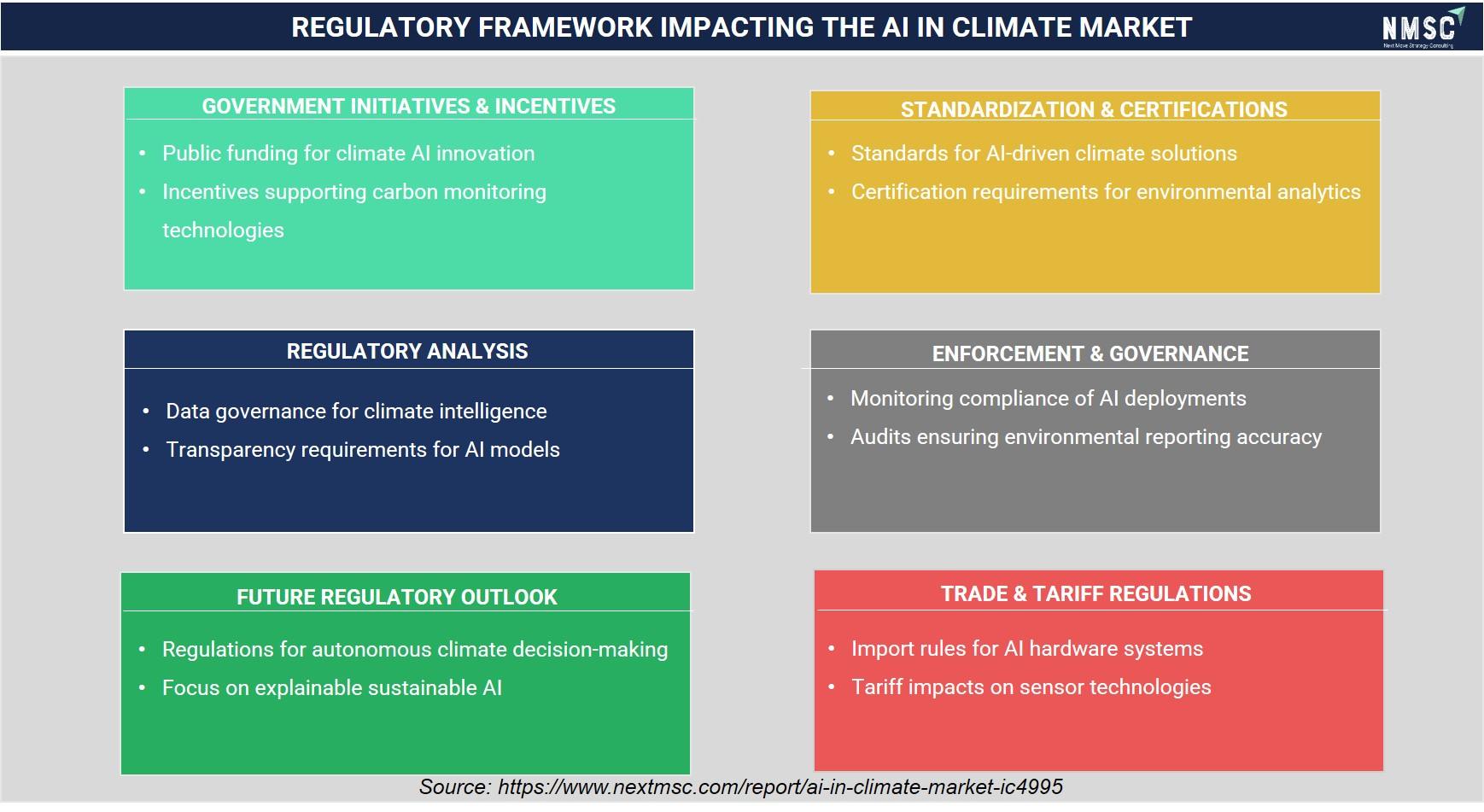
The above infographic presents a regulatory framework impacting the AI in climate market. Public funding and incentives are supporting climate AI innovation and carbon monitoring technologies, while data governance and transparency requirements ensure responsible AI deployment. Standardization and certification are reinforcing credibility, with enforcement through audits and monitoring, ensuring reporting accuracy. Looking ahead, we observed that future regulations are focusing on autonomous climate decision-making and explainable sustainable AI, while import rules and tariffs continue to influence AI hardware and sensor costs across the market.
Competitive Landscape
Competitive Dynamics and M&A Landscape in the AI in Climate Market
|
Parameter |
Details |
|
Market Structure |
The AI in Climate Market is structurally bifurcated between hyperscale platform providers, Microsoft, Google, and Amazon, that dominate through horizontal AI infrastructure with embedded climate capabilities, and specialist climate AI vendors, Watershed Technology, Jupiter Intelligence, Tomorrow.io, and SatSure, that compete on domain-specific depth. NMSC's analysis estimates that the top five players hold approximately 45% of the 2025 market, with significant revenue concentration in the application software and data services sub-segments. |
|
Innovation Focus |
Active innovation is concentrated in foundation climate model development, satellite-based methane and emissions detection, AI-powered catastrophe modeling for insurance underwriting, precision agriculture AI, and carbon footprint traceability platforms for supply chain Scope 3 reporting. NVIDIA's AI compute infrastructure is enabling an order-of-magnitude improvement in climate model training throughput that is democratising advanced climate AI capability across specialist vendors. |
|
M&A Activity |
The AI in Climate Market has seen significant consolidation: Moody's acquired Jupiter Intelligence's parent Four Twenty Seven; Salesforce acquired climate disclosure management tools through its Net Zero Cloud; SAP embedded sustainability reporting through acquisitions. NMSC's assessment projects accelerating M&A through 2030, with hyperscalers and enterprise software incumbents targeting specialist climate AI platform acquisitions to close domain-specific capability gaps against purpose-built climate AI vendors. |
How Do Companies Compete in the AI in Climate Market?
Competition in the AI in Climate Market operates across three distinct tiers. Hyperscale platform providers compete through breadth of AI infrastructure, embedded climate datasets, and sustainability software marketplace ecosystems, Microsoft's Cloud for Sustainability, Google's Earth Engine, and AWS's Climate Pledge all create proprietary data and developer lock-in. Specialist climate AI vendors compete through domain depth, regulatory workflow specificity, and reference customer credibility in high-stakes financial and government procurement. Emerging foundation model-native startups compete through state-of-the-art model performance at dramatically lower inference cost than legacy vendors, threatening to commoditise weather and climate data services that incumbents have built recurring revenue on. Pricing strategies reflect this tiering: hyperscalers compete on consumption pricing; specialists on ACV subscription; startups on performance-based API pricing.
Which Kind of Companies Dominate the AI in Climate Market?
The AI in Climate Market is dominated by two distinct company archetypes. The first is the hyperscale AI platform provider that has embedded climate-specific capabilities, Microsoft's climate data partnerships and Azure AI sustainability services, Google's NeuralGCM and Earth Engine, and AWS's sustainability data integrations, into broadly deployed enterprise cloud infrastructure. These players win by breadth of distribution and integration with existing enterprise technology stacks. The second is the domain-specialist climate AI vendor, exemplified by Watershed Technology for carbon management, Jupiter Intelligence for physical risk analytics, and Tomorrow.io for enterprise weather intelligence, that wins by regulatory workflow depth, auditability features, and scientific credibility that general-purpose AI platforms cannot match in compliance-critical procurement contexts.
AI-Native Differentiation and Open Standards Drive Market Success in the AI in Climate Market
NMSC's analysis indicates that the most successful vendors in the AI in Climate Market are those that combine AI-native product architectures, capable of ingesting and processing satellite, weather, and enterprise emissions data at petabyte scale without human-in-the-loop bottlenecks, with commitment to open data standards including XBRL for financial climate disclosures, ISO 14064 for GHG accounting, and IUCN-compliant biodiversity risk metrics. Vendors building on open science foundations, publishing model architectures, validation datasets, and uncertainty quantification methodologies, are achieving superior credibility with regulatory-grade buyers in financial services and government that require explainable, auditable AI outputs for compliance filings.
Market Players to Opt for Merger and Acquisition Strategies to Expand Their Presence in the AI in Climate Market
Our findings suggest that M&A velocity in the AI in Climate Market will escalate through 2030 as enterprise software incumbents, SAP, Salesforce, Oracle, and IBM, seek to deepen climate disclosure and risk analytics capabilities beyond their current product portfolios through acquisition rather than organic development. The most attractive acquisition targets are specialist platforms with regulatory-grade carbon accounting engines validated for SEC and CSRD compliance, physical climate risk analytics providers with certified financial institution use cases, and foundation climate model companies with commercial API revenue and proprietary training datasets. NVIDIA's strategic investment in AI climate compute infrastructure creates an indirect but powerful consolidation pressure across the model training and inference infrastructure layer of the market.
Who Are the Key Market Players in the AI in Climate Market?
-
Microsoft Corporation
-
Google LLC
-
Amazon Web Services, Inc.
-
IBM Corporation
-
Schneider Electric SE
-
Siemens AG
-
SAP SE
-
Salesforce, Inc.
-
NVIDIA Corporation
-
Honeywell International Inc.
-
Planet Labs PBC
-
Vaisala Oyj
-
Spire Global, Inc.
-
The Tomorrow Companies Inc.
-
Watershed Technology, Inc.
-
Jupiter Intelligence, Inc.
-
AccuWeather, Inc.
-
Meteomatics AG
-
SatSure Analytics India Pvt Ltd
-
Atmo, Inc.
What Are the Latest Developments in the AI in Climate Market Industry?
|
Date |
Event |
|
December 2025 |
NEC and ClimateAi. NEC and ClimateAi signed an MoU to co-create AI-powered climate-resilience solutions for agriculture, corporate supply chains, finance, and insurance. The deal is strategically important because it links climate-risk forecasting with commercial adaptation use cases that can move from pilots into scalable enterprise deployment. |
|
October 2025 |
IBM and UAE MoCCAE. IBM signed a cooperation agreement with the UAE's climate ministry to develop AI-driven capabilities for environmental sustainability and national climate objectives. This matters because it shows governments moving from experimentation to policy-linked AI deployment in climate action, public-sector resilience, and food and water security. |
Expert Insights
 “AI is an unbelievable opportunity to address some of the world’s most pressing challenges in health care, manufacturing, climate change and more.”
— Christina Shim, IBM’s Global Head of Sustainability Software and an AI Ethics Board Member
Statement made during IBM's discussion on responsible AI and sustainability.
Market Interpretation
The comment underscores the increasing recognition of AI as a critical enabler of climate action and sustainability initiatives. Organizations are increasingly deploying AI-powered solutions to improve climate-risk assessment, optimize energy consumption, enhance emissions monitoring, strengthen environmental forecasting, and support decarbonization strategies. As governments and enterprises accelerate investments in digital sustainability technologies, AI is emerging as a foundational tool for climate resilience, resource efficiency, and data-driven environmental management, supporting the long-term growth of the AI in Climate Market.
What Are the Investment Opportunities in the AI in Climate Market?
Capital Inflows and Venture Investment Activity
Capital inflows into the AI in Climate Market are accelerating from both private venture and public institutional channels. The U.S. Inflation Reduction Act directs over USD 369 billion toward clean energy and climate programs, a meaningful portion of which generates AI monitoring, MRV, and optimisation software demand. The European Commission's Horizon Europe program dedicates EUR 35.5 billion to research and innovation, with AI-powered climate science explicitly prioritised. Private venture capital investment in climate technology, which includes AI climate as a growing sub-category, reached USD 63 billion in 2023 according to BNEF (which is cited as a public data point, not a market research estimate), with AI-specific climate investments representing the fastest-growing sub-category within climate tech venture deployment.
Infrastructure Investment in AI Climate Data and Compute
Infrastructure investment in AI in Climate Market spans satellite earth observation constellation expansion, AI compute data centre buildout for climate model training, and national MRV monitoring network deployment. Planet Labs has deployed over 200 satellites; Spire Global operates over 100 satellites providing atmospheric data. ECMWF's Bologna high-performance computing infrastructure, representing a EUR 80 million investment commitment, is specifically designed for next-generation AI-enhanced numerical weather prediction. National meteorological services across APAC and MEA are receiving World Bank and ADB infrastructure financing for AI-enhanced climate monitoring networks that will generate commercial API data revenue over multi-decade operational lifespans.
ESG Considerations in AI Climate Market Investment
ESG considerations operate as both a demand driver and a strategic risk factor for AI in Climate Market investment. On the demand side, institutional investor ESG mandates, including those from UN PRI signatories managing over USD 120 trillion in assets, are compelling portfolio companies to adopt AI-powered carbon management and climate risk reporting tools, directly expanding the market's enterprise TAM. On the risk side, AI compute energy consumption represents a credibility and operational risk for climate AI vendors whose own carbon footprints are subject to increasing scrutiny. Vendors demonstrating RE100 renewable energy commitments for their data centre operations and publishing Science-Based Targets-aligned emissions reduction plans are achieving superior positioning in ESG-sensitive enterprise procurement processes.
Digital Transformation and Climate AI Platform Investment
Digital transformation investment is the primary mechanism through which enterprises are entering the AI in Climate Market, as climate disclosure obligations create demand for AI climate platforms integrated with existing ERP, treasury, and risk management systems. SAP's Green Ledger and Microsoft's Cloud for Sustainability are positioned as the integration layer between enterprise financial systems and AI climate analytics, representing the digital transformation investment pathway that captures the largest addressable enterprise buyer base. The shift from legacy manual carbon accounting and spreadsheet-based climate risk assessment to AI-powered automated platforms represents a USD 372 billion software category by 2035, a digital transformation opportunity comparable in scale to the CRM and ERP adoption waves of prior technology cycles.
Private Equity and Strategic M&A in the AI in Climate Market
Private equity investment in the AI in Climate Market is concentrated in three strategies: growth equity investment in specialist AI climate software companies with demonstrated regulatory compliance revenue and expanding enterprise ACV; infrastructure-style investment in commercial satellite data providers and AI compute infrastructure that generates predictable long-term data service revenue; and buy-and-build strategies consolidating regional AI climate software vendors into platform businesses targeting specific vertical markets such as agricultural intelligence, physical risk analytics, or carbon management. Strategic M&A, where enterprise software incumbents, including SAP, Salesforce, Oracle, and IBM, acquire specialist AI climate capabilities, is projected to be the dominant value creation mechanism in the market through 2030.
Key Benefits for Stakeholders
For Enterprise Corporates
Enterprise organizations gain access to a comprehensive assessment of the AI Climate Technology Market, including segmentation by technology type, deployment model, application area, and end-user industry. The analysis provides actionable insights into carbon management platforms, climate risk analytics, emissions monitoring solutions, and sustainability reporting technologies, enabling informed investment decisions aligned with regulatory compliance, decarbonization targets, and ESG reporting requirements. Regional and industry-specific insights further support long-term climate strategy development and technology adoption planning.
For Financial Institutions
Financial institutions benefit from structured intelligence on climate risk modeling platforms, physical and transition risk assessment tools, catastrophe analytics solutions, and regulatory compliance technologies. The study evaluates evolving requirements associated with climate disclosure frameworks, stress testing programs, and sustainable finance initiatives, enabling banks, insurers, and asset managers to strengthen risk management capabilities, technology procurement strategies, and regulatory preparedness.
For AI Climate Technology Vendors
AI climate technology providers gain detailed visibility into market opportunities through segment-level revenue forecasts, competitive benchmarking, buyer behavior analysis, and regional demand assessments. The report identifies high-growth application areas, emerging customer requirements, and evolving technology adoption trends, enabling vendors to refine product roadmaps, optimize go-to-market strategies, prioritize innovation investments, and identify expansion opportunities through 2035.
For Government and Regulatory Bodies
Government agencies, environmental authorities, and regulatory organizations gain an evidence-based understanding of how AI-driven climate technologies are supporting emissions monitoring, Measurement, Reporting and Verification (MRV) systems, climate adaptation initiatives, and Nationally Determined Contribution (NDC) implementation efforts. The analysis supports policy development, public-sector technology procurement, and climate governance planning by evaluating market capabilities and deployment trends across major regions.
For Investors and Private Equity Firms
Investors, venture capital firms, and private equity stakeholders receive a data-driven evaluation of market growth potential, competitive dynamics, investment activity, and emerging technology trends across the AI Climate Technology Market. Market sizing, CAGR forecasts, sub-segment growth comparisons, and strategic positioning assessments provide a robust framework for deal sourcing, portfolio construction, valuation analysis, growth equity investments, and exit planning within the climate technology ecosystem.
For Technology and Cloud Infrastructure Providers
Technology vendors, cloud service providers, and data infrastructure companies gain insights into the growing computational, storage, connectivity, and analytics requirements associated with climate-focused AI applications. The study highlights demand trends related to satellite data processing, geospatial analytics, climate modeling workloads, and enterprise sustainability platforms, enabling infrastructure providers to align product development and investment strategies with evolving market needs.
For Academic and Research Institutions
Academic organizations, research centers, and innovation hubs gain visibility into the commercialization trajectory of AI-enabled climate solutions across environmental monitoring, climate modeling, emissions management, and adaptation planning applications. The analysis supports research prioritization, technology transfer initiatives, commercialization strategy development, and industry collaboration efforts by identifying emerging innovation areas and market-driven technology requirements.
Key Market Segments
By Offering Type
-
Application Software and SaaS
-
Carbon Management and Sustainability Reporting
-
Emissions Tracking
-
Scope 3 Accounting
-
ESG Disclosure
-
Product Carbon Footprint Management
-
-
Climate Risk and Resilience Analytics
-
Physical Risk Assessment
-
Portfolio Stress Testing
-
Underwriting Analytics
-
Adaptation Planning
-
-
Weather and Climate Forecasting
-
Nowcasting
-
Short Range Forecasting
-
Medium Range Forecasting
-
Long Range Forecasting
-
-
Energy and Grid Optimization
-
Virtual Power Plants
-
Distributed Energy Resource Management
-
Grid Operations Optimization
-
Demand Forecasting
-
-
Land and Agriculture Intelligence
-
Crop Monitoring
-
Yield Forecasting
-
Deforestation Monitoring
-
Water Resource Intelligence
-
-
Environmental Monitoring and Response
-
Wildfire Intelligence
-
Flood Intelligence
-
Methane and Emissions Detection
-
Disaster Response Analytics
-
-
Other Climate Applications
-
-
Data and API Services
-
Weather Data
-
Historical Data
-
Real Time Data
-
Forecast Data
-
-
Climate Data
-
Climate Scenarios
-
Climate Projections
-
Climate Normals
-
-
Earth Observation Data
-
Satellite Imagery
-
Derived Geospatial Layers
-
Geospatial Analytics APIs
-
-
Risk Scores and Indices
-
Physical Risk Scores
-
Sustainability Indices
-
-
Other Data Services
-
-
Climate AI Platforms and Infrastructure
-
Climate Model Platforms
-
Model Hosting
-
Inference Services
-
AI Compute
-
Digital Twin Platforms
-
Other Infrastructure
-
-
Professional Services
-
Advisory
-
Implementation
-
Systems Integration
-
Custom Model Development
-
Managed Operations
-
Other Services
-
By Deployment Mode
-
Cloud
-
On Premises
-
Hybrid
By Application
-
Carbon Management and Sustainability Reporting
-
Climate Risk and Resilience
-
Weather and Climate Forecasting
-
Energy and Grid Optimization
-
Land and Agriculture Intelligence
-
Environmental Monitoring and Response
-
Other Applications
By Data Source
-
Satellite and Earth Observation
-
Weather Station and Radar
-
IoT and Sensors
-
Enterprise Systems
-
Public and Open Data
-
Other Data Sources
By Revenue Model
-
Subscription
-
Usage Based
-
Perpetual License
-
Professional Services
By Customer Type
-
Enterprise
-
Financial Institutions
-
Public Sector
-
Developers
-
Consumers
By Sales Channel
-
Direct Sales
-
Self-serve API
-
Channel Partner
-
Embedded OEM
By End Industry
-
Energy and Utilities
-
Agriculture and Food
-
Financial Services and Insurance
-
Government and Defense
-
Logistics and Transportation
-
Built Environment and Real Estate
-
Industrial and Manufacturing
-
Retail and Consumer Goods
-
Other Industries
By Region
-
North America: U.S., Canada, and Mexico
-
Europe: UK, Germany, France, Italy, Spain, Sweden, Denmark, Finland, the Netherlands, and the Rest of Europe
-
Asia Pacific: China, India, Japan, South Korea, Taiwan, Indonesia, Vietnam, Australia, Philippines, Malaysia, and the Rest of APAC
-
Middle East & Africa: Saudi Arabia, UAE, Egypt, Israel, Turkey, Nigeria, South Africa, and the Rest of MEA
-
Latin America: Brazil, Argentina, Chile, Colombia, and the Rest of LATAM
Conclusion and Recommendations
Long-Term Outlook for the AI in Climate Market
The AI in Climate Market is positioned for one of the highest sustained growth trajectories in enterprise technology through 2035, underpinned by regulatory mandates that make AI climate investment obligatory rather than discretionary, technology step-changes in foundation model performance that dramatically expand the market's total addressable opportunity, and the irreversible physical climate change dynamics that will continue to escalate demand for risk analytics, adaptation planning, and emissions monitoring capabilities across every major industry vertical and geography globally. The market's progression from USD 26.8 billion in 2025 to USD 372.31 billion by 2035 at a CAGR of 30.1% reflects genuine structural demand expansion rather than speculative technology bubble dynamics.
Strategic Positioning Recommendations
NMSC's analysis recommends that AI climate technology vendors prioritise four strategic investments to capture maximum market share through 2035: first, achieving regulatory-grade auditability and certification for SEC, CSRD, and ISSB disclosure workflows, which converts the platform from discretionary software to obligatory compliance infrastructure; second, building foundation model training and inference capabilities on domain-specific climate and earth observation datasets to achieve technical differentiation against general-purpose AI platforms; third, establishing embedded OEM distribution partnerships with ERP, treasury, and risk management platform providers to access the broadest possible enterprise buyer base without proportionate direct sales headcount; and fourth, investing in API-first platform architectures that enable developer ecosystem growth and Usage-Based revenue scaling independent of enterprise sales cycle timelines.
Investment Attractiveness of the AI in Climate Market
The AI in Climate Market presents an exceptionally attractive investment profile characterised by regulatory demand certainty, technology-driven TAM expansion, and the structural rarity of a market where both compliance mandates and genuine product-market fit are simultaneously accelerating adoption. The highest-conviction investment sub-segments include Energy and Grid Optimization (CAGR 38.5%), Climate AI Platforms and Infrastructure (CAGR 38.5%), and IoT and Sensor data sources (CAGR 38.5%), all of which represent technology-driven demand rather than pure compliance-driven procurement and therefore offer superior revenue quality and retention characteristics. Investors should prioritise companies with foundation model capabilities, regulatory-validated workflows, and cloud-native architectures with Usage-Based pricing flexibility.
Market Shifts Reshaping the AI in Climate Market
Three structural market shifts are fundamentally reshaping the AI in Climate Market through 2035. First, the shift from bespoke climate modeling to foundation model inference is commoditising weather and climate data services that incumbents have built recurring revenue on, compressing margins in legacy data API businesses while creating opportunities for inference platform providers. Second, the shift from voluntary to mandatory climate disclosure is converting the enterprise buyer from an innovation-adopter to a compliance-obligated procurement authority, dramatically accelerating adoption timelines and reducing sales cycle length. Third, the shift from siloed climate applications to integrated climate intelligence platforms, combining emissions management, physical risk, and weather intelligence within a single data fabric, is reshaping competitive dynamics from point-solution competition to platform ecosystem competition.
Key Risks to the AI in Climate Market Outlook
The primary risk to the AI in Climate Market's 30.1% CAGR forecast is a political reversal of mandatory climate disclosure frameworks, particularly if SEC climate rules face sustained legal challenges, which would convert obligatory compliance procurement back into discretionary spending and dramatically extend adoption timelines. Secondary risks include: the AI energy consumption backlash reaching a tipping point where corporate ESG procurement teams reject AI climate tools on net-carbon impact grounds; data sovereignty fragmentation reducing addressable market TAM for global SaaS platforms; and foundation model commoditisation compressing margins across the weather and climate data API sub-segment faster than vendors can transition to higher-value analytics and decision-support revenue streams.
Growth Pathways for AI in Climate Market Participants
The clearest growth pathways for participants in the AI in Climate Market through 2035 are: achieving regulatory workflow certification that makes platform switching prohibitively costly for compliance-critical buyers; building proprietary climate AI training datasets from satellite, IoT, and enterprise emissions data streams that cannot be replicated by general-purpose AI platforms; developing physical climate risk scoring methodologies endorsed by financial regulators that create reference-site credibility for financial institution procurement; expanding into government MRV and national climate accounting contracts that offer large total contract values and multi-decade operational lifespans; and integrating Usage-Based API pricing models that enable developer ecosystem growth as an independent revenue scaling mechanism alongside traditional enterprise sales.
Final Recommendations
The AI in Climate Market represents one of the most compelling intersections of regulatory inevitability, technology step-change, and genuine societal imperative in enterprise software history. NMSC's analysis concludes that vendors embedding themselves as regulatory-grade climate data infrastructure, rather than positioning as sustainability software, will achieve the most defensible market positions and superior long-term enterprise retention. Investors seeking exposure should prioritise companies with regulatory-certified workflows, foundation model AI capabilities, and cloud-native API architectures generating measurable Usage-Based revenue growth as leading indicators of platform ecosystem maturity and sustainable CAGR through the 2026 to 2035 forecast horizon.
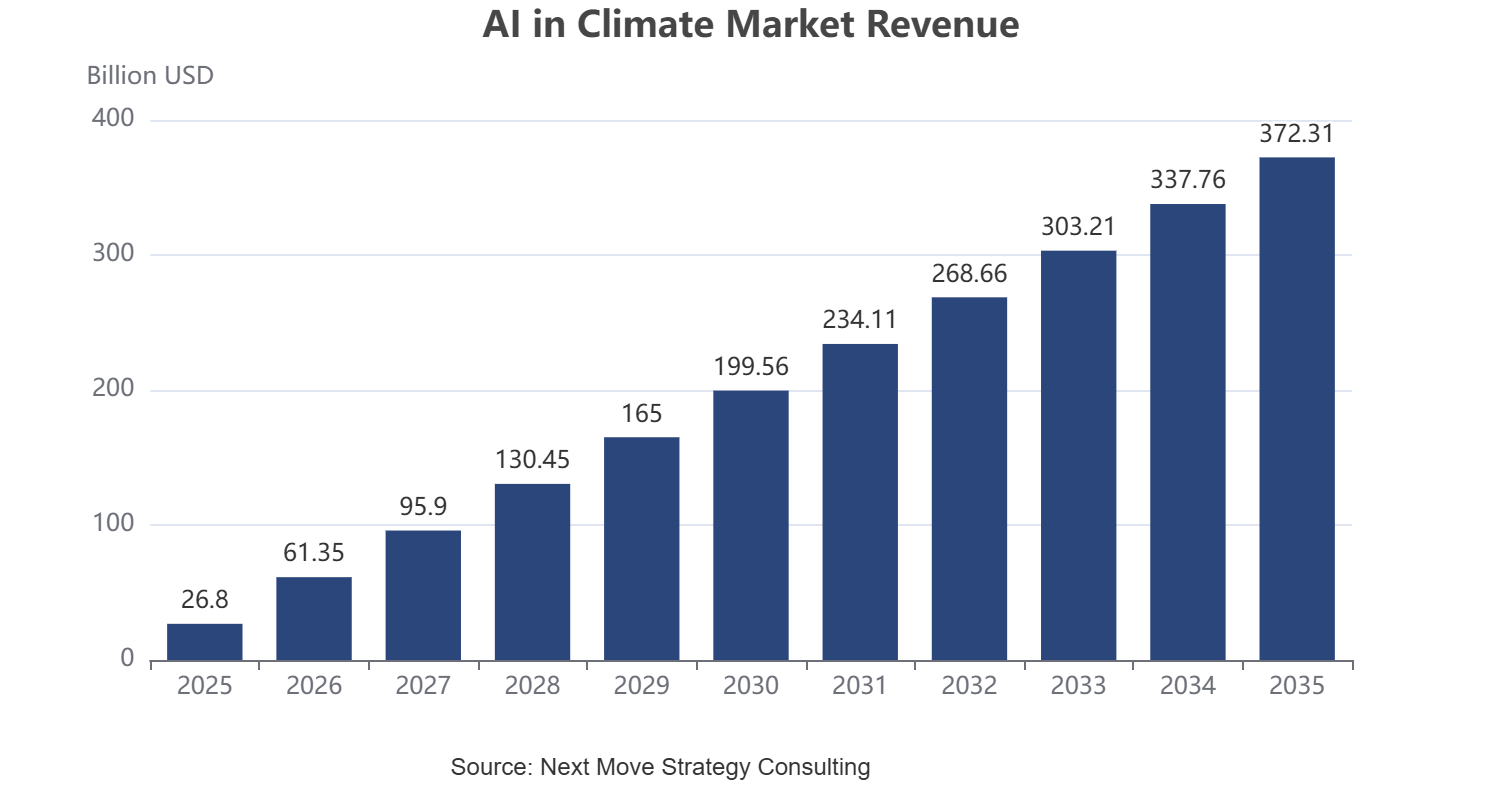
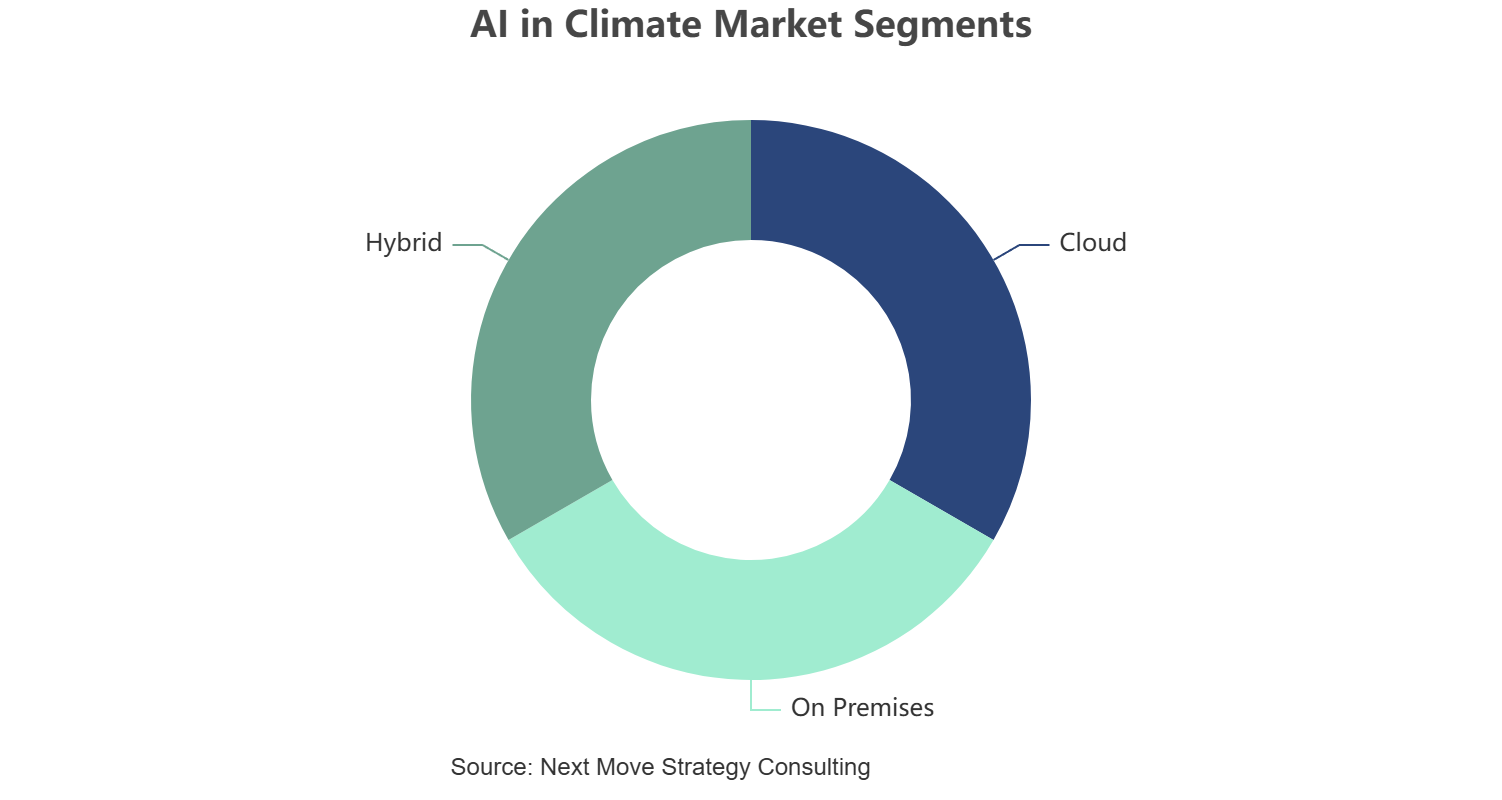
About the Author
 Mayurima Roy
— Mayurima Roy is Research Analyst at Next Move Strategy Consulting, where she has spent 4 years working across the firm's full industry coverage rather than a single fixed vertical. Her work centers on structured research, ongoing trend tracking, competitive assessment, and insight-led content development, translating complex market data into clear, decision-ready narratives that support informed client decision-making across diverse global industries, market sectors, and world regions every day.
Mayurima Roy
— Mayurima Roy is Research Analyst at Next Move Strategy Consulting, where she has spent 4 years working across the firm's full industry coverage rather than a single fixed vertical. Her work centers on structured research, ongoing trend tracking, competitive assessment, and insight-led content development, translating complex market data into clear, decision-ready narratives that support informed client decision-making across diverse global industries, market sectors, and world regions every day.
About the Reviewer
 Supradip Baul
— Supradip Baul is an accomplished business consultant and strategist with over a decade of rich experience in market intelligence, strategy, technology, and business transformation. His work has included rigorous qualitative and quantitative analysis across multiple industries, helping clients shape investment decisions and long-term roadmaps. Earlier in his career, he was associated with Gartner, where he contributed to industry-leading reports and market share analyses. He has worked with leading global companies and holds an MBA with a dual specialization in Marketing and Finance.
Supradip Baul
— Supradip Baul is an accomplished business consultant and strategist with over a decade of rich experience in market intelligence, strategy, technology, and business transformation. His work has included rigorous qualitative and quantitative analysis across multiple industries, helping clients shape investment decisions and long-term roadmaps. Earlier in his career, he was associated with Gartner, where he contributed to industry-leading reports and market share analyses. He has worked with leading global companies and holds an MBA with a dual specialization in Marketing and Finance.
At Next Move Strategy Consulting, we understand that insightful market research is the cornerstone of successful business decisions. That's why we employ a robust and multifaceted approach, combining various methodologies to deliver the most accurate and actionable data for our clients.

Research Landscape
We navigate the world of research with two primary approaches:
Qualitative Approach
Our qualitative research methodologies involve immersive techniques such as in-depth interviews, focus groups, and observational studies. By engaging directly with individuals and stakeholders, we uncover valuable insights that quantitative data alone may overlook.

Quantitative Research
In tandem with qualitative methodologies, NMSC leverages the power of Quantitative Research to provide a robust foundation of numerical insights. Through systematic data collection and analysis, we quantify patterns, preferences, and market trends, offering a comprehensive view of the business landscape.
Our quantitative research approach employs diverse tools, including surveys, experiments, and statistical modelling. These methodologies enable us to gather data from a large and representative sample, ensuring the statistical significance of our findings. By employing structured questionnaires and standardized data collection methods, we guarantee the reliability and validity of the information we present to our clients.
Quantitative research is particularly effective in measuring the prevalence of trends, assessing market size, and gauging the impact of various factors on consumer behavior. The numerical precision attained through this approach equips our clients with actionable insights, facilitating data-driven decision-making and strategy formulation.


Our Specialized Toolbox for Industry-Specific Market Research
We deploy a specialized arsenal of techniques tailored to meet your unique requirements. Here's a glimpse into our comprehensive toolbox:

Information Procurement
The stage entails acquiring market data or relevant information through various sources and methodologies.


Market Research Approach
We utilize both top-down and bottom-up approaches in market research analysis to achieve a comprehensive understanding of the market dynamics, leveraging the broad perspective of industry trends and macroeconomic factors alongside detailed insights from specific segments and individual companies.

Porters Five Forces Analysis
We conduct Porter's Five Forces analysis to evaluate the competitive landscape of an industry, providing us with insights into factors that affect profitability and strategic positioning.

SWOT Analysis

Forecasting
We utilize a forecasting model to predict future consumption by considering parameters like population, economics, regulations, market competition, drivers, constraints, technology, and pricing. We also employ statistical techniques such as multilinear regression, exponential smoothing, moving average, ARIMA, and Monte Carlo simulations for accurate predictions. In econometric forecasting, we analyzed short-term and long-term event impacts, attributing values based on regulatory frameworks, economic factors, and market events.





 Speak to Our Analyst