AI Driver Coaching Market Size, Share, Growth & Forecast by Offering (Software [Real-Time Coaching, Post-Trip Coaching, Scorecards and Analytics, Self-Coaching Apps, AI-Generated Coaching Content], Hardware [Dashcam Kits, Driver Monitoring Kits, Multi-Camera Kits, Telematics Gateway Kits], Services [Managed Coaching, Monitoring and Review, Installation and Onboarding, Training and Consulting]), By Vehicle Class, By Sales Channel, By End Use — Global Analysis 2025–2035
Industry: Automotive & Transportation | Publishing Date: July 14, 2026 | Last Updated: September 30, 2026 | No of Pages: N/A | No. of Tables: N/A | No. of Figures: N/A | Format: PDF | Report Code: AT5130
What Is the AI Driver Coaching Market Size?
The AI Driver Coaching Market encompasses software, hardware, and services that use artificial intelligence to monitor, score, and coach commercial and passenger vehicle drivers in real time and post-trip, improving fleet safety outcomes across freight, passenger transport, and field service operations worldwide.
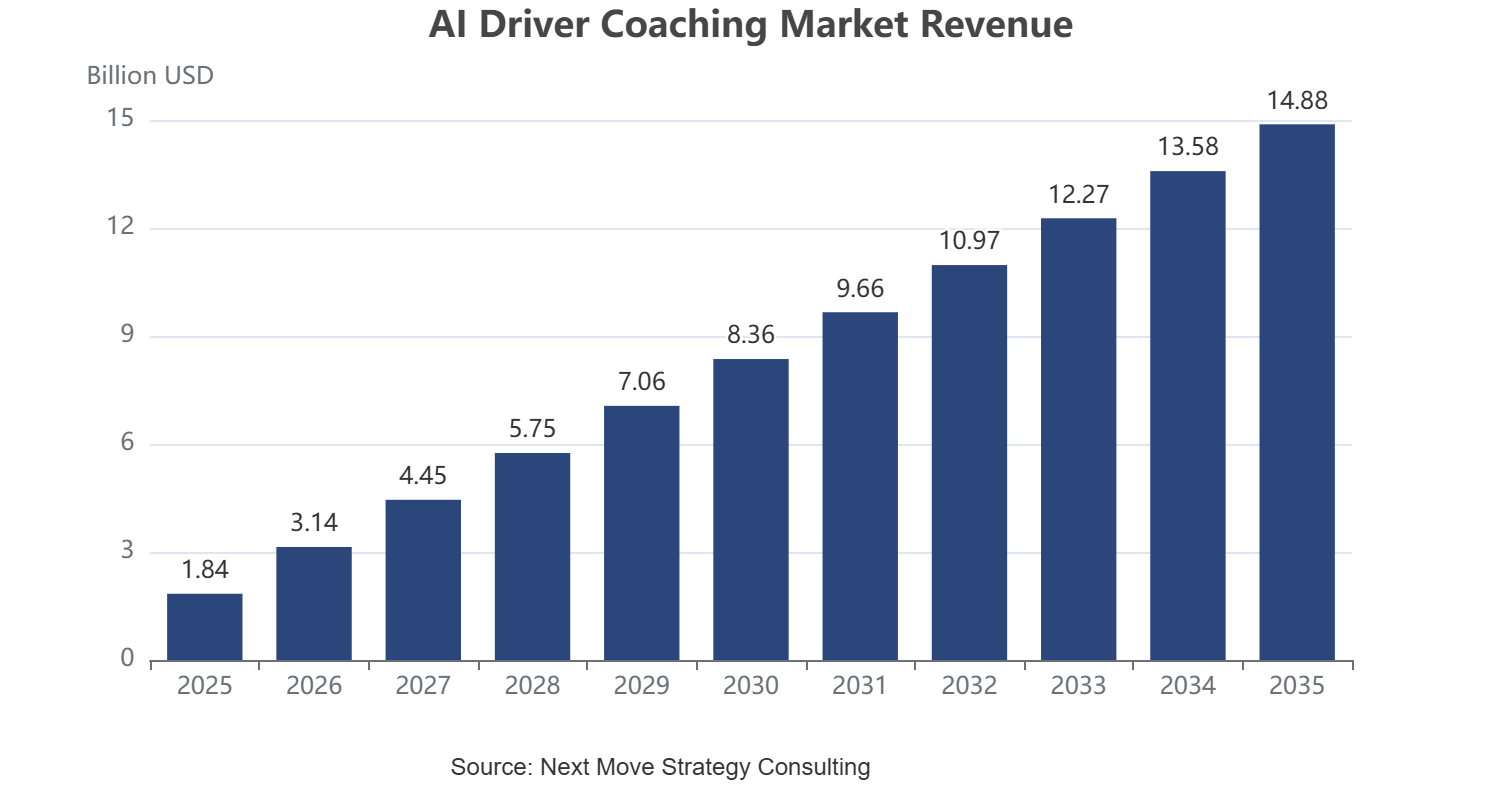
From our research, we found that the AI Driver Coaching Market size was valued at USD 1.84 billion in 2025 and is expected to reach USD 2.26 billion by the end of 2026, before advancing to USD 14.88 billion by 2035 at a CAGR of 23.3% between 2026 and 2035. Growth is driven by tightening fleet safety regulations, rising insurance-linked telematics adoption, expanding use of AI-generated coaching content, and growing demand for real-time in-cab alerts across freight and logistics fleets globally.
Based on research conducted by NMSC, we found that fleet operators are increasingly replacing manual review processes with automated video-based coaching platforms that reduce administrative burden while improving driver retention. Our analysis indicates that the convergence of dashcam hardware, edge-AI inference, and cloud-based scorecard analytics is accelerating platform consolidation among fleet safety vendors, reshaping how enterprises procure and deploy driver coaching technology across diverse vehicle classes and end-use sectors.
|
Parameters |
Details |
|
Market Size in 2025 |
USD 1.84 Billion |
|
Market Size in 2026 |
USD 2.26 Billion |
|
Revenue Forecast in 2035 |
USD 14.88 Billion |
|
Growth Rate |
CAGR of 23.3% from 2026 to 2035 |
|
Analysis Period |
2025–2035 |
|
Base Year Considered |
2025 |
|
Forecast Period |
2026–2035 |
|
Market Size Estimation |
Revenue (USD Billion) |
|
Companies Profiled |
20 |
|
Countries Covered |
33 |
|
Market Share |
Available for Top 10 Companies |
AI Driver Coaching Market Overview
The AI Driver Coaching Market spans software, hardware, and services that evaluate driving behavior and deliver real-time or post-trip feedback to reduce collisions and insurance costs. Through our market assessment, we observed that the industry is evolving from standalone dashcam recording toward integrated, AI-native coaching platforms embedded within broader fleet management suites. Regulatory frameworks such as the EU General Safety Regulation and U.S. FMCSA safety scoring programs are pushing fleets toward continuous monitoring, while rising edge-AI processing power is accelerating adoption of real-time in-cab alerts across freight, passenger transport, and field service fleets.
|
Key Takeaways |
|
By offering, Software held the largest share of the AI Driver Coaching Market at USD 0.83 billion in 2025, rising to USD 7.20 billion by 2035. Software is also the fastest-growing offering, expanding at a CAGR of 24.3% from 2026 to 2035, led by demand for real-time coaching and AI-generated coaching content. |
|
By vehicle class, Heavy Commercial Vehicle commanded the largest share at USD 0.64 billion in 2025 and is projected to reach USD 6.20 billion by 2035. It is also the fastest-growing vehicle class in the AI Driver Coaching Market at a CAGR of 25.7% from 2026 to 2035, driven by freight fleet safety mandates. |
|
By sales channel, Direct sales accounted for the largest revenue contribution in 2025, reflecting the enterprise-heavy nature of fleet safety procurement. Telco and Integrator is the fastest-growing sales channel in the AI Driver Coaching Market, as telecom-linked telematics bundles expand across mid-sized fleets. |
|
By end use, Freight and Logistics held the largest share at USD 0.74 billion in 2025, projected to reach USD 5.90 billion by 2035 at a CAGR of 23.2%. Construction and Utilities is the fastest-growing end use in the AI Driver Coaching Market at a CAGR of 25.5% from 2026 to 2035. |
|
North America held the largest regional share at USD 0.64 billion in 2025, projected to reach USD 4.55 billion by 2035 at a CAGR of 21.5%, anchored by leading fleet safety vendors and mature telematics infrastructure. |
|
Asia-Pacific is the fastest-growing major region in the AI Driver Coaching Market at a CAGR of 28.0%, propelled by expanding commercial fleets in China and India alongside rapid telematics adoption across Southeast Asia. |
|
The U.S. dominated the AI Driver Coaching Market in 2025 at approximately USD 0.46 billion, supported by the presence of leading fleet safety vendors, extensive commercial fleet safety budgets, and sustained regulatory enforcement across freight and logistics operators. |
|
India is projected to be the fastest-growing country in the AI Driver Coaching Market during the forecast period, advancing at a CAGR of 32.5%, driven by rapid commercial fleet expansion and rising insurance-linked telematics adoption. |
Key Emerging Trends in the AI Driver Coaching Market
How Is Real-Time In-Cab Coaching Replacing Post-Trip Review?
Real-time in-cab voice and visual alerts are shifting driver coaching from retrospective video review toward in-the-moment correction. Samsara's 2025 expansion of its AI Driver Coach feature illustrated this shift, delivering audible alerts for distraction and following-distance events as they occur. Our research indicates that this transformation is reducing preventable collisions and shortening the feedback loop between unsafe behavior and driver awareness, with freight and passenger transport fleets adopting the format fastest.
How Is AI-Generated Coaching Content Personalizing Driver Development?
NMSC's analysis indicates that vendors are moving beyond generic scorecards toward AI-generated, personalized coaching plans tailored to individual driver risk profiles. Lytx's continued rollout of automated coaching workflows reflects this shift, using machine learning to prioritize which events warrant manager intervention. This transformation is helping fleet safety managers scale coaching across larger driver rosters without proportional headcount growth, while improving consistency of feedback delivery across dispersed fleet operations.
How Is Regulatory Pressure Expanding Driver Monitoring Adoption?
Our assessment indicates that tightening vehicle safety regulation is a defining trend across the AI Driver Coaching Market. The European Union's General Safety Regulation mandates advanced driver monitoring systems on new vehicle types, while U.S. FMCSA safety scoring continues to incentivize fleet-level monitoring investment. This is pushing vendors such as Netradyne to expand driver monitoring kit deployment, and we expect compliance-linked adoption to become a decisive purchasing driver for regulated commercial fleets.
Strategic Framework of the AI Driver Coaching Market
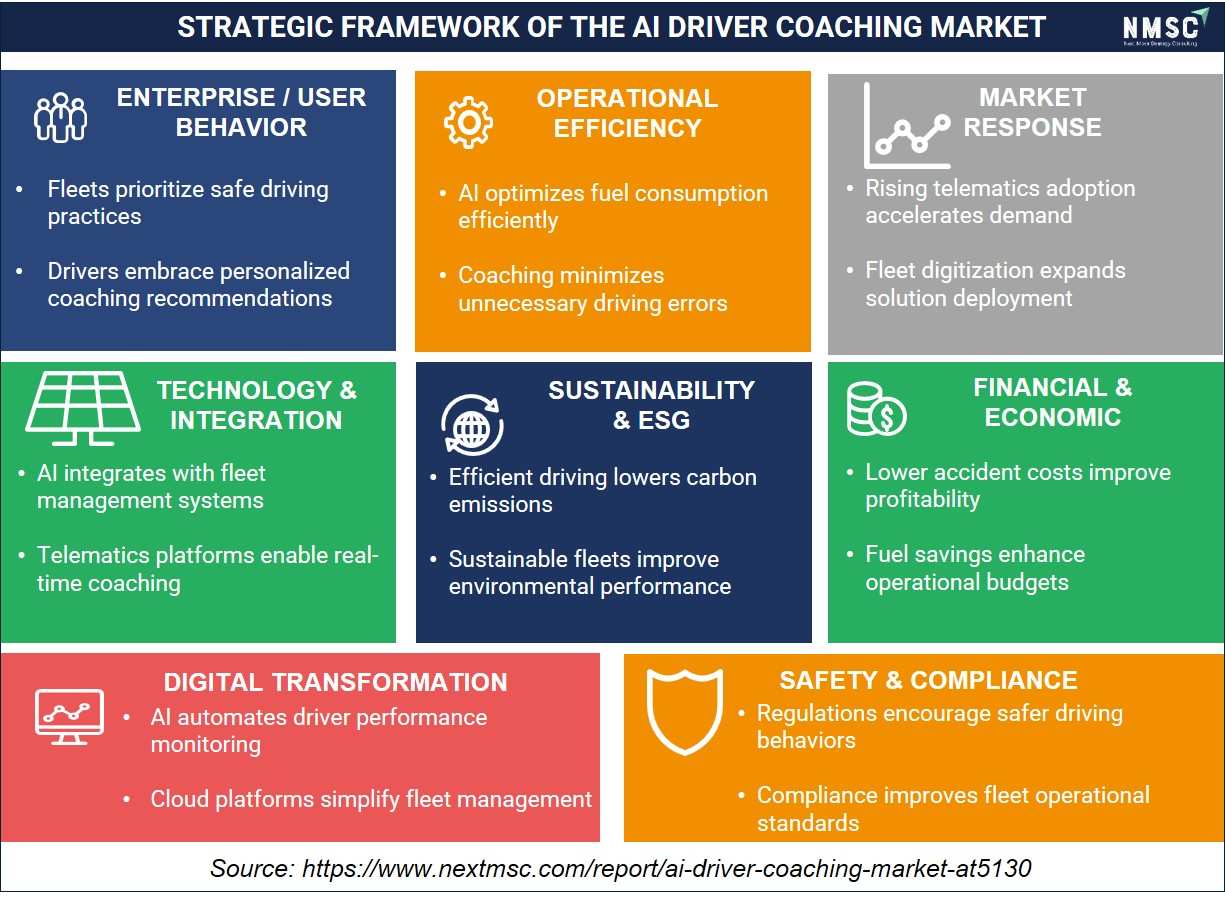
The strategic framework examines the critical business factors influencing growth and competitive positioning within the AI Driver Coaching Market. Our assessment indicates that fleet operators increasingly prioritize driver safety, operational efficiency, and digital transformation to enhance transportation performance. AI-powered coaching platforms integrate with telematics and fleet management systems to deliver real-time guidance, automate driver performance monitoring, and improve decision-making through predictive analytics. Sustainability objectives are supported through optimized driving behavior that reduces fuel consumption, emissions, and operating costs. Regulatory compliance and road safety initiatives further accelerate market adoption by encouraging safer driving practices, while measurable financial benefits, including lower accident-related expenses and improved fleet productivity, strengthen long-term investment in AI driver coaching solutions.
What Are the Key Market Drivers, Restraints, and Investment Opportunities that will Shape the AI Driver Coaching Market in the Next Decade?
|
Driver / Trend / Restraint |
(+/-) % Impact on CAGR Forecast |
Geographic Relevance |
Impact Timeline |
|
Tightening fleet safety regulation accelerating driver monitoring adoption |
+3.0% |
North America, European Union, GCC fleet hubs |
Medium term (2–4 years) |
|
Rising insurance-linked telematics programs rewarding coached driver behavior |
+2.6% |
North America, Europe, Asia-Pacific |
Medium to long term (3–6 years) |
|
Growing demand for AI-generated, personalized coaching content |
+1.9% |
North America, Europe, Australia |
Medium term (2–5 years) |
|
High upfront hardware and integration costs limiting small-fleet adoption |
-1.5% |
Latin America, Middle East & Africa, Southeast Asia |
Medium term (2–4 years) |
|
Driver privacy and data-consent concerns constraining monitoring deployment |
-1.1% |
North America, Western Europe |
Short to Medium term (1–3 years) |
What Are the Growth Drivers of the AI Driver Coaching Market?
How Is Fleet Safety Regulation Accelerating Driver Monitoring Adoption?
Tightening vehicle safety regulation is directly fueling AI Driver Coaching Market growth. Under the European Union's General Safety Regulation, new vehicle types placed on the market since July 2024 must include advanced driver monitoring and distraction warning systems. Our analysis indicates that this regulatory mandate is compelling fleet operators and OEMs to standardize on AI-enabled monitoring hardware, particularly across commercial passenger and freight vehicle classes operating within EU member states.
How Are Insurance-Linked Telematics Programs Fueling Market Expansion?
Insurance carriers are increasingly linking premium discounts to verified driver coaching program participation, reinforcing fleet demand for AI-based scoring platforms. Based on NMSC's research, we found that fleets adopting continuous driver risk scoring report measurable reductions in at-fault claim frequency, encouraging brokers to formalize telematics-linked underwriting. This dynamic is particularly pronounced among mid-sized freight and logistics fleets seeking to offset rising commercial auto insurance premiums through demonstrable safety improvement.
What Are the Growth Inhibitors of the AI Driver Coaching Market?
How Do High Hardware and Integration Costs Limit Small-Fleet Adoption?
Upfront costs for dashcam kits, driver monitoring hardware, and telematics gateway integration remain a barrier for small and mid-sized fleet operators. In our observation, fleets operating fewer than fifty vehicles often defer full deployment in favor of partial rollouts limited to highest-risk routes. This restrains near-term revenue growth in cost-sensitive regions, particularly across Latin America and parts of the Middle East and Africa, where financing access for fleet safety technology remains constrained.
How Do Driver Privacy Concerns Constrain Monitoring Deployment?
Driver privacy and data-consent concerns continue to slow monitoring deployment in jurisdictions with strict labor and biometric data protections. Through our market assessment, we observed that works councils in several Western European markets require formal consultation before in-cab camera deployment, extending sales cycles. This restraint is most pronounced in passenger transport and public sector fleets, where union representation and public accountability requirements add procedural steps to monitoring rollouts.
What Are the Key Investment Opportunities in the AI Driver Coaching Market?
Where Are AI-Generated Coaching Content Opportunities Emerging?
Opportunities are emerging in AI-generated, personalized coaching content that adapts to individual driver risk patterns rather than delivering standardized modules. Our findings suggest that vendors integrating generative AI into coaching plan creation can differentiate on engagement and retention outcomes, particularly among self-coaching app users in passenger transport and field service fleets seeking scalable, low-cost driver development pathways.
Where Are Multi-Camera and Telematics Gateway Opportunities Emerging?
Multi-camera kits and telematics gateway hardware present expansion opportunities as fleets seek unified visibility across cabin, road, and cargo-facing views. Our assessment indicates that hardware bundling with managed coaching services is becoming a preferred procurement model among heavy commercial vehicle fleets, creating recurring services revenue opportunities for vendors able to combine hardware, software, and remote human coaching support.
How Is the AI Driver Coaching Industry Segmented in This Report, and What Are the Key Insights from the Segmentation Analysis?
Which Offering Segment Leads the AI Driver Coaching Market?
|
Segment |
2025 (USD Billion) |
2035 (USD Billion) |
CAGR% (2026–2035) |
|
Software |
0.83 |
7.20 |
24.3% |
|
Hardware |
0.55 |
4.00 |
21.8% |
|
Services |
0.46 |
3.68 |
23.1% |
|
Total |
1.84 |
14.88 |
23.3% |
By offering, the AI Driver Coaching Market is segmented into Software, Hardware, and Services. Software held the largest share at USD 0.83 billion in 2025, led by real-time coaching, post-trip coaching, and scorecard analytics modules embedded within fleet safety platforms. Software is also the fastest-growing offering at a CAGR of 24.3%, driven by expanding adoption of AI-generated coaching content. Hardware remains foundational, supplying the dashcam and driver monitoring kits that feed software-layer analytics across fleet operations.
Which Vehicle Class Dominates the AI Driver Coaching Market?
|
Segment |
2025 (USD Billion) |
2035 (USD Billion) |
CAGR% (2026–2035) |
|
Passenger Car |
0.37 |
2.20 |
19.2% |
|
Light Commercial Vehicle |
0.55 |
4.20 |
22.5% |
|
Heavy Commercial Vehicle |
0.64 |
6.20 |
25.7% |
|
Bus and Coach |
0.18 |
1.55 |
23.9% |
|
Specialty and Off-Road Vehicle |
0.09 |
0.73 |
23.0% |
|
Total |
1.84 |
14.88 |
23.3% |
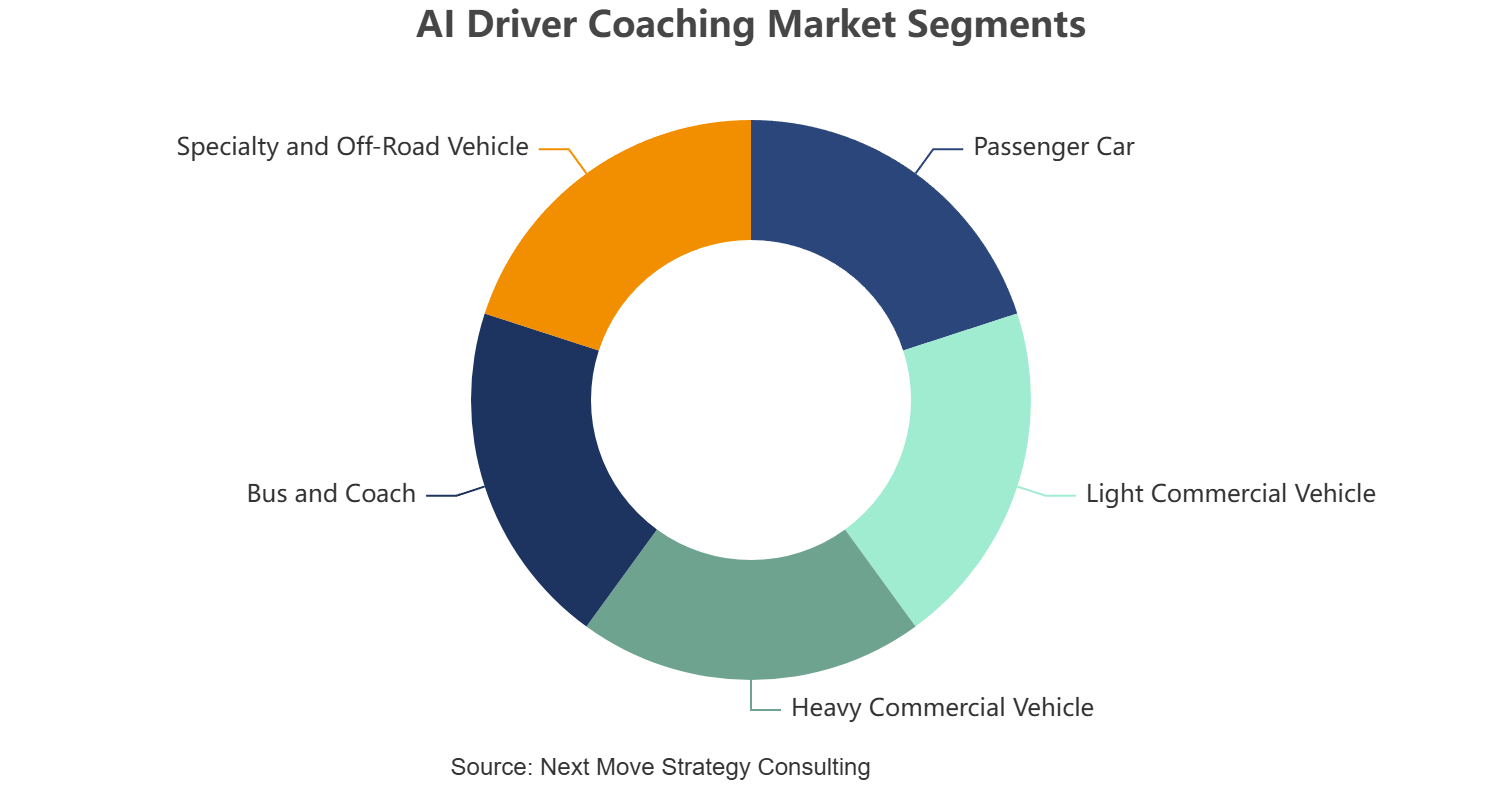
By vehicle class, the market spans Passenger Car, Light Commercial Vehicle, Heavy Commercial Vehicle, Bus and Coach, and Specialty and Off-Road Vehicle categories. Heavy Commercial Vehicle led with USD 0.64 billion in 2025, reflecting stringent freight safety compliance requirements. It is also the fastest-growing category at a CAGR of 25.7%, as long-haul freight operators prioritize continuous driver monitoring to reduce fatigue-related incidents and insurance costs across heavy-duty fleets.
Which Sales Channel Leads the AI Driver Coaching Market?
|
Segment |
2025 (USD Billion) |
2035 (USD Billion) |
CAGR% (2026–2035) |
|
Direct |
0.74 |
5.35 |
21.8% |
|
OEM Embedded |
0.37 |
3.55 |
25.7% |
|
Dealer and Reseller |
0.39 |
2.65 |
21.1% |
|
Telco and Integrator |
0.26 |
2.55 |
26.1% |
|
Marketplace and API |
0.09 |
0.78 |
23.8% |
|
Total |
1.84 |
14.88 |
23.3% |
By sales channel, the market is segmented into Direct, OEM Embedded, Dealer and Reseller, Telco and Integrator, and Marketplace and API. Direct sales led with USD 0.74 billion in 2025, reflecting the enterprise-heavy nature of fleet safety procurement, where large fleets negotiate directly with vendors. Telco and Integrator is the fastest-growing channel at a CAGR of 26.1%, as telecom operators increasingly bundle AI driver coaching within broader connected-fleet and IoT service packages sold to mid-sized commercial fleet operators.
Which End Use Sector Leads the AI Driver Coaching Market?
|
Segment |
2025 (USD Billion) |
2035 (USD Billion) |
CAGR% (2026–2035) |
|
Freight and Logistics |
0.74 |
5.90 |
23.2% |
|
Passenger Transport |
0.37 |
2.85 |
22.7% |
|
Field Service |
0.28 |
2.55 |
25.1% |
|
Construction and Utilities |
0.18 |
1.75 |
25.5% |
|
Oil and Gas |
0.11 |
0.85 |
22.6% |
|
Public Sector |
0.11 |
0.68 |
19.6% |
|
Rental and Leasing |
0.06 |
0.30 |
18.0% |
|
Total |
1.84 |
14.88 |
23.3% |
By end use, Freight and Logistics accounted for the largest share at USD 0.74 billion in 2025, reaching USD 5.90 billion by 2035, supported by high vehicle utilization rates and regulatory scrutiny of commercial driver behavior. Construction and Utilities is the fastest-growing end use at a CAGR of 25.5%, as heavy-equipment operators adopt coaching platforms to manage off-road and mixed-terrain driving risk across expanding infrastructure and utility maintenance programs.
Regional Outlook
Geographic Performance Snapshot
|
Region |
2025 (USD Billion) |
2035 (USD Billion) |
CAGR% (2026–2035) |
Key Driver |
|
North America |
0.64 |
4.55 |
21.5% |
Fleet safety mandates and early AI dashcam adoption |
|
Europe |
0.52 |
3.65 |
21.5% |
EU General Safety Regulation camera and monitoring mandates |
|
Asia-Pacific |
0.46 |
5.20 |
28.0% |
Rapid commercial fleet expansion and telematics penetration |
|
Middle East & Africa |
0.13 |
0.95 |
22.0% |
Rising logistics investment and fleet modernization programs |
|
Latin America |
0.09 |
0.53 |
18.7% |
Growing freight digitization and insurance-linked telematics adoption |
|
Total |
1.84 |
14.88 |
23.3% |
— |
North America AI Driver Coaching Market
North America represents a mature AI Driver Coaching Market, anchored by stringent FMCSA safety scoring requirements and widespread enterprise fleet safety budgets. Our analysis indicates that the region's dense presence of leading dashcam and telematics vendors, combined with mature cloud infrastructure, supports rapid feature rollout. Insurance-linked telematics programs are reinforcing adoption across freight, field service, and passenger transport fleets, positioning the region as the largest revenue contributor through the forecast period.
Europe AI Driver Coaching Market
Europe's AI Driver Coaching Market is shaped by the European Union's General Safety Regulation, which mandates advanced driver monitoring systems on new vehicle types. Through NMSC's assessment, we found that fleet operators across Germany, France, and the UK are accelerating monitoring kit deployment to meet compliance timelines. Data protection requirements under GDPR are shaping vendor design toward privacy-preserving analytics, while adoption remains concentrated among large freight and passenger transport operators.
Asia-Pacific AI Driver Coaching Market
Asia-Pacific is the fastest-growing AI Driver Coaching Market region, propelled by expanding commercial fleets in China and India and rapid telematics penetration across Southeast Asia. Our findings suggest that rising smartphone-linked telematics adoption and government road-safety initiatives are accelerating uptake among logistics and ride-hailing fleets. Regulatory frameworks remain less standardized than in Europe, creating opportunity for vendors offering flexible, cloud-based deployment models suited to fragmented fleet ownership structures.
Middle East & Africa AI Driver Coaching Market
The Middle East and Africa AI Driver Coaching Market is expanding on the back of large-scale logistics investment and fleet modernization programs, particularly across the GCC. Based on our engagements, national road-safety strategies in Saudi Arabia and the UAE are driving public and private fleet operators toward AI-enabled monitoring adoption. Africa's growth remains concentrated in South Africa and Nigeria, where insurance-linked telematics programs are gradually extending coverage across commercial fleets.
Latin America AI Driver Coaching Market
Latin America's AI Driver Coaching Market is developing steadily, led by Brazil's large commercial vehicle fleet and growing freight digitization initiatives. Our assessment indicates that rising cargo theft and road-safety concerns are pushing logistics operators toward AI-based monitoring adoption, while financing constraints continue to slow deployment among smaller fleets. Insurance-linked telematics programs are emerging as a key adoption catalyst across Argentina, Chile, and Colombia's commercial transport sectors.
U.S. AI Driver Coaching Market
Based on our engagements, the U.S. AI Driver Coaching industry was valued at approximately USD 0.46 billion in 2025 and is projected to reach approximately USD 2.82 billion by 2035, expanding at a CAGR of 19.5% from 2026 to 2035. Demand structure reflects the maturity of the country's commercial fleet base, with adoption levels shaped by local regulatory influence and technology penetration. Competitive intensity remains driven by both global and regional fleet safety vendors, and the strategic outlook favors continued expansion of AI-enabled coaching across freight, passenger transport, and field service fleet segments within the market.
Canada AI Driver Coaching Market
Through our analysis, the Canada AI Driver Coaching industry was valued at approximately USD 0.12 billion in 2025 and is projected to reach approximately USD 0.85 billion by 2035, expanding at a CAGR of 22.0% from 2026 to 2035. Demand structure reflects the maturity of the country's commercial fleet base, with adoption levels shaped by local regulatory influence and technology penetration. Competitive intensity remains driven by both global and regional fleet safety vendors, and the strategic outlook favors continued expansion of AI-enabled coaching across freight, passenger transport, and field service fleet segments within the market.
Mexico AI Driver Coaching Market
From our assessment, the Mexico AI Driver Coaching industry was valued at approximately USD 0.06 billion in 2025 and is projected to reach approximately USD 0.55 billion by 2035, expanding at a CAGR of 24.0% from 2026 to 2035. Demand structure reflects the maturity of the country's commercial fleet base, with adoption levels shaped by local regulatory influence and technology penetration. Competitive intensity remains driven by both global and regional fleet safety vendors, and the strategic outlook favors continued expansion of AI-enabled coaching across freight, passenger transport, and field service fleet segments within the market.
UK AI Driver Coaching Market
According to evaluation, the UK AI Driver Coaching industry was valued at approximately USD 0.08 billion in 2025 and is projected to reach approximately USD 0.54 billion by 2035, expanding at a CAGR of 20.5% from 2026 to 2035. Demand structure reflects the maturity of the country's commercial fleet base, with adoption levels shaped by local regulatory influence and technology penetration. Competitive intensity remains driven by both global and regional fleet safety vendors, and the strategic outlook favors continued expansion of AI-enabled coaching across freight, passenger transport, and field service fleet segments within the market.
Germany AI Driver Coaching Market
Based on our engagements, the Germany AI Driver Coaching industry was valued at approximately USD 0.11 billion in 2025 and is projected to reach approximately USD 0.72 billion by 2035, expanding at a CAGR of 20.0% from 2026 to 2035. Demand structure reflects the maturity of the country's commercial fleet base, with adoption levels shaped by local regulatory influence and technology penetration. Competitive intensity remains driven by both global and regional fleet safety vendors, and the strategic outlook favors continued expansion of AI-enabled coaching across freight, passenger transport, and field service fleet segments within the market.
France AI Driver Coaching Market
Through our analysis, the France AI Driver Coaching industry was valued at approximately USD 0.07 billion in 2025 and is projected to reach approximately USD 0.49 billion by 2035, expanding at a CAGR of 21.0% from 2026 to 2035. Demand structure reflects the maturity of the country's commercial fleet base, with adoption levels shaped by local regulatory influence and technology penetration. Competitive intensity remains driven by both global and regional fleet safety vendors, and the strategic outlook favors continued expansion of AI-enabled coaching across freight, passenger transport, and field service fleet segments within the market.
Italy AI Driver Coaching Market
From our assessment, the Italy AI Driver Coaching industry was valued at approximately USD 0.05 billion in 2025 and is projected to reach approximately USD 0.34 billion by 2035, expanding at a CAGR of 22.0% from 2026 to 2035. Demand structure reflects the maturity of the country's commercial fleet base, with adoption levels shaped by local regulatory influence and technology penetration. Competitive intensity remains driven by both global and regional fleet safety vendors, and the strategic outlook favors continued expansion of AI-enabled coaching across freight, passenger transport, and field service fleet segments within the market.
Spain AI Driver Coaching Market
According to evaluation, the Spain AI Driver Coaching industry was valued at approximately USD 0.04 billion in 2025 and is projected to reach approximately USD 0.28 billion by 2035, expanding at a CAGR of 22.5% from 2026 to 2035. Demand structure reflects the maturity of the country's commercial fleet base, with adoption levels shaped by local regulatory influence and technology penetration. Competitive intensity remains driven by both global and regional fleet safety vendors, and the strategic outlook favors continued expansion of AI-enabled coaching across freight, passenger transport, and field service fleet segments within the market.
Sweden AI Driver Coaching Market
Based on our engagements, the Sweden AI Driver Coaching industry was valued at approximately USD 0.03 billion in 2025 and is projected to reach approximately USD 0.18 billion by 2035, expanding at a CAGR of 21.5% from 2026 to 2035. Demand structure reflects the maturity of the country's commercial fleet base, with adoption levels shaped by local regulatory influence and technology penetration. Competitive intensity remains driven by both global and regional fleet safety vendors, and the strategic outlook favors continued expansion of AI-enabled coaching across freight, passenger transport, and field service fleet segments within the market.
Denmark AI Driver Coaching Market
Through our analysis, the Denmark AI Driver Coaching industry was valued at approximately USD 0.02 billion in 2025 and is projected to reach approximately USD 0.15 billion by 2035, expanding at a CAGR of 21.5% from 2026 to 2035. Demand structure reflects the maturity of the country's commercial fleet base, with adoption levels shaped by local regulatory influence and technology penetration. Competitive intensity remains driven by both global and regional fleet safety vendors, and the strategic outlook favors continued expansion of AI-enabled coaching across freight, passenger transport, and field service fleet segments within the market.
Finland AI Driver Coaching Market
From our assessment, the Finland AI Driver Coaching industry was valued at approximately USD 0.02 billion in 2025 and is projected to reach approximately USD 0.11 billion by 2035, expanding at a CAGR of 21.5% from 2026 to 2035. Demand structure reflects the maturity of the country's commercial fleet base, with adoption levels shaped by local regulatory influence and technology penetration. Competitive intensity remains driven by both global and regional fleet safety vendors, and the strategic outlook favors continued expansion of AI-enabled coaching across freight, passenger transport, and field service fleet segments within the market.
Netherlands AI Driver Coaching Market
According to evaluation, the Netherlands AI Driver Coaching industry was valued at approximately USD 0.03 billion in 2025 and is projected to reach approximately USD 0.23 billion by 2035, expanding at a CAGR of 22.0% from 2026 to 2035. Demand structure reflects the maturity of the country's commercial fleet base, with adoption levels shaped by local regulatory influence and technology penetration. Competitive intensity remains driven by both global and regional fleet safety vendors, and the strategic outlook favors continued expansion of AI-enabled coaching across freight, passenger transport, and field service fleet segments within the market.
Rest of Europe AI Driver Coaching Market
Based on our engagements, the Rest of Europe AI Driver Coaching industry was valued at approximately USD 0.07 billion in 2025 and is projected to reach approximately USD 0.57 billion by 2035, expanding at a CAGR of 23.0% from 2026 to 2035. Demand structure reflects the maturity of the country's commercial fleet base, with adoption levels shaped by local regulatory influence and technology penetration. Competitive intensity remains driven by both global and regional fleet safety vendors, and the strategic outlook favors continued expansion of AI-enabled coaching across freight, passenger transport, and field service fleet segments within the market.
China AI Driver Coaching Market
Through our analysis, the China AI Driver Coaching industry was valued at approximately USD 0.13 billion in 2025 and is projected to reach approximately USD 1.56 billion by 2035, expanding at a CAGR of 29.0% from 2026 to 2035. Demand structure reflects the maturity of the country's commercial fleet base, with adoption levels shaped by local regulatory influence and technology penetration. Competitive intensity remains driven by both global and regional fleet safety vendors, and the strategic outlook favors continued expansion of AI-enabled coaching across freight, passenger transport, and field service fleet segments within the market.
India AI Driver Coaching Market
From our assessment, the India AI Driver Coaching industry was valued at approximately USD 0.09 billion in 2025 and is projected to reach approximately USD 1.42 billion by 2035, expanding at a CAGR of 32.5% from 2026 to 2035. Demand structure reflects the maturity of the country's commercial fleet base, with adoption levels shaped by local regulatory influence and technology penetration. Competitive intensity remains driven by both global and regional fleet safety vendors, and the strategic outlook favors continued expansion of AI-enabled coaching across freight, passenger transport, and field service fleet segments within the market.
Japan AI Driver Coaching Market
According to evaluation, the Japan AI Driver Coaching industry was valued at approximately USD 0.06 billion in 2025 and is projected to reach approximately USD 0.52 billion by 2035, expanding at a CAGR of 25.5% from 2026 to 2035. Demand structure reflects the maturity of the country's commercial fleet base, with adoption levels shaped by local regulatory influence and technology penetration. Competitive intensity remains driven by both global and regional fleet safety vendors, and the strategic outlook favors continued expansion of AI-enabled coaching across freight, passenger transport, and field service fleet segments within the market.
South Korea AI Driver Coaching Market
Based on our engagements, the South Korea AI Driver Coaching Market was valued at approximately USD 0.04 billion in 2025 and is projected to reach approximately USD 0.40 billion by 2035, expanding at a CAGR of 27.5% from 2026 to 2035. Demand structure reflects the maturity of the country's commercial fleet base, with adoption levels shaped by local regulatory influence and technology penetration. Competitive intensity remains driven by both global and regional fleet safety vendors, and the strategic outlook favors continued expansion of AI-enabled coaching across freight, passenger transport, and field service fleet segments within the market.
Taiwan AI Driver Coaching Market
Through our analysis, the Taiwan AI Driver Coaching Market was valued at approximately USD 0.02 billion in 2025 and is projected to reach approximately USD 0.26 billion by 2035, expanding at a CAGR of 28.0% from 2026 to 2035. Demand structure reflects the maturity of the country's commercial fleet base, with adoption levels shaped by local regulatory influence and technology penetration. Competitive intensity remains driven by both global and regional fleet safety vendors, and the strategic outlook favors continued expansion of AI-enabled coaching across freight, passenger transport, and field service fleet segments within the market.
Indonesia AI Driver Coaching Market
From our assessment, the Indonesia AI Driver Coaching Market was valued at approximately USD 0.03 billion in 2025 and is projected to reach approximately USD 0.40 billion by 2035, expanding at a CAGR of 31.5% from 2026 to 2035. Demand structure reflects the maturity of the country's commercial fleet base, with adoption levels shaped by local regulatory influence and technology penetration. Competitive intensity remains driven by both global and regional fleet safety vendors, and the strategic outlook favors continued expansion of AI-enabled coaching across freight, passenger transport, and field service fleet segments within the market.
Vietnam AI Driver Coaching Market
According to evaluation, the Vietnam AI Driver Coaching Market was valued at approximately USD 0.02 billion in 2025 and is projected to reach approximately USD 0.27 billion by 2035, expanding at a CAGR of 32.0% from 2026 to 2035. Demand structure reflects the maturity of the country's commercial fleet base, with adoption levels shaped by local regulatory influence and technology penetration. Competitive intensity remains driven by both global and regional fleet safety vendors, and the strategic outlook favors continued expansion of AI-enabled coaching across freight, passenger transport, and field service fleet segments within the market.
Australia AI Driver Coaching Market
Based on our engagements, the Australia AI Driver Coaching Market was valued at approximately USD 0.03 billion in 2025 and is projected to reach approximately USD 0.34 billion by 2035, expanding at a CAGR of 27.0% from 2026 to 2035. Demand structure reflects the maturity of the country's commercial fleet base, with adoption levels shaped by local regulatory influence and technology penetration. Competitive intensity remains driven by both global and regional fleet safety vendors, and the strategic outlook favors continued expansion of AI-enabled coaching across freight, passenger transport, and field service fleet segments within the market.
Philippines AI Driver Coaching Market
Through our analysis, the Philippines AI Driver Coaching Market was valued at approximately USD 0.01 billion in 2025 and is projected to reach approximately USD 0.20 billion by 2035, expanding at a CAGR of 31.5% from 2026 to 2035. Demand structure reflects the maturity of the country's commercial fleet base, with adoption levels shaped by local regulatory influence and technology penetration. Competitive intensity remains driven by both global and regional fleet safety vendors, and the strategic outlook favors continued expansion of AI-enabled coaching across freight, passenger transport, and field service fleet segments within the market.
Malaysia AI Driver Coaching Market
From our assessment, the Malaysia AI Driver Coaching Market was valued at approximately USD 0.01 billion in 2025 and is projected to reach approximately USD 0.18 billion by 2035, expanding at a CAGR of 30.0% from 2026 to 2035. Demand structure reflects the maturity of the country's commercial fleet base, with adoption levels shaped by local regulatory influence and technology penetration. Competitive intensity remains driven by both global and regional fleet safety vendors, and the strategic outlook favors continued expansion of AI-enabled coaching across freight, passenger transport, and field service fleet segments within the market.
Rest of APAC AI Driver Coaching Market
According to evaluation, the Rest of APAC AI Driver Coaching Market was valued at approximately USD 0.02 billion in 2025 and is projected to reach approximately USD 0.25 billion by 2035, expanding at a CAGR of 30.5% from 2026 to 2035. Demand structure reflects the maturity of the country's commercial fleet base, with adoption levels shaped by local regulatory influence and technology penetration. Competitive intensity remains driven by both global and regional fleet safety vendors, and the strategic outlook favors continued expansion of AI-enabled coaching across freight, passenger transport, and field service fleet segments within the market.
Saudi Arabia AI Driver Coaching Market
Based on our engagements, the Saudi Arabia AI Driver Coaching Market was valued at approximately USD 0.02 billion in 2025 and is projected to reach approximately USD 0.21 billion by 2035, expanding at a CAGR of 24.5% from 2026 to 2035. Demand structure reflects the maturity of the country's commercial fleet base, with adoption levels shaped by local regulatory influence and technology penetration. Competitive intensity remains driven by both global and regional fleet safety vendors, and the strategic outlook favors continued expansion of AI-enabled coaching across freight, passenger transport, and field service fleet segments within the market.
UAE AI Driver Coaching Market
Through our analysis, the UAE AI Driver Coaching Market was valued at approximately USD 0.02 billion in 2025 and is projected to reach approximately USD 0.19 billion by 2035, expanding at a CAGR of 25.0% from 2026 to 2035. Demand structure reflects the maturity of the country's commercial fleet base, with adoption levels shaped by local regulatory influence and technology penetration. Competitive intensity remains driven by both global and regional fleet safety vendors, and the strategic outlook favors continued expansion of AI-enabled coaching across freight, passenger transport, and field service fleet segments within the market.
Egypt AI Driver Coaching Market
From our assessment, the Egypt AI Driver Coaching Market was valued at approximately USD 0.01 billion in 2025 and is projected to reach approximately USD 0.09 billion by 2035, expanding at a CAGR of 24.0% from 2026 to 2035. Demand structure reflects the maturity of the country's commercial fleet base, with adoption levels shaped by local regulatory influence and technology penetration. Competitive intensity remains driven by both global and regional fleet safety vendors, and the strategic outlook favors continued expansion of AI-enabled coaching across freight, passenger transport, and field service fleet segments within the market.
Israel AI Driver Coaching Market
According to evaluation, the Israel AI Driver Coaching Market was valued at approximately USD 0.01 billion in 2025 and is projected to reach approximately USD 0.10 billion by 2035, expanding at a CAGR of 22.5% from 2026 to 2035. Demand structure reflects the maturity of the country's commercial fleet base, with adoption levels shaped by local regulatory influence and technology penetration. Competitive intensity remains driven by both global and regional fleet safety vendors, and the strategic outlook favors continued expansion of AI-enabled coaching across freight, passenger transport, and field service fleet segments within the market.
Turkey AI Driver Coaching Market
Based on our engagements, the Turkey AI Driver Coaching Market was valued at approximately USD 0.02 billion in 2025 and is projected to reach approximately USD 0.15 billion by 2035, expanding at a CAGR of 24.0% from 2026 to 2035. Demand structure reflects the maturity of the country's commercial fleet base, with adoption levels shaped by local regulatory influence and technology penetration. Competitive intensity remains driven by both global and regional fleet safety vendors, and the strategic outlook favors continued expansion of AI-enabled coaching across freight, passenger transport, and field service fleet segments within the market.
Nigeria AI Driver Coaching Market
Through our analysis, the Nigeria AI Driver Coaching Market was valued at approximately USD 0.01 billion in 2025 and is projected to reach approximately USD 0.12 billion by 2035, expanding at a CAGR of 25.5% from 2026 to 2035. Demand structure reflects the maturity of the country's commercial fleet base, with adoption levels shaped by local regulatory influence and technology penetration. Competitive intensity remains driven by both global and regional fleet safety vendors, and the strategic outlook favors continued expansion of AI-enabled coaching across freight, passenger transport, and field service fleet segments within the market.
South Africa AI Driver Coaching Market
From our assessment, the South Africa AI Driver Coaching Market was valued at approximately USD 0.02 billion in 2025 and is projected to reach approximately USD 0.14 billion by 2035, expanding at a CAGR of 23.0% from 2026 to 2035. Demand structure reflects the maturity of the country's commercial fleet base, with adoption levels shaped by local regulatory influence and technology penetration. Competitive intensity remains driven by both global and regional fleet safety vendors, and the strategic outlook favors continued expansion of AI-enabled coaching across freight, passenger transport, and field service fleet segments within the market.
Rest of MEA AI Driver Coaching Market
According to evaluation, the Rest of MEA AI Driver Coaching Market was valued at approximately USD 0.02 billion in 2025 and is projected to reach approximately USD 0.11 billion by 2035, expanding at a CAGR of 24.0% from 2026 to 2035. Demand structure reflects the maturity of the country's commercial fleet base, with adoption levels shaped by local regulatory influence and technology penetration. Competitive intensity remains driven by both global and regional fleet safety vendors, and the strategic outlook favors continued expansion of AI-enabled coaching across freight, passenger transport, and field service fleet segments within the market.
Brazil AI Driver Coaching Market
Based on our engagements, the Brazil AI Driver Coaching Market was valued at approximately USD 0.04 billion in 2025 and is projected to reach approximately USD 0.25 billion by 2035, expanding at a CAGR of 19.2% from 2026 to 2035. Demand structure reflects the maturity of the country's commercial fleet base, with adoption levels shaped by local regulatory influence and technology penetration. Competitive intensity remains driven by both global and regional fleet safety vendors, and the strategic outlook favors continued expansion of AI-enabled coaching across freight, passenger transport, and field service fleet segments within the market.
Argentina AI Driver Coaching Market
Through our analysis, the Argentina AI Driver Coaching Market was valued at approximately USD 0.02 billion in 2025 and is projected to reach approximately USD 0.10 billion by 2035, expanding at a CAGR of 19.7% from 2026 to 2035. Demand structure reflects the maturity of the country's commercial fleet base, with adoption levels shaped by local regulatory influence and technology penetration. Competitive intensity remains driven by both global and regional fleet safety vendors, and the strategic outlook favors continued expansion of AI-enabled coaching across freight, passenger transport, and field service fleet segments within the market.
Chile AI Driver Coaching Market
From our assessment, the Chile AI Driver Coaching Market was valued at approximately USD 0.01 billion in 2025 and is projected to reach approximately USD 0.07 billion by 2035, expanding at a CAGR of 18.7% from 2026 to 2035. Demand structure reflects the maturity of the country's commercial fleet base, with adoption levels shaped by local regulatory influence and technology penetration. Competitive intensity remains driven by both global and regional fleet safety vendors, and the strategic outlook favors continued expansion of AI-enabled coaching across freight, passenger transport, and field service fleet segments within the market.
Colombia AI Driver Coaching Market
According to evaluation, the Colombia AI Driver Coaching Market was valued at approximately USD 0.01 billion in 2025 and is projected to reach approximately USD 0.08 billion by 2035, expanding at a CAGR of 20.2% from 2026 to 2035. Demand structure reflects the maturity of the country's commercial fleet base, with adoption levels shaped by local regulatory influence and technology penetration. Competitive intensity remains driven by both global and regional fleet safety vendors, and the strategic outlook favors continued expansion of AI-enabled coaching across freight, passenger transport, and field service fleet segments within the market.
Rest of LATAM AI Driver Coaching Market
Based on our engagements, the Rest of LATAM AI Driver Coaching industry was valued at approximately USD 0.01 billion in 2025 and is projected to reach approximately USD 0.06 billion by 2035, expanding at a CAGR of 20.2% from 2026 to 2035. Demand structure reflects the maturity of the country's commercial fleet base, with adoption levels shaped by local regulatory influence and technology penetration. Competitive intensity remains driven by both global and regional fleet safety vendors, and the strategic outlook favors continued expansion of AI-enabled coaching across freight, passenger transport, and field service fleet segments within the market.
Consumer Behavior Analysis of the AI Driver Coaching Market
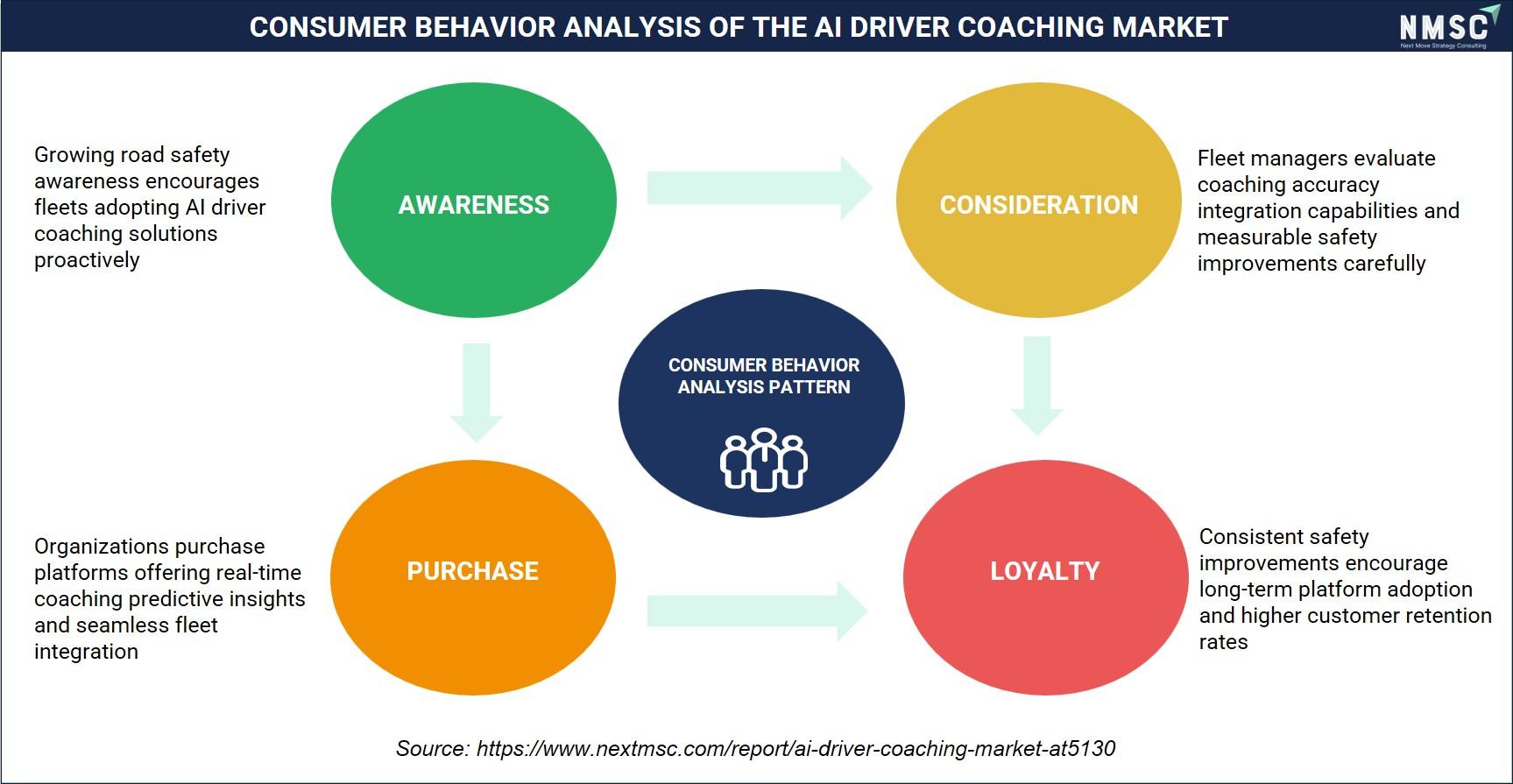
The consumer behavior analysis evaluates enterprise decision-making throughout the adoption journey in the AI Driver Coaching Market. Our assessment indicates that organizations initially recognize AI driver coaching solutions through increasing road safety awareness, regulatory initiatives, and fleet digitization efforts. During the evaluation stage, fleet managers assess coaching accuracy, predictive analytics, integration capabilities with telematics platforms, scalability, and measurable safety improvements before vendor selection. Purchasing decisions prioritize solutions that provide real-time coaching, seamless fleet management integration, and actionable driver performance insights. Long-term customer loyalty is driven by continuous reductions in accident rates, fuel savings, operational efficiency improvements, reliable technical support, and ongoing platform enhancements that strengthen fleet safety performance.
Competitive Landscape
Competitive Dynamics and M&A Landscape
|
Dimension |
Assessment |
|
Market Structure |
Moderately fragmented, with global telematics leaders competing alongside specialized dashcam and driver monitoring vendors |
|
Innovation Focus |
Real-time AI alerts, AI-generated coaching content, and multi-camera driver monitoring integration |
|
M&A Activity |
Active consolidation as telematics platforms acquire specialized coaching and computer-vision vendors |
How Do Companies Compete in the AI Driver Coaching Market?
Companies in the AI Driver Coaching Market compete primarily on AI detection accuracy, breadth of real-time alert capability, and depth of fleet management integration. Our analysis indicates that vendors differentiate through proprietary computer-vision models trained on large driving-event datasets, alongside managed coaching services that reduce the administrative burden on fleet safety managers. Pricing strategies increasingly bundle hardware, software, and services into unified per-vehicle subscription contracts.
Which Competitive Archetypes Dominate the AI Driver Coaching Market?
Two competitive archetypes dominate the AI Driver Coaching Market: full-stack telematics platforms such as Samsara and Geotab that embed driver coaching within broader fleet management suites, and specialized AI safety vendors such as Netradyne and Lytx that focus exclusively on video-based driver monitoring and coaching. Our findings suggest that full-stack platforms are gaining share among large enterprise fleets seeking unified procurement, while specialists retain strength in accuracy-critical, safety-first deployments.
AI-Native Differentiation and Explainability Drive Market Success in the AI Driver Coaching Market
Leading vendors differentiate through proprietary AI models that reduce false-positive alert rates, expanding libraries of AI-generated coaching content, and driver-facing gamification features that improve engagement. Based on NMSC's research, we found that vendors investing in edge-AI processing to enable real-time in-cab alerts, rather than cloud-only post-trip review, are capturing disproportionate share among safety-conscious freight and logistics fleets seeking immediate behavioral correction.
Market Players to Opt for Merger and Acquisition Strategies to Expand Their Presence in the AI Driver Coaching Market
M&A activity remains active as telematics platforms acquire specialized computer-vision and coaching technology to broaden AI capability. Our assessment indicates that consolidation is concentrated among mid-sized vendors seeking scale in AI model training data and geographic distribution, while larger platforms pursue acquisitions to accelerate entry into adjacent vehicle classes and end-use verticals, including construction and public sector fleet safety programs.
Key Market Players in the AI Driver Coaching Industry
-
Samsara Inc.
-
Geotab Inc.
-
Lytx, Inc.
-
Trimble Inc.
-
Powerfleet, Inc.
-
Karooooo Ltd.
-
Netradyne, Inc.
-
Seeing Machines Limited
-
Microlise Group plc
-
EROAD Limited
-
GreenRoad Technologies Ltd.
-
Nauto, Inc.
-
Azuga, Inc.
-
Streamax Technology Co., Ltd.
-
AddSecure AB
-
VisionTrack Ltd.
-
CameraMatics Limited
-
SureCam Ltd.
What Are the Latest Developments in the AI Driver Coaching Industry?
|
Date |
Event |
|
June 2026 |
Lytx unveiled significant enhancements to its LytxOne™ all-in-one fleet management solution. New capabilities include a generative "Fleet AI Assistant" for natural-language queries, configurable privacy controls (such as geofence-based camera disabling), and integrated asset tracking, aiming to unify safety, operations, and compliance into a single streamlined ecosystem |
|
February 2026 |
Geotab unveiled its next-generation AI-powered telematics roadmap at Geotab Connect 2026, introducing the GO Focus Pro AI dash cam, next-generation GO and GO Plus telematics devices, and Geotab Ace generative AI assistant. These innovations strengthen real-time driver behavior monitoring, AI-powered coaching, predictive safety analytics, and fleet intelligence, reinforcing Geotab's leadership in AI-enabled fleet safety solutions |
|
April 2025 |
Netradyne announced a multi-year international expansion plan, targeting a footprint in 15 countries by the end of 2026. Following its successful entry into Japan and Spain in 2025, the company outlined its schedule to establish commercial operations in Ireland, France, and Italy throughout |
Expert Insights
 “Motive understands the power of driver coaching and has provided tools, such as our Integrated Coaching product and the ability for drivers to review their safety events in the Driver App, to help our customers manage the complexity of this work. With AI Coach we are taking this a step further and giving customers the ability to completely automate coaching with an AI version of themselves to give personalized and authentic feedback to drivers.”
— Shoaib Makani, Co-founder and CEO, Motive
Statement made during the launch of Motive AI Coach, highlighting the growing role of artificial intelligence in automating personalized driver coaching and enabling fleet operators to deliver consistent safety guidance at scale.
Market Interpretation
The statement highlights a significant shift in the AI Driver Coaching Market toward automated, personalized coaching powered by artificial intelligence. Fleet operators are increasingly adopting AI-driven coaching platforms to deliver timely, consistent, and individualized feedback without increasing managerial workload. By combining AI, telematics, and driver behavior analytics, these solutions enable organizations to improve driver performance, reinforce safe driving practices, reduce coaching delays, and support scalable safety programs. As commercial fleets continue prioritizing operational efficiency and proactive risk management, demand for AI-enabled driver coaching platforms capable of delivering real-time, personalized interventions is expected to accelerate.
What Are the Investment Opportunities in the AI Driver Coaching Industry?
Capital inflows into the AI Driver Coaching Market are concentrated among vendors developing proprietary computer-vision models and AI-generated coaching content platforms. Our analysis indicates that infrastructure investment is expanding around edge-AI processing hardware that enables real-time in-cab alerts without continuous cloud connectivity, particularly across freight corridors with limited network coverage. Environmental, social, and governance considerations are increasingly relevant as fleet safety technology demonstrably reduces collision rates, supporting insurer-backed financing programs and public-sector procurement incentives tied to measurable road-safety outcomes across commercial fleet operations globally.
Key Benefits for Stakeholders
This report delivers actionable value across stakeholder groups engaged with the AI Driver Coaching Market. Enterprise technology leaders and fleet safety CIOs gain segmentation-level demand forecasts to guide platform procurement and integration planning. Investors and financial analysts benefit from company-level competitive positioning and growth trajectory data to inform capital allocation decisions. Technology vendors and product teams gain granular insight into segment-specific growth drivers, regional adoption patterns, and competitive innovation strategies, enabling more precise roadmap prioritization across software, hardware, and services offerings within the evolving driver coaching landscape.
Key Market Segments
By Offering
-
Software
-
Real-Time Coaching
-
In-Cab Voice Alerts
-
Visual Overlay Alerts
-
-
Post-Trip Coaching
-
Automated Video Clip Review
-
Personalized Coaching Plans
-
-
Scorecards and Analytics
-
Driver Risk Scoring
-
Fleet Safety Dashboards
-
-
Self-Coaching Apps
-
Gamified Driver Challenges
-
On-Demand Trip Replay
-
-
AI-Generated Coaching Content
-
-
Hardware
-
Dashcam Kits
-
Road-Facing Only
-
Dual-Facing
-
-
Driver Monitoring Kits
-
Multi-Camera Kits
-
Telematics Gateway Kits
-
-
Services
-
Managed Coaching
-
Remote Human Coach Sessions
-
Manager-Led Coaching Support
-
-
Monitoring and Review
-
Installation and Onboarding
-
Training and Consulting
-
By Vehicle Class
-
Passenger Car
-
Light Commercial Vehicle
-
Heavy Commercial Vehicle
-
Bus and Coach
-
Specialty and Off-Road Vehicle
By Sales Channel
-
Direct
-
OEM Embedded
-
Dealer and Reseller
-
Telco and Integrator
-
Marketplace and API
By End Use
-
Freight and Logistics
-
Passenger Transport
-
Field Service
-
Construction and Utilities
-
Oil and Gas
-
Public Sector
-
Rental and Leasing
By Region
-
North America: U.S., Canada, Mexico
-
Europe: UK, Germany, France, Italy, Spain, Sweden, Denmark, Finland, Netherlands, Rest of Europe
-
Asia-Pacific: China, India, Japan, South Korea, Taiwan, Indonesia, Vietnam, Australia, Philippines, Malaysia, Rest of APAC
-
Middle East & Africa: Saudi Arabia, UAE, Egypt, Israel, Turkey, Nigeria, South Africa, Rest of MEA
-
Latin America: Brazil, Argentina, Chile, Colombia, Rest of LATAM
Conclusion and Recommendations
The AI Driver Coaching Market is positioned for sustained expansion from USD 2.26 billion in 2026 to USD 14.88 billion by 2035, reflecting durable regulatory and insurance-linked demand across freight, passenger transport, and field service fleets. Our assessment indicates that vendors should prioritize real-time coaching capability, AI-generated content personalization, and bundled hardware-software-services procurement models to capture enterprise and mid-market fleet demand. Key risks include privacy-related deployment friction and cost sensitivity among small fleets, while the clearest growth pathway lies in expanding heavy commercial vehicle and Asia-Pacific fleet penetration.
About the Author
 Saista Faiyaz
— Saista Faiyaz is Research Associate at Next Move Strategy Consulting, where she has covered consumer markets and healthcare technologies for 3 years. Her work includes primary interview review, secondary-source validation, market sizing, and structured analysis of company and industry data. She supports research by comparing evidence across sources, organizing findings into market narratives, and documenting assumptions used in analysis. Her scope includes cross-market benchmarking, and reports.
Saista Faiyaz
— Saista Faiyaz is Research Associate at Next Move Strategy Consulting, where she has covered consumer markets and healthcare technologies for 3 years. Her work includes primary interview review, secondary-source validation, market sizing, and structured analysis of company and industry data. She supports research by comparing evidence across sources, organizing findings into market narratives, and documenting assumptions used in analysis. Her scope includes cross-market benchmarking, and reports.
About the Reviewer
 Supradip Baul
— Supradip Baul is an accomplished business consultant and strategist with over a decade of rich experience in market intelligence, strategy, technology, and business transformation. His work has included rigorous qualitative and quantitative analysis across multiple industries, helping clients shape investment decisions and long-term roadmaps. Earlier in his career, he was associated with Gartner, where he contributed to industry-leading reports and market share analyses. He has worked with leading global companies and holds an MBA with a dual specialization in Marketing and Finance.
Supradip Baul
— Supradip Baul is an accomplished business consultant and strategist with over a decade of rich experience in market intelligence, strategy, technology, and business transformation. His work has included rigorous qualitative and quantitative analysis across multiple industries, helping clients shape investment decisions and long-term roadmaps. Earlier in his career, he was associated with Gartner, where he contributed to industry-leading reports and market share analyses. He has worked with leading global companies and holds an MBA with a dual specialization in Marketing and Finance.
At Next Move Strategy Consulting, we understand that insightful market research is the cornerstone of successful business decisions. That's why we employ a robust and multifaceted approach, combining various methodologies to deliver the most accurate and actionable data for our clients.

Research Landscape
We navigate the world of research with two primary approaches:
Qualitative Approach
Our qualitative research methodologies involve immersive techniques such as in-depth interviews, focus groups, and observational studies. By engaging directly with individuals and stakeholders, we uncover valuable insights that quantitative data alone may overlook.

Quantitative Research
In tandem with qualitative methodologies, NMSC leverages the power of Quantitative Research to provide a robust foundation of numerical insights. Through systematic data collection and analysis, we quantify patterns, preferences, and market trends, offering a comprehensive view of the business landscape.
Our quantitative research approach employs diverse tools, including surveys, experiments, and statistical modelling. These methodologies enable us to gather data from a large and representative sample, ensuring the statistical significance of our findings. By employing structured questionnaires and standardized data collection methods, we guarantee the reliability and validity of the information we present to our clients.
Quantitative research is particularly effective in measuring the prevalence of trends, assessing market size, and gauging the impact of various factors on consumer behavior. The numerical precision attained through this approach equips our clients with actionable insights, facilitating data-driven decision-making and strategy formulation.


Our Specialized Toolbox for Industry-Specific Market Research
We deploy a specialized arsenal of techniques tailored to meet your unique requirements. Here's a glimpse into our comprehensive toolbox:

Information Procurement
The stage entails acquiring market data or relevant information through various sources and methodologies.


Market Research Approach
We utilize both top-down and bottom-up approaches in market research analysis to achieve a comprehensive understanding of the market dynamics, leveraging the broad perspective of industry trends and macroeconomic factors alongside detailed insights from specific segments and individual companies.

Porters Five Forces Analysis
We conduct Porter's Five Forces analysis to evaluate the competitive landscape of an industry, providing us with insights into factors that affect profitability and strategic positioning.

SWOT Analysis

Forecasting
We utilize a forecasting model to predict future consumption by considering parameters like population, economics, regulations, market competition, drivers, constraints, technology, and pricing. We also employ statistical techniques such as multilinear regression, exponential smoothing, moving average, ARIMA, and Monte Carlo simulations for accurate predictions. In econometric forecasting, we analyzed short-term and long-term event impacts, attributing values based on regulatory frameworks, economic factors, and market events.





 Speak to Our Analyst