AI Fatigue Detection Market Size, Share & Forecast: By Offering (Hardware, Software, Services), Technology (Vision-Based Systems, Multi-Sensor Systems, Physiological Monitoring Systems), Core Function (Fatigue Monitoring, Attention Monitoring, Impairment Monitoring), Sales Channel (Direct OEM Sales, Tier 1 Integration Sales, Direct Enterprise Sales), and End User (Automotive, Mining, Construction, Logistics & Transportation, Aviation)— Global Analysis 2025–2035
Industry: Automotive & Transportation | Publishing Date: July 13, 2026 | Last Updated: September 30, 2026 | No of Pages: N/A | No. of Tables: N/A | No. of Figures: N/A | Format: PDF | Report Code: AT5107
What Is the AI Fatigue Detection Market Size?
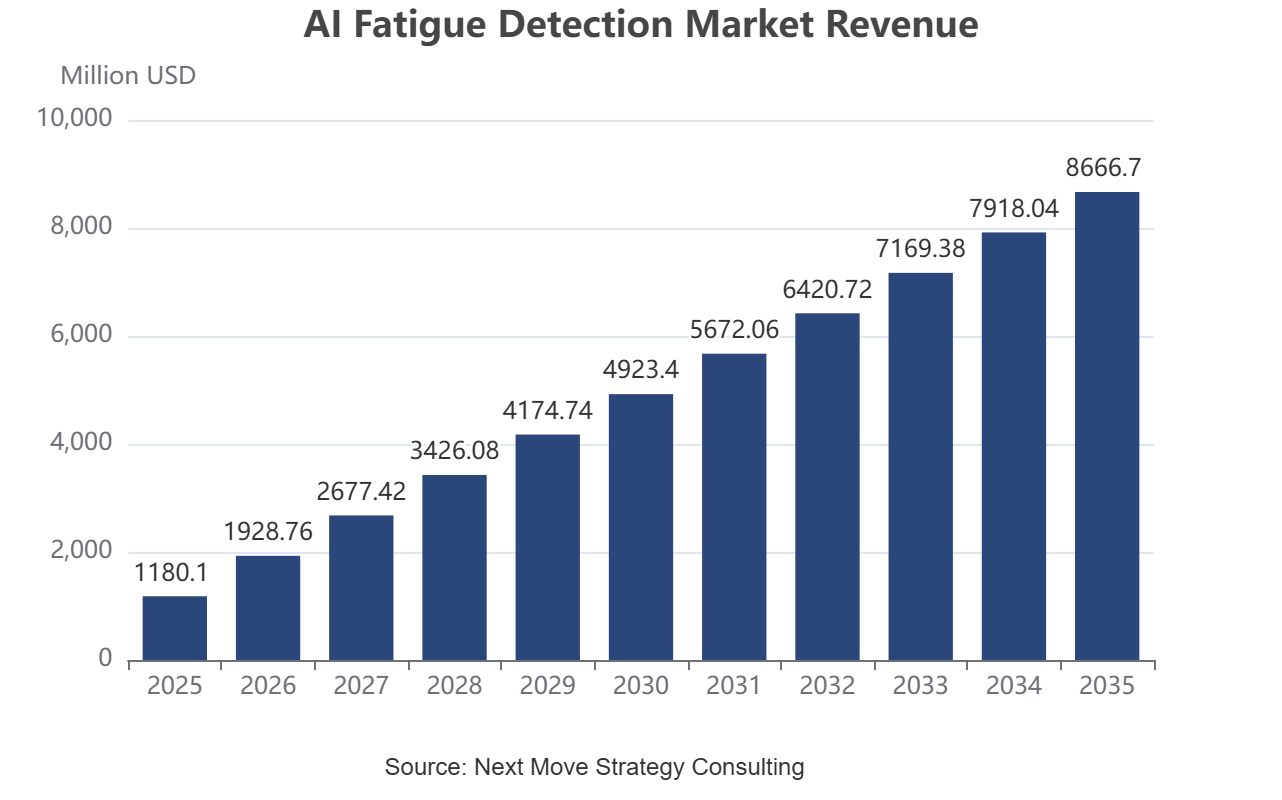
The AI Fatigue Detection Market encompasses artificial intelligence-driven hardware, software, and service solutions that continuously monitor, score, and alert on operator fatigue, drowsiness, and cognitive impairment in real time across automotive OEM, enterprise fleet, mining, construction, and aviation deployment environments. The global market was valued at USD 945.6 Million in 2025, is projected to reach USD 1180.1 Million in 2026, and is forecast to expand to USD 8666.7 Million by 2035, advancing at a CAGR of 24.8% from 2026 to 2035. Primary growth drivers include mandatory driver monitoring system regulations across major automotive markets, rapid advancement in edge AI inference capabilities, and expanding enterprise adoption of fatigue safety solutions across logistics, mining, and aviation sectors.
|
Parameter |
Details |
|
Market Size in 2025 |
USD 945.6 Million |
|
Market Size in 2026 |
USD 1180.1 Million |
|
Revenue Forecast in 2035 |
USD 8666.7 Million |
|
Growth Rate |
CAGR of 24.8% from 2026 to 2035 |
|
Analysis Period |
2025–2035 |
|
Base Year Considered |
2025 |
|
Forecast Period |
2026–2035 |
|
Market Size Estimation |
Revenue (USD Million) |
|
Companies Profiled |
20 |
|
Countries Covered |
38 |
|
Market Share |
Available for Top 10 Companies |
AI Fatigue Detection Market Overview
The market encompasses AI-enabled hardware, software, and services that detect operator fatigue and impairment across automotive, logistics, mining, and aviation environments. Structurally, the market evolved from basic camera-based drowsiness warnings in premium vehicles to integrated multi-sensor, edge-AI architectures deployed across diverse operator segments by 2025. The EU General Safety Regulation 2019/2144, NHTSA rulemaking, and FMCSA hours-of-service frameworks collectively mandate or incentivize adoption. Edge AI inference now executes PERCLOS and head-pose models below 33 milliseconds on automotive-grade embedded processors, enabling reliable 24/7 operator fatigue monitoring across vehicle and industrial equipment platforms.
|
Key Takeaways |
|
By Offering: Dominant: Hardware (USD 458.2 Million in 2025; USD 3933.4 Million by 2035; 24.0% CAGR). Fastest-Growing: Software (25.8% CAGR; USD 322.8 Million in 2025; USD 3200.1 Million by 2035). |
|
By Technology: Dominant: Vision-Based Systems (USD 512.3 Million in 2025; USD 3966.7 Million by 2035; 22.7% CAGR). Fastest-Growing: Multi-Sensor Systems (27.5% CAGR; USD 298.6 Million in 2025; USD 3400.0 Million by 2035). |
|
By Core Function: Dominant: Fatigue Monitoring (industry-derived estimate: USD 425.0 Million in 2025; USD 3800.0 Million by 2035). Fastest-Growing: Impairment Monitoring (industry-derived estimate: approximately 28.7% CAGR). |
|
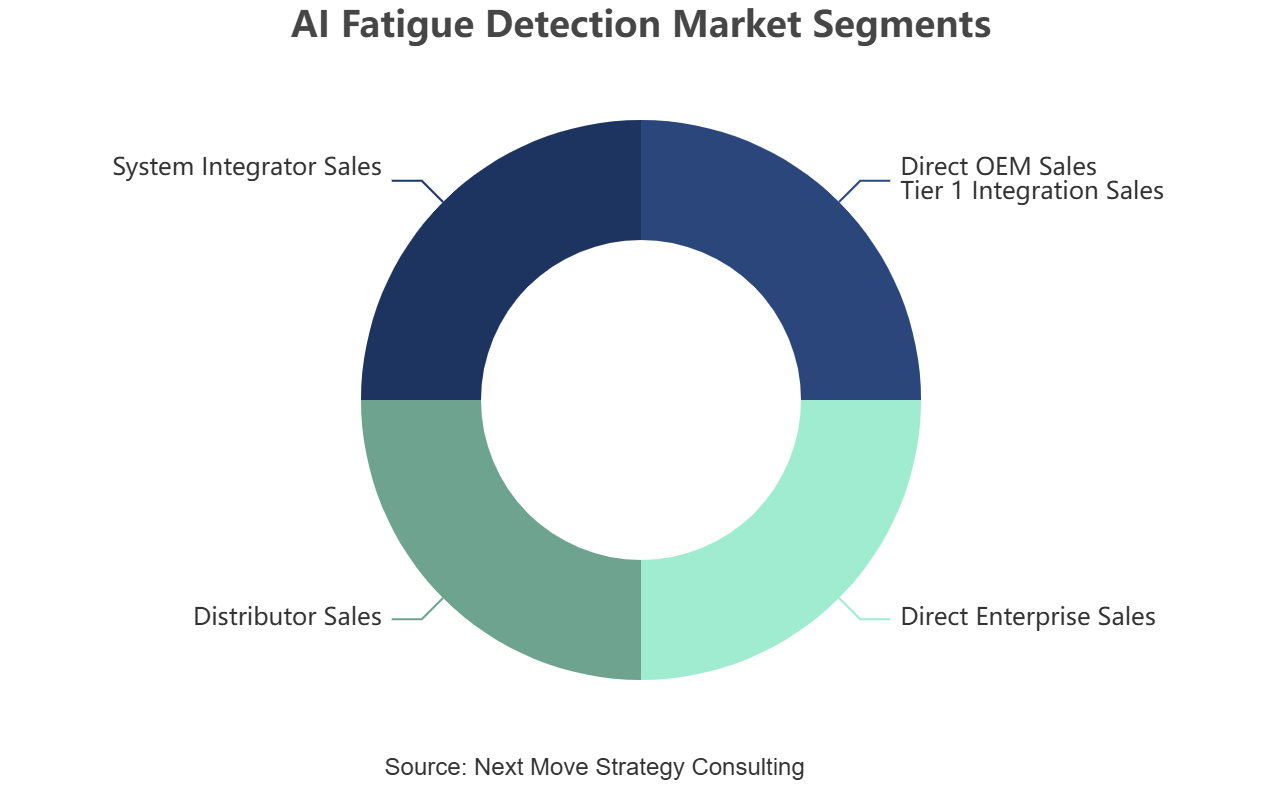
By Sales Channel: Dominant: Direct OEM Sales (industry-derived estimate: USD 420.0 Million in 2025; USD 3666.7 Million by 2035). Fastest-Growing: System Integrator Sales (industry-derived estimate: approximately 31.6% CAGR; USD 600.0 Million by 2035). |
|
By End User: Dominant: Automotive (USD 385.2 Million in 2025; USD 3100.0 Million by 2035; 23.2% CAGR). Fastest-Growing: Logistics & Transportation (28.2% CAGR; USD 156.3 Million in 2025; USD 1866.7 Million by 2035). |
|
Dominant Region: North America (USD 375.4 Million in 2025; USD 2933.4 Million by 2035; 22.8% CAGR). |
|
Fastest-Growing Region: Asia-Pacific (29.7% CAGR; USD 268.9 Million in 2025; USD 2800.0 Million by 2035). |
|
Dominant Country: United States (USD 318.2 Million in 2025; USD 2466.7 Million by 2035; 22.7% CAGR; industry-derived estimate). |
|
Fastest-Growing Country: Saudi Arabia (30.5% CAGR; USD 18.6 Million in 2025; USD 266.7 Million by 2035; industry-derived estimate). |
Key Emerging Trends in the AI Fatigue Detection Market
How Is Edge AI Integration Transforming AI Fatigue Detection Market Capabilities?
The deployment of dedicated neural processing units within vehicle-embedded driver monitoring modules is eliminating the latency and connectivity dependencies of cloud-reliant fatigue scoring architectures. Continental AG and Denso Corporation have both commercialized edge-inference DMS modules that execute PERCLOS and head-pose estimation locally at frame rates exceeding 30 frames per second under ISO 26262 functional safety constraints. This architectural shift enables fatigue intervention within regulatory response-time windows, expands deployment viability in connectivity-limited environments including mining sites and offshore logistics operations, and reduces per-vehicle data transmission costs that previously constrained fleet-scale deployment economics across the AI Fatigue Detection Market.
What Role Is Multi-Modal Sensor Fusion Playing in AI Fatigue Detection Market Innovation?
Through our market assessment, we observed that integrating vision data with physiological signals, vehicle dynamics telemetry, and wearable biometric feeds is materially improving fatigue detection accuracy and reducing false-alarm rates that previously limited operator acceptance. Seeing Machines' FOVIO platform and Smart Eye's integrated DMS architecture both combine infrared gaze tracking with head-pose models and contextual vehicle data to generate composite fatigue risk scores with demonstrated specificity improvements over single-sensor approaches. This multi-modal convergence is enabling AI Fatigue Detection Market entrants to meet the reliability thresholds required for aviation and mining sector safety-critical deployment programs.
How Are Industrial Sector Expansions Reshaping the AI Fatigue Detection Market Landscape?
In our observation, the expansion of AI fatigue detection technology beyond the passenger car segment into mining, construction, logistics, and aviation represents the most significant addressable market extension through 2035. Australia's National Heavy Vehicle Regulator mandates fatigue management programmes for heavy vehicle operators, creating a compliance-driven procurement pathway that fleet operators are fulfilling through technology-based solutions. Samsara and Lytx have captured enterprise fleet segments by bundling AI fatigue detection within comprehensive fleet telematics platforms, demonstrating that non-OEM distribution channels can capture substantial AI Fatigue Detection Market share through integrated safety and operational data value propositions.
What Are the Key Market Drivers, Breakthroughs, and Investment Opportunities that will Shape the AI Fatigue Detection Industry in the Next Decade?
|
Driver / Trend / Restraint |
(+/−) % Impact on CAGR Forecast |
Geographic Relevance |
Impact Timeline |
|
Mandatory DMS regulations and ADAS safety standards |
+4.2% |
Global |
Near-term (2025–2027) |
|
AI and edge computing algorithm advancement |
+3.8% |
Global |
Mid-term (2026–2029) |
|
Expanding industrial workplace fatigue safety mandates |
+2.5% |
MEA, LATAM, Asia-Pacific |
Mid-term (2026–2030) |
|
High hardware and system integration deployment costs |
−2.1% |
Emerging Markets |
Ongoing |
|
Data privacy regulations and ethical AI compliance requirements |
−1.4% |
Europe, North America |
Ongoing |
What Are the Growth Drivers of the AI Fatigue Detection Market?
How Are Mandatory Regulations Driving Growth in the Market?
Our analysis shows that the EU General Safety Regulation 2019/2144, fully applicable to all new M-category and N-category vehicle types from July 2024, is the most consequential demand driver in the AI Fatigue Detection Market, mandating driver drowsiness and attention warning systems and advanced driver distraction warning systems across European vehicle production volumes. The U.S. National Highway Traffic Safety Administration reports that drowsy driving contributed to approximately 91,000 police-reported crashes in its most recent annual analysis, providing the epidemiological foundation for ongoing federal rulemaking that signals further U.S. mandates within the near-term forecast horizon.
How Is AI Algorithm Advancement Accelerating AI Fatigue Detection Market Demand?
Based on our market evaluation, we noticed that advances in lightweight convolutional neural network architectures optimized for automotive-grade microcontrollers and systems-on-chip have reduced eye-closure detection model inference time below 33 milliseconds on embedded hardware, enabling real-time drowsiness alerts within regulatory response windows. The International Organization for Standardization's ISO 21434 cybersecurity standard for automotive systems provides a compliance framework that AI fatigue detection software suppliers are integrating into their product certification pathways, accelerating OEM acceptance and shortening platform integration timelines across major vehicle programmes globally.
What Are the Growth Inhibitors of the AI Fatigue Detection Market?
What High Deployment Costs Are Restraining the AI Fatigue Detection Market?
Our findings suggest that full-system DMS deployment costs encompassing infrared camera hardware, edge computing module, embedded software licensing, and vehicle integration engineering range from USD 150 to USD 400 per vehicle in current production configurations (industry-derived estimate), creating a material cost-of-goods barrier in high-volume value-segment automotive platforms and commercial fleet retrofit programmes. For mining and construction equipment operators deploying aftermarket fatigue monitoring across heterogeneous heavy equipment fleets, the absence of factory integration points requires custom sensor mounting, CAN-bus interface development, and operator training programmes that substantially increase total implementation costs relative to factory-fitted OEM alternatives.
What Are the Growth Opportunities in the AI Fatigue Detection Market?
What Opportunities Does Industrial Sector Expansion Offer the AI Fatigue Detection Market?
Through NMSC's assessment, we found that mining, construction, and logistics sectors collectively represent the fastest-growing demand opportunity for AI fatigue detection solutions outside the automotive OEM channel, with Logistics & Transportation projected to grow at 28.2% CAGR to USD 1866.7 Million by 2035. The U.S. Occupational Safety and Health Administration's general duty clause establishes employer liability for worker fatigue incidents, providing the legal foundation for enterprise procurement of continuous fatigue monitoring solutions in high-risk industrial environments. Australia's National Heavy Vehicle Regulator and EU Framework Directive 89/391/EEC both establish employer obligations for fatigue risk management that are driving enterprise procurement contracts.
How Is the AI Fatigue Detection Industry Segmented in This Report, and What Are the Key Insights from the Segmentation Analysis?
Which Offering Type Dominates the AI Fatigue Detection Market?
|
Segment |
2025 (USD Million) |
2035 (USD Million) |
CAGR% (2026–2035) |
|
Hardware |
458.2 |
3933.4 |
24.0% |
|
Software |
322.8 |
3200.1 |
25.8% |
|
Services |
164.6 |
1533.2 |
25.0% |
Hardware is the dominant offering within the market at USD 458.2 Million in 2025, projected to reach USD 3933.4 Million by 2035 at a CAGR of 24.0%. This dominance reflects the mandatory physical sensing infrastructure required by every fatigue detection deployment, including infrared cameras, driver monitoring modules, edge computing units, and three-dimensional imaging sensors that underpin AI model execution at the point of operation. Software records the fastest CAGR of 25.8%, reaching USD 3200.1 Million by 2035, as AI analytics platforms, fatigue risk scoring engines, and occupant monitoring software increasingly layer premium recurring revenue opportunities over established hardware installations.
Which Technology Type Leads the AI Fatigue Detection Market?
|
Segment |
2025 (USD Million) |
2035 (USD Million) |
CAGR% (2026–2035) |
|
Vision-Based Systems |
512.3 |
3966.7 |
22.7% |
|
Multi-Sensor Systems |
298.6 |
3400.0 |
27.5% |
|
Physiological Monitoring Systems |
134.7 |
1300.0 |
25.4% |
Vision-Based Systems are the dominant technology segment within the market at USD 512.3 Million in 2025, reflecting their maturity, cost efficiency, and compatibility with automotive-grade hardware integration across infrared and RGB camera platforms. Multi-Sensor Systems record the fastest CAGR of 27.5%, driven by accuracy improvements achieved through fusing camera-based gaze and head-pose data with vehicle dynamics telemetry, heart rate biometrics, and wearable physiological feeds. Multi-Sensor Systems are projected to reach USD 3400.0 Million by 2035 as aviation, mining, and premium automotive OEM programmes specify multi-modal sensor architectures for safety-critical deployment requirements.
Which End User Segment Generates the Highest Revenue in the AI Fatigue Detection Market?
|
Segment |
2025 (USD Million) |
2035 (USD Million) |
CAGR% (2026–2035) |
|
Automotive |
385.2 |
3100.0 |
23.2% |
|
Mining |
168.4 |
1500.0 |
24.5% |
|
Construction |
142.8 |
1333.4 |
25.0% |
|
Logistics & Transportation |
156.3 |
1866.7 |
28.2% |
|
Aviation |
62.4 |
600.0 |
25.4% |
|
Other End Users |
30.5 |
266.6 |
24.2% |
|
Total |
945.6 |
8666.7 |
24.8% |
Automotive is the dominant end-user segment within the AI Fatigue Detection Market at USD 385.2 Million in 2025, driven by OEM integration across passenger vehicles and commercial trucks mandated by European and emerging global driver monitoring regulations. Logistics & Transportation is the fastest-growing end user at a CAGR of 28.2%, projected to reach USD 1866.7 Million by 2035, as fleet operators deploy AI fatigue detection within telematics platforms to reduce commercial vehicle incidents, lower insurance premiums, and comply with hours-of-service safety mandates enforced by the FMCSA and equivalent international freight transport regulatory bodies.
Consumer Behavior Analysis of the AI Fatigue Detection Market
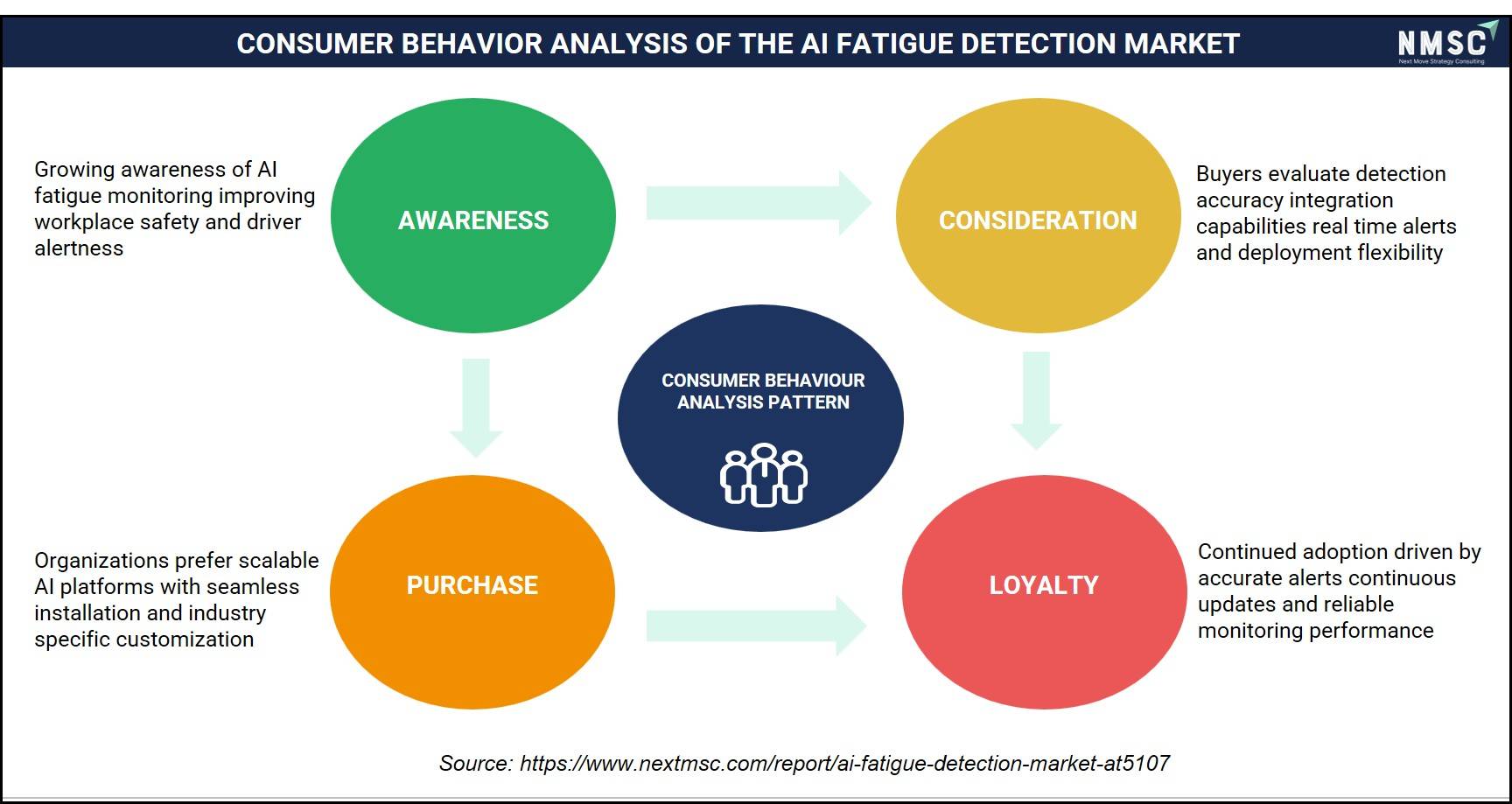
The consumer behavior analysis below maps the key stages, such as awareness, consideration, purchase, and loyalty, shaping the AI fatigue monitoring market. From our analysis, we observed that consideration is the most decisive stage, as buyers rigorously evaluate detection accuracy, integration capabilities, and real-time alert systems before committing, prompting vendors to emphasize technical reliability and seamless deployment to convert prospects into long-term enterprise clients.
Regional Outlook
Geographic Performance Snapshot
|
Region |
2025 (USD Million) |
2035 (USD Million) |
CAGR% (2026–2035) |
Key Driver |
|
North America |
375.4 |
2933.4 |
22.8% |
Stringent NHTSA and FMCSA safety mandates and fleet density |
|
Europe |
212.5 |
1800.0 |
26.8% |
EU GSR 2019/2144 mandatory DMS deployment across vehicle types |
|
Asia-Pacific |
268.9 |
2800.0 |
29.7% |
High automotive production volume and EV platform expansion |
|
Middle East & Africa |
55.6 |
733.3 |
29.4% |
Mining and logistics fleet safety investment and Vision programs |
|
Latin America |
33.2 |
400.0 |
28.2% |
Growing road safety regulation and commercial fleet mandates |
North America AI Fatigue Detection Market
North America is the dominant region within the AI Fatigue Detection Market, valued at USD 375.4 Million in 2025 and projected to reach USD 2933.4 Million by 2035 at a CAGR of 22.8%. The region benefits from the highest concentration of commercial fleet operations globally, well-funded NHTSA and FMCSA regulatory frameworks that impose stringent driver monitoring requirements, and the presence of major fatigue detection platform providers, including Samsara, Netradyne, and Lytx, that drive enterprise fleet adoption through integrated telematics solutions. The United States commands the largest individual country market share, supported by high commercial vehicle registration volumes and ongoing federal autonomous vehicle safety rulemaking.
United States AI Fatigue Detection Market
Based on our engagements, the United States represents the largest individual country market within the market, estimated at approximately USD 318.2 Million in 2025 and projected to reach USD 2466.7 Million by 2035 at a CAGR of 22.7%. The FMCSA electronic logging device mandate and NHTSA's ongoing rulemakings on driver monitoring technologies create a compliance-driven procurement environment underpinning demand for both OEM-integrated and aftermarket AI fatigue detection systems. Technology penetration is highest in Class 8 trucking, ride-share platforms, and industrial mining operations across western states, where enterprise telematics operators have established recurring subscription revenue models.
Canada AI Fatigue Detection Market
Through our analysis, Canada's AI Fatigue Detection Market is estimated at approximately USD 57.2 Million in 2025, projected to reach USD 466.7 Million by 2035 at a CAGR of 26.3%. Transport Canada's Commercial Vehicle Safety Alliance-aligned inspection programmes and provincial hours-of-service regulations create baseline compliance demand for driver monitoring systems across Canada's long-haul freight and resource extraction vehicle fleets. Alberta and British Columbia host the largest concentrations of mining and oil-field transport operations adopting enterprise fatigue monitoring platforms, while Ontario's automotive manufacturing cluster supports OEM supplier development for DMS hardware and software components.
Europe AI Fatigue Detection Market
Europe is the second-largest region within the market at USD 212.5 Million in 2025, projected to reach USD 1800.0 Million by 2035 at a CAGR of 26.8%. The EU General Safety Regulation 2019/2144 mandate for drowsiness and attention warning systems across all new M1 and N1 vehicles is the primary structural demand driver, converting the region's high annual new vehicle registration volumes into a compliance-guaranteed technology procurement pipeline. European automotive OEMs, including Volkswagen Group, BMW, and Stellantis, have integrated fatigue detection solutions from Continental AG, Valeo, and Bosch, creating a concentrated supplier ecosystem within Europe's automotive manufacturing heartland.
United Kingdom AI Fatigue Detection Market
From our assessment, the United Kingdom's market is estimated at approximately USD 52.4 Million in 2025, projected to reach USD 433.3 Million by 2035 at a CAGR of 26.5%. The Medicines and Healthcare products Regulatory Agency and DVSA enforce driver fitness standards that create a regulatory context for fatigue monitoring adoption, and the UK's post-Brexit framework aligns with EU GSR DMS mandates for new type approvals. The UK's large commercial vehicle fleet operating under DVSA enforcement, combined with high-density ride-share and last-mile delivery operations across London and major urban centres, sustains strong enterprise demand for AI-enabled fatigue monitoring solutions.
Germany AI Fatigue Detection Market
According to our evaluation, Germany's AI Fatigue Detection Market is estimated at approximately USD 63.8 Million in 2025, projected to reach USD 566.7 Million by 2035 at a CAGR of 27.5%. Germany is the highest-priority European market for AI fatigue detection suppliers, given its position as the continent's largest automotive manufacturing hub. Continental AG, Robert Bosch GmbH, and ZF Friedrichshafen AG are headquartered in Germany and serve as primary DMS hardware and software suppliers to domestic OEMs. The Kraftfahrt-Bundesamt type approval process under EU GSR 2019/2144 is compelling all passenger vehicle OEMs to integrate compliant fatigue warning systems, generating steady volume-driven demand growth through 2035.
France AI Fatigue Detection Market
Based on our engagements, France's AI Fatigue Detection Market is estimated at approximately USD 38.5 Million in 2025, projected to reach USD 333.3 Million by 2035 at a CAGR of 27.1%. Valeo SE, headquartered in Paris, is a global DMS supplier that sources engineering and production activity domestically, reinforcing France's position as an AI fatigue detection R&D centre within the European automotive supplier ecosystem. The Securite Routiere national road safety agency's ongoing fatigue awareness campaigns and government investment in road safety technology validate the regulatory environment supporting sustained AI fatigue detection adoption across passenger and commercial vehicle platforms.
Asia-Pacific AI Fatigue Detection Market
Asia-Pacific is the fastest-growing major region within the market, valued at USD 268.9 Million in 2025 and projected to reach USD 2800.0 Million by 2035 at a CAGR of 29.7%. The region combines the world's highest automotive production volumes, concentrated in China, Japan, South Korea, and India, with rapidly expanding OEM integration of advanced safety systems driven by New Car Assessment Programme mandates and evolving national DMS regulations. Asia-Pacific's large mining and construction sectors, particularly in Australia, China, and Indonesia, are also generating substantial non-automotive enterprise demand for AI fatigue detection solutions across heavy equipment operators.
China AI Fatigue Detection Market
Through our analysis, China's market is estimated at approximately USD 98.6 Million in 2025, projected to reach USD 1066.7 Million by 2035 at a CAGR of 30.3%. The Ministry of Industry and Information Technology's intelligent connected vehicle technical standards and China's GB standards for advanced driver assistance systems are creating regulatory tailwinds for DMS integration across China's annual vehicle production of over 27 million units. Chinese electric vehicle OEMs, including BYD and NIO, are integrating fatigue monitoring as standard equipment in their intelligent cockpit systems, accelerating local AI Fatigue Detection Market adoption independent of foreign regulatory mandates.
India AI Fatigue Detection Market
From our assessment, India's AI Fatigue Detection Market is estimated at approximately USD 52.4 Million in 2025, projected to reach USD 666.7 Million by 2035 at a CAGR of 32.7%. The Ministry of Road Transport and Highways has mandated vehicle tracking and driver behavior monitoring systems for commercial vehicles, creating a regulatory foundation for AI fatigue detection adoption across India's estimated 10 million commercial vehicles. India's high road accident fatality rate, cited by the World Health Organization as among the highest globally, provides strong public safety justification for accelerating driver monitoring technology requirements across the country's transport sector.
Japan AI Fatigue Detection Market
According to our evaluation, Japan's market is estimated at approximately USD 58.3 Million in 2025, projected to reach USD 533.3 Million by 2035 at a CAGR of 24.8%. The Ministry of Land, Infrastructure, Transport and Tourism's safety protocols for commercial vehicle operators establish fatigue monitoring obligations that are driving fleet-level AI fatigue detection adoption. Japanese tier-one automotive suppliers including Denso Corporation, Panasonic Holdings, and Mitsubishi Electric are active DMS developers serving both domestic OEMs and international export markets, positioning Japan as a key technology origination market within the global AI Fatigue Detection Market supply chain.
South Korea AI Fatigue Detection Market
Based on our engagements, South Korea's market is estimated at approximately USD 32.4 Million in 2025, projected to reach USD 333.3 Million by 2035 at a CAGR of 29.6%. The Ministry of Land, Infrastructure and Transport has enacted autonomous driving safety guidelines that include driver monitoring requirements for semi-autonomous vehicle systems, aligning South Korea's regulatory trajectory with EU and U.S. DMS mandates. Hyundai Motor Group's integration of driver monitoring across its Hyundai, Kia, and Genesis platforms creates strong domestic procurement volumes and export production demand for AI fatigue detection hardware and software components.
Middle East & Africa AI Fatigue Detection Market
The Middle East & Africa region is one of the highest-growth areas within the AI Fatigue Detection Market, advancing from USD 55.6 Million in 2025 to USD 733.3 Million by 2035 at a CAGR of 29.4%. Growth is driven by large-scale mining and logistics fleet operations in Saudi Arabia, the UAE, and South Africa that face increasing safety audit scrutiny and corporate ESG accountability requirements, alongside national Vision programmes in GCC states incorporating transport safety technology as a strategic priority. Both international AI fatigue detection providers and local system integrators are competing to serve the region's government-led safety modernization programmes.
United Arab Emirates AI Fatigue Detection Market
Through our analysis, the UAE's AI Fatigue Detection Market is estimated at approximately USD 14.8 Million in 2025, projected to reach USD 200.0 Million by 2035 at a CAGR of 33.5%. The UAE's Roads and Transport Authority and National Transport Authority have implemented commercial vehicle safety programmes that increasingly specify driver monitoring requirements for freight and public transport fleet operators. Dubai's smart city infrastructure investment and Abu Dhabi's autonomous vehicle testing programmes are generating institutional procurement demand for AI-enabled driver state monitoring solutions, supported by GCC membership in international vehicle safety harmonization agreements.
Saudi Arabia AI Fatigue Detection Market
From our assessment, Saudi Arabia's AI Fatigue Detection Market is estimated at approximately USD 18.6 Million in 2025, projected to reach USD 266.7 Million by 2035 at a CAGR of 30.5%, ranking it among the fastest-growing individual country markets globally. Saudi Vision 2030 transport and logistics modernization programmes include fleet safety technology requirements for the kingdom's rapidly expanding logistics sector, and the Saudi Standards, Metrology and Quality Organization is developing vehicle safety standards aligned with international DMS requirements. Large mining and construction operations supporting Vision 2030 infrastructure projects are also procuring enterprise fatigue monitoring solutions for heavy equipment operator safety compliance.
South Africa AI Fatigue Detection Market
According to our evaluation, South Africa's market is estimated at approximately USD 7.2 Million in 2025, projected to reach USD 100.0 Million by 2035 at a CAGR of 33.9%. South Africa's Road Traffic Management Corporation enforces commercial vehicle safety regulations, and the country's extensive mining sector, comprising platinum, gold, and coal operations, applies fatigue monitoring requirements under Mine Health and Safety Act obligations enforced by the Department of Mineral Resources and Energy. International mining operators including Anglo American have deployed enterprise fatigue monitoring platforms at South African mining sites, establishing reference deployment cases for broader regional adoption.
Latin America AI Fatigue Detection Market
Latin America is projected to advance at a CAGR of 28.2% within the AI Fatigue Detection Market, from USD 33.2 Million in 2025 to USD 400.0 Million by 2035. Brazil and Argentina host the region's most developed commercial vehicle fleet and automotive manufacturing sectors, which are primary demand sources for AI fatigue detection solutions. Growing road safety regulation across the region, supported by alignment with the UN Decade of Action on Road Safety objectives, is creating regulatory momentum for driver monitoring mandates across Latin America's large commercial vehicle and public transport fleet operator base.
Brazil AI Fatigue Detection Market
Based on our engagements, Brazil's AI Fatigue Detection Market is estimated at approximately USD 18.4 Million in 2025, projected to reach USD 233.3 Million by 2035 at a CAGR of 32.6%. Brazil's CONTRAN traffic authority and ANTT national land transport agency are progressively introducing driver monitoring requirements for commercial freight and passenger transport operators, and the country's Proconve vehicle safety standards programme provides the regulatory infrastructure for integrating DMS requirements into future vehicle approval cycles. Brazil's large agribusiness and mining transport sectors are also generating enterprise procurement demand for fatigue monitoring solutions across long-haul operator fleets.
Argentina AI Fatigue Detection Market
Through our analysis, Argentina's AI Fatigue Detection Market is estimated at approximately USD 6.8 Million in 2025, projected to reach USD 80.0 Million by 2035 at a CAGR of 31.5%. Argentina's National Vial Road Safety Agency enforces commercial driver operating hours and fatigue management requirements for intercity freight and passenger transport operators, creating baseline compliance procurement demand for fatigue monitoring technology. The country's mining sector in Mendoza and San Juan provinces and its agricultural logistics networks represent growth segments for enterprise AI fatigue detection deployment as international mining operators apply global safety standards to Argentinian operations.
Strategic Analysis of the AI Fatigue Detection Market
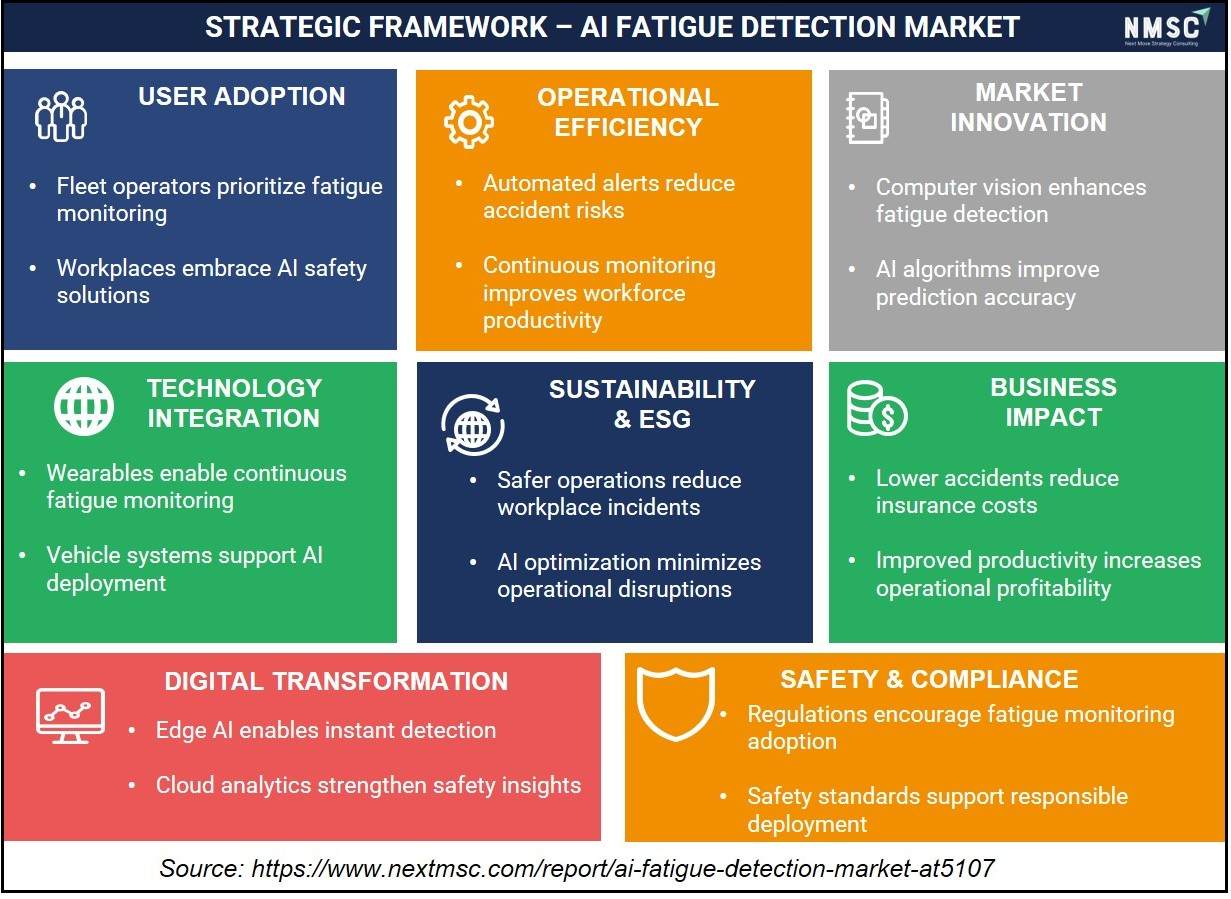
The below strategic framework maps the key pillars, such as user adoption, operational efficiency, market innovation, technology integration, sustainability and ESG, business impact, digital transformation, and safety and compliance, shaping the AI fatigue detection market. We observed from our analysis that safety and compliance mandates are increasingly converging with business impact metrics, as regulatory pressures and insurance cost benefits together create a compelling case for adoption, pushing fleet operators and workplaces to view fatigue monitoring not just as a compliance obligation but as a strategic investment in operational profitability.
Competitive Landscape
|
Category |
Key Takeaways |
|
Market Structure |
Moderately fragmented; automotive tier-one suppliers and dedicated DMS specialists compete with fleet telematics platform providers across distinct OEM, enterprise fleet, and industrial end-use channels |
|
Innovation Focus |
Edge AI inference optimization, multi-modal sensor fusion, ISO 26262 safety certification, and integration with ADAS and autonomous driving platform architectures |
|
M&A Activity |
Strategic partnerships between DMS software specialists and automotive tier-ones; fleet telematics platform acquisitions targeting AI-enabled safety analytics capabilities |
How Do Companies Compete in the AI Fatigue Detection Industry?
Competition within the AI Fatigue Detection Market spans three primary commercial channels with distinct competitive dynamics. In the automotive OEM channel, tier-one suppliers including Continental AG, Robert Bosch GmbH, Valeo SE, and Denso Corporation compete on ISO 26262 safety certification depth, platform integration scalability, and multi-OEM programme breadth. In the enterprise fleet channel, dedicated DMS platforms, including Seeing Machines, Smart Eye, Samsara, Netradyne, and Lytx compete on detection accuracy, false-alarm performance, telematics integration breadth, and per-fleet total cost of ownership. In the industrial channel, competition focuses on system integration capability, harsh-environment hardware robustness, and regulatory compliance documentation for mining and construction certifications.
How Are Innovation and Differentiation Strategies Shaping the AI Fatigue Detection Market?
NMSC's analysis indicates that innovation within the AI Fatigue Detection Market is concentrated in three specific differentiators: AI model accuracy and false-alert rate reduction, edge computing platform efficiency enabling real-time inference within ISO 26262 ASIL-B and ASIL-D constraint envelopes, and the extension of fatigue scoring beyond drowsiness detection to impairment, distraction, and occupant wellness monitoring. Mobileye's EyeQ system-on-chip and Continental's camera systems represent hardware innovation leadership, while Seeing Machines' cloud-based fleet monitoring platform and Smart Eye's multi-OEM software deployment demonstrate software-led differentiation building recurring revenue models independent of hardware vendor relationships.
What M&A Activity Is Reshaping the AI Fatigue Detection Market?
Our assessment indicates that M&A activity in the AI Fatigue Detection Market reflects two converging dynamics. Automotive tier-one suppliers are acquiring DMS software capabilities through licensing agreements and technology partnerships to supplement hardware portfolios as OEM customers demand integrated software-plus-sensor solutions rather than component-level procurement. Fleet telematics platform operators, including Samsara, have pursued acquisition strategies targeting AI safety analytics capabilities to enhance predictive fatigue and distraction scoring functionality within fleet management software-as-a-service offerings, converting AI fatigue detection from a standalone product into a value-added feature within subscription-based fleet intelligence platforms.
Key Market Players of the AI Fatigue Detection Market
-
Continental AG
-
Robert Bosch GmbH
-
Denso Corporation
-
Aptiv PLC
-
Magna International Inc.
-
Valeo SE
-
ZF Friedrichshafen AG
-
Autoliv Inc.
-
Mobileye Global Inc.
-
Seeing Machines Limited
-
Smart Eye AB
-
HARMAN International Industries, Inc.
-
Visteon Corporation
-
Tobii AB
-
Mitsubishi Electric Corporation
-
Panasonic Holdings Corporation
-
Omron Corporation
-
Samsara Inc.
-
Netradyne Inc.
-
Lytx, Inc.
What Are the Latest Developments in the AI Fatigue Detection Industry?
|
Date |
Event |
|
September 2025 |
Lytx announced rapid commercial adoption of its AI-powered Fatigue Detection solution, reporting deployment across more than 23,000 vehicles within weeks of launch and approximately 90% detection accuracy through its machine vision and professional review approach. |
|
July 2025 |
Lytx launched Fatigue Detection, an AI-powered solution combining machine vision, artificial intelligence, and human review to detect progressive signs of driver fatigue. |
Expert Insights

“Fatigue is a progressive process and often cannot be determined based on a singular event. Lytx’s state-of-the-art Fatigue Detection AI technology analyzes numerous signals, behaviors, and data to minimize false positives and provide drivers and fleet managers with more accurate alerts. This enables our customers to reliably support their drivers if fatigue sets in”
— Casey McGee, Chief Revenue Officer of Lytx, Incz
Statement made during the launch of Lytx's AI-powered Fatigue Detection solution.
Market Interpretation
The statement highlights the increasing sophistication of AI fatigue detection technologies, with a growing emphasis on analyzing multiple behavioral and physiological indicators to improve detection accuracy while minimizing false alerts. As fleet operators seek more reliable driver monitoring solutions, demand is expected to rise for AI-powered fatigue detection systems that enhance road safety through real-time risk identification and proactive intervention.
Investment Opportunities
Our analysis shows that the AI Fatigue Detection Market presents investment opportunities across hardware sensing, AI software platforms, and system integration services, representing an estimated USD 7721.1 Million incremental revenue opportunity between 2025 and 2035. Private equity and strategic capital are concentrating on AI software providers with recurring fleet subscription models that combine fatigue detection with broader driver behavior analytics, ESG-aligned safety performance reporting, and insurance telematics integrations. ESG considerations are integral to investment thesis construction, as fatigue accident reduction directly supports corporate safety performance metrics, social responsibility indices, and insurer risk models linking fleet safety technology adoption to commercial vehicle premium structures.
Key Benefits for Stakeholders
This AI Fatigue Detection Market report delivers targeted value to three stakeholder groups: enterprise technology leaders and CIOs gain granular segmentation data across five dimensions and 38 geographies supporting vendor evaluation, platform investment decisions, and build-versus-buy assessments for fleet safety technology; investors and financial analysts access the data framework underpinning the USD 8666.7 Million 2035 market opportunity, with CAGR analysis identifying Asia-Pacific (29.7%) and Middle East & Africa (29.4%) as priority capital deployment geographies; and technology vendors and product teams access competitive differentiation benchmarks, end-user growth trajectories, and sales channel analysis guiding automotive OEM, enterprise fleet, and industrial product development prioritization across the 2026–2035 forecast horizon.
Key Market Segments
By Offering
-
Hardware
-
Cameras
-
Infrared Cameras
-
Three-Dimensional Imaging Sensors
-
Edge Computing Units
-
Driver Monitoring Modules
-
Biometric Monitoring Devices
-
-
Software
-
Embedded Fatigue Detection Software
-
Driver Monitoring Software
-
AI Analytics Software
-
Fatigue Risk Scoring Software
-
Occupant Monitoring Software
-
-
Services
-
Engineering Services
-
System Integration Services
-
Deployment Services
-
Training Services
-
Maintenance and Support Services
-
By Technology
- Vision-Based Systems
-
RGB Camera Systems
-
Infrared Camera Systems
-
Three-Dimensional Imaging Systems
-
-
Multi-Sensor Systems
-
Vision and Vehicle Dynamics Fusion
-
Vision and Biometric Fusion
-
Vision and Wearable Fusion
-
Physiological Monitoring Systems
-
Eye Tracking Systems
-
Heart Rate Monitoring Systems
-
Brain Activity Monitoring Systems
-
By Core Function
-
Fatigue Monitoring
-
Drowsiness Detection
-
Microsleep Detection
-
Fatigue Progression Monitoring
-
-
Attention Monitoring
-
Distraction Detection
-
Inattention Detection
-
Mobile Device Usage Detection
-
-
Impairment Monitoring
-
Cognitive Load Assessment
-
Stress Assessment
-
Behavioral Impairment Detection
-
-
Occupant State Monitoring
-
Driver State Monitoring
-
Crew State Monitoring
-
Occupant Wellness Monitoring
-
By Sales Channel
-
Direct OEM Sales
-
Tier 1 Integration Sales
-
Direct Enterprise Sales
-
Distributor Sales
-
System Integrator Sales
By End User
-
Automotive
-
Mining
-
Construction
-
Logistics & Transportation
-
Aviation
-
Other End Users
Conclusion & Recommendations
The AI Fatigue Detection Market is positioned for sustained high growth, advancing from USD 1180.1 Million in 2026 to USD 8666.7 Million by 2035 at a CAGR of 24.8%, underpinned by regulatory compliance mandates, AI algorithm maturity, and structural demand expansion across logistics, mining, construction, and aviation. Strategic actors should prioritize software platform development with recurring subscription revenue and extend deployment beyond automotive OEM channels into industrial enterprise segments where Logistics & Transportation (28.2% CAGR, USD 1866.7 Million by 2035) offers the largest non-automotive growth pathway. Geographic expansion into Asia-Pacific (29.7% CAGR) and Middle East & Africa (29.4% CAGR) represents the primary volume opportunity for participants willing to invest in regional regulatory compliance capability and local system integration partnerships through 2035.
About the Author
 Mayurima Roy
— Mayurima Roy is Research Analyst at Next Move Strategy Consulting, where she has spent 4 years working across the firm's full industry coverage rather than a single fixed vertical. Her work centers on structured research, ongoing trend tracking, competitive assessment, and insight-led content development, translating complex market data into clear, decision-ready narratives that support informed client decision-making across diverse global industries, market sectors, and world regions every day.
Mayurima Roy
— Mayurima Roy is Research Analyst at Next Move Strategy Consulting, where she has spent 4 years working across the firm's full industry coverage rather than a single fixed vertical. Her work centers on structured research, ongoing trend tracking, competitive assessment, and insight-led content development, translating complex market data into clear, decision-ready narratives that support informed client decision-making across diverse global industries, market sectors, and world regions every day.
About the Reviewer
 Supradip Baul
— Supradip Baul is an accomplished business consultant and strategist with over a decade of rich experience in market intelligence, strategy, technology, and business transformation. His work has included rigorous qualitative and quantitative analysis across multiple industries, helping clients shape investment decisions and long-term roadmaps. Earlier in his career, he was associated with Gartner, where he contributed to industry-leading reports and market share analyses. He has worked with leading global companies and holds an MBA with a dual specialization in Marketing and Finance.
Supradip Baul
— Supradip Baul is an accomplished business consultant and strategist with over a decade of rich experience in market intelligence, strategy, technology, and business transformation. His work has included rigorous qualitative and quantitative analysis across multiple industries, helping clients shape investment decisions and long-term roadmaps. Earlier in his career, he was associated with Gartner, where he contributed to industry-leading reports and market share analyses. He has worked with leading global companies and holds an MBA with a dual specialization in Marketing and Finance.
At Next Move Strategy Consulting, we understand that insightful market research is the cornerstone of successful business decisions. That's why we employ a robust and multifaceted approach, combining various methodologies to deliver the most accurate and actionable data for our clients.

Research Landscape
We navigate the world of research with two primary approaches:
Qualitative Approach
Our qualitative research methodologies involve immersive techniques such as in-depth interviews, focus groups, and observational studies. By engaging directly with individuals and stakeholders, we uncover valuable insights that quantitative data alone may overlook.

Quantitative Research
In tandem with qualitative methodologies, NMSC leverages the power of Quantitative Research to provide a robust foundation of numerical insights. Through systematic data collection and analysis, we quantify patterns, preferences, and market trends, offering a comprehensive view of the business landscape.
Our quantitative research approach employs diverse tools, including surveys, experiments, and statistical modelling. These methodologies enable us to gather data from a large and representative sample, ensuring the statistical significance of our findings. By employing structured questionnaires and standardized data collection methods, we guarantee the reliability and validity of the information we present to our clients.
Quantitative research is particularly effective in measuring the prevalence of trends, assessing market size, and gauging the impact of various factors on consumer behavior. The numerical precision attained through this approach equips our clients with actionable insights, facilitating data-driven decision-making and strategy formulation.


Our Specialized Toolbox for Industry-Specific Market Research
We deploy a specialized arsenal of techniques tailored to meet your unique requirements. Here's a glimpse into our comprehensive toolbox:

Information Procurement
The stage entails acquiring market data or relevant information through various sources and methodologies.


Market Research Approach
We utilize both top-down and bottom-up approaches in market research analysis to achieve a comprehensive understanding of the market dynamics, leveraging the broad perspective of industry trends and macroeconomic factors alongside detailed insights from specific segments and individual companies.

Porters Five Forces Analysis
We conduct Porter's Five Forces analysis to evaluate the competitive landscape of an industry, providing us with insights into factors that affect profitability and strategic positioning.

SWOT Analysis

Forecasting
We utilize a forecasting model to predict future consumption by considering parameters like population, economics, regulations, market competition, drivers, constraints, technology, and pricing. We also employ statistical techniques such as multilinear regression, exponential smoothing, moving average, ARIMA, and Monte Carlo simulations for accurate predictions. In econometric forecasting, we analyzed short-term and long-term event impacts, attributing values based on regulatory frameworks, economic factors, and market events.





 Speak to Our Analyst