AI Liveness Detection Market Size, Share, Trends and Growth Analysis, By Offer Type (Standalone Software, Bundled Software, and Others), By Method (Passive, Active, and Hybrid), By Modality (Face, Fingerprint, and Others), By Channel, By Buyer, By Application (Remote Identity Verification, Access Control, and Other Use Cases), By Revenue Model, By End User (BFSI, Government, Travel and Transport, and Other Industries), and Region -- Global Industry Report and Forecast, 2026-2035
Industry: ICT & Media | Publishing Date: July 15, 2026 | Last Updated: September 30, 2026 | No of Pages: N/A | No. of Tables: N/A | No. of Figures: N/A | Format: PDF | Report Code: IC5148
What Is the AI Liveness Detection Market Size?
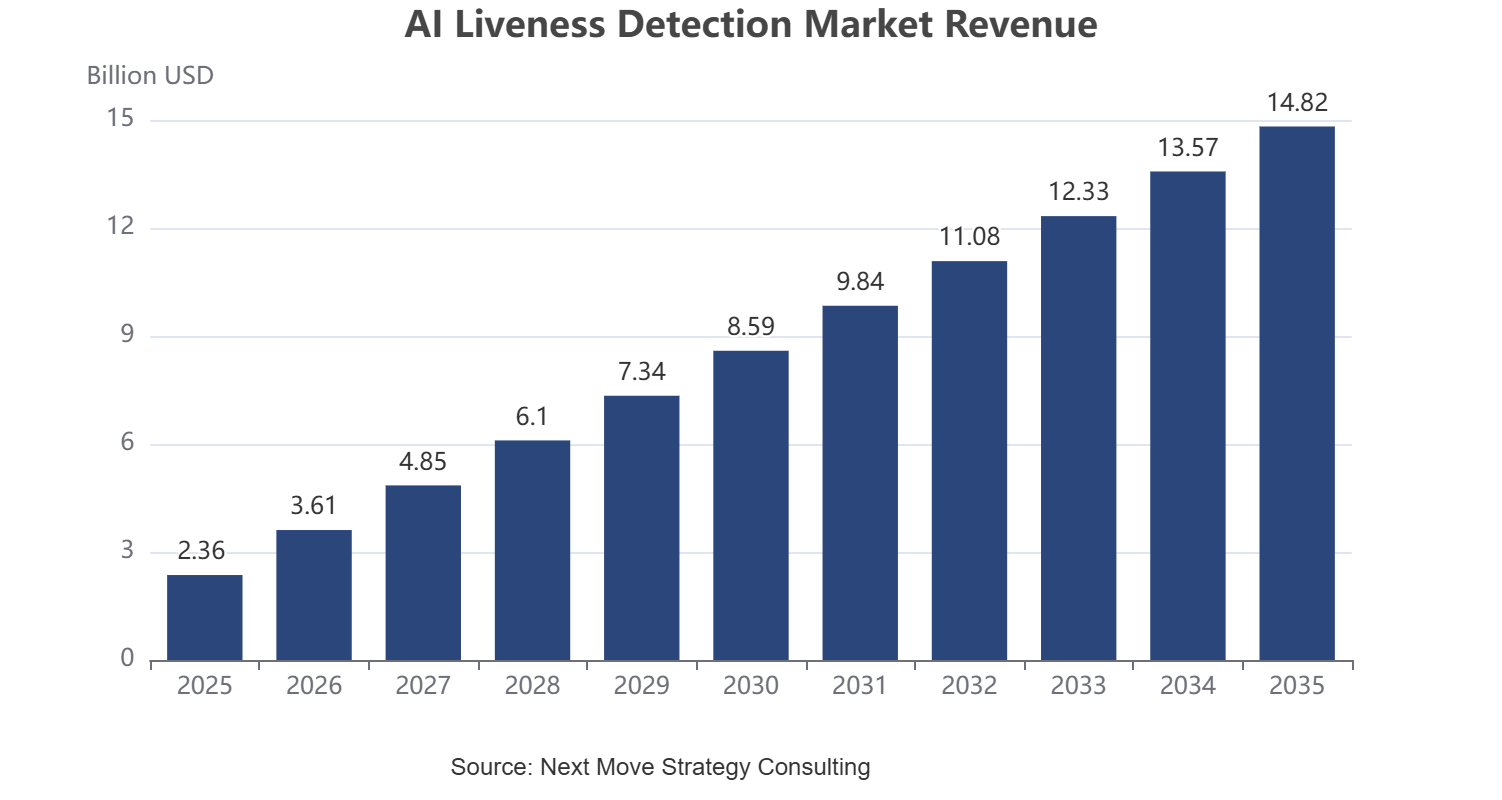
The global AI Liveness Detection Market size was valued at USD 2.36 Billion in 2025 and is estimated at USD 2.79 Billion in 2026, forecast to reach USD 14.82 Billion by 2035, expanding at a 20.4% CAGR between 2026 and 2035. North America leads with approximately 34% share, while under modality, Face liveness detection dominates with approximately 58% share.
We observed that growth is broad-based across every segmentation axis, with hybrid passive-active liveness architectures and multimodal biometric fusion driving the dominant structural shifts through 2035 as deepfake and injection-attack sophistication accelerates enterprise adoption.
|
Key Takeaways |
|
By Offer Type: Standalone Software held the largest share of approximately 40% (USD 944 Million) in 2025; Services is the fastest-growing sub-segment at 22.5% CAGR from 2026–2035. |
|
By Method: Passive held the largest share of approximately 47% (USD 1.11 Billion) in 2025; Hybrid is the fastest-growing sub-segment at 24.3% CAGR from 2026–2035. |
|
By Modality: Face held the largest share of approximately 58% (USD 1.37 Billion) in 2025; Multimodal is the fastest-growing sub-segment at 29.3% CAGR from 2026–2035. |
|
By Deployment: Cloud held the largest share of approximately 52% (USD 1.23 Billion) in 2025; Edge is the fastest-growing sub-segment at 23.2% CAGR from 2026–2035. |
|
By Channel: Direct held the largest share of approximately 44% (USD 1.04 Million) in 2025; Marketplace is the fastest-growing sub-segment at 25.0% CAGR from 2026–2035. |
|
By Buyer: Enterprise held the largest share of approximately 46% (USD 1.09 Billion) in 2025; Developer is the fastest-growing sub-segment at 22.2% CAGR from 2026–2035. |
|
By Application: Remote Identity Verification held the largest share of approximately 39% (USD 920 Million) in 2025; Age Verification is the fastest-growing sub-segment at 25.6% CAGR from 2026–2035. |
|
By Revenue Model: Subscription held the largest share of approximately 41% (USD 968 Million) in 2025; Transaction is the fastest-growing sub-segment at 21.3% CAGR from 2026–2035. |
|
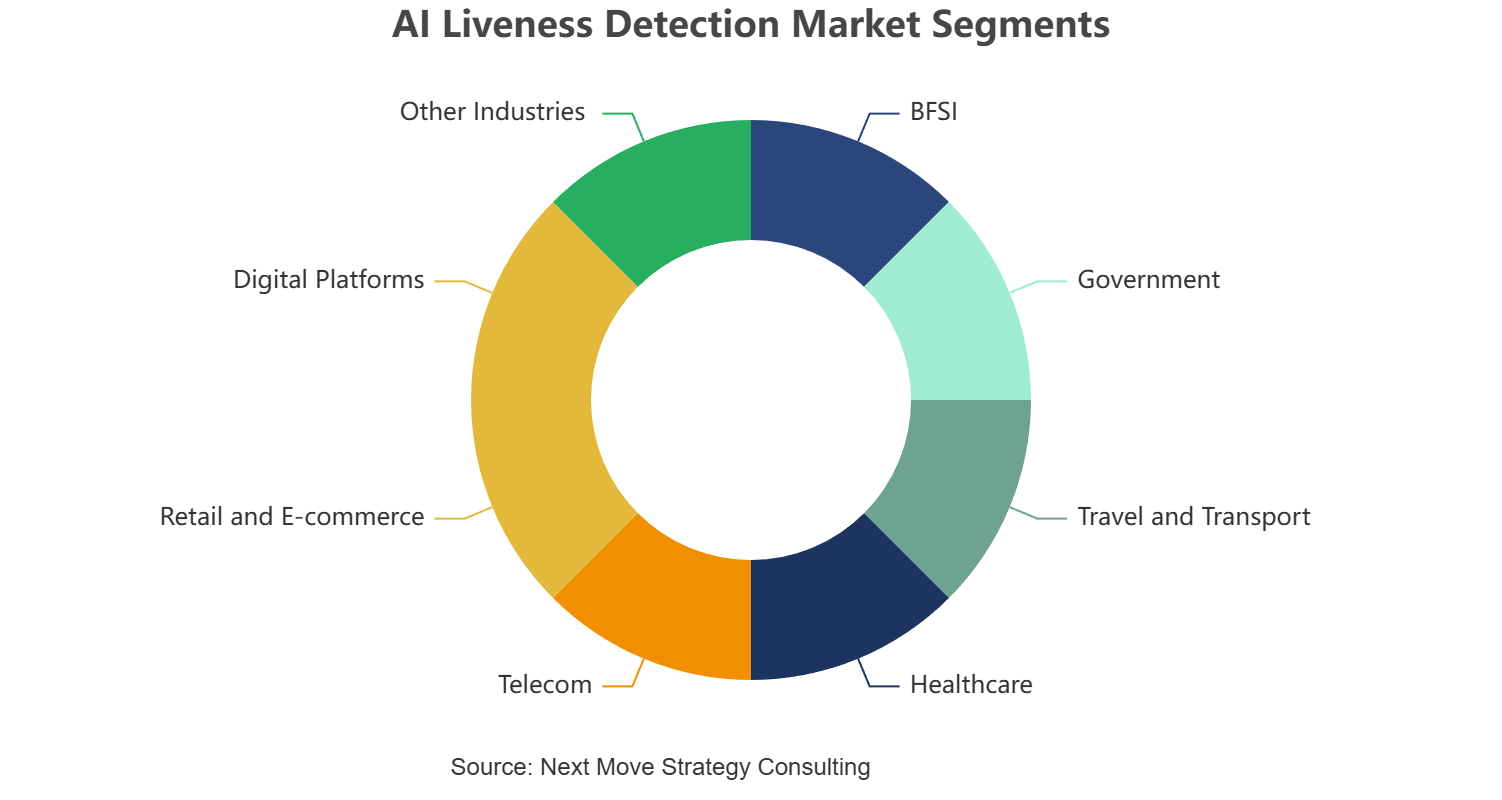
By End User: BFSI held the largest share of approximately 29% (USD 684 Million) in 2025; Healthcare is the fastest-growing sub-segment at 22.9% CAGR from 2026–2035. |
|
Dominant Region: North America dominated with approximately 34% revenue share (USD 802 Million) in 2025. |
|
Fastest-Growing Region: Asia-Pacific is expected to register the highest CAGR of 23.9% during 2026–2035. |
|
Dominant Country: U.S. led with approximately USD 658 Million in 2025. |
|
Fastest-Growing Country: India is the fastest-growing country at approximately 28.3% CAGR from 2026–2035. |
Between 2026 and 2035, the AI Liveness Detection Market is set to generate an absolute dollar opportunity of USD 12.03 Billion, positioning deepfake-resilient, injection-attack-aware biometric liveness platforms as a compelling area for capital allocation.
According to Next Move Strategy Consulting analysis, sustained investment in multimodal and hybrid liveness architectures is reshaping vendor selection criteria for enterprises, as certified presentation attack detection performance increasingly determines procurement shortlisting across BFSI, government, and digital platform onboarding workflows.
What does the AI Liveness Detection Market Encompass?
The AI Liveness Detection industry encompasses software, embedded modules, and services that determine whether a biometric sample, typically a face, fingerprint, iris, or voice capture, originates from a live human subject rather than a photograph, video replay, mask, deepfake, or digitally injected artifact. Our assessment indicates that the scope spans standalone SDKs and APIs, bundled identity verification platforms, embedded device and camera modules, and integration and certification services supplied to enterprises, public sector agencies, and digital platform operators across BFSI, government, travel, healthcare, telecom, and retail end markets.
The category has evolved from a niche anti-spoofing feature into a mandatory trust layer, driven by rising deepfake sophistication, remote onboarding growth, and regulatory mandates for verifiable digital identity. We observed that this shift accelerated sharply between 2025 and 2026, as generative AI tools lowered the cost of convincing spoof attempts and pushed liveness detection from an optional add-on toward a baseline requirement across regulated onboarding and authentication workflows globally.
Regulatory frameworks such as the European Union's eIDAS 2.0 regulation and its European Digital Identity Wallet requirements, alongside the UK Online Safety Act's highly effective age assurance provisions enforced by Ofcom, shape presentation attack detection and injection attack detection requirements across onboarding workflows. We observed that technology adoption is shifting toward hybrid passive-active and multimodal architectures validated against ISO/IEC 30107-3 and the newer CEN/TS 18099 injection attack detection specification. Next Move Strategy Consulting's analysis indicates that this standards-driven shift, combined with generative AI-enabled fraud, is redefining vendor selection criteria across the AI Liveness Detection industry.
|
Parameters |
Details |
|
Market Size in 2025 |
USD 2.36 Billion |
|
Market Size in 2026 |
USD 2.79 Billion |
|
Revenue Forecast in 2035 |
USD 14.82 Billion |
|
Growth Rate |
CAGR of 20.4% from 2026 to 2035 |
|
Analysis Period |
2025–2035 |
|
Base Year Considered |
2025 |
|
Forecast Period |
2026–2035 |
|
Market Size Estimation |
Revenue (USD Billion) |
|
Companies Profiled |
20 |
|
Countries Covered |
38 |
|
Market Share |
Available for Top 10 Companies |
Key Emerging Trends
Based on research conducted by Next Move Strategy Consulting, we found that four structural trends are reshaping product development, deployment architecture, and stakeholder trust across the AI Liveness Detection Market.
How Is Generative AI Deepfake Defense Transforming Liveness Architecture?
Generative AI face-swapping and real-time deepfake tools are pushing vendors to layer dedicated deepfake detection onto conventional presentation attack detection. We observed that Jumio's Liveness Premium, made generally available in 2025, combines randomized challenge sequencing with AI-based analysis to counter injection and deepfake attacks, and helped a Latin American finance client catch materially more sophisticated fraud attempts. Enterprises are retooling onboarding pipelines to add network-level injection attack detection alongside camera-level liveness checks.
Why Are Certification Standards Becoming a Procurement Gate?
ISO/IEC 30107-3 Level 1 and Level 2 presentation attack detection certification, tested by NIST/NVLAP-accredited laboratories, is increasingly a mandatory procurement gate rather than a differentiator. Our findings suggest that vendors demonstrating zero-fake-acceptance results against silicone masks, 3D-printed faces, and AI deepfakes in independent testing are winning enterprise and government shortlists. This certification-led buying behavior is compressing sales cycles for vendors that invest early in third-party validation.
How Is Regulation-Driven Age Assurance Reshaping Deployment Priorities?
The UK Online Safety Act's highly effective age assurance requirement, enforced by Ofcom since July 2025, and the announced under-16 social media restrictions are pushing platforms toward facial age estimation paired with liveness detection. We observed that Ofcom's four-part effectiveness test, covering technical accuracy, robustness, reliability, and fairness, is compressing integration timelines for age verification vendors serving adult content, gaming, and social platforms operating in the UK.
What Role Does eIDAS 2.0 Play in Liveness Detection Adoption?
The European Union's eIDAS 2.0 framework and its European Digital Identity Wallet mandate are accelerating fully automated, liveness-backed remote identity proofing across member states. Our analysis shows that the European Commission's implementing acts referencing ETSI TS 119 461 conformance requirements are compelling qualified trust service providers to embed passive liveness detection into wallet onboarding flows, reducing reliance on costly manual video-operator verification.
Regulatory Framework Impacting the AI Liveness Detection Industry
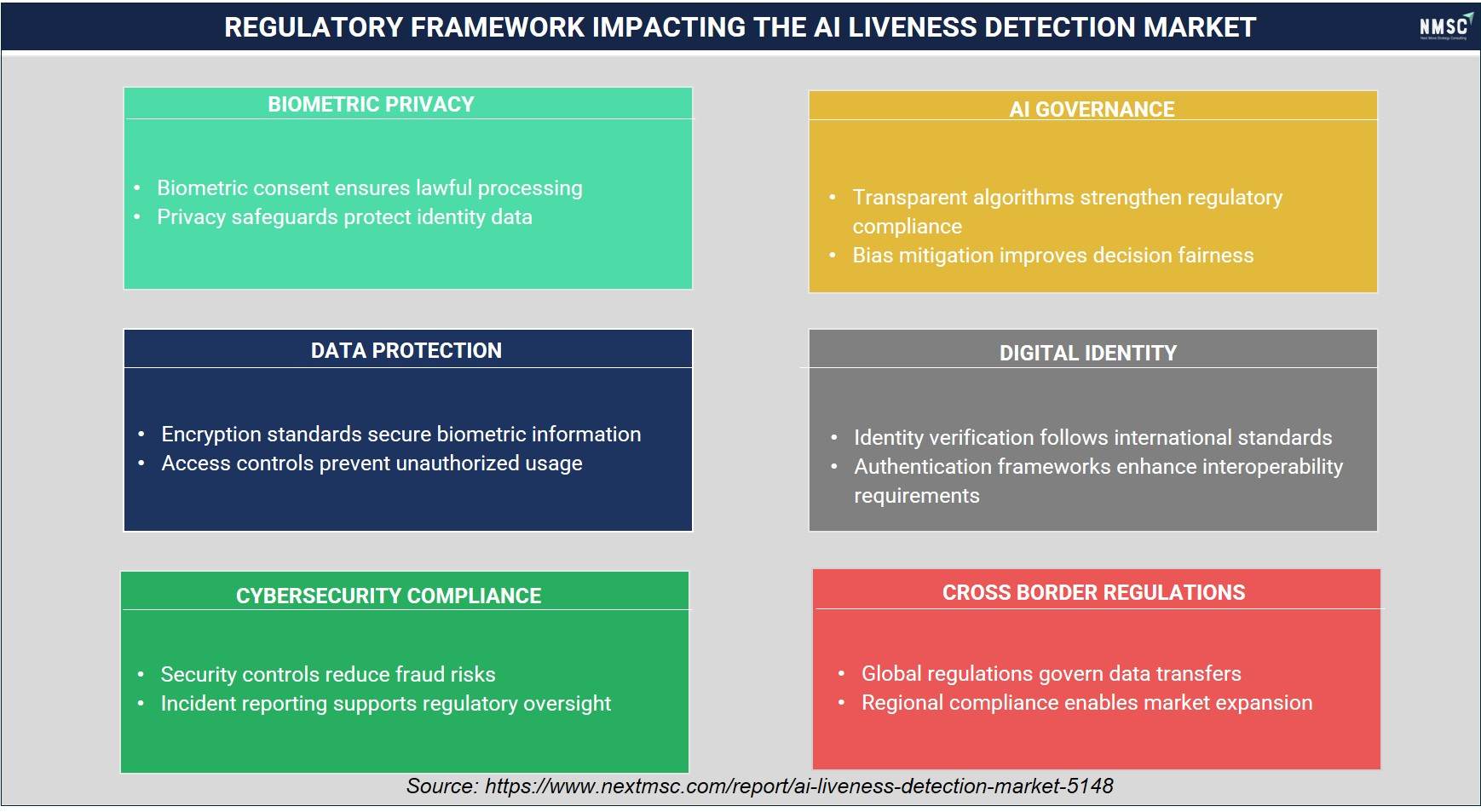
The regulatory framework impacting the AI Liveness Detection industry emphasizes biometric privacy, AI governance, cybersecurity, and cross-border data compliance. Organizations must obtain user consent for biometric processing while implementing strong encryption, access controls, and identity protection measures. AI governance promotes transparency, fairness, and bias mitigation to strengthen regulatory compliance and user trust. Authentication systems are also required to comply with international digital identity standards, while evolving global data transfer regulations and cybersecurity policies influence product deployment, interoperability, and market expansion across regions.
Growth Drivers and Restraints
|
Factors |
Type |
(+/-) % Impact on CAGR |
Geographic Relevance |
Impact Timeline |
|
Rising generative AI deepfake and injection attack sophistication |
Driver |
+2.4% |
Global |
2026-2035 |
|
eIDAS 2.0 and EU Digital Identity Wallet rollout |
Driver |
+2.0% |
Europe |
2026-2035 |
|
UK Online Safety Act highly effective age assurance mandate |
Driver |
+1.7% |
Europe |
2026-2032 |
|
ISO/IEC 30107-3 and CEN/TS 18099 certification-led procurement |
Driver |
+1.5% |
Global |
2026-2035 |
|
Expansion of remote onboarding in BFSI and digital platforms |
Driver |
+1.3% |
North America, Asia-Pacific |
2026-2035 |
|
Growth of mobile driver's license and digital ID programs |
Driver |
+1.1% |
North America, Asia-Pacific |
2026-2035 |
|
Rising government digital identity and e-governance investment |
Driver |
+0.9% |
Asia-Pacific, MEA |
2026-2035 |
|
High false-rejection risk affecting user conversion |
Restraint |
-1.1% |
Global |
2026-2032 |
|
Fragmented regional biometric and data-privacy regulation |
Restraint |
-0.8% |
Europe, North America |
2026-2035 |
|
Patent litigation risk among leading liveness vendors |
Restraint |
-0.5% |
North America |
2026-2030 |
What Is the Primary Growth Driver of the AI Liveness Detection Market?
Escalating generative AI deepfake and biometric injection attack sophistication is the primary driver of the AI Liveness Detection Market. The FBI's Internet Crime Complaint Center reported nearly USD 21 billion in cyber-enabled crime losses for 2025 in its report published in April 2026, with AI-generated fraudulent profiles and synthetic media contributing meaningfully to that total. We observed that this threat escalation is anchoring baseline demand for hybrid and multimodal liveness detection across BFSI and digital platform onboarding workflows worldwide.
How Is Regulation Driving AI Liveness Detection Market Growth?
Regulatory mandates including the European Union's eIDAS 2.0 framework and the UK Online Safety Act's highly effective age assurance requirement are accelerating AI Liveness Detection Market growth toward certified, standards-compliant deployments. The European Commission's implementing acts for remote European Digital Identity Wallet onboarding reference ETSI TS 119 461 identity-proofing conformance. Our assessment indicates that this regulatory pressure, combined with Ofcom's active enforcement since July 2025, is compressing adoption timelines for passive and hybrid liveness architectures across Europe.
What Is Restraining AI Liveness Detection Market Expansion?
High false-rejection rates during legitimate user authentication remain a key restraint on AI Liveness Detection Market growth. The U.S. National Institute of Standards and Technology (NIST), through its Face Recognition Vendor Test (FRVT), continues to demonstrate that biometric accuracy varies with image quality and operating conditions. We found that higher false rejections increase onboarding friction, manual verification costs, and customer abandonment. Our assessment indicates that vendors must balance strong fraud prevention with a seamless user experience to sustain enterprise adoption.
Segmentation Analysis
Segment Sizing: By Offer Type
|
Segment |
2025 (USD) |
2035 (USD) |
CAGR% (2026-2035) |
|
Standalone Software |
USD 944 Million |
USD 5.34 Billion |
19.0% |
|
Bundled Software |
USD 708 Million |
USD 4.59 Billion |
20.8% |
|
Embedded Module |
USD 425 Million |
USD 2.82 Billion |
21.1% |
|
Services |
USD 283 Million |
USD 2.07 Billion |
22.5% |
|
Total |
USD 2.36 Billion |
USD 14.82 Billion |
20.4% |
Which Offer Type Leads the AI Liveness Detection Market?
Standalone Software led the AI Liveness Detection Market with USD 944 Million in 2025, as enterprises favor licensable SDKs and APIs that embed directly into existing identity verification pipelines without vendor lock-in. We observed that Services is the fastest-growing offer type at 22.5% CAGR from 2026 to 2035, as integration, managed service, and testing and certification demand rises alongside ISO/IEC 30107-3 compliance requirements across regulated end markets such as BFSI and government.
Segment Sizing: By Modality
|
Segment |
2025 (USD) |
2035 (USD) |
CAGR% (2026-2035) |
|
Face |
USD 1.37 Billion |
USD 7.26 Billion |
18.2% |
|
Fingerprint |
USD 354 Million |
USD 1.93 Billion |
18.5% |
|
Iris |
USD 212 Million |
USD 1.33 Billion |
20.4% |
|
Voice |
USD 189 Million |
USD 1.48 Billion |
23.4% |
|
Multimodal |
USD 236 Million |
USD 2.82 Billion |
29.3% |
|
Total |
USD 2.36 Billion |
USD 14.82 Billion |
20.4% |
Which Modality Dominates the AI Liveness Detection Market?
Face liveness detection dominated with USD 1.37 Billion in 2025, reflecting its role as the default modality for remote identity verification and payment authentication across camera-equipped smartphones. Our findings suggest that Multimodal is the fastest-growing modality at 29.3% CAGR from 2026 to 2035, as enterprises combine face, voice, and fingerprint signals to counter increasingly convincing single-modality deepfake and injection attacks.
Segment Sizing: By Application
|
Segment |
2025 (USD) |
2035 (USD) |
CAGR% (2026-2035) |
|
Remote Identity Verification |
USD 920 Million |
USD 5.04 Billion |
18.6% |
|
Access Control |
USD 519 Million |
USD 2.96 Billion |
19.1% |
|
Payment Authentication |
USD 448 Million |
USD 2.96 Billion |
21.1% |
|
Age Verification |
USD 307 Million |
USD 2.82 Billion |
25.6% |
|
Other Use Cases |
USD 165 Million |
USD 1.04 Billion |
20.4% |
|
Total |
USD 2.36 Billion |
USD 14.82 Billion |
20.4% |
Which Application Drives the Largest AI Liveness Detection Market Revenue?
Remote Identity Verification generated USD 920 Million in 2025, the largest application share, as banks, fintechs, and government portals require verifiable live-person checks during remote onboarding. We observed that Age Verification is the fastest-growing application at 25.6% CAGR from 2026 to 2035, driven directly by the UK Online Safety Act's highly effective age assurance mandate and comparable regulatory proposals emerging across the European Union and parts of Asia-Pacific.
Growth Opportunities
Next Move Strategy Consulting's analysis indicates that three whitespace opportunities stand out for vendors and investors positioning ahead of 2035 demand across the AI Liveness Detection Market.
Can Edge-Based Liveness Detection Unlock On-Device Privacy-Sensitive Deployments?
Edge deployment, running liveness inference directly on smartphones and access-control hardware without transmitting biometric data to the cloud, addresses privacy-sensitive government and healthcare buyers unwilling to accept cloud-only architectures. Embedded module vendors serving OEM device manufacturers stand to benefit most as edge silicon performance improves.
Does Mobile Driver's License Integration Create a New Revenue Channel?
Expanding mobile driver's license and digital ID wallet programs across U.S. states and the EU's Digital Identity Wallet create a licensing and per-transaction revenue channel for liveness vendors embedded at the point of credential issuance. OEM and public sector buyers are the primary beneficiaries as governments select certified liveness partners for statewide rollouts.
Can Voice-Face Multimodal Fusion Capture Contact-Center Fraud Prevention Spend?
Combining voice and face liveness signals opens contact-center and call-based authentication use cases historically underserved by camera-only liveness tools. BFSI and telecom buyers adopting multimodal fusion gain measurable fraud-prevention returns, positioning this as a distinct upsell opportunity for vendors currently offering single-modality solutions.
Regional Outlook
|
Region |
2025 (USD) |
2035 (USD) |
CAGR% (2026-2035) |
Key Driver |
|
North America |
USD 802 Million |
USD 4.3 Billion |
18.3% |
Mobile driver's license and BFSI fraud-prevention adoption |
|
Europe |
USD 614 Million |
USD 3.26 Billion |
18.2% |
eIDAS 2.0 and Online Safety Act compliance mandates |
|
Asia-Pacific |
USD 566 Million |
USD 4.59 Billion |
23.9% |
Digital ID rollouts and fintech onboarding growth |
|
Middle East and Africa |
USD 236 Million |
USD 1.78 Billion |
22.9% |
National e-government digital identity programs |
|
Latin America |
USD 142 Million |
USD 889 Million |
20.4% |
Financial inclusion and remote banking expansion |
|
Total |
USD 2.36 Billion |
USD 14.82 Billion |
20.4% |
|
North America AI Liveness Detection Market
North America held USD 802 Million in 2025, projected to reach USD 4.3 Billion by 2035 at a 18.3% CAGR. The region's mature BFSI and mobile driver's license infrastructure, combined with FBI-reported cyber-fraud losses approaching USD 21 billion in 2025, sustains premium demand for certified liveness detection. We observed strong technology adoption among Fortune 500 enterprises and high competitive intensity among established vendors, positioning North America as the AI Liveness Detection Market's most mature commercial base.
Europe AI Liveness Detection Market
Europe held USD 614 Million in 2025, forecast to reach USD 3.26 Billion by 2035 at a 18.2% CAGR. Our analysis shows that the eIDAS 2.0 regulation and the UK Online Safety Act's highly effective age assurance requirement, enforced by Ofcom since July 2025, are compelling regulatory catalysts. Technology adoption favors ETSI TS 119 461-conformant passive liveness solutions, and regulatory influence remains the region's single strongest demand driver through 2035.
Asia-Pacific AI Liveness Detection Market
Asia-Pacific held USD 566 Million in 2025, projected to reach USD 4.59 Billion by 2035 at a 23.9% CAGR, the fastest of any region. We found that expanding digital identity programs, fintech onboarding volumes, and smartphone-based biometric payment adoption underpin this trajectory. Regulatory frameworks remain more fragmented than Europe's, but rising government digital ID investment and competitive intensity among domestic and multinational vendors support an increasingly strategic growth outlook.
Middle East and Africa AI Liveness Detection Market
Middle East and Africa held USD 236 Million in 2025, expected to reach USD 1.78 Billion by 2035 at a 22.9% CAGR. National e-government digital identity programs across the Gulf Cooperation Council states drive early-stage but accelerating technology adoption. Our assessment indicates that regulatory influence remains government-led rather than statute-driven, with strategic outlook favorable as smart-city and digital-government investment continues to expand liveness detection deployment.
Latin America AI Liveness Detection Market
Latin America held USD 142 Million in 2025, forecast to reach USD 889 Million by 2035 at a 20.4% CAGR. We observed that financial inclusion initiatives and remote banking expansion, including Jumio's deepfake-defense deployment with a regional finance client, anchor demand. Regulatory influence remains comparatively light-touch, and competitive intensity is rising as global vendors expand local partnerships to serve underbanked populations across the region.
United States
Based on our engagements, U.S. held approximately USD 658 Million in 2025, projected to reach approximately USD 3.44 Billion by 2035 at a 18.0% CAGR. Demand is concentrated among BFSI, healthcare, and mobile driver's license issuers, with technology adoption led by certified, injection-attack-resistant platforms and regulatory influence shaped by state-level privacy statutes and active PTAB patent litigation among domestic vendors.
Canada
Through our analysis, Canada held approximately USD 144 Million in 2025, projected to reach approximately USD 860 Million by 2035 at a 19.7% CAGR. Adoption concentrates in banking and government digital ID pilots, with moderate regulatory influence from federal privacy law and a competitive landscape shaped by U.S. vendor expansion northward alongside domestic identity verification providers.
United Kingdom
From our assessment, UK held approximately USD 147 Million in 2025, projected to reach approximately USD 750 Million by 2035 at a 17.6% CAGR. Ofcom's highly effective age assurance enforcement since July 2025 anchors demand from adult content, gaming, and social platforms, with technology penetration favoring facial age estimation paired with liveness checks and a competitive field led by domestic and European vendors.
Germany
According to evaluation, Germany held approximately USD 135 Million in 2025, projected to reach approximately USD 685 Million by 2035 at a 17.6% CAGR. Demand is concentrated in BFSI and e-government services aligned with eIDAS 2.0 wallet onboarding, with strong regulatory influence from federal data-protection authorities and technology adoption favoring ETSI-conformant passive liveness architectures.
France
Based on our engagements, France held approximately USD 98 Million in 2025, projected to reach approximately USD 522 Million by 2035 at a 18.2% CAGR. Government-led digital identity initiatives and banking sector modernization drive adoption, with regulatory influence shaped by CNIL data-protection oversight and a competitive landscape featuring both domestic biometric specialists and multinational platform vendors.
China
Through our analysis, China held approximately USD 170 Million in 2025, projected to reach approximately USD 1.29 Billion by 2035 at a 22.9% CAGR. Large-scale fintech and super-app onboarding volumes anchor demand, with high technology penetration across face-based payment authentication and a competitive landscape dominated by domestic biometric technology providers operating under state-directed data-localization rules.
India
From our assessment, India held approximately USD 91 Million in 2025, projected to reach approximately USD 1.01 Billion by 2035 at a 28.3% CAGR. Aadhaar-linked digital identity infrastructure and expanding fintech onboarding drive the fastest country-level growth, with rising technology adoption among public sector and BFSI buyers and increasing regulatory influence from the Digital Personal Data Protection framework.
Japan
According to evaluation, Japan held approximately USD 96 Million in 2025, projected to reach approximately USD 643 Million by 2035 at a 21.2% CAGR. Demand concentrates in banking and telecom sectors amid an aging population that elevates false-rejection sensitivity, with technology adoption favoring multimodal fusion and a competitive landscape featuring both domestic electronics manufacturers and global platform vendors.
South Korea
Based on our engagements, South Korea held approximately USD 62 Million in 2025, projected to reach approximately USD 505 Million by 2035 at a 23.9% CAGR. High smartphone penetration and advanced mobile banking infrastructure support strong technology adoption, with regulatory influence from the Personal Information Protection Act and a competitive landscape featuring domestic biometric and telecom-affiliated vendors.
Australia
Through our analysis, Australia held approximately USD 45 Million in 2025, projected to reach approximately USD 368 Million by 2035 at a 23.9% CAGR. Digital identity initiatives tied to the national Digital ID system drive government and BFSI adoption, with regulatory influence from the Privacy Act and a competitive landscape featuring both domestic identity-verification firms and multinational platform vendors.
UAE
From our assessment, UAE held approximately USD 71 Million in 2025, projected to reach approximately USD 516 Million by 2035 at a 22.4% CAGR. National digital identity and smart-government programs drive early, well-funded technology adoption, with regulatory influence from federal data-protection law and a competitive landscape favoring vendors with strong government-integration capabilities.
Saudi Arabia
According to evaluation, Saudi Arabia held approximately USD 66 Million in 2025, projected to reach approximately USD 534 Million by 2035 at a 23.8% CAGR. Vision 2030-aligned digital government and fintech licensing programs anchor demand, with rising technology adoption across BFSI and telecom sectors and regulatory influence shaped by the Saudi Data and Artificial Intelligence Authority.
South Africa
Based on our engagements, South Africa held approximately USD 33 Million in 2025, projected to reach approximately USD 267 Million by 2035 at a 23.8% CAGR. Banking sector modernization and financial inclusion initiatives drive adoption, with moderate regulatory influence from the Protection of Personal Information Act and a competitive landscape featuring both regional integrators and multinational vendors.
Brazil
Through our analysis, Brazil held approximately USD 65 Million in 2025, projected to reach approximately USD 400 Million by 2035 at a 20.1% CAGR. Open banking expansion and rising digital fraud losses drive strong BFSI adoption, with regulatory influence from the Lei Geral de Proteção de Dados framework and a competitive landscape combining domestic fintech-focused vendors with global platform providers.
Argentina
From our assessment, Argentina held approximately USD 24 Million in 2025, projected to reach approximately USD 151 Million by 2035 at a 20.4% CAGR. Financial inclusion initiatives and remote banking expansion support steady adoption, with moderate regulatory influence from national data-protection law and a competitive landscape led by regional integrators partnering with global liveness detection vendors.
Pain Point Analysis of the AI Liveness Detection Market
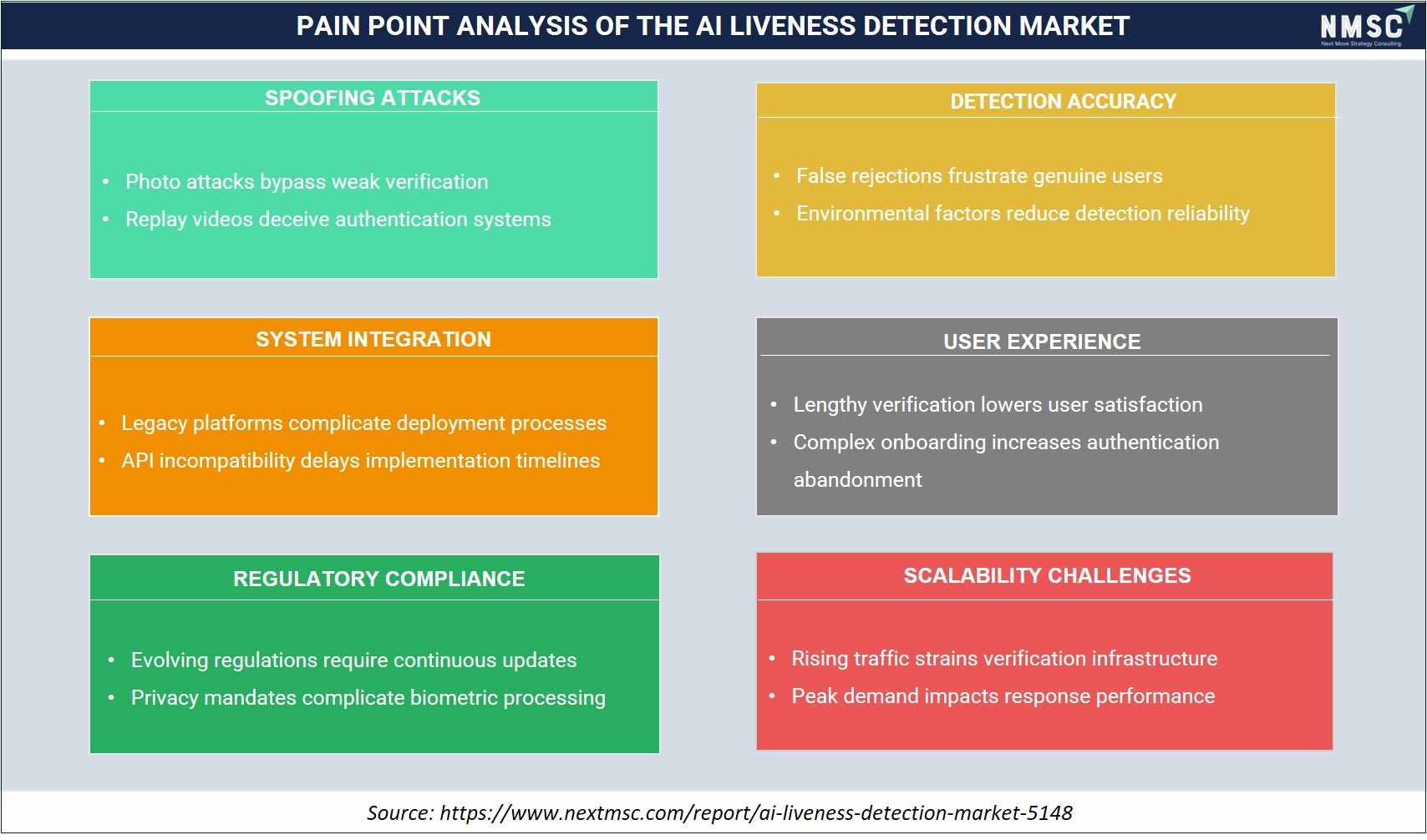
The pain point analysis of the AI Liveness Detection Market highlights key challenges affecting deployment and user adoption. Sophisticated spoofing attacks, including photo and replay video attempts, continue to test detection capabilities, while false rejections and environmental conditions reduce authentication reliability. Legacy system integration and API incompatibility delay implementation across enterprise environments. In addition, evolving biometric privacy regulations, complex onboarding experiences, and infrastructure scalability limitations during peak authentication demand create operational challenges that vendors must address to ensure secure and seamless identity verification.
Competitive Landscape
We observed that the AI Liveness Detection Market remains moderately fragmented, with certification performance, patent portfolios, and platform-integration depth now functioning as the primary competitive differentiators among the twenty profiled vendors.
|
Market Structure |
Moderately fragmented, with a mix of specialist biometric vendors, large identity-platform providers, and hyperscale cloud entrants competing across standalone software, bundled platforms, and embedded modules. |
|
Innovation Focus |
Deepfake and injection-attack detection, ISO/IEC 30107-3 and CEN/TS 18099 certification, and multimodal fusion combining face, voice, and fingerprint signals. |
|
M&A Activity |
Selective acquisitions and patent litigation activity, exemplified by FaceTec's June 2026 PTAB victory upholding its 3D liveness patents against Jumio's inter partes review challenges. |
How Do Companies Compete in the AI Liveness Detection Market?
Vendors compete primarily on certified presentation attack detection accuracy, integration breadth across identity verification and access-control platforms, and total cost of ownership across subscription, transaction, and license-based revenue models. We observed that certification transparency, publishing independent ISO/IEC 30107-3 test results, has become a decisive factor in enterprise and government procurement, alongside API-first integration that reduces implementation timelines for developer and OEM buyers.
Which Competitive Archetypes Dominate the AI Liveness Detection Market?
Three archetypes dominate: specialist biometric-liveness pioneers such as FaceTec and iProov, whose differentiation rests on deep patent portfolios and certified accuracy; bundled identity-verification platforms such as Jumio, Onfido, and Sumsub, which differentiate on end-to-end onboarding workflow breadth; and hyperscale cloud entrants such as Microsoft and Amazon, which differentiate on native integration with enterprise identity and access-management ecosystems already in production use.
What Innovation and Differentiation Strategies Define Market Leaders?
Leading vendors are investing in deepfake-resilient challenge-response architectures, network-level injection attack detection, and multimodal biometric fusion to stay ahead of generative AI-enabled fraud. Our findings suggest that patent-protected 3D depth-sensing techniques, exemplified by FaceTec's upheld patent portfolio, and enterprise identity-platform embedding, exemplified by iProov's integration with Microsoft Entra ID, represent the two dominant differentiation strategies among top-tier competitors.
What M&A and Partnership Activity Is Shaping the Competitive Landscape?
Patent litigation and strategic partnership activity, rather than large-scale M&A, currently shape competitive positioning. FaceTec's successful defense of four foundational patents against Jumio's inter partes review petitions in June 2026 illustrates the high stakes attached to core liveness intellectual property. Meanwhile, partnership-led geographic expansion, such as biometric vendors embedding into hyperscale identity platforms, is emerging as the preferred low-risk route to enterprise market access.
Key Market Players
Based on research conducted by Next Move Strategy Consulting, the following twenty companies represent the validated competitive set profiled across the AI Liveness Detection Market, ranked by overall market presence and certification strength.
-
FaceTec
-
Microsoft
-
Amazon
-
IDEMIA
-
Thales
-
NEC
-
Onfido
-
HID Global
-
Daon
-
Sumsub
-
Persona
-
Yoti
-
Veridas
-
Paravision
-
Regula
-
Innovatrics
-
Facephi
-
ID R&D (Mitek Systems)
Latest Developments
We observed a wave of certification, litigation, and regulatory milestones across the AI Liveness Detection Market during 2025 and 2026, summarized below.
|
Date |
Event |
|
April 2026 |
Sumsub expanded its fraud monitoring bundle (Pix) and refined its duplicate detection logic, alongside enhanced filters for VPNs/proxies to combat injection fraud. |
Expert Insights
 “Rapid advancements in artificial intelligence bring new challenges to securing digital onboarding and authentication, particularly from deepfakes.”
— Alexey Khitrov , CEO, ID R&D
Statement made in an industry feature discussing the impact of generative AI on voice biometrics, identity verification, and deepfake-driven fraud risks.
Market Interpretation
This insight directly highlights a core driver of the AI liveness detection market—the rapid rise of deepfake-enabled fraud. As AI-generated synthetic voices and identities become more realistic, traditional authentication systems are increasingly vulnerable. This is accelerating demand for advanced liveness detection and anti-spoofing technologies capable of distinguishing real users from AI-generated entities during digital onboarding and verification processes.
Investment Opportunities
Where Is Capital Flowing Within the AI Liveness Detection Market?
Capital is concentrating in vendors with independently certified ISO/IEC 30107-3 performance and defensible patent portfolios, as illustrated by FaceTec's successful June 2026 patent defense. We observed growing investor interest in multimodal fusion and deepfake-specific detection capabilities, segments projected to expand at approximately 29.3% and above through 2035 as enterprises prioritize certified, litigation-tested technology over unproven entrants.
How Is Infrastructure Investment Shaping Market Access?
Infrastructure investment is flowing toward edge-computing capability and cloud-native deployment architectures that let liveness detection scale across mobile driver's license programs and national digital identity wallets. Our assessment indicates that vendors capable of supporting both cloud and edge deployment simultaneously are best positioned to win large government and OEM contracts requiring flexible, jurisdiction-specific data-residency compliance.
What ESG Considerations Affect AI Liveness Detection Investment Decisions?
Environmental, social, and governance considerations increasingly influence investment decisions, particularly around algorithmic fairness across skin tones and age groups, and data-minimization practices aligned with the EU's eIDAS 2.0 framework and comparable privacy statutes. Investors are prioritizing vendors that publish demographic fairness testing alongside standard accuracy certification, reflecting growing scrutiny of biometric technology's social governance implications.
Key Benefits for Stakeholders
How Does This Report Benefit Enterprise and Industry Leaders?
Enterprise and industry leaders gain segmentation-level revenue forecasts across offer type, method, modality, and application, enabling precise vendor shortlisting aligned with certification requirements and deployment architecture. Our analysis, forecasts, and competitive benchmarking help procurement and security teams evaluate vendor claims against independently reasoned market data rather than marketing collateral alone.
How Does This Report Benefit Investors and Financial Analysts?
Investors and financial analysts gain a reconciled, single-point-estimate market model spanning USD 2.36 Billion in 2025 to USD 14.82 Billion by 2035, alongside company-level competitive positioning and identified whitespace opportunities. This supports diligence on liveness detection targets, cross-segment capital allocation decisions, and comparison against the USD 12.03 Billion absolute dollar opportunity identified for 2026 through 2035.
How Does This Report Benefit Technology Vendors and Product Teams?
Technology vendors and product teams gain granular visibility into fastest-growing sub-segments, regulatory catalysts, and regional demand patterns that inform roadmap prioritization. Our findings suggest that product teams can use the regional outlook and emerging trends sections to sequence certification investments and multimodal feature development ahead of anticipated demand inflection points across Europe and Asia-Pacific.
Key Market Segments
By Offer Type
-
Standalone Software
-
SDK
-
API
-
Web Service
-
-
Bundled Software
-
Identity Verification Platform
-
Biometric Suite
-
-
Embedded Module
-
Device Module
-
Camera Module
-
-
Services
-
Integration
-
Managed Service
-
Testing and Certification
-
By Method
-
Passive
-
Active
-
Hybrid
By Modality
-
Face
-
Fingerprint
-
Iris
-
Voice
-
Multimodal
By Deployment
-
Cloud
-
On-Premise
-
Edge
-
Hybrid Cloud
By Channel
-
Direct
-
OEM
-
Partner
-
Marketplace
By Buyer
-
Enterprise
-
Public Sector
-
Developer
-
OEM
By Application
-
Remote Identity Verification
-
Access Control
-
Payment Authentication
-
Age Verification
-
Other Use Cases
By Revenue Model
-
Subscription
-
Transaction
-
License
-
Maintenance
-
Services
By End User
-
BFSI
-
Government
-
Travel and Transport
-
Healthcare
-
Telecom
-
Retail and E-commerce
-
Digital Platforms
-
Other Industries
By Region
-
North America: U.S., Canada, Mexico
-
Europe: UK, Germany, France, Italy, Spain, Sweden, Denmark, Finland, Netherlands, Rest of Europe
-
Asia-Pacific: China, India, Japan, South Korea, Taiwan, Indonesia, Vietnam, Australia, Philippines, Malaysia, Rest of APAC
-
Middle East & Africa: Saudi Arabia, UAE, Egypt, Israel, Turkey, Nigeria, South Africa, Rest of MEA
-
Latin America: Brazil, Argentina, Chile, Colombia, Rest of LATAM
Conclusion and Recommendations
What Is the Long-Term Outlook for the AI Liveness Detection Market?
The long-term outlook remains structurally positive, with the market projected to expand from USD 2.79 Billion in 2026 to USD 14.82 Billion by 2035 at a 20.4% CAGR. We observed that certification-led procurement, regulatory mandates, and generative AI-driven fraud sustain durable, non-cyclical demand, positioning liveness detection as a permanent layer of digital identity infrastructure rather than a discretionary security add-on.
What Strategic Positioning Should Vendors Pursue?
Vendors should prioritize independent ISO/IEC 30107-3 and CEN/TS 18099 certification, defensible patent portfolios, and deep integration with hyperscale identity platforms such as Microsoft Entra ID. Our assessment indicates that specialist vendors lacking certification transparency risk exclusion from enterprise and government procurement shortlists as buyers standardize around verifiable, third-party-tested accuracy benchmarks.
How Attractive Is the AI Liveness Detection Market for Investment?
Investment attractiveness remains high, underpinned by a USD 12.03 Billion absolute dollar opportunity between 2026 and 2035 and sustained double-digit CAGR across nearly every segmentation axis. Our findings suggest that capital allocators should prioritize vendors combining certified performance with multimodal fusion capability, given the disproportionate growth concentrated in that sub-segment relative to single-modality offerings.
What Market Shifts and Key Risks Should Stakeholders Monitor?
Stakeholders should monitor accelerating generative AI deepfake sophistication, patent litigation risk exemplified by the FaceTec-Jumio PTAB dispute, and regulatory fragmentation across jurisdictions as key risks. We found that vendors overly dependent on a single certification body or geographic market face elevated exposure should regulatory requirements or presentation attack techniques evolve faster than product roadmaps can adapt.
What Are the Primary Growth Pathways Through 2035?
Primary growth pathways include multimodal fusion expansion, edge-based privacy-sensitive deployment, and mobile driver's license and digital identity wallet integration. Next Move Strategy Consulting's analysis indicates that vendors executing across all three pathways simultaneously, rather than pursuing a single growth vector, are best positioned to capture disproportionate share of the projected 2026-2035 market expansion.
About the Author
 Saista Faiyaz
— Saista Faiyaz is Research Associate at Next Move Strategy Consulting, where she has covered consumer markets and healthcare technologies for 3 years. Her work includes primary interview review, secondary-source validation, market sizing, and structured analysis of company and industry data. She supports research by comparing evidence across sources, organizing findings into market narratives, and documenting assumptions used in analysis. Her scope includes cross-market benchmarking, and reports.
Saista Faiyaz
— Saista Faiyaz is Research Associate at Next Move Strategy Consulting, where she has covered consumer markets and healthcare technologies for 3 years. Her work includes primary interview review, secondary-source validation, market sizing, and structured analysis of company and industry data. She supports research by comparing evidence across sources, organizing findings into market narratives, and documenting assumptions used in analysis. Her scope includes cross-market benchmarking, and reports.
About the Reviewer
 Supradip Baul
— Supradip Baul is an accomplished business consultant and strategist with over a decade of rich experience in market intelligence, strategy, technology, and business transformation. His work has included rigorous qualitative and quantitative analysis across multiple industries, helping clients shape investment decisions and long-term roadmaps. Earlier in his career, he was associated with Gartner, where he contributed to industry-leading reports and market share analyses. He has worked with leading global companies and holds an MBA with a dual specialization in Marketing and Finance.
Supradip Baul
— Supradip Baul is an accomplished business consultant and strategist with over a decade of rich experience in market intelligence, strategy, technology, and business transformation. His work has included rigorous qualitative and quantitative analysis across multiple industries, helping clients shape investment decisions and long-term roadmaps. Earlier in his career, he was associated with Gartner, where he contributed to industry-leading reports and market share analyses. He has worked with leading global companies and holds an MBA with a dual specialization in Marketing and Finance.
At Next Move Strategy Consulting, we understand that insightful market research is the cornerstone of successful business decisions. That's why we employ a robust and multifaceted approach, combining various methodologies to deliver the most accurate and actionable data for our clients.

Research Landscape
We navigate the world of research with two primary approaches:
Qualitative Approach
Our qualitative research methodologies involve immersive techniques such as in-depth interviews, focus groups, and observational studies. By engaging directly with individuals and stakeholders, we uncover valuable insights that quantitative data alone may overlook.

Quantitative Research
In tandem with qualitative methodologies, NMSC leverages the power of Quantitative Research to provide a robust foundation of numerical insights. Through systematic data collection and analysis, we quantify patterns, preferences, and market trends, offering a comprehensive view of the business landscape.
Our quantitative research approach employs diverse tools, including surveys, experiments, and statistical modelling. These methodologies enable us to gather data from a large and representative sample, ensuring the statistical significance of our findings. By employing structured questionnaires and standardized data collection methods, we guarantee the reliability and validity of the information we present to our clients.
Quantitative research is particularly effective in measuring the prevalence of trends, assessing market size, and gauging the impact of various factors on consumer behavior. The numerical precision attained through this approach equips our clients with actionable insights, facilitating data-driven decision-making and strategy formulation.


Our Specialized Toolbox for Industry-Specific Market Research
We deploy a specialized arsenal of techniques tailored to meet your unique requirements. Here's a glimpse into our comprehensive toolbox:

Information Procurement
The stage entails acquiring market data or relevant information through various sources and methodologies.


Market Research Approach
We utilize both top-down and bottom-up approaches in market research analysis to achieve a comprehensive understanding of the market dynamics, leveraging the broad perspective of industry trends and macroeconomic factors alongside detailed insights from specific segments and individual companies.

Porters Five Forces Analysis
We conduct Porter's Five Forces analysis to evaluate the competitive landscape of an industry, providing us with insights into factors that affect profitability and strategic positioning.

SWOT Analysis

Forecasting
We utilize a forecasting model to predict future consumption by considering parameters like population, economics, regulations, market competition, drivers, constraints, technology, and pricing. We also employ statistical techniques such as multilinear regression, exponential smoothing, moving average, ARIMA, and Monte Carlo simulations for accurate predictions. In econometric forecasting, we analyzed short-term and long-term event impacts, attributing values based on regulatory frameworks, economic factors, and market events.





 Speak to Our Analyst