AI Model Hosting Market Global Industry Analysis and Forecast (2026–2035)

AI Model Hosting Market size reached USD 7.84 Billion in 2025 and is forecast at USD 135.46 Billion in 2035, a CAGR of 24.1% over 2026 to 2035. Rising production inference volumes, enterprise demand for fine-tuned models, and large GPU capacity commitments drive growth, with North America leading the global market.
Download Free Sample PDF
Base Year (2025)
$7.84 Billion
Forecast (2035)
$135.46 Billion
CAGR (2026-2035)
24.1%
Top Region
North America

What Is the AI Model Hosting Market Size?
The global AI Model Hosting Market reached USD 7.84 Billion in 2025 and is estimated at USD 19.35 Billion in 2026, forecast to reach USD 135.46 Billion by 2035 at a CAGR of 24.1% between 2026 and 2035. North America leads with approximately 55% revenue share in 2025, while Serverless API hosting is the dominant deployment model at approximately 52%.
We observed that the revenue pool is moving from experimentation budgets to production inference budgets. Enterprises now pay for tokens, dedicated GPU endpoints and private deployments as recurring operating costs rather than as one off proofs of concept, and this change turns hosting into a predictable, contract backed revenue line for providers with reliable capacity.

Our analysis shows that the leading segments, regions and countries below account for most of the 2026 to 2035 revenue expansion.

AI Model Hosting Market Global Industry Analysis and Forecast (2026–2035) Revenue Forecast

Values in USD Billion

2025 $7.84 Billion
2025
2026 $19.35 Billion
2026
2027 $24.01 Billion
2027
2028 $29.80 Billion
2028
2029 $36.98 Billion
2029
2030 $45.90 Billion
2030
2031 $56.96 Billion
2031
2032 $70.68 Billion
2032
2033 $87.72 Billion
2033
2034 $108.86 Billion
2034
2035 $135.46 Billion
2035

Key Takeaways

By Deployment Model: Serverless API hosting held the largest share in 2025, expanding from USD 4.07 Billion in 2025 to USD 51.47 Billion by 2035; Private and hybrid hosting is the fastest growing at 29.9% CAGR from 2026–2035.

By Model Source: Proprietary partner models held the largest share in 2025, expanding from USD 3.52 Billion in 2025 to USD 33.87 Billion by 2035; Customer-owned custom models is the fastest growing at 31.9% CAGR from 2026–2035.

By Application: Conversational and agentic AI held the largest share in 2025, expanding from USD 2.35 Billion in 2025 to USD 46.05 Billion by 2035; Multimodal content generation is the fastest growing at 26.1% CAGR from 2026–2035.

Dominant Region: North America dominated with approximately 55% revenue share in 2025, at USD 4.30 Billion.

Fastest-Growing Region: Middle East & Africa is expected to register the highest CAGR of 30.5% during 2026–2035, from USD 0.24 Billion in 2025.

Dominant Country: The U.S. led the market with an estimated USD 3.87 Billion in 2025, supported by the deepest concentration of hosting capacity.

Fastest-Growing Country: India is the fastest growing major country, projected to expand from USD 0.13 Billion in 2025 at a CAGR of 34.9% through 2035.

The AI Model Hosting Market presents an absolute investment opportunity of approximately USD 116.11 Billion between 2026 and 2035. This equals the 2035 forecast of USD 135.46 Billion minus the 2026 base of USD 19.35 Billion. The opportunity favours operators that secure power, GPU supply and enterprise customer contracts early, and it rewards investors who back capacity with signed demand.

According to NMSC analysis, the most structurally important shift is the rise of customer-owned custom models. Tuned models create switching costs that generic token resale never achieves, they anchor long duration hosting contracts, and they move revenue toward providers that combine fine tuning, serving and monitoring in one platform.

What Does the AI Model Hosting Market Encompass?

The AI Model Hosting Market covers revenue earned by providers that host and serve AI models on behalf of customers, including serverless token metered APIs, dedicated inference endpoints, serverless GPU runtimes and private or hybrid deployments. It includes hyperscaler hosting of partner and open weight models. The scope excludes first party model developer subscriptions and direct APIs, raw GPU leasing without a serving layer, model training services and hardware sales, which prevents double counting with adjacent cloud computing revenue pools.

Regulation shapes hosting design through data residency, privacy and AI governance requirements. The EU AI Omnibus entered into force on 27 July 2026, amending the AI Act implementation timetable. Requirements for high-risk AI systems under Annex III are scheduled to apply from 2 December 2027, while requirements for high-risk AI systems embedded in products covered by Annex I are scheduled to apply from 2 August 2028. Obligations for individual hosting providers depend on their role and the services they provide.

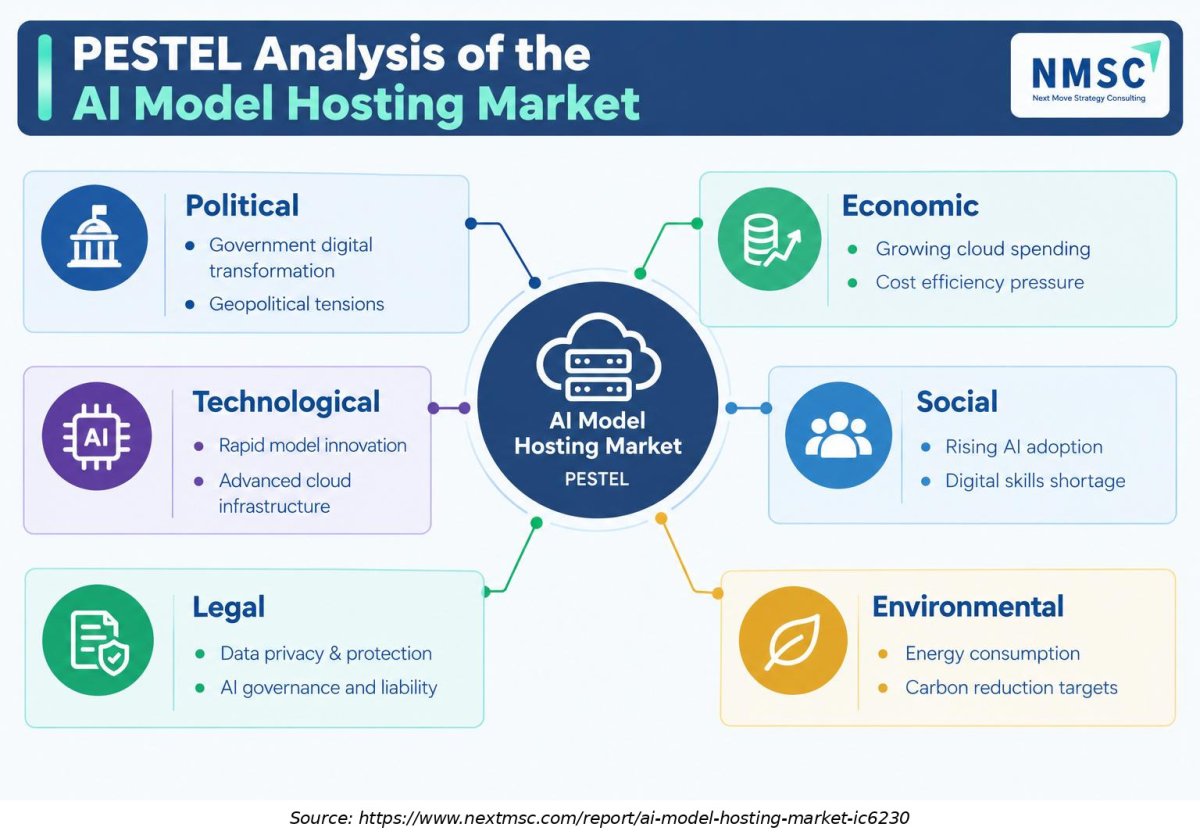
PESTEL Analysis of the AI Model Hosting Market

PESTEL Analysis of the AI Model Hosting Market

The AI model hosting market is shaped by government digitalization initiatives, rising cloud expenditure, rapid AI innovation, and increasing enterprise adoption. Economic pressures encourage cost-efficient infrastructure, while technological advancements improve model deployment and scalability. At the same time, data privacy laws, AI governance requirements, and growing energy consumption are influencing hosting strategies, making regulatory compliance and infrastructure efficiency critical market considerations.

Market Drivers & Dynamics

Interactive Dataset
Surge in production inference volume and token consumption driver +4.2% Global, led by North America 2026–2030
Specialist inference funding and GPU capacity build out driver +3.4% North America, Asia-Pacific 2026–2029
Enterprise shift to customer owned custom models driver +3.0% Global 2026–2033
Open weight model quality convergence with proprietary models driver +2.2% Global 2026–2031
Sovereign and private hosting mandates driver +1.8% Middle East, Europe, Asia-Pacific 2027–2035
Data centre power and grid constraints restraint −2.6% North America, Europe 2026–2032
GPU supply concentration and token price compression restraint −2.1% Global 2026–2030
Compliance cost under data residency and AI governance rules restraint −1.4% Europe, Middle East 2026–2029
Source: Next Move Strategy Consulting

Growth Drivers

What Is the Primary Growth Driver of the AI Model Hosting Market?

Rising production inference volume is the primary driver. Alphabet said model APIs reached about 22 billion tokens per minute in the second quarter of 2026, and Amazon stated that Bedrock token usage in the first quarter of 2026 exceeded all prior years combined. Our findings suggest that coding assistants and AI agents generate repeated multi step calls per user action, which multiplies tokens consumed per task and converts each deployment into a large recurring hosting contract.

How Is Enterprise Adoption Driving the Market Growth?

Adoption is spreading from early users to mainstream firms. The U.S. Census Bureau Business Trends and Outlook Survey, for the period ending 3 May 2026, found that 37% of firms with 250 or more employees used AI. The share was 32% for firms with 100 to 249 employees and under 20% for firms with four or fewer employees. This gap indicates a long runway, and Baseten customers such as Notion, HubSpot and Harvey show how software vendors buy hosted capacity.

Growth Inhibitors

What Is Restraining the AI Model Hosting Market?

Power availability is the main restraint. The International Energy Agency reported that data centre electricity demand rose 17% in 2025 and is expected to double by 2030, with AI focused facilities tripling. The U.S. Department of Energy and Lawrence Berkeley National Laboratory estimate data centers used 4.4% of U.S. electricity in 2023, rising to between 6.7% and 12% by 2028. Capacity delays can therefore cap revenue even when hyperscale datacenter demand is strong.

What Are the Growth Opportunities?

How Large Is the Sovereign and Private Hosting Opportunity?

Governments and regulated industries want models served inside national borders. Aramco Ventures led the Together AI Series C announced on 1 July 2026, which signals Gulf capital interest, and Saudi Arabia grows at 33.4% from 2026 to 2035 in our model. Providers that package isolated clusters, local data residency and audit support can capture the private and hybrid hosting segment, which is forecast to reach USD 24.38 Billion by 2035 at a 29.9% CAGR from 2026 to 2035. These capabilities are particularly relevant to regulated enterprises and sovereign AI infrastructure programmes.

Where Does Fine Tuned Model Serving Create Value for Software Engineering?

Coding tools need low latency models trained on a customer's repositories. Together AI lists Cursor and Cognition among its customers and Baseten lists Cursor and Lovable, which shows that developer tools anchor large contracts. Hosts that offer fast fine tuning, speculative decoding and per customer model versions can win share from generic APIs and support the wider AI augmented software engineering workflow.

What Opportunity Exists in Multimodal and Document Workloads on Serverless GPUs?

Burst workloads such as image generation, transcription and document extraction suit per second GPU billing. Modal reports revenue growth above 15 times and an annualized run rate above USD 1.00 Billion, including USD 0.30 Billion from Sandboxes. Providers that scale GPUs to zero between jobs serve intelligent document processing pipelines economically, and this lifts the serverless GPU runtime segment from USD 1.74 Billion in 2026 to USD 16.26 Billion by 2035.

Segmentation Analysis

2025 (USD Billion)
2035 (USD Billion)
Serverless API hosting 2025: $4.07 Billion | 2035: $51.47 Billion
Serverless A
Dedicated endpoint hosting 2025: $2.20 Billion | 2035: $43.35 Billion
Dedicated en
Serverless GPU runtime hosting 2025: $0.63 Billion | 2035: $16.26 Billion
Serverless G
Private and hybrid hosting 2025: $0.94 Billion | 2035: $24.38 Billion
Private and
Serverless API hosting $4.07 Billion $51.47 Billion 20.4%
Dedicated endpoint hosting $2.20 Billion $43.35 Billion 25.5%
Serverless GPU runtime hosting $0.63 Billion $16.26 Billion 28.2%
Private and hybrid hosting $0.94 Billion $24.38 Billion 29.9%

Which Deployment Model Leads the AI Model Hosting Market?

Serverless API hosting led in 2025 with USD 4.07 Billion, about 52% of the market, because pay per token access removes capacity planning for developers. Private and hybrid hosting is the fastest growing at 29.9% from 2026 to 2035, as regulated buyers and sovereign programmes demand isolation. We observed that dedicated endpoints, sold by Oracle and Baseten among others, keep growing steadily because predictable latency matters for production AI as a service contracts.

2025 (USD Billion)
2035 (USD Billion)
Open-weight
Proprietary
Customer-own
Segment Item 2025 (USD Billion) 2035 (USD Billion) CAGR
Open-weight models $10.0 USD Billion $40.0 USD Billion 15.0%
Proprietary partner models $17.1 USD Billion $51.1 USD Billion 13.0%
Customer-owned custom models $24.2 USD Billion $62.2 USD Billion 27.0%

Segment-wise data is locked

Unlock complete segment-wise numbers for By Model Source.

Unlock Full Data
2025 (USD Billion)
2035 (USD Billion)
Coding and s
Conversation
Enterprise s
Multimodal c
Document and
Segment Item 2025 (USD Billion) 2035 (USD Billion) CAGR
Coding and software engineering $10.0 USD Billion $40.0 USD Billion 18.0%
Conversational and agentic AI $17.1 USD Billion $51.1 USD Billion 16.0%
Enterprise search and retrieval $24.2 USD Billion $62.2 USD Billion 22.0%
Multimodal content generation $31.3 USD Billion $73.3 USD Billion 12.0%
Document and data processing $38.4 USD Billion $84.4 USD Billion 19.0%

Segment-wise data is locked

Unlock complete segment-wise numbers for By Application.

Unlock Full Data

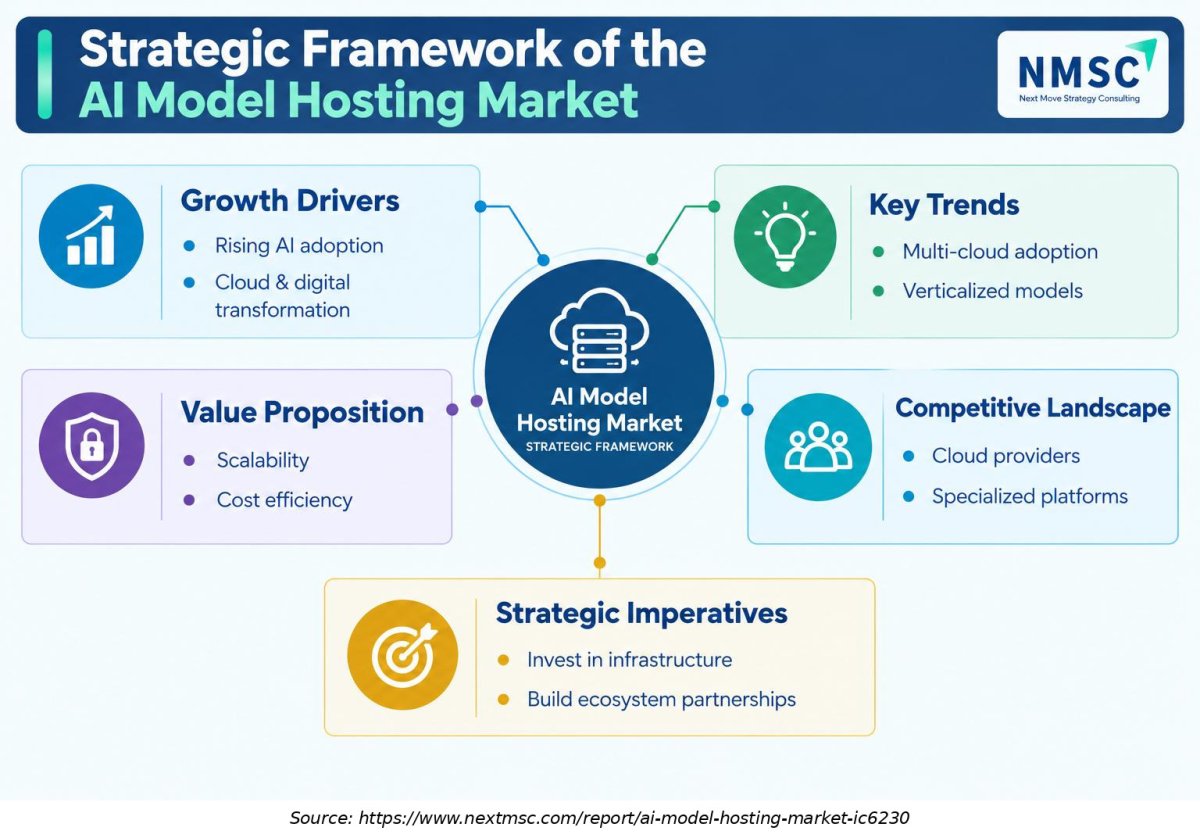
Strategic Framework of the AI Model Hosting Market

Strategic Framework of the AI Model Hosting Market
The AI model hosting market's strategic direction centers on scalable infrastructure, cost efficiency, and reliable model deployment. Growing AI adoption and digital transformation are strengthening demand, while multi-cloud strategies and specialized hosting platforms are reshaping competition. Providers can differentiate through security, performance, and industry-specific solutions, supported by infrastructure investment and ecosystem partnerships that address evolving enterprise requirements.

Growth Opportunities

We identified three opportunities where providers in the AI Model Hosting Market can convert demand growth into durable revenue.

How Large Is the Sovereign and Private Hosting Opportunity?

Governments and regulated industries want models served inside national borders. Aramco Ventures led the Together AI Series C announced on 1 July 2026, which signals Gulf capital interest, and Saudi Arabia grows at 33.4% from 2026 to 2035 in our model. Providers that package isolated clusters, local data residency and audit support can capture the private and hybrid hosting segment, which is forecast to reach USD 24.38 Billion by 2035 at a 29.9% CAGR from 2026 to 2035. These capabilities are particularly relevant to regulated enterprises and sovereign AI infrastructure programmes.

Where Does Fine Tuned Model Serving Create Value for Software Engineering?

Coding tools need low latency models trained on a customer's repositories. Together AI lists Cursor and Cognition among its customers and Baseten lists Cursor and Lovable, which shows that developer tools anchor large contracts. Hosts that offer fast fine tuning, speculative decoding and per customer model versions can win share from generic APIs and support the wider AI augmented software engineering workflow.

What Opportunity Exists in Multimodal and Document Workloads on Serverless GPUs?

Burst workloads such as image generation, transcription and document extraction suit per second GPU billing. Modal reports revenue growth above 15 times and an annualized run rate above USD 1.00 Billion, including USD 0.30 Billion from Sandboxes. Providers that scale GPUs to zero between jobs serve intelligent document processing pipelines economically, and this lifts the serverless GPU runtime segment from USD 1.74 Billion in 2026 to USD 16.26 Billion by 2035.

Regional Outlook

2025 (USD Billion)
2035 (USD Billion)
North Americ
Europe
Asia-Pacific
Middle East
Latin Americ
Region 2025 (USD Billion) 2035 (USD Billion) CAGR (%)
North America $10.0 USD Billion $40.0 USD Billion 9.0%
Europe $17.1 USD Billion $51.1 USD Billion 27.0%
Asia-Pacific $24.2 USD Billion $62.2 USD Billion 25.0%
Middle East & Africa $31.3 USD Billion $73.3 USD Billion 23.0%
Latin America $38.4 USD Billion $84.4 USD Billion 12.0%

Regional data is locked

Unlock complete regional numbers for this market.

Unlock Full Data

Competitive Landscape

Our findings suggest that competition in the AI Model Hosting Market splits between hyperscale platforms that bundle hosting with cloud contracts and specialists that sell speed and model control. Hyperscalers win on procurement convenience, compliance coverage and committed spend, while specialists win on latency, price per token and rapid access to new open models. Buyers increasingly use both, which keeps switching costs low and rewards continuous performance gains.

Dimension Description
Market Structure Concentrated at the top among hyperscale platforms, with a growing tier of venture funded specialist inference clouds.
Innovation Focus Faster serving engines, tuned model workflows, specialized inference silicon and sovereign deployment options.
M&A Activity Targeted deals for model catalogues and inference technology, plus very large private rounds in 2026.

How Do Companies Compete in the AI Model Hosting Market?

Providers compete on latency, price per token, model catalogue breadth and reliability. Hyperscalers rely on enterprise contracts and committed spend, while specialists such as Fireworks AI, Together AI, Baseten and Modal win on performance and developer experience. We observed that capacity access has become a competitive weapon, since CoreWeave reports a backlog near USD 104.00 Billion and Nebius targets 5 GW of contracted power, which locks in demand years ahead.

Which Provider Archetypes Dominate the Industry?

Four archetypes dominate: hyperscale clouds, data platforms, specialist inference clouds and hardware linked providers. Microsoft, Amazon and Alphabet sell integrated catalogues, Databricks and Snowflake serve models next to enterprise data, and Fireworks AI, Together AI and Baseten focus on speed and customization. NVIDIA, Cerebras and Groq pair silicon with hosted access. Differentiation themes include latency, data proximity, tuned models and sovereign deployment.

How Are Providers Differentiating Through Innovation?

Innovation centres on faster serving engines, cheaper tokens and tighter model customization loops. Cloudflare unified more than 70 models behind one API, Oracle packaged dedicated AI clusters, and Cerebras and Groq pursue specialized inference silicon. Our analysis shows that providers combining tuning, serving and observability reduce customer churn, because teams that fine tune on a platform rarely move production traffic elsewhere.

What Role Do Mergers and Acquisitions Play in the AI Model Hosting Industry?

Consolidation targets model catalogues, developer reach and silicon access. Cloudflare announced its Replicate acquisition in November 2025 to broaden its model library, and NVIDIA licensed Groq inference technology in December 2025 while GroqCloud continued to operate. Large private rounds also act as strategic moves, with Baseten, Fireworks AI, Together AI and Modal raising about USD 4.56 Billion between June and October 2026. Geographic expansion and price cuts remain key tools.

Key Market Players

NMSC's analysis indicates that the following companies, ranked by estimated hosted AI inference relevance, shape the industry.

Microsoft Corporation Amazon.com, Inc. Alphabet Inc. Alibaba Group Holding Limited Oracle Corporation Databricks, Inc. Fireworks AI, Inc. Together AI, Inc. Modal Labs, Inc. Baseten, Inc. Snowflake Inc. CoreWeave, Inc. Nebius Group N.V. NVIDIA Corporation International Business Machines Corporation Cloudflare, Inc. Cerebras Systems Inc. Hugging Face, Inc. Groq, Inc.

Latest Developments

We found that financing, capacity and consolidation news dominated the period from late 2025 to October 2026.

Date Event
Apr-26 Cloudflare introduced an inference layer providing access to more than 70 AI models from over 12 providers through a unified API. Developers can switch between models with minimal code changes, supporting agentic workflows that require different models for planning, classification and execution. The platform also expands multimodal model access.
Nov-25 Cloudflare announced an agreement to acquire Replicate, a platform that enables developers to deploy and run AI models through APIs. The acquisition was intended to expand model availability within Cloudflare Workers, simplify model deployment and strengthen its end-to-end platform for building and operating scalable AI applications.
Dec-25 Groq announced a non-exclusive licensing agreement with NVIDIA covering Groq’s inference technology. Groq founder Jonathan Ross, president Sunny Madra and other team members were set to join NVIDIA to advance the licensed technology. Groq confirmed that it would continue operating independently and that GroqCloud services would remain available without interruption.

Investment Opportunities

Where Is Capital Flowing in the AI Model Hosting Market?

Capital in the AI Model Hosting Market is concentrating in inference specialists. Baseten raised USD 1.50 Billion at a USD 13.00 Billion valuation on 22 June 2026, and Together AI raised USD 0.80 Billion at USD 8.30 Billion on 1 July 2026. Fireworks AI raised USD 1.51 Billion at USD 17.50 Billion on 15 July 2026, and Modal raised USD 0.75 Billion on 14 October 2026. Investors are backing revenue growth, with Fireworks AI and Modal each reporting annualized run rates above USD 1.00 Billion.

How Much Infrastructure Investment Does the Market Require?

Infrastructure is the largest cost line. CoreWeave reported active power of 1.5 GW and contracted power of about 3.7 GW in its second quarter of 2026 results, while Oracle reported remaining performance obligations of USD 638.00 Billion. Investors should note that power, datacentercolocation space and GPUs drive returns, so sites with secured grid connections and long term customer contracts offer the strongest risk adjusted position.

What Are the ESG Considerations for AI Model Hosting?

Energy use and grid impact dominate ESG scrutiny. The IEA expects data centre electricity demand to double by 2030, and the U.S. Department of Energy report shows data centers could reach 6.7% to 12% of U.S. electricity by 2028. Providers that adopt efficient serving, immersion cooling and renewable power contracts reduce emissions per token, and these metrics increasingly appear in enterprise procurement scorecards.

Key Benefits for Stakeholders

How Does This Report Help Enterprise and Industry Leaders?

Enterprise leaders gain a clear view of which deployment model fits each workload. The segment sizing shows that private and hybrid hosting grows fastest, while serverless APIs remain the entry point. The regional analysis and forecasts help buyers plan contracts, negotiate committed spend and avoid lock in. They also support Cloud FinOps budgeting for token and GPU costs.

How Does This Report Help Investors and Financial Analysts?

Investors receive a reconciled view of the USD 19.35 Billion 2026 base and the USD 135.46 Billion 2035 forecast, with segment and country detail that supports valuation work. The analysis highlights where growth is fastest, including India at 34.9% and customer owned custom models at 31.9%. It also flags power, GPU supply and price compression as the main risks to private company valuations.

How Does This Report Help Technology Vendors and Product Teams?

Vendors and product teams can use the competitive analysis to position offerings against hyperscalers and specialists. The report identifies differentiation themes such as latency, tuning and sovereignty, and it shows which applications generate the most demand. Product teams can prioritize catalogues, serving features and pricing models, and align roadmaps with the Responsible AI and compliance expectations of large buyers.

Key Market Segments Evaluated

By Deployment Model

  • Serverless API hosting
  • Dedicated endpoint hosting
  • Serverless GPU runtime hosting
  • Private and hybrid hosting

By Model Source

  • Open-weight models
  • Proprietary partner models
  • Customer-owned custom models

By Application

  • Coding and software engineering
  • Conversational and agentic AI
  • Enterprise search and retrieval
  • Multimodal content generation
  • Document and data processing

By Region

  • North America 
    • U.S.
    • Canada
    • Mexico
  • Europe 
    • UK
    • Germany
    • France
    • Italy
    • Spain
    • Sweden
    • Denmark
    • Finland
    • Netherlands
    • Rest of Europe
  • Asia-Pacific 
    • China
    • India
    • Japan
    • South Korea
    • Taiwan
    • Indonesia
    • Vietnam
    • Australia
    • Philippines
    • Malaysia
    • Rest of APAC
  • Middle East & Africa 
    • Saudi Arabia
    • UAE
    • Egypt
    • Israel
    • Turkey
    • Nigeria
    • South Africa
    • Rest of MEA
  • Latin America 
    • Brazil
    • Argentina
    • Chile
    • Colombia
    • Rest of LATAM

Conclusion & Recommendations

The market grows from USD 19.35 Billion in 2026 to USD 135.46 Billion in 2035, and growth moderates as the base expands and unit prices fall. We expect hosting to become a core layer of enterprise computing, with custom models and private deployments gaining share. Revenue concentration should remain high among platforms with secured power and GPU supply, though specialists will keep winning latency sensitive workloads.

What Strategic Positioning Recommendations Does NMSC Offer?

Hyperscalers should defend share by bundling hosting with committed cloud spend and sovereign options. Specialists should deepen tuning, observability and enterprise support to reduce churn. Data platform vendors should keep models close to governed data. All providers should secure multi year power and GPU contracts, price on utilization and publish transparent latency commitments to earn enterprise trust.

What Is the Investment Attractiveness of the AI Model Hosting Market?

Attractiveness is high but uneven. Growth, rising run rates and strong private valuations support the opportunity, yet capital intensity and price compression compress margins for undifferentiated resellers. NMSC rates private and hybrid hosting and customer-owned model serving as the most attractive areas, because contracts are longer and switching costs are higher than in commodity serverless token sales.

What Are the Market Shifts and Key Risks in the AI Model Hosting Market?

Key shifts include movement from public APIs to private deployments, and from partner models to tuned models. Principal risks are power shortages, concentrated GPU supply, falling token prices, regulatory change and customer concentration among a few large buyers. A sharp slowdown in AI application spending would also strand capacity financed with long dated debt, which makes balance sheet strength a decisive competitive factor.

What Are the Primary Growth Pathways Through 2035?

Growth pathways include agentic workloads that multiply tokens per task, multimodal generation that consumes GPU time, and sovereign programmes in the Gulf, Europe and Asia. Enterprise adoption beyond the 37% of large firms using AI today also expands the buyer base. Providers that align capacity, tuned models and regional compliance with these pathways can capture the largest share of incremental revenue.

FAQs

About the Author

Mihul Sharma

Mihul Sharma

Mihul Sharma is Research Associate at Next Move Strategy Consulting, where he has covered technology, industrial, and healthcare markets for 3 years. His work applies structured business research, market analysis, and secondary-source review to assess market trends, competitive developments, and growth opportunities. He supports report development by fully synthesizing industry data, company information, and market signals into concise findings for strategy and investment-focused research teams.

About the Reviewer

Supradip Baul

Supradip Baul

Supradip Baul is an accomplished business consultant and strategist with over a decade of rich experience in market intelligence, strategy, technology, and business transformation. His work has included rigorous qualitative and quantitative analysis across multiple industries, helping clients shape investment decisions and long-term roadmaps. Earlier in his career, he was associated with Gartner, where he contributed to industry-leading reports and market share analyses. He has worked with leading global companies and holds an MBA with a dual specialization in Marketing and Finance.

Download Free Sample

Pratyush Kumar Das

PRATYUSH KUMAR DAS

Assistant Manager

Polycab India Limited

We would like to express our appreciation for the data and insights provided by nextmsc. We are very pleased with the quality and depth of the information, which has proven to be highly valuable and beneficial for our business decision-making.

Gaurav Jaiswal

GAURAV JAISWAL

Founder & CEO

Yano Charge Private Limited

The EV Charging market research report provided by the NextMSC was exceptionally detailed and insightful. It offered a comprehensive analysis that proved to be a game-changer for our strategic planning. Truly a testament to the NextMSC’s expertise and thoroughness in EV market landscape & analysis.

Diana Trejo

DIANA TREJO

Assistant Manager

Sumitomo Corporation de Mexico, S.A. de C.V.

Recently, we purchased a report on the Mexico Data Center Market from Next Move Strategy Consulting. The service has been excellent, with support that is always timely and thoroughly professional. The information provided is interesting, highly useful, and delivered with clarity. I would highly recommend NextMSC for anyone seeking insightful and dependable analysis.

Kevin Coker

KEVIN COKER

Founder, CEO and Board Diector

Proxima Clinical Research

I have been using Next MSC reports for product positioning in a new geography for a long time. They have by far the best reports I have found and the price is reasonable too!

Kishu Kanda

KISHU KANDA

Strategy Analyst

Accenture

We purchased the AI Consumer Market Report from this company. Not only did they customize the report to meet our specific requirements, but they also showed great flexibility in accommodating our budget. The report we received fully met our expectations. Additionally, they provided prompt and thorough responses to both our pre-purchase and follow-up questions. We look forward to working with this company again in the future.

Custom Market Research Services

We will customize the research for you if the listed report does not fully match your requirements.

Get 30% Free Customization

Select License

This website uses cookies to ensure you get the best experience on our website. Learn more

✖