
Automated Valuation Model (AVM) Market Size, Share, Trends and Growth Analysis, By Solution (Valuation Models, Workflow Software, Property Data & Analytics, Vision AI, and Services), By Property Type (Residential, Commercial, Industrial, Retail, Mixed Use, Land, and Others), By Delivery Mode, By Pricing Model, By Valuation Purpose, By Buyer Type, and Region – Global Industry Report and Forecast, 2026–2035
Industry: ICT & Media | Publishing Date: July 13, 2026 | Last Updated: September 30, 2026 | No of Pages: N/A | No. of Tables: N/A | No. of Figures: N/A | Format: PDF | Report Code: IC5116
What Is the AI Property Valuation Market Size?
The AI Property Valuation Market size was valued at USD 1.58 Billion in 2025 and is estimated at USD 1.96 Billion in 2026, forecast to reach USD 14.21 Billion by 2035, expanding at a 24.6% CAGR between 2026 and 2035. North America leads with approximately 44% share, while under valuation models, Market Value AVM dominates with approximately 42% share.
We observed that growth is broad-based across every segmentation axis, with computer vision-based condition scoring and agentic AI data platforms driving the dominant structural shifts through 2035.
|
Key Takeaways |
|
By Valuation Models: Market Value AVM held the largest share of approximately 42% (USD 664 Million) in 2025; Replacement Cost AVM is the fastest-growing sub-segment at 34.0% CAGR from 2026–2035. |
|
By Workflow Software: Order Management held the largest share of approximately 27% (USD 427 Million) in 2025; Hybrid Valuation is the fastest-growing sub-segment at 34.0% CAGR from 2026–2035. |
|
By Property Data and Analytics: Property Records held the largest share of approximately 30% (USD 474 Million) in 2025; Forecasts is the fastest-growing sub-segment at 34.9% CAGR from 2026–2035. |
|
By Vision AI: Photo Analysis held the largest share of approximately 36% (USD 569 Million) in 2025; Damage Detection is the fastest-growing sub-segment at 33.4% CAGR from 2026–2035. |
|
By Services: Model Build held the largest share of approximately 38% (USD 600 Million) in 2025; Managed Valuation is the fastest-growing sub-segment at 31.9% CAGR from 2026–2035. |
|
By Property Type: Single Family held the largest share of approximately 38% (USD 600 Million) in 2025; Multifamily is the fastest-growing sub-segment at 33.1% CAGR from 2026–2035. |
|
By Delivery Mode: API held the largest share of approximately 33% (USD 521 Million) in 2025; Embedded Workflow is the fastest-growing sub-segment at 36.5% CAGR from 2026–2035. |
|
By Pricing Model: Subscription held the largest share of approximately 34% (USD 537 Million) in 2025; Transaction Fee is the fastest-growing sub-segment at 37.6% CAGR from 2026–2035. |
|
By Valuation Purpose: Origination held the largest share of approximately 26% (USD 411 Million) in 2025; Insurance is the fastest-growing sub-segment at 36.6% CAGR from 2026–2035. |
|
By Buyer Type: Lender held the largest share of approximately 24% (USD 379 Million) in 2025; Investor is the fastest-growing sub-segment at 37.5% CAGR from 2026–2035. |
|
Dominant Region: North America dominated with approximately 44% revenue share (USD 695 Million) in 2025. |
|
Fastest-Growing Region: Asia-Pacific is expected to register the highest CAGR of 36.3% during 2026–2035. |
|
Dominant Country: The U.S. led with approximately USD 549 Million in 2025. |
|
Fastest-Growing Country: India is the fastest-growing country at approximately 44.7% CAGR from 2026–2035. |
Between 2026 and 2035, the AI Property Valuation Market is set to generate an absolute dollar opportunity of USD 12.25 Billion, positioning AI-driven condition scoring and agentic data platforms as a compelling area for capital allocation.
According to Next Move Strategy Consulting analysis, sustained investment in computer vision-based condition scoring and hybrid valuation workflows is reshaping procurement criteria for mortgage lenders, as GSE-aligned automation increasingly determines vendor shortlisting across origination and portfolio-monitoring use cases.
What Does the AI Property Valuation Market Encompass?
The AI Property Valuation Market encompasses software platforms and data services that apply machine learning, computer vision, and statistical modeling to estimate property values without a full manual appraisal. We observed that scope spans automated valuation models, appraisal workflow software, property data and analytics feeds, and vision AI tools supplied to lenders, servicers, appraisal management companies, appraisers, agents, brokers, insurers, and government agencies. The category has evolved from static comparable-sales AVMs into condition-aware, image-informed engines that blend public records, listing data, and borrower-submitted photographs to support origination, servicing, and portfolio-monitoring decisions worldwide.
Regulatory frameworks increasingly shape how valuation technology is deployed across mortgage finance. The interagency Quality Control Standards for Automated Valuation Models rule, issued under the Dodd-Frank Act by the CFPB, OCC, Federal Reserve, FDIC, NCUA, and FHFA and effective October 1, 2025, requires mortgage originators and secondary market issuers to validate AVM confidence, guard against data manipulation, and comply with nondiscrimination laws. Our assessment indicates that Fannie Mae and Freddie Mac's expanded hybrid appraisal eligibility, alongside the phased rollout of Uniform Appraisal Dataset 3.6 through November 2026, is compressing adoption timelines for AI-assisted desktop and hybrid valuation workflows.
Technology adoption is shifting toward computer vision-based condition scoring that adjusts automated valuations using borrower- or appraiser-submitted photographs, reducing reliance on stale public-record condition data. Next Move Strategy Consulting's analysis indicates that generative and agentic AI layers are increasingly embedded atop existing property data graphs, enabling lenders and investors to query portfolio risk directly rather than through static reports. This shift, combined with GSE-aligned data standards, is redefining sourcing criteria for valuation technology across mortgage, insurance, and real estate investment workflows across the AI Property Valuation Market.
|
Parameter |
Details |
|
Market Size in 2025 |
USD 1.58 Billion |
|
Market Size in 2026 |
USD 1.96 Billion |
|
Revenue Forecast in 2035 |
USD 14.21 Billion |
|
Growth Rate |
CAGR of 24.6% from 2026 to 2035 |
|
Analysis Period |
2025–2035 |
|
Base Year Considered |
2025 |
|
Forecast Period |
2026–2035 |
|
Market Size Estimation |
Revenue (USD Billion) |
|
Companies Profiled |
20 |
|
Countries Covered |
33 |
|
Market Share |
Available for Top 10 Companies |
Key Emerging Trends
Based on research conducted by Next Move Strategy Consulting, we found that four structural trends are reshaping product development, regulatory engagement, and stakeholder adoption across the AI Property Valuation Market.
How Is Computer Vision Transforming Condition-Adjusted Valuations?
Computer vision models that analyze borrower- and appraiser-submitted photographs are replacing static, public-record condition assumptions in automated valuations. We observed that ICE Mortgage Technology's Validate platform applies geofenced, time-stamped photo verification alongside a condition-adjusted AVM to support reconsideration-of-value requests and home equity originations. Lenders are adopting these tools to reduce manual appraisal steps, while investors and servicers use condition-scored valuations to monitor single-family rental and mortgage-backed portfolios with greater confidence in collateral accuracy across market cycles.
Why Is Hybrid and Desktop Appraisal Technology Gaining Adoption?
Hybrid and desktop appraisal workflows, which pair third-party data collection with remote appraiser review, are gaining share as Fannie Mae and Freddie Mac expanded eligibility across Desktop Underwriter and Loan Product Advisor in 2025. Our findings suggest that appraisal management companies and lenders are integrating hybrid-ready workflow software to route eligible loans automatically, reducing turnaround times without removing licensed appraiser oversight. This trend is positioning workflow and desktop appraisal software as a fast-growing category within the broader market segmentation structure.
How Is the Uniform Appraisal Dataset 3.6 Transition Reshaping Data Requirements?
The phased transition to Uniform Appraisal Dataset 3.6, with limited production beginning September 2025 and mandatory use required by November 2026, is prompting valuation technology vendors to rebuild data schemas around a more granular, form-agnostic reporting structure. We found that property data and analytics providers are prioritizing UAD 3.6-compliant integrations to remain eligible for delivery through the Uniform Collateral Data Portal. This transition is elevating demand for flexible workflow software capable of supporting both legacy and next-generation appraisal datasets simultaneously.
What Role Does AI Play in Reconsideration of Value and Bias Mitigation?
Reconsideration-of-value tools and bias-mitigation analytics are emerging as a regulatory response to fair-lending scrutiny of both traditional appraisals and automated models. Our analysis shows that the interagency AVM quality-control rule's nondiscrimination requirement, effective October 2025, is prompting lenders to adopt AI-based audit and disparity-testing layers alongside valuation models. Cotality's Araya platform and comparable AI-driven analytics suites illustrate how vendors are embedding fairness testing directly into valuation workflows to support compliance across origination and servicing channels.
Regulatory Framework Impacting the AI Property Valuation Industry
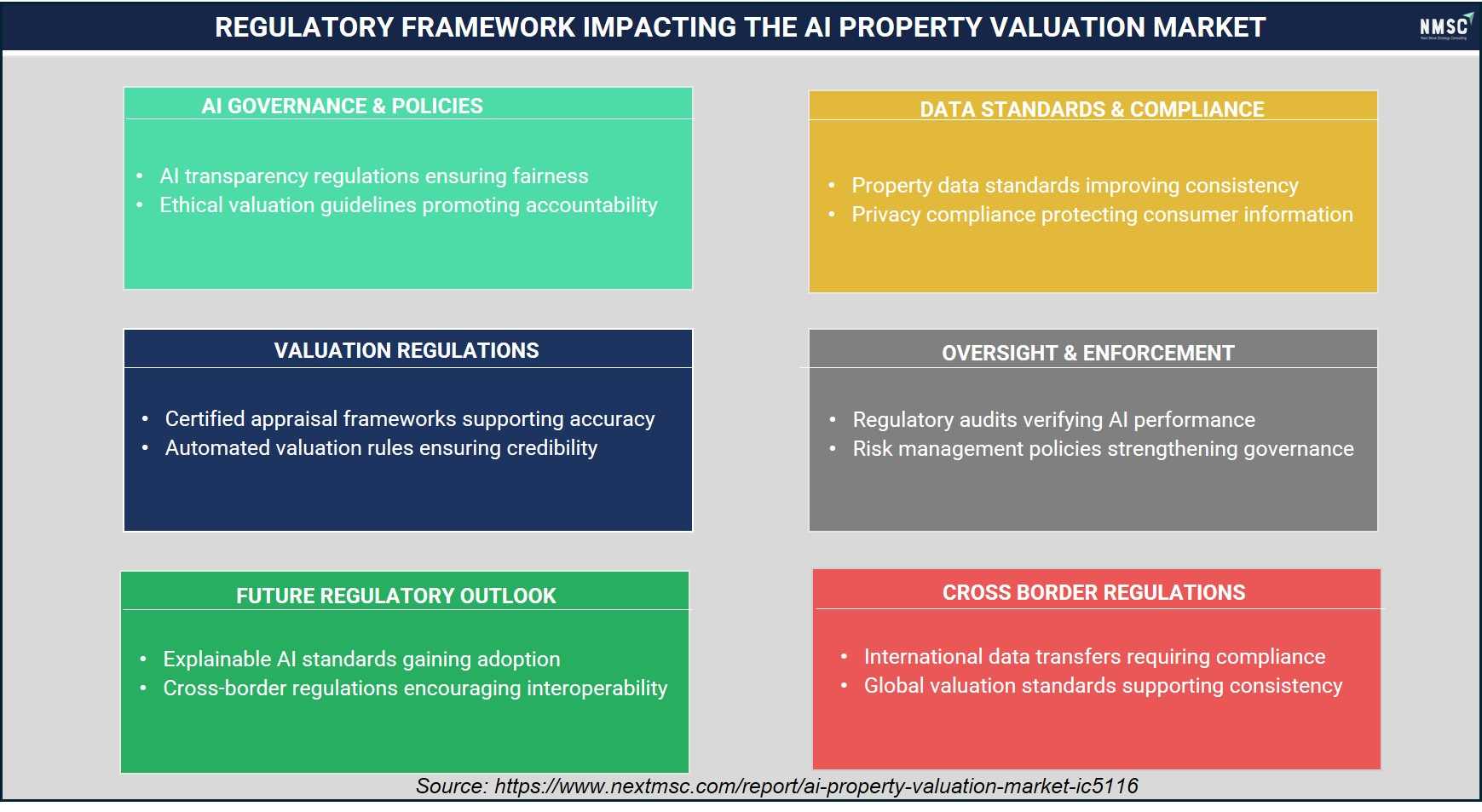
The infographic outlines the regulatory framework shaping the AI Property Valuation Market, emphasizing AI governance, data standards, valuation regulations, oversight, and cross-border compliance. Transparent AI practices, ethical guidelines, and standardized property data improve valuation accuracy and consumer trust, while privacy regulations safeguard sensitive information. Regulatory audits and risk management strengthen accountability, and the growing adoption of explainable AI and international interoperability standards is expected to support secure, reliable, and scalable deployment of AI-powered property valuation solutions worldwide.
Growth Drivers and Restraints
Growth Catalyst and Risk Assessment Matrix
|
Factors |
Type |
(+/−) % Impact on CAGR |
Geographic Relevance |
Impact Timeline |
|
GSE hybrid and desktop appraisal expansion |
Driver |
+3.2% |
North America |
2026-2032 |
|
Mandatory AVM quality control and nondiscrimination rule |
Driver |
+2.4% |
North America |
2026-2035 |
|
Institutional single-family rental portfolio growth |
Driver |
+2.6% |
North America, Asia-Pacific |
2026-2035 |
|
Uniform Appraisal Dataset 3.6 data modernization mandate |
Driver |
+1.8% |
North America |
2026-2028 |
|
Expanding proptech investment in Asia-Pacific |
Driver |
+3.0% |
Asia-Pacific |
2026-2035 |
|
Appraiser workforce shortage in rural and secondary markets |
Driver |
+1.5% |
North America, Europe |
2026-2035 |
|
Appraiser and industry association pushback on AI displacement |
Restraint |
−1.4% |
North America |
2026-2032 |
|
Data privacy and algorithmic bias liability concerns |
Restraint |
−1.1% |
Global |
2026-2035 |
|
Fragmented property data standards across countries |
Restraint |
−0.9% |
Europe, Asia-Pacific |
2026-2033 |
What Is the Primary Growth Driver of the AI Property Valuation Market?
Expanded hybrid and desktop appraisal eligibility across Fannie Mae's Desktop Underwriter and Freddie Mac's Loan Product Advisor, effective from March and April 2025 respectively, is the primary driver of the market. The Federal Housing Finance Agency's October 2024 valuation modernization announcement broadened eligibility to a large majority of qualifying loans, sustaining lender demand for AI-assisted desktop appraisal and hybrid valuation workflow software. We observed that this policy shift continues to anchor baseline consumption of workflow software and vision AI tools across mortgage origination channels.
How Is Regulatory Modernization Driving AI Property Valuation Market Growth?
Federal regulatory modernization is accelerating AI Property Valuation Market growth toward compliant, auditable valuation technology. The interagency Quality Control Standards for Automated Valuation Models rule, effective October 1, 2025, and the government-sponsored enterprises phased Uniform Appraisal Dataset 3.6 rollout through November 2026 are pushing lenders to specify AVM and workflow platforms with built-in non-discrimination testing and modern data schemas. Our assessment indicates that this regulatory pressure is compressing adoption timelines for AI-based reconsideration-of-value and condition-scoring tools across North America and increasingly across Europe.
What Is Restraining AI Property Valuation Market Expansion?
Appraiser industry pushback and unresolved algorithmic bias liability restrain adoption pace across the market supply chain. The Appraisal Institute's February 2025 Valuation Modernization Summit highlighted continuing concerns about the diminishing role of licensed appraisers as inspection-informed waivers and hybrid appraisals expand. We found that smaller technology vendors face particular exposure, as limited compliance budgets reduce their ability to satisfy non-discrimination testing requirements compared with larger, well-capitalized data and analytics providers.
Segmentation Analysis
Segment Sizing: By Valuation Models
|
Segment |
2025 (USD) |
2035 (USD) |
CAGR% (2026–2035) |
|
Market Value AVM |
USD 664 Million |
USD 3.48 Billion |
18.0% |
|
Rental Value AVM |
USD 316 Million |
USD 3.46 Billion |
27.0% |
|
Assessed Value AVM |
USD 348 Million |
USD 2.54 Billion |
22.0% |
|
Replacement Cost AVM |
USD 253 Million |
USD 4.73 Billion |
34.0% |
|
Total |
USD 1.58 Billion |
USD 14.21 Billion |
24.6% |
Which Valuation Models Segment Dominates the Market?
Market Value AVM, encompassing residential consumer grade, residential lending grade, commercial grade, and distressed and liquidation models, led the AI Property Valuation Market with USD 664 Million in 2025, supported by its near-universal use in mortgage origination and portfolio monitoring. We observed that Replacement Cost AVM is the fastest-growing valuation model category, expanding at a 34.0% CAGR from 2026 to 2035, as insurers increasingly adopt replacement-cost estimation to support underwriting and claims accuracy amid rising property reconstruction costs.
Segment Sizing: By Property Type
|
Segment |
2025 (USD) |
2035 (USD) |
CAGR% (2026–2035) |
|
Single Family |
USD 600 Million |
USD 3.13 Billion |
18.0% |
|
Condo and Townhome |
USD 205 Million |
USD 1.92 Billion |
25.0% |
|
Multifamily |
USD 253 Million |
USD 4.41 Billion |
33.1% |
|
Office |
USD 126 Million |
USD 719 Million |
19.0% |
|
Industrial |
USD 142 Million |
USD 1.97 Billion |
30.1% |
|
Retail |
USD 95 Million |
USD 586 Million |
20.0% |
|
Mixed Use |
USD 79 Million |
USD 865 Million |
27.0% |
|
Land |
USD 47 Million |
USD 376 Million |
23.0% |
|
Other |
USD 32 Million |
USD 231 Million |
22.0% |
|
Total |
USD 1.58 Billion |
USD 14.21 Billion |
24.6% |
Which Property Type Segment Leads the Market Demand?
Single Family properties remained the leading property type within the market, valued at USD 600 Million in 2025 on sustained mortgage origination, refinance, and single-family rental transaction volume. Our findings suggest that Multifamily is the fastest-growing property type, registering a 33.1% CAGR from 2026 to 2035, as institutional investors and agency lenders increasingly specify AI-driven portfolio valuation and rent-comp analytics to underwrite large multifamily acquisition and refinance pipelines.
Segment Sizing: By Buyer Type
|
Segment |
2025 (USD) |
2035 (USD) |
CAGR% (2026–2035) |
|
Lender |
USD 379 Million |
USD 1.73 Billion |
16.4% |
|
Servicer |
USD 174 Million |
USD 1.21 Billion |
21.4% |
|
Appraisal Management Company |
USD 205 Million |
USD 1.83 Billion |
24.4% |
|
Appraiser |
USD 126 Million |
USD 310 Million |
9.4% |
|
Agent |
USD 158 Million |
USD 1.40 Billion |
24.4% |
|
Broker |
USD 111 Million |
USD 708 Million |
20.4% |
|
Consumer |
USD 95 Million |
USD 1.25 Billion |
29.4% |
|
Investor |
USD 142 Million |
USD 3.43 Billion |
37.5% |
|
Insurer |
USD 79 Million |
USD 1.64 Billion |
35.5% |
|
Government |
USD 63 Million |
USD 242 Million |
14.4% |
|
Developer |
USD 32 Million |
USD 357 Million |
27.4% |
|
Other |
USD 16 Million |
USD 101 Million |
20.4% |
|
Total |
USD 1.58 Billion |
USD 14.21 Billion |
24.6% |
Which Buyer Type Drives the Most AI Property Valuation Market Revenue?
Lenders remained the dominant buyer type across the AI Property Valuation Market, generating USD 379 Million in 2025 through sustained origination, underwriting, and portfolio-monitoring demand for automated valuation and workflow tools. Based on research conducted by Next Move Strategy Consulting, we found that Investors are the fastest-growing buyer type, expanding at a 37.5% CAGR from 2026 to 2035, as single-family rental operators and mortgage-backed securities investors scale AI-driven portfolio valuation to support acquisition and risk-monitoring decisions.
Growth Opportunities
Our analysis shows that three forward-looking opportunities stand out for stakeholders positioning within the market over the 2026-2035 forecast period.
How Are Computer Vision Condition Scores Creating Opportunities for Insurers?
Computer vision-based condition scoring presents a whitespace opportunity for insurers seeking more accurate replacement-cost and risk underwriting data. Vendors that commercialize photo- and image-informed condition models stand to capture recurring data-licensing revenue as insurers shift from static public-record attributes toward continuously updated, image-verified property condition profiles, particularly across catastrophe-exposed regions where underwriting accuracy directly affects loss ratios.
Why Are Hybrid Valuation Workflows Emerging as a Growth Opportunity for Appraisal Management Companies?
Appraisal management companies represent an underpenetrated opportunity for hybrid and desktop valuation workflow software engineered to GSE data standards. Companies that develop validated, UAD 3.6-ready hybrid appraisal routing can secure long-term lender procurement contracts, benefiting from recurring per-order revenue tied to the government-sponsored enterprises' expanding hybrid appraisal eligibility across conventional mortgage originations.
How Are Portfolio Monitoring Platforms Unlocking Opportunities for Institutional Investors?
Institutional single-family rental operators and mortgage-backed securities investors seeking continuous collateral visibility create an opportunity for providers of portfolio-monitoring AVM and analytics platforms. Early movers that combine automated valuation, rental comp, and forecast data into unified dashboards can differentiate with real estate investment trusts and private credit funds pursuing scaled acquisition and loss-mitigation strategies across residential and commercial portfolios.
Consumer Behavior Analysis of the AI Property Valuation Industry
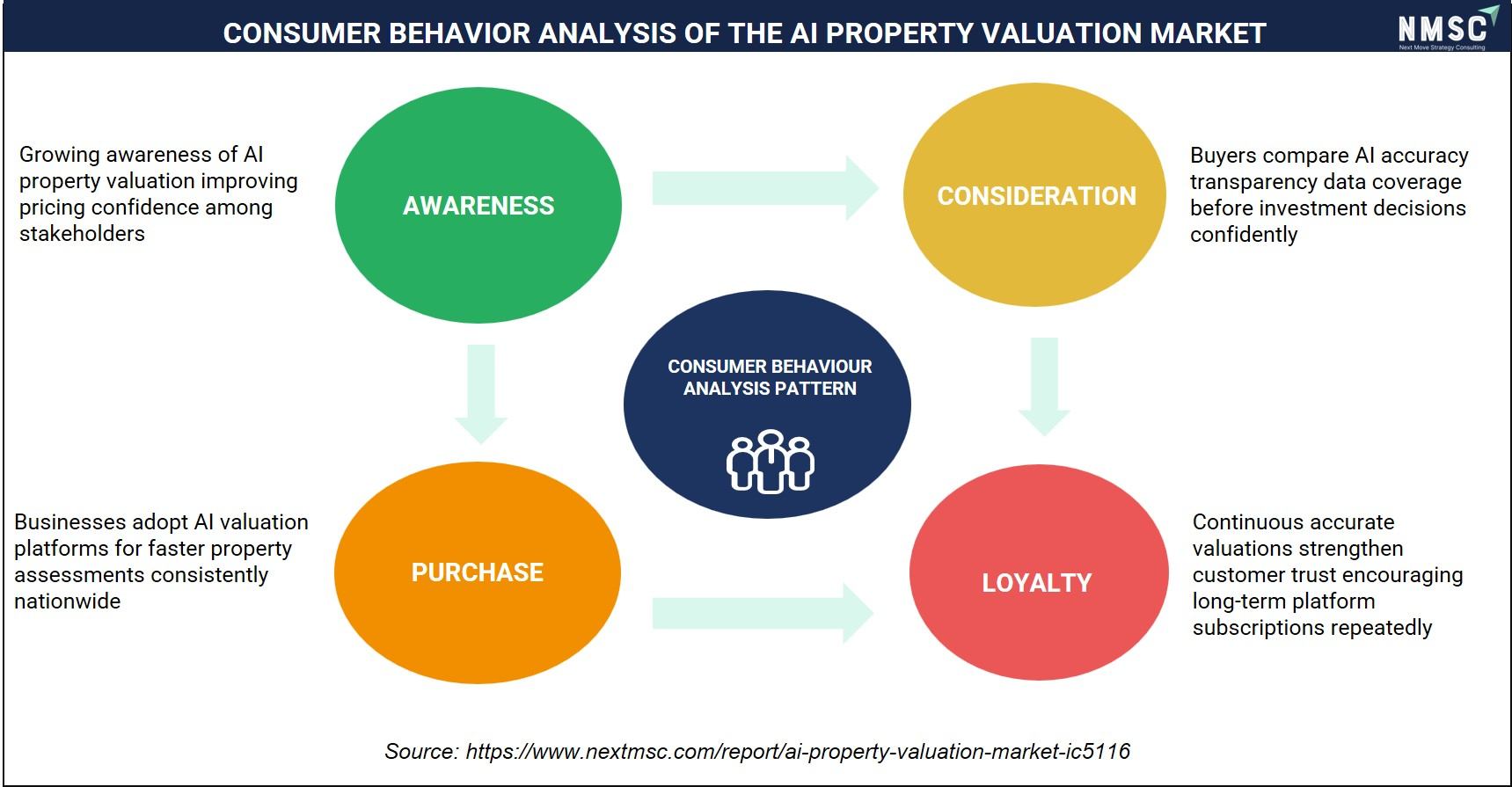
The infographic illustrates the consumer behavior journey in the AI Property Valuation Market through four stages: awareness, consideration, purchase, and loyalty. Stakeholders first recognize the benefits of AI-driven property valuations, then evaluate solution accuracy, transparency, and data coverage before adoption. Businesses increasingly implement AI valuation platforms for faster and more consistent property assessments. Positive user experiences, reliable valuation accuracy, and continuous platform improvements strengthen customer trust, encouraging long-term subscriptions, repeat usage, and sustained market growth.
Regional Outlook
Geographic Performance Snapshot
|
Region |
2025 (USD) |
2035 (USD) |
CAGR% (2026–2035) |
Key Driver |
|
North America |
USD 695 Million |
USD 3.18 Billion |
16.4% |
GSE hybrid appraisal expansion and interagency AVM quality-control rule |
|
Europe |
USD 379 Million |
USD 1.97 Billion |
17.9% |
European AVM Alliance data standardization and mortgage digitalization |
|
Asia-Pacific |
USD 316 Million |
USD 7.01 Billion |
36.3% |
Proptech investment and expanding institutional mortgage securitization |
|
Middle East & Africa |
USD 111 Million |
USD 1.34 Billion |
28.4% |
Vision 2030-linked mortgage digitization and real estate investment |
|
Latin America |
USD 79 Million |
USD 701 Million |
24.4% |
Expanding mortgage credit penetration and modernizing property registries |
|
Total |
USD 1.58 Billion |
USD 14.21 Billion |
24.6% |
— |
North America AI Property Valuation Market Outlook
North America leads the market with an established mortgage finance infrastructure and the earliest regulatory push toward valuation modernization. We observed that the Federal Housing Finance Agency's expanded hybrid and desktop appraisal eligibility, combined with the interagency Quality Control Standards for Automated Valuation Models rule effective October 2025, sustains lender demand for compliant AVM and workflow platforms. Technology adoption remains advanced, with condition-scoring vision AI and portfolio-monitoring analytics increasingly embedded across the region's mortgage origination and single-family rental sectors.
Europe AI Property Valuation Market Outlook
Europe's market reflects a maturing but data-fragmented landscape shaped by varying national valuation standards and mortgage regulatory frameworks. Our findings suggest that UK, German, and French lenders are accelerating adoption of AVM-based valuation tools through initiatives such as the European AVM Alliance, which promotes shared data standards among providers including Hometrack and Cotality. Technology adoption favors hybrid desktop valuation models, supported by regional lenders investing in digitized mortgage origination platforms across the region's largest housing markets.
Asia-Pacific AI Property Valuation Market Outlook
Asia-Pacific is the fastest-growing market region, propelled by expanding mortgage securitization in China and India and rising institutional real estate investment across Australia and South Korea. We found that regulatory frameworks remain less harmonized than in North America, giving technology vendors flexibility to scale AVM and property data platforms rapidly. Technology adoption is accelerating as regional proptech providers, including REA Group's PropTrack and Domain Holdings, expand valuation and analytics capacity to serve institutional lenders and investors.
Middle East & Africa AI Property Valuation Market Outlook
The Middle East & Africa AI Property Valuation Market is expanding as Gulf Cooperation Council economies digitize mortgage finance and diversify into data-driven real estate investment. Our analysis shows that Saudi Arabia and the UAE are attracting proptech investment tied to Vision 2030-linked housing finance modernization. Regulatory influence remains moderate, while technology adoption is gradually shifting toward imported AVM and property data platforms as regional lenders and government agencies align with global valuation standards.
Latin America AI Property Valuation Market Outlook
Latin America's AI Property Valuation Market is supported by expanding mortgage credit penetration in Brazil and Argentina and modernizing property registry infrastructure. We observed that regulatory frameworks are less stringent than in North America or Europe, though multinational data providers operating locally are introducing AVM and analytics specifications aligned with regional lending standards. Technology adoption remains centered on property records and comparable sales analytics, with competitive intensity increasing as regional lenders partner with global valuation technology integrators.
U.S. AI Property Valuation Market
Based on our engagements, the U.S. AI Property Valuation Market was valued at approximately USD 549 Million in 2025 and is projected to reach USD 2.20 Billion by 2035, growing at a 14.9% CAGR. Demand is anchored by the nation's mature mortgage origination infrastructure, GSE hybrid appraisal expansion, and the interagency AVM quality-control rule. Technology penetration favors condition-scoring vision AI, and competitive intensity remains high among established data providers serving national mortgage lenders.
Canada AI Property Valuation Market
Through our analysis, Canada's market reached roughly USD 90 Million in 2025 and is forecast to hit USD 530 Million by 2035 at a 19.4% CAGR. Demand structure mirrors U.S. mortgage origination patterns, while federally regulated lenders increasingly specify AVM-based collateral checks for underwriting. Technology penetration is rising as national lenders request condition-adjusted valuation tools, with competitive intensity moderate given reliance on cross-border data platforms from U.S.-based providers.
UK AI Property Valuation Market
From our assessment, the UK market stood at about USD 102 Million in 2025, advancing toward USD 415 Million by 2035 at a 15.0% CAGR. Demand is driven by established mortgage lenders navigating post-Brexit valuation data standards and the European AVM Alliance's shared data initiatives. Regulatory influence is significant, technology penetration favors Hometrack-style AVM integration, and competitive intensity remains steady among domestic and pan-European data providers serving UK mortgage lenders.
Germany AI Property Valuation Market
According to evaluation, Germany's market was valued near USD 83 Million in 2025 and is set to reach USD 402 Million by 2035, expanding at a 17.0% CAGR. Demand structure benefits from a large domestic mortgage lending base and growing institutional real estate investment. Germany's participation in the European AVM Alliance drives regulatory influence, while technology penetration favors property data and analytics platforms among leading pan-European providers.
France AI Property Valuation Market
Based on our engagements, France's market reached approximately USD 61 Million in 2025, projected to climb to USD 332 Million by 2035 at an 18.5% CAGR. Demand is supported by France's concentrated mortgage banking sector, which is beginning to specify AVM and workflow software for collateral risk management. Regulatory influence from evolving European data-sharing standards is notable, and competitive intensity remains moderate given a small number of established valuation data providers.
China AI Property Valuation Market
Through our analysis, China's AI Property Valuation Market stood at roughly USD 95 Million in 2025 and is forecast to reach USD 1.91 Billion by 2035, registering a 35.1% CAGR. Demand is fueled by expanding mortgage securitization and a growing base of domestic proptech vendors serving institutional lenders. Regulatory influence is increasing gradually, technology penetration is accelerating through AI-driven valuation platforms, and competitive intensity remains elevated among numerous domestic data providers.
India AI Property Valuation Market
From our assessment, India's AI Property Valuation Market was valued at about USD 51 Million in 2025, projected to reach USD 2.03 Billion by 2035 at a 44.7% CAGR, the fastest among covered countries. Demand structure reflects rapidly expanding organized mortgage lending and growing institutional real estate investment. Regulatory influence remains developing, while technology penetration is rising quickly as multinational data providers localize AVM and analytics offerings to serve India's expanding housing finance base.
Japan AI Property Valuation Market
According to evaluation, Japan's market reached close to USD 54 Million in 2025 and is expected to hit USD 584 Million by 2035, growing at a 27.0% CAGR. Demand is supported by Japan's precision-oriented property data heritage and an aging appraiser workforce driving automation interest. Regulatory influence is well established, technology penetration is advancing steadily, and competitive intensity remains moderate among long-standing domestic data and valuation providers.
South Korea AI Property Valuation Market
Based on our engagements, South Korea's market stood at approximately USD 32 Million in 2025, forecast to reach USD 548 Million by 2035 at a 33.0% CAGR. Demand structure benefits from the country's advanced digital mortgage infrastructure and growing institutional real estate investment activity. Technology penetration is high, with domestic proptech vendors supplying AVM and analytics tools to major lenders, and competitive intensity remains pronounced amid rapid product innovation cycles.
Australia AI Property Valuation Market
Through our analysis, Australia's market reached about USD 28 Million in 2025 and is projected to reach USD 392 Million by 2035, expanding at a 30.0% CAGR. Demand is supported by a well-established mortgage lending sector and growing consumer reliance on automated valuation estimates through platforms such as PropTrack and Domain. Regulatory influence stems from national credit and valuation standards, while technology penetration favors integrated AVM and analytics platforms amid moderate competitive intensity.
UAE AI Property Valuation Market
From our assessment, the UAE market was valued near USD 29 Million in 2025, projected to reach USD 320 Million by 2035 at a 27.2% CAGR. Demand structure is shaped by the UAE's role as a regional real estate investment and mortgage finance hub. Regulatory influence remains moderate, technology penetration is improving through imported AVM platforms, and competitive intensity is rising as distributors expand valuation and analytics portfolios to serve Gulf lenders.
Saudi Arabia AI Property Valuation Market
According to evaluation, Saudi Arabia's market reached roughly USD 27 Million in 2025 and is expected to hit USD 402 Million by 2035, growing at a 31.2% CAGR. Demand is driven by Vision 2030-linked housing finance diversification and rising mortgage credit penetration. Regulatory influence is developing under national housing finance guidelines, and technology penetration is advancing as domestic and regional data providers scale valuation platforms.
South Africa AI Property Valuation Market
Based on our engagements, South Africa's market stood at about USD 15 Million in 2025, forecast to reach USD 125 Million by 2035 at a 23.2% CAGR. Demand structure reflects a developing mortgage lending base serving regional Southern African markets. Regulatory influence remains moderate, technology penetration is gradually improving, and competitive intensity is limited given reliance on imported valuation data platforms from Europe and North America.
Brazil AI Property Valuation Market
Through our analysis, Brazil's AI Property Valuation Market reached approximately USD 32 Million in 2025 and is projected to reach USD 249 Million by 2035, registering a 22.9% CAGR. Demand is underpinned by Brazil's large domestic mortgage lending industry and expanding organized property registries. Regulatory influence stems from Brazil's evolving property data modernization initiatives, technology penetration favors property records and comparable sales analytics, and competitive intensity remains moderate among regional data providers.
Argentina AI Property Valuation Market
From our assessment, Argentina's AI Property Valuation Market was valued near USD 17 Million in 2025, projected to reach USD 174 Million by 2035 at a 25.9% CAGR. Demand structure is supported by steady mortgage lending recovery despite macroeconomic volatility. Regulatory influence remains limited, technology penetration is modest, and competitive intensity is centered on a small number of regional distributors serving domestic mortgage lenders.
Competitive Landscape
We observed that the AI Property Valuation Market features a moderately consolidated competitive landscape, with global property data specialists competing alongside regional AVM providers and venture-backed proptech challengers on accuracy, data coverage, and regulatory alignment.
|
Key Takeaways |
Description |
|
Market Structure |
Moderately consolidated, with prime contractors and hyperscale cloud providers holding leading positions across large federal and defense programs. |
|
Innovation Focus |
Agentic AI orchestration, sovereign cloud deployment, and classified-environment model integration. |
|
M&A Activity |
Rising strategic partnership activity as systems integrators embed frontier AI models to expand mission-specific agentic AI capabilities. |
How Do Companies Compete in the AI Property Valuation Market?
Companies compete primarily on data coverage, model accuracy, and regulatory alignment across the AI Property Valuation Market. Global players such as Cotality and Intercontinental Exchange leverage broad property data assets and mortgage technology integration to serve large lenders and government-sponsored enterprises, while venture-backed challengers such as HouseCanary and Quantarium compete on AVM accuracy benchmarking and flexible API delivery for lenders, investors, and single-family rental operators.
Which Competitive Archetypes Dominate the AI Property Valuation Market?
Two archetypes dominate the AI Property Valuation Market: diversified data and mortgage technology groups offering integrated valuation, workflow, and compliance suites, and specialized vendors focused on a single valuation use case. Cotality and Intercontinental Exchange exemplify the diversified archetype through integrated data-to-decisioning platforms, while Reggora and Valcre exemplify the specialized workflow-software archetype serving residential and commercial appraisal management.
How Are Companies Differentiating Through Innovation in AI Property Valuation?
Innovation and differentiation strategy increasingly center on computer vision condition scoring and agentic AI data platforms. Cherre's Agent.STUDIO and Cotality's Araya platform both embed AI agents directly atop property data graphs to automate underwriting and portfolio-monitoring workflows. Our analysis shows that vendors unable to demonstrate credible model accuracy and nondiscrimination compliance risk exclusion from lender and government-sponsored enterprise vendor shortlists.
What M&A and Expansion Activity Is Shaping the AI Property Valuation Market?
Mergers, acquisitions, and funding activity continue to consolidate valuation technology capabilities within the AI Property Valuation Market. Reggora's acquisition of Appreeze broadened its appraisal workflow and review portfolio, while Cherre's USD 30 Million Series C round and CoreLogic's rebrand to Cotality illustrate how established and venture-backed providers pursue geographic expansion and platform investment across lending, insurance, and investment end markets.
Key Market Players
Our assessment indicates that the following 20 companies represent the validated competitive set actively shaping product innovation, data expansion, and regulatory alignment strategy within the global AI Property Valuation Market.
-
CoreLogic, Inc. d/b/a Cotality
-
Intercontinental Exchange, Inc.
-
HouseCanary, Inc.
-
Clear Capital, LLC
-
ATTOM Data Solutions, LLC
-
Veros Real Estate Solutions, LLC
-
Quantarium, Inc.
-
Hometrack Limited
-
PropTrack Pty Ltd
-
Domain Holdings Australia Limited
-
Redfin Corporation
-
HomeLight, Inc.
-
Bowery Valuation, LLC
-
Reggora, Inc.
-
Valcre, Inc.
-
Cherre, Inc.
-
CompStak, Inc.
-
PropMix.io LLC
Latest Developments
We found that recent product and regulatory developments within the AI Property Valuation Market are concentrated on AI-driven condition scoring, hybrid appraisal expansion, and data platform investment, reflecting the industry's broader modernization transition.
|
Date |
Event |
|
March 2026 |
Cherre launched its platform on Snowflake AI Data Cloud, enabling real estate organizations to unify property datasets and build AI-powered valuation, portfolio analytics, and investment intelligence applications. |
|
March 2025 |
CoreLogic rebranded to Cotality, repositioning itself as an AI-powered property intelligence company. The company introduced CoreAI, integrating machine learning, generative AI, property data, and analytics to enhance automated property valuation, risk assessment, and mortgage decision-making. |
|
February 2024 |
CoreLogic expanded its strategic collaboration with Google Cloud, leveraging Vertex AI to develop next-generation AI-powered property analytics and valuation capabilities across its property data platform. |
Source: www.nextmsc.com
Expert Insights
 "AVMs are redefining how the entire real estate ecosystem measures value. Our goal at HouseCanary is to make high-quality property intelligence accessible in real time, so confidence replaces guesswork."
— Jeremy Sicklick, CEO & Co-Founder, HouseCanary
Statement Made In: Official HouseCanary article discussing how AI-powered Automated Valuation Models (AVMs) are transforming real estate valuation through real-time property intelligence and data-driven decision-making.
Market Interpretation:
The statement highlights the accelerating shift from traditional property appraisal methods to AI-powered Automated Valuation Models (AVMs) that deliver faster, scalable, and data-driven property valuations. As real estate transactions become increasingly digital, lenders, investors, insurers, and real estate firms are adopting AI-based valuation solutions to improve pricing accuracy, reduce turnaround times, and enhance risk assessment. This trend is expected to drive sustained growth in the AI Property Valuation Market by increasing demand for real-time property intelligence, predictive analytics, and automated decision-making across residential and commercial real estate.
Investment Opportunities
What Capital Inflows Are Targeting the AI Property Valuation Market?
Capital inflows into the AI Property Valuation Market are increasingly directed toward AI agent platforms and data intelligence infrastructure. Venture and growth-equity investors continue to fund platform expansion, as seen in Cherre's USD 30 Million Series C round led by HighSage Ventures and Reggora's USD 18 Million raise led by Centana Growth Partners. We observed that investors favor vendors demonstrating GSE-aligned compliance credentials, viewing regulatory readiness as a proxy for long-term lender contract retention.
How Is Infrastructure Investment Supporting AI Property Valuation Model Development?
Infrastructure investment is expanding cloud-based data processing and model training capacity to support larger, more granular property datasets required under Uniform Appraisal Dataset 3.6. Our findings suggest that data and analytics providers are investing in computer vision pipelines and agentic AI infrastructure to process borrower- and appraiser-submitted photographs at scale, supporting the precision required for condition-adjusted valuations across single-family, multifamily, and commercial property types.
What ESG Considerations Are Shaping AI Property Valuation Investment Decisions?
Environmental, social, and governance considerations are increasingly central to investment decisions across the AI Property Valuation Market, with algorithmic fairness and climate-risk data integration as key criteria. The interagency AVM quality-control rule's nondiscrimination requirement continues to inform investor due diligence on valuation technology vendors. We found that investors increasingly favor providers with documented bias-testing processes, treating it as a governance indicator alongside data security and appraiser labor practices.
Key Benefits for Stakeholders
How Does This Report Benefit Enterprise and Industry Leaders?
Enterprise and industry leaders gain access to validated segmentation, competitive benchmarking, and regional demand forecasts that support product and go-to-market decisions across the AI Property Valuation Market. Our analysis shows that detailed valuation model, workflow software, and buyer type breakdowns help product teams align roadmaps with regulatory and GSE data requirements while identifying underserved valuation purpose segments for portfolio expansion.
How Does This Report Benefit Investors and Financial Analysts?
Investors and financial analysts benefit from consistent, single-point market size and CAGR estimates that support valuation and capital-allocation decisions across the AI Property Valuation Market supply chain. We observed that the report's regional and segment-level growth differentials help identify which data providers and workflow vendors are best positioned to capture above-market growth in investor and insurer buyer categories through 2035.
How Does This Report Benefit Technology Vendors and Product Teams?
Technology vendors and product teams gain insight into emerging requirements, including computer vision condition scoring, hybrid appraisal integration, and agentic AI data platforms, that are reshaping the AI Property Valuation Market. Our findings suggest that this analysis helps R&D teams prioritize development roadmaps around GSE data compliance and non-discrimination testing that are increasingly required by lender and government-sponsored enterprise procurement processes.
Key Market Segments
By Valuation Models
-
Market Value AVM
-
Residential Consumer Grade
-
Residential Lending Grade
-
Commercial Grade
-
Distressed and Liquidation
-
-
Rental Value AVM
-
Single Family
-
Multifamily
-
-
Assessed Value AVM
-
Tax Assessment
-
Revaluation
-
-
Replacement Cost AVM
-
Residential
-
Commercial
-
By Workflow Software
-
Order Management
-
Review and QC
-
Desktop Appraisal
-
Hybrid Valuation
-
Reconsideration of Value
By Property Data and Analytics
-
Property Records
-
Comparable Sales
-
Rental Comps
-
Market Indices
-
Forecasts
By Vision AI
-
Photo Analysis
-
Floor Plan Analysis
-
Condition Scoring
-
Damage Detection
By Services
-
Model Build
-
Integration
-
Managed Valuation
By Property Type
-
Single Family
-
Condo and Townhome
-
Multifamily
-
Office
-
Industrial
-
Retail
-
Mixed Use
-
Land
-
Other
By Delivery Mode
-
API
-
SaaS Platform
-
Embedded Workflow
-
Web App
-
Batch File
-
Report
-
Managed Service
-
On Premises
By Pricing Model
-
Subscription
-
Per Call
-
Per Report
-
Enterprise License
-
Transaction Fee
-
Managed Service
By Valuation Purpose
-
Origination
-
Underwriting
-
Portfolio Monitoring
-
Pricing and CMA
-
Tax Assessment
-
Insurance
-
Listing
-
Rental Pricing
-
Other
By Buyer Type
-
Lender
-
Servicer
-
Appraisal Management Company
-
Appraiser
-
Agent
-
Broker
-
Consumer
-
Investor
-
Insurer
-
Government
-
Developer
-
Other
By Region
-
North America: U.S., Canada, Mexico.
-
Europe: UK, Germany, France, Italy, Spain, Sweden, Denmark, Finland, Netherlands, Rest of Europe.
-
Asia-Pacific: China, India, Japan, South Korea, Taiwan, Indonesia, Vietnam, Australia, Philippines, Malaysia, Rest of APAC.
-
Middle East & Africa: Saudi Arabia, UAE, Egypt, Israel, Turkey, Nigeria, South Africa, Rest of MEA.
-
Latin America: Brazil, Argentina, Chile, Colombia, Rest of LATAM.
Conclusion and Recommendations
What Is the Long-Term Outlook for the AI Property Valuation Market?
The long-term outlook for the AI Property Valuation Market remains strongly positive, with global revenue projected to expand nearly ninefold from USD 1.58 billion in 2025 to USD 14.21 billion by 2035 at a 24.6% CAGR. We observed that sustained GSE valuation modernization, regulatory compliance requirements, and computer vision-driven condition scoring will continue underpinning demand across origination, servicing, and portfolio-monitoring applications through the forecast period.
What Strategic Positioning Should AI Property Valuation Suppliers Pursue?
Suppliers should prioritize GSE-aligned hybrid and desktop appraisal integration while pursuing documented nondiscrimination and bias-testing credentials to secure long-term lender contracts. Our assessment indicates that vendors investing early in computer vision condition scoring and agentic AI data platforms will be best positioned to capture premium pricing within the AI Property Valuation Market.
How Attractive Is the AI Property Valuation Market for New Investment?
The AI Property Valuation Market presents a highly attractive investment case, supported by a USD 12.25 billion absolute dollar opportunity between 2026 and 2035 and above-average growth in Asia-Pacific and investor-driven buyer categories. We found that investment attractiveness is highest for vendors combining regulatory compliance credentials with scaled data infrastructure, positioning them to serve both institutional lenders and investor-driven demand simultaneously.
What Market Shifts and Key Risks Should Stakeholders Monitor?
Stakeholders should monitor appraiser industry pushback, algorithmic bias liability, and fragmented international data standards as key risks to the AI Property Valuation Market. Our analysis shows that vendors unable to adapt to nondiscrimination testing requirements risk losing lender shelf space to competitors with certified, auditable valuation platforms, particularly as North American regulatory scrutiny of automated valuation models continues to intensify.
What Are the Key Growth Pathways for the AI Property Valuation Market?
Key growth pathways include expanding computer vision condition-scoring portfolios, scaling agentic AI data platforms, and deepening penetration into insurer and investor buyer categories. Next Move Strategy Consulting's analysis indicates that suppliers pursuing these pathways while maintaining GSE compliance credentials in core lender-facing categories will be best positioned to capture the AI Property Valuation Market's projected growth through 2035.


About the Author
 Liza Phukan
— Liza Phukan is Research Associate at Next Move Strategy Consulting, where she has covered emerging industries and market research across sectors for 3.5 years. Her work includes analyzing industry developments, validating market data, and developing structured business content from research findings. She uses secondary research and data-validation practices to turn complex market information into clear decision-useful market analysis for business audiences and support report development and B2B.
Liza Phukan
— Liza Phukan is Research Associate at Next Move Strategy Consulting, where she has covered emerging industries and market research across sectors for 3.5 years. Her work includes analyzing industry developments, validating market data, and developing structured business content from research findings. She uses secondary research and data-validation practices to turn complex market information into clear decision-useful market analysis for business audiences and support report development and B2B.
About the Reviewer
 Supradip Baul
— Supradip Baul is an accomplished business consultant and strategist with over a decade of rich experience in market intelligence, strategy, technology, and business transformation. His work has included rigorous qualitative and quantitative analysis across multiple industries, helping clients shape investment decisions and long-term roadmaps. Earlier in his career, he was associated with Gartner, where he contributed to industry-leading reports and market share analyses. He has worked with leading global companies and holds an MBA with a dual specialization in Marketing and Finance.
Supradip Baul
— Supradip Baul is an accomplished business consultant and strategist with over a decade of rich experience in market intelligence, strategy, technology, and business transformation. His work has included rigorous qualitative and quantitative analysis across multiple industries, helping clients shape investment decisions and long-term roadmaps. Earlier in his career, he was associated with Gartner, where he contributed to industry-leading reports and market share analyses. He has worked with leading global companies and holds an MBA with a dual specialization in Marketing and Finance.
At Next Move Strategy Consulting, we understand that insightful market research is the cornerstone of successful business decisions. That's why we employ a robust and multifaceted approach, combining various methodologies to deliver the most accurate and actionable data for our clients.

Research Landscape
We navigate the world of research with two primary approaches:
Qualitative Approach
Our qualitative research methodologies involve immersive techniques such as in-depth interviews, focus groups, and observational studies. By engaging directly with individuals and stakeholders, we uncover valuable insights that quantitative data alone may overlook.

Quantitative Research
In tandem with qualitative methodologies, NMSC leverages the power of Quantitative Research to provide a robust foundation of numerical insights. Through systematic data collection and analysis, we quantify patterns, preferences, and market trends, offering a comprehensive view of the business landscape.
Our quantitative research approach employs diverse tools, including surveys, experiments, and statistical modelling. These methodologies enable us to gather data from a large and representative sample, ensuring the statistical significance of our findings. By employing structured questionnaires and standardized data collection methods, we guarantee the reliability and validity of the information we present to our clients.
Quantitative research is particularly effective in measuring the prevalence of trends, assessing market size, and gauging the impact of various factors on consumer behavior. The numerical precision attained through this approach equips our clients with actionable insights, facilitating data-driven decision-making and strategy formulation.


Our Specialized Toolbox for Industry-Specific Market Research
We deploy a specialized arsenal of techniques tailored to meet your unique requirements. Here's a glimpse into our comprehensive toolbox:

Information Procurement
The stage entails acquiring market data or relevant information through various sources and methodologies.


Market Research Approach
We utilize both top-down and bottom-up approaches in market research analysis to achieve a comprehensive understanding of the market dynamics, leveraging the broad perspective of industry trends and macroeconomic factors alongside detailed insights from specific segments and individual companies.

Porters Five Forces Analysis
We conduct Porter's Five Forces analysis to evaluate the competitive landscape of an industry, providing us with insights into factors that affect profitability and strategic positioning.

SWOT Analysis

Forecasting
We utilize a forecasting model to predict future consumption by considering parameters like population, economics, regulations, market competition, drivers, constraints, technology, and pricing. We also employ statistical techniques such as multilinear regression, exponential smoothing, moving average, ARIMA, and Monte Carlo simulations for accurate predictions. In econometric forecasting, we analyzed short-term and long-term event impacts, attributing values based on regulatory frameworks, economic factors, and market events.





 Speak to Our Analyst