Tray Dryer Market Size, Share and Trends Analysis Report By Product Type (Atmospheric, Vacuum, Specialized, Custom Engineered), By Heating Source (Electric Heating, Steam Heating, Thermic Fluid Heating), By Capacity (Up To 50 Kg Per Batch, 51 Kg To 200 Kg Per Batch, 201 Kg To 500 Kg Per Batch), By Automation Level, By Construction Material, By Airflow Configuration (Horizontal Airflow, Vertical Airflow, Mixed Airflow), By Sales Channel, By End Use Industry - Global Industry Analysis, 2026-2035
Industry: Construction & Manufacturing | Publishing Date: July 7, 2026 | Last Updated: September 30, 2026 | No of Pages: N/A | No. of Tables: N/A | No. of Figures: N/A | Format: PDF | Report Code: CM5001
What Is the Tray Dryer Market Size?
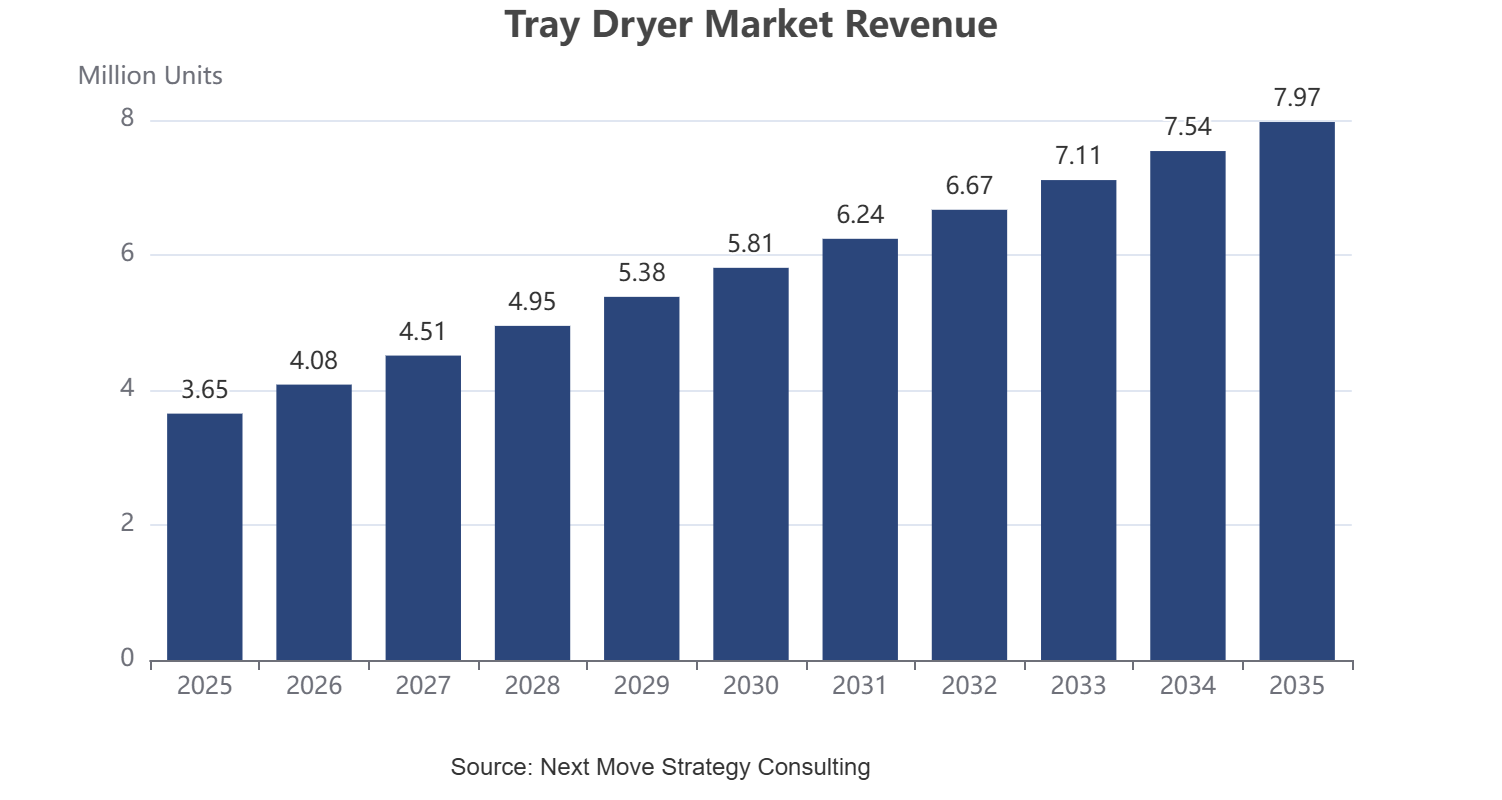
The Tray Dryer Market was valued at USD 3.65 billion in 2025 and is estimated at USD 3.95 billion in 2026, advancing to USD 7.97 billion by 2035 at a CAGR of 8.12% from 2026 to 2035. NMSC's analysis indicates that this growth is driven by rising pharmaceutical and nutraceutical manufacturing capacity, expanding food processing and dehydration infrastructure, the shift from mild steel to stainless steel construction under tightening hygiene standards, and growing adoption of automated and IoT-enabled batch drying systems across emerging manufacturing economies.
|
Parameters |
Details |
|
Market Size in 2025 |
USD 3.65 Billion |
|
Market Size in 2026 |
USD 3.95 Billion |
|
Revenue Forecast in 2035 |
USD 7.97 Billion |
|
Growth Rate |
CAGR of 8.12% from 2026 to 2035 |
|
Analysis Period |
2025-2035 |
|
Base Year Considered |
2025 |
|
Forecast Period |
2026-2035 |
|
Market Size Estimation |
USD Billion |
|
Companies Profiled |
20 |
|
Countries Covered |
33 |
|
Market Share |
Top 10 |
Tray Dryer Market Overview
What Is the SSD Controller Market?
The Tray Dryer Market encompasses the global commercial ecosystem for batch drying equipment designed to remove moisture from solid, granular, powdered, and paste-form materials through controlled heat transfer and airflow. Tray dryers are widely deployed across pharmaceutical, food processing, chemical, agricultural, and nutraceutical industries, where products are arranged on trays and subjected to heated air or vacuum conditions to achieve the desired moisture content. Our analysis indicates that the market includes atmospheric tray dryers, vacuum tray dryers, and specialized drying systems, ranging from laboratory-scale units to large industrial installations capable of processing more than one tonne of material per batch.
How Has the Tray Dryer Market Evolved?
The Tray Dryer Market has undergone a significant technological transformation from conventional natural convection drying cabinets to advanced forced-air circulation systems that improve drying efficiency, product consistency, and batch productivity. Early systems relied on basic heat transfer mechanisms with limited process control, while modern designs incorporate horizontal, vertical, and recirculating airflow configurations to achieve greater temperature uniformity and shorter drying cycles. Based on research conducted by NMSC, we found that vacuum tray dryers have gained substantial adoption in pharmaceutical and nutraceutical manufacturing due to their ability to preserve heat-sensitive compounds through low-temperature drying. In parallel, infrared-assisted and microwave-assisted tray dryers have emerged as advanced solutions for high-value products requiring faster processing and enhanced product quality.
How Do Regulations Influence the Tray Dryer Market?
Regulatory compliance plays a critical role in shaping the Tray Dryer Market, particularly in pharmaceutical and food processing applications. Current Good Manufacturing Practice (cGMP) guidelines enforced by the U.S. Food and Drug Administration and comparable regulatory authorities worldwide require validated equipment design, documented operating procedures, and traceable batch records for pharmaceutical production. Food processing applications are similarly governed by food safety regulations that mandate hygienic equipment construction, contamination control, and sanitary operating conditions. These requirements have accelerated demand for stainless steel processing equipment, validated drying systems, and automated monitoring capabilities that support regulatory audits and quality assurance programs.
How Is Technology Adoption Expanding Across the Tray Dryer Market?
Technology adoption across the Tray Dryer Market is accelerating as manufacturers prioritize product quality, operational efficiency, and digital process control. Our findings suggest that pharmaceutical and high-purity processing facilities are increasingly transitioning from mild steel equipment to stainless steel 316L construction to meet stringent hygiene and corrosion-resistance requirements. At the same time, PLC- and SCADA-based automation platforms are becoming standard across industrial drying operations, enabling precise control of temperature, airflow, and batch parameters while improving repeatability and process validation. The emergence of IoT-enabled monitoring systems, which provide real-time visibility into temperature, humidity, and drying cycle performance across multiple facilities, represents the next phase of digital transformation within the tray dryer industry.
|
Key Takeaways |
|
By Product Type, Forced Air Circulation dominated the Tray Dryer Market with USD 1.33 billion in 2025 due to its broad industrial adoption. Specialized Tray Dryers are the fastest-growing segment, projected to expand at a CAGR of 10.86% from 2026 to 2035, driven by demand for application-specific drying solutions. |
|
By Heating Source, Electric Heating led the market with USD 1.24 billion and a 34.0% share in 2025, supported by reliable and precise operation. Microwave Heating is the fastest-growing segment at a CAGR of 14.87% through 2035, owing to its superior drying efficiency. |
|
By Capacity, 201–500 kg per batch accounted for the largest revenue at USD 1.02 billion in 2025, reflecting strong demand from medium-scale industries. Above 1000 kg per batch is projected to grow fastest at a CAGR of 10.94% through 2035 as manufacturers expand production capacity. |
|
By Automation Level, Automatic systems held the largest share at USD 0.95 billion in 2025, benefiting from growing industrial automation. IoT-enabled smart systems are expected to record the highest CAGR of 20.67% through 2035, driven by Industry 4.0 adoption. |
|
By Construction Material, Stainless Steel 304 led the market with USD 1.24 billion in 2025 due to its durability and hygienic properties. Specialty Alloy is the fastest-growing material segment at a CAGR of 12.10% through 2035. |
|
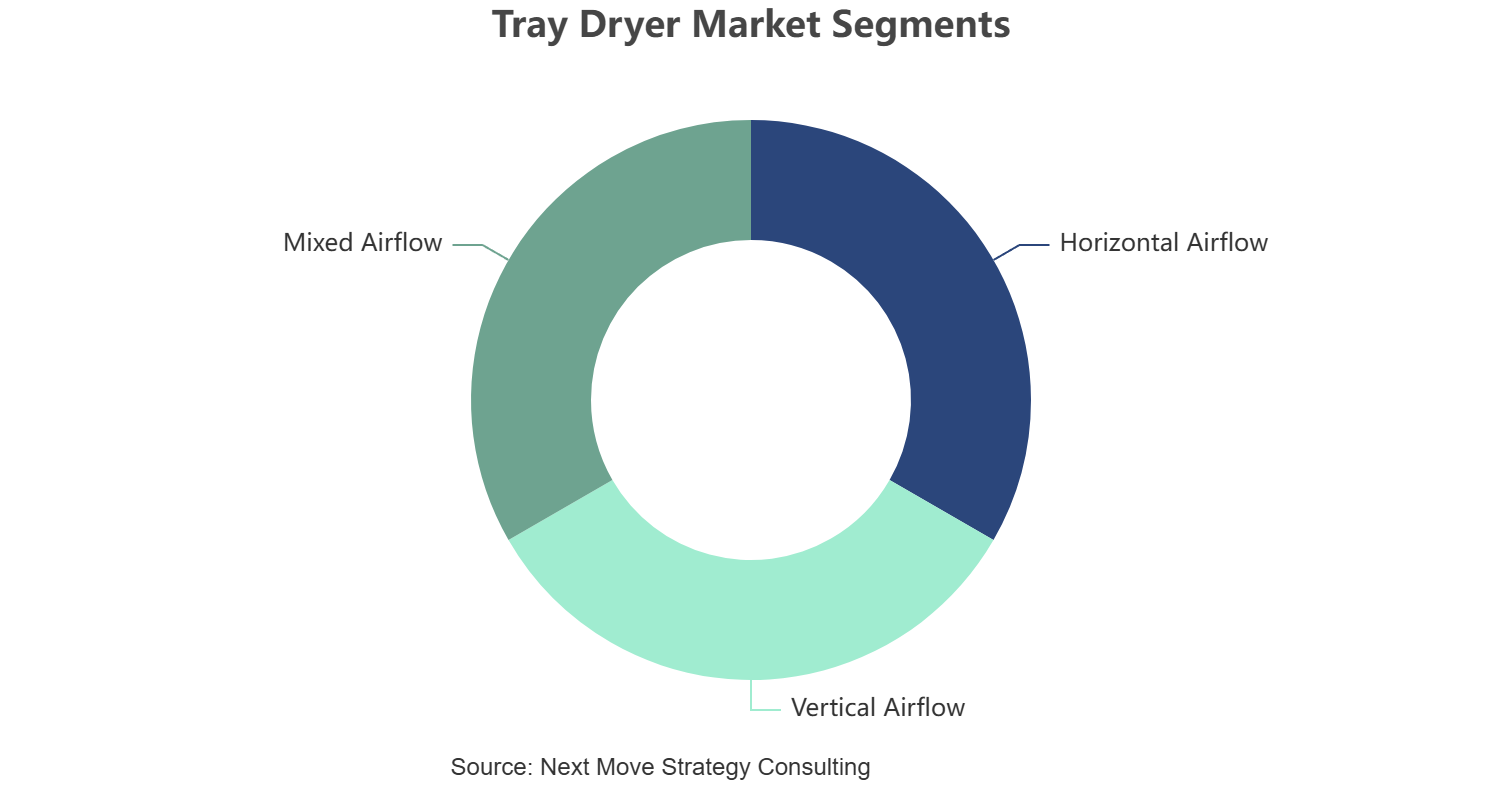
By Airflow Configuration, Horizontal Airflow dominated with USD 1.68 billion in 2025 because of its effective heat distribution. Mixed Airflow is forecast to grow fastest at a CAGR of 10.99% through 2035. |
|
By Sales Channel, Direct Sales generated the highest revenue at USD 1.39 billion in 2025, reflecting the customized nature of industrial equipment procurement. OEM Supply is the fastest-growing channel with a CAGR of 12.09% through 2035. |
|
By End Use Industry, Pharmaceuticals led the market with USD 1.02 billion and a 28.0% share in 2025, supported by stringent drying requirements. Personal Care is projected to be the fastest-growing segment at a CAGR of 10.31% through 2035. |
|
Asia Pacific was the largest regional market with USD 1.53 billion and a 41.9% share in 2025, driven by strong manufacturing activity. The Middle East & Africa are expected to register the fastest growth at a CAGR of 10.72% through 2035. |
|
China was the largest country market, generating USD 0.55 billion in 2025 due to its extensive industrial base. India is projected to be the fastest-growing country market with a CAGR of 11.25% from 2026 to 2035. |
Key Emerging Trends in the Tray Dryer Market
How Is the Shift to Stainless Steel 316L Reshaping Pharmaceutical Tray Dryer Design?
Pharmaceutical manufacturers are increasingly specifying stainless steel 316L construction over standard 304 grade for active pharmaceutical ingredient drying applications, given its superior corrosion resistance and compliance with stringent validation requirements. The U.S. Food and Drug Administration's current Good Manufacturing Practice guidance for equipment construction reinforces this shift. Through NMSC's assessment, this transition is driving the 316L sub-segment to grow at 11.27% CAGR, outpacing the broader Construction Material segment average.
How Is IoT-Enabled Monitoring Transforming Batch Drying Operations?
Manufacturers are integrating IoT-enabled sensors into tray dryer systems to remotely track temperature, humidity, and airflow data across production cycles, supporting batch record digitization required under pharmaceutical and food safety regulations. From our research, we found that this capability is particularly valuable for multi-site manufacturers seeking centralized quality oversight, driving the IoT-enabled smart systems sub-segment to the fastest growth rate across the entire Automation Level dimension at 20.67% CAGR.
How Is Vacuum Drying Technology Gaining Share in Heat-Sensitive Applications?
Vacuum tray dryers allow moisture removal at substantially lower temperatures than atmospheric systems, preserving the stability of heat-sensitive active pharmaceutical ingredients, nutraceuticals, and specialty chemicals. Our analysis shows that this advantage is driving the Vacuum Tray Dryers sub-segment to grow at 9.60% CAGR from 2026 to 2035, faster than atmospheric formats, as pharmaceutical and nutraceutical manufacturing capacity expands across both established and emerging markets.
How Is Indigenous Manufacturing Capacity Expansion Driving Tray Dryer Demand in Asia Pacific?
Government-supported pharmaceutical and food processing manufacturing expansion across China and India is directly increasing demand for industrial-scale tray drying equipment. Based on our market evaluation, we noticed that India's Production Linked Incentive scheme for pharmaceuticals, administered by the Indian Ministry of Chemicals and Fertilizers, is a material contributor to India's projected 11.25% country-level CAGR, the fastest among the larger Asia Pacific economies covered in this report.
What Are the Key Market Drivers, Breakthroughs, and Investment Opportunities That Will Shape the Tray Dryer Market in the Next Decade?
Growth Catalyst and Risk Assessment Matrix
|
Drivers / Trends / Restraints |
(+/-) % Impact on CAGR Forecast |
Geographic Relevance |
Impact Timeline |
|
Pharmaceutical Manufacturing Capacity Expansion |
+2.1% |
Asia Pacific, North America |
Near-Term (2025-2028) |
|
Food Processing Infrastructure Growth |
+1.7% |
Global |
Near-Term (2025-2027) |
|
Shift to Stainless Steel and GMP Compliance |
+1.3% |
Global |
Mid-Term (2027-2031) |
|
Automation and IoT Integration |
+1.5% |
North America, Europe, Asia Pacific |
Mid-Term (2027-2032) |
|
Vacuum and Specialized Drying Adoption |
+1.2% |
Global |
Mid-Term (2027-2031) |
|
High Capital Cost of Advanced Systems |
-0.7% |
MEA, Latin America |
Near-Term (2025-2027) |
|
Energy Cost Volatility |
-0.6% |
Europe, Global |
Near-Term (2025-2027) |
|
Indigenous Manufacturing Policy Support |
+1.4% |
Asia Pacific, MEA |
Long-Term (2030-2035) |
|
Skilled Operator Shortage for Validated Systems |
-0.4% |
Global |
Near-Term (2025-2028) |
What Are the Growth Drivers of the Tray Dryer Market?
How Is Pharmaceutical Manufacturing Capacity Expansion Driving Tray Dryer Market Growth?
Global pharmaceutical manufacturing capacity has expanded steadily, with the U.S. Food and Drug Administration's facility registration data showing continued growth in registered drug manufacturing establishments. This expansion directly drives demand for validated drying equipment used in active pharmaceutical ingredient and formulation production, supporting the Pharmaceuticals end-use segment's projection to grow from USD 1.02 billion in 2025 to USD 2.39 billion by 2035, an 8.89% CAGR.
How Is Food Processing Infrastructure Growth Supporting Tray Dryer Market Demand?
National food safety and agricultural development programs across multiple economies are expanding cold chain and processing infrastructure investment, as documented in published agricultural ministry development plans. This infrastructure growth is increasing demand for dehydration equipment used in fruit, vegetable, herb, and spice processing, sustaining the Food & Beverage end-use segment's USD 0.95 billion 2025 base.
How Is Automation Adoption Accelerating Tray Dryer Market Demand?
Manufacturers across the pharmaceutical and food processing industries are increasingly specifying PLC and SCADA-controlled drying systems to meet batch record and traceability requirements under quality regulations. NMSC's analysis projects the combined PLC-controlled and PLC SCADA-controlled sub-segments to grow faster than manual and semi-automatic formats, reflecting a structural shift toward digitised batch process control.
What Are the Growth Inhibitors of the Tray Dryer Market?
How Does High Capital Cost Constrain Tray Dryer Market Expansion in Price-Sensitive Markets?
Advanced vacuum, IoT-enabled, and specialized tray dryer systems carry substantially higher upfront capital cost than basic atmospheric units, limiting adoption among small and mid-sized manufacturers in cost-sensitive markets across Latin America and parts of the Middle East & Africa. Through our analysis, this cost barrier is a primary reason these regions exhibit a smaller installed base of advanced automation-enabled systems relative to North America and Europe.
How Does Energy Cost Volatility Affect Tray Dryer Market Operating Economics?
Tray dryers, particularly electric and gas-heated systems, are energy-intensive in continuous industrial operation, exposing manufacturers to energy price volatility documented in national energy administration statistics across Europe and other regions. From our assessment, this volatility is encouraging the gradual adoption of hybrid and solar heating configurations as a hedge against fluctuating energy costs in select markets.
What Are the Growth Opportunities in the Tray Dryer Market?
How Does Indigenous Pharmaceutical Manufacturing Policy Create Opportunity in the Tray Dryer Market?
Government-led indigenisation programs, including India's Production Linked Incentive scheme for pharmaceuticals administered by the Ministry of Chemicals and Fertilizers, are creating new domestic demand for validated drying equipment as manufacturers localize active pharmaceutical ingredient production. NMSC's analysis indicates that this policy-driven opportunity is a primary contributor to India's projected 11.25% CAGR, among the fastest of any country covered in this report.
How Does IoT Integration Create a High-Growth Opportunity Segment in the Tray Dryer Market?
As manufacturers digitize quality and batch record systems, IoT-enabled tray dryers represent a structurally faster-growing opportunity than legacy manual and semi-automatic formats. Our findings suggest that IoT-enabled smart systems, projected to grow at 20.67% CAGR from 2026 to 2035, will increasingly define competitive differentiation among equipment suppliers serving multi-site pharmaceutical and food manufacturers.
How Does Specialty Alloy and Glass-Lined Construction Create Opportunity in Corrosive Applications?
Chemical and specialty chemical manufacturers processing corrosive or reactive materials increasingly require specialty alloy or glass-lined dryer construction beyond standard stainless steel grades. Based on our market evaluation, we noticed that this niche but fast-growing 12.10% CAGR sub-segment is creating a differentiated opportunity for suppliers with metallurgical engineering expertise beyond standard tray dryer fabrication capability.
How Is the Tray Dryer Market Segmented in This Report, and What Are the Key Insights from the Segmentation Analysis?
Which Tray Dryer Product Type Leads Market Revenue, and Which Format Is Growing Fastest?
|
Segment |
2025 (USD Bn) |
2035 (USD Bn) |
CAGR (%) |
|
Natural Convection (Atmospheric) |
0.57 |
1.10 |
6.80% |
|
Forced Air Circulation (Atmospheric) |
1.33 |
2.57 |
6.81% |
|
Vacuum Tray Dryers |
1.02 |
2.55 |
9.60% |
|
Specialized Tray Dryers |
0.51 |
1.43 |
10.86% |
|
Custom Engineered Tray Dryers |
0.22 |
0.32 |
3.82% |
The Product Type segment spans Atmospheric Tray Dryers, split between Natural Convection and Forced Air Circulation formats, Vacuum Tray Dryers, Specialized Tray Dryers, including infrared, microwave-assisted, and solar formats, and Custom Engineered Tray Dryers. Forced Air Circulation leads at USD 1.33 billion in 2025, given its broad applicability across food and chemical processing. Specialized Tray Dryers are the fastest-growing format at a 10.86% CAGR, as infrared and microwave-assisted systems gain adoption for heat-sensitive pharmaceutical and nutraceutical drying applications.
Which Heating Source Dominates the Tray Dryer Market, and Why Is Microwave Heating Accelerating?
|
Segment |
2025 (USD Bn) |
2035 (USD Bn) |
CAGR (%) |
|
Electric Heating |
1.24 |
2.39 |
6.78% |
|
Steam Heating |
0.88 |
1.59 |
6.09% |
|
Thermic Fluid Heating |
0.44 |
0.96 |
8.11% |
|
Gas Heating |
0.36 |
0.72 |
7.18% |
|
Infrared Heating |
0.29 |
0.88 |
11.74% |
|
Microwave Heating |
0.18 |
0.72 |
14.87% |
|
Solar Heating |
0.15 |
0.40 |
10.31% |
|
Hybrid Heating |
0.11 |
0.31 |
10.92% |
Heating Source segmentation spans Electric, Steam, Thermic Fluid, Gas, Infrared, Microwave, Solar, and Hybrid configurations. Electric Heating leads at USD 1.24 billion in 2025, given its operational simplicity and broad compatibility across industries. Microwave Heating is the fastest-growing sub-segment at a 14.87% CAGR, despite its small base, as precision drying applications in pharmaceuticals and specialty food products increasingly favour its faster, more uniform moisture removal characteristics over conventional convective heating.
Which Batch Capacity Range Leads the Tray Dryer Market, and Where Is Growth Concentrated?
|
Segment |
2025 (USD Bn) |
2035 (USD Bn) |
CAGR (%) |
|
Up to 50 Kg Per Batch |
0.44 |
0.80 |
6.16% |
|
51 Kg to 200 Kg Per Batch |
0.80 |
1.51 |
6.56% |
|
201 Kg to 500 Kg Per Batch |
1.02 |
2.07 |
7.33% |
|
501 Kg to 1000 Kg Per Batch |
0.88 |
2.15 |
9.34% |
|
Above 1000 Kg Per Batch |
0.51 |
1.44 |
10.94% |
Capacity segmentation spans five batch size ranges from Up to 50 Kg through Above 1000 Kg per batch. The 201 to 500 Kg per batch range leads at USD 1.02 billion in 2025, reflecting its fit for mid-scale industrial production. Above 1000 Kg per batch is the fastest-growing range at a 10.94% CAGR, as large-scale pharmaceutical and food manufacturers consolidate production into higher-capacity batch systems to improve unit economics.
How Is Automation Reshaping the Tray Dryer Market, and Which Systems Are Growing Fastest?
|
Segment |
2025 (USD Bn) |
2035 (USD Bn) |
CAGR (%) |
|
Manual |
0.66 |
0.64 |
-0.31% |
|
Semi-Automatic |
1.02 |
1.59 |
4.54% |
|
Automatic |
0.95 |
2.15 |
8.51% |
|
PLC Controlled |
0.58 |
1.59 |
10.61% |
|
PLC SCADA Controlled |
0.33 |
1.28 |
14.52% |
|
IoT-Enabled Smart Systems |
0.11 |
0.72 |
20.67% |
Automation Level segmentation spans Manual, Semi-Automatic, Automatic, PLC Controlled, PLC SCADA Controlled, and IoT-Enabled Smart Systems. Automatic systems lead at USD 0.95 billion in 2025, while Manual systems are contracting in absolute terms as automation adoption accelerates across regulated industries. IoT-enabled smart systems are the fastest-growing sub-segment at a 20.67% CAGR, as manufacturers increasingly digitize batch process monitoring to meet quality and traceability requirements.
Which Construction Material Leads the Tray Dryer Market, and Where Is Specialty Alloy Demand Rising?
|
Segment |
2025 (USD Bn) |
2035 (USD Bn) |
CAGR (%) |
|
Mild Steel |
0.80 |
1.20 |
4.14% |
|
Stainless Steel 304 |
1.24 |
2.55 |
7.48% |
|
Stainless Steel 316 |
0.80 |
1.99 |
9.54% |
|
Stainless Steel 316L |
0.44 |
1.28 |
11.27% |
|
Glass Lined |
0.22 |
0.48 |
8.11% |
|
Specialty Alloy |
0.15 |
0.47 |
12.10% |
Construction Material segmentation spans Mild Steel, Stainless Steel 304, Stainless Steel 316, Stainless Steel 316L, Glass-Lined, and Specialty Alloy formats. Stainless Steel 304 leads at USD 1.24 billion in 2025, given its balance of cost and corrosion resistance for general industrial use. Specialty Alloy is the fastest-growing sub-segment at a 12.10% CAGR, as chemical and specialty chemical manufacturers processing corrosive materials increasingly specify advanced metallurgy beyond standard stainless-steel grades.
Which Airflow Configuration Dominates the Tray Dryer Market, and Why Is Mixed Airflow Gaining Adoption?
|
Segment |
2025 (USD Bn) |
2035 (USD Bn) |
CAGR (%) |
|
Horizontal Airflow |
1.68 |
3.19 |
6.62% |
|
Vertical Airflow |
1.24 |
2.71 |
8.13% |
|
Mixed Airflow |
0.73 |
2.07 |
10.99% |
Airflow Configuration segmentation spans Horizontal, Vertical, and Mixed Airflow designs. Horizontal Airflow leads at USD 1.68 billion in 2025, reflecting its established use in traditional atmospheric dryer designs. Mixed Airflow is the fastest-growing configuration at a 10.99% CAGR, as equipment designers combine horizontal and vertical flow paths to improve drying uniformity across irregularly shaped or densely loaded tray configurations.
Which Sales Channel Leads the Tray Dryer Market Distribution, and Where Is OEM Supply Expanding?
|
Segment |
2025 (USD Bn) |
2035 (USD Bn) |
CAGR (%) |
|
Direct Sales |
1.39 |
2.71 |
6.90% |
|
Distributors |
0.80 |
1.51 |
6.56% |
|
Agents |
0.36 |
0.64 |
5.92% |
|
EPC Contractors |
0.51 |
1.35 |
10.22% |
|
Turnkey Contractors |
0.36 |
1.04 |
11.19% |
|
OEM Supply |
0.23 |
0.72 |
12.09% |
Sales Channel segmentation spans Direct Sales, Distributors, Agents, EPC Contractors, Turnkey Contractors, and OEM Supply. Direct Sales leads at USD 1.39 billion in 2025, reflecting the customized, engineering-intensive nature of large industrial tray dryer procurement. OEM Supply is the fastest-growing channel at a 12.09% CAGR, as equipment manufacturers increasingly integrate tray dryers into larger turnkey process lines sold by systems integrators rather than as standalone units.
Which End Use Industry Generates the Largest Share of Tray Dryer Market Revenue?
|
Segment |
2025 (USD Bn) |
2035 (USD Bn) |
CAGR (%) |
|
Pharmaceuticals |
1.02 |
2.39 |
8.89% |
|
Food & Beverage |
0.95 |
1.91 |
7.23% |
|
Chemicals |
0.73 |
1.51 |
7.54% |
|
Cosmetics |
0.22 |
0.56 |
9.79% |
|
Personal Care |
0.18 |
0.48 |
10.31% |
|
Agriculture |
0.26 |
0.64 |
9.43% |
|
Research Laboratories |
0.15 |
0.24 |
4.81% |
|
Academic Laboratories |
0.07 |
0.16 |
8.62% |
|
Other Industrial Applications |
0.07 |
0.08 |
1.34% |
End Use Industry segmentation spans Pharmaceuticals, Food & Beverage, Chemicals, Cosmetics, Personal Care, Agriculture, Research Laboratories, Academic Laboratories, and Other Industrial Applications. Pharmaceuticals leads at USD 1.02 billion in 2025, reflecting the industry's stringent validated equipment requirements and expanding global manufacturing capacity. Personal Care is the fastest-growing vertical at a 10.31% CAGR, as cosmetic and personal care ingredient processing scales alongside rising consumer demand for natural and herbal formulations.
Supply Chain Structure of the Tray Dryer Market
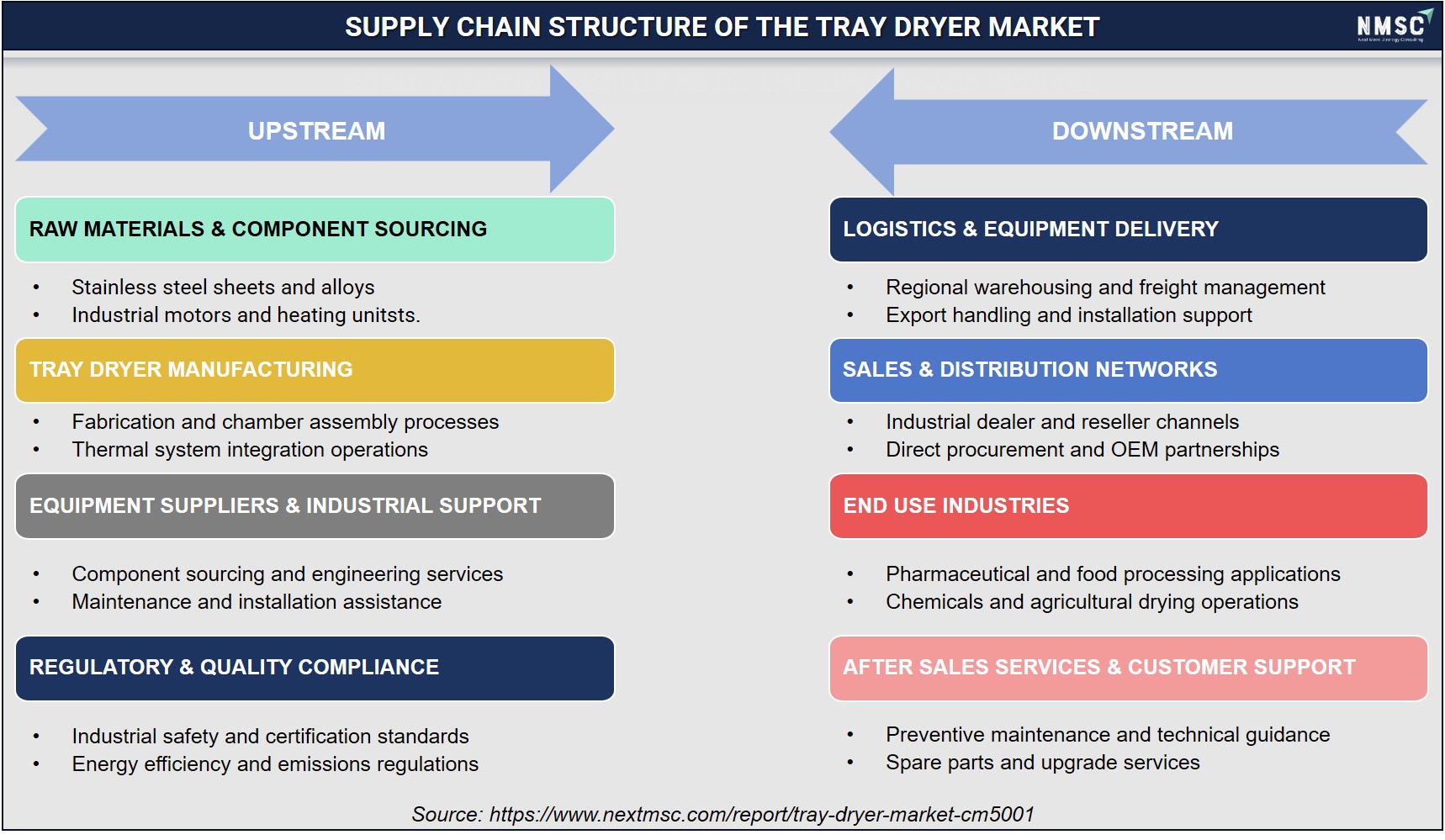
The above infographic presents the supply chain structure of the tray dryer market, segmented into upstream and downstream activities. Upstream begins with raw materials such as stainless steel and alloys, moving into fabrication, chamber assembly, and thermal system integration. Suppliers provide engineering and maintenance support, while regulatory compliance ensures industrial safety and energy efficiency standards. Moving downstream, regional warehousing and OEM partnerships enable efficient distribution to pharmaceutical, food, chemical, and agricultural sectors. Looking ahead, we observed that after-sales preventive maintenance, spare parts, and upgrade services collectively ensure long-term operational reliability across the market.
Regional Outlook
Geographic Performance Snapshot
|
Region |
2025 (USD Bn) |
2035 (USD Bn) |
CAGR (%) |
Key Driver |
|
Asia Pacific |
1.53 |
3.59 |
8.90% |
Pharmaceutical and food manufacturing capacity growth |
|
Europe |
0.84 |
1.59 |
6.59% |
GMP modernization, food safety compliance |
|
North America |
0.80 |
1.51 |
6.56% |
Pharmaceutical validation upgrades |
|
Middle East & Africa |
0.26 |
0.72 |
10.72% |
Food security and pharma localization programs |
|
Latin America |
0.22 |
0.56 |
9.79% |
Agro-processing and pharma manufacturing growth |
North America Tray Dryer Market
The North America Tray Dryer Market is valued at USD 0.80 billion in 2025, projected to reach USD 1.51 billion by 2035 at a 6.56% CAGR. Based on our engagements with the region's pharmaceutical and food manufacturing base, growth is supported by continued validation system upgrades and the gradual replacement of legacy manual drying equipment with automated and IoT enabled alternatives across regulated industries.
U.S. Tray Dryer Market
Based on our engagements with U.S. pharmaceutical and food manufacturers, the United States accounts for approximately USD 0.62 billion of the North America total in 2025, rising to USD 1.13 billion by 2035. The U.S. Food and Drug Administration's current Good Manufacturing Practice requirements continue to drive equipment validation and replacement cycles, while growing nutraceutical and specialty food manufacturing capacity supports steady demand for vacuum and specialized drying systems.
Canada Tray Dryer Market
Through our analysis of the Canadian market, Canada's tray dryer demand is supported by its pharmaceutical and food processing manufacturing sectors, with Health Canada enforcing Good Manufacturing Practice standards consistent with international norms. Technology penetration is steady, with most regulated facilities operating automated or PLC controlled systems aligned with quality compliance requirements.
Mexico Tray Dryer Market
From our assessment of the Mexican market, Mexico's growing generic pharmaceutical manufacturing sector and expanding food processing industry are driving steady tray dryer demand. Mexico's Federal Commission for Protection against Sanitary Risks maintains quality manufacturing oversight, and the country's position as a nearshoring manufacturing hub is gradually increasing demand for automated and stainless steel drying systems.
Asia Pacific Tray Dryer Market
Asia Pacific leads the global market at USD 1.53 billion in 2025, projected to reach USD 3.59 billion by 2035 at an 8.90% CAGR. NMSC's analysis indicates that this leadership reflects the region's concentration of pharmaceutical and food processing manufacturing capacity, particularly across China and India, supported by government-backed manufacturing localization programs that continue to expand the region's strategic outlook through 2035.
China Tray Dryer Market
Through our analysis of the Chinese market, China represents the largest Asia Pacific market at approximately USD 0.55 billion in 2025, supported by extensive pharmaceutical and food processing manufacturing capacity. Industry adoption of stainless steel and automated drying systems is well established among large domestic manufacturers, while government quality standards administered by China's National Medical Products Administration continue to raise validated equipment requirements across the pharmaceutical sector.
India Tray Dryer Market
Based on our market evaluation, India is the fastest-growing major country market in this report at an 11.25% CAGR, rising from approximately USD 0.31 billion in 2025 to USD 0.90 billion by 2035. India's Production Linked Incentive scheme for pharmaceuticals, administered by the Ministry of Chemicals and Fertilizers, is directly expanding domestic active pharmaceutical ingredient manufacturing capacity, a primary structural driver behind this above-regional-average growth rate.
Japan Tray Dryer Market
According to evaluation of the Japanese market, Japan's tray dryer demand is supported by its mature pharmaceutical and specialty chemical manufacturing base, with the Ministry of Health, Labour and Welfare's quality standards driving consistent replacement and upgrade cycles for validated drying equipment. Technology penetration is high, with most facilities operating automated or PLC controlled systems rather than manual formats.
South Korea Tray Dryer Market
From our assessment of the South Korean market, South Korea's Ministry of Food and Drug Safety has reinforced quality manufacturing standards across pharmaceutical and food processing sectors, supporting steady demand for validated drying equipment. South Korea's growing nutraceutical and cosmetic ingredient processing industry is contributing to above-average regional growth in specialized drying system adoption.
Taiwan Tray Dryer Market
Through our market assessment, Taiwan's tray dryer demand is anchored by its specialty chemical and electronics-adjacent materials processing industries, alongside a growing nutraceutical manufacturing base. Taiwan's Food and Drug Administration has maintained quality manufacturing requirements consistent with international pharmaceutical standards, supporting steady adoption of stainless steel and automated drying systems.
Indonesia Tray Dryer Market
Based on our engagements with the Indonesian market, Indonesia's expanding food processing and herbal product manufacturing sectors are driving steady tray dryer demand. Indonesia's National Agency of Drug and Food Control has reinforced quality standards for pharmaceutical and herbal product manufacturing, supporting gradual upgrades from manual to semi-automatic and automatic drying systems across the country's growing manufacturing base.
Vietnam Tray Dryer Market
According to evaluation of the Vietnamese market, Vietnam's growing pharmaceutical and agricultural processing sectors are supporting above-average regional growth in tray dryer demand. Vietnam's Ministry of Health has expanded Good Manufacturing Practice enforcement across domestic pharmaceutical producers, gradually increasing adoption of validated stainless steel drying equipment over legacy mild steel systems.
Australia Tray Dryer Market
Through our analysis, Australia's tray dryer demand is supported by its established food processing and nutraceutical export industries, with the Therapeutic Goods Administration maintaining quality manufacturing standards for pharmaceutical and supplement production. Technology penetration is comparatively high, with most facilities operating automated or PLC controlled systems aligned with export quality certification requirements.
Philippines Tray Dryer Market
Based on our assessment, the Philippines' Food and Drug Administration has maintained quality standards supporting gradual modernization of pharmaceutical and food processing drying equipment. The market remains comparatively smaller in absolute terms, with growth tracking the country's broader food processing and pharmaceutical manufacturing investment cycle.
Malaysia Tray Dryer Market
According to evaluation of the Malaysian market, Malaysia's National Pharmaceutical Regulatory Agency has reinforced Good Manufacturing Practice compliance across the country's growing generic pharmaceutical manufacturing sector, supporting steady demand for validated drying equipment. Malaysia's halal-certified food processing industry is an additional contributor to sustained regional demand.
Rest of Asia Pacific Tray Dryer Market
Based on our engagements with the remaining Asia Pacific markets, including Thailand, Singapore, and New Zealand, food processing and pharmaceutical manufacturing investment continues to expand steadily. Singapore's advanced pharmaceutical manufacturing hub status and Thailand's growing food export sector contribute to this category, which remains a smaller but steady contributor to overall regional revenue.
Europe Tray Dryer Market
The Europe Tray Dryer Market is valued at USD 0.84 billion in 2025, projected to reach USD 1.59 billion by 2035 at a 6.59% CAGR. NMSC's analysis indicates that this growth is underpinned by continued Good Manufacturing Practice modernization across the region's pharmaceutical manufacturing base and tightening food safety compliance requirements administered by national and European Union food safety authorities.
Germany Tray Dryer Market
Through our market assessment, Germany leads the European market at approximately USD 0.17 billion in 2025, supported by its large pharmaceutical and specialty chemical manufacturing base. Germany's Federal Institute for Drugs and Medical Devices enforces stringent equipment validation standards, sustaining demand for stainless steel and automated drying systems across the country's manufacturing sector.
United Kingdom Tray Dryer Market
Based on our market evaluation, the United Kingdom's tray dryer demand is supported by its established pharmaceutical and food processing industries, with the Medicines and Healthcare products Regulatory Agency maintaining Good Manufacturing Practice standards consistent with international norms. Technology penetration is high, with most regulated manufacturers operating PLC controlled or PLC SCADA controlled systems.
France Tray Dryer Market
According to evaluation of the French market, France's tray dryer demand is anchored by its pharmaceutical and cosmetics manufacturing industries, with the French National Agency for the Safety of Medicines and Health Products enforcing equipment validation requirements. France's large personal care and cosmetics sector is a meaningful contributor to specialized and vacuum dryer adoption.
Italy Tray Dryer Market
Through our analysis, Italy's tray dryer demand is supported by its substantial pharmaceutical manufacturing base, one of the largest in Europe, alongside a well-established food processing and herbal product industry. Italy's Medicines Agency enforces Good Manufacturing Practice standards consistent with European Union requirements, sustaining steady demand for validated stainless steel drying systems.
Spain Tray Dryer Market
Based on our engagements with the Spanish market, Spain's growing generic pharmaceutical manufacturing sector and established food processing industry are driving steady tray dryer demand. The Spanish Agency of Medicines and Medical Devices maintains quality manufacturing standards aligned with European Union requirements, supporting consistent equipment upgrade cycles across the country's manufacturing base.
Sweden Tray Dryer Market
From our assessment of the Nordic market, Sweden's tray dryer demand is supported by its specialty pharmaceutical and biotechnology manufacturing sector. Sweden's Medical Products Agency enforces rigorous equipment validation standards, and the country's well-established research infrastructure contributes to demand for laboratory and pilot-scale vacuum drying systems.
Denmark Tray Dryer Market
Our analysis shows that Denmark's tray dryer demand is anchored by its globally significant pharmaceutical and biotechnology manufacturing industry. The Danish Medicines Agency maintains stringent Good Manufacturing Practice enforcement, supporting sustained demand for validated stainless steel and vacuum drying systems across the country's specialty pharmaceutical production base.
Finland Tray Dryer Market
According to evaluation of the Finnish market, Finland's tray dryer demand is supported by its forest-products-adjacent specialty chemical sector alongside a smaller pharmaceutical manufacturing base. Finland's Medicines Agency maintains quality standards consistent with European Union requirements, supporting steady but comparatively modest equipment demand relative to larger Nordic peers.
Netherlands Tray Dryer Market
Through our market assessment, the Netherlands' tray dryer demand is supported by its position as a major European food processing and agricultural export hub, alongside a growing biotechnology manufacturing sector. The Dutch Medicines Evaluation Board maintains Good Manufacturing Practice standards, sustaining demand for validated drying equipment across both food and pharmaceutical applications.
Rest of Europe Tray Dryer Market
Based on our engagements with the remaining European markets, including Poland, Belgium, Switzerland, and the Baltic states, pharmaceutical and food processing manufacturing investment continues to expand. Switzerland's globally significant pharmaceutical manufacturing base and Poland's growing generic drug production sector contribute meaningfully to this category's overall regional contribution.
Middle East & Africa Tray Dryer Market
The Middle East & Africa Tray Dryer Market is valued at USD 0.26 billion in 2025, projected to reach USD 0.72 billion by 2035 at a 10.72% CAGR, the fastest of any region covered in this report. From our research, we found that this growth is driven by Gulf state food security initiatives and pharmaceutical localization programs that are expanding domestic manufacturing capacity across the region.
Saudi Arabia Tray Dryer Market
Through our analysis, Saudi Arabia represents the largest MEA market at approximately USD 0.07 billion in 2025, supported by its Saudi Food and Drug Authority's pharmaceutical localization requirements under Saudi Vision 2030. The kingdom's growing domestic pharmaceutical and food processing manufacturing base is steadily increasing demand for validated drying equipment.
UAE Tray Dryer Market
Based on our market evaluation, the UAE is among the fastest-growing MEA markets at a 12.33% CAGR, supported by its Ministry of Health and Prevention's pharmaceutical manufacturing localization initiatives and the country's position as a regional food processing and re-export hub. Growing investment in food security infrastructure is reinforcing sustained equipment demand.
Turkey Tray Dryer Market
According to evaluation of the Turkish market, Turkey's well-established generic pharmaceutical manufacturing industry and large food processing sector are driving steady tray dryer demand. The Turkish Medicines and Medical Devices Agency enforces Good Manufacturing Practice standards, supporting continued equipment upgrade cycles among domestic pharmaceutical producers.
Egypt Tray Dryer Market
Based on our engagements with the Egyptian market, Egypt's Ministry of Health and Population has expanded pharmaceutical manufacturing oversight as the country pursues greater domestic drug production self-sufficiency. Egypt's large agricultural processing sector additionally supports demand for food-grade drying equipment across the country's expanding manufacturing base.
South Africa Tray Dryer Market
Through our market assessment, South Africa's South African Health Products Regulatory Authority maintains Good Manufacturing Practice oversight across the country's pharmaceutical manufacturing sector, the most developed in Sub-Saharan Africa. South Africa's established food processing industry additionally contributes to steady demand for both food-grade and pharmaceutical-grade drying systems.
Nigeria Tray Dryer Market
According to evaluation of the Nigerian market, Nigeria's National Agency for Food and Drug Administration and Control has prioritized expanding domestic pharmaceutical manufacturing capacity to reduce import dependency. Nigeria's large agricultural processing sector is an additional structural driver behind the country's above-regional-average growth rate.
Israel Tray Dryer Market
From our assessment, Israel's advanced pharmaceutical and biotechnology manufacturing sector supports demand for validated vacuum and specialized drying systems. Israel's Ministry of Health enforces quality manufacturing standards consistent with international norms, and the country's research-intensive pharmaceutical industry sustains demand for laboratory and pilot-scale equipment.
Rest of Middle East & Africa Tray Dryer Market
Based on our engagements with the remaining MEA markets, including Qatar, Kuwait, and Morocco, pharmaceutical localization and food processing investment is expanding gradually. This category remains a smaller but steadily growing contributor to overall MEA revenue, supported by broader Gulf Cooperation Council and North African food security priorities.
Latin America Tray Dryer Market
The Latin America Tray Dryer Market is valued at USD 0.22 billion in 2025, projected to reach USD 0.56 billion by 2035 at a 9.79% CAGR. Through our analysis, growth in this region is anchored by Brazil's domestic pharmaceutical and agro-processing manufacturing base alongside steady food processing modernization investment across the broader region.
Brazil Tray Dryer Market
Based on our engagements with the Brazilian market, Brazil represents the largest Latin American market at approximately USD 0.10 billion in 2025, supported by Brazil's National Health Surveillance Agency enforcing Good Manufacturing Practice standards across the country's substantial generic pharmaceutical manufacturing sector. Brazil's large agricultural processing industry additionally sustains demand for food-grade drying systems.
Argentina Tray Dryer Market
From our assessment, Argentina's pharmaceutical manufacturing sector, regulated by the National Administration of Drugs, Foods and Medical Devices, continues to support steady tray dryer demand. Argentina's agricultural processing industry, one of the largest in the region, is an additional contributor to sustained equipment demand despite broader macroeconomic volatility.
Chile Tray Dryer Market
According to evaluation of the Chilean market, Chile's Institute of Public Health maintains pharmaceutical manufacturing oversight supporting steady demand for validated drying equipment. Chile's well-established food export industry, particularly in fruit and herb processing, is a meaningful contributor to the country's tray dryer demand.
Colombia Tray Dryer Market
Through our analysis, Colombia's National Institute for Food and Drug Surveillance has expanded pharmaceutical manufacturing oversight, supporting growth in validated drying equipment demand. Colombia's growing nutraceutical and herbal product processing sector is contributing to above-regional-average growth in specialized drying system adoption.
Rest of Latin America Tray Dryer Market
Based on our engagements with the remaining Latin American markets, including Peru, Ecuador, and Central American states, pharmaceutical and food processing manufacturing investment remains modest but is gradually increasing. This category continues to represent a small but steady contributor to overall regional revenue.
Competitive Landscape
Competitive Dynamics and M&A Landscape
|
Key Takeaways |
Details |
|
Market Structure |
Fragmented globally, with large diversified process equipment groups competing alongside a substantial base of India and China-based specialized pharmaceutical and industrial dryer manufacturers. |
|
Innovation Focus |
Validated stainless steel construction, IoT-enabled batch monitoring, and energy-efficient heating configurations, including hybrid and solar formats. |
|
M&A Activity |
Concentrated in capability-driven acquisitions by larger process equipment groups seeking to expand validated pharmaceutical drying portfolios and regional manufacturing footprints. |
How Do Companies Compete in the Tray Dryer Market?
The tray dryer industry's market structure combines large diversified process equipment groups, including GEA Group and SPX FLOW, that offer drying systems as part of broader process technology portfolios, with a substantial base of specialized manufacturers concentrated in India and China that focus exclusively on pharmaceutical and industrial drying equipment. Competitive strategies center on Good Manufacturing Practice validation credentials, construction material expertise, and geographic expansion into emerging manufacturing economies through direct sales offices and EPC contractor partnerships.
Which Kind of Companies Dominate the Tray Dryer Market?
Specialized pharmaceutical process equipment manufacturers with deep Good Manufacturing Practice validation expertise, including Promas Engineering, Goma Engineering, and SSP, dominate the pharmaceutical-grade segment, given their established regulatory documentation track record. Large diversified process equipment groups such as GEA Group and Hosokawa Micron compete most effectively in food and chemical processing applications where their broader systems integration capability provides a competitive advantage over standalone dryer specialists.
How Does Validated Construction and Digital Monitoring Drive Differentiation in the Tray Dryer Market?
Stainless steel 316L construction credentials and IoT-enabled monitoring capability have become primary axes of competitive differentiation, particularly for suppliers serving pharmaceutical and nutraceutical clients subject to strict validation requirements. Suppliers capable of demonstrating established GMP documentation track records combined with digital batch monitoring integration are increasingly favoured over manufacturers offering only standard mild steel or manual configuration equipment.
Why Are Market Players Pursuing Mergers and Acquisitions to Expand Their Tray Dryer Market Presence?
Larger process equipment groups are pursuing targeted acquisitions of specialized regional dryer manufacturers to accelerate entry into high-growth markets across Asia Pacific and the Middle East without the multi-year timeline required to build validated local manufacturing and regulatory documentation capability organically. This consolidation trend reflects the strategic value of acquiring established regional regulatory relationships and manufacturing footprints ahead of anticipated demand growth through 2035.
Who Are the Key Market Players in the Tray Dryer Market?
-
GEA Group Aktiengesellschaft
-
SPX FLOW, Inc.
-
Hosokawa Micron Corporation
-
Buhler Holding AG
-
Yamato Scientific Co., Ltd.
-
Memmert GmbH + Co. KG
-
BINDER GmbH
-
Thermo Fisher Scientific Inc.
-
Despatch Industries, LLC
-
Lytzen A/S
-
BUCHI Labortechnik AG
-
AICHELIN Holding GmbH
-
Promas Engineering Pvt. Ltd.
-
Goma Engineering Pvt. Ltd.
-
SSP Pvt. Limited
-
Ace Industries (India) Pvt. Ltd.
-
Changzhou Fanqun Drying Equipment Co., Ltd.
-
Changzhou Yibu Drying Equipment Co., Ltd.
-
SNJ Process Systems Pvt. Ltd.
-
Bhagwati Pharma Machinery Company
What Are the Latest Developments in the Tray Dryer Industry?
|
Date |
Event |
|
August 2025 |
GEA announced the successful commissioning of its PSD-3 pharmaceutical spray dryer for Chugai Pharmaceutical in Japan. Designed for OEB-5 containment, the installation demonstrates growing investment in advanced pharmaceutical drying technologies and reinforces demand |
SWOT Analysis of the Tray Dryer Market
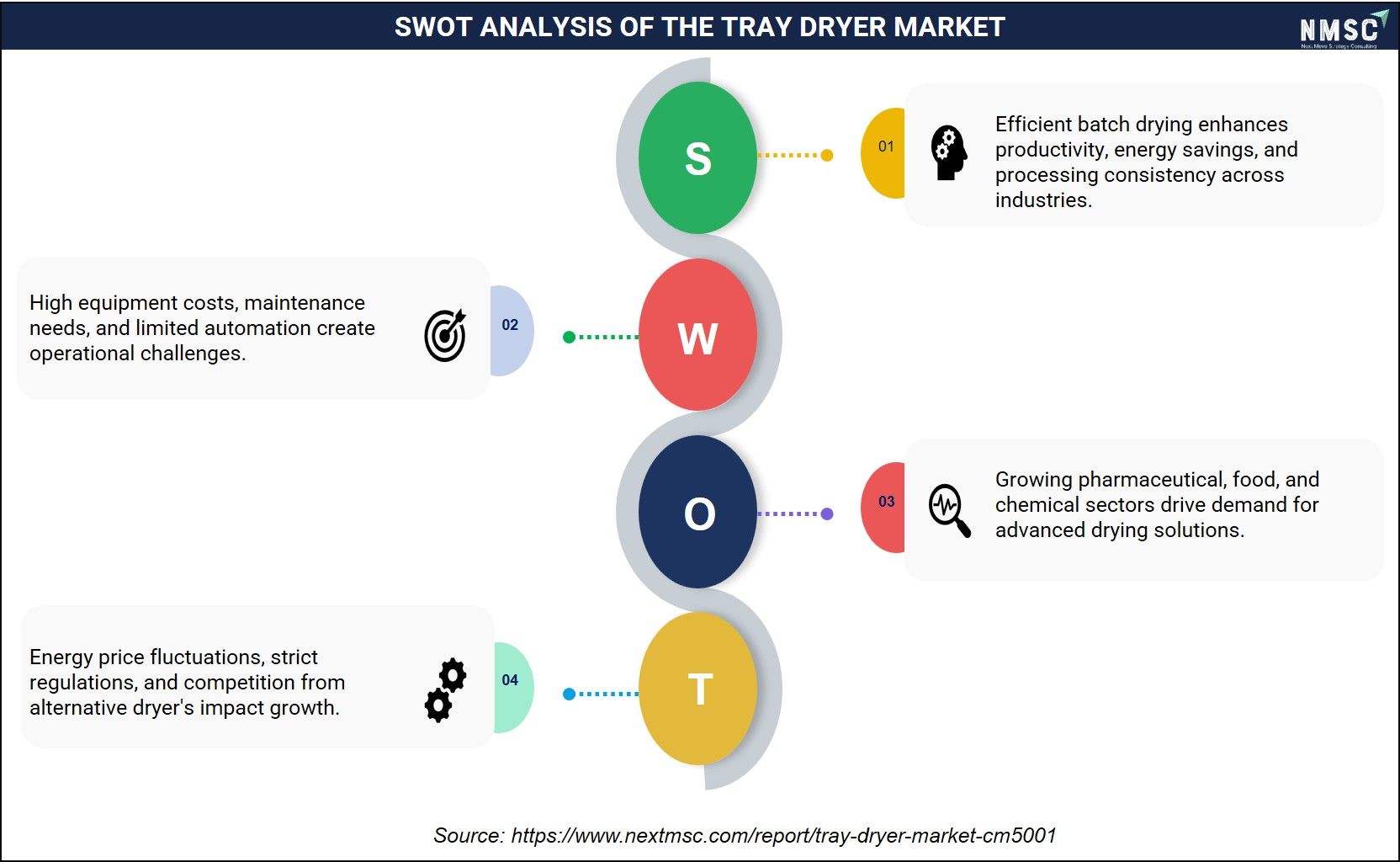
The above infographic presents a SWOT analysis of the tray dryer market, where efficient batch drying enhances productivity, energy savings, and processing consistency, serving as key strengths. However, high equipment costs, maintenance needs, and limited automation create operational challenges, posing notable weaknesses. Looking ahead, we observed that growing pharmaceutical, food, and chemical sectors drive demand for advanced drying solutions. That said, energy price fluctuations, strict regulations, and competition from alternative dryers continue to impact overall market growth and stability.
What Are the Investment Opportunities in the Tray Dryer Market?
Capital Inflows and Industrial Investment
The Tray Dryer Market continues to attract capital through pharmaceutical manufacturing localization, food processing modernization, and specialty chemical production expansion. Government-backed initiatives such as India's Production Linked Incentive (PLI) scheme for bulk drugs and pharmaceutical manufacturing are encouraging investments in processing infrastructure, creating sustained demand for validated tray drying systems. Manufacturers with strong regulatory compliance capabilities, stainless-steel fabrication expertise, and customized drying solutions are well positioned to benefit from these capital inflows.
Infrastructure Investment
Industrial infrastructure expansion remains a key investment driver for the Tray Dryer Market. New pharmaceutical plants, food processing facilities, agro-processing units, and chemical manufacturing complexes require reliable drying equipment as part of their production lines. Rapid industrialization across Asia-Pacific, the Middle East, and emerging manufacturing hubs is generating long-term demand visibility for tray dryer suppliers, particularly those serving regulated and high-volume production environments.
ESG Considerations
Environmental, Social, and Governance (ESG) priorities are increasingly influencing investment decisions in the Tray Dryer Market. Energy-efficient drying technologies, hybrid heating systems, and solar-assisted drying configurations are gaining attention as manufacturers seek to reduce operating costs and carbon emissions. Companies investing in lower-energy consumption designs and sustainable processing solutions are likely to benefit from growing corporate sustainability commitments and evolving environmental regulations.
Digital Transformation Enablement
Digitalization presents a significant investment opportunity within the Tray Dryer Market. IoT-enabled monitoring systems, automated process controls, remote diagnostics, and real-time batch tracking technologies are improving operational efficiency and product quality. NMSC's analysis indicates that manufacturers integrating digital monitoring and predictive maintenance capabilities into tray drying systems are positioned to capture rising demand from pharmaceutical and food processors pursuing Industry 4.0 modernization initiatives.
Private Equity and Strategic M&A Activity
Strategic acquisitions and private equity investments are increasingly focused on specialized tray dryer manufacturers with established customer relationships, regulatory expertise, and regional market presence. Larger process equipment companies are pursuing tuck-in acquisitions to expand product portfolios, strengthen manufacturing footprints, and access high-growth markets across Asia-Pacific and the Middle East. Firms offering differentiated drying technologies and strong aftermarket service capabilities are expected to remain attractive targets for strategic investors through 2035.
Key Benefits for Stakeholders
For Pharmaceutical and Food Manufacturers
Pharmaceutical and food manufacturers gain access to a comprehensive and vendor-neutral assessment of the Tray Dryer Market, including quantitative sizing and forecasts across Product Type, Heating Source, Capacity, Construction Material, and regional segments. The analysis supports equipment specification, supplier qualification, and procurement planning by identifying optimal equipment configurations, evaluating supplier capabilities, and aligning procurement strategies with evolving market dynamics and regulatory requirements.
For Tray Dryer Equipment Suppliers
Tray dryer manufacturers and equipment suppliers benefit from detailed competitive intelligence covering leading market participants, technology positioning, product portfolios, and regional presence. The study highlights growth opportunities across pharmaceutical, food processing, chemical, and agricultural applications while identifying emerging trends in automation, energy efficiency, and advanced drying technologies. These insights support product development, market-entry planning, and competitive benchmarking initiatives.
For EPC and Turnkey Contractors
Engineering, Procurement, and Construction (EPC) firms and turnkey solution providers gain valuable insights into capacity trends, sales channel dynamics, and end-user procurement preferences across industrial drying applications. The analysis supports project planning, equipment specification, vendor selection, and integration decisions for pharmaceutical plants, food processing facilities, and industrial manufacturing projects. Regional demand assessments also help contractors prioritize high-growth markets for business development activities.
For Investors and Financial Analysts
Investors and financial analysts receive a structured evaluation of the Tray Dryer Market's growth outlook, competitive landscape, and revenue potential through 2035. Market sizing, segment-level forecasts, and CAGR analysis provide a reliable foundation for investment screening, valuation modelling, and strategic due diligence. The study also identifies key growth catalysts, technology adoption trends, and expansion opportunities that can influence capital allocation and merger and acquisition decisions within the industrial equipment sector.
For Government and Regulatory Agencies
Government institutions, industrial development authorities, and regulatory bodies gain access to country-level and regional insights covering pharmaceutical manufacturing expansion, food processing infrastructure development, and industrial modernization trends across 33 countries. The analysis supports evidence-based policy formulation, investment promotion initiatives, and industrial planning efforts aimed at strengthening domestic manufacturing capabilities, improving food security infrastructure, and enhancing compliance with quality and safety standards.
Key Market Segments
By Product Type
-
Atmospheric Tray Dryers
-
Natural Convection Tray Dryers
-
Forced Air Circulation Tray Dryers
-
Horizontal Airflow Tray Dryers
-
Vertical Airflow Tray Dryers
-
Recirculating Airflow Tray Dryers
-
-
-
Vacuum Tray Dryers
-
Laboratory Vacuum Tray Dryers
-
Pilot Scale Vacuum Tray Dryers
-
Industrial Vacuum Tray Dryers
-
-
Specialized Tray Dryers
-
Infrared Tray Dryers
-
Microwave Assisted Tray Dryers
-
Solar Tray Dryers
-
-
Custom Engineered Tray Dryers
By Heating Source
-
Electric Heating
-
Steam Heating
-
Thermic Fluid Heating
-
Gas Heating
-
Infrared Heating
-
Microwave Heating
-
Solar Heating
-
Hybrid Heating
By Capacity
-
Up To 50 Kg Per Batch
-
51 Kg To 200 Kg Per Batch
-
201 Kg To 500 Kg Per Batch
-
501 Kg To 1000 Kg Per Batch
-
Above 1000 Kg Per Batch
By Automation Level
-
Manual
-
Semi-Automatic
-
Automatic
-
PLC Controlled
-
PLC SCADA Controlled
-
IoT Enabled Smart Systems
By Construction Material
-
Mild Steel
-
Stainless Steel 304
-
Stainless Steel 316
-
Stainless Steel 316L
-
Glass Lined
-
Specialty Alloy
By Airflow Configuration
-
Horizontal Airflow
-
Vertical Airflow
-
Mixed Airflow
By Sales Channel
-
Direct Sales
-
Distributors
-
Agents
-
EPC Contractors
-
Turnkey Contractors
- OEM Supply
By End Use Industry
-
Pharmaceuticals
-
Active Pharmaceutical Ingredients
-
Pharmaceutical Formulations
-
Herbal Products
-
Nutraceutical Products
-
-
Food Beverage
-
Fruits
-
Vegetables
-
Herbs
-
Spices
-
Dairy Ingredients
-
Processed Foods
-
-
Chemicals
-
Fine Chemicals
-
Specialty Chemicals
-
Dyes
-
Pigments
-
Agrochemicals
-
-
Cosmetics
-
Personal Care
-
Agriculture
-
Seeds
-
Medicinal Plants
-
Biomass Products
-
-
Research Laboratories
-
Academic Laboratories
-
Other Industrial Applications
By Region
-
North America: U.S., Canada, and Mexico.
-
Europe: UK, Germany, France, Italy, Spain, Sweden, Denmark, Finland, the Netherlands, and the rest of Europe.
-
Asia Pacific: China, India, Japan, South Korea, Taiwan, Indonesia, Vietnam, Australia, Philippines, Malaysia and the rest of APAC.
-
Middle East & Africa (MEA): Saudi Arabia, UAE, Egypt, Israel, Turkey, Nigeria, South Africa, and the rest of MEA.
-
Latin America: Brazil, Argentina, Chile, Colombia, and the rest of LATAM.
Conclusion and Recommendations
Long-Term Outlook
The Tray Dryer Market is positioned for sustained growth through 2035, expanding from USD 3.65 billion in 2025 to USD 7.97 billion at an 8.12% CAGR. NMSC's analysis indicates that this trajectory is underpinned by expanding pharmaceutical and food processing manufacturing capacity across Asia Pacific, North America, and Europe, providing a multi-year demand foundation supported by regulatory and food security policy commitments.
Strategic Positioning
Suppliers positioned around validated stainless steel construction and digital batch monitoring capability are best placed to capture share across pharmaceutical and regulated food processing applications. Our assessment indicates that regulatory documentation credibility, rather than price competitiveness alone, will remain a dominant basis of competition in validated manufacturing segments through the forecast period.
Investment Attractiveness
Investment attractiveness is highest in specialized drying technology, IoT-enabled automation, and specialty alloy construction, each tied to sub-segments growing meaningfully faster than the broader market average. Indigenous pharmaceutical manufacturing programs in India and select Gulf states represent an emerging investment category benefiting from policy-driven demand independent of broader market cyclicality.
Anticipated Market Shifts
The continued shift from mild steel to stainless steel 316L construction, the gradual digitization of batch automation through IoT-enabled systems, and the localization of pharmaceutical manufacturing across indigenizing nations represent the three most consequential structural shifts likely to reshape competitive positioning through 2035.
Key Risks to Monitor
High capital costs for advanced systems, energy price volatility affecting operating economics, and a shortage of skilled operators for validated equipment represent the primary risks to the market's growth trajectory. NMSC's analysis indicates that these risks are unlikely to materially alter the market's overall growth direction but may affect the pace of adoption among smaller manufacturers in price-sensitive regions.
Growth Pathways Forward
Growth pathways for market participants include expanding validated stainless steel manufacturing capacity, integrating IoT-enabled monitoring into existing product lines ahead of digitization-driven procurement criteria, and establishing regional partnerships in indigenizing pharmaceutical markets across the Asia Pacific and the Middle East. NMSC's assessment is that suppliers combining these three strategies are best positioned to outperform the broader market through 2035.
About the Author
 Mayurima Roy
— Mayurima Roy is Research Analyst at Next Move Strategy Consulting, where she has spent 4 years working across the firm's full industry coverage rather than a single fixed vertical. Her work centers on structured research, ongoing trend tracking, competitive assessment, and insight-led content development, translating complex market data into clear, decision-ready narratives that support informed client decision-making across diverse global industries, market sectors, and world regions every day.
Mayurima Roy
— Mayurima Roy is Research Analyst at Next Move Strategy Consulting, where she has spent 4 years working across the firm's full industry coverage rather than a single fixed vertical. Her work centers on structured research, ongoing trend tracking, competitive assessment, and insight-led content development, translating complex market data into clear, decision-ready narratives that support informed client decision-making across diverse global industries, market sectors, and world regions every day.
About the Reviewer
 Supradip Baul
— Supradip Baul is an accomplished business consultant and strategist with over a decade of rich experience in market intelligence, strategy, technology, and business transformation. His work has included rigorous qualitative and quantitative analysis across multiple industries, helping clients shape investment decisions and long-term roadmaps. Earlier in his career, he was associated with Gartner, where he contributed to industry-leading reports and market share analyses. He has worked with leading global companies and holds an MBA with a dual specialization in Marketing and Finance.
Supradip Baul
— Supradip Baul is an accomplished business consultant and strategist with over a decade of rich experience in market intelligence, strategy, technology, and business transformation. His work has included rigorous qualitative and quantitative analysis across multiple industries, helping clients shape investment decisions and long-term roadmaps. Earlier in his career, he was associated with Gartner, where he contributed to industry-leading reports and market share analyses. He has worked with leading global companies and holds an MBA with a dual specialization in Marketing and Finance.
At Next Move Strategy Consulting, we understand that insightful market research is the cornerstone of successful business decisions. That's why we employ a robust and multifaceted approach, combining various methodologies to deliver the most accurate and actionable data for our clients.

Research Landscape
We navigate the world of research with two primary approaches:
Qualitative Approach
Our qualitative research methodologies involve immersive techniques such as in-depth interviews, focus groups, and observational studies. By engaging directly with individuals and stakeholders, we uncover valuable insights that quantitative data alone may overlook.

Quantitative Research
In tandem with qualitative methodologies, NMSC leverages the power of Quantitative Research to provide a robust foundation of numerical insights. Through systematic data collection and analysis, we quantify patterns, preferences, and market trends, offering a comprehensive view of the business landscape.
Our quantitative research approach employs diverse tools, including surveys, experiments, and statistical modelling. These methodologies enable us to gather data from a large and representative sample, ensuring the statistical significance of our findings. By employing structured questionnaires and standardized data collection methods, we guarantee the reliability and validity of the information we present to our clients.
Quantitative research is particularly effective in measuring the prevalence of trends, assessing market size, and gauging the impact of various factors on consumer behavior. The numerical precision attained through this approach equips our clients with actionable insights, facilitating data-driven decision-making and strategy formulation.


Our Specialized Toolbox for Industry-Specific Market Research
We deploy a specialized arsenal of techniques tailored to meet your unique requirements. Here's a glimpse into our comprehensive toolbox:

Information Procurement
The stage entails acquiring market data or relevant information through various sources and methodologies.


Market Research Approach
We utilize both top-down and bottom-up approaches in market research analysis to achieve a comprehensive understanding of the market dynamics, leveraging the broad perspective of industry trends and macroeconomic factors alongside detailed insights from specific segments and individual companies.

Porters Five Forces Analysis
We conduct Porter's Five Forces analysis to evaluate the competitive landscape of an industry, providing us with insights into factors that affect profitability and strategic positioning.

SWOT Analysis

Forecasting
We utilize a forecasting model to predict future consumption by considering parameters like population, economics, regulations, market competition, drivers, constraints, technology, and pricing. We also employ statistical techniques such as multilinear regression, exponential smoothing, moving average, ARIMA, and Monte Carlo simulations for accurate predictions. In econometric forecasting, we analyzed short-term and long-term event impacts, attributing values based on regulatory frameworks, economic factors, and market events.





 Speak to Our Analyst