Issue Tracking Market Size, Share, Growth & Forecast by Workflow (Software Development Tracking, Bug Tracking, Work Item Tracking, Backlog Management, IT Service Management, Incident Management, Request Management, Problem Management, Change Management, Customer Support Ticketing, Help Desk, Case Management, Omnichannel Support, Work Management ), Deployment (Cloud, Self-Hosted, Hybrid), Organization Size, Go-to-Market, Revenue Stream, and End User Industry — Global Analysis 2025–2035
Industry: ICT & Media | Publishing Date: July 8, 2026 | Last Updated: September 30, 2026 | No of Pages: N/A | No. of Tables: N/A | No. of Figures: N/A | Format: PDF | Report Code: IC5020
What Is the Issue Tracking Market Size?
The global Issue Tracking Market was valued at USD 5.8 billion in 2025 and is expected to reach USD 6.6 billion in 2026. Accelerating enterprise digitization, expanding DevOps adoption, and rising IT service management requirements are projected to propel the Issue Tracking Market to USD 20.4 billion by 2035, advancing at a CAGR of 13.4% from 2026 to 2035. Key growth catalysts include the widespread deployment of cloud-native workflow platforms, integration of AI-powered triage and resolution automation, surging demand for omnichannel customer support ticketing, and the growing need for structured defect and release tracking across software-intensive industries.
|
Parameters |
Details |
|
Market Size in 2025 |
USD 5.8 Billion |
|
Market Size in 2026 |
USD 6.6 Billion |
|
Revenue Forecast in 2035 |
USD 20.4 Billion |
|
Growth Rate |
CAGR of 13.4% from 2026 to 2035 |
|
Analysis Period |
2025–2035 |
|
Base Year Considered |
2025 |
|
Forecast Period |
2026–2035 |
|
Market Size Estimation |
Billion USD |
|
Companies Profiled |
20 |
|
Countries Covered |
33 |
|
Market Share |
Top 10 |
Issue Tracking Market Overview
What Is the Issue Tracking Market?
The Issue Tracking Market encompasses software platforms and solutions that enable organizations to log, assign, track, prioritize, and resolve structured work items, defects, service requests, incidents, and operational tasks across technology and business functions. NMSC's analysis indicates that issue tracking platforms serve as the operational backbone for software engineering teams, IT operations, customer support organizations, and cross-functional project teams seeking structured, auditable, and workflow-governed resolution of discrete work items. The market spans purpose-built bug tracking tools, enterprise ITSM suites, customer support ticketing systems, and horizontal work management platforms that incorporate issue tracking as a core capability.
How Has the Issue Tracking Market Evolved?
The Issue Tracking Market has evolved through three distinct structural phases. The first phase focused on standalone bug tracking utilities primarily serving software development teams, with pioneering tools such as Bugzilla and Mantis establishing the taxonomy of issue lifecycle management. The second phase introduced cloud-based, collaborative platforms that extended issue tracking to cross-functional teams, product managers, and IT operations, led by Atlassian's Jira and ServiceNow's ITSM suites. Our assessment indicates that the current third phase is defined by AI-native issue intelligence, integrating automated triage, intelligent routing, root cause prediction, and generative resolution summarization into comprehensive workflow management ecosystems.
How Do Regulations Influence the Issue Tracking Market?
Regulatory frameworks are increasingly shaping procurement and architecture decisions within the Issue Tracking Market. ISO/IEC 20000 for IT service management, the IT Infrastructure Library (ITIL) 4 framework, and SOC 2 compliance requirements compel enterprises to maintain structured, auditable records of every service incident, change event, and support request. GDPR and equivalent data protection laws impose additional obligations on customer support ticketing systems to manage personal data lifecycles within issue records. Through NMSC's assessment, we found that regulated industries, including financial services, healthcare, and public sector, require issue tracking platforms with granular access controls, audit trail immutability, and data residency capabilities.
How Is Technology Adoption Expanding Across the Issue Tracking Market?
Technology adoption in the Issue Tracking Market is accelerating as enterprises shift from siloed, departmental tools toward integrated, AI-enabled workflow platforms. The proliferation of DevOps and Site Reliability Engineering (SRE) practices has created demand for issue tracking systems that natively integrate with CI/CD pipelines, code repositories, monitoring tools, and incident response platforms. Based on our market evaluation, we noticed that the convergence of ITSM, customer support ticketing, and software development tracking into unified workflow hubs is reshaping competitive dynamics, enabling vendors such as ServiceNow, Atlassian, and monday.com to expand platform footprint and average contract value across enterprise accounts.
|
Key Takeaways |
|
By Workflow, IT Service Management (ITSM) held the largest share of the Issue Tracking Market at an estimated USD 2.14 billion in 2025, driven by enterprise adoption of ITIL-aligned incident, problem, and change management workflows across global IT organizations. |
|
Bug Tracking is the fastest-growing workflow sub-segment at a CAGR of 15.2% from 2026 to 2035, propelled by the exponential growth in software development activity, open-source project proliferation, and the integration of AI-powered defect detection within CI/CD pipelines. |
|
By Deployment, Cloud-based issue tracking platforms command the dominant revenue share at an estimated USD 3.6 billion in 2025, representing approximately 62% of total market revenue, reflecting enterprise migration from on-premises tools to SaaS delivery models. |
|
Hybrid Deployment is the fastest-growing deployment model in the Issue Tracking Market at a CAGR of 14.8% from 2026 to 2035, driven by regulated industries requiring data residency alongside cloud-native scalability for distributed development and support teams. |
|
By Organization Size, Enterprise accounts generate the largest Issue Tracking Market revenue at an estimated USD 3.4 billion in 2025, supported by large seat counts, complex multi-project configurations, and high-value ITSM platform subscriptions. |
|
The Mid-Market segment is the fastest-growing organization size tier at a CAGR of 14.6% from 2026 to 2035 in the Issue Tracking Market, as competitive SaaS pricing and low-friction onboarding lower deployment barriers for growing businesses. |
|
By Go-to-Market, Self-Serve is the largest go-to-market channel at an estimated USD 2.18 billion in 2025, led by PLG-driven platforms like Linear, GitHub Issues, and Jira's freemium tiers that convert individual developers into enterprise accounts. |
|
Sales-Led Direct is the fastest-growing go-to-market channel at a CAGR of 15.1% from 2026 to 2035, as large enterprise procurement for ITSM and omnichannel support platforms requires negotiated agreements, custom SLAs, and dedicated account management. |
|
By Revenue Stream, Subscription dominates with an estimated USD 4.18 billion in 2025, reflecting the broad SaaS transition across the Issue Tracking Market and the preference of enterprise buyers for predictable, seat-based or usage-based annual licensing. |
|
By End User Industry, Software and IT is the dominant industry vertical with an estimated USD 1.92 billion in 2025, while BFSI is the fastest-growing vertical at a CAGR of 14.9%, driven by compliance obligations, incident management mandates, and digital banking infrastructure investments. |
|
North America held the largest regional share at an estimated USD 2.4 billion in 2025, projected to reach USD 8.4 billion by 2035 at a CAGR of 13.4%, anchored by the concentration of global software vendors, enterprise IT buyers, and DevOps adoption leadership. |
|
Asia-Pacific is the fastest-growing major region at a CAGR of 15.8% from 2026 to 2035 in the Issue Tracking Market, propelled by India's rapid software engineering growth, China's enterprise IT modernization, and the expanding technology sector across Southeast Asia. |
|
The United States is the single largest country market, representing over 70% of North American Issue Tracking Market revenue in 2025, underpinned by the world's highest concentration of software companies, SaaS vendors, and enterprise IT departments. |
|
India is the fastest-growing national market in Asia-Pacific at a CAGR of 18.2% from 2026 to 2035, driven by the expansion of IT services exports, domestic digital transformation, and the rapid scaling of software product companies in Bangalore, Hyderabad, and Pune. |
Key Emerging Trends in the Issue Tracking Market
How Is Artificial Intelligence Transforming Triage and Resolution in the Issue Tracking Market?
AI-powered triage and resolution automation is the most consequential trend reshaping the Issue Tracking Market. Vendors including ServiceNow, Zendesk, and Atlassian have embedded large language model capabilities directly into their ticketing workflows to enable automated classification, sentiment detection, resolution suggestion, and root cause identification. Based on our market assessment, we observed that Atlassian Intelligence on Jira Service Management now automates first-response ticket categorization for enterprise accounts, reducing mean time to resolve (MTTR) for Tier-1 incidents by automating previously manual triage steps. Generative AI is further enabling natural-language issue creation, making structured tracking accessible to non-technical stakeholders.
How Is the Convergence of ITSM and DevOps Platforms Reshaping the Issue Tracking Market?
The convergence of IT Service Management and DevOps issue tracking workflows represents a structural trend accelerating platform consolidation in the Issue Tracking Market. Organizations are replacing siloed bug trackers and separate ITSM tools with unified platforms that map change requests directly to code commits, deployment events, and incident records within a single workflow graph. Our findings suggest that ServiceNow's DevOps integration capabilities and GitLab's integrated ITSM-development tracking are emblematic of this convergence. The result is a closed-loop traceability system spanning code defect, CI/CD pipeline failure, production incident, and resolution commit, eliminating manual handoffs between development and operations teams.
How Is the Shift Toward No-Code and Low-Code Issue Configuration Influencing the Issue Tracking Market?
No-code and low-code workflow configuration capabilities are becoming standard differentiators in the Issue Tracking Market, enabling non-technical administrators to design custom issue schemas, automation rules, and escalation paths without engineering resources. monday.com, Freshservice, and Zoho Desk have positioned configurable workflow builders as central to their platform value propositions, enabling business operations, legal, HR, and procurement teams to adopt structured issue tracking without dependency on IT. From our research, we found that this trend is expanding the total addressable market beyond traditional software and IT buyers toward every function within an enterprise that manages structured, recurring work requiring resolution accountability.
How Is the Rise of Embedded OEM Issue Tracking Expanding the Issue Tracking Market?
Embedded OEM distribution of issue tracking capabilities is an emerging growth vector in the Issue Tracking Market, as SaaS platform vendors integrate white-labeled ticketing, incident logging, and defect tracking directly within their own products. ERP, CRM, and HRIS platform vendors are embedding customer-facing support ticketing and internal issue logging to reduce dependence on third-party tools. Through NMSC's assessment, we found that this trend is both an opportunity and a competitive threat: it expands issue tracking usage broadly, while simultaneously reducing the standalone market addressable by dedicated issue tracking vendors. Vendors with robust API-first architectures and white-label licensing programs are best positioned to capture OEM revenue streams.
Porter's Five Forces Analysis Of The Issue Tracking Market
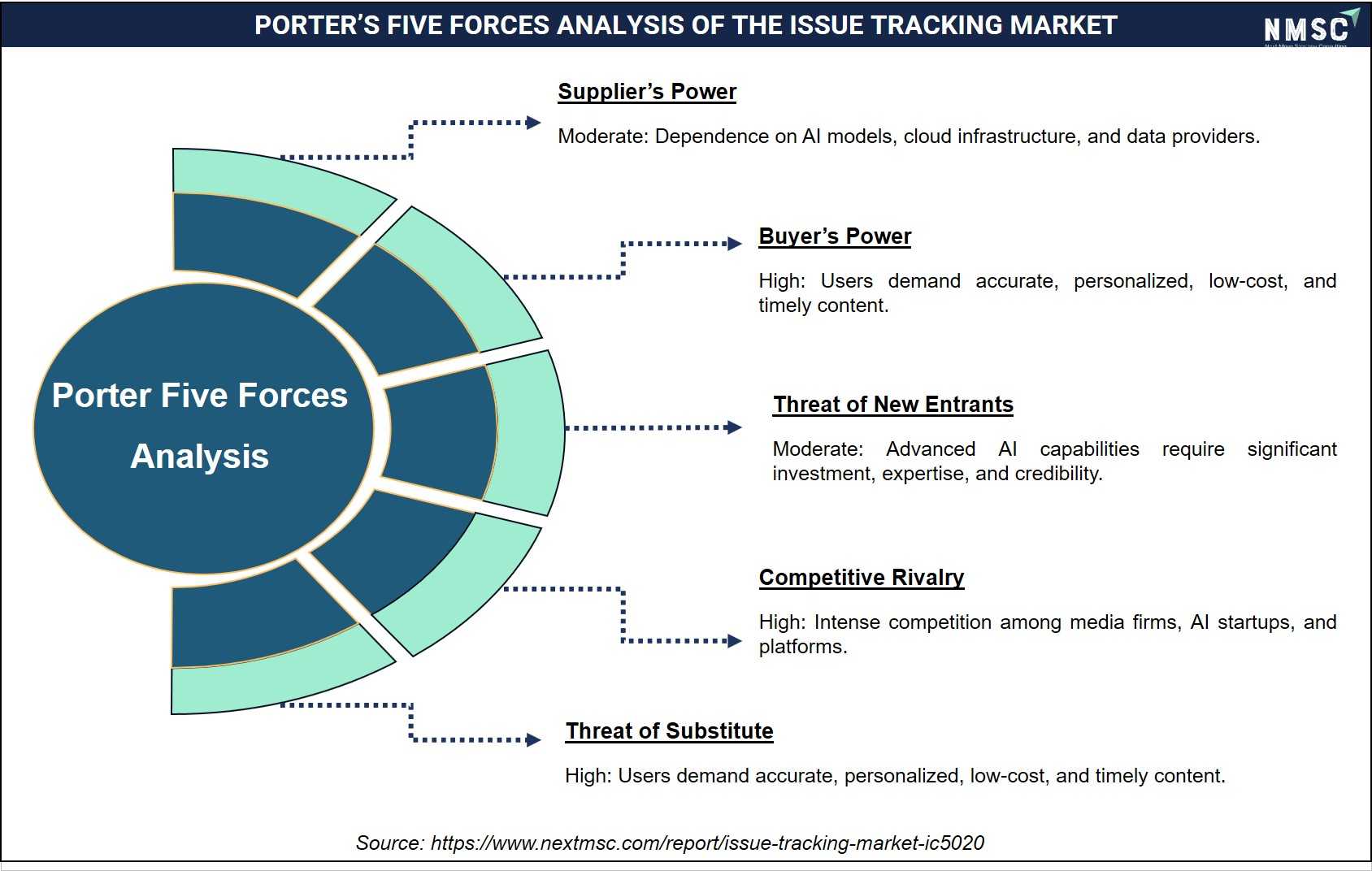
The Issue Tracking Market exhibits high competitive rivalry due to the presence of numerous global software vendors offering integrated ITSM, DevOps, and workflow management solutions. Buyer bargaining power is moderate to high, supported by the availability of multiple platform alternatives and cloud-based deployment models. Supplier power remains low to moderate as software development infrastructure is widely accessible. The threat of new entrants is moderate, constrained by enterprise integration requirements and customer trust factors. Meanwhile, the threat of substitutes is moderate, as project management, collaboration, and workflow automation platforms increasingly incorporate issue tracking capabilities.
What Are the Key Market Drivers, Breakthroughs, and Investment Opportunities that Will Shape the Issue Tracking Market in the Next Decade?
|
Drivers / Trends / Restraints |
(+/-) % Impact on CAGR Forecast |
Geographic Relevance |
Impact Timeline |
|
Accelerating DevOps and SRE Adoption |
+1.8% |
Global (led by North America, Europe) |
2025–2030 |
|
AI-Powered Triage and Resolution Automation |
+1.5% |
North America, Europe, APAC |
2025–2035 |
|
Expanding ITSM and Incident Management Deployments |
+1.3% |
Global (all regions) |
2025–2032 |
|
Growth in Omnichannel Customer Support Ticketing |
+1.2% |
North America, APAC, Europe |
2025–2035 |
|
Regulatory Compliance Driving Audit-Trail Requirements |
+0.9% |
Europe, MEA, North America |
2026–2035 |
|
High Switching Costs and Data Migration Complexity |
-1.1% |
Enterprise globally |
Ongoing |
|
Open-Source Issue Tracking Alternatives |
-0.7% |
SMB, Mid-market globally |
2025–2030 |
|
Security Vulnerabilities in Cloud Ticketing Platforms |
-0.5% |
All regions |
Ongoing |
|
Expansion of Mid-Market Self-Serve Adoption |
+1.0% |
North America, Europe, APAC |
2025–2032 |
|
Public Sector Digital Transformation Programs |
+0.8% |
MEA, APAC, Latin America |
2026–2035 |
What Are the Growth Drivers of the Issue Tracking Market?
How Is the Global Acceleration of DevOps Adoption Driving the Issue Tracking Market?
DevOps and Site Reliability Engineering (SRE) practices are the primary structural catalyst driving demand across the Issue Tracking Market. The DevOps methodology fundamentally requires integrated issue tracking for sprint planning, backlog grooming, CI/CD failure logging, and post-incident review management. Based on NMSC's research, we found that the U.S. Bureau of Labor Statistics projects software developer and software quality assurance occupations to grow by 25% through 2032, significantly outpacing average occupational growth. Every incremental software engineering role creates corresponding demand for structured bug, defect, and work item tracking tooling. Organizations adopting DevOps at scale require platforms that provide bi-directional linkage between code commits, test failures, deployment events, and issue records.
How Is the Proliferation of ITSM Frameworks Expanding the Issue Tracking Market?
The global adoption of ITIL 4 and ISO/IEC 20000 IT service management standards is expanding enterprise investment in structured incident, problem, change, and request management workflows, all of which require dedicated issue tracking infrastructure. Our analysis shows that regulated industries in financial services, healthcare, and government are mandated to maintain immutable audit trails of every incident and change management event, creating non-discretionary demand for ITSM-grade issue tracking platforms. The National Institute of Standards and Technology (NIST) SP 800-61 Computer Security Incident Handling Guide specifies detailed issue tracking requirements for cybersecurity incident response, further institutionalizing the market among enterprise IT security teams.
How Is the Surge in Omnichannel Customer Support Demand Fueling the Issue Tracking Market?
The proliferation of digital customer engagement channels, including email, live chat, social media, SMS, and AI-powered chatbots, is creating strong demand for omnichannel customer support ticketing platforms within the Issue Tracking Market. Retailers, financial institutions, healthcare providers, and telecom operators increasingly require unified case management systems that aggregate customer issues from multiple channels into a single trackable record. From our assessment, we found that the U.S. Federal Trade Commission's customer complaint tracking guidelines and equivalent consumer protection regulations across the EU, India, and Brazil are compelling organizations to maintain structured, auditable records of all customer service interactions, creating regulatory-driven demand for enterprise-grade customer support ticketing solutions.
What Are the Growth Inhibitors of the Issue Tracking Market?
How Do High Switching Costs and Data Migration Complexity Constrain the Issue Tracking Market?
Platform lock-in and data migration complexity represent the most significant structural constraints on the Issue Tracking Market. Enterprises that have accumulated years of issue history, custom workflow schemas, integrations, and automation rules in platforms such as Jira or ServiceNow face prohibitive switching costs when evaluating alternative vendors. Migration of historical issue data, custom field mappings, and workflow automation logic requires significant professional services investment and extended parallel-run periods. Our analysis shows that the U.S. Government Accountability Office (GAO) has documented analogous challenges in federal IT system migrations, noting that institutional data complexity and user re-training represent the primary cost and time drivers, dynamics equally applicable to enterprise issue tracking platform transitions.
How Does the Availability of Open-Source Issue Tracking Tools Limit the Issue Tracking Market?
Open-source issue tracking alternatives, including GitLab Community Edition, Redmine, Bugzilla, and Taiga, provide functional bug tracking, backlog management, and work item tracking capabilities at zero license cost, moderating pricing pressure and limiting addressable market size for commercial vendors among SMB and development-stage organizations. The Linux Foundation and Apache Software Foundation communities maintain mature, actively developed open-source project management and issue tracking tools that satisfy baseline requirements for many engineering teams. NMSC's analysis indicates that commercial vendors must continuously differentiate through AI capabilities, enterprise security, compliance certifications, and managed cloud hosting to justify subscription costs over self-hosted open-source alternatives.
What Are the Growth Opportunities in the Issue Tracking Market?
How Does the Expansion of AI-Native Issue Intelligence Create Multi-Dimensional Opportunities in the Issue Tracking Market?
Generative AI and machine learning capabilities embedded within issue tracking platforms are creating a new layer of premium value that justifies significant price-tier expansion in the Issue Tracking Market. AI-powered features, including automated duplicate detection, predictive escalation routing, resolution recommendation, sentiment-based SLA prioritization, and natural-language issue creation, are enabling vendors to introduce AI add-on SKUs at meaningful premium pricing above base subscription tiers. Our findings suggest that the National Institute of Standards and Technology (NIST) AI Risk Management Framework establishes governance requirements for AI systems used in operational decision-making, including automated issue classification, creating compliance-adjacent demand for auditable AI issue tracking capabilities across regulated enterprise buyers.
How Does Digital Transformation Across Emerging Markets Present a Structural Opportunity for the Issue Tracking Market?
Rapid enterprise digitization across Asia-Pacific, Latin America, and the Middle East and Africa is creating durable demand for issue tracking platforms across expanding technology and service sectors. India's National Digital India Programme, overseen by the Ministry of Electronics and Information Technology (MeitY), is driving large-scale IT modernization across public sector organizations, generating demand for structured incident and request management tracking. Brazil's Marco Legal das Startups and Saudi Arabia's Vision 2030 technology investment programs are similarly catalyzing enterprise software adoption across countries that previously lacked mature issue tracking infrastructure. From our research, we found that these markets represent multi-year greenfield opportunities for cloud-native issue tracking vendors offering localized, compliance-ready platforms.
How Do Public Sector Digital Transformation Mandates Create Structural Demand in the Issue Tracking Market?
Government-led digital transformation programs across North America, Europe, and Asia-Pacific are driving structured investment in ITSM and issue tracking infrastructure at the institutional level. The U.S. Government's Cloud Smart Strategy, overseen by the White House Office of Management and Budget (OMB), mandates migration of federal IT systems to cloud platforms, including ITSM and incident management tools. The UK Government Digital Service mandates structured issue tracking and incident reporting across government digital services. Through NMSC's assessment, we found that these programs are creating long-duration, high-value public sector contracts for ITSM-grade issue tracking vendors with FedRAMP, IL2/IL4, and equivalent government compliance certifications.
Ecosystem Analysis Of The Issue Tracking Market
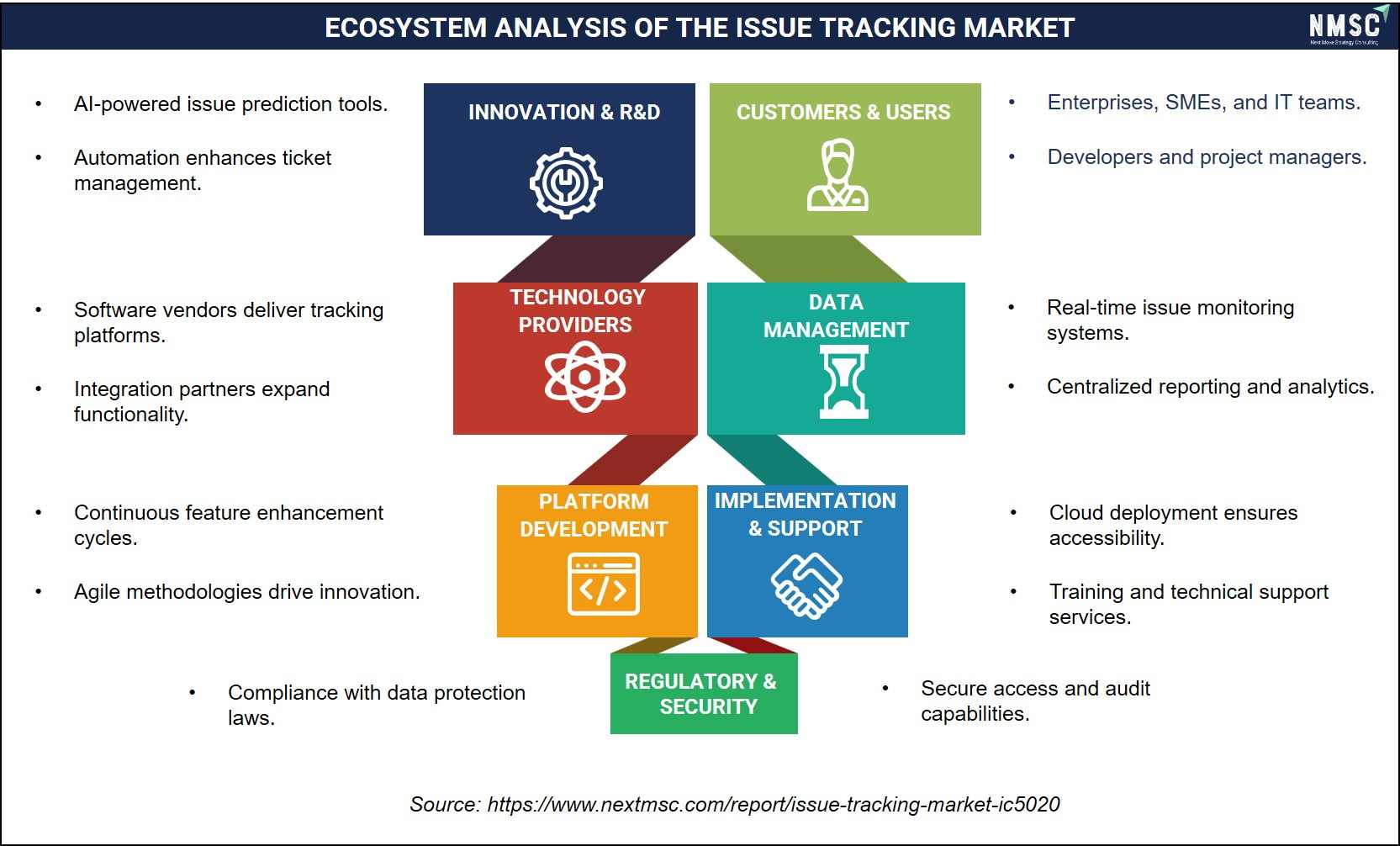
The Issue Tracking Market ecosystem consists of interconnected stakeholders spanning innovation and R&D, technology providers, platform developers, data management specialists, implementation partners, regulatory bodies, and end users. Technology vendors drive innovation through AI-powered automation, workflow optimization, and cloud-native architectures, while implementation and support providers facilitate deployment and integration. Regulatory and security frameworks ensure compliance with data protection and governance requirements. Demand is primarily generated by enterprises, SMEs, IT operations teams, software developers, and project managers seeking efficient issue resolution, collaboration, and workflow management capabilities across digital environments.
How Is the Issue Tracking Market Segmented in This Report, and What Are the Key Insights from the Segmentation Analysis?
How Do Workflow Segments Define the Demand Structure of the Issue Tracking Market?
|
Workflow Segment |
2025 (USD Bn) |
2035 (USD Bn) |
CAGR (%) |
|
Software Development Tracking |
0.89 |
3.22 |
13.8% |
|
Bug Tracking |
0.37 |
1.41 |
15.2% |
|
Work Item Tracking |
0.30 |
1.06 |
14.3% |
|
Backlog Management |
0.22 |
0.75 |
13.8% |
|
IT Service Management (ITSM) |
2.14 |
7.40 |
13.2% |
|
Incident Management |
0.89 |
3.07 |
13.4% |
|
Request Management |
0.60 |
2.08 |
13.4% |
|
Problem Management |
0.31 |
1.10 |
13.5% |
|
Change Management |
0.34 |
1.15 |
13.0% |
|
Customer Support Ticketing |
1.17 |
4.13 |
13.6% |
|
Help Desk |
0.46 |
1.55 |
13.3% |
|
Case Management |
0.38 |
1.32 |
13.5% |
|
Omnichannel Support |
0.33 |
1.26 |
14.8% |
|
Work Management Issue Logs |
0.71 |
2.55 |
13.8% |
|
Task Tracking |
0.34 |
1.22 |
13.8% |
|
RAID Logs |
0.12 |
0.42 |
13.3% |
|
Intake Management |
0.25 |
0.91 |
14.2% |
|
Quality and Defect Tracking |
0.71 |
2.52 |
13.6% |
|
Defect Management |
0.37 |
1.32 |
13.7% |
|
Test Tracking |
0.23 |
0.81 |
13.6% |
|
Release Tracking |
0.11 |
0.39 |
13.3% |
|
Other Issue Tracking |
0.18 |
0.58 |
12.2% |
Based on our analysis of enterprise software development and IT operations practices, the Issue Tracking Market is segmented across Software Development Tracking, Bug Tracking, Work Item Tracking, Backlog Management, IT Service Management, Incident Management, Request Management, Problem Management, Change Management, Customer Support Ticketing, Help Desk, Case Management, Omnichannel Support, Work Management Issue Logs, Task Tracking, RAID Logs, Intake Management, Quality and Defect Tracking, Defect Management, Test Tracking, Release Tracking, and Other Issue Tracking workflows. ITSM dominates as the largest workflow category, driven by enterprise-wide adoption of structured incident, problem, and change management frameworks. Bug Tracking represents the fastest-growing sub-segment as DevOps acceleration and AI-powered defect detection embed issue tracking deeper into software delivery pipelines. Omnichannel Support is emerging as a high-growth category as enterprises consolidate fragmented customer service channels into unified, trackable case management workflows.
How Do Deployment Models Shape Revenue Distribution Across the Issue Tracking Market?
|
Deployment Segment |
2025 (USD Bn) |
2035 (USD Bn) |
CAGR (%) |
|
Cloud |
3.60 |
12.96 |
13.6% |
|
Self-Hosted |
1.56 |
4.90 |
12.1% |
|
Hybrid |
0.64 |
2.54 |
14.8% |
The Issue Tracking Market is segmented into Cloud, Self-Hosted, and Hybrid deployment models. Cloud deployment dominates with approximately 62% of total market revenue in 2025, reflecting the enterprise-wide migration toward SaaS issue tracking platforms that offer automatic updates, global accessibility, and API-first integration. Self-Hosted deployment retains relevance among regulated enterprises, government agencies, and organizations with strict data sovereignty requirements, such as those in the defense, financial services, and public healthcare sectors. Hybrid deployment is the fastest-growing model at a CAGR of 14.8%, driven by enterprises seeking to balance cloud scalability for development teams with on-premises data residency for sensitive incident records and compliance audit trails.
How Does Organization Size Influence Adoption Patterns in the Issue Tracking Market?
|
Organization Size Segment |
2025 (USD Bn) |
2035 (USD Bn) |
CAGR (%) |
|
Small Business |
0.72 |
2.56 |
13.5% |
|
Mid-Market |
1.68 |
6.12 |
14.6% |
|
Enterprise |
3.40 |
11.72 |
13.0% |
Based on our market evaluation, the Issue Tracking Market is segmented into Small Business, Mid-Market, and Enterprise organization tiers. Enterprise organizations account for the largest revenue share, driven by complex multi-project deployments, enterprise ITSM platform subscriptions, and high seat counts across distributed development and operations teams. Mid-Market organizations represent the fastest-growing tier at a CAGR of 14.6%, as competitive SaaS pricing, self-serve onboarding, and scalable cloud-native platforms lower the barrier for structured issue management adoption outside traditional large-enterprise contexts. Small business adoption is expanding steadily through freemium PLG models offered by platforms such as Linear, GitHub Issues, and Jira's entry-level tiers.
How Do Go-to-Market Strategies Shape Revenue Capture in the Issue Tracking Market?
|
Go-to-Market Segment |
2025 (USD Bn) |
2035 (USD Bn) |
CAGR (%) |
|
Self-Serve |
2.18 |
7.34 |
12.8% |
|
Sales-Led Direct |
1.80 |
6.86 |
15.1% |
|
Partner-Led |
1.26 |
4.58 |
13.8% |
|
Embedded OEM |
0.56 |
1.62 |
11.2% |
Our findings suggest that the Issue Tracking Market go-to-market landscape is evolving toward a dual-motion model combining high-velocity self-serve growth with high-value sales-led enterprise expansion. Self-Serve channels dominate total revenue, led by product-led growth strategies from Atlassian, Linear, and GitHub that convert individual developers into team and enterprise accounts through usage-driven expansion. Sales-Led Direct is the fastest-growing channel as enterprise procurement of ITSM and omnichannel support platforms requires negotiated multi-year contracts, custom security requirements, and dedicated account management. Partner-Led channels remain significant, with system integrators and managed service providers bundling issue tracking deployment within broader digital transformation engagements.
How Do Revenue Stream Models Reflect the Commercial Evolution of the Issue Tracking Market?
|
Revenue Stream Segment |
2025 (USD Bn) |
2035 (USD Bn) |
CAGR (%) |
|
Subscription |
4.18 |
15.50 |
13.9% |
|
Perpetual License |
0.88 |
2.02 |
8.7% |
|
Maintenance and Support |
0.74 |
2.88 |
14.6% |
The Issue Tracking Market revenue stream structure strongly favors subscription-based models, which account for approximately 72% of total market revenue in 2025. The subscription model dominates due to its alignment with SaaS delivery, providing vendors with predictable recurring revenue while offering buyers flexible seat scaling, continuous updates, and usage-based pricing options. Perpetual License revenue is declining as a proportion of total market as legacy on-premises vendors accelerate subscription migration programs. Maintenance and Support revenue is the fastest-growing stream at a CAGR of 14.6%, driven by enterprise demand for premium support tiers, SLA guarantees, and professional services bundled with complex ITSM platform deployments.
How Do Industry Verticals Define Value Creation Across the Issue Tracking Market?
|
End User Industry |
2025 (USD Bn) |
2035 (USD Bn) |
CAGR (%) |
|
Software and IT |
1.92 |
6.32 |
12.7% |
|
BFSI |
0.82 |
3.24 |
14.9% |
|
Healthcare |
0.56 |
2.14 |
14.3% |
|
Manufacturing |
0.48 |
1.72 |
13.6% |
|
Retail and Ecommerce |
0.52 |
1.96 |
14.2% |
|
Public Sector |
0.62 |
2.18 |
13.4% |
|
Professional Services |
0.38 |
1.40 |
13.9% |
|
Other Industry |
0.50 |
1.44 |
14.0% |
Based on our analysis of enterprise software adoption patterns, the Issue Tracking Market spans Software and IT, BFSI, Healthcare, Manufacturing, Retail and Ecommerce, Public Sector, Professional Services, and Other industries. The Software and IT vertical is the dominant end user, generating approximately 33% of total market revenue in 2025, reflecting the centrality of bug tracking, sprint management, and CI/CD issue tracking to software-intensive organizations. BFSI is the fastest-growing vertical at a CAGR of 14.9%, driven by regulatory mandates for IT incident management, change advisory board documentation, and structured customer complaint tracking. Healthcare adoption is expanding rapidly as electronic health record systems, health information exchanges, and clinical software platforms require structured defect management and incident tracking within ISO 13485 and FDA 21 CFR Part 820 quality management frameworks.
Regional Outlook
Geographic Performance Snapshot
|
Region |
2025 (USD Bn) |
2035 (USD Bn) |
CAGR (%) |
Key Driver |
|
North America |
2.38 |
8.36 |
13.4% |
Software industry concentration, ITSM maturity |
|
Europe |
1.46 |
5.02 |
13.2% |
GDPR compliance, regulated ITSM adoption |
|
Asia-Pacific |
1.24 |
4.82 |
15.8% |
India IT growth, digital enterprise modernization |
|
Middle East & Africa |
0.38 |
1.38 |
13.8% |
Vision 2030, cloud ITSM deployment |
|
Latin America |
0.34 |
0.82 |
10.3% |
Digital economy expansion, software exports |
North America Issue Tracking Market
North America is the global leader in the Issue Tracking Market, accounting for an estimated USD 2.38 billion in 2025 and forecast to reach USD 8.36 billion by 2035 at a CAGR of 13.4%. The region benefits from the highest global concentration of software companies, SaaS vendors, and technology-intensive enterprises that require mature bug tracking, ITSM, and customer support ticketing platforms. Strong regulatory influences from NIST cybersecurity frameworks, FedRAMP compliance for government platforms, and HIPAA incident tracking requirements in healthcare drive structured, non-discretionary demand. Competitive intensity is the highest globally, with ServiceNow, Atlassian, and Salesforce headquartered in the region.
United States Issue Tracking Market
Based on our engagements across enterprise software procurement channels, the United States represents over 70% of North American Issue Tracking Market revenue. The U.S. market is defined by its world-leading concentration of software product companies, managed service providers, and enterprise IT departments with sophisticated ITSM and DevOps platform requirements. Regulatory drivers include NIST SP 800-61 for incident handling, SOC 2 Type II requirements for audit-trail issue tracking, and the Federal Information Security Management Act (FISMA) mandating structured incident management for government contractors. Cloud adoption is near-universal among enterprise buyers, with self-hosted deployments concentrated in defense and financial services sectors.
Canada Issue Tracking Market
Through our analysis, Canada represents approximately 18% of North American Issue Tracking Market revenue. Canadian enterprises, led by financial institutions, insurance firms, and growing technology companies in Toronto, Vancouver, and Montreal, are sophisticated ITSM and cloud issue tracking platform buyers. The Government of Canada's Digital Ambition strategy and Treasury Board cloud adoption policy are accelerating public sector issue tracking modernization. Canadian data sovereignty requirements around cross-border data flows to U.S. hyperscalers are driving demand for Canada-based cloud deployments of issue tracking platforms, with AWS Canada and Azure Canada East supporting data residency compliance for enterprise and government buyers.
Mexico Issue Tracking Market
From our assessment, Mexico is a growing market within North America for issue tracking platforms, primarily driven by the expansion of IT nearshoring, digital manufacturing operations, and the growing domestic fintech sector. The national digital strategy and electronic government services programs are expanding public sector ITSM requirements. Manufacturing sector digitization, supported by Industry 4.0 adoption in Monterrey and Guadalajara, is creating demand for quality defect tracking and production issue management tools. Mexico's Ley Federal de Protección de Datos Personales is increasing enterprise attention to compliant data handling within customer support ticketing platforms serving the growing e-commerce sector.
Europe Issue Tracking Market
Europe is the second-largest region in the Issue Tracking Market at an estimated USD 1.46 billion in 2025, forecast to reach USD 5.02 billion by 2035 at a CAGR of 13.2%. European regulatory dynamics, including GDPR's mandatory data breach notification windows requiring structured incident tracking, the NIS2 Directive mandating cybersecurity incident management across critical infrastructure, and emerging EU AI Act compliance workflows, are creating structured, compliance-driven demand for enterprise issue tracking platforms. Sovereign cloud considerations are increasingly relevant as organizations seek EU-hosted issue tracking deployments that comply with data residency obligations for sensitive incident and personal data records.
UK Issue Tracking Market
Based on our engagements with UK enterprise technology buyers, the United Kingdom is Europe's largest individual country market for issue tracking, representing approximately 22% of European revenue in 2025. Post-Brexit, the UK maintains GDPR-equivalent standards under UK GDPR while developing an independent regulatory environment through the Data Protection and Digital Information Act. The Financial Conduct Authority's operational resilience requirements and the Bank of England's supervisory guidelines mandate structured incident tracking for UK financial institutions. The Government Digital Service's technology standards and the National Cyber Security Centre incident reporting frameworks further drive ITSM platform adoption across public sector and regulated private sector organizations.
Germany Issue Tracking Market
According to evaluation of German enterprise IT procurement practices, Germany is the second-largest European market for issue tracking, anchored by its world-class manufacturing sector, financial services industry, and engineering-intensive technology companies. German enterprises are among the most privacy-conscious IT platform buyers, demanding EU-hosted cloud deployments or on-premises options that comply with the Bundesdatenschutzgesetz (BDSG) and GDPR. The Federal Office for Information Security (BSI) IT-Grundschutz framework specifies structured change management and incident tracking requirements that drive enterprise ITSM adoption. SAP's dominance in German enterprise ERP creates workflow integration opportunities for issue tracking platforms connecting to SAP landscapes.
France Issue Tracking Market
Through our analysis, France is the third-largest European Issue Tracking Market, characterized by strong public sector investment in digital infrastructure and significant adoption across financial services and telecommunications. The CNIL remains one of Europe's most active GDPR enforcement bodies, compelling all organizations handling personal data to maintain structured, auditable records of data breach incidents within issue tracking systems. France 2030 program investments in AI and cloud technology are driving accelerated adoption of AI-enhanced issue management platforms across both private enterprise and government agency buyers. OVHcloud's presence provides a sovereign French cloud hosting option for issue tracking deployments requiring French data residency.
Italy Issue Tracking Market
From our assessment, Italy is a mid-tier European market for issue tracking, with growing adoption in manufacturing, banking, and public administration sectors. The PNRR (Piano Nazionale di Ripresa e Resilienza) has directed significant public investment toward cloud migration for Italian government entities, creating structured demand for cloud-based ITSM and incident management platforms. Italy's Garante data protection authority maintains active GDPR enforcement, compelling compliance-driven investment in auditable issue tracking for personal data incident management. The Polo Strategico Nazionale (PSN) national cloud initiative supports Italian public sector organizations in deploying sovereign-cloud issue tracking environments.
Spain Issue Tracking Market
Based on our market evaluation, Spain demonstrates growing momentum in the Issue Tracking Market, driven by a dynamic financial services sector, expanding e-commerce industry, and digital transformation under the Agenda España Digital 2026. Spanish banks and insurance companies are significant enterprise ITSM platform buyers, driven by Banco de España and CNMV operational resilience requirements. The Agencia Española de Protección de Datos (AEPD) actively enforces GDPR, compelling investment in auditable customer support ticketing and data breach incident tracking. Madrid and Barcelona host growing technology hubs with high DevOps adoption, generating strong demand for developer-centric bug and work item tracking platforms.
Sweden Issue Tracking Market
Through our analysis, Sweden represents a mature and technologically sophisticated issue tracking market within Northern Europe. Swedish enterprises are early adopters of DevOps methodologies and cloud-native workflows, creating strong demand for integrated bug tracking and CI/CD issue management platforms. The Swedish Integritetsskyddsmyndigheten (IMY) enforces GDPR with notable rigor, compelling structured personal data incident tracking within enterprise issue management systems. Sweden's highly digitized public sector, including Skatteverket and the Swedish Social Insurance Agency, maintains mature ITSM platforms with structured incident and change management workflows meeting ISO/IEC 20000 standards.
Denmark Issue Tracking Market
Based on our engagements, Denmark's Issue Tracking Market is characterized by high enterprise maturity and significant public sector digitization. The Danish Business Authority's mandatory digital reporting requirements and the Danish government's digital service delivery standards create institutional demand for structured issue and incident tracking within government IT organizations. Danish financial institutions, pharmaceutical companies, and energy firms adopt enterprise ITSM platforms compliant with Danish Data Protection Act (Databeskyttelsesloven) requirements for incident notification and audit trail maintenance. Denmark's public-private digital collaboration model generates ITSM platform adoption across both sectors simultaneously.
Finland Issue Tracking Market
From our assessment, Finland maintains a technologically advanced Issue Tracking Market, supported by a strong engineering culture, high DevOps adoption in the gaming, technology, and telecommunications sectors, and active public sector digital transformation. The Finnish Transport and Communications Agency (Traficom) and Finnish National Cyber Security Centre (NCSC-FI) provide structured incident reporting and management guidance that drives ITSM platform adoption across critical infrastructure operators. Finnish enterprise buyers favor European-hosted cloud platforms with GDPR compliance certification, creating opportunity for issue tracking vendors offering EU-resident deployment options.
Netherlands Issue Tracking Market
According to evaluation, the Netherlands is a significant European Issue Tracking Market, anchored by its position as a major European financial hub, e-commerce center, and ICT infrastructure gateway. The Dutch Authority for the Personal Data (Autoriteit Persoonsgegevens) is among Europe's most active GDPR enforcement bodies, creating strong compliance-driven demand for structured incident and personal data breach tracking. The Netherlands' Amsterdam-based logistics, financial services, and technology sectors generate multi-vertical demand for ITSM, customer support ticketing, and DevOps issue tracking platforms. Amsterdam is also home to significant European headquarters for global technology companies, driving enterprise issue tracking procurement at scale.
Rest of Europe Issue Tracking Market
Based on our market assessment, the Rest of Europe encompasses Switzerland, Belgium, Austria, Poland, Czech Republic, Portugal, and other markets that collectively represent an estimated 20% of European Issue Tracking Market revenue. Switzerland's financial services and pharmaceutical sectors drive ITSM demand aligned with FINMA and Swissmedic regulatory requirements. Poland and Czech Republic are growing markets driven by expanding IT outsourcing sectors and nearshore software development for Western European enterprises. The broader Central and Eastern European region is experiencing accelerated cloud adoption, creating demand for cloud-native issue tracking platforms supporting both domestic enterprise needs and cross-border software development team operations.
Asia-Pacific Issue Tracking Market
Asia-Pacific is the fastest-growing major region in the Issue Tracking Market at a CAGR of 15.8% from 2026 to 2035, advancing from an estimated USD 1.24 billion in 2025 to USD 4.82 billion by 2035. The region's growth is anchored by India's globally significant software engineering workforce, China's enterprise IT modernization programs, and the rapid expansion of technology-intensive industries across Japan, South Korea, and Southeast Asia. Government-led digital transformation initiatives across the region, including India's Digital India Programme, China's digital economy strategy, and Singapore's Smart Nation initiative, are creating institutional demand for structured issue and incident management platforms across public sector and regulated private sectors.
China Issue Tracking Market
From our assessment, China represents the largest absolute revenue market within Asia-Pacific for issue tracking platforms, estimated at approximately 28% of Asia-Pacific regional revenue in 2025. China's enterprise IT modernization agenda, driven by the Ministry of Industry and Information Technology's (MIIT) digital economy development plans, is creating widespread demand for structured ITSM, incident management, and software development tracking platforms across state-owned enterprises, financial institutions, and technology companies. Data localization requirements under the Cybersecurity Law and the Personal Information Protection Law (PIPL) mandate China-resident cloud deployments for sensitive issue and incident records, creating opportunities for domestic vendors alongside internationally compliant cloud providers.
India Issue Tracking Market
Based on our engagements, India is the fastest-growing national market for issue tracking in Asia-Pacific at a CAGR of 18.2% from 2026 to 2035. India's globally dominant IT services export industry, comprising over 5 million software engineers, creates structural demand for enterprise-grade bug tracking, defect management, and work item tracking platforms across Infosys, TCS, Wipro, HCL, and thousands of software product companies. MeitY's Digital India Programme is accelerating public sector ITSM adoption. India's Personal Data Protection Act, overseen by the Data Protection Board of India, is increasing compliance-driven demand for auditable incident tracking within enterprises handling personal data. Bengaluru, Hyderabad, and Pune are leading regional adoption centers.
Japan Issue Tracking Market
Through our analysis, Japan's Issue Tracking Market is characterized by high enterprise maturity, strong adoption in manufacturing quality management, and significant investment in IT service management by Japan's major financial institutions and telecommunications operators. The Japan Industrial Standards (JIS) Q 20000 IT service management standard and the Ministry of Economy, Trade and Industry (METI) cybersecurity incident reporting guidelines create institutionalized demand for structured issue tracking. Japanese automotive manufacturers embed issue and defect tracking within quality management systems (QMS) aligned with IATF 16949 automotive quality standards, creating a specialized manufacturing vertical within the broader market.
South Korea Issue Tracking Market
Based on our market evaluation, South Korea represents a technologically advanced issue tracking market anchored by its globally significant semiconductor industry, electronics manufacturing sector, and growing software and gaming industries. The Korean Personal Information Protection Act (PIPA), enforced by the Personal Information Protection Commission (PIPC), mandates structured incident notification procedures requiring robust incident tracking platforms within enterprises handling personal data. South Korea's major chaebols, including Samsung, LG, SK, and Hyundai, maintain sophisticated enterprise ITSM deployments. The expanding Korean SaaS ecosystem and the government's Digital New Deal program are driving cloud-native issue tracking adoption at enterprise and SMB scales.
Taiwan Issue Tracking Market
From our assessment, Taiwan's Issue Tracking Market is driven primarily by the semiconductor and hardware technology industries concentrated around TSMC, MediaTek, and the broader Hsinchu Science Park ecosystem. Chip fabrication and hardware development processes generate significant demand for structured defect management, test tracking, and quality issue logging platforms that integrate with EDA tools and quality management systems. Taiwan's Financial Supervisory Commission mandates structured incident management frameworks for financial institutions that require ITSM-grade issue tracking platforms. Taiwan's Personal Data Protection Act (PDPA) creates compliance obligations for customer support ticketing platforms handling personal data across the technology and financial services sectors.
Malaysia Issue Tracking Market
Based on our market evaluation, Malaysia demonstrates growing demand for issue tracking platforms across its technology, financial services, and shared services sectors. The Malaysia Digital Economy Corporation (MDEC) and MyDigital national digital economy blueprint are accelerating enterprise IT modernization, creating demand for cloud-based ITSM and issue management platforms. Bank Negara Malaysia's risk management and IT governance requirements, including RMiT (Risk Management in Technology), mandate structured incident management processes for financial institutions, driving adoption of enterprise-grade ITSM platforms. Kuala Lumpur and Cyberjaya host significant shared service centers for global multinationals with sophisticated issue tracking platform requirements.
Rest of APAC Issue Tracking Market
According to evaluation, the Rest of Asia-Pacific includes New Zealand, Thailand, Singapore, Bangladesh, Pakistan, and other markets that collectively represent an estimated 14% of Asia-Pacific Issue Tracking Market revenue. Singapore's Smart Nation Initiative and the Monetary Authority of Singapore's Technology Risk Management guidelines create structured ITSM demand among financial institutions. Thailand's national digital transformation policy under the Digital Economy Promotion Agency (DEPA) drives public sector and enterprise issue tracking adoption. New Zealand's Privacy Act 2020 and the government's digital service delivery standards institutionalize incident tracking requirements across both public and private sectors.
Middle East & Africa Issue Tracking Market
The Middle East and Africa (MEA) region is an emerging growth market for issue tracking platforms, estimated at USD 0.38 billion in 2025 and forecast to reach USD 1.38 billion by 2035 at a CAGR of 13.8%. Saudi Arabia's Vision 2030, the UAE's We the UAE 2031 digital agenda, and South Africa's digital government programs are driving structured ITSM and cloud issue tracking adoption across public sector and regulated private enterprise. Cybersecurity regulations, including Saudi Arabia's Essential Cybersecurity Controls (ECC) and UAE's National Information Assurance Policy, mandate structured incident management frameworks that require enterprise-grade issue tracking platforms.
Saudi Arabia Issue Tracking Market
Based on our engagements, Saudi Arabia is the largest individual Issue Tracking Market within the MEA region, driven by Vision 2030's digital transformation agenda and the Saudi Authority for Data and Artificial Intelligence's (SDAIA) digital infrastructure investments. The National Cybersecurity Authority's (NCA) Essential Cybersecurity Controls mandate structured incident management and change management procedures for government agencies and critical infrastructure operators. Saudi Aramco, SABIC, and the country's major financial institutions maintain sophisticated enterprise ITSM deployments. The growing Saudi technology startup ecosystem in Riyadh and NEOM city development programs are creating emerging demand for cloud-native DevOps and issue tracking platforms.
UAE Issue Tracking Market
Through our analysis, the UAE is the second-largest MEA market for issue tracking, defined by high technology adoption, a mature financial services sector, and aggressive public sector digitization. The Telecommunications and Digital Government Regulatory Authority (TDRA) and the Dubai Digital Authority mandate structured IT service management frameworks across government digital services. The UAE's Central Bank Risk Management Guidance requires structured incident tracking for financial institutions. Dubai Financial Services Authority (DFSA) regulated entities within the Dubai International Financial Centre maintain enterprise ITSM platforms meeting ISO 20000 standards. The UAE's significant multinational corporate hub status drives enterprise platform adoption across multiple issue tracking categories.
Egypt Issue Tracking Market
Based on our market evaluation, Egypt represents a growing issue tracking market within North Africa, driven by its expanding IT outsourcing sector, digital banking transformation, and government digitization under the Egypt Digital 2030 strategy. The Egyptian Financial Regulatory Authority and Central Bank of Egypt IT governance requirements are creating compliance-driven demand for structured incident and change management tracking platforms. Cairo's growing technology ecosystem and the government's Tiber Information Technology Park initiative are driving cloud platform adoption, including issue tracking, across both domestic enterprises and multinational shared service centers operating in Egypt.
Israel Issue Tracking Market
From our assessment, Israel maintains a disproportionately sophisticated issue tracking market relative to its size, reflecting the world's highest density of cybersecurity, software, and deep technology companies. Israeli technology companies are among the world's most intensive adopters of DevOps methodologies, agile development frameworks, and CI/CD pipelines, creating strong demand for advanced bug tracking, test tracking, and release management platforms. The Israel National Cyber Directorate incident reporting requirements and the Privacy Protection Authority's data breach notification mandates create structured regulatory demand for enterprise incident tracking within Israel's significant financial services and technology sectors.
Turkey Issue Tracking Market
According to evaluation, Turkey is a mid-sized MEA market for issue tracking, characterized by a growing technology sector, expanding e-commerce industry, and increasing enterprise adoption of cloud-based ITSM platforms. The Information Technologies and Communication Authority (BTK) and the Personal Data Protection Authority (KVKK) mandate structured personal data breach notification procedures requiring auditable incident tracking. Istanbul's growing fintech ecosystem and Turkey's expanding software development industry are driving cloud-native issue tracking adoption. Turkey's significant manufacturing sector creates demand for quality defect management and ISO 9001-aligned production issue tracking platforms among industrial enterprises.
Nigeria Issue Tracking Market
Based on our engagements, Nigeria is the largest Sub-Saharan African market for issue tracking, anchored by its significant telecommunications sector, rapidly growing fintech industry, and expanding software development ecosystem in Lagos. The Nigeria Data Protection Commission (NDPC) and the Nigeria Data Protection Act (NDPA) mandate structured data breach incident tracking for organizations handling personal data. The Central Bank of Nigeria's Risk-Based Cybersecurity Framework requires structured incident management for financial institutions, driving ITSM platform adoption among banks, payment processors, and insurance companies. Lagos hosts Africa's most active technology startup ecosystem, creating emerging demand for developer-centric bug and work item tracking platforms.
South Africa Issue Tracking Market
Through our analysis, South Africa is a mature and sophisticated issue tracking market within Sub-Saharan Africa, characterized by a well-established financial services sector, active regulatory environment, and growing technology industry. The Information Regulator enforces the Protection of Personal Information Act (POPIA), which mandates structured incident notification procedures requiring robust incident tracking within enterprises. The South African Reserve Bank's Prudential Authority IT governance guidelines create ITSM compliance requirements for financial institutions. Johannesburg and Cape Town host significant enterprise IT operations and growing technology startups adopting cloud-native issue tracking and agile project management platforms.
Rest of MEA Issue Tracking Market
Based on our market assessment, the Rest of MEA includes Kuwait, Qatar, Bahrain, Oman, Jordan, Kenya, Ghana, Ethiopia, Morocco, and other markets representing an estimated 25% of MEA Issue Tracking Market revenue. Kuwait and Qatar's National Vision programs and significant oil and gas sector IT investments drive structured ITSM demand. Kenya's iHub technology ecosystem and financial inclusion-driven fintech growth create emerging demand for cloud-native issue and customer support ticketing platforms. Morocco's Casablanca Finance City and growing outsourcing sector position the country as a rising demand center for enterprise issue tracking platform adoption within North Africa.
Latin America Issue Tracking Market
Latin America represents an emerging growth region for the Issue Tracking Market, estimated at USD 0.34 billion in 2025 and forecast to reach USD 0.82 billion by 2035 at a CAGR of 10.3%. Brazil's LGPD-driven compliance demand, growing fintech sector, and expanding software development ecosystem underpin regional market leadership. Argentina's software exports program and Colombia's digital economy strategy are creating additional demand clusters. Regional growth is tempered by macroeconomic volatility, currency risks, and lower per-capita IT spending compared with more mature regions, constraining both enterprise platform adoption rates and average contract values across Latin American markets.
Brazil Issue Tracking Market
Based on our engagements, Brazil is the dominant Latin American market for issue tracking, representing approximately 52% of regional revenue in 2025. Brazil's Lei Geral de Proteção de Dados (LGPD), enforced by the Autoridade Nacional de Proteção de Dados (ANPD), mandates structured personal data breach notification procedures requiring robust incident tracking within enterprises. The Central Bank of Brazil's Open Finance infrastructure and Pix instant payment system investments create ITSM demand within the country's sophisticated financial technology sector. São Paulo hosts Brazil's largest concentration of enterprise software buyers, multinational shared service centers, and domestic technology startups adopting cloud-native issue tracking platforms.
Argentina Issue Tracking Market
Through our analysis, Argentina is the second-largest Latin American market for issue tracking, distinguished by its globally competitive software engineering talent base and significant software export sector. The Argentina Personal Data Protection Act and the Secretaría de Innovación Pública's digital government program are creating compliance and institutional demand for structured issue tracking platforms. Buenos Aires hosts a thriving technology ecosystem with high DevOps adoption among local and multinational software development teams, generating strong demand for bug tracking, agile backlog management, and CI/CD issue management platforms at both startup and enterprise scales.
Chile Issue Tracking Market
Based on our market evaluation, Chile represents a growing and relatively mature Latin American issue tracking market, supported by a stable economic environment, strong financial services sector, and active government digital transformation program. Chile's Personal Data Protection Law (Ley 19.628) reform and the proposed new data protection framework are increasing compliance attention to personal data incident tracking within enterprises. The Chilean financial regulator CMF's cybersecurity requirements for financial institutions are driving ITSM adoption among banks and insurance companies. Santiago's growing technology hub, including the government-supported Start-Up Chile program, is creating emerging demand for cloud-native developer issue tracking tools.
Colombia Issue Tracking Market
From our assessment, Colombia demonstrates increasing momentum in the Issue Tracking Market, driven by Bogotá's growing technology sector, expanding BPO industry, and the government's TIC Colombia digital transformation strategy. Colombia's Superintendencia de Industria y Comercio (SIC) enforces data protection obligations under the Ley Estatutaria 1581, creating structured demand for personal data incident tracking within enterprises. The growing Colombian fintech ecosystem and the country's significant telecommunications sector are primary enterprise adopters of ITSM and customer support ticketing platforms. Colombia's strategic investment in digital skills and software export promotion is expanding the pool of DevOps-adopting organizations requiring structured issue tracking tools.
Rest of LATAM Issue Tracking Market
According to evaluation, the Rest of Latin America, including Peru, Ecuador, Uruguay, Paraguay, Venezuela, Central American nations, and the Caribbean, collectively represents an estimated 18% of Latin American Issue Tracking Market revenue. Uruguay's advanced digital government platform, operated by AGESIC, sets a regional benchmark for public sector ITSM adoption. Peru's expanding mining and energy sector IT operations create demand for structured incident and change management tracking. Central American free trade zones hosting technology and manufacturing operations generate demand for quality defect tracking and customer support ticketing platforms aligned with international quality management standards.
Competitive Landscape
Competitive Dynamics and M&A Landscape
|
Key Takeaways |
Details |
|
Market Structure |
The Issue Tracking Market is highly competitive, led by enterprise software vendors, ITSM providers, DevOps platform companies, and work management solution providers. Major players include ServiceNow, Atlassian, Salesforce, GitHub, Zendesk, and Freshworks, while niche vendors focus on developer-centric and project-specific issue tracking solutions. |
|
Innovation Focus |
Market innovation is centered on AI-powered ticket routing, automated incident resolution, predictive analytics, generative AI assistants, workflow automation, and integrated DevOps/ITSM platforms. Vendors are increasingly embedding AI copilots and autonomous agents into issue management workflows. |
|
M&A Activity |
The market has experienced consolidation through acquisitions aimed at strengthening IT service management, customer support, workflow automation, and developer collaboration capabilities. Vendors continue expanding platform ecosystems through strategic partnerships and AI-focused investments. |
How Do Companies Compete in the Issue Tracking Market?
The Issue Tracking Market is characterized by multi-tiered competition among enterprise workflow platform providers, IT service management (ITSM) vendors, customer support solution providers, and developer-centric tracking platforms. Enterprise platform leaders such as ServiceNow, Atlassian, and Salesforce compete on breadth of workflow automation capabilities, ecosystem integration, and AI-enabled service management. Mid-market vendors including Freshworks, monday.com, Zendesk, and Zoho differentiate through ease of deployment, cost-effectiveness, and industry-specific workflow solutions. Developer-focused platforms such as GitHub, GitLab, Linear, and JetBrains compete on engineering workflow optimization, DevOps integration, and agile project management capabilities.
Which Kind of Companies Dominate the Issue Tracking Market?
Three distinct categories of companies dominate the Issue Tracking Market. First, enterprise workflow and ITSM platform providers including ServiceNow, BMC Software, Ivanti, EasyVista, and OpenText leverage comprehensive service management capabilities to support large-scale incident, change, and asset management processes. Second, collaboration and work management platform vendors such as Atlassian, monday.com, Asana, Wrike, Zoho, and Freshworks provide integrated issue tracking, project management, and workflow automation solutions for organizations of all sizes. Finally, developer-focused software delivery platforms including GitHub, GitLab, JetBrains, and Linear specialize in bug tracking, sprint planning, release management, and DevOps workflow orchestration for software engineering teams.
AI-Powered Automation and Workflow Integration Drive Market Success in the Issue Tracking Market
Innovation focus across the Issue Tracking Market is concentrated in AI-powered incident management, intelligent ticket routing, autonomous resolution agents, predictive analytics, workflow automation, and unified ITSM-DevOps platform architectures. Vendors that successfully embed generative AI assistants, copilots, and automated service workflows within issue management platforms are capturing premium pricing opportunities and increasing customer retention through deeper workflow integration. Advanced integration capabilities across IT operations, software development, customer support, and enterprise collaboration environments are becoming key differentiators for platform providers. Security compliance certifications, cloud-native deployment models, and seamless interoperability with enterprise ecosystems further strengthen competitive positioning among leading vendors.
Market Players to Opt for Merger and Acquisition Strategies to Expand Their Presence in the Issue Tracking Market
Mergers and acquisitions are actively reshaping the Issue Tracking Market, with leading players pursuing strategic consolidations to broaden their product ecosystems and expand their customer base. Horizontal integration strategies are enabling vendors to unify workflow management, AI-powered triage, and DevSecOps capabilities under single platforms. Private equity-backed consolidation around helpdesk solutions, IT service management tools, and collaboration-embedded trackers is expected to intensify significantly through the 2025–2028 timeframe.
Key Market Players in the Issue Tracking Market
-
ServiceNow, Inc.
-
Atlassian Corporation
-
Salesforce, Inc.
-
GitHub, Inc.
-
Zendesk, Inc.
-
monday.com Ltd.
-
Freshworks Inc.
-
GitLab Inc.
-
OpenText Corporation
-
SolarWinds Corporation
-
Asana, Inc.
-
Zoho Corporation Private Limited
-
BMC Software, Inc.
-
Ivanti, Inc.
-
Mango Technologies, Inc.
-
Wrike, Inc.
-
JetBrains s.r.o.
-
EasyVista S.A.
-
Linear Orbit, Inc.
-
SysAid Technologies Ltd.
What Are the Latest Developments in the Issue Tracking Market?
|
Date |
Event |
|
Jun 2025 |
Freshworks introduced Freddy AI Agent Studio, a no-code platform enabling organizations to build and deploy AI agents for customer service and IT service management. The solution is specifically designed to reduce ticket handoffs, accelerate issue resolution, and automate service workflows. |
|
Mar 2025 |
ServiceNow announced its acquisition of Moveworks for approximately USD 2.85 billion. The acquisition expands ServiceNow's AI-powered workflow automation, employee support, ticket management, and enterprise service management capabilities, strengthening its position in the issue tracking ecosystem. |
|
Oct 2024 |
Freshworks launched Freddy AI Agent, an autonomous AI solution designed to automate customer support and employee service requests. The platform helps organizations resolve tickets, answer queries, and automate issue resolution workflows, making it highly relevant to the issue tracking and service desk market. |
Expert Insights

“AI is not replacing project managers. It is elevating them. AI frees PMs from administrative overload so they can lead with strategy, creativity, and empathy.”
— Pierre Le Manh, President & CEO, Project Management Institute (PMI)
Statement discussing the integration of intelligent tools into project management workflows, cited in recent industry assessments on the future of PM tools.
Market Interpretation
This highlights the shifting user expectations within the issue tracking software market. Because AI is successfully handling routine administrative tasks such as auto-generating task lists, risk pattern analysis, and status reporting the platforms are pivoting toward strategic decision-support. Issue-tracking vendors are compelled to build advanced predictive analytics that empower managers to focus on project strategy rather than manual task-logging interfaces.
What Are the Investment Opportunities in the Issue Tracking Market?
Capital Inflows and Venture Investment
The Issue Tracking Market is attracting significant venture capital and growth equity investment, particularly in AI-native issue intelligence startups and next-generation developer tooling platforms. Linear's Series C funding round in 2025 reflects sustained investor confidence in purpose-built, developer-centric issue tracking platforms that compete with incumbents through superior user experience and AI-enhanced workflow automation. Based on NMSC's research, we found that the National Venture Capital Association (NVCA) data indicates sustained venture investment in enterprise SaaS and AI operations tools, categories that directly encompass issue tracking platform innovation. PE-backed platform consolidation is accelerating, as financial sponsors acquire complementary ITSM, customer support, and DevOps tracking tools to create integrated workflow management suites.
Infrastructure and Cloud Platform Investments
Hyperscaler cloud marketplace investments are creating a critical distribution infrastructure opportunity for issue tracking vendors seeking to accelerate enterprise sales cycles. AWS Marketplace, Azure Marketplace, and Google Cloud Marketplace enable issue tracking platforms to be procured against committed cloud spend, removing standalone procurement barriers. The U.S. General Services Administration's FedRAMP marketplace expansion is creating a structured pathway for issue tracking vendors to access the federal government's multi-billion dollar IT modernization budget. Our assessment indicates that vendors investing in cloud marketplace certification, government compliance accreditation, and hyperscaler co-sell partnerships are establishing sustainable distribution advantages over competitors relying solely on direct sales motions.
ESG Considerations
Environmental, Social, and Governance (ESG) considerations are creating differentiation opportunities within the Issue Tracking Market as enterprises integrate sustainability tracking and social impact monitoring into their issue management workflows. ESG compliance programs require structured tracking of environmental incidents, supplier quality issues, and social governance concerns within enterprise issue management systems. From our research, we found that the European Commission's Corporate Sustainability Reporting Directive (CSRD) mandates structured, auditable records of environmental and social incidents for affected enterprises, creating compliance-driven demand for configurable issue tracking workflows that accommodate ESG event classification. Vendors that natively support ESG workflow templates within their platforms gain a compliance-adjacent differentiation advantage.
Digital Transformation
The digitization of traditionally offline industries, including manufacturing, energy, logistics, and agricultural services, is creating new demand clusters for issue tracking platforms within sectors previously underserved by enterprise software vendors. Industry 4.0 adoption in manufacturing creates demand for production defect tracking, equipment incident logging, and quality audit trail management integrated with MES and ERP platforms. Through NMSC's assessment, we found that the International Organization for Standardization's ISO 9001 quality management standard, adopted by over 900,000 organizations globally, mandates structured corrective action and nonconformance tracking, representing a significant greenfield opportunity for issue tracking vendors offering industry-specific quality management workflow templates and enterprise-grade audit trail capabilities.
Key Benefits for Stakeholders
For Enterprise Buyers
Enterprise buyers gain comprehensive, vendor-neutral insights into the Issue Tracking Market, including quantitative analysis across deployment models, organization sizes, workflow categories, and end-user industries. This intelligence supports platform selection, workflow modernization initiatives, and long-term digital operations planning. Our competitive landscape assessment enables procurement teams to benchmark vendor capabilities, evaluate total cost of ownership, and make informed decisions across IT service management, DevOps, customer support, and enterprise workflow automation environments.
For Investors and Financial Analysts
Investors and financial analysts access a structured, data-driven assessment of the Issue Tracking Market's growth outlook, competitive dynamics, consolidation trends, and segment-level revenue forecasts through 2035. The CAGR analysis across deployment models, enterprise sizes, and geographic regions supports valuation modeling and investment strategy development. Detailed profiles of leading vendors, combined with latest product launches, partnerships, and acquisition activity, provide a framework for identifying emerging growth opportunities, acquisition candidates, and competitive risks within the global issue tracking ecosystem.
For Issue Tracking Vendors and Platform Providers
Issue tracking vendors and platform providers gain actionable intelligence on market opportunities, competitive positioning, customer adoption trends, and high-growth application segments within the Issue Tracking Market. Our analysis highlights emerging demand areas including AI-powered incident management, autonomous ticket resolution, predictive workflow automation, and integrated ITSM-DevOps platforms. Regional outlook assessments identify expansion opportunities across developed and emerging markets, while deployment and pricing model analysis helps vendors refine go-to-market strategies, strengthen customer retention, and optimize channel partnerships.
For Government and Regulatory Bodies
Government agencies and regulatory bodies gain a structured analysis of how cybersecurity requirements, digital governance frameworks, data protection regulations, and public sector modernization initiatives are influencing the Issue Tracking Market's evolution. Regional and country-level insights provide policymakers with evidence-based perspectives on enterprise software adoption, digital service delivery modernization, and incident management best practices. The report also supports the development of procurement standards, IT governance policies, and digital transformation strategies across public sector organizations.
For System Integrators and Managed Service Providers
System integrators and managed service providers gain valuable insights into enterprise adoption patterns, regional demand trends, and ecosystem partnership opportunities within the Issue Tracking Market. The report helps service providers identify high-growth platform ecosystems, prioritize consulting and implementation investments, and develop differentiated managed ITSM, DevOps, and workflow automation offerings. Competitive benchmarking and customer preference analysis further support service portfolio optimization and long-term client engagement strategies.
For Academic and Research Institutions
Academic and research institutions benefit from a structured analytical framework, comprehensive segmentation methodology, and cross-regional market comparisons that support research into enterprise software adoption, workflow management technologies, IT governance practices, and AI-enabled operational automation. The report provides a reliable foundation for studying digital transformation trends, technology diffusion patterns, and the evolving role of issue tracking platforms in modern enterprise environments.
Key Market Segments
By Workflow
-
Software Development Tracking
-
Bug Tracking
-
Work Item Tracking
-
Backlog Management
-
-
IT Service Management
-
Incident Management
-
Request Management
-
Problem Management
-
Change Management
-
-
Customer Support Ticketing
-
Help Desk
-
Case Management
-
Omnichannel Support
-
-
Work Management Issue Logs
-
Task Tracking
-
RAID Logs
-
Intake Management
-
-
Quality and Defect Tracking
-
Defect Management
-
Test Tracking
-
Release Tracking
-
-
Other Issue Tracking
By Deployment
-
Cloud
-
Self-Hosted
-
Hybrid
By Organization Size
-
Small Business
-
Mid-Market
-
Enterprise
By Go-to-Market
-
Self-Serve
-
Sales-Led Direct
-
Partner-Led
-
Embedded OEM
By Revenue Stream
-
Subscription
-
Perpetual License
-
Maintenance and Support
By End User Industry
-
Software and IT
-
BFSI
-
Healthcare
-
Manufacturing
-
Retail and Ecommerce
-
Public Sector
-
Professional Services
-
Other Industry
By Region
-
North America: U.S., Canada, and Mexico.
-
Europe: UK, Germany, France, Italy, Spain, Sweden, Denmark, Finland, the Netherlands, and the rest of Europe.
-
Asia Pacific: China, India, Japan, South Korea, Taiwan, Indonesia, Vietnam, Australia```html, Philippines, Malaysia and the rest of APAC.
-
Middle East & Africa (MEA): Saudi Arabia, UAE, Egypt, Israel, Turkey, Nigeria, South Africa, and the rest of MEA.
-
Latin America: Brazil, Argentina, Chile, Colombia, and the rest of LATAM.
Conclusion and Recommendations
Long-Term Outlook
The Issue Tracking Market is entering a decade of sustained and structurally driven growth, advancing from USD 6.6 billion in 2026 to USD 20.4 billion by 2035 at a CAGR of 13.4%. NMSC's analysis indicates that this expansion reflects the deepening institutionalization of issue tracking as a non-discretionary enterprise infrastructure layer, embedded across software development, IT operations, customer experience, and business operations functions. The integration of AI-powered triage, resolution automation, and predictive incident intelligence will progressively differentiate premium platform tiers and compel enterprise buyers to consolidate fragmented point-solution portfolios onto fewer, higher-capability workflow platforms throughout the forecast period.
Strategic Positioning Recommendations
Platform vendors should prioritize AI-native issue intelligence as the primary competitive differentiator, investing in proprietary LLM fine-tuning on issue resolution datasets, automated root cause detection, and generative resolution recommendations that measurably reduce mean time to resolve (MTTR) and cost per ticket. Sovereign cloud and data residency capabilities are non-negotiable for vendors targeting European, Middle Eastern, and regulated Asia-Pacific enterprise buyers. Our findings suggest that vendors without in-region cloud deployment options will face structural procurement disadvantage as data localization requirements intensify. Horizontal expansion from DevOps tracking into ITSM, or from customer support ticketing into internal operations management, represents the highest-value platform extension strategy for scaling average contract values.
Investment Attractiveness
The Issue Tracking Market represents an attractive long-term investment environment underpinned by recurring SaaS revenue models, high customer retention driven by workflow entrenchment, and durable secular demand from software industry growth and enterprise digitization. The highest-conviction investment themes include AI-native issue intelligence (15%+ CAGR sub-segment), Hybrid Deployment model adoption (14.8% CAGR), BFSI vertical expansion (14.9% CAGR), and Sales-Led Direct go-to-market growth (15.1% CAGR). Through NMSC's assessment, we found that consolidation plays targeting quality management, release tracking, and specialized industry-vertical issue tools represent near-term value creation opportunities for strategic acquirers within the broader workflow management platform landscape.
Market Shifts and Key Risks
The most consequential market shift underway is the transition from standalone issue tracking tool procurement toward consolidated, AI-enhanced workflow platform purchasing from enterprise-grade vendors. This shift benefits large-platform vendors at the expense of point-solution providers. Key risks to the Issue Tracking Market include macroeconomic pressures dampening enterprise SaaS spending, open-source alternatives constraining addressable market among SMB buyers, cybersecurity vulnerabilities in cloud ticketing platforms undermining buyer confidence, and potential platform concentration concerns attracting antitrust scrutiny as top vendors pursue aggressive consolidation strategies across the issue management software landscape.
Growth Pathways
Organizations maximizing Issue Tracking Market value should pursue a structured three-horizon strategy. In the near term (2025–2027), enterprises should standardize on cloud-native, AI-ready issue tracking platforms across DevOps, ITSM, and customer support functions, eliminating siloed departmental tools and establishing unified workflow governance. In the mid-term (2027–2031), investment should prioritize AI-powered issue intelligence deployment, omnichannel support platform consolidation, and hybrid cloud deployment for regulated workloads. In the long term (2031–2035), organizations should evaluate autonomous issue resolution capabilities, cross-platform workflow interoperability standards, and the integration of issue tracking data streams into enterprise AI observability and operational intelligence architectures.
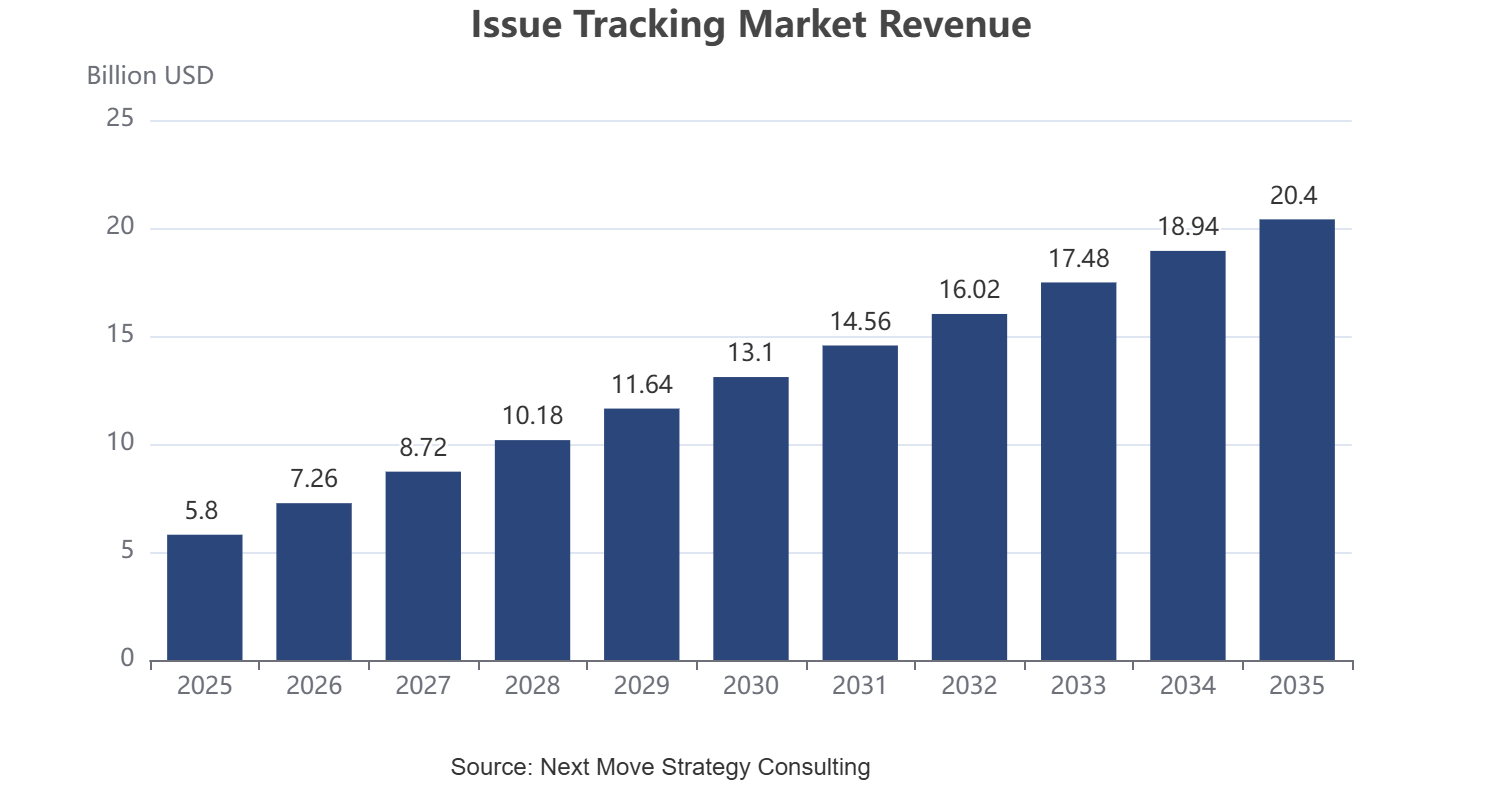
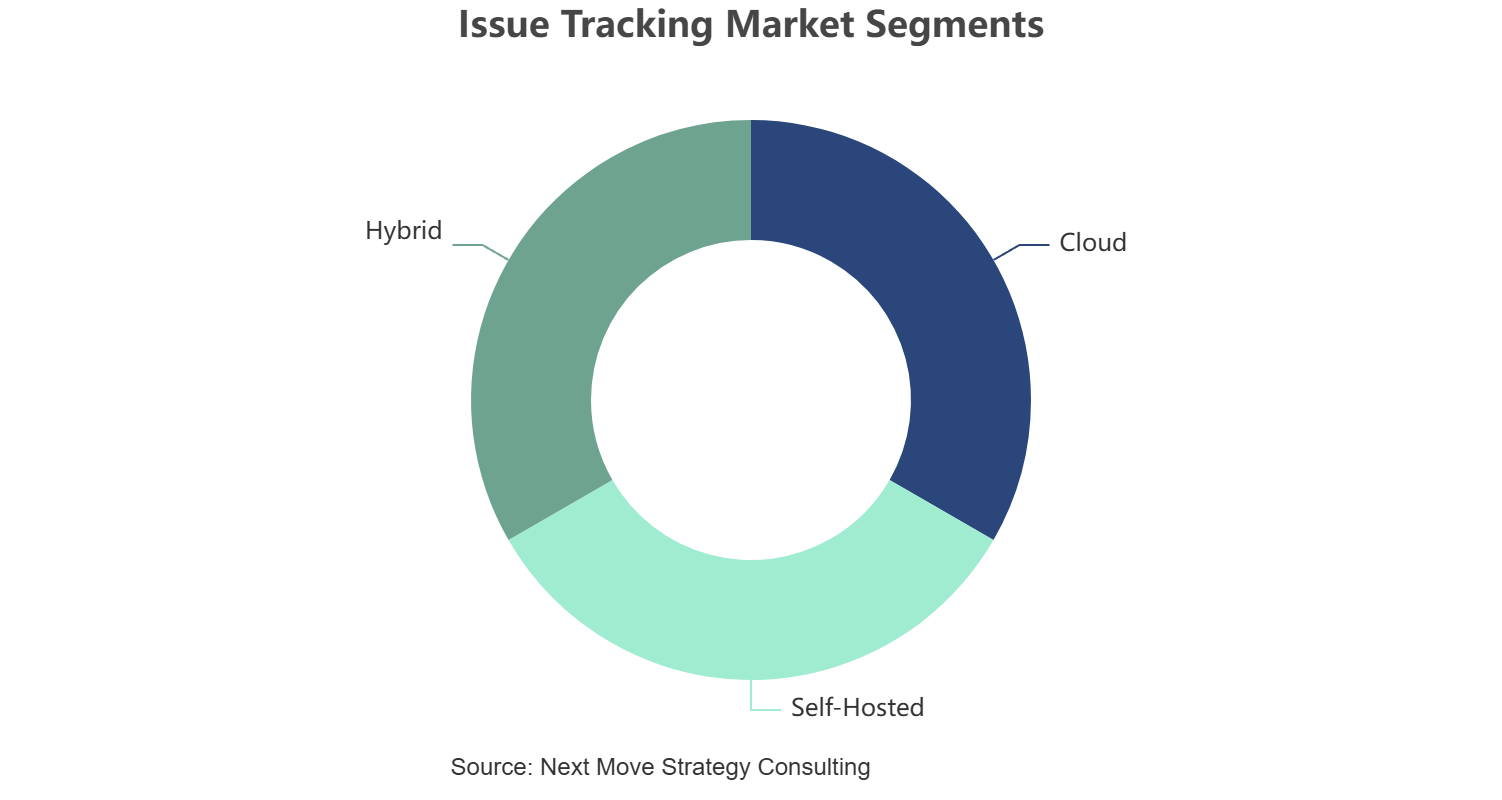
About the Author
 Liza Phukan
— Liza Phukan is Research Associate at Next Move Strategy Consulting, where she has covered emerging industries and market research across sectors for 3.5 years. Her work includes analyzing industry developments, validating market data, and developing structured business content from research findings. She uses secondary research and data-validation practices to turn complex market information into clear decision-useful market analysis for business audiences and support report development and B2B.
Liza Phukan
— Liza Phukan is Research Associate at Next Move Strategy Consulting, where she has covered emerging industries and market research across sectors for 3.5 years. Her work includes analyzing industry developments, validating market data, and developing structured business content from research findings. She uses secondary research and data-validation practices to turn complex market information into clear decision-useful market analysis for business audiences and support report development and B2B.
About the Reviewer
 Supradip Baul
— Supradip Baul is an accomplished business consultant and strategist with over a decade of rich experience in market intelligence, strategy, technology, and business transformation. His work has included rigorous qualitative and quantitative analysis across multiple industries, helping clients shape investment decisions and long-term roadmaps. Earlier in his career, he was associated with Gartner, where he contributed to industry-leading reports and market share analyses. He has worked with leading global companies and holds an MBA with a dual specialization in Marketing and Finance.
Supradip Baul
— Supradip Baul is an accomplished business consultant and strategist with over a decade of rich experience in market intelligence, strategy, technology, and business transformation. His work has included rigorous qualitative and quantitative analysis across multiple industries, helping clients shape investment decisions and long-term roadmaps. Earlier in his career, he was associated with Gartner, where he contributed to industry-leading reports and market share analyses. He has worked with leading global companies and holds an MBA with a dual specialization in Marketing and Finance.
At Next Move Strategy Consulting, we understand that insightful market research is the cornerstone of successful business decisions. That's why we employ a robust and multifaceted approach, combining various methodologies to deliver the most accurate and actionable data for our clients.

Research Landscape
We navigate the world of research with two primary approaches:
Qualitative Approach
Our qualitative research methodologies involve immersive techniques such as in-depth interviews, focus groups, and observational studies. By engaging directly with individuals and stakeholders, we uncover valuable insights that quantitative data alone may overlook.

Quantitative Research
In tandem with qualitative methodologies, NMSC leverages the power of Quantitative Research to provide a robust foundation of numerical insights. Through systematic data collection and analysis, we quantify patterns, preferences, and market trends, offering a comprehensive view of the business landscape.
Our quantitative research approach employs diverse tools, including surveys, experiments, and statistical modelling. These methodologies enable us to gather data from a large and representative sample, ensuring the statistical significance of our findings. By employing structured questionnaires and standardized data collection methods, we guarantee the reliability and validity of the information we present to our clients.
Quantitative research is particularly effective in measuring the prevalence of trends, assessing market size, and gauging the impact of various factors on consumer behavior. The numerical precision attained through this approach equips our clients with actionable insights, facilitating data-driven decision-making and strategy formulation.


Our Specialized Toolbox for Industry-Specific Market Research
We deploy a specialized arsenal of techniques tailored to meet your unique requirements. Here's a glimpse into our comprehensive toolbox:

Information Procurement
The stage entails acquiring market data or relevant information through various sources and methodologies.


Market Research Approach
We utilize both top-down and bottom-up approaches in market research analysis to achieve a comprehensive understanding of the market dynamics, leveraging the broad perspective of industry trends and macroeconomic factors alongside detailed insights from specific segments and individual companies.

Porters Five Forces Analysis
We conduct Porter's Five Forces analysis to evaluate the competitive landscape of an industry, providing us with insights into factors that affect profitability and strategic positioning.

SWOT Analysis

Forecasting
We utilize a forecasting model to predict future consumption by considering parameters like population, economics, regulations, market competition, drivers, constraints, technology, and pricing. We also employ statistical techniques such as multilinear regression, exponential smoothing, moving average, ARIMA, and Monte Carlo simulations for accurate predictions. In econometric forecasting, we analyzed short-term and long-term event impacts, attributing values based on regulatory frameworks, economic factors, and market events.





 Speak to Our Analyst