Radio Frequency Identification Label Market Size, Share, Growth & Forecast By Product Form (Finished Smart Labels, Finished Smart Tags), By Operating Frequency Band (UHF, High Frequency and NFC, Low Frequency, Others, By Substrate Material (Paper Material, Polymer Material, Textile Material, Others), By Conversion State (Blank Convertible Label, Others), By End Use Industry (Retail Apparel, Others), By Sales Channel (Direct Sales Channel, Indirect Sales Channel) — Global Analysis, 2025–2035
Industry: ICT & Media | Publishing Date: July 8, 2026 | Last Updated: September 30, 2026 | No of Pages: N/A | No. of Tables: N/A | No. of Figures: N/A | Format: PDF | Report Code: IC5015
What Is the Radio Frequency Identification Label Market Size?
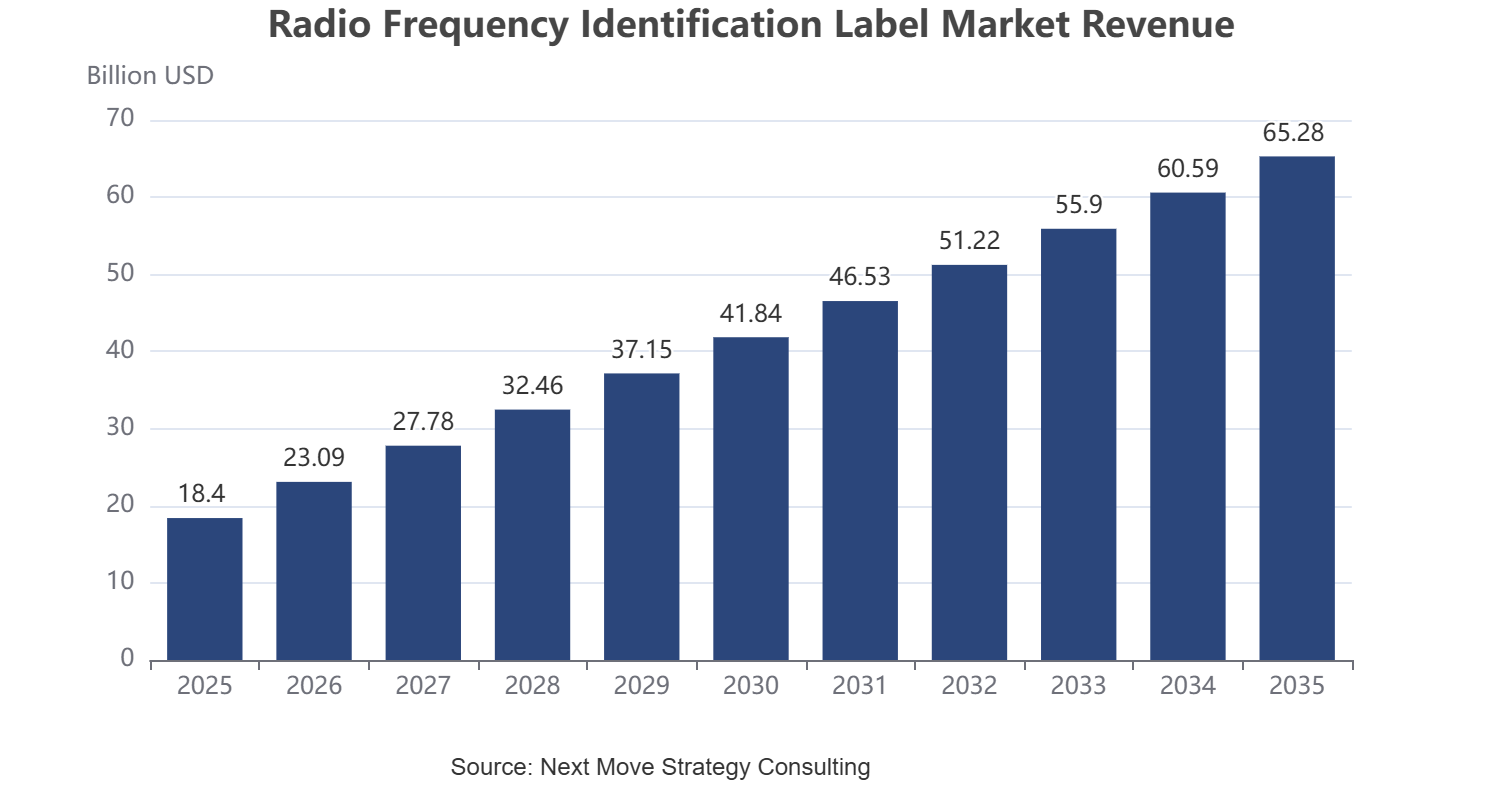
The Radio Frequency Identification Label Market was valued at USD 18.4 billion in 2025 and is expected to reach USD 20.88 billion in 2026. Expanding retail apparel item-level tagging mandates, rising logistics and parcel volume, pharmaceutical traceability regulation, and the EU's Digital Product Passport requirements for textiles are collectively projected to expand the market to USD 65.28 billion by 2035, advancing at a CAGR of 13.5% from 2026 to 2035. Additional growth demand stems from grocery and fresh food RFID adoption and the proliferation of NFC-enabled smart packaging across consumer brands.
|
Parameters |
Details |
|
Market Size in 2025 |
USD 18.4 Billion |
|
Market Size in 2026 |
USD 20.88 Billion |
|
Revenue Forecast in 2035 |
USD 65.28 Billion |
|
Growth Rate |
CAGR of 13.5% from 2026 to 2035 |
|
Analysis Period |
2025–2035 |
|
Base Year Considered |
2025 |
|
Forecast Period |
2026–2035 |
|
Market Size Estimation |
USD Billion |
|
Companies Profiled |
20 |
|
Countries Covered |
33 |
|
Market Share |
Top 10 |
Radio Frequency Identification Label Market Overview
What Does the Radio Frequency Identification Label Market Report Cover?
This RFID Label Market report covers RFID inlays, finished pressure-sensitive and durable labels, security labels, smart packaging labels, hang tags, source tags, returnable asset tags, and tickets across UHF, HF, NFC, dual frequency, and LF technologies. From our research, we found that the Market revenue and demand are increasingly concentrated in item-level apparel tagging, fresh food inventory labels, and pharmaceutical serialization labels, with paper, PET, and textile substrates serving distinct end-use requirements documented throughout this market report.
How Has the Radio Frequency Identification Label Market Evolved Structurally?
The RFID Label Market has progressed through three structural phases. The first phase centred on case- and pallet-level UHF tagging for logistics and warehouse management. The second phase introduced source tagging at the apparel manufacturing stage to support loss prevention and inventory counts. NMSC's analysis indicates that the current phase is defined by item-level tagging embedded directly into garment care labels and price tickets at the point of manufacture, alongside the emergence of NFC-enabled smart packaging that connects physical products to digital product identities for traceability, authentication, and consumer engagement.
How Does the Regulatory Environment Shape the Market?
Regulatory frameworks are increasingly shaping RFID Label Market demand. The European Union's Ecodesign for Sustainable Products Regulation, which entered into force in July 2024, mandates Digital Product Passports for textiles sold in the EU, with industry groups identifying RFID as a candidate data carrier method for capturing the required lifecycle information. The U.S. Food and Drug Administration's Drug Supply Chain Security Act enhanced drug distribution security requirements, compelling pharmaceutical manufacturers and distributors to adopt unit-level traceability technologies. Our assessment indicates that these regulatory mandates are converting RFID labelling from a discretionary efficiency tool into a baseline compliance requirement across apparel and pharmaceutical supply chains.
How Is Technology Adoption Advancing Within the Radio Frequency Identification Label Market?
Technology adoption within the RFID Label Market is accelerating as UHF inlay costs decline and read accuracy improves across high-throughput retail and logistics environments. Based on our market evaluation, we noticed that label converters are integrating flexible printed circuit chips and sensor-enabled inlays to extend RFID into fresh food categories that traditional rigid chip designs could not economically serve. NFC adoption is expanding beyond payment and access control into smart packaging applications that let consumers tap products for authentication and product information, broadening the Market technology stack considerably beyond its retail inventory origins.
|
Key Takeaways |
|
By product form, Inlays held the largest share at USD 7.50 billion in 2025, forecast to reach USD 25.50 billion by 2035. Tags and Tickets is the fastest-growing product form at a CAGR of 14.3% from 2026 to 2035, advancing from USD 3.30 billion in 2025 to USD 12.60 billion by 2035, driven by returnable asset tag adoption across logistics networks. |
|
By technology, UHF is the dominant technology segment at USD 11.20 billion in 2025, holding the largest share. NFC is the fastest-growing technology at a CAGR of 16.4%, rising from USD 2.40 billion in 2025 to USD 10.95 billion by 2035, reflecting expanding smart packaging and consumer engagement applications. |
|
By substrate, Paper commanded the largest substrate share at USD 7.40 billion in 2025. Metal Mount is the fastest-growing substrate at a CAGR of 16.3% from 2026 to 2035, advancing from USD 1.35 billion in 2025 to USD 6.10 billion by 2035, driven by industrial and asset tracking demand for on-metal tag durability. |
|
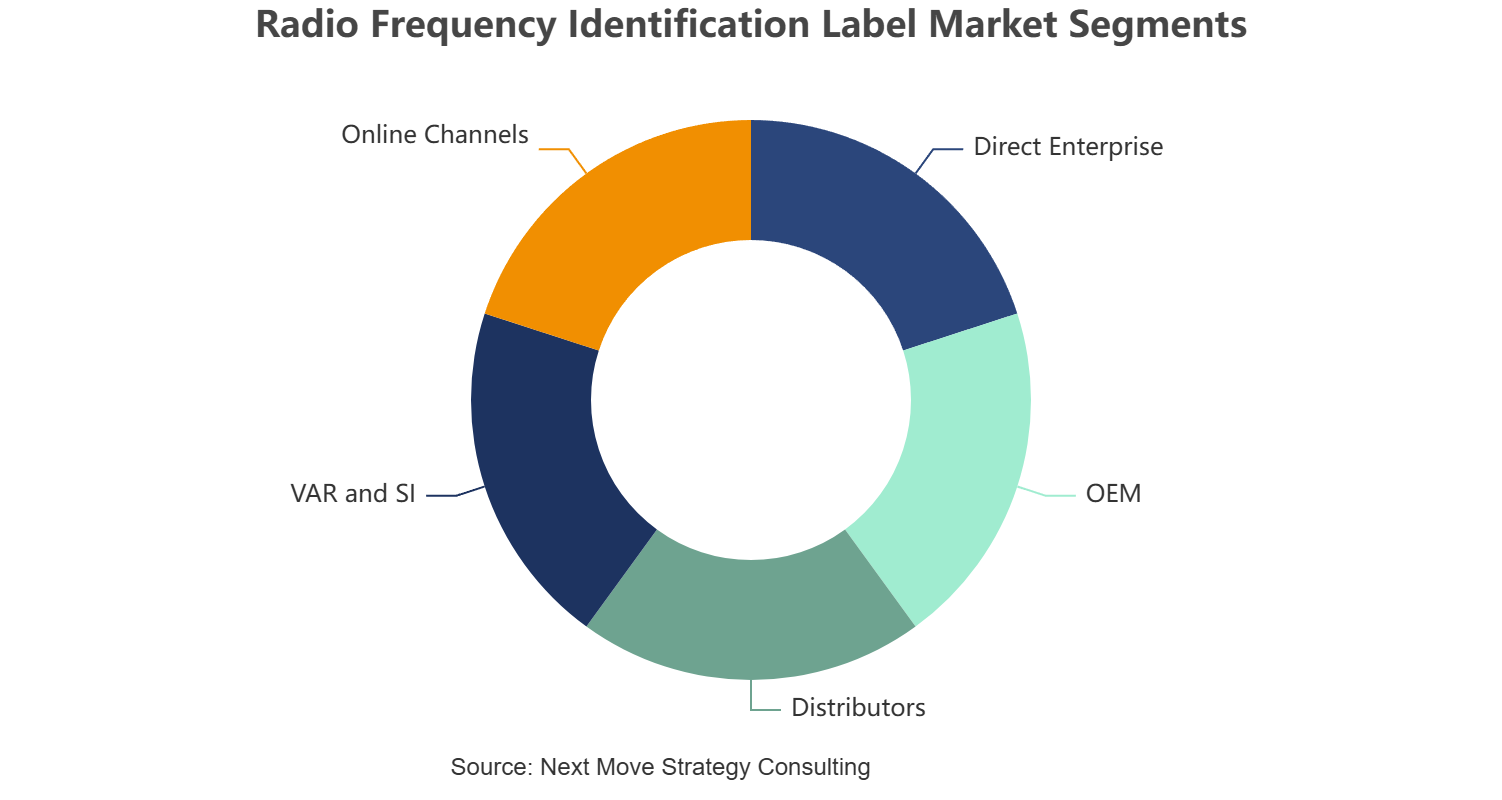
By distribution channel, Direct Enterprise dominates at USD 7.60 billion in 2025, the largest channel category. VAR and SI is the fastest-growing channel at a CAGR of 16.2%, climbing from USD 1.70 billion in 2025 to USD 7.65 billion by 2035 as RFID deployments require deeper systems integration expertise. |
|
By end use, Retail Apparel leads at USD 6.20 billion in 2025, representing approximately 34%. Healthcare and Pharmaceuticals are the fastest-growing end use at a CAGR of 15.8%, advancing from USD 1.85 billion in 2025 to USD 8.00 billion by 2035, driven by serialization and traceability mandates. |
|
North America held the largest regional share at USD 6.80 billion in 2025, projected to reach USD 22.40 billion by 2035. The Middle East and Africa are the fastest-growing regions at a CAGR of 15.0% from 2026 to 2035, while Asia-Pacific is the fastest-growing major region at a CAGR of 14.7%. |
|
The United States is the single largest country market, representing approximately 79% of North American revenue in 2025, underpinned by large-scale retail item-level tagging programs and the global headquarters of Avery Dennison and Zebra Technologies. India is among the fastest-growing national markets in Asia-Pacific, propelled by expanding retail modernization and pharmaceutical traceability adoption. |
Key Emerging Trends in the Radio Frequency Identification Label Industry
How Is Fresh Food RFID Tagging Reshaping Grocery Retail in the Radio Frequency Identification Label Market?
Sensor-enabled RFID labels are extending into fresh food categories that traditional rigid-chip inlays could not economically or physically support, creating a structurally new demand layer. Our analysis of enterprise deployments across North America indicates that Avery Dennison and Walmart's October 2025 collaboration introduced first-of-its-kind sensor technology, bringing RFID-enabled labels to the meat department, following earlier expansion into bakery and deli categories. This deployment demonstrates how label converters are engineering flexible, low-cost inlays specifically for high-humidity, short-shelf-life fresh food environments, expanding the RFID Label Market adoption beyond its traditional apparel and general merchandise base.
How Is the EU Digital Product Passport Driving Textile RFID Adoption?
The European Union's Ecodesign for Sustainable Products Regulation is reshaping textile labelling requirements, with industry groups identifying RFID as a candidate data carrier capable of capturing the lifecycle information mandated under forthcoming Digital Product Passport rules. Through NMSC's assessment, we found that the European Commission's ESPR Working Plan has prioritized textiles as a first-wave sector, with delegated acts expected by 2027 and compliance phasing in over the following 18 to 36 months. Brands and converters are piloting RFID-based traceability ahead of finalized rules, positioning the Radio Frequency Identification Label Market as a structural beneficiary of European sustainability and circularity regulation.
How Is NFC-Enabled Smart Packaging Expanding Consumer Engagement Use Cases in the Radio Frequency Identification Label Market?
NFC labels are moving beyond access control and payment into consumer-facing smart packaging that lets shoppers tap a product to access authentication, provenance, and usage information directly from their smartphone. Based on our market assessment, we observed that Avery Dennison's February 2026 integration of Pragmatic Semiconductor's flexible NFC chip technology represents a first-to-market mass-scale deployment of flexible integrated circuits within its inlay portfolio. This innovation is lowering the cost barrier for embedding NFC into everyday packaged goods, creating new demand among beauty, wine and spirits, and personal care brands seeking direct digital engagement with consumers.
How Is Ambient IoT Convergence Changing the Competitive Boundary of the Radio Frequency Identification Label Market?
Ambient IoT technology, which embeds battery-free sensing and connectivity directly into low-cost labels, is converging with traditional RFID labeling to create a new category of intelligent, sensor-enabled tags. Our findings suggest that Avery Dennison's expanded partnership with Wiliot, reinforced by an April 2026 strategic investment to scale physical AI for supply chains, signals that leading market participants are positioning ambient IoT as a complementary growth avenue rather than a competing technology. This convergence is blurring the boundary between passive identification labels and active sensing infrastructure across retail and logistics supply chains.
What Are the Key Market Drivers, Breakthroughs, and Investment Opportunities That Will Shape the Radio Frequency Identification Label Industry in the Next Decade?
|
Drivers / Trends / Restraints |
(+/-) % Impact on CAGR Forecast |
Geographic Relevance |
Impact Timeline |
|
Retail Apparel Item-Level Tagging Expansion |
+2.0% |
North America, Europe, APAC |
2025–2032 |
|
Pharmaceutical Traceability and Serialization Mandates |
+1.6% |
North America, Europe |
2025–2030 |
|
EU Digital Product Passport for Textiles |
+1.3% |
Europe |
2026–2030 |
|
Fresh Food and Grocery RFID Expansion |
+1.1% |
North America, Europe |
2026–2032 |
|
NFC Smart Packaging for Consumer Engagement |
+0.9% |
Global |
2026–2035 |
|
Chip Supply Constraints and Component Cost Volatility |
-0.8% |
Global |
Ongoing |
|
Fragmented Read Infrastructure Limiting Full ROI Realization |
-0.6% |
Emerging markets globally |
Ongoing |
|
Recyclability and Sustainable Materials Compliance Pressure |
-0.4% |
Europe, North America |
Ongoing |
|
Emerging Market Retail Modernization Creating Greenfield Demand |
+1.4% |
APAC, MEA, LATAM |
2026–2035 |
|
Ambient IoT and Sensor-Enabled Label Convergence |
+1.0% |
North America, Europe |
2026–2035 |
What Are the Growth Drivers of the Radio Frequency Identification Label Market?
How Is Retail Apparel Item-Level Tagging Driving RFID Growth?
Large-scale retail item-level tagging programs are the single most consequential structural driver, as major apparel retailers require source tagging at the point of manufacture to support inventory accuracy and loss prevention. From our research, we found that Avery Dennison's collaboration with Walmart and Kroger to expand RFID into general merchandise and grocery categories illustrates how retail-driven mandates cascade through entire supplier networks, compelling thousands of vendors to adopt RFID labeling as a condition of doing business. This retailer-led demand creation model continues to expand the addressable apparel and general merchandise base for market vendors.
How Are Pharmaceutical Traceability Mandates Accelerating RFID Label Market Demand?
Regulatory requirements for unit-level pharmaceutical traceability are creating durable, non-discretionary demand for serialized RFID and NFC labels across the healthcare supply chain. Based on NMSC's research, we found that the U.S. Food and Drug Administration's Drug Supply Chain Security Act enhanced drug distribution security requirements compel manufacturers, repackagers, wholesale distributors, and dispensers to verify product at the package level, supporting the adoption of RFID and NFC-enabled track-and-trace labels. This regulatory mandate, combined with growing counterfeit medication concerns, is driving sustained reinvestment in pharmaceutical-grade Radio Frequency Identification Label Market capabilities across manufacturers and packaging converters.
How Is the EU Digital Product Passport Fueling the Market Trends?
The European Union's Ecodesign for Sustainable Products Regulation is creating forward-looking demand for RFID-enabled textile labeling as brands prepare for mandatory Digital Product Passport compliance. Through our market assessment, we observed that the European Commission's ESPR framework, in force since July 2024, has prioritized textiles among its first-wave product categories, with delegated acts expected by 2027 defining exact data carrier requirements. This regulatory trajectory, combined with brand-led traceability pilots already underway, is converting RFID-based textile identification from an early adopter initiative into an anticipated compliance requirement, reinforcing durable market growth across European apparel supply chains.
What Are the Growth Inhibitors of the Radio Frequency Identification Label Market?
How Do Chip Supply Constraints Limit Market Scalability?
Market production depends on a concentrated base of semiconductor suppliers manufacturing the integrated circuits embedded within inlays, creating exposure to component cost volatility and capacity constraints during periods of broader semiconductor demand growth. The U.S. National Institute of Standards and Technology has published guidance on semiconductor supply chain resilience, noting that specialized chip categories can experience extended lead times during periods of constrained foundry capacity. Our analysis shows that label converters have responded by qualifying multiple chip suppliers and pursuing flexible printed circuit alternatives, though near-term cost pressure continues to affect price-sensitive, high-volume apparel and general merchandise applications.
How Does Fragmented Read Infrastructure Constrain Radio Frequency Identification Label Market ROI Realization?
Many retailers and logistics operators that have adopted RFID labeling have not yet deployed reader infrastructure broadly enough across stores, distribution centers, and point-of-sale environments to fully capture the inventory accuracy and loss prevention benefits the technology can deliver. Our findings suggest that this infrastructure gap creates a multi-year lag between initial label adoption and full return on investment realization, particularly among mid-market retailers with limited capital budgets for fixed and handheld reader deployment. This restraint disproportionately affects smaller market buyers that adopt tagging to meet supplier mandates without immediately upgrading their own internal read infrastructure.
What Are the Growth Opportunities in the Radio Frequency Identification Label Industry?
How Does Emerging Market Retail Modernization Create a Structural Opportunity?
Rapidly modernizing retail and logistics sectors across Asia-Pacific, the Middle East, and Latin America are creating significant greenfield demand within the RFID Label Market as regional retailers adopt item-level inventory technology for the first time. India's Ministry of Electronics and Information Technology has documented expanding retail technology adoption tied to organized retail growth and digital commerce expansion. Our assessment indicates that retailers and logistics operators entering RFID adoption in these high-growth regions frequently lack established domestic label converting capacity, creating direct procurement opportunities for global market vendors with regional manufacturing and distribution presence.
How Does Fresh Food and Grocery Expansion Create a High-Growth Radio Frequency Identification Label Market Opportunity?
The extension of RFID labeling into fresh food categories, including bakery, meat, deli, and produce, represents a substantial untapped opportunity for vendors capable of engineering sensor-enabled, low-cost inlays suited to high-humidity, short-shelf-life environments. NMSC's analysis indicates that Avery Dennison's February 2026 launch of its AD IdentiFresh inlay series, following its 2025 grocery deployments with Walmart and Kroger, demonstrates the commercial opportunity vendors are pursuing as grocery retailers seek the same inventory accuracy and waste reduction benefits long realized in general merchandise and apparel categories.
How Does Ambient IoT Convergence Expand Radio Frequency Identification Label Market Opportunities?
The convergence of passive RFID labelling with ambient IoT sensing technology is opening a substantial adjacent opportunity for market vendors to capture incremental value from temperature, location, and condition monitoring embedded within the same low-cost label form factor. Based on our market evaluation, we noticed that Avery Dennison's expanded partnership and strategic investment in Wiliot demonstrate how leading converters are positioning battery-free ambient sensing as a natural extension of their inlay manufacturing scale and retail distribution relationships, creating cross-sell opportunities across cold chain logistics, pharmaceutical, and perishable food applications previously underserved by passive identification labels alone.
How Is the Radio Frequency Identification Label Industry Segmented in This Market Report, and What Are the Key Insights from the Segmentation Analysis?
How Does Product Form Segmentation Reveal the Structural Composition of the Radio Frequency Identification Label Market?
|
Product Form |
2025 (USD Bn) |
2035 (USD Bn) |
CAGR (%) |
|
Inlays |
7.50 |
25.50 |
13.0% |
|
Labels |
6.80 |
24.80 |
13.8% |
|
Tags and Tickets |
3.30 |
12.60 |
14.3% |
|
Other Product Forms |
0.80 |
2.38 |
11.5% |
Based on our analysis of enterprise procurement patterns, we observed that the market spans Inlays, Labels, Tags and Tickets, and Other Product Forms. Inlays, encompassing dry, wet, and specialty variants, hold the largest segment share as the foundational chip-and-antenna component underlying nearly every finished RFID product. Labels, including pressure-sensitive, durable, on metal, security, and smart packaging variants, represent the largest finished-product category given their direct integration into retail and brand packaging workflows. Tags and Tickets, spanning hang tags, source tags, returnable asset tags, and tickets, is the fastest-growing product form as logistics networks expand returnable asset tracking programs and apparel source tagging volumes continue to rise across global supply chains.
Which RFID Technologies Are Generating the Most Radio Frequency Identification Label Market Revenue?
|
Technology |
2025 (USD Bn) |
2035 (USD Bn) |
CAGR (%) |
|
UHF |
11.20 |
39.80 |
13.5% |
|
HF |
3.60 |
11.90 |
12.7% |
|
NFC |
2.40 |
10.95 |
16.4% |
|
Dual Frequency |
0.85 |
2.20 |
10.0% |
|
LF |
0.35 |
0.43 |
2.1% |
Through NMSC's assessment, we found that the market is segmented by technology into UHF, HF, NFC, Dual Frequency, and LF categories. UHF holds the dominant technology share, reflecting its established role in retail apparel, general merchandise, and logistics item-level tagging at read ranges suited to high-throughput supply chain environments. NFC is the fastest-growing technology as smart packaging and consumer engagement applications expand across beauty, wine, and personal care brands. HF retains a substantial share supporting library, access control, and certain healthcare applications, while LF remains a small, slow-growing legacy category serving niche animal tracking and access applications.
Which Substrate Materials Dominate the Radio Frequency Identification Label Market Production?
|
Substrate |
2025 (USD Bn) |
2035 (USD Bn) |
CAGR (%) |
|
Paper |
7.40 |
24.60 |
12.8% |
|
PET |
4.60 |
16.80 |
13.8% |
|
Textile |
2.30 |
9.40 |
15.1% |
|
PP |
1.55 |
5.20 |
12.9% |
|
Metal Mount |
1.35 |
6.10 |
16.3% |
|
PVC |
0.85 |
2.45 |
11.2% |
|
Other Materials |
0.35 |
0.73 |
7.6% |
Our findings suggest that the market is segmented by substrate into Paper, PET, Textile, PP, Metal Mount, PVC, and Other Materials categories. Paper holds the largest substrate share, reflecting its cost-effectiveness and compatibility with high-volume apparel and general merchandise label printing workflows. Metal Mount is the fastest-growing substrate as industrial and asset tracking applications require durable on-metal tags capable of surviving harsh manufacturing and warehouse environments. Textile substrates are growing rapidly as woven and sewn RFID labels gain adoption within garment care labels, supported by the EU Digital Product Passport regulatory trajectory described elsewhere in this market report.
How Are Distribution Channels Shaping Go-to-Market Strategies in the Radio Frequency Identification Label Market?
|
Distribution Channel |
2025 (USD Bn) |
2035 (USD Bn) |
CAGR (%) |
|
Direct Enterprise |
7.60 |
25.80 |
13.0% |
|
Distributors |
5.20 |
17.90 |
13.2% |
|
OEM |
3.10 |
10.85 |
13.4% |
|
VAR and SI |
1.70 |
7.65 |
16.2% |
|
Online Channels |
0.80 |
3.08 |
14.4% |
NMSC's analysis indicates that the market is segmented by distribution channel into Direct Enterprise, Distributors, OEM, VAR, and SI, and Online Channels. Direct Enterprise commands the largest channel share, reflecting large retailers and logistics operators that negotiate volume label supply agreements directly with manufacturers. VAR and SI are the fastest-growing channels as RFID deployments increasingly require systems integration expertise spanning labeling, reader infrastructure, and middleware software. Distributors remain a substantial channel serving mid-market and regional converters, while Online Channels are growing fastest in relative percentage terms as smaller brands procure standardized inlay and tag products through e-commerce platforms.
Which End Use Industries Generate the Most Radio Frequency Identification Label Market Demand?
|
End Use |
2025 (USD Bn) |
2035 (USD Bn) |
CAGR (%) |
|
Retail Apparel |
6.20 |
20.40 |
12.6% |
|
Retail General Merchandise |
2.90 |
9.60 |
12.7% |
|
Logistics and Parcel |
2.60 |
10.20 |
14.6% |
|
Healthcare and Pharmaceuticals |
1.85 |
8.00 |
15.8% |
|
Industrial and Asset Tracking |
1.65 |
6.50 |
14.7% |
|
Food and Beverage |
1.10 |
3.90 |
13.5% |
|
Automotive |
0.85 |
2.95 |
13.3% |
|
Library and Education |
0.55 |
1.30 |
9.0% |
|
Access Control and Events |
0.45 |
1.60 |
13.5% |
|
Other End Uses |
0.25 |
0.83 |
12.8% |
Our analysis shows that the market serves Retail Apparel, Retail General Merchandise, Logistics and Parcel, Healthcare and Pharmaceuticals, Industrial and Asset Tracking, Food and Beverage, Automotive, Library and Education, Access Control and Events, and Other End Uses. Retail Apparel holds the largest end-use share, reflecting the scale of item-level source tagging programs across global apparel supply chains. Healthcare and Pharmaceuticals is the fastest-growing end uses, driven by unit-level traceability and serialization mandates. Logistics, Parcel, and Industrial and Asset Tracking represent substantial, fast-growing categories as returnable asset tracking and parcel volume continue to expand across global supply chains.
Supply Chain Analysis of the Radio Frequency Identification Label Industry
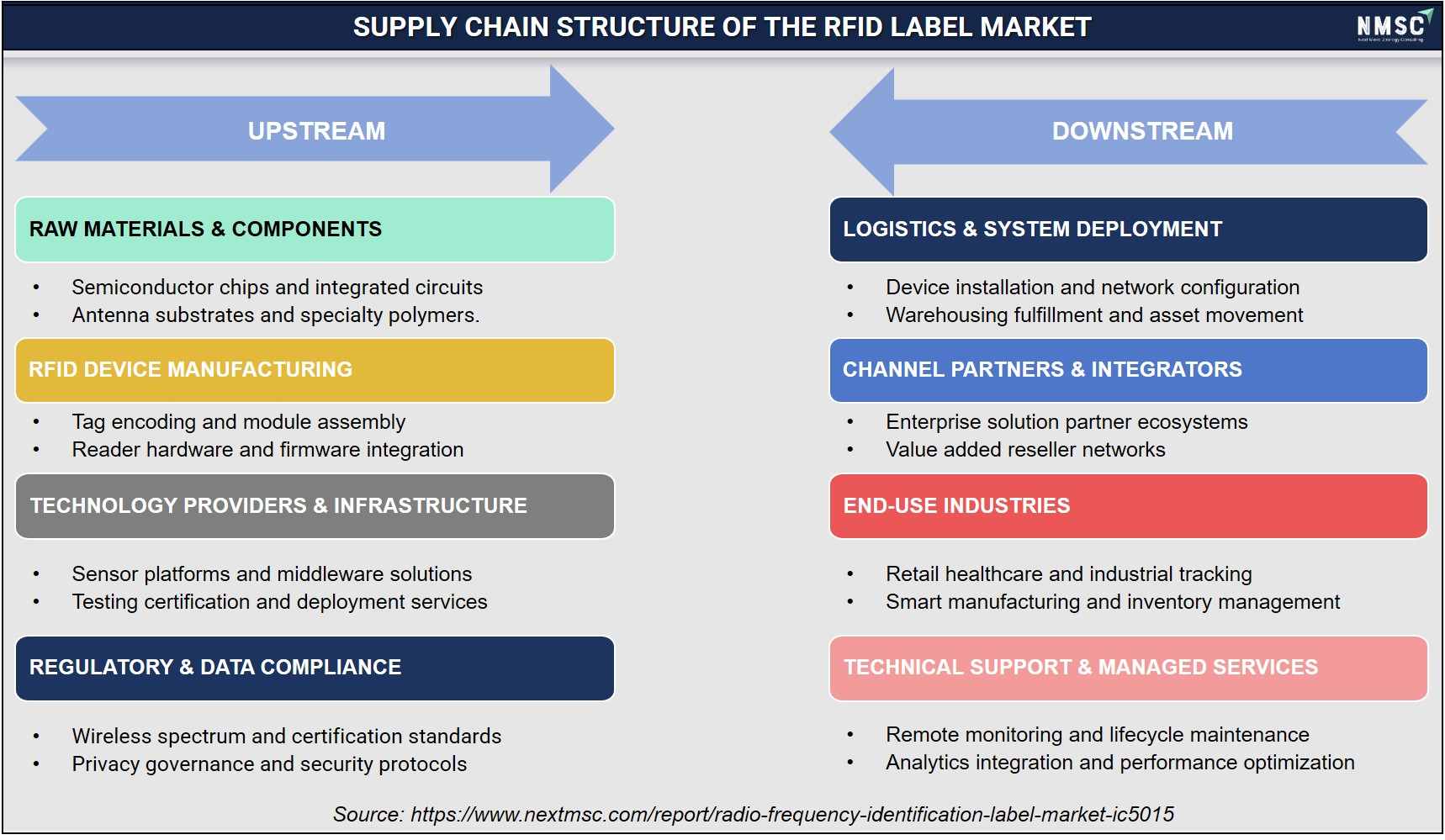
The above infographic presents the supply chain structure of the RFID label market, segmented into upstream and downstream activities. Upstream begins with semiconductor chips, antenna substrates, and polymers, moving into tag encoding, module assembly, and reader integration. Further, we noticed that technology providers supply middleware and testing services, while compliance ensures wireless spectrum and privacy standards. Moving downstream, system deployment and warehousing enable efficient distribution through enterprise partners and resellers to retail, healthcare, and manufacturing sectors. Looking ahead, we observed that after-sales remote monitoring, lifecycle maintenance, and analytics integration collectively ensure long-term system reliability across the market.
Regional Outlook
Radio Frequency Identification Label Market Geographic Performance Snapshot
|
Region |
2025 (USD Bn) |
2035 (USD Bn) |
CAGR (%) |
Key Driver |
|
North America |
6.80 |
22.40 |
12.7% |
Retail item-level tagging, vendor headquarters concentration |
|
Europe |
4.60 |
15.80 |
13.1% |
EU Digital Product Passport, sustainability-driven labeling |
|
Asia-Pacific |
5.40 |
21.30 |
14.7% |
Manufacturing base, retail modernization, expanding logistics |
|
Middle East & Africa |
0.95 |
3.85 |
15.0% |
Retail modernization, government digital economy programs |
|
Latin America |
0.65 |
1.93 |
11.5% |
Retail and logistics digitization, ecommerce growth |
North America Radio Frequency Identification Label Market
North America is the largest regional Radio Frequency Identification Label Market, contributing USD 6.80 billion in 2025 and forecast to reach USD 22.40 billion by 2035 at a CAGR of 12.7%. The region hosts the global headquarters of Avery Dennison, Zebra Technologies, Checkpoint Systems, and Brady Corporation, alongside the world's largest retail item-level tagging programs led by major apparel and grocery retailers. FDA traceability requirements for pharmaceuticals and large-scale retailer mandates sustain non-discretionary label procurement. North America's retail and logistics segments represent the most mature Radio Frequency Identification Label Market buyers, with multi-year supply agreements spanning apparel, general merchandise, and expanding fresh food categories.
United States Radio Frequency Identification Label Industry
Based on our engagements with retail and logistics teams across North America, the United States represents approximately 79% of North American Radio Frequency Identification Label Market revenue in 2025. The U.S. benefits from the world's highest concentration of RFID label manufacturers, the deepest retail item-level tagging penetration, and active FDA enforcement of pharmaceutical traceability requirements under the Drug Supply Chain Security Act. Walmart and Kroger's expanding RFID programs across general merchandise and grocery categories have institutionalized supplier-level tagging mandates, sustaining structural demand for inlays, labels, and tags across every major U.S. retail and logistics vertical.
Canada Radio Frequency Identification Label Industry
Through our analysis, Canada accounts for approximately 14% of the North American Radio Frequency Identification Label Market revenue in 2025. Canadian retailers and logistics operators increasingly mandate RFID labeling within supplier contracts, consistent with practices established by U.S.-headquartered global retailers operating across the border. Health Canada's oversight of pharmaceutical distribution reinforces traceability expectations relevant to healthcare labeling. Canada's concentrated retail and logistics landscape creates efficient channels for Radio Frequency Identification Label Market vendors to reach a large share of national demand through a relatively small number of major retail relationships.
Mexico Radio Frequency Identification Label Industry
From our assessment, Mexico is the fastest-growing Radio Frequency Identification Label Market within North America. Mexico's expanding manufacturing and nearshoring sectors, growing retail modernization, and proximity to major U.S. apparel and logistics supply chains are generating new demand for inlays, labels, and tags among regional converters and exporters. Avery Dennison's Querétaro RFID innovation facility, supported by a USD 100 million investment, anchors significant regional manufacturing capacity. Mexico's growing nearshore manufacturing base creates incremental demand for industrial and asset tracking labels supporting cross-border supply chain visibility.
Europe Radio Frequency Identification Label Market
Europe is the second-largest regional Radio Frequency Identification Label Market, contributing USD 4.60 billion in 2025 and forecast to reach USD 15.80 billion by 2035 at a CAGR of 13.1%. Europe's regulatory environment, anchored by the Ecodesign for Sustainable Products Regulation and its forthcoming Digital Product Passport requirements for textiles, creates structurally dense demand for RFID-enabled labeling among apparel brands and converters. NMSC's analysis indicates that European brands demonstrate above-average investment in recyclable and sustainable RFID label materials relative to global peers, reflecting the region's comparatively assertive sustainability and circularity regulatory agenda.
UK Radio Frequency Identification Label Industry
Based on our engagements, the United Kingdom represents the largest European Radio Frequency Identification Label Market by national revenue share in 2025. The UK's large apparel retail sector and active sports merchandising industry create concentrated demand for source tagging and licensed product authentication labels. JD Sports' rapid international expansion, supported by Avery Dennison's RFID and digital identification solutions, illustrates how UK retailers are scaling item-level tagging programs across new geographies. UK retailers have been particularly active adopters of supply chain visibility initiatives, mirroring broader European sustainability and traceability expectations.
Germany Radio Frequency Identification Label Industry
According to our evaluation, Germany is the second-largest European Radio Frequency Identification Label Market, anchored by its large automotive, industrial, and retail sectors. German enterprises apply rigorous quality and durability requirements to RFID label selection for industrial asset tracking and automotive component identification applications. Germany's concentrated manufacturing base creates demand for metal mount and specialty inlay labels supporting harsh-environment industrial tracking. Schreiner Group's German headquarters anchors significant domestic specialty labeling capacity serving automotive, industrial, and security label applications across the broader European market.
France Radio Frequency Identification Label Industry
Through our analysis, France is a significant European Radio Frequency Identification Label Market, supported by an active luxury goods, fragrance, and apparel sector pursuing NFC-enabled authentication and traceability labeling. French brands including those in the fragrance and wine sectors have piloted NFC-enabled smart packaging for consumer engagement and counterfeit protection. France's national circular economy and anti-waste legislation reinforces sustainability-driven labeling investment, sustaining steady Radio Frequency Identification Label Market demand growth across luxury, apparel, and food and beverage categories.
Italy Radio Frequency Identification Label Industry
From our assessment, Italy is a growing European Radio Frequency Identification Label Market, with expanding adoption among its large fashion, leather goods, and food and beverage sectors. Italy's strong artisanal and luxury manufacturing base creates demand for premium security and authentication labels protecting brand value and supporting traceability. Italian apparel and accessories brands are increasingly adopting NFC and RFID labeling consistent with broader European Union sustainability and digital product identity expectations, supporting steady growth in Radio Frequency Identification Label Market demand across the country's fashion-forward manufacturing ecosystem.
Spain Radio Frequency Identification Label Industry
According to our evaluation, Spain demonstrates growing Radio Frequency Identification Label Market momentum, driven by an expanding fast-fashion retail base and a growing food and beverage export sector. Spanish apparel retailers are increasingly adopting item-level tagging consistent with broader European retail digitization trends. Spain's growing wine and food export industry creates incremental demand for NFC-enabled authentication and traceability labels, while Spanish converters are expanding RFID label production capacity to serve both domestic retail and export-oriented food and beverage brands.
Sweden Radio Frequency Identification Label Industry
Based on our engagements, Sweden is a mature Northern European Radio Frequency Identification Label Market, with high enterprise adoption of item-level tagging across its globally significant fast-fashion retail sector. Swedish apparel retailers are early adopters of supply chain visibility technologies, reflecting the country's broader reputation for retail innovation. Sweden's advanced digital infrastructure and strong sustainability culture support continued adoption of recyclable RFID label materials across the Nordic apparel and general merchandise retail ecosystem.
Denmark Radio Frequency Identification Label Industry
Through our analysis, Denmark represents a high-maturity Scandinavian Radio Frequency Identification Label Market, with sophisticated enterprise adoption of RFID labeling across retail and logistics sectors. Danish retailers and logistics operators are increasingly procuring sustainable and recyclable RFID labels as sustainability commitments expand across the Danish business community. Denmark's strong design and apparel sector creates demand for premium security and authentication labeling, supporting steady Radio Frequency Identification Label Market growth across the Danish retail and logistics ecosystem.
Finland Radio Frequency Identification Label Industry
From our assessment, Finland is a digitally advanced Nordic Radio Frequency Identification Label Market, with steady adoption across retail, logistics, and industrial asset tracking applications. Finland's strong forest products and industrial manufacturing base create demand for durable, specialty substrate labels suited to harsh industrial environments. Finnish retailers' growing interest in supply chain transparency, combined with the country's broader digital infrastructure maturity, supports continued adoption of RFID and NFC labeling across the national retail and industrial ecosystem.
Netherlands Radio Frequency Identification Label Industry
According to our evaluation, the Netherlands is one of Europe's most active Radio Frequency Identification Label Markets, anchored by a concentration of global apparel brand regional headquarters and logistics operations in Amsterdam and Rotterdam. The Netherlands' role as a major European logistics and distribution hub creates concentrated demand for returnable asset tags and parcel-level identification labels. Dutch apparel brands and converters are active participants in European Digital Product Passport pilot programs, positioning the Netherlands as an early adopter market for next-generation textile traceability labeling.
Rest of Europe Radio Frequency Identification Label Industry
Based on our engagements, the rest of Europe, encompassing Poland, Belgium, Austria, Switzerland, Portugal, Czech Republic, Romania, and other markets, collectively represents a growing segment of the European Radio Frequency Identification Label Market. EU-wide Ecodesign for Sustainable Products Regulation enforcement creates a uniform compliance baseline for textile labeling across all member states. Central and Eastern European markets are experiencing accelerating retail and logistics RFID adoption, while Switzerland's precision manufacturing base and Belgium's logistics hub position create additional pockets of sophisticated Radio Frequency Identification Label Market demand.
Asia-Pacific Radio Frequency Identification Label Market
Asia-Pacific is the fastest-growing major regional Radio Frequency Identification Label Market, contributing USD 5.40 billion in 2025 and forecast to reach USD 21.30 billion by 2035 at a CAGR of 14.7%. The region's growth is driven by China's position as a global RFID manufacturing base, India's rapidly expanding organized retail sector, Japan's mature retail technology adoption, and Southeast Asia's accelerating ecommerce and logistics infrastructure growth. Our assessment indicates that the region's dual role as both a manufacturing hub and a rapidly growing end-market creates distinctive Radio Frequency Identification Label Market dynamics relative to other global regions.
China Radio Frequency Identification Label Industry
Based on our engagements, China is the largest Radio Frequency Identification Label Market within Asia-Pacific, driven by its position as a global manufacturing base for inlays and finished labels alongside a rapidly expanding domestic retail and logistics sector. Domestic converters, including Zhejiang Century RFID Co., operate substantial production capacity serving both export and domestic demand. China's large e-commerce and logistics sector creates structural demand for parcel-level identification labels, while expanding organized retail adoption supports continued growth in apparel and general merchandise tagging.
India Radio Frequency Identification Label Industry
Through our analysis, India is among the fastest-growing national Radio Frequency Identification Label Markets in Asia-Pacific, propelled by its rapidly expanding organized retail sector and growing pharmaceutical export industry. India's Ministry of Electronics and Information Technology has documented sustained growth in domestic retail technology adoption tied to organized retail expansion. India's large pharmaceutical manufacturing and export base creates substantial demand for serialized traceability labels meeting both domestic and international regulatory requirements, while India's growing apparel export sector supports expanding source tagging adoption.
Japan Radio Frequency Identification Label Industry
According to our evaluation, Japan is a mature Asia-Pacific Radio Frequency Identification Label Market, driven by its sophisticated retail technology sector and high enterprise adoption of item-level tagging among major Japanese apparel and convenience retail chains. Japan's Consumer Affairs Agency oversight of product labeling standards reinforces quality expectations for RFID-enabled traceability. Japanese retailers demonstrate strong adoption of NFC-enabled smart packaging, reflecting the country's broader emphasis on consumer-facing digital product information and authentication across its retail ecosystem.
South Korea Radio Frequency Identification Label Industry
From our assessment, South Korea is an advanced Radio Frequency Identification Label Market, characterized by a strong electronics and cosmetics export sector, and adoption of NFC and RFID labeling for authentication and traceability. South Korean cosmetics and beauty brands represent sophisticated buyers of NFC-enabled smart packaging supporting global export authentication requirements. South Korea's advanced logistics infrastructure drives demand for parcel and asset-tracking labels, reflecting the country's globally significant e-commerce and cross-border retail export industries.
Taiwan Radio Frequency Identification Label Industry
Based on our engagements, Taiwan is a growing Radio Frequency Identification Label Market driven by its globally significant electronics manufacturing sector's adoption of asset tracking and component identification labels. Taiwan's semiconductor and electronics manufacturers represent sophisticated buyers of specialty and metal mount substrate labels supporting industrial asset tracking applications. Taiwan's position as a regional electronics export hub creates demand for durable, specialty labeling capable of surviving complex global supply chain logistics.
Indonesia Radio Frequency Identification Label Industry
According to our evaluation, Indonesia is among the fastest-growing Southeast Asian Radio Frequency Identification Label Markets, driven by its large population and rapidly expanding e-commerce and logistics infrastructure. Indonesia's Ministry of Communication and Informatics oversees digital economy standards relevant to logistics technology adoption. Indonesia's expanding organized retail sector and growing e-commerce parcel volume create substantial demand for inlays and tags among both domestic and regional logistics operators entering RFID adoption for the first time.
Vietnam Radio Frequency Identification Label Industry
Through our analysis, Vietnam represents a rapidly emerging Radio Frequency Identification Label Market, driven by its growing apparel manufacturing and export sector. Vietnam's Ministry of Industry and Trade oversees manufacturing and export standards relevant to apparel supply chain labeling. Vietnam's position as a major global apparel manufacturing base creates substantial demand for source tagging labels meeting international retailer requirements, supporting steady Radio Frequency Identification Label Market growth across the country's expanding export manufacturing ecosystem.
Australia Radio Frequency Identification Label Industry
Based on our engagements, Australia is the most mature Radio Frequency Identification Label Market in Oceania, with well-developed retail and logistics adoption of item-level tagging standards. Australian retailers across apparel, general merchandise, and grocery represent sophisticated Radio Frequency Identification Label Market buyers with established supplier tagging mandates. Australia's large logistics and parcel sector creates demand for returnable asset tracking labels, while the country's growing pharmaceutical traceability requirements support expanding healthcare label adoption.
Philippines Radio Frequency Identification Label Industry
From our assessment, the Philippines is an emerging Radio Frequency Identification Label Market, driven by rapid e-commerce adoption and growing logistics infrastructure investment. The Philippine Department of Trade and Industry oversees consumer protection and product labeling standards relevant to retail traceability. The Philippines' expanding BPO and ecommerce sectors are creating new demand for parcel-level identification labels across the country's growing digital logistics ecosystem.
Malaysia Radio Frequency Identification Label Industry
According to our evaluation, Malaysia is a growing Radio Frequency Identification Label Market, driven by the government's MyDIGITAL national digital economy initiative and expanding regional logistics and manufacturing activity. The Malaysian Communications and Multimedia Commission oversees digital economy standards relevant to logistics technology. Malaysia's position as a regional manufacturing and logistics hub creates demand for industrial asset tracking labels supporting regional multinational manufacturing operations across Southeast Asia.
Rest of Asia-Pacific Radio Frequency Identification Label Industry
Based on our engagements, the rest of Asia-Pacific, encompassing New Zealand, Thailand, Singapore, Bangladesh, Sri Lanka, and Pakistan, collectively represents a developing but growing segment of the regional Radio Frequency Identification Label Market. Singapore's position as a regional logistics and trade hub creates sophisticated demand for parcel-level identification labels. Bangladesh and Pakistan's large apparel manufacturing and export base support steady source tagging adoption, while Thailand and the broader Southeast Asian markets experience accelerating ecommerce-driven logistics labeling growth.
Middle East & Africa Radio Frequency Identification Label Market
The Middle East and Africa region is the fastest-growing regional Radio Frequency Identification Label Market at a CAGR of 15.0% from 2026 to 2035, contributing USD 0.95 billion in 2025 and forecast to reach USD 3.85 billion by 2035. Growth is driven by rapidly expanding retail modernization in Saudi Arabia and the UAE, government digital economy programs, and growing logistics infrastructure investment across the region. Our findings suggest that retailers entering organized retail formats across MEA markets for the first time are creating substantial greenfield demand for foundational RFID labeling.
Saudi Arabia Radio Frequency Identification Label Industry
Based on our engagements, Saudi Arabia is the largest Radio Frequency Identification Label Market in the Middle East, driven by Vision 2030's retail and logistics modernization objectives and rapidly expanding organized retail activity. The Saudi Ministry of Commerce oversees consumer protection and product labeling standards relevant to retail traceability. Saudi retailers in apparel and general merchandise are increasingly adopting item-level tagging, supporting the growing Radio Frequency Identification Label Market demand across the country's expanding retail and logistics sector.
UAE Radio Frequency Identification Label Industry
Through our analysis, the UAE is the second-largest Middle Eastern Radio Frequency Identification Label Market, anchored by Dubai's position as a regional retail and logistics hub. The UAE Ministry of Economy oversees consumer protection standards relevant to retail labeling. The UAE's concentration of regional retail headquarters and logistics operations creates demand for enterprise-grade labeling supporting campaigns and parcel flows across the broader Middle East and North Africa region.
Egypt Radio Frequency Identification Label Industry
According to our evaluation, Egypt is an emerging Radio Frequency Identification Label Market within North Africa, driven by growing organized retail and e-commerce logistics activity. Egypt's Ministry of Trade and Industry oversees product labeling and consumer protection standards. Egypt's large population and expanding digital economy, supported by government digital transformation programs, are creating long-term demand for foundational RFID labeling as organized retail and logistics infrastructure continues to expand across the Egyptian market.
Israel Radio Frequency Identification Label Industry
From our assessment, Israel is a technologically advanced Radio Frequency Identification Label Market, supported by its globally significant technology innovation sector. Israeli technology companies represent sophisticated developers and early adopters of RFID and NFC labeling innovation. Several global vendors maintain Israeli research and development operations, supporting continued innovation in chip design and label engineering relevant to the broader global market.
Turkey Radio Frequency Identification Label Industry
Based on our engagements, Turkey is a growing Radio Frequency Identification Label Market, driven by a large textile and apparel manufacturing and export base, and expanding retail modernization. Turkey's Ministry of Trade oversees product labeling and consumer protection standards. Turkish apparel manufacturers are increasingly adopting source tagging to meet international retailer requirements, supporting steady market growth across the country's export-oriented textile manufacturing ecosystem.
Nigeria Radio Frequency Identification Label Industry
Through our analysis, Nigeria is the largest Sub-Saharan African Radio Frequency Identification Label Market, driven by Africa's largest population and growing organized retail and logistics activity. Nigeria's Federal Competition and Consumer Protection Commission oversees product labeling and consumer protection standards. Lagos's growing retail and logistics ecosystem is attracting increased investment in inventory technology, creating new demand for foundational RFID labeling among retailers entering organized retail formats for the first time.
South Africa Radio Frequency Identification Label Industry
According to our evaluation, South Africa is the most mature Sub-Saharan African Radio Frequency Identification Label Market, with established retail and logistics adoption of item-level tagging standards. South Africa's National Consumer Commission oversees product labeling and consumer protection standards. South African retailers across apparel, general merchandise, and grocery represent the region's most sophisticated market buyers, with growing adoption of RFID labeling across major retail chains.
Rest of MEA Radio Frequency Identification Label Industry
Based on our engagements, the rest of the Middle East and Africa, encompassing Kuwait, Qatar, Bahrain, Oman, Morocco, Kenya, Ethiopia, Ghana, and other markets, collectively represents an emerging segment of the regional Radio Frequency Identification Label Market. GCC states' growing retail modernization programs and East African logistics infrastructure expansion are creating new demand for foundational labeling as retailers and logistics operators across these markets expand organized retail and e-commerce adoption.
Latin America Radio Frequency Identification Label Market
Latin America represents a growing regional Radio Frequency Identification Label Market, contributing USD 0.65 billion in 2025 and forecast to reach USD 1.93 billion by 2035 at a CAGR of 11.5%. Growth is driven by Brazil's large apparel and logistics sector, expanding retail digitization across the region, and growing e-commerce parcel volume. Our assessment indicates that retail and logistics digitization represents the primary market demand driver across Latin American markets through the forecast period.
Brazil Radio Frequency Identification Label Industry
Based on our engagements, Brazil is the largest RFID Label Market in Latin America, driven by its large apparel manufacturing sector and expanding logistics infrastructure. Avery Dennison's manufacturing facility in São Paulo state supports regional production capacity serving Brazilian and broader South American demand. Brazilian retailers and logistics operators are adopting item-level RFID labeling at accelerating rates, driven by organized retail expansion and growing cross-border supply chain visibility requirements.
Argentina Radio Frequency Identification Label Industry
Through our analysis, Argentina is a significant market within Latin America, supported by its developed apparel and retail sectors. Argentina's National Consumer Defense Agency oversees product labeling and consumer protection standards. Argentine retailers and apparel manufacturers are active buyers of source tagging and inventory labeling solutions, with growing retail digitization supporting steady market growth despite broader macroeconomic constraints affecting capital budgets.
Chile Radio Frequency Identification Label Industry
According to our evaluation, Chile is a growing Radio Frequency Identification Label Market anchored by its advanced retail sector and growing food and beverage export industry. Chile's National Consumer Service oversees product labeling and consumer protection standards. Chilean retailers represent some of the most digitally sophisticated buyers in Latin America, supporting growing adoption of item-level tagging and NFC-enabled authentication labels across the country's expanding retail and export ecosystem.
Colombia Radio Frequency Identification Label Industry
From our assessment, Colombia is an emerging market within South America, driven by growing e-commerce and apparel manufacturing activity. Colombia's Superintendence of Industry and Commerce oversees product labeling and consumer protection standards. Colombian apparel manufacturers and retailers are increasingly adopting RFID labeling, supporting the growing RFID Label Market demand as organized retail expands across Bogotá's growing retail and logistics ecosystem.
Rest of Latin America Radio Frequency Identification Label Industry
Based on our engagements, the rest of Latin America, encompassing Peru, Ecuador, Panama, Uruguay, Paraguay, Costa Rica, and other markets, collectively represents a developing segment of the regional Radio Frequency Identification Label Market. Central American and Andean retailers and logistics operators are expanding RFID adoption alongside growing e-commerce activity, creating new demand for foundational labeling across these smaller regional retail and logistics markets.
Consumer Behaviour Analysis of the Radio Frequency Identification Label Market
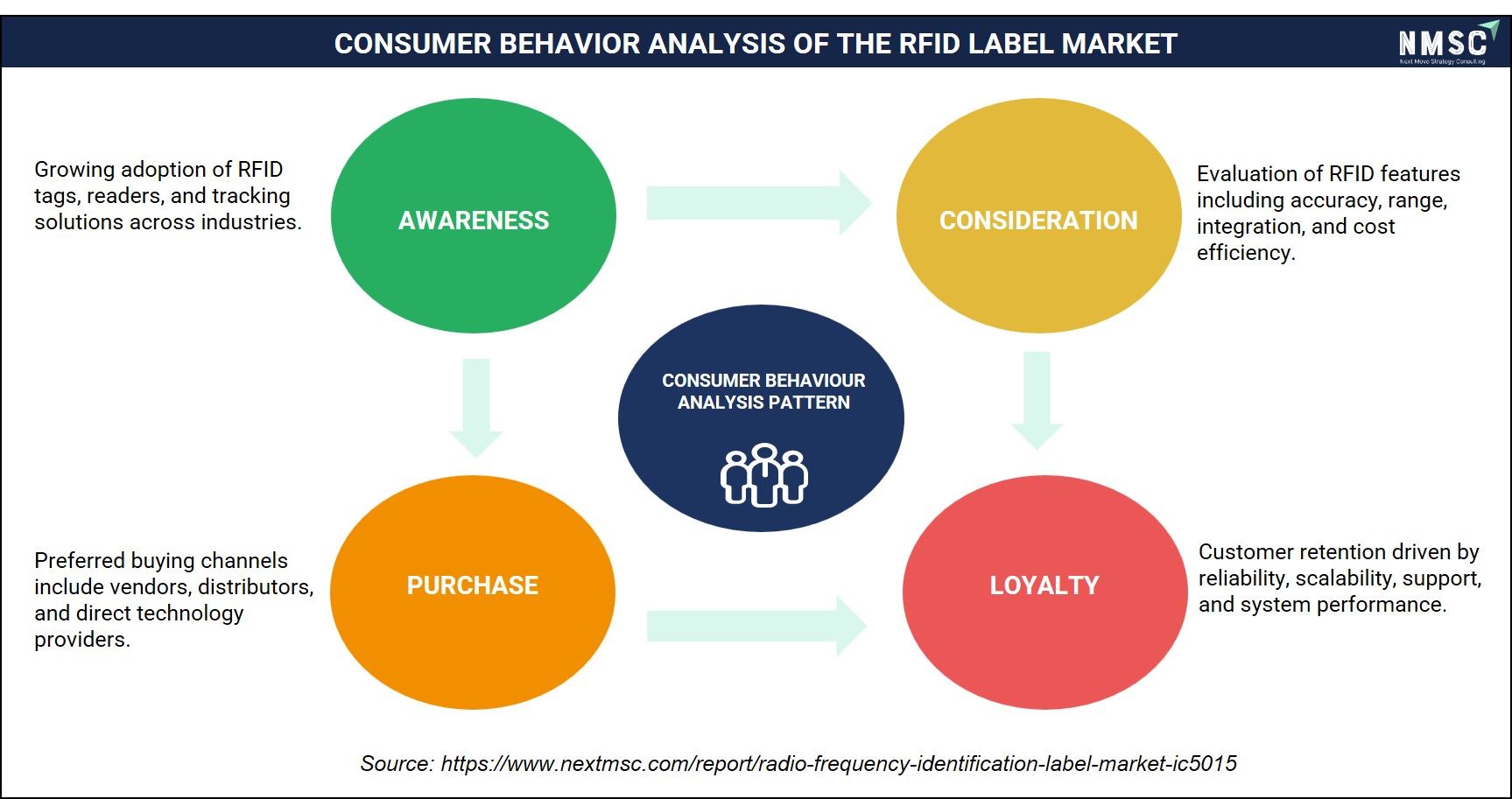
The above infographic presents a consumer behaviour analysis of the RFID label market, mapping the journey from awareness to loyalty. Shaped by growing adoption across industries, buyers evaluate accuracy, range, integration, and cost efficiency before purchasing through vendors, distributors, and direct providers. Looking ahead, we observed that retention is driven by reliability, scalability, support, and system performance, ensuring long-term customer engagement across the market.
Competitive Landscape
Key Takeaways for the Radio Frequency Identification Label Competitive Landscape
|
Key Takeaways |
Details |
|
Market Structure |
The Radio Frequency Identification Label Market is moderately concentrated at the top, led by Avery Dennison and Zebra Technologies, while a long tail of specialty converters serves industrial, security, and metal mount niches. |
|
Innovation Focus |
Vendors are concentrating innovation on sensor-enabled fresh food inlays, recyclable label materials, flexible NFC chip integration, and ambient IoT convergence with passive RFID labeling. |
|
M&A Activity |
Consolidation has been active in inlay manufacturing, exemplified by Avery Dennison's acquisition of Smartrac's transponder business and TexTrace, alongside strategic minority investments such as its 2026 Wiliot stake. |
How Do Companies Compete in the Radio Frequency Identification Label Market?
Competitive strategy within the RFID Label Market centers on manufacturing scale, retailer relationship depth, and material innovation. From our research, we found that Avery Dennison's global manufacturing footprint, spanning facilities in Mexico, Brazil, China, and South Korea, functions as a key competitive moat given the capital intensity of high-volume inlay production. Pricing strategies are bifurcating between volume-based contracts favored by large retailers seeking predictable per-unit costs and specialty pricing for security, metal mount, and pharmaceutical-grade labels. Geographic expansion is concentrated on building manufacturing presence near major apparel export and logistics hubs, while vendors increasingly bundle inlays, finished labels, and software platforms into unified supply agreements rather than standalone component sales.
Which Kind of Companies Dominate the RFID Label Market?
Vertically integrated manufacturers with both inlay production and finished label converting capability dominate the largest share of the market revenue, given their ability to serve large retailer supply agreements at scale. Hardware and software platform providers hold a strong secondary position by supplying the reader and middleware infrastructure that activates labeled inventory, while specialized niche vendors serving metal mount, security, or pharmaceutical-grade labeling occupy smaller but durable positions as application-specific durability and compliance requirements increase across the competitive landscape.
AI-Native Differentiation and Open Standards Drive Market Success in the Radio Frequency Identification Label Market
Vendors integrating AI-driven analytics into their connected product cloud platforms, rather than offering passive labels alone, are achieving stronger differentiation as retailers seek actionable inventory insights rather than raw tag reads. Compliance with GS1 EPC global standards and emerging EU Digital Product Passport data carrier requirements further reinforces competitive credibility, as brands increasingly require demonstrable adherence to interoperable identification standards before procuring market inlays, labels, and software from any given vendor.
Market Players to Opt for Merger and Acquisition Strategies to Expand Their Presence in the Radio Frequency Identification Label Market
Inlay and label manufacturers are pursuing acquisition and strategic investment to expand platform breadth and adjacent sensing capability, exemplified by Avery Dennison's historical acquisition of Smartrac's transponder business and more recent minority investment in ambient IoT pioneer Wiliot. NMSC's analysis indicates that continued consolidation among mid-market converters is likely as larger platforms seek to bundle inlay manufacturing, finished labeling, and connected product cloud software into unified offerings for global retail and brand accounts.
Who Are the Key Market Players in the Radio Frequency Identification Label Industry?
-
Zebra Technologies Corporation
-
Beontag
-
SML Group Limited
-
Tageos SAS
-
Paragon ID SA
-
Brady Corporation
-
SATO Holdings Corporation
-
TSC Auto ID Technology Co., Ltd.
-
HID Global Corporation
-
Invengo Information Technology Co., Ltd.
-
Multi-Color Corporation
-
Schreiner Group GmbH & Co. KG
-
TOPPAN Edge Inc.
-
Hangzhou Century Co., Ltd.
-
Arizon RFID Technology Co., Ltd.
-
Shanghai Boing Information Technology Co., Ltd.
-
Alien Technology, LLC
What Are the Latest Developments in the Radio Frequency Identification Label Industry?
|
Date |
Event |
|
July 2025 |
Avery Dennison launched RFID-enabled In-Mold Label (IML) solutions designed for reuse systems, asset tracking, and wash-durable returnables. |
|
June 2025 |
Avery Dennison announced the first RFID label to receive APR DfR recognition for compatibility with North America's PET recycling stream. |
|
April 2025 |
Avery Dennison opened its first India-based RFID inlays and labels production site in Pune, pairing local manufacturing with an India-specific inlay to cut lead times and better serve growing South Asian demand. |
|
March 2025 |
Beontag expanded its RFID portfolio with the eWave and Carrier eWave UHF tags for returnable food packaging. The labels are microwave- and water-resistant, supporting reusable containers, asset management, and traceability in food-service and logistics operations |
Expert Insights
 “RFID technology is essential for the effective and sustainable management of modern supply chains, supporting brands with greater inventory visibility, product traceability and loss prevention.”
— Pascale Wautelet, Vice President, Global R&D and Sustainability, Avery Dennison Materials Group
Statement made while announcing the first RFID label to receive APR Design for Recyclability recognition for compatibility with North America's PET recycling stream.
Market Interpretation
The comment highlights the growing importance of RFID labels as a critical enabler of modern supply chain digitalization and sustainability. As retailers, manufacturers, and logistics providers increasingly prioritize real-time inventory visibility, end-to-end product traceability, and loss prevention, demand for RFID labels is accelerating across retail, healthcare, logistics, and industrial sectors. Additionally, innovations in recyclable RFID label designs are supporting broader sustainability objectives, further driving market adoption.
What Are the Investment Opportunities in the Radio Frequency Identification Label Market?
Capital Inflows and Strategic Investment
The RFID Label Market presents compelling investment opportunities driven by the structural convergence of retail item-level tagging expansion, regulatory traceability mandates, and growing sensor and ambient IoT integration. Capital inflows into the sector are accelerating as investors recognize the durable, multi-year nature of retailer-driven tagging mandates that cascade demand through entire supplier networks. From our research, we found that Avery Dennison's April 2026 strategic USD 75 million minority investment in Wiliot illustrates the scale of capital being deployed to extend passive RFID labeling into active ambient sensing infrastructure adjacent to the core label business.
Infrastructure Investment
Infrastructure investment opportunities in the market include expanding inlay and label manufacturing capacity near major apparel export and logistics hubs, fresh food sensor label production lines, and recyclable material research and development. Our assessment indicates that Avery Dennison's continued capacity investment, including its Querétaro, Mexico facility supported by a USD 100 million commitment, reflects the durability of demand for manufacturing infrastructure capable of serving global retailer tagging mandates.
ESG Considerations
ESG considerations are increasingly relevant as brands seek recyclable and sustainable label materials within the market. Avery Dennison's APR-recognized recyclable RFID label demonstrates how sustainability-focused product innovation is becoming a competitive differentiator. Growing emphasis on circular packaging, waste reduction, and recyclable labeling solutions is expected to attract additional institutional capital aligned with corporate sustainability and circular economy objectives.
Digital Transformation Enablement
Digital transformation initiatives among retailers, logistics operators, and pharmaceutical manufacturers continue to create significant investment opportunities in the RFID Label Market. NMSC's analysis indicates that high-growth investment themes include healthcare and pharmaceutical traceability labeling, industrial asset tracking using metal-mount RFID labels, and retail modernization across Asia-Pacific, the Middle East & Africa, and Latin America. Platform consolidation, integrating RFID inlay manufacturing, finished labels, and connected product cloud software, offers attractive long-term value creation opportunities for both strategic and financial investors.
Key Benefits for Stakeholders
For Investors and Venture Capital Firms
Investors, venture capital firms, and financial institutions gain access to a comprehensive assessment of the Radio Frequency Identification (RFID) Label Market, including market sizing, segment-level revenue forecasts, and growth opportunities through 2035. The analysis identifies the fastest-growing substrate materials, technologies, applications, and end-use industries, enabling informed investment decisions, portfolio diversification, valuation analysis, and acquisition target identification across the RFID ecosystem.
For Technology Vendors
RFID technology providers and solution vendors benefit from detailed competitive benchmarking, product segmentation, and regional demand analysis across 33 countries. The study highlights emerging technology trends, application-specific adoption patterns, and customer requirements, enabling companies to prioritize product development, optimize go-to-market strategies, strengthen competitive positioning, and identify geographic expansion opportunities.
For Retailers and Brand Owners
Retailers, consumer goods companies, and brand owners gain valuable insights into RFID label adoption trends, vendor capabilities, substrate selection, and regulatory developments influencing product traceability and inventory management. The analysis supports supplier evaluation, procurement planning, omnichannel retail initiatives, and supply chain optimization by providing a structured assessment of technology adoption across major end-use sectors.
For Converters and Distributors
Label converters, manufacturers, and distribution partners receive detailed intelligence on product form demand, substrate material trends, technology adoption, and distribution channel dynamics across the Radio Frequency Identification Label Market. The report supports production planning, capacity expansion, inventory optimization, and channel strategy development by identifying the highest-growth product categories and regional market opportunities.
For Regulators and Industry Bodies
Government agencies, standards organizations, and industry associations gain an evidence-based understanding of RFID label adoption, technology maturity, traceability requirements, and sustainability trends across global industries. The analysis supports the development of interoperability standards, labeling regulations, supply chain traceability frameworks, and digital identification initiatives that enhance transparency, product authentication, and regulatory compliance.
For Research and Academic Institutions
Universities, research organizations, and innovation centers gain a structured analytical framework for evaluating the market across technology segments, materials, applications, competitive dynamics, and regional developments. The report supports research initiatives in smart packaging, supply chain digitization, materials science, and industrial automation while identifying emerging innovation opportunities and commercialization trends.
Key Market Segments
By Product Form
-
Finished Smart Labels
-
Pressure Sensitive Smart Labels
-
Durable Smart Labels
-
Security Smart Labels
-
Embedded Smart Labels
-
On-metal Smart Labels
-
Other Smart Labels
-
-
Finished Smart Tags
-
Hang Tags
-
Laundry Tags
-
Asset Tags
-
Baggage Tags
-
Other Smart Tags
-
By Operating Frequency Band
-
UHF
-
High Frequency and NFC
-
Low Frequency
-
Dual Frequency
By Substrate Material
-
Paper Material
-
Standard Paper
-
Sustainable Paper
-
Other Paper Materials
-
-
Polymer Material
-
Polyethylene Terephthalate
-
Polypropylene
-
Polyethylene
-
Polyimide
-
Other Polymer Materials
-
-
Textile Material
-
Cotton Fabric
-
Polyester Fabric
-
Nylon Fabric
-
Other Textile Materials
-
-
Composite Material
-
Other Substrate Materials
By Conversion State
-
Blank Convertible Label
-
Preprinted Unencoded Label
-
Printed and Encoded Label
-
Embedded and Encapsulated Label
-
Other Conversion States
By End Use Industry
-
Retail Apparel
-
Retail General Merchandise
-
Logistics and Parcel
-
Healthcare and Pharmaceuticals
-
Food and Beverage
-
Industrial and Asset Tracking
-
Transportation and Aviation
-
Government and Public Sector
-
Agriculture and Livestock
-
Other End Use Industries
By Sales Channel
-
Direct Sales Channel
-
Enterprise Direct Sales
-
Online E-commerce
-
-
Indirect Sales Channel
-
OEM Channel
-
Distributor Channel
-
VAR and SI Channel
-
By Region
-
North America: U.S., Canada, and Mexico.
-
Europe: UK, Germany, France, Italy, Spain, Sweden, Denmark, Finland, the Netherlands, and the rest of Europe.
-
Asia Pacific: China, India, Japan, South Korea, Taiwan, Indonesia, Vietnam, Australia, Philippines, Malaysia, and the rest of APAC.
-
Middle East & Africa (MEA): Saudi Arabia, UAE, Egypt, Israel, Turkey, Nigeria, South Africa, and the rest of MEA.
-
Latin America: Brazil, Argentina, Chile, Colombia, and the rest of LATAM.
Conclusion and Recommendations
Long-Term Outlook for the Market
The RFID Label Market is forecast to grow from USD 20.88 billion in 2026 to USD 65.28 billion by 2035 at a CAGR of 13.5%, driven by expanding retail item-level tagging, pharmaceutical traceability mandates, and the EU Digital Product Passport regulatory trajectory. Our analysis shows that this growth reflects both the expansion of addressable end uses, particularly fresh food and healthcare, and the deepening of the market investment per retailer as tagging programs extend from apparel into general merchandise, grocery, and industrial asset tracking categories.
Strategic Positioning Within the Market
Vendors should prioritize sensor-enabled inlay engineering for fresh food categories, recyclable material innovation, and EU Digital Product Passport data carrier readiness to differentiate from commodity label competitors. Bundling inlay manufacturing, finished labeling, and connected product cloud software into unified retailer supply agreements will strengthen retention against component-only competitors, while expanding ambient IoT and NFC smart packaging capabilities will capture cross-sell opportunities among brand owners increasingly central to the market growth.
Investment Attractiveness of the Market
The RFID Label Market represents an attractive investment environment supported by retailer-mandated, non-discretionary demand, recurring high-volume label procurement, and structural expansion across emerging geographies and end uses. Our findings suggest that the highest-conviction investment themes include Healthcare and Pharmaceuticals at a 15.8% CAGR, Metal Mount substrates at 16.3%, and the Middle East and Africa region at a 15.0% regional CAGR, each representing durable above-market growth opportunities for investors.
Market Shifts Reshaping the Market
The most significant structural shift underway is the migration from passive inventory labeling toward connected product identity infrastructure that integrates sensing, software, and consumer-facing digital engagement within the same physical label. This shift favours vertically integrated manufacturers with connected product cloud platforms over commodity inlay suppliers, and is reshaping competitive positioning across the market as brands increasingly demand data services layered atop physical tagging.
Key Risks Facing the Market
Key risks include semiconductor chip supply constraints affecting inlay production costs, fragmented reader infrastructure limiting full return on investment realization among adopting retailers, and recyclability compliance pressure that requires continued material innovation investment. Regulatory uncertainty around the final scope and timeline of EU Digital Product Passport delegated acts for textiles also introduces planning risk for converters investing ahead of finalized technical requirements.
Growth Pathways for RFID Label Market Stakeholders
Stakeholders should pursue a three-horizon approach. In the near term, prioritize source tagging expansion across core apparel and general merchandise categories alongside reader infrastructure investment to capture full inventory accuracy benefits. In the mid-term, invest in fresh food sensor labels and pharmaceutical traceability capabilities to capture the fastest-growing end-use segments. In the long term, the position for connected product identity platforms that integrate ambient sensing and NFC consumer engagement as Digital Product Passport requirements expands across additional product categories beyond textiles.
About the Author
 Mayurima Roy
— Mayurima Roy is Research Analyst at Next Move Strategy Consulting, where she has spent 4 years working across the firm's full industry coverage rather than a single fixed vertical. Her work centers on structured research, ongoing trend tracking, competitive assessment, and insight-led content development, translating complex market data into clear, decision-ready narratives that support informed client decision-making across diverse global industries, market sectors, and world regions every day.
Mayurima Roy
— Mayurima Roy is Research Analyst at Next Move Strategy Consulting, where she has spent 4 years working across the firm's full industry coverage rather than a single fixed vertical. Her work centers on structured research, ongoing trend tracking, competitive assessment, and insight-led content development, translating complex market data into clear, decision-ready narratives that support informed client decision-making across diverse global industries, market sectors, and world regions every day.
About the Reviewer
 Supradip Baul
— Supradip Baul is an accomplished business consultant and strategist with over a decade of rich experience in market intelligence, strategy, technology, and business transformation. His work has included rigorous qualitative and quantitative analysis across multiple industries, helping clients shape investment decisions and long-term roadmaps. Earlier in his career, he was associated with Gartner, where he contributed to industry-leading reports and market share analyses. He has worked with leading global companies and holds an MBA with a dual specialization in Marketing and Finance.
Supradip Baul
— Supradip Baul is an accomplished business consultant and strategist with over a decade of rich experience in market intelligence, strategy, technology, and business transformation. His work has included rigorous qualitative and quantitative analysis across multiple industries, helping clients shape investment decisions and long-term roadmaps. Earlier in his career, he was associated with Gartner, where he contributed to industry-leading reports and market share analyses. He has worked with leading global companies and holds an MBA with a dual specialization in Marketing and Finance.
At Next Move Strategy Consulting, we understand that insightful market research is the cornerstone of successful business decisions. That's why we employ a robust and multifaceted approach, combining various methodologies to deliver the most accurate and actionable data for our clients.

Research Landscape
We navigate the world of research with two primary approaches:
Qualitative Approach
Our qualitative research methodologies involve immersive techniques such as in-depth interviews, focus groups, and observational studies. By engaging directly with individuals and stakeholders, we uncover valuable insights that quantitative data alone may overlook.

Quantitative Research
In tandem with qualitative methodologies, NMSC leverages the power of Quantitative Research to provide a robust foundation of numerical insights. Through systematic data collection and analysis, we quantify patterns, preferences, and market trends, offering a comprehensive view of the business landscape.
Our quantitative research approach employs diverse tools, including surveys, experiments, and statistical modelling. These methodologies enable us to gather data from a large and representative sample, ensuring the statistical significance of our findings. By employing structured questionnaires and standardized data collection methods, we guarantee the reliability and validity of the information we present to our clients.
Quantitative research is particularly effective in measuring the prevalence of trends, assessing market size, and gauging the impact of various factors on consumer behavior. The numerical precision attained through this approach equips our clients with actionable insights, facilitating data-driven decision-making and strategy formulation.


Our Specialized Toolbox for Industry-Specific Market Research
We deploy a specialized arsenal of techniques tailored to meet your unique requirements. Here's a glimpse into our comprehensive toolbox:

Information Procurement
The stage entails acquiring market data or relevant information through various sources and methodologies.


Market Research Approach
We utilize both top-down and bottom-up approaches in market research analysis to achieve a comprehensive understanding of the market dynamics, leveraging the broad perspective of industry trends and macroeconomic factors alongside detailed insights from specific segments and individual companies.

Porters Five Forces Analysis
We conduct Porter's Five Forces analysis to evaluate the competitive landscape of an industry, providing us with insights into factors that affect profitability and strategic positioning.

SWOT Analysis

Forecasting
We utilize a forecasting model to predict future consumption by considering parameters like population, economics, regulations, market competition, drivers, constraints, technology, and pricing. We also employ statistical techniques such as multilinear regression, exponential smoothing, moving average, ARIMA, and Monte Carlo simulations for accurate predictions. In econometric forecasting, we analyzed short-term and long-term event impacts, attributing values based on regulatory frameworks, economic factors, and market events.





 Speak to Our Analyst