Time Series Database Market Size, Share, Growth & Forecast by Offering (Managed Cloud, Self-Managed Software, Embedded OEM, Support & Services), Product Family (Purpose-Built TSDB, Time Series Enabled Database, Observability TSDB, Industrial Historian), Deployment (Public Cloud, Private Cloud, On-Premises, Edge, Hybrid), Workload, Buyer Type, Sales Channel, and End User Industry — Global Analysis 2025–2035 | CAGR 15.0% (2026–2035)
Industry: ICT & Media | Publishing Date: July 9, 2026 | Last Updated: September 30, 2026 | No of Pages: N/A | No. of Tables: N/A | No. of Figures: N/A | Format: PDF | Report Code: IC5067
What Is the Time Series Database Market Size?
The global Time Series Database Market was valued at USD 1.8 billion in 2025 and is expected to reach USD 2.1 billion in 2026. Broad acceleration across cloud-native observability, industrial IoT telemetry, and real-time financial analytics is projected to propel the market to USD 7.3 billion by 2035, advancing at a CAGR of 15.0% from 2026 to 2035. Core growth catalysts include rapid expansion of IoT-connected assets demanding persistent time-stamped storage, surging enterprise observability stacks, growing adoption of cloud-native purpose-built TSDB platforms, and increasing deployment of edge computing architectures requiring lightweight embedded historians.
|
Parameters |
Details |
|
Market Size in 2025 |
USD 1.8 Billion |
|
Market Size in 2026 |
USD 2.1 Billion |
|
Revenue Forecast in 2035 |
USD 7.3 Billion |
|
Growth Rate |
CAGR of 15.0% from 2026 to 2035 |
|
Analysis Period |
2025–2035 |
|
Base Year Considered |
2025 |
|
Forecast Period |
2026–2035 |
|
Market Size Estimation |
Billion USD |
|
Companies Profiled |
20 |
|
Countries Covered |
33 |
|
Market Share |
Top 10 |
Time Series Database Market Overview
What Is the Time Series Database Market?
The Time Series Database Market encompasses purpose-built and time-series-enabled database platforms optimized for the ingestion, compression, storage, querying, and analysis of timestamped data streams. Unlike general-purpose relational or document databases, time series databases apply specialized data structures, such as columnar storage and downsampling algorithms, to handle millions of data points per second with microsecond query latency. The market includes managed cloud offerings, self-managed software distributions, embedded OEM libraries, and associated support services deployed across cloud, hybrid, on-premises, and edge environments.
How Has the Time Series Database Market Evolved Structurally?
The Time Series Database Market evolved through three distinct phases. The first phase was characterized by open-source tools such as RRDtool and Graphite serving monitoring workloads with limited scalability. The second phase introduced purpose-built platforms including InfluxDB and TimescaleDB, which added horizontal scaling, SQL-compatible query interfaces, and cloud deployment capabilities. NMSC's analysis indicates that the current phase is defined by cloud-native SaaS TSDB platforms, unified observability stacks, and industrial historian integration, with vendors competing on ingestion throughput, compression ratios, and seamless integration into broader data ecosystems.
How Do Regulations Influence the Time Series Database Market?
Regulatory mandates are increasingly shaping data retention, sovereignty, and security requirements across the Time Series Database Market. The European Union's GDPR and the NIS2 Directive impose strict data residency and breach-notification obligations on organizations storing operational telemetry and critical infrastructure data. The U.S. NERC CIP standards govern the cybersecurity of electric utility operational data, directly influencing how industrial historians are deployed across North American energy grids. Through NMSC's assessment, we found that compliance-driven demand for immutable audit trails and granular access controls is accelerating the adoption of enterprise-grade managed TSDB platforms.
How Is Technology Adoption Expanding Across the Time Series Database Market?
Technology adoption across the Time Series Database Market is accelerating as enterprises modernize monitoring, IoT, and financial analytics infrastructure. From our research, we found that the convergence of observability tooling, with platforms such as Grafana Labs, Chronosphere, and VictoriaMetrics bundling TSDB capabilities with dashboarding and alerting, is lowering deployment complexity and broadening buyer accessibility. Simultaneously, the emergence of serverless and bring-your-own-cloud TSDB offerings is enabling organizations of all sizes to adopt time series capabilities without upfront infrastructure investments, thereby expanding the total addressable market beyond large enterprises.
|
Key Takeaways |
|
By offering, Managed Cloud accounted for the largest share of the Time Series Database Market in 2025. The Serverless segment is the fastest-growing sub-segment, projected to expand at a CAGR of 22.0% from 2026 to 2035, driven by cloud-native adoption and the elimination of infrastructure management complexity. |
|
By offering, Support and Services is the fastest-growing primary segment in the Time Series Database Market at a CAGR of 17.5% from 2026 to 2035, as enterprises increasingly seek specialized implementation, migration, optimization, and technical support for large-scale time-series data environments. |
|
By product family, Purpose-Built TSDB held the largest revenue share in 2025, supported by strong enterprise adoption of dedicated time-series database platforms offering high performance, scalability, and advanced data retention capabilities. |
|
By product family, Observability TSDB is the fastest-growing segment in the Time Series Database Market at a CAGR of 20.0% from 2026 to 2035, driven by the growing convergence of metrics, logs, and traces within unified observability architectures. Unified Observability platforms represent the fastest-growing sub-segment within this category. |
|
By deployment, Public Cloud commanded the largest Time Series Database Market share in 2025, reflecting strong enterprise preference for scalable and managed cloud-based data infrastructure. Edge deployment is the fastest-growing model at a CAGR of 23.0% from 2026 to 2035, fueled by industrial IoT, telecommunications, and real-time analytics applications. |
|
By deployment, Hybrid Cloud is the second-fastest-growing deployment model in the Time Series Database Market at a CAGR of 17.0% from 2026 to 2035, as organizations balance on-premises operational requirements with cloud-based analytics and scalability. |
|
By workload, Observability represented the largest application segment in 2025, driven by increasing demand for application performance monitoring, infrastructure monitoring, and site reliability engineering practices. IoT Telemetry remains a major workload category and is projected to grow at a CAGR of 19.0% through 2035. |
|
By workload, Event Analytics is the fastest-growing segment in the Time Series Database Market at a CAGR of 21.0% from 2026 to 2035, propelled by rising demand for real-time behavioral analytics, clickstream analysis, fraud detection, and digital experience monitoring. |
|
By buyer type, Enterprise IT accounted for the largest revenue share in 2025, reflecting widespread deployment of time-series databases across enterprise infrastructure and analytics environments. OEM/ISV is the fastest-growing buyer segment at a CAGR of 18.0% from 2026 to 2035, as software vendors increasingly embed time-series capabilities into industry-specific applications. |
|
By sales channel, Direct Sales held the largest share of the Time Series Database Market in 2025. Cloud Marketplace is the fastest-growing distribution channel at a CAGR of 22.0% from 2026 to 2035, as enterprises increasingly procure database solutions through AWS, Microsoft Azure, and Google Cloud marketplaces. |
|
By end-user industry, Financial Services represented the largest vertical in 2025, driven by demand for high-frequency data processing, risk monitoring, and real-time analytics. Energy and Utilities is among the fastest-growing verticals at a CAGR of 19.0%, supported by smart grid modernization, renewable energy monitoring, and industrial telemetry applications. |
|
North America emerged as the leading region in the Time Series Database Market, supported by the strong presence of cloud service providers, observability platform vendors, and mature enterprise digital infrastructure ecosystems. |
|
Asia-Pacific is the fastest-growing region in the Time Series Database Market, driven by accelerating industrial digitalization, smart manufacturing initiatives, increasing cloud adoption, and large-scale IoT deployments across emerging economies. |
|
The United States remains the largest country market in the Time Series Database Market, benefiting from advanced cloud adoption, a mature DevOps ecosystem, and substantial enterprise investment in observability, monitoring, and real-time analytics technologies. |
|
China is the fastest-growing major country market in the Time Series Database Market, supported by industrial digital transformation programs, smart city initiatives, and the expanding deployment of connected infrastructure and IoT networks. |
Key Emerging Trends in the Time Series Database Market
How Is the Convergence of Observability and Time Series Storage Reshaping the Time Series Database Market Trends?
Observability platforms are increasingly absorbing TSDB capabilities, blurring the line between standalone time series databases and integrated metrics backends. From our research, we found that vendors such as Grafana Labs, VictoriaMetrics, and Chronosphere bundle metrics ingestion, storage, and dashboarding within unified observability stacks. Datadog's BoomeBox metrics store and Prometheus-compatible scrape pipelines exemplify how observability-first platforms now effectively function as full-featured time series databases. This convergence is compelling pure-play TSDB vendors to offer native Prometheus and OpenTelemetry compatibility to retain relevance within enterprise monitoring stacks.
How Are Edge and Fog Computing Use Cases Driving a New Growth Frontier in the Time Series Database Market?
Edge deployments represent the fastest-growing expansion vector for the Time Series Database Market. Industrial IoT, autonomous vehicles, smart grid substations, and 5G multi-access edge compute (MEC) nodes all require lightweight, embedded TSDB capabilities capable of operating with intermittent cloud connectivity. Our assessment indicates that vendors including InfluxData and TDengine have released edge-optimized distributions specifically targeting constrained hardware environments with limited RAM and storage. The Industrial Internet Consortium's edge computing architecture frameworks further validate the need for local time-series persistence before selective cloud synchronization.
What Role Is the OpenTelemetry Standard Playing in Accelerating Time Series Database Market Adoption?
The OpenTelemetry (OTel) project, hosted by the Cloud Native Computing Foundation (CNCF), is emerging as the primary standardization force within the Time Series Database Market. By providing a vendor-neutral API and SDK for telemetry data collection, OTel reduces integration complexity and lowers the switching cost between TSDB backends. Based on NMSC's research, we found that OTel adoption is expanding beyond cloud-native SRE teams into industrial and financial services sectors, compelling TSDB vendors to certify native OTel ingestion pipelines. This standardization dynamic is accelerating competitive displacement of legacy monitoring solutions and driving new enterprise TSDB evaluations.
How Is the Rise of AI-Driven Anomaly Detection and Forecasting Transforming the Time Series Database Market?
Artificial intelligence and machine learning capabilities are becoming table-stakes features within the Time Series Database Market, driving vendors to embed forecasting, anomaly detection, and predictive alerting directly within their query engines. Our findings suggest that enterprises increasingly expect TSDB platforms to support native ML inference alongside storage and retrieval functions. TimescaleDB's integration with pgvector for vector-similarity time series search and InfluxDB's Flux scripting language enabling built-in forecasting functions exemplify this transformation. This trend is elevating TSDB from infrastructure commodity to an intelligent analytics layer, expanding its value proposition and justifying higher per-seat and per-ingestion pricing.
Porter’s Five Forces Analysis of the Time Series Database Market
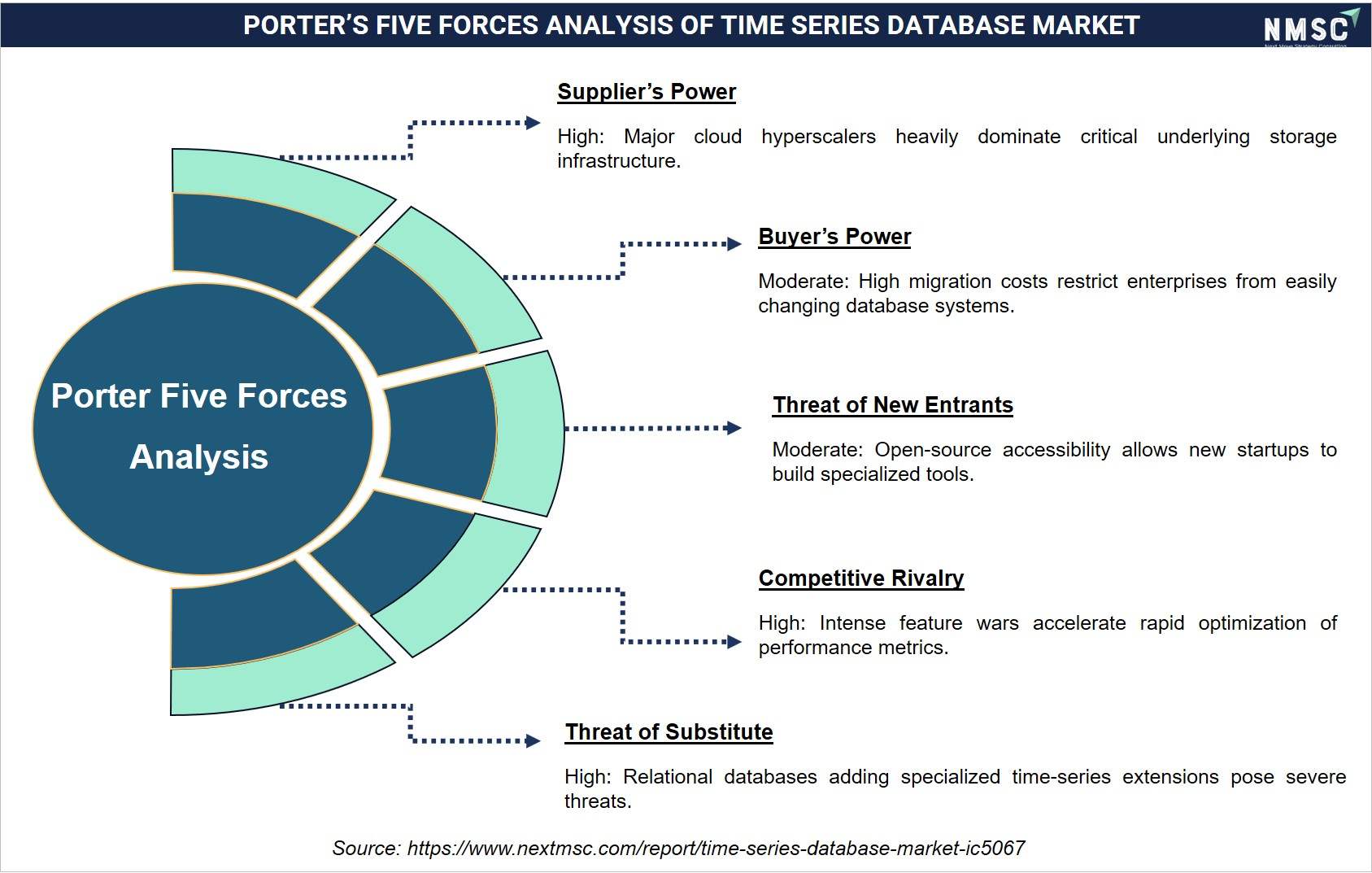
The Porter’s Five Forces Analysis of the Time Series Database Market highlights the competitive dynamics influencing industry growth and profitability. Competitive rivalry is high due to the presence of established database vendors and emerging cloud-native providers. The threat of new entrants is moderate, as developing scalable database architectures requires significant technical expertise and investment. Buyer bargaining power is increasing as enterprises have multiple database options available. Supplier power remains moderate, supported by cloud infrastructure and technology providers. The threat of substitutes is moderate, with traditional relational and NoSQL databases offering alternative data management solutions, though specialized time series databases maintain advantages in handling high-volume, real-time data workloads.
What Are the Key Market Drivers, Breakthroughs, and Investment Opportunities that Will Shape the Time Series Database Industry in the Next Decade?
|
Drivers / Trends / Restraints |
(+/-) % Impact on CAGR Forecast |
Geographic Relevance |
Impact Timeline |
|
Surge in Industrial IoT Sensor Deployments |
+2.5% |
Global (led by APAC, North America) |
2025–2032 |
|
Cloud-Native Observability Stack Adoption |
+2.1% |
North America, Europe, Australia |
2025–2030 |
|
OpenTelemetry Standardization Momentum |
+1.5% |
North America, Europe, APAC |
2025–2028 |
|
Edge TSDB for 5G and MEC Networks |
+1.4% |
APAC, North America, Europe |
2026–2035 |
|
Financial Market Data and HFT Analytics |
+1.2% |
North America, Europe, APAC |
2025–2035 |
|
AI-Driven Anomaly Detection Integration |
+1.3% |
Global |
2026–2035 |
|
Regulatory Complexity in Data Residency |
-1.1% |
Europe, APAC, North America |
Ongoing |
|
Skills Gap in TSDB Administration |
-0.8% |
SMB, Mid-market globally |
2025–2028 |
|
Cloud Migration Inertia from Legacy Historians |
-0.7% |
Manufacturing, Energy globally |
2025–2030 |
|
Smart Manufacturing & Industry 4.0 Rollout |
+1.8% |
APAC, Europe, North America |
2025–2035 |
|
Cloud Marketplace Distribution Expansion |
+1.1% |
North America, Europe |
2025–2032 |
|
Digital Twin Platform Integration |
+1.0% |
Global |
2026–2035 |
What Are the Growth Drivers of the Time Series Database Market?
How Is the Global Expansion of Industrial IoT Driving the Time Series Database Market?
Industrial IoT (IIoT) deployments are the most powerful structural driver of the Time Series Database Market expansion, generating unprecedented volumes of high-frequency timestamped sensor data from manufacturing lines, energy grids, and transportation networks. According to the International Telecommunication Union (ITU), global IoT connections surpassed 18 billion in 2023 and are forecast to approach 40 billion by 2030, each generating continuous telemetry streams that demand efficient time-indexed storage. Industry-derived estimates indicate that a typical smart factory with 5,000 sensors can generate over 50 million data points per day, necessitating specialized TSDB architectures for ingest performance, compression, and retention management. This growth trajectory directly translates into sustained demand for scalable TSDB platforms.
How Is Cloud-Native Observability Spending Fueling Time Series Database Market Growth?
Enterprise investment in cloud-native observability has become a primary procurement driver for the Time Series Database Market. The Cloud Native Computing Foundation's (CNCF) annual survey consistently identifies Prometheus as the most widely adopted open-source metrics backend, directly creating dependency on compatible TSDB storage layers such as Thanos, Cortex, and VictoriaMetrics for long-term retention. Our analysis shows that site reliability engineering (SRE) teams at hyperscale enterprises retain multiple billions of time-series data points for root cause analysis, capacity planning, and SLA monitoring. Growing regulatory pressure for audit trails of infrastructure events further extends TSDB retention windows and increases per-enterprise storage volume.
How Is the Growth of Financial Market Data Analytics Expanding the Time Series Database Market?
Financial services firms represent one of the most data-intensive verticals within the Time Series Database Market, relying on time-indexed storage for tick data, order book snapshots, algorithmic trading signals, and real-time risk analytics. The U.S. Securities and Exchange Commission's (SEC) Consolidated Audit Trail (CAT) regulation mandates the storage of all equity and options market event data with nanosecond-precision timestamps, creating regulatory compliance-driven demand for high-performance TSDB infrastructure across broker-dealers and exchanges. Through NMSC's assessment, we found that proprietary TSDB platforms such as KX Systems' kdb+ have historically commanded premium pricing in this segment due to their throughput and latency advantages in tick data processing.
What Are the Growth Inhibitors of the Time Series Database Market?
How Does Regulatory Complexity in Data Residency Constrain Time Series Database Market Expansion?
Cross-jurisdictional data sovereignty requirements represent a significant structural constraint on the Time Series Database Market, particularly for managed cloud TSDB offerings. The European Union's GDPR mandates that operational and telemetry data containing personal identifiers remain within approved jurisdictions, complicating multi-region TSDB deployments for enterprises with global IoT or observability stacks. The EU's NIS2 Directive further imposes stringent incident reporting and data security obligations on operators of critical infrastructure, directly affecting how industrial historians and SCADA-linked TSDB platforms are architected. NMSC's analysis indicates that compliance complexity extends procurement cycles by three to six months for enterprise deals in regulated verticals, dampening near-term market velocity.
How Does the Skills Gap in TSDB Administration Limit Time Series Database Market Penetration?
The shortage of qualified engineers with TSDB-specific skills, encompassing schema design for high-cardinality data, retention policy optimization, and distributed cluster management, represents a meaningful adoption barrier within the Time Series Database Market. The U.S. Bureau of Labor Statistics classifies database administration as a high-demand occupation, yet specialized TSDB skills are not widely represented in traditional database administrator training pathways. Our observations indicate that organizations frequently default to general-purpose relational or columnar databases for time-series workloads as a result of workforce familiarity, even at the cost of inferior performance, thereby deferring specialized TSDB adoption and suppressing market penetration among SMB and mid-market buyers.
Supply Chain Structure of the Time Series Database Market
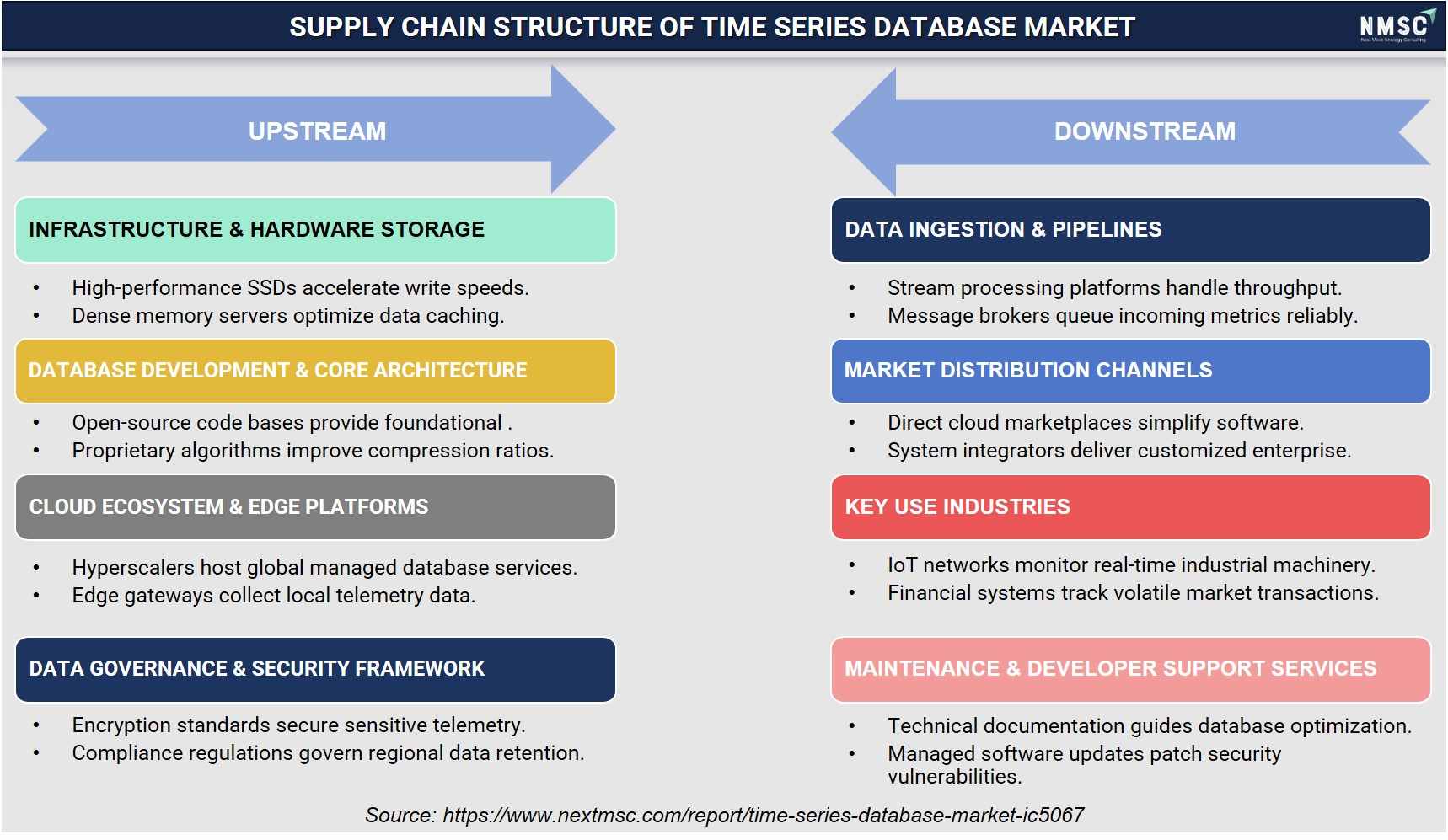
The Time Series Database Market supply chain consists of a well-connected ecosystem that supports the collection, storage, processing, and analysis of time-stamped data. Upstream activities include hardware infrastructure, database development, cloud platforms, and data security frameworks that provide the foundation for database operations. Downstream components focus on data ingestion pipelines, distribution channels, industry-specific applications, and maintenance services. Growing adoption across IoT, industrial automation, financial services, and cloud observability is driving demand for efficient time series database solutions, supported by continuous innovation in analytics, scalability, and security.
What Are the Growth Opportunities in the Time Series Database Market?
How Does the Proliferation of Smart Manufacturing and Industry 4.0 Create a Multi-Billion Dollar Opportunity in the Time Series Database Market?
Industry 4.0 digitalization programs are creating a structural long-term opportunity for the Time Series Database Market, particularly across industrial process historians and edge TSDB deployments. The U.S. Department of Commerce's Manufacturing Extension Partnership (MEP) identifies sensor-driven process monitoring as a core competency for competitive manufacturing, creating policy-supported demand for modern TSDB infrastructure. Our findings suggest that legacy process historians from vendors such as OSIsoft (now AVEVA) represent an estimated installed base of over 65,000 industrial servers globally, a substantial replacement and migration opportunity for modern cloud-native TSDB platforms offering lower total cost of ownership and superior cloud analytics integration.
How Is the Expansion of Digital Twin Platforms Generating New Demand for the Time Series Database Market?
Digital twin platforms, which maintain synchronized virtual replicas of physical assets by consuming continuous time-series feeds, represent a high-growth adjacent demand driver for the Time Series Database Market. The National Institute of Standards and Technology (NIST) has identified digital twin technology as a key pillar of smart manufacturing and infrastructure modernization. TSDB platforms form the foundational data persistence layer beneath digital twins, storing historical state vectors that enable predictive maintenance, simulation replay, and lifecycle analysis. Based on our market evaluation, we noticed that energy, aerospace, and smart city operators are jointly increasing digital twin investments, creating durable incremental demand for high-throughput TSDB ingestion and long-term historical storage capabilities.
How Is the Growth of 5G-Enabled Edge Analytics Creating New Addressable Markets for Time Series Database Market Players?
The global rollout of 5G networks is unlocking a new edge analytics opportunity for the Time Series Database Market by enabling dense, ultra-low-latency sensor deployments across smart cities, connected vehicles, and telecom infrastructure. The International Telecommunication Union (ITU-T) recommends edge-based time-series processing as a foundational component of IMT-2020 network management architectures, validating the strategic importance of embedded TSDB in 5G edge nodes. Through NMSC's assessment, we found that telecommunications operators are actively evaluating lightweight TSDB distributions for deployment in base station edge servers to enable real-time network performance analytics, fault isolation, and predictive maintenance, expanding the Time Series Database Market into a new and rapidly scaling buyer segment.
How Is the Time Series Database Market Segmented in This Report, and What Are the Key Insights from the Segmentation Analysis?
Offering
How Does the Offering Segmentation Reveal the Commercial Structure of the Time Series Database Market?
|
Offering Segment |
2025 (USD Bn) |
2035 (USD Bn) |
CAGR (%) |
|
Managed Cloud |
0.72 |
3.10 |
17.7% |
|
Self-Managed Software |
0.50 |
1.75 |
14.9% |
|
Embedded OEM |
0.27 |
1.00 |
14.0% |
|
Support and Services |
0.31 |
1.45 |
17.5% |
Based on our analysis of enterprise procurement patterns and cloud service adoption trends, the Time Series Database Market is segmented into Managed Cloud, Self-Managed Software, Embedded OEM, and Support and Services offerings. The Managed Cloud segment dominates, driven by rising enterprise preference for fully managed multi-tenant and serverless TSDB platforms that eliminate cluster administration overhead. Within Managed Cloud, the Dedicated sub-segment caters to regulated enterprises requiring single-tenant isolation, while the Serverless sub-segment is gaining rapid traction among developer-first teams seeking elastic, pay-per-metric pricing. Bring Your Own Cloud (BYOC) is emerging as a strategic option for enterprises with existing cloud commitments that wish to retain data sovereignty while leveraging managed operations. Self-Managed Software retains strong relevance, particularly through open-core distributions such as InfluxDB OSS and TimescaleDB Community Edition, which serve as adoption funnels toward commercial subscriptions. Embedded OEM licensing is critical for ISVs integrating TSDB capabilities into vertically oriented SaaS applications.
Which Product Family Segments Are Driving the Strongest Adoption in the Time Series Database Market?
|
Product Family Segment |
2025 (USD Bn) |
2035 (USD Bn) |
CAGR (%) |
|
Purpose-Built TSDB |
0.75 |
2.85 |
15.9% |
|
Time Series Enabled Database |
0.45 |
1.55 |
14.0% |
|
Observability TSDB |
0.38 |
1.85 |
20.0% |
|
Industrial Historian |
0.22 |
1.05 |
18.8% |
Our assessment indicates that the Time Series Database Market is organized across four distinct product families: Purpose-Built TSDB, Time Series Enabled Database, Observability TSDB, and Industrial Historian. Purpose-Built TSDB platforms, encompassing both open-source distributions like InfluxDB and QuestDB and commercial offerings from InfluxData, Timescale, and KX Systems, hold the dominant market share due to their superior ingestion throughput, native time-series compression, and purpose-designed query languages. Time Series Enabled Databases, including relational options like TimescaleDB, wide-column solutions like ScyllaDB, and columnar platforms like ClickHouse, address organizations seeking time-series capabilities within familiar database paradigms, reducing retraining costs. The Observability TSDB sub-category, comprising Metrics Stores and Unified Observability platforms from Grafana Labs, Chronosphere, and VictoriaMetrics, is the fastest-growing product family, driven by the explosive growth of cloud-native SRE practices. Industrial Historians, including both Process Historians and Edge Historians from TDengine and Timecho, are experiencing renewed growth from smart manufacturing and energy sector modernization programs.
How Does Deployment Mode Shape Revenue Distribution in the Time Series Database Market?
|
Deployment Segment |
2025 (USD Bn) |
2035 (USD Bn) |
CAGR (%) |
|
Public Cloud |
0.81 |
3.15 |
15.6% |
|
On-Premises |
0.43 |
1.25 |
11.4% |
|
Hybrid |
0.30 |
1.30 |
17.0% |
|
Private Cloud |
0.19 |
0.85 |
17.7% |
|
Edge |
0.07 |
0.75 |
23.0% |
Based on NMSC's research, the Time Series Database Market is deployed across Public Cloud, On-Premises, Hybrid, Private Cloud, and Edge environments, each addressing distinct enterprise data architecture requirements. Public Cloud deployment leads due to its scalability, consumption-based pricing alignment, and the availability of managed TSDB services from AWS, Microsoft, and Google Cloud. On-Premises deployment retains relevance among highly regulated sectors and organizations with legacy SCADA integration requirements, though its share is gradually declining. Hybrid deployments are growing strongly as enterprises in manufacturing and energy balance cloud analytics capabilities with on-premises historian continuity. Edge deployment is the fastest-growing mode, propelled by industrial IoT, autonomous systems, and 5G network management use cases where latency and connectivity constraints preclude cloud-only architectures. Private Cloud is expanding in regulated financial and government verticals requiring single-tenant infrastructure with cloud-native operational practices.
Which Workload Segments Represent the Highest Value in the Time Series Database Market?
|
Workload Segment |
2025 (USD Bn) |
2035 (USD Bn) |
CAGR (%) |
|
Observability |
0.45 |
1.75 |
15.3% |
|
IoT Telemetry |
0.40 |
1.90 |
19.0% |
|
Industrial Process |
0.27 |
1.10 |
15.2% |
|
Financial Market Data |
0.22 |
0.85 |
15.2% |
|
Event Analytics |
0.18 |
1.15 |
21.0% |
|
Application Analytics |
0.16 |
0.70 |
17.0% |
|
Other Workload |
0.12 |
0.55 |
16.4% |
Through our market assessment, the Time Series Database Market is segmented by workload into Observability, IoT Telemetry, Industrial Process, Financial Market Data, Event Analytics, Application Analytics, and Other workloads. Observability currently holds the largest workload revenue share, driven by enterprise investment in infrastructure monitoring, distributed tracing, and SLO management across cloud-native application stacks. IoT Telemetry is the second-largest workload and the fastest-growing traditional segment, as connected device counts multiply across smart cities, connected vehicles, and precision agriculture. Industrial Process workloads anchor the Industrial Historian sub-category, representing a stable but methodically growing revenue base from smart factory and energy sector modernization. Financial Market Data workloads serve high-frequency trading, real-time risk analytics, and regulatory compliance use cases where nanosecond timestamp precision is a hard requirement. Event Analytics is the highest-growth workload, reflecting rising demand from digital platforms requiring real-time clickstream analysis and user behavior intelligence.
Which Buyer Types Are Driving Purchasing Decisions in the Time Series Database Market?
|
Buyer Type Segment |
2025 (USD Bn) |
2035 (USD Bn) |
CAGR (%) |
|
Enterprise IT |
0.45 |
1.65 |
14.1% |
|
Platform Engineering |
0.29 |
1.25 |
17.6% |
|
Data Engineering |
0.25 |
1.00 |
16.4% |
|
Industrial Operations |
0.22 |
0.90 |
15.2% |
|
Trading |
0.18 |
0.70 |
15.2% |
|
OEM ISV |
0.22 |
0.95 |
18.0% |
|
Developer Self Serve |
0.19 |
0.75 |
15.6% |
From our research, the Time Series Database Market is served by seven distinct buyer type segments: Enterprise IT, Platform Engineering, Data Engineering, Industrial Operations, Trading, OEM ISV, and Developer Self Serve. Enterprise IT retains the largest buyer revenue share, procuring centralized TSDB infrastructure for enterprise-wide monitoring and compliance retention. Platform Engineering teams are the fastest-growing enterprise buyer segment, as they build and maintain internal developer platforms that embed TSDB capabilities within CI/CD observability and production telemetry pipelines. Data Engineering buyers are focused on time-series feature engineering for ML models and real-time analytics pipelines. Industrial Operations buyers represent the primary purchasers of industrial historians and edge TSDB deployments. OEM ISV buyers are growing rapidly, embedding TSDB engines within SaaS applications across energy management, connected health, and smart building verticals. Developer Self Serve purchasing is expanding through cloud marketplace and self-service trial-to-paid conversion pathways.
How Are Distribution Channels Reshaping Go-to-Market Strategies in the Time Series Database Market?
|
Sales Channel Segment |
2025 (USD Bn) |
2035 (USD Bn) |
CAGR (%) |
|
Direct |
0.72 |
2.55 |
14.3% |
|
Cloud Marketplace |
0.36 |
1.65 |
18.6% |
|
Partner Reseller |
0.29 |
1.10 |
15.6% |
|
Self Serve |
0.25 |
1.10 |
17.8% |
|
OEM Embedded |
0.18 |
0.90 |
19.5% |
Our analysis indicates that the Time Series Database Market is distributed across five sales channel segments: Direct, Cloud Marketplace, Partner Reseller, Self Serve, and OEM Embedded. The Direct sales channel continues to dominate due to the complexity of enterprise TSDB deployments, which require customized architecture consultation, SLA negotiation, and multi-year commitment structures. Cloud Marketplace is the fastest-growing channel, enabling procurement of TSDB solutions through AWS Marketplace, Azure Marketplace, and Google Cloud Marketplace via pre-committed cloud spend draw-downs, bypassing traditional procurement cycles. Partner Reseller channels add value through system integration expertise, particularly in industrial sectors where TSDB deployment is coupled with OT/IT convergence projects. Self Serve channels cater to developer-led evaluations and startup-scale deployments, serving as the primary top-of-funnel acquisition pathway for open-source TSDB vendors. OEM Embedded channels generate the highest gross margin and deliver the most predictable recurring revenue profile for vendors with deep ISV ecosystems.
Which End User Industries Generate the Most Value in the Time Series Database Market?
|
Industry Segment |
2025 (USD Bn) |
2035 (USD Bn) |
CAGR (%) |
|
Financial Services |
0.32 |
1.30 |
15.1% |
|
Software and Internet |
0.29 |
1.25 |
15.7% |
|
Manufacturing |
0.22 |
1.05 |
18.8% |
|
Energy and Utilities |
0.18 |
0.85 |
19.0% |
|
Telecommunications |
0.16 |
0.70 |
17.0% |
|
Retail and E-Commerce |
0.13 |
0.55 |
15.5% |
|
Healthcare and Life Sciences |
0.11 |
0.60 |
18.6% |
|
Government and Defense |
0.09 |
0.35 |
14.6% |
|
Transportation and Logistics |
0.09 |
0.40 |
17.7% |
|
Media and Gaming |
0.07 |
0.35 |
18.8% |
|
Other Industry |
0.14 |
0.55 |
14.8% |
Based on NMSC's research, the Time Series Database Market is served across eleven end user industry verticals, each presenting distinct use case requirements and growth profiles. Financial Services leads revenue contribution due to high-frequency trading, real-time risk management, and SEC CAT regulatory compliance use cases requiring nanosecond-precision timestamp storage. Software and Internet companies are the second-largest vertical, relying on TSDB platforms to power infrastructure monitoring, application performance management, and user behavior analytics across cloud-native deployments. Manufacturing is the fastest-growing among traditional verticals, fueled by Industry 4.0 sensor data volumes and legacy historian migration programs. Energy and Utilities follows closely, driven by smart grid SCADA-to-cloud migrations, renewable energy telemetry, and NERC CIP compliance requirements. Healthcare and Life Sciences is a fast-growing vertical, as continuous patient monitoring devices and clinical IoT platforms generate high-frequency time-stamped physiological data streams requiring compliant, high-throughput storage architectures.
Regional Outlook
Geographic Performance Snapshot
|
Region |
2025 (USD Bn) |
2035 (USD Bn) |
CAGR (%) |
Key Driver |
|
North America |
0.72 |
2.70 |
14.0% |
Cloud observability, HFT analytics, SRE investment |
|
Europe |
0.45 |
1.50 |
13.0% |
NIS2 compliance, smart grid, Industry 4.0 |
|
Asia-Pacific |
0.38 |
1.80 |
17.0% |
Smart manufacturing, IoT, cloud-first India |
|
Middle East & Africa |
0.11 |
0.50 |
17.0% |
Smart city, Vision 2030, telecom expansion |
|
Latin America |
0.14 |
0.80 |
19.0% |
Cloud adoption, fintech, digital infrastructure |
North America Time Series Database Market
North America is the leading region in the Time Series Database Market, accounting for USD 0.72 billion in 2025 and forecast to reach USD 2.70 billion by 2035 at a CAGR of 14.0%. The region benefits from the headquarters of major TSDB platform vendors including InfluxData, Timescale, Grafana Labs, Chronosphere, Imply Data, and QuestDB. Deep enterprise SRE investment, the world's most mature cloud-native DevOps ecosystem, and high concentrations of financial services firms demanding tick-data analytics underpin sustained market leadership. U.S. federal mandates such as the NERC CIP standards for energy sector operational data retention further drive enterprise-grade TSDB adoption across critical infrastructure operators.
U.S. Time Series Database Market
Based on our analysis, the United States represents over 78% of North American revenue in the Time Series Database Market and is the world's single largest national market. U.S.-headquartered hyperscalers AWS Timestream, Azure Time Series Insights, and Google Cloud BigQuery Time Series provide managed TSDB services that accelerate enterprise adoption. The SEC's Consolidated Audit Trail mandate drives sustained demand for high-precision timestamp storage across broker-dealers and exchanges. The National Institute of Standards and Technology's IoT cybersecurity guidance is also compelling federal agencies and defense contractors to deploy secure TSDB architectures for operational telemetry management, adding a significant public sector demand dimension to the U.S. Time Series Database Market.
Canada Time Series Database Market
Through our analysis, Canada represents approximately 14% of the North American Time Series Database Market, driven by financial services firms in Toronto and energy operators in Alberta and British Columbia. Canadian banks and investment dealers subject to OSFI's B-10 third-party risk guidelines are investing in on-premises and private cloud TSDB architectures for trading analytics and compliance retention. The Canadian Natural Resources sector, operating extensive IoT sensor networks across oil sands and pipeline infrastructure, represents a growing demand source for industrial historian and edge TSDB platforms. Canada's federal Digital Operations Strategic Plan further supports TSDB adoption within public sector IT modernization programs.
Mexico Time Series Database Market
According to our evaluation, Mexico is an emerging market within North America for the Time Series Database Market, driven by manufacturing sector growth, particularly in automotive and electronics assembly concentrated in the Bajio region and along the U.S.-Mexico border. Mexico's participation in the USMCA trade agreement is accelerating foreign direct investment in advanced manufacturing facilities equipped with IIoT sensor networks that generate continuous time-series data streams. Telecommunications expansion by América Móvil and Telcel is also creating infrastructure monitoring demand for TSDB platforms. Mexico's National Digital Strategy provides broader policy support for cloud adoption, although on-premises deployments remain prevalent among large manufacturing enterprises with legacy SCADA systems.
Europe Time Series Database Market
Europe accounts for USD 0.45 billion in the Time Series Database Market in 2025, projected to reach USD 1.50 billion by 2035 at a CAGR of 13.0%. The region's market is shaped by strong Industry 4.0 adoption in Germany and the Netherlands, GDPR and NIS2 compliance requirements driving demand for sovereign and on-premises TSDB deployments, and a robust open-source community contributing to time-series innovation. Germany's Industrie 4.0 framework and the EU's Smart Specialisation Strategy collectively prioritize IoT-driven manufacturing analytics, while renewable energy expansion across the EU creates growing demand for smart grid time-series storage architectures. European TSDB buyers demonstrate a strong preference for open-core and self-managed deployments to maintain data residency compliance.
U.K. Time Series Database Market
Based on our engagements, the United Kingdom holds the largest individual country share within Europe for the Time Series Database Market, driven by London's dominant position in global financial services. UK banks and asset managers subject to the Financial Conduct Authority's (FCA) operational resilience standards require high-availability TSDB architectures for trading analytics and real-time risk monitoring. The U.K.'s National Grid ESO is investing in smart grid sensor data infrastructure that requires long-term time-series retention for grid balancing analytics. Post-Brexit data adequacy arrangements have increased enterprise preference for UK-sovereign TSDB deployments, creating incremental demand for private cloud and on-premises configurations among regulated financial and critical infrastructure operators.
Germany Time Series Database Market
Through our analysis, Germany is the manufacturing-driven anchor of the European Time Series Database Market. Germany's Federal Ministry for Economic Affairs and Climate Action supports Industrie 4.0 digitalization grants that directly fund IIoT sensor deployments and associated TSDB infrastructure. German automotive manufacturers, including Volkswagen Group, BMW, and Mercedes-Benz, operate extensive smart factory sensor networks generating petabytes of production time-series data annually. The Bundesamt für Sicherheit in der Informationstechnik (BSI) IT-Grundschutz framework governs cybersecurity requirements for operational technology data storage, compelling industrial TSDB deployments to meet stringent security certification standards. Germany's energy transition (Energiewende) program is additionally creating demand for smart grid and renewable energy telemetry storage solutions.
France Time Series Database Market
From our assessment, France represents a mid-sized but strategically important market within the European Time Series Database Market, driven by energy utilities, aerospace, and telecommunications verticals. EDF's nuclear plant monitoring infrastructure and Engie's smart grid operations both generate continuous time-series sensor data streams requiring long-retention industrial historian capabilities. The French aerospace sector, anchored by Airbus and Safran, uses time-series platforms for aircraft health monitoring and predictive maintenance analytics. The Agence nationale de la sécurité des systèmes d'information (ANSSI) provides national cybersecurity guidance for critical infrastructure data systems, influencing TSDB architecture decisions for French energy and transport operators.
Italy Time Series Database Market
According to our evaluation, Italy's Time Series Database Market is primarily driven by manufacturing, energy, and utilities sectors. The Italian manufacturing sector, one of Europe's largest in terms of output, is undergoing digital transformation through the Industria 4.0 national program, which provides tax incentives for IIoT and advanced manufacturing technology investments. ENI's oil and gas operations and Enel's smart grid infrastructure generate significant operational time-series data volumes requiring industrial-grade TSDB deployments. Italy's relatively high prevalence of SMB manufacturers creates demand for cloud-managed TSDB offerings that minimize on-premises infrastructure complexity and reduce total cost of ownership compared to traditional historians.
Spain Time Series Database Market
Based on our market evaluation, Spain is an emerging European market for the Time Series Database Market, supported by renewable energy growth, smart city projects, and telecommunications investment. Spain's ambitious renewable energy targets under the National Energy and Climate Plan require advanced telemetry storage for wind farm and solar park monitoring, driving demand for time-series platforms capable of ingesting high-frequency SCADA data. Telefónica's 5G network rollout is generating network performance telemetry that relies on TSDB backends for real-time analytics. Smart city initiatives in Barcelona and Madrid are additionally deploying IoT sensor networks that create early-stage but structurally promising demand for managed TSDB services.
Sweden Time Series Database Market
Through our analysis, Sweden is a technologically advanced market for the Time Series Database Market, with strong cloud adoption and significant concentration of telecom equipment and industrial technology vendors. Ericsson's network analytics platforms and ABB's industrial automation systems both generate high-volume time-series telemetry data streams that require specialized TSDB infrastructure. Sweden's progressive cloud adoption within both public sector and enterprise environments supports managed TSDB offerings. The Swedish Energy Markets Inspectorate's smart metering regulations mandate the collection and storage of granular electricity consumption time series, creating steady regulatory-driven demand for TSDB solutions across energy distribution companies.
Denmark Time Series Database Market
From our assessment, Denmark's Time Series Database Market is driven by its advanced wind energy sector, smart grid infrastructure, and highly digitalized public administration. Ørsted, the world's largest offshore wind operator, relies on continuous turbine performance telemetry storage for predictive maintenance and performance optimization, representing a flagship industrial TSDB use case. Energinet, Denmark's national grid operator, manages extensive smart meter time-series data under European TSO network standards. Denmark's status as a leading digital economy within the EU Digital Economy and Society Index supports high enterprise cloud adoption rates, creating a favorable environment for managed TSDB services across both private sector and government buyers.
Finland Time Series Database Market
According to our evaluation, Finland's Time Series Database Market benefits from a strong telecom equipment manufacturing heritage, high cloud adoption, and proximity to Arctic edge computing infrastructure. Nokia's network analytics division is a significant TSDB consumer, processing massive volumes of cellular network performance metrics. Finland's clean energy sector, anchored by Fortum and Helen, generates renewable energy and district heating telemetry data requiring persistent time-series storage. The Finnish government's artificial intelligence strategy, which prioritizes data infrastructure investment, provides structural support for TSDB adoption within national data platform initiatives. Finland's geographic position as a major Nordic data center hub creates additional demand for co-location and managed TSDB deployments.
Netherlands Time Series Database Market
Based on NMSC's research, the Netherlands is a strategically significant market within the European Time Series Database Market, serving as the data center hub of Europe and hosting Amsterdam Internet Exchange (AMS-IX), the world's largest internet exchange point. Dutch financial services firms, particularly ING Group and ABN AMRO, are active TSDB adopters for trading analytics and fraud detection. The Port of Rotterdam's digitalization program generates large-scale IoT sensor data from container terminals, logistics infrastructure, and vessel tracking systems, creating industrial TSDB demand. The Netherlands Authority for Consumers and Markets (ACM) smart energy metering regulations drive TSDB adoption across Dutch utility providers, creating a regulatory-supported demand baseline.
Asia-Pacific Time Series Database Market
Asia-Pacific is the fastest-growing major region in the Time Series Database Market, accounting for USD 0.38 billion in 2025 and forecast to reach USD 1.80 billion by 2035 at a CAGR of 17.0%. The region's growth is propelled by China's smart manufacturing and IoT investments, India's cloud-first digital infrastructure programs, Japan's industrial automation modernization, and Southeast Asia's rapidly expanding telecommunications networks. NMSC's analysis indicates that the CNCF's Asia-Pacific community has recorded the fastest growth in Prometheus adoption globally, signaling accelerating cloud-native TSDB demand. Government-supported Industry 4.0 programs across South Korea, Taiwan, and Malaysia are additionally expanding the region's TSDB addressable market.
China Time Series Database Market
Based on our engagements, China is the fastest-growing national TSDB market in Asia-Pacific, estimated to grow at a CAGR of 18.0% from 2026 to 2035. China's Made in China 2025 and New Infrastructure policies directly fund smart manufacturing, 5G deployment, and IoT platform development that create massive time-series data generation. Domestic TSDB vendors including TDengine, DolphinDB, and Timecho (IoTDB) are gaining significant traction in Chinese industrial and financial sectors, supported by national preference policies for domestic software. The China Securities Regulatory Commission's real-time market surveillance mandates create regulatory-driven demand for high-performance TSDB among exchanges and brokerages. China's state grid digitalization program is also driving smart meter and grid telemetry TSDB deployments at national scale.
India Time Series Database Market
Through our analysis, India is the second-fastest-growing national TSDB market in the Asia-Pacific region, advancing at a CAGR of 17.5% from 2026 to 2035. India's Production Linked Incentive (PLI) scheme for electronics and manufacturing is driving IIoT sensor deployments across newly constructed factories, creating demand for cloud-managed TSDB platforms. India's National Smart Grid Mission requires advanced metering infrastructure (AMI) data storage at scale, directly supporting TSDB adoption across state electricity distribution companies. The country's large and growing cloud-native software engineering community ensures rapid adoption of open-source TSDB tools including Prometheus, InfluxDB, and VictoriaMetrics across SaaS vendors and technology firms. Government data center investments under the National Data Governance Framework support institutional TSDB deployment.
Japan Time Series Database Market
From our assessment, Japan is the largest established TSDB market in Asia-Pacific due to its highly automated manufacturing sector, advanced robotics adoption, and mature financial markets infrastructure. Japanese manufacturers including Toyota, Honda, and Panasonic operate extensive factory automation sensor networks that have historically relied on on-premises industrial historians and are now modernizing toward cloud-hybrid TSDB architectures. The Tokyo Stock Exchange's migration to Nasdaq's advanced trading system in 2024 created significant demand for high-frequency tick data TSDB infrastructure. Japan's Ministry of Economy, Trade and Industry (METI)'s Connected Industries policy provides national strategic support for IoT data platform investment across manufacturing, logistics, and energy verticals.
South Korea Time Series Database Market
According to our evaluation, South Korea's Time Series Database Market is driven by semiconductor manufacturing, telecommunications, and financial services. Samsung Electronics' and SK Hynix's advanced semiconductor fabrication plants deploy dense sensor arrays generating billions of time-series measurement data points daily for yield optimization and equipment health monitoring. South Korea's Ministry of SMEs and Startups provides cloud adoption subsidies that are accelerating TSDB migration among mid-market manufacturers. Korea Telecom and SK Telecom's 5G network deployments are generating network telemetry data streams that require high-throughput TSDB backends for real-time network operations analytics. The Korea Financial Intelligence Unit's transaction monitoring requirements additionally drive TSDB adoption for financial surveillance systems.
Taiwan Time Series Database Market
Based on our market evaluation, Taiwan's Time Series Database Market is anchored by its world-leading semiconductor and electronics manufacturing ecosystem. TSMC's and UMC's advanced fabrication nodes deploy thousands of process control sensors per fab tool, requiring ultra-high-frequency time-series ingestion and storage for statistical process control and predictive maintenance. Taiwan's Semiconductor Industry Association tracks IoT investment trends that confirm accelerating sensor density growth across fabrication plants. Taiwan's Industrial Technology Research Institute (ITRI) supports digital manufacturing innovation including TSDB platform development as part of its smart manufacturing roadmap. The financial sector's adoption of algorithmic trading platforms further drives demand for high-performance TSDB infrastructure in Taipei's financial district.
Indonesia Time Series Database Market
Through our analysis, Indonesia's Time Series Database Market is at an early but accelerating growth stage, supported by the country's large and expanding telecommunications sector, growing industrial base, and government digital transformation programs. Telkom Indonesia's infrastructure monitoring requirements and the expansion of 5G services are creating network telemetry demand for TSDB platforms. Indonesia's National Medium-Term Development Plan (RPJMN) 2020–2024 prioritizes digital infrastructure investment, supporting cloud adoption among government agencies and state-owned enterprises. The country's expanding manufacturing sector, particularly in electronics and automotive assembly, is beginning to adopt IIoT-linked TSDB solutions as part of Industry 4.0 initiatives supported by the Ministry of Industry.
Vietnam Time Series Database Market
From our assessment, Vietnam is one of the fastest-growing emerging markets for the Time Series Database Market in Southeast Asia, driven by rapid manufacturing sector expansion and cloud adoption. Vietnam's electronics manufacturing industry, led by Samsung Vietnam and LG Electronics operations, generates significant IIoT time-series data volumes. Vietnam's National Strategy for the Fourth Industrial Revolution explicitly prioritizes IoT and smart manufacturing adoption, creating policy support for TSDB infrastructure investment. The country's growing fintech ecosystem, concentrated in Ho Chi Minh City, is also adopting time-series analytics platforms for transaction monitoring and fraud detection. International cloud providers including AWS, Microsoft Azure, and Google Cloud have established local nodes, supporting managed TSDB deployment.
Australia Time Series Database Market
According to our evaluation, Australia holds the most mature TSDB market in Southeast Asia and the Pacific region, driven by mining and resources, energy utilities, and financial services. Rio Tinto and BHP operate fully autonomous mine sites that generate dense sensor telemetry requiring industrial TSDB platforms for predictive maintenance and autonomous equipment management. The Australian Energy Market Operator (AEMO) manages a national electricity market with smart metering mandates that create regulatory-driven TSDB demand across distribution network service providers. Australia's financial sector, subject to APRA CPS 230 operational resilience requirements, is investing in enterprise-grade TSDB architectures for trading analytics and system health monitoring. The country's high cloud adoption rate supports managed TSDB service growth.
Philippines Time Series Database Market
Based on our engagements, the Philippines' Time Series Database Market is growing steadily, supported by rapid BPO and technology sector expansion, infrastructure development, and rising telecom investment. PLDT and Globe Telecom's 5G infrastructure buildout generates network performance telemetry data requiring TSDB backends. The Philippine Department of Energy's Competitive Renewable Energy Zones (CREZ) program is accelerating smart grid and renewable energy sensor deployments that create new TSDB demand. The country's growing technology park ecosystem in Clark and Cebu, hosting global IT service providers, is creating enterprise observability demand. Government cloud-first initiatives under the Philippine Digital Transformation Roadmap further support TSDB adoption across public sector IT modernization programs.
Malaysia Time Series Database Market
Through our analysis, Malaysia's Time Series Database Market benefits from strong semiconductor and electronics manufacturing investment, a strategic location as a Southeast Asian data center hub, and active government support for digital industrialization. Intel's, Infineon's, and Texas Instruments' advanced packaging facilities in Penang generate high-frequency equipment telemetry requiring IIoT-linked TSDB architectures. Malaysia Digital Economy Corporation (MDEC)'s cloud adoption programs support TSDB migration among technology companies. Malaysia's energy transition plans, under the National Energy Transition Roadmap, are driving smart grid and renewable energy telemetry infrastructure investment. The country's proximity to Singapore's hyperscaler infrastructure ecosystem enables Malaysian enterprises to leverage managed TSDB cloud services with low-latency data access.
Middle East & Africa Time Series Database Market
The Middle East & Africa region represents USD 0.11 billion in the Time Series Database Market in 2025, projected to reach USD 0.50 billion by 2035 at a CAGR of 17.0%. The region's growth is driven by Vision 2030 digital transformation programs in Saudi Arabia and the UAE, growing telecommunications network expansion, and smart city IoT infrastructure investments. South Africa's financial sector and Nigeria's telecom expansion are additional demand catalysts. From our research, we found that MEA TSDB adoption is primarily concentrated in energy and utilities, telecommunications, and government sectors, with financial services emerging as a secondary growth vertical as Gulf fintech ecosystems mature.
Saudi Arabia Time Series Database Market
Based on our engagements, Saudi Arabia is the dominant TSDB market in the Middle East, driven by Vision 2030 industrial diversification, NEOM smart city development, and Saudi Aramco's digital transformation of oil and gas operations. Saudi Aramco's Upstream digital transformation program generates billions of subsurface sensor data points requiring industrial TSDB architectures for reservoir analytics and predictive equipment maintenance. The Saudi Data and AI Authority (SDAIA) governs national data governance standards, including data residency requirements that favor sovereign cloud and on-premises TSDB deployments for government agencies. NEOM's planned smart city infrastructure, spanning 26,500 square kilometers, will require extensive IoT sensor data platforms anchored by scalable TSDB capabilities.
UAE Time Series Database Market
Through our analysis, the UAE is a highly dynamic TSDB market in the Middle East, anchored by Dubai's technology sector, ADNOC's oil and gas digital transformation, and Abu Dhabi's smart city investments. ADNOC's integrated operation centers manage sensor data from thousands of production wells and pipeline assets, creating large-scale industrial TSDB demand. The Dubai Electricity and Water Authority (DEWA)'s smart grid initiative has deployed over 1 million smart meters, generating continuous time-series consumption data. The UAE's national AI strategy and cloud-first government IT mandate support managed TSDB service adoption across public sector entities. Dubai Internet City and Abu Dhabi's Hub71 ecosystem host global cloud providers, enabling low-latency TSDB service access for enterprise buyers.
Egypt Time Series Database Market
From our assessment, Egypt's Time Series Database Market is at an early growth stage, supported by telecommunications expansion, Suez Canal digital logistics infrastructure, and government digital transformation programs. Telecom Egypt and Orange Egypt's infrastructure monitoring requirements create network telemetry TSDB demand. The Egyptian Electricity Transmission Company's smart grid initiatives and Siemens' power plant monitoring contracts are creating industrial TSDB use cases in Egypt's energy sector. The Egyptian Ministry of Communications and Information Technology's Digital Egypt strategy provides structural policy support for cloud adoption and IoT infrastructure investment, laying the foundation for accelerated TSDB market development over the next decade.
Israel Time Series Database Market
According to our evaluation, Israel's Time Series Database Market benefits from the country's exceptional concentration of cybersecurity, agricultural technology, and software engineering talent. Israel's precision agriculture sector, supported by the Ministry of Agriculture and Rural Development, deploys advanced IoT sensor networks for crop monitoring that generate time-series data requiring efficient TSDB storage. Israel's military and defense agencies are significant consumers of high-performance TSDB infrastructure for sensor data analytics and situational awareness systems. The country's thriving startup ecosystem in Tel Aviv produces TSDB-adjacent monitoring and observability startups that both consume and contribute to the global time-series analytics technology landscape, reinforcing Israel's position as a high-value if small-scale TSDB market.
Turkey Time Series Database Market
Based on our market evaluation, Turkey's Time Series Database Market is driven by manufacturing, telecommunications, and energy sector digitalization. Turkey's industrial manufacturing sector, particularly in automotive and textiles, is adopting IIoT sensor platforms as part of the Ministry of Industry and Technology's Digital Transformation in Industry program. Turkcell and Türk Telekom's infrastructure monitoring generates network telemetry TSDB demand. Turkey's energy transition, supported by EPDK's renewable energy licensing program, is driving wind and solar plant sensor data storage requirements. Istanbul's growing fintech and financial services ecosystem is also an emerging source of TSDB demand for algorithmic trading and fraud analytics platforms targeting Turkey's vibrant retail banking market.
Nigeria Time Series Database Market
Through our analysis, Nigeria's Time Series Database Market is nascent but growing, primarily driven by telecommunications, oil and gas, and fintech sectors. MTN Nigeria and Airtel Africa's extensive 4G and emerging 5G network infrastructure generate network performance telemetry requiring TSDB platforms for network operations centers. Nigerian National Petroleum Corporation (NNPC)'s oil and gas operations deploy industrial sensors for pipeline monitoring, creating process historian demand. Nigeria's Central Bank's financial system monitoring and the rapid growth of Lagos-based fintech companies processing millions of daily payment transactions are generating real-time time-series analytics demand. Cloud adoption is growing through AWS and Microsoft Azure's African region investments, supporting managed TSDB service access.
South Africa Time Series Database Market
From our assessment, South Africa represents the most mature TSDB market in Sub-Saharan Africa, supported by financial services in Johannesburg, mining analytics, and utilities monitoring. Eskom's national power grid management and the expansion of South Africa's renewable energy independent power producers create smart grid telemetry data storage requirements. Standard Bank and FirstRand's algorithmic trading platforms are notable TSDB consumers in the Johannesburg financial services sector. The South African National Space Agency (SANSA) and CSIR research institutions use time-series analytics platforms for scientific and environmental monitoring. South Africa's participation in Africa's growing cloud infrastructure ecosystem, with AWS, Azure, and Google Cloud maintaining Cape Town and Johannesburg nodes, supports managed TSDB access for enterprise buyers.
Latin America Time Series Database Market
Latin America accounts for USD 0.14 billion in the Time Series Database Market in 2025 and is projected to reach USD 0.80 billion by 2035 at a CAGR of 19.0%, making it the fastest-growing region globally in this market. The region's growth is anchored by Brazil's financial technology sector, Colombia and Chile's growing cloud adoption, and energy sector IoT investments across the region. Our findings suggest that Latin American enterprises are increasingly adopting cloud-managed TSDB services from hyperscalers with local regions in Brazil and Chile, bypassing on-premises infrastructure constraints. Government digital transformation programs across the region's major economies are providing additional institutional demand for cloud-native analytics platforms including TSDB services.
Brazil Time Series Database Market
Based on our engagements, Brazil is the dominant TSDB market in Latin America, accounting for an estimated 45% of regional revenue in 2025. Brazil's Central Bank's open finance and Pix instant payment system generates massive real-time transaction time-series data streams that require high-throughput TSDB storage for analytics, fraud detection, and regulatory reporting. Petrobras' pre-salt deepwater oil and gas operations generate extensive subsurface sensor telemetry, driving industrial TSDB adoption. The Brazilian Electricity Regulatory Agency (ANEEL) smart metering mandate is driving TSDB adoption across concessionaires. AWS and Google Cloud's São Paulo regions enable managed TSDB service delivery with Brazilian data residency, satisfying LGPD (Lei Geral de Proteção de Dados) data sovereignty requirements for enterprise buyers.
Argentina Time Series Database Market
Through our analysis, Argentina's Time Series Database Market is primarily driven by agricultural technology, financial services, and energy sectors. Argentina's precision agriculture sector, supported by CONICET and the Ministry of Agriculture's Agri-tech programs, is deploying IoT sensor networks across Pampean farmland for crop monitoring and irrigation management, generating time-series agricultural data at scale. YPF's unconventional oil and gas operations in Vaca Muerta are creating subsurface sensor data analytics demand. Argentina's fintech ecosystem, one of the most active in Latin America, generates transaction time-series data requiring TSDB platforms. Economic instability has constrained enterprise IT investment, but cloud-managed TSDB services offering flexible pricing models are gaining traction.
Chile Time Series Database Market
According to our evaluation, Chile is one of the most digitally advanced TSDB markets in South America, driven by its mining sector, renewable energy leadership, and stable economic environment. Codelco and BHP's Escondida copper mining operations deploy extensive IIoT sensor platforms for equipment health monitoring and process optimization, representing large-scale industrial TSDB use cases. Chile's renewable energy sector, with the highest solar irradiation in the world in the Atacama Desert, generates wind and solar farm telemetry requiring persistent TSDB storage. Google Cloud's Santiago region has enabled Chilean enterprises to adopt managed TSDB services with local data residency, supporting compliance with Chile's personal data protection law. Santiago's growing technology startup ecosystem additionally contributes to developer-driven TSDB adoption.
Colombia Time Series Database Market
From our assessment, Colombia's Time Series Database Market is an emerging growth opportunity, supported by fintech sector expansion, oil and gas operations, and telecommunications infrastructure. Ecopetrol's digital transformation of upstream operations is deploying IIoT sensor platforms across Colombian oil fields, creating industrial TSDB demand. Bancolombia and Davivienda's digital banking platforms generate transaction analytics time-series data requiring TSDB infrastructure. Colombia's telecommunications market, led by Claro and Movistar, generates network telemetry data volumes supporting TSDB adoption. The Colombian government's Digital Economy Mission and the Banco de la República's open finance initiatives provide institutional support for data infrastructure investment, laying the groundwork for accelerating TSDB adoption across enterprise and public sector buyers.
Competitive Landscape
Competitive Dynamics and M&A Landscape
|
Key Takeaways |
Details |
|
Market Structure |
The Time Series Database Market features competition among hyperscale cloud providers, specialized time series database vendors, and observability platform providers. Key participants include InfluxData, Timescale, QuestDB, Amazon Web Services, Microsoft Azure, Google Cloud, and Datadog, each differentiating through scalability, query performance, real-time analytics, and cloud-native capabilities. |
|
Innovation Focus |
Innovation in the Time Series Database Market centers on real-time data ingestion, high-performance analytics, AI-driven anomaly detection, edge-to-cloud integration, and support for IoT and industrial monitoring workloads. Vendors are also enhancing compression technologies, distributed architectures, and vector-search capabilities to improve efficiency and actionable insights from large-scale temporal data. |
|
M&A Activity |
Strategic partnerships, acquisitions, and investments are shaping the competitive landscape as vendors seek to strengthen observability, IoT analytics, and cloud database portfolios. Market participants are focusing on integrating time series capabilities with AI, machine learning, and data analytics platforms to expand enterprise use cases and accelerate adoption across industries. |
How Do Companies Compete in the Time Series Database Market?
The Time Series Database Market is characterized by competition among purpose-built TSDB vendors, observability platform providers, cloud hyperscalers, and time-series-enabled general-purpose database vendors. Purpose-built platforms such as InfluxDB, TimescaleDB, QuestDB, TDengine, and DolphinDB compete on ingestion performance, query speed, compression efficiency, scalability, and developer experience. Observability-focused vendors increasingly integrate native time-series storage capabilities within broader monitoring and telemetry platforms, while hyperscalers compete through managed database services that simplify deployment and operations. Ecosystem compatibility, cloud marketplace availability, and open-source community adoption have become critical competitive differentiators as enterprise buyers prioritize flexibility and cloud-native integration.
Which Kind of Companies Dominate the Time Series Database Market?
Three distinct categories of companies dominate the Time Series Database Market. First, purpose-built TSDB vendors such as InfluxData, Timescale, QuestDB, TDengine, and DolphinDB specialize in high-performance storage and analytics for time-stamped data across IoT, observability, industrial, and financial applications. Second, observability and monitoring platform providers including Grafana Labs, Chronosphere, Datadog, and New Relic leverage integrated telemetry ecosystems that combine metrics, logs, traces, and time-series analytics within unified operational intelligence platforms. Third, cloud infrastructure providers including Amazon Web Services, Microsoft Azure, and Google Cloud offer managed time-series database services that benefit from existing cloud adoption, global infrastructure footprints, and seamless integration with broader cloud data ecosystems.
OpenTelemetry, Edge Analytics, and AI-Driven Observability Drive Market Success in the Time Series Database Market
Innovation across the Time Series Database Market is increasingly concentrated around OpenTelemetry-native ingestion, cloud-native observability architectures, edge computing support, and AI-powered operational analytics. Vendors are investing heavily in integrated anomaly detection, predictive analytics, real-time streaming capabilities, and distributed edge-to-cloud architectures to address growing telemetry data volumes. Open standards and ecosystem compatibility, including Prometheus support, Apache Arrow integration, Kubernetes interoperability, and cloud-native deployment frameworks, are becoming key differentiators for enterprise adoption. Vendors that successfully combine observability, analytics, and automation capabilities within a unified platform are increasingly capturing premium customer relationships and expanding enterprise deployments.
Market Players to Opt for Merger and Acquisition Strategies to Expand Their Presence in the Time Series Database Market
Mergers and acquisitions are becoming an increasingly important competitive strategy within the Time Series Database Market as vendors seek to strengthen capabilities across observability, Industrial IoT, edge analytics, and operational intelligence. Strategic acquisitions are focused on expanding telemetry analytics, cloud-native monitoring, AI-driven anomaly detection, and industrial data management capabilities. We assessed that consolidation is particularly active among observability platform providers seeking deeper metrics storage functionality and TSDB vendors pursuing broader analytics and monitoring portfolios. Private equity investors are also showing increasing interest in industrial historian modernization opportunities and mid-market TSDB providers, as the market continues to mature and platform convergence accelerates across observability, industrial analytics, and real-time data infrastructure ecosystems.
Who Are the Key Market Players in the Time Series Database Market?
-
Amazon.com, Inc.
-
Microsoft Corporation
-
Oracle Corporation
-
IBM
-
MongoDB, Inc.
-
Raintank, Inc. d/b/a Grafana Labs
-
ClickHouse, Inc.
-
InfluxData Inc.
-
Timescale, Inc. d/b/a Tiger Data
-
KX Systems, Inc.
-
TDengine
-
Chronosphere, Inc.
-
Crate.io Inc.
-
QuestDB
-
VictoriaMetrics
-
Imply Data, Inc.
-
Timecho Limited
-
DolphinDB
-
QuasarDB SAS
-
ScyllaDB Ltd.
What Are the Latest Developments in the Time Series Database Market Industry?
|
Date |
Event |
|
April 2026 |
Grafana Labs introduced new AI observability tools aimed at monitoring and controlling AI systems in production environments. |
|
August 2025 |
AWS expanded Amazon Timestream for InfluxDB with enhanced managed open-source time-series database capabilities for real-time decision-making applications. |
|
December 2024 |
ClickHouse announced a strategic collaboration agreement with AWS to accelerate real-time analytics and generative AI innovation. |
Expert Insights
 “Time series databases have key architectural design properties that make them very different from other databases. These include time-stamped data storage and compression, data lifecycle management, data summarization, ability to handle large time-series-dependent scans of many records, and time-series-aware queries.”
— Ryan Betts, VP of Engineering at InfluxData
Statement made in an interview with ODBMS.org discussing the architectural foundations, design principles, and enterprise applications of time series databases, including their role in managing large-scale telemetry, IoT, and observability workloads.
Market Interpretation
This insight highlights the core technological advantages that differentiate Time Series Databases (TSDBs) from traditional relational and general-purpose database systems. As organizations increasingly rely on IoT devices, cloud infrastructure monitoring, industrial automation systems, and real-time analytics platforms, the volume of timestamped data being generated continues to grow exponentially. Purpose-built TSDB architectures offer optimized data compression, high-ingestion performance, lifecycle management, and efficient time-based querying capabilities, making them better suited for handling large-scale telemetry and observability workloads. Consequently, enterprises are accelerating the transition from conventional databases to specialized time-series platforms to improve scalability, operational visibility, and real-time decision-making capabilities.
What Are the Investment Opportunities in the Time Series Database Market?
Capital Inflows and Venture Activity
The Time Series Database Market continues to attract significant venture capital and growth-stage investment as organizations increasingly adopt observability, Industrial IoT, and real-time analytics platforms. We observed that leading vendors such as Grafana Labs, Chronosphere, ClickHouse, and InfluxData have collectively secured substantial funding rounds over recent years to accelerate cloud-native product development, global expansion, and AI-driven analytics capabilities. Investor interest is particularly strong in open-source-based TSDB platforms, where community adoption serves as an effective customer acquisition engine and creates long-term monetization opportunities through managed cloud services and enterprise subscriptions. The continued growth of cloud-native infrastructure and telemetry-intensive applications positions the market as an attractive destination for infrastructure-focused investors.
Infrastructure Investment
Infrastructure investment represents a critical growth enabler for the Time Series Database Market. Hyperscale cloud providers continue expanding data center capacity and managed database service portfolios to support rapidly increasing volumes of machine-generated and sensor-driven data. We found that investments in edge computing infrastructure, sovereign cloud environments, and regional data center ecosystems are creating favorable conditions for TSDB deployment across industrial, telecommunications, and smart city applications. Additionally, partnerships between TSDB vendors, telecom operators, and colocation providers are generating opportunities for investors seeking exposure to the growing demand for low-latency data processing and geographically distributed analytics infrastructure.
ESG and Sustainable Digital Infrastructure
Environmental, Social, and Governance (ESG) considerations are emerging as an important investment theme within the Time Series Database Market. Time-series databases increasingly serve as the underlying data infrastructure for energy monitoring, renewable energy management, emissions tracking, water resource optimization, and industrial sustainability reporting. Regulatory frameworks such as the SEC climate disclosure requirements and the European Union's Corporate Sustainability Reporting Directive (CSRD) are driving demand for platforms capable of collecting, storing, and analyzing high-frequency environmental telemetry data. We observed growing investor interest in TSDB vendors supporting renewable energy operations, smart grid management, carbon accounting, and sustainability-focused Industrial IoT deployments due to their strong regulatory and long-term growth tailwinds.
Digital Transformation Enablement
Time-series databases have become a foundational technology layer within enterprise digital transformation initiatives. Organizations investing in predictive maintenance, digital twins, smart manufacturing, connected infrastructure, and real-time operational intelligence require scalable TSDB platforms to manage continuously generated telemetry data. We further analyzed that large-scale modernization programs across energy, utilities, manufacturing, transportation, and telecommunications sectors are creating sustained demand for time-series data infrastructure. As enterprises continue prioritizing operational efficiency, automation, and AI-driven decision-making, TSDB platforms are positioned to benefit from long-term digital transformation spending cycles.
Private Equity and Strategic M&A Activity
Private equity firms and strategic technology investors are increasingly evaluating opportunities within the Time Series Database Market, particularly across observability platforms, industrial data management solutions, and cloud-native analytics providers. We assessed that legacy industrial historian modernization represents a compelling investment theme, as enterprises seek alternatives to traditional operational data platforms and migrate toward modern cloud-native architectures. Strategic acquisitions are also expected to increase as database vendors, observability providers, and cloud platform companies seek to strengthen capabilities in telemetry analytics, edge computing, AI observability, and industrial data integration. Investors should closely monitor consolidation activity among TSDB vendors, observability platform providers, and Industrial IoT software companies, which are likely to remain attractive acquisition targets throughout the forecast period.
Key Benefits for Stakeholders
For Enterprise Buyers
Enterprise buyers gain comprehensive insights into the Time Series Database Market across deployment models, product families, workloads, and procurement channels. The study provides a structured framework for evaluating managed cloud, self-managed, and embedded TSDB solutions, enabling informed vendor selection and long-term data infrastructure planning. Detailed workload analysis across observability, IoT telemetry, and event analytics helps organizations align database investments with operational and business requirements while supporting scalability, performance, and compliance objectives.
For Investors and Financial Analysts
Investors and financial analysts receive a data-driven assessment of the Time Series Database Market's growth outlook, competitive environment, and long-term revenue opportunities through 2035. Segment-level analysis across offerings, deployments, workloads, and end-user industries enables accurate market opportunity evaluation and portfolio planning. Competitive intelligence, emerging technology trends, and regional growth assessments provide an analytical foundation for identifying high-potential investment opportunities, acquisition targets, and evolving market leaders within the TSDB ecosystem.
For TSDB Vendors and Platform Providers
TSDB vendors and platform providers gain actionable intelligence on market positioning, growth opportunities, and evolving customer requirements across enterprise, industrial, and cloud-native environments. The report highlights high-growth segments including serverless architectures, observability platforms, edge deployments, and cloud marketplace distribution channels. Detailed buyer-type and workload analysis supports product roadmap development, channel optimization, partnership strategies, and geographic expansion planning while identifying emerging white-space opportunities across underserved industry verticals.
For System Integrators and Consulting Firms
System integrators and consulting organizations benefit from comprehensive visibility into enterprise adoption patterns, workload-specific deployment requirements, and industry-specific TSDB implementation opportunities. The analysis enables consulting firms to prioritize capability development across observability modernization, industrial IoT analytics, historian migration programs, and cloud transformation initiatives. Regional and vertical market insights support strategic service portfolio expansion and ecosystem partnership development.
For Industrial Operations and Digital Transformation Leaders
Industrial operations professionals gain practical guidance on time-series data management strategies for smart manufacturing, energy management, utilities modernization, and connected infrastructure deployments. The report provides insights into edge computing architectures, industrial historian modernization pathways, real-time telemetry management, and operational analytics use cases. These insights support decision-making for process optimization, predictive maintenance initiatives, and large-scale industrial digital transformation programs.
For Government and Regulatory Bodies
Government agencies and regulatory authorities gain a structured understanding of how data sovereignty requirements, cybersecurity regulations, and critical infrastructure modernization initiatives influence the Time Series Database Market. Country- and region-level analysis provides policymakers with evidence-based perspectives on digital infrastructure development, industrial digitization programs, and cloud adoption trends. The study also offers insights into the role of TSDB technologies in supporting smart city initiatives, energy transition programs, and national digital transformation strategies.
For Technology Startups and Entrepreneurs
Technology startups and entrepreneurs gain visibility into emerging market opportunities across observability, industrial IoT, smart infrastructure, connected healthcare, and next-generation analytics applications. The report identifies underserved customer segments, evolving technology requirements, and commercialization opportunities within both open-source and commercial TSDB ecosystems. Competitive benchmarking and market-entry analysis help new entrants evaluate differentiation strategies, partnership opportunities, and barriers to entry in the rapidly evolving Time Series Database Market.
Key Market Segments
By Offering
-
Managed Cloud
-
Multi Tenant
-
Dedicated
-
Serverless
-
Bring Your Own Cloud
-
-
Self Managed Software
-
Subscription
-
Perpetual
-
Open Core
-
-
Embedded OEM
-
Licensed
-
Royalty Based
-
-
Support and Services
-
Implementation
-
Migration
-
Training
-
Technical Support
-
By Product Family
-
Purpose Built TSDB
-
Open Source
-
Commercial
-
-
Time Series Enabled Database
-
Relational
-
Document
-
Wide Column
-
Columnar
-
-
Observability TSDB
-
Metrics Store
-
Unified Observability
-
-
Industrial Historian
-
Process Historian
-
Edge Historian
-
By Deployment
-
Public Cloud
-
Private Cloud
-
On-Premises
-
Edge
-
Hybrid
By Workload
-
Observability
-
IoT Telemetry
-
Industrial Process
-
Financial Market Data
-
Event Analytics
-
Application Analytics
-
Other Workload
By Buyer Type
-
Enterprise IT
-
Platform Engineering
-
Data Engineering
-
Industrial Operations
-
Trading
-
OEM ISV
-
Developer Self Serve
By Sales Channel
-
Direct
-
Cloud Marketplace
-
Partner Reseller
-
Self Serve
-
OEM Embedded
By End User Industry
-
Financial Services
-
Software and Internet
-
Manufacturing
-
Energy and Utilities
-
Telecommunications
-
Retail and E-Commerce
-
Healthcare and Life Sciences
-
Government and Defense
-
Transportation and Logistics
-
Media and Gaming
-
Other Industry
By Region
-
North America: U.S., Canada, and Mexico.
-
Europe: UK, Germany, France, Italy, Spain, Sweden, Denmark, Finland, the Netherlands, and the rest of Europe.
-
Asia Pacific: China, India, Japan, South Korea, Taiwan, Indonesia, Vietnam, Australia, Philippines,Malaysia and the rest of APAC.
-
Middle East & Africa (MEA): Saudi Arabia, UAE, Egypt, Israel, Turkey, Nigeria, South Africa, and the rest of MEA.
-
Latin America: Brazil, Argentina, Chile, Colombia, and the rest of LATAM.
Conclusion and Recommendations
Long-Term Outlook
The Time Series Database Market is entering a decade of sustained expansion, driven by the proliferation of Industrial IoT deployments, cloud-native observability adoption, edge computing architectures, and real-time analytics requirements across enterprise environments. The market is forecast to grow from USD 1.8 billion in 2025 to USD 7.3 billion by 2035, at a CAGR of 15.0%. We further analysed that this growth reflects the increasing importance of machine-generated data across industries and the growing preference for purpose-built time-series platforms over traditional relational and general-purpose databases for telemetry-intensive workloads.
Strategic Positioning Recommendations
TSDB vendors should prioritize differentiation through AI-native analytics, OpenTelemetry integration, and unified observability capabilities that extend platform value beyond data storage. Organizations that combine real-time analytics, anomaly detection, and automated operational intelligence within a single platform will be best positioned to capture enterprise spending. Investment in managed cloud offerings and edge-native architectures should remain a strategic priority, as enterprises increasingly seek scalable, low-maintenance deployments that support distributed data generation environments. Vendors targeting industrial sectors should strengthen OT/IT integration capabilities and develop certified partnerships with leading SCADA, DCS, MES, and industrial automation ecosystems to secure long-term enterprise contracts.
Investment Attractiveness
The Time Series Database Market represents an attractive investment environment supported by recurring subscription revenues, expanding telemetry data volumes, and long-term digital transformation initiatives. We assessed that the highest-conviction investment themes include Edge TSDB deployment, Observability TSDB platforms, Managed Cloud services, and Industrial IoT analytics applications. Investors should also monitor opportunities arising from industrial historian modernization projects, AI-driven operational intelligence platforms, and cloud marketplace-based distribution models, which are expected to remain key growth engines throughout the forecast period.
Market Shifts and Key Risks
The most significant market shift underway is the convergence of observability platforms, industrial analytics solutions, and time-series databases into unified operational intelligence ecosystems. This transition favors vendors capable of providing integrated monitoring, analytics, and automation capabilities within a single architecture. Key risks for the Time Series Database Market include increasing feature commoditization by hyperscaler-managed database services, prolonged macroeconomic uncertainty affecting enterprise technology spending, regulatory fragmentation related to data sovereignty requirements, and intensifying competition from general-purpose databases incorporating native time-series functionality.
Growth Pathways
Organizations seeking to maximize value from the Time Series Database Market should adopt a phased strategy aligned with evolving digital transformation priorities. In the near term (2025–2027), enterprises should focus on observability modernization, cloud migration initiatives, and OpenTelemetry standardization to establish scalable telemetry data foundations. In the mid-term (2027–2031), investment should prioritize edge analytics deployments, Industrial IoT expansion, predictive maintenance programs, and AI-driven anomaly detection capabilities. In the long term (2031–2035), organizations should position for large-scale digital twin adoption, autonomous operational systems, and highly distributed edge-cloud architectures, where time-series databases will serve as a foundational layer for real-time intelligence and decision-making across connected ecosystems.
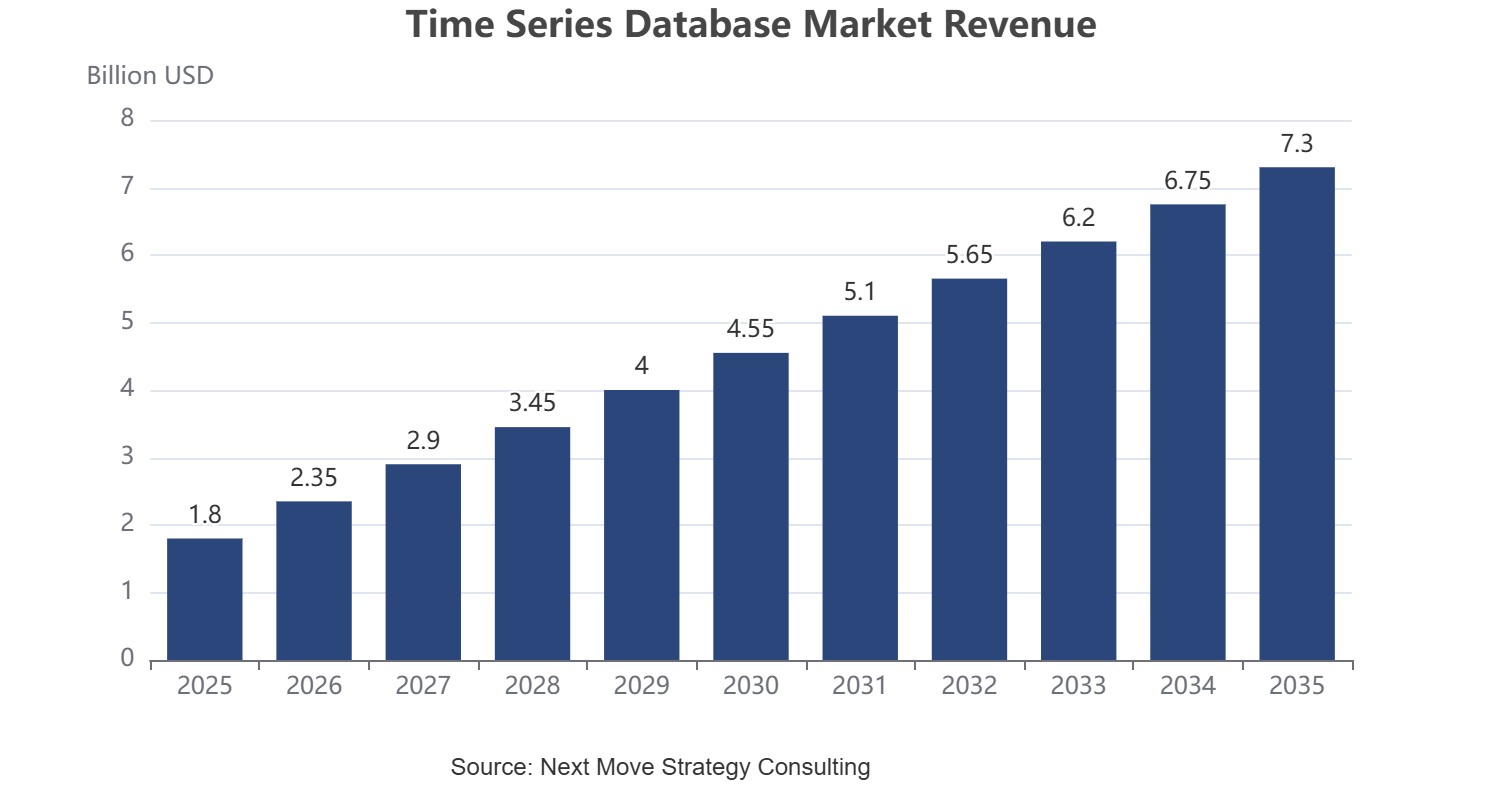
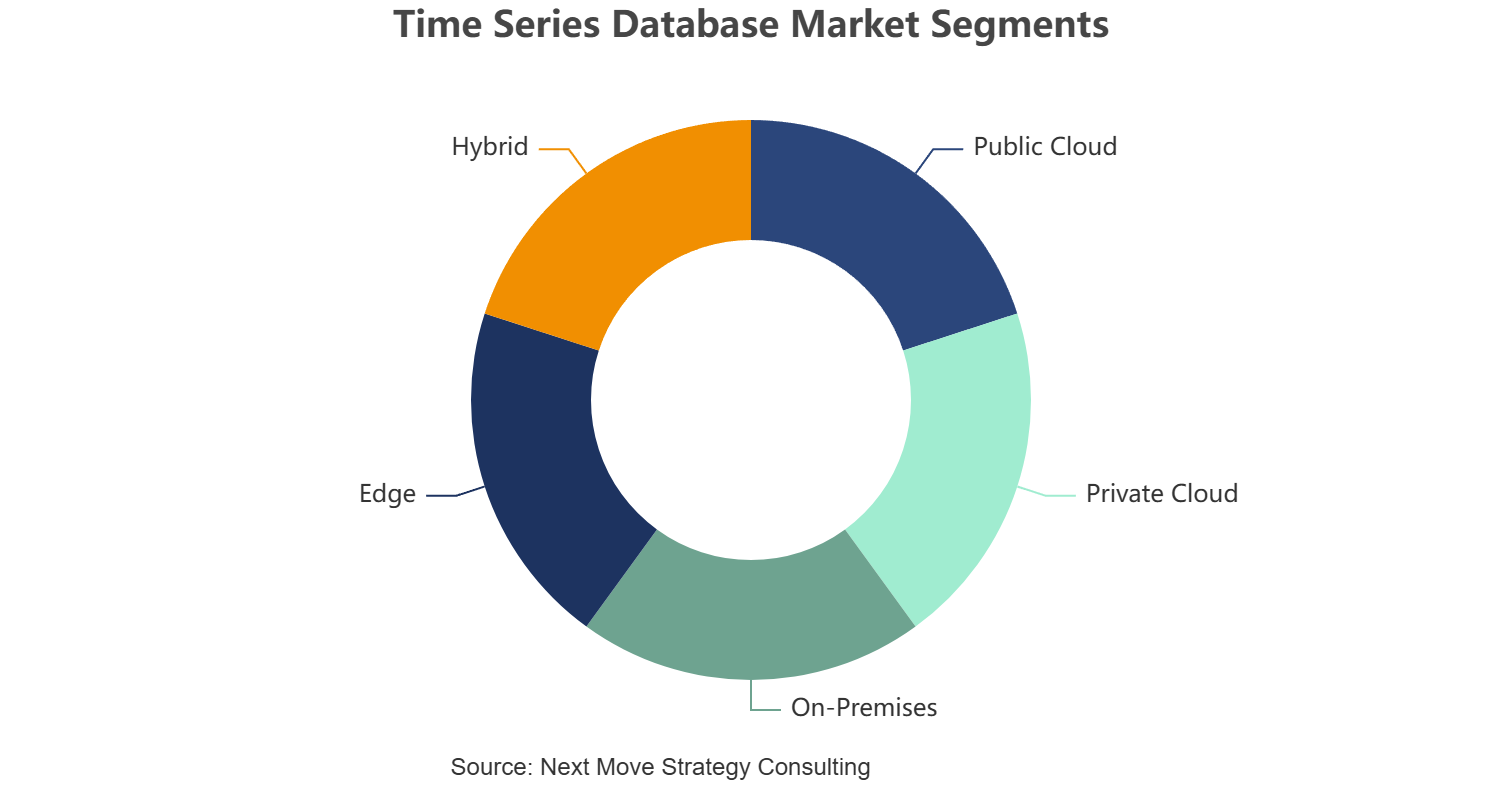
About the Author
 Liza Phukan
— Liza Phukan is Research Associate at Next Move Strategy Consulting, where she has covered emerging industries and market research across sectors for 3.5 years. Her work includes analyzing industry developments, validating market data, and developing structured business content from research findings. She uses secondary research and data-validation practices to turn complex market information into clear decision-useful market analysis for business audiences and support report development and B2B.
Liza Phukan
— Liza Phukan is Research Associate at Next Move Strategy Consulting, where she has covered emerging industries and market research across sectors for 3.5 years. Her work includes analyzing industry developments, validating market data, and developing structured business content from research findings. She uses secondary research and data-validation practices to turn complex market information into clear decision-useful market analysis for business audiences and support report development and B2B.
About the Reviewer
 Supradip Baul
— Supradip Baul is an accomplished business consultant and strategist with over a decade of rich experience in market intelligence, strategy, technology, and business transformation. His work has included rigorous qualitative and quantitative analysis across multiple industries, helping clients shape investment decisions and long-term roadmaps. Earlier in his career, he was associated with Gartner, where he contributed to industry-leading reports and market share analyses. He has worked with leading global companies and holds an MBA with a dual specialization in Marketing and Finance.
Supradip Baul
— Supradip Baul is an accomplished business consultant and strategist with over a decade of rich experience in market intelligence, strategy, technology, and business transformation. His work has included rigorous qualitative and quantitative analysis across multiple industries, helping clients shape investment decisions and long-term roadmaps. Earlier in his career, he was associated with Gartner, where he contributed to industry-leading reports and market share analyses. He has worked with leading global companies and holds an MBA with a dual specialization in Marketing and Finance.
At Next Move Strategy Consulting, we understand that insightful market research is the cornerstone of successful business decisions. That's why we employ a robust and multifaceted approach, combining various methodologies to deliver the most accurate and actionable data for our clients.

Research Landscape
We navigate the world of research with two primary approaches:
Qualitative Approach
Our qualitative research methodologies involve immersive techniques such as in-depth interviews, focus groups, and observational studies. By engaging directly with individuals and stakeholders, we uncover valuable insights that quantitative data alone may overlook.

Quantitative Research
In tandem with qualitative methodologies, NMSC leverages the power of Quantitative Research to provide a robust foundation of numerical insights. Through systematic data collection and analysis, we quantify patterns, preferences, and market trends, offering a comprehensive view of the business landscape.
Our quantitative research approach employs diverse tools, including surveys, experiments, and statistical modelling. These methodologies enable us to gather data from a large and representative sample, ensuring the statistical significance of our findings. By employing structured questionnaires and standardized data collection methods, we guarantee the reliability and validity of the information we present to our clients.
Quantitative research is particularly effective in measuring the prevalence of trends, assessing market size, and gauging the impact of various factors on consumer behavior. The numerical precision attained through this approach equips our clients with actionable insights, facilitating data-driven decision-making and strategy formulation.


Our Specialized Toolbox for Industry-Specific Market Research
We deploy a specialized arsenal of techniques tailored to meet your unique requirements. Here's a glimpse into our comprehensive toolbox:

Information Procurement
The stage entails acquiring market data or relevant information through various sources and methodologies.


Market Research Approach
We utilize both top-down and bottom-up approaches in market research analysis to achieve a comprehensive understanding of the market dynamics, leveraging the broad perspective of industry trends and macroeconomic factors alongside detailed insights from specific segments and individual companies.

Porters Five Forces Analysis
We conduct Porter's Five Forces analysis to evaluate the competitive landscape of an industry, providing us with insights into factors that affect profitability and strategic positioning.

SWOT Analysis

Forecasting
We utilize a forecasting model to predict future consumption by considering parameters like population, economics, regulations, market competition, drivers, constraints, technology, and pricing. We also employ statistical techniques such as multilinear regression, exponential smoothing, moving average, ARIMA, and Monte Carlo simulations for accurate predictions. In econometric forecasting, we analyzed short-term and long-term event impacts, attributing values based on regulatory frameworks, economic factors, and market events.





 Speak to Our Analyst