
U.S. Coffee Market by Product Form (Whole Bean, Ground, Soluble, & Others), By Bean Type (Arabica, Robusta, Blends, & Others), By Roast Level (Light, Medium, & Dark), By Caffeine Type (Regular & Decaffeinated), By Price Tier (Economy, Mid-Range, Premium, & Specialty), By Distribution Channel (Online & Offline), By End-User (Household Consumers, Commercial Establishments, Institutional Consumers, & Others) – Analysis & Forecast, 2025-2035
Industry: Retail and Consumer | Publishing Date: April 18, 2026 | Last Updated: September 30, 2026 | No of Pages: N/A | No. of Tables: N/A | No. of Figures: N/A | Format: PDF | Report Code: RC4517
Industry Outlook
The U.S. Coffee Market size was valued at USD 40.45 billion in 2025 and is expected to be valued at USD 42.59 billion by the end of 2026. The industry is projected to grow, hitting USD 67.85 billion by 2035, with a CAGR of 5.31% between 2026 and 2035.
U.S. Coffee Market Size & Forecast
|
Parameters |
Details |
|
Market Size in 2026 |
USD 42.59 Billion |
|
Revenue Forecast in 2035 |
USD 67.85 Billion |
|
Growth Rate |
CAGR of 5.31% from 2026 to 2035 |
|
Analysis Period |
2025–2035 |
|
Base Year Considered |
2025 |
|
Forecast Period |
2026–2035 |
|
Market Size Estimation |
Billion (USD) |
|
Companies Profiled |
20 |
|
Countries Covered |
33 |
|
Market Share |
Available for 10 companies |
The coffee market in the United States is evolving from a traditional beverage category into a highly diversified consumer market characterised by premiumization, product innovation, and expanding consumption occasions. Based on our analysis, we found that coffee demand is supported by widespread daily consumption across households, cafes, restaurants, and workplace environments, making it one of the most consistently consumed beverages in the country. Further, specialty coffee culture, premium bean sourcing, and advanced roasting techniques are elevating product differentiation and value creation across both retail and foodservice channels.
Industry evidence suggests that evolving consumer lifestyles and changing beverage preferences are accelerating innovation across ready-to-drink formats, cold brew beverages, and plant-based coffee formulations. Companies are increasingly investing in sustainable sourcing, digital commerce platforms, and direct-to-consumer subscription models to strengthen brand loyalty and capture emerging demand segments. In addition, technological improvements in roasting, brewing equipment, and supply chain analytics are enabling more consistent product quality and operational efficiency. These structural shifts, combined with expanding premium product portfolios, are expected to continue shaping the competitive landscape and supporting steady long-term growth across the U.S. coffee market.
What Are the Key U.S. Coffee Market Trends?
How is Cold Brew and Nitro Coffee Innovation Reshaping Product Portfolios?
The rapid innovation surrounding cold brew and nitro-infused coffee is reshaping beverage portfolios and redefining premium coffee experiences in the United States. Based on our analysis, we noticed that beverage developers and cafe operators are expanding cold brew offerings with new flavour infusions, dairy alternatives, and nitrogen-based texture enhancements to attract younger consumers seeking smoother and less acidic coffee profiles. Nitro coffee, delivered through nitrogen infusion technology, has gained popularity for its creamy mouthfeel and draft-style presentation. These formats are increasingly appearing not only in cafes but also in packaged retail beverages. Our evaluation shows that this trend is encouraging continuous experimentation in brewing techniques, product formats, and flavour development across the industry.
How Is the Rise of Alternative Milk Integration Influencing Coffee Product Development?
NMSC’s analysis indicates that the integration of plant-based milk alternatives is significantly influencing coffee formulation, menu innovation, and product positioning across the U.S. coffee market. Consumers are increasingly opting for dairy alternatives such as oat, almond, and soy milk due to dietary preferences, lactose intolerance, and sustainability considerations. Furthermore, coffee chains and packaged beverage brands are actively reformulating beverages to ensure compatibility with plant-based ingredients without compromising taste or texture. Manufacturers are also investing in barista-grade alternative milk formulations specifically designed for espresso-based beverages. As a result, this shift is expanding the customisation possibilities of coffee drinks while enabling brands to appeal to a broader consumer base seeking plant-forward beverage options.
How Is the Rise of Coffee Subscriptions and Direct-to-Consumer Models Reshaping Consumer Engagement?
The rapid growth of direct-to-consumer (DTC) subscription models is transforming how coffee brands build long-term relationships with consumers in the United States. Our evaluation indicates that specialty roasters and emerging coffee brands are increasingly bypassing traditional retail intermediaries by offering curated monthly coffee deliveries tailored to consumer taste preferences. Subscription platforms are integrating personalisation tools that recommend roast profiles, origin regions, and flavour notes based on past purchase behaviour. Furthermore, predictive demand analytics and automated fulfilment systems are enabling companies to optimise inventory while ensuring freshness. As a result, these subscription-driven ecosystems are strengthening brand loyalty, improving customer lifetime value, and enabling smaller roasters to scale nationally without relying heavily on traditional retail distribution networks.
Porter’s Five Forces Analysis of the U.S. Coffee Market
Porter's Five Forces Analysis reveals the competitive intensity in the U.S. coffee market, evaluating supplier dynamics, buyer influence, entry barriers, rivalry, and substitution threats.
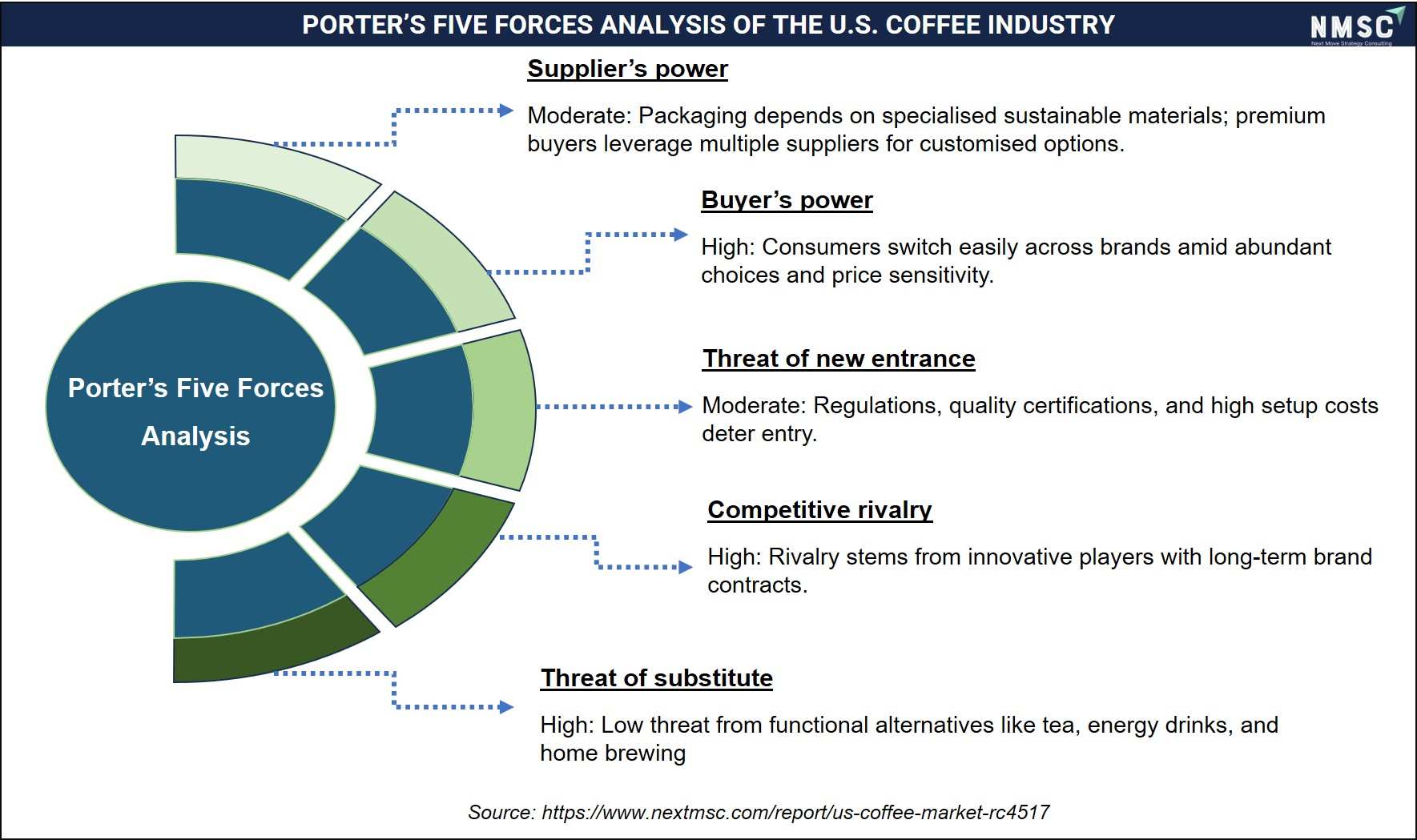
The above infographic illustrates Porter's Five Forces in the U.S. coffee market by outlining the key competitive dynamics shaping industry profitability. Our assessment shows that competitive forces begin with supplier power, focusing on specialised sustainable materials and premium packaging options. Roasters leverage multiple suppliers for customised sustainable packaging, while consumers switch easily across brands amid abundant choices and price sensitivity. Intense rivalry stems from innovative players with long-term brand contracts. Furthermore, threats from functional alternatives like tea, energy drinks, and home brewing are elevated. These forces compel brands to innovate amid regulations and quality standards, impacting market growth.
What Are the Key Market Drivers, Breakthroughs, And Investment Opportunities That Will Shape the U.S. Coffee Market in the Next Decade?
Growth Catalyst & Risk Assessment Matrix
|
DRIVERS/TRENDS/ RESTRAINTS |
(+/-) % IMPACT ON CAGR FORECAST |
GEOGRAPHIC RELEVANCE |
IMPACT TIMELINE |
|
Rising consumer preference for specialty and premium coffee driving higher value sales and product innovation |
|
United States (major urban markets), Canada, Western Europe |
Medium to Long term (3–6 years) |
|
Rapid expansion of ready-to-drink coffee and single-serve convenience formats accelerating retail demand |
+3.10% |
United States, North America, developed Asia-Pacific |
Short to Medium term (2–5 years) |
|
Functional and health-oriented coffee innovations drive the U.S. coffee market growth |
+1.95% |
United States, Canada, Western Europe |
Medium term (2–4 years) |
|
Increasing product innovation in cold brew, functional coffee beverages, and premium roasting technologies |
+1.70% |
United States, Japan, South Korea, Western Europe |
Medium term (2–4 years) |
|
Volatility in global coffee bean prices and climate-related supply chain disruptions increasing procurement costs |
-2.20% |
United States, Latin America supply chain regions, global coffee import markets |
Medium to Long term (3–6 years) |
Based on our comprehensive market analysis, we observed that the U.S. coffee market is primarily driven by the rapid expansion of specialty coffee concentrates consumption and the growing demand for convenient coffee formats across retail and foodservice channels in the United States. Coffee roasters, beverage manufacturers, and retail distributors are increasingly investing in premium bean sourcing, innovative roasting techniques, and ready-to-drink product development to meet evolving consumer preferences for quality, flavour diversity, and convenience. Furthermore, the expansion of digital commerce platforms and subscription-based coffee delivery services is accelerating market accessibility and consumer engagement. However, volatility in global coffee bean prices and supply chain disruptions remain key restraints, particularly for smaller roasters and independent cafes facing margin pressures.
Growth Drivers:
How Is the Expansion of Specialty Coffee Culture Accelerating the U.S. Coffee Market?
NMSC’s research indicates that the rapid expansion of specialty coffee culture is significantly strengthening demand across the United States coffee market. Based on our analysis, we found that consumers are increasingly prioritising premium beans, single-origin sourcing, artisanal roasting, and ethically certified products, reflecting a broader shift toward quality-driven beverage consumption. Younger demographics, particularly Millennials and Gen Z, are actively seeking differentiated flavour profiles and traceable supply chains. Furthermore, specialty coffee shops, boutique roasters, and direct-to-consumer subscription models are expanding rapidly, creating new revenue streams beyond traditional retail channels. As a result, this premiumization trend is elevating average selling prices, encouraging product innovation, and driving long-term value growth across both packaged coffee and foodservice segments.
How Is the Rapid Growth of Ready-to-Drink and Convenience Coffee Formats Accelerating U.S. Coffee Market Expansion?
Industry analysis suggests that the surge in ready-to-drink coffee and convenient single-serve formats is reshaping consumption patterns and accelerating market expansion. Based on our primary research, we found that busy urban lifestyles and the growing demand for portable beverages are increasing consumer preference for canned cold brew, bottled iced coffee, and capsule-based brewing systems. Furthermore, retailers, beverage manufacturers, and technology providers are investing heavily in innovative packaging, cold-chain logistics, and flavour diversification to capture this demand. Ready-to-drink coffee is particularly gaining traction in convenience stores, supermarkets, and e-commerce platforms. As a result, the combination of portability, longer shelf life, and premium flavour profiles is enabling brands to expand beyond traditional cold brew coffee consumption occasions, thereby broadening the total addressable market.
Growth Inhibitor:
How Are Coffee Bean Price Volatility and Supply Chain Pressures Restraining Market Growth?
Volatility in global coffee bean prices and supply chain disruptions remain a critical restraint affecting the U.S. coffee market. The NMSC bar chart given below illustrates this through surging green coffee import values, from USD 4.38 billion in 2019 to USD 7.78 billion in 2025, reflecting increased market activity alongside fluctuating input costs. Based on our analysis, we observed that fluctuations in green coffee prices, driven by climate variability, crop yield uncertainty, and geopolitical trade dynamics, are significantly influencing procurement costs for roasters and beverage manufacturers. Furthermore, unpredictable supply conditions in major coffee-producing regions are forcing companies to adjust sourcing strategies and pricing models. Smaller specialty roasters and independent cafes are particularly vulnerable to cost inflation, which compresses margins or leads to price increases for consumers. As a result, persistent input cost volatility limits pricing flexibility and slows expansion across certain retail and foodservice segments.

Growth Opportunity:
How Are Functional and Health-Oriented Coffee Innovations Creating New Market Opportunities?
From our market evaluation, we observed that functional and health-oriented coffee innovations represent one of the most transformative opportunities shaping the evolution of the U.S. coffee market. Consumers are increasingly seeking beverages that go beyond caffeine delivery, incorporating added health benefits such as improved energy, focus, immunity, and overall wellness. Based on our interviews with specialty roasters, we found that the integration of ingredients such as adaptogens, collagen, protein, and vitamins is enabling brands to reposition coffee as a functional beverage. Industry evidence suggests that clean-label formulations, low-sugar variants, and plant-based enhancements are further strengthening appeal among health-conscious consumers. As a result, these innovations are expanding consumption occasions, attracting new consumer segments, and enabling premium pricing, thereby driving both value-added growth and competitive differentiation across the market.
Expert Insights
 “Coffee’s staying power as a beloved touchstone in Americans’ daily lives is remarkable, and its contributions to our health and our economy give Americans even more ‘grounds for celebration’ this National Coffee Day and every day.”
Bill Murray, NCA President and CEO
Statement made during a National Coffee Day address highlighting the cultural and economic importance of coffee consumption in the United States.
Market Interpretation
The comment underscores the enduring role of coffee as one of the most widely consumed beverages in the United States and highlights the beverage’s deep integration into everyday consumer routines. Strong and consistent consumption patterns continue to support demand across retail, foodservice, and ready-to-drink beverage segments. The statement also reflects the broader economic significance of the coffee industry, which sustains a large ecosystem of importers, roasters, café operators, and beverage manufacturers. As consumer preferences evolve toward specialty, premium, and convenience-oriented formats, the market is witnessing increasing product innovation and retail diversification. This dynamic reinforces the long-term stability of the U.S. coffee market while encouraging continued investment in premium sourcing, sustainable supply chains, and advanced roasting and brewing technologies.
How Is the U.S. Coffee Industry Segmented in This Report, And What Are the Key Insights from the Segmentation Analysis?
Market Highlights & Strategic Insights - U.S. Coffee Market:
|
Segments |
Key Takeaways |
|
Product Form |
Product form remains a central differentiator shaping consumption patterns. Ground coffee and whole bean dominate household consumption due to traditional brewing methods, while coffee pods, capsules, and ready-to-drink beverages are growing rapidly among convenience-driven consumers |
|
Bean Type |
Arabica beans dominate due to their smooth flavour and strong association with specialty and premium coffee. Robusta is used mainly in blends and soluble products for cost efficiency and higher caffeine content. Blends allow balancing taste and affordability, while other varieties serve niche consumer segments. |
|
Roast Level |
Medium roast is the most widely consumed due to its balanced flavour and versatility. Light roast, on the other hand, is gaining among specialty coffee consumers seeking origin-specific notes, while dark roast maintains demand in traditional retail and cafe espresso beverages. |
|
Flavour |
Flavoured coffee is increasingly used to differentiate products, with vanilla, caramel, and hazelnut being the most common. Seasonal and dessert-inspired flavours target younger, indulgence-seeking consumers, while unflavoured coffee remains the standard for traditional consumption. |
|
Packaging Type |
Packaging innovation drives freshness and convenience. Pouches and vacuum-sealed bags dominate ground, and whole bean formats, bottles and cans are used for ready-to-drink coffee, and stick packs or single-serve packs are growing for on-the-go consumption. Glass jars cater to premium segments. |
|
End-User |
Household consumers account for the largest share due to home brewing. Commercial establishments and institutional consumers (hospitals, schools, government) contribute significantly, while travel & leisure venues support on-the-go demand. |
By Product Form Insights
Is Product Form Innovation Reshaping the U.S. Coffee Market Demand?
On the basis of product form, the U.S. coffee market is segmented into whole bean coffee, ground coffee, soluble coffee, coffee pods and capsules, and ready-to-drink coffee.
Ground coffee remains the dominant product form in the U.S. coffee market due to its affordability, widespread retail availability, and compatibility with the most common household brewing methods. Industry data shows that ground coffee accounts for a substantial share of total consumption, supported by drip coffee maker usage in a large proportion of U.S. homes. However, market dynamics are evolving as convenience-oriented formats gain traction. Coffee pods and capsules are expanding due to single-serve machine adoption, while ready-to-drink beverages are benefiting from on-the-go consumption trends and product innovation such as cold brew. While traditional formats maintain volume leadership, convenience-driven and premium formats will generate the strongest growth over the next decade.

By Caffeine Type Insights
Is Caffeine Preference Influencing Consumption Patterns in the U.S. Coffee Market?
Based on caffeine type, the U.S. coffee market is segmented into regular coffee and decaffeinated coffee.
Our market assessment identifies that regular coffee clearly dominates the caffeine type segmentation in the United States coffee market due to its strong association with daily energy consumption and workplace productivity. Most consumers prefer caffeinated beverages as part of their morning routines and throughout the workday, reinforcing demand across retail and foodservice channels. However, industry trends indicate that decaffeinated coffee is gradually expanding as health-conscious consumers seek to moderate caffeine intake without eliminating coffee consumption. However, improvements in modern decaffeination technologies are helping preserve flavour quality, supporting steady growth and broader consumer acceptance within this niche segment.
By Price Tier Insights
Is Price Tier Segmentation Influencing Value Creation in the U.S. Coffee Market?
Based on the price tier, the U.S. coffee market is segmented into economy coffee, mid-range coffee, premium coffee, and specialty coffee.
We found that the mid-range coffee segment dominates the U.S. coffee market due to its strong balance between affordability, quality, and wide retail availability. Mainstream brands positioned within this price tier capture the largest consumer base because they serve everyday coffee consumption across households and workplaces. However, market trends indicate that premium and specialty coffee segments are growing faster, supported by rising consumer interest in high-quality beans, sustainable sourcing, and artisanal roasting. While economy coffee maintains strong volume demand, the long-term value growth of the market will increasingly be driven by premiumization and specialty coffee adoption.
By End-User Insights
Is End-User Consumption Shaping Demand Patterns in the U.S. Coffee Market?
Based on end-user, the U.S. coffee market is segmented into household consumers, commercial establishments, institutional consumers, travel & leisure venues, and others.
Based on our evaluation of industry consumption patterns, we found that household consumers dominate the end-user segmentation in the U.S. coffee market due to the widespread prevalence of home brewing and daily coffee drinking routines. Most Americans consume coffee at home, supported by accessible retail distribution and the growing popularity of single-serve machines and specialty brewing equipment. However, market data also suggests that commercial establishments, institutional facilities, and travel venues continue to represent significant secondary demand channels. While at-home consumption drives the largest volume share, away-from-home segments remain critical for brand visibility, product experimentation, and premium beverage experiences across the market.

Regional Outlook:
NMSC’s analysis indicates that the United States represents the world’s largest coffee-consuming market, characterised by high per-capita consumption, a well-established retail ecosystem, and continuous product innovation across specialty beverages and ready-to-drink formats. Based on our observation of data published by the National Coffee Association, approximately 66% of American adults drink coffee daily, with the average consumer consuming nearly three cups per day, highlighting the beverage’s deep integration into everyday routines and workplace culture. Market growth is increasingly supported by the rising adoption of specialty coffee, premium beans, and innovative brewing formats such as cold brew and nitro coffee. Industry evidence further suggests that 46% of adults consumed specialty coffee in 2025, indicating a structural shift toward higher-value offerings. Robust retail distribution networks, expanding cafe chains, and digital ordering platforms continue to reinforce market maturity, while future opportunities are emerging from premiumization, sustainability initiatives, and innovation in ready-to-drink beverages across the broader coffee value chain.
Consumer Behaviour Analysis Impacting the U.S. Coffee Market
The infographic illustrates the consumer decision journey in the U.S. coffee market, highlighting key drivers from awareness to loyalty amid rising demands for sustainability, premiumization, and convenience.
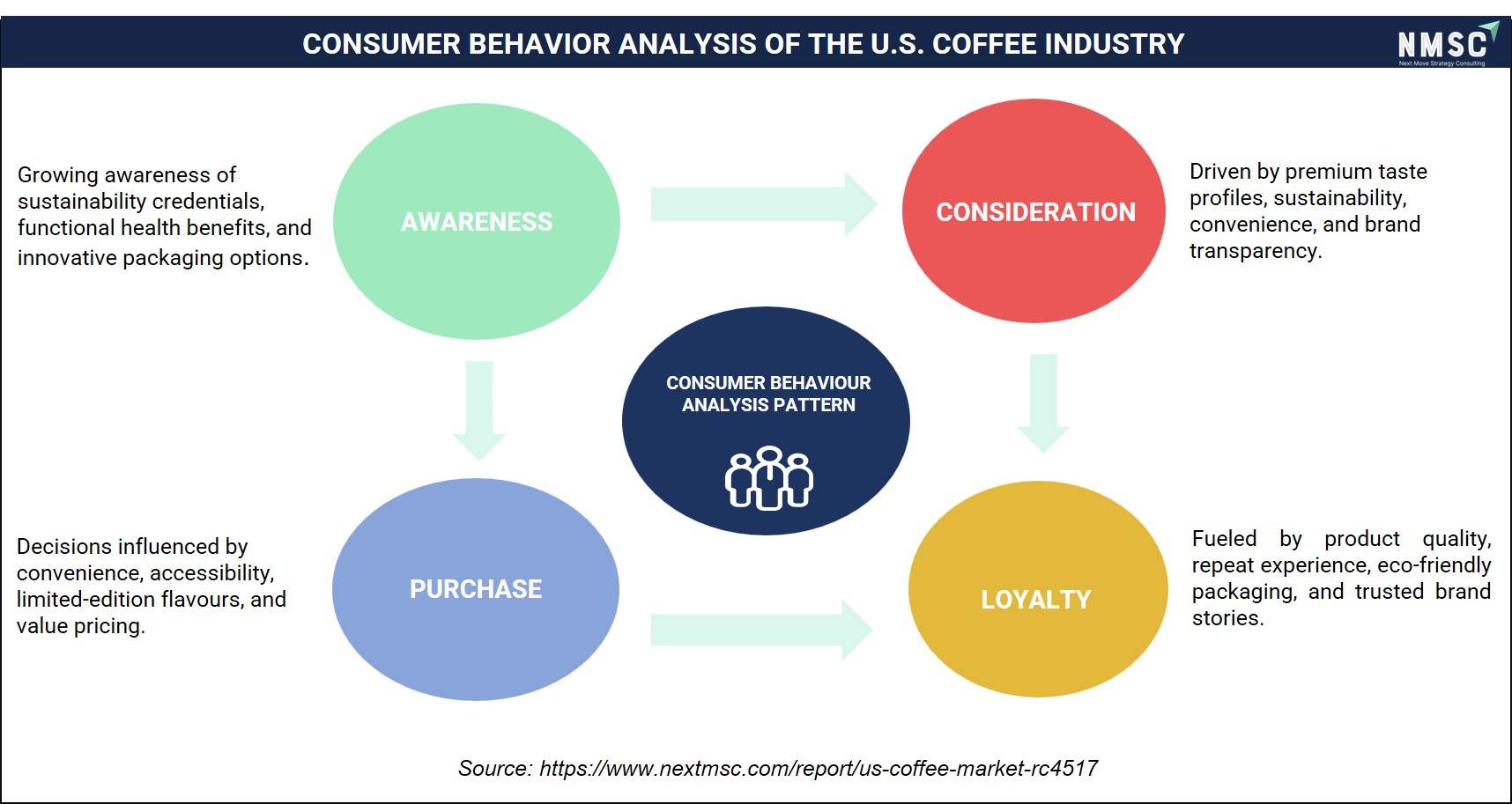
We observed that brands play a critical role through sustainability credentials and ethical sourcing initiatives that support premiumization, functional health benefits, and innovative packaging options, alongside convenient access via apps and drive-throughs. Premium taste profiles and transparency standards ensure high-quality, resilient consumer experiences, while value-driven options require accessible, localised product availability to meet diverse preferences. Together, these market factors significantly influence investment strategies, brand development, and global competitive dynamics.
Competitive Landscape
Competitive Dynamics & M&A Landscape:
|
Key Takeaways |
|
The U.S. coffee market is characterized by the presence of global leaders, national brands, and specialty roasters, including Starbucks Coffee Company, Nestlé USA, Peet’s Coffee, The Folger Coffee Company, La Colombe Coffee Workshop, Death Wish Coffee, Black Rifle Coffee Company, Paramount Coffee, and Massimo Zanetti Beverage USA. Their combined scale and diversified portfolios across retail, foodservice, and DTC channels shape a highly competitive and fragmented landscape. |
|
From our assessment, we observed that companies are focusing on premiumization, product innovation, and omnichannel expansion. Large players leverage brand equity, RTD offerings, and loyalty ecosystems, while specialty roasters differentiate through artisanal quality, ethical sourcing, and personalised consumer experiences. |
|
Industry evaluation suggests increasing focus on functional coffee, cold brew formats, sustainable packaging, and digital subscription models. Companies such as Starbucks and Lavazza are investing in digital ecosystems and sustainability, while smaller brands like Driftaway emphasise traceability and customisation. |
Which Companies Dominate the U.S. Coffee Market and How Do They Compete?
Our assessment indicates that the U.S. coffee market is led by a mix of multinational giants and strong domestic brands, including Nestlé USA, Starbucks Coffee Company, Peet’s Coffee, Kraft Heinz, and Luigi Lavazza, alongside established players such as Massimo Zanetti Beverage USA and Caribou Coffee. These companies compete through scale, brand equity, and diversified portfolios spanning retail, foodservice, and ready-to-drink segments. We observed that Starbucks continues to strengthen its premium retail positioning and digital ecosystem, while Nestlé leverages its global supply chain and product innovation capabilities. At the same time, specialty players such as Onyx Coffee Lab and Driftaway differentiate through direct trade sourcing and subscription-led personalisation.
Market Dominated by U.S. Coffee Giants and Specialists
Industry analysis indicates a dual-layer competitive structure where global corporations dominate mass-market and packaged coffee segments, while niche and specialty roasters capture premium and artisanal demand. Large-scale players such as Kraft Heinz (Maxwell House) and The Folger Coffee Company maintain strong presence in value-driven retail channels, whereas companies like La Colombe Coffee Workshop and Black Rifle Coffee Company focus on lifestyle branding and high-growth RTD segments. Industry observation suggests that Westrock Coffee has been expanding its B2B and private-label capabilities to serve large retailers and foodservice clients. Meanwhile, Community Coffee and Royal Cup Coffee sustain regional strength through heritage branding and localized distribution strategies.
Innovation and Adaptability Drive Market Success
innovation is a key competitive differentiator, particularly in functional beverages, sustainability, and digital engagement. Companies are actively launching new formats such as cold brew concentrates, low-sugar RTD variants, and functional coffee blends. For instance, Starbucks has continued to expand its cold beverage and customisation-driven offerings while enhancing its mobile ordering and loyalty ecosystem. At the same time, Driftaway and Onyx Coffee Lab are leveraging data-driven subscriptions and transparency in sourcing to attract younger consumers. Technical evaluation shows that sustainability initiatives, including recyclable packaging and carbon reduction goals by companies like Lavazza, are becoming central to long-term competitive positioning.
Market Players to Opt for Merger & Acquisition Strategies to Expand Their Presence
Mergers, acquisitions, and strategic partnerships are playing a critical role in expanding market reach and capabilities. Larger companies are acquiring niche brands to enter high-growth segments such as RTD and specialty coffee. For example, Massimo Zanetti Beverage Group has continued to strengthen its U.S. footprint through portfolio expansion and private-label partnerships. Similarly, Coffee Holding Company has pursued strategic distribution expansions to enhance its wholesale and private-label presence. Industry evidence suggests that such moves enable companies to diversify offerings, access new consumer segments, and strengthen supply chain integration, thereby intensifying competitive dynamics across both premium and mass-market segments.
List of Key U.S. Coffee Companies
-
Nestle USA
-
Starbucks Coffee Company
-
PEET'S COFFEE
-
The Folger Coffee Company
-
Kraft Heinz, Inc.
-
Royal Cup Coffee
-
Massimo Zanetti Beverage USA
-
Luigi Lavazza SPA
-
Community Coffee
-
La Colombe Coffee Workshop
-
Black Rifle Coffee Company
-
The Eight O'Clock Coffee Company
-
Onyx Coffee Lab
-
Death Wish Coffee.
-
Caribou Coffee Operating Company, Inc.
-
Coffee Holding
-
Paramount Coffee
-
Cameron's Coffee
-
Driftaway Inc.
What Are the Latest Key Industry Developments?
-
March 2026- Starbucks Coffee Company launched a redesigned Starbucks Rewards loyalty program featuring three membership tiers, Green, Gold, and Reserve, to deepen personalisation, increase engagement, and incentivise repeat visits in the U.S. market.
-
March 2026- Nestle agreed to sell the global retail operations of Blue Bottle Coffee to Centurium Capital, a private equity firm and controlling shareholder of Luckin Coffee.
-
August 2025- Keurig Dr Pepper completed a multi billion dollar acquisition of JDE Peet’s, uniting major coffee brands like Peet’s, Jacobs, Senseo, and L’OR with Keurig’s North American coffee business.
Supply Chain Analysis of the U.S. Coffee Market
The infographic maps the supply chain structure of the U.S. coffee market, detailing upstream sourcing and downstream distribution flows critical to industry efficiency.
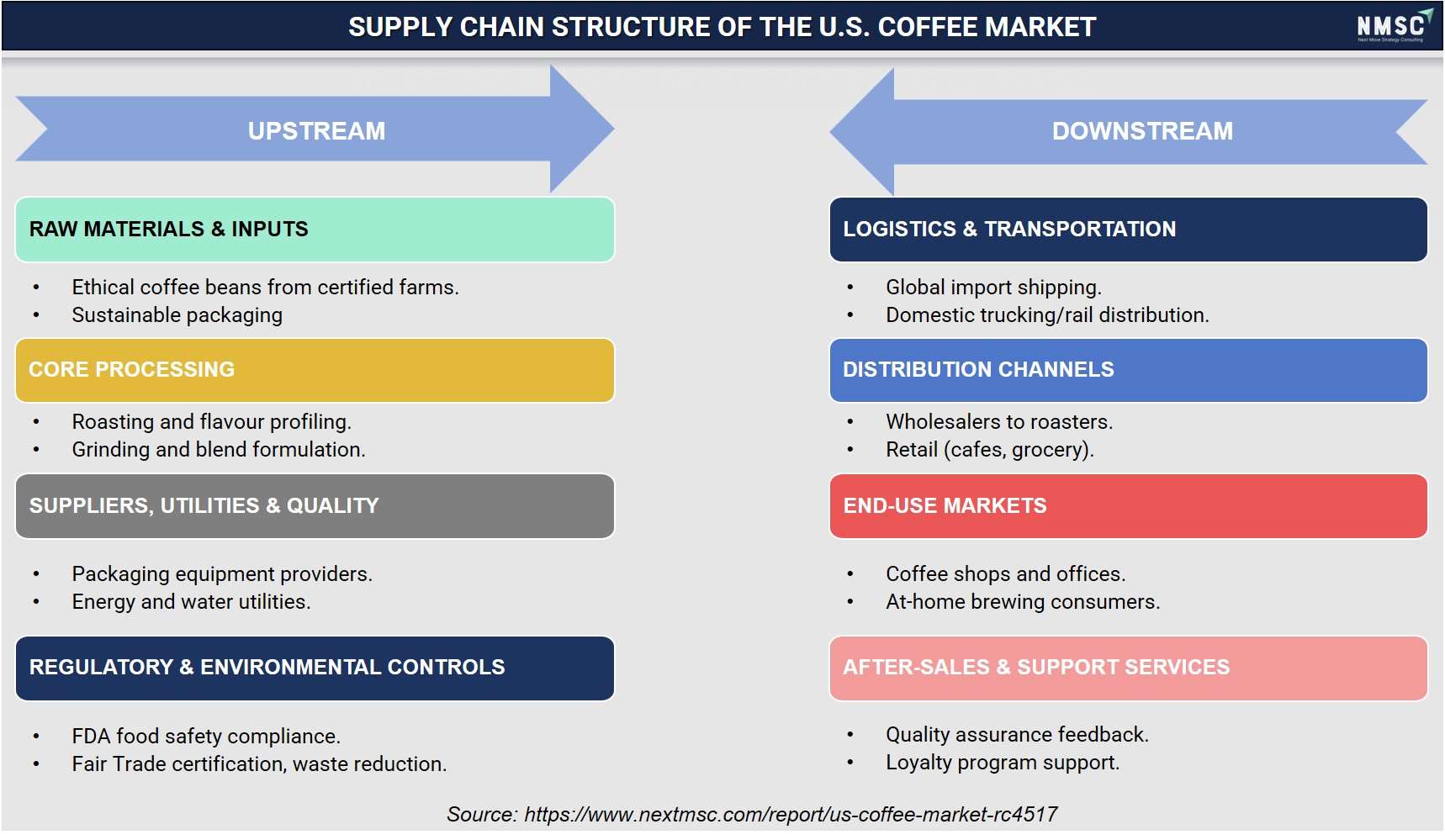
The above infographic illustrates the supply chain structure of the U.S. coffee market by outlining upstream and downstream processes from sourcing to end-use. Our evaluation shows it begins with raw materials & inputs, core processing, suppliers/utilities/quality, and regulatory/environmental controls. Downstream includes logistics/transportation, distribution channels, end-use markets, and after-sales/support services. These elements enhance traceability and resilience, fueling U.S. market growth.
What Are the Key Factors Influencing Investment Analysis & Opportunities in the U.S. Coffee Market?
Investment activity in the United States coffee market is increasingly shaped by premiumization, technology-enabled production, and the consolidation of specialty brands. NMSC’s analysis indicates that private equity firms and strategic investors are actively acquiring or funding specialty coffee chains, roasting companies, and beverage innovators to capture value in premium and experiential segments. Venture capital is also supporting startups developing alternative production methods, advanced brewing technologies, and new product formats such as flash-frozen capsules and beanless coffee alternatives, reflecting growing investor interest in differentiated and scalable beverage innovation.
Investor attention is also concentrating on sustainability and operational technology across the coffee value chain. Based on our evaluation, we found strong demand for energy-efficient roasting systems and digitally connected supply chains that improve traceability and operational efficiency. Technology developers are introducing electric roasting platforms designed to reduce emissions and enable localised roasting for cafes and retailers. Our assessment further indicates that investors view these innovations as strategic opportunities to enhance margins, strengthen sustainability credentials, and support long-term differentiation. Consequently, future investment hotspots are expected to center on specialty retail expansion, sustainable sourcing platforms, and technology-driven coffee production systems.
Key Benefits for Stakeholders:
Next Move Strategy Consulting (NMSC) provides a comprehensive and evidence-based analysis of the U.S. coffee market trends, covering historical developments from 2020 to 2025 and offering forward-looking forecasts through 2035. Our study assesses the market at global, regional, and country levels, combining quantitative outlooks with qualitative insights into key growth drivers, adoption constraints, technology evolution, and investment dynamics across major U.S. coffee segments.
Market evidence suggests that the U.S. coffee market creates distinct value across multiple stakeholder groups through premiumization, product innovation, and strong consumer demand. Investors benefit from a resilient beverage category with recurring consumption patterns, opportunities in specialty coffee brands, and emerging technologies in roasting, supply chain transparency, and direct-to-consumer retail models. From a customer perspective, consumers gain access to a diverse range of high-quality products, including specialty beans, ready-to-drink beverages, and customizable brewing formats that enhance convenience and flavour experiences. Industry assessment further suggests that retailers, cafes, and supply chain participants benefit from consistent demand and opportunities to differentiate through sustainability, ethical sourcing, and premium beverage offerings. Supportive trade policies for agricultural imports, combined with growing consumer preference for responsibly sourced products, continue to create a favourable ecosystem that encourages innovation, long-term investment, and value creation across the coffee value chain.
|
Parameters |
Details |
|
Customization Scope |
Free customization (equivalent to up to 80 analyst-working hours) after purchase. Addition or alteration to country, regional & segment scope. |
|
Pricing and Purchase Options |
Avail customized purchase options to meet your exact research needs. |
|
Approach |
In-depth primary and secondary research; proprietary databases; rigorous quality control and validation measures. |
|
Analytical Tools |
Porter's Five Forces, SWOT, value chain, and Harvey ball analysis to assess competitive intensity, stakeholder roles, and relative impact of key factors. |
U.S. Coffee Market Key Segments
By Product Form
-
Whole Bean Coffee
-
Single Origin Coffee
-
Blended Coffee
-
-
Ground Coffee
-
Fine Grind Coffee
-
Medium Grind Coffee
-
Coarse Grind Coffee
-
-
Soluble Coffee
-
Spray Dried Coffee
-
Freeze Dried Coffee
-
Agglomerated Coffee
-
Instant Coffee Mixes
-
Two-in-One Coffee Mix
-
Three-in-One Coffee Mix
-
Instant Latte Mix
-
Instant Cappuccino Mix
-
-
-
Coffee Pods and Capsules
-
Closed System Capsules
-
Open System Pods
-
-
Ready-to-Drink Coffee
-
Black Coffee Beverages
-
Milk-Based Coffee Beverages
-
By Bean Type
-
Arabica Coffee
-
Robusta Coffee
-
Blends Coffee
-
Other Varieties
By Roast Level
-
Light Roast
-
Medium Roast
-
Dark Roast
By Caffeine Type
-
Regular Coffee
-
Decaffeinated Coffee
By Flavour
-
Unflavoured Coffee
-
Flavoured Coffee
-
Vanilla
-
Caramel
-
Hazelnut
-
Chocolate
-
Mocha
-
Spiced Flavours
-
Others Flavours
-
By Packaging Type
-
Pouches
-
Glass Jars
-
Cans
-
Bottles
-
Stick Packs
By Price Tier
-
Economy Coffee
-
Mid-Range Coffee
-
Premium Coffee
-
Specialty Coffee
By Distribution Channel
-
Offline
-
Supermarkets & Hypermarkets
-
Convenience Stores
-
Specialty Stores
-
-
Online Retail
-
E-commerce Marketplaces
-
Brand-Owned Websites
-
By End User
-
Household Consumers
-
Commercial Establishments
-
Cafes & Coffee Shops
-
Restaurants
-
Hotels
-
Offices
-
-
Institutional Consumers
-
Hospitals
-
Educational Institutions
-
Government Facilities
-
-
Travel & Leisure Venues
-
Airports
-
Railway Stations
-
Airlines
-
Cruise Lines
-
-
Others
Conclusion & Recommendations
The U.S. coffee market continues to demonstrate strong structural resilience, supported by deeply embedded consumption habits, premium product innovation, and evolving retail formats. Based on our industry evaluation, we observed that specialty coffee, ready-to-drink beverages, and convenient single-serve brewing formats are reshaping consumer purchasing patterns while encouraging brand differentiation and product premiumization. Sustainability, traceability in sourcing, and technology-enabled roasting and distribution models are becoming central competitive factors. Our research further suggests that companies able to combine product quality, ethical sourcing, and omnichannel distribution will be better positioned to capture long-term value as consumer expectations around transparency and experience continue to evolve.
From a strategic perspective, executives and investors should focus on strengthening supply chain resilience, supporting sustainable sourcing initiatives, and enabling innovation across processing, packaging, and retail channels. Investment in climate-resilient sourcing practices, advanced roasting technologies, and premium retail experiences will remain critical to maintaining competitiveness. Proactive collaboration between industry participants and regulators to encourage sustainable trade practices and responsible sourcing frameworks can further strengthen long-term market stability while unlocking new opportunities for growth and value creation across the broader coffee ecosystem.


About the Author
 Mayurima Roy
— Mayurima Roy is Research Analyst at Next Move Strategy Consulting, where she has spent 4 years working across the firm's full industry coverage rather than a single fixed vertical. Her work centers on structured research, ongoing trend tracking, competitive assessment, and insight-led content development, translating complex market data into clear, decision-ready narratives that support informed client decision-making across diverse global industries, market sectors, and world regions every day.
Mayurima Roy
— Mayurima Roy is Research Analyst at Next Move Strategy Consulting, where she has spent 4 years working across the firm's full industry coverage rather than a single fixed vertical. Her work centers on structured research, ongoing trend tracking, competitive assessment, and insight-led content development, translating complex market data into clear, decision-ready narratives that support informed client decision-making across diverse global industries, market sectors, and world regions every day.
About the Reviewer
 Supradip Baul
— Supradip Baul is an accomplished business consultant and strategist with over a decade of rich experience in market intelligence, strategy, technology, and business transformation. His work has included rigorous qualitative and quantitative analysis across multiple industries, helping clients shape investment decisions and long-term roadmaps. Earlier in his career, he was associated with Gartner, where he contributed to industry-leading reports and market share analyses. He has worked with leading global companies and holds an MBA with a dual specialization in Marketing and Finance.
Supradip Baul
— Supradip Baul is an accomplished business consultant and strategist with over a decade of rich experience in market intelligence, strategy, technology, and business transformation. His work has included rigorous qualitative and quantitative analysis across multiple industries, helping clients shape investment decisions and long-term roadmaps. Earlier in his career, he was associated with Gartner, where he contributed to industry-leading reports and market share analyses. He has worked with leading global companies and holds an MBA with a dual specialization in Marketing and Finance.
At Next Move Strategy Consulting, we understand that insightful market research is the cornerstone of successful business decisions. That's why we employ a robust and multifaceted approach, combining various methodologies to deliver the most accurate and actionable data for our clients.

Research Landscape
We navigate the world of research with two primary approaches:
Qualitative Approach
Our qualitative research methodologies involve immersive techniques such as in-depth interviews, focus groups, and observational studies. By engaging directly with individuals and stakeholders, we uncover valuable insights that quantitative data alone may overlook.

Quantitative Research
In tandem with qualitative methodologies, NMSC leverages the power of Quantitative Research to provide a robust foundation of numerical insights. Through systematic data collection and analysis, we quantify patterns, preferences, and market trends, offering a comprehensive view of the business landscape.
Our quantitative research approach employs diverse tools, including surveys, experiments, and statistical modelling. These methodologies enable us to gather data from a large and representative sample, ensuring the statistical significance of our findings. By employing structured questionnaires and standardized data collection methods, we guarantee the reliability and validity of the information we present to our clients.
Quantitative research is particularly effective in measuring the prevalence of trends, assessing market size, and gauging the impact of various factors on consumer behavior. The numerical precision attained through this approach equips our clients with actionable insights, facilitating data-driven decision-making and strategy formulation.


Our Specialized Toolbox for Industry-Specific Market Research
We deploy a specialized arsenal of techniques tailored to meet your unique requirements. Here's a glimpse into our comprehensive toolbox:

Information Procurement
The stage entails acquiring market data or relevant information through various sources and methodologies.


Market Research Approach
We utilize both top-down and bottom-up approaches in market research analysis to achieve a comprehensive understanding of the market dynamics, leveraging the broad perspective of industry trends and macroeconomic factors alongside detailed insights from specific segments and individual companies.

Porters Five Forces Analysis
We conduct Porter's Five Forces analysis to evaluate the competitive landscape of an industry, providing us with insights into factors that affect profitability and strategic positioning.

SWOT Analysis

Forecasting
We utilize a forecasting model to predict future consumption by considering parameters like population, economics, regulations, market competition, drivers, constraints, technology, and pricing. We also employ statistical techniques such as multilinear regression, exponential smoothing, moving average, ARIMA, and Monte Carlo simulations for accurate predictions. In econometric forecasting, we analyzed short-term and long-term event impacts, attributing values based on regulatory frameworks, economic factors, and market events.





 Speak to Our Analyst